Information Seeking Information Literacy: WHAT  IS  ALL THIS? Finding a way through the word maze LIB 640 Information Sources and Services Summer 2009
What Is Information Seeking?  In the simplest terms, information seeking involves the search, retrieval, recognition, and application of meaningful content. This search may be explicit or implicit, the retrieval may be the result of specific strategies or serendipity, the resulting information may be embraced or rejected, the entire experience may be carried through to a logical conclusion or aborted in midstream, and there may be a million other potential results. Kelly Patricia Kingrey ,  Concepts of Information Seeking and Their Presence in the Practical Library Literature .  Library Philosophy and Practice Vol. 4, No. 2 (Spring 2002)   What is information seeking?
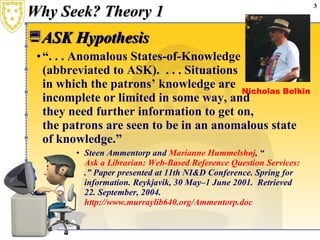
Why Seek? Theory 1 ASK Hypothesis “ . . .  Anomalous States-of-Knowledge  (abbreviated to ASK).   . . .  Situations  in which the patrons’ knowledge are  incomplete or limited in some way, and  they need further information to get on,  the patrons are seen to be in an anomalous state of knowledge.” Steen Ammentorp and  Marianne Hummelshøj , “ Ask a Librarian: Web-Based Reference Question Services: A Model for Development .” Paper presented at 11th NI&D Conference. Spring for information. Reykjavik, 30 May–1 June 2001.  Retrieved  22. September, 2004.  http://www.murraylib640.org/Ammentorp.doc   Nicholas Belkin
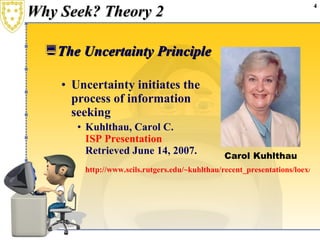
Why Seek? Theory 2 The Uncertainty Principle Uncertainty initiates the  process of information  seeking  Kuhlthau, Carol C.  ISP Presentation  Retrieved June 14, 2007.    http://www.scils.rutgers.edu/~kuhlthau/recent_presentations/loex/loex_presentation.ppt Carol Kuhlthau
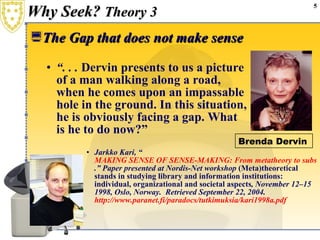
Why Seek?  Theory 3 The Gap that does not make sense “ . . .  Dervin presents to us a picture  of a man walking along a road,  when he comes upon an impassable  hole in the ground. In this situation,  he is obviously facing a gap. What  is he to do now?” Jarkko Kari, “ MAKING SENSE OF SENSE-MAKING: From metatheory to substantive theory in the context of paranormal information seeking .” Paper presented at Nordis-Net workshop  (Meta)theoretical stands in studying library and information institutions: individual, organizational and societal aspects , November 12–15 1998, Oslo, Norway.  Retrieved September 22, 2004.  http://www.paranet.fi/paradocs/tutkimuksia/kari1998a.pdf Brenda Dervin
Who Seeks? Theory 1 Anomalous State of Knowledge  (ASK) hypothesis:   “ . . .  patrons in problematic situations.” Steen Ammentorp and  Marianne Hummelshøj , “ Ask a Librarian: Web-Based Reference Question Services: A Model for Development .” Marianne Hummelshøj Holm   Steen Ammentorp
Who Seeks? Theory 2 Kulthau’s Information Search Process: People experience the ISP [Information Search Process] holistically with an interplay of thoughts, feelings, and actions.  Kuhlthau, Carol C.  “ An Overview of the Information Search Proces s .”  Retrieved June 14, 2007.  http://www.scils.rutgers.edu/~kuhlthau/information_search_process.htm Carol Kuhlthau
Who Seeks? Theory 3 Sense-Making Hypothesis: “ . . .  [a] patron [who] is seen as being locked in a situation unable to move further because of some kind of gap in his knowledge.”   Steen Ammentorp and  Marianne Hummelshøj , “ Ask a Librarian: Web-Based Reference Question Services: A Model for Development .” Brenda Dervin
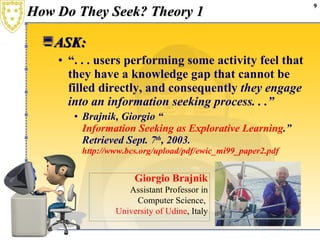
How Do They Seek? Theory 1 ASK: “ . . . users performing some activity   feel that they have a knowledge gap that cannot be filled directly, and consequently  they engage into an information seeking process. . .” Brajnik, Giorgio “ Information Seeking as Explorative Learning .” Retrieved Sept. 7 th , 2003.  http://www.bcs.org/upload/pdf/ewic_mi99_paper2.pdf Giorgio Brajnik Assistant Professor in Computer Science,  University of Udine , Italy
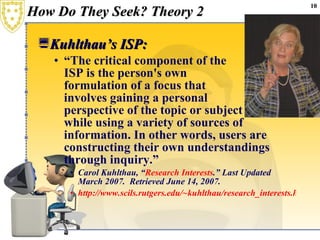
How Do They Seek? Theory 2 Kuhlthau’s ISP: “ The critical component of the  ISP is the person's own  formulation of a focus that  involves gaining a personal  perspective of the topic or subject  while using a variety of sources of information. In other words, users are constructing their own understandings through inquiry.” Carol Kuhlthau, “ Research Interests .” Last Updated March 2007.  Retrieved June 14, 2007. http://www.scils.rutgers.edu/~kuhlthau/research_interests.htm
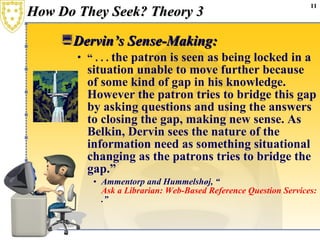
How Do They Seek? Theory 3 Dervin’s Sense-Making: “  . . .  the patron is seen as being locked in a situation unable to move further because of some kind of gap in his knowledge. However the patron tries to bridge this gap by asking questions and using the answers to closing the gap, making new sense. As Belkin, Dervin sees the nature of the information need as something situational changing as the patrons tries to bridge the gap.” Ammentorp and Hummelshøj, “ Ask a Librarian: Web-Based Reference Question Services: A Model for Development .”
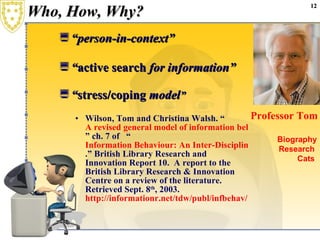
Who, How, Why? “ person-in-context” “ active search  for information” “ stress/coping  model ” Wilson, Tom and Christina Walsh. “ A revised general model of information behaviour ” ch. 7 of  “ Information Behaviour: An Inter-Disciplinary Perspective .” British Library Research and Innovation Report 10.  A report to the British Library Research & Innovation Centre on a review of the literature. Retrieved Sept. 8 th , 2003. http://informationr.net/tdw/publ/infbehav/ Professor Tom Wilson Biography Research   Cats
Another Why to Consider Self-Generated or Imposed? internally motivated by personal context  OR thought up by one person then given to someone else to resolve  Gross, Melissa.  “ Imposed information seeking in public libraries and school library media centers: a common behaviour? ”  Information Research  6.2 (January 2001).  Retrieved Sept. 8 th , 20003. http://informationr.net/ir/6-2/paper100.html
Process of Searching Kulthau’s ISP: Carol C. Kuhlthau ,  Jannica Heinström  and  Ross J. Todd ,  “The ‘information search process’ revisited: is the model still useful? ”  Information Research  VOL. 13 NO. 4, DECEMBER, 2008.
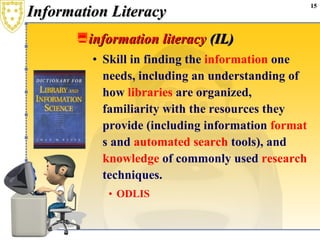
Information Literacy information literacy  (IL)  Skill in finding the  information  one needs, including an understanding of how  libraries  are organized, familiarity with the resources they provide (including information  format s and  automated   search  tools), and  knowledge  of commonly used  research  techniques.  ODLIS
What  is  Information Literacy?  And why should I care?   Information literacy skills are skills you will need through your life. We are always seeking information.  . . . Information helps us reach conclusions, make our choices, and communicate more effectively. But the good stuff is often buried in heaps of junk. We need to continue to improve our searching, evaluating and communication skills in a changing information environment.  Remember computer literacy is not information literacy. For a comparison, read this  article .  http://www.sdst.org/shs/library/infolit.html
Why teach information literacy?  The information explosion has provided  countless opportunities for students and  has dramatically altered the knowledge and abilities they will need to live productively in the twenty-first century.  Students must become skillful consumers and producers of information in a range of sources and formats to thrive personally and economically in the communication age.  American Association of School Librarians and Association for Educational Communications and Technology.  Information Power: Building Partnerships for Learning .  Chicago: American Library Association, 1998.
What is information literacy?  If you are information literate, you are able to  know when you have a  need for information  find the information you need  evaluate the information you find and use it effectively to meet your  needs INTRODUCTION TO INFORMATION  LITERACY:  THE PROCESS http://www.greece.k12.ny.us/ody/library/information%20literacy.htm
Another concept What is Information Competence? information competence, at heart, is the ability to find, evaluate, use, and communicate information in all of its various formats. the fusing or the integration of library literacy, computer literacy, media literacy, technological literacy, ethics, critical thinking, and communication skills.  http://hcom.csumb.edu/infocomp/aboutic /
Literacy, Competence or Competency? Information literacy  also known as  information competence  or  information competency  is a set of skills that helps students sift through the mass of information now available to them in order to locate and retrieve what is relevant and reliable for their research needs.  Simply put, an information literate student understands how to  find ,  retrieve ,  analyze , and  use  information effectively. [1]  Teaching Information Literacy at Pasadena City College
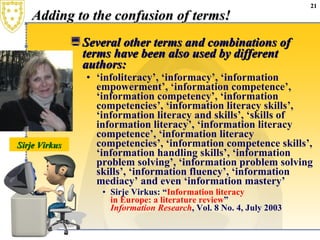
Adding to the confusion of terms! Several other terms and combinations of terms have been also used by different authors:  ‘ infoliteracy’, ‘informacy’, ‘information empowerment’, ‘information competence’, ‘information competency’, ‘information competencies’, ‘information literacy skills’, ‘information literacy and skills’, ‘skills of information literacy’, ‘information literacy competence’, ‘information literacy competencies’, ‘information competence skills’, ‘information handling skills’, ‘information problem solving’, ‘information problem solving skills’, ‘information fluency’, ‘information mediacy’ and even ‘information mastery’  Sirje Virkus: “ Information  literacy  in Europe: a literature review ”  Information Research , Vol. 8 No. 4, July 2003 Sirje Virkus
Now also as Information Literac ies Why the plural? The use of the term  “information literacies”  emphasizes the complexity and multiplicity of skills and strategies involved in finding and using information. Dianne Oberg : “ Promoting Information Literacies: A Focus on Inquiry .” 70th IFLA General Conference and Council, 22-27 August 2004, Buenos Aires, Argentina http://www.ifla.org/IV/ifla70/papers/088e-Oberg.pdf Dr. Dianne Oberg
A related term often used outside library media circles What is inquiry-based learning? An old adage states: “Tell me and I forget, show me and I remember, involve me and I understand.” . . . Inquiry implies involvement that leads to understanding. Furthermore, involvement in learning implies possessing skills and attitudes that permit you to seek resolutions to questions and issues while you construct new knowledge. Inquiry-based learning
Project, Problem, and Inquiry-based Learning  Explore the Approaches  Project-based learning, problem-based learning, and inquiry-based learning all three closely relate to the information processing approach. They all fit well with technology-rich learning environments where the focus is not on the hardware and software, but on the learning experience.  Project, Problem, and Inquiry-based Learning   http://eduscapes.com/tap/topic43.htm
Another Related Term Resource-Based Learning   Resource-based learning actively involves students, teachers and teacher-librarians in the effective use of a wide range of print, non print and human resources . . . Students who use a wide range of resources in various mediums for learning have the opportunity to approach a theme, issue or topic of study in ways which allow for a range of learning styles and access to the theme or topic via cognitive or affective appeals.  More Resource-Based Learning: Approaches
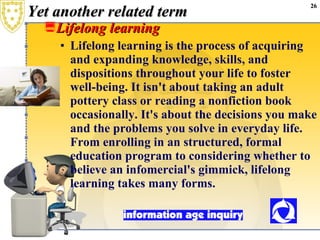
Yet another related term Lifelong learning Lifelong learning is the process of acquiring and expanding knowledge, skills, and dispositions throughout your life to foster well-being. It isn't about taking an adult pottery class or reading a nonfiction book occasionally. It's about the decisions you make and the problems you solve in everyday life. From enrolling in an structured, formal education program to considering whether to believe an infomercial's gimmick, lifelong learning takes many forms.
And another! 21 st  Century Skills
AKA 21st Century Literacies 21st Century Literacies refer to the skills needed to flourish in today's society and in the future. Today discrete disciplines have emerged around  information ,  media ,  multicultural , and  visual  literacies. It is the combination of literacies that can better help K-12 students and adult learners address and solve the issues that confront them.    http://www.kn.sbc.com/wired/21stcent/index.html
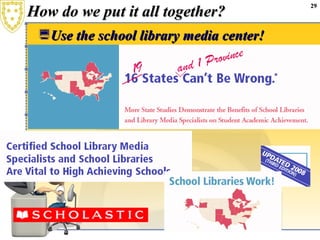
How do we put it all together? Use the school library media center!
After all, why are we doing this? Dr. Ross Todd, Rutgers University: The destination is not an information literature student, but rather, the development of a knowledgeable and knowing person, one who is able to engage effectively with a rich and complex information world, and who is able to develop new understandings, insights and ideas. School Libraries as Knowledge Spaces: Connections and Actions; Outcomes and Evidence     Powerpoint presentation for SLAV conference, Victoria, Australia The School Library Association of Victoria
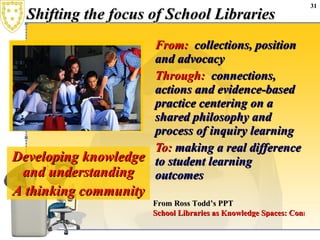
Shifting the focus of School Libraries From:   collections, position and advocacy Through:   connections, actions and evidence-based practice centering on a shared philosophy and process of inquiry learning To:  making a real difference to student learning outcomes Developing knowledge and understanding A thinking community From Ross Todd’s PPT  School Libraries as Knowledge Spaces: Connections and Actions; Outcomes and Evidence
The Library as a  Knowledge Space , not an Information Place Ross Todd
Evidence for the benefits Student Learning through Ohio School Libraries (2004) Students appear to indicate that the school library – not as a passive supply agency, but as an instructional agency – helps them substantially in their learning. What is clearly perceived to be of help is the  library ’ s part in engaging students in an active process of building their own understanding and knowledge  –  the library as an agency for active learning. Review of the Findings   Powerpoint  presentation. Researchers:  Dr. Ross Todd  and  Dr. Carol Kuhlthau , Rutgers
Keith Curry Lance What Research Tells Us About the Importance of School Libraries At this point . . . there is a clear consensus in the results now [2002] available for eight states*: School libraries are a powerful force in the lives of America's children. The school library is one of the few factors whose contribution to academic achievement has been documented empirically, and it is a contribution that cannot be explained away by other powerful influences on student performance.   White House Conference on School Libraries  *Now 19 states and 1 Canadian province—see
A European view School Library and School Librarianship The stream of information from TV channels, Internet, CD-ROMs, computer programmes etc. is unending. If the students, when they become adult citizens, are not to feel lost and helpless in the face of such rich sources of information, they must learn [to] devise personal strategies for information retrieval while they are still at school. Information Literacy and “strategies for independent learning skill development” are key components of any school library. From a  White Paper  by Gert Larsen, School Library Advisor, Albertslund, Denmark, p. 7 Part of Project  GrandSlam - General Research and New Development in School Libraries As Multimedia Learning Centres  (see project website  http://www.gslam.net  ) A previous project in the same series
Competence and  comfort with information and information sources Information literacy is the solution to  Data Smog . It allows us to cope by giving us the skills to know when we need information and where to locate it effectively and efficiently. It includes the technological skills needed to use the modern library as a gateway to information. It enables us to analyze and evaluate the information we find, thus giving us confidence in using that information to make a decision or create a product.  Introduction to Information Literacy , Association for College and Research Libraries (a division of the American Library Association) The Key Concept?

Information Seeking Information Literacy

  • 1.
    Information Seeking InformationLiteracy: WHAT IS ALL THIS? Finding a way through the word maze LIB 640 Information Sources and Services Summer 2009
  • 2.
    What Is InformationSeeking? In the simplest terms, information seeking involves the search, retrieval, recognition, and application of meaningful content. This search may be explicit or implicit, the retrieval may be the result of specific strategies or serendipity, the resulting information may be embraced or rejected, the entire experience may be carried through to a logical conclusion or aborted in midstream, and there may be a million other potential results. Kelly Patricia Kingrey , Concepts of Information Seeking and Their Presence in the Practical Library Literature . Library Philosophy and Practice Vol. 4, No. 2 (Spring 2002) What is information seeking?
  • 3.
    Why Seek? Theory1 ASK Hypothesis “ . . . Anomalous States-of-Knowledge (abbreviated to ASK). . . . Situations in which the patrons’ knowledge are incomplete or limited in some way, and they need further information to get on, the patrons are seen to be in an anomalous state of knowledge.” Steen Ammentorp and Marianne Hummelshøj , “ Ask a Librarian: Web-Based Reference Question Services: A Model for Development .” Paper presented at 11th NI&D Conference. Spring for information. Reykjavik, 30 May–1 June 2001. Retrieved 22. September, 2004. http://www.murraylib640.org/Ammentorp.doc Nicholas Belkin
  • 4.
    Why Seek? Theory2 The Uncertainty Principle Uncertainty initiates the process of information seeking Kuhlthau, Carol C. ISP Presentation Retrieved June 14, 2007. http://www.scils.rutgers.edu/~kuhlthau/recent_presentations/loex/loex_presentation.ppt Carol Kuhlthau
  • 5.
    Why Seek? Theory 3 The Gap that does not make sense “ . . . Dervin presents to us a picture of a man walking along a road, when he comes upon an impassable hole in the ground. In this situation, he is obviously facing a gap. What is he to do now?” Jarkko Kari, “ MAKING SENSE OF SENSE-MAKING: From metatheory to substantive theory in the context of paranormal information seeking .” Paper presented at Nordis-Net workshop (Meta)theoretical stands in studying library and information institutions: individual, organizational and societal aspects , November 12–15 1998, Oslo, Norway. Retrieved September 22, 2004. http://www.paranet.fi/paradocs/tutkimuksia/kari1998a.pdf Brenda Dervin
  • 6.
    Who Seeks? Theory1 Anomalous State of Knowledge (ASK) hypothesis: “ . . . patrons in problematic situations.” Steen Ammentorp and Marianne Hummelshøj , “ Ask a Librarian: Web-Based Reference Question Services: A Model for Development .” Marianne Hummelshøj Holm Steen Ammentorp
  • 7.
    Who Seeks? Theory2 Kulthau’s Information Search Process: People experience the ISP [Information Search Process] holistically with an interplay of thoughts, feelings, and actions. Kuhlthau, Carol C. “ An Overview of the Information Search Proces s .” Retrieved June 14, 2007. http://www.scils.rutgers.edu/~kuhlthau/information_search_process.htm Carol Kuhlthau
  • 8.
    Who Seeks? Theory3 Sense-Making Hypothesis: “ . . . [a] patron [who] is seen as being locked in a situation unable to move further because of some kind of gap in his knowledge.” Steen Ammentorp and Marianne Hummelshøj , “ Ask a Librarian: Web-Based Reference Question Services: A Model for Development .” Brenda Dervin
  • 9.
    How Do TheySeek? Theory 1 ASK: “ . . . users performing some activity feel that they have a knowledge gap that cannot be filled directly, and consequently they engage into an information seeking process. . .” Brajnik, Giorgio “ Information Seeking as Explorative Learning .” Retrieved Sept. 7 th , 2003. http://www.bcs.org/upload/pdf/ewic_mi99_paper2.pdf Giorgio Brajnik Assistant Professor in Computer Science, University of Udine , Italy
  • 10.
    How Do TheySeek? Theory 2 Kuhlthau’s ISP: “ The critical component of the ISP is the person's own formulation of a focus that involves gaining a personal perspective of the topic or subject while using a variety of sources of information. In other words, users are constructing their own understandings through inquiry.” Carol Kuhlthau, “ Research Interests .” Last Updated March 2007. Retrieved June 14, 2007. http://www.scils.rutgers.edu/~kuhlthau/research_interests.htm
  • 11.
    How Do TheySeek? Theory 3 Dervin’s Sense-Making: “ . . . the patron is seen as being locked in a situation unable to move further because of some kind of gap in his knowledge. However the patron tries to bridge this gap by asking questions and using the answers to closing the gap, making new sense. As Belkin, Dervin sees the nature of the information need as something situational changing as the patrons tries to bridge the gap.” Ammentorp and Hummelshøj, “ Ask a Librarian: Web-Based Reference Question Services: A Model for Development .”
  • 12.
    Who, How, Why?“ person-in-context” “ active search for information” “ stress/coping model ” Wilson, Tom and Christina Walsh. “ A revised general model of information behaviour ” ch. 7 of “ Information Behaviour: An Inter-Disciplinary Perspective .” British Library Research and Innovation Report 10. A report to the British Library Research & Innovation Centre on a review of the literature. Retrieved Sept. 8 th , 2003. http://informationr.net/tdw/publ/infbehav/ Professor Tom Wilson Biography Research Cats
  • 13.
    Another Why toConsider Self-Generated or Imposed? internally motivated by personal context OR thought up by one person then given to someone else to resolve Gross, Melissa. “ Imposed information seeking in public libraries and school library media centers: a common behaviour? ” Information Research 6.2 (January 2001). Retrieved Sept. 8 th , 20003. http://informationr.net/ir/6-2/paper100.html
  • 14.
    Process of SearchingKulthau’s ISP: Carol C. Kuhlthau , Jannica Heinström and Ross J. Todd , “The ‘information search process’ revisited: is the model still useful? ” Information Research VOL. 13 NO. 4, DECEMBER, 2008.
  • 15.
    Information Literacy informationliteracy (IL) Skill in finding the information one needs, including an understanding of how libraries are organized, familiarity with the resources they provide (including information format s and automated search tools), and knowledge of commonly used research techniques. ODLIS
  • 16.
    What is Information Literacy? And why should I care? Information literacy skills are skills you will need through your life. We are always seeking information. . . . Information helps us reach conclusions, make our choices, and communicate more effectively. But the good stuff is often buried in heaps of junk. We need to continue to improve our searching, evaluating and communication skills in a changing information environment. Remember computer literacy is not information literacy. For a comparison, read this article . http://www.sdst.org/shs/library/infolit.html
  • 17.
    Why teach informationliteracy? The information explosion has provided countless opportunities for students and has dramatically altered the knowledge and abilities they will need to live productively in the twenty-first century. Students must become skillful consumers and producers of information in a range of sources and formats to thrive personally and economically in the communication age. American Association of School Librarians and Association for Educational Communications and Technology. Information Power: Building Partnerships for Learning . Chicago: American Library Association, 1998.
  • 18.
    What is informationliteracy? If you are information literate, you are able to know when you have a need for information find the information you need evaluate the information you find and use it effectively to meet your needs INTRODUCTION TO INFORMATION LITERACY: THE PROCESS http://www.greece.k12.ny.us/ody/library/information%20literacy.htm
  • 19.
    Another concept Whatis Information Competence? information competence, at heart, is the ability to find, evaluate, use, and communicate information in all of its various formats. the fusing or the integration of library literacy, computer literacy, media literacy, technological literacy, ethics, critical thinking, and communication skills. http://hcom.csumb.edu/infocomp/aboutic /
  • 20.
    Literacy, Competence orCompetency? Information literacy also known as information competence or information competency is a set of skills that helps students sift through the mass of information now available to them in order to locate and retrieve what is relevant and reliable for their research needs. Simply put, an information literate student understands how to find , retrieve , analyze , and use information effectively. [1] Teaching Information Literacy at Pasadena City College
  • 21.
    Adding to theconfusion of terms! Several other terms and combinations of terms have been also used by different authors: ‘ infoliteracy’, ‘informacy’, ‘information empowerment’, ‘information competence’, ‘information competency’, ‘information competencies’, ‘information literacy skills’, ‘information literacy and skills’, ‘skills of information literacy’, ‘information literacy competence’, ‘information literacy competencies’, ‘information competence skills’, ‘information handling skills’, ‘information problem solving’, ‘information problem solving skills’, ‘information fluency’, ‘information mediacy’ and even ‘information mastery’ Sirje Virkus: “ Information literacy in Europe: a literature review ” Information Research , Vol. 8 No. 4, July 2003 Sirje Virkus
  • 22.
    Now also asInformation Literac ies Why the plural? The use of the term “information literacies” emphasizes the complexity and multiplicity of skills and strategies involved in finding and using information. Dianne Oberg : “ Promoting Information Literacies: A Focus on Inquiry .” 70th IFLA General Conference and Council, 22-27 August 2004, Buenos Aires, Argentina http://www.ifla.org/IV/ifla70/papers/088e-Oberg.pdf Dr. Dianne Oberg
  • 23.
    A related termoften used outside library media circles What is inquiry-based learning? An old adage states: “Tell me and I forget, show me and I remember, involve me and I understand.” . . . Inquiry implies involvement that leads to understanding. Furthermore, involvement in learning implies possessing skills and attitudes that permit you to seek resolutions to questions and issues while you construct new knowledge. Inquiry-based learning
  • 24.
    Project, Problem, andInquiry-based Learning Explore the Approaches Project-based learning, problem-based learning, and inquiry-based learning all three closely relate to the information processing approach. They all fit well with technology-rich learning environments where the focus is not on the hardware and software, but on the learning experience. Project, Problem, and Inquiry-based Learning http://eduscapes.com/tap/topic43.htm
  • 25.
    Another Related TermResource-Based Learning Resource-based learning actively involves students, teachers and teacher-librarians in the effective use of a wide range of print, non print and human resources . . . Students who use a wide range of resources in various mediums for learning have the opportunity to approach a theme, issue or topic of study in ways which allow for a range of learning styles and access to the theme or topic via cognitive or affective appeals. More Resource-Based Learning: Approaches
  • 26.
    Yet another relatedterm Lifelong learning Lifelong learning is the process of acquiring and expanding knowledge, skills, and dispositions throughout your life to foster well-being. It isn't about taking an adult pottery class or reading a nonfiction book occasionally. It's about the decisions you make and the problems you solve in everyday life. From enrolling in an structured, formal education program to considering whether to believe an infomercial's gimmick, lifelong learning takes many forms.
  • 27.
    And another! 21st Century Skills
  • 28.
    AKA 21st CenturyLiteracies 21st Century Literacies refer to the skills needed to flourish in today's society and in the future. Today discrete disciplines have emerged around information , media , multicultural , and visual literacies. It is the combination of literacies that can better help K-12 students and adult learners address and solve the issues that confront them. http://www.kn.sbc.com/wired/21stcent/index.html
  • 29.
    How do weput it all together? Use the school library media center!
  • 30.
    After all, whyare we doing this? Dr. Ross Todd, Rutgers University: The destination is not an information literature student, but rather, the development of a knowledgeable and knowing person, one who is able to engage effectively with a rich and complex information world, and who is able to develop new understandings, insights and ideas. School Libraries as Knowledge Spaces: Connections and Actions; Outcomes and Evidence Powerpoint presentation for SLAV conference, Victoria, Australia The School Library Association of Victoria
  • 31.
    Shifting the focusof School Libraries From: collections, position and advocacy Through: connections, actions and evidence-based practice centering on a shared philosophy and process of inquiry learning To: making a real difference to student learning outcomes Developing knowledge and understanding A thinking community From Ross Todd’s PPT School Libraries as Knowledge Spaces: Connections and Actions; Outcomes and Evidence
  • 32.
    The Library asa Knowledge Space , not an Information Place Ross Todd
  • 33.
    Evidence for thebenefits Student Learning through Ohio School Libraries (2004) Students appear to indicate that the school library – not as a passive supply agency, but as an instructional agency – helps them substantially in their learning. What is clearly perceived to be of help is the library ’ s part in engaging students in an active process of building their own understanding and knowledge – the library as an agency for active learning. Review of the Findings Powerpoint presentation. Researchers: Dr. Ross Todd and Dr. Carol Kuhlthau , Rutgers
  • 34.
    Keith Curry LanceWhat Research Tells Us About the Importance of School Libraries At this point . . . there is a clear consensus in the results now [2002] available for eight states*: School libraries are a powerful force in the lives of America's children. The school library is one of the few factors whose contribution to academic achievement has been documented empirically, and it is a contribution that cannot be explained away by other powerful influences on student performance. White House Conference on School Libraries *Now 19 states and 1 Canadian province—see
  • 35.
    A European viewSchool Library and School Librarianship The stream of information from TV channels, Internet, CD-ROMs, computer programmes etc. is unending. If the students, when they become adult citizens, are not to feel lost and helpless in the face of such rich sources of information, they must learn [to] devise personal strategies for information retrieval while they are still at school. Information Literacy and “strategies for independent learning skill development” are key components of any school library. From a White Paper by Gert Larsen, School Library Advisor, Albertslund, Denmark, p. 7 Part of Project GrandSlam - General Research and New Development in School Libraries As Multimedia Learning Centres (see project website http://www.gslam.net ) A previous project in the same series
  • 36.
    Competence and comfort with information and information sources Information literacy is the solution to Data Smog . It allows us to cope by giving us the skills to know when we need information and where to locate it effectively and efficiently. It includes the technological skills needed to use the modern library as a gateway to information. It enables us to analyze and evaluate the information we find, thus giving us confidence in using that information to make a decision or create a product. Introduction to Information Literacy , Association for College and Research Libraries (a division of the American Library Association) The Key Concept?