Controlled Drugs
DARYA OSMAN HUSSEIN DAOUD
Objective
 Brief History of controlled drug use
 Define Controlled Drugs
 Different classifications of controlled drugs
 Prescribing of controlled drugs
 Procurement, Storing and Dispensing of controlled drugs
 Disposing of controlled drugs
History
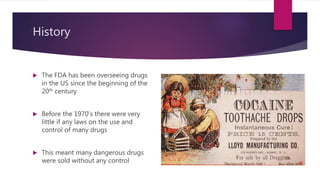
 The FDA has been overseeing drugs
in the US since the beginning of the
20th century
 Before the 1970’s there were very
little if any laws on the use and
control of many drugs
 This meant many dangerous drugs
were sold without any control
History Cont.
 During the 1970s recreational drug use
began becoming a huge problem in the
USA
 President Nixon recognized this as a
problem and encouraged his
administration to act on this issue
 In 1970 the FDA released the Controlled
Substance Act (CSA)
The CSA
 This act contains “schedules” which are
classifications of drugs based on risk of
abuse or harm
 It contains laws on the manufacture,
import, export, distribution and
possession of controlled substances
 It also contains the fines and prison
terms for violations of the laws
Controlled drugs
 “Controlled substance” is a legal term referring specifically to substances controlled
by federal or state laws.
 CSA Definition: The term "controlled substance" means a drug or other substance,
or immediate precursor, included in schedule I, II, III, IV, or V …… The term does not
include distilled spirits, wine, malt beverages, or tobacco,….”
 Substances are placed in their respective schedules based on:
 Whether they have a currently accepted medical use in treatment in the United States,
 Their relative abuse potential, and
 Likelihood of causing dependence when abused.
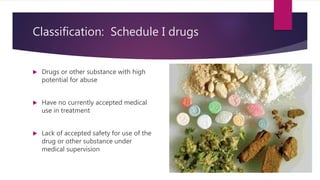
Classification: Schedule I drugs
 Drugs or other substance with high
potential for abuse
 Have no currently accepted medical
use in treatment
 Lack of accepted safety for use of the
drug or other substance under
medical supervision
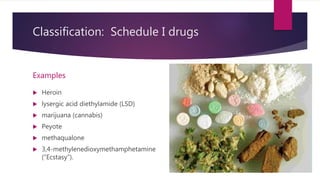
Classification: Schedule I drugs
Examples
 Heroin
 lysergic acid diethylamide (LSD)
 marijuana (cannabis)
 Peyote
 methaqualone
 3,4-methylenedioxymethamphetamine
(“Ecstasy”).
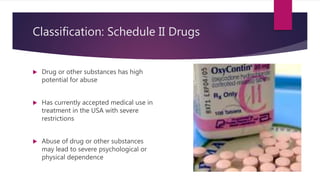
Classification: Schedule II Drugs
 Drug or other substances has high
potential for abuse
 Has currently accepted medical use in
treatment in the USA with severe
restrictions
 Abuse of drug or other substances
may lead to severe psychological or
physical dependence
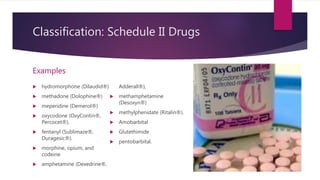
Classification: Schedule II Drugs
Examples
 hydromorphone (Dilaudid®)
 methadone (Dolophine®)
 meperidine (Demerol®)
 oxycodone (OxyContin®,
Percocet®),
 fentanyl (Sublimaze®,
Duragesic®).
 morphine, opium, and
codeine
 amphetamine (Dexedrine®,
Adderall®),
 methamphetamine
(Desoxyn®)
 methylphenidate (Ritalin®).
 Amobarbital
 Glutethimide
 pentobarbital.
Classification: Schedule III Drugs
 Drug or substance has a potential for abuse less
than those in schedule I and II
 Drug or substance has currently accepted
medical use in the USA
 Abuse of drug or substance may lead to
moderate or low physical dependence or high
psychological dependence
Classification: Schedule III Drugs
Examples
 combination products containing less than 15
milligrams of hydrocodone per dosage unit (Vicodin®)
 products containing not more than 90 milligrams of
codeine per dosage unit (Tylenol with Codeine®)
 buprenorphine (Suboxone®).
 benzphetamine (Didrex®)
 phendimetrazine
 anabolicsteroids such as Depo®-Testosterone.
Classification: Schedule IV Drugs
 Drug or other substance has a low potential
for abuse relative to those in schedule III
 Drug or substance has currently accepted
medical use in treatment in the USA
 Abuse of may lead to limited physical
dependence or psychological dependence
relative to schedule III drug
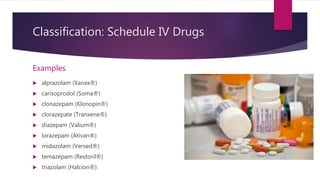
Classification: Schedule IV Drugs
Examples
 alprazolam (Xanax®)
 carisoprodol (Soma®)
 clonazepam (Klonopin®)
 clorazepate (Tranxene®)
 diazepam (Valium®)
 lorazepam (Ativan®)
 midazolam (Versed®)
 temazepam (Restoril®)
 triazolam (Halcion®).
Classification: Schedule V Drugs
 Drug or other substance has a low potential for abuse
relative to schedule IV substances
 Drug or substance has currently accepted medical use
 Abuse of drug or substance may lead to limited physical
dependence or psychological dependence relative to
schedule IV drugs
 Includes primarily preparations containing limited quantities
of certain narcotics
Classification: Schedule V Drugs
Examples
 cough preparations containing not more than 200
milligrams of codeine per 100 milliliters or per 100 grams
(Robitussin AC®, Phenergan with Codeine®), and
ezogabine.
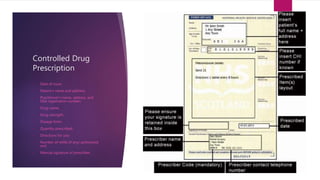
Controlled Drug
Prescription
• Date of issue;
• Patient's name and address;
• Practitioner's name, address, and
DEA registration number;
• Drug name;
• Drug strength;
• Dosage form;
• Quantity prescribed;
• Directions for use;
• Number of refills (if any) authorized;
and
• Manual signature of prescriber.
Prescribing: Schedule I
 No prescriptions allowed
 They are also subject to production quotas which
the DEA imposes
 It is illegal (a class 1 felony) even to conduct
otherwise legitimate scientific research of any
kind of schedule I substance
Prescribing: Schedule II
 Must have a written (can also be
faxed) prescription from a practitioner
 There is no refilling of prescription
but can write max. of 3 prescription
when refill is required
Prescribing: Schedule III
 Requires a written or oral prescription
 Can not be filled or refilled more than
6 months after date
 Max. number of refills is 5 in 6 month
period
Prescribing: Schedule IV
 Similar to schedule III
 May be refilled up to 5 times within a
six-month period
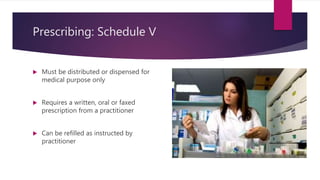
Prescribing: Schedule V
 Must be distributed or dispensed for
medical purpose only
 Requires a written, oral or faxed
prescription from a practitioner
 Can be refilled as instructed by
practitioner
Procurement of Controlled Drugs
 Must have a DEA license
 Must use special DEA order form (for
schedule I and II)
 Must be shipped to address on
licence and once received become the
responsibility of the licence holder
 Shipments must be insured against
theft and damage
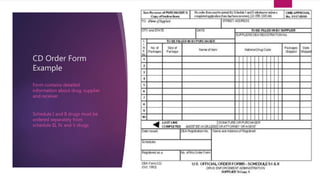
CD Order Form
Example
Form contains detailed
information about drug, supplier
and receiver
Schedule I and II drugs must be
ordered separately from
schedule III, IV and V drugs
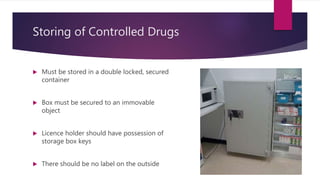
Storing of Controlled Drugs
 Must be stored in a double locked, secured
container
 Box must be secured to an immovable
object
 Licence holder should have possession of
storage box keys
 There should be no label on the outside
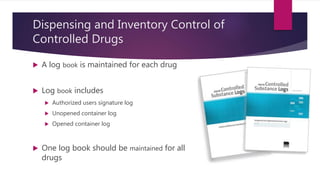
Dispensing and Inventory Control of
Controlled Drugs
 A log book is maintained for each drug
 Log book includes
 Authorized users signature log
 Unopened container log
 Opened container log
 One log book should be maintained for all
drugs
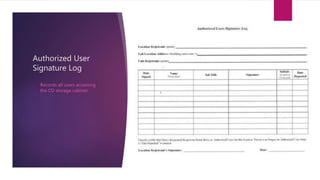
Authorized User
Signature Log
• Records all users accessing
the CD storage cabinet
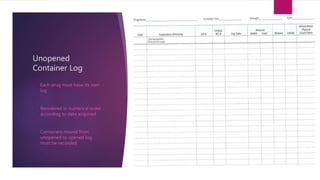
Unopened
Container Log
• Each drug must have its own
log
• Reordered in numerical order
according to date acquired
• Containers moved from
unopened to opened log
must be recorded
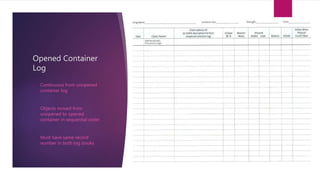
Opened Container
Log
• Continuous from unopened
container log
• Objects moved from
unopened to opened
container in sequential order
• Must have same record
number in both log books
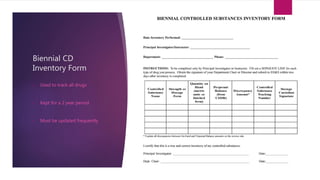
Biennial CD
Inventory Form
• Used to track all drugs
• Kept for a 2 year period
• Must be updated frequently
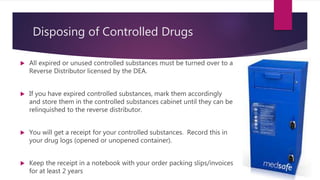
Disposing of Controlled Drugs
 All expired or unused controlled substances must be turned over to a
Reverse Distributor licensed by the DEA.
 If you have expired controlled substances, mark them accordingly
and store them in the controlled substances cabinet until they can be
relinquished to the reverse distributor.
 You will get a receipt for your controlled substances. Record this in
your drug logs (opened or unopened container).
 Keep the receipt in a notebook with your order packing slips/invoices
for at least 2 years
Questions?
Thank you!

Controlled drugs

  • 1.
  • 2.
    Objective  Brief Historyof controlled drug use  Define Controlled Drugs  Different classifications of controlled drugs  Prescribing of controlled drugs  Procurement, Storing and Dispensing of controlled drugs  Disposing of controlled drugs
  • 3.
    History  The FDAhas been overseeing drugs in the US since the beginning of the 20th century  Before the 1970’s there were very little if any laws on the use and control of many drugs  This meant many dangerous drugs were sold without any control
  • 4.
    History Cont.  Duringthe 1970s recreational drug use began becoming a huge problem in the USA  President Nixon recognized this as a problem and encouraged his administration to act on this issue  In 1970 the FDA released the Controlled Substance Act (CSA)
  • 5.
    The CSA  Thisact contains “schedules” which are classifications of drugs based on risk of abuse or harm  It contains laws on the manufacture, import, export, distribution and possession of controlled substances  It also contains the fines and prison terms for violations of the laws
  • 6.
    Controlled drugs  “Controlledsubstance” is a legal term referring specifically to substances controlled by federal or state laws.  CSA Definition: The term "controlled substance" means a drug or other substance, or immediate precursor, included in schedule I, II, III, IV, or V …… The term does not include distilled spirits, wine, malt beverages, or tobacco,….”  Substances are placed in their respective schedules based on:  Whether they have a currently accepted medical use in treatment in the United States,  Their relative abuse potential, and  Likelihood of causing dependence when abused.
  • 7.
    Classification: Schedule Idrugs  Drugs or other substance with high potential for abuse  Have no currently accepted medical use in treatment  Lack of accepted safety for use of the drug or other substance under medical supervision
  • 8.
    Classification: Schedule Idrugs Examples  Heroin  lysergic acid diethylamide (LSD)  marijuana (cannabis)  Peyote  methaqualone  3,4-methylenedioxymethamphetamine (“Ecstasy”).
  • 9.
    Classification: Schedule IIDrugs  Drug or other substances has high potential for abuse  Has currently accepted medical use in treatment in the USA with severe restrictions  Abuse of drug or other substances may lead to severe psychological or physical dependence
  • 10.
    Classification: Schedule IIDrugs Examples  hydromorphone (Dilaudid®)  methadone (Dolophine®)  meperidine (Demerol®)  oxycodone (OxyContin®, Percocet®),  fentanyl (Sublimaze®, Duragesic®).  morphine, opium, and codeine  amphetamine (Dexedrine®, Adderall®),  methamphetamine (Desoxyn®)  methylphenidate (Ritalin®).  Amobarbital  Glutethimide  pentobarbital.
  • 11.
    Classification: Schedule IIIDrugs  Drug or substance has a potential for abuse less than those in schedule I and II  Drug or substance has currently accepted medical use in the USA  Abuse of drug or substance may lead to moderate or low physical dependence or high psychological dependence
  • 12.
    Classification: Schedule IIIDrugs Examples  combination products containing less than 15 milligrams of hydrocodone per dosage unit (Vicodin®)  products containing not more than 90 milligrams of codeine per dosage unit (Tylenol with Codeine®)  buprenorphine (Suboxone®).  benzphetamine (Didrex®)  phendimetrazine  anabolicsteroids such as Depo®-Testosterone.
  • 13.
    Classification: Schedule IVDrugs  Drug or other substance has a low potential for abuse relative to those in schedule III  Drug or substance has currently accepted medical use in treatment in the USA  Abuse of may lead to limited physical dependence or psychological dependence relative to schedule III drug
  • 14.
    Classification: Schedule IVDrugs Examples  alprazolam (Xanax®)  carisoprodol (Soma®)  clonazepam (Klonopin®)  clorazepate (Tranxene®)  diazepam (Valium®)  lorazepam (Ativan®)  midazolam (Versed®)  temazepam (Restoril®)  triazolam (Halcion®).
  • 15.
    Classification: Schedule VDrugs  Drug or other substance has a low potential for abuse relative to schedule IV substances  Drug or substance has currently accepted medical use  Abuse of drug or substance may lead to limited physical dependence or psychological dependence relative to schedule IV drugs  Includes primarily preparations containing limited quantities of certain narcotics
  • 16.
    Classification: Schedule VDrugs Examples  cough preparations containing not more than 200 milligrams of codeine per 100 milliliters or per 100 grams (Robitussin AC®, Phenergan with Codeine®), and ezogabine.
  • 17.
    Controlled Drug Prescription • Dateof issue; • Patient's name and address; • Practitioner's name, address, and DEA registration number; • Drug name; • Drug strength; • Dosage form; • Quantity prescribed; • Directions for use; • Number of refills (if any) authorized; and • Manual signature of prescriber.
  • 18.
    Prescribing: Schedule I No prescriptions allowed  They are also subject to production quotas which the DEA imposes  It is illegal (a class 1 felony) even to conduct otherwise legitimate scientific research of any kind of schedule I substance
  • 19.
    Prescribing: Schedule II Must have a written (can also be faxed) prescription from a practitioner  There is no refilling of prescription but can write max. of 3 prescription when refill is required
  • 20.
    Prescribing: Schedule III Requires a written or oral prescription  Can not be filled or refilled more than 6 months after date  Max. number of refills is 5 in 6 month period
  • 21.
    Prescribing: Schedule IV Similar to schedule III  May be refilled up to 5 times within a six-month period
  • 22.
    Prescribing: Schedule V Must be distributed or dispensed for medical purpose only  Requires a written, oral or faxed prescription from a practitioner  Can be refilled as instructed by practitioner
  • 23.
    Procurement of ControlledDrugs  Must have a DEA license  Must use special DEA order form (for schedule I and II)  Must be shipped to address on licence and once received become the responsibility of the licence holder  Shipments must be insured against theft and damage
  • 24.
    CD Order Form Example Formcontains detailed information about drug, supplier and receiver Schedule I and II drugs must be ordered separately from schedule III, IV and V drugs
  • 25.
    Storing of ControlledDrugs  Must be stored in a double locked, secured container  Box must be secured to an immovable object  Licence holder should have possession of storage box keys  There should be no label on the outside
  • 26.
    Dispensing and InventoryControl of Controlled Drugs  A log book is maintained for each drug  Log book includes  Authorized users signature log  Unopened container log  Opened container log  One log book should be maintained for all drugs
  • 27.
    Authorized User Signature Log •Records all users accessing the CD storage cabinet
  • 28.
    Unopened Container Log • Eachdrug must have its own log • Reordered in numerical order according to date acquired • Containers moved from unopened to opened log must be recorded
  • 29.
    Opened Container Log • Continuousfrom unopened container log • Objects moved from unopened to opened container in sequential order • Must have same record number in both log books
  • 30.
    Biennial CD Inventory Form •Used to track all drugs • Kept for a 2 year period • Must be updated frequently
  • 31.
    Disposing of ControlledDrugs  All expired or unused controlled substances must be turned over to a Reverse Distributor licensed by the DEA.  If you have expired controlled substances, mark them accordingly and store them in the controlled substances cabinet until they can be relinquished to the reverse distributor.  You will get a receipt for your controlled substances. Record this in your drug logs (opened or unopened container).  Keep the receipt in a notebook with your order packing slips/invoices for at least 2 years
  • 32.
  • 33.