Md. Imran Nur Manik
Lecturer
Department of Pharmacy, NUB
Phrm 1103:Pharmacognosy
• A carbohydrate is a naturally occurring compound, or a
derivative of such a compound, with the general chemical
formula Cx(H2O)y, made up of molecules of carbon (C),
hydrogen (H), and oxygen (O) in which the hydrogen and
oxygen are generally in the same ratio as in water.
• Carbohydrates are the most widespread organic
substances and play a vital role in all life.
• Chemically carbohydrates are aldehyde or ketone
alcohols which are either polyhydroxy aldehydes or
polyhydroxy ketons or compounds that can be
hydrolyzed to them.
• Example: Glucose, Fructose.
• Carbohydrates are called carbohydrates because they
are essentially hydrates of carbon (i.e. they are
composed of carbon and water and have a composition
of (CH2O)n.
M
d
.
I
m
r
a
n
N
u
r
M
a
n
i
k
Saccharide is derived from the Greek sakcharon,
meaning “sugar”.
Sugars are monosaccharides, i.e., compounds that
cannot be hydrolyzed to simpler sugars; e.g. D-glucose,
also called dextrose.
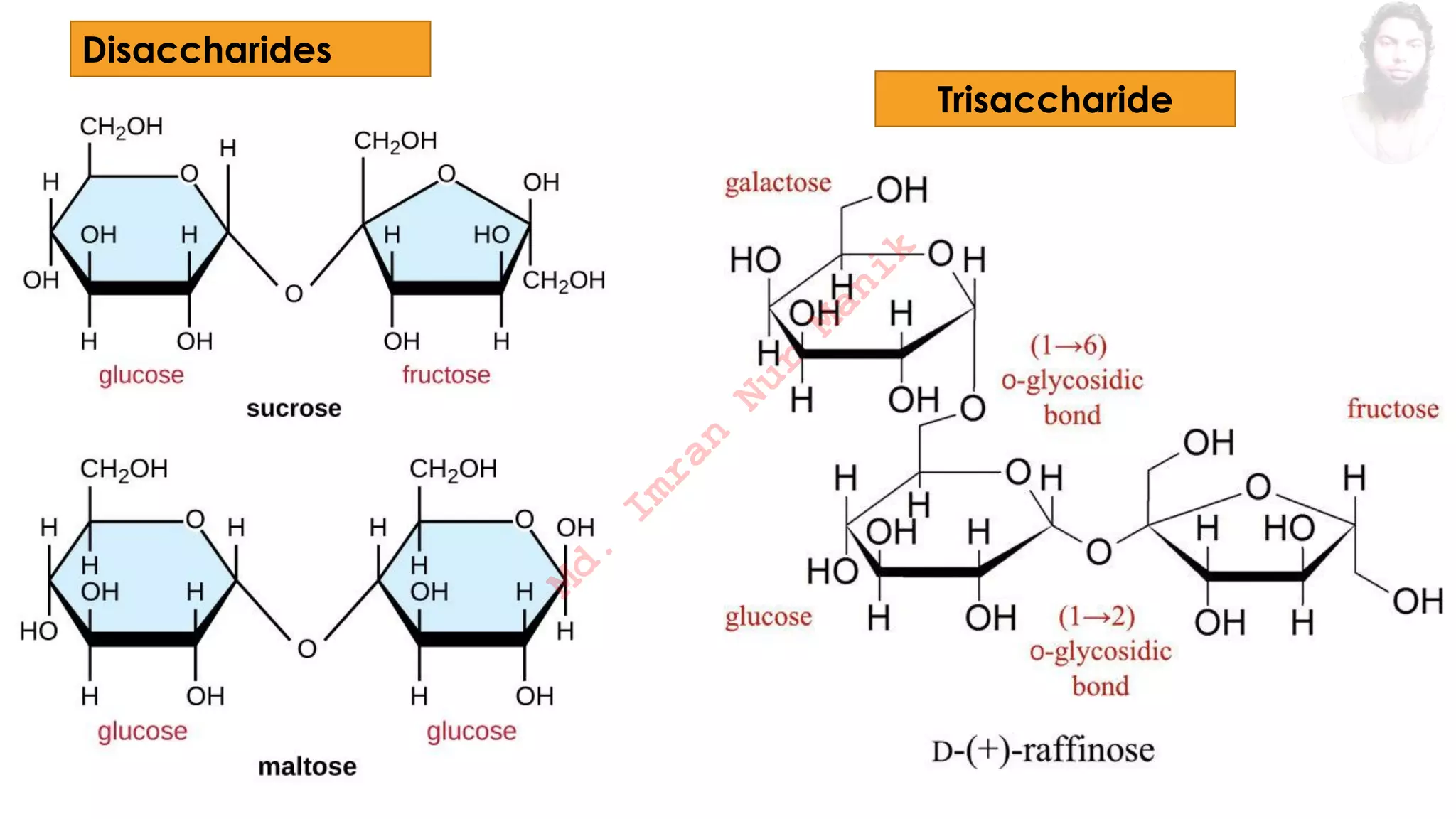
Disaccharides: Yields 2 monosaccharide molecules on
hydrolysis;(e.g. sucrose, which is hydrolyzed into glucose
and fructose) Trisaccharides yields 3 and
Tetrasaccharides yields 4 monosaccharide molecules on
hydrolysis; and so forth.
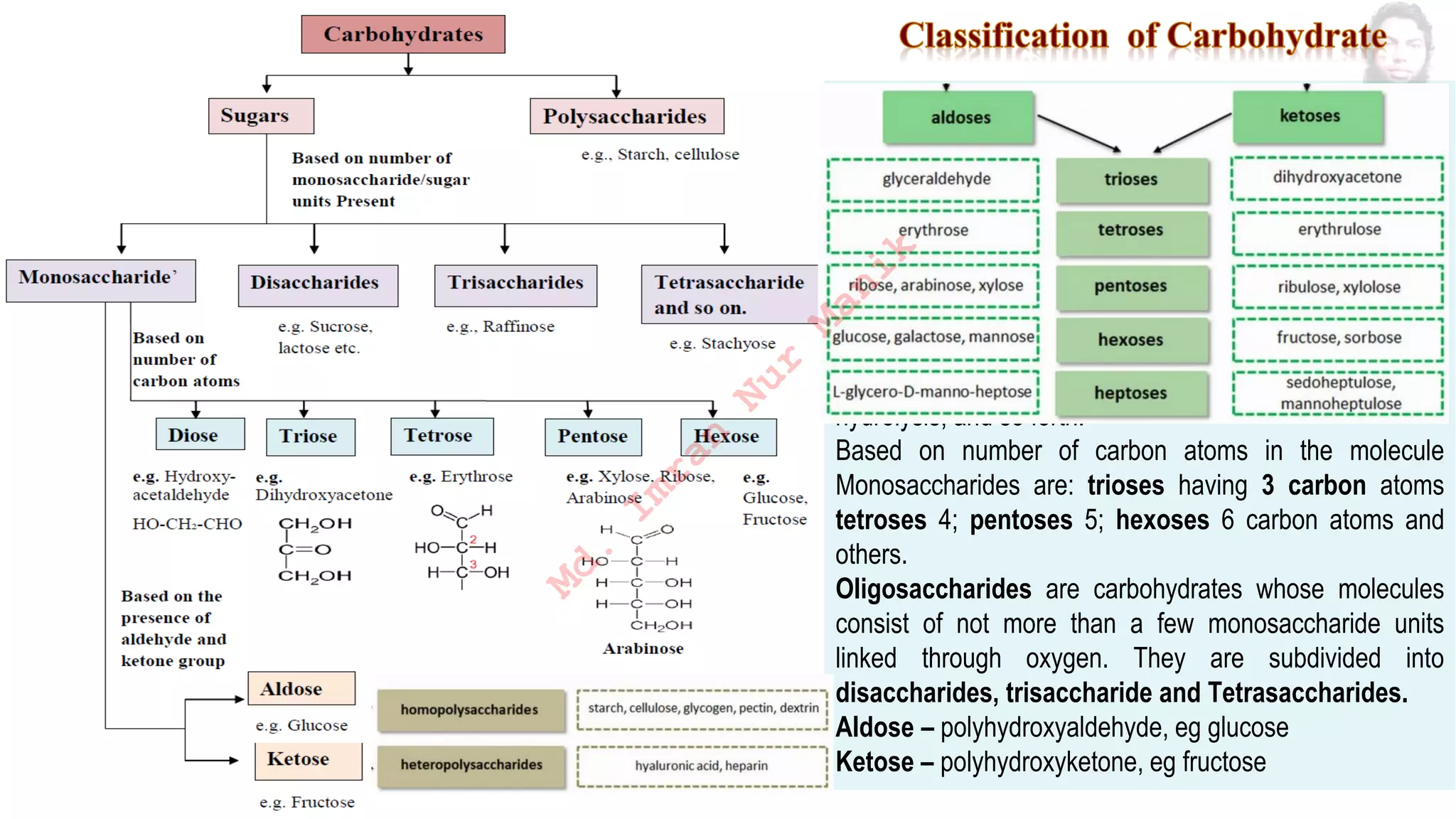
Based on number of carbon atoms in the molecule
Monosaccharides are: trioses having 3 carbon atoms
tetroses 4; pentoses 5; hexoses 6 carbon atoms and
others.
Oligosaccharides are carbohydrates whose molecules
consist of not more than a few monosaccharide units
linked through oxygen. They are subdivided into
disaccharides, trisaccharide and Tetrasaccharides.
Aldose – polyhydroxyaldehyde, eg glucose
Ketose – polyhydroxyketone, eg fructose
M
d
.
I
m
r
a
n
N
u
r
M
a
n
i
k
M
d
.
I
m
r
a
n
N
u
r
M
a
n
i
k
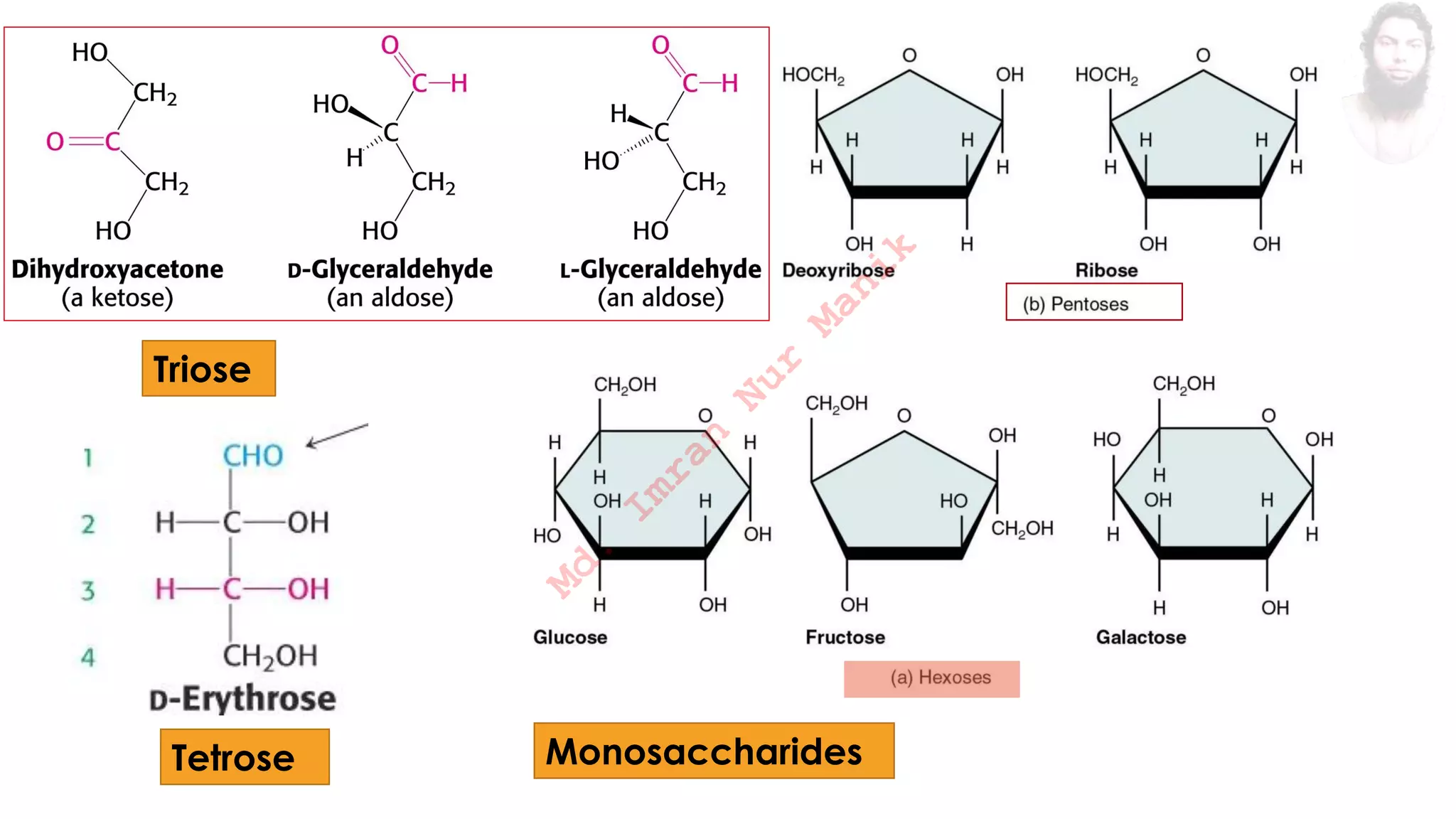
Monosaccharides
Triose
Tetrose
M
d
.
I
m
r
a
n
N
u
r
M
a
n
i
k
Disaccharides
Trisaccharide
M
d
.
I
m
r
a
n
N
u
r
M
a
n
i
k
Polysaccharides
M
d
.
I
m
r
a
n
N
u
r
M
a
n
i
k
Test Procedure Observation
Molisch’s test
A solution of carbohydrate Is prepared in water containing a-
naphthol; concentrated sulphuric acid is added along the side of
test tube.
Purple ring s formed on the junction below
aqueous layer.
Fehling’s test
The sample substance (0.5 g,) is heated with dilute hydrochloric
acid to hydrolyze a polysaccharide. The reaction mixture is
neutralized by addition of sodium hydroxide solution and then
Fehling's solutions 1 and 2 are added.
Red precipitate of reducing sugar;
(all monosaccharides, and many
disaccharides like lactose, maltose,
cellobiose and gentlobios
Benedict’s test
0.5gm aqueous extract of plant material taken in a test tube is
mixed with 5ml Benedict’s solution and boiled for 5minutes. Then it
is allowed to cool spontaneously.
A Brick red precipitate of cuprous oxide forms
confirming the presence of a reducing sugar.
Resorcinol Test
for Ketoses
(Selivanoffs Test)
A crystal of resorcinol is added to the solution and warmed on a
water-bath with an equal volume of concentrated hydrochloric acid.
A rose colour is produced if a ketone is
present(e.g. fructose,honey or hydrolysed
inulin).
Osazone
formation
Sample solution is heated with phenylhydrazine hydrochloride,
sodium acetate and acetic acid
Sugar derivatives form yellow crystals of
Osazone.
Tests for Carbohydrates
M
d
.
I
m
r
a
n
N
u
r
M
a
n
i
k
i) Molish Reagent: 10gm of alpha-naphthol mixed with 100ml of ethanol or chloroform.
ii) Fehling’s Solution A: 34.64gm copper sulphate dissolved in a mixture containing 0.5ml sulphuric acid and sufficient volume of DW to yield 500ml.
iii) Fehling’s Solution B: 176gm of sodium potassium tartarate and 77gm NaOH dissolved in sufficient water to produce 500ml. Equal volumes of
above solutions are mixed at the time of use.
iv) Benedict’s Reagent: 1.73 gm. cupric sulphate, 1.73 gm. sodium citrate and 10 gm. anhydrous sodium carbonate were dissolved in water and the
volume was made up to 100 ml with water.
Molisch’s Test:The appearance of purple or violet ring confirms the
presence of carbohydrate.
Fehling’s Test:The appearance of red precipitate confirms the presence of carbohydrates
Benedict’s Test: The appearance of red precipitate confirms the presence of
carbohydrates
M
d
.
I
m
r
a
n
N
u
r
M
a
n
i
k
Monosaccharides
A simple sugar is chemically defined as a substance
belonging to the carbohydrate group that is a ketonic
or aldehydic substitution product of a polyhydroxy
alcohol.
The simplest of these is a those HO-CH2-CHO
(hydroxy-acetaldehyde), which does not occur free in
nature.
An aldehydic and a ketonic triose do exist
(glyceraldehyde and dihydroxyacetone) usually in the
form of phosphate esters.
A sugar that serves as a reducing agent due to its
free aldehyde and ketone functional groups in its
molecular structure. e.g. Glucose, Fructose.
All monosaccharide's are reducing sugar.
M
d
.
I
m
r
a
n
N
u
r
M
a
n
i
k
❑ Sucrose:
Sucrose (α-D-glucopyranosyl (1→2)β-D-fructofuranoside)
is the only disaccharide that occurs abundantly in the free
state in plants.
Invert sugar:
The equimolecular mixture of glucose and fructose which
is obtained upon hydrolysis from sucrose is called invert
sugar. Sucrose is a nonreducing sugar.
Hydrolysis
Sucrose Glucose + Fructose
Biosynthesis of Carbohydrate
Carbohydrates are products of photosynthesis, a biologic process that converts
electromagnetic energy into chemical energy. In the green plant, photosynthesis consists of
2 classes of reactions.
1. Light reaction: convert electromagnetic energy into chemical potential.
2. Enzymatic reaction: It utilize energy from light source to fix Carbon dioxide into sugar.
M
d
.
I
m
r
a
n
N
u
r
M
a
n
i
k
The results of both of these types of reactions are most simply summarized in the following equation:
Chlorophyll
2H2O + CO2 + light (CH2O) + H2O + O2
Fructose 6-phosphate, derived
from the photosynthetic cycle,
is converted to glucose-1-
phosphate which, in turn,
reacts with UTP to form UDP-
glucose. UDP-glucose either
reacts with fructose-6-
phosphate to form first sucrose
phosphate and ultimately
sucrose, or with fructose to
form sucrose directly.
F-6-P = Fructose 6-phosphate
G-1- P = Glucose-1-phosphate
G-6- P = Glucose-6-phosphate
UTP = Uridine Tri-phosphate
UDP-glucose = Uridine Di-phosphate Glucose
Sucrose – P = Sucrose-phosphate
Pi = Inorganic – phosphate
F = Fructose
M
d
.
I
m
r
a
n
N
u
r
M
a
n
i
k
SUGARS AND SUGAR CONTAINING DRUGS
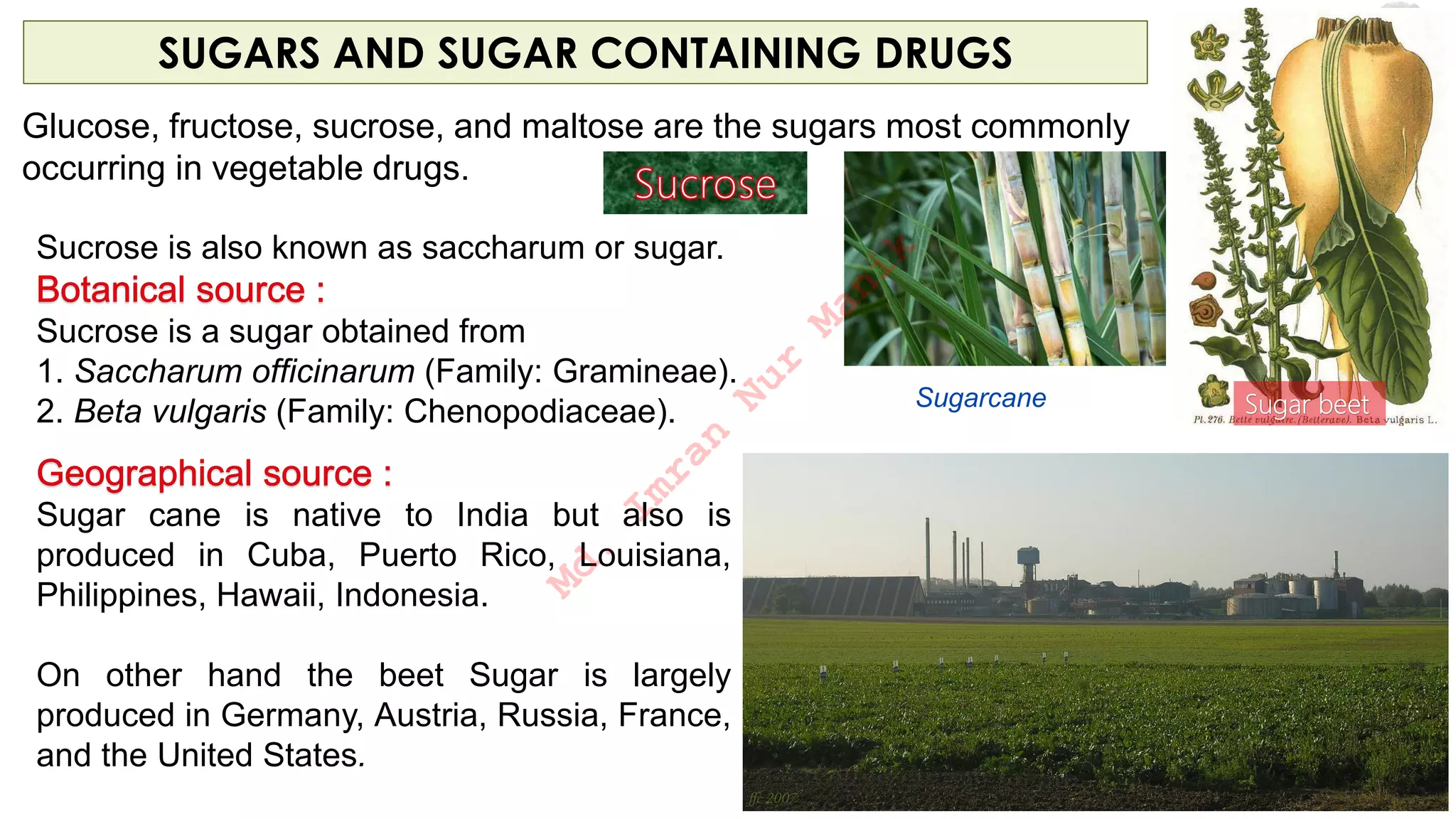
Glucose, fructose, sucrose, and maltose are the sugars most commonly
occurring in vegetable drugs.
Sucrose is also known as saccharum or sugar.
Sucrose is a sugar obtained from
1. Saccharum officinarum (Family: Gramineae).
2. Beta vulgaris (Family: Chenopodiaceae). Sugarcane
Sugar cane is native to India but also is
produced in Cuba, Puerto Rico, Louisiana,
Philippines, Hawaii, Indonesia.
On other hand the beet Sugar is largely
produced in Germany, Austria, Russia, France,
and the United States.
M
d
.
I
m
r
a
n
N
u
r
M
a
n
i
k
From sugar cane
1. The juice is obtained from sugar cane by crushing the
stems between a series of heavy iron rollers.
2. It is boiled with lime to neutralize the plant acids
(which would otherwise change the sucrose to invert sugar, and to coagulate
albumins. The latter rise to the top as a scum and are removed.)
3. The juice is filtered, sometimes decolorized with sulfur
dioxide, concentrated, and crystallized.
4. When crystals of sugar are no longer obtainable, then
there arises the residual, dark-colored syrup called
molasses. (which is extensively used in foods, prepared animal foods, and in
the manufacture of ethyl alcohol.)
From sugar beets
1. The beets are dug, washed, and sliced into small, limp
slivers known as "cossettes".
2. Sucrose and other soluble constituents are extracted from
the plant material with hot water.
3. The crude sugar-containing solution is then subjected to
the purification process.
Commercial Production of sucrose:
M
d
.
I
m
r
a
n
N
u
r
M
a
n
i
k
Sucrose is a pharmaceutical necessity for syrups.
It is also a demulcent and a nutrient.
In sufficient concentration in aqueous solution, sugar is
bacteriostatic and preservative.
Sugar masks disagreeable tastes in tablets.
It retards oxidation in certain preparations.
Sugar provides 4 calories per gram or 16 calories in a level teaspoon (4 g)}
A demulcent is a high molecular weight compound in aqueous solution that coats the skin surface, thus protecting the underlying cells and
alleviating irritation.
The concentration of sugar in syrup should be 66..7% (w/w) according to BP
. (85%w/v in USP). Sugar acts as a
preservative by inhibiting microbial activity
M
d
.
I
m
r
a
n
N
u
r
M
a
n
i
k
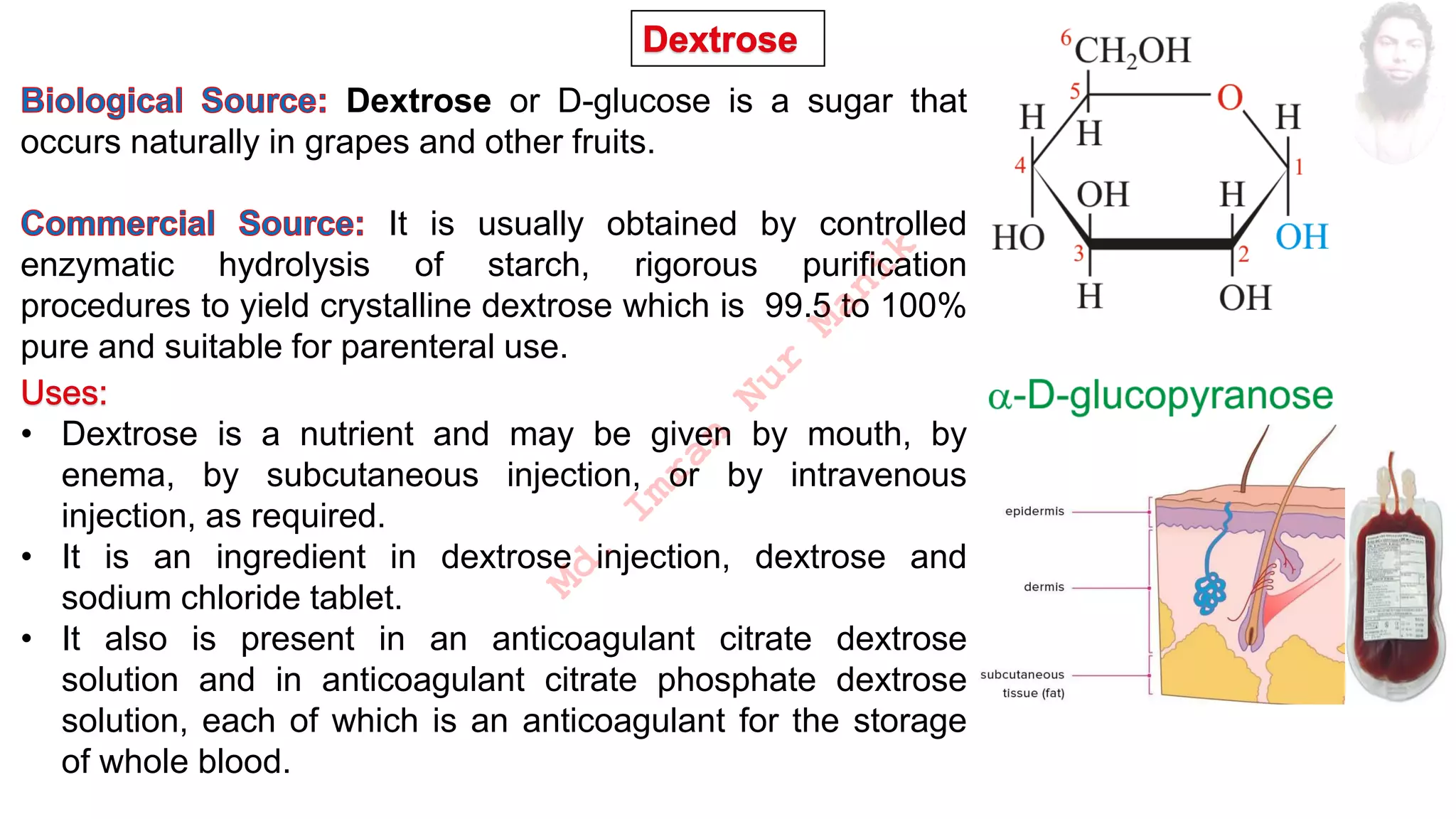
Dextrose or D-glucose is a sugar that
occurs naturally in grapes and other fruits.
It is usually obtained by controlled
enzymatic hydrolysis of starch, rigorous purification
procedures to yield crystalline dextrose which is 99.5 to 100%
pure and suitable for parenteral use.
• Dextrose is a nutrient and may be given by mouth, by
enema, by subcutaneous injection, or by intravenous
injection, as required.
• It is an ingredient in dextrose injection, dextrose and
sodium chloride tablet.
• It also is present in an anticoagulant citrate dextrose
solution and in anticoagulant citrate phosphate dextrose
solution, each of which is an anticoagulant for the storage
of whole blood.
M
d
.
I
m
r
a
n
N
u
r
M
a
n
i
k
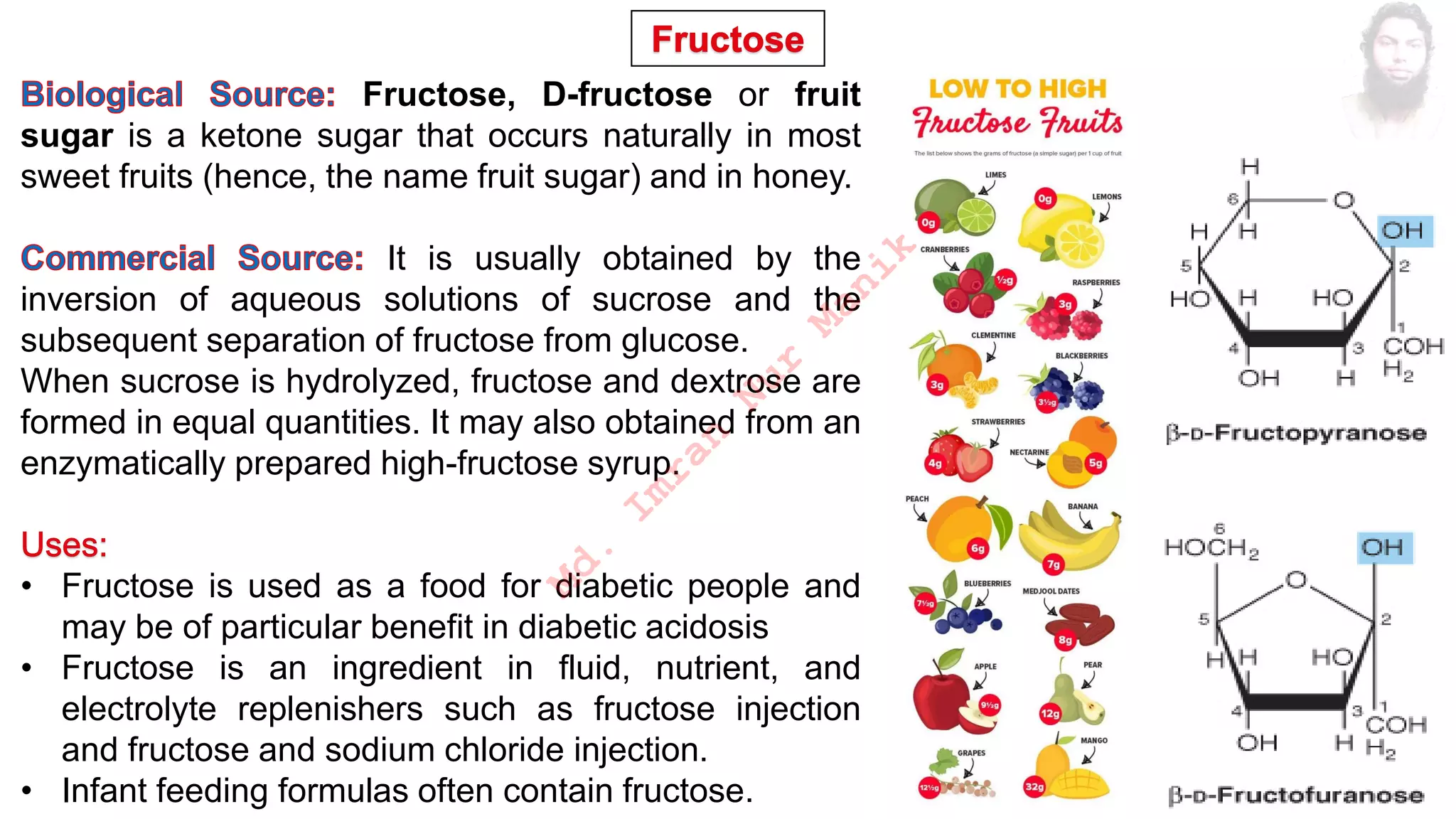
Fructose, D-fructose or fruit
sugar is a ketone sugar that occurs naturally in most
sweet fruits (hence, the name fruit sugar) and in honey.
It is usually obtained by the
inversion of aqueous solutions of sucrose and the
subsequent separation of fructose from glucose.
When sucrose is hydrolyzed, fructose and dextrose are
formed in equal quantities. It may also obtained from an
enzymatically prepared high-fructose syrup.
• Fructose is used as a food for diabetic people and
may be of particular benefit in diabetic acidosis
• Fructose is an ingredient in fluid, nutrient, and
electrolyte replenishers such as fructose injection
and fructose and sodium chloride injection.
• Infant feeding formulas often contain fructose.
M
d
.
I
m
r
a
n
N
u
r
M
a
n
i
k
POLYSACCHARIDES AND POLYSACCHARIDE CONTAINING DRUGS
Starch (Amylum) is the most widely distributed organic compound in
plants. It is produced in large quantities in green leaves as the temporary
storage form of photosynthetic products.
Starch occurs as granules in the mature grain of
corn,Zea mays Linn. (Fam: Gramineae) or of wheat, Triticum aestivum
Linn. (Gramineae), or tubers of potato, Solanum tuberosum Linn.
(Solanaceae) or rice, Oryza sativa Linn. (Gramineae)
Commercially the starch is produced in U.S.A.,
Argentina, India, China, Japan and other tropical and sub-tropical
countries.
Starch is generally a mixture of two structurally different polysaccharides.
Amylose: composed of 250 to 300 D-glucopyranose units uniformly
bonded to each other through α(1→4) glycosidic bonds.
Amylopectin: consists of 1000 or more glucose units that are also
connected with linked by α-1,4-glycosidic bonds and α-1,6-glycosidic
bonds..
M
d
.
I
m
r
a
n
N
u
r
M
a
n
i
k
• Externally it is used as an absorbent, emollient, in dusting powders and in ointments.
• It is used as tablet filler, binder, and disintegrant.
• A starch suspension may be swallowed as an antidote for iodine poisoning.
• It is the starting material from which liquid glucose (corn syrup), dextrose, dextrins, and
high-fructose sweeteners are made.
M
d
.
I
m
r
a
n
N
u
r
M
a
n
i
k
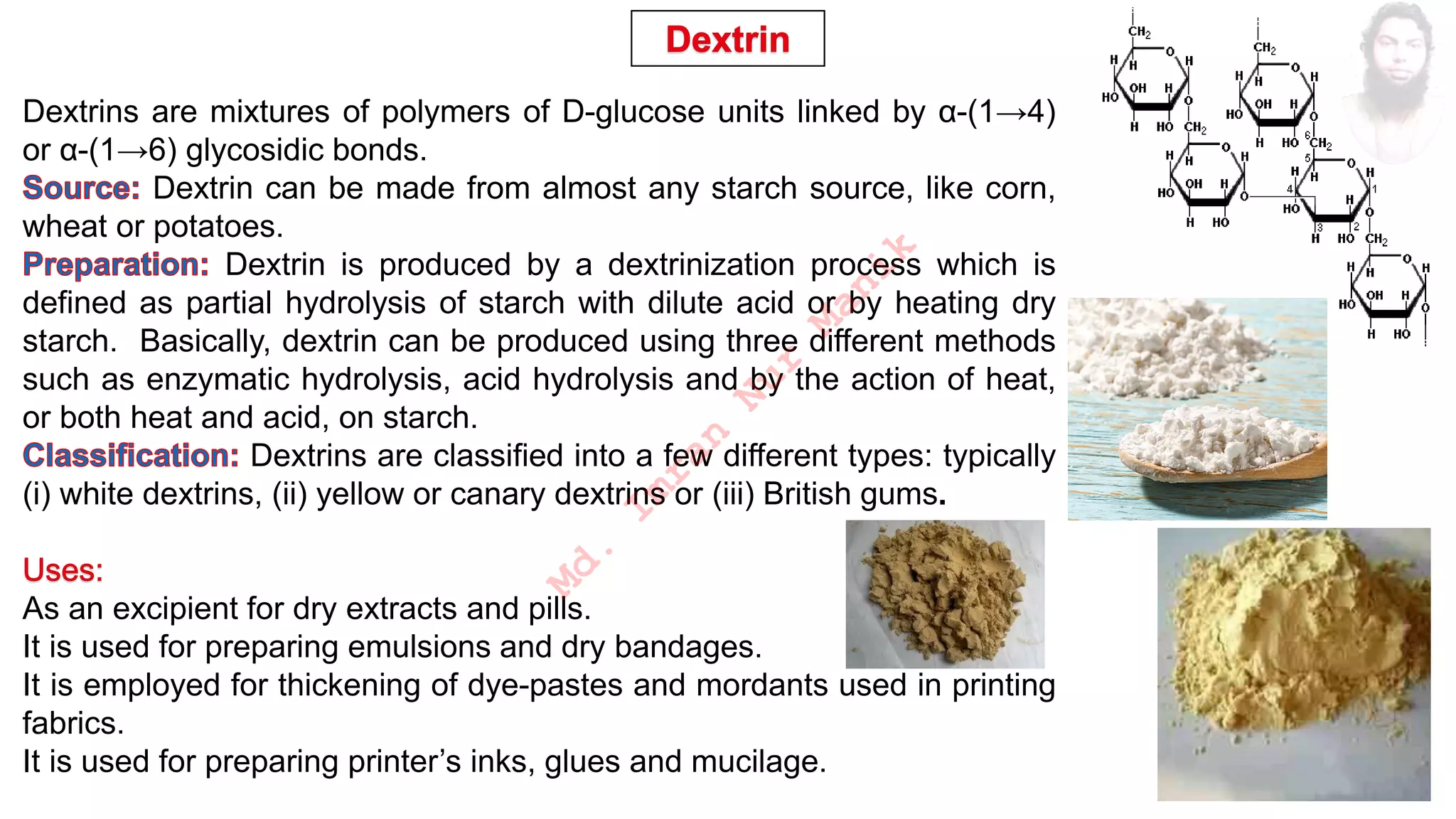
Dextrins are mixtures of polymers of D-glucose units linked by α-(1→4)
or α-(1→6) glycosidic bonds.
Dextrin can be made from almost any starch source, like corn,
wheat or potatoes.
Dextrin is produced by a dextrinization process which is
defined as partial hydrolysis of starch with dilute acid or by heating dry
starch. Basically, dextrin can be produced using three different methods
such as enzymatic hydrolysis, acid hydrolysis and by the action of heat,
or both heat and acid, on starch.
Dextrins are classified into a few different types: typically
(i) white dextrins, (ii) yellow or canary dextrins or (iii) British gums.
As an excipient for dry extracts and pills.
It is used for preparing emulsions and dry bandages.
It is employed for thickening of dye-pastes and mordants used in printing
fabrics.
It is used for preparing printer’s inks, glues and mucilage.
M
d
.
I
m
r
a
n
N
u
r
M
a
n
i
k
GUMS AND MUCILAGES
Gums are natural plant hydrocolloid that may be either anionic or non
ionic polysaccharides or salts of polysaccharides. They are translucent,
amorphous substances that are frequently produced in higher plants as a
protective after injury.
Mucilages are generally normal products of metabolism, formed
within the cell (intracellular formation) and/or are produced without
injury to the plant. A gelatinous substance of various plants (such as
legumes or seaweeds) that contains protein and polysaccharides.
Shrub or tree exudates: acacia, karaya, tragacanth; Marine gums:agar,
algin; Seed gums: guar, locust bean; Plant extracts:pectins;
Starch and cellulose derivatives: carboxymethylcellulose,
ethylcellulose, methylcellulose; Microbial gums: dextrans, xanthan
They are useful as tablet binders, emulsifiers, suspending agents,
stabilizers, and thickeners.
They are ingredients in dental and other adhesives and in bulk laxatives.
They are used as thickening and gelating agents.
M
d
.
I
m
r
a
n
N
u
r
M
a
n
i
k
Tragacanth is the dried, gummy exudate obtained by
incisions from the stem of Astragalus gummifer, or other Asiatic species of
Astragalus (Fam. Leguminosae). It is commonly known as gum tragacanth.
The Tragacanth plants are 1 meter high thorny branching
shrubs. The gum Is produced physiologically in the plant cells. When a one-
or two years old plant is injured, the cell wall of the pith and then of the
medullary rays are gradually converted Into gum.
• Tragacanth is used in pharmaceutical as compounding and dispensing
agent, e.g. to suspend heavy insoluble powders. as an excipient for tablets
• Tragacanth is used as suspending agent for insoluble powders in
mixtures.
• It is used as an emulsifying agent for oils and resins.
• Used as an adhesive.
• It is employed in cosmetics (hand lotions) as a demulcent and an
emollient.
• It is employed in cloth printing, confectionery, and other processes.
M
d
.
I
m
r
a
n
N
u
r
M
a
n
i
k
Acacia is the dried, gummy exudate from the
stems and branches of Acacia senegal. African species of Acacia
(Fam. Leguminosae). It is commonly known as gum arabic.
Acacia plant is a 6 m high thorny tree. The gum is
produced by living and physiologically active cells of the phloem.
Bark is peeled by a transverse incision. The tears of gum are formed
on this exposed surface due to bacterial action or the action of a
ferment which flow on its own and are collected in leather bags.
Acacia gum is demulcent, emollient, and used as emulsifying and
suspending agent for the administration of insoluble drugs.
Used as an adhesive and binder in tablet granulations.
Due to Its demulcent properties it is used in various formulations for
cough, diarrhea and throat problems.
It is also used to cover inflamed surfaces such as burns, sore
nipples. etc.
M
d
.
I
m
r
a
n
N
u
r
M
a
n
i
k
Karaya gum or Sterculia gum is
the dried, gummy exudate from Sterculia urens
Roxburgh, S. villosa Roxb., S. tragacantha Lindley or
other species of Sterculia Linne (Fam. Sterculiaceae).
Sterculia gum occurs in irregular,
translucent striated mass. It has a distinct odor of
acetic acid.
Karaya gum is used
as a bulk laxative,
as an agent for forming emulsions & suspensions,
as a dental adhesive.
It is used extensively in solutions and in skin lotions.
In the preparation of food products
M
d
.
I
m
r
a
n
N
u
r
M
a
n
i
k
Sodium alginate or algin is the purified gelling
carbohydrate (polysaccharide) extracted with dilute alkali from the
giant brown seaweeds extra Macrocystis pyrifera (Family:
Lessoniaceae).
Sodium alginate occurs as a nearly odorless and
tasteless coarse or fine powder and is yellowish white in color. It is
readily soluble in water, forming a viscous, colloidal solution.
Sodium alginate is a suspending agent.
Alginates are used as
stabilizing, thickening, emulsifying, deflocculating, gelling and
film & filament-forming agents: in the rubber, paint, textile, food
(including as stabilizing colloid), cosmetics and pharmaceutical
industries.
It is also used in the food industry.
M
d
.
I
m
r
a
n
N
u
r
M
a
n
i
k
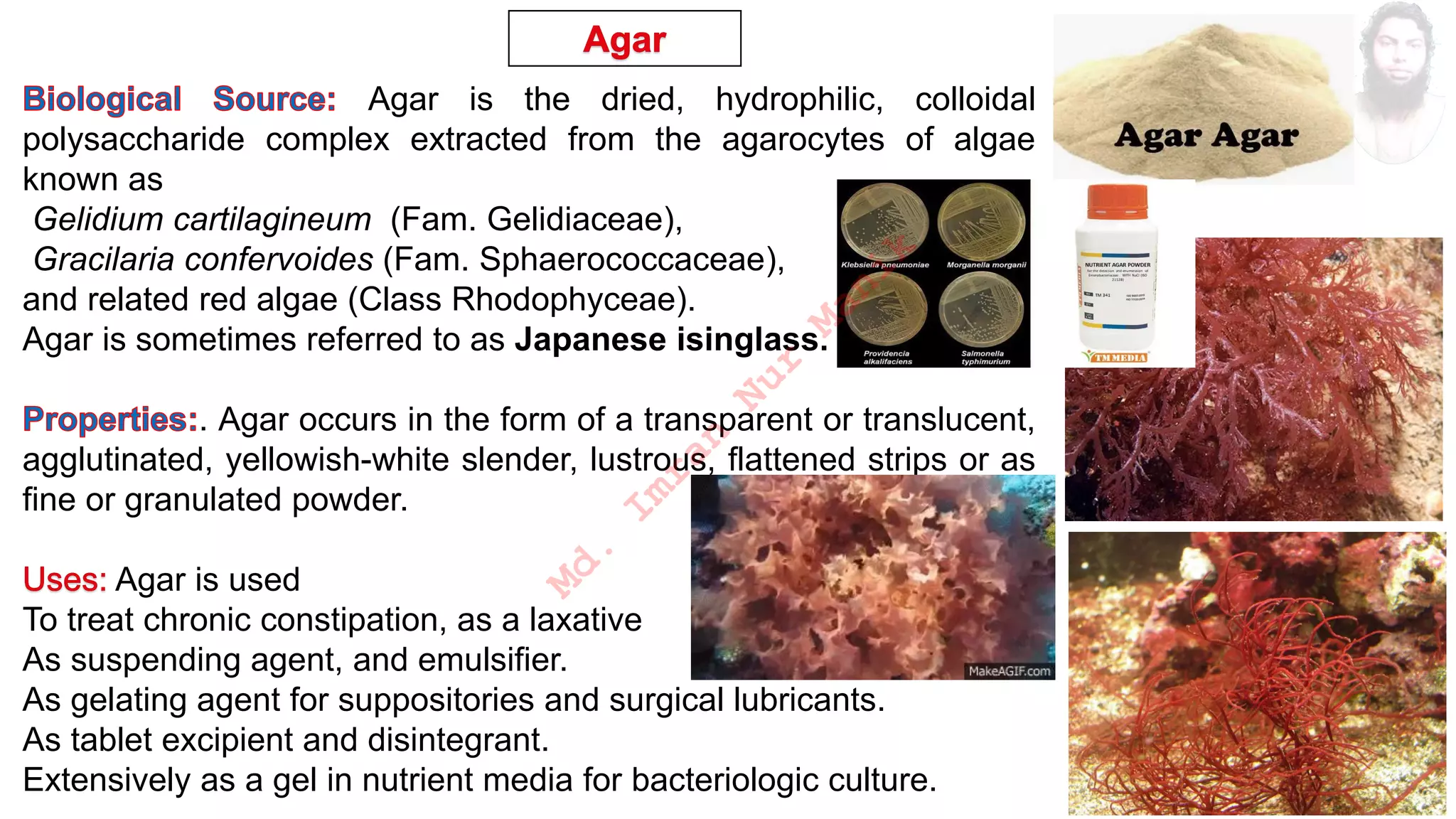
Agar is the dried, hydrophilic, colloidal
polysaccharide complex extracted from the agarocytes of algae
known as
Gelidium cartilagineum (Fam. Gelidiaceae),
Gracilaria confervoides (Fam. Sphaerococcaceae),
and related red algae (Class Rhodophyceae).
Agar is sometimes referred to as Japanese isinglass.
. Agar occurs in the form of a transparent or translucent,
agglutinated, yellowish-white slender, lustrous, flattened strips or as
fine or granulated powder.
Agar is used
To treat chronic constipation, as a laxative
As suspending agent, and emulsifier.
As gelating agent for suppositories and surgical lubricants.
As tablet excipient and disintegrant.
Extensively as a gel in nutrient media for bacteriologic culture.
M
d
.
I
m
r
a
n
N
u
r
M
a
n
i
k
CELLULOSE
Here are some examples
of cellulose fibers:
Cotton.
Linen.
Rayon.
Bamboo.
Hemp.
Jute.
Cellulose is a polysaccharide
composed of a linear chain of
several hundred to many
thousands of β-1,4 linked
D-glucose units. Cellulose is the
main substance in the walls of
plant cells, helping plants to
remain stiff and upright.
M
d
.
I
m
r
a
n
N
u
r
M
a
n
i
k
It is the hair of the seed of Cultivated varieties of
Gossypium hirsutum or of other species of Gossypium
(Fam: Malvaceae) that is freed from adhering impurities, deprived of
fatty matter, bleached, and sterilized in its final container.
Purified cotton is also referred to as absorbent cotton.
. Purified cotton should be free from alkali, acid, fatty
matter, dyes, and water soluble substances
It is used as a surgical dressing;
It provides mechanical protection to absorb blood, mucus, or pus
and to keep bacteria from infecting wounds.
Microcrystalline Cellulose: It is a purified, partially depolymerized
cellulose prepared by treating α-cellulose, obtained as a pulp from
fibrous plant material, with mineral acids.
It is used as a diluent in tablets.
M
d
.
I
m
r
a
n
N
u
r
M
a
n
i
k
M
d
.
I
m
r
a
n
N
u
r
M
a
n
i
k

Carbohydrate (Pharmacognosy) MANIK

  • 1.
    Md. Imran NurManik Lecturer Department of Pharmacy, NUB Phrm 1103:Pharmacognosy
  • 2.
    • A carbohydrateis a naturally occurring compound, or a derivative of such a compound, with the general chemical formula Cx(H2O)y, made up of molecules of carbon (C), hydrogen (H), and oxygen (O) in which the hydrogen and oxygen are generally in the same ratio as in water. • Carbohydrates are the most widespread organic substances and play a vital role in all life. • Chemically carbohydrates are aldehyde or ketone alcohols which are either polyhydroxy aldehydes or polyhydroxy ketons or compounds that can be hydrolyzed to them. • Example: Glucose, Fructose. • Carbohydrates are called carbohydrates because they are essentially hydrates of carbon (i.e. they are composed of carbon and water and have a composition of (CH2O)n. M d . I m r a n N u r M a n i k
  • 3.
    Saccharide is derivedfrom the Greek sakcharon, meaning “sugar”. Sugars are monosaccharides, i.e., compounds that cannot be hydrolyzed to simpler sugars; e.g. D-glucose, also called dextrose. Disaccharides: Yields 2 monosaccharide molecules on hydrolysis;(e.g. sucrose, which is hydrolyzed into glucose and fructose) Trisaccharides yields 3 and Tetrasaccharides yields 4 monosaccharide molecules on hydrolysis; and so forth. Based on number of carbon atoms in the molecule Monosaccharides are: trioses having 3 carbon atoms tetroses 4; pentoses 5; hexoses 6 carbon atoms and others. Oligosaccharides are carbohydrates whose molecules consist of not more than a few monosaccharide units linked through oxygen. They are subdivided into disaccharides, trisaccharide and Tetrasaccharides. Aldose – polyhydroxyaldehyde, eg glucose Ketose – polyhydroxyketone, eg fructose M d . I m r a n N u r M a n i k
  • 4.
  • 5.
  • 6.
  • 7.
  • 8.
    Test Procedure Observation Molisch’stest A solution of carbohydrate Is prepared in water containing a- naphthol; concentrated sulphuric acid is added along the side of test tube. Purple ring s formed on the junction below aqueous layer. Fehling’s test The sample substance (0.5 g,) is heated with dilute hydrochloric acid to hydrolyze a polysaccharide. The reaction mixture is neutralized by addition of sodium hydroxide solution and then Fehling's solutions 1 and 2 are added. Red precipitate of reducing sugar; (all monosaccharides, and many disaccharides like lactose, maltose, cellobiose and gentlobios Benedict’s test 0.5gm aqueous extract of plant material taken in a test tube is mixed with 5ml Benedict’s solution and boiled for 5minutes. Then it is allowed to cool spontaneously. A Brick red precipitate of cuprous oxide forms confirming the presence of a reducing sugar. Resorcinol Test for Ketoses (Selivanoffs Test) A crystal of resorcinol is added to the solution and warmed on a water-bath with an equal volume of concentrated hydrochloric acid. A rose colour is produced if a ketone is present(e.g. fructose,honey or hydrolysed inulin). Osazone formation Sample solution is heated with phenylhydrazine hydrochloride, sodium acetate and acetic acid Sugar derivatives form yellow crystals of Osazone. Tests for Carbohydrates M d . I m r a n N u r M a n i k
  • 9.
    i) Molish Reagent:10gm of alpha-naphthol mixed with 100ml of ethanol or chloroform. ii) Fehling’s Solution A: 34.64gm copper sulphate dissolved in a mixture containing 0.5ml sulphuric acid and sufficient volume of DW to yield 500ml. iii) Fehling’s Solution B: 176gm of sodium potassium tartarate and 77gm NaOH dissolved in sufficient water to produce 500ml. Equal volumes of above solutions are mixed at the time of use. iv) Benedict’s Reagent: 1.73 gm. cupric sulphate, 1.73 gm. sodium citrate and 10 gm. anhydrous sodium carbonate were dissolved in water and the volume was made up to 100 ml with water. Molisch’s Test:The appearance of purple or violet ring confirms the presence of carbohydrate. Fehling’s Test:The appearance of red precipitate confirms the presence of carbohydrates Benedict’s Test: The appearance of red precipitate confirms the presence of carbohydrates M d . I m r a n N u r M a n i k
  • 10.
    Monosaccharides A simple sugaris chemically defined as a substance belonging to the carbohydrate group that is a ketonic or aldehydic substitution product of a polyhydroxy alcohol. The simplest of these is a those HO-CH2-CHO (hydroxy-acetaldehyde), which does not occur free in nature. An aldehydic and a ketonic triose do exist (glyceraldehyde and dihydroxyacetone) usually in the form of phosphate esters. A sugar that serves as a reducing agent due to its free aldehyde and ketone functional groups in its molecular structure. e.g. Glucose, Fructose. All monosaccharide's are reducing sugar. M d . I m r a n N u r M a n i k
  • 11.
    ❑ Sucrose: Sucrose (α-D-glucopyranosyl(1→2)β-D-fructofuranoside) is the only disaccharide that occurs abundantly in the free state in plants. Invert sugar: The equimolecular mixture of glucose and fructose which is obtained upon hydrolysis from sucrose is called invert sugar. Sucrose is a nonreducing sugar. Hydrolysis Sucrose Glucose + Fructose Biosynthesis of Carbohydrate Carbohydrates are products of photosynthesis, a biologic process that converts electromagnetic energy into chemical energy. In the green plant, photosynthesis consists of 2 classes of reactions. 1. Light reaction: convert electromagnetic energy into chemical potential. 2. Enzymatic reaction: It utilize energy from light source to fix Carbon dioxide into sugar. M d . I m r a n N u r M a n i k
  • 12.
    The results ofboth of these types of reactions are most simply summarized in the following equation: Chlorophyll 2H2O + CO2 + light (CH2O) + H2O + O2 Fructose 6-phosphate, derived from the photosynthetic cycle, is converted to glucose-1- phosphate which, in turn, reacts with UTP to form UDP- glucose. UDP-glucose either reacts with fructose-6- phosphate to form first sucrose phosphate and ultimately sucrose, or with fructose to form sucrose directly. F-6-P = Fructose 6-phosphate G-1- P = Glucose-1-phosphate G-6- P = Glucose-6-phosphate UTP = Uridine Tri-phosphate UDP-glucose = Uridine Di-phosphate Glucose Sucrose – P = Sucrose-phosphate Pi = Inorganic – phosphate F = Fructose M d . I m r a n N u r M a n i k
  • 13.
    SUGARS AND SUGARCONTAINING DRUGS Glucose, fructose, sucrose, and maltose are the sugars most commonly occurring in vegetable drugs. Sucrose is also known as saccharum or sugar. Sucrose is a sugar obtained from 1. Saccharum officinarum (Family: Gramineae). 2. Beta vulgaris (Family: Chenopodiaceae). Sugarcane Sugar cane is native to India but also is produced in Cuba, Puerto Rico, Louisiana, Philippines, Hawaii, Indonesia. On other hand the beet Sugar is largely produced in Germany, Austria, Russia, France, and the United States. M d . I m r a n N u r M a n i k
  • 14.
    From sugar cane 1.The juice is obtained from sugar cane by crushing the stems between a series of heavy iron rollers. 2. It is boiled with lime to neutralize the plant acids (which would otherwise change the sucrose to invert sugar, and to coagulate albumins. The latter rise to the top as a scum and are removed.) 3. The juice is filtered, sometimes decolorized with sulfur dioxide, concentrated, and crystallized. 4. When crystals of sugar are no longer obtainable, then there arises the residual, dark-colored syrup called molasses. (which is extensively used in foods, prepared animal foods, and in the manufacture of ethyl alcohol.) From sugar beets 1. The beets are dug, washed, and sliced into small, limp slivers known as "cossettes". 2. Sucrose and other soluble constituents are extracted from the plant material with hot water. 3. The crude sugar-containing solution is then subjected to the purification process. Commercial Production of sucrose: M d . I m r a n N u r M a n i k
  • 15.
    Sucrose is apharmaceutical necessity for syrups. It is also a demulcent and a nutrient. In sufficient concentration in aqueous solution, sugar is bacteriostatic and preservative. Sugar masks disagreeable tastes in tablets. It retards oxidation in certain preparations. Sugar provides 4 calories per gram or 16 calories in a level teaspoon (4 g)} A demulcent is a high molecular weight compound in aqueous solution that coats the skin surface, thus protecting the underlying cells and alleviating irritation. The concentration of sugar in syrup should be 66..7% (w/w) according to BP . (85%w/v in USP). Sugar acts as a preservative by inhibiting microbial activity M d . I m r a n N u r M a n i k
  • 16.
    Dextrose or D-glucoseis a sugar that occurs naturally in grapes and other fruits. It is usually obtained by controlled enzymatic hydrolysis of starch, rigorous purification procedures to yield crystalline dextrose which is 99.5 to 100% pure and suitable for parenteral use. • Dextrose is a nutrient and may be given by mouth, by enema, by subcutaneous injection, or by intravenous injection, as required. • It is an ingredient in dextrose injection, dextrose and sodium chloride tablet. • It also is present in an anticoagulant citrate dextrose solution and in anticoagulant citrate phosphate dextrose solution, each of which is an anticoagulant for the storage of whole blood. M d . I m r a n N u r M a n i k
  • 17.
    Fructose, D-fructose orfruit sugar is a ketone sugar that occurs naturally in most sweet fruits (hence, the name fruit sugar) and in honey. It is usually obtained by the inversion of aqueous solutions of sucrose and the subsequent separation of fructose from glucose. When sucrose is hydrolyzed, fructose and dextrose are formed in equal quantities. It may also obtained from an enzymatically prepared high-fructose syrup. • Fructose is used as a food for diabetic people and may be of particular benefit in diabetic acidosis • Fructose is an ingredient in fluid, nutrient, and electrolyte replenishers such as fructose injection and fructose and sodium chloride injection. • Infant feeding formulas often contain fructose. M d . I m r a n N u r M a n i k
  • 18.
    POLYSACCHARIDES AND POLYSACCHARIDECONTAINING DRUGS Starch (Amylum) is the most widely distributed organic compound in plants. It is produced in large quantities in green leaves as the temporary storage form of photosynthetic products. Starch occurs as granules in the mature grain of corn,Zea mays Linn. (Fam: Gramineae) or of wheat, Triticum aestivum Linn. (Gramineae), or tubers of potato, Solanum tuberosum Linn. (Solanaceae) or rice, Oryza sativa Linn. (Gramineae) Commercially the starch is produced in U.S.A., Argentina, India, China, Japan and other tropical and sub-tropical countries. Starch is generally a mixture of two structurally different polysaccharides. Amylose: composed of 250 to 300 D-glucopyranose units uniformly bonded to each other through α(1→4) glycosidic bonds. Amylopectin: consists of 1000 or more glucose units that are also connected with linked by α-1,4-glycosidic bonds and α-1,6-glycosidic bonds.. M d . I m r a n N u r M a n i k
  • 19.
    • Externally itis used as an absorbent, emollient, in dusting powders and in ointments. • It is used as tablet filler, binder, and disintegrant. • A starch suspension may be swallowed as an antidote for iodine poisoning. • It is the starting material from which liquid glucose (corn syrup), dextrose, dextrins, and high-fructose sweeteners are made. M d . I m r a n N u r M a n i k
  • 20.
    Dextrins are mixturesof polymers of D-glucose units linked by α-(1→4) or α-(1→6) glycosidic bonds. Dextrin can be made from almost any starch source, like corn, wheat or potatoes. Dextrin is produced by a dextrinization process which is defined as partial hydrolysis of starch with dilute acid or by heating dry starch. Basically, dextrin can be produced using three different methods such as enzymatic hydrolysis, acid hydrolysis and by the action of heat, or both heat and acid, on starch. Dextrins are classified into a few different types: typically (i) white dextrins, (ii) yellow or canary dextrins or (iii) British gums. As an excipient for dry extracts and pills. It is used for preparing emulsions and dry bandages. It is employed for thickening of dye-pastes and mordants used in printing fabrics. It is used for preparing printer’s inks, glues and mucilage. M d . I m r a n N u r M a n i k
  • 21.
    GUMS AND MUCILAGES Gumsare natural plant hydrocolloid that may be either anionic or non ionic polysaccharides or salts of polysaccharides. They are translucent, amorphous substances that are frequently produced in higher plants as a protective after injury. Mucilages are generally normal products of metabolism, formed within the cell (intracellular formation) and/or are produced without injury to the plant. A gelatinous substance of various plants (such as legumes or seaweeds) that contains protein and polysaccharides. Shrub or tree exudates: acacia, karaya, tragacanth; Marine gums:agar, algin; Seed gums: guar, locust bean; Plant extracts:pectins; Starch and cellulose derivatives: carboxymethylcellulose, ethylcellulose, methylcellulose; Microbial gums: dextrans, xanthan They are useful as tablet binders, emulsifiers, suspending agents, stabilizers, and thickeners. They are ingredients in dental and other adhesives and in bulk laxatives. They are used as thickening and gelating agents. M d . I m r a n N u r M a n i k
  • 22.
    Tragacanth is thedried, gummy exudate obtained by incisions from the stem of Astragalus gummifer, or other Asiatic species of Astragalus (Fam. Leguminosae). It is commonly known as gum tragacanth. The Tragacanth plants are 1 meter high thorny branching shrubs. The gum Is produced physiologically in the plant cells. When a one- or two years old plant is injured, the cell wall of the pith and then of the medullary rays are gradually converted Into gum. • Tragacanth is used in pharmaceutical as compounding and dispensing agent, e.g. to suspend heavy insoluble powders. as an excipient for tablets • Tragacanth is used as suspending agent for insoluble powders in mixtures. • It is used as an emulsifying agent for oils and resins. • Used as an adhesive. • It is employed in cosmetics (hand lotions) as a demulcent and an emollient. • It is employed in cloth printing, confectionery, and other processes. M d . I m r a n N u r M a n i k
  • 23.
    Acacia is thedried, gummy exudate from the stems and branches of Acacia senegal. African species of Acacia (Fam. Leguminosae). It is commonly known as gum arabic. Acacia plant is a 6 m high thorny tree. The gum is produced by living and physiologically active cells of the phloem. Bark is peeled by a transverse incision. The tears of gum are formed on this exposed surface due to bacterial action or the action of a ferment which flow on its own and are collected in leather bags. Acacia gum is demulcent, emollient, and used as emulsifying and suspending agent for the administration of insoluble drugs. Used as an adhesive and binder in tablet granulations. Due to Its demulcent properties it is used in various formulations for cough, diarrhea and throat problems. It is also used to cover inflamed surfaces such as burns, sore nipples. etc. M d . I m r a n N u r M a n i k
  • 24.
    Karaya gum orSterculia gum is the dried, gummy exudate from Sterculia urens Roxburgh, S. villosa Roxb., S. tragacantha Lindley or other species of Sterculia Linne (Fam. Sterculiaceae). Sterculia gum occurs in irregular, translucent striated mass. It has a distinct odor of acetic acid. Karaya gum is used as a bulk laxative, as an agent for forming emulsions & suspensions, as a dental adhesive. It is used extensively in solutions and in skin lotions. In the preparation of food products M d . I m r a n N u r M a n i k
  • 25.
    Sodium alginate oralgin is the purified gelling carbohydrate (polysaccharide) extracted with dilute alkali from the giant brown seaweeds extra Macrocystis pyrifera (Family: Lessoniaceae). Sodium alginate occurs as a nearly odorless and tasteless coarse or fine powder and is yellowish white in color. It is readily soluble in water, forming a viscous, colloidal solution. Sodium alginate is a suspending agent. Alginates are used as stabilizing, thickening, emulsifying, deflocculating, gelling and film & filament-forming agents: in the rubber, paint, textile, food (including as stabilizing colloid), cosmetics and pharmaceutical industries. It is also used in the food industry. M d . I m r a n N u r M a n i k
  • 26.
    Agar is thedried, hydrophilic, colloidal polysaccharide complex extracted from the agarocytes of algae known as Gelidium cartilagineum (Fam. Gelidiaceae), Gracilaria confervoides (Fam. Sphaerococcaceae), and related red algae (Class Rhodophyceae). Agar is sometimes referred to as Japanese isinglass. . Agar occurs in the form of a transparent or translucent, agglutinated, yellowish-white slender, lustrous, flattened strips or as fine or granulated powder. Agar is used To treat chronic constipation, as a laxative As suspending agent, and emulsifier. As gelating agent for suppositories and surgical lubricants. As tablet excipient and disintegrant. Extensively as a gel in nutrient media for bacteriologic culture. M d . I m r a n N u r M a n i k
  • 27.
    CELLULOSE Here are someexamples of cellulose fibers: Cotton. Linen. Rayon. Bamboo. Hemp. Jute. Cellulose is a polysaccharide composed of a linear chain of several hundred to many thousands of β-1,4 linked D-glucose units. Cellulose is the main substance in the walls of plant cells, helping plants to remain stiff and upright. M d . I m r a n N u r M a n i k
  • 28.
    It is thehair of the seed of Cultivated varieties of Gossypium hirsutum or of other species of Gossypium (Fam: Malvaceae) that is freed from adhering impurities, deprived of fatty matter, bleached, and sterilized in its final container. Purified cotton is also referred to as absorbent cotton. . Purified cotton should be free from alkali, acid, fatty matter, dyes, and water soluble substances It is used as a surgical dressing; It provides mechanical protection to absorb blood, mucus, or pus and to keep bacteria from infecting wounds. Microcrystalline Cellulose: It is a purified, partially depolymerized cellulose prepared by treating α-cellulose, obtained as a pulp from fibrous plant material, with mineral acids. It is used as a diluent in tablets. M d . I m r a n N u r M a n i k
  • 29.