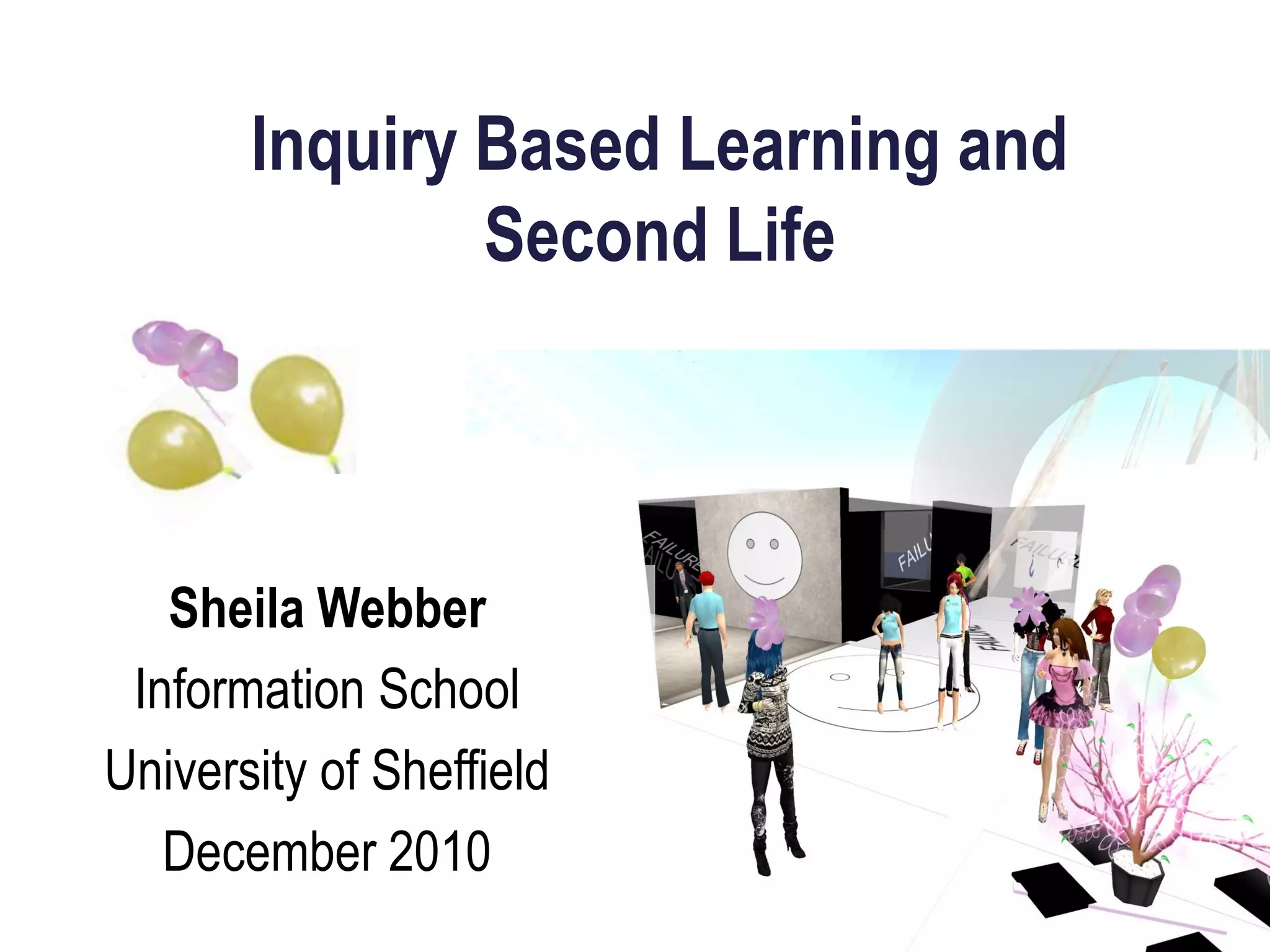
Inquiry Based Learning and
               Second Life


   Sheila Webber
 Information School
University of Sheffield
   December 2010
Introduction
• This draws on a presentation given last month by
  Professor Philippa Levy and me. I have acknowledged
  her on slides she authored
• Phil was Academic Director of the Centre for Inquiry
  Based Learning in the Arts and Social Sciences (a
  Centre for Teaching & Learning) and I was a CILASS
  Academic Fellow (small % buyout of my time)
• CILASS funded the purchase & year 1
  rent (2007/8) on our SL island
Structure
• Identify how we view IBL
• Present a framework of IBL for learners derived
  from longitudinal research study
• Also have created version of this in 3D in SL
• Identify how activities with first year students fit this
  framework
• Discussion about what aspects of IBL can be
  supported/ pursued in SL
What is IBL?

• A cluster of related pedagogies in which student
  inquiry or research drives the experience of learning
  and building knowledge


    ‘inquiry n: the action of seeking, especially (now always) for
    truth, knowledge or information concerning something;
    search, research, investigation, examination’ (COD)
                                                                     Philippa Levy
Designed around students engaging in
      a process of inquiry: they …

• investigate questions & problems that often are
  open-ended
• apply the principles and practices of scholarship or
  research in their academic or professional area
• explore a knowledge-base actively, critically and
  creatively
• participate in building new meaning and knowledge
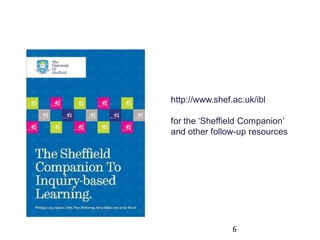
http://www.shef.ac.uk/ibl

for the ‘Sheffield Companion’
and other follow-up resources


                6
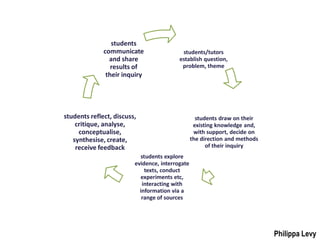
students
              communicate                  students/tutors
                and share                 establish question,
                 results of                problem, theme
               their inquiry


students reflect, discuss,                         students draw on their
    critique, analyse,                            existing knowledge and,
     conceptualise,                               with support, decide on
   synthesise, create,                           the direction and methods
    receive feedback                                   of their inquiry
                           students explore
                         evidence, interrogate
                             texts, conduct
                           experiments etc,
                            interacting with
                           information via a
                            range of sources


                                                                             Philippa Levy
8


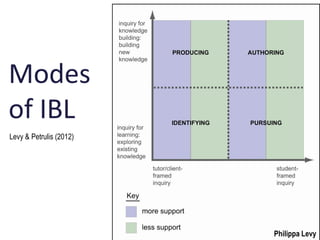
Modes
of IBL
Levy & Petrulis (2012)


                         Philippa Levy
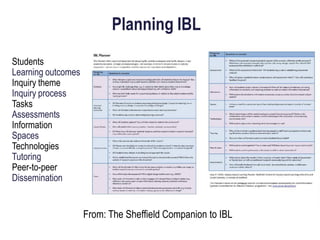
Planning IBL
Students
Learning outcomes
Inquiry theme
Inquiry process
Tasks
Assessments
Information
Spaces
Technologies
Tutoring
Peer-to-peer
Dissemination


                    From: The Sheffield Companion to IBL
Transition and inquiry
“Approaches to supporting transition are linked to improving
preparedness for HE, easing integration into the university
environment - both academically and socially - and
encouraging the development of the independent learner.”
(Whittaker, 2008: 3)
“Curriculum design should have a greater focus on the
interactive dimensions of learning and the social experience
of students, for example working in small groups and more
enquiry-based and project work. It should also provide a
more challenging learning experience to encourage greater
engagement and the development of independent learning
and high-level critical skills.” (Whittaker, 2008: 8).
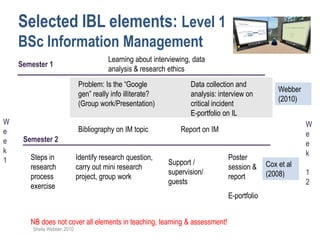
Selected IBL elements: Level 1
    BSc Information Management
                                         Learning about interviewing, data
    Semester 1
                                         analysis & research ethics
                              Problem: Is the “Google                Data collection and
                                                                                                    Webber
                              gen” really info illiterate?           analysis: interview on
                                                                                                    (2010)
                              (Group work/Presentation)              critical incident
                                                                     E-portfolio on IL
W                                                                                                            W
e                             Bibliography on IM topic           Report on IM
                                                                                                             e
e    Semester 2
                                                                                                             e
k                                                                                                            k
1      Steps in               Identify research question,                         Poster
                                                             Support /                          Cox et al
       research               carry out mini research                             session &
                                                             supervision/                       (2008)       1
       process                project, group work                                 report
                                                             guests                                          2
       exercise
                                                                                  E-portfolio


       NB does not cover all elements in teaching, learning & assessment!
        Sheila Webber, 2010
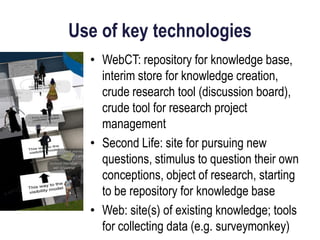
Use of key technologies
  • WebCT: repository for knowledge base,
    interim store for knowledge creation,
    crude research tool (discussion board),
    crude tool for research project
    management
  • Second Life: site for pursuing new
    questions, stimulus to question their own
    conceptions, object of research, starting
    to be repository for knowledge base
  • Web: site(s) of existing knowledge; tools
    for collecting data (e.g. surveymonkey)
• Facebook: (likely) informal tool for project
  management, host for survey instruments, object of
  research
• Mobile phones & IM
  “Initially we simply handed out phone
  numbers and communicated via text
  messaging, with some use of instant
  messaging conversations…”
  (student blog 2008, talking about working on their
  assessed mini-research project)
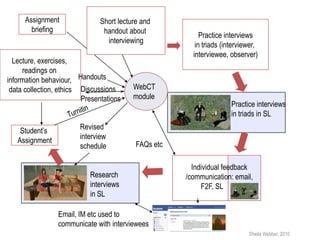
Assignment               Short lecture and
        briefing                handout about
                                                           Practice interviews
                                 interviewing
                                                         in triads (interviewer,
                                                        interviewee, observer)
  Lecture, exercises,
     readings on
information behaviour, Handouts
 data collection, ethics Discussions      WebCT
                         Presentations    module
                                                                      Practice interviews
                                                                      in triads in SL

    Student‟s           Revised
   Assignment           interview
                        schedule           FAQs etc

                                                        Individual feedback
                           Research                   /communication: email,
                           interviews                      F2F, SL      .
                           in SL

                 Email, IM etc used to
                 communicate with interviewees
                                                                            Sheila Webber, 2010
15


Sheila Webber, 2010
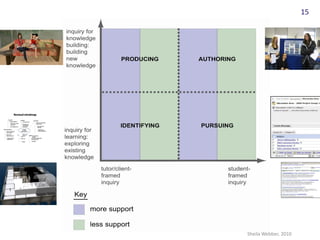
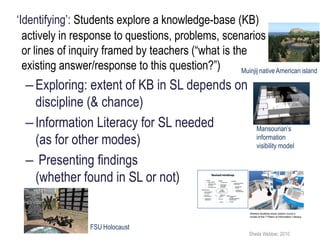
„Identifying‟: Students explore a knowledge-base (KB)
  actively in response to questions, problems, scenarios
  or lines of inquiry framed by teachers (“what is the
  existing answer/response to this question?”)       Muinjij native American island

  – Exploring: extent of KB in SL depends on
    discipline (& chance)
  – Information Literacy for SL needed                             Mansourian‟s
    (as for other modes)                                           information
                                                                   visibility model

  – Presenting findings
    (whether found in SL or not)


                    FSU Holocaust
                                                                Sheila Webber, 2010
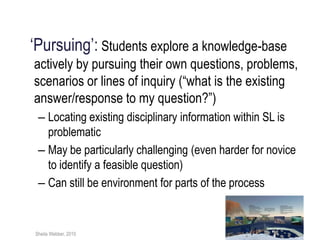
„Pursuing‟: Students explore a knowledge-base
actively by pursuing their own questions, problems,
scenarios or lines of inquiry (“what is the existing
answer/response to my question?”)
 – Locating existing disciplinary information within SL is
   problematic
 – May be particularly challenging (even harder for novice
   to identify a feasible question)
 – Can still be environment for parts of the process


Sheila Webber, 2010
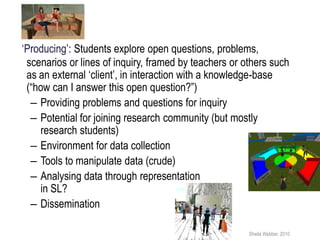
„Producing‟: Students explore open questions, problems,
 scenarios or lines of inquiry, framed by teachers or others such
 as an external „client‟, in interaction with a knowledge-base
 (“how can I answer this open question?”)
  – Providing problems and questions for inquiry
  – Potential for joining research community (but mostly
    research students)
  – Environment for data collection
  – Tools to manipulate data (crude)
  – Analysing data through representation
    in SL?
  – Dissemination

                                                       Sheila Webber, 2010
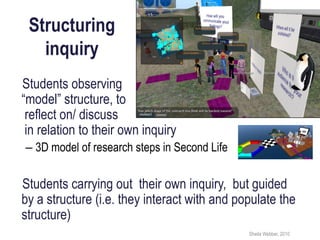
Structuring
   inquiry
Students observing
“model” structure, to
 reflect on/ discuss
 in relation to their own inquiry
– 3D model of research steps in Second Life

Students carrying out their own inquiry, but guided
by a structure (i.e. they interact with and populate the
structure)
                                              Sheila Webber, 2010
„Authoring‟: Students explore their own open questions, problems,
 scenarios or lines of inquiry, in interaction with a knowledge-base
 (“how can I answer my open question?”)
  – Again, discipline/specialism-specific in terms of whether could
    support students in identifying valid research questions/
    problems
  – If students forming their own questions with significant use of
    SL, implies existing SL competence/ knowledge
  – Could be particularly useful at certain stages e.g.
      • Question formulation (engaging with SL research
         community)
      • Data collection (just as use Web 2.0 channels like
         Facebook)
      • Testing emerging results with international
         audience
      • Dissemination
                                                        Sheila Webber, 2010
Concluding points
• Framework as means of
   – thinking when and why SL can be valuable in IBL e.g. as part
     of blended learning
   – identifying areas for development
   – clarifying course design & approach to T, L & A
• Thinking of students as researchers from level 1
   – most research communities in SL focused around postgrad
     researchers (not unique to SL!)
   – however constructivist/ PBL/ IBL tendencies of SL educators
     world seem fertile ground for developing community


                                                     Sheila Webber, 2010
Sheila Webber
s.webber@shef.ac.uk
Twitter & SL: Sheila Yoshikawa
http://information-literacy.blogspot.com/
http://www.slideshare.net/sheilawebber/
Flickr: http://www.flickr.com/photos/23396182@N00/
Netvibes: http://www.netvibes.com/sheilawebber
References etc.
• Centre for Inquiry Based Learning in the Arts and Social Sciences. (2008)
  Inquiry-based Learning: a conceptual framework. Sheffield: CILASS.
  http://www.shef.ac.uk/cilass/resources
• Cox, A. et al. (2008) “Inquiry-based learning in the first-year Information
  Management curriculum.” Italics, 7 (1), 3-21
• Healey, M. & Jenkins, A. (2009). Developing Undergraduate research and
  Enquiry. York: Higher Education Academy.
• Khan, P. and O´Rourke, K. (2005). “Understanding Enquiry-based Learning”,
  In: Barrett, T., Mac Labhrainn, I., Fallon, H. (eds), Handbook of Enquiry and
  Problem Based Learning. Galway: CELT.
• Levy, P. & Petrulis, R. (2012). How do first-year students experience inquiry
  and research, and what are the implications for the practice of inquiry-based
  learning? Studies in Higher Education, 37(1).
• Webber, S. (2010) “Investigating modes of student inquiry in Second Life as
  part of a blended approach.” International Journal of Virtual and Personal
  Learning Environments, 1 (3), 55-70.
• Whittaker, R. (2008) Quality Enhancement Themes: The First Year
  Experience: Transition to and during the first year. Glasgow: QAA Scotland
                                                                  Sheila Webber, 2010

Inquiry Based Learning and Second Life

  • 1.
    Inquiry Based Learningand Second Life Sheila Webber Information School University of Sheffield December 2010
  • 2.
    Introduction • This drawson a presentation given last month by Professor Philippa Levy and me. I have acknowledged her on slides she authored • Phil was Academic Director of the Centre for Inquiry Based Learning in the Arts and Social Sciences (a Centre for Teaching & Learning) and I was a CILASS Academic Fellow (small % buyout of my time) • CILASS funded the purchase & year 1 rent (2007/8) on our SL island
  • 3.
    Structure • Identify howwe view IBL • Present a framework of IBL for learners derived from longitudinal research study • Also have created version of this in 3D in SL • Identify how activities with first year students fit this framework • Discussion about what aspects of IBL can be supported/ pursued in SL
  • 4.
    What is IBL? •A cluster of related pedagogies in which student inquiry or research drives the experience of learning and building knowledge ‘inquiry n: the action of seeking, especially (now always) for truth, knowledge or information concerning something; search, research, investigation, examination’ (COD) Philippa Levy
  • 5.
    Designed around studentsengaging in a process of inquiry: they … • investigate questions & problems that often are open-ended • apply the principles and practices of scholarship or research in their academic or professional area • explore a knowledge-base actively, critically and creatively • participate in building new meaning and knowledge
  • 6.
    http://www.shef.ac.uk/ibl for the ‘SheffieldCompanion’ and other follow-up resources 6
  • 7.
    students communicate students/tutors and share establish question, results of problem, theme their inquiry students reflect, discuss, students draw on their critique, analyse, existing knowledge and, conceptualise, with support, decide on synthesise, create, the direction and methods receive feedback of their inquiry students explore evidence, interrogate texts, conduct experiments etc, interacting with information via a range of sources Philippa Levy
  • 8.
    8 Modes of IBL Levy &Petrulis (2012) Philippa Levy
  • 9.
    Planning IBL Students Learning outcomes Inquirytheme Inquiry process Tasks Assessments Information Spaces Technologies Tutoring Peer-to-peer Dissemination From: The Sheffield Companion to IBL
  • 10.
    Transition and inquiry “Approachesto supporting transition are linked to improving preparedness for HE, easing integration into the university environment - both academically and socially - and encouraging the development of the independent learner.” (Whittaker, 2008: 3) “Curriculum design should have a greater focus on the interactive dimensions of learning and the social experience of students, for example working in small groups and more enquiry-based and project work. It should also provide a more challenging learning experience to encourage greater engagement and the development of independent learning and high-level critical skills.” (Whittaker, 2008: 8).
  • 11.
    Selected IBL elements:Level 1 BSc Information Management Learning about interviewing, data Semester 1 analysis & research ethics Problem: Is the “Google Data collection and Webber gen” really info illiterate? analysis: interview on (2010) (Group work/Presentation) critical incident E-portfolio on IL W W e Bibliography on IM topic Report on IM e e Semester 2 e k k 1 Steps in Identify research question, Poster Support / Cox et al research carry out mini research session & supervision/ (2008) 1 process project, group work report guests 2 exercise E-portfolio NB does not cover all elements in teaching, learning & assessment! Sheila Webber, 2010
  • 12.
    Use of keytechnologies • WebCT: repository for knowledge base, interim store for knowledge creation, crude research tool (discussion board), crude tool for research project management • Second Life: site for pursuing new questions, stimulus to question their own conceptions, object of research, starting to be repository for knowledge base • Web: site(s) of existing knowledge; tools for collecting data (e.g. surveymonkey)
  • 13.
    • Facebook: (likely)informal tool for project management, host for survey instruments, object of research • Mobile phones & IM “Initially we simply handed out phone numbers and communicated via text messaging, with some use of instant messaging conversations…” (student blog 2008, talking about working on their assessed mini-research project)
  • 14.
    Assignment Short lecture and briefing handout about Practice interviews interviewing in triads (interviewer, interviewee, observer) Lecture, exercises, readings on information behaviour, Handouts data collection, ethics Discussions WebCT Presentations module Practice interviews in triads in SL Student‟s Revised Assignment interview schedule FAQs etc Individual feedback Research /communication: email, interviews F2F, SL . in SL Email, IM etc used to communicate with interviewees Sheila Webber, 2010
  • 15.
  • 16.
    „Identifying‟: Students explorea knowledge-base (KB) actively in response to questions, problems, scenarios or lines of inquiry framed by teachers (“what is the existing answer/response to this question?”) Muinjij native American island – Exploring: extent of KB in SL depends on discipline (& chance) – Information Literacy for SL needed Mansourian‟s (as for other modes) information visibility model – Presenting findings (whether found in SL or not) FSU Holocaust Sheila Webber, 2010
  • 17.
    „Pursuing‟: Students explorea knowledge-base actively by pursuing their own questions, problems, scenarios or lines of inquiry (“what is the existing answer/response to my question?”) – Locating existing disciplinary information within SL is problematic – May be particularly challenging (even harder for novice to identify a feasible question) – Can still be environment for parts of the process Sheila Webber, 2010
  • 18.
    „Producing‟: Students exploreopen questions, problems, scenarios or lines of inquiry, framed by teachers or others such as an external „client‟, in interaction with a knowledge-base (“how can I answer this open question?”) – Providing problems and questions for inquiry – Potential for joining research community (but mostly research students) – Environment for data collection – Tools to manipulate data (crude) – Analysing data through representation in SL? – Dissemination Sheila Webber, 2010
  • 19.
    Structuring inquiry Students observing “model” structure, to reflect on/ discuss in relation to their own inquiry – 3D model of research steps in Second Life Students carrying out their own inquiry, but guided by a structure (i.e. they interact with and populate the structure) Sheila Webber, 2010
  • 20.
    „Authoring‟: Students exploretheir own open questions, problems, scenarios or lines of inquiry, in interaction with a knowledge-base (“how can I answer my open question?”) – Again, discipline/specialism-specific in terms of whether could support students in identifying valid research questions/ problems – If students forming their own questions with significant use of SL, implies existing SL competence/ knowledge – Could be particularly useful at certain stages e.g. • Question formulation (engaging with SL research community) • Data collection (just as use Web 2.0 channels like Facebook) • Testing emerging results with international audience • Dissemination Sheila Webber, 2010
  • 21.
    Concluding points • Frameworkas means of – thinking when and why SL can be valuable in IBL e.g. as part of blended learning – identifying areas for development – clarifying course design & approach to T, L & A • Thinking of students as researchers from level 1 – most research communities in SL focused around postgrad researchers (not unique to SL!) – however constructivist/ PBL/ IBL tendencies of SL educators world seem fertile ground for developing community Sheila Webber, 2010
  • 22.
    Sheila Webber s.webber@shef.ac.uk Twitter &SL: Sheila Yoshikawa http://information-literacy.blogspot.com/ http://www.slideshare.net/sheilawebber/ Flickr: http://www.flickr.com/photos/23396182@N00/ Netvibes: http://www.netvibes.com/sheilawebber
  • 23.
    References etc. • Centrefor Inquiry Based Learning in the Arts and Social Sciences. (2008) Inquiry-based Learning: a conceptual framework. Sheffield: CILASS. http://www.shef.ac.uk/cilass/resources • Cox, A. et al. (2008) “Inquiry-based learning in the first-year Information Management curriculum.” Italics, 7 (1), 3-21 • Healey, M. & Jenkins, A. (2009). Developing Undergraduate research and Enquiry. York: Higher Education Academy. • Khan, P. and O´Rourke, K. (2005). “Understanding Enquiry-based Learning”, In: Barrett, T., Mac Labhrainn, I., Fallon, H. (eds), Handbook of Enquiry and Problem Based Learning. Galway: CELT. • Levy, P. & Petrulis, R. (2012). How do first-year students experience inquiry and research, and what are the implications for the practice of inquiry-based learning? Studies in Higher Education, 37(1). • Webber, S. (2010) “Investigating modes of student inquiry in Second Life as part of a blended approach.” International Journal of Virtual and Personal Learning Environments, 1 (3), 55-70. • Whittaker, R. (2008) Quality Enhancement Themes: The First Year Experience: Transition to and during the first year. Glasgow: QAA Scotland Sheila Webber, 2010