Kuhlthau’s Information Search Process and Guided Inquiry Johan Koren Murray State University LIB 601 Libraries and Learning  Fall 2008
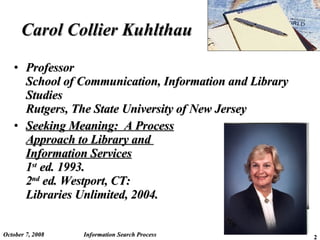
Carol Collier Kuhlthau Professor School of Communication, Information and Library Studies Rutgers, The State University of New Jersey Seeking Meaning:  A Process Approach to Library and  Information Services 1 st  ed. 1993. 2 nd  ed. Westport, CT:  Libraries Unlimited, 2004. June 5, 2009 Information Search Process
An empirically-based theory A qualitative beginning The initial study addressed the problem of understanding the user’s experience in the process of seeking information. The study was conducted in a large eastern [United States], suburban high school with a group of 25 academically capable high school seniors (1983). The qualitative methods used were journals, search logs, short written statements, case study interviews and conceptual maps, and the teacher’s assessment of focus in the students’ papers. June 5, 2009 Information Search Process
Grounded Theory A description of the search process was sought through the data collected from . . . students’ journals, search logs, and writings as well as the case study subjects’ interviews, timelines and flowcharts . . . Six categories of characteristics were sought for each stage: Task, thoughts, feelings, actions, strategies and mood. Common patterns in the experience of this small, specialized group were noted when they were articulated and could be documented. June 5, 2009 Information Search Process
Pattern of 6 stages: Stage 1 Task initiation Feelings of uncertainty and apprehension Preparing to select a topic within the assigned problem Need to understand the assignment and relate it to personal experience June 5, 2009 Information Search Process
Stage 2 Topic selection Optimism once topic selected Apprehension if topic not selected quickly June 5, 2009 Information Search Process
Stage 3 Exploration to gain a focus Feelings of confusion grow with the discovery of the complexity of the topic For some, a desire to abandon the topic and find another one June 5, 2009 Information Search Process
Stage 4 Focus formulation Feelings of relief:  the turning point now reached When focus not found, the student had difficulties throughout the assignment June 5, 2009 Information Search Process
Stage 5 Collecting information on the focus Sense of direction and feelings of confidence Increased interest in the topic June 5, 2009 Information Search Process
Stage 6 Conclusion of the search and start of the writing process Sources found diminish in relevance Sources found begin to be repetitive Feelings that enough effort has been made to find sources Time constraints June 5, 2009 Information Search Process
Studies to verify Large-scale studies 147 participants from diverse backgrounds and abilities in 6 New Jersey high schools (1988) 385 academic, public and school library users at 21 sites (1989) Longitudinal study (1989) Quantitative:  25 from first study; survey at beginning of last year in high school and at last year of university, 5 years later Qualitative:  in-depth  case studies of 4 of the above students during the 4 years of university study. June 5, 2009 Information Search Process
Six stages of the final model: Stage 1 Task initiation Essential element:  presence of an information need, generally from an imposed assignment Feelings:  uncertainty Actions:  exploring information within parameters of the assignment/project June 5, 2009 Information Search Process
Stage 2 Selection of a topic Criteria for selecting a topic: Personal interest, requirements of the assignment, information available and time allotted Feelings:  optimism Thoughts: vague Actions:  exploratory seeking  June 5, 2009 Information Search Process
Stage 3 Exploration Searching from general to specific, though often without a clear plan Feelings:  confusion/frustration/doubt Thoughts:  still vague, but becoming clearer Actions:  exploratory seeking  June 5, 2009 Information Search Process
Stage 4 Formulation Development of a focus that provides direction for the collection of information Feelings:  clarity Thoughts:  becoming increasingly clearer Actions: searching becoming progressively more directed to selection of relevant sources June 5, 2009 Information Search Process
Stage 5 Collection Development of a sense of ownership, personal interest in topic Feelings:  sense of direction/confidence Thoughts:  focused, with an increased interest Actions:  seeking pertinent information; documenting and recording; developing outline for presentation June 5, 2009 Information Search Process
Final stage: 6 Presentation Organization of information for communication to others Feelings:  satisfaction (or disappointment) Thoughts:  interest, ownership of ideas/information  Actions:  outlining, expansion, final searching June 5, 2009 Information Search Process
Implication for mediation by librarians Know the appropriate zone of intervention “ Zone of intervention”:  that area in which an information user can do with advice and assistance what he or she cannot do alone or can do only with great difficulty. Exact nature of zone and the nature of the help needed must be determined through a reference interview June 5, 2009 Information Search Process
Extending the ISP Guided Inquiry Guided Inquiry is carefully planned, closely supervised targeted intervention of an instructional team of school librarians and teachers to guide students through curriculum based inquiry units that build deep knowledge and deep understanding of a curriculum topic, and gradually lead towards independent learning.  What is Guided Inquiry? June 5, 2009 Information Search Process
Six principles of Guided Inquiry Students learn by being actively engaged and reflecting on that experience   Students learn by building on what they already know Students develop higher order thinking through guidance at critical points in the learning process
Six principles Students have different ways of learning Students have different ways and modes of learning Students learn through social interaction with others Students’ development occurs in a sequence of stages Children learn through instruction and experience in accord with their cognitive  development
Implementing Guided Inquiry Effective inquiry through the school library is guided and structured Guided Inquiry revolves around mediation and intervention. The Information Search Process provides a useful framework for understanding students’ journey of information seeking and use, and a basis for guiding and intervening to ensure learning is meaningful
Guided Inquiry Implementation (cont.) Effective inquiry through the school library is shared. Specific interventions are determined by the stage of the search process, the affective, cognitive and behavioral needs of the learners, and the curriculum standards and goals to be achieved Guided Inquiry is an opportunity for the school to provide some comprehensive evidence of how the teaching and learning focus of the school library improves student learning outcomes
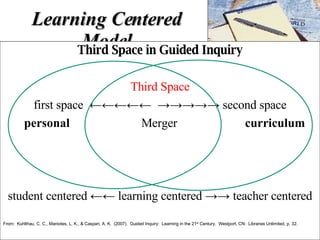
Learning Centered Model Third Space in Guided Inquiry Third Space first space  ←←←←←  ->->->->-> second space personal     Merger     curriculum student centered ←← learning centered ->-> teacher centered From:  Kuhlthau, C. C., Maniotes, L. K., & Caspari, A. K.  (2007).  Guided Inquiry:  Learning in the 21 st  Century.  Westport, CN:  Libraries Unlimited, p. 32.
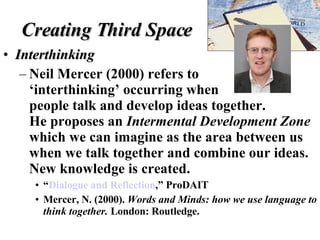
Creating Third Space Interthinking Neil Mercer (2000) refers to  ‘interthinking’ occurring when  people talk and develop ideas together.  He proposes an  Intermental Development Zone  which we can imagine as the area between us when we talk together and combine our ideas. New knowledge is created. “ Dialogue and Reflection ,” ProDAIT  Mercer, N. (2000).  Words and Minds: how we use language to think together.  London: Routledge.
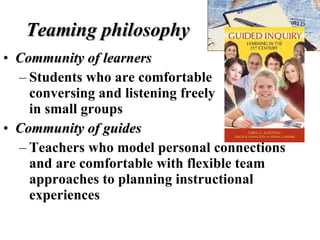
Teaming philosophy Community of learners Students who are comfortable  conversing and listening freely  in small groups Community of guides Teachers who model personal connections and are comfortable with flexible team approaches to planning instructional experiences
 
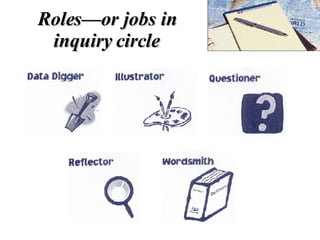
Community of learners Inquiry Circles  (AKA  Information Circles ) select relevant non-fiction resources on a specific topic for the students or guide students to select their own resources  introduce roles by distributing the role description and modelling their job in action  organize students into goups of 4 or 5 for a designated block of time; switch roles at the end of the time block or as needed  provide students with folders to help keep information organized  Taken from  Info Tasks for Successful Learning   by Carol Koechlin and Sandi Zwaan.
Roles—or jobs in inquiry circle
 

Guided Inquiry

  • 1.
    Kuhlthau’s Information SearchProcess and Guided Inquiry Johan Koren Murray State University LIB 601 Libraries and Learning Fall 2008
  • 2.
    Carol Collier KuhlthauProfessor School of Communication, Information and Library Studies Rutgers, The State University of New Jersey Seeking Meaning: A Process Approach to Library and Information Services 1 st ed. 1993. 2 nd ed. Westport, CT: Libraries Unlimited, 2004. June 5, 2009 Information Search Process
  • 3.
    An empirically-based theoryA qualitative beginning The initial study addressed the problem of understanding the user’s experience in the process of seeking information. The study was conducted in a large eastern [United States], suburban high school with a group of 25 academically capable high school seniors (1983). The qualitative methods used were journals, search logs, short written statements, case study interviews and conceptual maps, and the teacher’s assessment of focus in the students’ papers. June 5, 2009 Information Search Process
  • 4.
    Grounded Theory Adescription of the search process was sought through the data collected from . . . students’ journals, search logs, and writings as well as the case study subjects’ interviews, timelines and flowcharts . . . Six categories of characteristics were sought for each stage: Task, thoughts, feelings, actions, strategies and mood. Common patterns in the experience of this small, specialized group were noted when they were articulated and could be documented. June 5, 2009 Information Search Process
  • 5.
    Pattern of 6stages: Stage 1 Task initiation Feelings of uncertainty and apprehension Preparing to select a topic within the assigned problem Need to understand the assignment and relate it to personal experience June 5, 2009 Information Search Process
  • 6.
    Stage 2 Topicselection Optimism once topic selected Apprehension if topic not selected quickly June 5, 2009 Information Search Process
  • 7.
    Stage 3 Explorationto gain a focus Feelings of confusion grow with the discovery of the complexity of the topic For some, a desire to abandon the topic and find another one June 5, 2009 Information Search Process
  • 8.
    Stage 4 Focusformulation Feelings of relief: the turning point now reached When focus not found, the student had difficulties throughout the assignment June 5, 2009 Information Search Process
  • 9.
    Stage 5 Collectinginformation on the focus Sense of direction and feelings of confidence Increased interest in the topic June 5, 2009 Information Search Process
  • 10.
    Stage 6 Conclusionof the search and start of the writing process Sources found diminish in relevance Sources found begin to be repetitive Feelings that enough effort has been made to find sources Time constraints June 5, 2009 Information Search Process
  • 11.
    Studies to verifyLarge-scale studies 147 participants from diverse backgrounds and abilities in 6 New Jersey high schools (1988) 385 academic, public and school library users at 21 sites (1989) Longitudinal study (1989) Quantitative: 25 from first study; survey at beginning of last year in high school and at last year of university, 5 years later Qualitative: in-depth case studies of 4 of the above students during the 4 years of university study. June 5, 2009 Information Search Process
  • 12.
    Six stages ofthe final model: Stage 1 Task initiation Essential element: presence of an information need, generally from an imposed assignment Feelings: uncertainty Actions: exploring information within parameters of the assignment/project June 5, 2009 Information Search Process
  • 13.
    Stage 2 Selectionof a topic Criteria for selecting a topic: Personal interest, requirements of the assignment, information available and time allotted Feelings: optimism Thoughts: vague Actions: exploratory seeking June 5, 2009 Information Search Process
  • 14.
    Stage 3 ExplorationSearching from general to specific, though often without a clear plan Feelings: confusion/frustration/doubt Thoughts: still vague, but becoming clearer Actions: exploratory seeking June 5, 2009 Information Search Process
  • 15.
    Stage 4 FormulationDevelopment of a focus that provides direction for the collection of information Feelings: clarity Thoughts: becoming increasingly clearer Actions: searching becoming progressively more directed to selection of relevant sources June 5, 2009 Information Search Process
  • 16.
    Stage 5 CollectionDevelopment of a sense of ownership, personal interest in topic Feelings: sense of direction/confidence Thoughts: focused, with an increased interest Actions: seeking pertinent information; documenting and recording; developing outline for presentation June 5, 2009 Information Search Process
  • 17.
    Final stage: 6Presentation Organization of information for communication to others Feelings: satisfaction (or disappointment) Thoughts: interest, ownership of ideas/information Actions: outlining, expansion, final searching June 5, 2009 Information Search Process
  • 18.
    Implication for mediationby librarians Know the appropriate zone of intervention “ Zone of intervention”: that area in which an information user can do with advice and assistance what he or she cannot do alone or can do only with great difficulty. Exact nature of zone and the nature of the help needed must be determined through a reference interview June 5, 2009 Information Search Process
  • 19.
    Extending the ISPGuided Inquiry Guided Inquiry is carefully planned, closely supervised targeted intervention of an instructional team of school librarians and teachers to guide students through curriculum based inquiry units that build deep knowledge and deep understanding of a curriculum topic, and gradually lead towards independent learning. What is Guided Inquiry? June 5, 2009 Information Search Process
  • 20.
    Six principles ofGuided Inquiry Students learn by being actively engaged and reflecting on that experience Students learn by building on what they already know Students develop higher order thinking through guidance at critical points in the learning process
  • 21.
    Six principles Studentshave different ways of learning Students have different ways and modes of learning Students learn through social interaction with others Students’ development occurs in a sequence of stages Children learn through instruction and experience in accord with their cognitive development
  • 22.
    Implementing Guided InquiryEffective inquiry through the school library is guided and structured Guided Inquiry revolves around mediation and intervention. The Information Search Process provides a useful framework for understanding students’ journey of information seeking and use, and a basis for guiding and intervening to ensure learning is meaningful
  • 23.
    Guided Inquiry Implementation(cont.) Effective inquiry through the school library is shared. Specific interventions are determined by the stage of the search process, the affective, cognitive and behavioral needs of the learners, and the curriculum standards and goals to be achieved Guided Inquiry is an opportunity for the school to provide some comprehensive evidence of how the teaching and learning focus of the school library improves student learning outcomes
  • 24.
    Learning Centered ModelThird Space in Guided Inquiry Third Space first space ←←←←← ->->->->-> second space personal Merger curriculum student centered ←← learning centered ->-> teacher centered From: Kuhlthau, C. C., Maniotes, L. K., & Caspari, A. K. (2007). Guided Inquiry: Learning in the 21 st Century. Westport, CN: Libraries Unlimited, p. 32.
  • 25.
    Creating Third SpaceInterthinking Neil Mercer (2000) refers to ‘interthinking’ occurring when people talk and develop ideas together. He proposes an Intermental Development Zone which we can imagine as the area between us when we talk together and combine our ideas. New knowledge is created. “ Dialogue and Reflection ,” ProDAIT Mercer, N. (2000). Words and Minds: how we use language to think together. London: Routledge.
  • 26.
    Teaming philosophy Communityof learners Students who are comfortable conversing and listening freely in small groups Community of guides Teachers who model personal connections and are comfortable with flexible team approaches to planning instructional experiences
  • 27.
  • 28.
    Community of learnersInquiry Circles (AKA Information Circles ) select relevant non-fiction resources on a specific topic for the students or guide students to select their own resources introduce roles by distributing the role description and modelling their job in action organize students into goups of 4 or 5 for a designated block of time; switch roles at the end of the time block or as needed provide students with folders to help keep information organized Taken from Info Tasks for Successful Learning by Carol Koechlin and Sandi Zwaan.
  • 29.
    Roles—or jobs ininquiry circle
  • 30.