
Phenessa A. Jones,  MSLS FINDS: Research for Language Arts
Objectives Today, you will: Define Information Literacy Identify stages of the FINDS Research Model Review a sample lesson plan using FINDS Determine FINDS questions to think about Create a plan for using the FINDS Model
R U E-Literate? Compliments of University of California
Think-Pair-Share Question Think about what information means to you. How would you define Information Literacy? Why is accurate information important?
Information Literacy “ To be information literate, a person must be able to recognize when information is needed and have the ability to locate, evaluate, and use effectively the information needed.” American Library Association, 1998
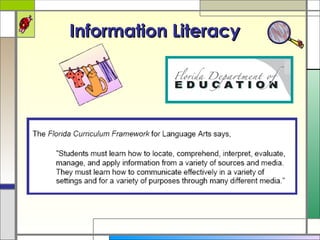
Information Literacy
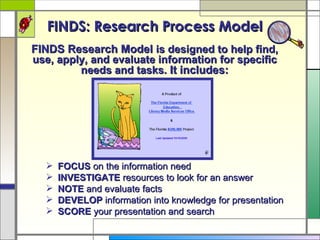
FINDS: Research Process Model FOCUS  on the information need INVESTIGATE  resources to look for an answer NOTE  and evaluate facts DEVELOP  information into knowledge for presentation SCORE  your presentation and search FINDS Research Model  is designed to help find, use, apply, and evaluate information for specific needs and tasks.  It includes:
Sample Lesson Plan ReadWriteThink: Biography Project
FINDS Questions to Think about…
What is my assignment or the information problem to be solved?                                                                                       
What are my questions and/or thesis sentence?
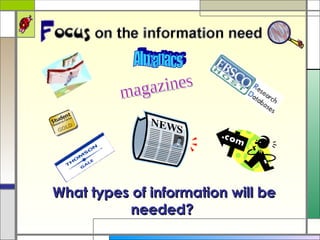
What types of information will be needed?   magazines Almanacs
How will I organize my search plan?
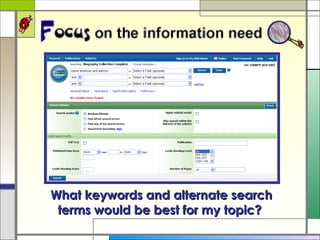
What keywords and alternate search terms would be best for my topic?
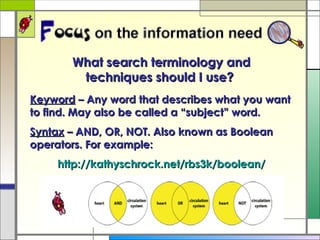
What search terminology and techniques should I use?  Keyword  – Any word that describes what you want to find. May also be called a “subject” word. Syntax  – AND, OR, NOT. Also known as Boolean operators. For example: http://kathyschrock.net/rbs3k/boolean/
What are the best sources of information to investigate and explore for your answers?
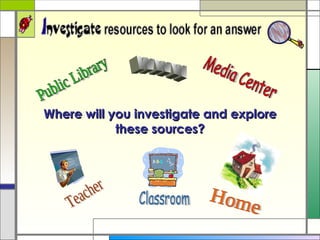
WWW Public Library Classroom Teacher Home Media Center Where will you investigate and explore these sources?
If you will be using the World Wide Web, what search engine(s) will you use to investigate and gather your information?
Where is the information within each source and how do I locate it?  Who What When Where Why
What online database(s) will you use to investigate and explore your information?
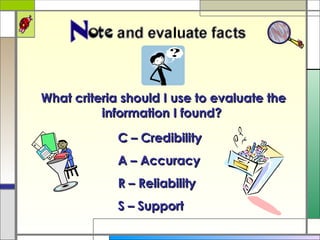
What criteria should I use to evaluate the information I found?  C – Credibility  A – Accuracy  R – Reliability  S – Support
Does the information I found relate to my topic and questions?
How do I take notes so that they are in my own words?
Which facts do I need to create a citation for each source?
Do I have facts from all points of view on my topic?
Do I have the information I need and is my research complete?  WWW
How should I present the information to best share what I learned with others?
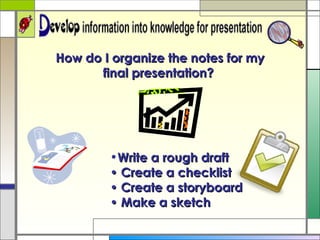
How do I organize the notes for my final presentation?  Write a rough draft • Create a checklist • Create a storyboard • Make a sketch
Have I analyzed and used the information effectively?
Are my conclusions based on the research evidence?
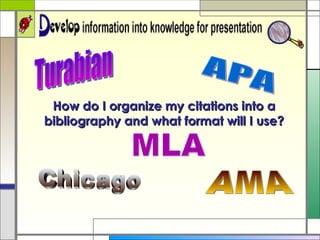
How do I organize my citations into a bibliography and what format will I use?   APA MLA AMA Turabian Chicago
How do I integrate technology to enrich, publish, or present my project?
What criteria will I use to judge my product?
Did I present the information in the best way?
Was my research process efficient and effective?
How could I improve my search process next time?
THANK YOU The Florida SUNLINK Project is a product of the Florida Department of Education, Library Media Services Office:  http://www.sunlink.ucf.edu/finds /

Finds Research For Language Arts

  • 1.
    Phenessa A. Jones, MSLS FINDS: Research for Language Arts
  • 2.
    Objectives Today, youwill: Define Information Literacy Identify stages of the FINDS Research Model Review a sample lesson plan using FINDS Determine FINDS questions to think about Create a plan for using the FINDS Model
  • 3.
    R U E-Literate?Compliments of University of California
  • 4.
    Think-Pair-Share Question Thinkabout what information means to you. How would you define Information Literacy? Why is accurate information important?
  • 5.
    Information Literacy “To be information literate, a person must be able to recognize when information is needed and have the ability to locate, evaluate, and use effectively the information needed.” American Library Association, 1998
  • 6.
  • 7.
    FINDS: Research ProcessModel FOCUS on the information need INVESTIGATE resources to look for an answer NOTE and evaluate facts DEVELOP information into knowledge for presentation SCORE your presentation and search FINDS Research Model is designed to help find, use, apply, and evaluate information for specific needs and tasks. It includes:
  • 8.
    Sample Lesson PlanReadWriteThink: Biography Project
  • 9.
    FINDS Questions toThink about…
  • 10.
    What is myassignment or the information problem to be solved?                                                                                   
  • 11.
    What are myquestions and/or thesis sentence?
  • 12.
    What types ofinformation will be needed? magazines Almanacs
  • 13.
    How will Iorganize my search plan?
  • 14.
    What keywords andalternate search terms would be best for my topic?
  • 15.
    What search terminologyand techniques should I use? Keyword – Any word that describes what you want to find. May also be called a “subject” word. Syntax – AND, OR, NOT. Also known as Boolean operators. For example: http://kathyschrock.net/rbs3k/boolean/
  • 16.
    What are thebest sources of information to investigate and explore for your answers?
  • 17.
    WWW Public LibraryClassroom Teacher Home Media Center Where will you investigate and explore these sources?
  • 18.
    If you willbe using the World Wide Web, what search engine(s) will you use to investigate and gather your information?
  • 19.
    Where is theinformation within each source and how do I locate it? Who What When Where Why
  • 20.
    What online database(s)will you use to investigate and explore your information?
  • 21.
    What criteria shouldI use to evaluate the information I found? C – Credibility A – Accuracy R – Reliability S – Support
  • 22.
    Does the informationI found relate to my topic and questions?
  • 23.
    How do Itake notes so that they are in my own words?
  • 24.
    Which facts doI need to create a citation for each source?
  • 25.
    Do I havefacts from all points of view on my topic?
  • 26.
    Do I havethe information I need and is my research complete? WWW
  • 27.
    How should Ipresent the information to best share what I learned with others?
  • 28.
    How do Iorganize the notes for my final presentation? Write a rough draft • Create a checklist • Create a storyboard • Make a sketch
  • 29.
    Have I analyzedand used the information effectively?
  • 30.
    Are my conclusionsbased on the research evidence?
  • 31.
    How do Iorganize my citations into a bibliography and what format will I use? APA MLA AMA Turabian Chicago
  • 32.
    How do Iintegrate technology to enrich, publish, or present my project?
  • 33.
    What criteria willI use to judge my product?
  • 34.
    Did I presentthe information in the best way?
  • 35.
    Was my researchprocess efficient and effective?
  • 36.
    How could Iimprove my search process next time?
  • 37.
    THANK YOU TheFlorida SUNLINK Project is a product of the Florida Department of Education, Library Media Services Office: http://www.sunlink.ucf.edu/finds /