The Research Process
A six step research inquiry process
The Information Process

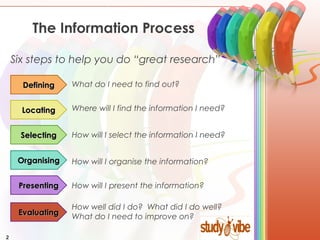
    Six steps to help you do “great research”

      Defining    What do I need to find out?


      Locating    Where will I find the information I need?


      Selecting   How will I select the information I need?


     Organising   How will I organise the information?


     Presenting   How will I present the information?

                  How well did I do? What did I do well?
     Evaluating   What do I need to improve on?

2
Defining the task
        Know exactly what it is that you are
                 required to do.
    When you first get your
    research project, it is worth
    spending the time getting
    REALLY CLEAR on what you

    are expected to do.

    It will make the other stages
    of the process much easier.

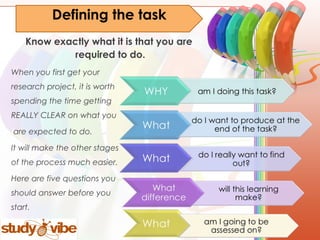
    Here are five questions you
    should answer before you
    start.


3
The question is the answer
    The questions you create will define
     how you approach your research.
     Great questions will lead to great
     research.


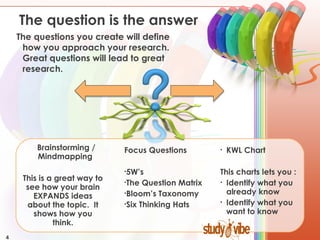
        Brainstorming /       Focus Questions         •   KWL Chart
        Mindmapping
                              •5W’s                   This charts lets you :
     This is a great way to   •The  Question Matrix   • Identify what you
      see how your brain
                              •Bloom’s Taxonomy         already know
        EXPANDS ideas
                              •Six Thinking Hats      • Identify what you
      about the topic. It
        shows how you                                   want to know
              think.
4
In the DEFINING stage…..
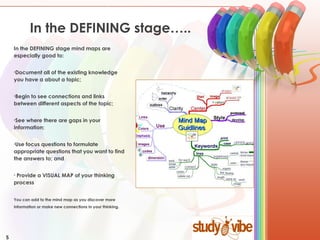
    In the DEFINING stage mind maps are
    especially good to:

    •Document all of the existing knowledge
    you have a about a topic;


    •Begin
         to see connections and links
    between different aspects of the topic;


    •See where there are gaps in your
    information;


    •Use focus questions to formulate
    appropriate questions that you want to find
    the answers to; and


    •Provide a VISUAL MAP of your thinking
    process


    You can add to the mind map as you discover more
    information or make new connections in your thinking.


5
The 5 W’s
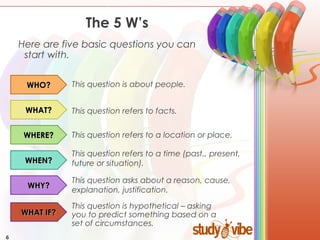
    Here are five basic questions you can
     start with.


     WHO?      This question is about people.


     WHAT?     This question refers to facts.


     WHERE?    This question refers to a location or place.

               This question refers to a time (past., present,
     WHEN?     future or situation).

               This question asks about a reason, cause,
     WHY?
               explanation, justification.

               This question is hypothetical – asking
    WHAT IF?   you to predict something based on a
               set of circumstances.
6
The Question Matrix
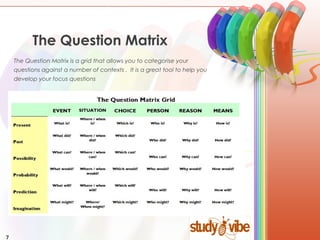
    The Question Matrix is a grid that allows you to categorise your
    questions against a number of contexts . It is a great tool to help you
    develop your focus questions


7
Locating Resources
    When doing your
     research you will find
     that different sources
     have a different
     purpose and
     audience. For
     example an
     encyclopedia article is
     very different to a
     journal article which is
     different again to a
     brochure.
    Pick the information
     source that best suits
     your task.
8
Sources of information
    Different ways of looking at information
There are many different
sources of information. Try
to utilise all of these when
you get the opportunity.

Do NOT underestimate the
value of primary sources.

More and more the
internet is taking primary
sources and converting
them to an electronic
form:
•Virtual Tours
•Videos of interviews
•Digital versions of “real”
documents”


9
Graphic Organisers
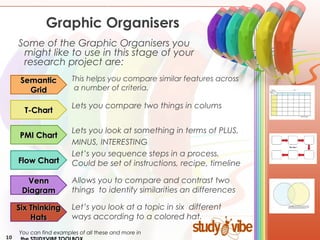
     Some of the Graphic Organisers you
      might like to use in this stage of your
      research project are:
      Semantic          This helps you compare similar features across
        Grid             a number of criteria.

                        Lets you compare two things in colums
       T-Chart

                        Lets you look at something in terms of PLUS,
     PMI Chart
                        MINUS, INTERESTING
                        Let’s you sequence steps in a process.
     Flow Chart         Could be set of instructions, recipe, timeline

       Venn             Allows you to compare and contrast two
      Diagram           things to identify similarities an differences

     Six Thinking       Let’s you look at a topic in six different
         Hats           ways according to a colored hat.
     You can find examples of all these and more in
10
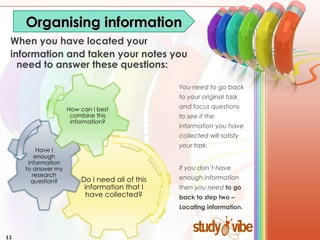
Organising information
 When you have located your
 information and taken your notes you
   need to answer these questions:

                                   You need to go back
                                   to your original task
                                   and focus questions
                                   to see if the
                                   information you have
                                   collected will satisfy
                                   your task.


                                   If you don’t have
                                   enough information
                                   then you need to go
                                   back to step two –
                                   Locating information.


11
Presenting information
     The way you present your information will
       depend upon:


       • Your research task requirements
       Is the presentation format set or can you
         choose how you present your work?


       •Your audience
       Who are you presenting the work to? Is your
        presentation format relevant?

           •The purpose of the task
           What was the purpose of the task?
           To inform? To entertain?
           To persuade?
12
Presenting information
     Here are just a few presentation ideas
that you might like to try for your final product /
  presentation. They can be traditional or digital


                                                       Also check out
                                                        the ‘Creative
                                                      Output” module n
                                                        iResearch for
                                                         some great
                                                        presentation
                                                            ideas.


13
Evaluating
      This is probably one of the most important stages of the
        whole research process because it helps you to work
        out how well you did. Here are some questions you can
        ask?


     1.What    did I learn from this task?
     2.How     is this learning going to help me?
     3.Did   I answer all of my focus questions?
     4.How     well did I go at each stage?
     5.How     well did I present my information?
     6.What    did I really do well?
     7.What    needs to be improved next time?


14
Don’t forget to reference!!
This really shouldn’t come at the end…..

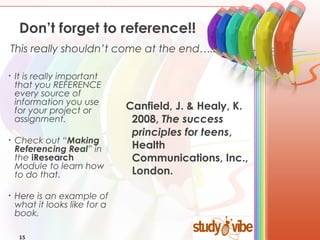
•   It is really important
    that you REFERENCE
    every source of
    information you use
    for your project or        Canfield, J. & Healy, K.
    assignment.                 2008, The success
                                principles for teens,
•   Check out “Making
    Referencing Real” in        Health
    the iResearch               Communications, Inc.,
    Module to learn how
    to do that.                 London.

•   Here is an example of
    what it looks like for a
    book.

     15
Where to from here?
      OK, you have done your research
       project. So now what?

                 Celebrate your success!!


                             Think about ways you
     Focus on what you       can build on what
     want to improve for     you have learnt to
     next time.              make your next
                             project bigger and
         But most of
                             better.
        all…have fun
          with your
         research!!


16

iResearch - The Research Process

  • 1.
    The Research Process Asix step research inquiry process
  • 2.
    The Information Process Six steps to help you do “great research” Defining What do I need to find out? Locating Where will I find the information I need? Selecting How will I select the information I need? Organising How will I organise the information? Presenting How will I present the information? How well did I do? What did I do well? Evaluating What do I need to improve on? 2
  • 3.
    Defining the task Know exactly what it is that you are required to do. When you first get your research project, it is worth spending the time getting REALLY CLEAR on what you are expected to do. It will make the other stages of the process much easier. Here are five questions you should answer before you start. 3
  • 4.
    The question isthe answer The questions you create will define how you approach your research. Great questions will lead to great research. Brainstorming / Focus Questions • KWL Chart Mindmapping •5W’s This charts lets you : This is a great way to •The Question Matrix • Identify what you see how your brain •Bloom’s Taxonomy already know EXPANDS ideas •Six Thinking Hats • Identify what you about the topic. It shows how you want to know think. 4
  • 5.
    In the DEFININGstage….. In the DEFINING stage mind maps are especially good to: •Document all of the existing knowledge you have a about a topic; •Begin to see connections and links between different aspects of the topic; •See where there are gaps in your information; •Use focus questions to formulate appropriate questions that you want to find the answers to; and •Provide a VISUAL MAP of your thinking process You can add to the mind map as you discover more information or make new connections in your thinking. 5
  • 6.
    The 5 W’s Here are five basic questions you can start with. WHO? This question is about people. WHAT? This question refers to facts. WHERE? This question refers to a location or place. This question refers to a time (past., present, WHEN? future or situation). This question asks about a reason, cause, WHY? explanation, justification. This question is hypothetical – asking WHAT IF? you to predict something based on a set of circumstances. 6
  • 7.
    The Question Matrix The Question Matrix is a grid that allows you to categorise your questions against a number of contexts . It is a great tool to help you develop your focus questions 7
  • 8.
    Locating Resources When doing your research you will find that different sources have a different purpose and audience. For example an encyclopedia article is very different to a journal article which is different again to a brochure. Pick the information source that best suits your task. 8
  • 9.
    Sources of information Different ways of looking at information There are many different sources of information. Try to utilise all of these when you get the opportunity. Do NOT underestimate the value of primary sources. More and more the internet is taking primary sources and converting them to an electronic form: •Virtual Tours •Videos of interviews •Digital versions of “real” documents” 9
  • 10.
    Graphic Organisers Some of the Graphic Organisers you might like to use in this stage of your research project are: Semantic This helps you compare similar features across Grid a number of criteria. Lets you compare two things in colums T-Chart Lets you look at something in terms of PLUS, PMI Chart MINUS, INTERESTING Let’s you sequence steps in a process. Flow Chart Could be set of instructions, recipe, timeline Venn Allows you to compare and contrast two Diagram things to identify similarities an differences Six Thinking Let’s you look at a topic in six different Hats ways according to a colored hat. You can find examples of all these and more in 10
  • 11.
    Organising information Whenyou have located your information and taken your notes you need to answer these questions: You need to go back to your original task and focus questions to see if the information you have collected will satisfy your task. If you don’t have enough information then you need to go back to step two – Locating information. 11
  • 12.
    Presenting information The way you present your information will depend upon: • Your research task requirements Is the presentation format set or can you choose how you present your work? •Your audience Who are you presenting the work to? Is your presentation format relevant? •The purpose of the task What was the purpose of the task? To inform? To entertain? To persuade? 12
  • 13.
    Presenting information Here are just a few presentation ideas that you might like to try for your final product / presentation. They can be traditional or digital Also check out the ‘Creative Output” module n iResearch for some great presentation ideas. 13
  • 14.
    Evaluating This is probably one of the most important stages of the whole research process because it helps you to work out how well you did. Here are some questions you can ask? 1.What did I learn from this task? 2.How is this learning going to help me? 3.Did I answer all of my focus questions? 4.How well did I go at each stage? 5.How well did I present my information? 6.What did I really do well? 7.What needs to be improved next time? 14
  • 15.
    Don’t forget toreference!! This really shouldn’t come at the end….. • It is really important that you REFERENCE every source of information you use for your project or Canfield, J. & Healy, K. assignment. 2008, The success principles for teens, • Check out “Making Referencing Real” in Health the iResearch Communications, Inc., Module to learn how to do that. London. • Here is an example of what it looks like for a book. 15
  • 16.
    Where to fromhere? OK, you have done your research project. So now what? Celebrate your success!! Think about ways you Focus on what you can build on what want to improve for you have learnt to next time. make your next project bigger and But most of better. all…have fun with your research!! 16