LEARNING OUTCOMES
 Describe the disease process of Crohn’s versus Ulcerative Colitis.Describe the disease process of Crohn’s versus Ulcerative Colitis.
 Identify the clinical presentation of a patient with Crohn’s DiseaseIdentify the clinical presentation of a patient with Crohn’s Disease
and Ulcerative Colitis.and Ulcerative Colitis.
 Discuss the various diagnostic workups and how they mayDiscuss the various diagnostic workups and how they may
differentiate Crohn’s & U.C. from other GI ailments.differentiate Crohn’s & U.C. from other GI ailments.
 Select appropriate treatments for a patient with Crohn’s DiseaseSelect appropriate treatments for a patient with Crohn’s Disease
and Ulcerative Colitis.and Ulcerative Colitis.
DEFINITION
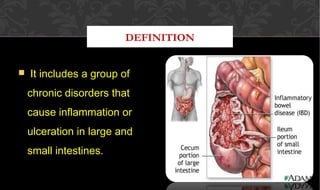
 It includes a group ofIt includes a group of
chronic disorders thatchronic disorders that
cause inflammation orcause inflammation or
ulceration in large andulceration in large and
small intestines.small intestines.
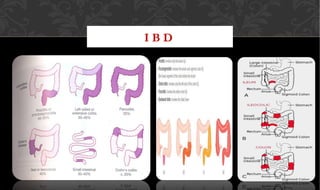
TYPES OF IBD
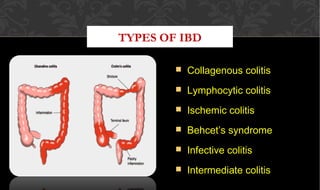
 Collagenous colitisCollagenous colitis
 Lymphocytic colitisLymphocytic colitis
 Ischemic colitisIschemic colitis
 Behcet’s syndromeBehcet’s syndrome
 Infective colitisInfective colitis
 Intermediate colitisIntermediate colitis
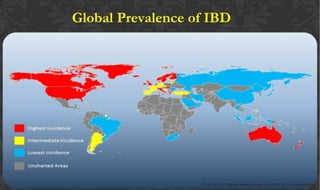
Global Prevalence of IBD
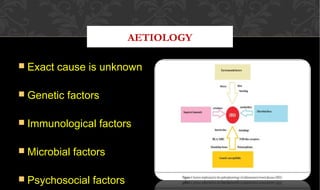
AETIOLOGY
 Exact cause is unknownExact cause is unknown
 Genetic factorsGenetic factors
 Immunological factorsImmunological factors
 Microbial factorsMicrobial factors
 Psychosocial factorsPsychosocial factors
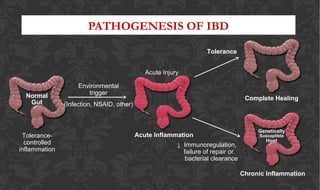
PATHOGENESIS OF IBD
Normal
Gut
Tolerance-
controlled
inflammation
Environmental
trigger
(Infection, NSAID, other)
Acute Injury
Complete Healing
Chronic Inflammation
Genetically
Susceptible
Host
Acute Inflammation
↓ Immunoregulation,
failure of repair or
bacterial clearance
Tolerance
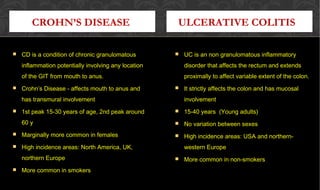
ULCERATIVE COLITIS
 UC is an non granulomatous inflammatoryUC is an non granulomatous inflammatory
disorder that affects the rectum and extendsdisorder that affects the rectum and extends
proximally to affect variable extent of the colon.proximally to affect variable extent of the colon.
 It strictly affects the colon and has mucosalIt strictly affects the colon and has mucosal
involvementinvolvement
 15-40 years (Young adults)15-40 years (Young adults)
 No variation between sexesNo variation between sexes
 High incidence areas: USA and northern-High incidence areas: USA and northern-
western Europewestern Europe
 More common in non-smokersMore common in non-smokers
 CD is a condition of chronic granulomatousCD is a condition of chronic granulomatous
inflammation potentially involving any locationinflammation potentially involving any location
of the GIT from mouth to anus.of the GIT from mouth to anus.
 Crohn’s Disease - affects mouth to anus andCrohn’s Disease - affects mouth to anus and
has transmural involvementhas transmural involvement
 1st peak 15-30 years of age, 2nd peak around1st peak 15-30 years of age, 2nd peak around
60 y60 y
 Marginally more common in femalesMarginally more common in females
 High incidence areas: North America, UK,High incidence areas: North America, UK,
northern Europenorthern Europe
 More common in smokersMore common in smokers
CROHN’S DISEASE
I B D
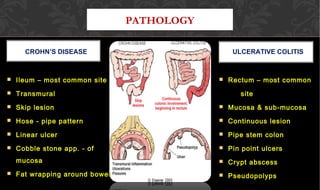
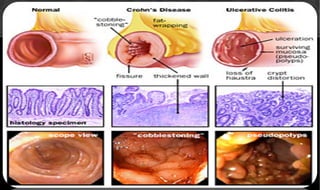
PATHOLOGY
CROHN’S DISEASE ULCERATIVE COLITIS
 Ileum – most common siteIleum – most common site
 TransmuralTransmural
 Skip lesionSkip lesion
 Hose - pipe patternHose - pipe pattern
 Linear ulcerLinear ulcer
 Cobble stone app. - ofCobble stone app. - of
mucosamucosa
 Fat wrapping around bowelFat wrapping around bowel
 Rectum – most commonRectum – most common
sitesite
 Mucosa & sub-mucosaMucosa & sub-mucosa
 Continuous lesionContinuous lesion
 Pipe stem colonPipe stem colon
 Pin point ulcersPin point ulcers
 Crypt abscessCrypt abscess
 PseudopolypsPseudopolyps
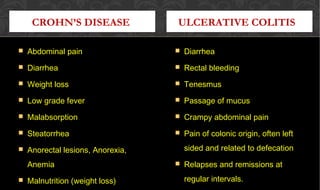
ULCERATIVE COLITISCROHN’S DISEASE
 Abdominal painAbdominal pain
 DiarrheaDiarrhea
 Weight lossWeight loss
 Low grade feverLow grade fever
 MalabsorptionMalabsorption
 SteatorrheaSteatorrhea
 Anorectal lesions, Anorexia,Anorectal lesions, Anorexia,
AnemiaAnemia
 Malnutrition (weight loss)Malnutrition (weight loss)
 DiarrheaDiarrhea
 Rectal bleedingRectal bleeding
 TenesmusTenesmus
 Passage of mucusPassage of mucus
 Crampy abdominal painCrampy abdominal pain
 Pain of colonic origin, often leftPain of colonic origin, often left
sided and related to defecationsided and related to defecation
 Relapses and remissions atRelapses and remissions at
regular intervals.regular intervals.
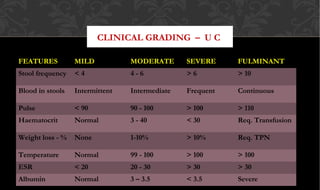
FEATURES MILD MODERATE SEVERE FULMINANT
Stool frequency < 4 4 - 6 > 6 > 10
Blood in stools Intermittent Intermediate Frequent Continuous
Pulse < 90 90 - 100 > 100 > 110
Haematocrit Normal 3 - 40 < 30 Req. Transfusion
Weight loss - % None 1-10% > 10% Req. TPN
Temperature Normal 99 - 100 > 100 > 100
ESR < 20 20 - 30 > 30 > 30
Albumin Normal 3 – 3.5 < 3.5 Severe
CLINICAL GRADING – U C
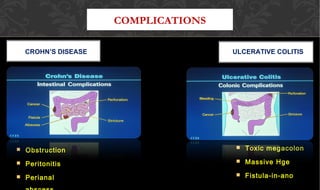
COMPLICATIONS
CROHN’S DISEASE ULCERATIVE COLITIS
 ObstructionObstruction
 PeritonitisPeritonitis
 PerianalPerianal
 Toxic megacolonToxic megacolon
 Massive HgeMassive Hge
 Fistula-in-anoFistula-in-ano
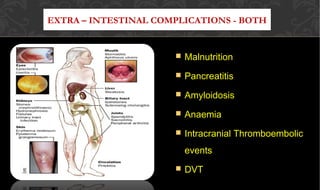
EXTRA – INTESTINAL COMPLICATIONS - BOTH
 MalnutritionMalnutrition
 PancreatitisPancreatitis
 AmyloidosisAmyloidosis
 AnaemiaAnaemia
 Intracranial ThromboembolicIntracranial Thromboembolic
eventsevents
 DVTDVT
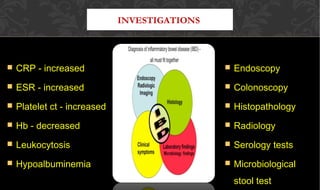
INVESTIGATIONS
 CRP - increasedCRP - increased
 ESR - increasedESR - increased
 Platelet ct - increasedPlatelet ct - increased
 Hb - decreasedHb - decreased
 LeukocytosisLeukocytosis
 HypoalbuminemiaHypoalbuminemia
 EndoscopyEndoscopy
 ColonoscopyColonoscopy
 HistopathologyHistopathology
 RadiologyRadiology
 Serology testsSerology tests
 MicrobiologicalMicrobiological
stool teststool test
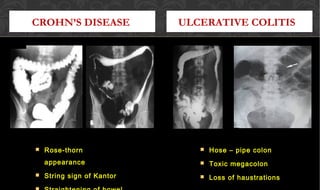
ULCERATIVE COLITISCROHN’S DISEASE
 Hose – pipe colonHose – pipe colon
 Toxic megacolonToxic megacolon
 Loss of haustrationsLoss of haustrations
 Rose-thornRose-thorn
appearanceappearance
 String sign of KantorString sign of Kantor
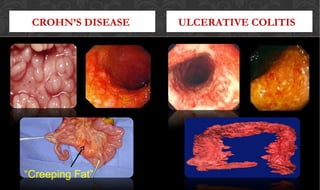
ULCERATIVE COLITISCROHN’S DISEASE
“Creeping Fat”
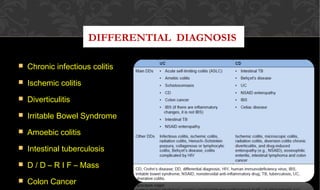
DIFFERENTIAL DIAGNOSIS
 Chronic infectious colitisChronic infectious colitis
 Ischemic colitisIschemic colitis
 DiverticulitisDiverticulitis
 Irritable Bowel SyndromeIrritable Bowel Syndrome
 Amoebic colitisAmoebic colitis
 Intestinal tuberculosisIntestinal tuberculosis
 D / D – R I F – MassD / D – R I F – Mass
 Colon CancerColon Cancer
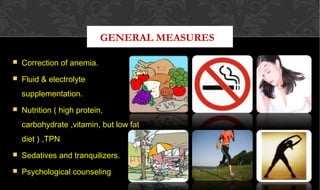
GENERAL MEASURES
 Correction of anemia.Correction of anemia.
 Fluid & electrolyteFluid & electrolyte
supplementation.supplementation.
 Nutrition ( high protein,Nutrition ( high protein,
carbohydrate ,vitamin, but low fatcarbohydrate ,vitamin, but low fat
diet ) ,TPNdiet ) ,TPN
 Sedatives and tranquilizers.Sedatives and tranquilizers.
 Psychological counselingPsychological counseling
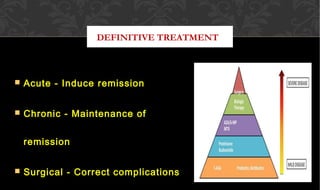
DEFINITIVE TREATMENT
 Acute - Induce remissionAcute - Induce remission
 Chronic - Maintenance ofChronic - Maintenance of
remissionremission
 Surgical - Correct complicationsSurgical - Correct complications
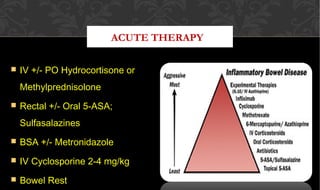
ACUTE THERAPY
 IV +/- PO Hydrocortisone orIV +/- PO Hydrocortisone or
MethylprednisoloneMethylprednisolone
 Rectal +/- Oral 5-ASA;Rectal +/- Oral 5-ASA;
SulfasalazinesSulfasalazines
 BSA +/- MetronidazoleBSA +/- Metronidazole
 IV Cyclosporine 2-4 mg/kgIV Cyclosporine 2-4 mg/kg
 Bowel RestBowel Rest
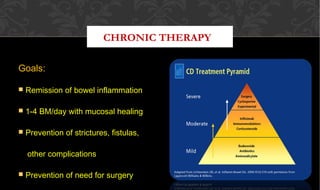
CHRONIC THERAPY
Goals:Goals:
 Remission of bowel inflammationRemission of bowel inflammation
 1-4 BM/day with mucosal healing1-4 BM/day with mucosal healing
 Prevention of strictures, fistulas,Prevention of strictures, fistulas,
other complicationsother complications
 Prevention of need for surgeryPrevention of need for surgery
CROHN’S DISEASE
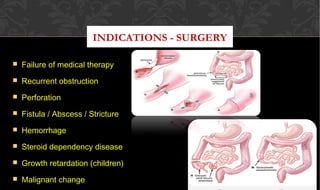
 Failure of medical therapyFailure of medical therapy
 Recurrent obstructionRecurrent obstruction
 PerforationPerforation
 Fistula / Abscess / StrictureFistula / Abscess / Stricture
 HemorrhageHemorrhage
 Steroid dependency diseaseSteroid dependency disease
 Growth retardation (children)Growth retardation (children)
 Malignant changeMalignant change
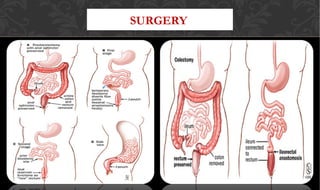
INDICATIONS - SURGERY
SURGERY
REFERENCES
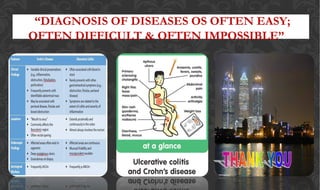
“DIAGNOSIS OF DISEASES OS OFTEN EASY;
OFTEN DIFFICULT & OFTEN IMPOSSIBLE”

Inflammatory Bowel Diseases

  • 2.
    LEARNING OUTCOMES  Describethe disease process of Crohn’s versus Ulcerative Colitis.Describe the disease process of Crohn’s versus Ulcerative Colitis.  Identify the clinical presentation of a patient with Crohn’s DiseaseIdentify the clinical presentation of a patient with Crohn’s Disease and Ulcerative Colitis.and Ulcerative Colitis.  Discuss the various diagnostic workups and how they mayDiscuss the various diagnostic workups and how they may differentiate Crohn’s & U.C. from other GI ailments.differentiate Crohn’s & U.C. from other GI ailments.  Select appropriate treatments for a patient with Crohn’s DiseaseSelect appropriate treatments for a patient with Crohn’s Disease and Ulcerative Colitis.and Ulcerative Colitis.
  • 3.
    DEFINITION  It includesa group ofIt includes a group of chronic disorders thatchronic disorders that cause inflammation orcause inflammation or ulceration in large andulceration in large and small intestines.small intestines.
  • 4.
    TYPES OF IBD Collagenous colitisCollagenous colitis  Lymphocytic colitisLymphocytic colitis  Ischemic colitisIschemic colitis  Behcet’s syndromeBehcet’s syndrome  Infective colitisInfective colitis  Intermediate colitisIntermediate colitis
  • 5.
  • 6.
    AETIOLOGY  Exact causeis unknownExact cause is unknown  Genetic factorsGenetic factors  Immunological factorsImmunological factors  Microbial factorsMicrobial factors  Psychosocial factorsPsychosocial factors
  • 7.
    PATHOGENESIS OF IBD Normal Gut Tolerance- controlled inflammation Environmental trigger (Infection,NSAID, other) Acute Injury Complete Healing Chronic Inflammation Genetically Susceptible Host Acute Inflammation ↓ Immunoregulation, failure of repair or bacterial clearance Tolerance
  • 8.
    ULCERATIVE COLITIS  UCis an non granulomatous inflammatoryUC is an non granulomatous inflammatory disorder that affects the rectum and extendsdisorder that affects the rectum and extends proximally to affect variable extent of the colon.proximally to affect variable extent of the colon.  It strictly affects the colon and has mucosalIt strictly affects the colon and has mucosal involvementinvolvement  15-40 years (Young adults)15-40 years (Young adults)  No variation between sexesNo variation between sexes  High incidence areas: USA and northern-High incidence areas: USA and northern- western Europewestern Europe  More common in non-smokersMore common in non-smokers  CD is a condition of chronic granulomatousCD is a condition of chronic granulomatous inflammation potentially involving any locationinflammation potentially involving any location of the GIT from mouth to anus.of the GIT from mouth to anus.  Crohn’s Disease - affects mouth to anus andCrohn’s Disease - affects mouth to anus and has transmural involvementhas transmural involvement  1st peak 15-30 years of age, 2nd peak around1st peak 15-30 years of age, 2nd peak around 60 y60 y  Marginally more common in femalesMarginally more common in females  High incidence areas: North America, UK,High incidence areas: North America, UK, northern Europenorthern Europe  More common in smokersMore common in smokers CROHN’S DISEASE
  • 9.
  • 10.
    PATHOLOGY CROHN’S DISEASE ULCERATIVECOLITIS  Ileum – most common siteIleum – most common site  TransmuralTransmural  Skip lesionSkip lesion  Hose - pipe patternHose - pipe pattern  Linear ulcerLinear ulcer  Cobble stone app. - ofCobble stone app. - of mucosamucosa  Fat wrapping around bowelFat wrapping around bowel  Rectum – most commonRectum – most common sitesite  Mucosa & sub-mucosaMucosa & sub-mucosa  Continuous lesionContinuous lesion  Pipe stem colonPipe stem colon  Pin point ulcersPin point ulcers  Crypt abscessCrypt abscess  PseudopolypsPseudopolyps
  • 12.
    ULCERATIVE COLITISCROHN’S DISEASE Abdominal painAbdominal pain  DiarrheaDiarrhea  Weight lossWeight loss  Low grade feverLow grade fever  MalabsorptionMalabsorption  SteatorrheaSteatorrhea  Anorectal lesions, Anorexia,Anorectal lesions, Anorexia, AnemiaAnemia  Malnutrition (weight loss)Malnutrition (weight loss)  DiarrheaDiarrhea  Rectal bleedingRectal bleeding  TenesmusTenesmus  Passage of mucusPassage of mucus  Crampy abdominal painCrampy abdominal pain  Pain of colonic origin, often leftPain of colonic origin, often left sided and related to defecationsided and related to defecation  Relapses and remissions atRelapses and remissions at regular intervals.regular intervals.
  • 13.
    FEATURES MILD MODERATESEVERE FULMINANT Stool frequency < 4 4 - 6 > 6 > 10 Blood in stools Intermittent Intermediate Frequent Continuous Pulse < 90 90 - 100 > 100 > 110 Haematocrit Normal 3 - 40 < 30 Req. Transfusion Weight loss - % None 1-10% > 10% Req. TPN Temperature Normal 99 - 100 > 100 > 100 ESR < 20 20 - 30 > 30 > 30 Albumin Normal 3 – 3.5 < 3.5 Severe CLINICAL GRADING – U C
  • 14.
    COMPLICATIONS CROHN’S DISEASE ULCERATIVECOLITIS  ObstructionObstruction  PeritonitisPeritonitis  PerianalPerianal  Toxic megacolonToxic megacolon  Massive HgeMassive Hge  Fistula-in-anoFistula-in-ano
  • 15.
    EXTRA – INTESTINALCOMPLICATIONS - BOTH  MalnutritionMalnutrition  PancreatitisPancreatitis  AmyloidosisAmyloidosis  AnaemiaAnaemia  Intracranial ThromboembolicIntracranial Thromboembolic eventsevents  DVTDVT
  • 16.
    INVESTIGATIONS  CRP -increasedCRP - increased  ESR - increasedESR - increased  Platelet ct - increasedPlatelet ct - increased  Hb - decreasedHb - decreased  LeukocytosisLeukocytosis  HypoalbuminemiaHypoalbuminemia  EndoscopyEndoscopy  ColonoscopyColonoscopy  HistopathologyHistopathology  RadiologyRadiology  Serology testsSerology tests  MicrobiologicalMicrobiological stool teststool test
  • 17.
    ULCERATIVE COLITISCROHN’S DISEASE Hose – pipe colonHose – pipe colon  Toxic megacolonToxic megacolon  Loss of haustrationsLoss of haustrations  Rose-thornRose-thorn appearanceappearance  String sign of KantorString sign of Kantor
  • 18.
  • 19.
    DIFFERENTIAL DIAGNOSIS  Chronicinfectious colitisChronic infectious colitis  Ischemic colitisIschemic colitis  DiverticulitisDiverticulitis  Irritable Bowel SyndromeIrritable Bowel Syndrome  Amoebic colitisAmoebic colitis  Intestinal tuberculosisIntestinal tuberculosis  D / D – R I F – MassD / D – R I F – Mass  Colon CancerColon Cancer
  • 20.
    GENERAL MEASURES  Correctionof anemia.Correction of anemia.  Fluid & electrolyteFluid & electrolyte supplementation.supplementation.  Nutrition ( high protein,Nutrition ( high protein, carbohydrate ,vitamin, but low fatcarbohydrate ,vitamin, but low fat diet ) ,TPNdiet ) ,TPN  Sedatives and tranquilizers.Sedatives and tranquilizers.  Psychological counselingPsychological counseling
  • 21.
    DEFINITIVE TREATMENT  Acute- Induce remissionAcute - Induce remission  Chronic - Maintenance ofChronic - Maintenance of remissionremission  Surgical - Correct complicationsSurgical - Correct complications
  • 22.
    ACUTE THERAPY  IV+/- PO Hydrocortisone orIV +/- PO Hydrocortisone or MethylprednisoloneMethylprednisolone  Rectal +/- Oral 5-ASA;Rectal +/- Oral 5-ASA; SulfasalazinesSulfasalazines  BSA +/- MetronidazoleBSA +/- Metronidazole  IV Cyclosporine 2-4 mg/kgIV Cyclosporine 2-4 mg/kg  Bowel RestBowel Rest
  • 23.
    CHRONIC THERAPY Goals:Goals:  Remissionof bowel inflammationRemission of bowel inflammation  1-4 BM/day with mucosal healing1-4 BM/day with mucosal healing  Prevention of strictures, fistulas,Prevention of strictures, fistulas, other complicationsother complications  Prevention of need for surgeryPrevention of need for surgery
  • 24.
    CROHN’S DISEASE  Failureof medical therapyFailure of medical therapy  Recurrent obstructionRecurrent obstruction  PerforationPerforation  Fistula / Abscess / StrictureFistula / Abscess / Stricture  HemorrhageHemorrhage  Steroid dependency diseaseSteroid dependency disease  Growth retardation (children)Growth retardation (children)  Malignant changeMalignant change INDICATIONS - SURGERY
  • 25.
  • 26.
  • 27.
    “DIAGNOSIS OF DISEASESOS OFTEN EASY; OFTEN DIFFICULT & OFTEN IMPOSSIBLE”