Prof. U.Murali.
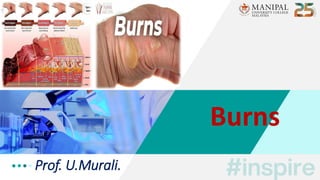
Burns
Learning Objectives
▪ Classify the types of Burns.
▪ Explain the pathophysiology, clinical features & effects of burns.
▪ Identify the assessment methods of a burn's patient.
▪ Identify the immediate care measures of a burn's patient.
▪ Mention the fluid resuscitative methods in treating burns patient.
▪ Outline the general measures in treating a burns patient.
▪ Describe the treatment aspects of Sup. & Deep dermal burns.
▪ Differentiate between electric burns & chemical burns.
Introduction
▪ A burn is an injury caused by thermal, chemical,
electrical, (or) radiation energy.
▪ A scald is a burn caused by contact with a hot liquid
(or) steam, but the term 'burn' is often used to
include scalds.
Introduction
Thermal Injury Others
- Scald – hot liquids
- Flame burns
- Flash burns – exp. Gas / Alcohol
- Contact burns – hot metals
- Electrical injury
- Chemical burns
- Cold injury
- Ionizing Radiation
- Sun burns
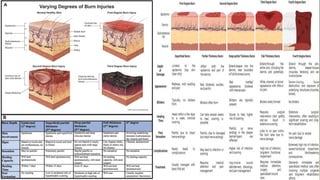
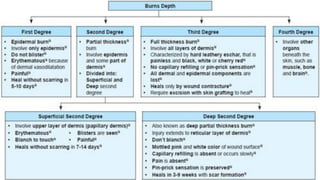
Classification of Burns
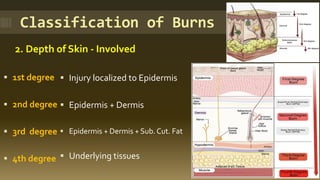
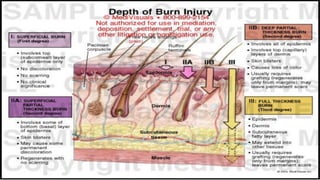
2. Depth of Skin - Involved
▪ 1st degree
▪ 2nd degree
▪ 3rd degree
▪ 4th degree
▪ Injury localized to Epidermis
▪ Epidermis + Dermis
▪ Epidermis + Dermis + Sub. Cut. Fat
▪ Underlying tissues
Classification of Burns
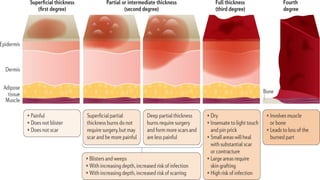
3.Thickness of Skin - Involved
▪ Superficial
▪ Partial thickness
[SP / DP]
▪ Full thickness
▪ 1st degree
▪ 2nd degree
▪ 2nd degree
▪ 3rd degree
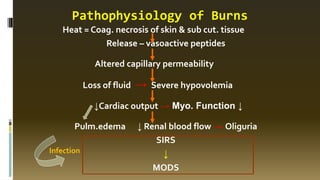
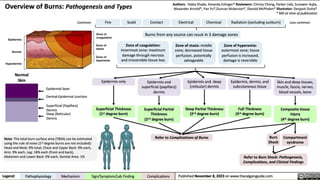
Heat = Coag. necrosis of skin & sub cut. tissue
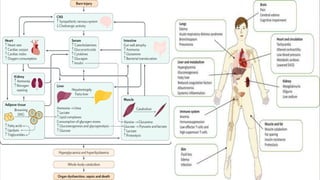
Release – vasoactive peptides
Altered capillary permeability
Loss of fluid → Severe hypovolemia
↓Cardiac output → Myo. Function ↓
Pulm.edema ↓ Renal blood flow → Oliguria
SIRS
↓
MODS
Pathophysiology of Burns
Infection
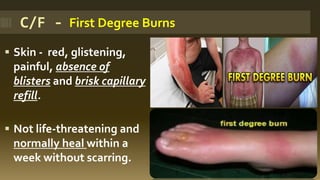
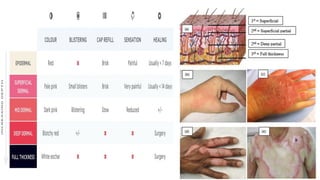
C/F - First Degree Burns
▪ Skin - red, glistening,
painful, absence of
blisters and brisk capillary
refill.
▪ Not life-threatening and
normally heal within a
week without scarring.
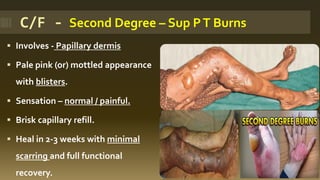
▪ Involves - Papillary dermis
▪ Pale pink (or) mottled appearance
with blisters.
▪ Sensation – normal / painful.
▪ Brisk capillary refill.
▪ Heal in 2-3 weeks with minimal
scarring and full functional
recovery.
C/F - Second Degree – Sup PT Burns
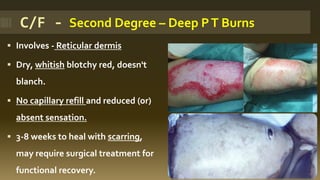
▪ Involves - Reticular dermis
▪ Dry, whitish blotchy red, doesn't
blanch.
▪ No capillary refill and reduced (or)
absent sensation.
▪ 3-8 weeks to heal with scarring,
may require surgical treatment for
functional recovery.
C/F - Second Degree – Deep PT Burns
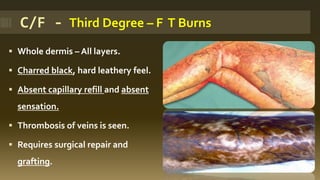
▪ Whole dermis – All layers.
▪ Charred black, hard leathery feel.
▪ Absent capillary refill and absent
sensation.
▪ Thrombosis of veins is seen.
▪ Requires surgical repair and
grafting.
C/F - Third Degree – F T Burns
15
Burn zones [Jackson’s]
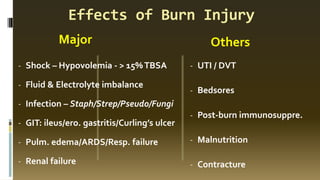
Effects of Burn Injury
Major Others
- Shock – Hypovolemia - > 15%TBSA
- Fluid & Electrolyte imbalance
- Infection – Staph/Strep/Pseudo/Fungi
- GIT: ileus/ero. gastritis/Curling’s ulcer
- Pulm. edema/ARDS/Resp. failure
- Renal failure
- UTI / DVT
- Bedsores
- Post-burn immunosuppre.
- Malnutrition
- Contracture
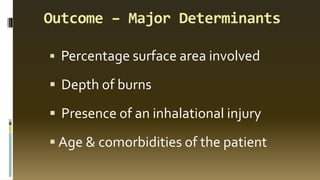
Outcome – Major Determinants
▪ Percentage surface area involved
▪ Depth of burns
▪ Presence of an inhalational injury
▪ Age & comorbidities of the patient
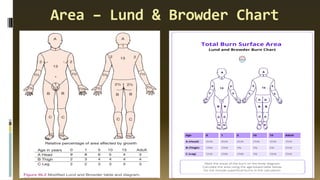
Area – Lund & Browder Chart
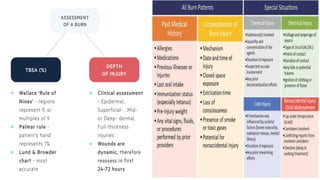
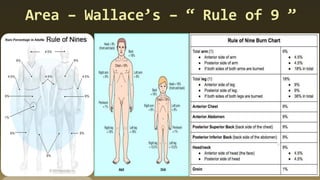
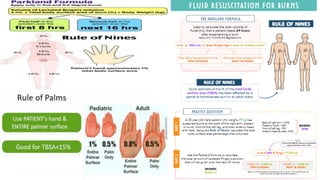
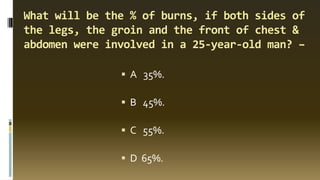
Area – Wallace’s – “ Rule of 9 ”
Burn causes – Likely depth
Cause of burn Probable depth of burn
Scald Superficial – Can be deep
Flash Burns Deep Dermal to FT
Flame Burns Mixed deep dermal + Full thickness
Alkali Burns Deep dermal [or] Full thickness
Acid Burns Weak – Superficial / Strong – Deep dermal
Electric Burns Full thickness
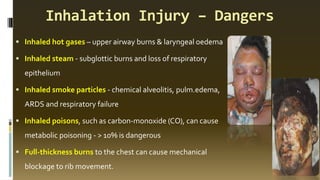
Inhalation Injury – Dangers
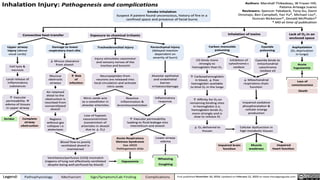
▪ Inhaled hot gases – upper airway burns & laryngeal oedema
▪ Inhaled steam - subglottic burns and loss of respiratory
epithelium
▪ Inhaled smoke particles - chemical alveolitis, pulm.edema,
ARDS and respiratory failure
▪ Inhaled poisons, such as carbon-monoxide (CO), can cause
metabolic poisoning - > 10% is dangerous
▪ Full-thickness burns to the chest can cause mechanical
blockage to rib movement.
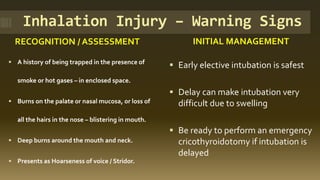
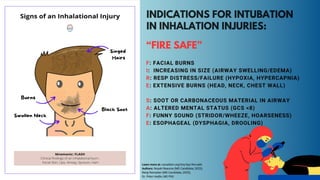
Inhalation Injury – Warning Signs
RECOGNITION / ASSESSMENT INITIAL MANAGEMENT
▪ A history of being trapped in the presence of
smoke or hot gases – in enclosed space.
▪ Burns on the palate or nasal mucosa, or loss of
all the hairs in the nose – blistering in mouth.
▪ Deep burns around the mouth and neck.
▪ Presents as Hoarseness of voice / Stridor.
▪ Early elective intubation is safest
▪ Delay can make intubation very
difficult due to swelling
▪ Be ready to perform an emergency
cricothyroidotomy if intubation is
delayed
Immediate [Pre-hospital Care]
▪ Remove from source of injury
▪ Clothing to be removed
▪ Cool the burn wound – 10 - 20mts –
no cold H2o
▪ Check for other injury
▪ Cleaning & Chemoprophylaxis
▪ Ensure rescuer safety
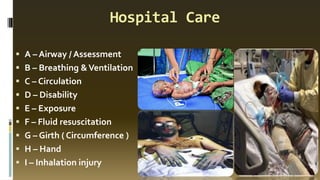
Hospital Care
▪ A – Airway / Assessment
▪ B – Breathing &Ventilation
▪ C – Circulation
▪ D – Disability
▪ E – Exposure
▪ F – Fluid resuscitation
▪ G – Girth ( Circumference )
▪ H – Hand
▪ I – Inhalation injury
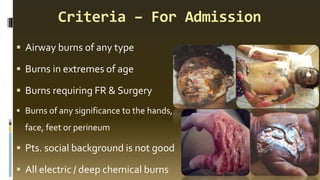
Criteria – For Admission
▪ Airway burns of any type
▪ Burns in extremes of age
▪ Burns requiring FR & Surgery
▪ Burns of any significance to the hands,
face, feet or perineum
▪ Pts. social background is not good
▪ All electric / deep chemical burns
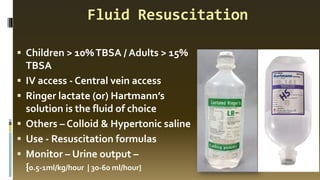
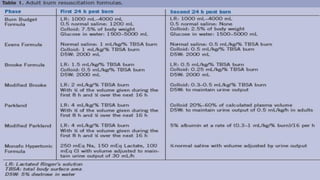
Fluid Resuscitation
▪ Children > 10%TBSA / Adults > 15%
TBSA
▪ IV access - Central vein access
▪ Ringer lactate (or) Hartmann’s
solution is the fluid of choice
▪ Others – Colloid & Hypertonic saline
▪ Use - Resuscitation formulas
▪ Monitor – Urine output –
{0.5-1ml/kg/hour | 30-60 ml/hour}
Fluids used
▪ First 24 hours = Crystalloids – given = Saline, RL, Hartmann’s fluid
( PASSTHROUGH CAPILLARYWALL EASILY & ALSO REPLICATESTHE
OSMOLALITY OF PLASMA)
▪ After 24 hrs up to 30 – 48 hrs = Colloids - Albumin, Dextran , Haemaccel
(TO COMPENSATE PLASMA LOSS )
▪ Blood transfusion – after 48 hours
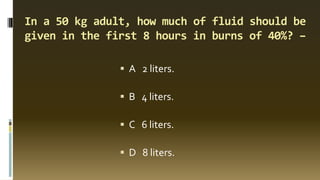
Parkland Formula – Commonly used
▪ 4ml x % burn x weight (kg) = volume [ml] - 24 hours
▪ Max. % considered = 50%
▪ First 8 hours ½ of vol. – Rest in next 16 hours = 24 hours
▪ Next 24 hours = ½ of first day fluids
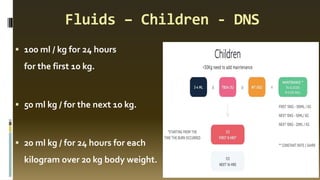
Fluids – Children - DNS
▪ 100 ml / kg for 24 hours
for the first 10 kg.
▪ 50 ml kg / for the next 10 kg.
▪ 20 ml kg / for 24 hours for each
kilogram over 20 kg body weight.
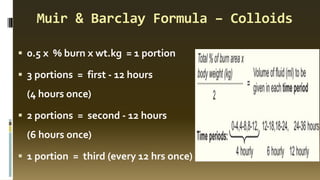
Muir & Barclay Formula – Colloids
▪ 0.5 x % burn x wt.kg = 1 portion
▪ 3 portions = first - 12 hours
(4 hours once)
▪ 2 portions = second - 12 hours
(6 hours once)
▪ 1 portion = third (every 12 hrs once)
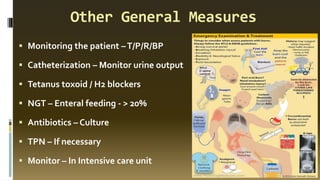
Other General Measures
▪ Monitoring the patient –T/P/R/BP
▪ Catheterization – Monitor urine output
▪ Tetanus toxoid / H2 blockers
▪ NGT – Enteral feeding - > 20%
▪ Antibiotics – Culture
▪ TPN – If necessary
▪ Monitor – In Intensive care unit
▪ No intramuscular,
subcutaneous injections.
▪ Small burns – Paracetamol,
NSAID.
▪ Large burns - Intravenous
opiates.
▪ Intensive nursing care.
▪ Physiotherapy – elevation,
splintage's, exercise.
▪ Psychological – counseling.
Analgesia + Supportive Measures
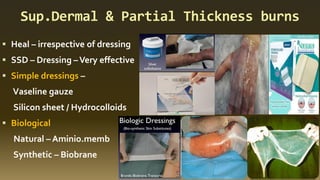
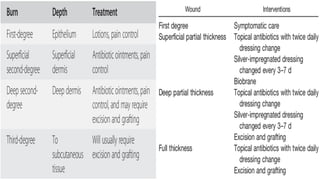
Sup.Dermal & Partial Thickness burns
▪ Heal – irrespective of dressing
▪ SSD – Dressing –Very effective
▪ Simple dressings –
Vaseline gauze
Silicon sheet / Hydrocolloids
▪ Biological
Natural – Aminio.memb
Synthetic – Biobrane
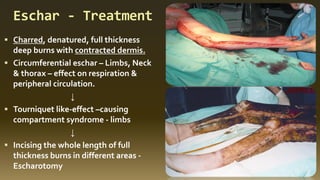
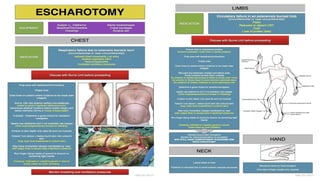
Eschar - Treatment
▪ Charred, denatured, full thickness
deep burns with contracted dermis.
▪ Circumferential eschar – Limbs, Neck
& thorax – effect on respiration &
peripheral circulation.
↓
▪ Tourniquet like-effect –causing
compartment syndrome - limbs
↓
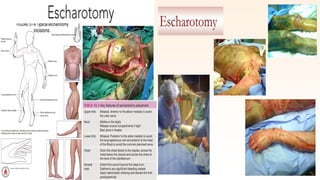
▪ Incising the whole length of full
thickness burns in different areas -
Escharotomy
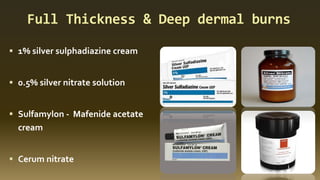
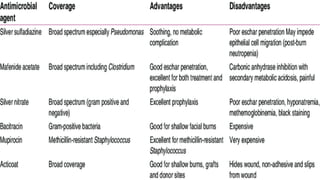
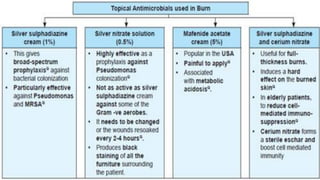
Full Thickness & Deep dermal burns
▪ 1% silver sulphadiazine cream
▪ 0.5% silver nitrate solution
▪ Sulfamylon - Mafenide acetate
cream
▪ Cerum nitrate
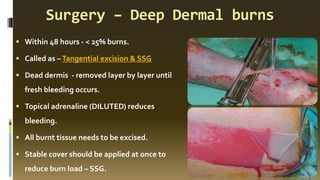
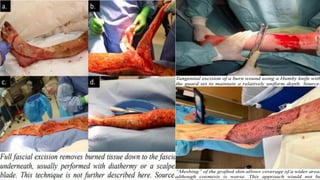
Surgery – Deep Dermal burns
▪ Within 48 hours - < 25% burns.
▪ Called as –Tangential excision & SSG
▪ Dead dermis - removed layer by layer until
fresh bleeding occurs.
▪ Topical adrenaline (DILUTED) reduces
bleeding.
▪ All burnt tissue needs to be excised.
▪ Stable cover should be applied at once to
reduce burn load – SSG.
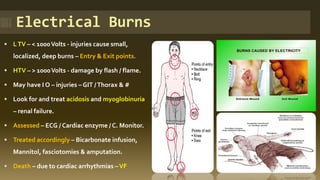
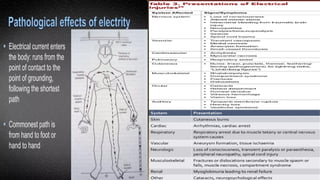
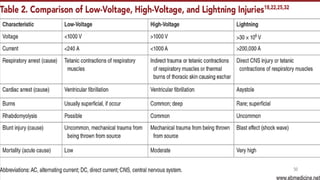
Electrical Burns
▪ LTV – < 1000Volts - injuries cause small,
localized, deep burns – Entry & Exit points.
▪ HTV – > 1000Volts - damage by flash / flame.
▪ May have I O – injuries – GIT /Thorax & #
▪ Look for and treat acidosis and myoglobinuria
– renal failure.
▪ Assessed – ECG / Cardiac enzyme / C. Monitor.
▪ Treated accordingly – Bicarbonate infusion,
Mannitol, fasciotomies & amputation.
▪ Death – due to cardiac arrhythmias –VF
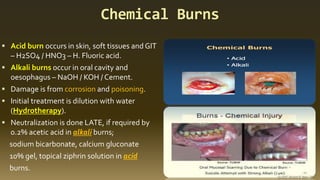
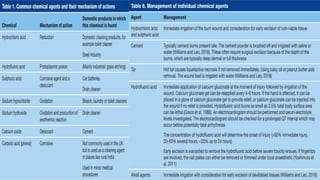
Chemical Burns
▪ Acid burn occurs in skin, soft tissues and GIT
– H2SO4 / HNO3 – H. Fluoric acid.
▪ Alkali burns occur in oral cavity and
oesophagus – NaOH / KOH / Cement.
▪ Damage is from corrosion and poisoning.
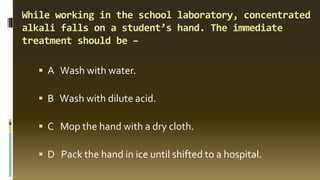
▪ Initial treatment is dilution with water
(Hydrotherapy).
▪ Neutralization is done LATE, if required by
0.2% acetic acid in alkali burns;
sodium bicarbonate, calcium gluconate
10% gel, topical ziphrin solution in acid
burns.
References
To Summarize
▪ Classification of burns & their clinical features.
▪ Pathophysiology & Effects of burns.
▪ Various assessment methods of a burns patient.
▪ Calculate the fluid requirements in a burns injury.
▪ Recognizing & Initial management of inhalation injury due to burns.
▪ Medical & Surgical treatment of burns patient.
▪ Difference between electrical & chemical burns.
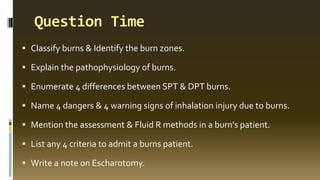
Question Time
▪ Classify burns & Identify the burn zones.
▪ Explain the pathophysiology of burns.
▪ Enumerate 4 differences between SPT & DPT burns.
▪ Name 4 dangers & 4 warning signs of inhalation injury due to burns.
▪ Mention the assessment & Fluid R methods in a burn's patient.
▪ List any 4 criteria to admit a burns patient.
▪ Write a note on Escharotomy.
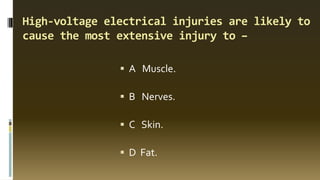
High-voltage electrical injuries are likely to
cause the most extensive injury to –
▪ A Muscle.
▪ B Nerves.
▪ C Skin.
▪ D Fat.
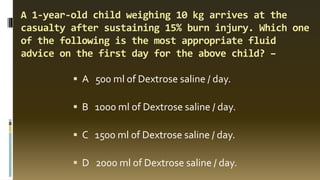
A 1-year-old child weighing 10 kg arrives at the
casualty after sustaining 15% burn injury. Which one
of the following is the most appropriate fluid
advice on the first day for the above child? –
▪ A 500 ml of Dextrose saline / day.
▪ B 1000 ml of Dextrose saline / day.
▪ C 1500 ml of Dextrose saline / day.
▪ D 2000 ml of Dextrose saline / day.
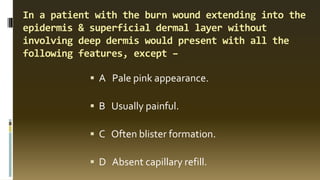
In a patient with the burn wound extending into the
epidermis & superficial dermal layer without
involving deep dermis would present with all the
following features, except –
▪ A Pale pink appearance.
▪ B Usually painful.
▪ C Often blister formation.
▪ D Absent capillary refill.
In a 50 kg adult, how much of fluid should be
given in the first 8 hours in burns of 40%? –
▪ A 2 liters.
▪ B 4 liters.
▪ C 6 liters.
▪ D 8 liters.
While working in the school laboratory, concentrated
alkali falls on a student’s hand. The immediate
treatment should be –
▪ A Wash with water.
▪ B Wash with dilute acid.
▪ C Mop the hand with a dry cloth.
▪ D Pack the hand in ice until shifted to a hospital.
What will be the % of burns, if both sides of
the legs, the groin and the front of chest &
abdomen were involved in a 25-year-old man? –
▪ A 35%.
▪ B 45%.
▪ C 55%.
▪ D 65%.
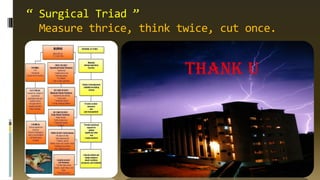
“ Surgical Triad ”
Measure thrice, think twice, cut once.
Thank U
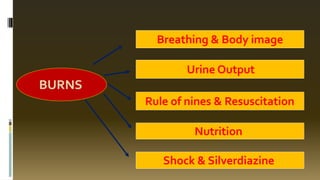
BURNS
Breathing & Body image
Urine Output
Rule of nines & Resuscitation
Nutrition
Shock & Silverdiazine
Burns - Types, Clinical Features & Management

Burns - Types, Clinical Features & Management

  • 1.
  • 2.
    Learning Objectives ▪ Classifythe types of Burns. ▪ Explain the pathophysiology, clinical features & effects of burns. ▪ Identify the assessment methods of a burn's patient. ▪ Identify the immediate care measures of a burn's patient. ▪ Mention the fluid resuscitative methods in treating burns patient. ▪ Outline the general measures in treating a burns patient. ▪ Describe the treatment aspects of Sup. & Deep dermal burns. ▪ Differentiate between electric burns & chemical burns.
  • 3.
    Introduction ▪ A burnis an injury caused by thermal, chemical, electrical, (or) radiation energy. ▪ A scald is a burn caused by contact with a hot liquid (or) steam, but the term 'burn' is often used to include scalds.
  • 4.
    Introduction Thermal Injury Others -Scald – hot liquids - Flame burns - Flash burns – exp. Gas / Alcohol - Contact burns – hot metals - Electrical injury - Chemical burns - Cold injury - Ionizing Radiation - Sun burns
  • 6.
    Classification of Burns 2.Depth of Skin - Involved ▪ 1st degree ▪ 2nd degree ▪ 3rd degree ▪ 4th degree ▪ Injury localized to Epidermis ▪ Epidermis + Dermis ▪ Epidermis + Dermis + Sub. Cut. Fat ▪ Underlying tissues
  • 7.
    Classification of Burns 3.Thicknessof Skin - Involved ▪ Superficial ▪ Partial thickness [SP / DP] ▪ Full thickness ▪ 1st degree ▪ 2nd degree ▪ 2nd degree ▪ 3rd degree
  • 8.
    Heat = Coag.necrosis of skin & sub cut. tissue Release – vasoactive peptides Altered capillary permeability Loss of fluid → Severe hypovolemia ↓Cardiac output → Myo. Function ↓ Pulm.edema ↓ Renal blood flow → Oliguria SIRS ↓ MODS Pathophysiology of Burns Infection
  • 10.
    C/F - FirstDegree Burns ▪ Skin - red, glistening, painful, absence of blisters and brisk capillary refill. ▪ Not life-threatening and normally heal within a week without scarring.
  • 11.
    ▪ Involves -Papillary dermis ▪ Pale pink (or) mottled appearance with blisters. ▪ Sensation – normal / painful. ▪ Brisk capillary refill. ▪ Heal in 2-3 weeks with minimal scarring and full functional recovery. C/F - Second Degree – Sup PT Burns
  • 12.
    ▪ Involves -Reticular dermis ▪ Dry, whitish blotchy red, doesn't blanch. ▪ No capillary refill and reduced (or) absent sensation. ▪ 3-8 weeks to heal with scarring, may require surgical treatment for functional recovery. C/F - Second Degree – Deep PT Burns
  • 13.
    ▪ Whole dermis– All layers. ▪ Charred black, hard leathery feel. ▪ Absent capillary refill and absent sensation. ▪ Thrombosis of veins is seen. ▪ Requires surgical repair and grafting. C/F - Third Degree – F T Burns
  • 15.
  • 16.
  • 18.
    Effects of BurnInjury Major Others - Shock – Hypovolemia - > 15%TBSA - Fluid & Electrolyte imbalance - Infection – Staph/Strep/Pseudo/Fungi - GIT: ileus/ero. gastritis/Curling’s ulcer - Pulm. edema/ARDS/Resp. failure - Renal failure - UTI / DVT - Bedsores - Post-burn immunosuppre. - Malnutrition - Contracture
  • 20.
    Outcome – MajorDeterminants ▪ Percentage surface area involved ▪ Depth of burns ▪ Presence of an inhalational injury ▪ Age & comorbidities of the patient
  • 22.
    Area – Lund& Browder Chart
  • 23.
    Area – Wallace’s– “ Rule of 9 ”
  • 27.
    Burn causes –Likely depth Cause of burn Probable depth of burn Scald Superficial – Can be deep Flash Burns Deep Dermal to FT Flame Burns Mixed deep dermal + Full thickness Alkali Burns Deep dermal [or] Full thickness Acid Burns Weak – Superficial / Strong – Deep dermal Electric Burns Full thickness
  • 28.
    Inhalation Injury –Dangers ▪ Inhaled hot gases – upper airway burns & laryngeal oedema ▪ Inhaled steam - subglottic burns and loss of respiratory epithelium ▪ Inhaled smoke particles - chemical alveolitis, pulm.edema, ARDS and respiratory failure ▪ Inhaled poisons, such as carbon-monoxide (CO), can cause metabolic poisoning - > 10% is dangerous ▪ Full-thickness burns to the chest can cause mechanical blockage to rib movement.
  • 30.
    Inhalation Injury –Warning Signs RECOGNITION / ASSESSMENT INITIAL MANAGEMENT ▪ A history of being trapped in the presence of smoke or hot gases – in enclosed space. ▪ Burns on the palate or nasal mucosa, or loss of all the hairs in the nose – blistering in mouth. ▪ Deep burns around the mouth and neck. ▪ Presents as Hoarseness of voice / Stridor. ▪ Early elective intubation is safest ▪ Delay can make intubation very difficult due to swelling ▪ Be ready to perform an emergency cricothyroidotomy if intubation is delayed
  • 32.
    Immediate [Pre-hospital Care] ▪Remove from source of injury ▪ Clothing to be removed ▪ Cool the burn wound – 10 - 20mts – no cold H2o ▪ Check for other injury ▪ Cleaning & Chemoprophylaxis ▪ Ensure rescuer safety
  • 33.
    Hospital Care ▪ A– Airway / Assessment ▪ B – Breathing &Ventilation ▪ C – Circulation ▪ D – Disability ▪ E – Exposure ▪ F – Fluid resuscitation ▪ G – Girth ( Circumference ) ▪ H – Hand ▪ I – Inhalation injury
  • 34.
    Criteria – ForAdmission ▪ Airway burns of any type ▪ Burns in extremes of age ▪ Burns requiring FR & Surgery ▪ Burns of any significance to the hands, face, feet or perineum ▪ Pts. social background is not good ▪ All electric / deep chemical burns
  • 35.
    Fluid Resuscitation ▪ Children> 10%TBSA / Adults > 15% TBSA ▪ IV access - Central vein access ▪ Ringer lactate (or) Hartmann’s solution is the fluid of choice ▪ Others – Colloid & Hypertonic saline ▪ Use - Resuscitation formulas ▪ Monitor – Urine output – {0.5-1ml/kg/hour | 30-60 ml/hour}
  • 36.
    Fluids used ▪ First24 hours = Crystalloids – given = Saline, RL, Hartmann’s fluid ( PASSTHROUGH CAPILLARYWALL EASILY & ALSO REPLICATESTHE OSMOLALITY OF PLASMA) ▪ After 24 hrs up to 30 – 48 hrs = Colloids - Albumin, Dextran , Haemaccel (TO COMPENSATE PLASMA LOSS ) ▪ Blood transfusion – after 48 hours
  • 37.
    Parkland Formula –Commonly used ▪ 4ml x % burn x weight (kg) = volume [ml] - 24 hours ▪ Max. % considered = 50% ▪ First 8 hours ½ of vol. – Rest in next 16 hours = 24 hours ▪ Next 24 hours = ½ of first day fluids
  • 39.
    Fluids – Children- DNS ▪ 100 ml / kg for 24 hours for the first 10 kg. ▪ 50 ml kg / for the next 10 kg. ▪ 20 ml kg / for 24 hours for each kilogram over 20 kg body weight.
  • 40.
    Muir & BarclayFormula – Colloids ▪ 0.5 x % burn x wt.kg = 1 portion ▪ 3 portions = first - 12 hours (4 hours once) ▪ 2 portions = second - 12 hours (6 hours once) ▪ 1 portion = third (every 12 hrs once)
  • 41.
    Other General Measures ▪Monitoring the patient –T/P/R/BP ▪ Catheterization – Monitor urine output ▪ Tetanus toxoid / H2 blockers ▪ NGT – Enteral feeding - > 20% ▪ Antibiotics – Culture ▪ TPN – If necessary ▪ Monitor – In Intensive care unit
  • 42.
    ▪ No intramuscular, subcutaneousinjections. ▪ Small burns – Paracetamol, NSAID. ▪ Large burns - Intravenous opiates. ▪ Intensive nursing care. ▪ Physiotherapy – elevation, splintage's, exercise. ▪ Psychological – counseling. Analgesia + Supportive Measures
  • 43.
    Sup.Dermal & PartialThickness burns ▪ Heal – irrespective of dressing ▪ SSD – Dressing –Very effective ▪ Simple dressings – Vaseline gauze Silicon sheet / Hydrocolloids ▪ Biological Natural – Aminio.memb Synthetic – Biobrane
  • 44.
    Eschar - Treatment ▪Charred, denatured, full thickness deep burns with contracted dermis. ▪ Circumferential eschar – Limbs, Neck & thorax – effect on respiration & peripheral circulation. ↓ ▪ Tourniquet like-effect –causing compartment syndrome - limbs ↓ ▪ Incising the whole length of full thickness burns in different areas - Escharotomy
  • 47.
    Full Thickness &Deep dermal burns ▪ 1% silver sulphadiazine cream ▪ 0.5% silver nitrate solution ▪ Sulfamylon - Mafenide acetate cream ▪ Cerum nitrate
  • 49.
    Surgery – DeepDermal burns ▪ Within 48 hours - < 25% burns. ▪ Called as –Tangential excision & SSG ▪ Dead dermis - removed layer by layer until fresh bleeding occurs. ▪ Topical adrenaline (DILUTED) reduces bleeding. ▪ All burnt tissue needs to be excised. ▪ Stable cover should be applied at once to reduce burn load – SSG.
  • 52.
    Electrical Burns ▪ LTV– < 1000Volts - injuries cause small, localized, deep burns – Entry & Exit points. ▪ HTV – > 1000Volts - damage by flash / flame. ▪ May have I O – injuries – GIT /Thorax & # ▪ Look for and treat acidosis and myoglobinuria – renal failure. ▪ Assessed – ECG / Cardiac enzyme / C. Monitor. ▪ Treated accordingly – Bicarbonate infusion, Mannitol, fasciotomies & amputation. ▪ Death – due to cardiac arrhythmias –VF
  • 55.
    Chemical Burns ▪ Acidburn occurs in skin, soft tissues and GIT – H2SO4 / HNO3 – H. Fluoric acid. ▪ Alkali burns occur in oral cavity and oesophagus – NaOH / KOH / Cement. ▪ Damage is from corrosion and poisoning. ▪ Initial treatment is dilution with water (Hydrotherapy). ▪ Neutralization is done LATE, if required by 0.2% acetic acid in alkali burns; sodium bicarbonate, calcium gluconate 10% gel, topical ziphrin solution in acid burns.
  • 57.
  • 58.
    To Summarize ▪ Classificationof burns & their clinical features. ▪ Pathophysiology & Effects of burns. ▪ Various assessment methods of a burns patient. ▪ Calculate the fluid requirements in a burns injury. ▪ Recognizing & Initial management of inhalation injury due to burns. ▪ Medical & Surgical treatment of burns patient. ▪ Difference between electrical & chemical burns.
  • 59.
    Question Time ▪ Classifyburns & Identify the burn zones. ▪ Explain the pathophysiology of burns. ▪ Enumerate 4 differences between SPT & DPT burns. ▪ Name 4 dangers & 4 warning signs of inhalation injury due to burns. ▪ Mention the assessment & Fluid R methods in a burn's patient. ▪ List any 4 criteria to admit a burns patient. ▪ Write a note on Escharotomy.
  • 60.
    High-voltage electrical injuriesare likely to cause the most extensive injury to – ▪ A Muscle. ▪ B Nerves. ▪ C Skin. ▪ D Fat.
  • 61.
    A 1-year-old childweighing 10 kg arrives at the casualty after sustaining 15% burn injury. Which one of the following is the most appropriate fluid advice on the first day for the above child? – ▪ A 500 ml of Dextrose saline / day. ▪ B 1000 ml of Dextrose saline / day. ▪ C 1500 ml of Dextrose saline / day. ▪ D 2000 ml of Dextrose saline / day.
  • 62.
    In a patientwith the burn wound extending into the epidermis & superficial dermal layer without involving deep dermis would present with all the following features, except – ▪ A Pale pink appearance. ▪ B Usually painful. ▪ C Often blister formation. ▪ D Absent capillary refill.
  • 63.
    In a 50kg adult, how much of fluid should be given in the first 8 hours in burns of 40%? – ▪ A 2 liters. ▪ B 4 liters. ▪ C 6 liters. ▪ D 8 liters.
  • 64.
    While working inthe school laboratory, concentrated alkali falls on a student’s hand. The immediate treatment should be – ▪ A Wash with water. ▪ B Wash with dilute acid. ▪ C Mop the hand with a dry cloth. ▪ D Pack the hand in ice until shifted to a hospital.
  • 65.
    What will bethe % of burns, if both sides of the legs, the groin and the front of chest & abdomen were involved in a 25-year-old man? – ▪ A 35%. ▪ B 45%. ▪ C 55%. ▪ D 65%.
  • 66.
    “ Surgical Triad” Measure thrice, think twice, cut once. Thank U
  • 67.
    BURNS Breathing & Bodyimage Urine Output Rule of nines & Resuscitation Nutrition Shock & Silverdiazine