Prof. U.Murali.
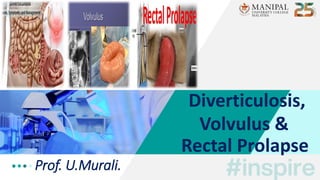
Diverticulosis,
Volvulus &
Rectal Prolapse
Learning Objectives
◼ Explain the etiology & complications of diverticulosis.
◼ Describe the C/F, investigations and treatment of diverticulosis.
◼ List the predisposing factors & types of sigmoid volvulus.
◼ Outline the C/F & management of sigmoid volvulus.
◼ Discuss about – Prolapse rectum.
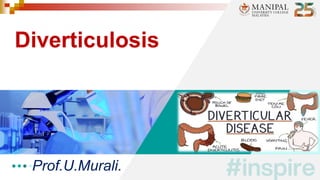
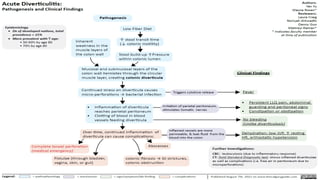
Diverticulosis
Prof.U.Murali.
D Disease - Introduction
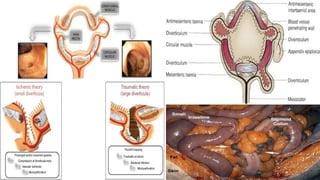
◼ They are {Diverticula} herniations of colonic mucosa
through circular muscles at the points where blood
vessels penetrate the bowel wall.
◼ It is more commonly localized to sigmoid colon (70-
90%) but can affect the whole colon. [Rectum is not
affected].
◼ It is rare in Asian & African countries because of the
high fiber diet. It is common in western countries.
◼ The combination of altered collagen structure with
ageing, disordered motility and increased
intraluminal pressure, is seen most notably in the
narrow sigmoid colon. Whereas the rectum has a
complete muscular coat and a wider lumen and is
thus very rarely affected.
D Disease - Types
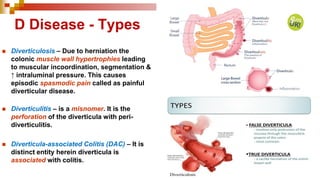
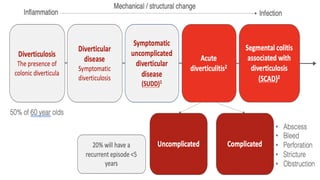
◼ Diverticulosis – Due to herniation the
colonic muscle wall hypertrophies leading
to muscular incoordination, segmentation &
↑ intraluminal pressure. This causes
episodic spasmodic pain called as painful
diverticular disease.
◼ Diverticulitis – is a misnomer. It is the
perforation of the diverticula with peri-
diverticulitis.
◼ Diverticula-associated Colitis (DAC) – It is
distinct entity herein diverticula is
associated with colitis.
Diverticular Disease - Etiology
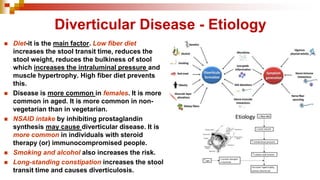
◼ Diet-it is the main factor. Low fiber diet
increases the stool transit time, reduces the
stool weight, reduces the bulkiness of stool
which increases the intraluminal pressure and
muscle hypertrophy. High fiber diet prevents
this.
◼ Disease is more common in females. It is more
common in aged. It is more common in non-
vegetarian than in vegetarian.
◼ NSAID intake by inhibiting prostaglandin
synthesis may cause diverticular disease. It is
more common in individuals with steroid
therapy (or) immunocompromised people.
◼ Smoking and alcohol also increases the risk.
◼ Long-standing constipation increases the stool
transit time and causes diverticulosis.
Diverticular Disease – C / F
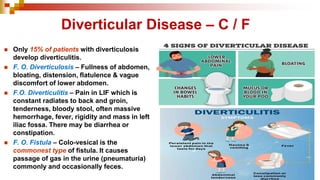
◼ Only 15% of patients with diverticulosis
develop diverticulitis.
◼ F. O. Diverticulosis – Fullness of abdomen,
bloating, distension, flatulence & vague
discomfort of lower abdomen.
◼ F.O. Diverticulitis – Pain in LIF which is
constant radiates to back and groin,
tenderness, bloody stool, often massive
hemorrhage, fever, rigidity and mass in left
iliac fossa. There may be diarrhea or
constipation.
◼ F. O. Fistula – Colo-vesical is the
commonest type of fistula. It causes
passage of gas in the urine (pneumaturia)
commonly and occasionally feces.
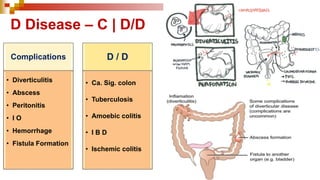
D Disease – C | D/D
Complications
• Diverticulitis
• Abscess
• Peritonitis
• I O
• Hemorrhage
• Fistula Formation
D / D
• Ca. Sig. colon
• Tuberculosis
• Amoebic colitis
• I B D
• Ischemic colitis
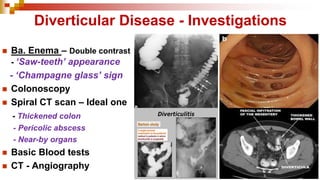
◼ Ba. Enema – Double contrast
- ‘Saw-teeth’ appearance
- ‘Champagne glass’ sign
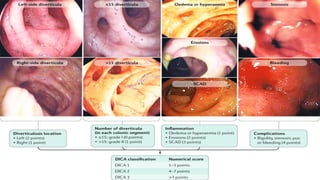
◼ Colonoscopy
◼ Spiral CT scan – Ideal one
- Thickened colon
- Pericolic abscess
- Near-by organs
◼ Basic Blood tests
◼ CT - Angiography
Diverticular Disease - Investigations
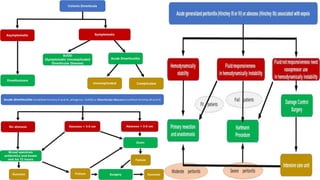
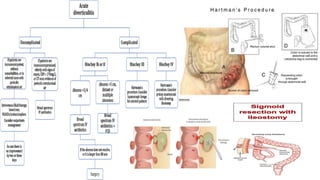
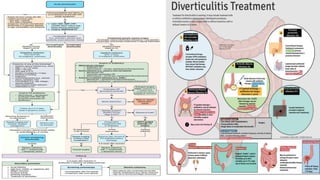
Diverticular Disease – Treatment
Medical
[Acute]
• Bowel rest
• Antibiotics
• Antispasmodics
• High fiber diet
• Bulk purgatives
• Avoid
constipation
Surgical
[Indications]
• Peritonitis
• FOM treatment
• R. Diverticulitis
• Abscess –can be
drained – PC by
CT-guidance
Volvulus
Prof.U.Murali.
Volvulus - Introduction
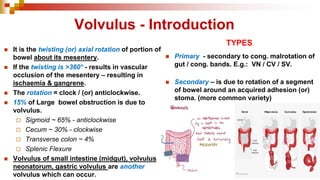
◼ It is the twisting (or) axial rotation of portion of
bowel about its mesentery.
◼ If the twisting is >360° - results in vascular
occlusion of the mesentery – resulting in
ischaemia & gangrene.
◼ The rotation = clock / (or) anticlockwise.
◼ 15% of Large bowel obstruction is due to
volvulus.
 Sigmoid ~ 65% - anticlockwise
 Cecum ~ 30% - clockwise
 Transverse colon ~ 4%
 Splenic Flexure
◼ Volvulus of small intestine (midgut), volvulus
neonatorum, gastric volvulus are another
volvulus which can occur.
TYPES
◼ Primary - secondary to cong. malrotation of
gut / cong. bands. E.g.: VN / CV / SV.
◼ Secondary – is due to rotation of a segment
of bowel around an acquired adhesion (or)
stoma. (more common variety)
Sigmoid Volvulus
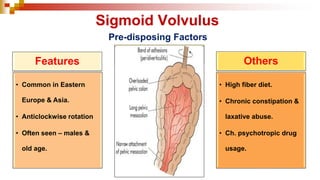
Features
• Common in Eastern
Europe & Asia.
• Anticlockwise rotation
• Often seen – males &
old age.
Others
• High fiber diet.
• Chronic constipation &
laxative abuse.
• Ch. psychotropic drug
usage.
Pre-disposing Factors
Sigmoid Volvulus
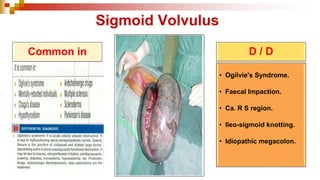
Common in D / D
• Ogilvie's Syndrome.
• Faecal Impaction.
• Ca. R S region.
• Ileo-sigmoid knotting.
• Idiopathic megacolon.
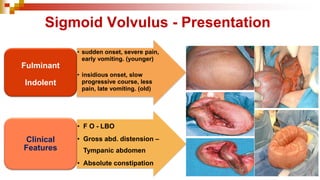
Sigmoid Volvulus - Presentation
• sudden onset, severe pain,
early vomiting. (younger)
• insidious onset, slow
progressive course, less
pain, late vomiting. (old)
Fulminant
Indolent
• F O - LBO
• Gross abd. distension –
Tympanic abdomen
• Absolute constipation
Clinical
Features
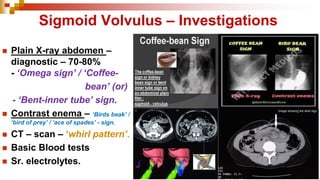
Sigmoid Volvulus – Investigations
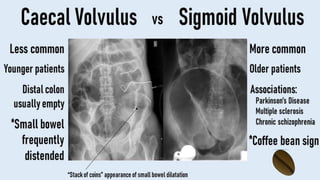
◼ Plain X-ray abdomen –
diagnostic – 70-80%
- ‘Omega sign’ / ‘Coffee-
bean’ (or)
- ‘Bent-inner tube’ sign.
◼ Contrast enema – ‘Birds beak’ /
‘bird of prey’ / ‘ace of spades’ - sign.
◼ CT – scan – ‘whirl pattern’.
◼ Basic Blood tests
◼ Sr. electrolytes.
Sigmoid Volvulus – Treatment
◼ Decompression:
- Sigmoidoscope (or) flatus tube inserted into
rectum / pt. passes flatus & faeces --> successful.
◼ If de-rotation does not occur --> E. Laparotomy.
◼ Manual de-rotation & check viability.
◼ Viable → Sigmoidopexy.
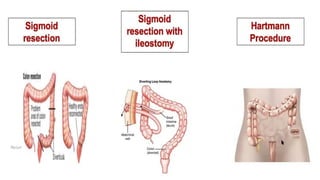
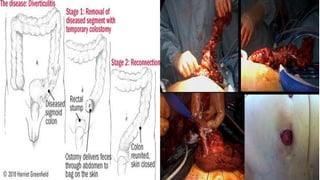
◼ Gangrenous → Paul-Mickulicz procedure
(or) Hartmann’s operation.
◼ If conditions are good, resection [sigmoid
colectomy] & anastomosis can be done.
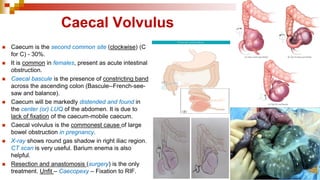
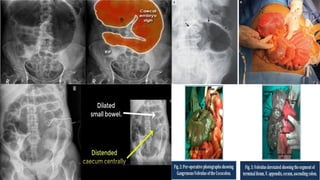
Caecal Volvulus
◼ Caecum is the second common site (clockwise) (C
for C) - 30%.
◼ It is common in females, present as acute intestinal
obstruction.
◼ Caecal bascule is the presence of constricting band
across the ascending colon (Bascule--French-see-
saw and balance).
◼ Caecum will be markedly distended and found in
the center (or) LUQ of the abdomen. It is due to
lack of fixation of the caecum-mobile caecum.
◼ Caecal volvulus is the commonest cause of large
bowel obstruction in pregnancy.
◼ X-ray shows round gas shadow in right iliac region.
CT scan is very useful. Barium enema is also
helpful.
◼ Resection and anastomosis (surgery) is the only
treatment. Unfit – Caecopexy – Fixation to RIF.
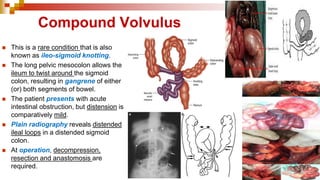
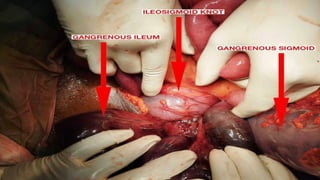
Compound Volvulus
◼ This is a rare condition that is also
known as ileo-sigmoid knotting.
◼ The long pelvic mesocolon allows the
ileum to twist around the sigmoid
colon, resulting in gangrene of either
(or) both segments of bowel.
◼ The patient presents with acute
intestinal obstruction, but distension is
comparatively mild.
◼ Plain radiography reveals distended
ileal loops in a distended sigmoid
colon.
◼ At operation, decompression,
resection and anastomosis are
required.
Rectal Prolapse
Prof.U.Murali.
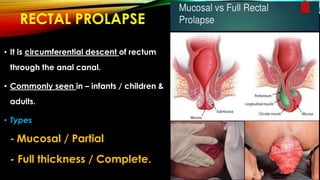
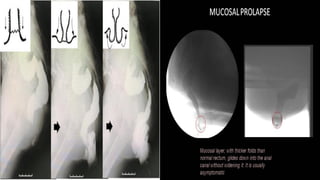
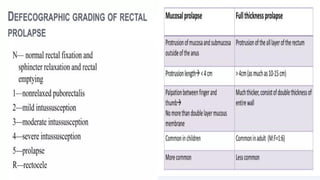
RECTAL PROLAPSE
• It is circumferential descent of rectum
through the anal canal.
• Commonly seen in – infants / children &
adults.
• Types
- Mucosal / Partial
- Full thickness / Complete.
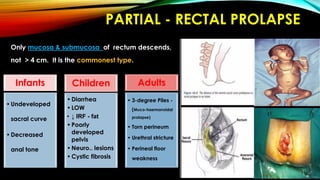
PARTIAL - RECTAL PROLAPSE
Infants
•Undeveloped
sacral curve
•Decreased
anal tone
Children
•Diarrhea
•LOW
• ↓ IRF - fat
•Poorly
developed
pelvis
•Neuro.. lesions
•Cystic fibrosis
Adults
• 3-degree Piles -
(Muco-haemorroidal
prolapse)
• Torn perineum
• Urethral stricture
• Perineal floor
weakness
Only mucosa & submucosa of rectum descends,
not > 4 cm. It is the commonest type.
P R P - TREATMENT
• Digital repositioning – Initially tried.
• Sub-mucosal injections – 10ml of 5%
phenol in almond oil ↓ GA / > 6 weeks.
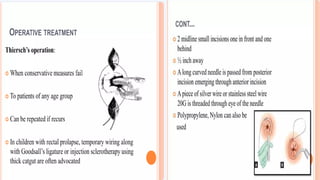
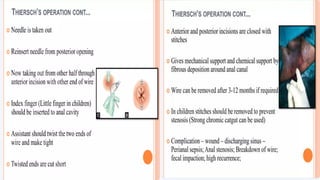
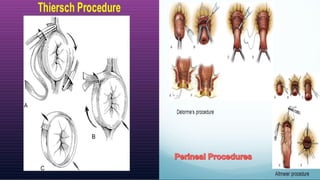
• Surgery – Thiersch wiring can be tried.
INFANTS / CHILDREN
ADULTS
• Sub-mucosal injections are tried.
• Unilateral - Excision of redundant mucosa
[Goodsall’s Operation]
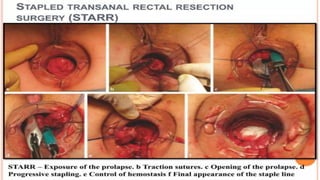
• Circumf. - Endo-stapling method is used.
COMPLETE RECTAL PROLAPSE - PROCIDENTIA
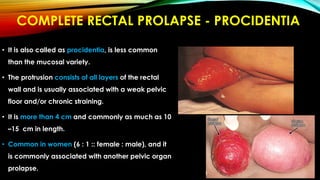
• It is also called as procidentia, is less common
than the mucosal variety.
• The protrusion consists of all layers of the rectal
wall and is usually associated with a weak pelvic
floor and/or chronic straining.
• It is more than 4 cm and commonly as much as 10
–15 cm in length.
• Common in women (6 : 1 :: female : male), and it
is commonly associated with another pelvic organ
prolapse.
COMPLETE RECTAL PROLAPSE - PROCIDENTIA
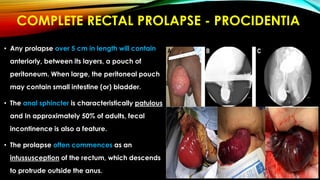
• Any prolapse over 5 cm in length will contain
anteriorly, between its layers, a pouch of
peritoneum. When large, the peritoneal pouch
may contain small intestine (or) bladder.
• The anal sphincter is characteristically patulous
and In approximately 50% of adults, fecal
incontinence is also a feature.
• The prolapse often commences as an
intussusception of the rectum, which descends
to protrude outside the anus.
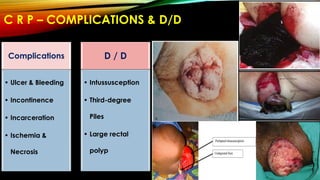
C R P – COMPLICATIONS & D/D
Complications
• Ulcer & Bleeding
• Incontinence
• Incarceration
• Ischemia &
Necrosis
D / D
• Intussusception
• Third-degree
Piles
• Large rectal
polyp
C R P – AIM - TREATMENT
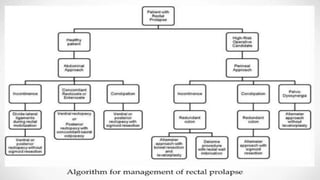
• To control the prolapse; to restore continence; to
prevent constipation [Perineal / Abdominal].
• Choice of procedure depends on age, sex, operative
risk, pelvic floor defect, degree of incontinence, history
of constipation.
• In young males, abdominal repair should be avoided
as it injures pelvic nerves leading to sexual impotency.
• When the patient is elderly and very frail a perineal
operation is usually safer.
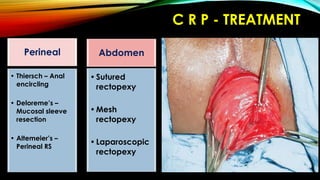
C R P - TREATMENT
Perineal
• Thiersch – Anal
encircling
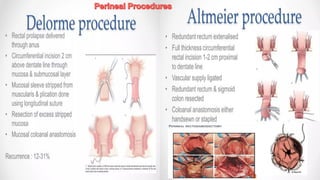
• Deloreme’s –
Mucosal sleeve
resection
• Altemeier’s –
Perineal RS
Abdomen
•Sutured
rectopexy
•Mesh
rectopexy
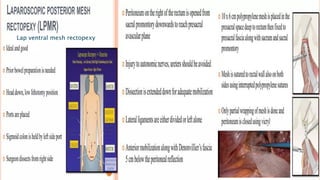
•Laparoscopic
rectopexy
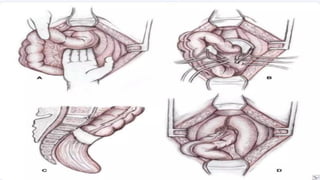
Perineal Procedures
Perineal Procedures
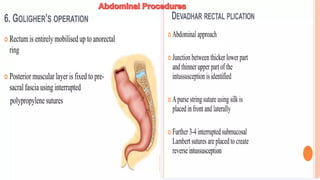
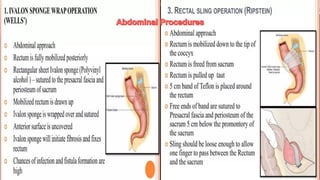
Abdominal Procedures
To Summarize
◼ Difference between diverticulosis & diverticulitis.
◼ Etiology & C/F of diverticular disease.
◼ Complications & D/D of diverticular disease.
◼ Investigations & Treatment aspects of diverticulosis.
◼ Volvulus – Types / C/F & treatment of SV + CV.
◼ Rectal prolapse – Causes, types, C/F & management.
References
Question time
◼ List 4 etiological factors of diverticulosis.
◼ Mention the types of diverticular disease.
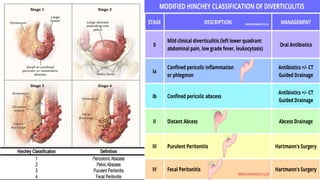
◼ Write the modified Hinchey classification of diverticulitis.
◼ Outline the treatment of acute uncomplicated diverticulitis.
◼ Enumerate 3 predisposing factors & 3 imaging findings of sigmoid volvulus.
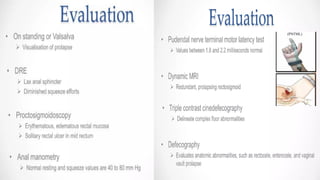
◼ Identify 4 evaluate methods of rectal prolapse.
◼ Enumerate 3 perineal & 3 abdominal surgical procedures for CRP.
◼ Compare & Contrast – Partial vs Complete rectal prolapse.
The most common type of fistula in colonic
diverticular disease is –
◼ a) Enterocolic.
◼ b) Vesicocolic.
◼ c) Colocutaneous.
◼ d) Colovaginal.
An obese old patient with diverticular disease if presents
with perforation, what will be the treatment of choice? –
◼ a) Primary resection & anastomosis.
◼ b) Conservative approach.
◼ c) Hartmann’s procedure.
◼ d) Left hemicolectomy.
A young male patient presents with complete rectal
prolapse. The surgery of choice is –
◼ a) Anterior resection.
◼ b) Abdominal rectopexy.
◼ c) Goodsall’s procedure.
◼ d) Delormes procedure.
Which is false regarding complete rectal prolapse? –
◼ a) It is more common than partial prolapse.
◼ b) It involves all layers of the rectum.
◼ c) It starts as an intussusception from the anterior wall of the rectum.
◼ d) Prolapse over 5 cm usually contains a pouch of peritoneum anteriorly.
A sigmoid volvulus is more likely to occur in all the
following situations, except –
◼ a) Short & wide mesentery.
◼ b) Mental-retarded individuals.
◼ c) Loaded pelvic colon.
◼ d) Previous bands or adhesions.
Which one of the following is not true for a cecal
volvulus? –
◼ a) It is more common in females.
◼ b) The presentation is usually acute.
◼ c) If the caecum is viable, a cecostomy usually prevents recurrence.
◼ d) Ba. Enema shows the classical pic. of a massively dilated cecum.
THANK YOU
Diverticulosis, Volvulus & Rectal prolapse.pdf

Diverticulosis, Volvulus & Rectal prolapse.pdf

  • 1.
  • 2.
    Learning Objectives ◼ Explainthe etiology & complications of diverticulosis. ◼ Describe the C/F, investigations and treatment of diverticulosis. ◼ List the predisposing factors & types of sigmoid volvulus. ◼ Outline the C/F & management of sigmoid volvulus. ◼ Discuss about – Prolapse rectum.
  • 3.
  • 4.
    D Disease -Introduction ◼ They are {Diverticula} herniations of colonic mucosa through circular muscles at the points where blood vessels penetrate the bowel wall. ◼ It is more commonly localized to sigmoid colon (70- 90%) but can affect the whole colon. [Rectum is not affected]. ◼ It is rare in Asian & African countries because of the high fiber diet. It is common in western countries. ◼ The combination of altered collagen structure with ageing, disordered motility and increased intraluminal pressure, is seen most notably in the narrow sigmoid colon. Whereas the rectum has a complete muscular coat and a wider lumen and is thus very rarely affected.
  • 6.
    D Disease -Types ◼ Diverticulosis – Due to herniation the colonic muscle wall hypertrophies leading to muscular incoordination, segmentation & ↑ intraluminal pressure. This causes episodic spasmodic pain called as painful diverticular disease. ◼ Diverticulitis – is a misnomer. It is the perforation of the diverticula with peri- diverticulitis. ◼ Diverticula-associated Colitis (DAC) – It is distinct entity herein diverticula is associated with colitis.
  • 8.
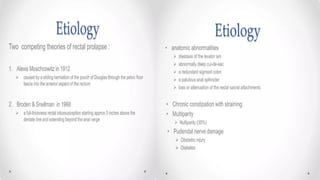
    Diverticular Disease -Etiology ◼ Diet-it is the main factor. Low fiber diet increases the stool transit time, reduces the stool weight, reduces the bulkiness of stool which increases the intraluminal pressure and muscle hypertrophy. High fiber diet prevents this. ◼ Disease is more common in females. It is more common in aged. It is more common in non- vegetarian than in vegetarian. ◼ NSAID intake by inhibiting prostaglandin synthesis may cause diverticular disease. It is more common in individuals with steroid therapy (or) immunocompromised people. ◼ Smoking and alcohol also increases the risk. ◼ Long-standing constipation increases the stool transit time and causes diverticulosis.
  • 9.
    Diverticular Disease –C / F ◼ Only 15% of patients with diverticulosis develop diverticulitis. ◼ F. O. Diverticulosis – Fullness of abdomen, bloating, distension, flatulence & vague discomfort of lower abdomen. ◼ F.O. Diverticulitis – Pain in LIF which is constant radiates to back and groin, tenderness, bloody stool, often massive hemorrhage, fever, rigidity and mass in left iliac fossa. There may be diarrhea or constipation. ◼ F. O. Fistula – Colo-vesical is the commonest type of fistula. It causes passage of gas in the urine (pneumaturia) commonly and occasionally feces.
  • 10.
    D Disease –C | D/D Complications • Diverticulitis • Abscess • Peritonitis • I O • Hemorrhage • Fistula Formation D / D • Ca. Sig. colon • Tuberculosis • Amoebic colitis • I B D • Ischemic colitis
  • 12.
    ◼ Ba. Enema– Double contrast - ‘Saw-teeth’ appearance - ‘Champagne glass’ sign ◼ Colonoscopy ◼ Spiral CT scan – Ideal one - Thickened colon - Pericolic abscess - Near-by organs ◼ Basic Blood tests ◼ CT - Angiography Diverticular Disease - Investigations
  • 14.
    Diverticular Disease –Treatment Medical [Acute] • Bowel rest • Antibiotics • Antispasmodics • High fiber diet • Bulk purgatives • Avoid constipation Surgical [Indications] • Peritonitis • FOM treatment • R. Diverticulitis • Abscess –can be drained – PC by CT-guidance
  • 20.
  • 21.
    Volvulus - Introduction ◼It is the twisting (or) axial rotation of portion of bowel about its mesentery. ◼ If the twisting is >360° - results in vascular occlusion of the mesentery – resulting in ischaemia & gangrene. ◼ The rotation = clock / (or) anticlockwise. ◼ 15% of Large bowel obstruction is due to volvulus.  Sigmoid ~ 65% - anticlockwise  Cecum ~ 30% - clockwise  Transverse colon ~ 4%  Splenic Flexure ◼ Volvulus of small intestine (midgut), volvulus neonatorum, gastric volvulus are another volvulus which can occur. TYPES ◼ Primary - secondary to cong. malrotation of gut / cong. bands. E.g.: VN / CV / SV. ◼ Secondary – is due to rotation of a segment of bowel around an acquired adhesion (or) stoma. (more common variety)
  • 22.
    Sigmoid Volvulus Features • Commonin Eastern Europe & Asia. • Anticlockwise rotation • Often seen – males & old age. Others • High fiber diet. • Chronic constipation & laxative abuse. • Ch. psychotropic drug usage. Pre-disposing Factors
  • 23.
    Sigmoid Volvulus Common inD / D • Ogilvie's Syndrome. • Faecal Impaction. • Ca. R S region. • Ileo-sigmoid knotting. • Idiopathic megacolon.
  • 24.
    Sigmoid Volvulus -Presentation • sudden onset, severe pain, early vomiting. (younger) • insidious onset, slow progressive course, less pain, late vomiting. (old) Fulminant Indolent • F O - LBO • Gross abd. distension – Tympanic abdomen • Absolute constipation Clinical Features
  • 25.
    Sigmoid Volvulus –Investigations ◼ Plain X-ray abdomen – diagnostic – 70-80% - ‘Omega sign’ / ‘Coffee- bean’ (or) - ‘Bent-inner tube’ sign. ◼ Contrast enema – ‘Birds beak’ / ‘bird of prey’ / ‘ace of spades’ - sign. ◼ CT – scan – ‘whirl pattern’. ◼ Basic Blood tests ◼ Sr. electrolytes.
  • 26.
    Sigmoid Volvulus –Treatment ◼ Decompression: - Sigmoidoscope (or) flatus tube inserted into rectum / pt. passes flatus & faeces --> successful. ◼ If de-rotation does not occur --> E. Laparotomy. ◼ Manual de-rotation & check viability. ◼ Viable → Sigmoidopexy. ◼ Gangrenous → Paul-Mickulicz procedure (or) Hartmann’s operation. ◼ If conditions are good, resection [sigmoid colectomy] & anastomosis can be done.
  • 27.
    Caecal Volvulus ◼ Caecumis the second common site (clockwise) (C for C) - 30%. ◼ It is common in females, present as acute intestinal obstruction. ◼ Caecal bascule is the presence of constricting band across the ascending colon (Bascule--French-see- saw and balance). ◼ Caecum will be markedly distended and found in the center (or) LUQ of the abdomen. It is due to lack of fixation of the caecum-mobile caecum. ◼ Caecal volvulus is the commonest cause of large bowel obstruction in pregnancy. ◼ X-ray shows round gas shadow in right iliac region. CT scan is very useful. Barium enema is also helpful. ◼ Resection and anastomosis (surgery) is the only treatment. Unfit – Caecopexy – Fixation to RIF.
  • 29.
    Compound Volvulus ◼ Thisis a rare condition that is also known as ileo-sigmoid knotting. ◼ The long pelvic mesocolon allows the ileum to twist around the sigmoid colon, resulting in gangrene of either (or) both segments of bowel. ◼ The patient presents with acute intestinal obstruction, but distension is comparatively mild. ◼ Plain radiography reveals distended ileal loops in a distended sigmoid colon. ◼ At operation, decompression, resection and anastomosis are required.
  • 31.
  • 32.
    RECTAL PROLAPSE • Itis circumferential descent of rectum through the anal canal. • Commonly seen in – infants / children & adults. • Types - Mucosal / Partial - Full thickness / Complete.
  • 34.
    PARTIAL - RECTALPROLAPSE Infants •Undeveloped sacral curve •Decreased anal tone Children •Diarrhea •LOW • ↓ IRF - fat •Poorly developed pelvis •Neuro.. lesions •Cystic fibrosis Adults • 3-degree Piles - (Muco-haemorroidal prolapse) • Torn perineum • Urethral stricture • Perineal floor weakness Only mucosa & submucosa of rectum descends, not > 4 cm. It is the commonest type.
  • 35.
    P R P- TREATMENT • Digital repositioning – Initially tried. • Sub-mucosal injections – 10ml of 5% phenol in almond oil ↓ GA / > 6 weeks. • Surgery – Thiersch wiring can be tried. INFANTS / CHILDREN ADULTS • Sub-mucosal injections are tried. • Unilateral - Excision of redundant mucosa [Goodsall’s Operation] • Circumf. - Endo-stapling method is used.
  • 39.
    COMPLETE RECTAL PROLAPSE- PROCIDENTIA • It is also called as procidentia, is less common than the mucosal variety. • The protrusion consists of all layers of the rectal wall and is usually associated with a weak pelvic floor and/or chronic straining. • It is more than 4 cm and commonly as much as 10 –15 cm in length. • Common in women (6 : 1 :: female : male), and it is commonly associated with another pelvic organ prolapse.
  • 40.
    COMPLETE RECTAL PROLAPSE- PROCIDENTIA • Any prolapse over 5 cm in length will contain anteriorly, between its layers, a pouch of peritoneum. When large, the peritoneal pouch may contain small intestine (or) bladder. • The anal sphincter is characteristically patulous and In approximately 50% of adults, fecal incontinence is also a feature. • The prolapse often commences as an intussusception of the rectum, which descends to protrude outside the anus.
  • 41.
    C R P– COMPLICATIONS & D/D Complications • Ulcer & Bleeding • Incontinence • Incarceration • Ischemia & Necrosis D / D • Intussusception • Third-degree Piles • Large rectal polyp
  • 44.
    C R P– AIM - TREATMENT • To control the prolapse; to restore continence; to prevent constipation [Perineal / Abdominal]. • Choice of procedure depends on age, sex, operative risk, pelvic floor defect, degree of incontinence, history of constipation. • In young males, abdominal repair should be avoided as it injures pelvic nerves leading to sexual impotency. • When the patient is elderly and very frail a perineal operation is usually safer.
  • 45.
    C R P- TREATMENT Perineal • Thiersch – Anal encircling • Deloreme’s – Mucosal sleeve resection • Altemeier’s – Perineal RS Abdomen •Sutured rectopexy •Mesh rectopexy •Laparoscopic rectopexy
  • 46.
  • 47.
  • 48.
  • 49.
  • 54.
    To Summarize ◼ Differencebetween diverticulosis & diverticulitis. ◼ Etiology & C/F of diverticular disease. ◼ Complications & D/D of diverticular disease. ◼ Investigations & Treatment aspects of diverticulosis. ◼ Volvulus – Types / C/F & treatment of SV + CV. ◼ Rectal prolapse – Causes, types, C/F & management.
  • 55.
  • 56.
    Question time ◼ List4 etiological factors of diverticulosis. ◼ Mention the types of diverticular disease. ◼ Write the modified Hinchey classification of diverticulitis. ◼ Outline the treatment of acute uncomplicated diverticulitis. ◼ Enumerate 3 predisposing factors & 3 imaging findings of sigmoid volvulus. ◼ Identify 4 evaluate methods of rectal prolapse. ◼ Enumerate 3 perineal & 3 abdominal surgical procedures for CRP. ◼ Compare & Contrast – Partial vs Complete rectal prolapse.
  • 57.
    The most commontype of fistula in colonic diverticular disease is – ◼ a) Enterocolic. ◼ b) Vesicocolic. ◼ c) Colocutaneous. ◼ d) Colovaginal.
  • 58.
    An obese oldpatient with diverticular disease if presents with perforation, what will be the treatment of choice? – ◼ a) Primary resection & anastomosis. ◼ b) Conservative approach. ◼ c) Hartmann’s procedure. ◼ d) Left hemicolectomy.
  • 59.
    A young malepatient presents with complete rectal prolapse. The surgery of choice is – ◼ a) Anterior resection. ◼ b) Abdominal rectopexy. ◼ c) Goodsall’s procedure. ◼ d) Delormes procedure.
  • 60.
    Which is falseregarding complete rectal prolapse? – ◼ a) It is more common than partial prolapse. ◼ b) It involves all layers of the rectum. ◼ c) It starts as an intussusception from the anterior wall of the rectum. ◼ d) Prolapse over 5 cm usually contains a pouch of peritoneum anteriorly.
  • 61.
    A sigmoid volvulusis more likely to occur in all the following situations, except – ◼ a) Short & wide mesentery. ◼ b) Mental-retarded individuals. ◼ c) Loaded pelvic colon. ◼ d) Previous bands or adhesions.
  • 62.
    Which one ofthe following is not true for a cecal volvulus? – ◼ a) It is more common in females. ◼ b) The presentation is usually acute. ◼ c) If the caecum is viable, a cecostomy usually prevents recurrence. ◼ d) Ba. Enema shows the classical pic. of a massively dilated cecum.
  • 63.