Infections of Hand & Feet
Dr. Murali. M.S; M.B.A.
Asso.Prof.of Surgery
HAND INFECTIONS
Introduction
• Hand is a compact actively functioning unit due to its
mechanical & sensory functions.
• It is one of the most developed structures in the human
evolution.
• Infection may be due to minor injuries or blood borne.
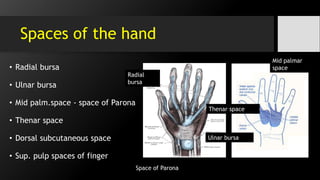
Spaces of the hand
• Radial bursa
• Ulnar bursa
• Mid palm.space - space of Parona
• Thenar space
• Dorsal subcutaneous space
• Sup. pulp spaces of finger
Radial
bursa
Space of Parona
Mid palmar
space
Ulnar bursa
Thenar space
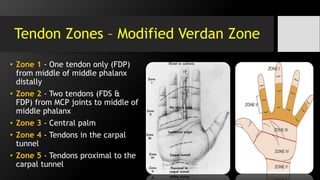
Tendon Zones – Modified Verdan Zone
• Zone 1 - One tendon only (FDP)
from middle of middle phalanx
distally
• Zone 2 - Two tendons (FDS &
FDP) from MCP joints to middle of
middle phalanx
• Zone 3 - Central palm
• Zone 4 - Tendons in the carpal
tunnel
• Zone 5 - Tendons proximal to the
carpal tunnel
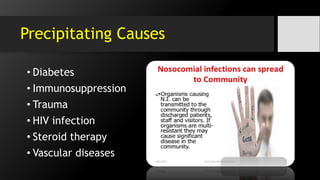
Precipitating Causes
• Diabetes
• Immunosuppression
• Trauma
• HIV infection
• Steroid therapy
• Vascular diseases
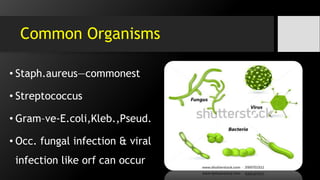
Common Organisms
• Staph.aureus—commonest
• Streptococcus
• Gram–ve-E.coli,Kleb.,Pseud.
• Occ. fungal infection & viral
infection like orf can occur
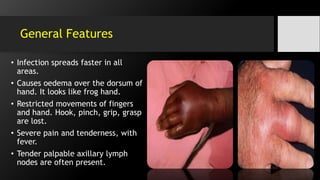
General Features
• Infection spreads faster in all
areas.
• Causes oedema over the dorsum of
hand. It looks like frog hand.
• Restricted movements of fingers
and hand. Hook, pinch, grip, grasp
are lost.
• Severe pain and tenderness, with
fever.
• Tender palpable axillary lymph
nodes are often present.
Classification
[I] Cut.& sub-cut.infections:
• Paronychia
• Pulp Space Infection (Felon)
• Web Space Abscess
[II] Fascial spaces infection :
• Deep Space Infection i.e.
midpalmar space, thenar space
& Parona’s space.
• [III] Inf. of the tendon with
its synovial sheath -
“tenosynovitis”.
• [IV] Inf. of the bone & joint -
“septic arthritis”.
• [V] Miscellaneous infections.
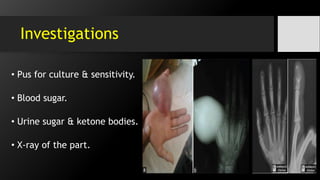
Investigations
• Pus for culture & sensitivity.
• Blood sugar.
• Urine sugar & ketone bodies.
• X-ray of the part.
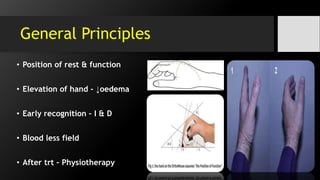
General Principles
• Position of rest & function
• Elevation of hand - ↓oedema
• Early recognition – I & D
• Blood less field
• After trt – Physiotherapy
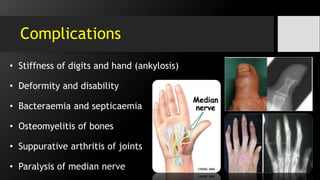
Complications
• Stiffness of digits and hand (ankylosis)
• Deformity and disability
• Bacteraemia and septicaemia
• Osteomyelitis of bones
• Suppurative arthritis of joints
• Paralysis of median nerve
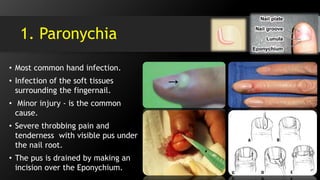
1. Paronychia
• Most common hand infection.
• Infection of the soft tissues
surrounding the fingernail.
• Minor injury - is the common
cause.
• Severe throbbing pain and
tenderness with visible pus under
the nail root.
• The pus is drained by making an
incision over the Eponychium.
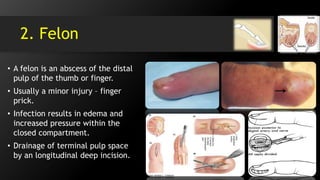
2. Felon
• A felon is an abscess of the distal
pulp of the thumb or finger.
• Usually a minor injury – finger
prick.
• Infection results in edema and
increased pressure within the
closed compartment.
• Drainage of terminal pulp space
by an longitudinal deep incision.
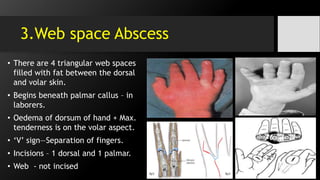
3.Web space Abscess
• There are 4 triangular web spaces
filled with fat between the dorsal
and volar skin.
• Begins beneath palmar callus – in
laborers.
• Oedema of dorsum of hand + Max.
tenderness is on the volar aspect.
• ‘V’ sign—Separation of fingers.
• Incisions – 1 dorsal and 1 palmar.
• Web - not incised
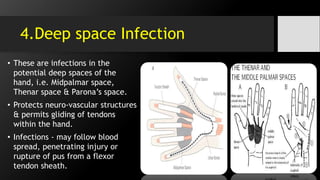
4.Deep space Infection
• These are infections in the
potential deep spaces of the
hand, i.e. Midpalmar space,
Thenar space & Parona’s space.
• Protects neuro-vascular structures
& permits gliding of tendons
within the hand.
• Infections - may follow blood
spread, penetrating injury or
rupture of pus from a flexor
tendon sheath.
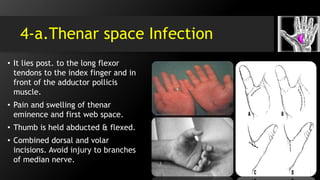
4-a.Thenar space Infection
• It lies post. to the long flexor
tendons to the index finger and in
front of the adductor pollicis
muscle.
• Pain and swelling of thenar
eminence and first web space.
• Thumb is held abducted & flexed.
• Combined dorsal and volar
incisions. Avoid injury to branches
of median nerve.
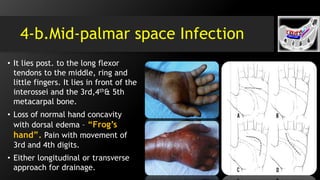
4-b.Mid-palmar space Infection
• It lies post. to the long flexor
tendons to the middle, ring and
little fingers. It lies in front of the
interossei and the 3rd,4th& 5th
metacarpal bone.
• Loss of normal hand concavity
with dorsal edema – “Frog’s
hand”. Pain with movement of
3rd and 4th digits.
• Either longitudinal or transverse
approach for drainage.
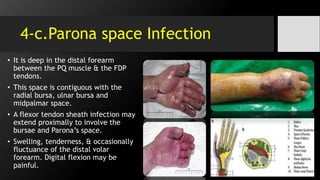
4-c.Parona space Infection
• It is deep in the distal forearm
between the PQ muscle & the FDP
tendons.
• This space is contiguous with the
radial bursa, ulnar bursa and
midpalmar space.
• A flexor tendon sheath infection may
extend proximally to involve the
bursae and Parona’s space.
• Swelling, tenderness, & occasionally
fluctuance of the distal volar
forearm. Digital flexion may be
painful.
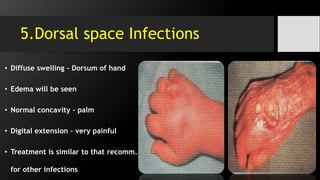
5.Dorsal space Infections
• Diffuse swelling – Dorsum of hand
• Edema will be seen
• Normal concavity - palm
• Digital extension – very painful
• Treatment is similar to that recomm.
for other infections
6.Tenosynovitis
• It is the bacterial inf. of flexor tendon sheaths.
• It is the inflam. the fluid-filled sheath (called
the synovium) that surrounds a tendon.
• Common flexor synovial sheath (ulnar bursa)
[FDP / FDS]
• The synovial sheath of the tendon of flexor
pollicis longus (radial bursa).
• Both comm. with each other in 80% of cases.
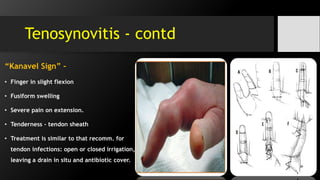
Tenosynovitis - contd
“Kanavel Sign” –
• Finger in slight flexion
• Fusiform swelling
• Severe pain on extension.
• Tenderness - tendon sheath
• Treatment is similar to that recomm. for
tendon infections: open or closed irrigation,
leaving a drain in situ and antibiotic cover.
FOOT INFECTIONS
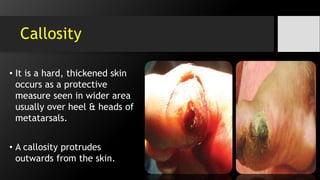
Callosity
• It is a hard, thickened skin
occurs as a protective
measure seen in wider area
usually over heel & heads of
metatarsals.
• A callosity protrudes
outwards from the skin.
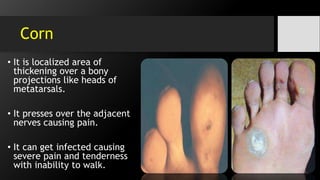
Corn
• It is localized area of
thickening over a bony
projections like heads of
metatarsals.
• It presses over the adjacent
nerves causing pain.
• It can get infected causing
severe pain and tenderness
with inability to walk.
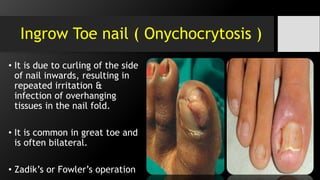
Ingrow Toe nail ( Onychocrytosis )
• It is due to curling of the side
of nail inwards, resulting in
repeated irritation &
infection of overhanging
tissues in the nail fold.
• It is common in great toe and
is often bilateral.
• Zadik’s or Fowler’s operation
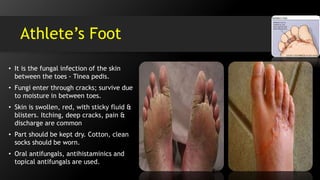
Athlete’s Foot
• It is the fungal infection of the skin
between the toes - Tinea pedis.
• Fungi enter through cracks; survive due
to moisture in between toes.
• Skin is swollen, red, with sticky fluid &
blisters. Itching, deep cracks, pain &
discharge are common
• Part should be kept dry. Cotton, clean
socks should be worn.
• Oral antifungals, antihistaminics and
topical antifungals are used.
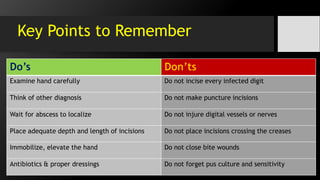
Key Points to Remember
Do’s Don’ts
Examine hand carefully Do not incise every infected digit
Think of other diagnosis Do not make puncture incisions
Wait for abscess to localize Do not injure digital vessels or nerves
Place adequate depth and length of incisions Do not place incisions crossing the creases
Immobilize, elevate the hand Do not close bite wounds
Antibiotics & proper dressings Do not forget pus culture and sensitivity
References
Surgeon should have –
“A heart of lion / Eyes of a hawk & Hands of a woman”.

Hand & Foot infections

  • 1.
    Infections of Hand& Feet Dr. Murali. M.S; M.B.A. Asso.Prof.of Surgery
  • 2.
  • 3.
    Introduction • Hand isa compact actively functioning unit due to its mechanical & sensory functions. • It is one of the most developed structures in the human evolution. • Infection may be due to minor injuries or blood borne.
  • 4.
    Spaces of thehand • Radial bursa • Ulnar bursa • Mid palm.space - space of Parona • Thenar space • Dorsal subcutaneous space • Sup. pulp spaces of finger Radial bursa Space of Parona Mid palmar space Ulnar bursa Thenar space
  • 5.
    Tendon Zones –Modified Verdan Zone • Zone 1 - One tendon only (FDP) from middle of middle phalanx distally • Zone 2 - Two tendons (FDS & FDP) from MCP joints to middle of middle phalanx • Zone 3 - Central palm • Zone 4 - Tendons in the carpal tunnel • Zone 5 - Tendons proximal to the carpal tunnel
  • 6.
    Precipitating Causes • Diabetes •Immunosuppression • Trauma • HIV infection • Steroid therapy • Vascular diseases
  • 7.
    Common Organisms • Staph.aureus—commonest •Streptococcus • Gram–ve-E.coli,Kleb.,Pseud. • Occ. fungal infection & viral infection like orf can occur
  • 8.
    General Features • Infectionspreads faster in all areas. • Causes oedema over the dorsum of hand. It looks like frog hand. • Restricted movements of fingers and hand. Hook, pinch, grip, grasp are lost. • Severe pain and tenderness, with fever. • Tender palpable axillary lymph nodes are often present.
  • 9.
    Classification [I] Cut.& sub-cut.infections: •Paronychia • Pulp Space Infection (Felon) • Web Space Abscess [II] Fascial spaces infection : • Deep Space Infection i.e. midpalmar space, thenar space & Parona’s space. • [III] Inf. of the tendon with its synovial sheath - “tenosynovitis”. • [IV] Inf. of the bone & joint - “septic arthritis”. • [V] Miscellaneous infections.
  • 10.
    Investigations • Pus forculture & sensitivity. • Blood sugar. • Urine sugar & ketone bodies. • X-ray of the part.
  • 11.
    General Principles • Positionof rest & function • Elevation of hand - ↓oedema • Early recognition – I & D • Blood less field • After trt – Physiotherapy
  • 12.
    Complications • Stiffness ofdigits and hand (ankylosis) • Deformity and disability • Bacteraemia and septicaemia • Osteomyelitis of bones • Suppurative arthritis of joints • Paralysis of median nerve
  • 13.
    1. Paronychia • Mostcommon hand infection. • Infection of the soft tissues surrounding the fingernail. • Minor injury - is the common cause. • Severe throbbing pain and tenderness with visible pus under the nail root. • The pus is drained by making an incision over the Eponychium.
  • 14.
    2. Felon • Afelon is an abscess of the distal pulp of the thumb or finger. • Usually a minor injury – finger prick. • Infection results in edema and increased pressure within the closed compartment. • Drainage of terminal pulp space by an longitudinal deep incision.
  • 15.
    3.Web space Abscess •There are 4 triangular web spaces filled with fat between the dorsal and volar skin. • Begins beneath palmar callus – in laborers. • Oedema of dorsum of hand + Max. tenderness is on the volar aspect. • ‘V’ sign—Separation of fingers. • Incisions – 1 dorsal and 1 palmar. • Web - not incised
  • 16.
    4.Deep space Infection •These are infections in the potential deep spaces of the hand, i.e. Midpalmar space, Thenar space & Parona’s space. • Protects neuro-vascular structures & permits gliding of tendons within the hand. • Infections - may follow blood spread, penetrating injury or rupture of pus from a flexor tendon sheath.
  • 17.
    4-a.Thenar space Infection •It lies post. to the long flexor tendons to the index finger and in front of the adductor pollicis muscle. • Pain and swelling of thenar eminence and first web space. • Thumb is held abducted & flexed. • Combined dorsal and volar incisions. Avoid injury to branches of median nerve.
  • 18.
    4-b.Mid-palmar space Infection •It lies post. to the long flexor tendons to the middle, ring and little fingers. It lies in front of the interossei and the 3rd,4th& 5th metacarpal bone. • Loss of normal hand concavity with dorsal edema – “Frog’s hand”. Pain with movement of 3rd and 4th digits. • Either longitudinal or transverse approach for drainage.
  • 19.
    4-c.Parona space Infection •It is deep in the distal forearm between the PQ muscle & the FDP tendons. • This space is contiguous with the radial bursa, ulnar bursa and midpalmar space. • A flexor tendon sheath infection may extend proximally to involve the bursae and Parona’s space. • Swelling, tenderness, & occasionally fluctuance of the distal volar forearm. Digital flexion may be painful.
  • 20.
    5.Dorsal space Infections •Diffuse swelling – Dorsum of hand • Edema will be seen • Normal concavity - palm • Digital extension – very painful • Treatment is similar to that recomm. for other infections
  • 21.
    6.Tenosynovitis • It isthe bacterial inf. of flexor tendon sheaths. • It is the inflam. the fluid-filled sheath (called the synovium) that surrounds a tendon. • Common flexor synovial sheath (ulnar bursa) [FDP / FDS] • The synovial sheath of the tendon of flexor pollicis longus (radial bursa). • Both comm. with each other in 80% of cases.
  • 22.
    Tenosynovitis - contd “KanavelSign” – • Finger in slight flexion • Fusiform swelling • Severe pain on extension. • Tenderness - tendon sheath • Treatment is similar to that recomm. for tendon infections: open or closed irrigation, leaving a drain in situ and antibiotic cover.
  • 23.
  • 24.
    Callosity • It isa hard, thickened skin occurs as a protective measure seen in wider area usually over heel & heads of metatarsals. • A callosity protrudes outwards from the skin.
  • 25.
    Corn • It islocalized area of thickening over a bony projections like heads of metatarsals. • It presses over the adjacent nerves causing pain. • It can get infected causing severe pain and tenderness with inability to walk.
  • 26.
    Ingrow Toe nail( Onychocrytosis ) • It is due to curling of the side of nail inwards, resulting in repeated irritation & infection of overhanging tissues in the nail fold. • It is common in great toe and is often bilateral. • Zadik’s or Fowler’s operation
  • 27.
    Athlete’s Foot • Itis the fungal infection of the skin between the toes - Tinea pedis. • Fungi enter through cracks; survive due to moisture in between toes. • Skin is swollen, red, with sticky fluid & blisters. Itching, deep cracks, pain & discharge are common • Part should be kept dry. Cotton, clean socks should be worn. • Oral antifungals, antihistaminics and topical antifungals are used.
  • 28.
    Key Points toRemember Do’s Don’ts Examine hand carefully Do not incise every infected digit Think of other diagnosis Do not make puncture incisions Wait for abscess to localize Do not injure digital vessels or nerves Place adequate depth and length of incisions Do not place incisions crossing the creases Immobilize, elevate the hand Do not close bite wounds Antibiotics & proper dressings Do not forget pus culture and sensitivity
  • 29.
  • 30.
    Surgeon should have– “A heart of lion / Eyes of a hawk & Hands of a woman”.