Prof. U. Murali.
Urolithiasis
Learning Objectives
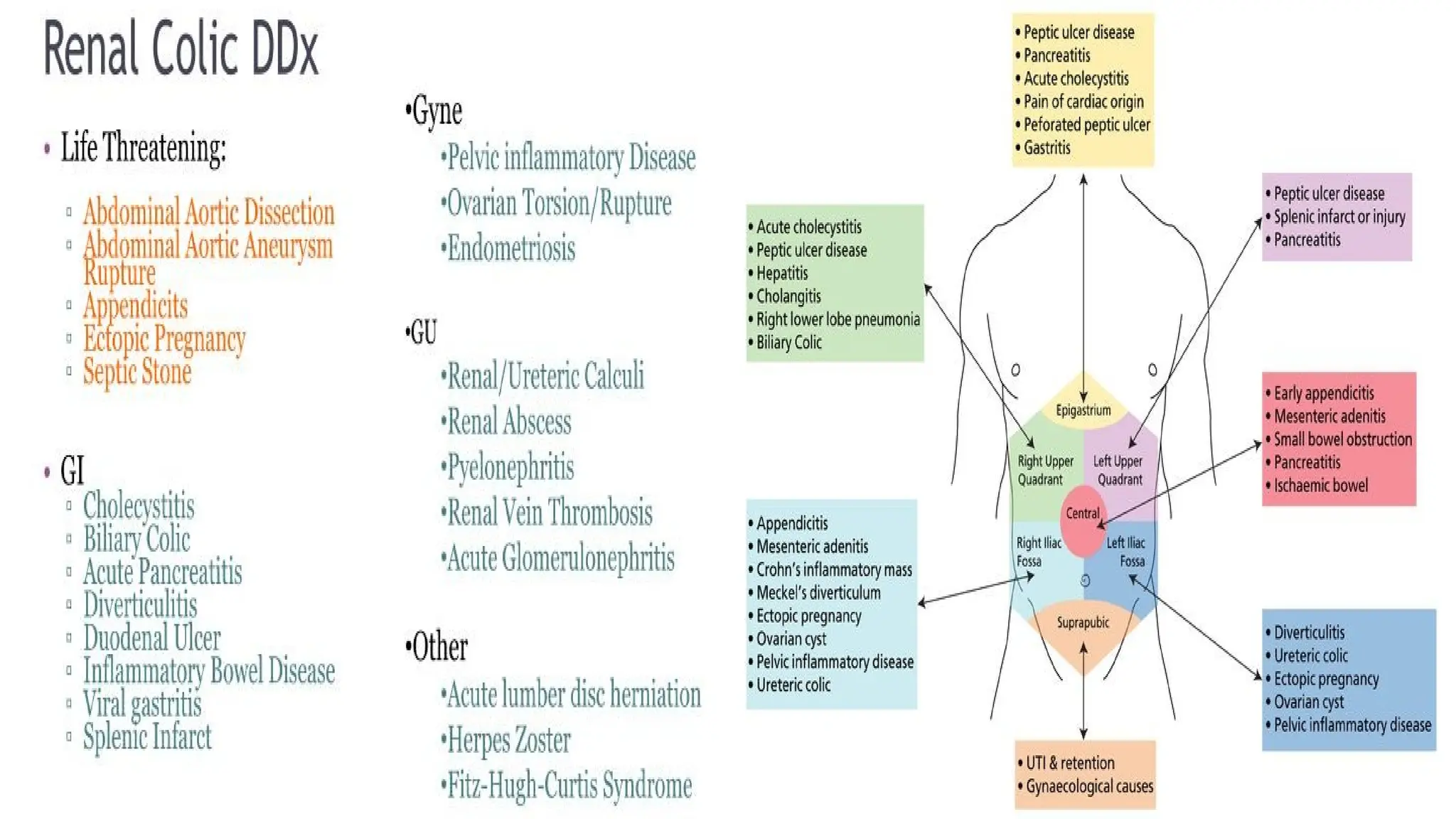
 Identify the D / D of Renal colic.
 List out the types of Renal calculus.
 Describe the etiology, C/F, investigations & treatment of
Renal, Ureteric & Vesical calculus.
 Explain the pathophysiology of stone formation.
 Discuss about Stag-horn calculus.
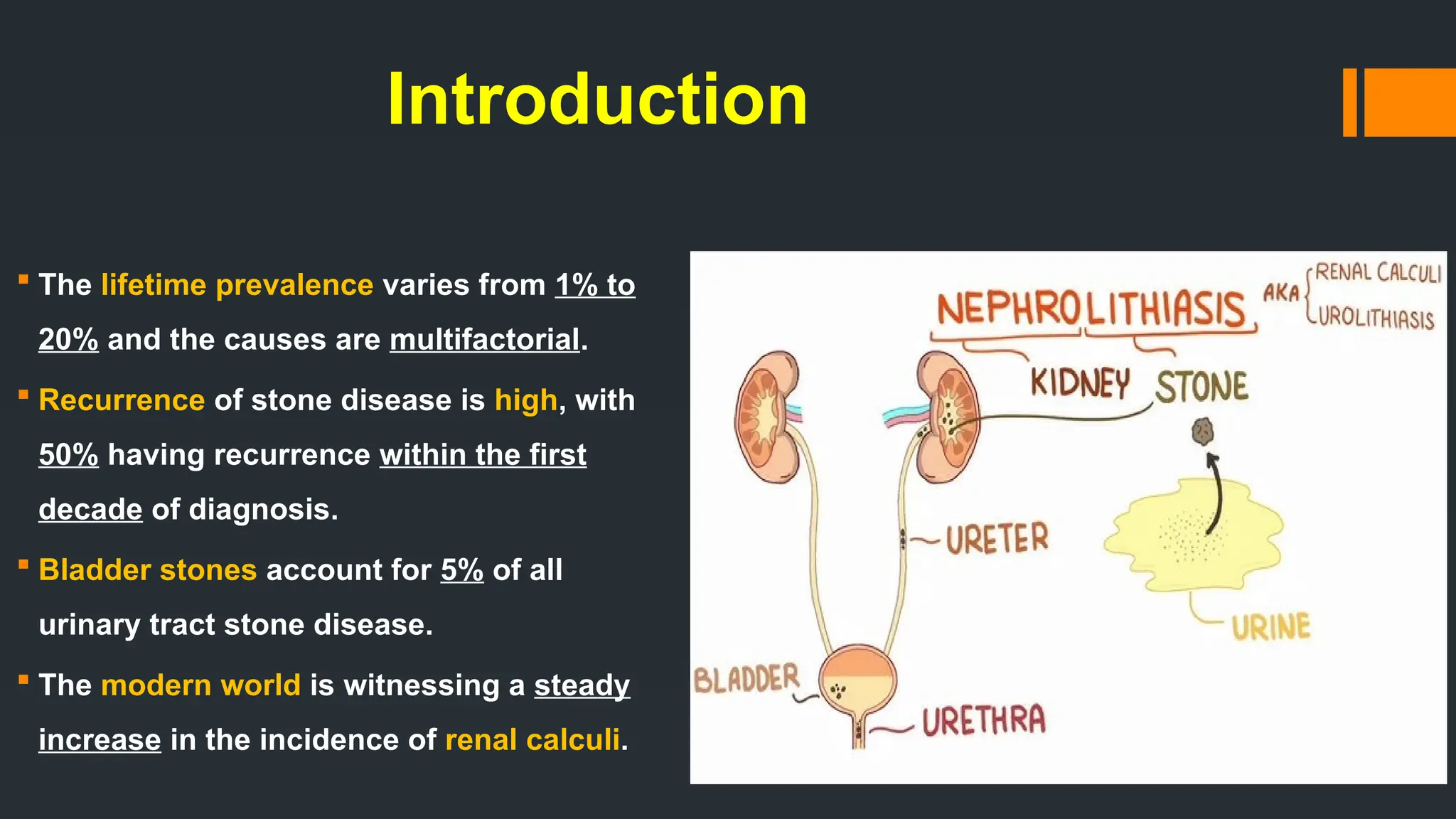
Introduction
 The lifetime prevalence varies from 1% to
20% and the causes are multifactorial.
 Recurrence of stone disease is high, with
50% having recurrence within the first
decade of diagnosis.
 Bladder stones account for 5% of all
urinary tract stone disease.
 The modern world is witnessing a steady
increase in the incidence of renal calculi.
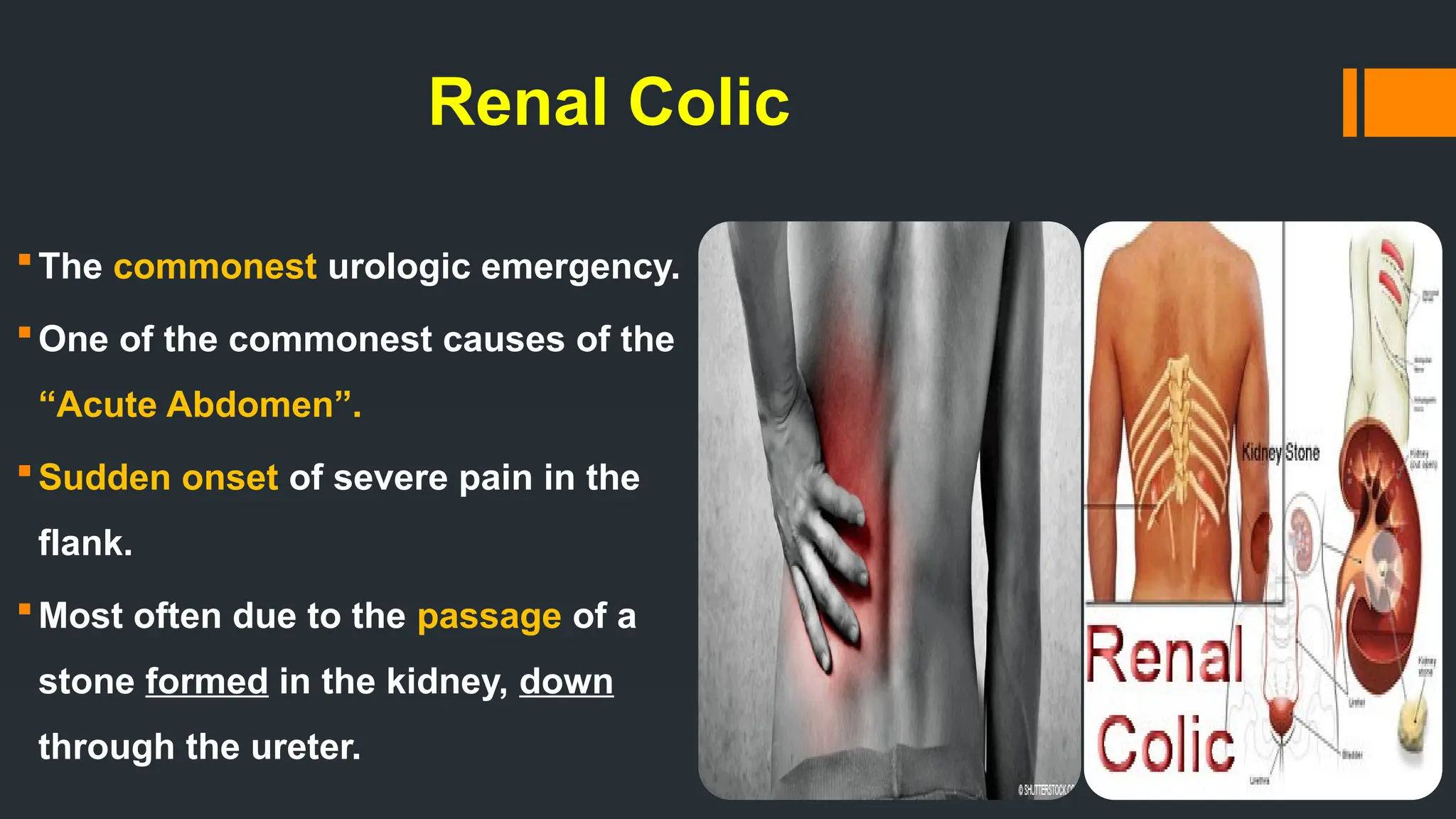
Renal Colic
The commonest urologic emergency.
One of the commonest causes of the
“Acute Abdomen”.
Sudden onset of severe pain in the
flank.
Most often due to the passage of a
stone formed in the kidney, down
through the ureter.
Renal Colic
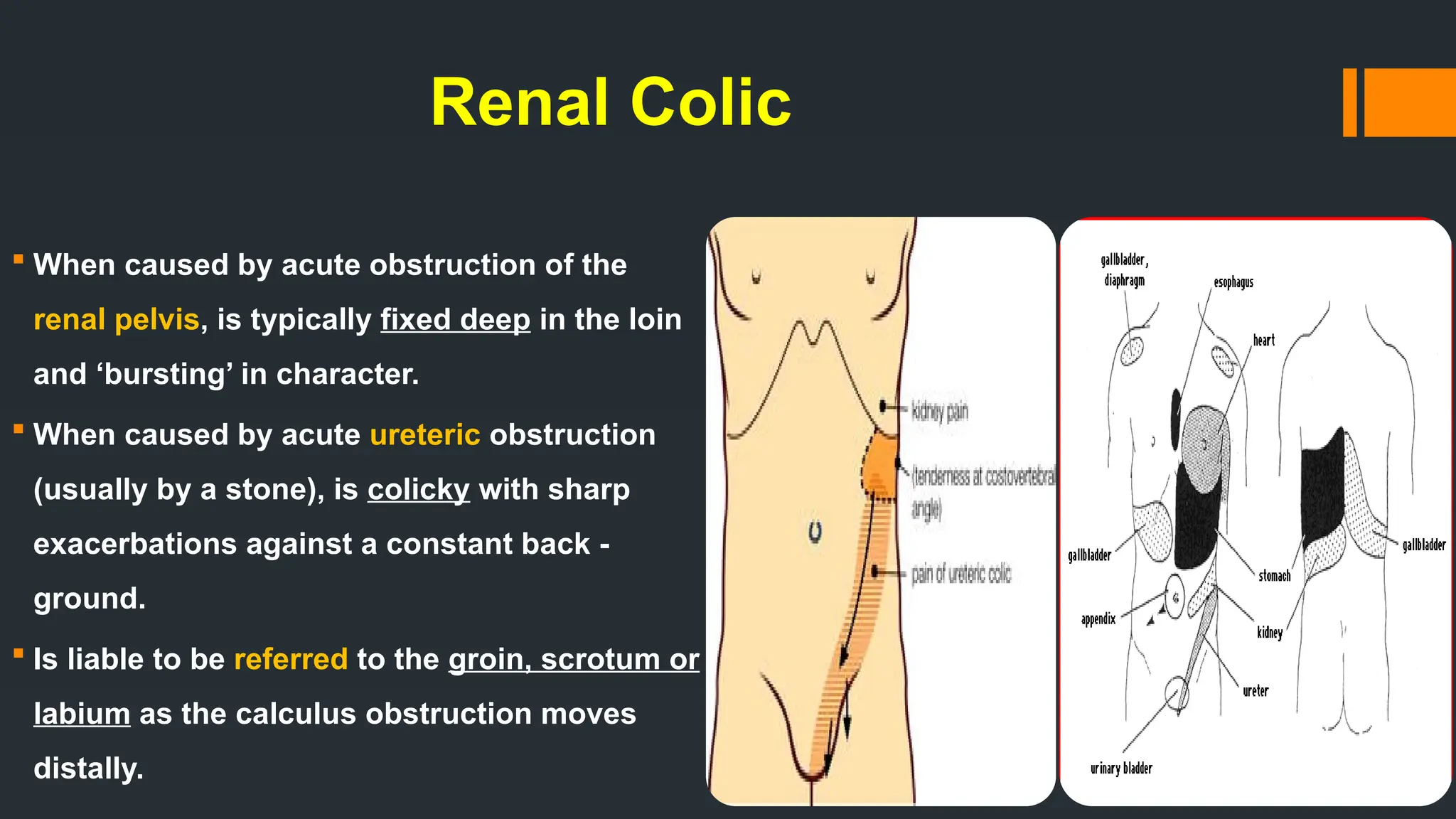
 When caused by acute obstruction of the
renal pelvis, is typically fixed deep in the loin
and ‘bursting’ in character.
 When caused by acute ureteric obstruction
(usually by a stone), is colicky with sharp
exacerbations against a constant back -
ground.
 Is liable to be referred to the groin, scrotum or
labium as the calculus obstruction moves
distally.
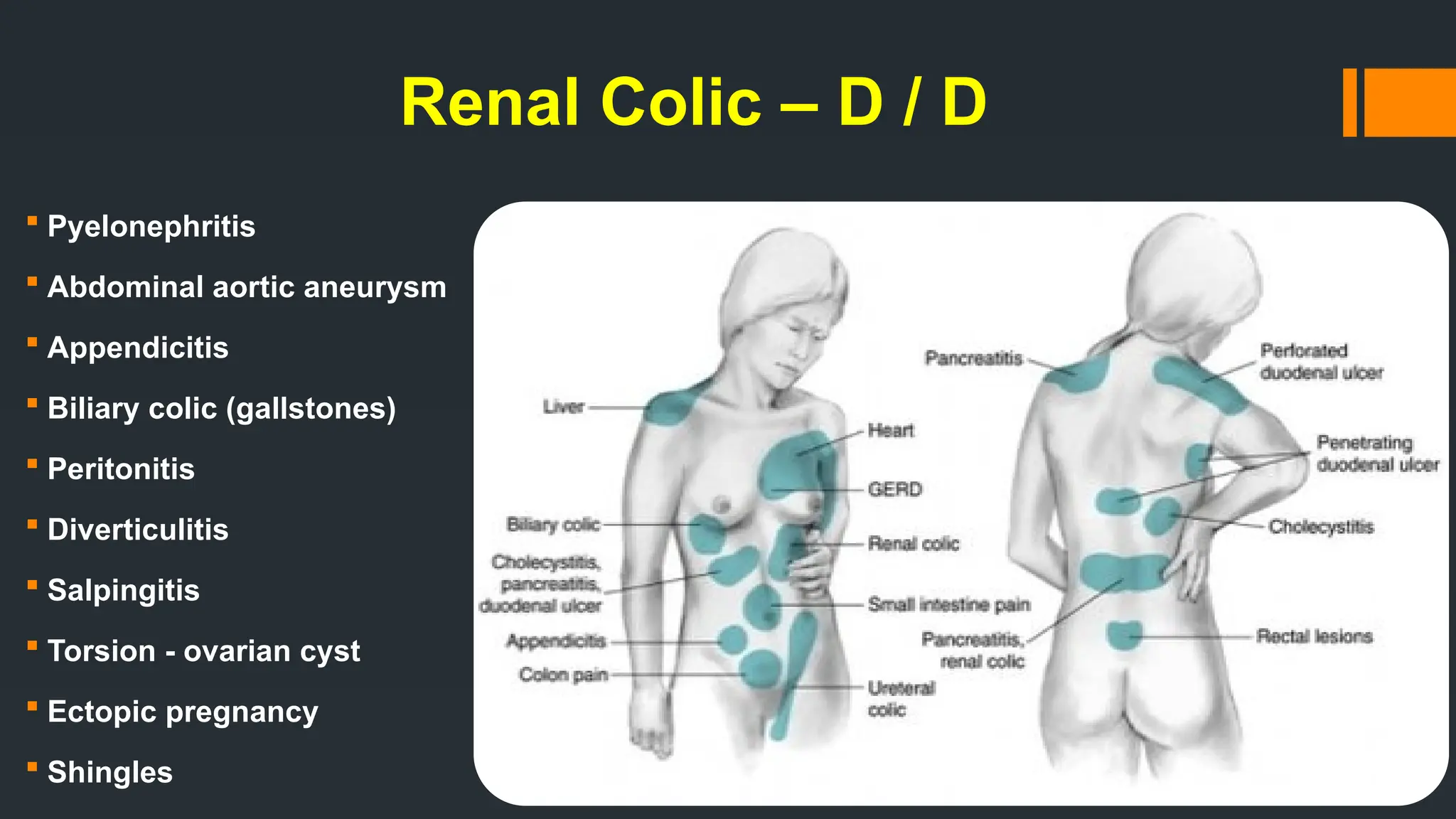
Renal Colic – D / D
 Pyelonephritis
 Abdominal aortic aneurysm
 Appendicitis
 Biliary colic (gallstones)
 Peritonitis
 Diverticulitis
 Salpingitis
 Torsion - ovarian cyst
 Ectopic pregnancy
 Shingles
Prof. U. Murali.
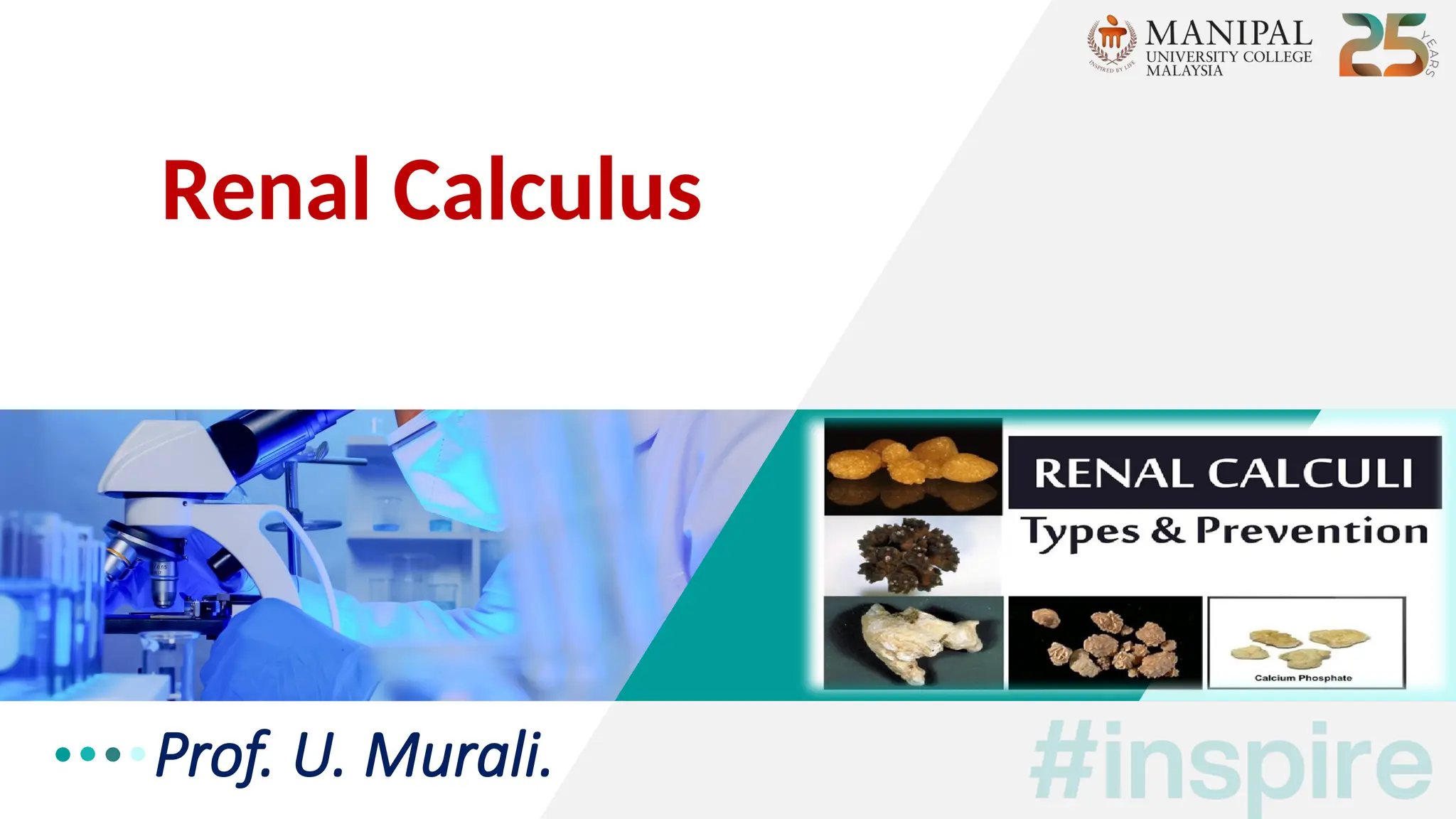
Renal Calculus
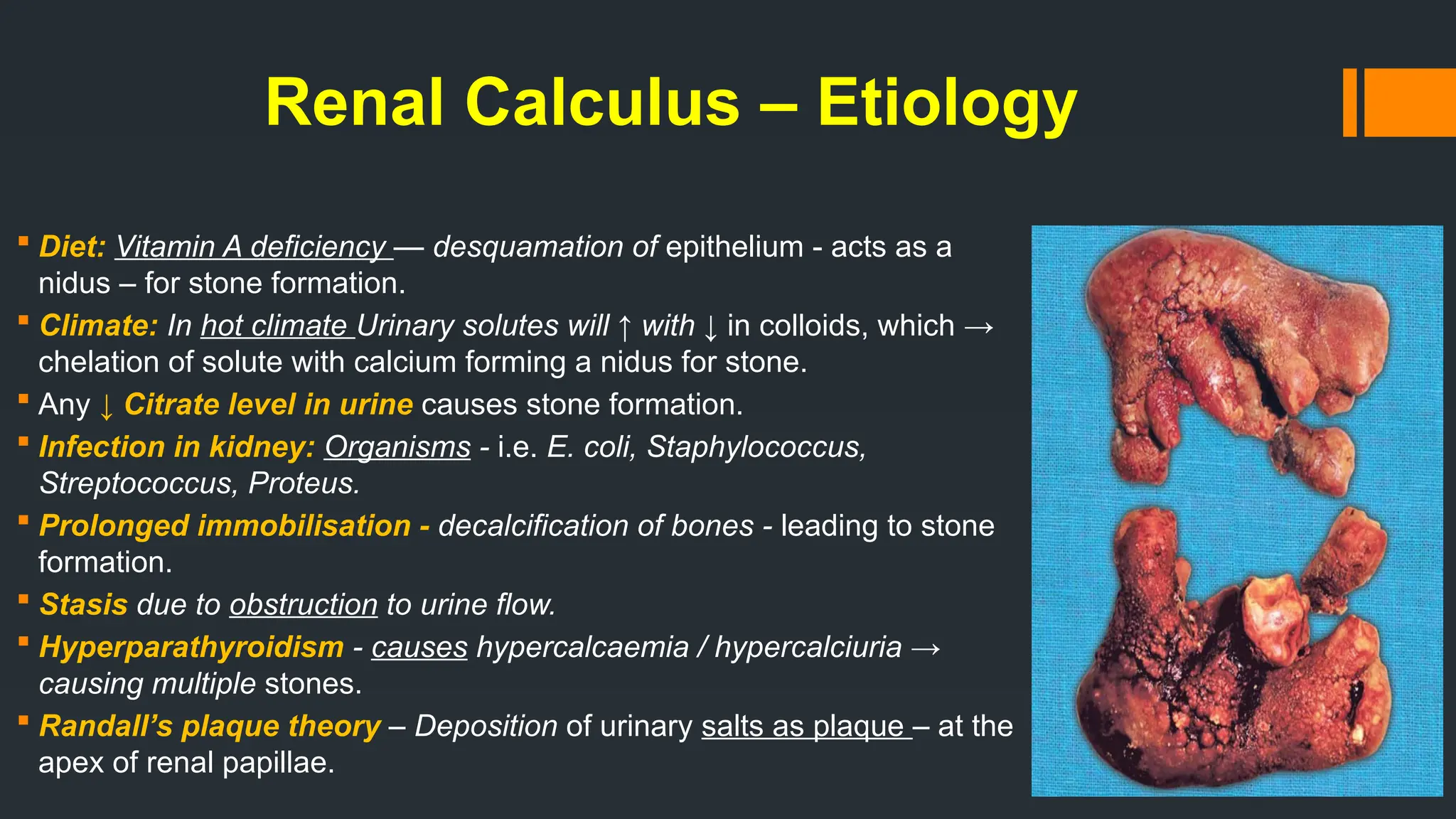
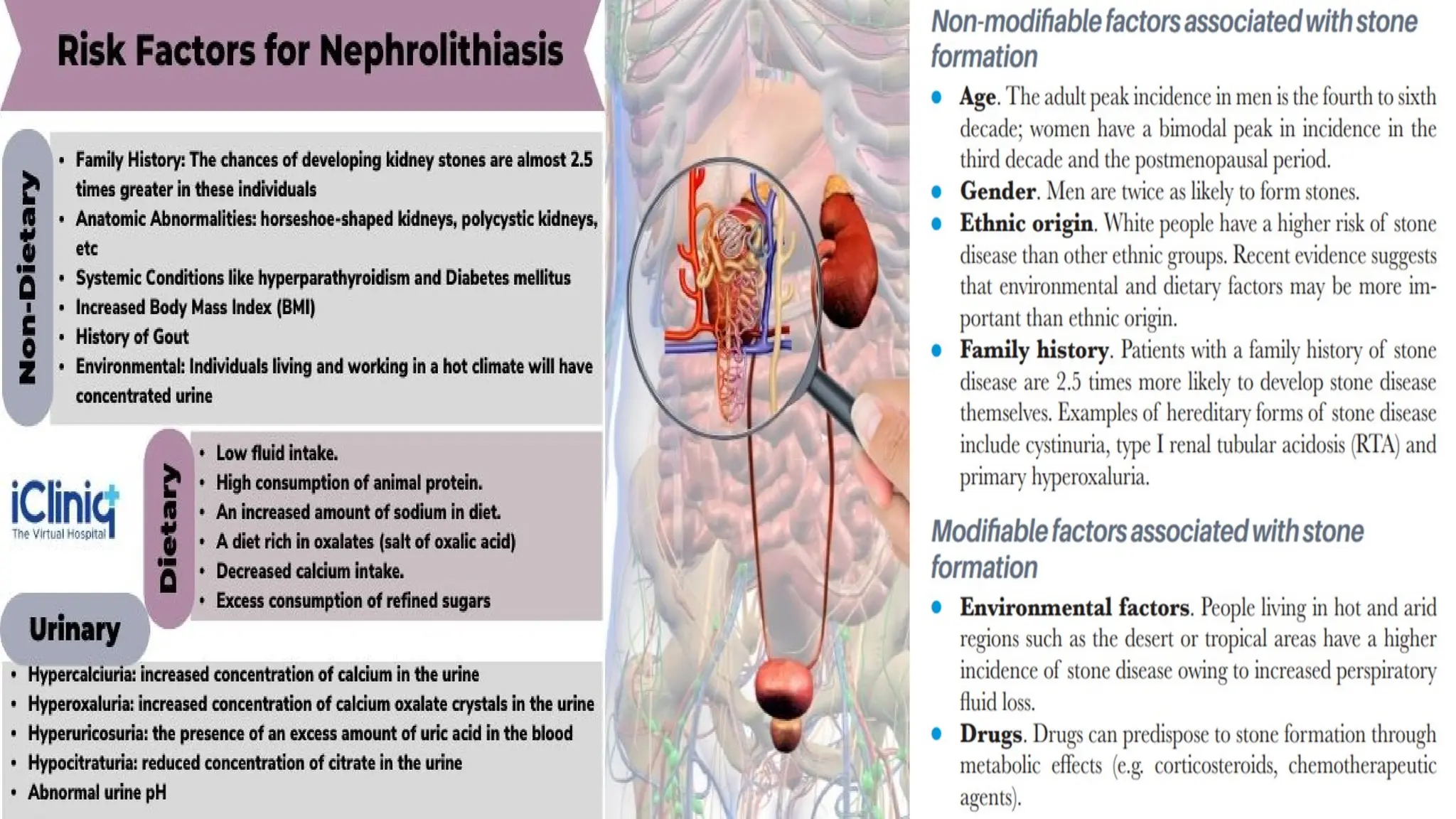
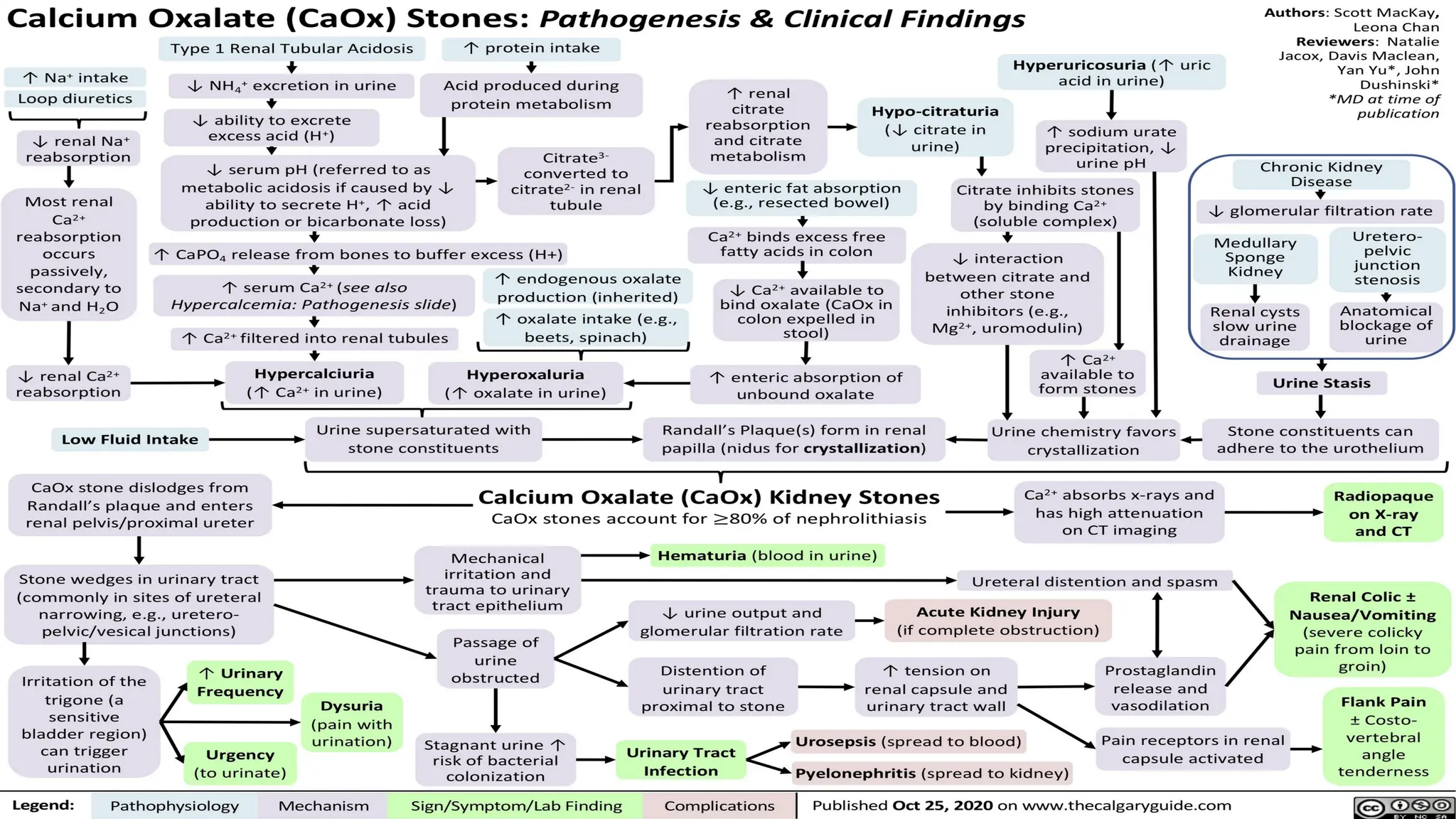
Renal Calculus – Etiology
 Diet: Vitamin A deficiency — desquamation of epithelium - acts as a
nidus – for stone formation.
 Climate: In hot climate Urinary solutes will ↑ with ↓ in colloids, which →
chelation of solute with calcium forming a nidus for stone.
 Any ↓ Citrate level in urine causes stone formation.
 Infection in kidney: Organisms - i.e. E. coli, Staphylococcus,
Streptococcus, Proteus.
 Prolonged immobilisation - decalcification of bones - leading to stone
formation.
 Stasis due to obstruction to urine flow.
 Hyperparathyroidism - causes hypercalcaemia / hypercalciuria →
causing multiple stones.
 Randall’s plaque theory – Deposition of urinary salts as plaque – at the
apex of renal papillae.
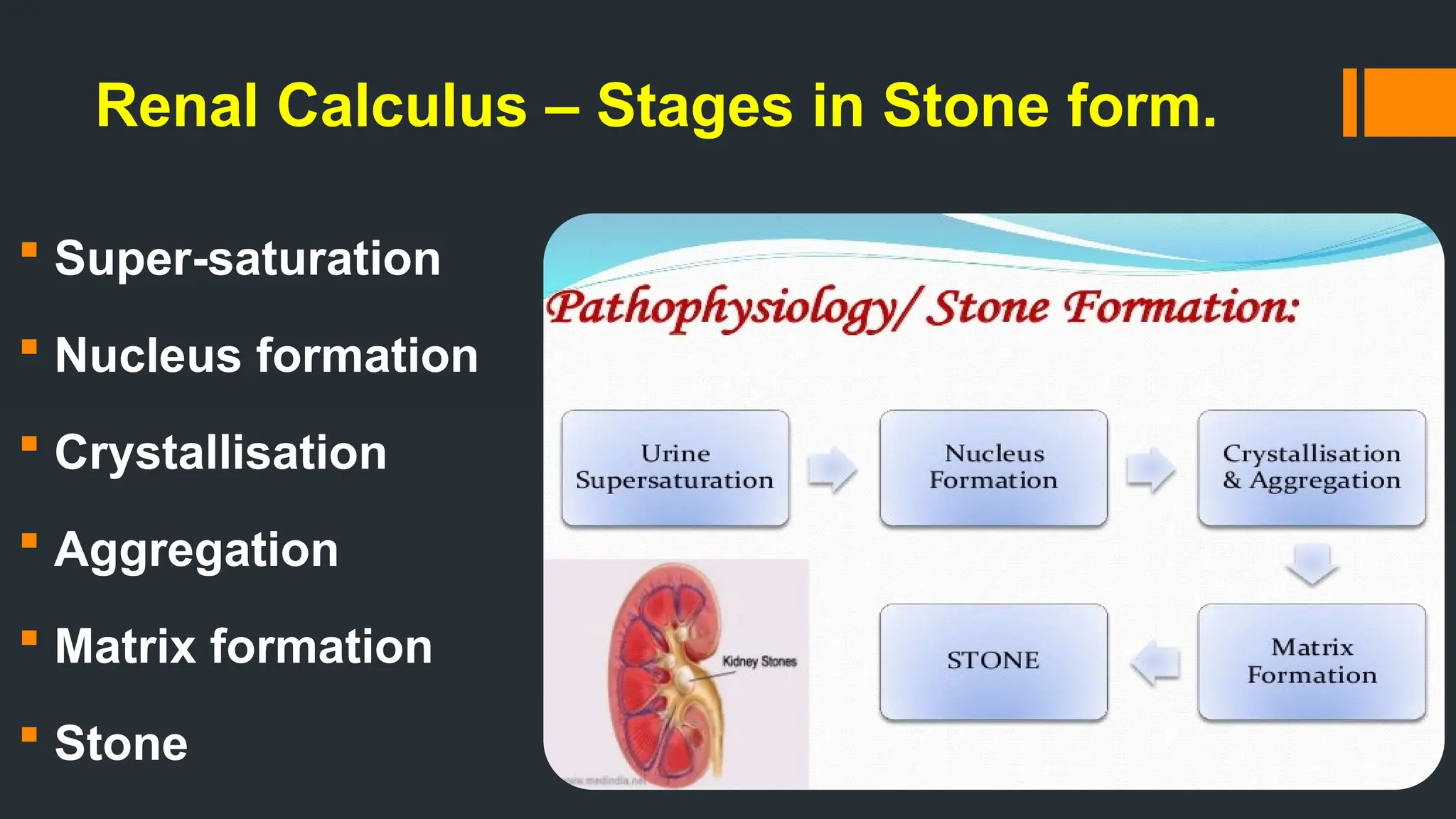
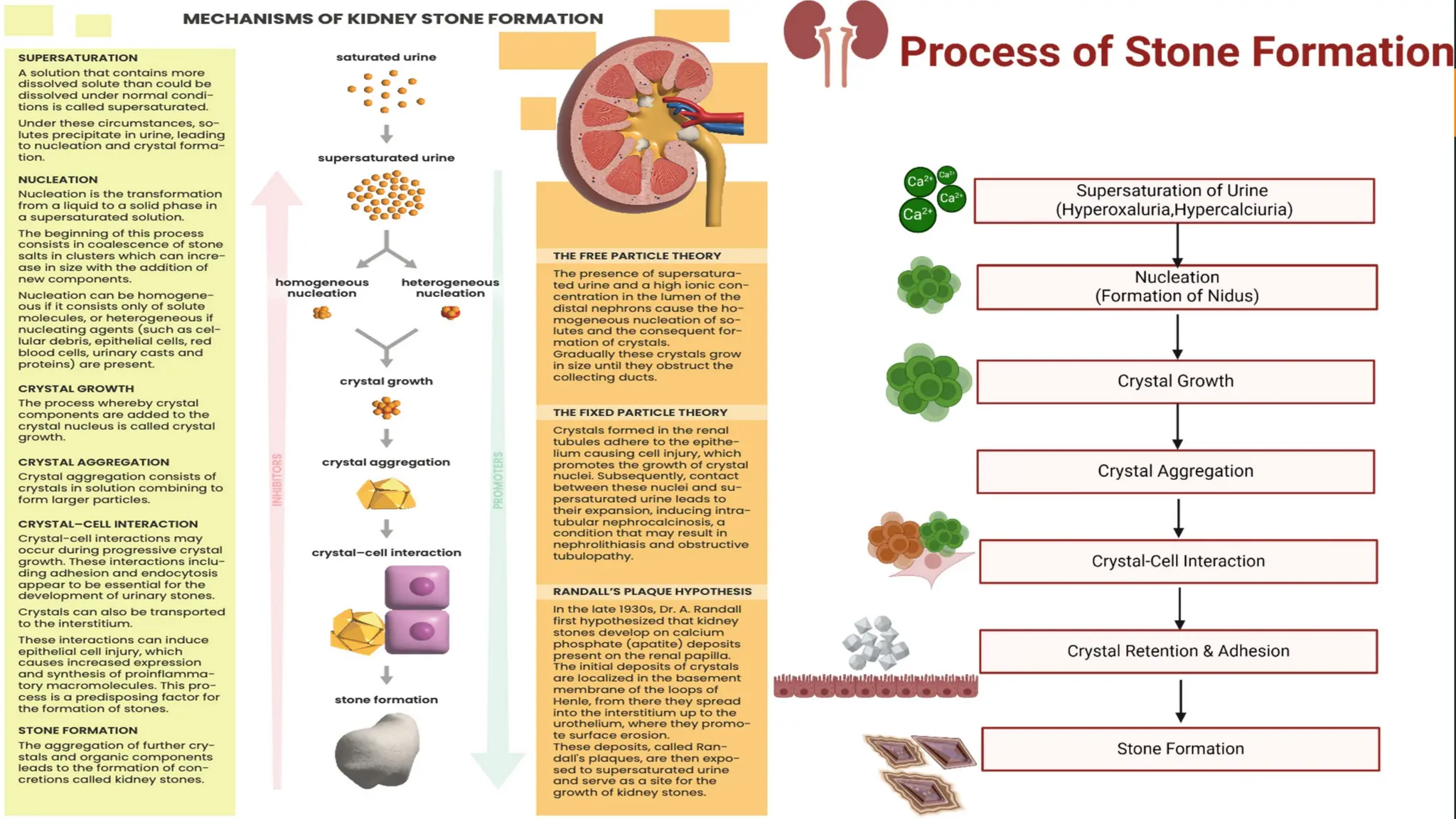
Renal Calculus – Stages in Stone form.
 Super-saturation
 Nucleus formation
 Crystallisation
 Aggregation
 Matrix formation
 Stone
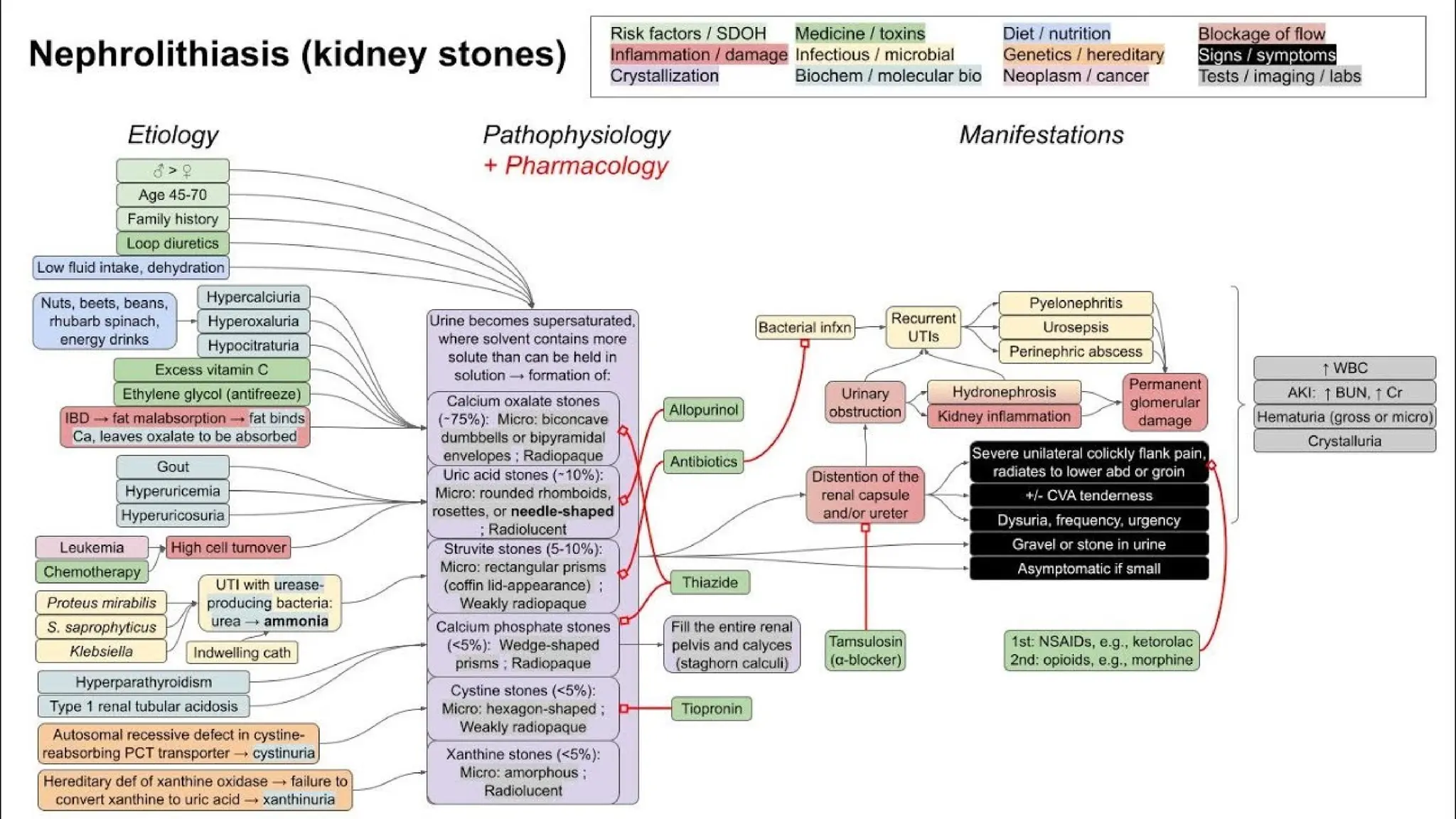
Renal Calculus – Types
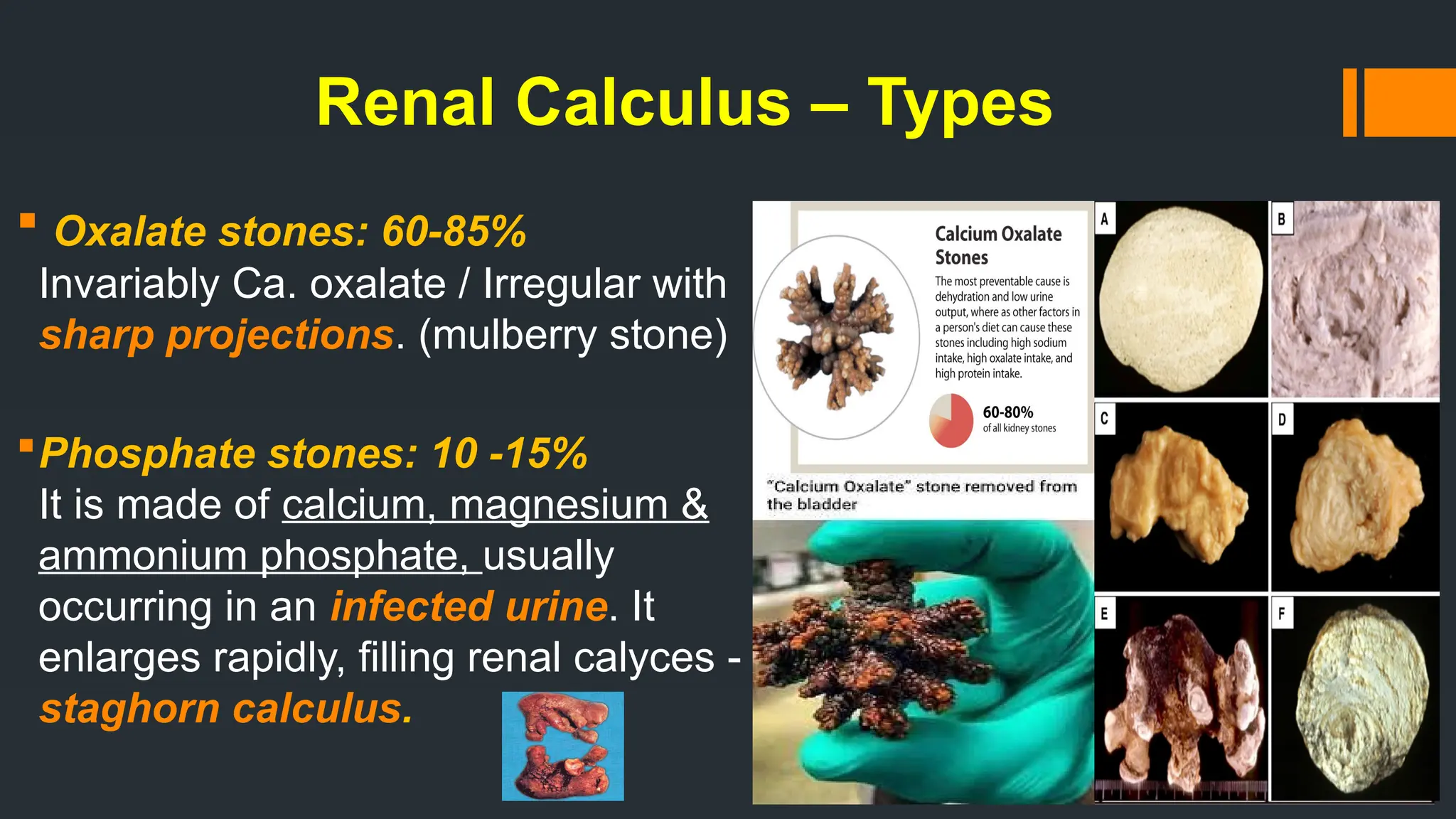
 Oxalate stones: 60-85%
Invariably Ca. oxalate / Irregular with
sharp projections. (mulberry stone)
Phosphate stones: 10 -15%
It is made of calcium, magnesium &
ammonium phosphate, usually
occurring in an infected urine. It
enlarges rapidly, filling renal calyces -
staghorn calculus.
Renal Calculus – Types
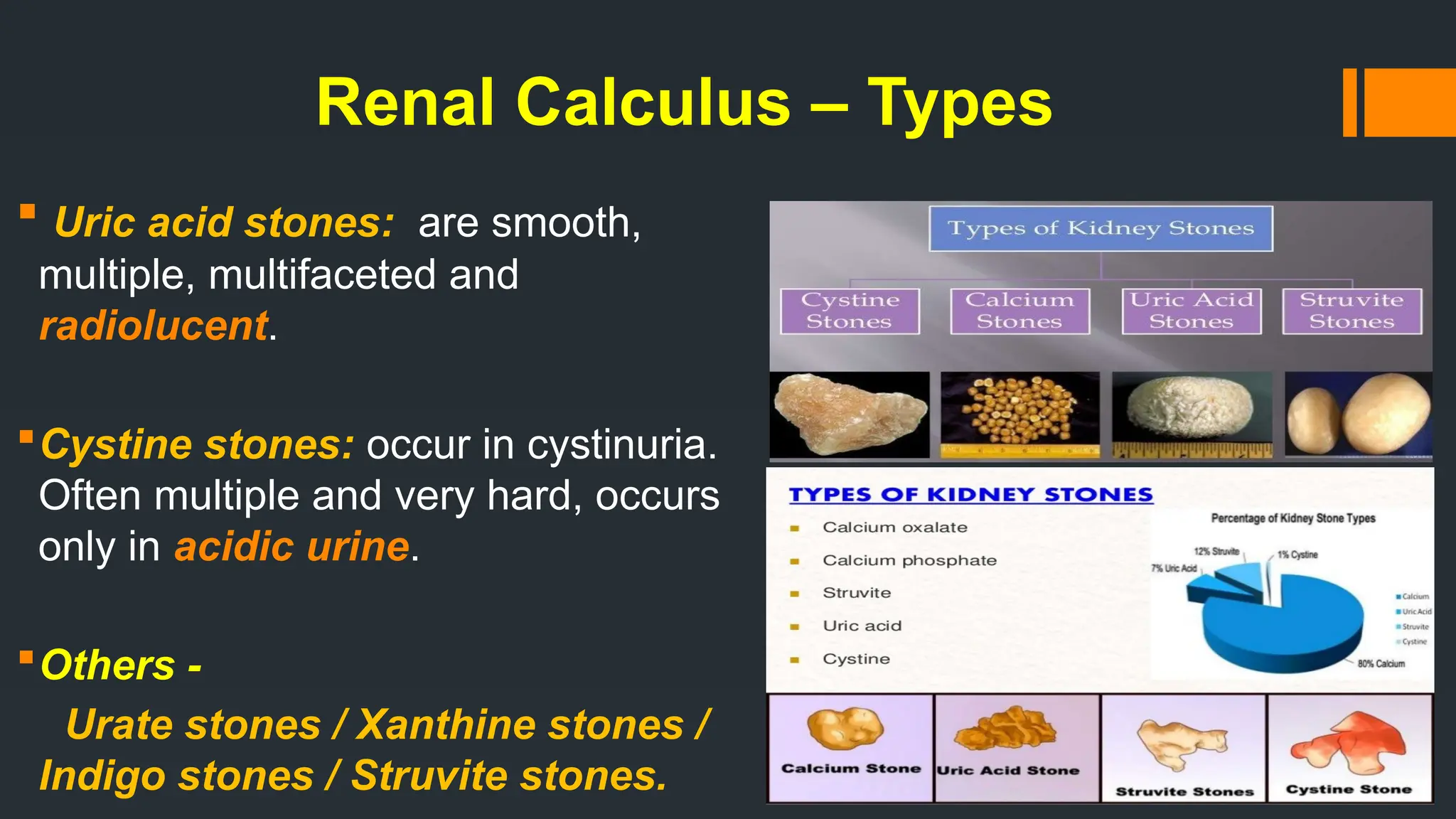
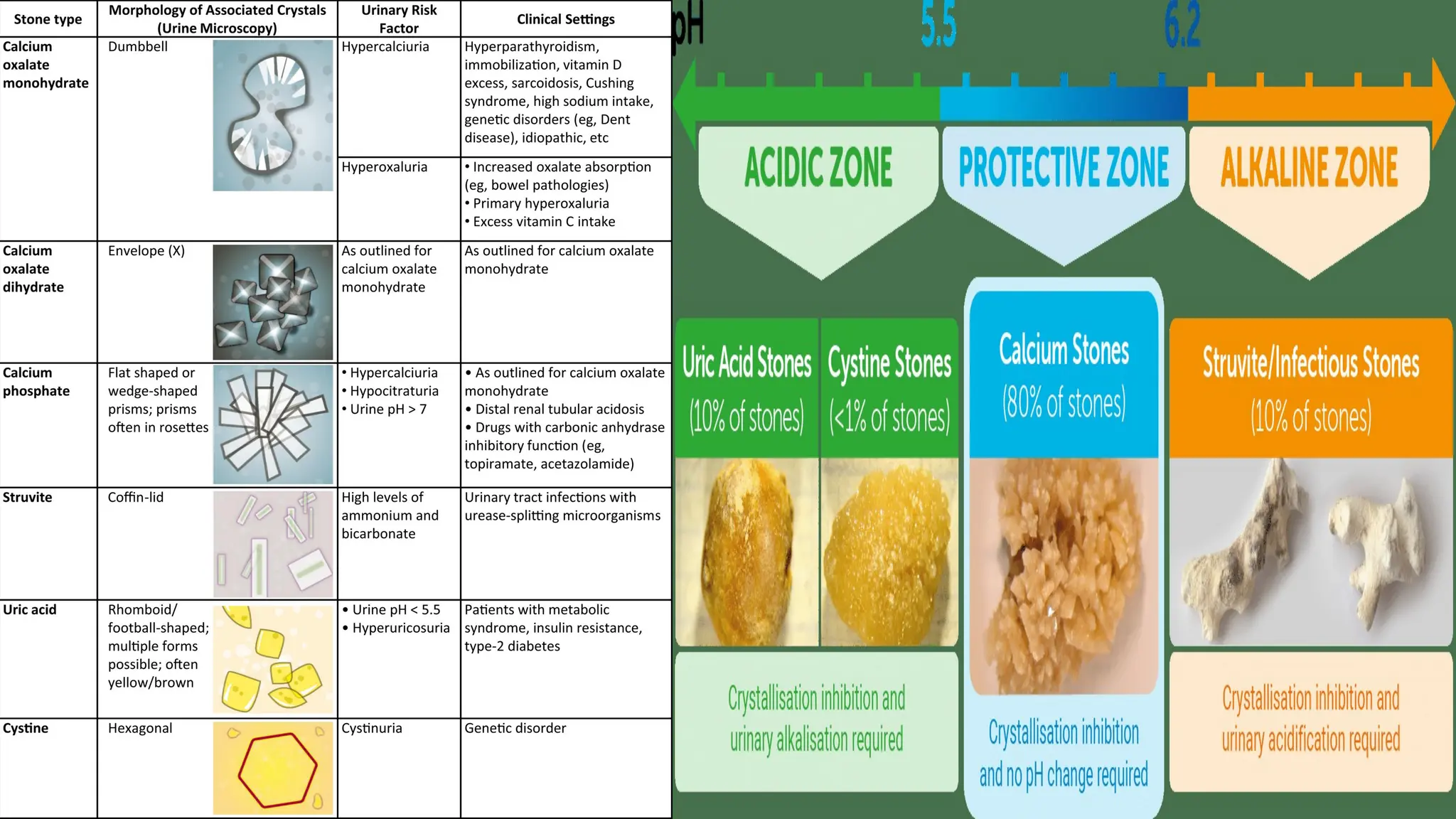
 Uric acid stones: are smooth,
multiple, multifaceted and
radiolucent.
Cystine stones: occur in cystinuria.
Often multiple and very hard, occurs
only in acidic urine.
Others -
Urate stones / Xanthine stones /
Indigo stones / Struvite stones.
Renal Calculus – Clinical Features
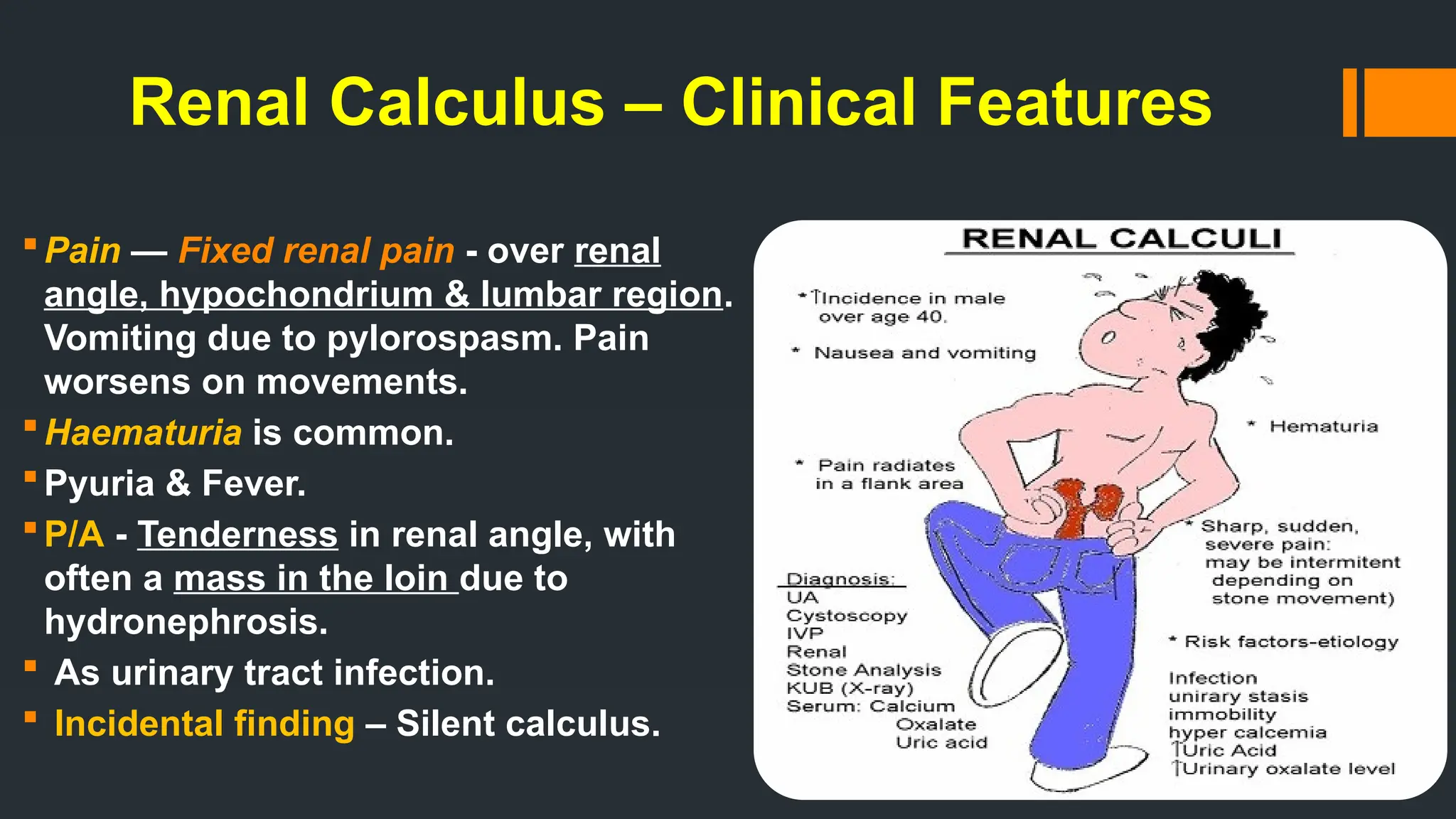
Pain — Fixed renal pain - over renal
angle, hypochondrium & lumbar region.
Vomiting due to pylorospasm. Pain
worsens on movements.
Haematuria is common.
Pyuria & Fever.
P/A - Tenderness in renal angle, with
often a mass in the loin due to
hydronephrosis.
 As urinary tract infection.
 Incidental finding – Silent calculus.
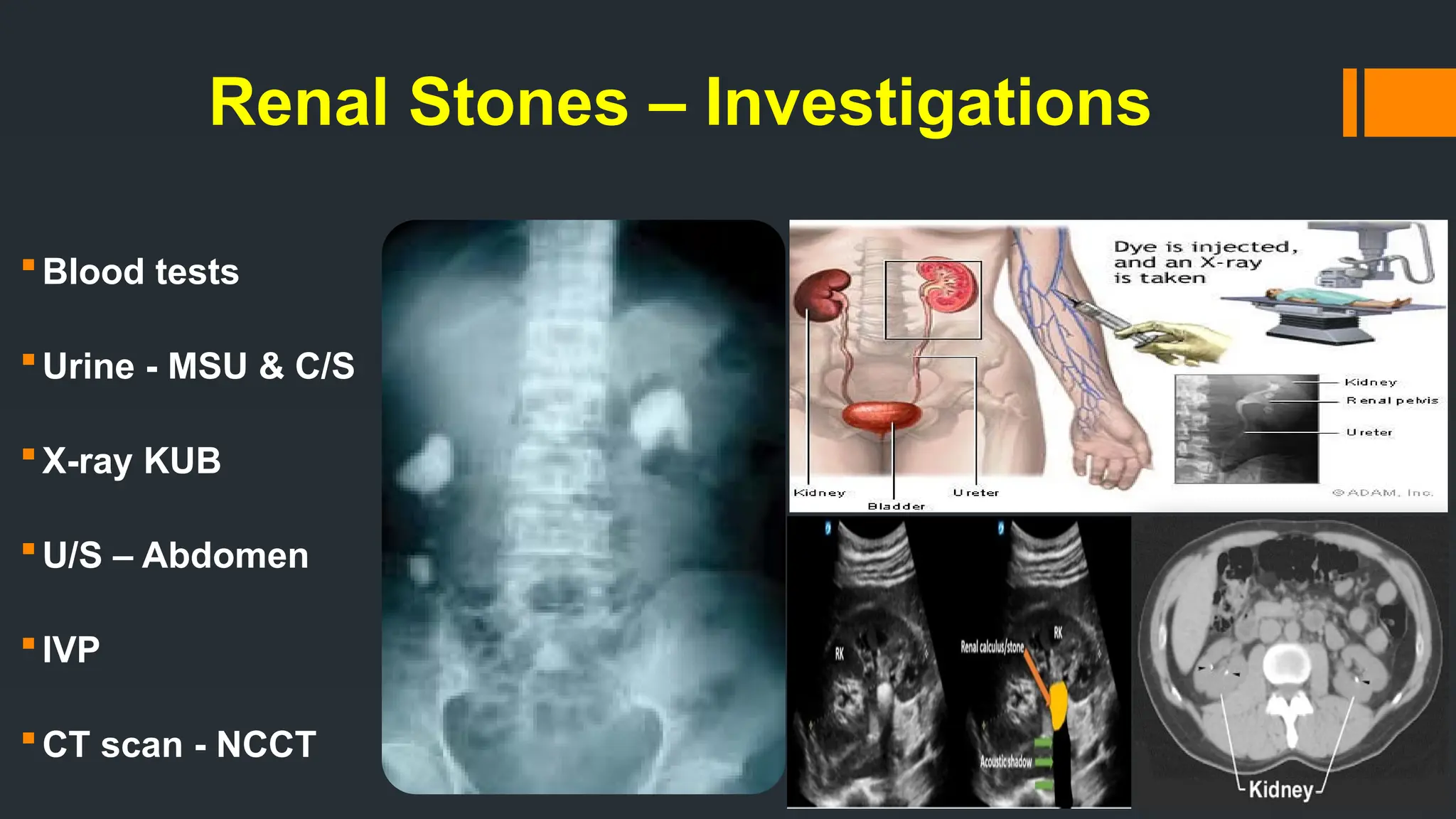
Renal Stones – Investigations
Blood tests
Urine - MSU & C/S
X-ray KUB
U/S – Abdomen
IVP
CT scan - NCCT
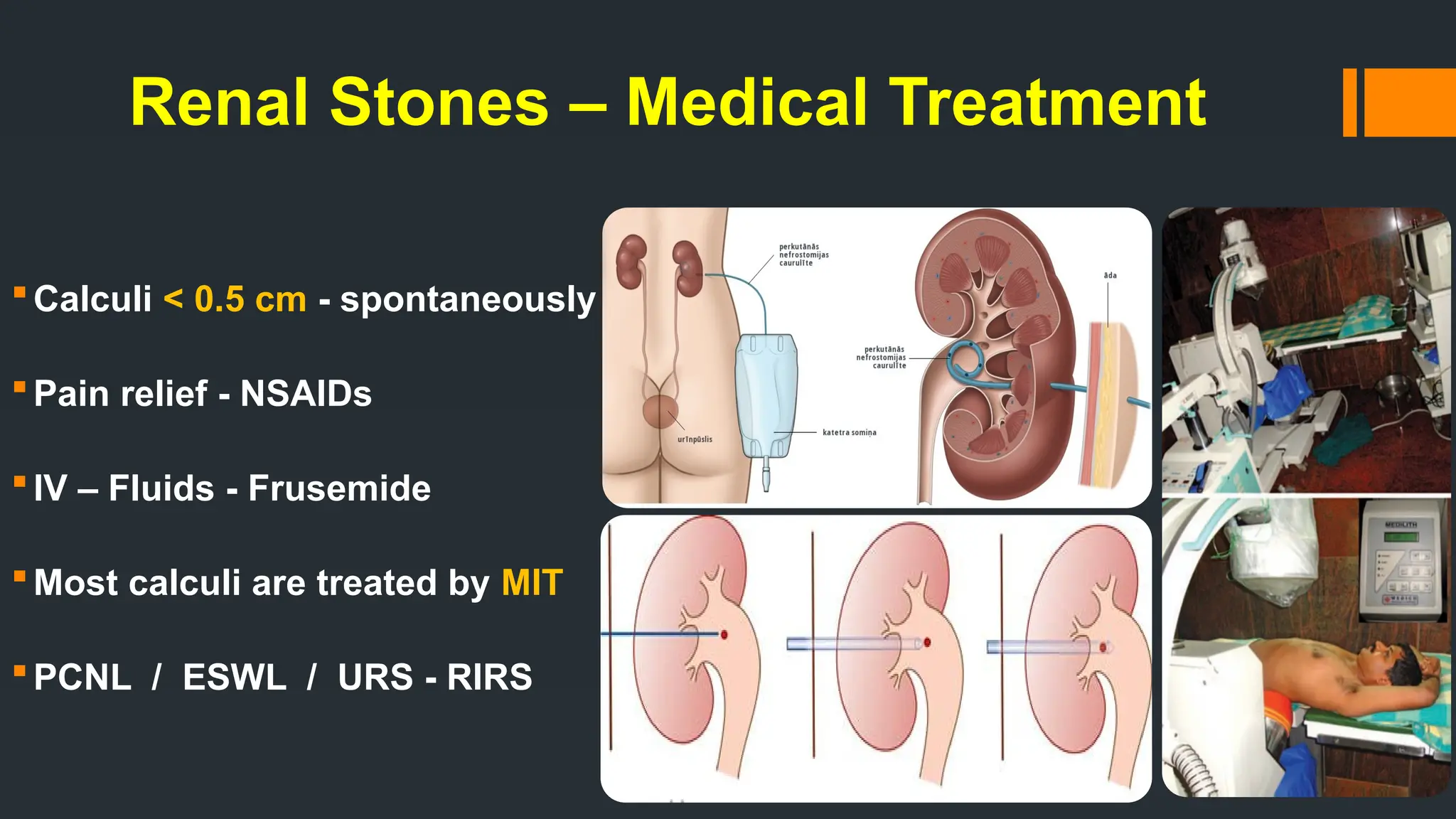
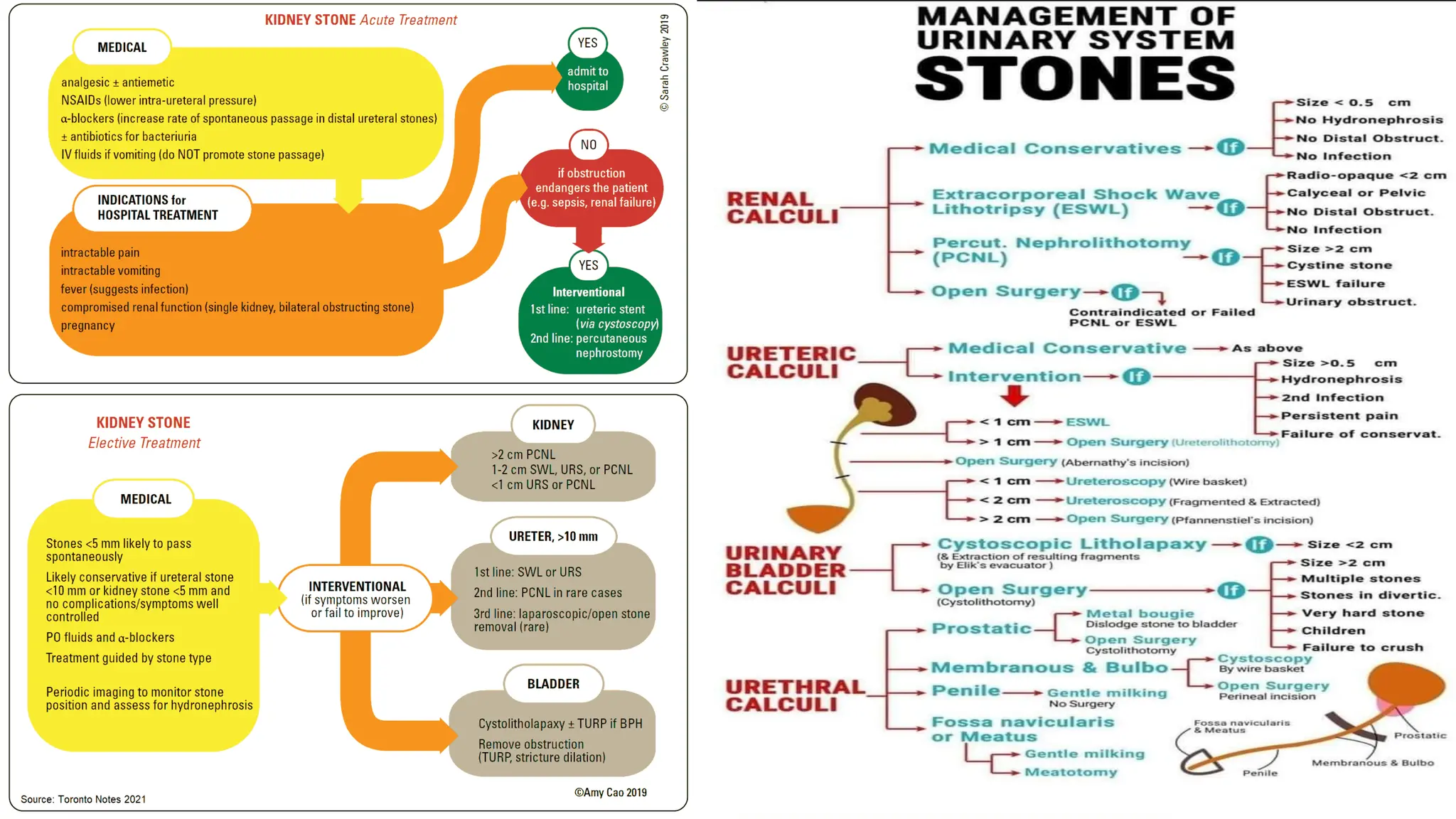
Renal Stones – Medical Treatment
Calculi < 0.5 cm - spontaneously
Pain relief - NSAIDs
IV – Fluids - Frusemide
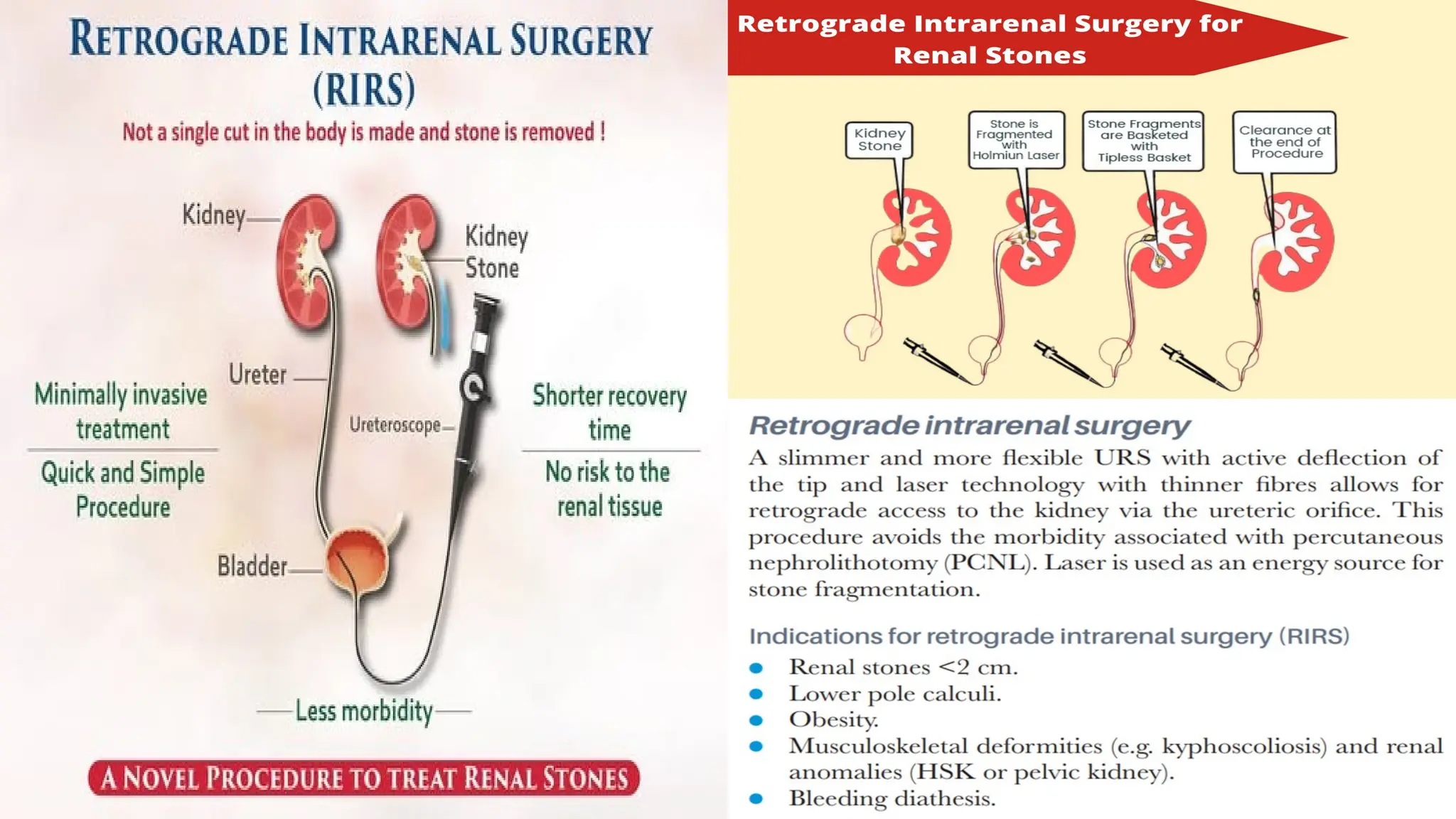
Most calculi are treated by MIT
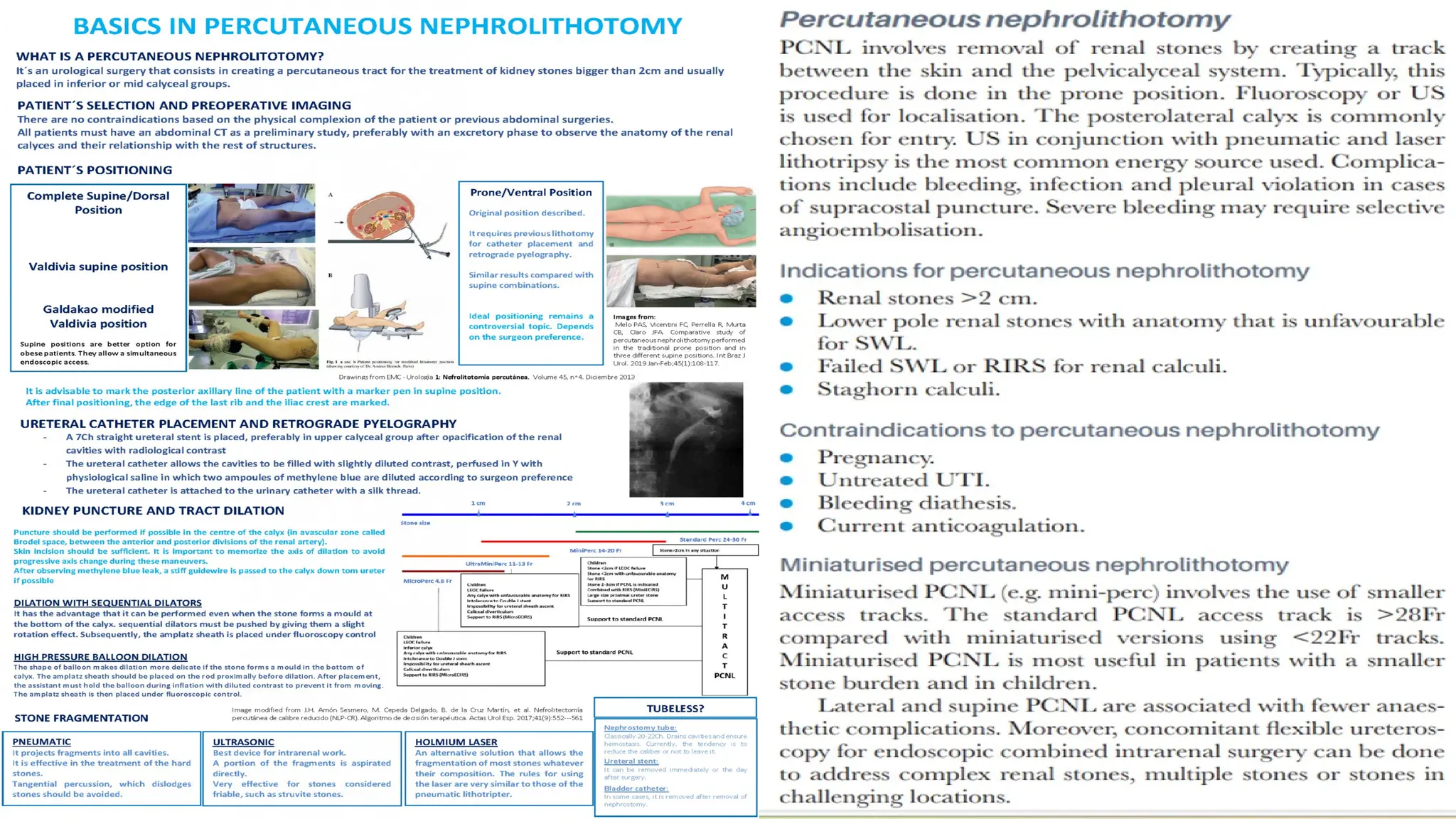
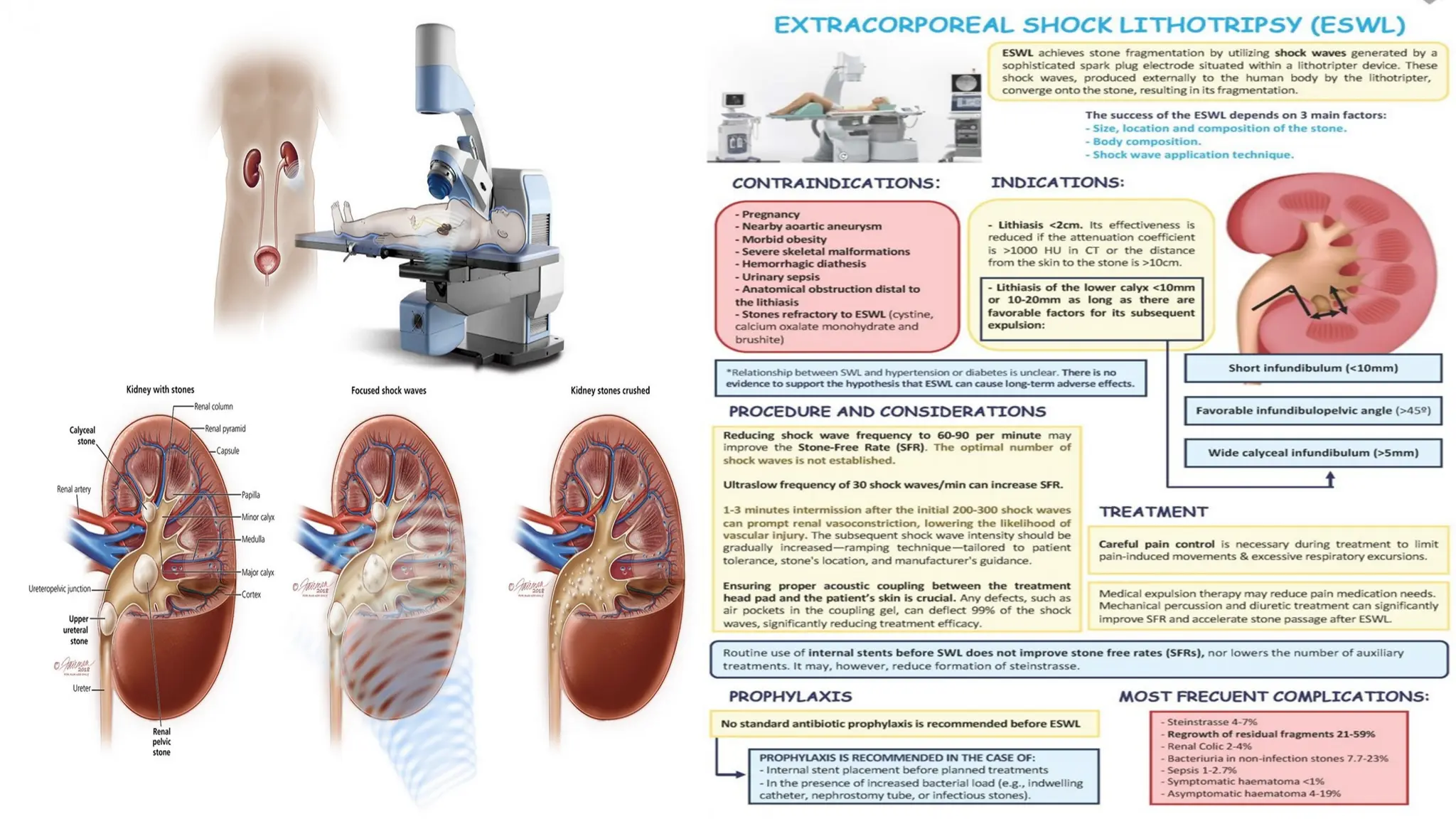
PCNL / ESWL / URS - RIRS
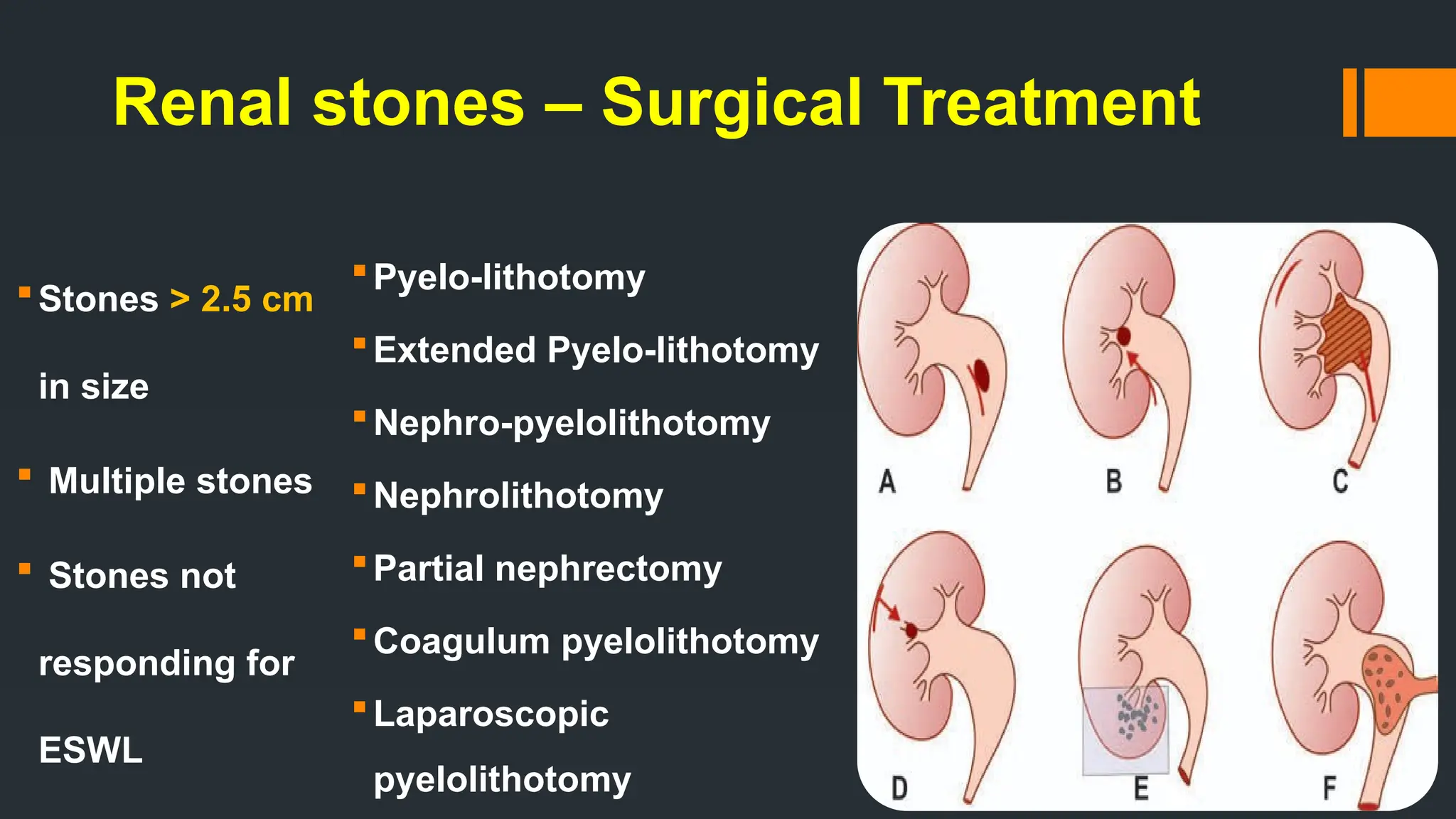
Renal stones – Surgical Treatment
Stones > 2.5 cm
in size
 Multiple stones
 Stones not
responding for
ESWL
Pyelo-lithotomy
Extended Pyelo-lithotomy
Nephro-pyelolithotomy
Nephrolithotomy
Partial nephrectomy
Coagulum pyelolithotomy
Laparoscopic
pyelolithotomy
Prof. U. Murali.
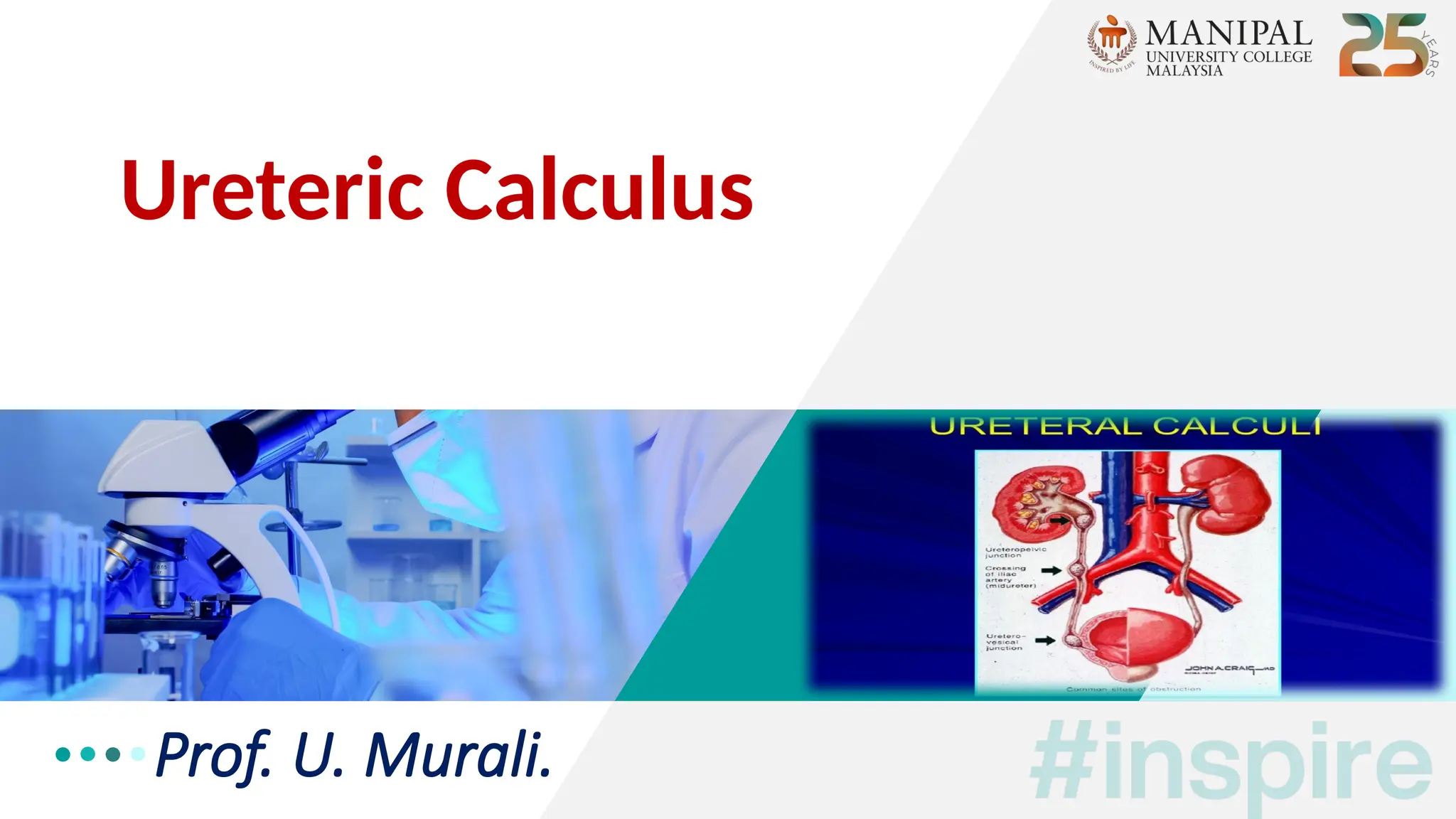
Ureteric Calculus
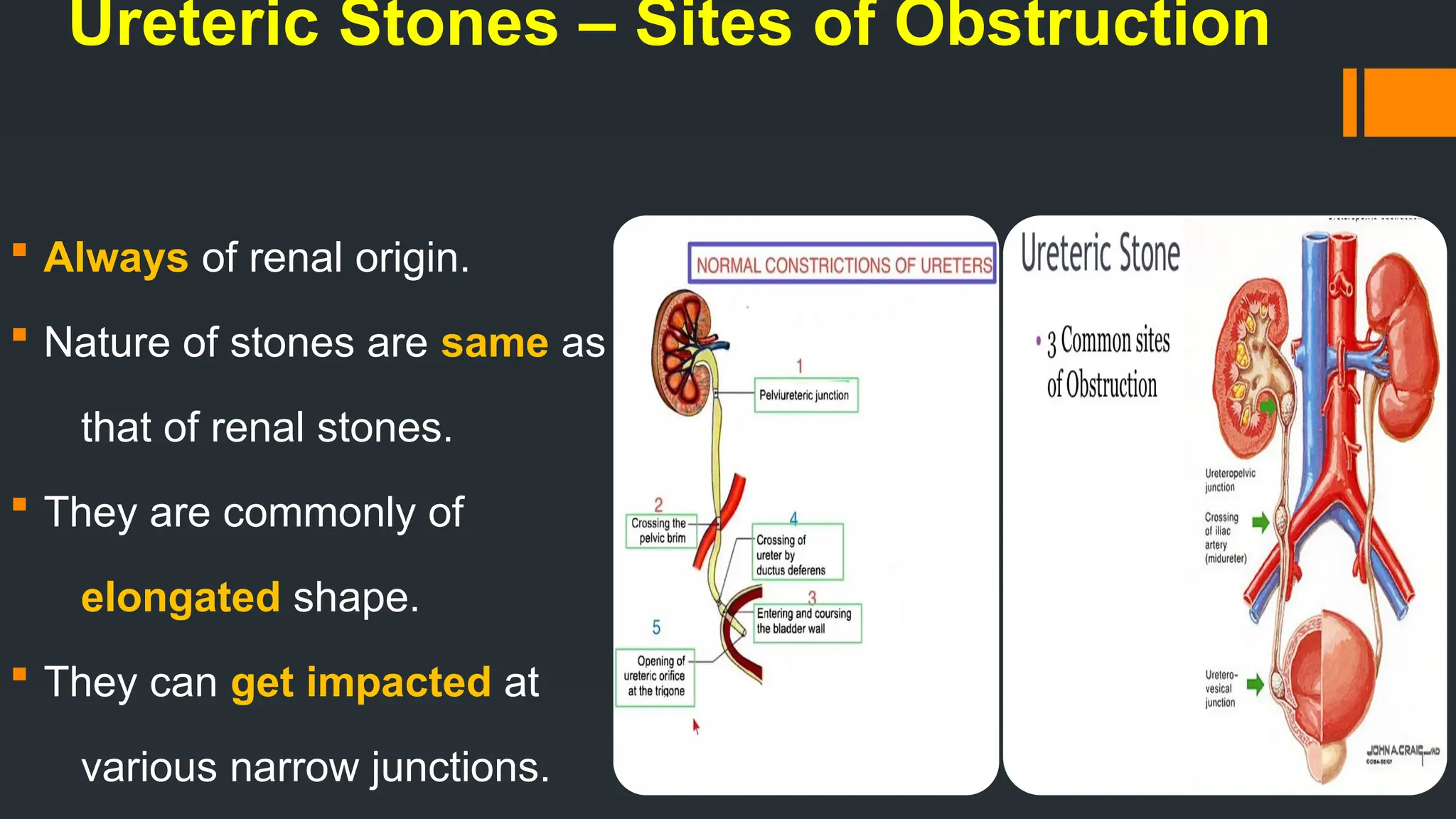
Ureteric Stones – Sites of Obstruction
 Always of renal origin.
 Nature of stones are same as
that of renal stones.
 They are commonly of
elongated shape.
 They can get impacted at
various narrow junctions.
Ureteric Calculus – C/F
Pain — It is of colicky type and
radiates from loin to groin often to the
tip of the genitalia - testis in males,
labia majora in females [G F N].
It is severe in intensity, increases with
exercise.
Nausea, vomiting, sweating due to
pain and reflex pylorospasm.
Haematuria, dysuria, frequency,
strangury.
Tenderness in over some part of the
course of the ureter - (iliac fossa /
renal angle).
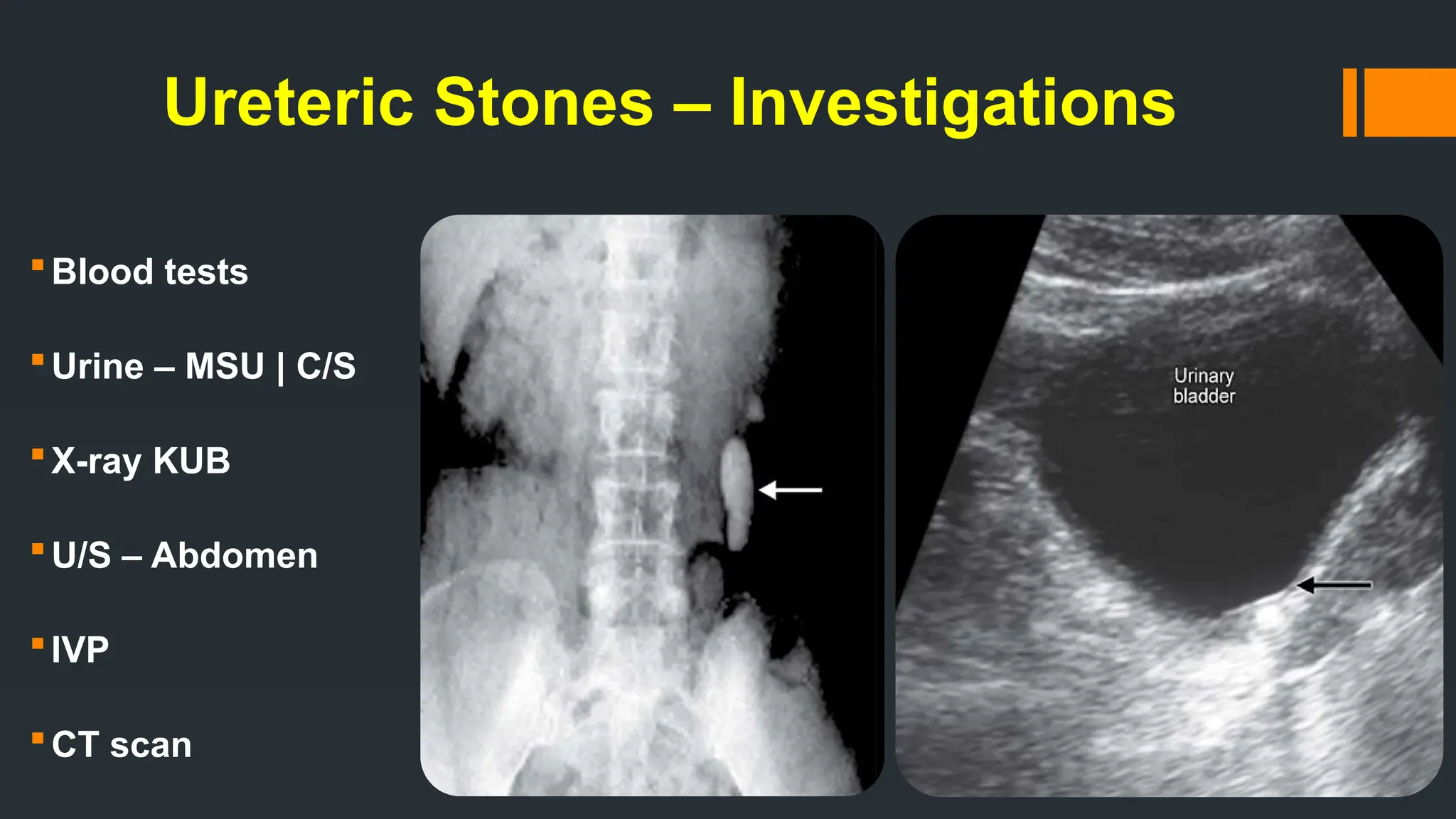
Ureteric Stones – Investigations
Blood tests
Urine – MSU | C/S
X-ray KUB
U/S – Abdomen
IVP
CT scan
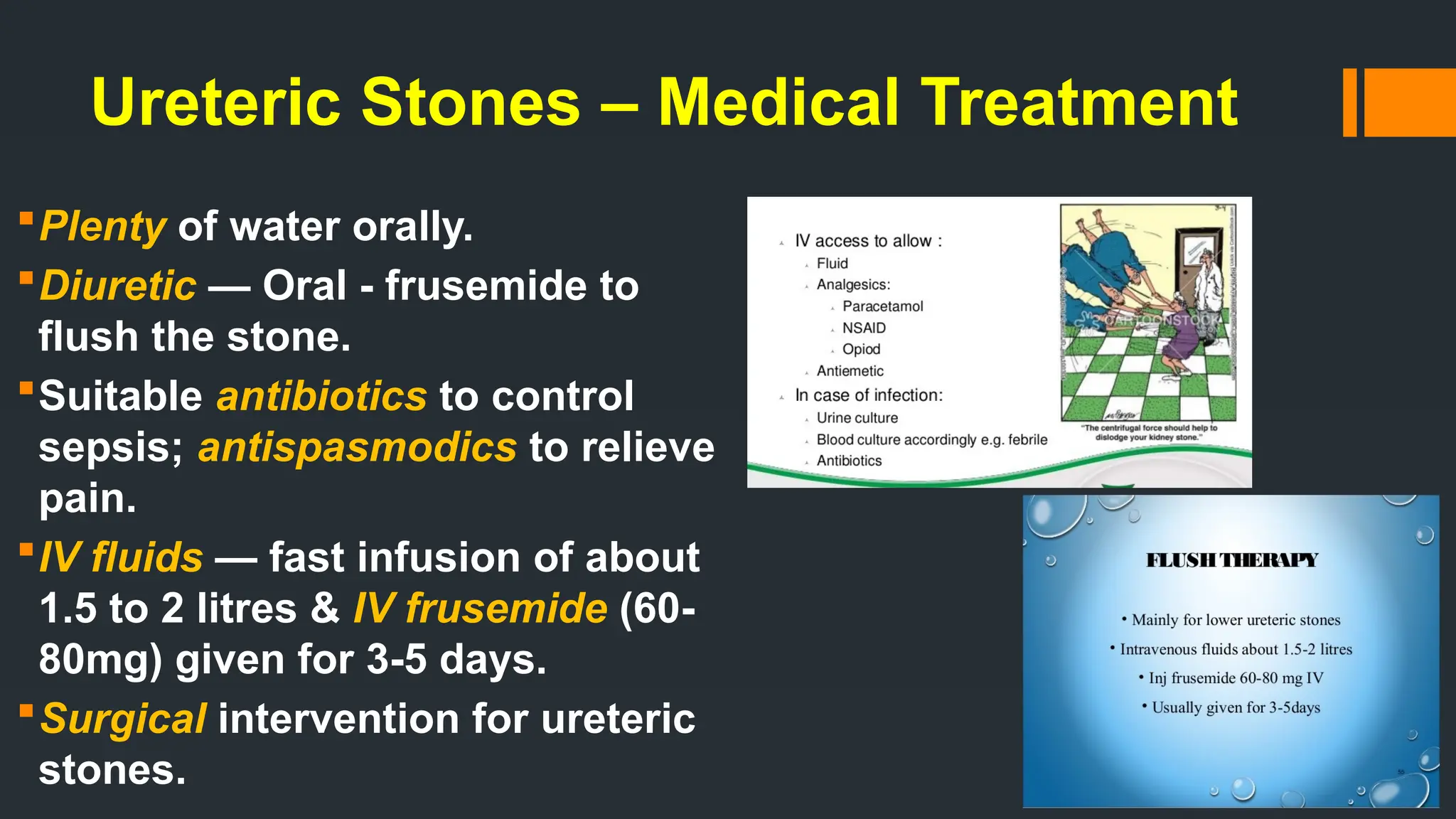
Ureteric Stones – Medical Treatment
Plenty of water orally.
Diuretic — Oral - frusemide to
flush the stone.
Suitable antibiotics to control
sepsis; antispasmodics to relieve
pain.
IV fluids — fast infusion of about
1.5 to 2 litres & IV frusemide (60-
80mg) given for 3-5 days.
Surgical intervention for ureteric
stones.
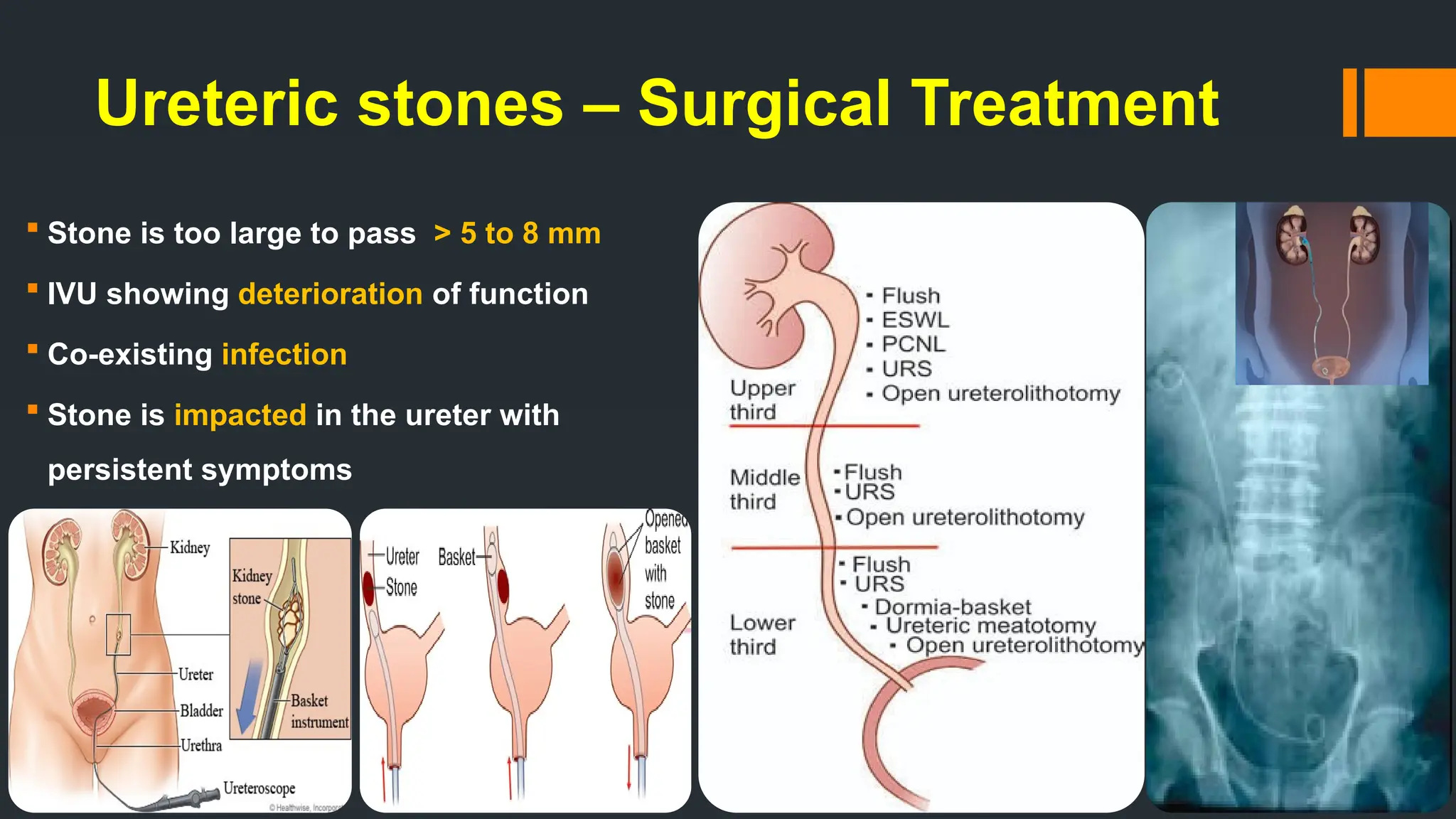
Ureteric stones – Surgical Treatment
 Stone is too large to pass > 5 to 8 mm
 IVU showing deterioration of function
 Co-existing infection
 Stone is impacted in the ureter with
persistent symptoms
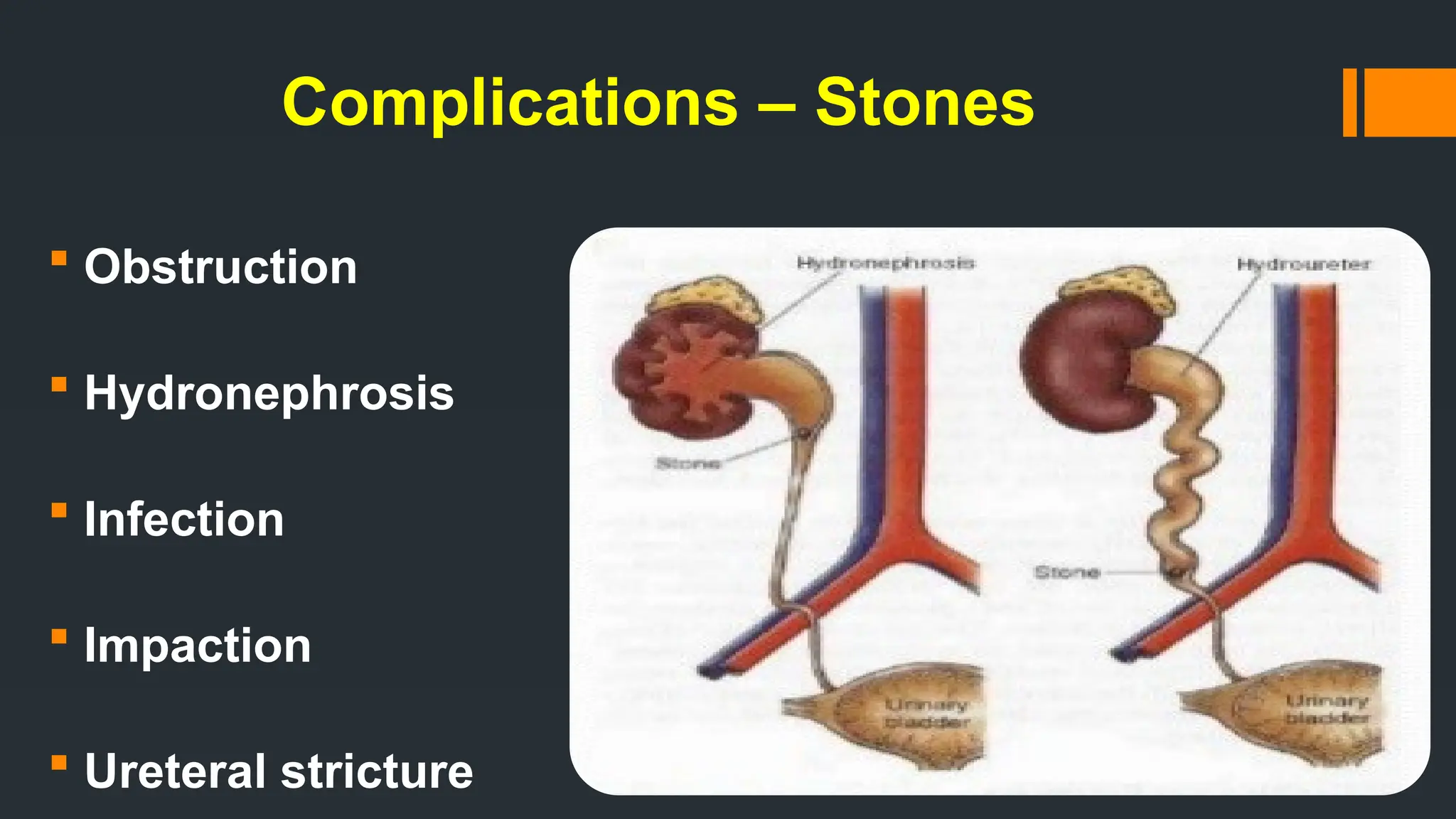
Complications – Stones
 Obstruction
 Hydronephrosis
 Infection
 Impaction
 Ureteral stricture
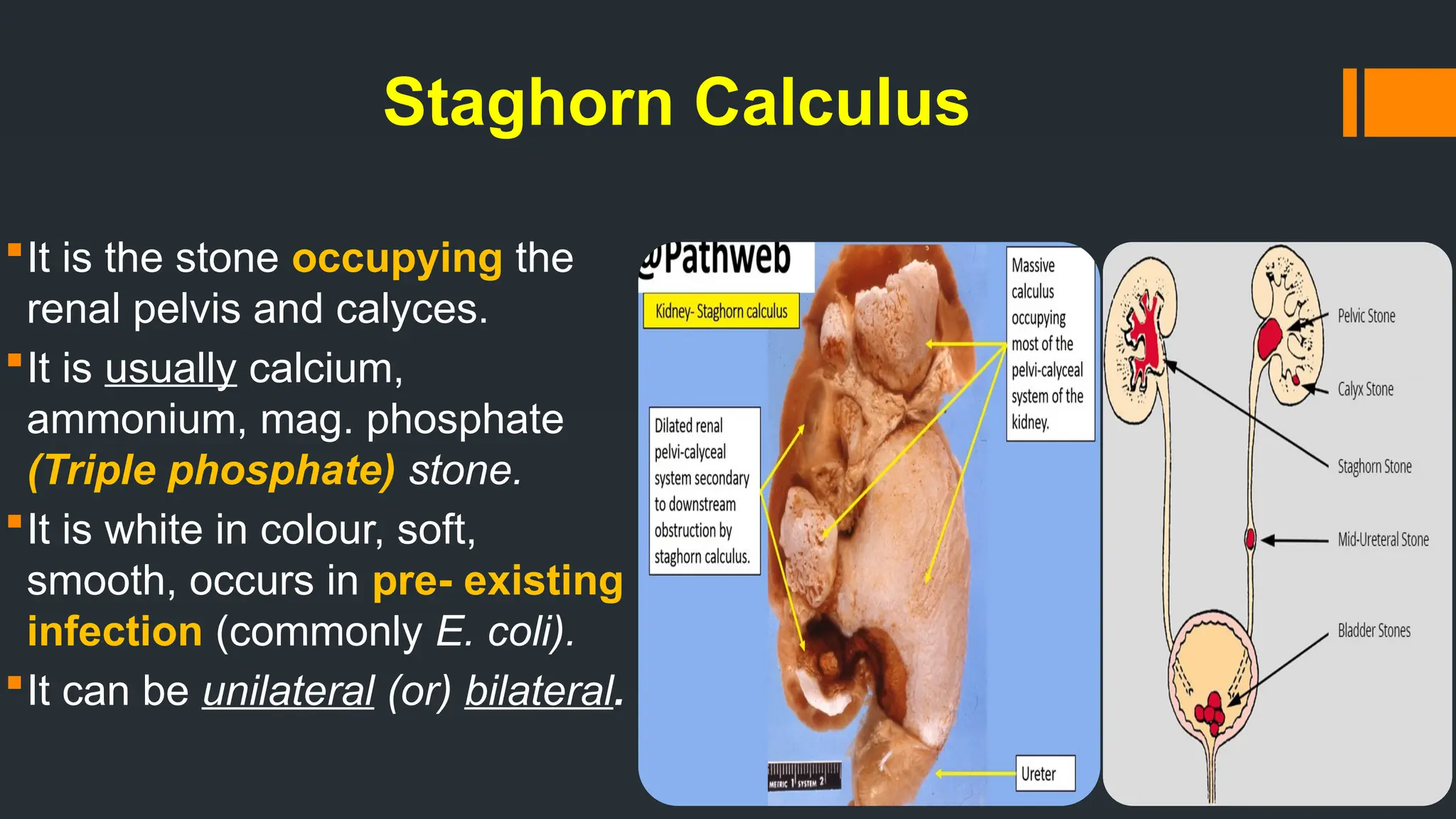
Staghorn Calculus
It is the stone occupying the
renal pelvis and calyces.
It is usually calcium,
ammonium, mag. phosphate
(Triple phosphate) stone.
It is white in colour, soft,
smooth, occurs in pre- existing
infection (commonly E. coli).
It can be unilateral (or) bilateral.
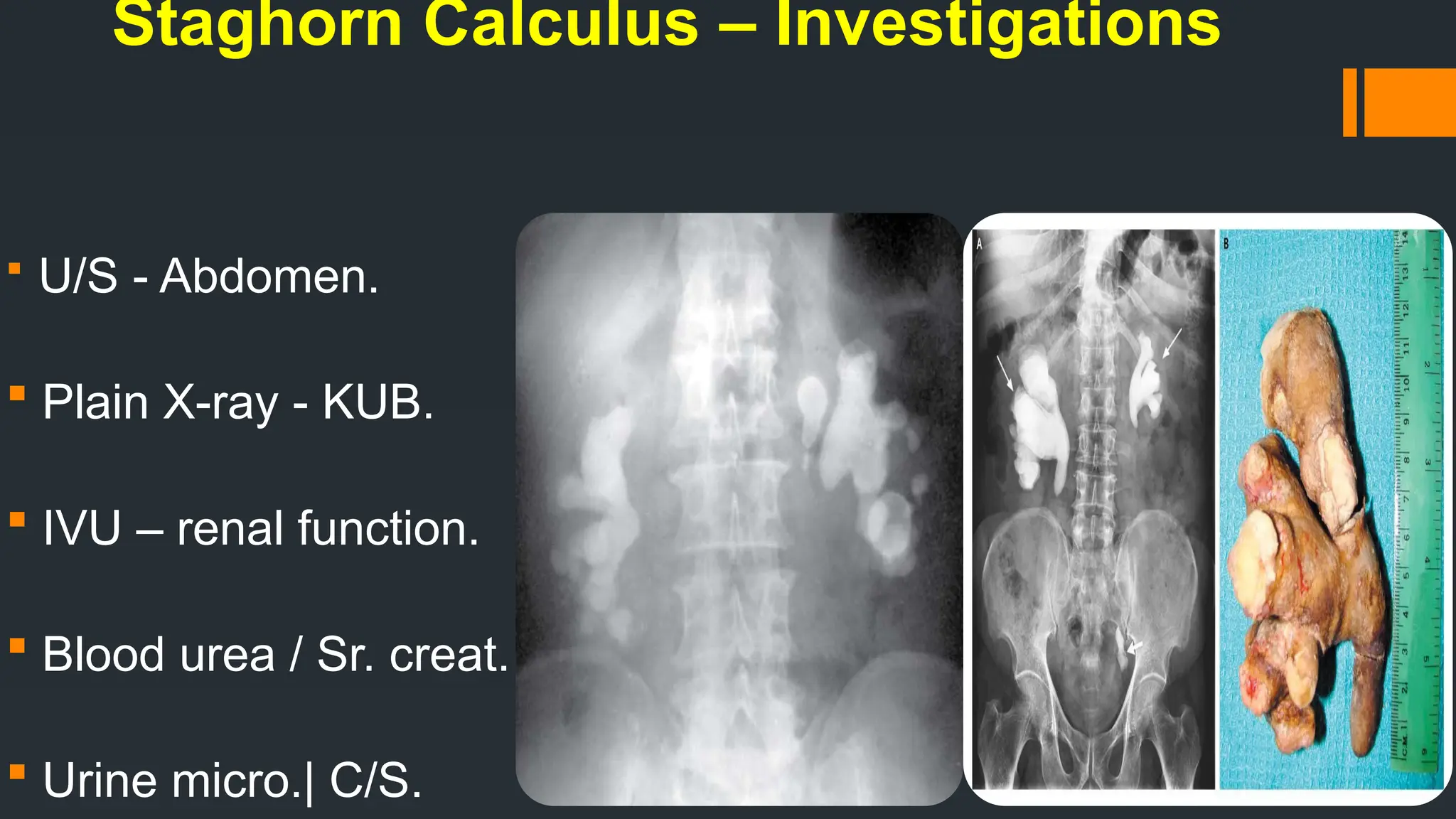
Staghorn Calculus – Investigations
 U/S - Abdomen.
 Plain X-ray - KUB.
 IVU – renal function.
 Blood urea / Sr. creat.
 Urine micro.| C/S.
Staghorn Calculus – Treatment
Initially Antibiotic is started.
1. Unilateral stone is removed by nephro-
pyelolithotomy.
2. In bilateral cases IVU is very essential.
The kidney which is functioning better
should be treated first. After 3 months,
the other side kidney should be operated
upon.
3. Presently, PCNL is becoming popular
procedure for unilateral or bilateral
staghorn calculi.
4. In cases of severe infection –
Nephrectomy is required.
Prof. U. Murali.
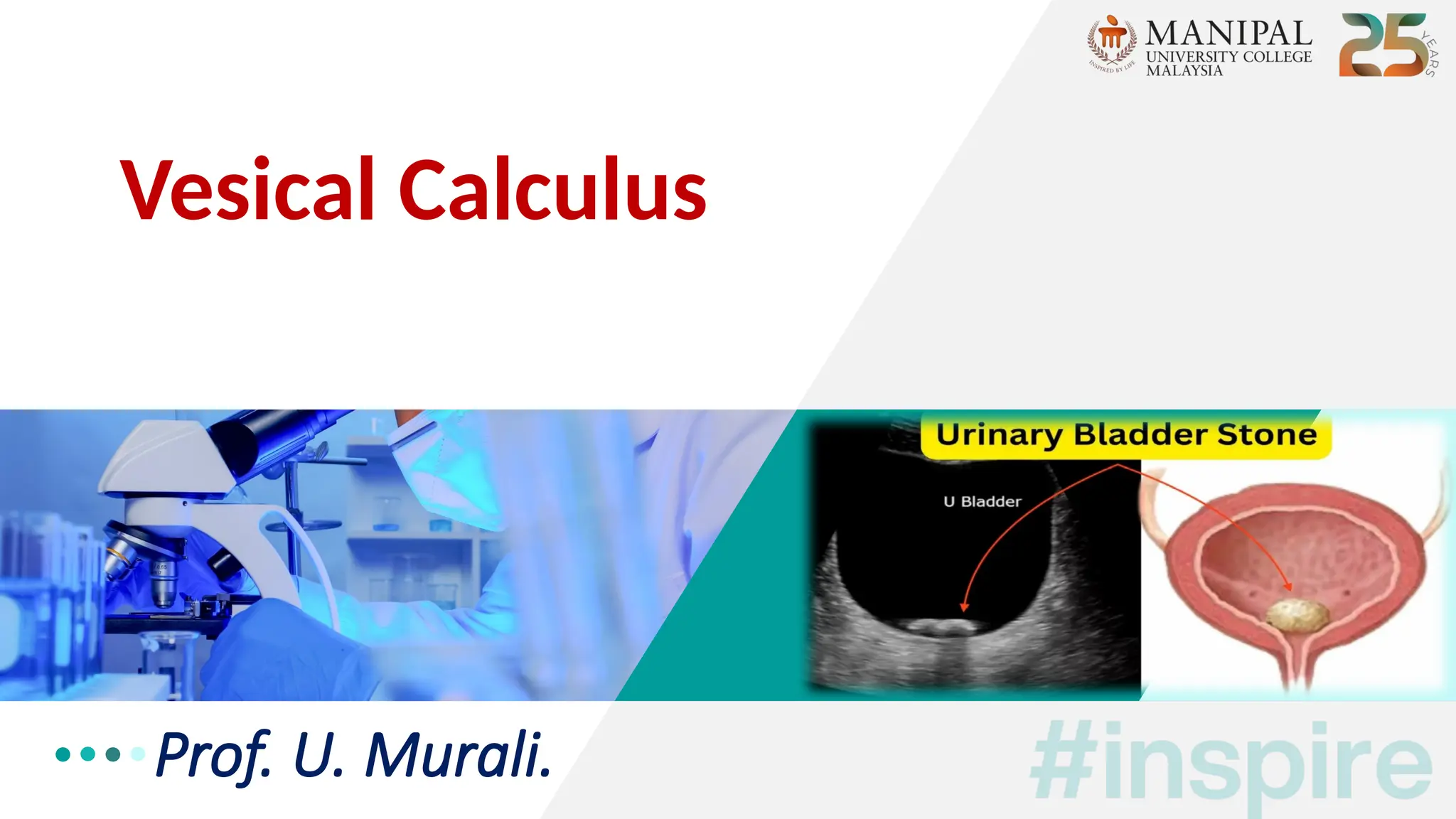
Vesical Calculus
Vesical Calculus - Types
• Occurs in sterile
urine.
• Usually comes
down from kidney
& it gets enlarged
here.
• It is usually
oxalate stone (Jack
stone).
• It is usually single,
primary stone,
brownish black in
• Occurs in the presence of
infection. Most common
bladder stone.
• It is usually phosphate
stone, occurs in bladder
only.
• It is either calcium
phosphate (or)
ammonium, calcium and
magnesium phosphate
(Triple phosphate stone).
• E. coli is the common
organism.
Primary Secondary
• Uric acid and urate stones:
are single or multiple, radio-
luscent, smooth, pale yellow in
colour.
• Cystine calculus: Occurs in
cystinuria and is radio-opaque
due to high sulphur content.
Vesical Calculus – Etiology
• Infection
• Hypercalciuria / Hyperoxaluria /
Cystinuria
• Bed ridden and paraplegic patients
• Gout and other hyperuricaemic patients
• Diverticula bladder
• Obst. - urine flow by BPH, urethral
stricture, bladder neck obstruction
• Neurogenic bladder
• Schistosomiasis
• Foreign body in bladder
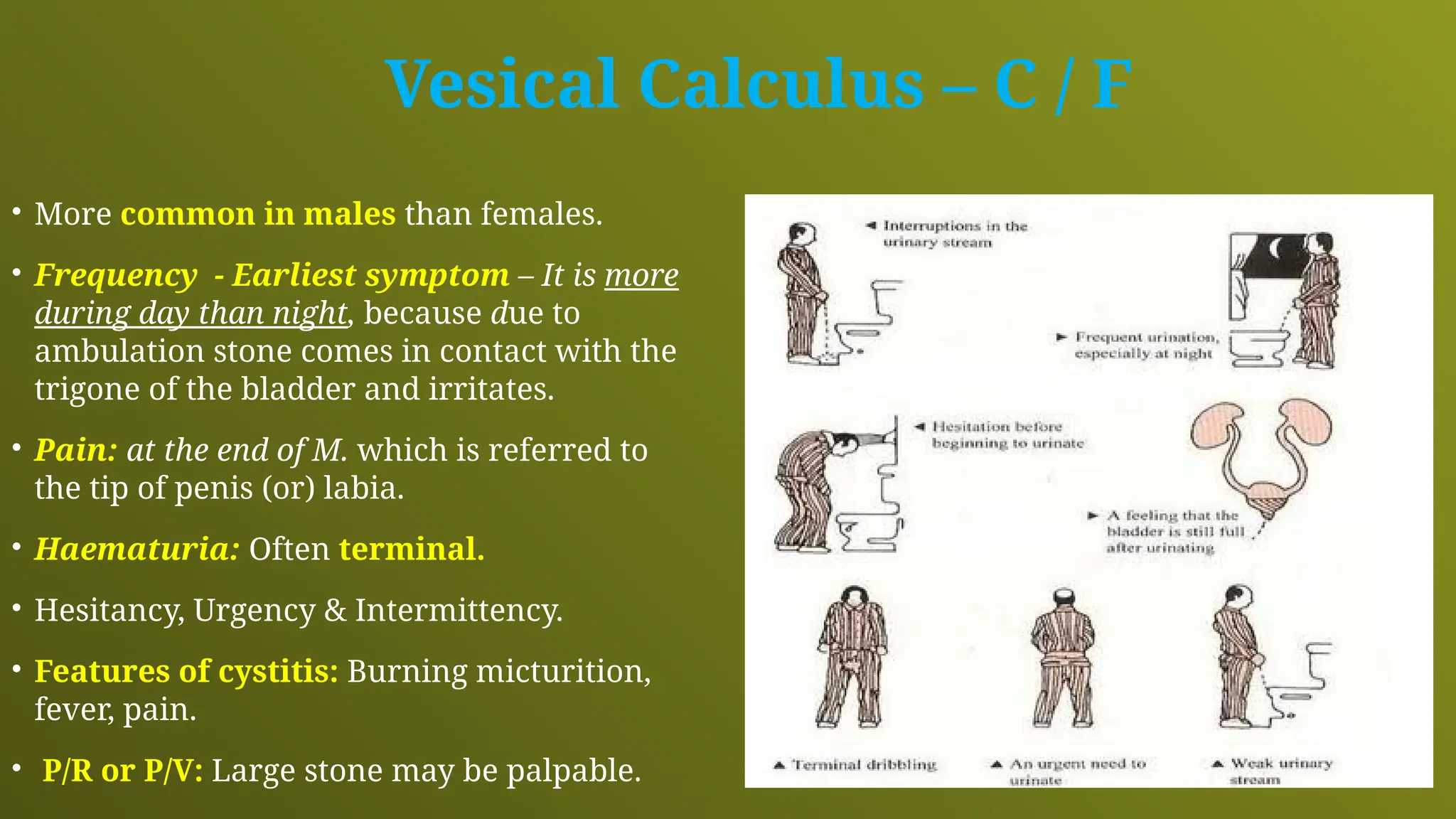
Vesical Calculus – C / F
• More common in males than females.
• Frequency - Earliest symptom – It is more
during day than night, because due to
ambulation stone comes in contact with the
trigone of the bladder and irritates.
• Pain: at the end of M. which is referred to
the tip of penis (or) labia.
• Haematuria: Often terminal.
• Hesitancy, Urgency & Intermittency.
• Features of cystitis: Burning micturition,
fever, pain.
• P/R or P/V: Large stone may be palpable.
Vesical Calculus – Investigations
• Urine microscopy - UFME.
• Urine C/S.
• Blood urea, serum creatinine, serum
calcium, inorganic phosphate, uric
acid.
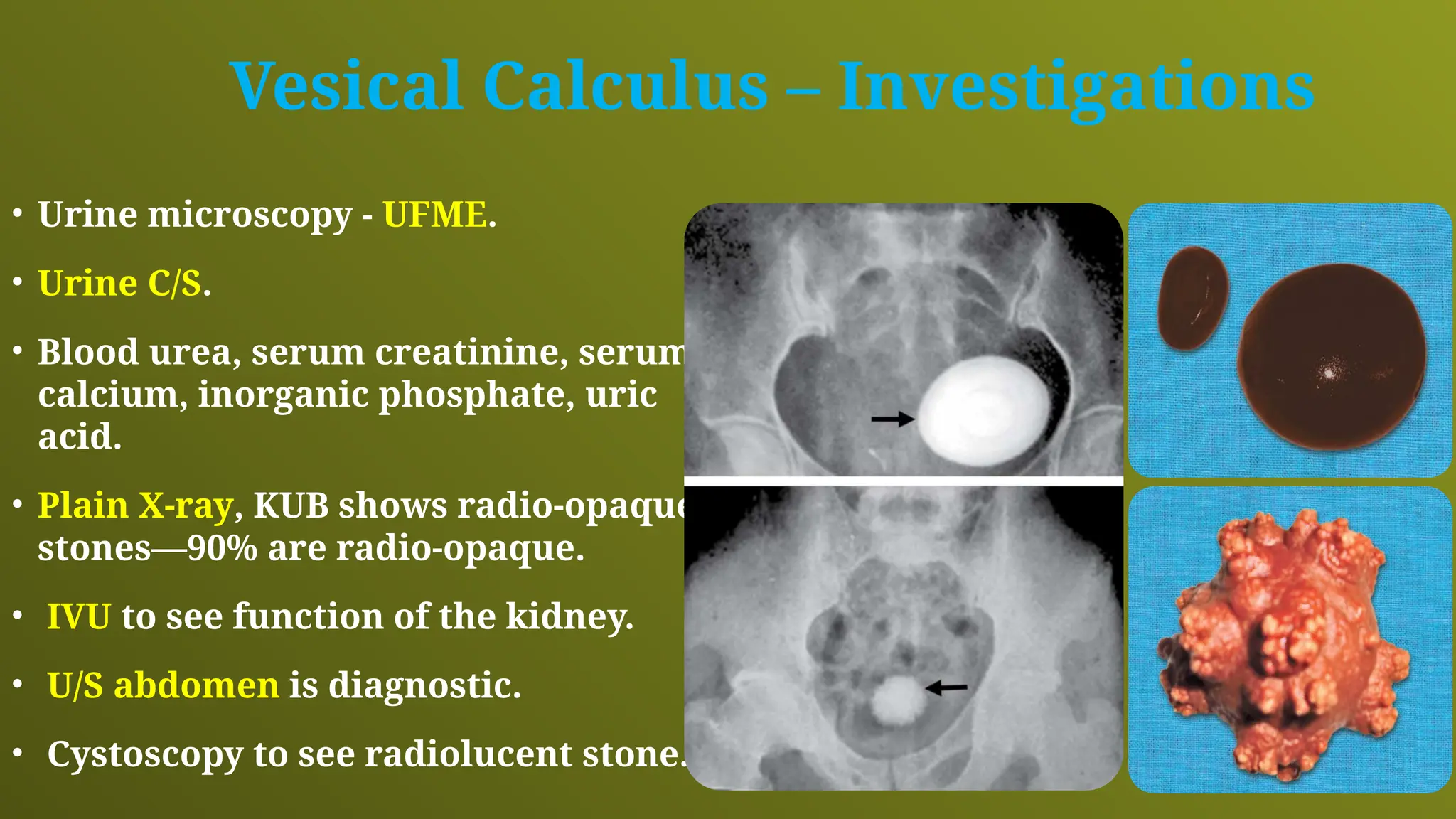
• Plain X-ray, KUB shows radio-opaque
stones—90% are radio-opaque.
• IVU to see function of the kidney.
• U/S abdomen is diagnostic.
• Cystoscopy to see radiolucent stone.
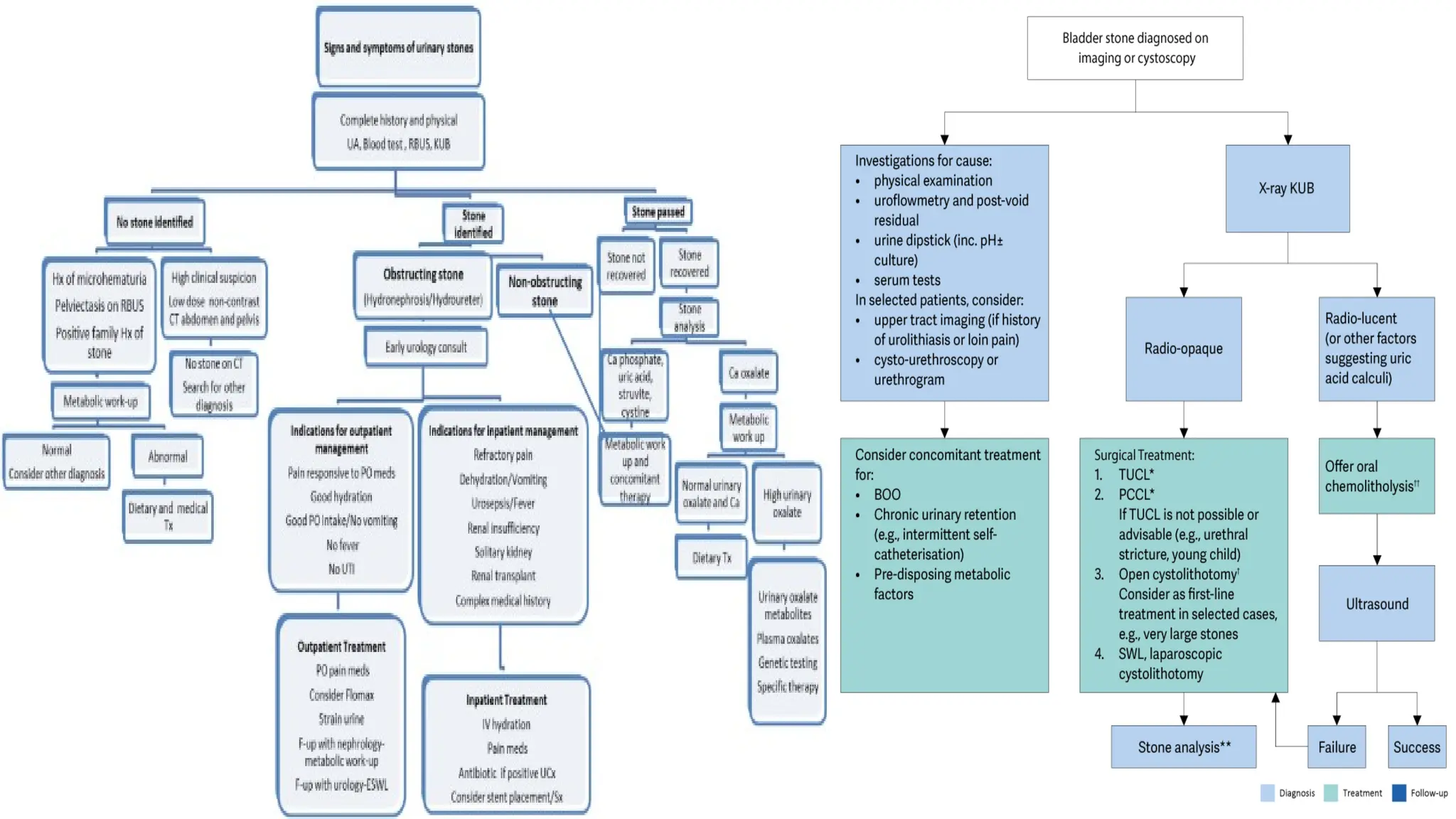
V. Calculus – Treatment
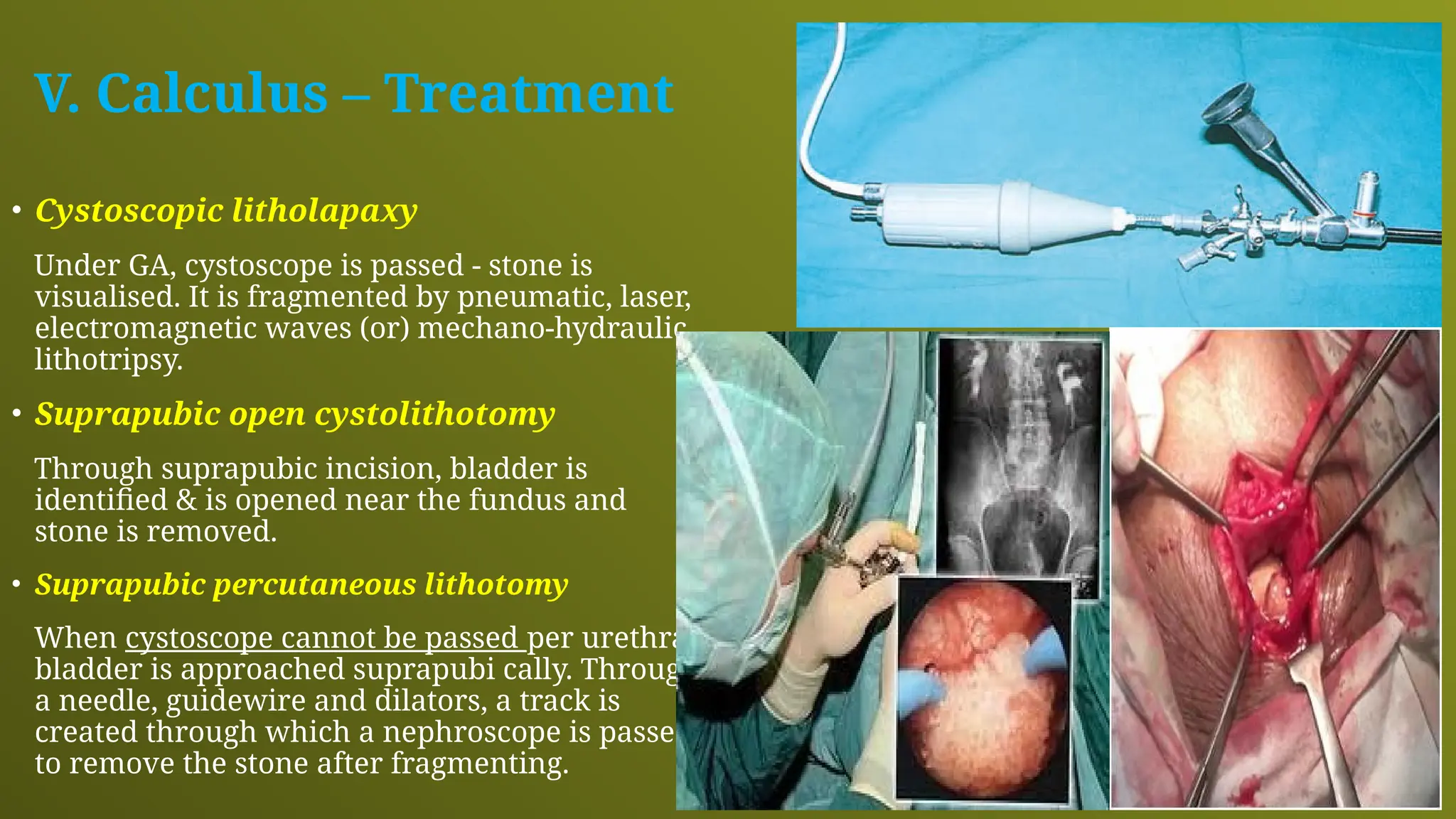
• Cystoscopic litholapaxy
Under GA, cystoscope is passed - stone is
visualised. It is fragmented by pneumatic, laser,
electromagnetic waves (or) mechano-hydraulic
lithotripsy.
• Suprapubic open cystolithotomy
Through suprapubic incision, bladder is
identified & is opened near the fundus and
stone is removed.
• Suprapubic percutaneous lithotomy
When cystoscope cannot be passed per urethra,
bladder is approached suprapubi cally. Through
a needle, guidewire and dilators, a track is
created through which a nephroscope is passed
to remove the stone after fragmenting.
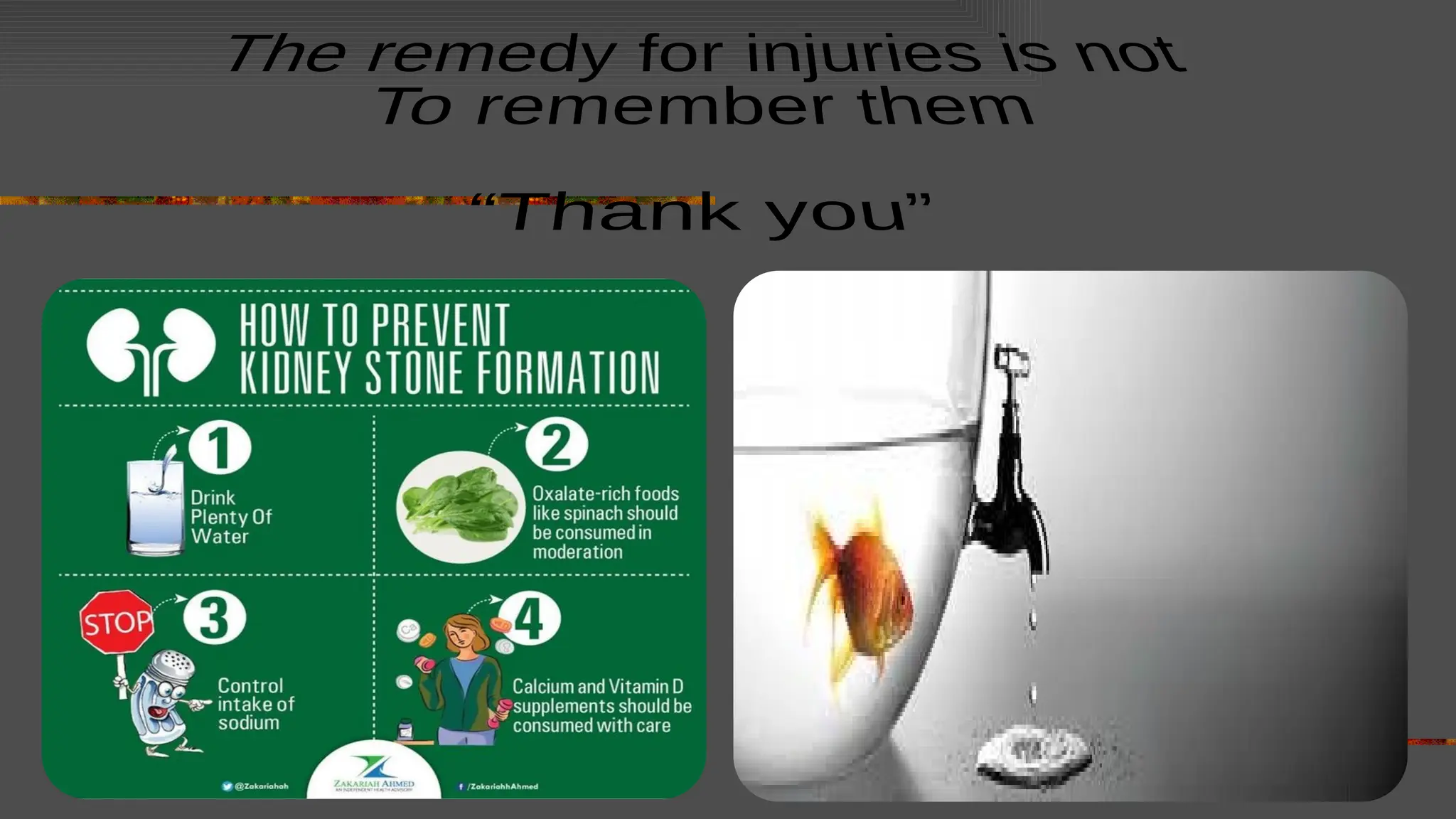
Recurrence of Stones – Prevention
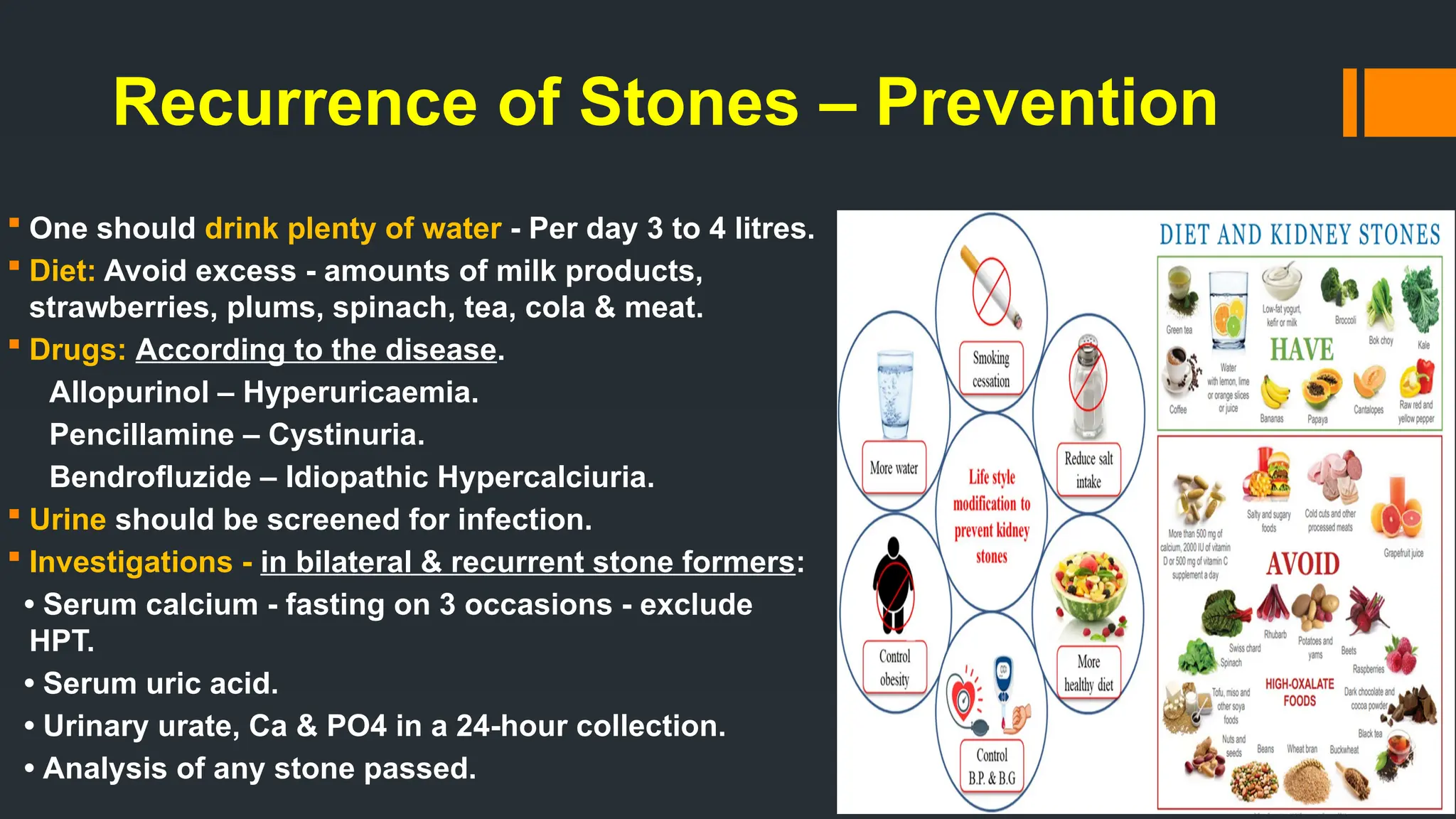
 One should drink plenty of water - Per day 3 to 4 litres.
 Diet: Avoid excess - amounts of milk products,
strawberries, plums, spinach, tea, cola & meat.
 Drugs: According to the disease.
Allopurinol – Hyperuricaemia.
Pencillamine – Cystinuria.
Bendrofluzide – Idiopathic Hypercalciuria.
 Urine should be screened for infection.
 Investigations - in bilateral & recurrent stone formers:
• Serum calcium - fasting on 3 occasions - exclude
HPT.
• Serum uric acid.
• Urinary urate, Ca & PO4 in a 24-hour collection.
• Analysis of any stone passed.
References
To Summarize
 D/D of Renal colic.
 Mechanism of renal stone formation.
 Etiology, types, C/F of Renal & Ureteric calculus.
 Medical & Surgical treatment of Renal & Ureteric calculus.
 Types, etiology, C/F & management of Vesical calculus.
 Preventive aspects of recurrence of urinary stones.
 Complications of renal stones & Stag-horn calculus.
Question Time
 List 5 D/D of left renal colic in a male patient.
 Outline the stages in the formation of renal stone.
 Mention 3 indications & contraindications of ESWL & PCNL.
 Enumerate 5 etiological factors of renal calculus.
 Mention the surgical treatment of ureteric stones – at various levels.
 List 5 salient clinical features of vesical calculus.
 Outline the management of stag-horn calculus.
 Identify 5 life-style modifications to prevent kidney stones.
The ureter is narrow at all the following
sites, except:
 A. At the ureteric orifice.
 B. At the point of crossover of the iliac artery.
 C. At the point of crossover of the terminal ileum.
 D. At the ureteropelvic junction.
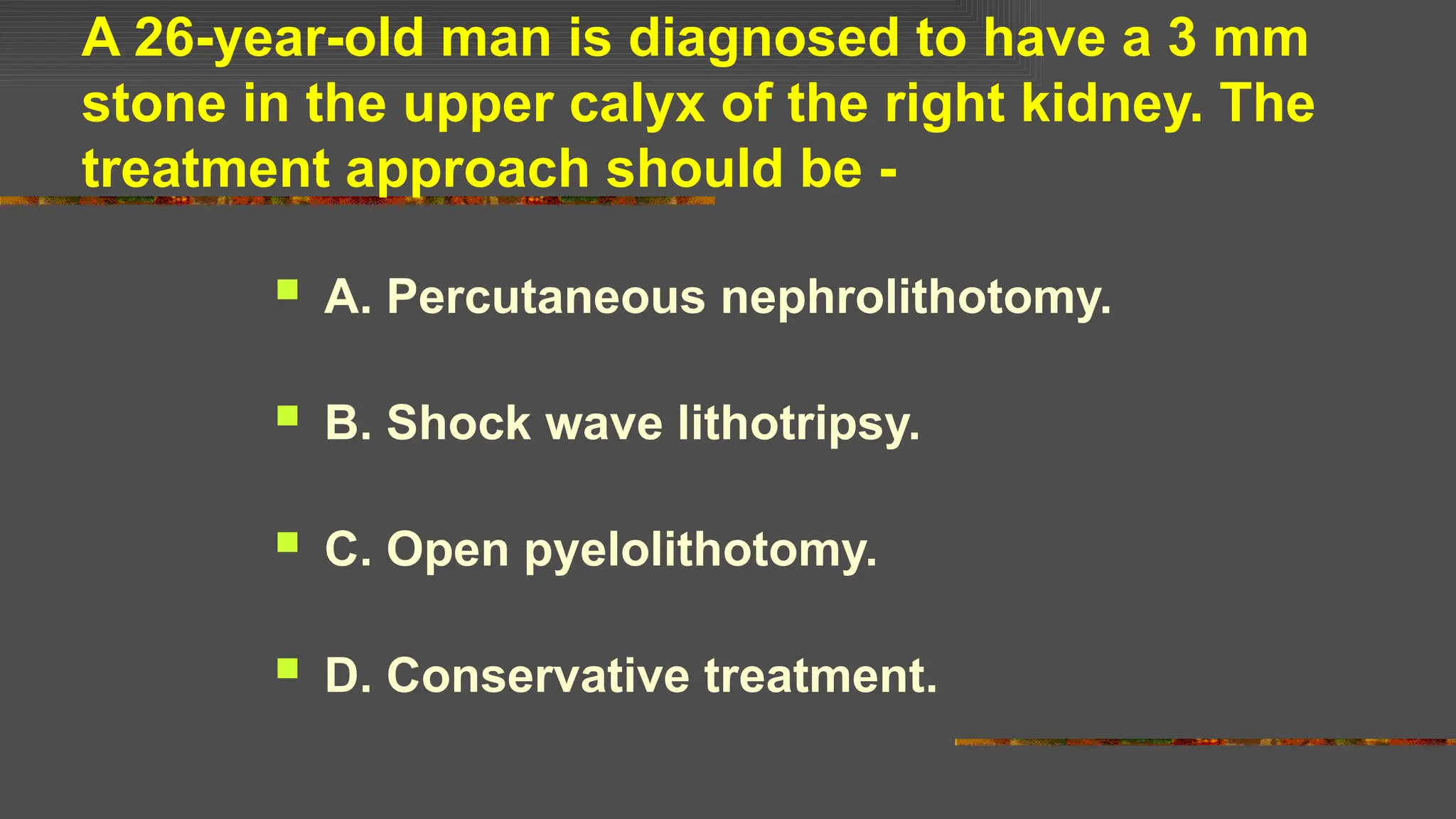
A 26-year-old man is diagnosed to have a 3 mm
stone in the upper calyx of the right kidney. The
treatment approach should be -
 A. Percutaneous nephrolithotomy.
 B. Shock wave lithotripsy.
 C. Open pyelolithotomy.
 D. Conservative treatment.
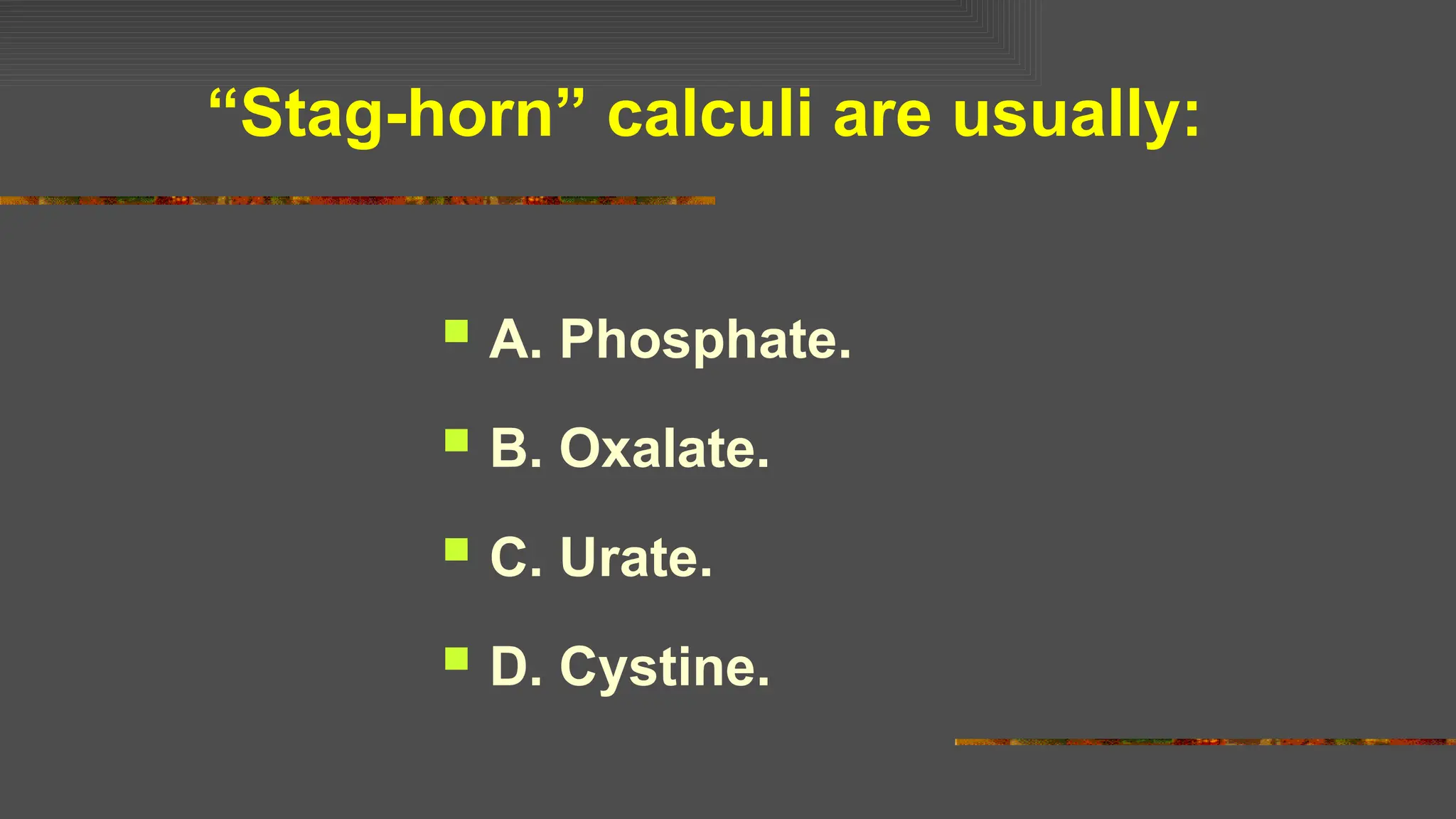
“Stag-horn” calculi are usually:
 A. Phosphate.
 B. Oxalate.
 C. Urate.
 D. Cystine.
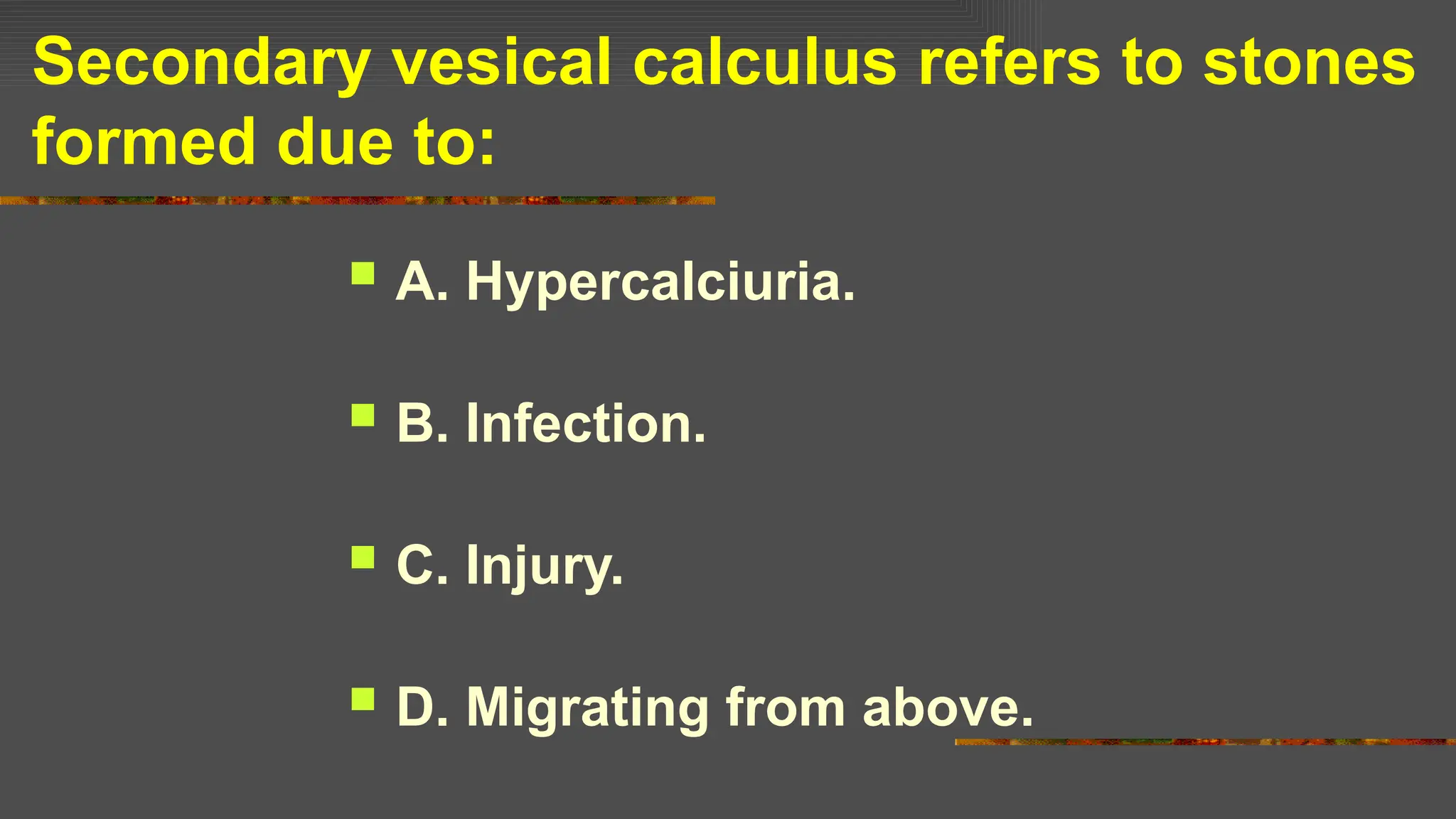
Secondary vesical calculus refers to stones
formed due to:
 A. Hypercalciuria.
 B. Infection.
 C. Injury.
 D. Migrating from above.
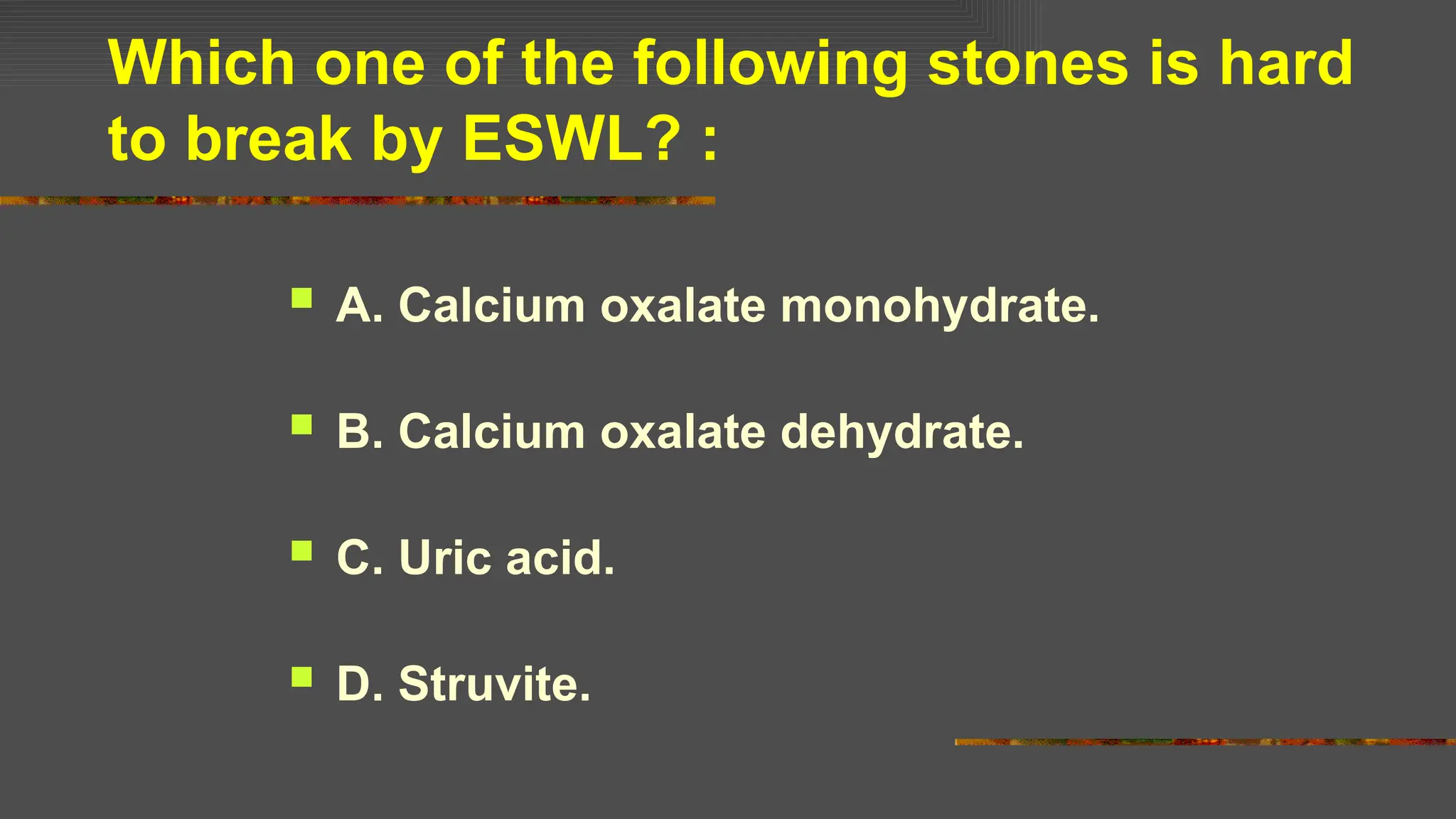
Which one of the following stones is hard
to break by ESWL? :
 A. Calcium oxalate monohydrate.
 B. Calcium oxalate dehydrate.
 C. Uric acid.
 D. Struvite.
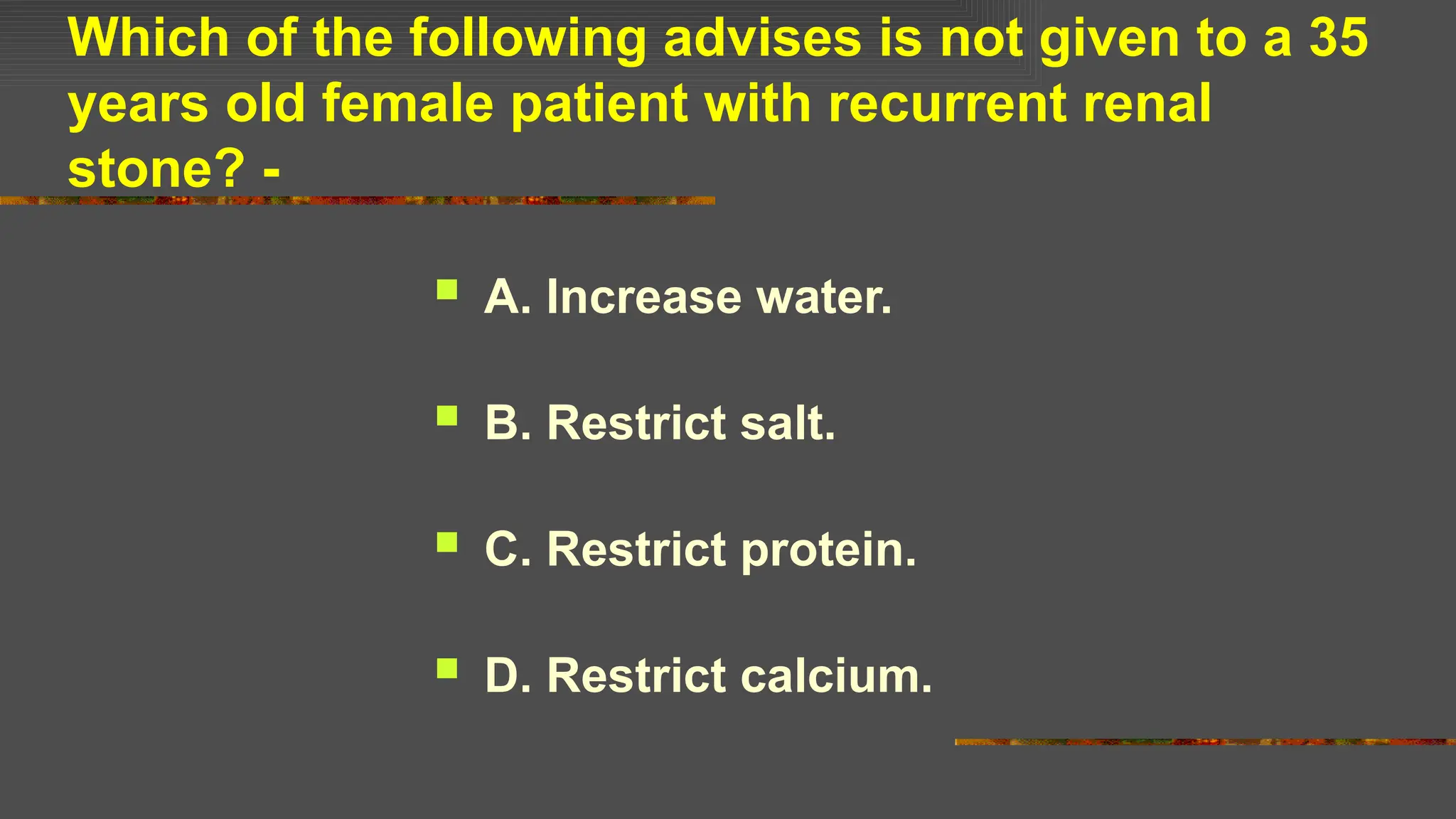
Which of the following advises is not given to a 35
years old female patient with recurrent renal
stone? -
 A. Increase water.
 B. Restrict salt.
 C. Restrict protein.
 D. Restrict calcium.
51
52
53
54

Urolithiasis - Stones of the Urinary System

  • 1.
  • 2.
    Learning Objectives  Identifythe D / D of Renal colic.  List out the types of Renal calculus.  Describe the etiology, C/F, investigations & treatment of Renal, Ureteric & Vesical calculus.  Explain the pathophysiology of stone formation.  Discuss about Stag-horn calculus.
  • 3.
    Introduction  The lifetimeprevalence varies from 1% to 20% and the causes are multifactorial.  Recurrence of stone disease is high, with 50% having recurrence within the first decade of diagnosis.  Bladder stones account for 5% of all urinary tract stone disease.  The modern world is witnessing a steady increase in the incidence of renal calculi.
  • 4.
    Renal Colic The commonesturologic emergency. One of the commonest causes of the “Acute Abdomen”. Sudden onset of severe pain in the flank. Most often due to the passage of a stone formed in the kidney, down through the ureter.
  • 5.
    Renal Colic  Whencaused by acute obstruction of the renal pelvis, is typically fixed deep in the loin and ‘bursting’ in character.  When caused by acute ureteric obstruction (usually by a stone), is colicky with sharp exacerbations against a constant back - ground.  Is liable to be referred to the groin, scrotum or labium as the calculus obstruction moves distally.
  • 6.
    Renal Colic –D / D  Pyelonephritis  Abdominal aortic aneurysm  Appendicitis  Biliary colic (gallstones)  Peritonitis  Diverticulitis  Salpingitis  Torsion - ovarian cyst  Ectopic pregnancy  Shingles
  • 8.
  • 9.
    Renal Calculus –Etiology  Diet: Vitamin A deficiency — desquamation of epithelium - acts as a nidus – for stone formation.  Climate: In hot climate Urinary solutes will ↑ with ↓ in colloids, which → chelation of solute with calcium forming a nidus for stone.  Any ↓ Citrate level in urine causes stone formation.  Infection in kidney: Organisms - i.e. E. coli, Staphylococcus, Streptococcus, Proteus.  Prolonged immobilisation - decalcification of bones - leading to stone formation.  Stasis due to obstruction to urine flow.  Hyperparathyroidism - causes hypercalcaemia / hypercalciuria → causing multiple stones.  Randall’s plaque theory – Deposition of urinary salts as plaque – at the apex of renal papillae.
  • 11.
    Renal Calculus –Stages in Stone form.  Super-saturation  Nucleus formation  Crystallisation  Aggregation  Matrix formation  Stone
  • 13.
    Renal Calculus –Types  Oxalate stones: 60-85% Invariably Ca. oxalate / Irregular with sharp projections. (mulberry stone) Phosphate stones: 10 -15% It is made of calcium, magnesium & ammonium phosphate, usually occurring in an infected urine. It enlarges rapidly, filling renal calyces - staghorn calculus.
  • 14.
    Renal Calculus –Types  Uric acid stones: are smooth, multiple, multifaceted and radiolucent. Cystine stones: occur in cystinuria. Often multiple and very hard, occurs only in acidic urine. Others - Urate stones / Xanthine stones / Indigo stones / Struvite stones.
  • 16.
    Renal Calculus –Clinical Features Pain — Fixed renal pain - over renal angle, hypochondrium & lumbar region. Vomiting due to pylorospasm. Pain worsens on movements. Haematuria is common. Pyuria & Fever. P/A - Tenderness in renal angle, with often a mass in the loin due to hydronephrosis.  As urinary tract infection.  Incidental finding – Silent calculus.
  • 17.
    Renal Stones –Investigations Blood tests Urine - MSU & C/S X-ray KUB U/S – Abdomen IVP CT scan - NCCT
  • 18.
    Renal Stones –Medical Treatment Calculi < 0.5 cm - spontaneously Pain relief - NSAIDs IV – Fluids - Frusemide Most calculi are treated by MIT PCNL / ESWL / URS - RIRS
  • 22.
    Renal stones –Surgical Treatment Stones > 2.5 cm in size  Multiple stones  Stones not responding for ESWL Pyelo-lithotomy Extended Pyelo-lithotomy Nephro-pyelolithotomy Nephrolithotomy Partial nephrectomy Coagulum pyelolithotomy Laparoscopic pyelolithotomy
  • 23.
  • 24.
    Ureteric Stones –Sites of Obstruction  Always of renal origin.  Nature of stones are same as that of renal stones.  They are commonly of elongated shape.  They can get impacted at various narrow junctions.
  • 25.
    Ureteric Calculus –C/F Pain — It is of colicky type and radiates from loin to groin often to the tip of the genitalia - testis in males, labia majora in females [G F N]. It is severe in intensity, increases with exercise. Nausea, vomiting, sweating due to pain and reflex pylorospasm. Haematuria, dysuria, frequency, strangury. Tenderness in over some part of the course of the ureter - (iliac fossa / renal angle).
  • 26.
    Ureteric Stones –Investigations Blood tests Urine – MSU | C/S X-ray KUB U/S – Abdomen IVP CT scan
  • 27.
    Ureteric Stones –Medical Treatment Plenty of water orally. Diuretic — Oral - frusemide to flush the stone. Suitable antibiotics to control sepsis; antispasmodics to relieve pain. IV fluids — fast infusion of about 1.5 to 2 litres & IV frusemide (60- 80mg) given for 3-5 days. Surgical intervention for ureteric stones.
  • 28.
    Ureteric stones –Surgical Treatment  Stone is too large to pass > 5 to 8 mm  IVU showing deterioration of function  Co-existing infection  Stone is impacted in the ureter with persistent symptoms
  • 30.
    Complications – Stones Obstruction  Hydronephrosis  Infection  Impaction  Ureteral stricture
  • 31.
    Staghorn Calculus It isthe stone occupying the renal pelvis and calyces. It is usually calcium, ammonium, mag. phosphate (Triple phosphate) stone. It is white in colour, soft, smooth, occurs in pre- existing infection (commonly E. coli). It can be unilateral (or) bilateral.
  • 32.
    Staghorn Calculus –Investigations  U/S - Abdomen.  Plain X-ray - KUB.  IVU – renal function.  Blood urea / Sr. creat.  Urine micro.| C/S.
  • 33.
    Staghorn Calculus –Treatment Initially Antibiotic is started. 1. Unilateral stone is removed by nephro- pyelolithotomy. 2. In bilateral cases IVU is very essential. The kidney which is functioning better should be treated first. After 3 months, the other side kidney should be operated upon. 3. Presently, PCNL is becoming popular procedure for unilateral or bilateral staghorn calculi. 4. In cases of severe infection – Nephrectomy is required.
  • 34.
  • 35.
    Vesical Calculus -Types • Occurs in sterile urine. • Usually comes down from kidney & it gets enlarged here. • It is usually oxalate stone (Jack stone). • It is usually single, primary stone, brownish black in • Occurs in the presence of infection. Most common bladder stone. • It is usually phosphate stone, occurs in bladder only. • It is either calcium phosphate (or) ammonium, calcium and magnesium phosphate (Triple phosphate stone). • E. coli is the common organism. Primary Secondary • Uric acid and urate stones: are single or multiple, radio- luscent, smooth, pale yellow in colour. • Cystine calculus: Occurs in cystinuria and is radio-opaque due to high sulphur content.
  • 36.
    Vesical Calculus –Etiology • Infection • Hypercalciuria / Hyperoxaluria / Cystinuria • Bed ridden and paraplegic patients • Gout and other hyperuricaemic patients • Diverticula bladder • Obst. - urine flow by BPH, urethral stricture, bladder neck obstruction • Neurogenic bladder • Schistosomiasis • Foreign body in bladder
  • 37.
    Vesical Calculus –C / F • More common in males than females. • Frequency - Earliest symptom – It is more during day than night, because due to ambulation stone comes in contact with the trigone of the bladder and irritates. • Pain: at the end of M. which is referred to the tip of penis (or) labia. • Haematuria: Often terminal. • Hesitancy, Urgency & Intermittency. • Features of cystitis: Burning micturition, fever, pain. • P/R or P/V: Large stone may be palpable.
  • 38.
    Vesical Calculus –Investigations • Urine microscopy - UFME. • Urine C/S. • Blood urea, serum creatinine, serum calcium, inorganic phosphate, uric acid. • Plain X-ray, KUB shows radio-opaque stones—90% are radio-opaque. • IVU to see function of the kidney. • U/S abdomen is diagnostic. • Cystoscopy to see radiolucent stone.
  • 39.
    V. Calculus –Treatment • Cystoscopic litholapaxy Under GA, cystoscope is passed - stone is visualised. It is fragmented by pneumatic, laser, electromagnetic waves (or) mechano-hydraulic lithotripsy. • Suprapubic open cystolithotomy Through suprapubic incision, bladder is identified & is opened near the fundus and stone is removed. • Suprapubic percutaneous lithotomy When cystoscope cannot be passed per urethra, bladder is approached suprapubi cally. Through a needle, guidewire and dilators, a track is created through which a nephroscope is passed to remove the stone after fragmenting.
  • 40.
    Recurrence of Stones– Prevention  One should drink plenty of water - Per day 3 to 4 litres.  Diet: Avoid excess - amounts of milk products, strawberries, plums, spinach, tea, cola & meat.  Drugs: According to the disease. Allopurinol – Hyperuricaemia. Pencillamine – Cystinuria. Bendrofluzide – Idiopathic Hypercalciuria.  Urine should be screened for infection.  Investigations - in bilateral & recurrent stone formers: • Serum calcium - fasting on 3 occasions - exclude HPT. • Serum uric acid. • Urinary urate, Ca & PO4 in a 24-hour collection. • Analysis of any stone passed.
  • 41.
  • 42.
    To Summarize  D/Dof Renal colic.  Mechanism of renal stone formation.  Etiology, types, C/F of Renal & Ureteric calculus.  Medical & Surgical treatment of Renal & Ureteric calculus.  Types, etiology, C/F & management of Vesical calculus.  Preventive aspects of recurrence of urinary stones.  Complications of renal stones & Stag-horn calculus.
  • 43.
    Question Time  List5 D/D of left renal colic in a male patient.  Outline the stages in the formation of renal stone.  Mention 3 indications & contraindications of ESWL & PCNL.  Enumerate 5 etiological factors of renal calculus.  Mention the surgical treatment of ureteric stones – at various levels.  List 5 salient clinical features of vesical calculus.  Outline the management of stag-horn calculus.  Identify 5 life-style modifications to prevent kidney stones.
  • 44.
    The ureter isnarrow at all the following sites, except:  A. At the ureteric orifice.  B. At the point of crossover of the iliac artery.  C. At the point of crossover of the terminal ileum.  D. At the ureteropelvic junction.
  • 45.
    A 26-year-old manis diagnosed to have a 3 mm stone in the upper calyx of the right kidney. The treatment approach should be -  A. Percutaneous nephrolithotomy.  B. Shock wave lithotripsy.  C. Open pyelolithotomy.  D. Conservative treatment.
  • 46.
    “Stag-horn” calculi areusually:  A. Phosphate.  B. Oxalate.  C. Urate.  D. Cystine.
  • 47.
    Secondary vesical calculusrefers to stones formed due to:  A. Hypercalciuria.  B. Infection.  C. Injury.  D. Migrating from above.
  • 48.
    Which one ofthe following stones is hard to break by ESWL? :  A. Calcium oxalate monohydrate.  B. Calcium oxalate dehydrate.  C. Uric acid.  D. Struvite.
  • 49.
    Which of thefollowing advises is not given to a 35 years old female patient with recurrent renal stone? -  A. Increase water.  B. Restrict salt.  C. Restrict protein.  D. Restrict calcium.
  • 51.
  • 52.
  • 53.
  • 54.