Surgical Site Infection
Dr. Utham Murali.M.S;M.B.A.
Asso.Prof.of Surgery
IMS / MSU / Malaysia.
Introduction
 Surgical infection is major problem in surgical practice.
 In 1992, the US Centers for Disease Control (CDC) revised its
definition of 'wound infection', creating the definition 'surgical site
infection' (SSI) to prevent confusion between the infection of a
surgical incision and the infection of a traumatic wound.
 Accounts for 15-25% of all surgical infections & increased cost to
healthcare.
Definition
 The infection of a wound can
be defined as the invasion of
organisms through tissues
following a breakdown of local
& systemic host defences
leading to local & systemic
presentation.
Micro-Organisms
S. aureus
S. epidermidis
Enterococcus
E. coli
Pseudomonas
klebsiella
Gr -ve
strept species
anaerobic
Gr +ve
19%
14%
12%8%8%
4%
15%
6% 3% 2%
Important Definitions
 SSI
 Is an infected incised wound or deep organ space.
 SIRS
 Is the body’s systemic response to an infected wound.
 MODS
 Is the effect that the infection produces systemically.
 MSOF
 Is the end-stage of uncontrolled MODS.
Important Definitions
 SIRS – Any 2
 Hyperthermia (> 38°C) or Hypothermia (< 36°C)
 Tachycardia (> 90/min) or Tachypnoea (> 20/min)
 WBC > 12 × 10 99 / l or < 4 × 10 9 / l
 SEPSIS
 Is SIRS with a documented infection.
 SEPSIS SYNDROME
 Is sepsis with evidence of one or more organ failures.
Pathogenesis
VirulenceBacterial dose
Impaired
host resistance
Risk factors
Malnutrition – Obesity
Metabolic disease – DM / Jaundice
Immunosuppression conditions
Colonoization of GIT
Poor perfusion – shock
FB material
Poor surgical technique
Factors - Determine
 Host response
 Virulence
 Vasculature & Health of tissue
 Presence of dead / foreign tissue
 Presence of antibiotic – “decisive
SSI – Assessment
 For surgical wound assessment several scoring systems are employed
 ASEPSIS wound score
 Southampton wound grading system
 These enable surgical wound healing to be graded according to specific
criteria, usually giving a numerical value, thus providing more objective
assessment of wound.
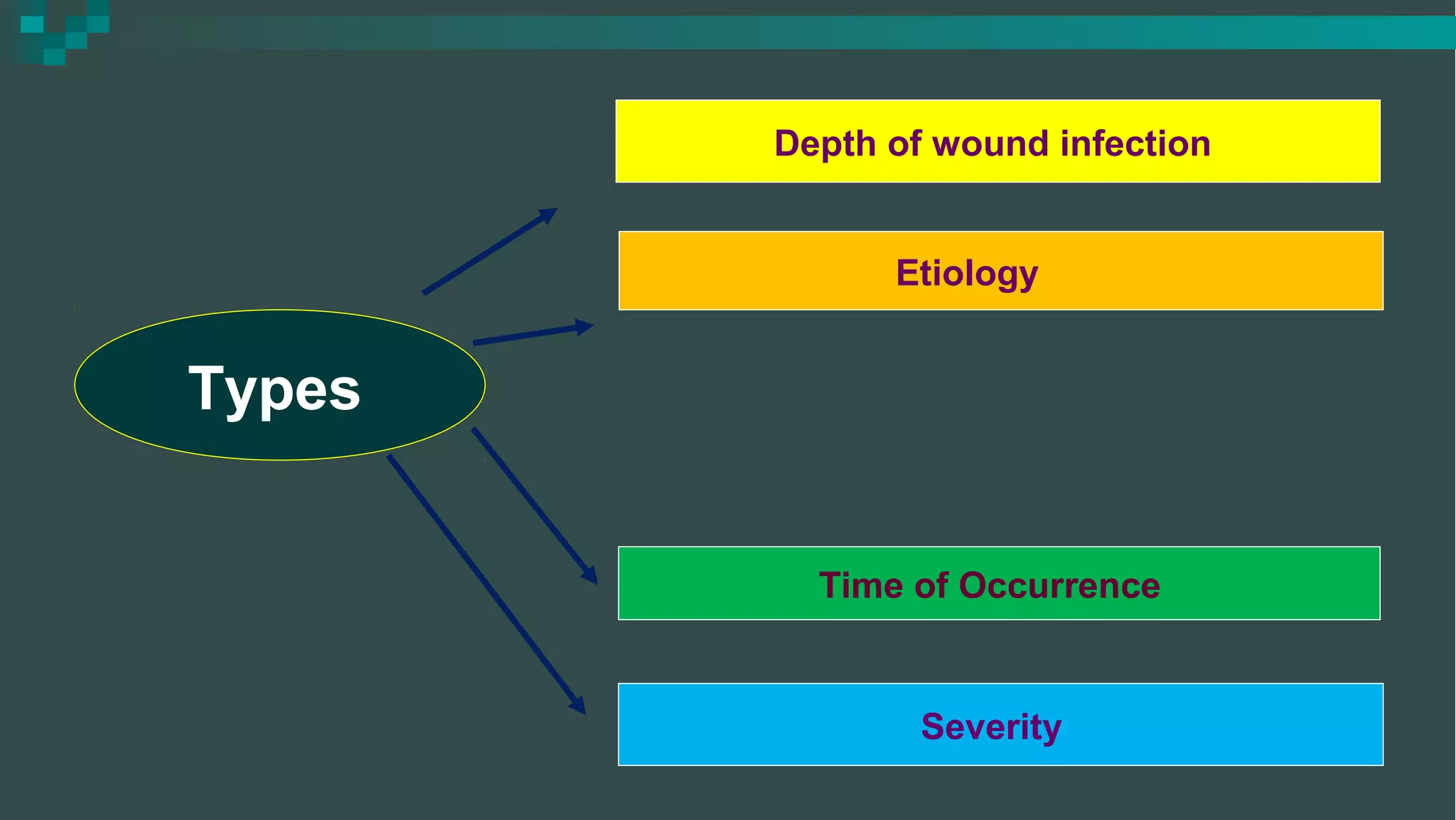
Types
Depth of wound infection
Etiology
Time of Occurrence
Severity
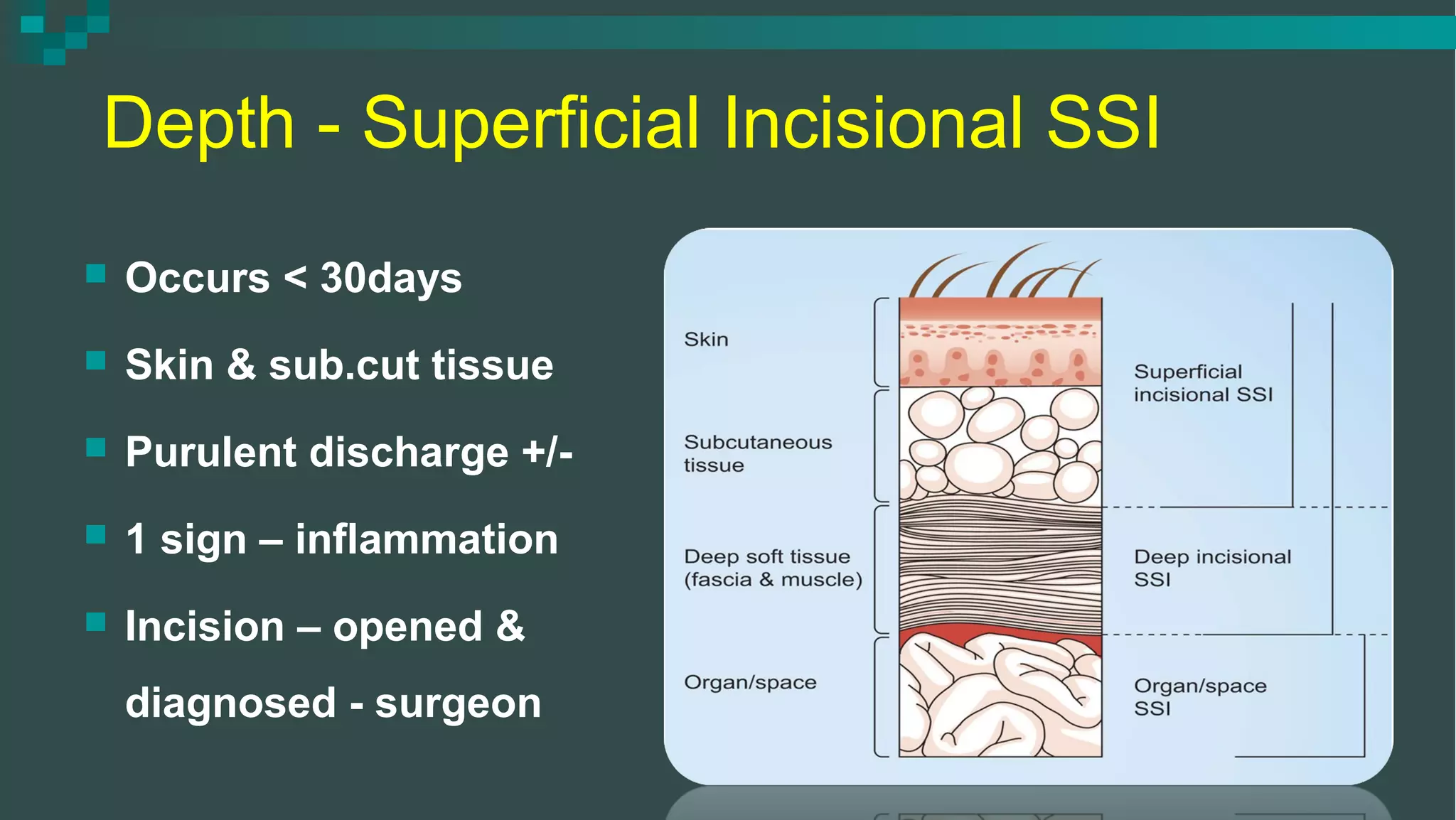
Depth - Superficial Incisional SSI
 Occurs < 30days
 Skin & sub.cut tissue
 Purulent discharge +/-
 1 sign – inflammation
 Incision – opened &
diagnosed - surgeon
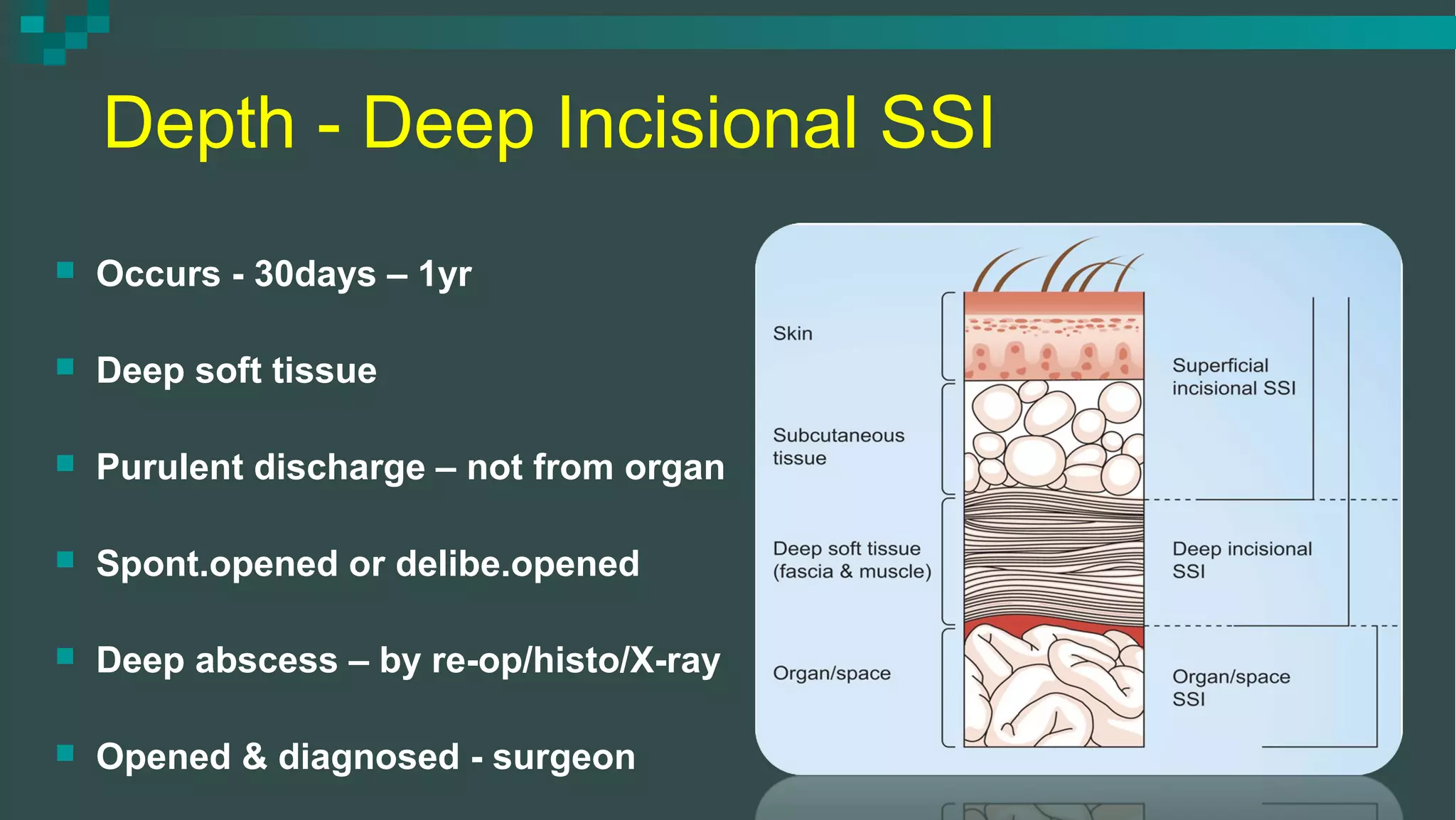
Depth - Deep Incisional SSI
 Occurs - 30days – 1yr
 Deep soft tissue
 Purulent discharge – not from organ
 Spont.opened or delibe.opened
 Deep abscess – by re-op/histo/X-ray
 Opened & diagnosed - surgeon
Depth - Organ / Space SSI
 Occurs - 30days – 1yr
 Involves – any part [organ/space]
 Purulent discharge – drain
 Organisms – isolated
 Deep abscess – direct & re-op /
histology / X-ray
 Opened & diagnosed - surgeon
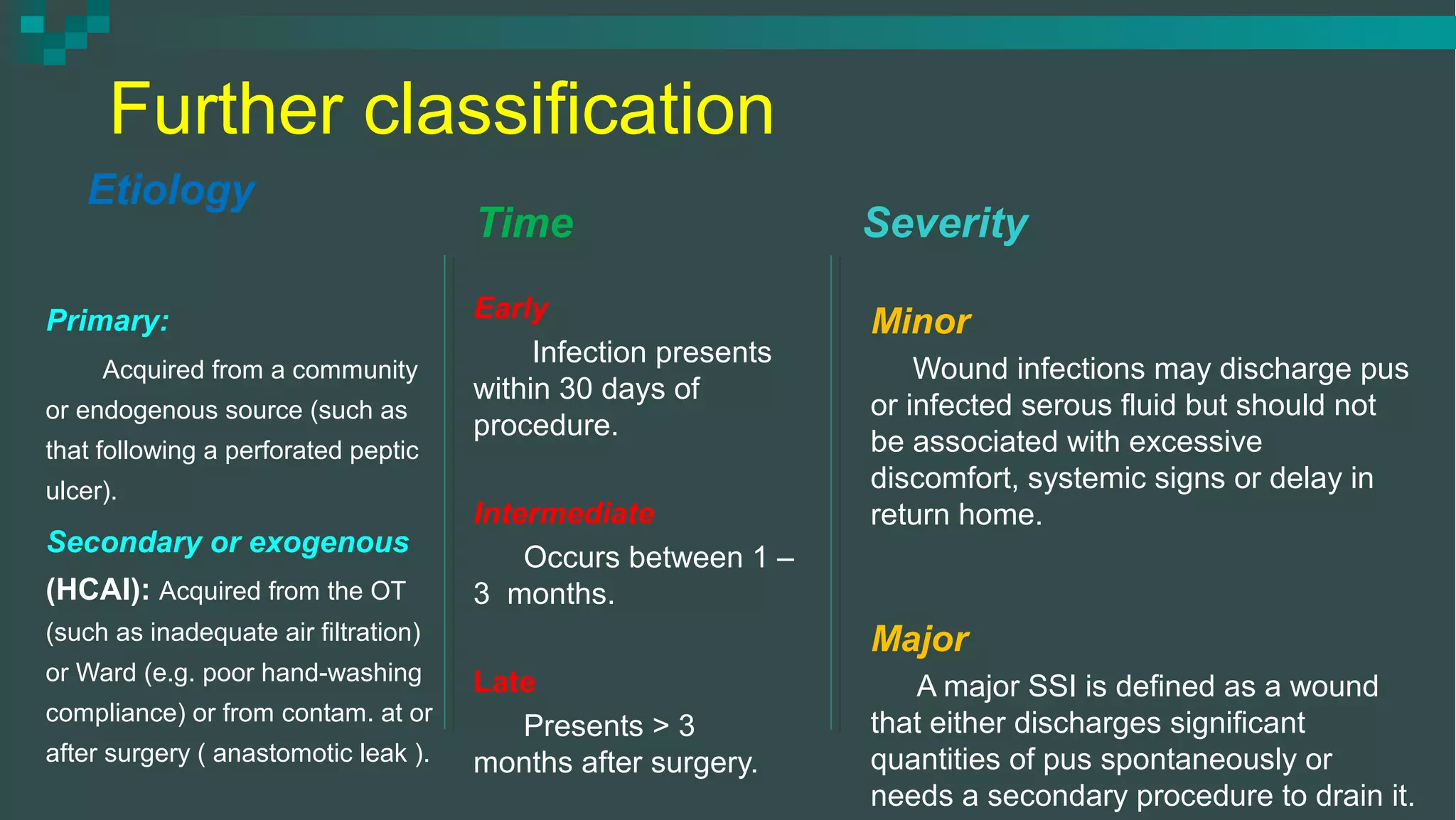
Further classification
Etiology
Time Severity
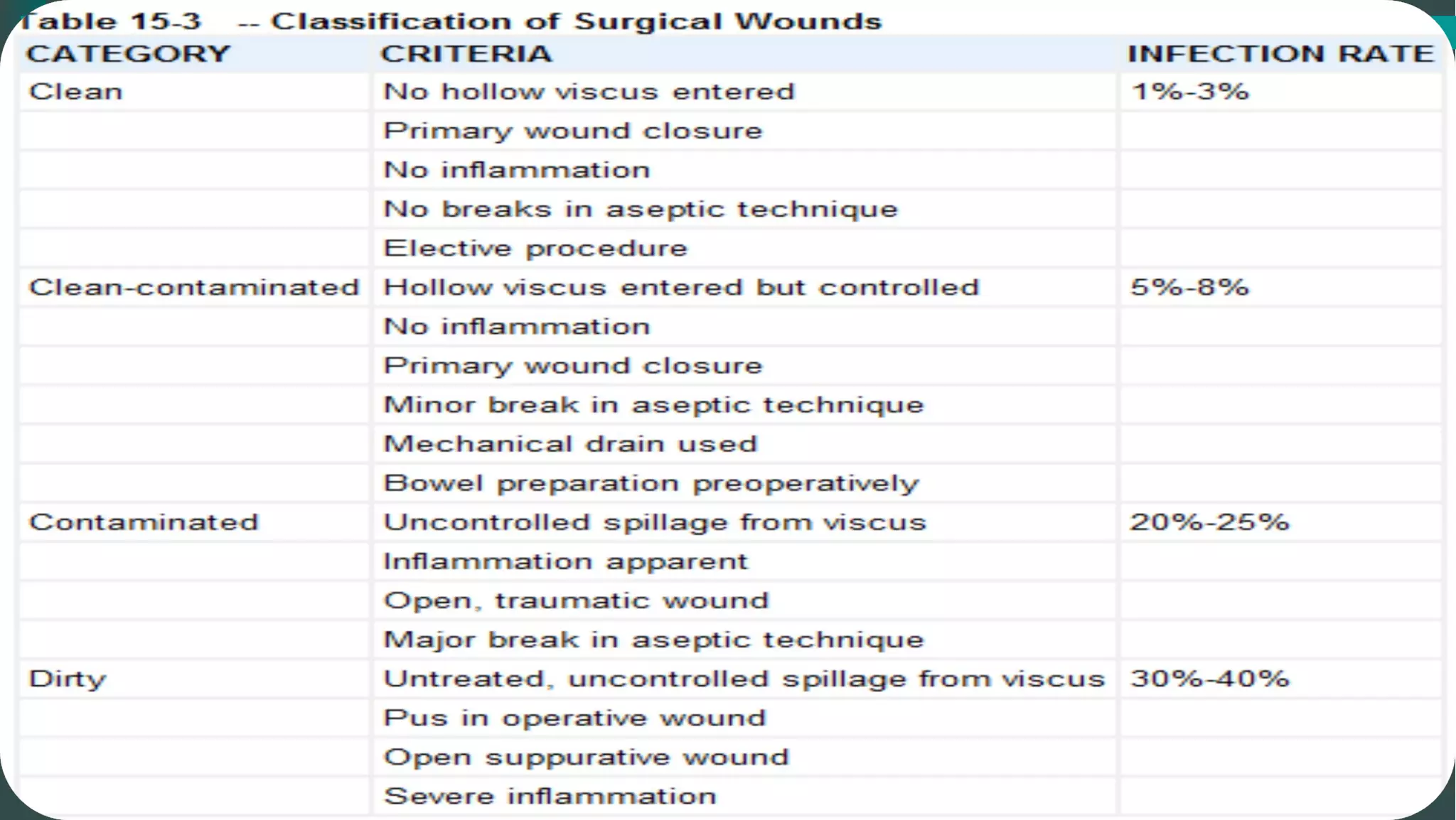
Primary:
Acquired from a community
or endogenous source (such as
that following a perforated peptic
ulcer).
Secondary or exogenous
(HCAI): Acquired from the OT
(such as inadequate air filtration)
or Ward (e.g. poor hand-washing
compliance) or from contam. at or
after surgery ( anastomotic leak ).
Early
Infection presents
within 30 days of
procedure.
Intermediate
Occurs between 1 –
3 months.
Late
Presents > 3
months after surgery.
Minor
Wound infections may discharge pus
or infected serous fluid but should not
be associated with excessive
discomfort, systemic signs or delay in
return home.
Major
A major SSI is defined as a wound
that either discharges significant
quantities of pus spontaneously or
needs a secondary procedure to drain it.
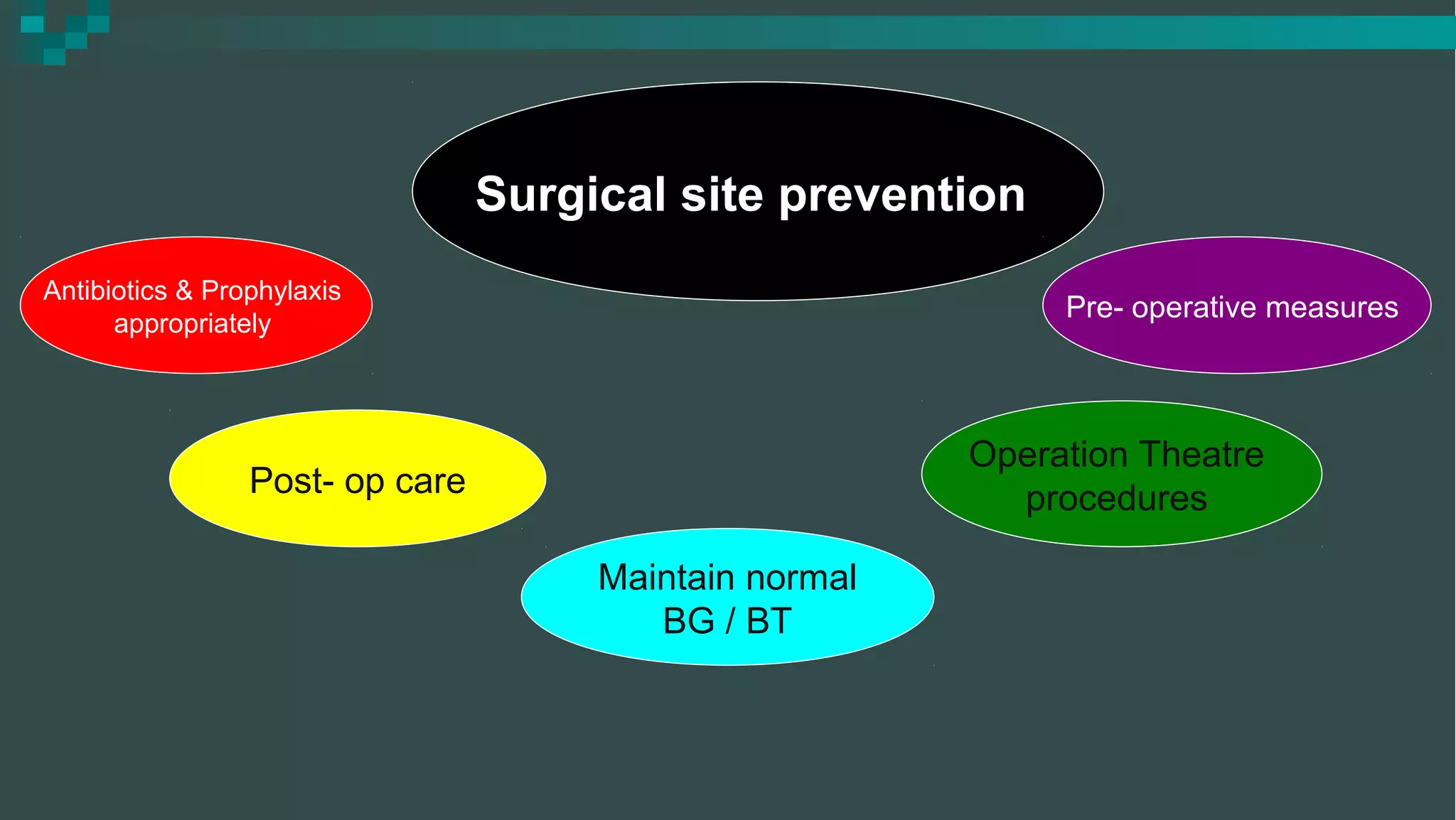
Surgical site prevention
Antibiotics & Prophylaxis
appropriately
Operation Theatre
procedures
Maintain normal
BG / BT
Post- op care
Pre- operative measures
Pre-operative
 Staff should always wash their hands - pts.
 Length of patient stay should be kept to a min.
 Preop. shaving should be avoided if possible.
 Antiseptic skin prepn. should be standardized.
 Attention to theatre technique & discipline.
 Avoid hypothermia perioperatively & ensure
supplemental O2 in recovery.
Operation Theatre
 Ensure – sterile caps, masks,gowns &
gloves – used
 Skin cleaning – povidone iodine – used
 Drapes – dry & instruments – sterilized
 Avoid - Unimpregnated plastic drapes
 Table tips – gentle tissue handling /
absolute haemostasis, appropriate suture
materials, avoiding dead space.
 Severely contaminated – leave upon
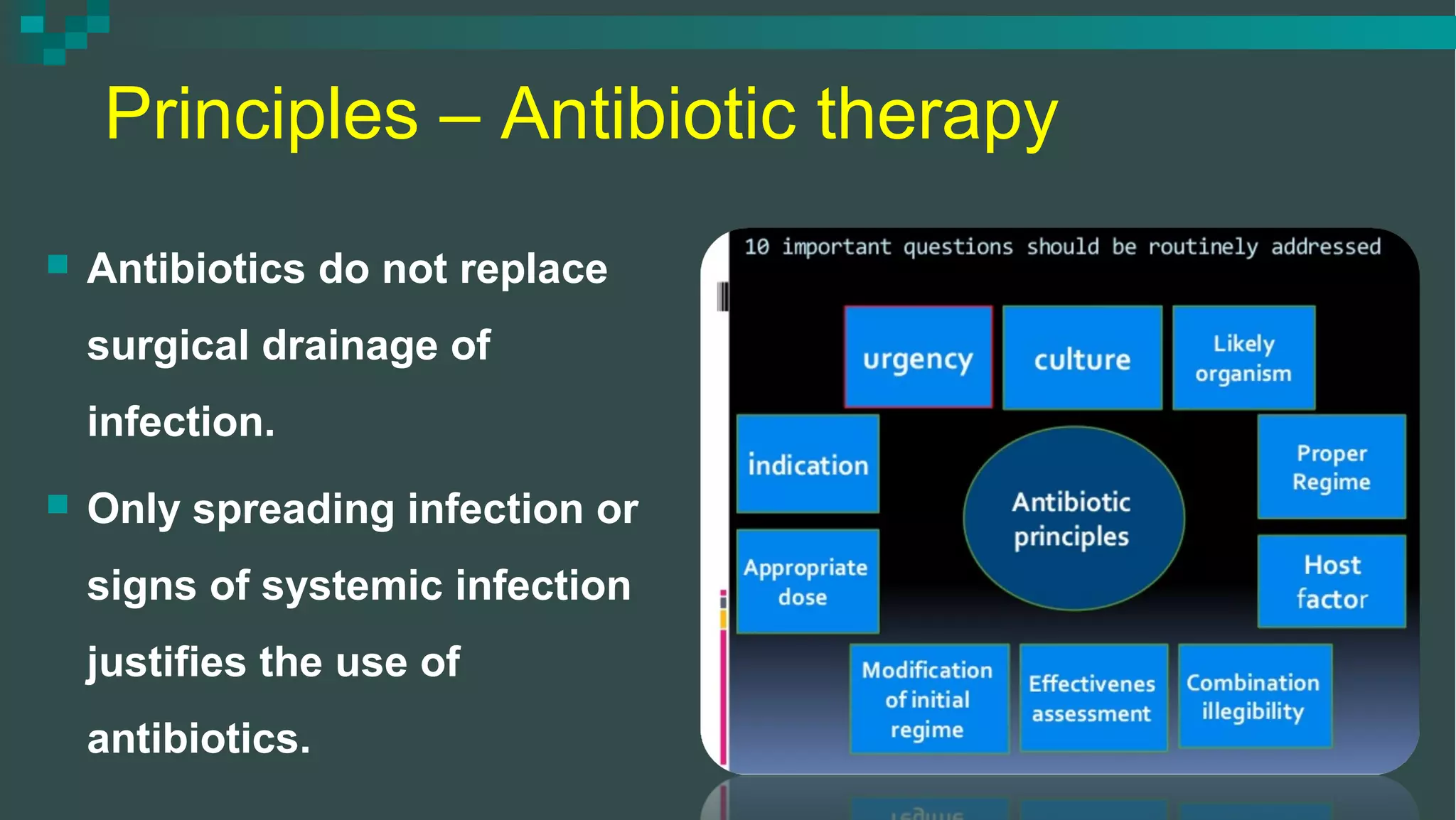
Principles – Antibiotic therapy
 Antibiotics do not replace
surgical drainage of
infection.
 Only spreading infection or
signs of systemic infection
justifies the use of
antibiotics.
Antibiotic therapy - Approach
 A narrow-spectrum antibiotic may be
used to treat a known sensitive infection.
 Combinations of broad-spectrum
antibiotics can be used when the
organism is not known or when it is
suspected that several bacteria, acting in
synergy, may be responsible for the
infection.
 New antibiotics should be used with
caution & wherever possible, sensitivities
should first be obtained.
Prophylaxis – Choice of antibiotics
 Empirical cover against expected pathogens
with local hospital guidelines.
 Single-shot I. V administration at induction of
anaesthesia.
 Repeat only in prosthetic surgery, long
operations or if there is excessive blood loss.
 Continue as therapy if there is unexpected
contamination.
 Pts. with heart valve disease or a prosthesis
should be protected from bacteraemia caused by
dental work, urethral instrumentation or visceral
surgery.
Regimes – Operations
Type of Surgery Organisms involved Prophylactic regime
Vascular Staphylococcus epidermidis (or
MRCNS)
Staphylococcus aureus (or MRSA)
Aerobic Gram-negative bacilli (AGNB)
3 doses of flucloxacillin with or without
gentamicin, vancomycin or rifampicin
if MRCNS / MRSA a risk
Orthopedic Staphylococcus epidermidis / aureus 1 -3 doses of a broad-spectrum
cephalosporin or gentamicin
Oesophagogastric Enterobacteriaceae / Enterococci 1 3 doses of a second-generation
cephalosporin & metronidazole in
severe contamination
Biliary Enterobacteriaceae / Enterococci 1 dose of a second-generation
cephalosporin
Small bowel Enterobacteriaceae / Anaerobes 1 – 3 doses of a second-generation
cephalosporin with or without
metronidazole
Appendix / Colorectal Enterobacteriaceae / Anaerobes 3 doses of a second-generation
cephalosporin (or gentamicin)
with metronidazole
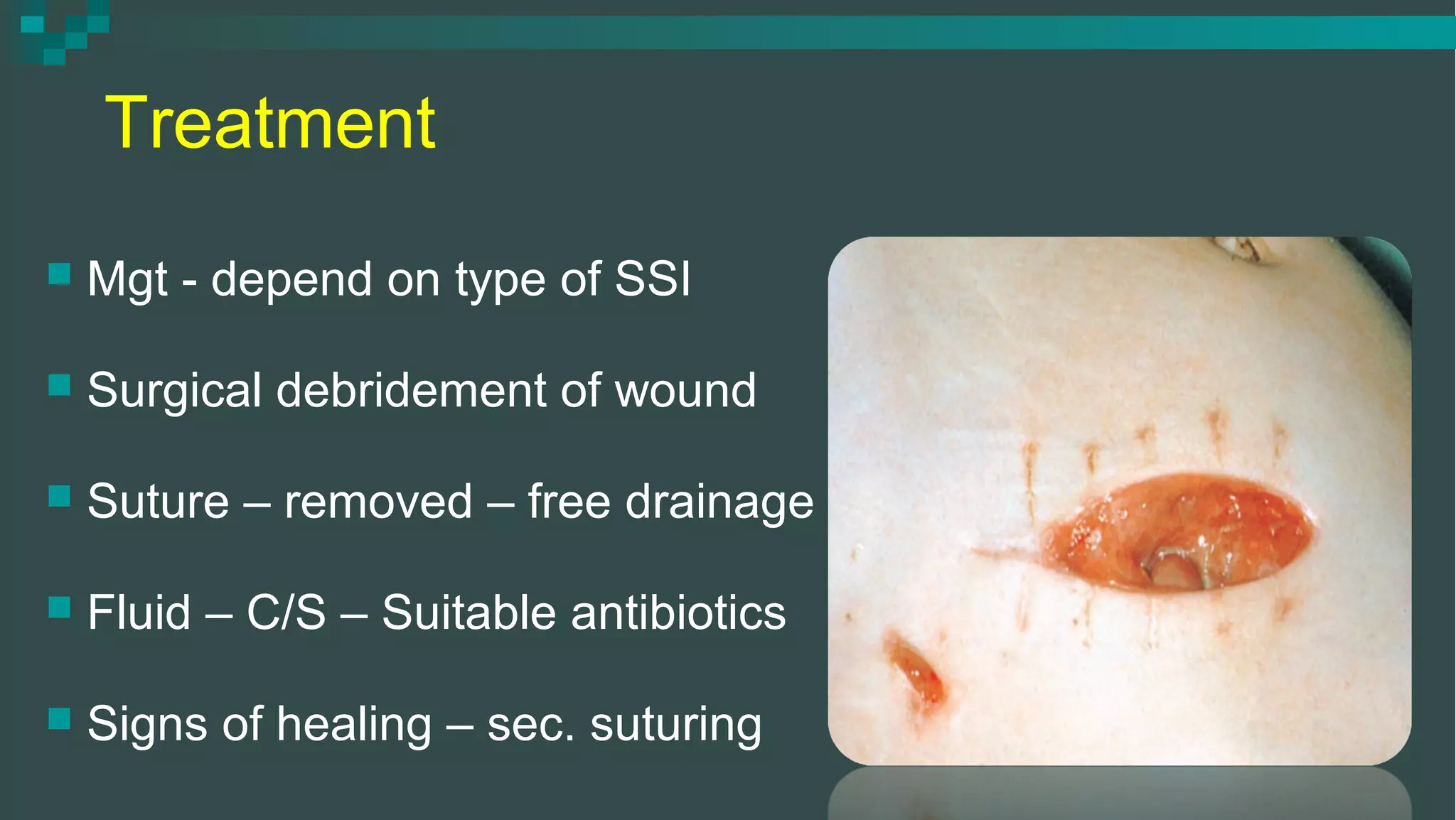
Treatment
 Mgt - depend on type of SSI
 Surgical debridement of wound
 Suture – removed – free drainage
 Fluid – C/S – Suitable antibiotics
 Signs of healing – sec. suturing
References
“Attack the problem, not the Person”
Penicillins- Penicillin G, Piperacillin
Penicillins with β-lactamase
inhibitors- Tazocin
Cephalosporins (I, II, III)-
Cephalexin, Cefuroxime, Ceftriaxone
Carbapenems- Imipenem, Meropenem
Aminoglycosides- Gentamycin,
Amikacin
Fluoroquinolones- Ciprofloxacin
Glycopeptides- Vancomycin
Macrolides- Erythromycin,
Clarithromycin
Tetracyclines- Minocycline,
Doxycycline

Surgical Site Infection

  • 1.
    Surgical Site Infection Dr.Utham Murali.M.S;M.B.A. Asso.Prof.of Surgery IMS / MSU / Malaysia.
  • 2.
    Introduction  Surgical infectionis major problem in surgical practice.  In 1992, the US Centers for Disease Control (CDC) revised its definition of 'wound infection', creating the definition 'surgical site infection' (SSI) to prevent confusion between the infection of a surgical incision and the infection of a traumatic wound.  Accounts for 15-25% of all surgical infections & increased cost to healthcare.
  • 3.
    Definition  The infectionof a wound can be defined as the invasion of organisms through tissues following a breakdown of local & systemic host defences leading to local & systemic presentation.
  • 4.
    Micro-Organisms S. aureus S. epidermidis Enterococcus E.coli Pseudomonas klebsiella Gr -ve strept species anaerobic Gr +ve 19% 14% 12%8%8% 4% 15% 6% 3% 2%
  • 5.
    Important Definitions  SSI Is an infected incised wound or deep organ space.  SIRS  Is the body’s systemic response to an infected wound.  MODS  Is the effect that the infection produces systemically.  MSOF  Is the end-stage of uncontrolled MODS.
  • 6.
    Important Definitions  SIRS– Any 2  Hyperthermia (> 38°C) or Hypothermia (< 36°C)  Tachycardia (> 90/min) or Tachypnoea (> 20/min)  WBC > 12 × 10 99 / l or < 4 × 10 9 / l  SEPSIS  Is SIRS with a documented infection.  SEPSIS SYNDROME  Is sepsis with evidence of one or more organ failures.
  • 7.
  • 8.
    Risk factors Malnutrition –Obesity Metabolic disease – DM / Jaundice Immunosuppression conditions Colonoization of GIT Poor perfusion – shock FB material Poor surgical technique
  • 9.
    Factors - Determine Host response  Virulence  Vasculature & Health of tissue  Presence of dead / foreign tissue  Presence of antibiotic – “decisive
  • 10.
    SSI – Assessment For surgical wound assessment several scoring systems are employed  ASEPSIS wound score  Southampton wound grading system  These enable surgical wound healing to be graded according to specific criteria, usually giving a numerical value, thus providing more objective assessment of wound.
  • 13.
    Types Depth of woundinfection Etiology Time of Occurrence Severity
  • 14.
    Depth - SuperficialIncisional SSI  Occurs < 30days  Skin & sub.cut tissue  Purulent discharge +/-  1 sign – inflammation  Incision – opened & diagnosed - surgeon
  • 16.
    Depth - DeepIncisional SSI  Occurs - 30days – 1yr  Deep soft tissue  Purulent discharge – not from organ  Spont.opened or delibe.opened  Deep abscess – by re-op/histo/X-ray  Opened & diagnosed - surgeon
  • 18.
    Depth - Organ/ Space SSI  Occurs - 30days – 1yr  Involves – any part [organ/space]  Purulent discharge – drain  Organisms – isolated  Deep abscess – direct & re-op / histology / X-ray  Opened & diagnosed - surgeon
  • 20.
    Further classification Etiology Time Severity Primary: Acquiredfrom a community or endogenous source (such as that following a perforated peptic ulcer). Secondary or exogenous (HCAI): Acquired from the OT (such as inadequate air filtration) or Ward (e.g. poor hand-washing compliance) or from contam. at or after surgery ( anastomotic leak ). Early Infection presents within 30 days of procedure. Intermediate Occurs between 1 – 3 months. Late Presents > 3 months after surgery. Minor Wound infections may discharge pus or infected serous fluid but should not be associated with excessive discomfort, systemic signs or delay in return home. Major A major SSI is defined as a wound that either discharges significant quantities of pus spontaneously or needs a secondary procedure to drain it.
  • 22.
    Surgical site prevention Antibiotics& Prophylaxis appropriately Operation Theatre procedures Maintain normal BG / BT Post- op care Pre- operative measures
  • 23.
    Pre-operative  Staff shouldalways wash their hands - pts.  Length of patient stay should be kept to a min.  Preop. shaving should be avoided if possible.  Antiseptic skin prepn. should be standardized.  Attention to theatre technique & discipline.  Avoid hypothermia perioperatively & ensure supplemental O2 in recovery.
  • 24.
    Operation Theatre  Ensure– sterile caps, masks,gowns & gloves – used  Skin cleaning – povidone iodine – used  Drapes – dry & instruments – sterilized  Avoid - Unimpregnated plastic drapes  Table tips – gentle tissue handling / absolute haemostasis, appropriate suture materials, avoiding dead space.  Severely contaminated – leave upon
  • 25.
    Principles – Antibiotictherapy  Antibiotics do not replace surgical drainage of infection.  Only spreading infection or signs of systemic infection justifies the use of antibiotics.
  • 26.
    Antibiotic therapy -Approach  A narrow-spectrum antibiotic may be used to treat a known sensitive infection.  Combinations of broad-spectrum antibiotics can be used when the organism is not known or when it is suspected that several bacteria, acting in synergy, may be responsible for the infection.  New antibiotics should be used with caution & wherever possible, sensitivities should first be obtained.
  • 27.
    Prophylaxis – Choiceof antibiotics  Empirical cover against expected pathogens with local hospital guidelines.  Single-shot I. V administration at induction of anaesthesia.  Repeat only in prosthetic surgery, long operations or if there is excessive blood loss.  Continue as therapy if there is unexpected contamination.  Pts. with heart valve disease or a prosthesis should be protected from bacteraemia caused by dental work, urethral instrumentation or visceral surgery.
  • 28.
    Regimes – Operations Typeof Surgery Organisms involved Prophylactic regime Vascular Staphylococcus epidermidis (or MRCNS) Staphylococcus aureus (or MRSA) Aerobic Gram-negative bacilli (AGNB) 3 doses of flucloxacillin with or without gentamicin, vancomycin or rifampicin if MRCNS / MRSA a risk Orthopedic Staphylococcus epidermidis / aureus 1 -3 doses of a broad-spectrum cephalosporin or gentamicin Oesophagogastric Enterobacteriaceae / Enterococci 1 3 doses of a second-generation cephalosporin & metronidazole in severe contamination Biliary Enterobacteriaceae / Enterococci 1 dose of a second-generation cephalosporin Small bowel Enterobacteriaceae / Anaerobes 1 – 3 doses of a second-generation cephalosporin with or without metronidazole Appendix / Colorectal Enterobacteriaceae / Anaerobes 3 doses of a second-generation cephalosporin (or gentamicin) with metronidazole
  • 29.
    Treatment  Mgt -depend on type of SSI  Surgical debridement of wound  Suture – removed – free drainage  Fluid – C/S – Suitable antibiotics  Signs of healing – sec. suturing
  • 30.
  • 31.
    “Attack the problem,not the Person” Penicillins- Penicillin G, Piperacillin Penicillins with β-lactamase inhibitors- Tazocin Cephalosporins (I, II, III)- Cephalexin, Cefuroxime, Ceftriaxone Carbapenems- Imipenem, Meropenem Aminoglycosides- Gentamycin, Amikacin Fluoroquinolones- Ciprofloxacin Glycopeptides- Vancomycin Macrolides- Erythromycin, Clarithromycin Tetracyclines- Minocycline, Doxycycline

Editor's Notes

  • #5 Inoculation of the surgical sites occurs during surgery either inward from the skin or outward from the internal organ being operated upon, the microbiology of SSI depends on the type of operation being performed . Most SSI are caused by gram positive bacteria , organisms are part are skin derived. Increased likelihood of infection by gram negative bacilli after gastrointestinal surgery. With surgery of the head and neck when pharyngeoesophygeal structure are opened anaerobic bacteria may cause SSI