
Dr. Utham Murali. M.S ; M.B.A.
Dept. of Surgery
IMS / MSU
Malaysia.
OPENING THOUGHT
Contents of Discussion
• Introduction - Brief History / Definitions
• Characteristics – PBL
• Differences between TL / PBL
• Advantages & Disadvantages – PBL
• Assesment – PBL
Brief History
• 1950's - Integrated systems in teaching - USA - Medical School.
• 1960's - PBL introduced in Canadian Medical School.
• 1970's - Most of US and European Medical Schools adopted PBL.
• 1990's - PBL introduced in Medical Schools in UK by Manchester,
Glasgow, Liverpool Universities & also other disciplines.
• 2000 - Introduced into many other professional Schools & Colleges
throughout the world.
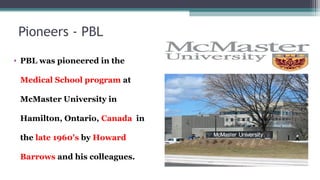
Pioneers - PBL
• PBL was pioneered in the
Medical School program at
McMaster University in
Hamilton, Ontario, Canada in
the late 1960's by Howard
Barrows and his colleagues.
6
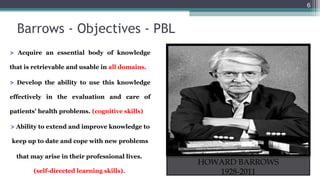
Barrows - Objectives - PBL
> Acquire an essential body of knowledge
that is retrievable and usable in all domains.
> Develop the ability to use this knowledge
effectively in the evaluation and care of
patients' health problems. (cognitive skills)
> Ability to extend and improve knowledge to
keep up to date and cope with new problems
that may arise in their professional lives.
(self-directed learning skills).
HOWARD BARROWS
1928-2011
Definition - PBL
" A learning method based on the principles of using
problems as a starting point for the acquisition &
integration of new knowledge " - H. Barrows.
" ... a process of acquiring understanding,
knowledge, skills and attitudes in the context of an
unfamiliar situation and applying such learning to
that situation. " - C. E. Engel.
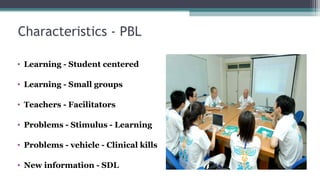
Characteristics - PBL
• Learning - Student centered
• Learning - Small groups
• Teachers - Facilitators
• Problems - Stimulus - Learning
• Problems - vehicle - Clinical kills
• New information - SDL
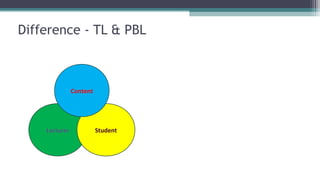
Difference - TL & PBL
Lecturer Student
Content
Difference - TL & PBL
Lecturer Student
Content
Facilitator
Problem
Solver
Problem
Teacher-centeredStudent-centered
New-Innovative
Curricula
Traditional Medical
Curricula
Information gatheringProblem-based
Discipline-basedIntegrated
Hospital basedCommunity- oriented
Standard CourseElectives with core curriculum
Apprenticeship-basedSystematic
 Continuum 
S
P
I
C
E
S
SPICES
PBL tutorial
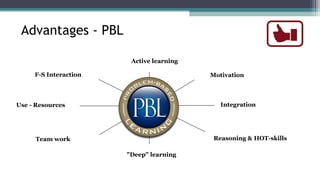
Active learning
Motivation
Integration
Reasoning & HOT-skills
"Deep" learning
F-S Interaction
Use - Resources
Team work
Advantages - PBL
PBL tutorial
Large class size
Knowledge - Un-organised
Quality - Control
Cost - wise
"Time" consuming
Inform. - Overload
Resources
Teachers - acquaintation
Disadvantages - PBL
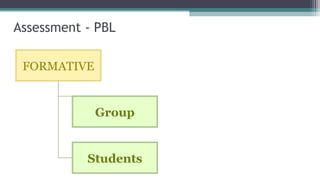
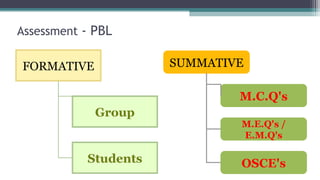
Assessment - PBL
FORMATIVE
Group
Students
Assessment - PBL
SUMMATIVE
M.C.Q's
M.E.Q's /
E.M.Q's
OSCE's
FORMATIVE
Group
Students
Pbl   introduction
Pbl   introduction
Pbl   introduction

Pbl introduction

  • 1.
    Dr. Utham Murali.M.S ; M.B.A. Dept. of Surgery IMS / MSU Malaysia.
  • 2.
  • 3.
    Contents of Discussion •Introduction - Brief History / Definitions • Characteristics – PBL • Differences between TL / PBL • Advantages & Disadvantages – PBL • Assesment – PBL
  • 4.
    Brief History • 1950's- Integrated systems in teaching - USA - Medical School. • 1960's - PBL introduced in Canadian Medical School. • 1970's - Most of US and European Medical Schools adopted PBL. • 1990's - PBL introduced in Medical Schools in UK by Manchester, Glasgow, Liverpool Universities & also other disciplines. • 2000 - Introduced into many other professional Schools & Colleges throughout the world.
  • 5.
    Pioneers - PBL •PBL was pioneered in the Medical School program at McMaster University in Hamilton, Ontario, Canada in the late 1960's by Howard Barrows and his colleagues.
  • 6.
    6 Barrows - Objectives- PBL > Acquire an essential body of knowledge that is retrievable and usable in all domains. > Develop the ability to use this knowledge effectively in the evaluation and care of patients' health problems. (cognitive skills) > Ability to extend and improve knowledge to keep up to date and cope with new problems that may arise in their professional lives. (self-directed learning skills). HOWARD BARROWS 1928-2011
  • 7.
    Definition - PBL "A learning method based on the principles of using problems as a starting point for the acquisition & integration of new knowledge " - H. Barrows. " ... a process of acquiring understanding, knowledge, skills and attitudes in the context of an unfamiliar situation and applying such learning to that situation. " - C. E. Engel.
  • 8.
    Characteristics - PBL •Learning - Student centered • Learning - Small groups • Teachers - Facilitators • Problems - Stimulus - Learning • Problems - vehicle - Clinical kills • New information - SDL
  • 9.
    Difference - TL& PBL Lecturer Student Content
  • 10.
    Difference - TL& PBL Lecturer Student Content Facilitator Problem Solver Problem
  • 11.
    Teacher-centeredStudent-centered New-Innovative Curricula Traditional Medical Curricula Information gatheringProblem-based Discipline-basedIntegrated HospitalbasedCommunity- oriented Standard CourseElectives with core curriculum Apprenticeship-basedSystematic  Continuum  S P I C E S SPICES
  • 12.
    PBL tutorial Active learning Motivation Integration Reasoning& HOT-skills "Deep" learning F-S Interaction Use - Resources Team work Advantages - PBL
  • 13.
    PBL tutorial Large classsize Knowledge - Un-organised Quality - Control Cost - wise "Time" consuming Inform. - Overload Resources Teachers - acquaintation Disadvantages - PBL
  • 14.
  • 15.
    Assessment - PBL SUMMATIVE M.C.Q's M.E.Q's/ E.M.Q's OSCE's FORMATIVE Group Students