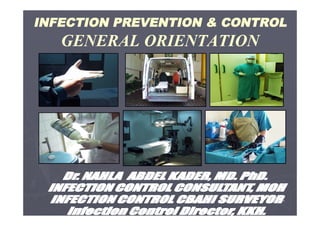
INFECTION PREVENTION & CONTROL

GENERAL ORIENTATION

١
Infection Control Overview
• Infection control (IC) is a quality standard
that is essential for the well being and safety of
patients, staff and visitors.
• It affects most departments of the hospital and
involves issues of quality, risk management, clinical
governance and health and safety.
• It is a discipline that applies epidemiologic and
scientific principles and statistical analysis to the
prevention or reduction in rates of Healthcare
Acquired Infections (HAIs).
٢
Hospital Acquired Infections
or
Healthcare Associated Infections

( HAIs )
An infection meeting the following criteria:
a) Not present or incubating on admission.
admission.
b) An infection incubating at the time of admission that is
related to previous hospitalization at the same facility or
identified in an admission following performance of a
procedure during a previous admission.

٣
HEALTHCARE ASSOCIATED
INFECTIONS
Remember

►Infection

in a hospitalized

patient
►Not present or incubating on
admission
►Hospital acquired infection
٤
Why now the urgent need for
Infection Control Program
► HAIs

are becoming more prevalent, especially
with the advent of more invasive procedures &
increase in use of immunosuppresive therapy.
► HAIs are preventable( can kill )
► HAIs are associated with prolonged morbidity.
► HAIs are associated with increased length of
stay & increased cost of care.
٥
TYPES OF HAIs

Devices Associated Infections
 Catheter Associated Urinary tract infections
(CAUTI)
 Central Line Associated Blood Stream Infections
(CLABSI)
 Ventilator Associated Pneumonia (VAP)

Procedure Associated Infections
 Surgical Site infections (SSI)

٦
Main Types of Infections
17%
44%
18%
10%

11%

UTI
SSI
BSI
Pneumo
Others

٧
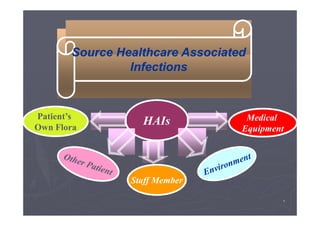
Source Healthcare Associated
Infections

Patient’s
Own Flora

HAIs

Medical
Equipment

Staff Member
٨
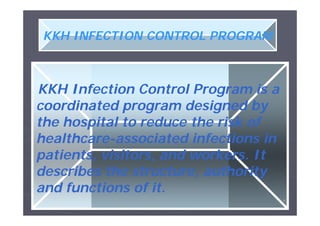
KKH INFECTION CONTROL PROGRAM

KKH Infection Control Program is a
coordinated program designed by
the hospital to reduce the risk of
healthcarehealthcare-associated infections in
patients, visitors, and workers. It
describes the structure, authority
and functions of it.
٩
The GOAL
The goal of Infection Control Program is
to provide a safe healthy environment
through identification and reduction the
risks of acquiring and transmission of

HAIs among patients, medical staff,
administration staff, volunteers, students
and visitors.

١٠
Importance
of Infection Control Program
1. We have an obligation to reduce the morbidity
and mortality of our patients.
2. Accreditation requirements demand a strong
infection control program.
3. The infection control efforts are part of the ''
risk management'' efforts of any hospital.
4. Hospital outbreaks now occur frequently in the
average community hospital.
5. Financial deficit control has become a crucial
issue for many hospital.

١١
 Prevention of healthcare acquired infections is the
responsibility of all individuals and services providing
healthcare.
 Everyone must work cooperatively to reduce the risk
of infection for patients ,staff and visitors.
 Infection control programs are effective, provided they
are comprehensive and including surveillance and
prevention activities, as well as staff training.
 There must also be effective support at the national
and regional levels.

١٢
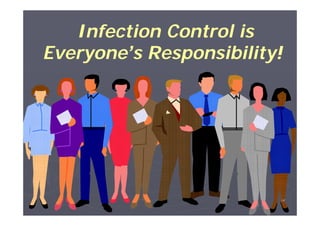
Infection Control is
Everyone’
Everyone’s Responsibility!

١٣
HOSPITAL ENVIRONMENT
HIV

CHIKENPOX

TB

١٤
How are infections transmitted?

١٥
How to Break the
Chain of Infection????

١٦
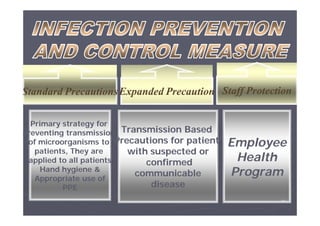
Standard Precautions Expanded Precaution Staff Protection
Primary strategy for
preventing transmission Transmission Based
of microorganisms to Precautions for patient
patients, They are
with suspected or
applied to all patients
confirmed
Hand hygiene &
communicable
Appropriate use of
disease
PPE

Employee
Health
Program
١٧
Practical Issues and Considerations
for Standard Precautions
► Hand

Hygiene.
► Personnel Protective Equipment (PPE).
► Safe Use of Sharps.
► Monitoring Staff Health.
► Cleaning and Disinfecting Patient Care
Equipment.
► Disposing

of Waste Safely.
► Cleaning the Environment.
► Removing Spills of Blood and Body
Fluids

١٨
١٩
So Why All the Fuss About
Hand Hygiene?
Most common mode of transmission
of pathogens is via hands!

 Infections acquired in healthcare
 Spread of antimicrobial
resistance
٢٠
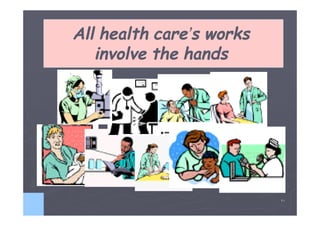
All health care’s works
care’
involve the hands

٢١
Hands are contaminated

Hands
spread
germs

٢٢
The health care environment
is contaminated

٢٣
Colonized or Infected:
What is the Difference?
► People

who carry bacteria without evidence
of infection (fever, increased white blood
cell count) are colonized

► If

an infection develops, it is usually from
bacteria that colonize patients

► Bacteria

that colonize patients can be
transmitted from one patient to another by
the hands of healthcare workers
~ Bacteria can be transmitted even if the
patient is not infected ~

٢٤
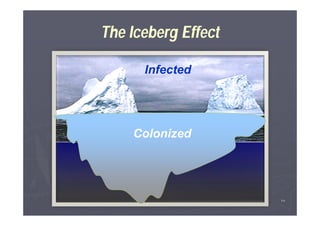
The Iceberg Effect
Infected

Colonized

٢٥
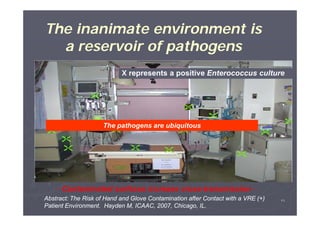
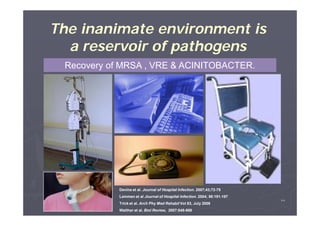
The inanimate environment is
a reservoir of pathogens
X represents a positive Enterococcus culture

The pathogens are ubiquitous

~ Contaminated surfaces increase cross-transmission ~
Abstract: The Risk of Hand and Glove Contamination after Contact with a VRE (+)
Patient Environment. Hayden M, ICAAC, 2007, Chicago, IL.

٢٦
The inanimate environment is
a reservoir of pathogens
Recovery of MRSA , VRE & ACINITOBACTER.

Devine et al. Journal of Hospital Infection. 2007;43;72-75
Lemmen et al Journal of Hospital Infection. 2004; 56:191-197
Trick et al. Arch Phy Med Rehabil Vol 83, July 2006
Walther et al. Biol Review, 2007:849-869

٢٧
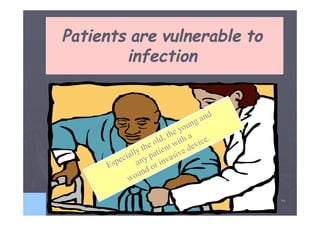
Patients are vulnerable to
infection

٢٨
Hand Hygiene is the simplest, most
effective measure for preventing
HospitalHospital-Acquired Infections.

٢٩
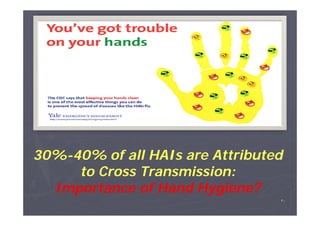
30% 40%
30%-40% of all HAIs are Attributed
to Cross Transmission:
Importance of Hand Hygiene?
٣٠
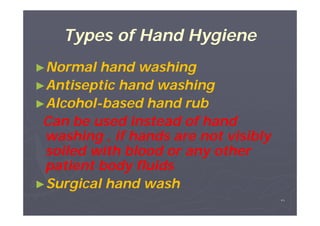
Types of Hand Hygiene
►Normal

hand washing
►Antiseptic hand washing
►Alcohol-based hand rub
AlcoholCan be used instead of hand
washing , if hands are not visibly
soiled with blood or any other
patient body fluids
►Surgical hand wash
٣١
Routine Hand Washing

٣٢
Antiseptic Hand Washing

٣٣
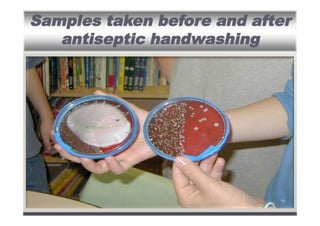
Samples taken before and after
antiseptic handwashing

٣٤
Waterless Hand Rub
“alcohol“alcohol-based hand rub

٣٥
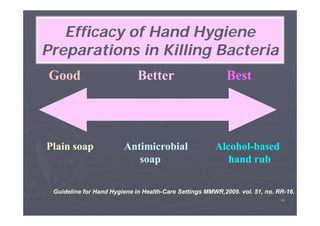
Efficacy of Hand Hygiene
Preparations in Killing Bacteria
Good

Plain soap

Better

Antimicrobial
soap

Best

Alcohol-based
hand rub

Guideline for Hand Hygiene in Health-Care Settings MMWR,2009. vol. 51, no. RR-16.
٣٦
Hand Hygiene Options
Wet hands, apply
soap and rub for
>10 seconds.
Rinse, dry & turn
off faucet with
paper towel.

Apply to palm; rub
hands until dry

~ Use soap and water for visibly soiled hands ~
٣٧

~ Do not wash off alcohol handrub ~
Surgical Hand Wash

٣٨
٣٩
٤٠
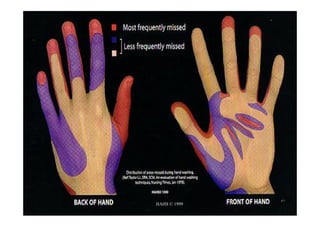
Areas Most Frequently Missed

HAHS © 1999

٤١
٤٢
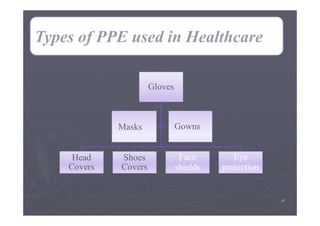
Types of PPE used in Healthcare
Gloves

Masks
Head
Covers

Shoes
Covers

Gowns
Face
shields

Eye
protection

٤٣
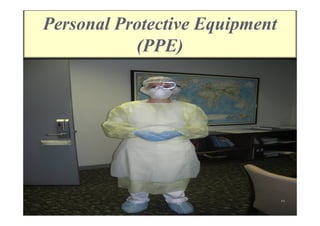
Personal Protective Equipment
(PPE)

٤٤
٤٥
Procedures
►Putting

on Gowns, Gloves, and

Mask
Gown: Put on gown so that its edges overlap in
back to cover clothing. Fasten closures.
Gloves: If worn with gown, pull up over cuffs of
gown to protect the wrists.

Mask: Apply mask over mouth and nose by
securing mask with ties so that it fits tightly over the
face.
٤٦
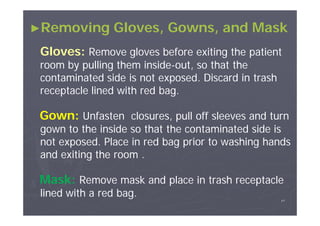
►Removing

Gloves, Gowns, and Mask

Gloves: Remove gloves before exiting the patient
room by pulling them inside-out, so that the
insidecontaminated side is not exposed. Discard in trash
receptacle lined with red bag.

Gown: Unfasten closures, pull off sleeves and turn
gown to the inside so that the contaminated side is
not exposed. Place in red bag prior to washing hands
and exiting the room .

Mask: Remove mask and place in trash receptacle
lined with a red bag.
٤٧
٤٨
ISOLATION PRECAUTIONS
Types of Isolation Precautions
1- Standard Precautions
Standard precaution (SP) is the primary
strategy for preventing transmission of
microorganisms to patients, They are
applied to all patients .
٤٩
Practical Issues and Considerations
► Hand

Hygiene.
► Personnel Protective Equipment (PPE).
► Safe Use of Sharps.
► Monitoring Staff Health.
► Cleaning and Disinfecting Patient Care
Equipment.
► Disposing of Waste Safely.
► Cleaning the Environment.
► Removing Spills of Blood

Fluids

and Body
٥٠
Expanded Precautions

Expanded precautions are designed for patients
with documented or suspected infection with
communicable or epidemiologically important
pathogens for which additional precautions
beyond SP are needed to interrupt transmission.

The aim of isolating a patient is to prevent
the spread of communicable
٥١
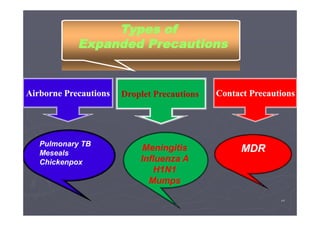
Types of
Expanded Precautions

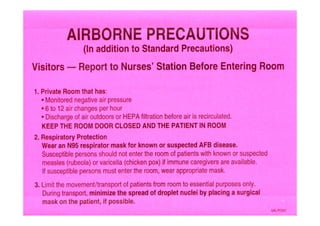
Airborne Precautions

Pulmonary TB
Meseals
Chickenpox

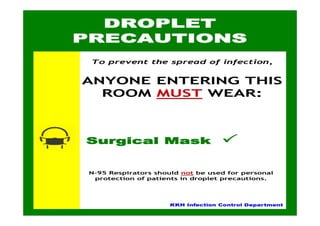
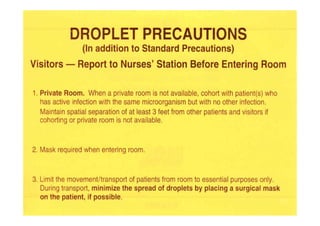
Droplet Precautions

Meningitis
Influenza A
H1N1
Mumps

Contact Precautions

MDR

٥٢
٥٣
٥٤
٥٥
٥٦
٥٧
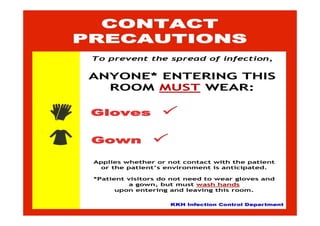
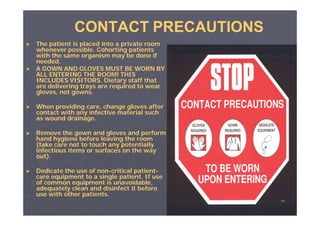
CONTACT PRECAUTIONS
►

►

The patient is placed into a private room
whenever possible. Cohorting patients
with the same organism may be done if
needed.
A GOWN AND GLOVES MUST BE WORN BY
ALL ENTERING THE ROOM! THIS
INCLUDES VISITORS. Dietary staff that
are delivering trays are required to wear
gloves, not gowns.

►

When providing care, change gloves after
contact with any infective material such
as wound drainage.

►

Remove the gown and gloves and perform
hand hygiene before leaving the room
(take care not to touch any potentially
infectious items or surfaces on the way
out).

►

Dedicate the use of non-critical patientnonpatientcare equipment to a single patient. If use
of common equipment is unavoidable,
adequately clean and disinfect it before
use with other patients.
٥٨
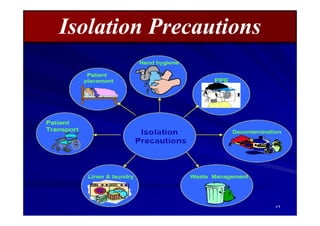
Isolation Precautions

٥٩
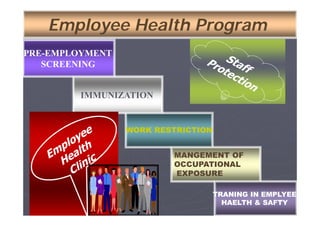
Employee Health Program
PRE-EMPLOYMENT
SCREENING

IMMUNIZATION

WORK RESTRICTION
MANGEMENT OF
OCCUPATIONAL
EXPOSURE
TRANING IN EMPLYEE
٦٠
HAELTH & SAFTY
٦١
OBJECTIVES
►What

the risk of exposure?
►How we can prevent the
exposure?
►If the exposure is already
done, what is the exposure
management plan?
٦٢
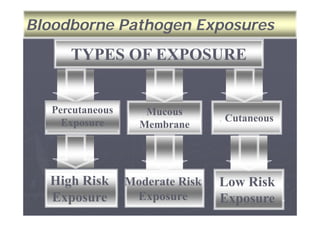
Bloodborne Pathogen Exposures

TYPES OF EXPOSURE

Percutaneous
Exposure

Mucous
Membrane

High Risk
Exposure

Moderate Risk
Exposure

.

Cutaneous

Low Risk
Exposure

٦٣
Exposure Control PLAN
The single most effective
measure to control the
transmission of Bloodborne
Pathogens is:

Standard
Precautions
Treat all human blood and other potentially
infectious materials like they are infectious
for Hepatitis B&C and HIV

٦٤
Safer Sharps

٦٥
SHARP INJURIES PREVENTION
►

Avoid rushing when handling needles and sharps.

►

Dispose all needles and other sharps promptly. Place used
disposable items in puncture resistant biohazard containers for
disposal.

DO NOT re-cap needles.
re► In the event recapping is unavoidable, the one-handed scoop
onetechnique or a needle recapping device shall be used.

►

Sharps containers shall be labeled as “sharps waste” and
biohazardous with international biohazardous symbol.

٦٦
٦٧
► Sharp

containers shall be filled up to
three quarters and taped closed or
tightly lidded.
► Sharps containers are placed in yellow
bags by housekeeping personnel for
storage and then processing.
► Sharps waste is disposed of in sharps
containers as close to site of use as
possible.
► In-patient rooms shall have wall
Inmounted “Sharps Container” system,
Container”
which is kept near the patient’s bed and
patient’
is securely locked.
٦٨
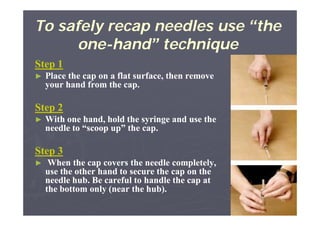
To safely recap needles use “the
one-hand”
one-hand” technique
Step 1
►

Place the cap on a flat surface, then remove
your hand from the cap.

Step 2
►

With one hand, hold the syringe and use the
needle to “scoop up” the cap.

Step 3
►

When the cap covers the needle completely,
use the other hand to secure the cap on the
needle hub. Be careful to handle the cap at
the bottom only (near the hub).
٦٩
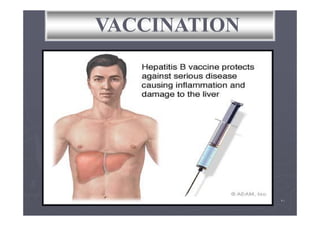
VACCINATION

٧٠
IMMEDIATE CARE
OF INJURY

Risk
Reduction

Management
PLAN

MANGEMENTOF
EXPOSED
HCWs

INCIDENT
DOCUMENTATION

RISK ASSESMENT
٧١
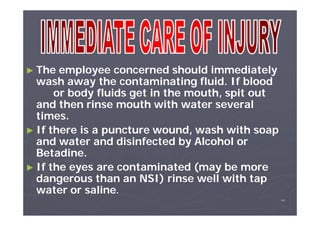
► The

employee concerned should immediately
wash away the contaminating fluid. If blood
or body fluids get in the mouth, spit out
and then rinse mouth with water several
times.
► If there is a puncture wound, wash with soap
and water and disinfected by Alcohol or
Betadine.
► If the eyes are contaminated (may be more
dangerous than an NSI) rinse well with tap
water or saline.
٧٢
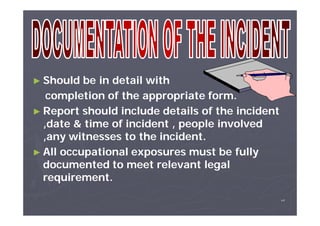
► Should

be in detail with
completion of the appropriate form.
► Report should include details of the incident
,date & time of incident , people involved
,any witnesses to the incident.
► All occupational exposures must be fully
documented to meet relevant legal
requirement.
٧٣
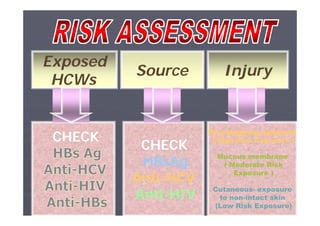
Exposed
HCWs

CHECK

Source

CHECK
HBsAg
Anti-HCV
Anti-HIV

Injury

Percutaneous exposure
( High Risk Exposure )
Mucous membrane
( Moderate Risk
Exposure )
Cutaneous- exposure
to non-intact skin
٧٤
(Low Risk Exposure)
٧٥
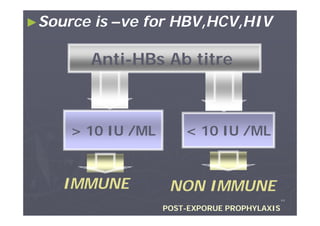
►Source

is –ve for HBV,HCV,HIV

Anti-HBs Ab titre

> 10 IU /ML

IMMUNE

< 10 IU /ML

NON IMMUNE
٧٦

POST-EXPORUE PROPHYLAXIS
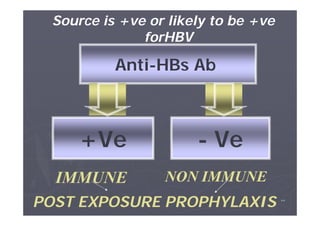
Source is +ve or likely to be +ve
forHBV
forHBV

Anti-HBs Ab

+Ve
IMMUNE

- Ve
NON IMMUNE

POST EXPOSURE PROPHYLAXIS

٧٧
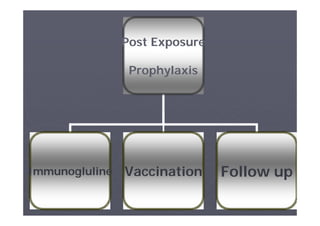
Post Exposure
Prophylaxis

Immunogluline

Vaccination

Follow up
٧٨
Clinical or serological
Evidence of acute
hepatitis

Seek for clinical advise

Repeat HBs Ag at
1 & 6 months
No plasma,bl,body tissue
donation.
Protect sexual partner.
Highest risk
٧٩
percuteneous
exporure,modify WP.
Source is +ve or
likely to be +ve for HCV
Screening
HCV-IgG

-Ve
-No infection
-Early infection
-False -ve

+Ve
-Current
infection
-past infection
-False +ve

Confirmatory
HCV-RNA by
real-time PCR

+ve
Confirms
active HCV
replication

-ve
Does not
confirm
absence of
٨٠
HCV
replication
Clinical or serological
evidence of acute
hepatitis
Seek for clinical advise

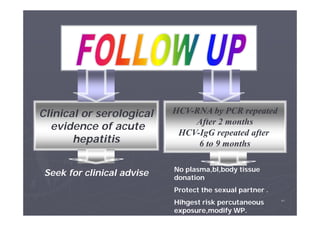
HCV-RNA by PCR repeated
After 2 months
HCV-IgG repeated after
6 to 9 months
No plasma,bl,body tissue
donation
Protect the sexual partner .
Hihgest risk percutaneous
exposure,modify WP.

٨١
Source is +ve or likely to be
+ve for HIV
► Postexporue

Prophylactic treatment is

indicated.
► It must be commenced as soon as possible
.preferably within hours rather than days .
► It should be administrated for 4 weeks.
► If PEP is offered & taken &the source is
later determined to be HIV -ve ,PEP should
be discontinued.
٨٢
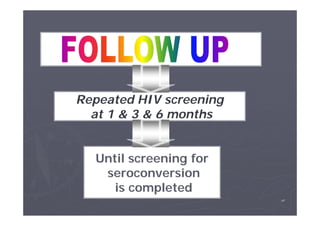
Repeated HIV screening
at 1 & 3 & 6 months

Until screening for
seroconversion
is completed
٨٣
PREVENTION IS
PRIMARY !

٨٤
٨٥
٨٦
٨٧

Infection prevention & control general orientation [compatibility mode]

  • 1.
    INFECTION PREVENTION &CONTROL GENERAL ORIENTATION ١
  • 2.
    Infection Control Overview •Infection control (IC) is a quality standard that is essential for the well being and safety of patients, staff and visitors. • It affects most departments of the hospital and involves issues of quality, risk management, clinical governance and health and safety. • It is a discipline that applies epidemiologic and scientific principles and statistical analysis to the prevention or reduction in rates of Healthcare Acquired Infections (HAIs). ٢
  • 3.
    Hospital Acquired Infections or HealthcareAssociated Infections ( HAIs ) An infection meeting the following criteria: a) Not present or incubating on admission. admission. b) An infection incubating at the time of admission that is related to previous hospitalization at the same facility or identified in an admission following performance of a procedure during a previous admission. ٣
  • 4.
    HEALTHCARE ASSOCIATED INFECTIONS Remember ►Infection in ahospitalized patient ►Not present or incubating on admission ►Hospital acquired infection ٤
  • 5.
    Why now theurgent need for Infection Control Program ► HAIs are becoming more prevalent, especially with the advent of more invasive procedures & increase in use of immunosuppresive therapy. ► HAIs are preventable( can kill ) ► HAIs are associated with prolonged morbidity. ► HAIs are associated with increased length of stay & increased cost of care. ٥
  • 6.
    TYPES OF HAIs DevicesAssociated Infections  Catheter Associated Urinary tract infections (CAUTI)  Central Line Associated Blood Stream Infections (CLABSI)  Ventilator Associated Pneumonia (VAP) Procedure Associated Infections  Surgical Site infections (SSI) ٦
  • 7.
    Main Types ofInfections 17% 44% 18% 10% 11% UTI SSI BSI Pneumo Others ٧
  • 8.
    Source Healthcare Associated Infections Patient’s OwnFlora HAIs Medical Equipment Staff Member ٨
  • 9.
    KKH INFECTION CONTROLPROGRAM KKH Infection Control Program is a coordinated program designed by the hospital to reduce the risk of healthcarehealthcare-associated infections in patients, visitors, and workers. It describes the structure, authority and functions of it. ٩
  • 10.
    The GOAL The goalof Infection Control Program is to provide a safe healthy environment through identification and reduction the risks of acquiring and transmission of HAIs among patients, medical staff, administration staff, volunteers, students and visitors. ١٠
  • 11.
    Importance of Infection ControlProgram 1. We have an obligation to reduce the morbidity and mortality of our patients. 2. Accreditation requirements demand a strong infection control program. 3. The infection control efforts are part of the '' risk management'' efforts of any hospital. 4. Hospital outbreaks now occur frequently in the average community hospital. 5. Financial deficit control has become a crucial issue for many hospital. ١١
  • 12.
     Prevention ofhealthcare acquired infections is the responsibility of all individuals and services providing healthcare.  Everyone must work cooperatively to reduce the risk of infection for patients ,staff and visitors.  Infection control programs are effective, provided they are comprehensive and including surveillance and prevention activities, as well as staff training.  There must also be effective support at the national and regional levels. ١٢
  • 13.
  • 14.
  • 15.
    How are infectionstransmitted? ١٥
  • 16.
    How to Breakthe Chain of Infection???? ١٦
  • 17.
    Standard Precautions ExpandedPrecaution Staff Protection Primary strategy for preventing transmission Transmission Based of microorganisms to Precautions for patient patients, They are with suspected or applied to all patients confirmed Hand hygiene & communicable Appropriate use of disease PPE Employee Health Program ١٧
  • 18.
    Practical Issues andConsiderations for Standard Precautions ► Hand Hygiene. ► Personnel Protective Equipment (PPE). ► Safe Use of Sharps. ► Monitoring Staff Health. ► Cleaning and Disinfecting Patient Care Equipment. ► Disposing of Waste Safely. ► Cleaning the Environment. ► Removing Spills of Blood and Body Fluids ١٨
  • 19.
  • 20.
    So Why Allthe Fuss About Hand Hygiene? Most common mode of transmission of pathogens is via hands!  Infections acquired in healthcare  Spread of antimicrobial resistance ٢٠
  • 21.
    All health care’sworks care’ involve the hands ٢١
  • 22.
  • 23.
    The health careenvironment is contaminated ٢٣
  • 24.
    Colonized or Infected: Whatis the Difference? ► People who carry bacteria without evidence of infection (fever, increased white blood cell count) are colonized ► If an infection develops, it is usually from bacteria that colonize patients ► Bacteria that colonize patients can be transmitted from one patient to another by the hands of healthcare workers ~ Bacteria can be transmitted even if the patient is not infected ~ ٢٤
  • 25.
  • 26.
    The inanimate environmentis a reservoir of pathogens X represents a positive Enterococcus culture The pathogens are ubiquitous ~ Contaminated surfaces increase cross-transmission ~ Abstract: The Risk of Hand and Glove Contamination after Contact with a VRE (+) Patient Environment. Hayden M, ICAAC, 2007, Chicago, IL. ٢٦
  • 27.
    The inanimate environmentis a reservoir of pathogens Recovery of MRSA , VRE & ACINITOBACTER. Devine et al. Journal of Hospital Infection. 2007;43;72-75 Lemmen et al Journal of Hospital Infection. 2004; 56:191-197 Trick et al. Arch Phy Med Rehabil Vol 83, July 2006 Walther et al. Biol Review, 2007:849-869 ٢٧
  • 28.
    Patients are vulnerableto infection ٢٨
  • 29.
    Hand Hygiene isthe simplest, most effective measure for preventing HospitalHospital-Acquired Infections. ٢٩
  • 30.
    30% 40% 30%-40% ofall HAIs are Attributed to Cross Transmission: Importance of Hand Hygiene? ٣٠
  • 31.
    Types of HandHygiene ►Normal hand washing ►Antiseptic hand washing ►Alcohol-based hand rub AlcoholCan be used instead of hand washing , if hands are not visibly soiled with blood or any other patient body fluids ►Surgical hand wash ٣١
  • 32.
  • 33.
  • 34.
    Samples taken beforeand after antiseptic handwashing ٣٤
  • 35.
  • 36.
    Efficacy of HandHygiene Preparations in Killing Bacteria Good Plain soap Better Antimicrobial soap Best Alcohol-based hand rub Guideline for Hand Hygiene in Health-Care Settings MMWR,2009. vol. 51, no. RR-16. ٣٦
  • 37.
    Hand Hygiene Options Wethands, apply soap and rub for >10 seconds. Rinse, dry & turn off faucet with paper towel. Apply to palm; rub hands until dry ~ Use soap and water for visibly soiled hands ~ ٣٧ ~ Do not wash off alcohol handrub ~
  • 38.
  • 39.
  • 40.
  • 41.
    Areas Most FrequentlyMissed HAHS © 1999 ٤١
  • 42.
  • 43.
    Types of PPEused in Healthcare Gloves Masks Head Covers Shoes Covers Gowns Face shields Eye protection ٤٣
  • 44.
  • 45.
  • 46.
    Procedures ►Putting on Gowns, Gloves,and Mask Gown: Put on gown so that its edges overlap in back to cover clothing. Fasten closures. Gloves: If worn with gown, pull up over cuffs of gown to protect the wrists. Mask: Apply mask over mouth and nose by securing mask with ties so that it fits tightly over the face. ٤٦
  • 47.
    ►Removing Gloves, Gowns, andMask Gloves: Remove gloves before exiting the patient room by pulling them inside-out, so that the insidecontaminated side is not exposed. Discard in trash receptacle lined with red bag. Gown: Unfasten closures, pull off sleeves and turn gown to the inside so that the contaminated side is not exposed. Place in red bag prior to washing hands and exiting the room . Mask: Remove mask and place in trash receptacle lined with a red bag. ٤٧
  • 48.
  • 49.
    ISOLATION PRECAUTIONS Types ofIsolation Precautions 1- Standard Precautions Standard precaution (SP) is the primary strategy for preventing transmission of microorganisms to patients, They are applied to all patients . ٤٩
  • 50.
    Practical Issues andConsiderations ► Hand Hygiene. ► Personnel Protective Equipment (PPE). ► Safe Use of Sharps. ► Monitoring Staff Health. ► Cleaning and Disinfecting Patient Care Equipment. ► Disposing of Waste Safely. ► Cleaning the Environment. ► Removing Spills of Blood Fluids and Body ٥٠
  • 51.
    Expanded Precautions Expanded precautionsare designed for patients with documented or suspected infection with communicable or epidemiologically important pathogens for which additional precautions beyond SP are needed to interrupt transmission. The aim of isolating a patient is to prevent the spread of communicable ٥١
  • 52.
    Types of Expanded Precautions AirbornePrecautions Pulmonary TB Meseals Chickenpox Droplet Precautions Meningitis Influenza A H1N1 Mumps Contact Precautions MDR ٥٢
  • 53.
  • 54.
  • 55.
  • 56.
  • 57.
  • 58.
    CONTACT PRECAUTIONS ► ► The patientis placed into a private room whenever possible. Cohorting patients with the same organism may be done if needed. A GOWN AND GLOVES MUST BE WORN BY ALL ENTERING THE ROOM! THIS INCLUDES VISITORS. Dietary staff that are delivering trays are required to wear gloves, not gowns. ► When providing care, change gloves after contact with any infective material such as wound drainage. ► Remove the gown and gloves and perform hand hygiene before leaving the room (take care not to touch any potentially infectious items or surfaces on the way out). ► Dedicate the use of non-critical patientnonpatientcare equipment to a single patient. If use of common equipment is unavoidable, adequately clean and disinfect it before use with other patients. ٥٨
  • 59.
  • 60.
    Employee Health Program PRE-EMPLOYMENT SCREENING IMMUNIZATION WORKRESTRICTION MANGEMENT OF OCCUPATIONAL EXPOSURE TRANING IN EMPLYEE ٦٠ HAELTH & SAFTY
  • 61.
  • 62.
    OBJECTIVES ►What the risk ofexposure? ►How we can prevent the exposure? ►If the exposure is already done, what is the exposure management plan? ٦٢
  • 63.
    Bloodborne Pathogen Exposures TYPESOF EXPOSURE Percutaneous Exposure Mucous Membrane High Risk Exposure Moderate Risk Exposure . Cutaneous Low Risk Exposure ٦٣
  • 64.
    Exposure Control PLAN Thesingle most effective measure to control the transmission of Bloodborne Pathogens is: Standard Precautions Treat all human blood and other potentially infectious materials like they are infectious for Hepatitis B&C and HIV ٦٤
  • 65.
  • 66.
    SHARP INJURIES PREVENTION ► Avoidrushing when handling needles and sharps. ► Dispose all needles and other sharps promptly. Place used disposable items in puncture resistant biohazard containers for disposal. DO NOT re-cap needles. re► In the event recapping is unavoidable, the one-handed scoop onetechnique or a needle recapping device shall be used. ► Sharps containers shall be labeled as “sharps waste” and biohazardous with international biohazardous symbol. ٦٦
  • 67.
  • 68.
    ► Sharp containers shallbe filled up to three quarters and taped closed or tightly lidded. ► Sharps containers are placed in yellow bags by housekeeping personnel for storage and then processing. ► Sharps waste is disposed of in sharps containers as close to site of use as possible. ► In-patient rooms shall have wall Inmounted “Sharps Container” system, Container” which is kept near the patient’s bed and patient’ is securely locked. ٦٨
  • 69.
    To safely recapneedles use “the one-hand” one-hand” technique Step 1 ► Place the cap on a flat surface, then remove your hand from the cap. Step 2 ► With one hand, hold the syringe and use the needle to “scoop up” the cap. Step 3 ► When the cap covers the needle completely, use the other hand to secure the cap on the needle hub. Be careful to handle the cap at the bottom only (near the hub). ٦٩
  • 70.
  • 71.
  • 72.
    ► The employee concernedshould immediately wash away the contaminating fluid. If blood or body fluids get in the mouth, spit out and then rinse mouth with water several times. ► If there is a puncture wound, wash with soap and water and disinfected by Alcohol or Betadine. ► If the eyes are contaminated (may be more dangerous than an NSI) rinse well with tap water or saline. ٧٢
  • 73.
    ► Should be indetail with completion of the appropriate form. ► Report should include details of the incident ,date & time of incident , people involved ,any witnesses to the incident. ► All occupational exposures must be fully documented to meet relevant legal requirement. ٧٣
  • 74.
    Exposed HCWs CHECK Source CHECK HBsAg Anti-HCV Anti-HIV Injury Percutaneous exposure ( HighRisk Exposure ) Mucous membrane ( Moderate Risk Exposure ) Cutaneous- exposure to non-intact skin ٧٤ (Low Risk Exposure)
  • 75.
  • 76.
    ►Source is –ve forHBV,HCV,HIV Anti-HBs Ab titre > 10 IU /ML IMMUNE < 10 IU /ML NON IMMUNE ٧٦ POST-EXPORUE PROPHYLAXIS
  • 77.
    Source is +veor likely to be +ve forHBV forHBV Anti-HBs Ab +Ve IMMUNE - Ve NON IMMUNE POST EXPOSURE PROPHYLAXIS ٧٧
  • 78.
  • 79.
    Clinical or serological Evidenceof acute hepatitis Seek for clinical advise Repeat HBs Ag at 1 & 6 months No plasma,bl,body tissue donation. Protect sexual partner. Highest risk ٧٩ percuteneous exporure,modify WP.
  • 80.
    Source is +veor likely to be +ve for HCV Screening HCV-IgG -Ve -No infection -Early infection -False -ve +Ve -Current infection -past infection -False +ve Confirmatory HCV-RNA by real-time PCR +ve Confirms active HCV replication -ve Does not confirm absence of ٨٠ HCV replication
  • 81.
    Clinical or serological evidenceof acute hepatitis Seek for clinical advise HCV-RNA by PCR repeated After 2 months HCV-IgG repeated after 6 to 9 months No plasma,bl,body tissue donation Protect the sexual partner . Hihgest risk percutaneous exposure,modify WP. ٨١
  • 82.
    Source is +veor likely to be +ve for HIV ► Postexporue Prophylactic treatment is indicated. ► It must be commenced as soon as possible .preferably within hours rather than days . ► It should be administrated for 4 weeks. ► If PEP is offered & taken &the source is later determined to be HIV -ve ,PEP should be discontinued. ٨٢
  • 83.
    Repeated HIV screening at1 & 3 & 6 months Until screening for seroconversion is completed ٨٣
  • 84.
  • 85.
  • 86.
  • 87.