Kingdom of Saudi Arabia
Ministry of Health
General Directorate for Health Affairs – Najran

King Khalid Hospital
1
Introduction
2

An Outbreaks of HAIS infection should be identified
and promptly investigated because of their importance
in terms of morbidity, costs and institutional image.
Early identification of an outbreak is important to limit
transmission among patients by health care workers or
through contaminated materials.
An outbreak is defined AS
3

Occurrence of more cases of

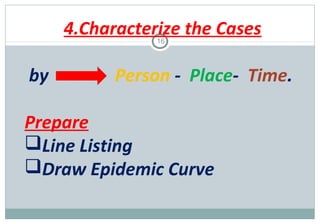
disease than expected HAIs
outbreak-any group of illnesses
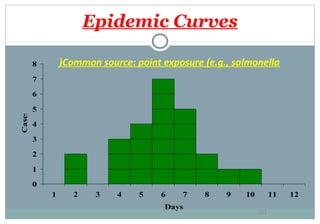
of common etiology occurring in
patients of a medical care facility
acquired by exposure of those
patients to the disease agent
while confined in such a facility.
Definition- (cont.)
4

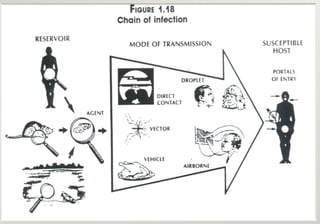
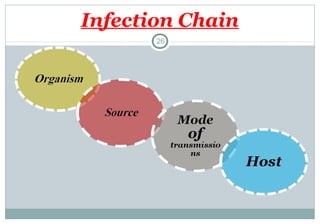
Occurrence of more cases of disease

more than expected


over a particular period of ( TIME )



in a given area (PLACE )



among a specific group of people
(PERSONS)
Aim of this Guideline
5

1.Provide a management protocol of an outbreak
in health care facilities.
2.Early detection of an outbreak and institute
immediate control measures.
3.Assign roles and responsibilities of persons
involved in management of an outbreak.
Aim of Outbreak Investigation
6

1.Prevent further disease transmission
2. Provide information that can be used to
control the outbreak
3.Prevent similar occurrences in the future
4.Identify populations at risk of a disease
5.Identify modes of disease transmission
Aim of Outbreak Investigation, cont7

6. Evaluate the effectiveness of infection
control measures.
7. Learn more about a disease, including the
impact of control measures.
8. Share knowledge and findings with other
health professionals by documenting the
outbreak investigations in reports or journal
article
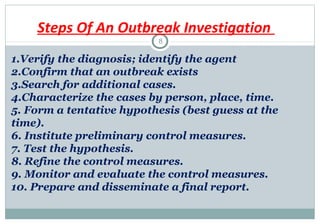
Steps Of An Outbreak Investigation
8

1.Verify the diagnosis; identify the agent
2.Confirm that an outbreak exists
3.Search for additional cases.
4.Characterize the cases by person, place, time.
5. Form a tentative hypothesis (best guess at the
time).
6. Institute preliminary control measures.
7. Test the hypothesis.
8. Refine the control measures.
9. Monitor and evaluate the control measures.
10. Prepare and disseminate a final report.
Planning of Outbreak Investigation
9

Notify the appropriate individuals and
departments in the institution of the problem;
Establish terms of reference for the
investigation.
This must include
 development of an outbreak team.
 Infection control must be part of the outbreak
team.
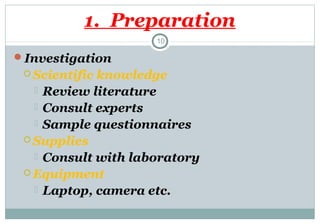
1. Preparation
10

Investigation
 Scientific

knowledge
 Review literature
 Consult experts
 Sample questionnaires
 Supplies
 Consult with laboratory
 Equipment
 Laptop, camera etc.
1-Verify the Diagnosis;
Identify the agent
11

Describe the initial magnitude of the
problem and what symptoms got the
facility's attention .
What diagnosis has been established?
What agent (bacterial, viral, other) has
been identified?
Establish a Case Definition.
12



Standard set of criteria for deciding whether an
individual should be classified as (case ) or non
(cases ) based on whether or not they meet the criteria
identified for outbreak



Includes clinical criteria and restrictions by
time, place and person.



Must be applied consistently and without bias to
all persons under investigation
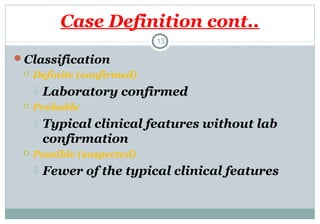
Case Definition cont..
13

Classification


Definite (confirmed)




Probable




Laboratory confirmed
Typical clinical features without lab
confirmation

Possible (suspected)


Fewer of the typical clinical features
2. Confirm that an Outbreak Exists
14

Use your case definition to find all cases
Based on your knowledge in #1, are the numbers of
cases above what is endemic (usually seen) in the
facility?
If yes, consider that an outbreak exists
Total number of cases .?
Do you have an outbreak?

If yes, proceed

If no, reasons why
report will made with justification why this case is not considered
an outbreak.
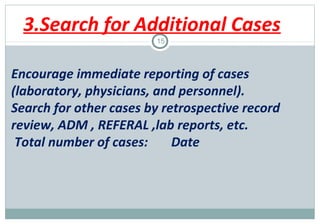
3.Search for Additional Cases
15

Encourage immediate reporting of cases
(laboratory, physicians, and personnel).
Search for other cases by retrospective record
review, ADM , REFERAL ,lab reports, etc.
Total number of cases:
Date
4.Characterize the Cases
16

by

Person - Place- Time.

Prepare
Line Listing
Draw Epidemic Curve
The Line List
17

It is an important tool in effective outbreak
management. collecting data that are.
CONSISTS -of

Rows and columns.
 Each Row represents a case
 Each column represents descriptive factors
or clinical details (i.e. date of birth, onset
date, symptoms
Epidemic Curves
18

•Epidemic curve plots the number of cases
on the –y- axis
• and time (in days or weeks or months)
on the -x- axis
•What time interval you use on the x axis
depends on the incubation period and the
time period over which cases are
distributed.
Epidemic Curves
19

What it tells you
 Mode





of transmission
 Propagated
 Common source
Timing of exposure
Course of exposure
Incubation Period
Epidemic Curves
)Common source: point exposure (e.g., salmonella

8
7

Cases

6
5
4
3
2
1
0
1

2

3

4

5

6

7

Days

8

9

10

11
20

12
Epidemic Curves
Propagated source: secondary and tertiary cases (e.g., hepatitis A)
10
9
8

Cases

7
6
5
4
3
2
1
0
1

2

3

4

5

6

7

8

9

10

11

12

Week

21
Estimating date of exposure
Maximum
incubation
days 21

9
8
7
Cases

Probable time of
exposure

10

6
5
4
3

Minimum incubation

2

days 14

1
0
1

3

5

7

9

11

13

15

17

19

21

23

25

27

29

Days

22
Develop Hypotheses(best guess at the time)
23

Hypotheses should address
Reservoir
Source of the agent
Mode of transmission (Vector or vehicle )
 Exposure that caused disease

Review data to determine common host
factors and exposures.
Implement Control /Prevention Measures
25

Implement control measures as soon as

possible if you know the source of an
outbreak.
Aim control measures at the specific agent,

source, or reservoir.
Aim control measures at the weak link in the

chain of infection. (mod of transmission )
Infection Chain
26
bacteria

PATIENT

virus

EQUPEMEN
TS

parasite

MEDICATIO
NS

fungus

SURFACES

CONTACT
(DIRECT,INDIRECT)

DROPLETS

AIRBORNE

    The host is a 

person who 
becomes 
infected after 
exposure to an 
infectious agent
Control Measure
28

Chain broken
Monitor and evaluate the control
measures..
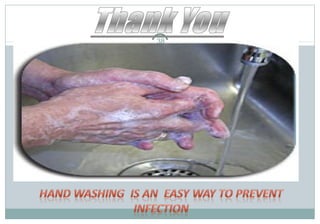
29

 The control measures will vary depending on the

agent and mode of transmission

 but may include isolation procedures or

improvements in patient care Hand hygiene Cohorting
or environmental cleaning.

 In

some outbreaks, you would direct control
measures at reducing the susceptibility of the host.
Examples
 Immunization against rubella
 Malaria chemoprophylaxis for travelers.
Refine the control measures
30

 additional control measures may be added

if needed
 example
 Destroying contaminated foods . fluids
 An infectious staff or food handler could be
removed from the work and treated.

 Close

the unit
The Descriptive Analysis
31

This includes identifying a potential exposure
type ,source and route of infection for the outbreak .
and
testing this hypothesis using statistical methods.
Special epidemiologic studies may be needed
Analytic Epidemiology
32

 which allows you to test your hypotheses.
 Use rates to identify high-risk groups

Numerator = number of case
 Denominator = number of people at risk


The nature of the outbreak determines which of
these studies you will use.
 Cohort studies .
 Case-control studies
Cohort Studies
33

Small, well defined population
 Contact each attendee and ask a series of
questions
 Ill Vs not ill Look for source exposure.








Attack rate is high among those exposed
Attack rate is low among those not
exposed
Most of the cases were exposed.
Relative risk = mathematical measure of
association between exposure and
disease .
Case-Control Studies
34

Case-control





Population not well defined
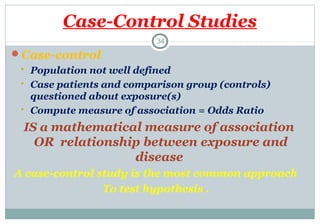
Case patients and comparison group (controls)
questioned about exposure(s)
Compute measure of association = Odds Ratio

IS a mathematical measure of association
OR relationship between exposure and
disease
A case-control study is the most common approach
To test hypothesis .
Communication and Conclusion
35

During the investigation of an outbreak,
timely, up to date information must be
communicated
to
the
hospital
administration, public health authorities,
and, in some cases, to the public.
Based on all evidence and the results of
an outbreak investigation
A final report describing all aspects of the
investigation should be prepared.
Prepare and disseminate a final report
36

 A final report on the outbreak investigation

should: describe the outbreak interventions, and
effectiveness,
 summarize the contribution of each team
member participating in the investigation.
 should also make recommendations to
prevent future occurrence.
 Make the final report. as detailed as
possible.
Final Report
37

 should also be a written report that follows
the usual scientific format of
introduction
 background
 methods
results, discussion
 and recommendations.
By formally presenting recommendations, the
report provides a blueprint for action.
38

Guidelines for Management of Outbreak in Healthcare Organization

  • 1.
    Kingdom of SaudiArabia Ministry of Health General Directorate for Health Affairs – Najran King Khalid Hospital 1
  • 2.
    Introduction 2 An Outbreaks ofHAIS infection should be identified and promptly investigated because of their importance in terms of morbidity, costs and institutional image. Early identification of an outbreak is important to limit transmission among patients by health care workers or through contaminated materials.
  • 3.
    An outbreak isdefined AS 3 Occurrence of more cases of disease than expected HAIs outbreak-any group of illnesses of common etiology occurring in patients of a medical care facility acquired by exposure of those patients to the disease agent while confined in such a facility.
  • 4.
    Definition- (cont.) 4 Occurrence ofmore cases of disease more than expected  over a particular period of ( TIME )  in a given area (PLACE )  among a specific group of people (PERSONS)
  • 5.
    Aim of thisGuideline 5 1.Provide a management protocol of an outbreak in health care facilities. 2.Early detection of an outbreak and institute immediate control measures. 3.Assign roles and responsibilities of persons involved in management of an outbreak.
  • 6.
    Aim of OutbreakInvestigation 6 1.Prevent further disease transmission 2. Provide information that can be used to control the outbreak 3.Prevent similar occurrences in the future 4.Identify populations at risk of a disease 5.Identify modes of disease transmission
  • 7.
    Aim of OutbreakInvestigation, cont7 6. Evaluate the effectiveness of infection control measures. 7. Learn more about a disease, including the impact of control measures. 8. Share knowledge and findings with other health professionals by documenting the outbreak investigations in reports or journal article
  • 8.
    Steps Of AnOutbreak Investigation 8 1.Verify the diagnosis; identify the agent 2.Confirm that an outbreak exists 3.Search for additional cases. 4.Characterize the cases by person, place, time. 5. Form a tentative hypothesis (best guess at the time). 6. Institute preliminary control measures. 7. Test the hypothesis. 8. Refine the control measures. 9. Monitor and evaluate the control measures. 10. Prepare and disseminate a final report.
  • 9.
    Planning of OutbreakInvestigation 9 Notify the appropriate individuals and departments in the institution of the problem; Establish terms of reference for the investigation. This must include  development of an outbreak team.  Infection control must be part of the outbreak team.
  • 10.
    1. Preparation 10 Investigation  Scientific knowledge Review literature  Consult experts  Sample questionnaires  Supplies  Consult with laboratory  Equipment  Laptop, camera etc.
  • 11.
    1-Verify the Diagnosis; Identifythe agent 11 Describe the initial magnitude of the problem and what symptoms got the facility's attention . What diagnosis has been established? What agent (bacterial, viral, other) has been identified?
  • 12.
    Establish a CaseDefinition. 12  Standard set of criteria for deciding whether an individual should be classified as (case ) or non (cases ) based on whether or not they meet the criteria identified for outbreak  Includes clinical criteria and restrictions by time, place and person.  Must be applied consistently and without bias to all persons under investigation
  • 13.
    Case Definition cont.. 13 Classification  Definite(confirmed)   Probable   Laboratory confirmed Typical clinical features without lab confirmation Possible (suspected)  Fewer of the typical clinical features
  • 14.
    2. Confirm thatan Outbreak Exists 14 Use your case definition to find all cases Based on your knowledge in #1, are the numbers of cases above what is endemic (usually seen) in the facility? If yes, consider that an outbreak exists Total number of cases .? Do you have an outbreak? If yes, proceed If no, reasons why report will made with justification why this case is not considered an outbreak.
  • 15.
    3.Search for AdditionalCases 15 Encourage immediate reporting of cases (laboratory, physicians, and personnel). Search for other cases by retrospective record review, ADM , REFERAL ,lab reports, etc. Total number of cases: Date
  • 16.
    4.Characterize the Cases 16 by Person- Place- Time. Prepare Line Listing Draw Epidemic Curve
  • 17.
    The Line List 17 Itis an important tool in effective outbreak management. collecting data that are. CONSISTS -of Rows and columns.  Each Row represents a case  Each column represents descriptive factors or clinical details (i.e. date of birth, onset date, symptoms
  • 18.
    Epidemic Curves 18 •Epidemic curveplots the number of cases on the –y- axis • and time (in days or weeks or months) on the -x- axis •What time interval you use on the x axis depends on the incubation period and the time period over which cases are distributed.
  • 19.
    Epidemic Curves 19 What ittells you  Mode    of transmission  Propagated  Common source Timing of exposure Course of exposure Incubation Period
  • 20.
    Epidemic Curves )Common source:point exposure (e.g., salmonella 8 7 Cases 6 5 4 3 2 1 0 1 2 3 4 5 6 7 Days 8 9 10 11 20 12
  • 21.
    Epidemic Curves Propagated source:secondary and tertiary cases (e.g., hepatitis A) 10 9 8 Cases 7 6 5 4 3 2 1 0 1 2 3 4 5 6 7 8 9 10 11 12 Week 21
  • 22.
    Estimating date ofexposure Maximum incubation days 21 9 8 7 Cases Probable time of exposure 10 6 5 4 3 Minimum incubation 2 days 14 1 0 1 3 5 7 9 11 13 15 17 19 21 23 25 27 29 Days 22
  • 23.
    Develop Hypotheses(best guessat the time) 23 Hypotheses should address Reservoir Source of the agent Mode of transmission (Vector or vehicle )  Exposure that caused disease Review data to determine common host factors and exposures.
  • 25.
    Implement Control /PreventionMeasures 25 Implement control measures as soon as possible if you know the source of an outbreak. Aim control measures at the specific agent, source, or reservoir. Aim control measures at the weak link in the chain of infection. (mod of transmission )
  • 26.
  • 27.
  • 28.
  • 29.
    Monitor and evaluatethe control measures.. 29  The control measures will vary depending on the agent and mode of transmission  but may include isolation procedures or improvements in patient care Hand hygiene Cohorting or environmental cleaning.  In some outbreaks, you would direct control measures at reducing the susceptibility of the host. Examples  Immunization against rubella  Malaria chemoprophylaxis for travelers.
  • 30.
    Refine the controlmeasures 30  additional control measures may be added if needed  example  Destroying contaminated foods . fluids  An infectious staff or food handler could be removed from the work and treated.  Close the unit
  • 31.
    The Descriptive Analysis 31 Thisincludes identifying a potential exposure type ,source and route of infection for the outbreak . and testing this hypothesis using statistical methods. Special epidemiologic studies may be needed
  • 32.
    Analytic Epidemiology 32  whichallows you to test your hypotheses.  Use rates to identify high-risk groups Numerator = number of case  Denominator = number of people at risk  The nature of the outbreak determines which of these studies you will use.  Cohort studies .  Case-control studies
  • 33.
    Cohort Studies 33 Small, welldefined population  Contact each attendee and ask a series of questions  Ill Vs not ill Look for source exposure.      Attack rate is high among those exposed Attack rate is low among those not exposed Most of the cases were exposed. Relative risk = mathematical measure of association between exposure and disease .
  • 34.
    Case-Control Studies 34 Case-control    Population notwell defined Case patients and comparison group (controls) questioned about exposure(s) Compute measure of association = Odds Ratio IS a mathematical measure of association OR relationship between exposure and disease A case-control study is the most common approach To test hypothesis .
  • 35.
    Communication and Conclusion 35 Duringthe investigation of an outbreak, timely, up to date information must be communicated to the hospital administration, public health authorities, and, in some cases, to the public. Based on all evidence and the results of an outbreak investigation A final report describing all aspects of the investigation should be prepared.
  • 36.
    Prepare and disseminatea final report 36  A final report on the outbreak investigation should: describe the outbreak interventions, and effectiveness,  summarize the contribution of each team member participating in the investigation.  should also make recommendations to prevent future occurrence.  Make the final report. as detailed as possible.
  • 37.
    Final Report 37  shouldalso be a written report that follows the usual scientific format of introduction  background  methods results, discussion  and recommendations. By formally presenting recommendations, the report provides a blueprint for action.
  • 38.

Editor's Notes

  • #20 Epidemic curve plots the number of cases on the y axis and time (in days or weeks or months) on the x axis What time interval you use on the x axis depends on the incubation period and the time period over which cases are distributed. For example, S aureus should be hours, while hepatitis B or TB should be days or weeks. Failure to use the right time interval mqy obscure the temporal distribution. As a rule of thumb, select aunit that is one-eighth to one-third as long as the incubation period. If you don’t know the incubation period, draw several epidemic curves with different time intervals on the x axis. Show the pre-epidemic period in the graph also to show the baseline. Can suggest whether its person to person or common source outbreak A common source outbreak id defined as an outbreak due to transmission from a single environmental or human source. Propagated (continuing) outbreaks are person to person spread. Outbreaks may begin as a commn source and then become person to person spread (e.g., viral gastroenteritis from shrimp consumption that is then spread person to person); most common with food or water borne outbreaks. Provide info regarding when the cases were likely exposed to the source The course of the exposure (limited or ongoing) Can also provide info on seasonal trends
  • #25 Reservior of an agent is the habitat in which an infectious agent normally lives ,grows , and multiplies .it could be human ,animals,and invironment.
  • #29 The infectious process, commonly referred to as the "chain of infection", requires the presence of four elements which, like the links of a chain, are all essential and interrelated. These elements consist of: an agent (infecting microorganism), a source of infecting microorganisms, a susceptible host, and a mode of transmission of the infectious agent. The four elements must be present for an infection to occur.  1. THE AGENT  The agent may be a bacteria, a virus, a fungus or a parasite. It must be pathogenic, that is, capable of causing disease (infection) and must be present in sufficient numbers (infective dose) to transmit infection.  2. THE SOURCE  Sources of pathogenic agents in the hospital include patients, personnel and to a much lesser extent visitors, and may comprise any of the following:                         · Persons with acute infections                         · Persons in the incubation phase of an infection                         · Persons colonized with an infectious agent                         · Persons who are chronic carriers of an infectious agent  Other sources of infectious microorganisms include inanimate environmental objects which have become contaminated, for example:                           · Patient care equipment                         · Instruments                         · Needles and sharps                         · Surfaces                         · Medications, etc. The patient's own microbial flora (microorganisms normally present in and on the human body) may also be the source of an infection in a susceptible or compromised host. 3. THE HOST The host is a person who becomes infected after exposure to an infectious agent. Factors which influence the development of an infection include the resistance of the host, the portal of entry, the size of the inoculum (infective dose), and the type and duration of the contact with the pathogen. Resistance to pathogenic microorganisms varies widely from person to person. Some individuals may be immune to, or able to resist, infection by a particular infectious agent. Others, exposed to the same pathogen, may develop clinical or subclinical infection. Still others may become either colonized with the organism, or asymptomatic carriers of the disease. The following host factors may increase an individual's susceptibility (decrease his/her resistance) to infection:                         · Extremes in age (the very young and the very old).                         · Presence of chronic diseases/conditions (Diabetes Mellitus, Neoplasia, Leukemia, Anemia, etc.).                         · Malnutrition, chronic alcoholism, drug abuse. , Other factors which contribute to lowered resistance include:    · Antimicrobial, immunosuppressive, steroid and irradiation therapies. · Breaks in the "first line of defense" (skin, mucous membranes), as a result of: trauma; surgery; anaesthesia; invasive procedures; pressure ulcers; etc.. To prevent the transmission of infection within a hospital, it is clear that one of the links in the chain of infection has to be "broken". Of the four links which make up the chain of infection, we have the least control over the agent, the source and the host. On the other hand, we do have a great deal of control over the mode of transmission, the weakest link in the chain, and the easiest to break. By implementing measures that interrupt transmission, we can prevent pathogenic microorganisms from reaching or entering a susceptible host.
  • #32 At the end of the descriptive analysis it should be possible to: formulate a hypothesis on the type Of infection Exogenous, Endogenous) Identify the source and route of infection suggest and implement initial control measures
  • #33 Cohort studiesA cohort study is the best technique for analyzing an outbreak in a small, well-defined population. For example, you would use a cohort study if an outbreak of gastroenteritis occurred among people who attended a social function, such as a wedding,