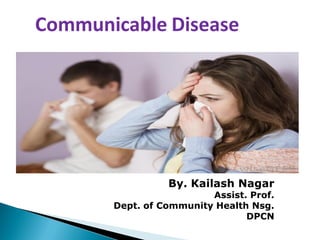
Communicable Disease
By. Kailash Nagar
Assist. Prof.
Dept. of Community Health Nsg.
DPCN
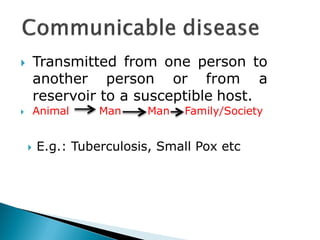
 Transmitted from one person to
another person or from a
reservoir to a susceptible host.
 Animal Man Man Family/Society
 E.g.: Tuberculosis, Small Pox etc
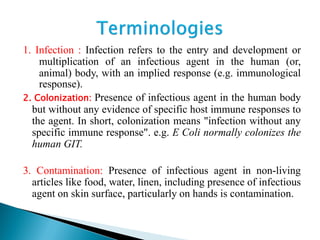
1. Infection : Infection refers to the entry and development or
multiplication of an infectious agent in the human (or,
animal) body, with an implied response (e.g. immunological
response).
2. Colonization: Presence of infectious agent in the human body
but without any evidence of specific host immune responses to
the agent. In short, colonization means "infection without any
specific immune response". e.g. E Coli normally colonizes the
human GIT.
3. Contamination: Presence of infectious agent in non-living
articles like food, water, linen, including presence of infectious
agent on skin surface, particularly on hands is contamination.
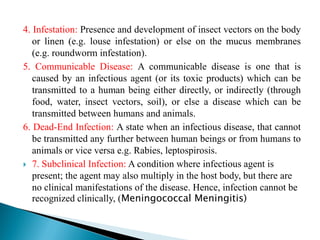
4. Infestation: Presence and development of insect vectors on the body
or linen (e.g. louse infestation) or else on the mucus membranes
(e.g. roundworm infestation).
5. Communicable Disease: A communicable disease is one that is
caused by an infectious agent (or its toxic products) which can be
transmitted to a human being either directly, or indirectly (through
food, water, insect vectors, soil), or else a disease which can be
transmitted between humans and animals.
6. Dead-End Infection: A state when an infectious disease, that cannot
be transmitted any further between human beings or from humans to
animals or vice versa e.g. Rabies, leptospirosis.
 7. Subclinical Infection: A condition where infectious agent is
present; the agent may also multiply in the host body, but there are
no clinical manifestations of the disease. Hence, infection cannot be
recognized clinically, (Meningococcal Meningitis)
8. Latent Infection: Condition when the infectious agent lies
"dormant" within the host body, without any clinical
manifestations but does not come out of the human body (e.g.
Herpes Zoster )
 9. Zoonosis: Zoonosis are infections, which are normally
transmitted between vertebrate animals, either directly, or
indirectly through a vehicle or insect vector.
 10. Opportunistic Infections: The term refers to disease,
caused by infectious agents, which are normally not
pathogenic, due to a decline in the general or specific immune
status of the host becomes very active. E.g. HIV infection with
various opportunistic.
 11. Nosocomial Infection: This is an infection contracted
while in hospital, as a result of health care or related
procedure.
 12. Eradication: The term refers to a complete cessation of
transmission of the infectious agent.
 13. Control: This refers to reducing the transmission of a
disease to a level when it no longer remains a "public health
problem" but needs ongoing preventive measures.
 14. Elimination: Elimination implies either a 'regional
eradication" (say from a country or continent), or else
reduction of disease to zero without total removal of infectious
agent.
 15. Cases: Those who have clinically apparent disease.
 16. Carriers: A carrier is a human being who harbors an infectious agent
and sheds it, thus becoming a potential source of infection for other human
beings, but does not exhibit any manifestation of the disease.
 17. Infectiousness: This is ease with which the agent is transmitted to the
susceptible host.
 18. Infectivity: This is the ability of the agent to cause infection, i.e. to
enter, survive and multiply in the host.
 19. Secondary Attack Rate (SAR): It is defined as the number of
susceptible persons who, within the duration of one incubation period,
following exposure, develop the disease out of the total susceptible who
were exposed. It gives an idea about communicability of organism.
 20. Pathogenicity: It is the ability of the agent to produce manifest disease
out of those who have been infected.
 21. Virulence: generally referred as Killing Power of Diseases sometimes
simply defined as ability of the agent to produce severe disease. Case
Fatality Ratio (CFR) is a measure of virulence.
 22. Infective Dose: Infective dose refers to the dose that might lead to
infection.
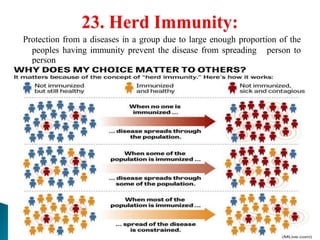
 23. Herd Immunity: Protection from a diseases in a group due to large
enough proportion of the peoples having immunity prevent the disease
from spreading person to person
Protection from a diseases in a group due to large enough proportion of the
peoples having immunity prevent the disease from spreading person to
person
 24. Incubation Period: Incubation period is the time period
between the entry of infectious agent (and its toxin) into the
human body to the point when the earliest clinical
manifestations of the disease are apparent.
 25. Reservoir: It is the one in whom the causative organism
lives, multiplies and depends primarily for its survival (i.e. the
natural habitat of the organism). Such a reservoir may be human
being, animal or soil.
 26. "Epidemic": This is the occurrence of disease frequency, in
a defined population or area.
 27. "Endemic": frequency refers to continued transmission of a
disease, in a defined population or area.
 28. "Sporadic": frequency which refers to few, scattered cases
of infection, which do not have any relation to each other
temporally.
 29. Host: A person or an animal including birds and arthropods
that affords lodgment to an infectious agent or a parasite.
 A communicable disease is transmitted from the
reservoir/ source to a susceptible person either
directly or indirectly, depending upon various
factors: There are various types of Modes of
Transmission:
 A. Direct : It includes person-to-person contact , they can be
of There are five direct modes:
 1. Direct contact: When the reservoir and the susceptible are in
close, physical, skin-to-skin contact. Example, as from dirty
fingers or via food and water in the diarrheal diseases. Direct
transmission also occurs through droplet infection in the
respiratory diseases.
 2. Droplet infection: When the susceptible host inhales the
infected droplets, of 5 to 10 μ diameter, coming out of the mouth
or nose from the reservoir during the act of coughing, sneezing,
talking and laughing. For example, pulmonary tuberculosis,
measles, ARTI etc.
 3. Contact with the contaminated soil: For example, majority of
worm infestations.
 4. Contact with the animal: Either by Bite e.g. Rabies or infected
agent enters the susceptible host by skin or mucous membrane
e.g. Leptospirosis
 5. Trans placental (vertical) transmission: Means transmission of
the disease from the mother to the fetus through the placenta e.g.
HIV, Malaria, TORCHS
 B. Indirect Modes of Transmission There are five
different indirect modes of disease:
 1. Vehicle route: The term vehicles refers to water, food, milk,
ice-cream, vegetables, biological products like blood etc.
 2. Vector Borne:
 3. Air-borne route of transmission: By droplet nuclei and
infected dust:
 4. Fomite route of transmission: Fomites are the inanimate
objects capable of transmitting the diseases. For example,
clothes, linen (Scabies), clinical thermometer, spoons, pencils,
syringes, needles, toothbrush, etc.
 5. Unclean hands and fingers: These contaminate the food and
drinks and transmit diseases like typhoid, streptococcal and
staphylococcal infections, diarrheas and dysentery.
Depending upon source:
1.Respiratory Infections:
a) Smallpox:
b) Chickenpox:
c) Measles:
D) Rubella:
e) Mumps:
f) Influenza:
g) Whooping cough (Pertussis):
E) Diphtheria
 2) Fecal-Oral Diseases.
 1) Gastroenteritis:
 2) Cholera
 3) Typhoid:
 4) Polio:
 5) Viral Hepatitis
 3. Vector Borne Disease (Mosquito Borne Diseases)
 4. Arthropod Borne Infections:
 E.g.: Plague etc
 5. Sexually Transmitted Disease:
 E.g.: AIDS etc
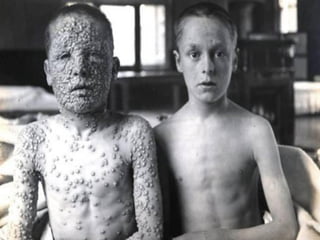
• Also called – Varicella
• Occur mainly in Children under 10 years of age.
• Uncommon in adults.
• Incubation Period :About 14 – 16 days.
Agent: Varicella Zoster Virus or Human a Herpes Virus 3 Source:
Infectivity: 1-2 days before & 4-5 d after rash appearance)
Control: Notification & Isolation (6 days)
Prevention: VZIG within 72hrsVaccine,
Live attenuated OKA vaccine
2-12yrs one dose; >12yrs-2 doses.
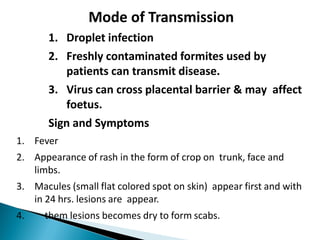
Mode of Transmission
1. Droplet infection
2. Freshly contaminated formites used by
patients can transmit disease.
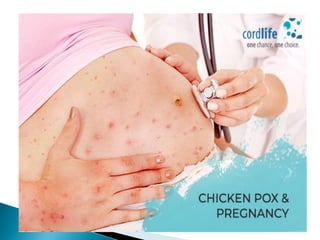
3. Virus can cross placental barrier & may affect
foetus.
Sign and Symptoms
1. Fever
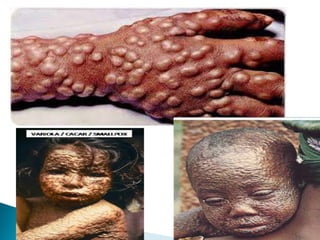
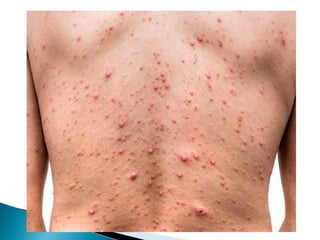
2. Appearance of rash in the form of crop on trunk, face and
limbs.
3. Macules (small flat colored spot on skin) appear first and with
in 24 hrs. lesions are appear.
4. them lesions becomes dry to form scabs.
1. Fever
2. Appearance of rash in the form of crop on
trunk, face and limbs.
3. Macules (small flat colored spot on skin)
appear first and with in 24 hrs. lesions are
appear.
4. them lesions becomes dry to form scabs.
1. By administering specific V. Zoster
immunoglobulin.
2. Use of local antiseptics like chlorhexidine.
3. If bacterial infection progress give antibiotics.
4. Transmission prevented by isolation of
patient for 5-7 days.
5. Sterilization of all articles used by patient
after cure .
 Measles, an acute viral fever is a leading cause of
childhood deaths caused by Agent: genus
Morbillivirus from the family paramyxoviridae.
 Host: most infections occur in the age group six
months to Six years. Nutritional status has an important
bearing on the severity of disease.
 Environment: In India, the peak incidence of measles
is in winter and early spring.
 The mode of transmission
 When someone with measles coughs, sneezes or talks,
infected droplets spray into the air, where other people
can inhale them.
 The infected droplets may also land on a surface, where
they remain active and contagious for several hours.
 The incubation period :- ranges from 10 to14 days
after exposure to virus.
Signs and symptoms
 Fever
 Dry cough
 Runny nose
 Sore throat
 Inflamed eyes (conjunctivitis)
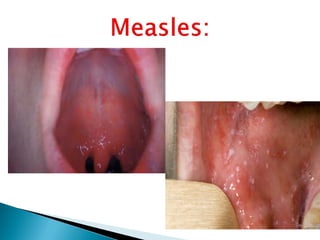
 Tiny white spots with bluish-white centers on a red
background found inside the mouth on the inner lining
of the cheek — also called Koplik's spots
 A skin rash made up of large, flat blotches that often
flow into one another.
Treatments
 Post-exposure vaccination. may be given the measles
vaccination within 72 hours of exposure to the
measles virus to provide protection against the disease.
If measles still develops, the illness usually has milder
symptoms and lasts for a shorter time.
 Immune serum globulin. Pregnant women, infants
and people with weakened immune systems who are
exposed to the virus may receive an injection of
proteins (antibodies) called immune serum globulin.
When given within six days of exposure to the virus,
these antibodies can prevent measles or make
symptoms less severe.
 Fever reducers. acetaminophen (Tylenol, others),
ibuprofen (Advil, Motrin, others) or naproxen
(Aleve) to help relieve the fever that accompanies
measles.
 Vitamin A. People with low levels of vitamin A are
more likely to have a more severe case of measles.
Giving vitamin A may lessen the severity of the
measles. It's generally given as a large dose of
200,000 international units (IU) for two days.
 Nursing considerations:
1. Isolation until 5th day of rash; if hospitalized,
institute respiratory precautions.
2. Maintain bed rest during prodromal stage.
3. Instruct parents to administer antipyretics and cool
sponge bath, avoid chilling. If child is prone to
seizures, institute appropriate precautions (fever
spikes to 400c) between 4th and 5th days.
4. Eye care: cleanse the eyelids with warm saline to
remove secretions or crusts,
 Agent: RNA virus of toga viridae family (Rubi virus)
 Infectivity: One week before to one week after onset
of rash
 Host factors: Age: 3-10 yrs
 Immunity: One attack gives lifelong immunity
 In India 40% women of child -bearing age are
susceptible to rubella
 Incubation period: 2-3 Wks. (Av 18 days)
 Mode of transmission: direct contact and spread via
infected person, droplet infection, through feces or urine.
 Incubation period: 14-21 days
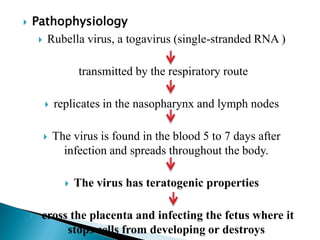
 Pathophysiology
 Rubella virus, a togavirus (single-stranded RNA )
transmitted by the respiratory route
 replicates in the nasopharynx and lymph nodes
 The virus is found in the blood 5 to 7 days after
infection and spreads throughout the body.
 The virus has teratogenic properties
 cross the placenta and infecting the fetus where it
stops cells from developing or destroys
Congenital Rubella Syndrome : CRS is known for Triad –
Patent Ductus Arteriosus , Cataract, and Deafness
Infection in 1st Trimester: Spontaneous Abortion OR still
birth OR Triad “ PDA, Deafness , Cataract”
Infection in II Trimester: Deafness
Infection in III Trimester: No major abnormality
 S/S
1. Mild fever of 102 F (38.9 C) or lower
2. Headache
3. Stuffy or runny nose
4. Inflamed, red eyes
5. Enlarged, tender lymph nodes at the base of the skull,
the back of the neck and behind the ears
6. A fine, pink rash that begins on the face and quickly
spreads to the trunk and then the arms and legs,
7. Prevention: By live attenuated RA 27/3 vaccine.
1. Clinical findings
2. Laboratory findings: leucopenia with or without
thrombocytopenia, serological test shows rise in
rubella antibody titre, increased IgM levels with
decreased IgA and IgG levels is useful in diagnosis
of newborn.
3. Culture of throat swabs, urine, feces and blood to
isolate the virus before the rash appears.
 Therapeutic management:
1. Rest in bed as necessary.
2. Symptomatic management is given in children
3. Antipyretics (acetaminophen) for low grade fever and
analgesics for discomfort.
 Nursing considerations:
1. Reassure parents of benign nature of illness.
2. Provide comfort measures as necessary.
3. Isolate child from pregnant women.
4. Avoid people who have conditions that cause
deficient or suppressed immune systems.
5. Tell your child's school or child care provider that
your child has rubella.
 Agent: mumps virus (RNA)
 Source: saliva of infected persons
 Mode of transmission: direct contact
with or droplet spread from an infected
person
 Incubation period: 14-21 days
 Prevention: Live attenuated vaccine 0.5ml
JeryLynn strain.
 The first between ages 12 and 15 months
 The second between ages 4 and 6 years, or
between 11 and 12 if not previously given
 Symptoms
 Some people infected with the mumps virus have either
no signs or symptoms or very mild ones.
 When signs and symptoms do develop, they usually
appear about two to three weeks after exposure to the
virus and may include:
1. Swollen, painful salivary glands on one or both sides
of your face (Parotitis)
2. Fever
3. Headache
4. Weakness and fatigue
5. Loss of appetite
6. Pain while chewing or swallowing
Diagnosis: virus culture or a blood test may be needed.
Therapeutic management:
1. Symptomatic and supportive- analgesics for pain and
antipyretics for fever.
2. IV fluids for children who refuse to drink or vomit
because of meningo-encephalitis.
Nursing considerations:
 Isolation during the period of communicability, institute
respiratory isolation during hospitalization.
 Maintain bed rest during prodromal phase until swelling
subsides.
 Give analgesics for pain.
 Encourage fluids and soft bland foods.
 Apply hot or cold compress to neck, whichever is more
comforting.
 To relieve orchitis, provide warmth and local support by
means of a nest of absorbent cotton in the diaper.
 An acute respiratory infection characterized by
sudden onset of chills, malaise, fever, muscular pain
and cough.
 It is caused by influenza virus-A (which also cause
pandemics), Type B (Which also causes Epidemics)
and Type C (Which causes Endemic).
 Influenza is more known as a public health problem
because of Antigenic Variation
 Shift: Sudden complete & major change- genetic
recombination-causes major epidemics & pandemics
 Drift: gradual Antigenic change over a period of
time- point mutation
 Period of infectivity: 1-2 before and 1-2 days
after onset of symptoms Incubation period:
18-72 hrs.
 Prevention: vaccines don't control epidemics,
it must be administered at least 2 week prior
to onset of epidemic or preferably 2 to 3
months before influenza is expected- in
high-risk groups.
 Kindly refer to the Guidelines for Govt of
India for Management of Cases of Influenza
in the Module of National Health Programs
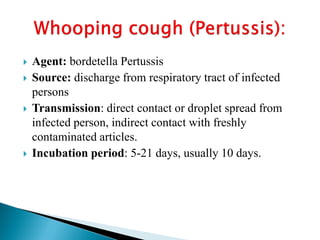
 Agent: bordetella Pertussis
 Source: discharge from respiratory tract of infected
persons
 Transmission: direct contact or droplet spread from
infected person, indirect contact with freshly
contaminated articles.
 Incubation period: 5-21 days, usually 10 days.
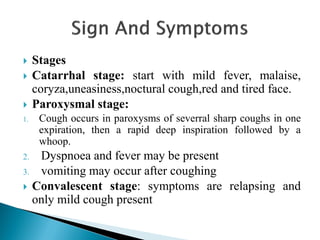
 Stages
 Catarrhal stage: start with mild fever, malaise,
coryza,uneasiness,noctural cough,red and tired face.
 Paroxysmal stage:
1. Cough occurs in paroxysms of severral sharp coughs in one
expiration, then a rapid deep inspiration followed by a
whoop.
2. Dyspnoea and fever may be present
3. vomiting may occur after coughing
 Convalescent stage: symptoms are relapsing and
only mild cough present
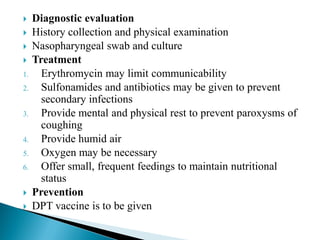
 Diagnostic evaluation
 History collection and physical examination
 Nasopharyngeal swab and culture
 Treatment
1. Erythromycin may limit communicability
2. Sulfonamides and antibiotics may be given to prevent
secondary infections
3. Provide mental and physical rest to prevent paroxysms of
coughing
4. Provide humid air
5. Oxygen may be necessary
6. Offer small, frequent feedings to maintain nutritional
status
 Prevention
 DPT vaccine is to be given
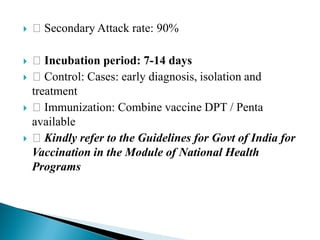
 Secondary Attack rate: 90%
 Incubation period: 7-14 days
 Control: Cases: early diagnosis, isolation and
treatment
 Immunization: Combine vaccine DPT / Penta
available
 Kindly refer to the Guidelines for Govt of India for
Vaccination in the Module of National Health
Programs
 Gastroenteritis:
 Cholera
 Typhoid:
 Polio:
 Viral Hepatitis
• An infection or inflammation
of the digestive tract,
particularly the stomach and
intestines
• It is frequently referred to as
the stomach or intestinal flu
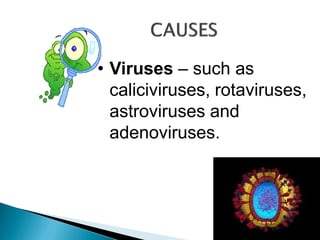
• Viruses – such as
caliciviruses, rotaviruses,
astroviruses and
adenoviruses.
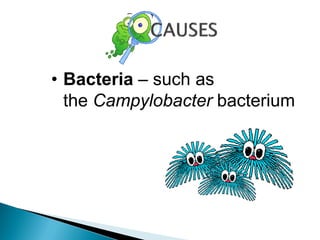
• Bacteria – such as
the Campylobacter bacterium
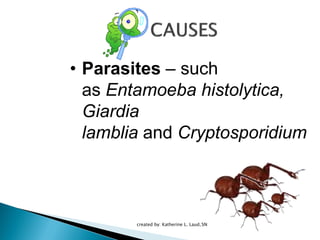
• Parasites – such
as Entamoeba histolytica,
Giardia
lamblia and Cryptosporidium
created by: Katherine L. Laud,SN
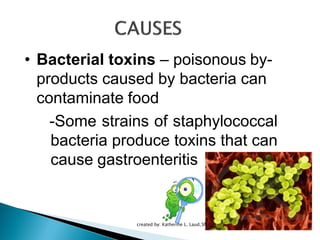
• Bacterial toxins – poisonous by-
products caused by bacteria can
contaminate food
-Some strains of staphylococcal
bacteria produce toxins that can
cause gastroenteritis
• Chemicals – lead
poisoning, for example,
can trigger gastroenteritis
• Drugs – certain drugs,
such as antibiotics, can
cause gastroenteritis in
susceptible people and
can irritate the digestive
tract
Escherichia coli infection
• this is a common
problem for travelers
to countries with poor
sanitation. Infection is
caused by drinking
contaminated water
or eating
contaminated raw
fruits and vegetables.
Campylobacter infection
• the bacteria are found in
animal feces. Infection is
caused by, for example,
consuming contaminated
food or water, eating
undercooked meat
(especially chicken), and
not washing your hands
after handling infected
animals.
Cryptosporidium infection
• parasites are found in the
bowels of humans and
animals. Infection is caused
by, for example, swimming in
a contaminated pool and
accidentally swallowing
water, or through contact with
infected animals. An infected
person may spread the
parasites to food or surfaces
if they don’t wash their hands
after going to the toilet..
Giardiasis
• parasite infection of the
bowel. Infection is caused
by, for example, drinking
contaminated water,
handling infected animals
or changing the nappy of
an infected baby and not
washing your hands
afterwards.
 Salmonellosis
 Bacteria are found in
animal feces. Infection
is caused by eating
contaminated food or
handling infected
animals. An infected
person may also
spread the bacteria to
other people or surfaces
by not washing their
hands properly.
 Shigellosis
 bacteria are found in
feces. An infected
person may spread
the bacteria to food or
surfaces if they don’t
wash their hands after
going to the toilet.
Viral Gastroenteritis
• viruses are found in human feces. Infection
is caused by person-to-person contact such
as touching contaminated hands, feces or
vomit, or by drinking contaminated water or
food.
• Loss of Appetite
• Bloating
• Nausea and Vomiting
• Diarrhea
• Abdominal Pain and Cramps
• Body Aches
• Bloody stools (in some cases)
• Pus in the stools (in some cases)
 Lethargy
 These symptoms are sometimes also
accompanied by Fever and Weakness
• The greatest danger presented by
gastroenteritis is dehydration. The loss of
fluids through diarrhea and vomiting can upset
the body's electrolyte balance, leading to
potentially life-threatening problems such as
heart beat abnormalities (arrhythmia)
• The risk of dehydration increases as
symptoms are prolonged. Dehydration
should be suspected if a dry mouth,
increased or excessive thirst, or scanty
urination is experienced
• The symptoms of gastroenteritis are usually
enough to identify the illness
• It is important to establish the cause, as different
types of gastroenteritis respond to different
treatments. Diagnostic methods may include:
- Medical history
- Physical examination
- Blood tests
- Stool tests
Treatment depends on the cause but may
include:
• Plenty of fluids and Right Diet
• Oral rehydration drinks, available
from your chemist
• Admission to hospital and intravenous
fluid replacement, in severe cases
• Antibiotics, if bacteria are the cause
• Drugs to kill the parasites, if
parasites are the cause
• Avoiding anti-vomiting or anti- diarrhea
drugs unless prescribed or
recommended by your doctor, because
these medications will keep the infection
inside your body
General suggestions on how to reduce the risk of
gastroenteritis include:
• Wash hands thoroughly with soap and water
after going to the toilet or changing nappies,
after smoking, after using a handkerchief or
tissue, or after handling animals
• Wash your hands thoroughly with soap and
water before preparing food or eating
• Use disposable paper towels to dry
your hands rather than cloth towels,
since the bacteria can survive for
some time on objects
• Keep cold food cold (below 5 C) and
hot foot hot (above 60 C) to
discourage the growth of bacteria
• Make sure foods are thoroughly
cooked
• Clean the toilet and bathroom
regularly, especially the toilet seat,
door handles and taps
• When travelling overseas to countries
where sanitation is suspect, only drink
bottled water. Don’t forget to brush
your teeth in bottled water too. Avoid
food buffets, uncooked foods or peeled
fruits and vegetables, and ice in drinks
Cholera
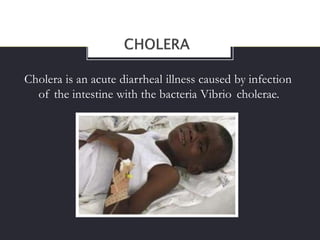
Cholera is an acute diarrheal illness caused by infection
of the intestine with the bacteria Vibrio cholerae.
EPIDEMIOLOGY
• Cholera was prevalent in the 1800s, but due to
proper treatment of sewage and drinking water,
has become rare in developed countries.
•Cholera is a fecal disease, meaning that it
spreads when the feces of an infected person
come into contact with food or water.
• Over 1 million cases and nearly 10,000
fatalities.
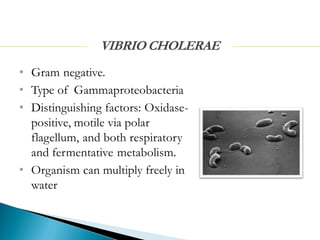
• Gram negative.
• Type of Gammaproteobacteria
• Distinguishing factors: Oxidase-
positive, motile via polar
flagellum, and both respiratory
and fermentative metabolism.
• Organism can multiply freely in
water
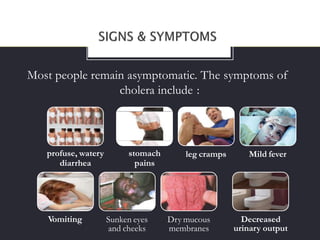
Most people remain asymptomatic. The symptoms of
cholera include :
profuse, watery
diarrhea
stomach
pains
leg cramps Mild fever
Vomiting Sunken eyes
and cheeks
Dry mucous
membranes
Decreased
urinary output
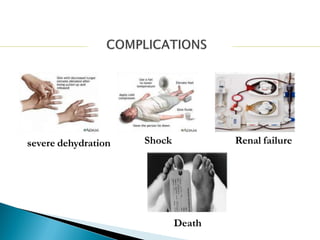
severe dehydration Shock Renal failure
Death
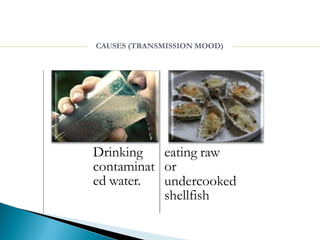
ed water.
Drinking eating raw
contaminat or
undercooked
shellfish
CAUSES (TRANSMISSION MOOD)
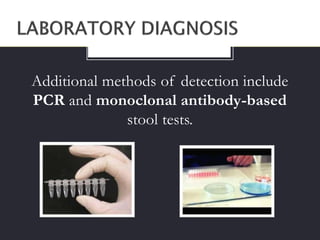
• Vibrios often detected by dark
field or phase contrast
microscopy of stool
• Organisms are motile,
appearing like “shooting stars”
• Microscopy show sheets of
curved Gram negative rods.
• When plated on sucrose
dishes, yellow colonies appear
confirming cholera present
Additional methods of detection include
PCR and monoclonal antibody-based
stool tests.
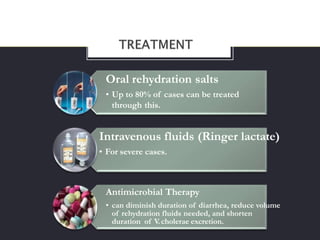
Oral rehydration salts
• Up to 80% of cases can be treated
through this.
Intravenous fluids (Ringer lactate)
• For severe cases.
Antimicrobial Therapy
• can diminish duration of diarrhea, reduce volume
of rehydration fluids needed, and shorten
duration of V.cholerae excretion.
PREVENTION
• Basic health education and hygiene
• Mass chemoprophylaxis
• Provision of safe water and sanitation
•Comprehensive Multidisciplinary
Approach: water, sanitation,
education and communication
Parenteral Vaccine :
•2 doses administered 2 weeks apart
Killed WC/rBS Vaccine :
•Killed whole-cell V.cholerae in combination with a
recombinant B-subunit of cholera toxin
•Safe in pregnancy and breastfeeding
Live, attenuated CVD 103-HgR Vaccine :
•Protection as early as 1 week after vaccination, with
>90%
The prognosis of cholera can range depending
on the severity of the dehydration and how
quickly the patient is given and responds to
treatments.
Death (mortality) rates in untreated cholera can
be as high as 50%-60% during large outbreaks
but can be reduced to about 1% if treatment
protocols are rapidly put into action.
Treatment
centers Set up treatment centers for prompt
treatment.
Sanitary
measures. food safety and animal health measures
Comprehensive
surveillance
data
(adapt to each situation) for a
comprehensive multidisciplinary approach.
CONTROLLING CHOLERA
Steps in the treatment of a patient with suspected cholera are as follows:
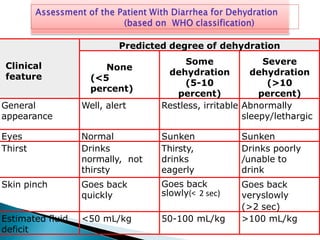
1. Assess for dehydration (see Table 1)
2. Rehydrate the patient and monitor frequently, then reassess hydration status
3. Maintain hydration; replace ongoing fluid losses until diarrhea stops
4. Administer an oral antibiotic to the patient with severe dehydration
5. Feed the patient
More detailed guidelines for the treatment of cholera are as follows:
 Evaluate the degree of dehydration upon arrival
 Rehydrate the patient in 2 phases; these include rehydration (for 2-4 h) and maintenance (until diarrhea
abates)
 Register output and intake volumes on predesigned charts and periodically review these data
 Use the intravenous route only (1) during the rehydration phase for severely dehydrated patients for
whom an infusion rate of 50-100 mL/kg/h is advised, (2) for moderately dehydrated patients who do not
tolerate the oral route, and (3) during the maintenance phase in patients considered high stool purgers (ie,
>10 mL/kg/h)
 During the maintenance phase, use oral rehydration solution at a rate of 800-1000 mL/h; match ongoing
losses with ORS administration

 Discharge patients to the treatment center if oral tolerance is greater than or equal to 1000 mL/h, urine
volume is greater than or equal to 40 mL/h, and stool volume is less than or equal to 400 mL/h.
Clinical
feature
Predicted degree of dehydration
None
(<5
percent)
Some
dehydration
(5-10
percent)
Severe
dehydration
(>10
percent)
General
appearance
Well, alert Restless, irritable Abnormally
sleepy/lethargic
Eyes Normal Sunken Sunken
Thirst Drinks
normally, not
thirsty
Thirsty,
drinks
eagerly
Drinks poorly
/unable to
drink
Skin pinch Goes back
quickly
Goes back
slowly(< 2 sec)
Goes back
veryslowly
(>2 sec)
Estimated fluid
deficit
<50 mL/kg 50-100 mL/kg >100 mL/kg
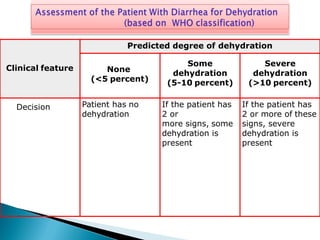
Clinical feature
Predicted degree of dehydration
None
(<5 percent)
Some
dehydration
(5-10 percent)
Severe
dehydration
(>10 percent)
Decision Patient has no
dehydration
If the patient has
2 or
more signs, some
dehydration is
present
If the patient has
2 or more of these
signs, severe
dehydration is
present
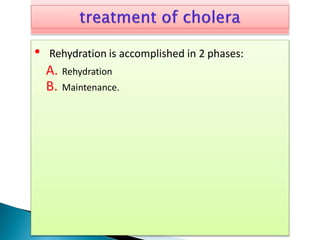
• Rehydration is accomplished in 2 phases:
A. Rehydration
B. Maintenance.
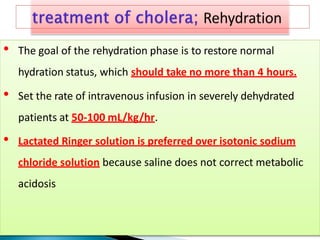
• The goal of the rehydration phase is to restore normal
hydration status, which should take no more than 4 hours.
• Set the rate of intravenous infusion in severely dehydrated
patients at 50-100 mL/kg/hr.
• Lactated Ringer solution is preferred over isotonic sodium
chloride solution because saline does not correct metabolic
acidosis
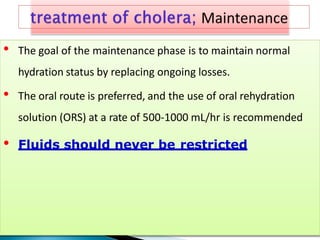
• The goal of the maintenance phase is to maintain normal
hydration status by replacing ongoing losses.
• The oral route is preferred, and the use of oral rehydration
solution (ORS) at a rate of 500-1000 mL/hr is recommended
• Fluids should never be restricted
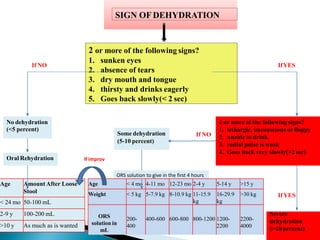
SIGN OF DEHYDRATION
No dehydration
(<5 percent)
Some dehydration
(5-10 percent)
2 or more of the following signs?
1. sunken eyes
2. absence of tears
3. dry mouth and tongue
4. thirsty and drinks eagerly
5. Goes back slowly(< 2 sec)
Oral Rehydration
If NO IfYES
2 or more of the followingsigns?
1. lethargic, unconscious orfloppy
2. unable to drink
3. radial pulse is weak
4. Goes back very slowly(>2 sec)
IfYES
Severe
dehydration
(>10 percent)
If NO
Age Amount After Loose
Stool
< 24 mo 50-100 mL
2-9 y 100-200 mL
>10 y As much as is wanted
Age < 4 mo 4-11 mo 12-23 mo 2-4 y 5-14 y >15 y
Weight < 5 kg 5-7.9 kg 8-10.9 kg 11-15.9
kg
16-29.9
kg
>30 kg
ORS
solution in
mL
200-
400
400-600 600-800 800-1200 1200-
2200
2200-
4000
ORS solution to give in the first 4 hours
If improv
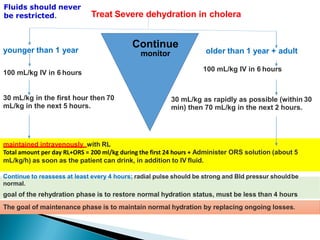
Treat Severe dehydration in cholera
younger than 1 year
100 mL/kg IV in 6 hours
older than 1 year + adult
30 mL/kg in the first hour then 70
mL/kg in the next 5 hours.
30 mL/kg as rapidly as possible (within 30
min) then 70 mL/kg in the next 2 hours.
Fluids should never
be restricted.
maintained intravenously with RL
Total amount per day RL+ORS = 200 ml/kg during the first 24 hours + Administer ORS solution (about 5
mL/kg/h) as soon as the patient can drink, in addition to IV fluid.
Continue to reassess at least every 4 hours; radial pulse should be strong and Bld pressur shouldbe
normal.
goal of the rehydration phase is to restore normal hydration status, must be less than 4 hours
The goal of maintenance phase is to maintain normal hydration by replacing ongoing losses.
100 mL/kg IV in 6 hours
Continue
monitor
• After receiving therapy of adequate hydration, patients that fulfill
these three criteria can be discharged of the hospital:
1. Adequate oral intake
2. Normal urinary flow (40-50 cc by hour)
3. Maximum diarrhea flow of 400 cc per hour
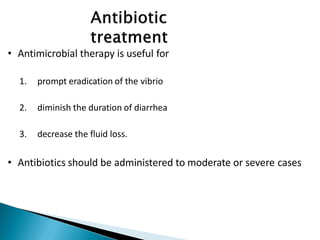
• Antimicrobial therapy is useful for
1. prompt eradication of the vibrio
2. diminish the duration of diarrhea
3. decrease the fluid loss.
• Antibiotics should be administered to moderate or severe cases
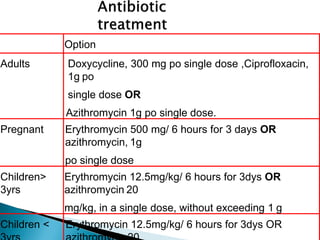
Option
Adults Doxycycline, 300 mg po single dose ,Ciprofloxacin,
1g po
single dose OR
Azithromycin 1g po single dose.
Pregnant Erythromycin 500 mg/ 6 hours for 3 days OR
azithromycin, 1g
po single dose
Children>
3yrs
Erythromycin 12.5mg/kg/ 6 hours for 3dys OR
azithromycin 20
mg/kg, in a single dose, without exceeding 1 g
Children < Erythromycin 12.5mg/kg/ 6 hours for 3dys OR
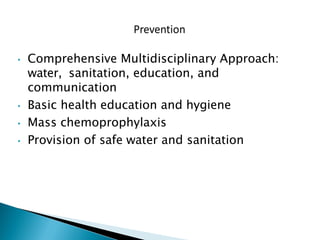
• Comprehensive Multidisciplinary Approach:
water, sanitation, education, and
communication
• Basic health education and hygiene
• Mass chemoprophylaxis
• Provision of safe water and sanitation
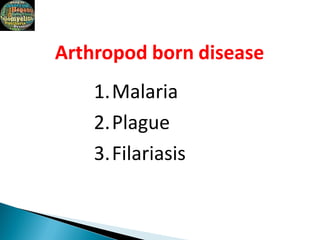
Arthropod born disease
1.Malaria
2.Plague
3.Filariasis
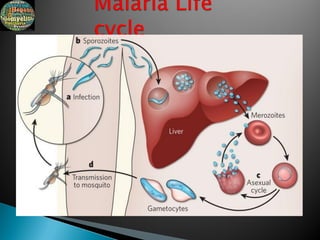
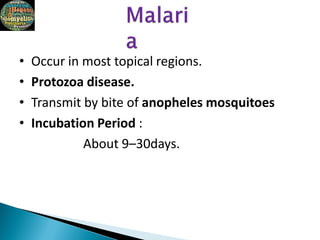
• Occur in most topical regions.
• Protozoa disease.
• Transmit by bite of anopheles mosquitoes
• Incubation Period :
About 9–30days.
Causative Organism
Plasmodium vivax
Plasmodium ovale
Plasmodium malariae
Plasmodium falciparum
Mode of Transmission
Influenza is mainly spread by,
1. Droplet infection
2. Direct contact
Malaria is mainly spread by,
1. Vector transmission:
By bite of female anopheles mosquito
2. Direct transmission:
By injections of infected blood or
plasma
3. Congenital:
Infected mother to new born
1. Cold Stage
 Onset of Fever with chills and sensation of extreme
cold.
1. Hot Stage


Temperature rise upto 106
Intense headache.
3.Sweating stage:
 Fever decreases with sweating.
1. Prevention against mosquito bite
2. Anti larval measures
3. Anti adult mosquito measures
4. Control of human reservoir
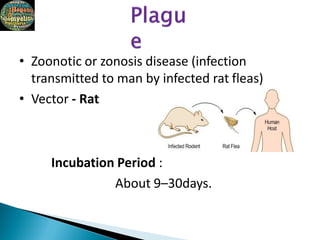
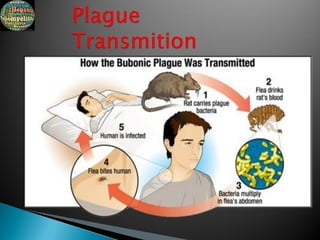
• Zoonotic or zonosis disease (infection
transmitted to man by infected rat fleas)
• Vector - Rat
Incubation Period :
About 9–30days.
Yersinia pestis
Incubation period
3- 6 days.
1. General measures



Prophylaxis for prevention bites of fleas – by controlling rats.
Early diagnosis, notification, isolation & disinfection of excretions like
sputum etc
Attendant must wear protective measures like gloves etc.
1. Chemoprophylaxis
 Protect by using suitable drugs.
1. Vaccination
 Two vaccines used
1. Killed vaccine
2. Attenuated vaccine
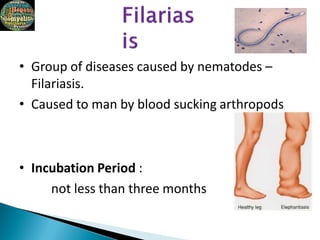
• Group of diseases caused by nematodes –
Filariasis.
• Caused to man by blood sucking arthropods
• Incubation Period :
not less than three months
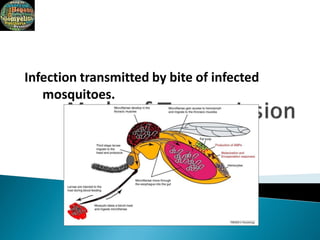
Infection transmitted by bite of infected
mosquitoes.






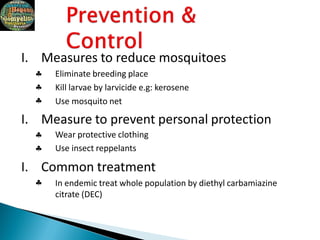
I. Measures to reduce mosquitoes
Eliminate breeding place
Kill larvae by larvicide e.g: kerosene
Use mosquito net
I. Measure to prevent personal protection
Wear protective clothing
Use insect reppelants
I. Common treatment
In endemic treat whole population by diethyl carbamiazine
citrate (DEC)
1. Rabies
2. Trachoma
3. Tetanus
4. Leprosy
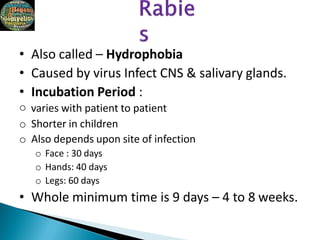
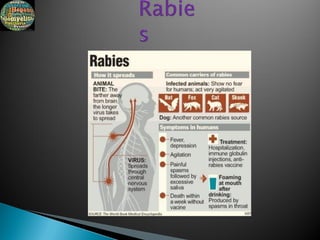
• Also called – Hydrophobia
• Caused by virus Infect CNS & salivary glands.
• Incubation Period :
o varies with patient to patient
o Shorter in children
o Also depends upon site of infection
o Face : 30 days
o Hands: 40 days
o Legs: 60 days
• Whole minimum time is 9 days – 4 to 8 weeks.
Lysssa virus type - I
Mode of Transmission
Mainly spread by,
1. Zoonosis
2. Spreads by wide range of animals
3. Mostly by bites or lick on broken skin
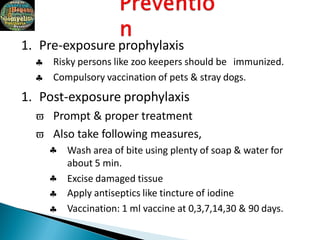
1. Pre-exposure prophylaxis


Risky persons like zoo keepers should be immunized.
Compulsory vaccination of pets & stray dogs.
1. Post-exposure prophylaxis
 Prompt & proper treatment
 Also take following measures,




Wash area of bite using plenty of soap & water for
about 5 min.
Excise damaged tissue
Apply antiseptics like tincture of iodine
Vaccination: 1 ml vaccine at 0,3,7,14,30 & 90 days.
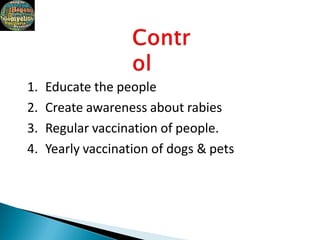
1. Educate the people
2. Create awareness about rabies
3. Regular vaccination of people.
4. Yearly vaccination of dogs & pets
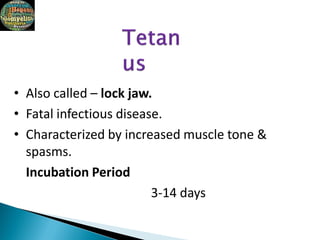
• Also called – lock jaw.
• Fatal infectious disease.
• Characterized by increased muscle tone &
spasms.
Incubation Period
3-14 days
Clostridium tetani
Mode of Transmission
mainly spread by,
1. Occur after acute injury.
2. Also occur after burns, ear infection,
surgery etc.
1. Active immunization
1. Vaccination using DPT vaccine
2. By using purified tetanus toxoids.
2. Passive immunization
1. With human tetanus immuno-globin (TIG) or anti
tetanus serum.
3. General measures
1. By cleansing of wounds reduce further risk
4. Miscellaneous
1. In case of deep puncture use suitable antibiotic
therapy is started
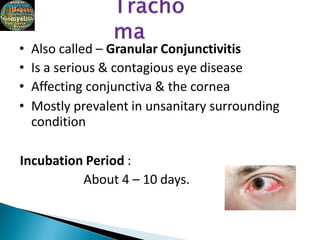
• Also called – Granular Conjunctivitis
• Is a serious & contagious eye disease
• Affecting conjunctiva & the cornea
• Mostly prevalent in unsanitary surrounding
condition
Incubation Period :
About 4 – 10 days.
Chlamydia trachomatis
Mode of Transmission
Mainly spread by,
1. Personal direct contact
E.g: shaking of hands etc.
2. Indirect contact
E.g: through common towels etc.
3. Through flies
1. Isolation of trachoma cases
2. In schools & institutes careful examination
3. Any article of patient e.g: towels etc. must
not be used by any other
4. Maintain personal hygiene
5. Avoid over crowding.
By using


Sulphonamides &
Antibiotics etc.
• Also called – Hansens disease
• Chronic infections of human.
• Affect & damage superficial tissue especially
skin and peripheral nerves.
• Incubation Period :
About 3–5 years
Mycobacterium leprae
Mode of Transmission
Mainly spread by,
1. Direct transmission
Prolonged close contact with an
infected person.
2. Through air borne droplets
1. Initially nerve damage causes numbness of
skin on face, hands & feet.
2. Affected skin may become thickened &
discolored.
3. Loss of sensation
4. Lack of sensation leads to injury or even loss
of fingers or toes.
1. Isolation of patient
2. Early diagnosis & chemotherapy
3. Treated with some specific drugs such as
dapsone etc.
4. Create awareness about leprosy



Avoid over crowding
Bad personal hygiene
Avoid of sharing of cloths etc
1. For prophylactic purposes use BCG vaccine
1. Gonorrhea
2. Syphilis
3. AIDS
• Causes infection by gonococci
• Produce local complications like urethritis,
endometritis etc.
• Also produce systemic complications like
dermatitis, meningitis etc.
Incubation Period
3-10 days
Neisseria gonorrhoeae
Mode of Transmission
Mainly spread by,
1. Sexual intercourse with infected
person
2. May transfer from mother to new born
child.
1. In male
include purpulent (with pus) uretheral mucous
membrane with dysuria(painfull urination)
1. In female
Include dysuria, freuquent urination, increased vaginal
secretions etc.
1. In childrens
Accidental contamination of eye
1. Detection of cases of gonorrhoea
2. Cases of gonorrhoea is identified &
investigated.
3. Use of contraceptive device
4. Avoid unsafe sexual contact.
5. Create awareness about STD’s
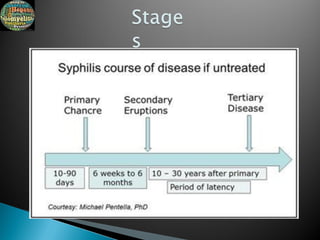
• Is chronic systemic infection
Incubation Period :
About 10days – 10 weeks.
average periods is 3 weeks.
Treponema pallidium
Mode of Transmission
Mainly spread by,
1. By sexual contact with infected partner
2. Less common
 Through blood transmission
 Mother to child etc.
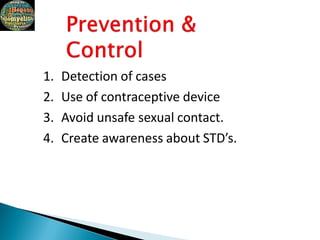
1. Detection of cases
2. Use of contraceptive device
3. Avoid unsafe sexual contact.
4. Create awareness about STD’s.
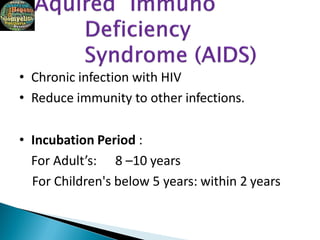
• Chronic infection with HIV
• Reduce immunity to other infections.
• Incubation Period :
For Adult’s: 8 –10 years
For Children's below 5 years: within 2 years
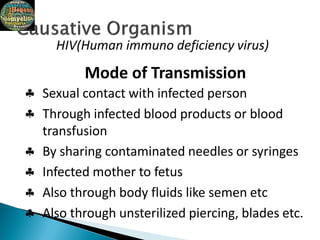
HIV(Human immuno deficiency virus)






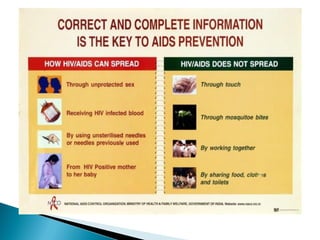
Mode of Transmission
Sexual contact with infected person
Through infected blood products or blood
transfusion
By sharing contaminated needles or syringes
Infected mother to fetus
Also through body fluids like semen etc
Also through unsterilized piercing, blades etc.
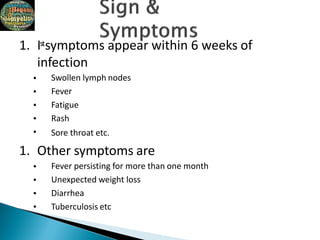
1. Istsymptoms appear within 6 weeks of
infection
•
•
•
•
•
Swollen lymph nodes
Fever
Fatigue
Rash
Sore throat etc.
1. Other symptoms are
•
•
•
•
Fever persisting for more than one month
Unexpected weight loss
Diarrhea
Tuberculosis etc
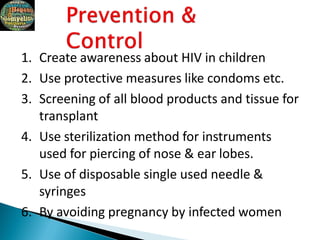
1. Create awareness about HIV in children
2. Use protective measures like condoms etc.
3. Screening of all blood products and tissue for
transplant
4. Use sterilization method for instruments
used for piercing of nose & ear lobes.
5. Use of disposable single used needle &
syringes
6. By avoiding pregnancy by infected women
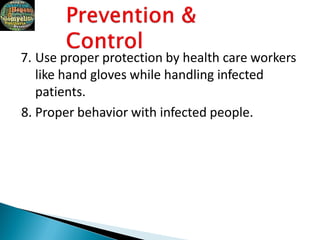
7. Use proper protection by health care workers
like hand gloves while handling infected
patients.
8. Proper behavior with infected people.
1. Poliomyelitis
2. Cholera
3. Typhoid fever
4. Hepatitis
5. Food poisoning
6. Hook worm infection
•
•
•
•
•
•
Acute systemic disease
Caused by an RNA
Replicate mainly in GIT
May reach CNS, damage spinal cord
Occasionally reach & damage medulla & motor cortex
Result in various degree of paralysis.
Incubation Period
7 – 14 days.
In some cases 4 – 35 days
Polio virus type 1, 2, 3
Mode of Transmission
Mainly transmit by,
1. Through fecal – oral route
2. During acute stage
a. Droplet
b. Contaminated fingers of patient
1. Immunization
a. Salk (inactivated) polio vaccine
b. Sabin vaccine or oral polio vaccine(OPV)
2. Isolation of the patient.
3. Supply of safe drinking water.
4. Improvement in personal hygiene.
• Severe acute GIT infection
• Incubation Period :
Few hours – 5 days.
Vibrio cholerae
Mode of Transmission
1. Through food & water (contaminated
by flies, insects & improper storage)
2. Rarely with contaminated hands of
persons who handle excreta, vomitus of
patients etc.)
1. Severe watery diarrhea,
2. Occasional vomiting.
3. Weakness.
4. Dehydration.
5. Sub normal temp.
6. Electrolyte imbalance.
1. Strict personal hygiene.
2. Using boiling drinking water.
3. Early detection of cases.
4. Proper and immediate treatment.
5. Disinfection of infective discharges & clothing must
be done
6. Sanitation should be maintained.
7. For prevention use vaccine.
8. Treatment is done by,
a. By giving ORS,
b. Antiboitics.
• Acute infectious illness
• Affect GIT.
• Enteric fever – Typhoid & Paratyphoid fever.
Incubation Period :
About 5 –20 days.
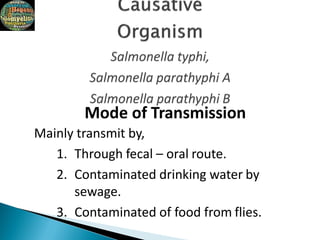
Mode of Transmission
Mainly transmit by,
1. Through fecal – oral route.
2. Contaminated drinking water by
sewage.
3. Contaminated of food from flies.
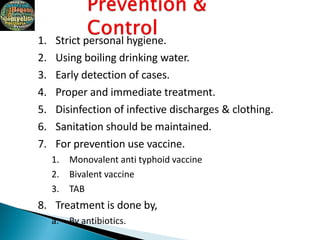
1. Strict personal hygiene.
2. Using boiling drinking water.
3. Early detection of cases.
4. Proper and immediate treatment.
5. Disinfection of infective discharges & clothing.
6. Sanitation should be maintained.
7. For prevention use vaccine.
1. Monovalent anti typhoid vaccine
2. Bivalent vaccine
3. TAB
8. Treatment is done by,
a. By antibiotics.
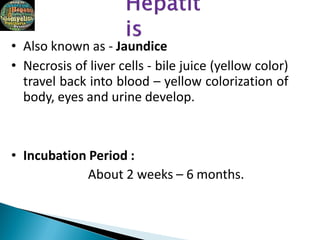
• Also known as - Jaundice
• Necrosis of liver cells - bile juice (yellow color)
travel back into blood – yellow colorization of
body, eyes and urine develop.
• Incubation Period :
About 2 weeks – 6 months.
Hepatitis A Virus (HAV)
Hepatitis B Virus (HBV)
Mode of Transmission
 Ingestion of contaminated food or water
 Person to person spread via the faeco-oral
route.
 Transmitted by food.
1. Blocking the route of transmission:
a. Physical isolation of patient
b. Protective clothing should be wear while handling patient.
2. Self care measures
a. Rest, Plenty of food
b. High calorie diet
3. Safe water supply
a. Supply safe water
b. Contaminated water treated with chlorine.
4. Immunization
5. By using HAV vaccine
6. By using HBV Vaccine
• Acute inflammation of lining of stomach &
intestine.
• Caused by consuming food & drink
contaminated
– by toxins of bacteria or
– inorganic chemical substances and
– poisons derived from plants & animals.
2 types:
1. Non – bacterial food poisoning
E.g.: Heavy metal poisoning etc.
1. Bacterial food poisoning
Due to living bacteria and its toxins.
1. Salmonella food poisoning:
1. Staphylococcal food poisoning:
2. Botulism:
 Due to non bacterial reason like mushroom
poisoning, fruit contaminated by pesticide etc.
It also include metal poisoning.
Salmonella Food Poisoning
Causative agent:
Salmonella Typhi marium
Mode of Transmission:
By eating raw, or under cooked
contaminated eggs, meat or milk etc.
Incubation period:
6-48 hrs.
Staphylococcal Food Poisoning
Causative agent:
Staphylococcal Aureus
Mode of Transmission:
By eating contaminated salads, custards,
eggs, meat or milk etc.
Incubation period:
1-8 hrs.
Botulism
Causative agent:
Clostridium botulinum
Mode of Transmission:
due to improperly cooked food like
pickled fish, home made cheese, low acid
food etc.
1. Food sanitation
1. Avoid ill person from food handling.
2. Carefully handling of hands & clean dishes and
utensils.
3. Don’t used unwashed utensils
4. Do not use food that have unusual odor or spoiled
taste.
2. Meat inspection
3. Refrigeration
4. Care fully inspection and testing of food
from hotels & restaurants on time to time.
• Also called Ancylostomiasis
• Caused due to small worms
• Attach to walls of intestines and causes
bleeding and poisoning.
Mode of Transmission
1. Tiny worms penetrate the base of feet of those
working in field.
2. Also transmit through arms & legs.
1. Patient appear pale and weak
2. Suffer from ringing of ears
dizziness, headache etc.
3. In severe case heart is enlarged
4. Nausea & vomiting are
frequent.
5. Mental development is
retarded.
1. By using or providing sewage system
2. Sanitary latrines provide to avoid
open air defecation.
3. Human waste & excreta should not
be used in fields
4. Shoes should be worn by all workers.
Communicable Disease

Communicable Disease

  • 1.
    Communicable Disease By. KailashNagar Assist. Prof. Dept. of Community Health Nsg. DPCN
  • 2.
     Transmitted fromone person to another person or from a reservoir to a susceptible host.  Animal Man Man Family/Society  E.g.: Tuberculosis, Small Pox etc
  • 3.
    1. Infection :Infection refers to the entry and development or multiplication of an infectious agent in the human (or, animal) body, with an implied response (e.g. immunological response). 2. Colonization: Presence of infectious agent in the human body but without any evidence of specific host immune responses to the agent. In short, colonization means "infection without any specific immune response". e.g. E Coli normally colonizes the human GIT. 3. Contamination: Presence of infectious agent in non-living articles like food, water, linen, including presence of infectious agent on skin surface, particularly on hands is contamination.
  • 4.
    4. Infestation: Presenceand development of insect vectors on the body or linen (e.g. louse infestation) or else on the mucus membranes (e.g. roundworm infestation). 5. Communicable Disease: A communicable disease is one that is caused by an infectious agent (or its toxic products) which can be transmitted to a human being either directly, or indirectly (through food, water, insect vectors, soil), or else a disease which can be transmitted between humans and animals. 6. Dead-End Infection: A state when an infectious disease, that cannot be transmitted any further between human beings or from humans to animals or vice versa e.g. Rabies, leptospirosis.  7. Subclinical Infection: A condition where infectious agent is present; the agent may also multiply in the host body, but there are no clinical manifestations of the disease. Hence, infection cannot be recognized clinically, (Meningococcal Meningitis)
  • 5.
    8. Latent Infection:Condition when the infectious agent lies "dormant" within the host body, without any clinical manifestations but does not come out of the human body (e.g. Herpes Zoster )  9. Zoonosis: Zoonosis are infections, which are normally transmitted between vertebrate animals, either directly, or indirectly through a vehicle or insect vector.  10. Opportunistic Infections: The term refers to disease, caused by infectious agents, which are normally not pathogenic, due to a decline in the general or specific immune status of the host becomes very active. E.g. HIV infection with various opportunistic.
  • 6.
     11. NosocomialInfection: This is an infection contracted while in hospital, as a result of health care or related procedure.  12. Eradication: The term refers to a complete cessation of transmission of the infectious agent.  13. Control: This refers to reducing the transmission of a disease to a level when it no longer remains a "public health problem" but needs ongoing preventive measures.  14. Elimination: Elimination implies either a 'regional eradication" (say from a country or continent), or else reduction of disease to zero without total removal of infectious agent.  15. Cases: Those who have clinically apparent disease.
  • 7.
     16. Carriers:A carrier is a human being who harbors an infectious agent and sheds it, thus becoming a potential source of infection for other human beings, but does not exhibit any manifestation of the disease.  17. Infectiousness: This is ease with which the agent is transmitted to the susceptible host.  18. Infectivity: This is the ability of the agent to cause infection, i.e. to enter, survive and multiply in the host.  19. Secondary Attack Rate (SAR): It is defined as the number of susceptible persons who, within the duration of one incubation period, following exposure, develop the disease out of the total susceptible who were exposed. It gives an idea about communicability of organism.  20. Pathogenicity: It is the ability of the agent to produce manifest disease out of those who have been infected.  21. Virulence: generally referred as Killing Power of Diseases sometimes simply defined as ability of the agent to produce severe disease. Case Fatality Ratio (CFR) is a measure of virulence.  22. Infective Dose: Infective dose refers to the dose that might lead to infection.  23. Herd Immunity: Protection from a diseases in a group due to large enough proportion of the peoples having immunity prevent the disease from spreading person to person
  • 8.
    Protection from adiseases in a group due to large enough proportion of the peoples having immunity prevent the disease from spreading person to person
  • 9.
     24. IncubationPeriod: Incubation period is the time period between the entry of infectious agent (and its toxin) into the human body to the point when the earliest clinical manifestations of the disease are apparent.  25. Reservoir: It is the one in whom the causative organism lives, multiplies and depends primarily for its survival (i.e. the natural habitat of the organism). Such a reservoir may be human being, animal or soil.  26. "Epidemic": This is the occurrence of disease frequency, in a defined population or area.  27. "Endemic": frequency refers to continued transmission of a disease, in a defined population or area.  28. "Sporadic": frequency which refers to few, scattered cases of infection, which do not have any relation to each other temporally.  29. Host: A person or an animal including birds and arthropods that affords lodgment to an infectious agent or a parasite.
  • 10.
     A communicabledisease is transmitted from the reservoir/ source to a susceptible person either directly or indirectly, depending upon various factors: There are various types of Modes of Transmission:
  • 11.
     A. Direct: It includes person-to-person contact , they can be of There are five direct modes:  1. Direct contact: When the reservoir and the susceptible are in close, physical, skin-to-skin contact. Example, as from dirty fingers or via food and water in the diarrheal diseases. Direct transmission also occurs through droplet infection in the respiratory diseases.  2. Droplet infection: When the susceptible host inhales the infected droplets, of 5 to 10 μ diameter, coming out of the mouth or nose from the reservoir during the act of coughing, sneezing, talking and laughing. For example, pulmonary tuberculosis, measles, ARTI etc.  3. Contact with the contaminated soil: For example, majority of worm infestations.  4. Contact with the animal: Either by Bite e.g. Rabies or infected agent enters the susceptible host by skin or mucous membrane e.g. Leptospirosis  5. Trans placental (vertical) transmission: Means transmission of the disease from the mother to the fetus through the placenta e.g. HIV, Malaria, TORCHS
  • 12.
     B. IndirectModes of Transmission There are five different indirect modes of disease:  1. Vehicle route: The term vehicles refers to water, food, milk, ice-cream, vegetables, biological products like blood etc.  2. Vector Borne:  3. Air-borne route of transmission: By droplet nuclei and infected dust:  4. Fomite route of transmission: Fomites are the inanimate objects capable of transmitting the diseases. For example, clothes, linen (Scabies), clinical thermometer, spoons, pencils, syringes, needles, toothbrush, etc.  5. Unclean hands and fingers: These contaminate the food and drinks and transmit diseases like typhoid, streptococcal and staphylococcal infections, diarrheas and dysentery.
  • 13.
    Depending upon source: 1.RespiratoryInfections: a) Smallpox: b) Chickenpox: c) Measles: D) Rubella: e) Mumps: f) Influenza: g) Whooping cough (Pertussis): E) Diphtheria
  • 14.
     2) Fecal-OralDiseases.  1) Gastroenteritis:  2) Cholera  3) Typhoid:  4) Polio:  5) Viral Hepatitis  3. Vector Borne Disease (Mosquito Borne Diseases)  4. Arthropod Borne Infections:  E.g.: Plague etc  5. Sexually Transmitted Disease:  E.g.: AIDS etc
  • 15.
    • Also called– Varicella • Occur mainly in Children under 10 years of age. • Uncommon in adults. • Incubation Period :About 14 – 16 days. Agent: Varicella Zoster Virus or Human a Herpes Virus 3 Source: Infectivity: 1-2 days before & 4-5 d after rash appearance) Control: Notification & Isolation (6 days) Prevention: VZIG within 72hrsVaccine, Live attenuated OKA vaccine 2-12yrs one dose; >12yrs-2 doses.
  • 20.
    Mode of Transmission 1.Droplet infection 2. Freshly contaminated formites used by patients can transmit disease. 3. Virus can cross placental barrier & may affect foetus. Sign and Symptoms 1. Fever 2. Appearance of rash in the form of crop on trunk, face and limbs. 3. Macules (small flat colored spot on skin) appear first and with in 24 hrs. lesions are appear. 4. them lesions becomes dry to form scabs.
  • 21.
    1. Fever 2. Appearanceof rash in the form of crop on trunk, face and limbs. 3. Macules (small flat colored spot on skin) appear first and with in 24 hrs. lesions are appear. 4. them lesions becomes dry to form scabs.
  • 22.
    1. By administeringspecific V. Zoster immunoglobulin. 2. Use of local antiseptics like chlorhexidine. 3. If bacterial infection progress give antibiotics. 4. Transmission prevented by isolation of patient for 5-7 days. 5. Sterilization of all articles used by patient after cure .
  • 24.
     Measles, anacute viral fever is a leading cause of childhood deaths caused by Agent: genus Morbillivirus from the family paramyxoviridae.  Host: most infections occur in the age group six months to Six years. Nutritional status has an important bearing on the severity of disease.  Environment: In India, the peak incidence of measles is in winter and early spring.
  • 26.
     The modeof transmission  When someone with measles coughs, sneezes or talks, infected droplets spray into the air, where other people can inhale them.  The infected droplets may also land on a surface, where they remain active and contagious for several hours.  The incubation period :- ranges from 10 to14 days after exposure to virus.
  • 27.
    Signs and symptoms Fever  Dry cough  Runny nose  Sore throat  Inflamed eyes (conjunctivitis)  Tiny white spots with bluish-white centers on a red background found inside the mouth on the inner lining of the cheek — also called Koplik's spots  A skin rash made up of large, flat blotches that often flow into one another.
  • 28.
    Treatments  Post-exposure vaccination.may be given the measles vaccination within 72 hours of exposure to the measles virus to provide protection against the disease. If measles still develops, the illness usually has milder symptoms and lasts for a shorter time.  Immune serum globulin. Pregnant women, infants and people with weakened immune systems who are exposed to the virus may receive an injection of proteins (antibodies) called immune serum globulin. When given within six days of exposure to the virus, these antibodies can prevent measles or make symptoms less severe.
  • 29.
     Fever reducers.acetaminophen (Tylenol, others), ibuprofen (Advil, Motrin, others) or naproxen (Aleve) to help relieve the fever that accompanies measles.  Vitamin A. People with low levels of vitamin A are more likely to have a more severe case of measles. Giving vitamin A may lessen the severity of the measles. It's generally given as a large dose of 200,000 international units (IU) for two days.
  • 30.
     Nursing considerations: 1.Isolation until 5th day of rash; if hospitalized, institute respiratory precautions. 2. Maintain bed rest during prodromal stage. 3. Instruct parents to administer antipyretics and cool sponge bath, avoid chilling. If child is prone to seizures, institute appropriate precautions (fever spikes to 400c) between 4th and 5th days. 4. Eye care: cleanse the eyelids with warm saline to remove secretions or crusts,
  • 31.
     Agent: RNAvirus of toga viridae family (Rubi virus)  Infectivity: One week before to one week after onset of rash  Host factors: Age: 3-10 yrs  Immunity: One attack gives lifelong immunity  In India 40% women of child -bearing age are susceptible to rubella  Incubation period: 2-3 Wks. (Av 18 days)  Mode of transmission: direct contact and spread via infected person, droplet infection, through feces or urine.  Incubation period: 14-21 days
  • 32.
     Pathophysiology  Rubellavirus, a togavirus (single-stranded RNA ) transmitted by the respiratory route  replicates in the nasopharynx and lymph nodes  The virus is found in the blood 5 to 7 days after infection and spreads throughout the body.  The virus has teratogenic properties  cross the placenta and infecting the fetus where it stops cells from developing or destroys
  • 33.
    Congenital Rubella Syndrome: CRS is known for Triad – Patent Ductus Arteriosus , Cataract, and Deafness Infection in 1st Trimester: Spontaneous Abortion OR still birth OR Triad “ PDA, Deafness , Cataract” Infection in II Trimester: Deafness Infection in III Trimester: No major abnormality
  • 34.
     S/S 1. Mildfever of 102 F (38.9 C) or lower 2. Headache 3. Stuffy or runny nose 4. Inflamed, red eyes 5. Enlarged, tender lymph nodes at the base of the skull, the back of the neck and behind the ears 6. A fine, pink rash that begins on the face and quickly spreads to the trunk and then the arms and legs, 7. Prevention: By live attenuated RA 27/3 vaccine.
  • 35.
    1. Clinical findings 2.Laboratory findings: leucopenia with or without thrombocytopenia, serological test shows rise in rubella antibody titre, increased IgM levels with decreased IgA and IgG levels is useful in diagnosis of newborn. 3. Culture of throat swabs, urine, feces and blood to isolate the virus before the rash appears.
  • 36.
     Therapeutic management: 1.Rest in bed as necessary. 2. Symptomatic management is given in children 3. Antipyretics (acetaminophen) for low grade fever and analgesics for discomfort.  Nursing considerations: 1. Reassure parents of benign nature of illness. 2. Provide comfort measures as necessary. 3. Isolate child from pregnant women. 4. Avoid people who have conditions that cause deficient or suppressed immune systems. 5. Tell your child's school or child care provider that your child has rubella.
  • 37.
     Agent: mumpsvirus (RNA)  Source: saliva of infected persons  Mode of transmission: direct contact with or droplet spread from an infected person  Incubation period: 14-21 days  Prevention: Live attenuated vaccine 0.5ml JeryLynn strain.  The first between ages 12 and 15 months  The second between ages 4 and 6 years, or between 11 and 12 if not previously given
  • 39.
     Symptoms  Somepeople infected with the mumps virus have either no signs or symptoms or very mild ones.  When signs and symptoms do develop, they usually appear about two to three weeks after exposure to the virus and may include: 1. Swollen, painful salivary glands on one or both sides of your face (Parotitis) 2. Fever 3. Headache 4. Weakness and fatigue 5. Loss of appetite 6. Pain while chewing or swallowing
  • 40.
    Diagnosis: virus cultureor a blood test may be needed. Therapeutic management: 1. Symptomatic and supportive- analgesics for pain and antipyretics for fever. 2. IV fluids for children who refuse to drink or vomit because of meningo-encephalitis. Nursing considerations:  Isolation during the period of communicability, institute respiratory isolation during hospitalization.  Maintain bed rest during prodromal phase until swelling subsides.  Give analgesics for pain.  Encourage fluids and soft bland foods.  Apply hot or cold compress to neck, whichever is more comforting.  To relieve orchitis, provide warmth and local support by means of a nest of absorbent cotton in the diaper.
  • 41.
     An acuterespiratory infection characterized by sudden onset of chills, malaise, fever, muscular pain and cough.  It is caused by influenza virus-A (which also cause pandemics), Type B (Which also causes Epidemics) and Type C (Which causes Endemic).  Influenza is more known as a public health problem because of Antigenic Variation  Shift: Sudden complete & major change- genetic recombination-causes major epidemics & pandemics  Drift: gradual Antigenic change over a period of time- point mutation
  • 43.
     Period ofinfectivity: 1-2 before and 1-2 days after onset of symptoms Incubation period: 18-72 hrs.  Prevention: vaccines don't control epidemics, it must be administered at least 2 week prior to onset of epidemic or preferably 2 to 3 months before influenza is expected- in high-risk groups.  Kindly refer to the Guidelines for Govt of India for Management of Cases of Influenza in the Module of National Health Programs
  • 44.
     Agent: bordetellaPertussis  Source: discharge from respiratory tract of infected persons  Transmission: direct contact or droplet spread from infected person, indirect contact with freshly contaminated articles.  Incubation period: 5-21 days, usually 10 days.
  • 46.
     Stages  Catarrhalstage: start with mild fever, malaise, coryza,uneasiness,noctural cough,red and tired face.  Paroxysmal stage: 1. Cough occurs in paroxysms of severral sharp coughs in one expiration, then a rapid deep inspiration followed by a whoop. 2. Dyspnoea and fever may be present 3. vomiting may occur after coughing  Convalescent stage: symptoms are relapsing and only mild cough present
  • 47.
     Diagnostic evaluation History collection and physical examination  Nasopharyngeal swab and culture  Treatment 1. Erythromycin may limit communicability 2. Sulfonamides and antibiotics may be given to prevent secondary infections 3. Provide mental and physical rest to prevent paroxysms of coughing 4. Provide humid air 5. Oxygen may be necessary 6. Offer small, frequent feedings to maintain nutritional status  Prevention  DPT vaccine is to be given
  • 48.
     Secondary Attackrate: 90%  Incubation period: 7-14 days  Control: Cases: early diagnosis, isolation and treatment  Immunization: Combine vaccine DPT / Penta available  Kindly refer to the Guidelines for Govt of India for Vaccination in the Module of National Health Programs
  • 49.
     Gastroenteritis:  Cholera Typhoid:  Polio:  Viral Hepatitis
  • 51.
    • An infectionor inflammation of the digestive tract, particularly the stomach and intestines • It is frequently referred to as the stomach or intestinal flu
  • 52.
    • Viruses –such as caliciviruses, rotaviruses, astroviruses and adenoviruses.
  • 53.
    • Bacteria –such as the Campylobacter bacterium
  • 54.
    • Parasites –such as Entamoeba histolytica, Giardia lamblia and Cryptosporidium created by: Katherine L. Laud,SN
  • 55.
    created by: KatherineL. Laud,SN • Bacterial toxins – poisonous by- products caused by bacteria can contaminate food -Some strains of staphylococcal bacteria produce toxins that can cause gastroenteritis
  • 56.
    • Chemicals –lead poisoning, for example, can trigger gastroenteritis
  • 57.
    • Drugs –certain drugs, such as antibiotics, can cause gastroenteritis in susceptible people and can irritate the digestive tract
  • 58.
    Escherichia coli infection •this is a common problem for travelers to countries with poor sanitation. Infection is caused by drinking contaminated water or eating contaminated raw fruits and vegetables. Campylobacter infection • the bacteria are found in animal feces. Infection is caused by, for example, consuming contaminated food or water, eating undercooked meat (especially chicken), and not washing your hands after handling infected animals.
  • 59.
    Cryptosporidium infection • parasitesare found in the bowels of humans and animals. Infection is caused by, for example, swimming in a contaminated pool and accidentally swallowing water, or through contact with infected animals. An infected person may spread the parasites to food or surfaces if they don’t wash their hands after going to the toilet.. Giardiasis • parasite infection of the bowel. Infection is caused by, for example, drinking contaminated water, handling infected animals or changing the nappy of an infected baby and not washing your hands afterwards.
  • 60.
     Salmonellosis  Bacteriaare found in animal feces. Infection is caused by eating contaminated food or handling infected animals. An infected person may also spread the bacteria to other people or surfaces by not washing their hands properly.  Shigellosis  bacteria are found in feces. An infected person may spread the bacteria to food or surfaces if they don’t wash their hands after going to the toilet.
  • 61.
    Viral Gastroenteritis • virusesare found in human feces. Infection is caused by person-to-person contact such as touching contaminated hands, feces or vomit, or by drinking contaminated water or food.
  • 62.
    • Loss ofAppetite • Bloating • Nausea and Vomiting • Diarrhea • Abdominal Pain and Cramps • Body Aches • Bloody stools (in some cases) • Pus in the stools (in some cases)
  • 63.
     Lethargy  Thesesymptoms are sometimes also accompanied by Fever and Weakness
  • 64.
    • The greatestdanger presented by gastroenteritis is dehydration. The loss of fluids through diarrhea and vomiting can upset the body's electrolyte balance, leading to potentially life-threatening problems such as heart beat abnormalities (arrhythmia) • The risk of dehydration increases as symptoms are prolonged. Dehydration should be suspected if a dry mouth, increased or excessive thirst, or scanty urination is experienced
  • 65.
    • The symptomsof gastroenteritis are usually enough to identify the illness • It is important to establish the cause, as different types of gastroenteritis respond to different treatments. Diagnostic methods may include: - Medical history - Physical examination - Blood tests - Stool tests
  • 66.
    Treatment depends onthe cause but may include: • Plenty of fluids and Right Diet • Oral rehydration drinks, available from your chemist • Admission to hospital and intravenous fluid replacement, in severe cases
  • 67.
    • Antibiotics, ifbacteria are the cause • Drugs to kill the parasites, if parasites are the cause • Avoiding anti-vomiting or anti- diarrhea drugs unless prescribed or recommended by your doctor, because these medications will keep the infection inside your body
  • 68.
    General suggestions onhow to reduce the risk of gastroenteritis include: • Wash hands thoroughly with soap and water after going to the toilet or changing nappies, after smoking, after using a handkerchief or tissue, or after handling animals • Wash your hands thoroughly with soap and water before preparing food or eating
  • 69.
    • Use disposablepaper towels to dry your hands rather than cloth towels, since the bacteria can survive for some time on objects • Keep cold food cold (below 5 C) and hot foot hot (above 60 C) to discourage the growth of bacteria • Make sure foods are thoroughly cooked
  • 70.
    • Clean thetoilet and bathroom regularly, especially the toilet seat, door handles and taps • When travelling overseas to countries where sanitation is suspect, only drink bottled water. Don’t forget to brush your teeth in bottled water too. Avoid food buffets, uncooked foods or peeled fruits and vegetables, and ice in drinks
  • 71.
  • 72.
    Cholera is anacute diarrheal illness caused by infection of the intestine with the bacteria Vibrio cholerae.
  • 73.
    EPIDEMIOLOGY • Cholera wasprevalent in the 1800s, but due to proper treatment of sewage and drinking water, has become rare in developed countries. •Cholera is a fecal disease, meaning that it spreads when the feces of an infected person come into contact with food or water. • Over 1 million cases and nearly 10,000 fatalities.
  • 74.
    • Gram negative. •Type of Gammaproteobacteria • Distinguishing factors: Oxidase- positive, motile via polar flagellum, and both respiratory and fermentative metabolism. • Organism can multiply freely in water
  • 75.
    Most people remainasymptomatic. The symptoms of cholera include : profuse, watery diarrhea stomach pains leg cramps Mild fever Vomiting Sunken eyes and cheeks Dry mucous membranes Decreased urinary output
  • 76.
    severe dehydration ShockRenal failure Death
  • 77.
    ed water. Drinking eatingraw contaminat or undercooked shellfish CAUSES (TRANSMISSION MOOD)
  • 78.
    • Vibrios oftendetected by dark field or phase contrast microscopy of stool • Organisms are motile, appearing like “shooting stars” • Microscopy show sheets of curved Gram negative rods. • When plated on sucrose dishes, yellow colonies appear confirming cholera present
  • 79.
    Additional methods ofdetection include PCR and monoclonal antibody-based stool tests.
  • 80.
    Oral rehydration salts •Up to 80% of cases can be treated through this. Intravenous fluids (Ringer lactate) • For severe cases. Antimicrobial Therapy • can diminish duration of diarrhea, reduce volume of rehydration fluids needed, and shorten duration of V.cholerae excretion.
  • 81.
    PREVENTION • Basic healtheducation and hygiene • Mass chemoprophylaxis • Provision of safe water and sanitation •Comprehensive Multidisciplinary Approach: water, sanitation, education and communication
  • 82.
    Parenteral Vaccine : •2doses administered 2 weeks apart Killed WC/rBS Vaccine : •Killed whole-cell V.cholerae in combination with a recombinant B-subunit of cholera toxin •Safe in pregnancy and breastfeeding Live, attenuated CVD 103-HgR Vaccine : •Protection as early as 1 week after vaccination, with >90%
  • 83.
    The prognosis ofcholera can range depending on the severity of the dehydration and how quickly the patient is given and responds to treatments. Death (mortality) rates in untreated cholera can be as high as 50%-60% during large outbreaks but can be reduced to about 1% if treatment protocols are rapidly put into action.
  • 84.
    Treatment centers Set uptreatment centers for prompt treatment. Sanitary measures. food safety and animal health measures Comprehensive surveillance data (adapt to each situation) for a comprehensive multidisciplinary approach. CONTROLLING CHOLERA
  • 85.
    Steps in thetreatment of a patient with suspected cholera are as follows: 1. Assess for dehydration (see Table 1) 2. Rehydrate the patient and monitor frequently, then reassess hydration status 3. Maintain hydration; replace ongoing fluid losses until diarrhea stops 4. Administer an oral antibiotic to the patient with severe dehydration 5. Feed the patient More detailed guidelines for the treatment of cholera are as follows:  Evaluate the degree of dehydration upon arrival  Rehydrate the patient in 2 phases; these include rehydration (for 2-4 h) and maintenance (until diarrhea abates)  Register output and intake volumes on predesigned charts and periodically review these data  Use the intravenous route only (1) during the rehydration phase for severely dehydrated patients for whom an infusion rate of 50-100 mL/kg/h is advised, (2) for moderately dehydrated patients who do not tolerate the oral route, and (3) during the maintenance phase in patients considered high stool purgers (ie, >10 mL/kg/h)  During the maintenance phase, use oral rehydration solution at a rate of 800-1000 mL/h; match ongoing losses with ORS administration  Discharge patients to the treatment center if oral tolerance is greater than or equal to 1000 mL/h, urine volume is greater than or equal to 40 mL/h, and stool volume is less than or equal to 400 mL/h.
  • 86.
    Clinical feature Predicted degree ofdehydration None (<5 percent) Some dehydration (5-10 percent) Severe dehydration (>10 percent) General appearance Well, alert Restless, irritable Abnormally sleepy/lethargic Eyes Normal Sunken Sunken Thirst Drinks normally, not thirsty Thirsty, drinks eagerly Drinks poorly /unable to drink Skin pinch Goes back quickly Goes back slowly(< 2 sec) Goes back veryslowly (>2 sec) Estimated fluid deficit <50 mL/kg 50-100 mL/kg >100 mL/kg
  • 87.
    Clinical feature Predicted degreeof dehydration None (<5 percent) Some dehydration (5-10 percent) Severe dehydration (>10 percent) Decision Patient has no dehydration If the patient has 2 or more signs, some dehydration is present If the patient has 2 or more of these signs, severe dehydration is present
  • 88.
    • Rehydration isaccomplished in 2 phases: A. Rehydration B. Maintenance.
  • 89.
    • The goalof the rehydration phase is to restore normal hydration status, which should take no more than 4 hours. • Set the rate of intravenous infusion in severely dehydrated patients at 50-100 mL/kg/hr. • Lactated Ringer solution is preferred over isotonic sodium chloride solution because saline does not correct metabolic acidosis
  • 90.
    • The goalof the maintenance phase is to maintain normal hydration status by replacing ongoing losses. • The oral route is preferred, and the use of oral rehydration solution (ORS) at a rate of 500-1000 mL/hr is recommended • Fluids should never be restricted
  • 91.
    SIGN OF DEHYDRATION Nodehydration (<5 percent) Some dehydration (5-10 percent) 2 or more of the following signs? 1. sunken eyes 2. absence of tears 3. dry mouth and tongue 4. thirsty and drinks eagerly 5. Goes back slowly(< 2 sec) Oral Rehydration If NO IfYES 2 or more of the followingsigns? 1. lethargic, unconscious orfloppy 2. unable to drink 3. radial pulse is weak 4. Goes back very slowly(>2 sec) IfYES Severe dehydration (>10 percent) If NO Age Amount After Loose Stool < 24 mo 50-100 mL 2-9 y 100-200 mL >10 y As much as is wanted Age < 4 mo 4-11 mo 12-23 mo 2-4 y 5-14 y >15 y Weight < 5 kg 5-7.9 kg 8-10.9 kg 11-15.9 kg 16-29.9 kg >30 kg ORS solution in mL 200- 400 400-600 600-800 800-1200 1200- 2200 2200- 4000 ORS solution to give in the first 4 hours If improv
  • 92.
    Treat Severe dehydrationin cholera younger than 1 year 100 mL/kg IV in 6 hours older than 1 year + adult 30 mL/kg in the first hour then 70 mL/kg in the next 5 hours. 30 mL/kg as rapidly as possible (within 30 min) then 70 mL/kg in the next 2 hours. Fluids should never be restricted. maintained intravenously with RL Total amount per day RL+ORS = 200 ml/kg during the first 24 hours + Administer ORS solution (about 5 mL/kg/h) as soon as the patient can drink, in addition to IV fluid. Continue to reassess at least every 4 hours; radial pulse should be strong and Bld pressur shouldbe normal. goal of the rehydration phase is to restore normal hydration status, must be less than 4 hours The goal of maintenance phase is to maintain normal hydration by replacing ongoing losses. 100 mL/kg IV in 6 hours Continue monitor
  • 93.
    • After receivingtherapy of adequate hydration, patients that fulfill these three criteria can be discharged of the hospital: 1. Adequate oral intake 2. Normal urinary flow (40-50 cc by hour) 3. Maximum diarrhea flow of 400 cc per hour
  • 94.
    • Antimicrobial therapyis useful for 1. prompt eradication of the vibrio 2. diminish the duration of diarrhea 3. decrease the fluid loss. • Antibiotics should be administered to moderate or severe cases
  • 95.
    Option Adults Doxycycline, 300mg po single dose ,Ciprofloxacin, 1g po single dose OR Azithromycin 1g po single dose. Pregnant Erythromycin 500 mg/ 6 hours for 3 days OR azithromycin, 1g po single dose Children> 3yrs Erythromycin 12.5mg/kg/ 6 hours for 3dys OR azithromycin 20 mg/kg, in a single dose, without exceeding 1 g Children < Erythromycin 12.5mg/kg/ 6 hours for 3dys OR
  • 96.
    • Comprehensive MultidisciplinaryApproach: water, sanitation, education, and communication • Basic health education and hygiene • Mass chemoprophylaxis • Provision of safe water and sanitation
  • 97.
  • 98.
    • Occur inmost topical regions. • Protozoa disease. • Transmit by bite of anopheles mosquitoes • Incubation Period : About 9–30days.
  • 99.
    Causative Organism Plasmodium vivax Plasmodiumovale Plasmodium malariae Plasmodium falciparum Mode of Transmission Influenza is mainly spread by, 1. Droplet infection 2. Direct contact
  • 100.
    Malaria is mainlyspread by, 1. Vector transmission: By bite of female anopheles mosquito 2. Direct transmission: By injections of infected blood or plasma 3. Congenital: Infected mother to new born
  • 101.
    1. Cold Stage Onset of Fever with chills and sensation of extreme cold. 1. Hot Stage   Temperature rise upto 106 Intense headache. 3.Sweating stage:  Fever decreases with sweating.
  • 102.
    1. Prevention againstmosquito bite 2. Anti larval measures 3. Anti adult mosquito measures 4. Control of human reservoir
  • 104.
    • Zoonotic orzonosis disease (infection transmitted to man by infected rat fleas) • Vector - Rat Incubation Period : About 9–30days.
  • 105.
  • 108.
    1. General measures    Prophylaxisfor prevention bites of fleas – by controlling rats. Early diagnosis, notification, isolation & disinfection of excretions like sputum etc Attendant must wear protective measures like gloves etc. 1. Chemoprophylaxis  Protect by using suitable drugs. 1. Vaccination  Two vaccines used 1. Killed vaccine 2. Attenuated vaccine
  • 109.
    • Group ofdiseases caused by nematodes – Filariasis. • Caused to man by blood sucking arthropods • Incubation Period : not less than three months
  • 111.
    Infection transmitted bybite of infected mosquitoes.
  • 112.
          I. Measures toreduce mosquitoes Eliminate breeding place Kill larvae by larvicide e.g: kerosene Use mosquito net I. Measure to prevent personal protection Wear protective clothing Use insect reppelants I. Common treatment In endemic treat whole population by diethyl carbamiazine citrate (DEC)
  • 113.
    1. Rabies 2. Trachoma 3.Tetanus 4. Leprosy
  • 114.
    • Also called– Hydrophobia • Caused by virus Infect CNS & salivary glands. • Incubation Period : o varies with patient to patient o Shorter in children o Also depends upon site of infection o Face : 30 days o Hands: 40 days o Legs: 60 days • Whole minimum time is 9 days – 4 to 8 weeks.
  • 116.
    Lysssa virus type- I Mode of Transmission Mainly spread by, 1. Zoonosis 2. Spreads by wide range of animals 3. Mostly by bites or lick on broken skin
  • 118.
    1. Pre-exposure prophylaxis   Riskypersons like zoo keepers should be immunized. Compulsory vaccination of pets & stray dogs. 1. Post-exposure prophylaxis  Prompt & proper treatment  Also take following measures,     Wash area of bite using plenty of soap & water for about 5 min. Excise damaged tissue Apply antiseptics like tincture of iodine Vaccination: 1 ml vaccine at 0,3,7,14,30 & 90 days.
  • 119.
    1. Educate thepeople 2. Create awareness about rabies 3. Regular vaccination of people. 4. Yearly vaccination of dogs & pets
  • 120.
    • Also called– lock jaw. • Fatal infectious disease. • Characterized by increased muscle tone & spasms. Incubation Period 3-14 days
  • 121.
    Clostridium tetani Mode ofTransmission mainly spread by, 1. Occur after acute injury. 2. Also occur after burns, ear infection, surgery etc.
  • 123.
    1. Active immunization 1.Vaccination using DPT vaccine 2. By using purified tetanus toxoids. 2. Passive immunization 1. With human tetanus immuno-globin (TIG) or anti tetanus serum. 3. General measures 1. By cleansing of wounds reduce further risk 4. Miscellaneous 1. In case of deep puncture use suitable antibiotic therapy is started
  • 124.
    • Also called– Granular Conjunctivitis • Is a serious & contagious eye disease • Affecting conjunctiva & the cornea • Mostly prevalent in unsanitary surrounding condition Incubation Period : About 4 – 10 days.
  • 125.
    Chlamydia trachomatis Mode ofTransmission Mainly spread by, 1. Personal direct contact E.g: shaking of hands etc. 2. Indirect contact E.g: through common towels etc. 3. Through flies
  • 127.
    1. Isolation oftrachoma cases 2. In schools & institutes careful examination 3. Any article of patient e.g: towels etc. must not be used by any other 4. Maintain personal hygiene 5. Avoid over crowding.
  • 128.
  • 129.
    • Also called– Hansens disease • Chronic infections of human. • Affect & damage superficial tissue especially skin and peripheral nerves. • Incubation Period : About 3–5 years
  • 130.
    Mycobacterium leprae Mode ofTransmission Mainly spread by, 1. Direct transmission Prolonged close contact with an infected person. 2. Through air borne droplets
  • 131.
    1. Initially nervedamage causes numbness of skin on face, hands & feet. 2. Affected skin may become thickened & discolored. 3. Loss of sensation 4. Lack of sensation leads to injury or even loss of fingers or toes.
  • 132.
    1. Isolation ofpatient 2. Early diagnosis & chemotherapy 3. Treated with some specific drugs such as dapsone etc. 4. Create awareness about leprosy    Avoid over crowding Bad personal hygiene Avoid of sharing of cloths etc 1. For prophylactic purposes use BCG vaccine
  • 133.
  • 134.
    • Causes infectionby gonococci • Produce local complications like urethritis, endometritis etc. • Also produce systemic complications like dermatitis, meningitis etc. Incubation Period 3-10 days
  • 135.
    Neisseria gonorrhoeae Mode ofTransmission Mainly spread by, 1. Sexual intercourse with infected person 2. May transfer from mother to new born child.
  • 136.
    1. In male includepurpulent (with pus) uretheral mucous membrane with dysuria(painfull urination) 1. In female Include dysuria, freuquent urination, increased vaginal secretions etc. 1. In childrens Accidental contamination of eye
  • 137.
    1. Detection ofcases of gonorrhoea 2. Cases of gonorrhoea is identified & investigated. 3. Use of contraceptive device 4. Avoid unsafe sexual contact. 5. Create awareness about STD’s
  • 138.
    • Is chronicsystemic infection Incubation Period : About 10days – 10 weeks. average periods is 3 weeks.
  • 139.
    Treponema pallidium Mode ofTransmission Mainly spread by, 1. By sexual contact with infected partner 2. Less common  Through blood transmission  Mother to child etc.
  • 141.
    1. Detection ofcases 2. Use of contraceptive device 3. Avoid unsafe sexual contact. 4. Create awareness about STD’s.
  • 142.
    • Chronic infectionwith HIV • Reduce immunity to other infections. • Incubation Period : For Adult’s: 8 –10 years For Children's below 5 years: within 2 years
  • 143.
    HIV(Human immuno deficiencyvirus)       Mode of Transmission Sexual contact with infected person Through infected blood products or blood transfusion By sharing contaminated needles or syringes Infected mother to fetus Also through body fluids like semen etc Also through unsterilized piercing, blades etc.
  • 144.
    1. Istsymptoms appearwithin 6 weeks of infection • • • • • Swollen lymph nodes Fever Fatigue Rash Sore throat etc. 1. Other symptoms are • • • • Fever persisting for more than one month Unexpected weight loss Diarrhea Tuberculosis etc
  • 145.
    1. Create awarenessabout HIV in children 2. Use protective measures like condoms etc. 3. Screening of all blood products and tissue for transplant 4. Use sterilization method for instruments used for piercing of nose & ear lobes. 5. Use of disposable single used needle & syringes 6. By avoiding pregnancy by infected women
  • 146.
    7. Use properprotection by health care workers like hand gloves while handling infected patients. 8. Proper behavior with infected people.
  • 148.
    1. Poliomyelitis 2. Cholera 3.Typhoid fever 4. Hepatitis 5. Food poisoning 6. Hook worm infection
  • 149.
    • • • • • • Acute systemic disease Causedby an RNA Replicate mainly in GIT May reach CNS, damage spinal cord Occasionally reach & damage medulla & motor cortex Result in various degree of paralysis. Incubation Period 7 – 14 days. In some cases 4 – 35 days
  • 150.
    Polio virus type1, 2, 3 Mode of Transmission Mainly transmit by, 1. Through fecal – oral route 2. During acute stage a. Droplet b. Contaminated fingers of patient
  • 152.
    1. Immunization a. Salk(inactivated) polio vaccine b. Sabin vaccine or oral polio vaccine(OPV) 2. Isolation of the patient. 3. Supply of safe drinking water. 4. Improvement in personal hygiene.
  • 153.
    • Severe acuteGIT infection • Incubation Period : Few hours – 5 days.
  • 154.
    Vibrio cholerae Mode ofTransmission 1. Through food & water (contaminated by flies, insects & improper storage) 2. Rarely with contaminated hands of persons who handle excreta, vomitus of patients etc.)
  • 155.
    1. Severe waterydiarrhea, 2. Occasional vomiting. 3. Weakness. 4. Dehydration. 5. Sub normal temp. 6. Electrolyte imbalance.
  • 156.
    1. Strict personalhygiene. 2. Using boiling drinking water. 3. Early detection of cases. 4. Proper and immediate treatment. 5. Disinfection of infective discharges & clothing must be done 6. Sanitation should be maintained. 7. For prevention use vaccine. 8. Treatment is done by, a. By giving ORS, b. Antiboitics.
  • 157.
    • Acute infectiousillness • Affect GIT. • Enteric fever – Typhoid & Paratyphoid fever. Incubation Period : About 5 –20 days.
  • 158.
    Mode of Transmission Mainlytransmit by, 1. Through fecal – oral route. 2. Contaminated drinking water by sewage. 3. Contaminated of food from flies.
  • 160.
    1. Strict personalhygiene. 2. Using boiling drinking water. 3. Early detection of cases. 4. Proper and immediate treatment. 5. Disinfection of infective discharges & clothing. 6. Sanitation should be maintained. 7. For prevention use vaccine. 1. Monovalent anti typhoid vaccine 2. Bivalent vaccine 3. TAB 8. Treatment is done by, a. By antibiotics.
  • 161.
    • Also knownas - Jaundice • Necrosis of liver cells - bile juice (yellow color) travel back into blood – yellow colorization of body, eyes and urine develop. • Incubation Period : About 2 weeks – 6 months.
  • 162.
    Hepatitis A Virus(HAV) Hepatitis B Virus (HBV) Mode of Transmission  Ingestion of contaminated food or water  Person to person spread via the faeco-oral route.  Transmitted by food.
  • 163.
    1. Blocking theroute of transmission: a. Physical isolation of patient b. Protective clothing should be wear while handling patient. 2. Self care measures a. Rest, Plenty of food b. High calorie diet 3. Safe water supply a. Supply safe water b. Contaminated water treated with chlorine. 4. Immunization 5. By using HAV vaccine 6. By using HBV Vaccine
  • 164.
    • Acute inflammationof lining of stomach & intestine. • Caused by consuming food & drink contaminated – by toxins of bacteria or – inorganic chemical substances and – poisons derived from plants & animals.
  • 165.
    2 types: 1. Non– bacterial food poisoning E.g.: Heavy metal poisoning etc. 1. Bacterial food poisoning Due to living bacteria and its toxins. 1. Salmonella food poisoning: 1. Staphylococcal food poisoning: 2. Botulism:
  • 166.
     Due tonon bacterial reason like mushroom poisoning, fruit contaminated by pesticide etc. It also include metal poisoning.
  • 167.
    Salmonella Food Poisoning Causativeagent: Salmonella Typhi marium Mode of Transmission: By eating raw, or under cooked contaminated eggs, meat or milk etc. Incubation period: 6-48 hrs.
  • 168.
    Staphylococcal Food Poisoning Causativeagent: Staphylococcal Aureus Mode of Transmission: By eating contaminated salads, custards, eggs, meat or milk etc. Incubation period: 1-8 hrs.
  • 169.
    Botulism Causative agent: Clostridium botulinum Modeof Transmission: due to improperly cooked food like pickled fish, home made cheese, low acid food etc.
  • 170.
    1. Food sanitation 1.Avoid ill person from food handling. 2. Carefully handling of hands & clean dishes and utensils. 3. Don’t used unwashed utensils 4. Do not use food that have unusual odor or spoiled taste. 2. Meat inspection 3. Refrigeration 4. Care fully inspection and testing of food from hotels & restaurants on time to time.
  • 171.
    • Also calledAncylostomiasis • Caused due to small worms • Attach to walls of intestines and causes bleeding and poisoning.
  • 172.
    Mode of Transmission 1.Tiny worms penetrate the base of feet of those working in field. 2. Also transmit through arms & legs.
  • 173.
    1. Patient appearpale and weak 2. Suffer from ringing of ears dizziness, headache etc. 3. In severe case heart is enlarged 4. Nausea & vomiting are frequent. 5. Mental development is retarded.
  • 174.
    1. By usingor providing sewage system 2. Sanitary latrines provide to avoid open air defecation. 3. Human waste & excreta should not be used in fields 4. Shoes should be worn by all workers.