Standard Precautions toStandard Precautions to
Prevent & Control InfectionsPrevent & Control Infections
Aman Ullah
B.Sc. Med. Lab. Technology
M. Phil. Microbiology
Certificate in Health Professional Education
Lecturer, Department of Medical Lab. Technology
Institute of Paramedical Sciences, Khyber Medical
University, Peshawar, Pakistan
ALERT:ALERT: The materials included inThe materials included in
this presentation was actuallythis presentation was actually
compiled bycompiled by
Dr. Naeem KhattakDr. Naeem Khattak
in the workshop of infection controlin the workshop of infection control
at Khyber medical university,at Khyber medical university,
Peshawar, PakistanPeshawar, Pakistan
Outline of the topicOutline of the topic
To update the participants about :To update the participants about :
•State the purpose of standard precautions.State the purpose of standard precautions.
•Components of standard precautionsComponents of standard precautions
•Routes of transmission of infectious agentsRoutes of transmission of infectious agents
•Exposure control methods to prevent exposureExposure control methods to prevent exposure
•Infectious or biomedical waste disposal proceduresInfectious or biomedical waste disposal procedures
•How to address accidents and injuries whenHow to address accidents and injuries when
working with BBPs and OPIMsworking with BBPs and OPIMs
What are StandardWhat are Standard (universal)(universal)
Precautions?Precautions?
Standard precaution are controlStandard precaution are control
guidelines designed to protectguidelines designed to protect
workers from exposure to Diseasesworkers from exposure to Diseases
spread by Blood and other Bodyspread by Blood and other Body
fluidsfluids (CDC)(CDC)
Standard (Universal) PrecautionsStandard (Universal) Precautions
““Precautions to protect against exposure must bePrecautions to protect against exposure must be
taken when there is any potential for exposure totaken when there is any potential for exposure to
bodily fluids. It is assumed that all bodily fluidsbodily fluids. It is assumed that all bodily fluids
have the potential to transmit disease”have the potential to transmit disease”
The Standard Precaution Rule:The Standard Precaution Rule:
Treat all human blood, bodily fluids and otherTreat all human blood, bodily fluids and other
potentially infectious materialspotentially infectious materials
as if they are infectious.as if they are infectious.
Why Standard (universal) healthWhy Standard (universal) health
Precautions?Precautions?
The concept of Standard (universal) HealthThe concept of Standard (universal) Health
Precautions emphasizes that all ourPrecautions emphasizes that all our
patients should be treated as though theypatients should be treated as though they
have potential blood born infections, andhave potential blood born infections, and
can infect the caring health care workerscan infect the caring health care workers
((CDC)CDC)
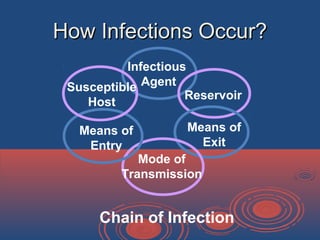
Infectious
Agent
Reservoir
Means of
Exit
Mode of
Transmission
Means of
Entry
Susceptible
Host
Chain of Infection
How Infections Occur?How Infections Occur?
How Exposures Occur?How Exposures Occur?
 Most common: needle sticks injuriesMost common: needle sticks injuries
 Cuts from other contaminated sharpsCuts from other contaminated sharps
(scalpels, broken glass, etc.)(scalpels, broken glass, etc.)
 Splashes of blood intoSplashes of blood into mucous membranesmucous membranes
(for example, the eye, nose, mouth) or broken(for example, the eye, nose, mouth) or broken
skin (cut or abraded) with contaminated bloodskin (cut or abraded) with contaminated blood
 Contamination where clothes soaked by bloodContamination where clothes soaked by blood
 Bites (which break the skin)Bites (which break the skin)
How Exposures Occur to Blood borneHow Exposures Occur to Blood borne
pathogens?pathogens?
By blood from someone who is infected with theBy blood from someone who is infected with the
virus getting into someone else's body:virus getting into someone else's body:
 Needle stick injuriesNeedle stick injuries
 Damaged or cut skin including bitesDamaged or cut skin including bites
 Sharing needles, syringes, razors & toothSharing needles, syringes, razors & tooth
brushesbrushes
 Mother to baby around the time of birthMother to baby around the time of birth
 Through unprotected sexual intercourseThrough unprotected sexual intercourse
 By tattooing, body piercing or acupuncture ifBy tattooing, body piercing or acupuncture if
instruments are not properly sterilisedinstruments are not properly sterilised
Which human materials/tissues areWhich human materials/tissues are
considered highly Infectious?considered highly Infectious?
BloodBlood
Blood stained body fluidsBlood stained body fluids
SemenSemen
Vaginal secretionsVaginal secretions
TissuesTissues

CSF, amniotic, pericardial, pleuralCSF, amniotic, pericardial, pleural
fluidsfluids
Which human materials/tissues are less
likely to contain pathogens?
Body fluids less likely to contain
pathogens:
 TearsTears
 Nasal secretionsNasal secretions
 SweatSweat
 Saliva (more likely if blood present)Saliva (more likely if blood present)
Spread of InfectionSpread of Infection
BBVs (contd.)BBVs (contd.)
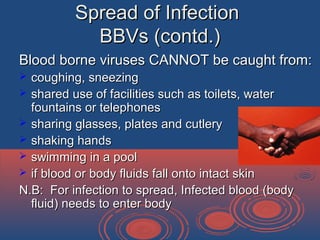
Blood borne viruses CANNOT be caught from:Blood borne viruses CANNOT be caught from:
 coughing, sneezingcoughing, sneezing
 shared use of facilities such as toilets, watershared use of facilities such as toilets, water
fountains or telephonesfountains or telephones
 sharing glasses, plates and cutlerysharing glasses, plates and cutlery
 shaking handsshaking hands
 swimming in a poolswimming in a pool
 if blood or body fluids fall onto intact skinif blood or body fluids fall onto intact skin
N.B: For infection to spread, Infected blood (bodyN.B: For infection to spread, Infected blood (body
fluid) needs to enter bodyfluid) needs to enter body
BBV’s - risk of transmissionBBV’s - risk of transmission
Estimated risk from person infectedEstimated risk from person infected
 Hepatitis B positive sourceHepatitis B positive source - 1 in 3- 1 in 3
 Hepatitis C positive sourceHepatitis C positive source -1 in 30-1 in 30
 HIVHIV - 1 in 300- 1 in 300
Occupational risk (HCW) of acquiring BBVOccupational risk (HCW) of acquiring BBV
post exposure:post exposure:
 HIV 0.37%HIV 0.37%
 HBV 20-40%HBV 20-40%
(Alder 1997)(Alder 1997)
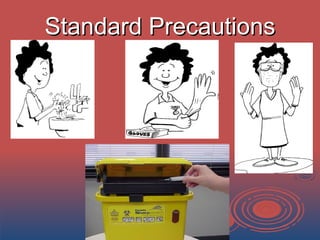
Standard PrecautionsStandard Precautions
• Apply standard precautions to allApply standard precautions to all
patients regardless of theirpatients regardless of their
diagnosis, and to all contaminateddiagnosis, and to all contaminated
equipment and materialsequipment and materials
• Use judgment in determining whichUse judgment in determining which
protective barriers are necessary.protective barriers are necessary.
Standard PrecautionsStandard Precautions
• Applied to Blood, Blood Products,Applied to Blood, Blood Products,
Body fluids and ExcretaBody fluids and Excreta
• To avoid exposure to blood-borneTo avoid exposure to blood-borne
pathogens (e.g. HBV, HCV & HIV)pathogens (e.g. HBV, HCV & HIV)
Standard PrecautionsStandard Precautions
1.1. Hands HygieneHands Hygiene
2.2. Use Personal protectiveUse Personal protective
equipments (PPE)equipments (PPE)

GlovesGloves

GownsGowns

MasksMasks

Eye protectionEye protection

Face ShieldsFace Shields
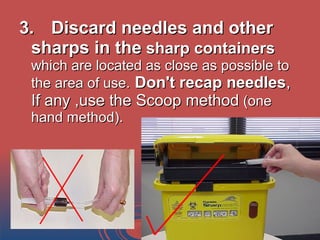
3.3. Discard needles and otherDiscard needles and other
sharps in thesharps in the sharp containerssharp containers
which are located as close as possible towhich are located as close as possible to
the area of use.the area of use. Don't recap needlesDon't recap needles,,
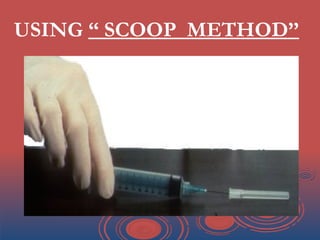
If any ,use the Scoop methodIf any ,use the Scoop method (one(one
hand method).hand method).
USING “ SCOOP METHOD’’
4.4. CLEANING SPILLSCLEANING SPILLS
(e.g. Blood & body fluids)

Wear gloves and other PPEWear gloves and other PPE

Absorb: WipeAbsorb: Wipe up the spill with anup the spill with an
absorbent towel.absorbent towel.Clean with detergentClean with detergent..

ApplyApply disinfectantdisinfectant to the contaminatedto the contaminated
area using sodium hypochloritearea using sodium hypochlorite( Clorox 1:( Clorox 1:
10= 1 volume+9 water volumes)10= 1 volume+9 water volumes) contactcontact
timetime 5-10min.5-10min.

Absorb Clorox and wash with water.Absorb Clorox and wash with water.
Hand HygieneHand Hygiene
Hand washingHand washing
Alcohol-based Hand RubAlcohol-based Hand Rub
Use of gloves doesUse of gloves does NOTNOT replace handreplace hand
washing.washing.
Gloves must be changed in-betweenGloves must be changed in-between
patients.patients.
HAND WASHINGHAND WASHING
When to wash your handsWhen to wash your hands ::
If hands are visibly dirty .If hands are visibly dirty .
Soiled handsSoiled hands with blood or bodywith blood or body
fluids.fluids.
After contactAfter contact with: blood ,bodywith: blood ,body
fluids, secretions or mucusfluids, secretions or mucus
membranes.membranes.
When to wash your hands?When to wash your hands?
 After contact with intact or non-intactAfter contact with intact or non-intact
skin.skin.
 After handling items potentiallyAfter handling items potentially
contaminated (equipments)contaminated (equipments)
 In-between patients .In-between patients .
 After removing gloves.After removing gloves.
 After using bathroomAfter using bathroom..
When to wash handsWhen to wash hands
Before direct contact with patient.Before direct contact with patient.
Before donning (sterile) gloves.Before donning (sterile) gloves.
Before preparing or handlingBefore preparing or handling
medications.medications.
Before handling clean dressing.Before handling clean dressing.
When to use alcohol-basedWhen to use alcohol-based
hand rubhand rub
• If hands areIf hands are NOT visiblyNOT visibly
soiledsoiled alcohol rub could bealcohol rub could be
used instead of hand washing.used instead of hand washing.
• If hand are visibly soiledIf hand are visibly soiled
(contaminated) ,they should be(contaminated) ,they should be
washed first.washed first.
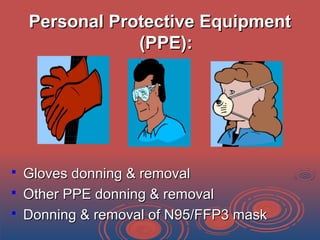
Personal Protective EquipmentPersonal Protective Equipment
(PPE):(PPE):
 Gloves donning & removalGloves donning & removal
 Other PPE donning & removalOther PPE donning & removal
 Donning & removal of N95/FFP3 maskDonning & removal of N95/FFP3 mask
Standard PrecautionsStandard Precautions
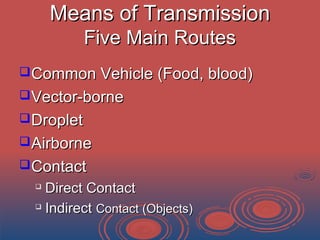
Means of TransmissionMeans of Transmission
Five Main RoutesFive Main Routes
Common Vehicle (Food, blood)Common Vehicle (Food, blood)
Vector-borneVector-borne
DropletDroplet
AirborneAirborne
ContactContact

Direct ContactDirect Contact

IndirectIndirect Contact (Objects)Contact (Objects)
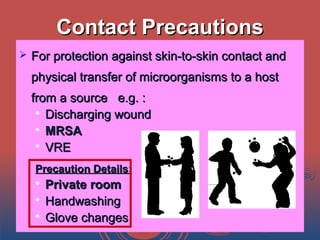
Contact PrecautionsContact Precautions
 For protection against skin-to-skin contact andFor protection against skin-to-skin contact and
physical transfer of microorganisms to a hostphysical transfer of microorganisms to a host
from a source e.g. :from a source e.g. :

Discharging woundDischarging wound

MRSAMRSA

VREVRE
Precaution Details:Precaution Details:

Private roomPrivate room

HandwashingHandwashing

Glove changesGlove changes
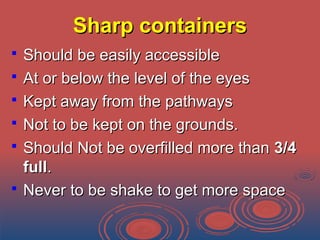
Sharp containersSharp containers
 Should be easily accessibleShould be easily accessible
 At or below the level of the eyesAt or below the level of the eyes
 Kept away from the pathwaysKept away from the pathways
 Not to be kept on the grounds.Not to be kept on the grounds.
 Should Not be overfilled more thanShould Not be overfilled more than 3/43/4
fullfull..
 Never to be shake to get more spaceNever to be shake to get more space
Accidents and InjuriesAccidents and Injuries
 If you are exposed to blood or other potentiallyIf you are exposed to blood or other potentially
infectious or hazardous materials, follow theseinfectious or hazardous materials, follow these
steps:steps:

If you experience a needlestick or sharps injury,If you experience a needlestick or sharps injury,
immediately wash needlesticks or cuts withimmediately wash needlesticks or cuts with
soap and water.soap and water.

Splashes to the nose, mouth, or skin should beSplashes to the nose, mouth, or skin should be
flushed with water.flushed with water.

Irrigate eyes using eyewash, for 10 to 15Irrigate eyes using eyewash, for 10 to 15
minutes.minutes.

Report the incident to your supervisorReport the incident to your supervisor

Immediately seek medical treatmentImmediately seek medical treatment..
SummarySummary
 Treat all human blood, bodily fluids andTreat all human blood, bodily fluids and
other potentially infectious materials as ifother potentially infectious materials as if
they are infectiousthey are infectious
 There are 3 major Blood-borneThere are 3 major Blood-borne
pathogens: Hepatitis B, Hepatitis C andpathogens: Hepatitis B, Hepatitis C and
HIV.HIV.
 The most common mode of transmissionThe most common mode of transmission
of pathogens is the handsof pathogens is the hands
 Wear proper PPE in exposure situationsWear proper PPE in exposure situations
Questions/SuggestionsQuestions/Suggestions
khurramthalwi@hotamail.comkhurramthalwi@hotamail.com

Standard Precautions

  • 1.
    Standard Precautions toStandardPrecautions to Prevent & Control InfectionsPrevent & Control Infections Aman Ullah B.Sc. Med. Lab. Technology M. Phil. Microbiology Certificate in Health Professional Education Lecturer, Department of Medical Lab. Technology Institute of Paramedical Sciences, Khyber Medical University, Peshawar, Pakistan
  • 2.
    ALERT:ALERT: The materialsincluded inThe materials included in this presentation was actuallythis presentation was actually compiled bycompiled by Dr. Naeem KhattakDr. Naeem Khattak in the workshop of infection controlin the workshop of infection control at Khyber medical university,at Khyber medical university, Peshawar, PakistanPeshawar, Pakistan
  • 3.
    Outline of thetopicOutline of the topic To update the participants about :To update the participants about : •State the purpose of standard precautions.State the purpose of standard precautions. •Components of standard precautionsComponents of standard precautions •Routes of transmission of infectious agentsRoutes of transmission of infectious agents •Exposure control methods to prevent exposureExposure control methods to prevent exposure •Infectious or biomedical waste disposal proceduresInfectious or biomedical waste disposal procedures •How to address accidents and injuries whenHow to address accidents and injuries when working with BBPs and OPIMsworking with BBPs and OPIMs
  • 4.
    What are StandardWhatare Standard (universal)(universal) Precautions?Precautions? Standard precaution are controlStandard precaution are control guidelines designed to protectguidelines designed to protect workers from exposure to Diseasesworkers from exposure to Diseases spread by Blood and other Bodyspread by Blood and other Body fluidsfluids (CDC)(CDC)
  • 5.
    Standard (Universal) PrecautionsStandard(Universal) Precautions ““Precautions to protect against exposure must bePrecautions to protect against exposure must be taken when there is any potential for exposure totaken when there is any potential for exposure to bodily fluids. It is assumed that all bodily fluidsbodily fluids. It is assumed that all bodily fluids have the potential to transmit disease”have the potential to transmit disease” The Standard Precaution Rule:The Standard Precaution Rule: Treat all human blood, bodily fluids and otherTreat all human blood, bodily fluids and other potentially infectious materialspotentially infectious materials as if they are infectious.as if they are infectious.
  • 6.
    Why Standard (universal)healthWhy Standard (universal) health Precautions?Precautions? The concept of Standard (universal) HealthThe concept of Standard (universal) Health Precautions emphasizes that all ourPrecautions emphasizes that all our patients should be treated as though theypatients should be treated as though they have potential blood born infections, andhave potential blood born infections, and can infect the caring health care workerscan infect the caring health care workers ((CDC)CDC)
  • 7.
    Infectious Agent Reservoir Means of Exit Mode of Transmission Meansof Entry Susceptible Host Chain of Infection How Infections Occur?How Infections Occur?
  • 8.
    How Exposures Occur?HowExposures Occur?  Most common: needle sticks injuriesMost common: needle sticks injuries  Cuts from other contaminated sharpsCuts from other contaminated sharps (scalpels, broken glass, etc.)(scalpels, broken glass, etc.)  Splashes of blood intoSplashes of blood into mucous membranesmucous membranes (for example, the eye, nose, mouth) or broken(for example, the eye, nose, mouth) or broken skin (cut or abraded) with contaminated bloodskin (cut or abraded) with contaminated blood  Contamination where clothes soaked by bloodContamination where clothes soaked by blood  Bites (which break the skin)Bites (which break the skin)
  • 9.
    How Exposures Occurto Blood borneHow Exposures Occur to Blood borne pathogens?pathogens? By blood from someone who is infected with theBy blood from someone who is infected with the virus getting into someone else's body:virus getting into someone else's body:  Needle stick injuriesNeedle stick injuries  Damaged or cut skin including bitesDamaged or cut skin including bites  Sharing needles, syringes, razors & toothSharing needles, syringes, razors & tooth brushesbrushes  Mother to baby around the time of birthMother to baby around the time of birth  Through unprotected sexual intercourseThrough unprotected sexual intercourse  By tattooing, body piercing or acupuncture ifBy tattooing, body piercing or acupuncture if instruments are not properly sterilisedinstruments are not properly sterilised
  • 10.
    Which human materials/tissuesareWhich human materials/tissues are considered highly Infectious?considered highly Infectious? BloodBlood Blood stained body fluidsBlood stained body fluids SemenSemen Vaginal secretionsVaginal secretions TissuesTissues  CSF, amniotic, pericardial, pleuralCSF, amniotic, pericardial, pleural fluidsfluids
  • 11.
    Which human materials/tissuesare less likely to contain pathogens? Body fluids less likely to contain pathogens:  TearsTears  Nasal secretionsNasal secretions  SweatSweat  Saliva (more likely if blood present)Saliva (more likely if blood present)
  • 12.
    Spread of InfectionSpreadof Infection BBVs (contd.)BBVs (contd.) Blood borne viruses CANNOT be caught from:Blood borne viruses CANNOT be caught from:  coughing, sneezingcoughing, sneezing  shared use of facilities such as toilets, watershared use of facilities such as toilets, water fountains or telephonesfountains or telephones  sharing glasses, plates and cutlerysharing glasses, plates and cutlery  shaking handsshaking hands  swimming in a poolswimming in a pool  if blood or body fluids fall onto intact skinif blood or body fluids fall onto intact skin N.B: For infection to spread, Infected blood (bodyN.B: For infection to spread, Infected blood (body fluid) needs to enter bodyfluid) needs to enter body
  • 13.
    BBV’s - riskof transmissionBBV’s - risk of transmission Estimated risk from person infectedEstimated risk from person infected  Hepatitis B positive sourceHepatitis B positive source - 1 in 3- 1 in 3  Hepatitis C positive sourceHepatitis C positive source -1 in 30-1 in 30  HIVHIV - 1 in 300- 1 in 300 Occupational risk (HCW) of acquiring BBVOccupational risk (HCW) of acquiring BBV post exposure:post exposure:  HIV 0.37%HIV 0.37%  HBV 20-40%HBV 20-40% (Alder 1997)(Alder 1997)
  • 14.
    Standard PrecautionsStandard Precautions •Apply standard precautions to allApply standard precautions to all patients regardless of theirpatients regardless of their diagnosis, and to all contaminateddiagnosis, and to all contaminated equipment and materialsequipment and materials • Use judgment in determining whichUse judgment in determining which protective barriers are necessary.protective barriers are necessary.
  • 15.
    Standard PrecautionsStandard Precautions •Applied to Blood, Blood Products,Applied to Blood, Blood Products, Body fluids and ExcretaBody fluids and Excreta • To avoid exposure to blood-borneTo avoid exposure to blood-borne pathogens (e.g. HBV, HCV & HIV)pathogens (e.g. HBV, HCV & HIV)
  • 16.
    Standard PrecautionsStandard Precautions 1.1.Hands HygieneHands Hygiene 2.2. Use Personal protectiveUse Personal protective equipments (PPE)equipments (PPE)  GlovesGloves  GownsGowns  MasksMasks  Eye protectionEye protection  Face ShieldsFace Shields
  • 17.
    3.3. Discard needlesand otherDiscard needles and other sharps in thesharps in the sharp containerssharp containers which are located as close as possible towhich are located as close as possible to the area of use.the area of use. Don't recap needlesDon't recap needles,, If any ,use the Scoop methodIf any ,use the Scoop method (one(one hand method).hand method).
  • 18.
    USING “ SCOOPMETHOD’’
  • 19.
    4.4. CLEANING SPILLSCLEANINGSPILLS (e.g. Blood & body fluids)  Wear gloves and other PPEWear gloves and other PPE  Absorb: WipeAbsorb: Wipe up the spill with anup the spill with an absorbent towel.absorbent towel.Clean with detergentClean with detergent..  ApplyApply disinfectantdisinfectant to the contaminatedto the contaminated area using sodium hypochloritearea using sodium hypochlorite( Clorox 1:( Clorox 1: 10= 1 volume+9 water volumes)10= 1 volume+9 water volumes) contactcontact timetime 5-10min.5-10min.  Absorb Clorox and wash with water.Absorb Clorox and wash with water.
  • 20.
    Hand HygieneHand Hygiene HandwashingHand washing Alcohol-based Hand RubAlcohol-based Hand Rub Use of gloves doesUse of gloves does NOTNOT replace handreplace hand washing.washing. Gloves must be changed in-betweenGloves must be changed in-between patients.patients.
  • 21.
    HAND WASHINGHAND WASHING Whento wash your handsWhen to wash your hands :: If hands are visibly dirty .If hands are visibly dirty . Soiled handsSoiled hands with blood or bodywith blood or body fluids.fluids. After contactAfter contact with: blood ,bodywith: blood ,body fluids, secretions or mucusfluids, secretions or mucus membranes.membranes.
  • 22.
    When to washyour hands?When to wash your hands?  After contact with intact or non-intactAfter contact with intact or non-intact skin.skin.  After handling items potentiallyAfter handling items potentially contaminated (equipments)contaminated (equipments)  In-between patients .In-between patients .  After removing gloves.After removing gloves.  After using bathroomAfter using bathroom..
  • 23.
    When to washhandsWhen to wash hands Before direct contact with patient.Before direct contact with patient. Before donning (sterile) gloves.Before donning (sterile) gloves. Before preparing or handlingBefore preparing or handling medications.medications. Before handling clean dressing.Before handling clean dressing.
  • 24.
    When to usealcohol-basedWhen to use alcohol-based hand rubhand rub • If hands areIf hands are NOT visiblyNOT visibly soiledsoiled alcohol rub could bealcohol rub could be used instead of hand washing.used instead of hand washing. • If hand are visibly soiledIf hand are visibly soiled (contaminated) ,they should be(contaminated) ,they should be washed first.washed first.
  • 25.
    Personal Protective EquipmentPersonalProtective Equipment (PPE):(PPE):  Gloves donning & removalGloves donning & removal  Other PPE donning & removalOther PPE donning & removal  Donning & removal of N95/FFP3 maskDonning & removal of N95/FFP3 mask
  • 26.
  • 27.
    Means of TransmissionMeansof Transmission Five Main RoutesFive Main Routes Common Vehicle (Food, blood)Common Vehicle (Food, blood) Vector-borneVector-borne DropletDroplet AirborneAirborne ContactContact  Direct ContactDirect Contact  IndirectIndirect Contact (Objects)Contact (Objects)
  • 28.
    Contact PrecautionsContact Precautions For protection against skin-to-skin contact andFor protection against skin-to-skin contact and physical transfer of microorganisms to a hostphysical transfer of microorganisms to a host from a source e.g. :from a source e.g. :  Discharging woundDischarging wound  MRSAMRSA  VREVRE Precaution Details:Precaution Details:  Private roomPrivate room  HandwashingHandwashing  Glove changesGlove changes
  • 29.
    Sharp containersSharp containers Should be easily accessibleShould be easily accessible  At or below the level of the eyesAt or below the level of the eyes  Kept away from the pathwaysKept away from the pathways  Not to be kept on the grounds.Not to be kept on the grounds.  Should Not be overfilled more thanShould Not be overfilled more than 3/43/4 fullfull..  Never to be shake to get more spaceNever to be shake to get more space
  • 30.
    Accidents and InjuriesAccidentsand Injuries  If you are exposed to blood or other potentiallyIf you are exposed to blood or other potentially infectious or hazardous materials, follow theseinfectious or hazardous materials, follow these steps:steps:  If you experience a needlestick or sharps injury,If you experience a needlestick or sharps injury, immediately wash needlesticks or cuts withimmediately wash needlesticks or cuts with soap and water.soap and water.  Splashes to the nose, mouth, or skin should beSplashes to the nose, mouth, or skin should be flushed with water.flushed with water.  Irrigate eyes using eyewash, for 10 to 15Irrigate eyes using eyewash, for 10 to 15 minutes.minutes.  Report the incident to your supervisorReport the incident to your supervisor  Immediately seek medical treatmentImmediately seek medical treatment..
  • 31.
    SummarySummary  Treat allhuman blood, bodily fluids andTreat all human blood, bodily fluids and other potentially infectious materials as ifother potentially infectious materials as if they are infectiousthey are infectious  There are 3 major Blood-borneThere are 3 major Blood-borne pathogens: Hepatitis B, Hepatitis C andpathogens: Hepatitis B, Hepatitis C and HIV.HIV.  The most common mode of transmissionThe most common mode of transmission of pathogens is the handsof pathogens is the hands  Wear proper PPE in exposure situationsWear proper PPE in exposure situations
  • 32.