


MODULE 10 COMMON EMERGENCIES
SCOPE OF PRESENTATION ENVIRONMENTAL EMERGENCIES MEDICAL EMERGENCIES EMERGENCY CHILDBIRTH OTHER EMERGENCIES
I. ENVIRONMENTAL  EMERGENCIES A.  COLD EMERGENCIES HYPOTHERMIA   -  A condition when the entire body temp  falls.   1.Mild Hypothermia – patient is still alert   and oriented   Signs and Symptoms :  cold skin    apathy, drowsiness, incoherence      breathing rate  sluggish pupils    pulse rate  uncontrollable shivering   slow, thick speech   apathy, drowsiness, incoherence   staggering walk
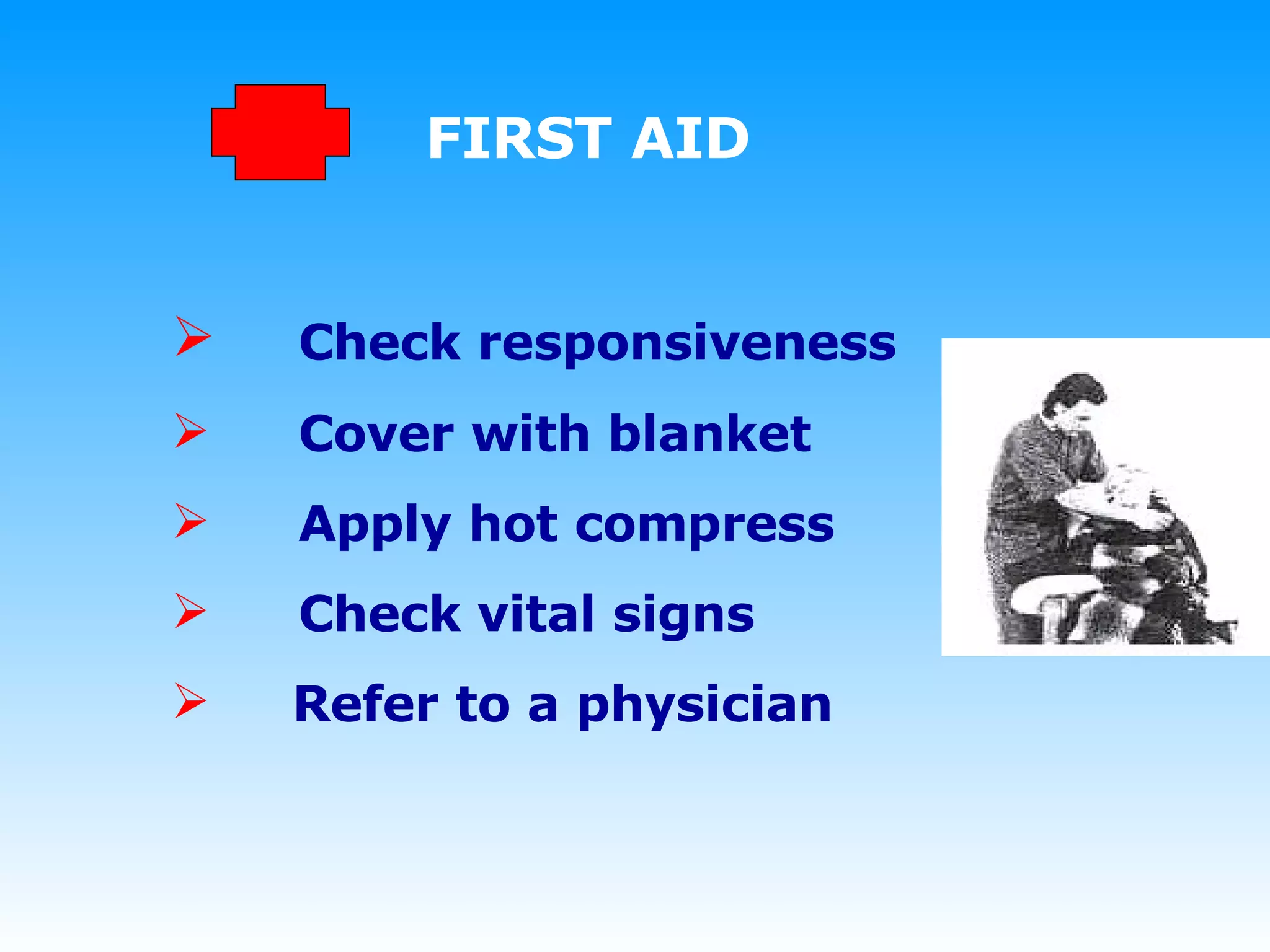
FIRST AID Check responsiveness Cover with blanket Apply hot compress Check vital signs Refer to a physician
b.  Severe Hypothermia   –  patient may  become    unresponsive.  Signs and Symptoms: Extremely slow breathing rate. Extremely slow pulse rate. Unresponsiveness Fixed and dilated pupils. Rigid extremities. Absence of shivering
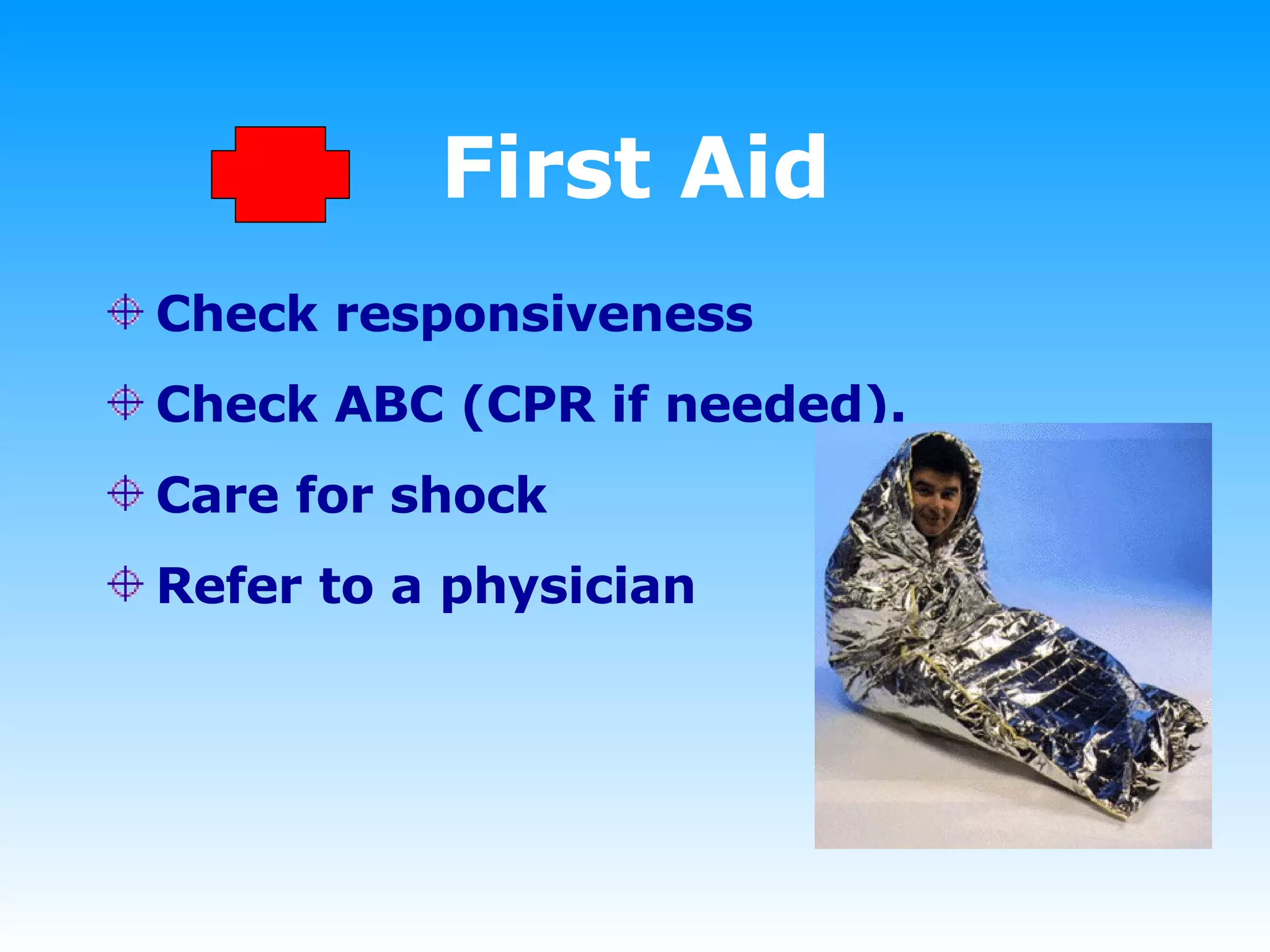
First Aid Check responsiveness Check ABC (CPR if needed). Care for shock Refer to a physician
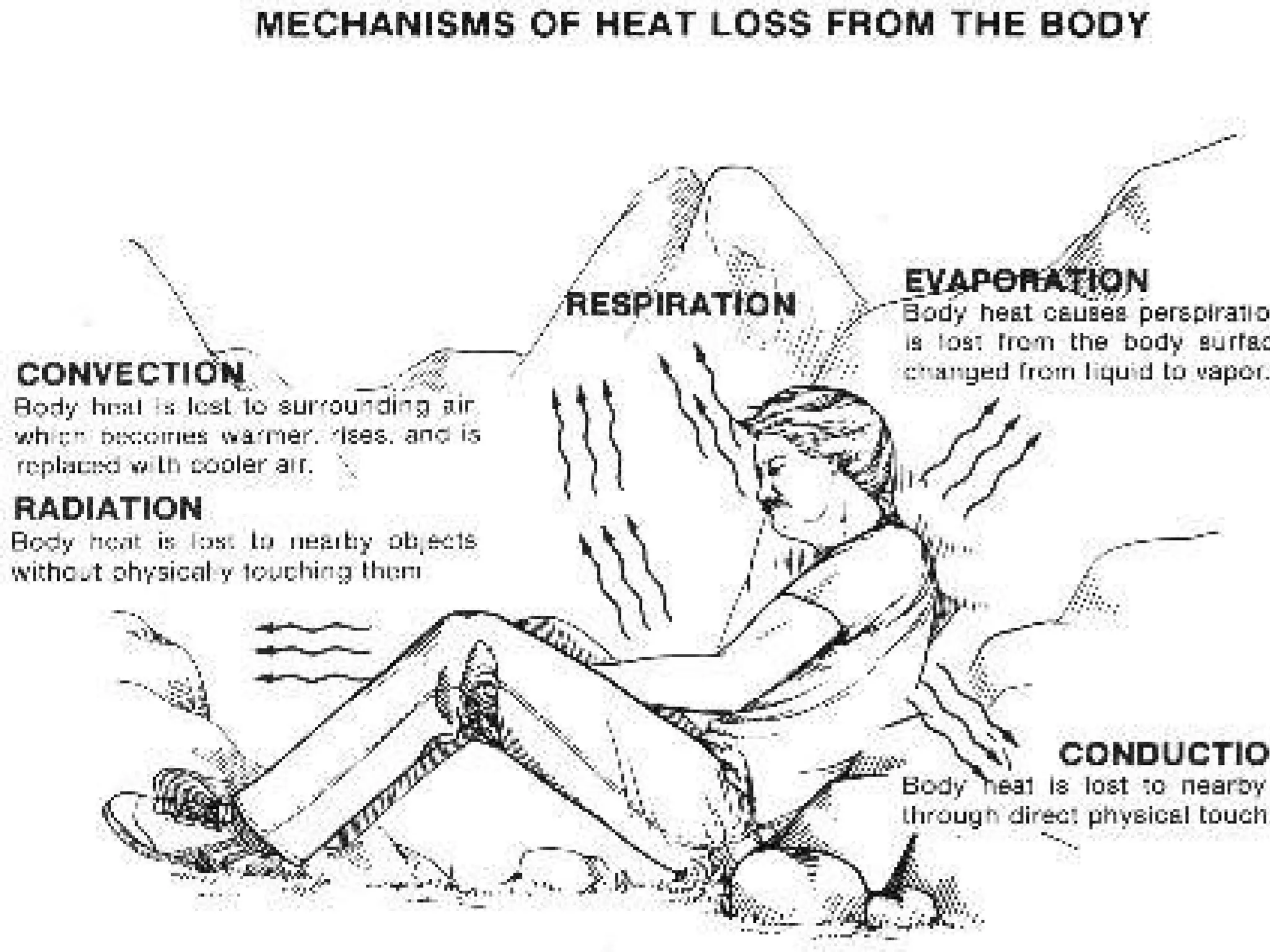
B.   Heat Emergencies Mechanism of Heat Loss Convection - Body heat is lost to surrounding air. Respiration - Occurs when  one breathes in cold air and  breathes out air warned inside the body. Radiation - Body heat is lost to nearby objects without  physically touching them. Conduction-  Body heat is lost to nearby objects through  direct physical touch. Evaporation-  Body heat causes perspiration, which is lost  from the body surface when changed from  liquid to   vapor
 
General types of  Heat Emergencies 1.   Heat Cramps   -  a muscular pain and spasm due largely to loss of salt from the body. Signs and Symptoms Muscle cramps, (abdomen or legs) Heavy perspiration. Lightheadedness;weakness
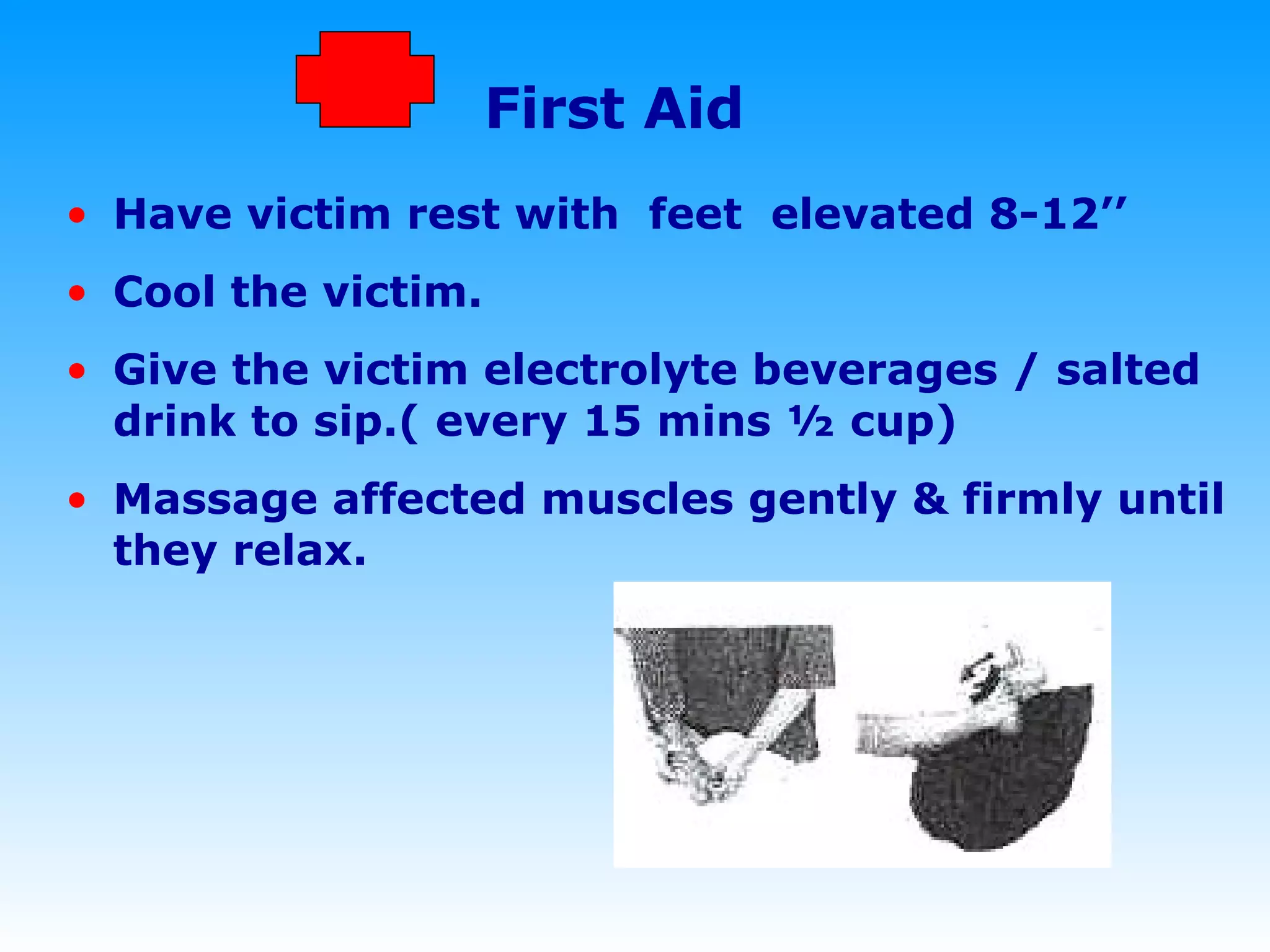
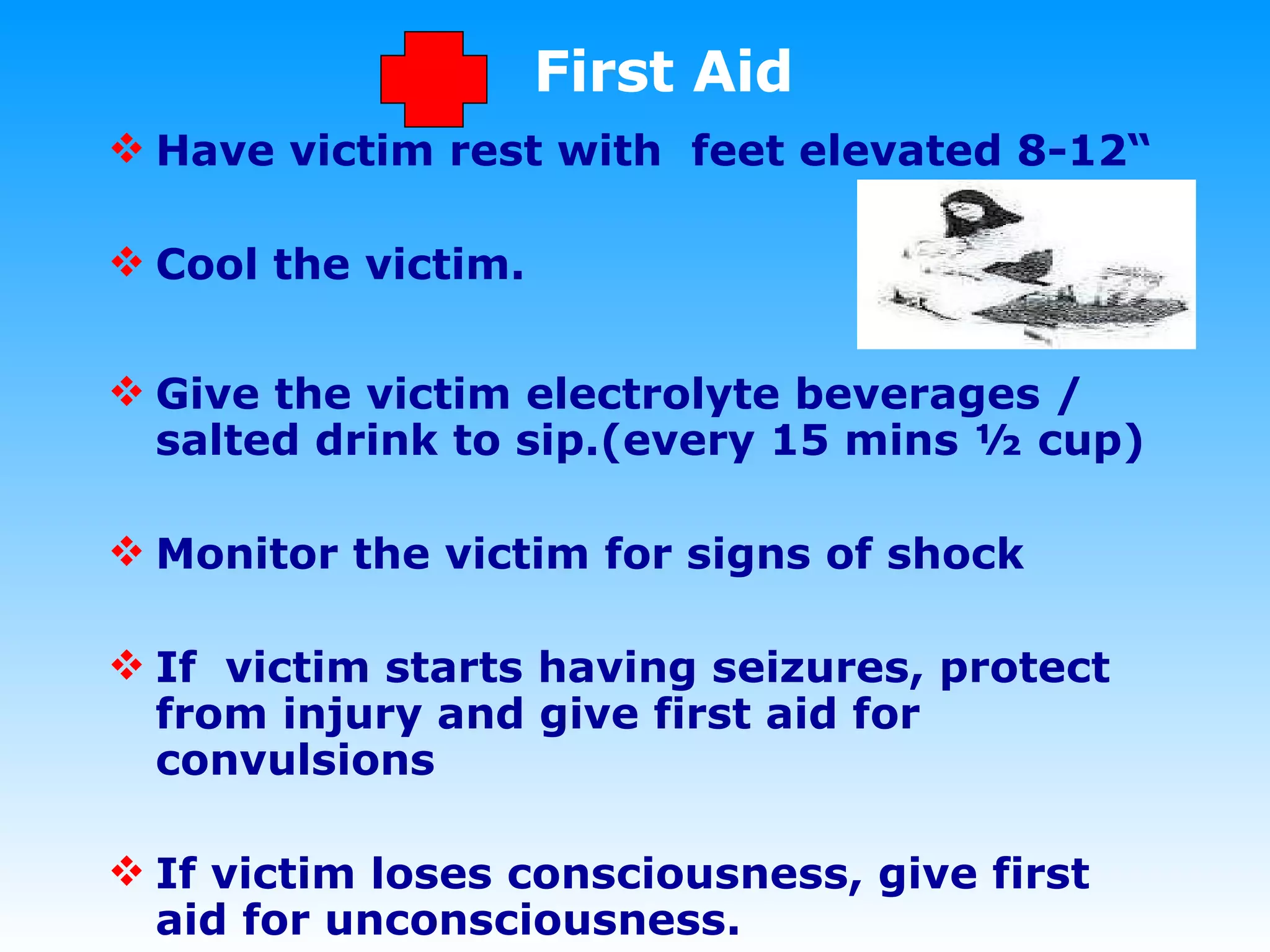
First Aid Have victim rest with  feet  elevated 8-12’’  Cool the victim. Give the victim electrolyte beverages / salted drink to sip.( every 15 mins ½ cup)  Massage affected muscles gently & firmly until they relax.
2.  Heat Exhaustion A response to heat characterized by fatigue, weakness, and collapse due to inadequate intake of water to compensate for loss of fluids through sweating
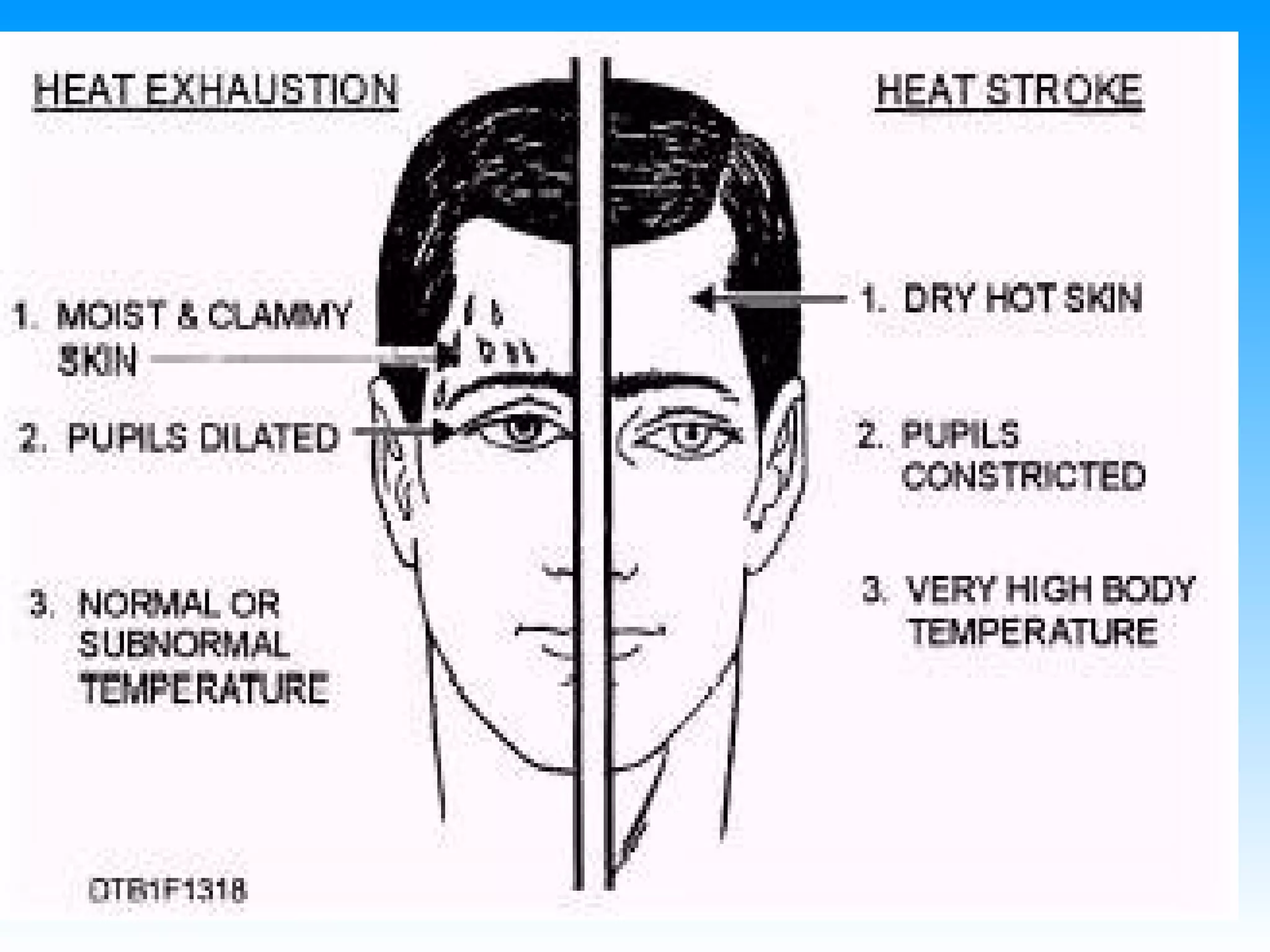
Signs and Symptoms Cool, pale or red, moist skin  Dilated Pupils Headache Extreme thirst. Nausea; vomiting. Irrational behavior. Weakness; dizziness. Unconsciousness
First Aid Have victim rest with  feet elevated 8-12 “ Cool the victim. Give the victim electrolyte beverages / salted drink to sip.(every 15 mins ½ cup)  Monitor the victim for signs of shock If  victim starts having seizures, protect from injury and give first aid for convulsions If victim loses consciousness, give first aid for unconsciousness.
Heat Stroke or Sunstroke A response to heat characterized by extremely high body temperature and disturbance of sweating mechanism. Signs and Symptoms Raised body temp (  102 °F). Dry, hot red skin, Dark urine. Small pupils. Rapid, shallow breathing, Extreme confusion. Weakness Seizures Unconsciousness
 
First Aid Cool the victim. (no alcohol rub) Give First Aid for shock.Lay the victim flat and elevate his\her legs 8-12 inches.  If the victim starts having seizures, give first aid for seizures. Keep the victim cool as you await medical help.
Prevention of Heat Emergencies Avoid exposure to direct rays of sun. Wear proper clothing. 12-15 glasses a day, together with extra salt. Exposure to air currents from fans or open windows.
Some Reminders Don’t underestimate seriousness of heat illness especially if victim is a child, elderly, or injured. Don’t give  victim liquids that contain alcohol or caffeine.  Don’t give victim over-the-counter medications that are used to treat fever. Don’t give victim salt tablets.  Don’t overlook possible complication resulting from the victim’s ongoing medical problem. 6.  For heatstroke – don’t give victim any thing by mouth – not even salted drinks.
How to Cool a Victim of Heat Illness   Move the victim into the shade, into a cool room, or to air-conditioned building or car. Spray the victim with hose, or pour a bucket of water over him or her (not in the face).  Wrap the victim in wet towels or sheets, then turn on a fan.  Place cold compresses on the victim’s neck, groin, and armpits.
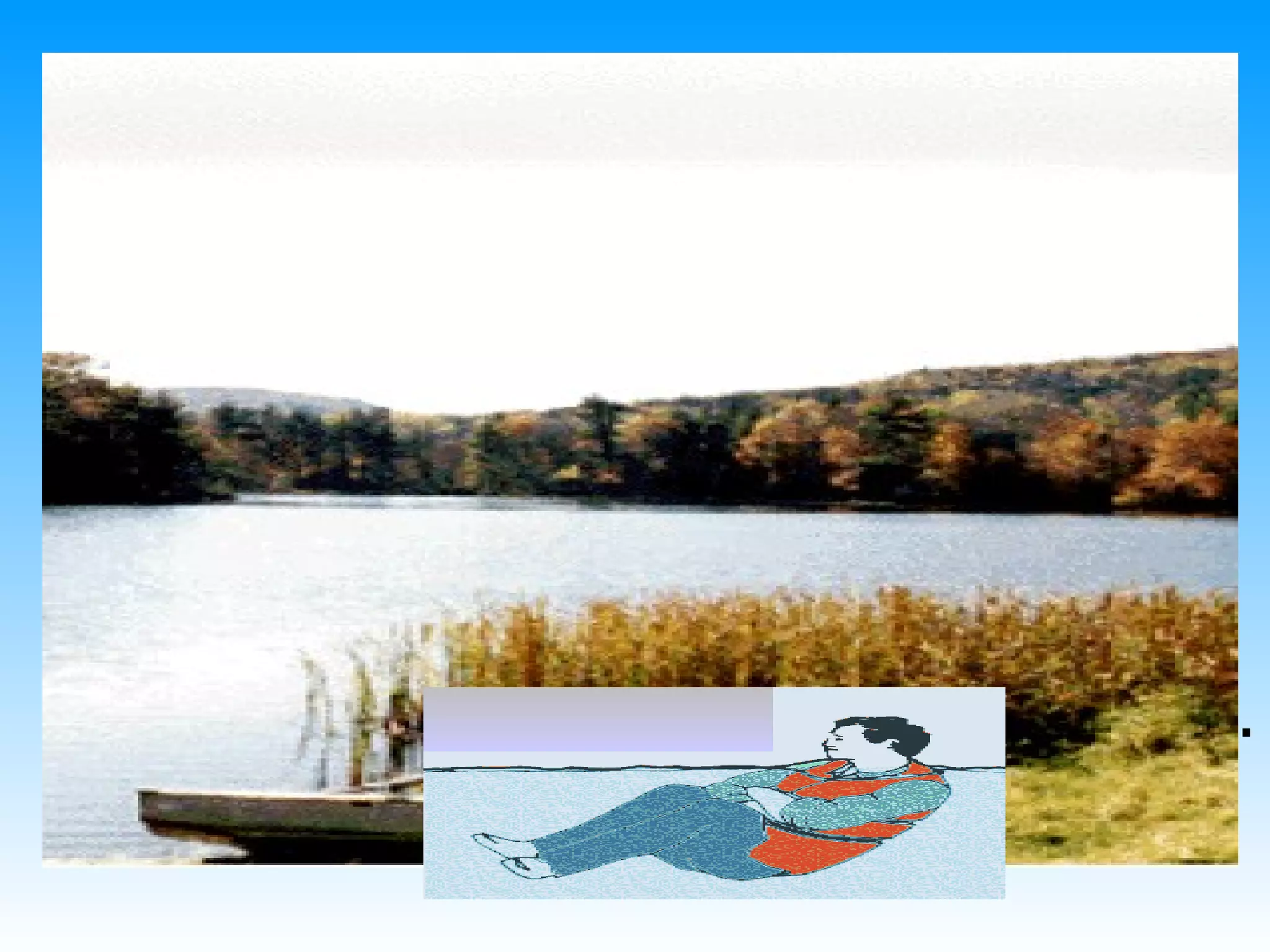
5 . Heat stroke - immerse victim in cold water  (bath, lake, stream),if medical help is not  immediately available, but only if you can  carefully monitor level of alertness and ABC’s). 6.Once temp is    to 100  ° F, ease up  cooling  efforts, but keep checking the temp every ½ hr.  for next 3 - 4 hrs .
MEDICAL  EMERGENCIES
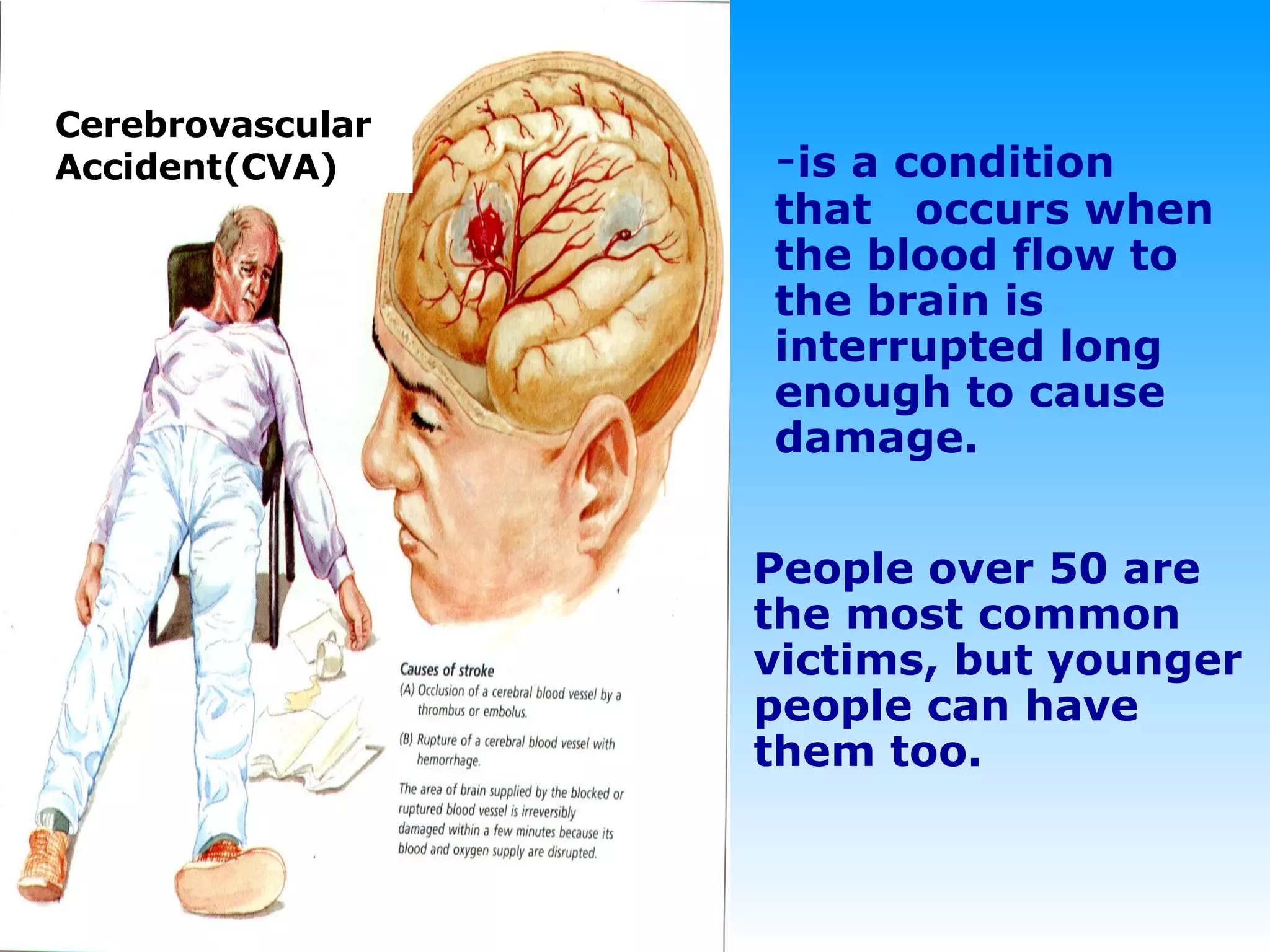
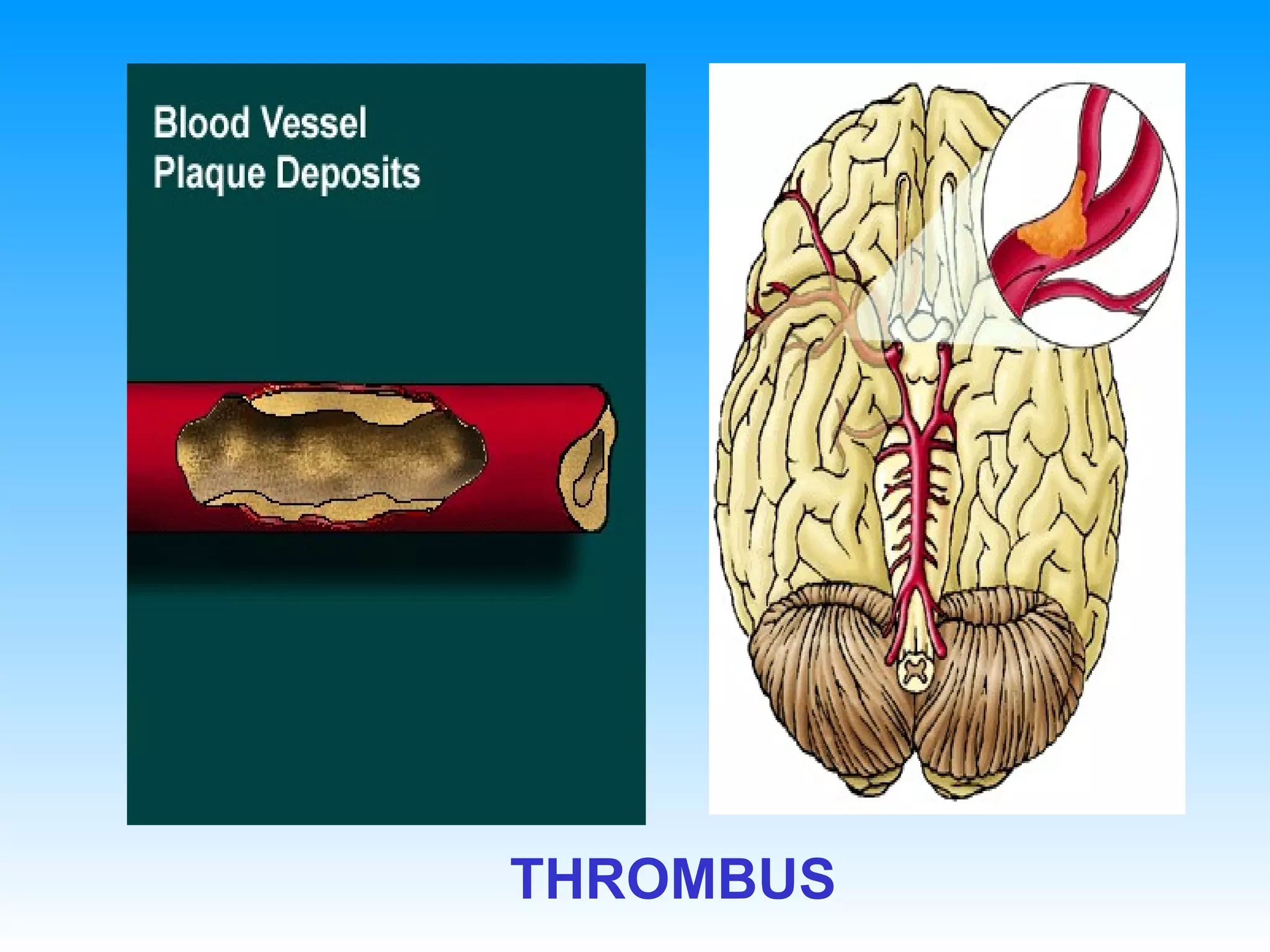
Stroke Cerebrovascular  Accident(CVA) - is a condition that  occurs when the blood flow to the brain is interrupted long enough to cause damage. People over 50 are the most common victims, but younger people can have them   too.
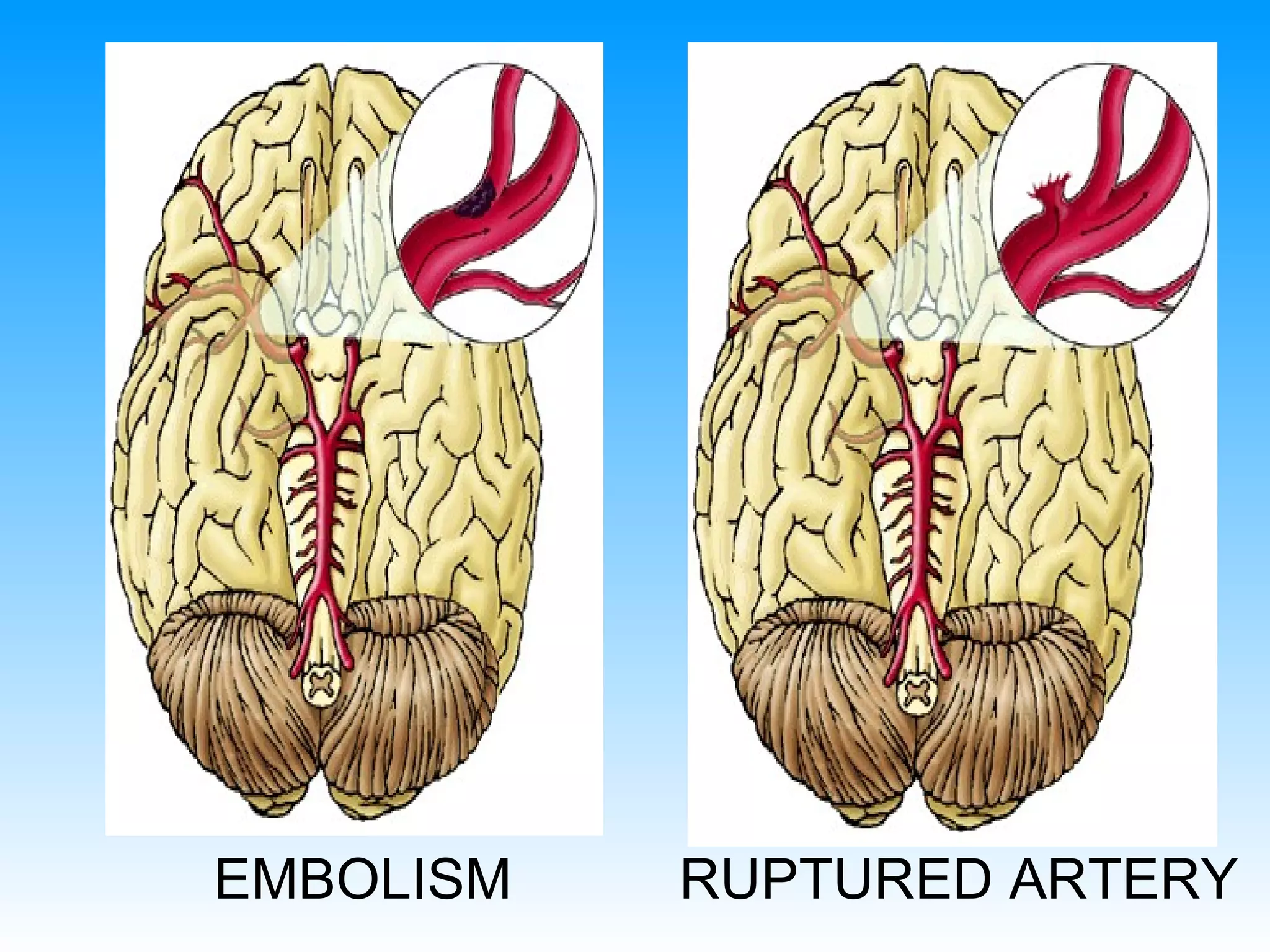
Causes 1.  Thrombus or Embolism 2. Ruptured artery in the brain due to:  - head injury - high blood pressure,  - a weak spot in the wall of the blood vessel    (Aneurysm)  -fat deposit lining a vessel (Atherosclerosis) 3.   Compression of an artery in the brain -  brain tumor - inborn anomalies
EMBOLISM RUPTURED ARTERY
THROMBUS
Signs and Symptoms   -weakness and  numbness of the face, arm,  or leg often on one side only.   - dizziness,    - confusion, -headache  -ringing in the ears   -a change in mood   -difficulty in speaking, breathing and swallowing   -loss of bowel and bladder control
First Aid Management    Check the victim’s ABC’s.     Have the victim rest in a comfortable position.    Seek immediate medical help.    Do not give the victim anything by mouth.    If unconscious, place  in a recovery position and  administer first aid for unconsciousness.    Continue monitoring his ABC’s    Stay with  victim until you have medical help.
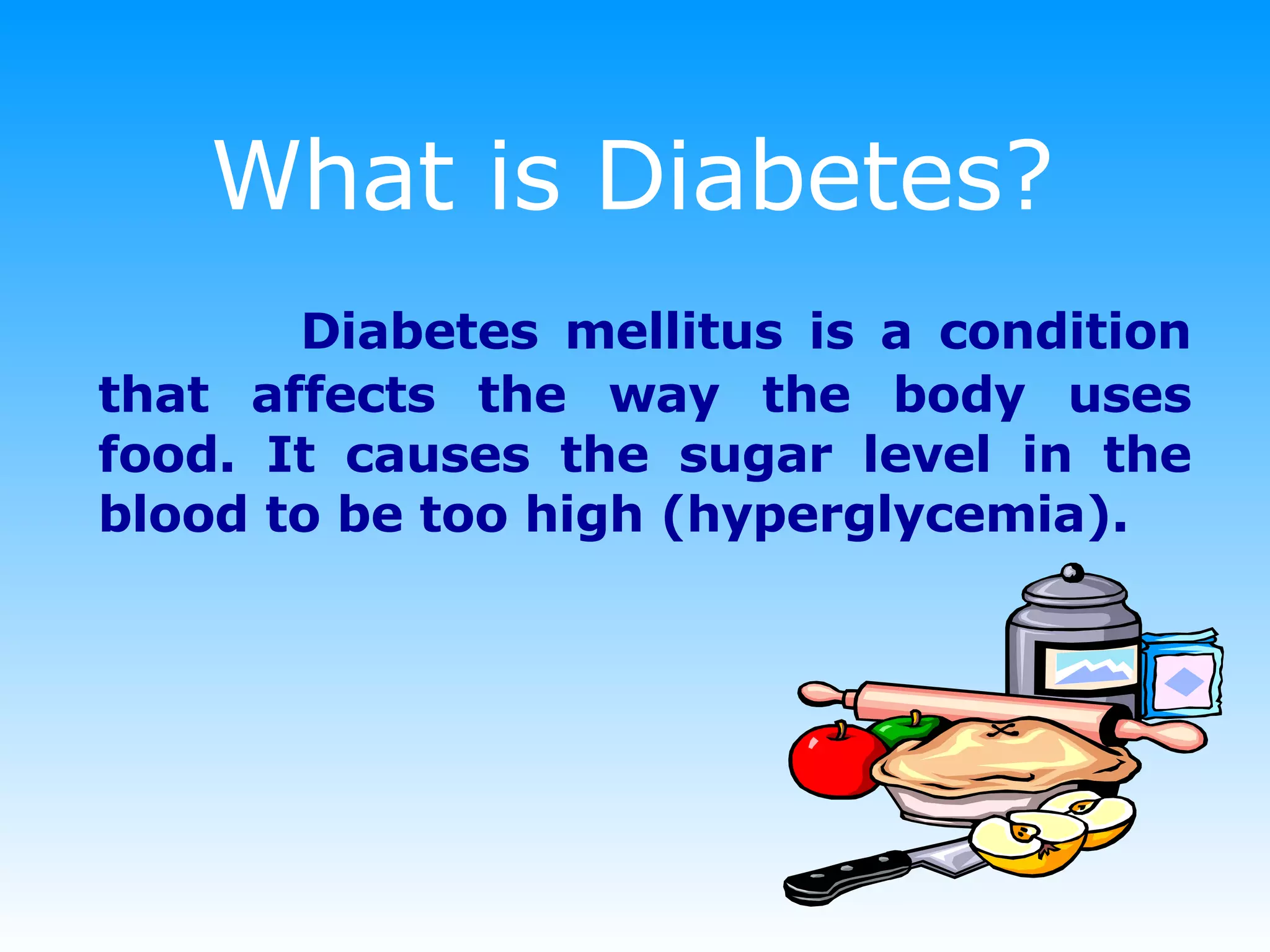
What is Diabetes? Diabetes mellitus is a condition that affects the way the body uses food. It causes the sugar level in the blood to be too high (hyperglycemia).
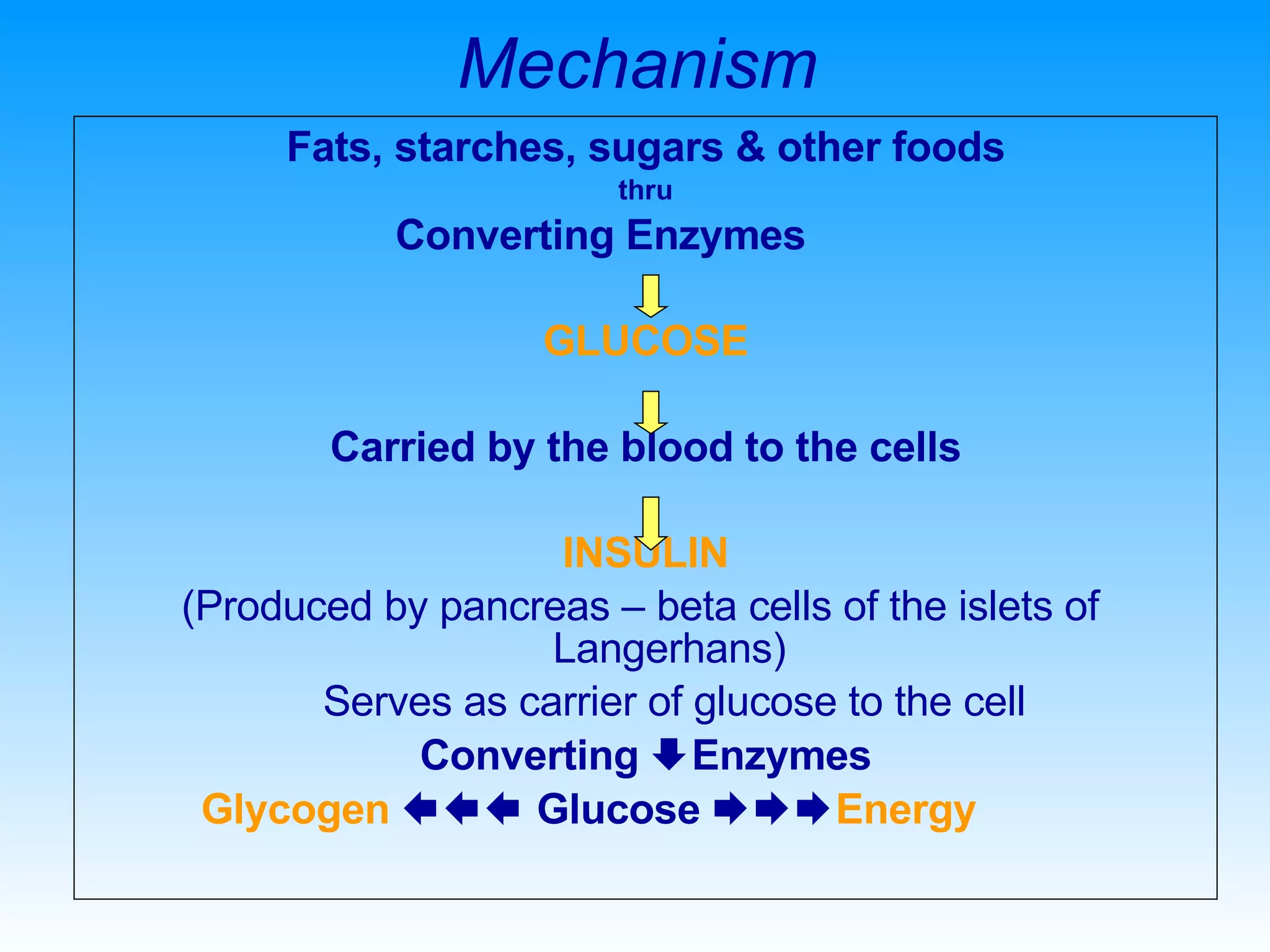
Mechanism Fats, starches, sugars & other foods thru Converting Enzymes GLUCOSE Carried by the blood to the cells INSULIN (Produced by pancreas – beta cells of the islets of  Langerhans) Serves as carrier of glucose to the cell Converting   Enzymes Glycogen     Glucose   Energy
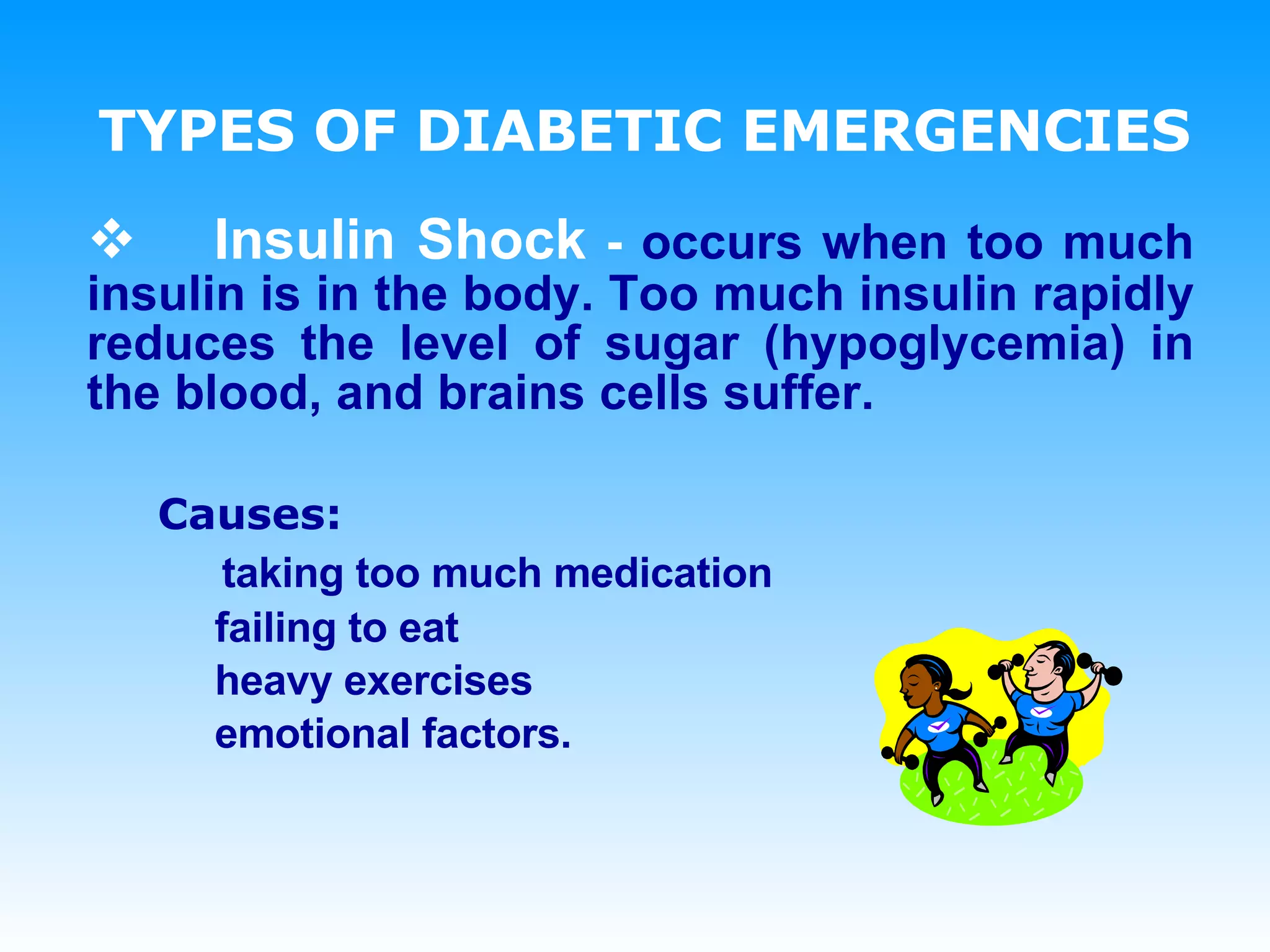
TYPES OF DIABETIC EMERGENCIES Insulin Shock  -  occurs when too much insulin is in the body. Too much insulin rapidly reduces the level of sugar (hypoglycemia) in the blood, and brains cells suffer. Causes:   taking too much medication failing to eat heavy exercises  emotional factors.
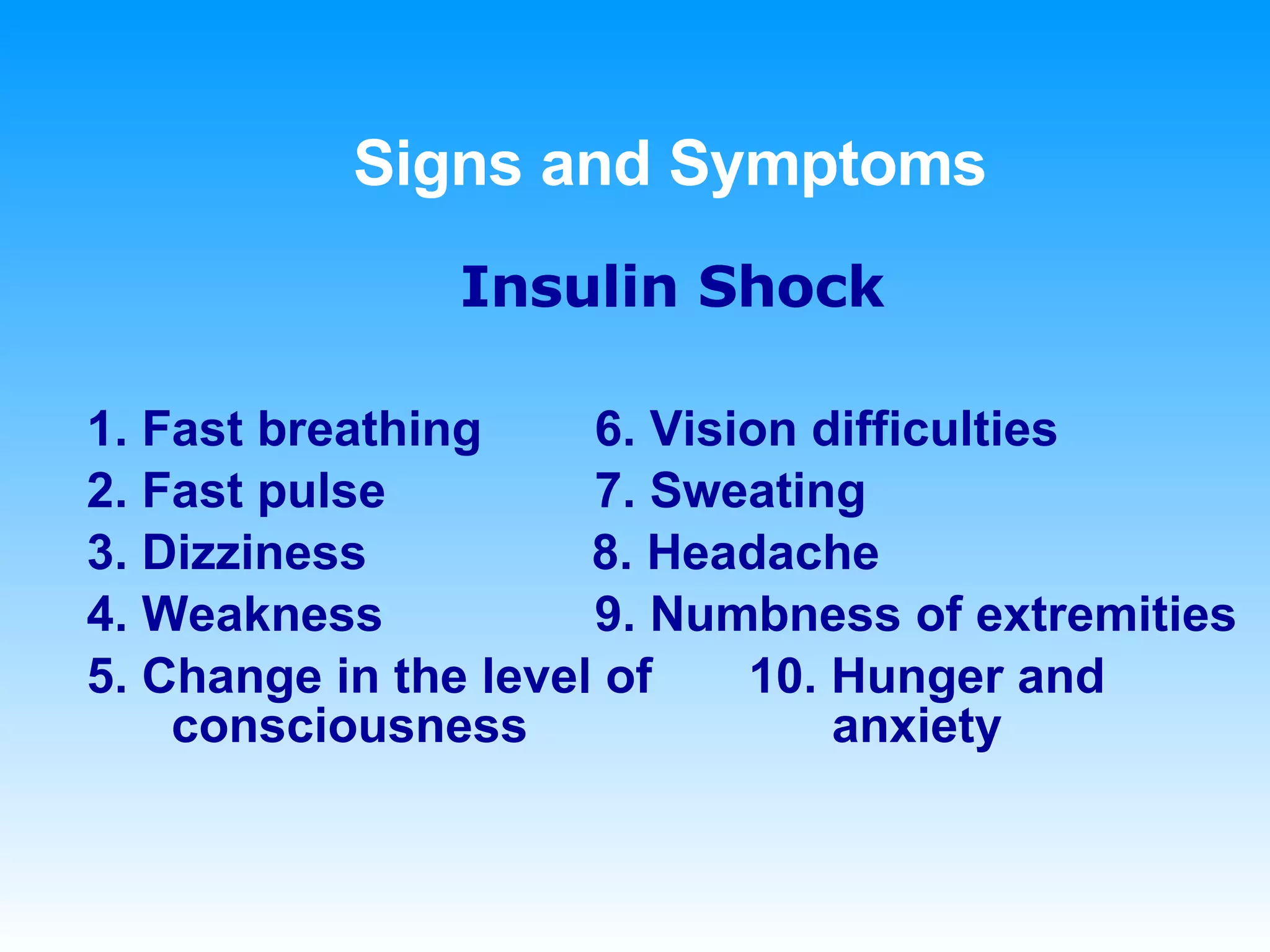
Signs and Symptoms Insulin Shock 1. Fast breathing 6. Vision difficulties 2. Fast pulse 7. Sweating 3. Dizziness   8. Headache 4. Weakness 9. Numbness of extremities 5. Change in the level of  10. Hunger and consciousness   anxiety
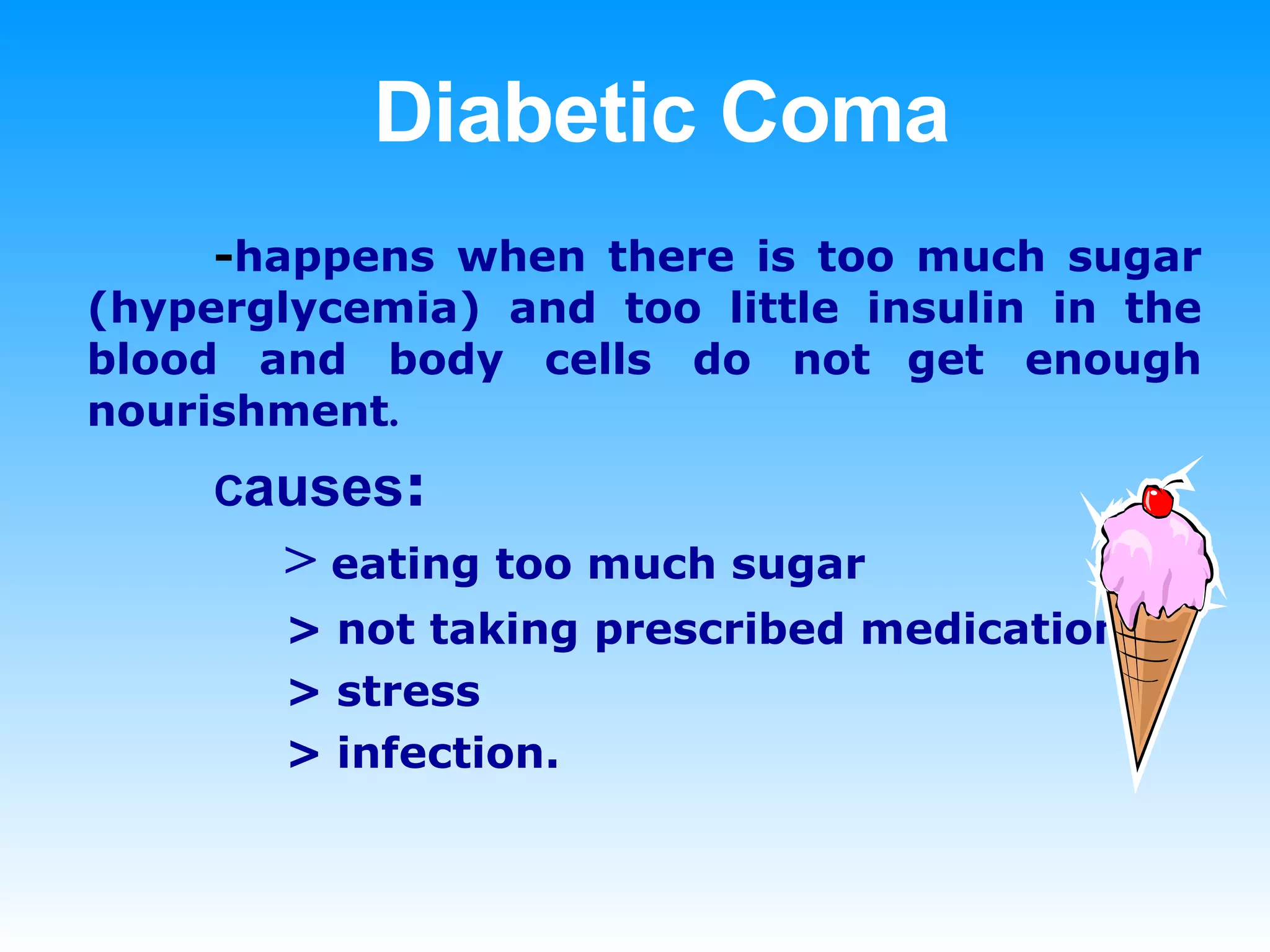
Diabetic Coma - happens when there is too much sugar (hyperglycemia) and too little insulin in the blood and body cells do not   get enough nourishment . C auses :   >  eating too much sugar   > not taking prescribed medication   > stress   > infection.
SIGNS AND SYMPTOMS   1. Drowsiness and confusion 2. Deep and fast breathing 3. Thirst  4. Dehydration 5. Fever 6. A fruity smelling breath 7. A change of consciousness
Important Note Besides being aware of the different signs and symptoms listed, you can ask someone who is conscious these questions:  “Have you eaten today?”  and  “Have you taken your medication today?” .   A. Someone who has eaten but has not taken his/ her medication maybe in  Diabetic Coma . B. Someone who has not eaten but has taken his/her medication  maybe  having  an  Insulin  Reaction .
First Aid Management 1. In a diabetic emergency, it is possible to confuse signs & symptoms of insulin shock and diabetic coma. Since  Insulin Shock  is a  true emergency  that needs quick response, give any fully conscious victim in diabetic emergency sugar-candy, fruit juice, or a soft drink containing sugar.
2. If a victim is unconscious check his ABC’s and call for a physician. 3. A person/victim of diabetic coma also needs immediate transport to the hospital.
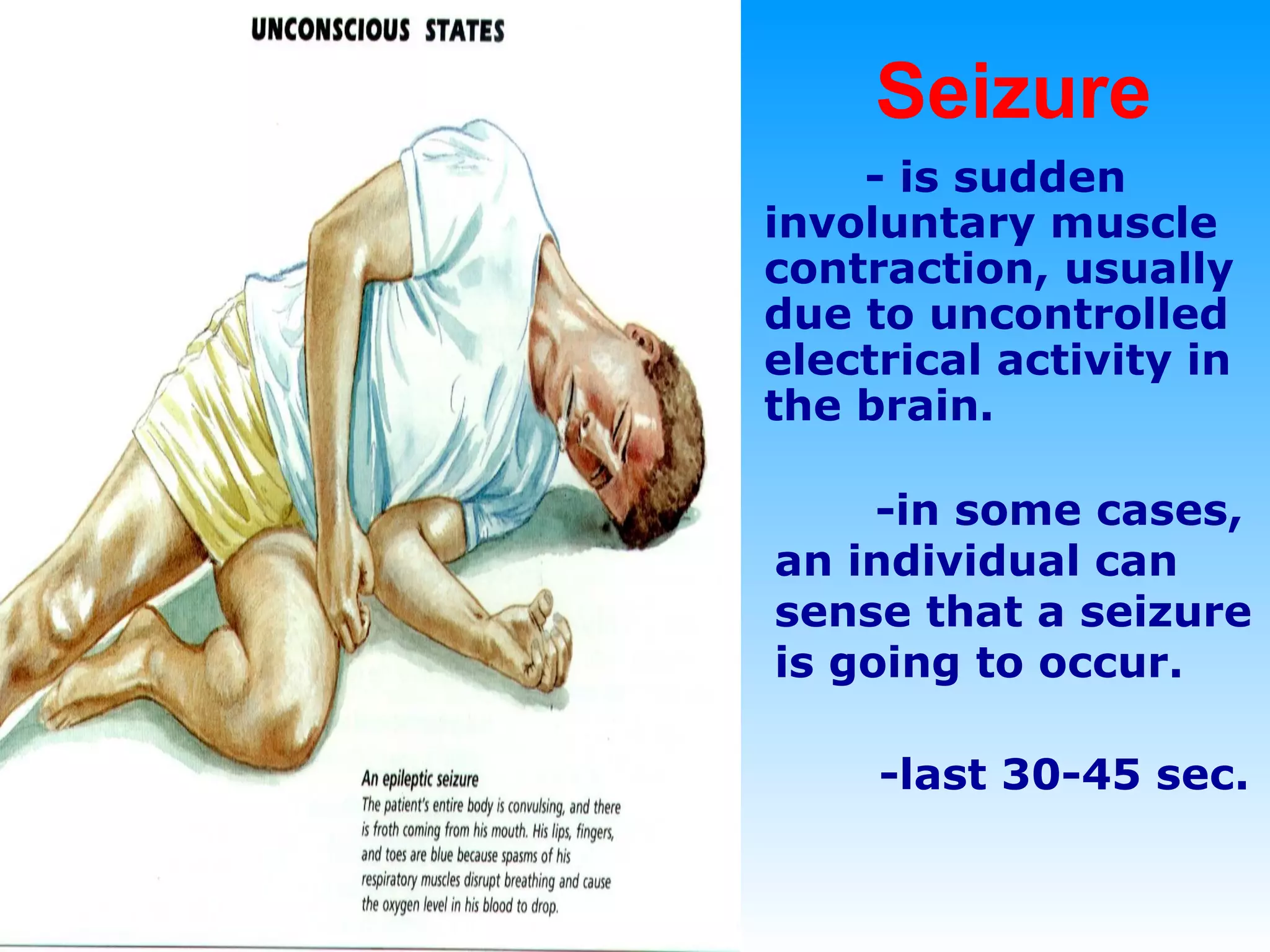
Seizure - is sudden involuntary muscle contraction, usually due to uncontrolled electrical activity in the brain. -in some cases, an individual can sense that a seizure is going to occur. -last 30-45 sec.
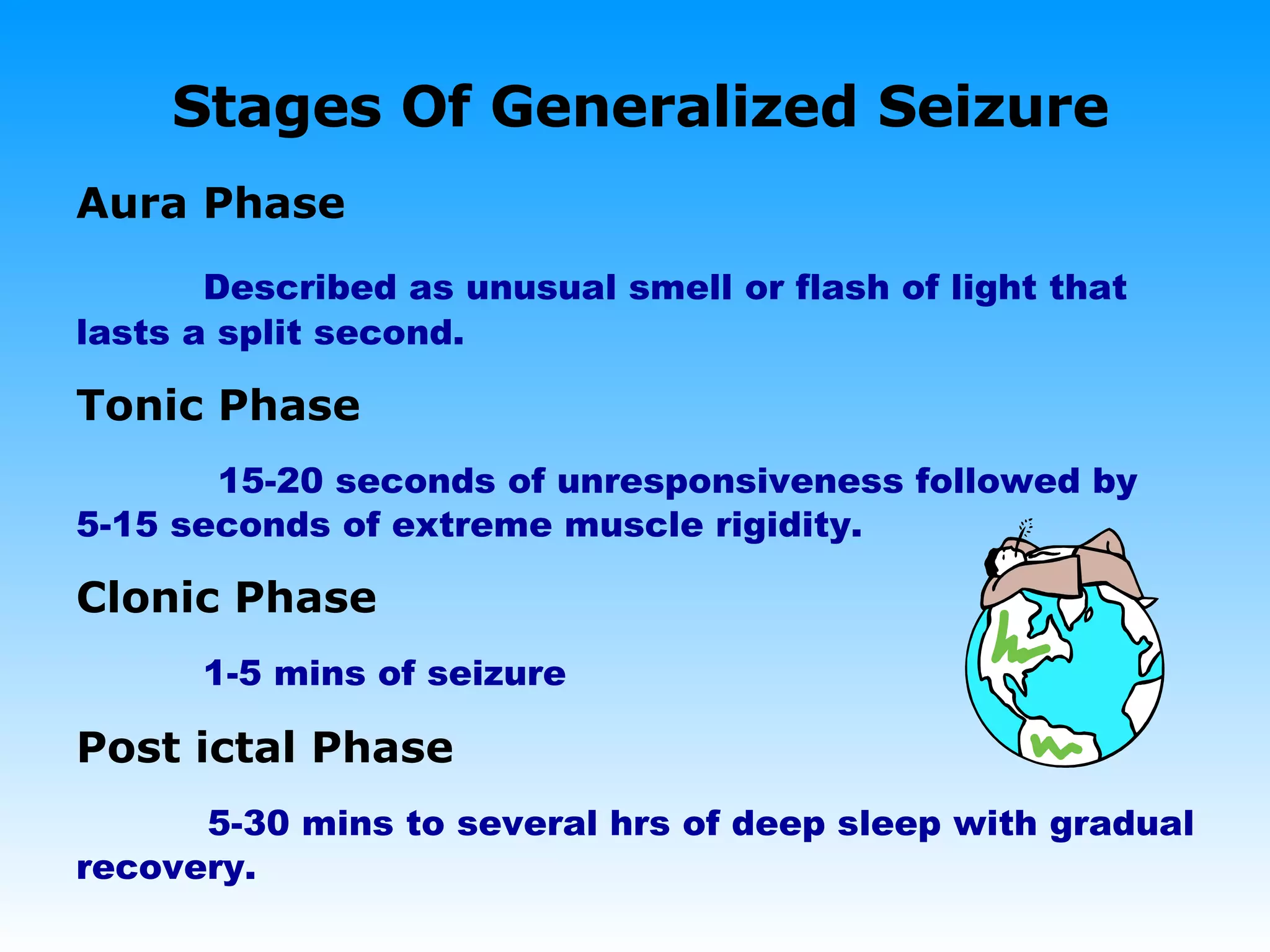
Stages Of Generalized Seizure Aura Phase   Described as unusual smell or flash of light that lasts a split second. Tonic Phase     15-20 seconds of unresponsiveness followed by 5-15 seconds of extreme muscle rigidity. Clonic Phase 1-5 mins of seizure Post ictal Phase 5-30 mins to several hrs of deep sleep with gradual recovery.
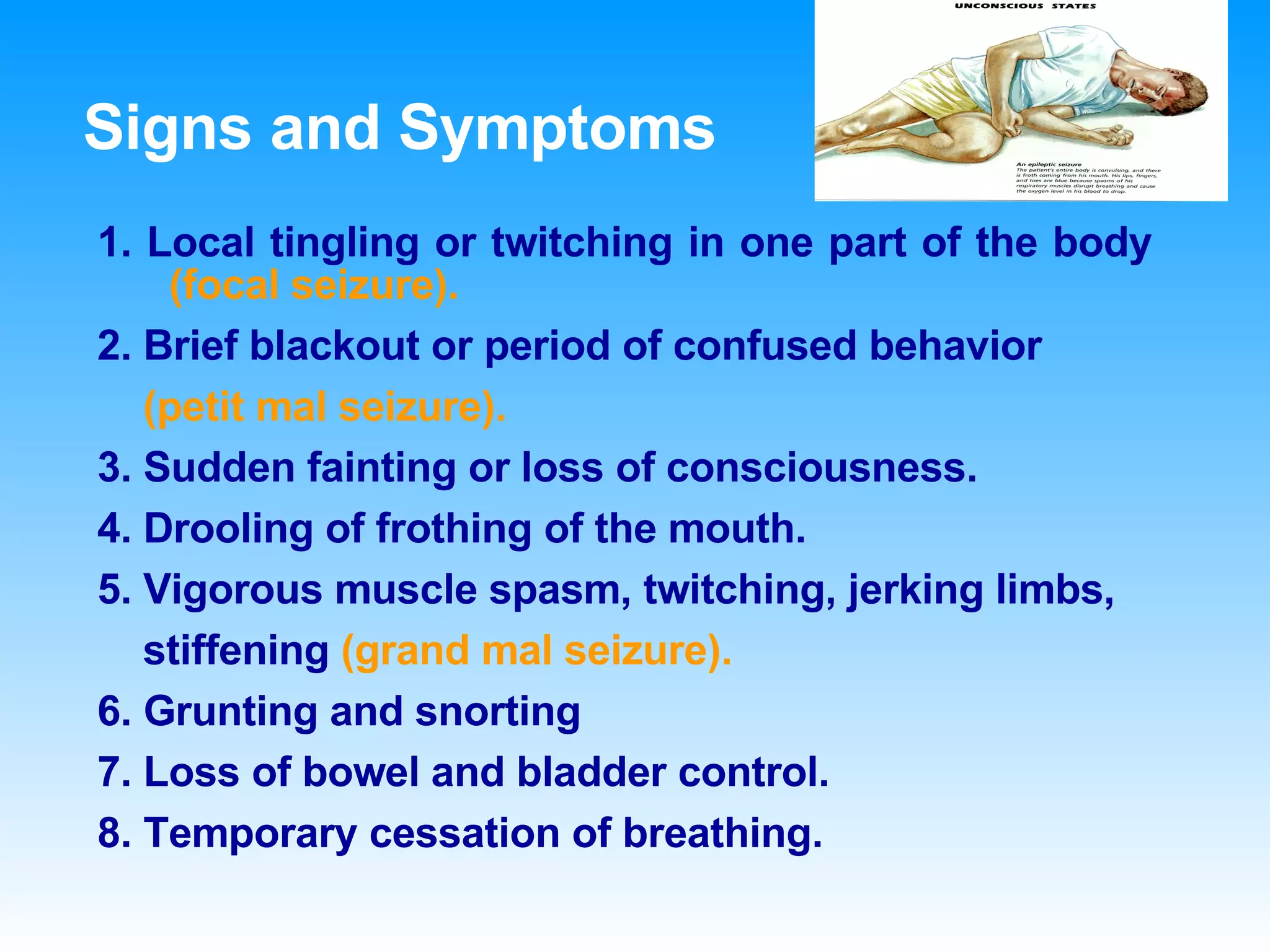
Signs and Symptoms 1. Local tingling or twitching in one part of the body  (focal seizure). 2. Brief blackout or period of confused behavior (petit mal seizure). 3. Sudden fainting or loss of consciousness. 4. Drooling of frothing of the mouth. 5. Vigorous muscle spasm, twitching, jerking limbs, stiffening  (grand mal seizure). 6. Grunting and snorting 7. Loss of bowel and bladder control. 8. Temporary cessation of breathing.
Seizures are often associated with: 1. Epilepsy   7. Fever in children 2. Hypertension   8. Electric shock 3. Heart disease   9. Heat illness 4. Brain tumor   10. Stroke or brain injury 5.  Shaking children  or illness violently  11. Poisoning & choking 6. Venomous bites  12. Drug and alcohol and stings  overdose/withdrawal
First Aid Management Once seizure have started, there is nothing you do to stop it. First aid is aimed at protecting the victim from injury and getting medical help as needed.
If you know the person has EPILEPSY, it is usually not necessary to call a physician unless: a. seizure lasts longer than a few minutes. b. another seizure begins soon after the first. c. victim does not regain consciousness after the jerking movement have stopped. 2. You should call a physician when  someone having a seizure : a. is victim is pregnant. b. carries an identification as a diabetic. c. is in the water and has swallowed large amount  of  water. First Aid ….
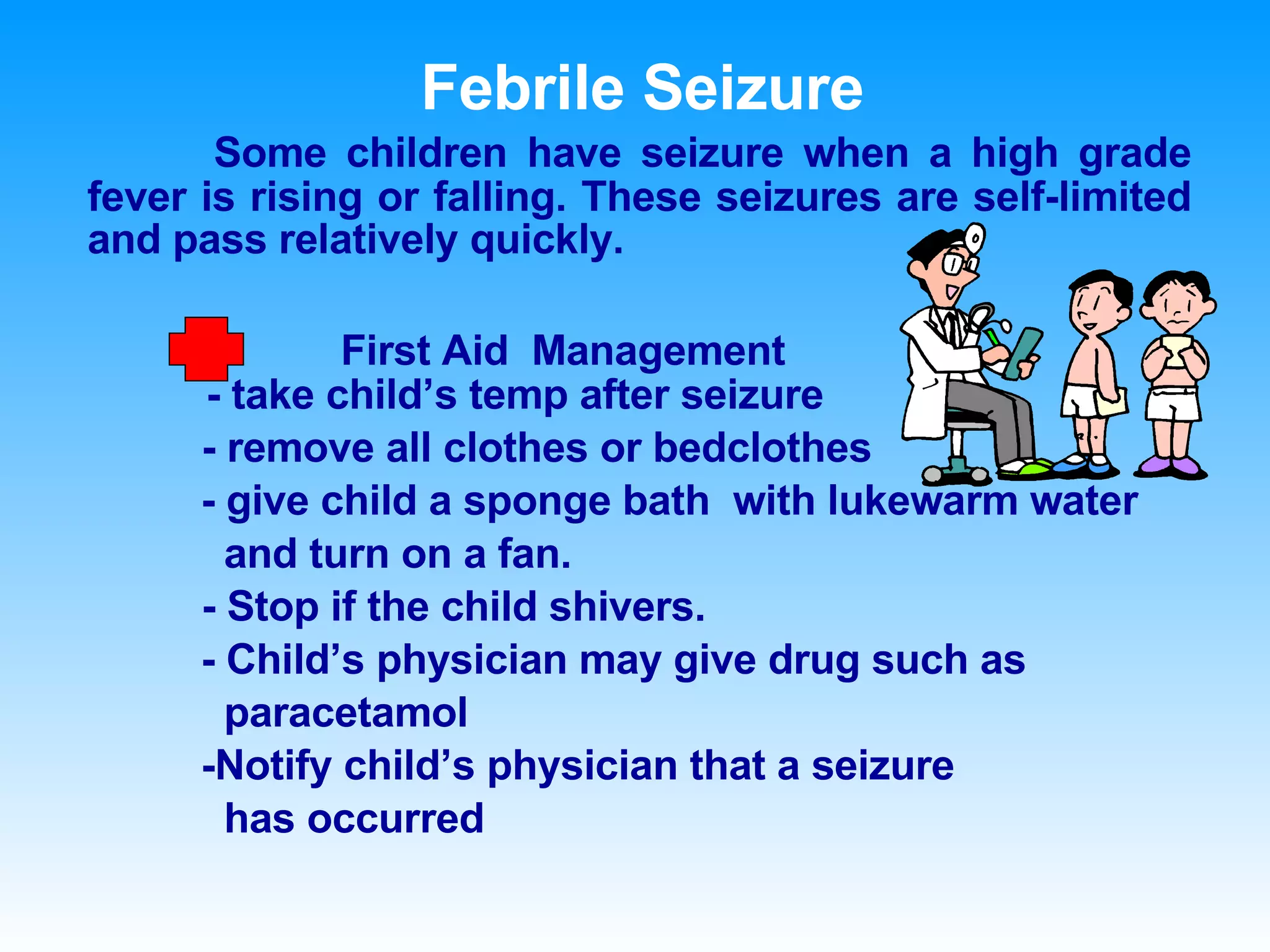
Febrile Seizure Some children have seizure when a high grade fever is rising or falling. These seizures are self-limited and pass relatively quickly. First Aid  Management   - take child’s temp after seizure   - remove all clothes or bedclothes - give child a sponge bath  with lukewarm water  and turn on a fan.    - Stop if the child shivers. - Child’s physician may give drug such as  paracetamol  -Notify child’s physician that a seizure has occurred
When to get help for Fever? 1.  Fever is over 102 º F ( rectally for baby’s under 3 months). 2.  Fever is accompanied by: - difficulty of breathing - unusual skin color (blue, gray purple) - a rash of tiny red or purple dots under the skin - shock - stiff neck - bulging fontanel (soft spot of the baby’s skull) - sign of dehydration (sunken fontanel, little or no  urine,dry mouth, sunken eyeballs, severe thirst,  sleepiness,weakness)
Causes:   1. Ruptured tubal pregnancy with concealed  hemorrhage into the abdominal cavity. 2. Unusual bleeding at the vagina at any stage. 3. Convulsions associated with pregnancy. 4. Miscalculations in the anticipated delivery. 5. Premature onset of labor after an accident. 6. Delay in transportation. 7. Others factors Emergency Childbirth -  when delivery occurs unexpectedly and you cannot get medical help in time.
Signs and Symptoms 1. If labor contraction are approximately 2 minutes apart. 2.  If the woman is straining or pushing down with contractions. 3.  If the woman is crying out constantly. 4.  A warning from the woman that the baby is coming.
MATERIALS NEEDED At home en route to hospital: Assemble clean cloth, plastic bag or other materials  to protect bed clothes or car upholstery Clean towels, one or two folded sheets Set of sterile cord ties or sterilized shoelaces New razor blade in protective paper Diaper Alcohol Sanitary napkins Receiving blanket for the baby - Safety pins
MATERIALS NEEDED For a long trip The mother should wear along nightgown or slip and  a robe (no underclothing) and place a sanitary napkin or clean folded towel between her thighs if the bag of  water has ruptured or if the blood and mucous are  draining form the birth canal - Take along a flashlight, if the trip will be at night - Blanket and pillow - Container of some sort for the after birth
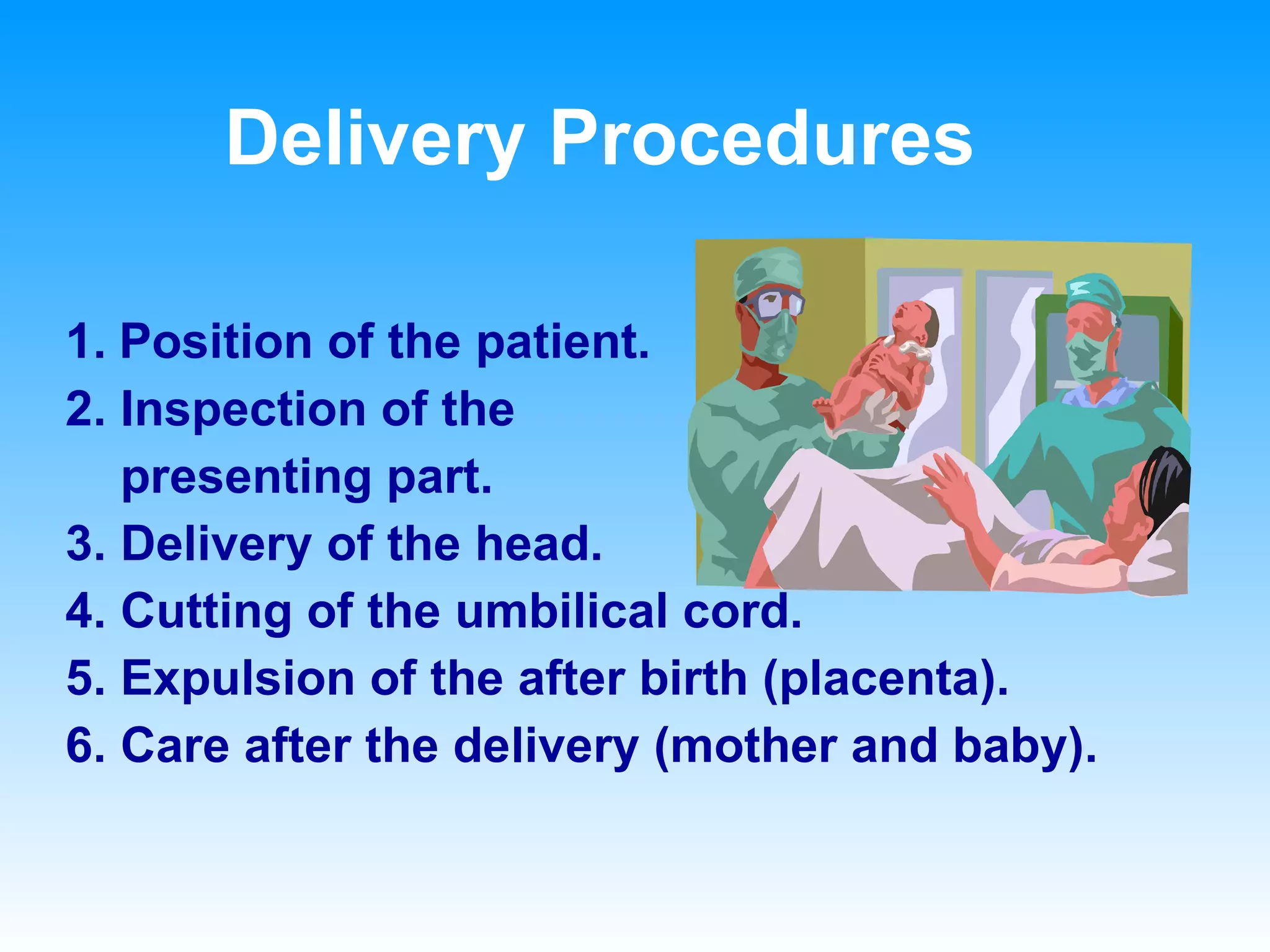
Delivery Procedures 1.   Position of the patient. 2. Inspection of the  presenting part. 3. Delivery of the head. 4. Cutting of the umbilical cord. 5. Expulsion of the after birth (placenta). 6. Care after the delivery (mother and baby).
Natural Spontaneous Delivery


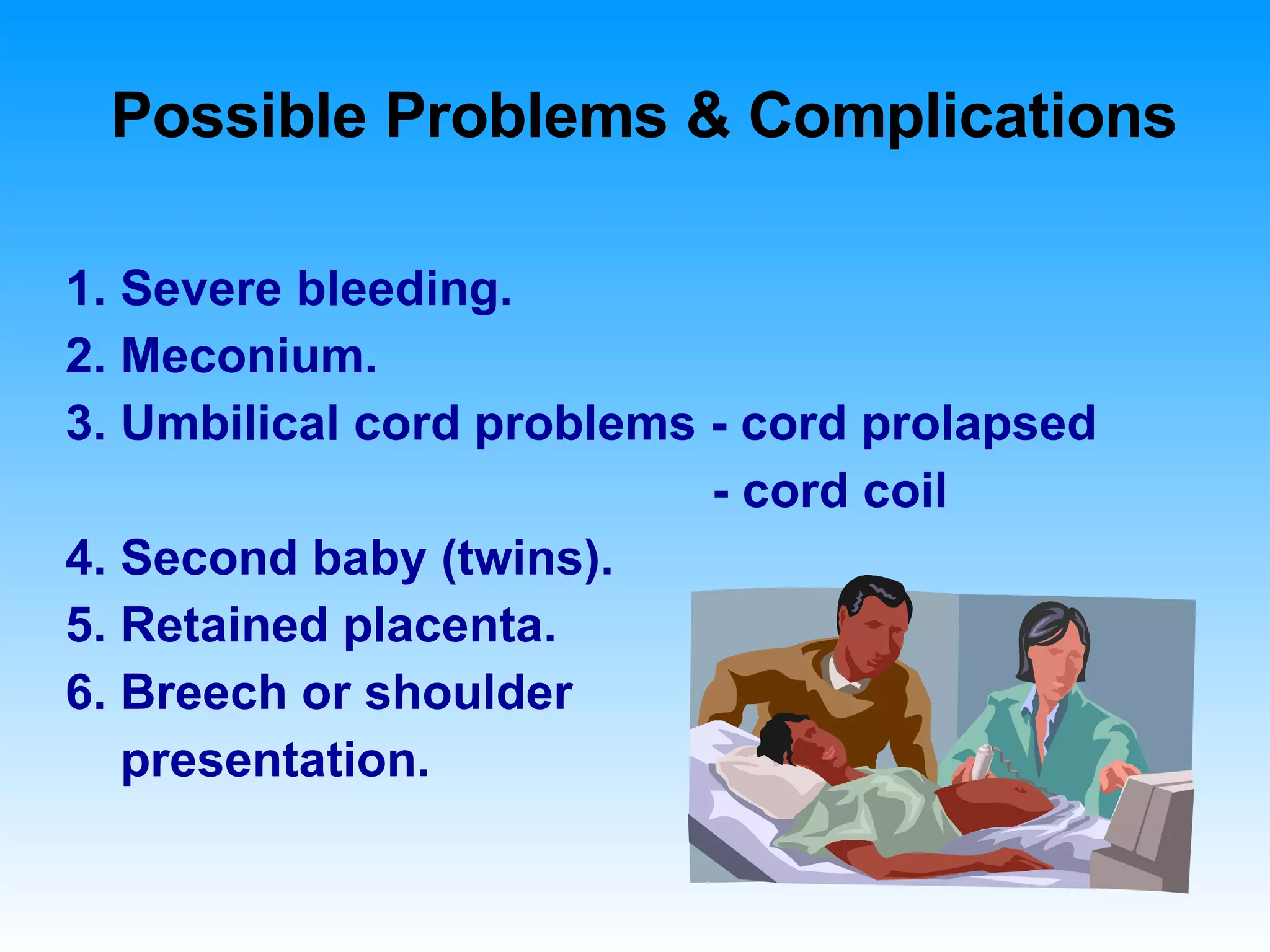
Possible Problems & Complications 1. Severe bleeding. 2. Meconium. 3. Umbilical cord problems - cord prolapsed - cord coil 4. Second baby (twins). 5. Retained placenta. 6. Breech or shoulder  presentation.
OTHER  COMMON  EMERGENCIES 1.   Fever  - a sustained body temperature above  normal level of 37 °C(98.6 °F). Usual Causes: Bacterial or viral infection When to call a Dr. Temp of   40 °C (104 °F)
Signs and Symptoms Early stage: Pallor Chilled feeling As fever advances: Hot, flushed skin, and sweating  Headache Generalized “aches and pains” Higher temperature
First Aid Make patient comfortable Give plenty of cool, bland  drinks Give recommended dose of  analgesics Call a doctor
2.  HEADACHE may accompany any illness may develop for no apparent reason ranges from low-grade discomfort to blinding pain  When to call a Dr.   Develops very suddenly   Severe and incapacitating   Recurrent or persistent   Accompanied by loss of strength or sensation,    impaired consciousness   Accompanied by stiff neck  Follows a head injury
First Aid Help patient sit or lie down comfortably.  Give recommended dose of analgesics Call a doctor if pain does not ease  within 2 hours
3.   Abdominal pain pain in the abdomen often has a relatively trivial cause but can indicate serious illness . First Aid Make patient comfortable.  Don’t give any medicines or anything to    eat/drink.  Give a hot- water bottle place against    the abdomen.  Call a doctor if pain does not ease  within 30 mins
4.  Vomiting and Diarrhea c auses: food poisoning, contaminated  water, allergy, or unusual or exotic  food. may occur without the other if both occur together there is an   risk    of dehydration  First Aid Reassure patient .  Give lots of bland fluids to sip slowly.  Call a doctor if persistent
Thank you  for your time !

Common Emergencies

  • 1.
    MODULE 10 COMMONEMERGENCIES
  • 2.
    SCOPE OF PRESENTATIONENVIRONMENTAL EMERGENCIES MEDICAL EMERGENCIES EMERGENCY CHILDBIRTH OTHER EMERGENCIES
  • 3.
    I. ENVIRONMENTAL EMERGENCIES A. COLD EMERGENCIES HYPOTHERMIA - A condition when the entire body temp falls. 1.Mild Hypothermia – patient is still alert and oriented Signs and Symptoms : cold skin apathy, drowsiness, incoherence  breathing rate sluggish pupils  pulse rate uncontrollable shivering slow, thick speech apathy, drowsiness, incoherence staggering walk
  • 4.
    FIRST AID Checkresponsiveness Cover with blanket Apply hot compress Check vital signs Refer to a physician
  • 5.
    b. SevereHypothermia – patient may become unresponsive. Signs and Symptoms: Extremely slow breathing rate. Extremely slow pulse rate. Unresponsiveness Fixed and dilated pupils. Rigid extremities. Absence of shivering
  • 6.
    First Aid Checkresponsiveness Check ABC (CPR if needed). Care for shock Refer to a physician
  • 7.
    B. Heat Emergencies Mechanism of Heat Loss Convection - Body heat is lost to surrounding air. Respiration - Occurs when one breathes in cold air and breathes out air warned inside the body. Radiation - Body heat is lost to nearby objects without physically touching them. Conduction- Body heat is lost to nearby objects through direct physical touch. Evaporation- Body heat causes perspiration, which is lost from the body surface when changed from liquid to vapor
  • 8.
  • 9.
    General types of Heat Emergencies 1. Heat Cramps - a muscular pain and spasm due largely to loss of salt from the body. Signs and Symptoms Muscle cramps, (abdomen or legs) Heavy perspiration. Lightheadedness;weakness
  • 10.
    First Aid Havevictim rest with feet elevated 8-12’’ Cool the victim. Give the victim electrolyte beverages / salted drink to sip.( every 15 mins ½ cup) Massage affected muscles gently & firmly until they relax.
  • 11.
    2. HeatExhaustion A response to heat characterized by fatigue, weakness, and collapse due to inadequate intake of water to compensate for loss of fluids through sweating
  • 12.
    Signs and SymptomsCool, pale or red, moist skin Dilated Pupils Headache Extreme thirst. Nausea; vomiting. Irrational behavior. Weakness; dizziness. Unconsciousness
  • 13.
    First Aid Havevictim rest with feet elevated 8-12 “ Cool the victim. Give the victim electrolyte beverages / salted drink to sip.(every 15 mins ½ cup) Monitor the victim for signs of shock If victim starts having seizures, protect from injury and give first aid for convulsions If victim loses consciousness, give first aid for unconsciousness.
  • 14.
    Heat Stroke orSunstroke A response to heat characterized by extremely high body temperature and disturbance of sweating mechanism. Signs and Symptoms Raised body temp (  102 °F). Dry, hot red skin, Dark urine. Small pupils. Rapid, shallow breathing, Extreme confusion. Weakness Seizures Unconsciousness
  • 15.
  • 16.
    First Aid Coolthe victim. (no alcohol rub) Give First Aid for shock.Lay the victim flat and elevate his\her legs 8-12 inches. If the victim starts having seizures, give first aid for seizures. Keep the victim cool as you await medical help.
  • 17.
    Prevention of HeatEmergencies Avoid exposure to direct rays of sun. Wear proper clothing. 12-15 glasses a day, together with extra salt. Exposure to air currents from fans or open windows.
  • 18.
    Some Reminders Don’tunderestimate seriousness of heat illness especially if victim is a child, elderly, or injured. Don’t give victim liquids that contain alcohol or caffeine. Don’t give victim over-the-counter medications that are used to treat fever. Don’t give victim salt tablets. Don’t overlook possible complication resulting from the victim’s ongoing medical problem. 6. For heatstroke – don’t give victim any thing by mouth – not even salted drinks.
  • 19.
    How to Coola Victim of Heat Illness Move the victim into the shade, into a cool room, or to air-conditioned building or car. Spray the victim with hose, or pour a bucket of water over him or her (not in the face). Wrap the victim in wet towels or sheets, then turn on a fan. Place cold compresses on the victim’s neck, groin, and armpits.
  • 20.
    5 . Heatstroke - immerse victim in cold water (bath, lake, stream),if medical help is not immediately available, but only if you can carefully monitor level of alertness and ABC’s). 6.Once temp is  to 100 ° F, ease up cooling efforts, but keep checking the temp every ½ hr. for next 3 - 4 hrs .
  • 21.
  • 22.
    Stroke Cerebrovascular Accident(CVA) - is a condition that occurs when the blood flow to the brain is interrupted long enough to cause damage. People over 50 are the most common victims, but younger people can have them too.
  • 23.
    Causes 1. Thrombus or Embolism 2. Ruptured artery in the brain due to: - head injury - high blood pressure, - a weak spot in the wall of the blood vessel (Aneurysm) -fat deposit lining a vessel (Atherosclerosis) 3. Compression of an artery in the brain - brain tumor - inborn anomalies
  • 24.
  • 25.
  • 26.
    Signs and Symptoms -weakness and numbness of the face, arm, or leg often on one side only. - dizziness, - confusion, -headache -ringing in the ears -a change in mood -difficulty in speaking, breathing and swallowing -loss of bowel and bladder control
  • 27.
    First Aid Management Check the victim’s ABC’s.  Have the victim rest in a comfortable position.  Seek immediate medical help.  Do not give the victim anything by mouth.  If unconscious, place in a recovery position and administer first aid for unconsciousness.  Continue monitoring his ABC’s  Stay with victim until you have medical help.
  • 28.
    What is Diabetes?Diabetes mellitus is a condition that affects the way the body uses food. It causes the sugar level in the blood to be too high (hyperglycemia).
  • 29.
    Mechanism Fats, starches,sugars & other foods thru Converting Enzymes GLUCOSE Carried by the blood to the cells INSULIN (Produced by pancreas – beta cells of the islets of Langerhans) Serves as carrier of glucose to the cell Converting  Enzymes Glycogen  Glucose  Energy
  • 30.
    TYPES OF DIABETICEMERGENCIES Insulin Shock - occurs when too much insulin is in the body. Too much insulin rapidly reduces the level of sugar (hypoglycemia) in the blood, and brains cells suffer. Causes: taking too much medication failing to eat heavy exercises emotional factors.
  • 31.
    Signs and SymptomsInsulin Shock 1. Fast breathing 6. Vision difficulties 2. Fast pulse 7. Sweating 3. Dizziness 8. Headache 4. Weakness 9. Numbness of extremities 5. Change in the level of 10. Hunger and consciousness anxiety
  • 32.
    Diabetic Coma -happens when there is too much sugar (hyperglycemia) and too little insulin in the blood and body cells do not get enough nourishment . C auses : > eating too much sugar > not taking prescribed medication > stress > infection.
  • 33.
    SIGNS AND SYMPTOMS 1. Drowsiness and confusion 2. Deep and fast breathing 3. Thirst 4. Dehydration 5. Fever 6. A fruity smelling breath 7. A change of consciousness
  • 34.
    Important Note Besidesbeing aware of the different signs and symptoms listed, you can ask someone who is conscious these questions: “Have you eaten today?” and “Have you taken your medication today?” . A. Someone who has eaten but has not taken his/ her medication maybe in Diabetic Coma . B. Someone who has not eaten but has taken his/her medication maybe having an Insulin Reaction .
  • 35.
    First Aid Management1. In a diabetic emergency, it is possible to confuse signs & symptoms of insulin shock and diabetic coma. Since Insulin Shock is a true emergency that needs quick response, give any fully conscious victim in diabetic emergency sugar-candy, fruit juice, or a soft drink containing sugar.
  • 36.
    2. If avictim is unconscious check his ABC’s and call for a physician. 3. A person/victim of diabetic coma also needs immediate transport to the hospital.
  • 37.
    Seizure - issudden involuntary muscle contraction, usually due to uncontrolled electrical activity in the brain. -in some cases, an individual can sense that a seizure is going to occur. -last 30-45 sec.
  • 38.
    Stages Of GeneralizedSeizure Aura Phase Described as unusual smell or flash of light that lasts a split second. Tonic Phase 15-20 seconds of unresponsiveness followed by 5-15 seconds of extreme muscle rigidity. Clonic Phase 1-5 mins of seizure Post ictal Phase 5-30 mins to several hrs of deep sleep with gradual recovery.
  • 39.
    Signs and Symptoms1. Local tingling or twitching in one part of the body (focal seizure). 2. Brief blackout or period of confused behavior (petit mal seizure). 3. Sudden fainting or loss of consciousness. 4. Drooling of frothing of the mouth. 5. Vigorous muscle spasm, twitching, jerking limbs, stiffening (grand mal seizure). 6. Grunting and snorting 7. Loss of bowel and bladder control. 8. Temporary cessation of breathing.
  • 40.
    Seizures are oftenassociated with: 1. Epilepsy 7. Fever in children 2. Hypertension 8. Electric shock 3. Heart disease 9. Heat illness 4. Brain tumor 10. Stroke or brain injury 5. Shaking children or illness violently 11. Poisoning & choking 6. Venomous bites 12. Drug and alcohol and stings overdose/withdrawal
  • 41.
    First Aid ManagementOnce seizure have started, there is nothing you do to stop it. First aid is aimed at protecting the victim from injury and getting medical help as needed.
  • 42.
    If you knowthe person has EPILEPSY, it is usually not necessary to call a physician unless: a. seizure lasts longer than a few minutes. b. another seizure begins soon after the first. c. victim does not regain consciousness after the jerking movement have stopped. 2. You should call a physician when someone having a seizure : a. is victim is pregnant. b. carries an identification as a diabetic. c. is in the water and has swallowed large amount of water. First Aid ….
  • 43.
    Febrile Seizure Somechildren have seizure when a high grade fever is rising or falling. These seizures are self-limited and pass relatively quickly. First Aid Management - take child’s temp after seizure - remove all clothes or bedclothes - give child a sponge bath with lukewarm water and turn on a fan. - Stop if the child shivers. - Child’s physician may give drug such as paracetamol -Notify child’s physician that a seizure has occurred
  • 44.
    When to gethelp for Fever? 1. Fever is over 102 º F ( rectally for baby’s under 3 months). 2. Fever is accompanied by: - difficulty of breathing - unusual skin color (blue, gray purple) - a rash of tiny red or purple dots under the skin - shock - stiff neck - bulging fontanel (soft spot of the baby’s skull) - sign of dehydration (sunken fontanel, little or no urine,dry mouth, sunken eyeballs, severe thirst, sleepiness,weakness)
  • 45.
    Causes: 1. Ruptured tubal pregnancy with concealed hemorrhage into the abdominal cavity. 2. Unusual bleeding at the vagina at any stage. 3. Convulsions associated with pregnancy. 4. Miscalculations in the anticipated delivery. 5. Premature onset of labor after an accident. 6. Delay in transportation. 7. Others factors Emergency Childbirth - when delivery occurs unexpectedly and you cannot get medical help in time.
  • 46.
    Signs and Symptoms1. If labor contraction are approximately 2 minutes apart. 2. If the woman is straining or pushing down with contractions. 3. If the woman is crying out constantly. 4. A warning from the woman that the baby is coming.
  • 47.
    MATERIALS NEEDED Athome en route to hospital: Assemble clean cloth, plastic bag or other materials to protect bed clothes or car upholstery Clean towels, one or two folded sheets Set of sterile cord ties or sterilized shoelaces New razor blade in protective paper Diaper Alcohol Sanitary napkins Receiving blanket for the baby - Safety pins
  • 48.
    MATERIALS NEEDED Fora long trip The mother should wear along nightgown or slip and a robe (no underclothing) and place a sanitary napkin or clean folded towel between her thighs if the bag of water has ruptured or if the blood and mucous are draining form the birth canal - Take along a flashlight, if the trip will be at night - Blanket and pillow - Container of some sort for the after birth
  • 49.
    Delivery Procedures 1. Position of the patient. 2. Inspection of the presenting part. 3. Delivery of the head. 4. Cutting of the umbilical cord. 5. Expulsion of the after birth (placenta). 6. Care after the delivery (mother and baby).
  • 50.
  • 51.
  • 52.
  • 53.
  • 54.
    Possible Problems &Complications 1. Severe bleeding. 2. Meconium. 3. Umbilical cord problems - cord prolapsed - cord coil 4. Second baby (twins). 5. Retained placenta. 6. Breech or shoulder presentation.
  • 55.
    OTHER COMMON EMERGENCIES 1. Fever - a sustained body temperature above normal level of 37 °C(98.6 °F). Usual Causes: Bacterial or viral infection When to call a Dr. Temp of  40 °C (104 °F)
  • 56.
    Signs and SymptomsEarly stage: Pallor Chilled feeling As fever advances: Hot, flushed skin, and sweating Headache Generalized “aches and pains” Higher temperature
  • 57.
    First Aid Makepatient comfortable Give plenty of cool, bland drinks Give recommended dose of analgesics Call a doctor
  • 58.
    2. HEADACHEmay accompany any illness may develop for no apparent reason ranges from low-grade discomfort to blinding pain When to call a Dr. Develops very suddenly Severe and incapacitating Recurrent or persistent Accompanied by loss of strength or sensation, impaired consciousness Accompanied by stiff neck Follows a head injury
  • 59.
    First Aid Helppatient sit or lie down comfortably. Give recommended dose of analgesics Call a doctor if pain does not ease within 2 hours
  • 60.
    3. Abdominal pain pain in the abdomen often has a relatively trivial cause but can indicate serious illness . First Aid Make patient comfortable. Don’t give any medicines or anything to eat/drink. Give a hot- water bottle place against the abdomen. Call a doctor if pain does not ease within 30 mins
  • 61.
    4. Vomitingand Diarrhea c auses: food poisoning, contaminated water, allergy, or unusual or exotic food. may occur without the other if both occur together there is an  risk of dehydration First Aid Reassure patient . Give lots of bland fluids to sip slowly. Call a doctor if persistent
  • 62.
    Thank you for your time !