Infection Control in
Health Care Settings
Osama Ramadan
Florence Nightingale, Notes on Hospitals, 1863
It may seem a strange principle
to state the very first requirement
of a hospital
that it do the sick no harm
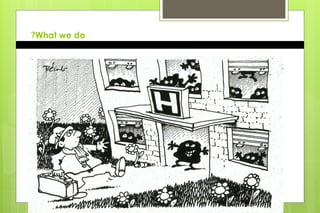
What we do
?
Learning Objectives
1. Recognize patient safety as an important nursing
responsibility in global health care systems.
2. Apply required knowledge in preventing and/or minimizing
infection.
3. Perform appropriate behaviors required to prevent health
care associated infections.
4. Demonstrate required competence to provide patients with
safe care.
Objectives cont’d
 Discuss basic infection control (IC) concepts
 State the causes of nosocomial infections
 list the components of an infection control
program
 Understand how the Infection Control
Committee and DTC can decrease the
incidence of nosocomial infections and
antimicrobial resistance (AMR)
Key Definitions (1)
 Infection Control—The process by which health care
facilities develop and implement specific policies
and procedures to prevent the spread of infections
among health care staff and patients
 Nosocomial Infection—An infection contracted by a
patient or staff member while in a hospital or health
care facility (and not present or incubating on
admission)
Key Definitions (2)
 Disinfection—The process of microbial inactivation
that eliminates virtually all recognized pathogenic
microorganisms, but not necessarily all microbial
forms (e.g., spores)
 Sterilization—The use of physical or chemical
procedures to destroy all microbial life, including
large numbers of highly resistant bacterial
endospores. Procedures include—
 Steam sterilization
 Heat sterilization
 Chemical sterilization
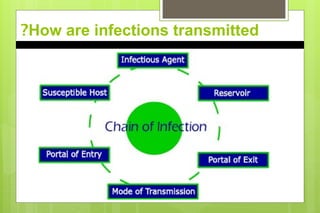
How are infections transmitted
?
Global Infection Problems
According to WHO (2005),
 On average, 8.7% of hospital patients suffer health care-
associated infections (HAI).
 In developed countries: 5-10%
 In developing countries:
 Risk of HAI: 2-20 times higher
 HAI may affect more than 25% of patients
 At any one time, over 1.4 million people worldwide suffer from
infections acquired while in hospital.
Health Care-Associated Infections (HAI)
According to WHO:
 HAI is also called “nosocomial”.
 HAI is defined as:
 an infection acquired in hospital by a patient who was admitted
for a reason other than that infection.
 an infection occurring in a patient in a hospital or other health-
care facility in whom the infection was not present or incubating
at the time of admission.
Impacts of Health Care-Associated
Infections (HAI)
HAI can:
 Increase patients’ suffering.
 Lead to permanent disability.
 Lead to death.
 Prolong hospital stay.
 Increase need for a higher level of care.
 Increase the costs to patients and hospitals.
Root Causes of Nosocomial Infections (1)
 Lack of training in basic IC
 Lack of an IC infrastructure and poor IC practices
(procedures)
 Inadequate facilities and techniques for hand
hygiene
 Lack of isolation precautions and procedures
Root Causes of Nosocomial Infections (2)
 Use of advanced and complex treatments without
adequate training and supporting infrastructure,
including—
 Invasive devices and procedures
 Complex surgical procedures
 Interventional obstetric practices
 Intravenous catheters, fluids, and medications
 Urinary catheters
 Mechanical ventilators
 Inadequate sterilization and disinfection practices
and inadequate cleaning of hospital
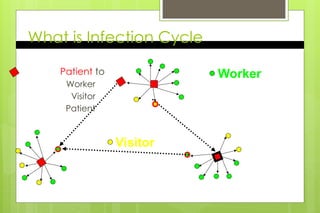
What is Infection Cycle
Patient to
Worker
Visitor
Patient
Worker to
Worker
Visitor
Patient
Visitor to
Worker
Visitor
Patient
Preventing infections
Requires health care providers who
have:
Knowledge of common infections and
their vectors
An attitude of cooperation and
commitment
Skills necessary to provide safe care
Required Skills
 Apply universal precautions*
 Use personal protection methods
 Know what to do if exposed
 Encourage others to use universal precautions
 Report breaks in technique that increase patient
risks
 Observe patients for signs and symptoms of
infection
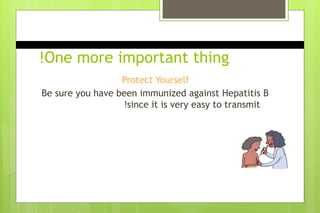
One more important thing
!
Protect Yourself
Be sure you have been immunized against Hepatitis B
since it is very easy to transmit
!
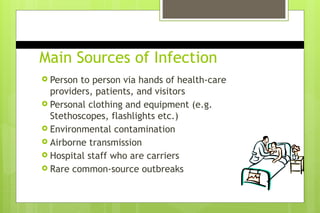
Main Sources of Infection
 Person to person via hands of health-care
providers, patients, and visitors
 Personal clothing and equipment (e.g.
Stethoscopes, flashlights etc.)
 Environmental contamination
 Airborne transmission
 Hospital staff who are carriers
 Rare common-source outbreaks
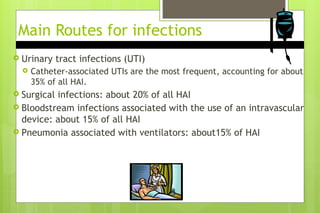
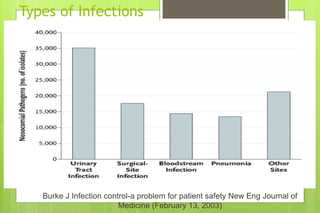
Main Routes for infections
 Urinary tract infections (UTI)
 Catheter-associated UTIs are the most frequent, accounting for about
35% of all HAI.
 Surgical infections: about 20% of all HAI
 Bloodstream infections associated with the use of an intravascular
device: about 15% of all HAI
 Pneumonia associated with ventilators: about15% of HAI
Burke J Infection control-a problem for patient safety New Eng Journal of
Medicine (February 13, 2003)
Types of Infections
Four Ways to Prevent HAI
1. Maintain cleanliness of the hospital.
2. Personal attention to hand washing before and
after every contact with a patient or object.
3. Use personal protective equipment whenever
indicated.
4. Use and dispose of sharps safely.
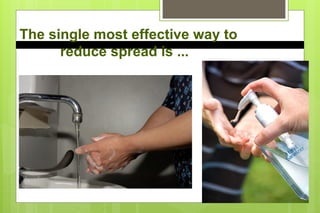
The single most effective way to
reduce spread is ...
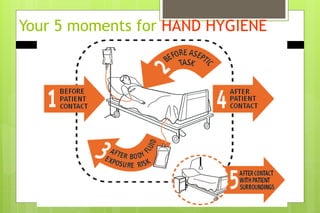
Your 5 moments for HAND HYGIENE
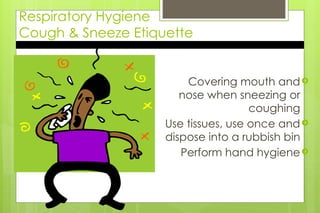
Respiratory Hygiene
Cough & Sneeze Etiquette

Covering mouth and
nose when sneezing or
coughing

Use tissues, use once and
dispose into a rubbish bin

Perform hand hygiene
Personal Protective Equipment
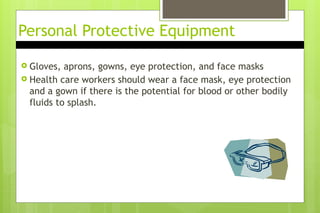
 Gloves, aprons, gowns, eye protection, and face masks
 Health care workers should wear a face mask, eye protection
and a gown if there is the potential for blood or other bodily
fluids to splash.
Personal protective equipment 2
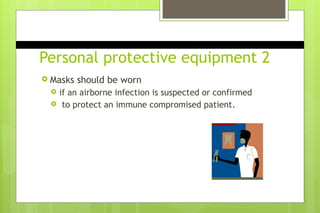
 Masks should be worn
 if an airborne infection is suspected or confirmed
 to protect an immune compromised patient.
Gloves
Gloves must be worn for:
 all invasive procedures
 contact with sterile sites
 contact with non-intact skin or mucous membranes
 all activities assessed as having a risk of exposure
to blood, bodily fluids, secretions and excretions,
and handling sharps or contaminated instruments.
Hands should be washed before and after gloving
Safe Use and Disposal of Sharps
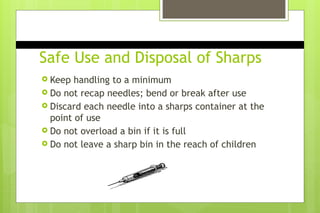
 Keep handling to a minimum
 Do not recap needles; bend or break after use
 Discard each needle into a sharps container at the
point of use
 Do not overload a bin if it is full
 Do not leave a sharp bin in the reach of children
Aseptic Technique
Practice of ensuring that bacteria are excluded
from open sites during surgery, wound dressing,
blood sampling, and other medical procedures.
Aseptic technique is a first line of defense against
infection.
 Use of sterile instruments and supplies and the
application of principles of asepsis while
performing invasive procedures are important
aspects of infection control.
Examples of aseptic technique include:
- Disinfecting IV ports/valves and capping open lines
- Checking the integrity of sterile packages and
ensuring a color change on the chemical indicator
- Use of a sheathed catheter for closed suctioning of
ventilated
patients.
Isolation and Precautions
- More Safety Activities
• Along with good hand hygiene, Standard Precautions
and disease specific precautions help prevent the
transmission of organisms. There are 6 types of
precautions used at Karmanos:
1. Standard Precautions
2. Contact Precautions
3. Contact Precautions with Special Cleaning
4. Droplet Precautions
5. Airborne Precautions
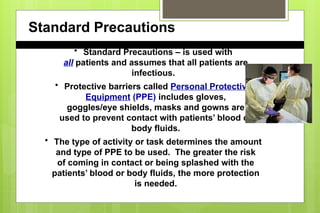
Standard Precautions
• Standard Precautions – is used with
all patients and assumes that all patients are
infectious.
• Protective barriers called Personal Protective
Equipment (PPE) includes gloves,
goggles/eye shields, masks and gowns are
used to prevent contact with patients’ blood or
body fluids.
• The type of activity or task determines the amount
and type of PPE to be used. The greater the risk
of coming in contact or being splashed with the
patients’ blood or body fluids, the more protection
is needed.
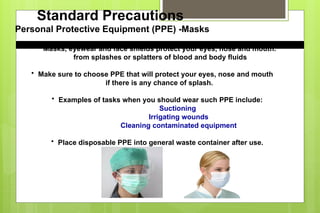
• Masks, eyewear and face shields protect your eyes, nose and mouth.
from splashes or splatters of blood and body fluids
• Make sure to choose PPE that will protect your eyes, nose and mouth
if there is any chance of splash.
• Examples of tasks when you should wear such PPE include:
Suctioning
Irrigating wounds
Cleaning contaminated equipment
• Place disposable PPE into general waste container after use.
Standard Precautions
Personal Protective Equipment (PPE) -Masks
Standard Precautions
Personal Protective Equipment (PPE) - Gloves
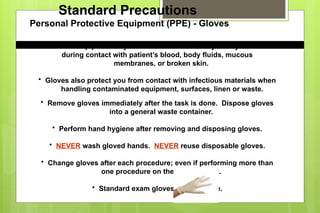
• Gloves keep potentially infectious materials away from your hands
during contact with patient’s blood, body fluids, mucous
membranes, or broken skin.
• Gloves also protect you from contact with infectious materials when
handling contaminated equipment, surfaces, linen or waste.
• Remove gloves immediately after the task is done. Dispose gloves
into a general waste container.
• Perform hand hygiene after removing and disposing gloves.
• NEVER wash gloved hands. NEVER reuse disposable gloves.
• Change gloves after each procedure; even if performing more than
one procedure on the same patient.
• Standard exam gloves are latex-free.
Standard Precautions
Personal Protective Equipment (PPE) –
Gowns
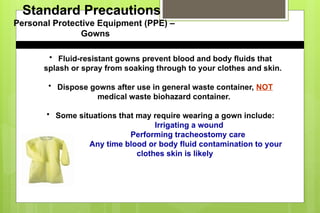
• Fluid-resistant gowns prevent blood and body fluids that
splash or spray from soaking through to your clothes and skin.
• Dispose gowns after use in general waste container, NOT
medical waste biohazard container.
• Some situations that may require wearing a gown include:
Irrigating a wound
Performing tracheostomy care
Any time blood or body fluid contamination to your
clothes skin is likely
Airborne Precautions
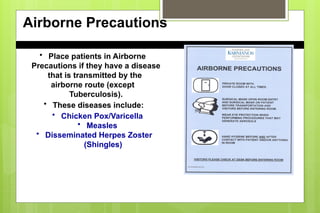
• Place patients in Airborne
Precautions if they have a disease
that is transmitted by the
airborne route (except
Tuberculosis).
• These diseases include:
• Chicken Pox/Varicella
• Measles
• Disseminated Herpes Zoster
(Shingles)
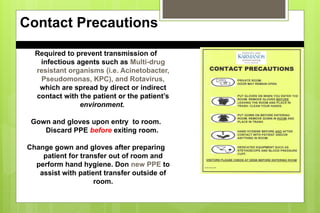
Contact Precautions
Required to prevent transmission of
infectious agents such as Multi-drug
resistant organisms (i.e. Acinetobacter,
Pseudomonas, KPC), and Rotavirus,
which are spread by direct or indirect
contact with the patient or the patient’s
environment.
Gown and gloves upon entry to room.
Discard PPE before exiting room.
Change gown and gloves after preparing
patient for transfer out of room and
perform hand hygiene. Don new PPE to
assist with patient transfer outside of
room.
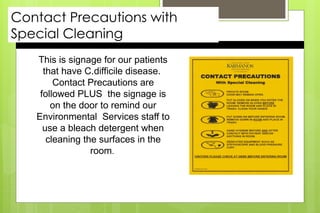
Contact Precautions with
Special Cleaning
This is signage for our patients
that have C.difficile disease.
Contact Precautions are
followed PLUS the signage is
on the door to remind our
Environmental Services staff to
use a bleach detergent when
cleaning the surfaces in the
room.
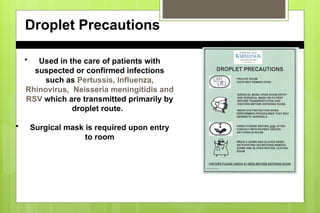
Droplet Precautions
• Used in the care of patients with
suspected or confirmed infections
such as Pertussis, Influenza,
Rhinovirus, Neisseria meningitidis and
RSV which are transmitted primarily by
droplet route.
• Surgical mask is required upon entry
to room
Bloodborne Pathogen
Standard
• Hospitals are required by the Bloodborne Pathogen
Standard of MI/OSHA to protect all healthcare
workers (HCWs) from exposure to bloodborne
pathogens, while on the job.
• Assume that all patients could have organisms
that are transmitted by contact with their blood
and/or body fluids. Follow Standard Precautions.
• The MIOSHA Blood Borne Pathogen Exposure
Control Plan is the policy that describes protection
measures for staff and patients.
Refer to policy IC 110
Bloodborne Pathogen Standard
Epidemiology of Bloodborne Pathogens:
• Important bloodborne pathogens (disease-causing organisms)
that may be present in human blood could include:
• Hepatitis B Virus (HBV)
• Hepatitis C Virus (HCV)
• Human Immunodeficiency Virus (HIV)
• These same bloodborne pathogens may also be found in other
body fluids, including:
• Semen
• Vaginal fluids
• Fluids around the brain, spine, heart, lungs, abdomen and joints
• Bloody saliva during certain dental procedures
• Bloodborne pathogens are NOT found in tears, urine, stool,
sweat or saliva unless these body fluids are visibly bloody.
Bloodborne Pathogen Standard
Exposure to Bloodborne Pathogens:
• HCWs may be exposed to bloodborne pathogens by:
•Your skin being punctured with a contaminated needle or cut by a
contaminated sharp device, such as a lancet or scalpel.
•Blood or body fluids getting on skin that has cuts, cracks, rashes
or burns.
•Being splashed or sprayed with blood or body fluids into your
eyes, nose or mouth.
• Certain HCWs have a higher risk of exposure to bloodborne
pathogens while on the job.
•Nurses and Patient Care Staff
•Physicians
•Lab Staff
•Environmental Services Staff who handle Regulated Medical Waste
•Dental Staff
Bloodborne Pathogen Standard
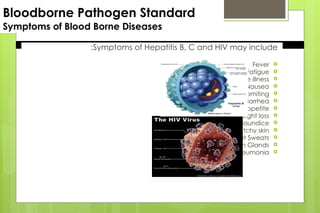
Symptoms of Blood Borne Diseases
Symptoms of Hepatitis B, C and HIV may include
:

Fever

Fatigue

Flu-like illness

Nausea

Vomiting

Diarrhea

Loss of Appetite

Weight loss

Jaundice

Itchy skin

Night Sweats

Swollen Lymph Glands

Pneumonia
Bloodborne Pathogen
Standard
• Standard Precautions requires HCWs to treat all blood
and body fluids as if they are infected with disease-
causing organisms.
• ALWAYS using Standard Precautions will prevent the
spread of disease to yourself, co-workers, patients and
visitors.
Your protection and Safety is important. Know where to
find PPE in your department.
How to Manage a Blood or
Body Fluid Spill
• Small spills that can be contained by a paper towel
will be cleaned and disinfected by the department. The
Small Spill Procedure is:
• Put on PPE
• Contain and absorb spill with paper towels
• Dispose of the paper towels
• Add approved disinfectant to the spill site
• Dispose of used supplies in general waste container
• Remove gloves and perform hand hygiene
• Large spills will be contained by the department with a
barrier pad and then disinfected by Environmental
Services. See Blood and Body Fluid Spill policy IC 134
on the KCC Policy Web Site.
Bloodborne Pathogen Standard
Safe Sharps Disposal
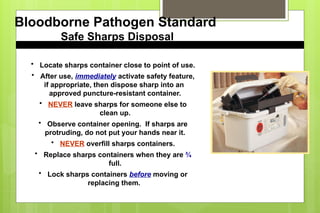
• Locate sharps container close to point of use.
• After use, immediately activate safety feature,
if appropriate, then dispose sharp into an
approved puncture-resistant container.
• NEVER leave sharps for someone else to
clean up.
• Observe container opening. If sharps are
protruding, do not put your hands near it.
• NEVER overfill sharps containers.
• Replace sharps containers when they are ¾
full.
• Lock sharps containers before moving or
replacing them.
Bloodborne Pathogen Standard
Safety Devices
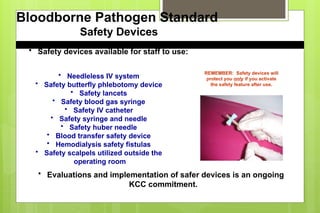
• Needleless IV system
• Safety butterfly phlebotomy device
• Safety lancets
• Safety blood gas syringe
• Safety IV catheter
• Safety syringe and needle
• Safety huber needle
• Blood transfer safety device
• Hemodialysis safety fistulas
• Safety scalpels utilized outside the
operating room
• Safety devices available for staff to use:
• Evaluations and implementation of safer devices is an ongoing
KCC commitment.
REMEMBER: Safety devices will
protect you only if you activate
the safety feature after use.
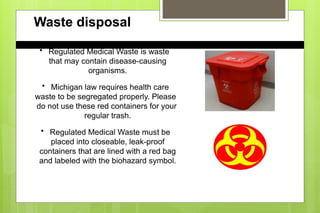
• Regulated Medical Waste is waste
that may contain disease-causing
organisms.
• Michigan law requires health care
waste to be segregated properly. Please
do not use these red containers for your
regular trash.
• Regulated Medical Waste must be
placed into closeable, leak-proof
containers that are lined with a red bag
and labeled with the biohazard symbol.
Waste disposal
Bloodborne Pathogen Standard What
is Regulated Medical Waste?
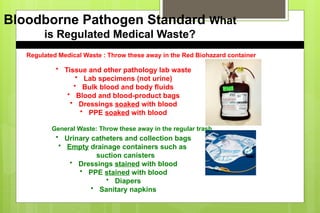
• Tissue and other pathology lab waste
• Lab specimens (not urine)
• Bulk blood and body fluids
• Blood and blood-product bags
• Dressings soaked with blood
• PPE soaked with blood
• Urinary catheters and collection bags
• Empty drainage containers such as
suction canisters
• Dressings stained with blood
• PPE stained with blood
• Diapers
• Sanitary napkins
Regulated Medical Waste : Throw these away in the Red Biohazard container
General Waste: Throw these away in the regular trash
Required Performance
Nursing students need to:
 apply universal precautions
 be immunized against Hepatitis B
 use personal protection methods
 know what to do if exposed
 encourage others to use universal precautions
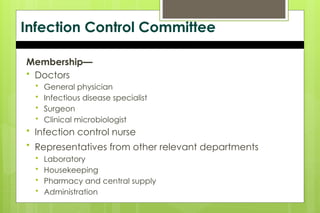
Infection Control Committee
Membership—
 Doctors
 General physician
 Infectious disease specialist
 Surgeon
 Clinical microbiologist
 Infection control nurse
 Representatives from other relevant departments
 Laboratory
 Housekeeping
 Pharmacy and central supply
 Administration
Thank you

5.&6 lecture Infection control.pptx DFGHJ

  • 1.
    Infection Control in HealthCare Settings Osama Ramadan
  • 2.
    Florence Nightingale, Noteson Hospitals, 1863 It may seem a strange principle to state the very first requirement of a hospital that it do the sick no harm
  • 3.
  • 4.
    Learning Objectives 1. Recognizepatient safety as an important nursing responsibility in global health care systems. 2. Apply required knowledge in preventing and/or minimizing infection. 3. Perform appropriate behaviors required to prevent health care associated infections. 4. Demonstrate required competence to provide patients with safe care.
  • 5.
    Objectives cont’d  Discussbasic infection control (IC) concepts  State the causes of nosocomial infections  list the components of an infection control program  Understand how the Infection Control Committee and DTC can decrease the incidence of nosocomial infections and antimicrobial resistance (AMR)
  • 6.
    Key Definitions (1) Infection Control—The process by which health care facilities develop and implement specific policies and procedures to prevent the spread of infections among health care staff and patients  Nosocomial Infection—An infection contracted by a patient or staff member while in a hospital or health care facility (and not present or incubating on admission)
  • 7.
    Key Definitions (2) Disinfection—The process of microbial inactivation that eliminates virtually all recognized pathogenic microorganisms, but not necessarily all microbial forms (e.g., spores)  Sterilization—The use of physical or chemical procedures to destroy all microbial life, including large numbers of highly resistant bacterial endospores. Procedures include—  Steam sterilization  Heat sterilization  Chemical sterilization
  • 8.
    How are infectionstransmitted ?
  • 9.
    Global Infection Problems Accordingto WHO (2005),  On average, 8.7% of hospital patients suffer health care- associated infections (HAI).  In developed countries: 5-10%  In developing countries:  Risk of HAI: 2-20 times higher  HAI may affect more than 25% of patients  At any one time, over 1.4 million people worldwide suffer from infections acquired while in hospital.
  • 10.
    Health Care-Associated Infections(HAI) According to WHO:  HAI is also called “nosocomial”.  HAI is defined as:  an infection acquired in hospital by a patient who was admitted for a reason other than that infection.  an infection occurring in a patient in a hospital or other health- care facility in whom the infection was not present or incubating at the time of admission.
  • 11.
    Impacts of HealthCare-Associated Infections (HAI) HAI can:  Increase patients’ suffering.  Lead to permanent disability.  Lead to death.  Prolong hospital stay.  Increase need for a higher level of care.  Increase the costs to patients and hospitals.
  • 12.
    Root Causes ofNosocomial Infections (1)  Lack of training in basic IC  Lack of an IC infrastructure and poor IC practices (procedures)  Inadequate facilities and techniques for hand hygiene  Lack of isolation precautions and procedures
  • 13.
    Root Causes ofNosocomial Infections (2)  Use of advanced and complex treatments without adequate training and supporting infrastructure, including—  Invasive devices and procedures  Complex surgical procedures  Interventional obstetric practices  Intravenous catheters, fluids, and medications  Urinary catheters  Mechanical ventilators  Inadequate sterilization and disinfection practices and inadequate cleaning of hospital
  • 14.
    What is InfectionCycle Patient to Worker Visitor Patient Worker to Worker Visitor Patient Visitor to Worker Visitor Patient
  • 15.
    Preventing infections Requires healthcare providers who have: Knowledge of common infections and their vectors An attitude of cooperation and commitment Skills necessary to provide safe care
  • 16.
    Required Skills  Applyuniversal precautions*  Use personal protection methods  Know what to do if exposed  Encourage others to use universal precautions  Report breaks in technique that increase patient risks  Observe patients for signs and symptoms of infection
  • 17.
    One more importantthing ! Protect Yourself Be sure you have been immunized against Hepatitis B since it is very easy to transmit !
  • 18.
    Main Sources ofInfection  Person to person via hands of health-care providers, patients, and visitors  Personal clothing and equipment (e.g. Stethoscopes, flashlights etc.)  Environmental contamination  Airborne transmission  Hospital staff who are carriers  Rare common-source outbreaks
  • 19.
    Main Routes forinfections  Urinary tract infections (UTI)  Catheter-associated UTIs are the most frequent, accounting for about 35% of all HAI.  Surgical infections: about 20% of all HAI  Bloodstream infections associated with the use of an intravascular device: about 15% of all HAI  Pneumonia associated with ventilators: about15% of HAI
  • 20.
    Burke J Infectioncontrol-a problem for patient safety New Eng Journal of Medicine (February 13, 2003) Types of Infections
  • 21.
    Four Ways toPrevent HAI 1. Maintain cleanliness of the hospital. 2. Personal attention to hand washing before and after every contact with a patient or object. 3. Use personal protective equipment whenever indicated. 4. Use and dispose of sharps safely.
  • 22.
    The single mosteffective way to reduce spread is ...
  • 23.
    Your 5 momentsfor HAND HYGIENE
  • 24.
    Respiratory Hygiene Cough &Sneeze Etiquette  Covering mouth and nose when sneezing or coughing  Use tissues, use once and dispose into a rubbish bin  Perform hand hygiene
  • 25.
    Personal Protective Equipment Gloves, aprons, gowns, eye protection, and face masks  Health care workers should wear a face mask, eye protection and a gown if there is the potential for blood or other bodily fluids to splash.
  • 26.
    Personal protective equipment2  Masks should be worn  if an airborne infection is suspected or confirmed  to protect an immune compromised patient.
  • 27.
    Gloves Gloves must beworn for:  all invasive procedures  contact with sterile sites  contact with non-intact skin or mucous membranes  all activities assessed as having a risk of exposure to blood, bodily fluids, secretions and excretions, and handling sharps or contaminated instruments. Hands should be washed before and after gloving
  • 28.
    Safe Use andDisposal of Sharps  Keep handling to a minimum  Do not recap needles; bend or break after use  Discard each needle into a sharps container at the point of use  Do not overload a bin if it is full  Do not leave a sharp bin in the reach of children
  • 29.
    Aseptic Technique Practice ofensuring that bacteria are excluded from open sites during surgery, wound dressing, blood sampling, and other medical procedures. Aseptic technique is a first line of defense against infection.  Use of sterile instruments and supplies and the application of principles of asepsis while performing invasive procedures are important aspects of infection control.
  • 30.
    Examples of aseptictechnique include: - Disinfecting IV ports/valves and capping open lines - Checking the integrity of sterile packages and ensuring a color change on the chemical indicator - Use of a sheathed catheter for closed suctioning of ventilated patients.
  • 31.
    Isolation and Precautions -More Safety Activities • Along with good hand hygiene, Standard Precautions and disease specific precautions help prevent the transmission of organisms. There are 6 types of precautions used at Karmanos: 1. Standard Precautions 2. Contact Precautions 3. Contact Precautions with Special Cleaning 4. Droplet Precautions 5. Airborne Precautions
  • 32.
    Standard Precautions • StandardPrecautions – is used with all patients and assumes that all patients are infectious. • Protective barriers called Personal Protective Equipment (PPE) includes gloves, goggles/eye shields, masks and gowns are used to prevent contact with patients’ blood or body fluids. • The type of activity or task determines the amount and type of PPE to be used. The greater the risk of coming in contact or being splashed with the patients’ blood or body fluids, the more protection is needed.
  • 33.
    • Masks, eyewearand face shields protect your eyes, nose and mouth. from splashes or splatters of blood and body fluids • Make sure to choose PPE that will protect your eyes, nose and mouth if there is any chance of splash. • Examples of tasks when you should wear such PPE include: Suctioning Irrigating wounds Cleaning contaminated equipment • Place disposable PPE into general waste container after use. Standard Precautions Personal Protective Equipment (PPE) -Masks
  • 34.
    Standard Precautions Personal ProtectiveEquipment (PPE) - Gloves • Gloves keep potentially infectious materials away from your hands during contact with patient’s blood, body fluids, mucous membranes, or broken skin. • Gloves also protect you from contact with infectious materials when handling contaminated equipment, surfaces, linen or waste. • Remove gloves immediately after the task is done. Dispose gloves into a general waste container. • Perform hand hygiene after removing and disposing gloves. • NEVER wash gloved hands. NEVER reuse disposable gloves. • Change gloves after each procedure; even if performing more than one procedure on the same patient. • Standard exam gloves are latex-free.
  • 35.
    Standard Precautions Personal ProtectiveEquipment (PPE) – Gowns • Fluid-resistant gowns prevent blood and body fluids that splash or spray from soaking through to your clothes and skin. • Dispose gowns after use in general waste container, NOT medical waste biohazard container. • Some situations that may require wearing a gown include: Irrigating a wound Performing tracheostomy care Any time blood or body fluid contamination to your clothes skin is likely
  • 36.
    Airborne Precautions • Placepatients in Airborne Precautions if they have a disease that is transmitted by the airborne route (except Tuberculosis). • These diseases include: • Chicken Pox/Varicella • Measles • Disseminated Herpes Zoster (Shingles)
  • 37.
    Contact Precautions Required toprevent transmission of infectious agents such as Multi-drug resistant organisms (i.e. Acinetobacter, Pseudomonas, KPC), and Rotavirus, which are spread by direct or indirect contact with the patient or the patient’s environment. Gown and gloves upon entry to room. Discard PPE before exiting room. Change gown and gloves after preparing patient for transfer out of room and perform hand hygiene. Don new PPE to assist with patient transfer outside of room.
  • 38.
    Contact Precautions with SpecialCleaning This is signage for our patients that have C.difficile disease. Contact Precautions are followed PLUS the signage is on the door to remind our Environmental Services staff to use a bleach detergent when cleaning the surfaces in the room.
  • 39.
    Droplet Precautions • Usedin the care of patients with suspected or confirmed infections such as Pertussis, Influenza, Rhinovirus, Neisseria meningitidis and RSV which are transmitted primarily by droplet route. • Surgical mask is required upon entry to room
  • 40.
    Bloodborne Pathogen Standard • Hospitalsare required by the Bloodborne Pathogen Standard of MI/OSHA to protect all healthcare workers (HCWs) from exposure to bloodborne pathogens, while on the job. • Assume that all patients could have organisms that are transmitted by contact with their blood and/or body fluids. Follow Standard Precautions. • The MIOSHA Blood Borne Pathogen Exposure Control Plan is the policy that describes protection measures for staff and patients. Refer to policy IC 110
  • 41.
    Bloodborne Pathogen Standard Epidemiologyof Bloodborne Pathogens: • Important bloodborne pathogens (disease-causing organisms) that may be present in human blood could include: • Hepatitis B Virus (HBV) • Hepatitis C Virus (HCV) • Human Immunodeficiency Virus (HIV) • These same bloodborne pathogens may also be found in other body fluids, including: • Semen • Vaginal fluids • Fluids around the brain, spine, heart, lungs, abdomen and joints • Bloody saliva during certain dental procedures • Bloodborne pathogens are NOT found in tears, urine, stool, sweat or saliva unless these body fluids are visibly bloody.
  • 42.
    Bloodborne Pathogen Standard Exposureto Bloodborne Pathogens: • HCWs may be exposed to bloodborne pathogens by: •Your skin being punctured with a contaminated needle or cut by a contaminated sharp device, such as a lancet or scalpel. •Blood or body fluids getting on skin that has cuts, cracks, rashes or burns. •Being splashed or sprayed with blood or body fluids into your eyes, nose or mouth. • Certain HCWs have a higher risk of exposure to bloodborne pathogens while on the job. •Nurses and Patient Care Staff •Physicians •Lab Staff •Environmental Services Staff who handle Regulated Medical Waste •Dental Staff
  • 43.
    Bloodborne Pathogen Standard Symptomsof Blood Borne Diseases Symptoms of Hepatitis B, C and HIV may include :  Fever  Fatigue  Flu-like illness  Nausea  Vomiting  Diarrhea  Loss of Appetite  Weight loss  Jaundice  Itchy skin  Night Sweats  Swollen Lymph Glands  Pneumonia
  • 44.
    Bloodborne Pathogen Standard • StandardPrecautions requires HCWs to treat all blood and body fluids as if they are infected with disease- causing organisms. • ALWAYS using Standard Precautions will prevent the spread of disease to yourself, co-workers, patients and visitors. Your protection and Safety is important. Know where to find PPE in your department.
  • 45.
    How to Managea Blood or Body Fluid Spill • Small spills that can be contained by a paper towel will be cleaned and disinfected by the department. The Small Spill Procedure is: • Put on PPE • Contain and absorb spill with paper towels • Dispose of the paper towels • Add approved disinfectant to the spill site • Dispose of used supplies in general waste container • Remove gloves and perform hand hygiene • Large spills will be contained by the department with a barrier pad and then disinfected by Environmental Services. See Blood and Body Fluid Spill policy IC 134 on the KCC Policy Web Site.
  • 46.
    Bloodborne Pathogen Standard SafeSharps Disposal • Locate sharps container close to point of use. • After use, immediately activate safety feature, if appropriate, then dispose sharp into an approved puncture-resistant container. • NEVER leave sharps for someone else to clean up. • Observe container opening. If sharps are protruding, do not put your hands near it. • NEVER overfill sharps containers. • Replace sharps containers when they are ¾ full. • Lock sharps containers before moving or replacing them.
  • 47.
    Bloodborne Pathogen Standard SafetyDevices • Needleless IV system • Safety butterfly phlebotomy device • Safety lancets • Safety blood gas syringe • Safety IV catheter • Safety syringe and needle • Safety huber needle • Blood transfer safety device • Hemodialysis safety fistulas • Safety scalpels utilized outside the operating room • Safety devices available for staff to use: • Evaluations and implementation of safer devices is an ongoing KCC commitment. REMEMBER: Safety devices will protect you only if you activate the safety feature after use.
  • 48.
    • Regulated MedicalWaste is waste that may contain disease-causing organisms. • Michigan law requires health care waste to be segregated properly. Please do not use these red containers for your regular trash. • Regulated Medical Waste must be placed into closeable, leak-proof containers that are lined with a red bag and labeled with the biohazard symbol. Waste disposal
  • 49.
    Bloodborne Pathogen StandardWhat is Regulated Medical Waste? • Tissue and other pathology lab waste • Lab specimens (not urine) • Bulk blood and body fluids • Blood and blood-product bags • Dressings soaked with blood • PPE soaked with blood • Urinary catheters and collection bags • Empty drainage containers such as suction canisters • Dressings stained with blood • PPE stained with blood • Diapers • Sanitary napkins Regulated Medical Waste : Throw these away in the Red Biohazard container General Waste: Throw these away in the regular trash
  • 50.
    Required Performance Nursing studentsneed to:  apply universal precautions  be immunized against Hepatitis B  use personal protection methods  know what to do if exposed  encourage others to use universal precautions
  • 51.
    Infection Control Committee Membership— Doctors  General physician  Infectious disease specialist  Surgeon  Clinical microbiologist  Infection control nurse  Representatives from other relevant departments  Laboratory  Housekeeping  Pharmacy and central supply  Administration
  • 52.

Editor's Notes

  • #3 Infection Prevention and control nurses work is aimed at preventing anyone receiving care in any health care facility from acquiring and infection. This also includes staff working in this facility. What we do:   Consultation/Advisory Education Policy/guideline development Audit and other quality improvement activities Outbreak advice/guidance Surveillance and investigation into clusters of infection  
  • #4 After completion of this unit, the learners will be able to: Recognize patient safety as an important nursing responsibility in global health care systems. Apply required knowledge in preventing and/or minimizing infection. Perform appropriate behaviors required to prevent health care associated infections. Demonstrate required competence to provide patients with safe care.
  • #7 Sterilization: Steam sterilization Heat sterilization (for glassware and metal) Chemical sterilization: (a) glutaraldehyde emersion and (b) ethylene oxide sterilization
  • #9 In a WHO sponsored survey study conducted in 55 hospitals of 14 countries representing four WHO regions (South-East Asia, Europe, the Eastern Mediterranean and the Western Pacific) it was found that, on average, 8.7% of hospital patients suffer health care-associated infections. Between 5% and 10% of patients admitted to modern hospitals in the developed world acquire one or more infections. The risk of HAI in developing countries is from 2 to 20 times higher than in developed countries.
  • #10 WHO [12] defines a health care-associated infection (also called “nosocomial”) as: An infection acquired in hospital by a patient who was admitted for a reason other than that infection. An infection occurring in a patient in a hospital or other health-care facility in whom the infection was not present or incubating at the time of admission. This includes infections acquired in the hospital but appearing after discharge, and also occupational infections among staff of the facility.
  • #11 In the United States, 1 out of every 136 hospital patients becomes seriously ill as a result of acquiring an infection in hospital; this is equivalent to two million cases and about 80 000 deaths a year. In England, more than 100 000 cases of health care-associated infection lead to over 5000 deaths directly attributed to infection each year. In Mexico, an estimated 450 000 cases of health care-associated infection cause 32 deaths per 100 000 inhabitants each year. Health care-associated infections in England are estimated to cost £1 billion a year. In the United States, the estimate is between US$ 4.5 billion and US$ 5.7 billion per year. In Mexico, the annual cost approaches US$ 1.5 billion.
  • #12 Discuss Shanghai Children’s Hospital and HP. Discuss Greek solid organ transplant delegation. Discuss CIPTO BMT.
  • #14 Keep in Mind that transmission is not one-way and does not discriminate! Patients can Transmit to workers, visitors and other patients and vice versa. Any infectious person puts everyone in her immediate surroundsing s at risk!
  • #16 Universal precautions: "Universal precautions," as defined by CDC, are a set of precautions designed to prevent transmission of human immunodeficiency virus (HIV), hepatitis B virus (HBV), and other bloodborne pathogens when providing first aid or health care. Under universal precautions, blood and certain body fluids of all patients are considered potentially infectious for HIV, HBV and other bloodborne pathogens. Retrieved from CDC web site http://www.cdc.gov/ncidod/dhqp/bp_universal_precautions.html
  • #18 Health care-associated infections Infections are caused by bacteria, fungi or viruses entering the body through one or more of the following routes. • person-person via hands of health-care providers patients and visitors; • personal equipment (e.g. stethoscopes, computers) and clothing; • environmental contamination; • airborne transmission; • carriers on the hospital staff; • rare common-source outbreaks. Epidemiological evidence suggests that multidrug-resistant organisms are carried from person-to-person by health-care professionals. Carriers are individuals who harbor disease organisms in their body without visible symptoms and may pass the infection to another person. It is possible to carry an organism without being aware of it for example, Typhoid Mary a woman who carried the typhoid bacillus and unknowingly started an epidemic in the US in the 1880s . Outbreak is a term used in epidemiology to describe an occurrence of disease greater than would otherwise be expected in a particular time and place. It may be small and localized group or impact upon thousands of people across an entire continent. Two linked cases of a rare infectious disease may be sufficient to constitute an outbreak. Outbreaks may also refer to epidemics, which affect a region in a country or a group of countries, or pandemics, which describe global disease outbreaks. Common source outbreak Some diseases arise from a single definable source, such as a common water supply. The basic idea is that common source outbreaks are not propagated from individual-to-individual (e.g., person-to-person). Instead, sick individuals typically are propagation dead ends. Yet the disease continues to be endemic and perhaps epidemic as a consequence of contact with some typically geographically well-defined disease reservoir.
  • #19 The following four types of infections account for more than 80% of all health care-associated infections: • urinary tract infections usually associated with catheters: - catheter-associated urinary tract infections are the most frequent, accounting for about 35% health care-associated infections; • surgical infections: - these are second in frequency, about 20%; • bloodstream infections associated with the use of an intravascular device: - about 15%; • pneumonia associated with ventilators: - about 15%.
  • #20 Reference: Burke, J. P. (2003). Infection control — A problem for patient safety. The New England Journal of Medicine, 348, p. 651-656.
  • #21 Students should approach every situation as having the potential to infect a patient or a health-care worker or themselves. Infections are preventable when health-care workers use the right techniques and remain on the look out for unclean and unsafe situations.
  • #22 Simple actions prevent the spread of infection - Hand Hygiene remains the single most effective…. Back to the basics - Hand Hygiene – these days it is not just about hand washing – ABHR/G very effective kill rate of bugs. There is no maximum number of times that ABHR can be used before hands need to be washed with soap and water.
  • #25 Personal protective equipment includes the use of gowns, gloves, aprons, eye protection and face masks. The use of these equipment is usually based on assessment of the risk of micro-organism transmission to the patient or to the carer as well as the risk of contamination of the health-care practitioner’s clothing and skin by the patient’s blood, bodily fluids, secretions or excretions.
  • #27 1. Gloves are now an everyday part of clinical practice. There are two main indicators for wearing gloves in the clinical setting: • to protect the hands from contamination with organic matter and micro-organisms; • to reduce the risk of transmitting microorganisms to both patients and staff. 2. Even if a student is required to wear gloves this does not replace the need for cleaning one’s hands. 3. Gloves must be worn for: - all invasive procedures; - contact with sterile sites; - contact with non-intact skin or mucous membranes; - all activities assessed as having a risk of exposure to blood, bodily fluids, secretions and excretions, and handling sharps or contaminated instruments. 4. Gloves should be worn only once and should be put on immediately before the care activity, removed immediately afterwards and changed between patients and pisodes of care; 5. Gloves must be disposed of as clinical waste and hands must be decontaminated by washing appropriately.
  • #28 Students should be aware of the significant problem for health-care workers caused by needle stick injuries, which are as prevalent as injuries from falls and handling and exposure to hazardous substances.
  • #50 Nursing students need to make every effort to minimize the spread of infection and to encourage patients and other health-care workers to actively engage in practices that minimize the spread of infection in the community, the hospitals, and the clinics.