Hospital infection Control(Induction
ppt.)
Dr Jayant balani
Consultant Microbiologist(MBBS,MD))
Dharamshila hospital &research centre,
New Delhi
Definition
• Health Care-associated Infection (HCAI)
– Also referred to as “nosocomial” or “hospital”
infection
• “An infection occurring in a patient during the process of
care in a hospital or other health-care facility which was
not present or incubating at the time of admission. This
includes infections acquired in the health-care facility but
appearing after discharge, and also occupational
infections among health-care workers of the facility”
Sources of infection
• Self( immunity)
• Staff (contact)
• Environment (air, water)
• Instrumentation
• Food
• Iatrogenic or Procedural
• Surgical site infection
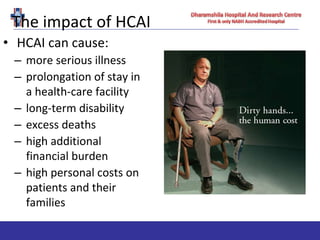
The impact of HCAI
• HCAI can cause:
– more serious illness
– prolongation of stay in
a health-care facility
– long-term disability
– excess deaths
– high additional
financial burden
– high personal costs on
patients and their
families
Importance of hospital associated
infection
• Term based payment system for hospitals
• Quality indicator: Accreditation
• Hub of M.D.R.O organisims-empiric
antibiotic guidelines/Cancer patients
Estimated rates of HCAI worldwide
– At any time, hundreds of millions of people worldwide are
suffering from infections acquired in health-care facilities
– In modern health-care facilities in the developed world:
5–10% of patients acquire one or more infections
– In developing countries the risk of HCAI is 2–20 times higher
than in developed countries and the proportion
of patients affected by HCAI can exceed 25%
– In intensive care units, HCAI affects about 30% of patients
and the attributable mortality may reach 44%
UNIVERSAL PRECAUTIONS
• Under Universal precautions , blood and certain bodily
fluids of all patients are considered as potentially infectious
for HIV, HBV and other bloodborne diseases (12). These
precautions include the use of personal protective
equipment (PPE), such as gloves, mask, gown and eyewear
appropriate for the anticipated risk, and hand hygiene, as
well as precautions to avoid needle stick injuries to both
patients and health care workers.
STANDARD AND
TRANSMISSIONPRECAUTIONS
• Standard precautions: They are based on the principle that all blood
and other bodily fluids, secretions and excretions, excluding
perspirations, may contain transmissible infectious agent. These
precautions include; hand hygiene; the use of gloves, a gown, a
mask, eye protection or a face shield, depending on the anticipated
exposure; and safe injection practices. Equipment or items in the
patient environment likely to have been contaminated with
infectious bodily fluids must be handled appropriately to prevent
transmission of infectious. Respiratory hygiene/cough etiquette.
• Transmission-based precautions should be used suspected to be
infected or colonized with infectious agents.
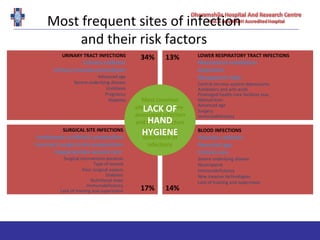
Most frequent sites of infection
and their risk factors
LOWER RESPIRATORY TRACT INFECTIONS
Mechanical ventilation
Aspiration
Nasogastric tube
Central nervous system depressants
Antibiotics and anti-acids
Prolonged health-care facilities stay
Malnutrition
Advanced age
Surgery
Immunodeficiency
13%
BLOOD INFECTIONS
Vascular catheter
Neonatal age
Critical care
Severe underlying disease
Neutropenia
Immunodeficiency
New invasive technologies
Lack of training and supervision
14%
SURGICAL SITE INFECTIONS
Inadequate antibiotic prophylaxis
Incorrect surgical skin preparation
Inappropriate wound care
Surgical intervention duration
Type of wound
Poor surgical asepsis
Diabetes
Nutritional state
Immunodeficiency
Lack of training and supervision 17%
URINARY TRACT INFECTIONS
Urinary catheter
Urinary invasive procedures
Advanced age
Severe underlying disease
Urolitiasis
Pregnancy
Diabetes
34%
Most common
sites of health care-
associated infection
and the risk factors
underlying the
occurrence of
infections
LACK OF
HAND
HYGIENE
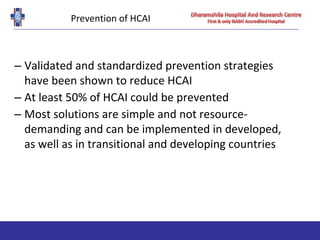
Prevention of HCAI
– Validated and standardized prevention strategies
have been shown to reduce HCAI
– At least 50% of HCAI could be prevented
– Most solutions are simple and not resource-
demanding and can be implemented in developed,
as well as in transitional and developing countries
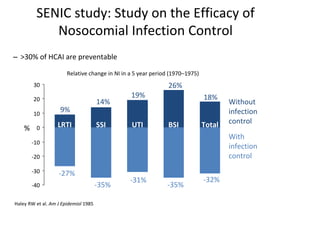
SENIC study: Study on the Efficacy of
Nosocomial Infection Control
– >30% of HCAI are preventable
With
infection
control
-31%
-35%-35%
-27%
-32%
Without
infection
control
14%
9%
19%
26%
18%
LRTI SSI UTI BSI Total
Relative change in NI in a 5 year period (1970–1975)
0
10
20
30
-40
-30
-20
-10
%
Haley RW et al. Am J Epidemiol 1985
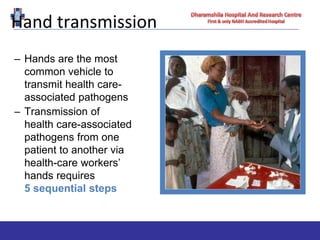
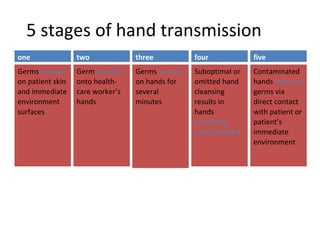
Hand transmission
– Hands are the most
common vehicle to
transmit health care-
associated pathogens
– Transmission of
health care-associated
pathogens from one
patient to another via
health-care workers’
hands requires
5 sequential steps
5 stages of hand transmission
Germs present
on patient skin
and immediate
environment
surfaces
Germ transfer
onto health-
care worker’s
hands
Germs survive
on hands for
several
minutes
Suboptimal or
omitted hand
cleansing
results in
hands
remaining
contaminated
Contaminated
hands transmit
germs via
direct contact
with patient or
patient’s
immediate
environment
one two three four five
Why should you clean your hands?
– Any health-care worker, caregiver or person involved in
patient care needs to be concerned about hand hygiene
– Therefore hand hygiene concerns you!
– You must perform hand hygiene to:
– protect the patient against harmful germs carried on your hands or present on
his/her own skin
– protect yourself and the health-care environment from harmful germs
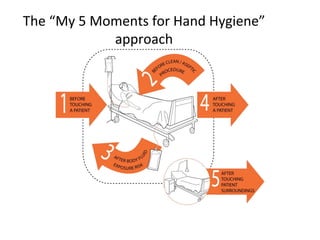
The “My 5 Moments for Hand Hygiene”
approach
How to clean your hands
– Handrubbing with alcohol-based handrub is the
preferred routine method of hand hygiene if hands
are not visibly soiled
– Handwashing with soap and water – essential
when
when hands are visibly dirty or visibly soiled
(following visible exposure to body fluids)1
1 If exposure to spore forming organisms e.g. Clostridium difficile is strongly suspected or
proven, including during outbreaks – clean hands using soap and water
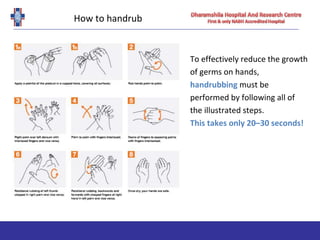
To effectively reduce the growth
of germs on hands,
handrubbing must be
performed by following all of
the illustrated steps.
This takes only 20–30 seconds!
How to handrub
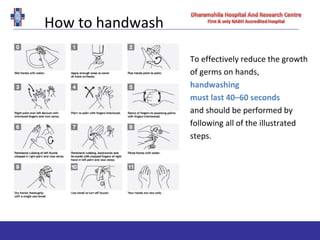
How to handwash
To effectively reduce the growth
of germs on hands,
handwashing
must last 40–60 seconds
and should be performed by
following all of the illustrated
steps.
Hand hygiene and glove use
– The use of gloves does not replace the need to
clean your hands!
– You should remove gloves to perform hand
hygiene, when an indication occurs while wearing
gloves
– You should wear gloves only when indicated (see
the Pyramid in the Hand Hygiene Why, How and
When Brochure and in the Glove Use Information
Leaflet) – otherwise they become a major risk for
germ transmission
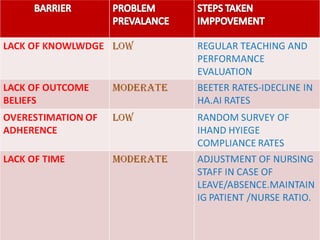
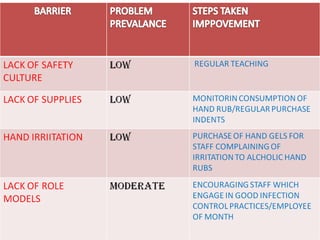
BARRIERS TO HAND HYIEGINE
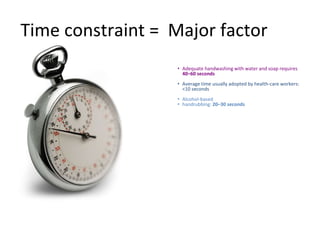
Time constraint = Major factor
• Adequate handwashing with water and soap requires
40–60 seconds
• Average time usually adopted by health-care workers:
<10 seconds
• Alcohol-based
• handrubbing: 20–30 seconds
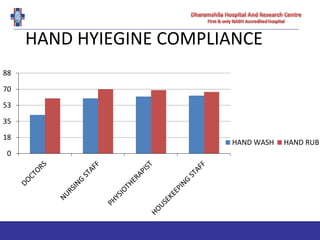
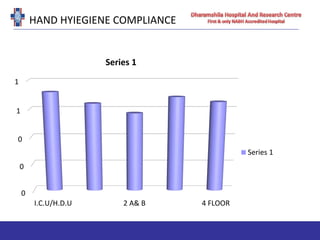
HAND HYIEGINE COMPLIANCE
0
18
35
53
70
88
HAND WASH HAND RUB
HAND HYIEGIENE COMPLIANCE
0
0
0
1
1
I.C.U/H.D.U 2 A& B 4 FLOOR
Series 1
Series 1
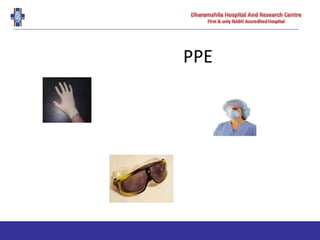
PPE
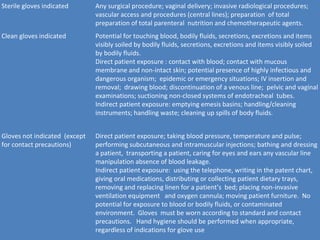
Sterile gloves indicated Any surgical procedure; vaginal delivery; invasive radiological procedures;
vascular access and procedures (central lines); preparation of total
preparation of total parenteral nutrition and chemotherapeutic agents.
Clean gloves indicated Potential for touching blood, bodily fluids, secretions, excretions and items
visibly soiled by bodily fluids, secretions, excretions and items visibly soiled
by bodily fluids.
Direct patient exposure : contact with blood; contact with mucous
membrane and non-intact skin; potential presence of highly infectious and
dangerous organism; epidemic or emergency situations; IV insertion and
removal; drawing blood; discontinuation of a venous line; pelvic and vaginal
examinations; suctioning non-closed systems of endotracheal tubes.
Indirect patient exposure: emptying emesis basins; handling/cleaning
instruments; handling waste; cleaning up spills of body fluids.
Gloves not indicated (except
for contact precautions)
Direct patient exposure; taking blood pressure, temperature and pulse;
performing subcutaneous and intramuscular injections; bathing and dressing
a patient, transporting a patient, caring for eyes and ears any vascular line
manipulation absence of blood leakage.
Indirect patient exposure: using the telephone, writing in the patent chart,
giving oral medications, distributing or collecting patient dietary trays,
removing and replacing linen for a patient’s bed; placing non-invasive
ventilation equipment and oxygen cannula; moving patient furniture. No
potential for exposure to blood or bodily fluids, or contaminated
environment. Gloves must be worn according to standard and contact
precautions. Hand hygiene should be performed when appropriate,
regardless of indications for glove use
GOWNS AND FACE MASKS
• Wear full-body, fluid-repellent gowns when there is a risk of
extensive splashing of blood, bodily fluids, secretions or
excretions, with the exception of perspiration (e.g. trauma,
operating theatres, obstetrics). In situations in which the
splashing of blood or fluid is likely or expected (e.g. in a labour
room during delivery), shoe covers should also be worn;
• Face masks and eye protection should be worn when there is
a risk of blood, bodily fluids, secretions and /or excretions
splashing into the face and eyes.
RESPIRATORY HYGIENE/COUGH ETIQUETTE
• Steps in respiratory hygiene/cough etiquette
• Anyone with signs and symptoms of a respiratory infection,
regardless of the cause, should follow or be instructed to follow
respiratory hygiene/cough etiquette as follows;
• Cover the nose/mouth when coughing or sneezing;
• Use tissues to contain respiratory secretions;
• Dispose of tissues in the nearest waste receptacle after use;
• If no tissues are available, cough or sneeze into the inner elbow
rather than the hand;
• Practice hand hygiene after contact with respiratory secretions and
contaminated objects/materials
PPE includes
• Gloves (Double gloves where used? )
• Aprons, masks, goggles. In certain situations
• In theatre, it may also include caps and
footwear
• Gloves should be worn whenever there might
be contact with blood and body fluids, mucous
membranes or non intact skin.
• Semi recumbent positioning.
• Aseptic intubation and suctioning.
• Good oral care
• Maintain gastric ph/Stress ulcer prophylaxis
• Daily weaning assessment/D.V.T Prophylaxis.
• Humidifier sterilized daily/use only distilled water.
• Suction apparatus to be cleaned daily.
• Envoirmental care during renovation.legionella,aspergillus
• Aseptic precautions to be used at time of
insertion
• Line to be changed every 72 hours.
• Date of insertion to be mentioned at time of
insertion.
• Upper extremity site better as compared to
lower extremity site.
• Use appropriate site-subclavian preferred over
jugular/femoral site.
• Clean the site with alcohol/iodine before and after
inserting/use gloves ,drape and put date of insertion.
• Use a single lumen/as per requirement/minimal hubs.
• Use stop cock on hubs when not in use/clean with alcohol
solution prior to using hub./Closed systems.
• Change guaze dressing every 2 days/transparent dresssing
every 7 days.No frequent changes.
• Central line change if signs of infec tion. No fixed time.
• Antibiotic coated catheter for short term catheterisation.
• Use an appropriate size catheter./smallest diameter
catheter.
• Use a no touch technique while inserting catheter. Perineal
cleaning/appropriate lubricant helps.
• Limit duration/maintain closed drainage.
• Bag should be at a lower position but should not touch the
floor.
• Urine for sampling should be taken by clamping , cleaning
with 70% alcohols solution and removing sample with a
syringe.
• Remove when signs of uti/no fixed change time
• Perineal hygiene for patients.
• Good hydration for patients.
NOT INDICATED
• Antimicrobial coated catheter..
• Neurogenic bladder
• Avoid an indwelling catheter.
• Intermittent urinary catherisation.
Prevention of hosp infection
• Use PPE
• Hand washing(6 pt)
• Sterile precaution
• Environment cleaning
• Vaccination
• Universal precaution
• Surveillance
• Linen management
• Safe blood product
• Sharp management
Universal precaution
• Universal precautions should be applied
to all body fluids when it is difficult to
identify the specific body fluid or when
body fluids are visibly contaminated with
blood.
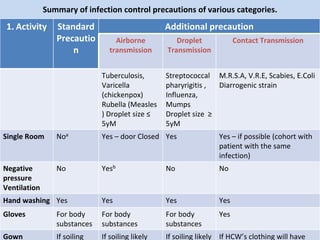
• Irrespective of HIV status of patient
Summary of infection control precautions of various categories.
1. Activity Standard
Precautio
n
Additional precaution
Airborne
transmission
Droplet
Transmission
Contact Transmission
Tuberculosis,
Varicella
(chickenpox)
Rubella (Measles
) Droplet size ≤
5yM
Streptococcal
pharyrigitis ,
Influenza,
Mumps
Droplet size ≥
5yM
M.R.S.A, V.R.E, Scabies, E.Coli
Diarrogenic strain
Single Room Noa Yes – door Closed Yes Yes – if possible (cohort with
patient with the same
infection)
Negative
pressure
Ventilation
No Yesb No No
Hand washing Yes Yes Yes Yes
Gloves For body
substances
For body
substances
For body
substances
Yes
Gown If soiling If soiling likely If soiling likely If HCW’s clothing will have
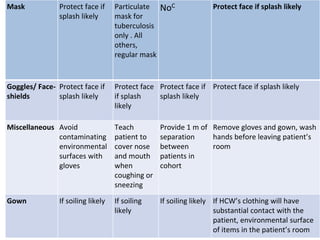
Mask Protect face if
splash likely
Particulate
mask for
tuberculosis
only . All
others,
regular mask
NoC Protect face if splash likely
Goggles/ Face-
shields
Protect face if
splash likely
Protect face
if splash
likely
Protect face if
splash likely
Protect face if splash likely
Miscellaneous Avoid
contaminating
environmental
surfaces with
gloves
Teach
patient to
cover nose
and mouth
when
coughing or
sneezing
Provide 1 m of
separation
between
patients in
cohort
Remove gloves and gown, wash
hands before leaving patient’s
room
Gown If soiling likely If soiling
likely
If soiling likely If HCW’s clothing will have
substantial contact with the
patient, environmental surface
of items in the patient’s room
Vaccination
• Hepatitis B vaccination
• Staff screening (kitchen staff)
• PEP (In HIV )
Environment cleaning
• Surface should be cleaned with phenyl 2-3
times a day
• The floor and walls should be carbolised
once a day
• ICU and OT tables, fans, lights should be
carbolised once a day or after every
infected case
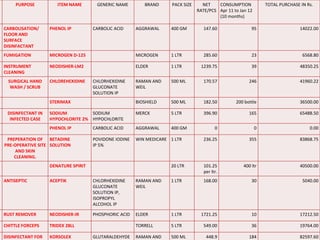
PURPOSE ITEM NAME GENERIC NAME BRAND PACK SIZE NET
RATE/PCS
CONSUMPTION
Apr 11 to Jan 12
(10 months)
TOTAL PURCHASE IN Rs.
CARBOLISATION/
FLOOR AND
SURFACE
DISINFACTANT
PHENOL IP CARBOLIC ACID AGGRAWAL 400 GM 147.60 95 14022.00
FUMIGATION MICROGEN D-125 MICROGEN 1 LTR 285.60 23 6568.80
INSTRUMENT
CLEANING
NEODISHER-LM2 ELDER 1 LTR 1239.75 39 48350.25
SURGICAL HAND
WASH / SCRUB
CHLOREHEXIDINE CHLORHEXIDINE
GLUCONATE
SOLUTION IP
RAMAN AND
WEIL
500 ML 170.57 246 41960.22
STERIMAX BIOSHIELD 500 ML 182.50 200 bottle 36500.00
DISINFECTANT IN
INFECTED CASE
SODIUM
HYPOCHLORITE 2%
SODIUM
HYPOCHLORITE
MERCK 5 LTR 396.90 165 65488.50
PHENOL IP CARBOLIC ACID AGGRAWAL 400 GM 0 0 0.00
PREPERATION OF
PRE-OPERATIVE SITE
AND SKIN
CLEANING.
BETADINE
SOLUTION
POVIDONE IODINE
IP 5%
WIN MEDICARE 1 LTR 236.25 355 83868.75
DENATURE SPIRIT 20 LTR 101.25
per ltr.
400 ltr 40500.00
ANTISEPTIC ACEPTIK CHLORHEXIDINE
GLUCONATE
SOLUTION IP,
ISOPROPYL
ALCOHOL IP
RAMAN AND
WEIL
1 LTR 168.00 30 5040.00
RUST REMOVER NEODISHER-IR PHOSPHORIC ACID ELDER 1 LTR 1721.25 10 17212.50
CHITTLE FORCEPS TRIDEX 28LL TORRELL 5 LTR 549.00 36 19764.00
DISINFECTANT FOR KORSOLEX GLUTARALDEHYDE RAMAN AND 500 ML 448.9 184 82597.60
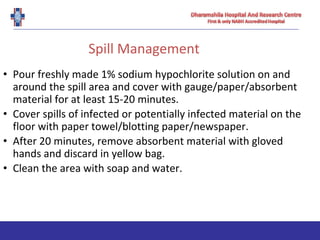
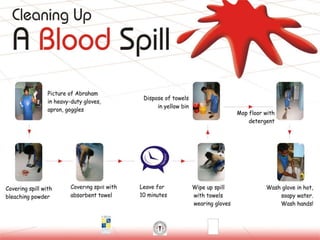
Spill Management
• Pour freshly made 1% sodium hypochlorite solution on and
around the spill area and cover with gauge/paper/absorbent
material for at least 15-20 minutes.
• Cover spills of infected or potentially infected material on the
floor with paper towel/blotting paper/newspaper.
• After 20 minutes, remove absorbent material with gloved
hands and discard in yellow bag.
• Clean the area with soap and water.
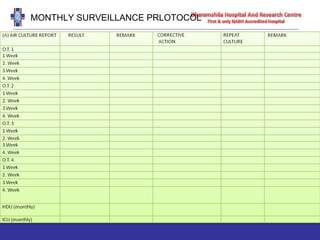
MONTHLY SURVEILLANCE PRLOTOCOL
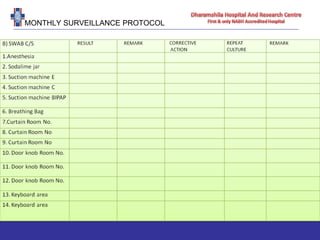
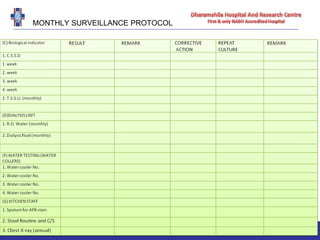
MONTHLY SURVEILLANCE PROTOCOL
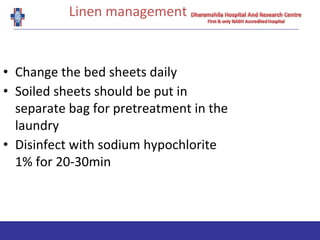
Linen management
• Change the bed sheets daily
• Soiled sheets should be put in
separate bag for pretreatment in the
laundry
• Disinfect with sodium hypochlorite
1% for 20-30min
Sharp management
• Needles should be destroyed by needle destroyer
• Put in puncture proof container
• Syringe should be put in hypochlorite solution
• Syringes after pretreatment should be put in red
bag
Things not to do
• You should ensure that:
• Sharps are not passed directly from hand to hand
• Handling is kept to a minimum
• Needles are not broken or bent
• Needles are never re-capped
• Staff take personal responsibility for any sharps they use
and dispose of them in a designated container at the point
of use
Handling of Accident
• Complete an accident form.
• Seek help to initiate an investigation into the cause of the
incident and risk assessment.
• If blood and body fluids splash into your mouth, do not
swallow.
• Rinse out several times with cold water.
• If blood and body fluids splash into eyes, irrigate with cold
water.
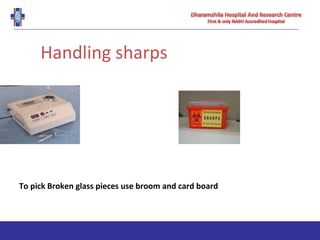
Handling sharps
To pick Broken glass pieces use broom and card board
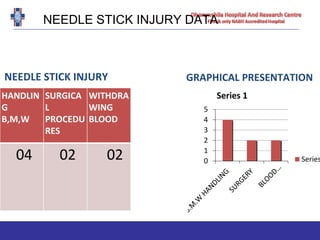
NEEDLE STICK INJURY DATA
NEEDLE STICK INJURY GRAPHICAL PRESENTATION
HANDLIN
G
B,M,W
SURGICA
L
PROCEDU
RES
WITHDRA
WING
BLOOD
04 02 02 0
1
2
3
4
5
Series 1
Series
HICC
• Members
• Job profile
• Issues to discuss
• Surveillance
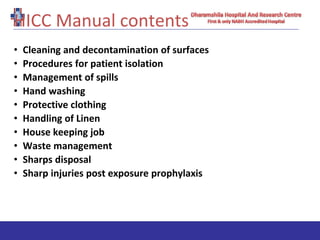
HICC Manual contents
• Cleaning and decontamination of surfaces
• Procedures for patient isolation
• Management of spills
• Hand washing
• Protective clothing
• Handling of Linen
• House keeping job
• Waste management
• Sharps disposal
• Sharp injuries post exposure prophylaxis
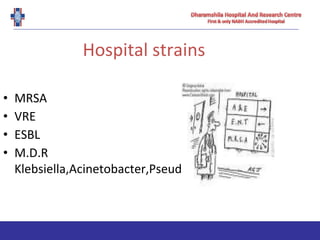
Hospital strains
• MRSA
• VRE
• ESBL
• M.D.R
Klebsiella,Acinetobacter,Pseudomonas
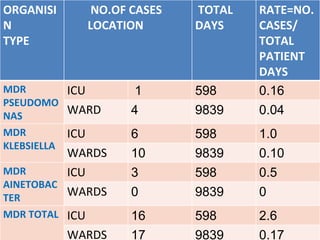
ORGANISI
N
TYPE
NO.OF CASES
LOCATION
TOTAL
DAYS
RATE=NO.
CASES/
TOTAL
PATIENT
DAYS
X100MDR
PSEUDOMO
NAS
ICU 1 598 0.16
WARD 4 9839 0.04
MDR
KLEBSIELLA
ICU 6 598 1.0
WARDS 10 9839 0.10
MDR
AINETOBAC
TER
ICU 3 598 0.5
WARDS 0 9839 0
MDR TOTAL ICU 16 598 2.6
WARDS 17 9839 0.17
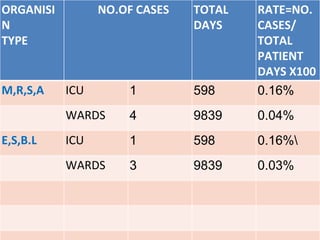
ORGANISI
N
TYPE
NO.OF CASES TOTAL
DAYS
RATE=NO.
CASES/
TOTAL
PATIENT
DAYS X100
M,R,S,A ICU 1 598 0.16%
WARDS 4 9839 0.04%
E,S,B.L ICU 1 598 0.16%
WARDS 3 9839 0.03%
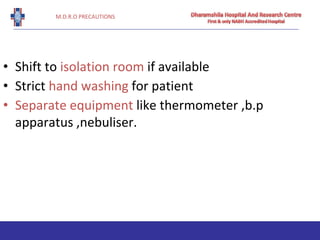
M.D.R.O PRECAUTIONS
• Shift to isolation room if available
• Strict hand washing for patient
• Separate equipment like thermometer ,b.p
apparatus ,nebuliser.
Care of patient
• Isolation
• Reverse isolation
BMW rule
• Bio-Medical Waste (Management and
Handling) Rule – 1998
• Under Forest Ministry
• The Private company makes the
arrangement to collect the bio-medical
waste from Hospital
Steps taken
• Segregation
• Collection
• Transportation
• Treatment
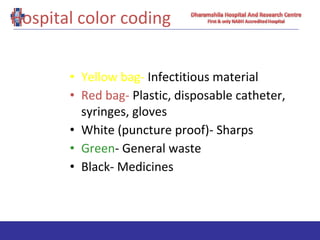
Hospital color coding
• Yellow bag- Infectitious material
• Red bag- Plastic, disposable catheter,
syringes, gloves
• White (puncture proof)- Sharps
• Green- General waste
• Black- Medicines
Pre treatment
• Red bag material are pretreated
• Hypochlorite solution is added
• 1% freshly prepared solution is used
• Double Basket dust bin is used
• After treatment plastic, syringes etc. are put in
red bag
• Gloves are cut before putting in bag
Transportation
• Waste is weighed according to color coded bags
and recorded
• Private company transport waste in closed vehicle
• Taken to treatment plant (area)
• Dumping and treating site is Okhla, New Delhi.
• Treated according to color coded bags
INFECTION CONTROL PROGRAMME
• GOAL
• TO REDUCE THE INCIDENCE OF
HOSPITAL ACQUIRED
INFECTIONS,CATER TO PATIENT AND
HEALTHCARE WORKER SAFETY
Surveillance
• LABORATORY BASED WARD
ALLIASON
POLICYFOR H.I.C
• COMPLIANCE WITH I.P.C PROCEDURES PART
OF PERFORMANCE EVALUATION FOR STAFF.
• ESTABLISHING ROLE MODELS FOR EMPLOYEES
BY ENCOURAGEMENT OF STAFF FOLLOWING
GOOD INFECTION CONTROL PRACTICES.
• COMMUNICATION WITH HEALTH
DEPARTMENT,DELHI GOVT. PROVIDING
FEEDBACK ABOUT COMMUNICABLE INFECTIONS.
. BENCHMARKING OF HOSPITAL DATA WITH
N.H.S.N
POLICY FOR H.I.C
• ADRESSING ISSUES RELATED TO
HEALTHCARE WORKER SAFETY-NEEDLE
STICK INJURY,VACCINATION OF
STAFF,BIOMEDICAL WASTE MANAGEMENT.
• MONITORING USE OF ANTIBIOTICS IN
HOSPITAL AND ENCOURAGING GOOD
ANTIBIOTIC PRACTICES.
• REGALAR AUDITS IIN FOLLOWING AREAS
AS MEASURE OF PROCESS OUTCOME
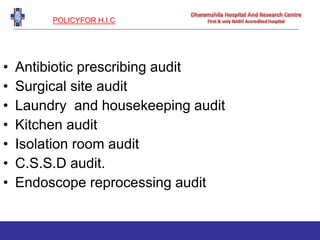
POLICYFOR H.I.C
• Antibiotic prescribing audit
• Surgical site audit
• Laundry and housekeeping audit
• Kitchen audit
• Isolation room audit
• C.S.S.D audit.
• Endoscope reprocessing audit
POLICY FOR H.I.C
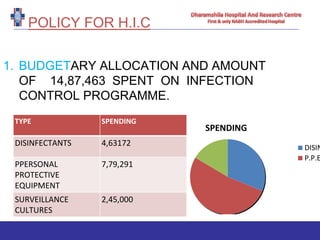
1. BUDGETARY ALLOCATION AND AMOUNT
OF 14,87,463 SPENT ON INFECTION
CONTROL PROGRAMME.
SPENDING
DISIN
P.P.E
TYPE SPENDING
DISINFECTANTS 4,63172
PPERSONAL
PROTECTIVE
EQUIPMENT
7,79,291
SURVEILLANCE
CULTURES
2,45,000
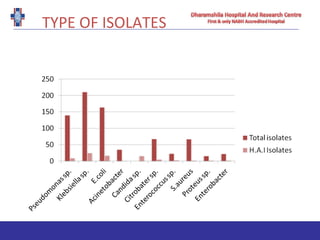
TYPE OF ISOLATES
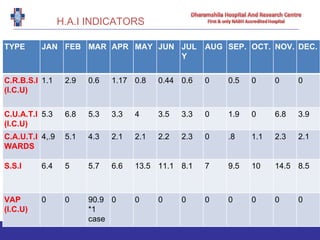
H.A.I INDICATORS
TYPE JAN FEB MAR APR MAY JUN JUL
Y
AUG SEP. OCT. NOV. DEC.
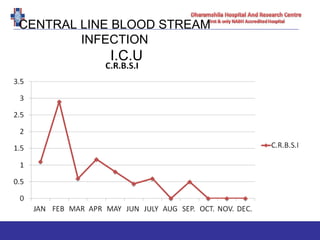
C.R.B.S.I
(I.C.U)
1.1 2.9 0.6 1.17 0.8 0.44 0.6 0 0.5 0 0 0
C.U.A.T.I
(I.C.U)
5.3 6.8 5.3 3.3 4 3.5 3.3 0 1.9 0 6.8 3.9
C.A.U.T.I
WARDS
4,.9 5.1 4.3 2.1 2.1 2.2 2.3 0 .8 1.1 2.3 2.1
S.S.I 6.4 5 5.7 6.6 13.5 11.1 8.1 7 9.5 10 14.5 8.5
VAP
(I.C.U)
0 0 90.9
*1
case
0 0 0 0 0 0 0 0 0
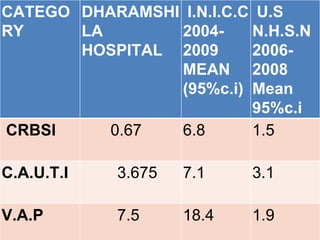
CATEGO
RY
DHARAMSHI
LA
HOSPITAL
I.N.I.C.C
2004-
2009
MEAN
(95%c.i)
U.S
N.H.S.N
2006-
2008
Mean
95%c.i
CRBSI 0.67 6.8 1.5
C.A.U.T.I 3.675 7.1 3.1
V.A.P 7.5 18.4 1.9
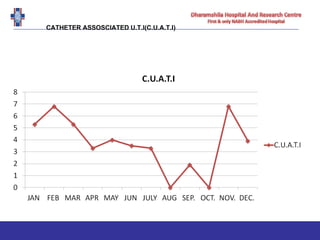
CATHETER ASSOSCIATED U.T.I(C.U.A.T.I)
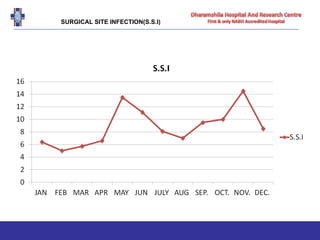
SURGICAL SITE INFECTION(S.S.I)
CENTRAL LINE BLOOD STREAM
INFECTION
I.C.U
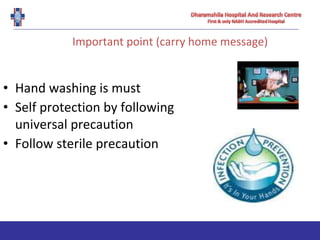
Important point (carry home message)
• Hand washing is must
• Self protection by following
universal precaution
• Follow sterile precaution
Sterility leads to infection free
atmosphere, we are
responsible for it.
Thank you

Employee Induction presentation (HIC)

  • 1.
    Hospital infection Control(Induction ppt.) DrJayant balani Consultant Microbiologist(MBBS,MD)) Dharamshila hospital &research centre, New Delhi
  • 2.
    Definition • Health Care-associatedInfection (HCAI) – Also referred to as “nosocomial” or “hospital” infection • “An infection occurring in a patient during the process of care in a hospital or other health-care facility which was not present or incubating at the time of admission. This includes infections acquired in the health-care facility but appearing after discharge, and also occupational infections among health-care workers of the facility”
  • 3.
    Sources of infection •Self( immunity) • Staff (contact) • Environment (air, water) • Instrumentation • Food • Iatrogenic or Procedural • Surgical site infection
  • 4.
    The impact ofHCAI • HCAI can cause: – more serious illness – prolongation of stay in a health-care facility – long-term disability – excess deaths – high additional financial burden – high personal costs on patients and their families
  • 5.
    Importance of hospitalassociated infection • Term based payment system for hospitals • Quality indicator: Accreditation • Hub of M.D.R.O organisims-empiric antibiotic guidelines/Cancer patients
  • 6.
    Estimated rates ofHCAI worldwide – At any time, hundreds of millions of people worldwide are suffering from infections acquired in health-care facilities – In modern health-care facilities in the developed world: 5–10% of patients acquire one or more infections – In developing countries the risk of HCAI is 2–20 times higher than in developed countries and the proportion of patients affected by HCAI can exceed 25% – In intensive care units, HCAI affects about 30% of patients and the attributable mortality may reach 44%
  • 7.
    UNIVERSAL PRECAUTIONS • UnderUniversal precautions , blood and certain bodily fluids of all patients are considered as potentially infectious for HIV, HBV and other bloodborne diseases (12). These precautions include the use of personal protective equipment (PPE), such as gloves, mask, gown and eyewear appropriate for the anticipated risk, and hand hygiene, as well as precautions to avoid needle stick injuries to both patients and health care workers.
  • 8.
    STANDARD AND TRANSMISSIONPRECAUTIONS • Standardprecautions: They are based on the principle that all blood and other bodily fluids, secretions and excretions, excluding perspirations, may contain transmissible infectious agent. These precautions include; hand hygiene; the use of gloves, a gown, a mask, eye protection or a face shield, depending on the anticipated exposure; and safe injection practices. Equipment or items in the patient environment likely to have been contaminated with infectious bodily fluids must be handled appropriately to prevent transmission of infectious. Respiratory hygiene/cough etiquette. • Transmission-based precautions should be used suspected to be infected or colonized with infectious agents.
  • 9.
    Most frequent sitesof infection and their risk factors LOWER RESPIRATORY TRACT INFECTIONS Mechanical ventilation Aspiration Nasogastric tube Central nervous system depressants Antibiotics and anti-acids Prolonged health-care facilities stay Malnutrition Advanced age Surgery Immunodeficiency 13% BLOOD INFECTIONS Vascular catheter Neonatal age Critical care Severe underlying disease Neutropenia Immunodeficiency New invasive technologies Lack of training and supervision 14% SURGICAL SITE INFECTIONS Inadequate antibiotic prophylaxis Incorrect surgical skin preparation Inappropriate wound care Surgical intervention duration Type of wound Poor surgical asepsis Diabetes Nutritional state Immunodeficiency Lack of training and supervision 17% URINARY TRACT INFECTIONS Urinary catheter Urinary invasive procedures Advanced age Severe underlying disease Urolitiasis Pregnancy Diabetes 34% Most common sites of health care- associated infection and the risk factors underlying the occurrence of infections LACK OF HAND HYGIENE
  • 10.
    Prevention of HCAI –Validated and standardized prevention strategies have been shown to reduce HCAI – At least 50% of HCAI could be prevented – Most solutions are simple and not resource- demanding and can be implemented in developed, as well as in transitional and developing countries
  • 11.
    SENIC study: Studyon the Efficacy of Nosocomial Infection Control – >30% of HCAI are preventable With infection control -31% -35%-35% -27% -32% Without infection control 14% 9% 19% 26% 18% LRTI SSI UTI BSI Total Relative change in NI in a 5 year period (1970–1975) 0 10 20 30 -40 -30 -20 -10 % Haley RW et al. Am J Epidemiol 1985
  • 12.
    Hand transmission – Handsare the most common vehicle to transmit health care- associated pathogens – Transmission of health care-associated pathogens from one patient to another via health-care workers’ hands requires 5 sequential steps
  • 13.
    5 stages ofhand transmission Germs present on patient skin and immediate environment surfaces Germ transfer onto health- care worker’s hands Germs survive on hands for several minutes Suboptimal or omitted hand cleansing results in hands remaining contaminated Contaminated hands transmit germs via direct contact with patient or patient’s immediate environment one two three four five
  • 14.
    Why should youclean your hands? – Any health-care worker, caregiver or person involved in patient care needs to be concerned about hand hygiene – Therefore hand hygiene concerns you! – You must perform hand hygiene to: – protect the patient against harmful germs carried on your hands or present on his/her own skin – protect yourself and the health-care environment from harmful germs
  • 15.
    The “My 5Moments for Hand Hygiene” approach
  • 16.
    How to cleanyour hands – Handrubbing with alcohol-based handrub is the preferred routine method of hand hygiene if hands are not visibly soiled – Handwashing with soap and water – essential when when hands are visibly dirty or visibly soiled (following visible exposure to body fluids)1 1 If exposure to spore forming organisms e.g. Clostridium difficile is strongly suspected or proven, including during outbreaks – clean hands using soap and water
  • 17.
    To effectively reducethe growth of germs on hands, handrubbing must be performed by following all of the illustrated steps. This takes only 20–30 seconds! How to handrub
  • 18.
    How to handwash Toeffectively reduce the growth of germs on hands, handwashing must last 40–60 seconds and should be performed by following all of the illustrated steps.
  • 19.
    Hand hygiene andglove use – The use of gloves does not replace the need to clean your hands! – You should remove gloves to perform hand hygiene, when an indication occurs while wearing gloves – You should wear gloves only when indicated (see the Pyramid in the Hand Hygiene Why, How and When Brochure and in the Glove Use Information Leaflet) – otherwise they become a major risk for germ transmission
  • 20.
  • 21.
    Time constraint =Major factor • Adequate handwashing with water and soap requires 40–60 seconds • Average time usually adopted by health-care workers: <10 seconds • Alcohol-based • handrubbing: 20–30 seconds
  • 24.
  • 25.
    HAND HYIEGIENE COMPLIANCE 0 0 0 1 1 I.C.U/H.D.U2 A& B 4 FLOOR Series 1 Series 1
  • 26.
  • 27.
    Sterile gloves indicatedAny surgical procedure; vaginal delivery; invasive radiological procedures; vascular access and procedures (central lines); preparation of total preparation of total parenteral nutrition and chemotherapeutic agents. Clean gloves indicated Potential for touching blood, bodily fluids, secretions, excretions and items visibly soiled by bodily fluids, secretions, excretions and items visibly soiled by bodily fluids. Direct patient exposure : contact with blood; contact with mucous membrane and non-intact skin; potential presence of highly infectious and dangerous organism; epidemic or emergency situations; IV insertion and removal; drawing blood; discontinuation of a venous line; pelvic and vaginal examinations; suctioning non-closed systems of endotracheal tubes. Indirect patient exposure: emptying emesis basins; handling/cleaning instruments; handling waste; cleaning up spills of body fluids. Gloves not indicated (except for contact precautions) Direct patient exposure; taking blood pressure, temperature and pulse; performing subcutaneous and intramuscular injections; bathing and dressing a patient, transporting a patient, caring for eyes and ears any vascular line manipulation absence of blood leakage. Indirect patient exposure: using the telephone, writing in the patent chart, giving oral medications, distributing or collecting patient dietary trays, removing and replacing linen for a patient’s bed; placing non-invasive ventilation equipment and oxygen cannula; moving patient furniture. No potential for exposure to blood or bodily fluids, or contaminated environment. Gloves must be worn according to standard and contact precautions. Hand hygiene should be performed when appropriate, regardless of indications for glove use
  • 28.
    GOWNS AND FACEMASKS • Wear full-body, fluid-repellent gowns when there is a risk of extensive splashing of blood, bodily fluids, secretions or excretions, with the exception of perspiration (e.g. trauma, operating theatres, obstetrics). In situations in which the splashing of blood or fluid is likely or expected (e.g. in a labour room during delivery), shoe covers should also be worn; • Face masks and eye protection should be worn when there is a risk of blood, bodily fluids, secretions and /or excretions splashing into the face and eyes.
  • 29.
    RESPIRATORY HYGIENE/COUGH ETIQUETTE •Steps in respiratory hygiene/cough etiquette • Anyone with signs and symptoms of a respiratory infection, regardless of the cause, should follow or be instructed to follow respiratory hygiene/cough etiquette as follows; • Cover the nose/mouth when coughing or sneezing; • Use tissues to contain respiratory secretions; • Dispose of tissues in the nearest waste receptacle after use; • If no tissues are available, cough or sneeze into the inner elbow rather than the hand; • Practice hand hygiene after contact with respiratory secretions and contaminated objects/materials
  • 30.
    PPE includes • Gloves(Double gloves where used? ) • Aprons, masks, goggles. In certain situations • In theatre, it may also include caps and footwear • Gloves should be worn whenever there might be contact with blood and body fluids, mucous membranes or non intact skin.
  • 31.
    • Semi recumbentpositioning. • Aseptic intubation and suctioning. • Good oral care • Maintain gastric ph/Stress ulcer prophylaxis • Daily weaning assessment/D.V.T Prophylaxis. • Humidifier sterilized daily/use only distilled water. • Suction apparatus to be cleaned daily. • Envoirmental care during renovation.legionella,aspergillus
  • 32.
    • Aseptic precautionsto be used at time of insertion • Line to be changed every 72 hours. • Date of insertion to be mentioned at time of insertion. • Upper extremity site better as compared to lower extremity site.
  • 33.
    • Use appropriatesite-subclavian preferred over jugular/femoral site. • Clean the site with alcohol/iodine before and after inserting/use gloves ,drape and put date of insertion. • Use a single lumen/as per requirement/minimal hubs. • Use stop cock on hubs when not in use/clean with alcohol solution prior to using hub./Closed systems. • Change guaze dressing every 2 days/transparent dresssing every 7 days.No frequent changes. • Central line change if signs of infec tion. No fixed time. • Antibiotic coated catheter for short term catheterisation.
  • 34.
    • Use anappropriate size catheter./smallest diameter catheter. • Use a no touch technique while inserting catheter. Perineal cleaning/appropriate lubricant helps. • Limit duration/maintain closed drainage. • Bag should be at a lower position but should not touch the floor. • Urine for sampling should be taken by clamping , cleaning with 70% alcohols solution and removing sample with a syringe. • Remove when signs of uti/no fixed change time
  • 35.
    • Perineal hygienefor patients. • Good hydration for patients. NOT INDICATED • Antimicrobial coated catheter.. • Neurogenic bladder • Avoid an indwelling catheter. • Intermittent urinary catherisation.
  • 36.
    Prevention of hospinfection • Use PPE • Hand washing(6 pt) • Sterile precaution • Environment cleaning • Vaccination • Universal precaution • Surveillance • Linen management • Safe blood product • Sharp management
  • 37.
    Universal precaution • Universalprecautions should be applied to all body fluids when it is difficult to identify the specific body fluid or when body fluids are visibly contaminated with blood. • Irrespective of HIV status of patient
  • 38.
    Summary of infectioncontrol precautions of various categories. 1. Activity Standard Precautio n Additional precaution Airborne transmission Droplet Transmission Contact Transmission Tuberculosis, Varicella (chickenpox) Rubella (Measles ) Droplet size ≤ 5yM Streptococcal pharyrigitis , Influenza, Mumps Droplet size ≥ 5yM M.R.S.A, V.R.E, Scabies, E.Coli Diarrogenic strain Single Room Noa Yes – door Closed Yes Yes – if possible (cohort with patient with the same infection) Negative pressure Ventilation No Yesb No No Hand washing Yes Yes Yes Yes Gloves For body substances For body substances For body substances Yes Gown If soiling If soiling likely If soiling likely If HCW’s clothing will have
  • 39.
    Mask Protect faceif splash likely Particulate mask for tuberculosis only . All others, regular mask NoC Protect face if splash likely Goggles/ Face- shields Protect face if splash likely Protect face if splash likely Protect face if splash likely Protect face if splash likely Miscellaneous Avoid contaminating environmental surfaces with gloves Teach patient to cover nose and mouth when coughing or sneezing Provide 1 m of separation between patients in cohort Remove gloves and gown, wash hands before leaving patient’s room Gown If soiling likely If soiling likely If soiling likely If HCW’s clothing will have substantial contact with the patient, environmental surface of items in the patient’s room
  • 40.
    Vaccination • Hepatitis Bvaccination • Staff screening (kitchen staff) • PEP (In HIV )
  • 41.
    Environment cleaning • Surfaceshould be cleaned with phenyl 2-3 times a day • The floor and walls should be carbolised once a day • ICU and OT tables, fans, lights should be carbolised once a day or after every infected case
  • 42.
    PURPOSE ITEM NAMEGENERIC NAME BRAND PACK SIZE NET RATE/PCS CONSUMPTION Apr 11 to Jan 12 (10 months) TOTAL PURCHASE IN Rs. CARBOLISATION/ FLOOR AND SURFACE DISINFACTANT PHENOL IP CARBOLIC ACID AGGRAWAL 400 GM 147.60 95 14022.00 FUMIGATION MICROGEN D-125 MICROGEN 1 LTR 285.60 23 6568.80 INSTRUMENT CLEANING NEODISHER-LM2 ELDER 1 LTR 1239.75 39 48350.25 SURGICAL HAND WASH / SCRUB CHLOREHEXIDINE CHLORHEXIDINE GLUCONATE SOLUTION IP RAMAN AND WEIL 500 ML 170.57 246 41960.22 STERIMAX BIOSHIELD 500 ML 182.50 200 bottle 36500.00 DISINFECTANT IN INFECTED CASE SODIUM HYPOCHLORITE 2% SODIUM HYPOCHLORITE MERCK 5 LTR 396.90 165 65488.50 PHENOL IP CARBOLIC ACID AGGRAWAL 400 GM 0 0 0.00 PREPERATION OF PRE-OPERATIVE SITE AND SKIN CLEANING. BETADINE SOLUTION POVIDONE IODINE IP 5% WIN MEDICARE 1 LTR 236.25 355 83868.75 DENATURE SPIRIT 20 LTR 101.25 per ltr. 400 ltr 40500.00 ANTISEPTIC ACEPTIK CHLORHEXIDINE GLUCONATE SOLUTION IP, ISOPROPYL ALCOHOL IP RAMAN AND WEIL 1 LTR 168.00 30 5040.00 RUST REMOVER NEODISHER-IR PHOSPHORIC ACID ELDER 1 LTR 1721.25 10 17212.50 CHITTLE FORCEPS TRIDEX 28LL TORRELL 5 LTR 549.00 36 19764.00 DISINFECTANT FOR KORSOLEX GLUTARALDEHYDE RAMAN AND 500 ML 448.9 184 82597.60
  • 43.
    Spill Management • Pourfreshly made 1% sodium hypochlorite solution on and around the spill area and cover with gauge/paper/absorbent material for at least 15-20 minutes. • Cover spills of infected or potentially infected material on the floor with paper towel/blotting paper/newspaper. • After 20 minutes, remove absorbent material with gloved hands and discard in yellow bag. • Clean the area with soap and water.
  • 45.
  • 46.
  • 47.
  • 48.
    Linen management • Changethe bed sheets daily • Soiled sheets should be put in separate bag for pretreatment in the laundry • Disinfect with sodium hypochlorite 1% for 20-30min
  • 49.
    Sharp management • Needlesshould be destroyed by needle destroyer • Put in puncture proof container • Syringe should be put in hypochlorite solution • Syringes after pretreatment should be put in red bag
  • 50.
    Things not todo • You should ensure that: • Sharps are not passed directly from hand to hand • Handling is kept to a minimum • Needles are not broken or bent • Needles are never re-capped • Staff take personal responsibility for any sharps they use and dispose of them in a designated container at the point of use
  • 51.
    Handling of Accident •Complete an accident form. • Seek help to initiate an investigation into the cause of the incident and risk assessment. • If blood and body fluids splash into your mouth, do not swallow. • Rinse out several times with cold water. • If blood and body fluids splash into eyes, irrigate with cold water.
  • 52.
    Handling sharps To pickBroken glass pieces use broom and card board
  • 53.
    NEEDLE STICK INJURYDATA NEEDLE STICK INJURY GRAPHICAL PRESENTATION HANDLIN G B,M,W SURGICA L PROCEDU RES WITHDRA WING BLOOD 04 02 02 0 1 2 3 4 5 Series 1 Series
  • 54.
    HICC • Members • Jobprofile • Issues to discuss • Surveillance
  • 55.
    HICC Manual contents •Cleaning and decontamination of surfaces • Procedures for patient isolation • Management of spills • Hand washing • Protective clothing • Handling of Linen • House keeping job • Waste management • Sharps disposal • Sharp injuries post exposure prophylaxis
  • 56.
    Hospital strains • MRSA •VRE • ESBL • M.D.R Klebsiella,Acinetobacter,Pseudomonas
  • 57.
    ORGANISI N TYPE NO.OF CASES LOCATION TOTAL DAYS RATE=NO. CASES/ TOTAL PATIENT DAYS X100MDR PSEUDOMO NAS ICU 1598 0.16 WARD 4 9839 0.04 MDR KLEBSIELLA ICU 6 598 1.0 WARDS 10 9839 0.10 MDR AINETOBAC TER ICU 3 598 0.5 WARDS 0 9839 0 MDR TOTAL ICU 16 598 2.6 WARDS 17 9839 0.17
  • 58.
    ORGANISI N TYPE NO.OF CASES TOTAL DAYS RATE=NO. CASES/ TOTAL PATIENT DAYSX100 M,R,S,A ICU 1 598 0.16% WARDS 4 9839 0.04% E,S,B.L ICU 1 598 0.16% WARDS 3 9839 0.03%
  • 59.
    M.D.R.O PRECAUTIONS • Shiftto isolation room if available • Strict hand washing for patient • Separate equipment like thermometer ,b.p apparatus ,nebuliser.
  • 60.
    Care of patient •Isolation • Reverse isolation
  • 61.
    BMW rule • Bio-MedicalWaste (Management and Handling) Rule – 1998 • Under Forest Ministry • The Private company makes the arrangement to collect the bio-medical waste from Hospital
  • 62.
    Steps taken • Segregation •Collection • Transportation • Treatment
  • 63.
    Hospital color coding •Yellow bag- Infectitious material • Red bag- Plastic, disposable catheter, syringes, gloves • White (puncture proof)- Sharps • Green- General waste • Black- Medicines
  • 64.
    Pre treatment • Redbag material are pretreated • Hypochlorite solution is added • 1% freshly prepared solution is used • Double Basket dust bin is used • After treatment plastic, syringes etc. are put in red bag • Gloves are cut before putting in bag
  • 65.
    Transportation • Waste isweighed according to color coded bags and recorded • Private company transport waste in closed vehicle • Taken to treatment plant (area) • Dumping and treating site is Okhla, New Delhi. • Treated according to color coded bags
  • 66.
    INFECTION CONTROL PROGRAMME •GOAL • TO REDUCE THE INCIDENCE OF HOSPITAL ACQUIRED INFECTIONS,CATER TO PATIENT AND HEALTHCARE WORKER SAFETY
  • 67.
  • 68.
    POLICYFOR H.I.C • COMPLIANCEWITH I.P.C PROCEDURES PART OF PERFORMANCE EVALUATION FOR STAFF. • ESTABLISHING ROLE MODELS FOR EMPLOYEES BY ENCOURAGEMENT OF STAFF FOLLOWING GOOD INFECTION CONTROL PRACTICES. • COMMUNICATION WITH HEALTH DEPARTMENT,DELHI GOVT. PROVIDING FEEDBACK ABOUT COMMUNICABLE INFECTIONS. . BENCHMARKING OF HOSPITAL DATA WITH N.H.S.N
  • 69.
    POLICY FOR H.I.C •ADRESSING ISSUES RELATED TO HEALTHCARE WORKER SAFETY-NEEDLE STICK INJURY,VACCINATION OF STAFF,BIOMEDICAL WASTE MANAGEMENT. • MONITORING USE OF ANTIBIOTICS IN HOSPITAL AND ENCOURAGING GOOD ANTIBIOTIC PRACTICES. • REGALAR AUDITS IIN FOLLOWING AREAS AS MEASURE OF PROCESS OUTCOME
  • 70.
    POLICYFOR H.I.C • Antibioticprescribing audit • Surgical site audit • Laundry and housekeeping audit • Kitchen audit • Isolation room audit • C.S.S.D audit. • Endoscope reprocessing audit
  • 71.
    POLICY FOR H.I.C 1.BUDGETARY ALLOCATION AND AMOUNT OF 14,87,463 SPENT ON INFECTION CONTROL PROGRAMME. SPENDING DISIN P.P.E TYPE SPENDING DISINFECTANTS 4,63172 PPERSONAL PROTECTIVE EQUIPMENT 7,79,291 SURVEILLANCE CULTURES 2,45,000
  • 72.
  • 73.
    H.A.I INDICATORS TYPE JANFEB MAR APR MAY JUN JUL Y AUG SEP. OCT. NOV. DEC. C.R.B.S.I (I.C.U) 1.1 2.9 0.6 1.17 0.8 0.44 0.6 0 0.5 0 0 0 C.U.A.T.I (I.C.U) 5.3 6.8 5.3 3.3 4 3.5 3.3 0 1.9 0 6.8 3.9 C.A.U.T.I WARDS 4,.9 5.1 4.3 2.1 2.1 2.2 2.3 0 .8 1.1 2.3 2.1 S.S.I 6.4 5 5.7 6.6 13.5 11.1 8.1 7 9.5 10 14.5 8.5 VAP (I.C.U) 0 0 90.9 *1 case 0 0 0 0 0 0 0 0 0
  • 74.
  • 75.
  • 76.
  • 77.
    CENTRAL LINE BLOODSTREAM INFECTION I.C.U
  • 78.
    Important point (carryhome message) • Hand washing is must • Self protection by following universal precaution • Follow sterile precaution
  • 79.
    Sterility leads toinfection free atmosphere, we are responsible for it.
  • 80.

Editor's Notes