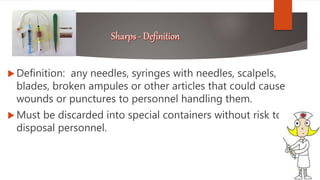
 Definition: any needles, syringes with needles, scalpels,
blades, broken ampules or other articles that could cause
wounds or punctures to personnel handling them.
 Must be discarded into special containers without risk to
disposal personnel.
 CDC estimates ~385,000 sharps injuries annually among
hospital-based healthcare personnel (>1,000 injuries/day).
 Increased risk for bloodborne virus transmission
 About ½ of sharp injuries go unreported.
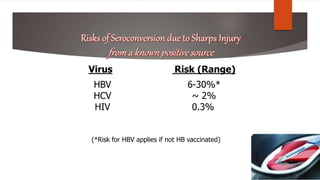
Virus
HBV
HCV
HIV
Risk (Range)
6-30%*
~ 2%
0.3%
(*Risk for HBV applies if not HB vaccinated)
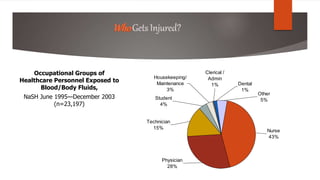
Nurse
43%
Technician
15%
Student
4%
Dental
1%
Housekeeping/
Maintenance
3%
Clerical /
Admin
1%
Other
5%
Physician
28%
Occupational Groups of
Healthcare Personnel Exposed to
Blood/Body Fluids,
NaSH June 1995—December 2003
(n=23,197)
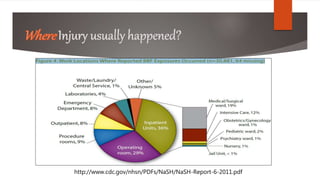
http://www.cdc.gov/nhsn/PDFs/NaSH/NaSH-Report-6-2011.pdf
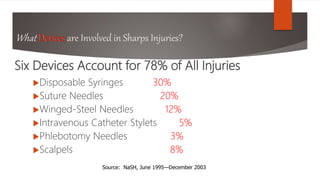
What are Involved in Sharps Injuries?
Six Devices Account for 78% of All Injuries
Disposable Syringes 30%
Suture Needles 20%
Winged-Steel Needles 12%
Intravenous Catheter Stylets 5%
Phlebotomy Needles 3%
Scalpels 8%
Source: NaSH, June 1995—December 2003
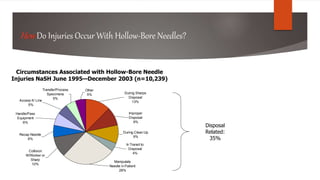
Do Injuries Occur With Hollow-Bore Needles?
During Sharps
Disposal
13%
During Clean Up
9%
In Transit to
Disposal
4%
Handle/Pass
Equipment
6%
Improper
Disposal
9%
Access IV Line
5%
Transfer/Process
Specimens
5%
Recap Needle
6%
Collision
W/Worker or
Sharp
10%
Manipulate
Needle in Patient
28%
Other
5%
Circumstances Associated with Hollow-Bore Needle
Injuries NaSH June 1995—December 2003 (n=10,239)
Disposal
Related:
35%
Passing or transferring equipment
Recapping contaminated needles
Colliding with coworkers
Decontaminating/processing used equipment
Injuries occur from sharps left in unusual places:
Laundry
Mattresses
Tables, trays, or other surfaces
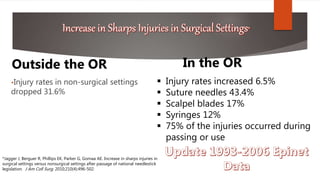
Outside the OR
•Injury rates in non-surgical settings
dropped 31.6%
In the OR
 Injury rates increased 6.5%
 Suture needles 43.4%
 Scalpel blades 17%
 Syringes 12%
 75% of the injuries occurred during
passing or use
*Jagger J, Berguer R, Phillips EK, Parker G, Gomaa AE. Increase in sharps injuries in
surgical settings versus nonsurgical settings after passage of national needlestick
legislation. J Am Coll Surg. 2010;210(4):496-502.
 Each year, 30% of the estimated needle sticks and other sharps-
related injuries that occur happen in the OR.
 Of injuries, 6% to 16% are self-inflicted while passing suture needles.
 Sutures are the most frequent percutaneous injury.
 Scalpels are the second most frequent percutaneous injury.
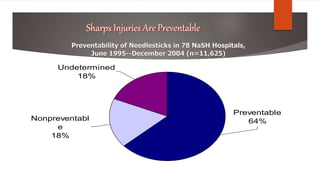
Preventable
64%Nonpreventabl
e
18%
Undetermined
18%
Be prepared
Be aware
Dispose with care
 Health care facilities must establish a written exposure control
plan.
 Initial and ongoing education competency validation of their
understanding of the principles and performance of the
processes for sharps safety.
 Documentation should reflect activities related to sharps safety.
 Policies and procedures for sharps safety processes and
practices should be developed.
 Perioperative team members should participate in a variety of
quality improvement activities.
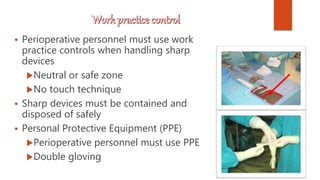
 Perioperative personnel must use work
practice controls when handling sharp
devices
Neutral or safe zone
No touch technique
 Sharp devices must be contained and
disposed of safely
 Personal Protective Equipment (PPE)
Perioperative personnel must use PPE
Double gloving
Eliminate or Reduce Unnecessary Needle Use
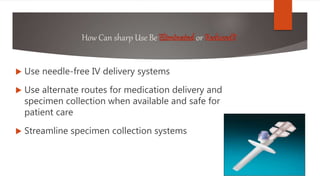
How Can sharp Use Be or
 Use needle-free IV delivery systems
 Use alternate routes for medication delivery and
specimen collection when available and safe for
patient care
 Streamline specimen collection systems
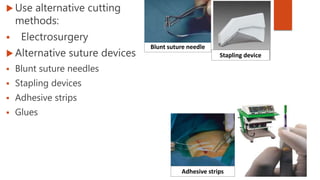
 Use alternative cutting
methods:
 Electrosurgery
 Alternative suture devices
 Blunt suture needles
 Stapling devices
 Adhesive strips
 Glues
Blunt suture needle
Adhesive strips
Stapling device
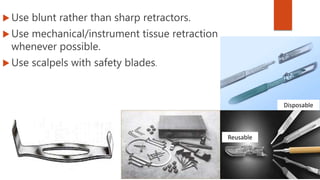
 Use blunt rather than sharp retractors.
 Use mechanical/instrument tissue retraction
whenever possible.
 Use scalpels with safety blades.
Reusable
Disposable
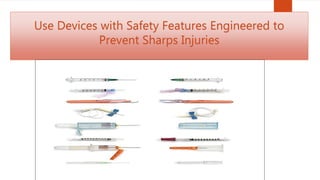
Use Devices with Safety Features Engineered to
Prevent Sharps Injuries
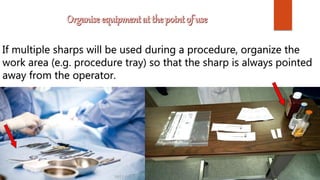
If multiple sharps will be used during a procedure, organize the
work area (e.g. procedure tray) so that the sharp is always pointed
away from the operator.
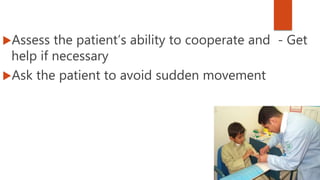
Assess the patient’s ability to cooperate and - Get
help if necessary
Ask the patient to avoid sudden movement
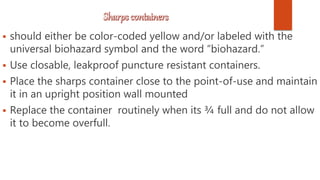
 should either be color-coded yellow and/or labeled with the
universal biohazard symbol and the word “biohazard.”
 Use closable, leakproof puncture resistant containers.
 Place the sharps container close to the point-of-use and maintain
it in an upright position wall mounted
 Replace the container routinely when its ¾ full and do not allow
it to become overfull.
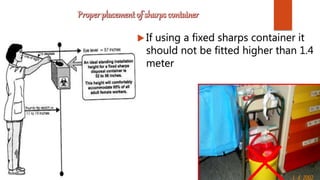
 If using a fixed sharps container it
should not be fitted higher than 1.4
meter
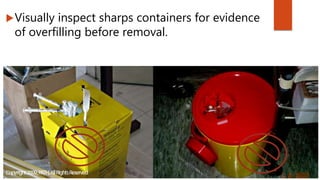
Visually inspect sharps containers for evidence
of overfilling before removal.
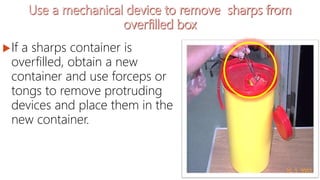
If a sharps container is
overfilled, obtain a new
container and use forceps or
tongs to remove protruding
devices and place them in the
new container.
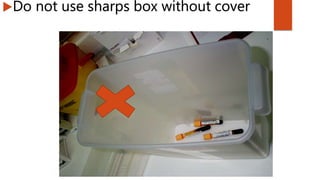
Do not use sharps box without cover
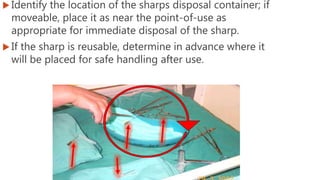
 Identify the location of the sharps disposal container; if
moveable, place it as near the point-of-use as
appropriate for immediate disposal of the sharp.
 If the sharp is reusable, determine in advance where it
will be placed for safe handling after use.
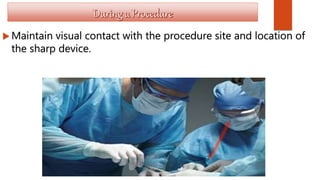
 Maintain visual contact with the procedure site and location of
the sharp device.
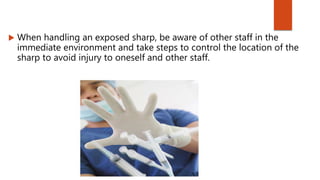
 When handling an exposed sharp, be aware of other staff in the
immediate environment and take steps to control the location of the
sharp to avoid injury to oneself and other staff.
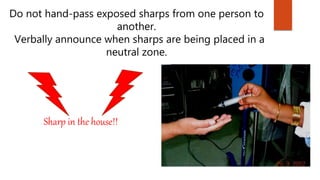
Do not hand-pass exposed sharps from one person to
another.
Verbally announce when sharps are being placed in a
neutral zone.
Sharp in the house!!
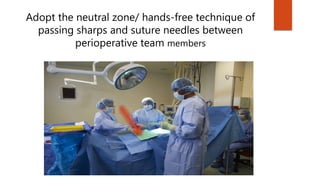
Adopt the neutral zone/ hands-free technique of
passing sharps and suture needles between
perioperative team members
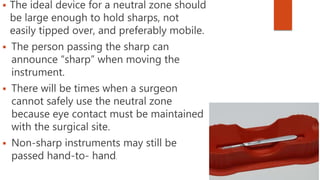
 The ideal device for a neutral zone should
be large enough to hold sharps, not
easily tipped over, and preferably mobile.
 The person passing the sharp can
announce “sharp” when moving the
instrument.
 There will be times when a surgeon
cannot safely use the neutral zone
because eye contact must be maintained
with the surgical site.
 Non-sharp instruments may still be
passed hand-to- hand.
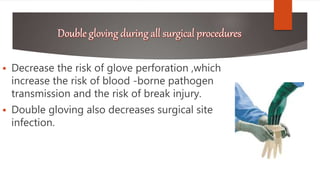
 Decrease the risk of glove perforation ,which
increase the risk of blood -borne pathogen
transmission and the risk of break injury.
 Double gloving also decreases surgical site
infection.
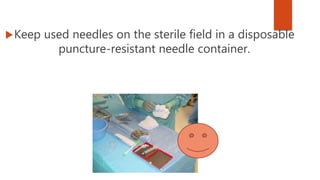
Keep used needles on the sterile field in a disposable
puncture-resistant needle container.
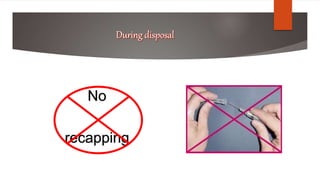
No
recapping
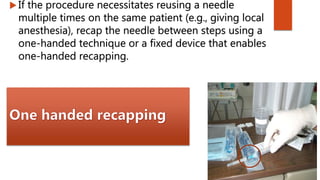
 If the procedure necessitates reusing a needle
multiple times on the same patient (e.g., giving local
anesthesia), recap the needle between steps using a
one-handed technique or a fixed device that enables
one-handed recapping.
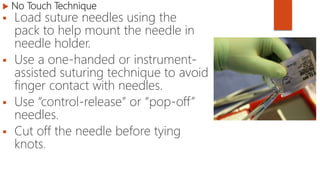
 No Touch Technique
 Load suture needles using the
pack to help mount the needle in
needle holder.
 Use a one-handed or instrument-
assisted suturing technique to avoid
finger contact with needles.
 Use “control-release” or “pop-off”
needles.
 Cut off the needle before tying
knots.
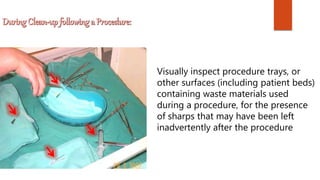
Visually inspect procedure trays, or
other surfaces (including patient beds)
containing waste materials used
during a procedure, for the presence
of sharps that may have been left
inadvertently after the procedure
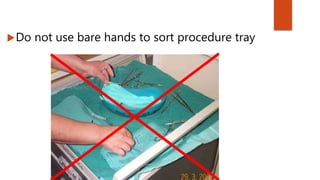
Do not use bare hands to sort procedure tray
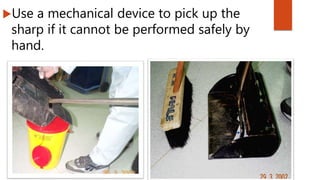
Use a mechanical device to pick up the
sharp if it cannot be performed safely by
hand.
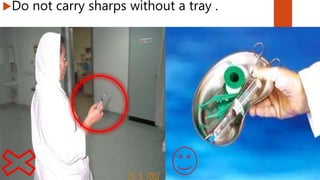
Do not carry sharps without a tray .
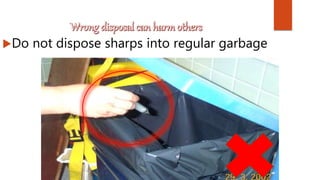
Do not dispose sharps into regular garbage
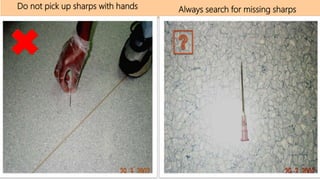
Always search for missing sharpsDo not pick up sharps with hands
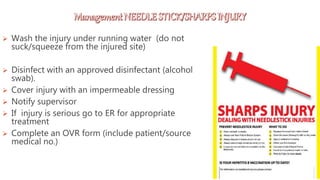
 Wash the injury under running water (do not
suck/squeeze from the injured site)
 Disinfect with an approved disinfectant (alcohol
swab).
 Cover injury with an impermeable dressing
 Notify supervisor
 If injury is serious go to ER for appropriate
treatment
 Complete an OVR form (include patient/source
medical no.)
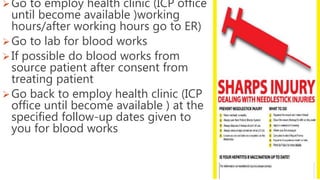
Go to employ health clinic (ICP office
until become available )working
hours/after working hours go to ER)
Go to lab for blood works
If possible do blood works from
source patient after consent from
treating patient
Go back to employ health clinic (ICP
office until become available ) at the
specified follow-up dates given to
you for blood works
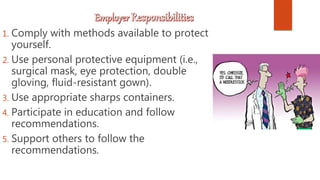
1. Comply with methods available to protect
yourself.
2. Use personal protective equipment (i.e.,
surgical mask, eye protection, double
gloving, fluid-resistant gown).
3. Use appropriate sharps containers.
4. Participate in education and follow
recommendations.
5. Support others to follow the
recommendations.
6.Follow your exposure control policy.
7.Report exposures(Location, job title, description of
incident, and type and brand of sharp involved)
8.Source testing, risk analysis, and post-exposure
prophylaxis
9.Encourage reporting.
Sharp injury

Sharp injury

  • 2.
     Definition: anyneedles, syringes with needles, scalpels, blades, broken ampules or other articles that could cause wounds or punctures to personnel handling them.  Must be discarded into special containers without risk to disposal personnel.
  • 3.
     CDC estimates~385,000 sharps injuries annually among hospital-based healthcare personnel (>1,000 injuries/day).  Increased risk for bloodborne virus transmission  About ½ of sharp injuries go unreported.
  • 4.
    Virus HBV HCV HIV Risk (Range) 6-30%* ~ 2% 0.3% (*Riskfor HBV applies if not HB vaccinated)
  • 5.
    Nurse 43% Technician 15% Student 4% Dental 1% Housekeeping/ Maintenance 3% Clerical / Admin 1% Other 5% Physician 28% Occupational Groupsof Healthcare Personnel Exposed to Blood/Body Fluids, NaSH June 1995—December 2003 (n=23,197)
  • 6.
  • 7.
    What are Involvedin Sharps Injuries? Six Devices Account for 78% of All Injuries Disposable Syringes 30% Suture Needles 20% Winged-Steel Needles 12% Intravenous Catheter Stylets 5% Phlebotomy Needles 3% Scalpels 8% Source: NaSH, June 1995—December 2003
  • 8.
    Do Injuries OccurWith Hollow-Bore Needles? During Sharps Disposal 13% During Clean Up 9% In Transit to Disposal 4% Handle/Pass Equipment 6% Improper Disposal 9% Access IV Line 5% Transfer/Process Specimens 5% Recap Needle 6% Collision W/Worker or Sharp 10% Manipulate Needle in Patient 28% Other 5% Circumstances Associated with Hollow-Bore Needle Injuries NaSH June 1995—December 2003 (n=10,239) Disposal Related: 35%
  • 9.
    Passing or transferringequipment Recapping contaminated needles Colliding with coworkers Decontaminating/processing used equipment Injuries occur from sharps left in unusual places: Laundry Mattresses Tables, trays, or other surfaces
  • 10.
    Outside the OR •Injuryrates in non-surgical settings dropped 31.6% In the OR  Injury rates increased 6.5%  Suture needles 43.4%  Scalpel blades 17%  Syringes 12%  75% of the injuries occurred during passing or use *Jagger J, Berguer R, Phillips EK, Parker G, Gomaa AE. Increase in sharps injuries in surgical settings versus nonsurgical settings after passage of national needlestick legislation. J Am Coll Surg. 2010;210(4):496-502.
  • 11.
     Each year,30% of the estimated needle sticks and other sharps- related injuries that occur happen in the OR.  Of injuries, 6% to 16% are self-inflicted while passing suture needles.  Sutures are the most frequent percutaneous injury.  Scalpels are the second most frequent percutaneous injury.
  • 12.
  • 13.
  • 14.
     Health carefacilities must establish a written exposure control plan.  Initial and ongoing education competency validation of their understanding of the principles and performance of the processes for sharps safety.  Documentation should reflect activities related to sharps safety.  Policies and procedures for sharps safety processes and practices should be developed.  Perioperative team members should participate in a variety of quality improvement activities.
  • 15.
     Perioperative personnelmust use work practice controls when handling sharp devices Neutral or safe zone No touch technique  Sharp devices must be contained and disposed of safely  Personal Protective Equipment (PPE) Perioperative personnel must use PPE Double gloving
  • 16.
    Eliminate or ReduceUnnecessary Needle Use
  • 17.
    How Can sharpUse Be or  Use needle-free IV delivery systems  Use alternate routes for medication delivery and specimen collection when available and safe for patient care  Streamline specimen collection systems
  • 18.
     Use alternativecutting methods:  Electrosurgery  Alternative suture devices  Blunt suture needles  Stapling devices  Adhesive strips  Glues Blunt suture needle Adhesive strips Stapling device
  • 19.
     Use bluntrather than sharp retractors.  Use mechanical/instrument tissue retraction whenever possible.  Use scalpels with safety blades. Reusable Disposable
  • 20.
    Use Devices withSafety Features Engineered to Prevent Sharps Injuries
  • 22.
    If multiple sharpswill be used during a procedure, organize the work area (e.g. procedure tray) so that the sharp is always pointed away from the operator.
  • 24.
    Assess the patient’sability to cooperate and - Get help if necessary Ask the patient to avoid sudden movement
  • 25.
     should eitherbe color-coded yellow and/or labeled with the universal biohazard symbol and the word “biohazard.”  Use closable, leakproof puncture resistant containers.  Place the sharps container close to the point-of-use and maintain it in an upright position wall mounted  Replace the container routinely when its ¾ full and do not allow it to become overfull.
  • 26.
     If usinga fixed sharps container it should not be fitted higher than 1.4 meter
  • 27.
    Visually inspect sharpscontainers for evidence of overfilling before removal.
  • 28.
    If a sharpscontainer is overfilled, obtain a new container and use forceps or tongs to remove protruding devices and place them in the new container.
  • 29.
    Do not usesharps box without cover
  • 30.
     Identify thelocation of the sharps disposal container; if moveable, place it as near the point-of-use as appropriate for immediate disposal of the sharp.  If the sharp is reusable, determine in advance where it will be placed for safe handling after use.
  • 31.
     Maintain visualcontact with the procedure site and location of the sharp device.
  • 32.
     When handlingan exposed sharp, be aware of other staff in the immediate environment and take steps to control the location of the sharp to avoid injury to oneself and other staff.
  • 33.
    Do not hand-passexposed sharps from one person to another. Verbally announce when sharps are being placed in a neutral zone. Sharp in the house!!
  • 34.
    Adopt the neutralzone/ hands-free technique of passing sharps and suture needles between perioperative team members
  • 35.
     The idealdevice for a neutral zone should be large enough to hold sharps, not easily tipped over, and preferably mobile.  The person passing the sharp can announce “sharp” when moving the instrument.  There will be times when a surgeon cannot safely use the neutral zone because eye contact must be maintained with the surgical site.  Non-sharp instruments may still be passed hand-to- hand.
  • 36.
     Decrease therisk of glove perforation ,which increase the risk of blood -borne pathogen transmission and the risk of break injury.  Double gloving also decreases surgical site infection.
  • 37.
    Keep used needleson the sterile field in a disposable puncture-resistant needle container.
  • 38.
  • 39.
     If theprocedure necessitates reusing a needle multiple times on the same patient (e.g., giving local anesthesia), recap the needle between steps using a one-handed technique or a fixed device that enables one-handed recapping.
  • 40.
     No TouchTechnique  Load suture needles using the pack to help mount the needle in needle holder.  Use a one-handed or instrument- assisted suturing technique to avoid finger contact with needles.  Use “control-release” or “pop-off” needles.  Cut off the needle before tying knots.
  • 41.
    Visually inspect proceduretrays, or other surfaces (including patient beds) containing waste materials used during a procedure, for the presence of sharps that may have been left inadvertently after the procedure
  • 42.
    Do not usebare hands to sort procedure tray
  • 43.
    Use a mechanicaldevice to pick up the sharp if it cannot be performed safely by hand.
  • 44.
    Do not carrysharps without a tray .
  • 45.
    Do not disposesharps into regular garbage
  • 46.
    Always search formissing sharpsDo not pick up sharps with hands
  • 47.
     Wash theinjury under running water (do not suck/squeeze from the injured site)  Disinfect with an approved disinfectant (alcohol swab).  Cover injury with an impermeable dressing  Notify supervisor  If injury is serious go to ER for appropriate treatment  Complete an OVR form (include patient/source medical no.)
  • 48.
    Go to employhealth clinic (ICP office until become available )working hours/after working hours go to ER) Go to lab for blood works If possible do blood works from source patient after consent from treating patient Go back to employ health clinic (ICP office until become available ) at the specified follow-up dates given to you for blood works
  • 49.
    1. Comply withmethods available to protect yourself. 2. Use personal protective equipment (i.e., surgical mask, eye protection, double gloving, fluid-resistant gown). 3. Use appropriate sharps containers. 4. Participate in education and follow recommendations. 5. Support others to follow the recommendations.
  • 50.
    6.Follow your exposurecontrol policy. 7.Report exposures(Location, job title, description of incident, and type and brand of sharp involved) 8.Source testing, risk analysis, and post-exposure prophylaxis 9.Encourage reporting.