Infection control protocol
                 in
   Intensive Care Unit
  Dr. Eman Mosaad Zaki, MD
  Lecturer of Clinical Pathology
Infection Control Unit, South Egypt C
I f ti C t l U it S th E          t Cancer I tit t
                                           Institute
Increased risk is associated with:
•   The severity of the patient’s illness and underlying conditions.

•   The exposure to multiple invasive devices and procedures.

•   Increased patient contact with h lth
    I       d ti t       t t ith health-care personnel.
                                                     l

•   A longer ICU stay which prolongs the risk of exposure.
         g          y       p     g                p

•   Space limitations that increase the risk of contaminating equipment
•   Since patients in the ICU are likely to have multiple devices for
    treating or monitoring their care it is not surprising that the most
                                 care,
    common nosocomial infections are pneumonia (endotracheal tubes),
    urinary tract infections (urinary catheters) and catheter-related blood
                                                     catheter related
    stream infections.
•   Urinary catheter, ventilator-associated, and catheter-associated
                      ventilator associated,     catheter associated
    bloodstream infection are common complications of care provided in
    the ICU.
•   Attributable mortality for pneumonia occurring in the ICU population
    is between 5 – 14%.
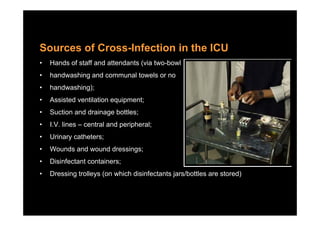
Sources of Cross-Infection in the ICU
•   Hands of staff and attendants (via two bowl
                                       two-bowl
•   handwashing and communal towels or no
•   handwashing);
•   Assisted ventilation equipment;
•   Suction and drainage bottles;
•   I.V. lines – central and peripheral;
•   Urinary catheters;
•   Wounds and wound dressings;
•   Disinfectant containers;
                           ;
•   Dressing trolleys (on which disinfectants jars/bottles are stored)
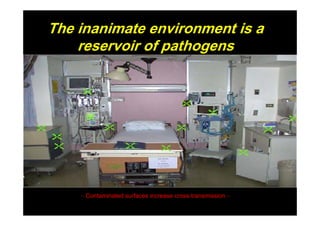
The inanimate environment is a
    reservoir of pathogens


    ~ Contaminated surfaces increase cross-transmission ~
Strategies to Reduce Infection Risk

I- Patients needing ICU care should be assessed for.

II- Hand hygiene.

III- Procedures requiring aseptic technique (Intravenous
   Therapy, Urinary Catheterization & Respiratory Care
   Equipment /
      i      /Practices).
                   i )
IV-ICU Personnel
Strategies to Reduce Infection Risk

I- Patients needing ICU care should be assessed for:
•   Diarrhea,
•   Rashes or skin conditions;
•   Recognized communicable disease;
•   Known carrier of an epidemic strain of bacterium;
•   Isolation: Patients suspected or known to have communicable
    diseases should be admitted directly to an isolation cubicle in the
    ICU or referred to a Fever Hospital.
II- Hand hygiene:
          yg

•   Hands are the most common vehicle of transmission of organisms
    and therefore sinks should be provided for handwashing
                                               handwashing.
•   All visitors and staff should wash their hands before direct contact
    with patients.
•   Aseptic hand wash or alcohol based hand rub should be performed:
     – Before entering the ICU.
     – Before performing any invasive procedure inlcuding peripheral
        cannula Insertion and removal.
     – Before use of multidose vials.
     – Before adminstration of iv fluids or medications/drugs
     – Routine hand wash should be performed:
     – Before and after any contact with the patient
     – After touching environmental surfaces
     – Wh
        Whenever soiled.
                      il d
III- Procedures requiring aseptic technique
 (Intravenous Therapy, Urinary Catheterization
   & Respiratory Care Equipment /Practices)

A) IV care practices.
               ti

B) Respiratory care - Patient Based Interventions
                      Patient-Based Interventions.

C) Personal protective equipment for routine patient

   care.
III- Procedures requiring aseptic technique (Intravenous Therapy,
    Urinary Catheterization & Respiratory Care Equipment
    /Practices)
A) IV care practices
•   Clean injection ports with 70% alcohol or an iodophor before accessing
•   the system.
•   Cap all stopcocks when not in use.
      p        p
•   Use aseptic technique including a cap, mask, sterile gown, sterile gloves,
•   and a large sterile sheet for the insertion of central venous catheters
•   (including PICCs) or guidewire exchange.
•   Do not routinely replace central venous catheters, hemodialysis catheters,
•   or pulmonary artery catheters
                        catheters.
•   Do not remove CVCs or PICCs on the basis of fever alone. Use clinical
    judgment regarding the appropriateness of removing the catheter if infection
    is id
    i evidenced elsewhere or if a noninfectious cause of f
              d l     h              i f ti            f fever i suspected.
                                                               is       t d
•   Do not routinely replace peripheral arterial catheters.
B) Respiratory care - Patient-Based Interventions:

•   If there is no medical contraindication, elevate the head of the bed of a
    patient at high risk for aspiration pneumonia, e.g., a person receiving
    mechanically assisted ventilation and/or who has an enteral tube in place, at
    an angle of 30-45 degrees.

•   Periodically drain and discard any condensate that collects in the tubing of a
    mechanical ventilator, taking precautions not to allow condensate to drain
    toward the patient. Decontaminate hands with soap and water or a
    waterless antiseptic agent after performing the procedure or after handling
    the fluid.

•   If available, use an endotracheal tube with a dorsal lumen above the
    endotracheal cuff to allow drainage (by continuous suctioning) of tracheal
    secretions that accumulate in the patient's subglottic area.
• Use       sucralfate,
                      ,   H2-blockers,
                                     ,    and/or     antacids
  interchangeably for stress-bleeding prophylaxis in a patient
  receiving mechanically assisted ventilation (H2-blockers
           g             y                       (
  alone decrease gastric acidity and increase gastric
  colonization and increases the susceptibility to respiratory
                                        p     y       p      y
  infections).
• Instruct preoperative patients, especially those at high risk
  of contracting pneumonia, regarding taking deep breaths
  and ambulating as soon as medically indicated in the
                 g                         y
  postoperative period. High-risk patients include those who
  will have an abdominal, thoracic, head, or neck operation
                          ,         ,      ,          p
  or who have substantial pulmonary dysfunction.
• Follow manufacturers' instructions for use and
         manufacturers
  maintenance of wall oxygen humidifiers .
• Between patients, change the tubing, including
  any nasal prongs or mask used to deliver
  oxygen from a wall outlet.
• Small-volume medication nebulizers: "in-line"
  and hand held nebulizers: Between treatments
      hand-held
  on the same patient, disinfect; rinse with sterile
  or pasteurized water; and air-dry small-volume
  in-line or hand-held medication nebulizers
                                  nebulizers.
• Use only sterile or pasteurized fluid for nebulization and
  dispense the fluid into the nebulizer aseptically.

• If multidose medication vials are used, then handle,
  dispense,
  dispense and store them according to manufacturers'
                                       manufacturers
  instructions using sterile techniques.
C) Personal protective equipment for routine patient

    care

•   Gloves: should be selected according to need.(e.g., sterile for

    procedures using aseptic technique such as insertion of central

    venous catheter and non sterile for procedures such as emptying
                        non-sterile

    urinary drainage bags, insertion of peripheral IV catheters, contact

    with contaminated surfaces or equipment);


•   Wear gloves for handling respiratory secretions or objects

    contaminated with respiratory secretions of any patient
                                                    patient.
• Change gloves and decontaminate hands,
  as above:
  – Between contacts with different patients.
  – After handling respiratory secretions or
    objects contaminated with secretions from
    one patient.
         p
  – Before contact with object, or environmental
    surface.
  – Between contacts with a contaminated body
    site and the respiratory tract of, or respiratory
                    p      y         ,       p      y
    device on, the same patient.
•   Wear a gown :When exposure to respiratory secretions from a

    patient i anticipated, and change it after soiling occurs and b f
      ti t is ti i t d       d h          ft     ili            d before

    providing care to another patient.

•   Plastic aprons may be worn when contact with patient body fluids is

    anticipated;
      ti i t d

•   Disposable high-efficiency filter masks may be used for wound care.
       p         g           y                y

•   Shoe and head coverings are not required for routine care
IV- ICU Personnel


•   All staff working on the unit should be offered hepatitis B vaccine
    before beginning work on the unit .

•   Orientation to the unit should include basic infection control
    concepts that include hand hygiene, management of sharps, and
         p                      yg    ,     g             p ,
    associated risks of disease transmission.

•   Training and education should include formal and informal infection
    control lectures and assessment of practices through periodic
    observations.
    observations
Environment Factors and Design
         Issues for the ICU
Unit Design should consider the following
• Space
• Ventilation
• Traffic flow
• Visitors
• Non-ICU Staff
I- Space

•   Beds
    – The beds should be 2 5 - 3 meters (7 9 feet) apart to allow free
                         2.5            (7-9       apart,
       movement of staff and equipment, reducing risk of crosscontamination.

    – Ideally a sharps container should be within easy access of each bed
      Ideally,                                                        bed.

•   Partitions
    – Privacy partitions should be of material that is easily cleaned and should
       be cleaned weekly and any time that it becomes soiled or contaminated.
       If curtains are used, they should be changed weekly and between
       patients.

•   Toilets
    – May be located outside the ICU.
•   Medication preparation
    – Medication prep areas should be separate from patient care areas and
       should be maintained as a clean area
                                       area.

•   Clean storage
    – An area should be identified and maintained for clean storage and
       should be separate from care and waste disposal areas.

•   Soiled and waste storage
    – An area should be identifed for storing collected bedside waste and
       should be maintained separate from direct care and clean medication
       areas. Ideally, this area should have a clinical sink for the disposal of
       blood and body fluid waste. The area should include storage of filled
       sharps containers until these containers can be removed.
II- Ventilation
• Type
   – The source of clean air should be determined including central or
     through-the wall
     through the –wall air conditioning units
                                        units.
• Windows
   – Windows should remain closed in order to control all airborne
     risks; plants and flowers should be kept outside the ICU.
• Sinks and Waterless Handrub Dispensers
   – Sinks should be placed near the ICU entrance and If this is not
     feasible, waterless handrub dispensers should be available at
     the ICU entrance and at each bedside. If the design permits
     scrub sinks
            sinks.
   – An adequate number of easily accessible Elbow/Foot operated
     sinks should be available. Sinks should not be plugged or used
     for storage
         storage.
   – Sinks assigned for handwashing should not be using for washing
     instruments.
III- Traffic flow

•   The unit may be situated close to the operating theatre and to the
    emergency department for accessibility, but should be separate from
    the main ward areas.

•   Policies should consider controlling traffic flow to and from the unit in
    order to reduce sources of contamination from visitors, staff and
    equipment.
    equipment
IV- Visitors

•   Design of the unit should permit staff to assess visitors for
    communicable disease (eg, rash, respiratory infection) before
    permitted to enter unit.

•   They should be instructed in washing their hands if assisting the
       y                               g                        g
    patient.
V- Non-ICU Staff

Staff not assigned to the ICU should follow the following protocol:

•   Street coats and white coats must be removed;

•   Hands should be washed on entering the ICU and before leaving
    the unit.

•   The proper procedure should be followed when attending the patient
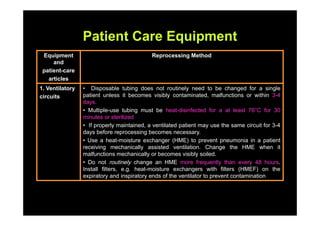
Patient Care Equipment
 Equipment                                 Reprocessing Method
     and
 patient-care
   articles
1.
1 Ventilatory   • Disposable tubing does not routinely need to be changed for a single
circuits        patient unless it becomes visibly contaminated, malfunctions or within 3-4
                days.
                • Multiple-use tubing must be heat-disinfected for a at least 76°C for 30
                        p              g
                minutes or sterilized
                • If properly maintained, a ventilated patient may use the same circuit for 3-4
                days before reprocessing becomes necessary.
                • U a h t
                  Use heat-moisture exchanger (HME) t prevent pneumonia i a patient
                                   i t      h                to        t          i in     ti t
                receiving mechanically assisted ventilation. Change the HME when it
                malfunctions mechanically or becomes visibly soiled.
                • Do not routinely change an HME more frequently than every 48 hours.
                                    y     g                       q      y          y
                Install filters, e.g. heat-moisture exchangers with filters (HMEF) on the
                expiratory and inspiratory ends of the ventilator to prevent contamination
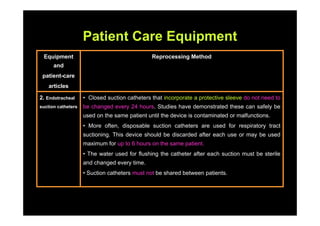
Patient Care Equipment
 Equipment                                     Reprocessing Method
      and
 patient-care
    articles

2. Endotracheal     • Closed suction catheters that incorporate a protective sleeve do not need to
suction catheters   be changed every 24 hours. Studies have demonstrated these can safely be
                    used on the same patient until the device is contaminated or malfunctions.
                    • More often, disposable suction catheters are used for respiratory tract
                    suctioning. This device should be discarded after each use or may be used
                    maximum for up to 6 hours on the same patient.
                    • The water used for flushing the catheter after each suction must be sterile
                    and changed every time.
                    • Suction catheters must not be shared between patients.
Patient Care Equipment
 Equipment                                   Reprocessing Method
     and
 patient-care
   articles
3.
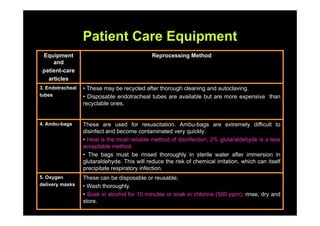
3 Endotracheal   • These may be recycled after thorough cleaning and autoclaving
                                                                     autoclaving.
tubes            • Disposable endotracheal tubes are available but are more expensive than
                 recyclable ones.


4. Ambu-bags     These are used for resuscitation. Ambu-bags are extremely difficult to
                 disinfect and become contaminated very quickly:
                 • Heat is the most reliable method of disinfection; 2% glutaraldehyde is a less
                 acceptable method.
                 • The bags must be rinsed thoroughly in sterile water after immersion in
                 g
                 glutaraldehyde. This will reduce the risk of chemical irritation, which can itself
                             y
                 precipitate respiratory infection.
5. Oxygen        These can be disposable or reusable;
delivery masks   • Wash thoroughly.
                 • Soak in alcohol for 10 minutes or soak in chlorine (500 ppm), rinse, dry and
                 store.
Patient Care Equipment
  Equipment and                             Reprocessing Method
   patient-care
     ti t
     articles


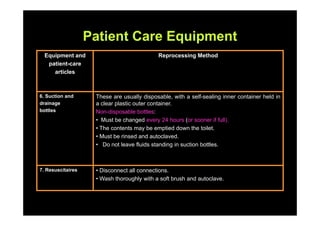
6. Suction and      These are usually disposable, with a self-sealing inner container held in
drainage            a clear plastic outer container.
bottles             Non disposable
                    Non-disposable bottles:
                    • Must be changed every 24 hours (or sooner if full).
                    • The contents may be emptied down the toilet.
                    • Must be rinsed and autoclaved.
                    • Do not leave fluids standing in suction bottles.


7. Resuscitaires    • Disconnect all connections.
                    • Wash thoroughly with a soft brush and autoclave.
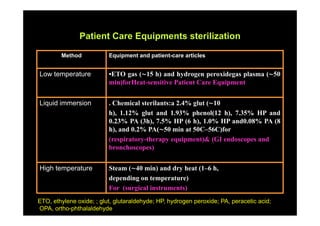
Patient Care Equipments sterilization

        Method            Equipment and patient-care articles


Low temperature           •ETO gas ( 15 h) and hydrogen peroxidegas plasma ( 50
                          min)forHeat-sensitive Patient Care Equipment


Liquid immersion          . Chemical sterilants:a 2.4% glut ( 10
                          h), 1.12%
                          h) 1 12% glut and 1 93% phenol(12 h) 7 35% HP and
                                                1.93%            h), 7.35%
                          0.23% PA (3h), 7.5% HP (6 h), 1.0% HP and0.08% PA (8
                          h), and 0.2% PA( 50 min at 50C–56C)for
                          (respiratory-therapy
                          (respiratory therapy equipment)& (GI endoscopes and
                          bronchoscopes)


High temperature          Steam ( 40 min) and dry heat (1–6 h,
                          depending on temperature)
                          For (surgical instruments)
ETO, ethylene oxide; ; glut, glutaraldehyde; HP, hydrogen peroxide; PA, peracetic acid;
OPA, ortho-phthalaldehyde.
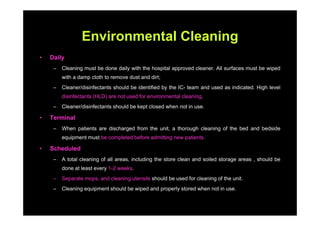
Environmental Cleaning
•   Daily
     –   Cleaning must be done daily with the hospital approved cleaner. All surfaces must be wiped
         with a damp cloth to remove dust and dirt;
     –   Cleaner/disinfectants should be identified by the IC team and used as indicated High level
                                                           IC-                 indicated.
         disinfectants (HLD) are not used for environmental cleaning.
     –   Cleaner/disinfectants should be kept closed when not in use.

•   Terminal
     –   When patients are discharged from the unit, a thorough cleaning of the bed and bedside
         equipment must be completed before admitting new patients
                                                          patients.

•   Scheduled
     –   A total cleaning of all areas, including the store clean and soiled storage areas , should be
         done at least every 1-2 weeks.
     –   Separate mops, and cleaning utensils should be used for cleaning of the unit.
     –   Cleaning equipment should be wiped and properly stored when not in use.
Infection control in intensive care unit

Infection control in intensive care unit

  • 1.
    Infection control protocol in Intensive Care Unit Dr. Eman Mosaad Zaki, MD Lecturer of Clinical Pathology Infection Control Unit, South Egypt C I f ti C t l U it S th E t Cancer I tit t Institute
  • 2.
    Increased risk isassociated with: • The severity of the patient’s illness and underlying conditions. • The exposure to multiple invasive devices and procedures. • Increased patient contact with h lth I d ti t t t ith health-care personnel. l • A longer ICU stay which prolongs the risk of exposure. g y p g p • Space limitations that increase the risk of contaminating equipment
  • 3.
    Since patients in the ICU are likely to have multiple devices for treating or monitoring their care it is not surprising that the most care, common nosocomial infections are pneumonia (endotracheal tubes), urinary tract infections (urinary catheters) and catheter-related blood catheter related stream infections. • Urinary catheter, ventilator-associated, and catheter-associated ventilator associated, catheter associated bloodstream infection are common complications of care provided in the ICU. • Attributable mortality for pneumonia occurring in the ICU population is between 5 – 14%.
  • 4.
    Sources of Cross-Infectionin the ICU • Hands of staff and attendants (via two bowl two-bowl • handwashing and communal towels or no • handwashing); • Assisted ventilation equipment; • Suction and drainage bottles; • I.V. lines – central and peripheral; • Urinary catheters; • Wounds and wound dressings; • Disinfectant containers; ; • Dressing trolleys (on which disinfectants jars/bottles are stored)
  • 5.
    The inanimate environmentis a reservoir of pathogens ~ Contaminated surfaces increase cross-transmission ~
  • 6.
    Strategies to ReduceInfection Risk I- Patients needing ICU care should be assessed for. II- Hand hygiene. III- Procedures requiring aseptic technique (Intravenous Therapy, Urinary Catheterization & Respiratory Care Equipment / i /Practices). i ) IV-ICU Personnel
  • 7.
    Strategies to ReduceInfection Risk I- Patients needing ICU care should be assessed for: • Diarrhea, • Rashes or skin conditions; • Recognized communicable disease; • Known carrier of an epidemic strain of bacterium; • Isolation: Patients suspected or known to have communicable diseases should be admitted directly to an isolation cubicle in the ICU or referred to a Fever Hospital.
  • 8.
    II- Hand hygiene: yg • Hands are the most common vehicle of transmission of organisms and therefore sinks should be provided for handwashing handwashing. • All visitors and staff should wash their hands before direct contact with patients. • Aseptic hand wash or alcohol based hand rub should be performed: – Before entering the ICU. – Before performing any invasive procedure inlcuding peripheral cannula Insertion and removal. – Before use of multidose vials. – Before adminstration of iv fluids or medications/drugs – Routine hand wash should be performed: – Before and after any contact with the patient – After touching environmental surfaces – Wh Whenever soiled. il d
  • 9.
    III- Procedures requiringaseptic technique (Intravenous Therapy, Urinary Catheterization & Respiratory Care Equipment /Practices) A) IV care practices. ti B) Respiratory care - Patient Based Interventions Patient-Based Interventions. C) Personal protective equipment for routine patient care.
  • 10.
    III- Procedures requiringaseptic technique (Intravenous Therapy, Urinary Catheterization & Respiratory Care Equipment /Practices) A) IV care practices • Clean injection ports with 70% alcohol or an iodophor before accessing • the system. • Cap all stopcocks when not in use. p p • Use aseptic technique including a cap, mask, sterile gown, sterile gloves, • and a large sterile sheet for the insertion of central venous catheters • (including PICCs) or guidewire exchange. • Do not routinely replace central venous catheters, hemodialysis catheters, • or pulmonary artery catheters catheters. • Do not remove CVCs or PICCs on the basis of fever alone. Use clinical judgment regarding the appropriateness of removing the catheter if infection is id i evidenced elsewhere or if a noninfectious cause of f d l h i f ti f fever i suspected. is t d • Do not routinely replace peripheral arterial catheters.
  • 11.
    B) Respiratory care- Patient-Based Interventions: • If there is no medical contraindication, elevate the head of the bed of a patient at high risk for aspiration pneumonia, e.g., a person receiving mechanically assisted ventilation and/or who has an enteral tube in place, at an angle of 30-45 degrees. • Periodically drain and discard any condensate that collects in the tubing of a mechanical ventilator, taking precautions not to allow condensate to drain toward the patient. Decontaminate hands with soap and water or a waterless antiseptic agent after performing the procedure or after handling the fluid. • If available, use an endotracheal tube with a dorsal lumen above the endotracheal cuff to allow drainage (by continuous suctioning) of tracheal secretions that accumulate in the patient's subglottic area.
  • 12.
    • Use sucralfate, , H2-blockers, , and/or antacids interchangeably for stress-bleeding prophylaxis in a patient receiving mechanically assisted ventilation (H2-blockers g y ( alone decrease gastric acidity and increase gastric colonization and increases the susceptibility to respiratory p y p y infections). • Instruct preoperative patients, especially those at high risk of contracting pneumonia, regarding taking deep breaths and ambulating as soon as medically indicated in the g y postoperative period. High-risk patients include those who will have an abdominal, thoracic, head, or neck operation , , , p or who have substantial pulmonary dysfunction.
  • 13.
    • Follow manufacturers'instructions for use and manufacturers maintenance of wall oxygen humidifiers . • Between patients, change the tubing, including any nasal prongs or mask used to deliver oxygen from a wall outlet. • Small-volume medication nebulizers: "in-line" and hand held nebulizers: Between treatments hand-held on the same patient, disinfect; rinse with sterile or pasteurized water; and air-dry small-volume in-line or hand-held medication nebulizers nebulizers.
  • 14.
    • Use onlysterile or pasteurized fluid for nebulization and dispense the fluid into the nebulizer aseptically. • If multidose medication vials are used, then handle, dispense, dispense and store them according to manufacturers' manufacturers instructions using sterile techniques.
  • 15.
    C) Personal protectiveequipment for routine patient care • Gloves: should be selected according to need.(e.g., sterile for procedures using aseptic technique such as insertion of central venous catheter and non sterile for procedures such as emptying non-sterile urinary drainage bags, insertion of peripheral IV catheters, contact with contaminated surfaces or equipment); • Wear gloves for handling respiratory secretions or objects contaminated with respiratory secretions of any patient patient.
  • 16.
    • Change glovesand decontaminate hands, as above: – Between contacts with different patients. – After handling respiratory secretions or objects contaminated with secretions from one patient. p – Before contact with object, or environmental surface. – Between contacts with a contaminated body site and the respiratory tract of, or respiratory p y , p y device on, the same patient.
  • 17.
    Wear a gown :When exposure to respiratory secretions from a patient i anticipated, and change it after soiling occurs and b f ti t is ti i t d d h ft ili d before providing care to another patient. • Plastic aprons may be worn when contact with patient body fluids is anticipated; ti i t d • Disposable high-efficiency filter masks may be used for wound care. p g y y • Shoe and head coverings are not required for routine care
  • 18.
    IV- ICU Personnel • All staff working on the unit should be offered hepatitis B vaccine before beginning work on the unit . • Orientation to the unit should include basic infection control concepts that include hand hygiene, management of sharps, and p yg , g p , associated risks of disease transmission. • Training and education should include formal and informal infection control lectures and assessment of practices through periodic observations. observations
  • 19.
    Environment Factors andDesign Issues for the ICU Unit Design should consider the following • Space • Ventilation • Traffic flow • Visitors • Non-ICU Staff
  • 20.
    I- Space • Beds – The beds should be 2 5 - 3 meters (7 9 feet) apart to allow free 2.5 (7-9 apart, movement of staff and equipment, reducing risk of crosscontamination. – Ideally a sharps container should be within easy access of each bed Ideally, bed. • Partitions – Privacy partitions should be of material that is easily cleaned and should be cleaned weekly and any time that it becomes soiled or contaminated. If curtains are used, they should be changed weekly and between patients. • Toilets – May be located outside the ICU.
  • 21.
    Medication preparation – Medication prep areas should be separate from patient care areas and should be maintained as a clean area area. • Clean storage – An area should be identified and maintained for clean storage and should be separate from care and waste disposal areas. • Soiled and waste storage – An area should be identifed for storing collected bedside waste and should be maintained separate from direct care and clean medication areas. Ideally, this area should have a clinical sink for the disposal of blood and body fluid waste. The area should include storage of filled sharps containers until these containers can be removed.
  • 22.
    II- Ventilation • Type – The source of clean air should be determined including central or through-the wall through the –wall air conditioning units units. • Windows – Windows should remain closed in order to control all airborne risks; plants and flowers should be kept outside the ICU. • Sinks and Waterless Handrub Dispensers – Sinks should be placed near the ICU entrance and If this is not feasible, waterless handrub dispensers should be available at the ICU entrance and at each bedside. If the design permits scrub sinks sinks. – An adequate number of easily accessible Elbow/Foot operated sinks should be available. Sinks should not be plugged or used for storage storage. – Sinks assigned for handwashing should not be using for washing instruments.
  • 23.
    III- Traffic flow • The unit may be situated close to the operating theatre and to the emergency department for accessibility, but should be separate from the main ward areas. • Policies should consider controlling traffic flow to and from the unit in order to reduce sources of contamination from visitors, staff and equipment. equipment IV- Visitors • Design of the unit should permit staff to assess visitors for communicable disease (eg, rash, respiratory infection) before permitted to enter unit. • They should be instructed in washing their hands if assisting the y g g patient.
  • 24.
    V- Non-ICU Staff Staffnot assigned to the ICU should follow the following protocol: • Street coats and white coats must be removed; • Hands should be washed on entering the ICU and before leaving the unit. • The proper procedure should be followed when attending the patient
  • 25.
    Patient Care Equipment Equipment Reprocessing Method and patient-care articles 1. 1 Ventilatory • Disposable tubing does not routinely need to be changed for a single circuits patient unless it becomes visibly contaminated, malfunctions or within 3-4 days. • Multiple-use tubing must be heat-disinfected for a at least 76°C for 30 p g minutes or sterilized • If properly maintained, a ventilated patient may use the same circuit for 3-4 days before reprocessing becomes necessary. • U a h t Use heat-moisture exchanger (HME) t prevent pneumonia i a patient i t h to t i in ti t receiving mechanically assisted ventilation. Change the HME when it malfunctions mechanically or becomes visibly soiled. • Do not routinely change an HME more frequently than every 48 hours. y g q y y Install filters, e.g. heat-moisture exchangers with filters (HMEF) on the expiratory and inspiratory ends of the ventilator to prevent contamination
  • 26.
    Patient Care Equipment Equipment Reprocessing Method and patient-care articles 2. Endotracheal • Closed suction catheters that incorporate a protective sleeve do not need to suction catheters be changed every 24 hours. Studies have demonstrated these can safely be used on the same patient until the device is contaminated or malfunctions. • More often, disposable suction catheters are used for respiratory tract suctioning. This device should be discarded after each use or may be used maximum for up to 6 hours on the same patient. • The water used for flushing the catheter after each suction must be sterile and changed every time. • Suction catheters must not be shared between patients.
  • 27.
    Patient Care Equipment Equipment Reprocessing Method and patient-care articles 3. 3 Endotracheal • These may be recycled after thorough cleaning and autoclaving autoclaving. tubes • Disposable endotracheal tubes are available but are more expensive than recyclable ones. 4. Ambu-bags These are used for resuscitation. Ambu-bags are extremely difficult to disinfect and become contaminated very quickly: • Heat is the most reliable method of disinfection; 2% glutaraldehyde is a less acceptable method. • The bags must be rinsed thoroughly in sterile water after immersion in g glutaraldehyde. This will reduce the risk of chemical irritation, which can itself y precipitate respiratory infection. 5. Oxygen These can be disposable or reusable; delivery masks • Wash thoroughly. • Soak in alcohol for 10 minutes or soak in chlorine (500 ppm), rinse, dry and store.
  • 28.
    Patient Care Equipment Equipment and Reprocessing Method patient-care ti t articles 6. Suction and These are usually disposable, with a self-sealing inner container held in drainage a clear plastic outer container. bottles Non disposable Non-disposable bottles: • Must be changed every 24 hours (or sooner if full). • The contents may be emptied down the toilet. • Must be rinsed and autoclaved. • Do not leave fluids standing in suction bottles. 7. Resuscitaires • Disconnect all connections. • Wash thoroughly with a soft brush and autoclave.
  • 29.
    Patient Care Equipmentssterilization Method Equipment and patient-care articles Low temperature •ETO gas ( 15 h) and hydrogen peroxidegas plasma ( 50 min)forHeat-sensitive Patient Care Equipment Liquid immersion . Chemical sterilants:a 2.4% glut ( 10 h), 1.12% h) 1 12% glut and 1 93% phenol(12 h) 7 35% HP and 1.93% h), 7.35% 0.23% PA (3h), 7.5% HP (6 h), 1.0% HP and0.08% PA (8 h), and 0.2% PA( 50 min at 50C–56C)for (respiratory-therapy (respiratory therapy equipment)& (GI endoscopes and bronchoscopes) High temperature Steam ( 40 min) and dry heat (1–6 h, depending on temperature) For (surgical instruments) ETO, ethylene oxide; ; glut, glutaraldehyde; HP, hydrogen peroxide; PA, peracetic acid; OPA, ortho-phthalaldehyde.
  • 30.
    Environmental Cleaning • Daily – Cleaning must be done daily with the hospital approved cleaner. All surfaces must be wiped with a damp cloth to remove dust and dirt; – Cleaner/disinfectants should be identified by the IC team and used as indicated High level IC- indicated. disinfectants (HLD) are not used for environmental cleaning. – Cleaner/disinfectants should be kept closed when not in use. • Terminal – When patients are discharged from the unit, a thorough cleaning of the bed and bedside equipment must be completed before admitting new patients patients. • Scheduled – A total cleaning of all areas, including the store clean and soiled storage areas , should be done at least every 1-2 weeks. – Separate mops, and cleaning utensils should be used for cleaning of the unit. – Cleaning equipment should be wiped and properly stored when not in use.