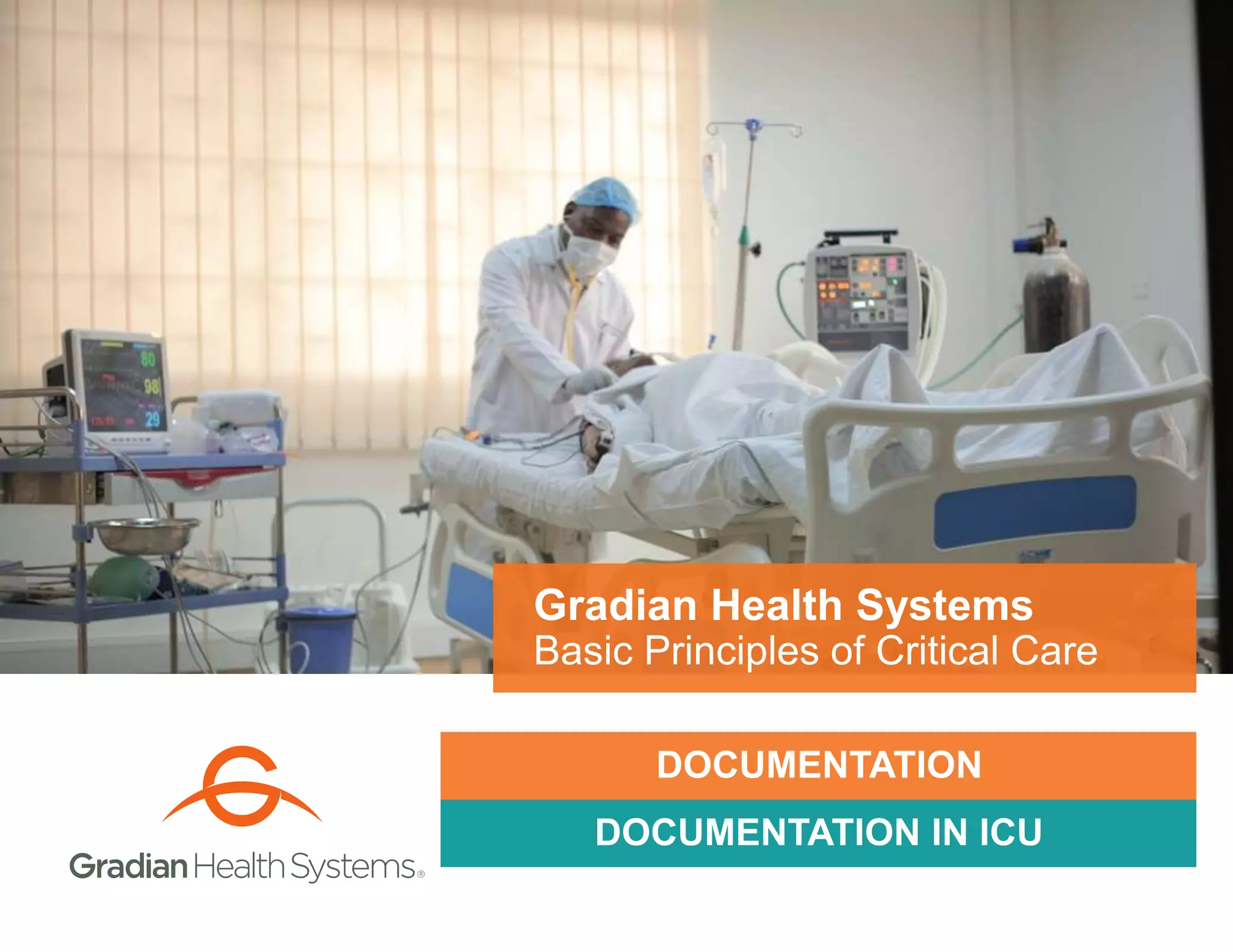
DOCUMENTATION IN ICU
Gradian Health Systems
Basic Principles of Critical Care
DOCUMENTATION
Disclaimer
Basic Principles of Critical Care Training I Documentation in ICU
Disclaimer: Gradian Health Systems cannot provide formal recommendations or indications
regarding medical care and clinical service delivery. The tables, checklists, and other clinical
documents referenced in this training have not been validated in all settings. These documents are
intended to serve as examples only. We recognize that all clinical training content and activities
must be customized to meet the needs of each facility and its clinical staff, factoring in available
resources, practitioner skill level, and other environmental considerations.
For any questions regarding the contents or applications of this training,
please contact Gradian Health Systems:
40 W 25th St, 6th Floor
New York, NY 10010 USA
+1 212-537-0340
training@gradianhealth.org
Module 5
Gradian Health Systems
Basics Principles of Critical Care
Documentation
Module 5: Documentation
MODULE OVERVIEW
Lesson 1 I Documentation in ICU
Lesson 2 I Shift Change Reports
Basic Principles of Critical Care Training I Documentation in ICU
Components of the Gradian CCV SystemLesson 1: Documentation in ICU
Lesson Objectives
• Discuss the importance of documentation used in the ICU
• Describe the types of documents used in the ICU
• Discuss the use of electronic medical records (EMR)
• Understand the legal issues surrounding medical records
Basic Principles of Critical Care Training I Documentation in ICU
Components of the Gradian CCV SystemLesson 1: Documentation in ICU
Key Concepts
• ICU documentation
• Electronic medical records (EMR)
• Legal issues
Basic Principles of Critical Care Training I Documentation in ICU
Components of the Gradian CCV SystemDocumentation in ICU
Benefits of Documentation
Clear and concise medical record documentation is critical to:
• Providing quality care
• Evaluating and planning patient treatment and maintaining the continuum of
care
• Ensuring accurate and timely payment for services
• Mitigating malpractice risks
Basic Principles of Critical Care Training I Documentation in ICU
Components of the Gradian CCV SystemDocumentation in ICU
Documentation
Good medical documentation promotes patients' and physicians' best interests
for different reasons. Recording all relevant information helps:
• Monitor what's been done
• Minimizes risk of errors creeping into the treatment process
• Reduce the likelihood of patients returning for additional treatment
The process also demands a high degree of self-evaluation that's essential to
promoting good clinical practices, as well as a practitioner's professional
development.
Basic Principles of Critical Care Training I Documentation in ICU
Components of the Gradian CCV SystemDocumentation in ICU
Importance of Good Record Keeping
• Eases continuity of care easier
• Promote better communication and dissemination of information between
team members
• Helps address complaints or legal processes
• Supports clinical audit, research, resource allocation, performance planning
• Helps identify risks and early detection of complications
• Supports patient care and patient-centered communication
• Supports effective clinical judgement
• Supports delivery of services
• Improves accountability
• Shows how decisions were made related to patient care
Basic Principles of Critical Care Training I Documentation in ICU
Components of the Gradian CCV SystemDocumentation in ICU
Principles of Good Record Keeping
The patient’s records should:
• Be factual, consistent and accurate
• Be updated as soon as possible after any recordable event
• Provide current information on the care and condition of the patient
• Be documented clearly in such a way that the text cannot be erased
• Be consecutive and accurately dated and timed, with all entries signed
(including any alterations)
• Have all original be legible; draw a clear line through any changes and sign
and date
• Not include abbreviations, slang or jargon as not all workplaces or
organizations will use the same terminology
Basic Principles of Critical Care Training I Documentation in ICU
Components of the Gradian CCV SystemDocumentation in ICU
Principles of Good Record Keeping
The patient’s records should:
• Be stored securely
• Only be destroyed following local policy
• Avoid meaningless phrases, speculation, offensive subjective statements,
and insulting or derogatory language
• Identify the patient by recording patient’s name, date of birth and hospital
number on each page of the record (three approved identifiers) or follow your
local policies on how to identify patient’s records
• Still be legible if photocopied or scanned
Basic Principles of Critical Care Training I Documentation in ICU
Components of the Gradian CCV SystemDocumentation in ICU
Most Common Deficiencies in Record Keeping
• Absence of clarity
• Inaccuracies
• Spelling mistakes
• Missing information
• Failure to record action taken when a problem has been identified
Basic Principles of Critical Care Training I Documentation in ICU
Components of the Gradian CCV SystemDocumentation in ICU
Types of ICU Documents
• Hand-written records
• Computer-based systems (electronic)
Some organizations or employers will use a combination of both hands-written
and computer-based systems for record keeping.
Basic Principles of Critical Care Training I Documentation in ICU
Components of the Gradian CCV SystemDocumentation in ICU
Components of Patient Records
• Medical records
• Nursing records / progress notes
• Medication charts
• Laboratory orders and reports
• Vital signs observation charts
• Handover sheets and admission
• Discharge and transfer checklists/ letters
• Patient’s assessment forms (e.g. nutrition or pressure area care assessment)
Basic Principles of Critical Care Training I Documentation in ICU
Components of the Gradian CCV SystemDocumentation in ICU
Electronic Medical Records (EMR)
The National Alliance for Health Information Technology (NAHIT) defines EMR
systems as “an electronic record of health-related information on an individual
that can be created, gathered, managed, and consulted by authorized clinicians
and staff within one health care organization.”
EMRs replace paper for storing patients’ records; they are used to keep medical
practitioners up to date with the progress of a patient’s treatment.
Basic Principles of Critical Care Training I Documentation in ICU
Components of the Gradian CCV SystemDocumentation in ICU
Benefits of EMRs
• Easier to access a patient's file.
• Easier to review medical records from previous years
• Allows for all vital information to be consolidated and gleaned at a glance
Basic Principles of Critical Care Training I Documentation in ICU
Components of the Gradian CCV SystemDocumentation in ICU
Functional Components of EMRs
• Integrated view of patient data (notes, labs, radiology, administration, etc.)
• Clinician order entry
• Limits errors from misreading handwriting
• Can be used for evidence based ordering
• Clinical decision support
• Use of artificial intelligence (AI)
• May include treatment approaches used in the past
• Access to knowledge resources
• May be linked to electronic resources
• Integrated communication and reporting support
• Continuum of care across multidisciplinary teams
• Communication across teams
Basic Principles of Critical Care Training I Documentation in ICU
Components of the Gradian CCV SystemDocumentation in ICU
Legal Aspects of Medical Records
Most countries regulate clinical records because they are a record of patient care
and are increasingly used in the courts.
There are three main pillars of relevant legal obligation:
• Accuracy and legibility – represent a formal record of the care provided so
must be clear, legible and accurate and contain all aspects of patient care
• Confidentiality and data protection
• Patient identifiers and records are confidential
• Use of the data is governed by local legal policies
• Use of EMR requires data management and safety
• Every patient has a right to her/his own medical records
Basic Principles of Critical Care Training I Documentation in ICU
Components of the Gradian CCV SystemDocumentation in ICU
Delegation and Countersigning
• A registered nurse is accountable for any delegation of record keeping to
members of the multi-professional team who are not registered practitioners
(e.g. nurse aids, assistant practitioners, care assistants and nursing students)
• Only countersign if the activity has been witnessed or validated
• Always follow local policies around record keeping, delegation and
countersigning
Basic Principles of Critical Care Training I Documentation in ICU

Module 5.1 Documentation in ICU

  • 1.
    DOCUMENTATION IN ICU GradianHealth Systems Basic Principles of Critical Care DOCUMENTATION
  • 2.
    Disclaimer Basic Principles ofCritical Care Training I Documentation in ICU Disclaimer: Gradian Health Systems cannot provide formal recommendations or indications regarding medical care and clinical service delivery. The tables, checklists, and other clinical documents referenced in this training have not been validated in all settings. These documents are intended to serve as examples only. We recognize that all clinical training content and activities must be customized to meet the needs of each facility and its clinical staff, factoring in available resources, practitioner skill level, and other environmental considerations. For any questions regarding the contents or applications of this training, please contact Gradian Health Systems: 40 W 25th St, 6th Floor New York, NY 10010 USA +1 212-537-0340 training@gradianhealth.org
  • 3.
    Module 5 Gradian HealthSystems Basics Principles of Critical Care Documentation
  • 4.
    Module 5: Documentation MODULEOVERVIEW Lesson 1 I Documentation in ICU Lesson 2 I Shift Change Reports Basic Principles of Critical Care Training I Documentation in ICU
  • 5.
    Components of theGradian CCV SystemLesson 1: Documentation in ICU Lesson Objectives • Discuss the importance of documentation used in the ICU • Describe the types of documents used in the ICU • Discuss the use of electronic medical records (EMR) • Understand the legal issues surrounding medical records Basic Principles of Critical Care Training I Documentation in ICU
  • 6.
    Components of theGradian CCV SystemLesson 1: Documentation in ICU Key Concepts • ICU documentation • Electronic medical records (EMR) • Legal issues Basic Principles of Critical Care Training I Documentation in ICU
  • 7.
    Components of theGradian CCV SystemDocumentation in ICU Benefits of Documentation Clear and concise medical record documentation is critical to: • Providing quality care • Evaluating and planning patient treatment and maintaining the continuum of care • Ensuring accurate and timely payment for services • Mitigating malpractice risks Basic Principles of Critical Care Training I Documentation in ICU
  • 8.
    Components of theGradian CCV SystemDocumentation in ICU Documentation Good medical documentation promotes patients' and physicians' best interests for different reasons. Recording all relevant information helps: • Monitor what's been done • Minimizes risk of errors creeping into the treatment process • Reduce the likelihood of patients returning for additional treatment The process also demands a high degree of self-evaluation that's essential to promoting good clinical practices, as well as a practitioner's professional development. Basic Principles of Critical Care Training I Documentation in ICU
  • 9.
    Components of theGradian CCV SystemDocumentation in ICU Importance of Good Record Keeping • Eases continuity of care easier • Promote better communication and dissemination of information between team members • Helps address complaints or legal processes • Supports clinical audit, research, resource allocation, performance planning • Helps identify risks and early detection of complications • Supports patient care and patient-centered communication • Supports effective clinical judgement • Supports delivery of services • Improves accountability • Shows how decisions were made related to patient care Basic Principles of Critical Care Training I Documentation in ICU
  • 10.
    Components of theGradian CCV SystemDocumentation in ICU Principles of Good Record Keeping The patient’s records should: • Be factual, consistent and accurate • Be updated as soon as possible after any recordable event • Provide current information on the care and condition of the patient • Be documented clearly in such a way that the text cannot be erased • Be consecutive and accurately dated and timed, with all entries signed (including any alterations) • Have all original be legible; draw a clear line through any changes and sign and date • Not include abbreviations, slang or jargon as not all workplaces or organizations will use the same terminology Basic Principles of Critical Care Training I Documentation in ICU
  • 11.
    Components of theGradian CCV SystemDocumentation in ICU Principles of Good Record Keeping The patient’s records should: • Be stored securely • Only be destroyed following local policy • Avoid meaningless phrases, speculation, offensive subjective statements, and insulting or derogatory language • Identify the patient by recording patient’s name, date of birth and hospital number on each page of the record (three approved identifiers) or follow your local policies on how to identify patient’s records • Still be legible if photocopied or scanned Basic Principles of Critical Care Training I Documentation in ICU
  • 12.
    Components of theGradian CCV SystemDocumentation in ICU Most Common Deficiencies in Record Keeping • Absence of clarity • Inaccuracies • Spelling mistakes • Missing information • Failure to record action taken when a problem has been identified Basic Principles of Critical Care Training I Documentation in ICU
  • 13.
    Components of theGradian CCV SystemDocumentation in ICU Types of ICU Documents • Hand-written records • Computer-based systems (electronic) Some organizations or employers will use a combination of both hands-written and computer-based systems for record keeping. Basic Principles of Critical Care Training I Documentation in ICU
  • 14.
    Components of theGradian CCV SystemDocumentation in ICU Components of Patient Records • Medical records • Nursing records / progress notes • Medication charts • Laboratory orders and reports • Vital signs observation charts • Handover sheets and admission • Discharge and transfer checklists/ letters • Patient’s assessment forms (e.g. nutrition or pressure area care assessment) Basic Principles of Critical Care Training I Documentation in ICU
  • 15.
    Components of theGradian CCV SystemDocumentation in ICU Electronic Medical Records (EMR) The National Alliance for Health Information Technology (NAHIT) defines EMR systems as “an electronic record of health-related information on an individual that can be created, gathered, managed, and consulted by authorized clinicians and staff within one health care organization.” EMRs replace paper for storing patients’ records; they are used to keep medical practitioners up to date with the progress of a patient’s treatment. Basic Principles of Critical Care Training I Documentation in ICU
  • 16.
    Components of theGradian CCV SystemDocumentation in ICU Benefits of EMRs • Easier to access a patient's file. • Easier to review medical records from previous years • Allows for all vital information to be consolidated and gleaned at a glance Basic Principles of Critical Care Training I Documentation in ICU
  • 17.
    Components of theGradian CCV SystemDocumentation in ICU Functional Components of EMRs • Integrated view of patient data (notes, labs, radiology, administration, etc.) • Clinician order entry • Limits errors from misreading handwriting • Can be used for evidence based ordering • Clinical decision support • Use of artificial intelligence (AI) • May include treatment approaches used in the past • Access to knowledge resources • May be linked to electronic resources • Integrated communication and reporting support • Continuum of care across multidisciplinary teams • Communication across teams Basic Principles of Critical Care Training I Documentation in ICU
  • 18.
    Components of theGradian CCV SystemDocumentation in ICU Legal Aspects of Medical Records Most countries regulate clinical records because they are a record of patient care and are increasingly used in the courts. There are three main pillars of relevant legal obligation: • Accuracy and legibility – represent a formal record of the care provided so must be clear, legible and accurate and contain all aspects of patient care • Confidentiality and data protection • Patient identifiers and records are confidential • Use of the data is governed by local legal policies • Use of EMR requires data management and safety • Every patient has a right to her/his own medical records Basic Principles of Critical Care Training I Documentation in ICU
  • 19.
    Components of theGradian CCV SystemDocumentation in ICU Delegation and Countersigning • A registered nurse is accountable for any delegation of record keeping to members of the multi-professional team who are not registered practitioners (e.g. nurse aids, assistant practitioners, care assistants and nursing students) • Only countersign if the activity has been witnessed or validated • Always follow local policies around record keeping, delegation and countersigning Basic Principles of Critical Care Training I Documentation in ICU