Ventilated associated pneumonia (VAP), Catheter
associated Urinary tract infection, and Central line
associated infection Reduction in intensive care
units
Education Department
Dalia Jumah 2019
 VAP definition and its Bundles.
 Central line associated infection definition
and its Bundles.
 Catheter associated Urinary Tract infection
definition and its bundles.
 Safety is a system property (IOM, 2010).
 Reducing risk and ensuring safety require
greater attention to systems that help prevent
and mitigate errors. Also, reduce health care
associated infections is one of the
problematic area concerning patient safety (Joint
Commission, 2013) .
 Most common infection in ICU are:
• Ventilated associated pneumonia
which is related to high occupancy
rate of ventilated patients (Blackwood et al.,2009; Grap,
2009)
• Central line associated infection. The relative
risk is up to 64 times greater with CVCs than
with peripheral venous catheters (Gahlot. Et al. 2014).
• Catheter associated Urinary Tract infection.
UTI is most type of healthcare-associated
infection reported and the most important
factor is the prolonged use of the urinary
catheter (CDC, 2015).
 The IOM recommendations for 2010 have
focused on improving the nurses'
opportunities to manage practice environment
with other health care members through
educational programs that aims to spread
successful practice by nurses' leadership (IOM,
2010).
 This project will help in improving quality of
care and practice for critical care units'
customers.
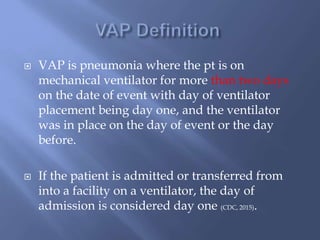
 VAP is pneumonia where the pt is on
mechanical ventilator for more than two days
on the date of event with day of ventilator
placement being day one, and the ventilator
was in place on the day of event or the day
before.
 If the patient is admitted or transferred from
into a facility on a ventilator, the day of
admission is considered day one (CDC, 2015).
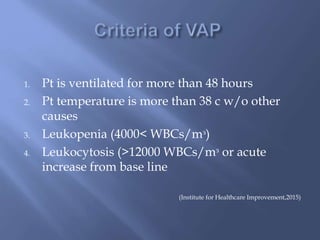
1. Pt is ventilated for more than 48 hours
2. Pt temperature is more than 38 c w/o other
causes
3. Leukopenia (4000< WBCs/mᵌ)
4. Leukocytosis (>12000 WBCs/mᵌ or acute
increase from base line
(Institute for Healthcare Improvement,2015)
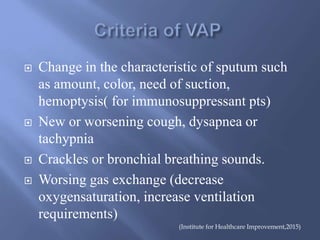
 Change in the characteristic of sputum such
as amount, color, need of suction,
hemoptysis( for immunosuppressant pts)
 New or worsening cough, dysapnea or
tachypnia
 Crackles or bronchial breathing sounds.
 Worsing gas exchange (decrease
oxygensaturation, increase ventilation
requirements)
(Institute for Healthcare Improvement,2015)
 Plural chest pain (for immunosuppressant pts)
 Positive chest radiology (consolidation or
progressive infiltrate)
 Positive cultures of blood, sputum, tracheal
aspirate, plural fluid
(Institute for Healthcare Improvement,2015)
 Head of bed 30
 PUD Prophylaxis
 DVD Prophylaxis
 Oral care with Chlorohexidine four times a
day
 Sedation vacation for pt readiness for
extubation
(Institute for Healthcare Improvement,2015)
 Central line associated infection is defined as
the presence of bacteremia originating from
an intravenous catheter (CDC, 2012).
 Inflammatory response syndrome
1. Tem <36°C or >38°C.
2. HR>90/min, RR>20/minute.
3. WBC count <4000/µL or >12 000/µL
 Obvious inflammation
 At least two cultures from central line lumen
is positive,
 Peripheral venipuncture culture is positive
 Tip of central line if sent is positive (Shah et al. 2013).
 Hand hygiene
 Maximal barrier precautions upon insertion
 Chlorohexidine skin antisepsis.
 Optimal catheter site selection, with
avoidance of the femoral vein for central
venous access in adult patients.
 Daily review of line necessity with promote
removal of unnecessary lines.
(Institute for Healthcare Improvement,2015)
 Infection involving any part of the urinary
system, including urethra, bladder, ureters,
and kidney (CDC, 2015).
 Pt has urinary catheter for more than two
days.
 Patient has a urine culture with no more than
two species of organisms identified (Exclude
mixed flora, Candida species, yeast not
otherwise specified, mold, dimorphic fungi,
or parasites.
 Patient has at least one of the following signs
or symptoms:
• Fever (>38°C) in a pt that is ≤ 65 years of age
• Suprapubic tenderness
• Costovertebral angle pain or tenderness
• Urinary frequency, urinary urgency or dysuria
 Pt has abcess.
 Pt has organism from fluid or tissue(Device-associated
Module, 2017) .
 Use Foley catheter only when there is no
other choice.
 Try to find another ways to use the toilet.
 Sterile technique on insertion.
 Make sure the catheter tubing is secured to
thigh.
 Take the Foley catheter as soon as possible.
 Keep the urine bag below the level of the
bladder.
 Maintain closed system.
 Make sure the urine tube does not kink.
 Hand hygiene.
 Maintenance:
1. Monitor sign and symptoms of UTI.
2. Date bag on insertion.
3. Bag and tubing kept lower than bladder and
straight.
(Institute for Healthcare Improvement,2015)
 Blackwood, B., Alderdice, F., Burns, K. E. A., Cardwell, C. R., Lavery, G. G., &
O'Halloran, P. (2009). Protocolized vs. non-protocolized weaning for reducing the duration
of mechanical ventilation in critically ill adult patients: Cochrane review protocol. Journal
Of Advanced Nursing, 65(5), 957-964.
 Centers for Disease Control and Prevention. Guidelines for preventing health-care-
associated pneumonia, 2015: recommendations of CDC and the Healthcare
Infection Control Practices Advisory Committee.
 Central for Disease Control and Prevention. Device-associated Module (2017). Urinary
Tract Infection (Catheter-Associated Urinary Tract Infection [CAUTI] and Non-Catheter-
Associated Urinary Tract Infection [UTI]) and Other Urinary System Infection [USI])
Events.
 Gahlot, R., Nigam, C., Kumar, V., Yadav, G., & Anupurba, S. (2014). Catheter-related
bloodstream infections. International Journal of Critical Illness and Injury Science, 4(2),
162–167.
 Institution of medicine, crossing the quality chasm, anew health system for the
21ST century: march2001.
 Institute for Healthcare Improvement. (2015). How-to Guide: Prevent Ventilator-
Associated Pneumonia. Institute for Healthcare Improvement.
http://www.ihi.org/knowledge/Pages/Tools/HowtoGuidePreventVAP.aspx
Accessed 7/10/12.
 JCI Accreditation Standards for Hospitals, 5th Edition Issued 4 December 2013
 Shah, H., Bosch, W., Thompson, K. M., & Hellinger, W. C. (2013). Intravascular Catheter-
Related Bloodstream Infection. The Neurohospitalist, 3(3), 144–151.
ICU Bundles

ICU Bundles

  • 1.
    Ventilated associated pneumonia(VAP), Catheter associated Urinary tract infection, and Central line associated infection Reduction in intensive care units Education Department Dalia Jumah 2019
  • 2.
     VAP definitionand its Bundles.  Central line associated infection definition and its Bundles.  Catheter associated Urinary Tract infection definition and its bundles.
  • 3.
     Safety isa system property (IOM, 2010).  Reducing risk and ensuring safety require greater attention to systems that help prevent and mitigate errors. Also, reduce health care associated infections is one of the problematic area concerning patient safety (Joint Commission, 2013) .
  • 4.
     Most commoninfection in ICU are: • Ventilated associated pneumonia which is related to high occupancy rate of ventilated patients (Blackwood et al.,2009; Grap, 2009)
  • 5.
    • Central lineassociated infection. The relative risk is up to 64 times greater with CVCs than with peripheral venous catheters (Gahlot. Et al. 2014). • Catheter associated Urinary Tract infection. UTI is most type of healthcare-associated infection reported and the most important factor is the prolonged use of the urinary catheter (CDC, 2015).
  • 6.
     The IOMrecommendations for 2010 have focused on improving the nurses' opportunities to manage practice environment with other health care members through educational programs that aims to spread successful practice by nurses' leadership (IOM, 2010).
  • 7.
     This projectwill help in improving quality of care and practice for critical care units' customers.
  • 9.
     VAP ispneumonia where the pt is on mechanical ventilator for more than two days on the date of event with day of ventilator placement being day one, and the ventilator was in place on the day of event or the day before.  If the patient is admitted or transferred from into a facility on a ventilator, the day of admission is considered day one (CDC, 2015).
  • 10.
    1. Pt isventilated for more than 48 hours 2. Pt temperature is more than 38 c w/o other causes 3. Leukopenia (4000< WBCs/mᵌ) 4. Leukocytosis (>12000 WBCs/mᵌ or acute increase from base line (Institute for Healthcare Improvement,2015)
  • 11.
     Change inthe characteristic of sputum such as amount, color, need of suction, hemoptysis( for immunosuppressant pts)  New or worsening cough, dysapnea or tachypnia  Crackles or bronchial breathing sounds.  Worsing gas exchange (decrease oxygensaturation, increase ventilation requirements) (Institute for Healthcare Improvement,2015)
  • 12.
     Plural chestpain (for immunosuppressant pts)  Positive chest radiology (consolidation or progressive infiltrate)  Positive cultures of blood, sputum, tracheal aspirate, plural fluid (Institute for Healthcare Improvement,2015)
  • 13.
     Head ofbed 30  PUD Prophylaxis  DVD Prophylaxis  Oral care with Chlorohexidine four times a day  Sedation vacation for pt readiness for extubation (Institute for Healthcare Improvement,2015)
  • 15.
     Central lineassociated infection is defined as the presence of bacteremia originating from an intravenous catheter (CDC, 2012).
  • 16.
     Inflammatory responsesyndrome 1. Tem <36°C or >38°C. 2. HR>90/min, RR>20/minute. 3. WBC count <4000/µL or >12 000/µL  Obvious inflammation  At least two cultures from central line lumen is positive,  Peripheral venipuncture culture is positive  Tip of central line if sent is positive (Shah et al. 2013).
  • 17.
     Hand hygiene Maximal barrier precautions upon insertion  Chlorohexidine skin antisepsis.  Optimal catheter site selection, with avoidance of the femoral vein for central venous access in adult patients.  Daily review of line necessity with promote removal of unnecessary lines. (Institute for Healthcare Improvement,2015)
  • 19.
     Infection involvingany part of the urinary system, including urethra, bladder, ureters, and kidney (CDC, 2015).
  • 20.
     Pt hasurinary catheter for more than two days.  Patient has a urine culture with no more than two species of organisms identified (Exclude mixed flora, Candida species, yeast not otherwise specified, mold, dimorphic fungi, or parasites.
  • 21.
     Patient hasat least one of the following signs or symptoms: • Fever (>38°C) in a pt that is ≤ 65 years of age • Suprapubic tenderness • Costovertebral angle pain or tenderness • Urinary frequency, urinary urgency or dysuria  Pt has abcess.  Pt has organism from fluid or tissue(Device-associated Module, 2017) .
  • 22.
     Use Foleycatheter only when there is no other choice.  Try to find another ways to use the toilet.  Sterile technique on insertion.  Make sure the catheter tubing is secured to thigh.  Take the Foley catheter as soon as possible.  Keep the urine bag below the level of the bladder.
  • 23.
     Maintain closedsystem.  Make sure the urine tube does not kink.  Hand hygiene.  Maintenance: 1. Monitor sign and symptoms of UTI. 2. Date bag on insertion. 3. Bag and tubing kept lower than bladder and straight. (Institute for Healthcare Improvement,2015)
  • 24.
     Blackwood, B.,Alderdice, F., Burns, K. E. A., Cardwell, C. R., Lavery, G. G., & O'Halloran, P. (2009). Protocolized vs. non-protocolized weaning for reducing the duration of mechanical ventilation in critically ill adult patients: Cochrane review protocol. Journal Of Advanced Nursing, 65(5), 957-964.  Centers for Disease Control and Prevention. Guidelines for preventing health-care- associated pneumonia, 2015: recommendations of CDC and the Healthcare Infection Control Practices Advisory Committee.  Central for Disease Control and Prevention. Device-associated Module (2017). Urinary Tract Infection (Catheter-Associated Urinary Tract Infection [CAUTI] and Non-Catheter- Associated Urinary Tract Infection [UTI]) and Other Urinary System Infection [USI]) Events.
  • 25.
     Gahlot, R.,Nigam, C., Kumar, V., Yadav, G., & Anupurba, S. (2014). Catheter-related bloodstream infections. International Journal of Critical Illness and Injury Science, 4(2), 162–167.  Institution of medicine, crossing the quality chasm, anew health system for the 21ST century: march2001.  Institute for Healthcare Improvement. (2015). How-to Guide: Prevent Ventilator- Associated Pneumonia. Institute for Healthcare Improvement. http://www.ihi.org/knowledge/Pages/Tools/HowtoGuidePreventVAP.aspx Accessed 7/10/12.  JCI Accreditation Standards for Hospitals, 5th Edition Issued 4 December 2013  Shah, H., Bosch, W., Thompson, K. M., & Hellinger, W. C. (2013). Intravascular Catheter- Related Bloodstream Infection. The Neurohospitalist, 3(3), 144–151.