MS.SUBASHINI KALIRAJ.RN
INFECTION CONTROL NURSE
NURSE SUPERVISOR
 To educate all staffs of SAUH about hand washing.
 To make standard handwashing practice throughout
hospital.
 To educate staffs about resident flora and transient
flora.
 To make handwashing practice a regular activity
irrespective of monitoring.
 Hand washing:Hand washing is the fundamental part of
standard precaution procedures and disease control helps
reduce or prevent infection and transmission of microbes
among people and objects.
 Medical hand washing:Medical hand washingis a procedure
done by health care personnel to prevent transmission of
infection and it is done for 60 seconds.
 Surgical hand washing:Surgical hand washing is the act of
washing the fingernails, hands, and forearms with a bactericidal
soap or solution in a prescribed manner for a specific period (3 to
5 minutes) before a surgical procedure.
 Hand hygiene :Hand hygiene relates to the removal of visible
soil and the removal or killing of transient microorganisms from
the hands and may be accomplished using soap and running
water or an alcohol-based hand rub.
 The outer layer of bacteria found on your hands is
termed as transient flora.
 This layer is potentially the most dangerous for
transmitting disease from one person to another.
 Fortunately, it is also the most easily eliminated
by hand washing.
 The deeper layer of bacteria is called Resident Flora.
 This bacterial population is more likely to be made up
of innocuous bacteria such as Staphylococcus
epidermidis and Corynebacteria spp. (diptheroids).
 They are resistant to washing, since they occupy the
deeper layers of skin
S. epidermidis is not usually pathogenic, patients with
compromised immune systems are often at risk for
developing an infection. These infections can be
bothnosocomial or community acquired.
S. epidermidis is also a major concern for people
with catheters or other surgical implants because it is
known to cause biofilms that grow on these devices.
 Corynebacterium is a genus of Gram-positive, rod-
shapedbacteria. They are widely distributed in nature
and are mostly innocuous.
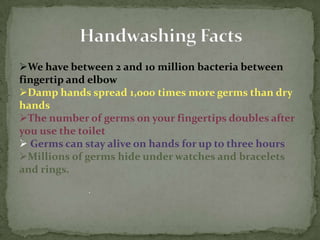
We have between 2 and 10 million bacteria between
fingertip and elbow
Damp hands spread 1,000 times more germs than dry
hands
The number of germs on your fingertips doubles after
you use the toilet
 Germs can stay alive on hands for up to three hours
Millions of germs hide under watches and bracelets
and rings.
.
 If hands are not visibly soiled or visibly contaminated
with blood or other proteinaceous material, the most
effective method for reducing the number of
pathogenic bacteria on the hands of personnel is using
alcohol hand rub.

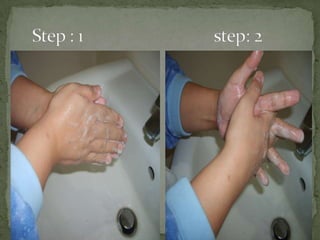
Hand washing

  • 1.
  • 2.
     To educateall staffs of SAUH about hand washing.  To make standard handwashing practice throughout hospital.  To educate staffs about resident flora and transient flora.  To make handwashing practice a regular activity irrespective of monitoring.
  • 3.
     Hand washing:Handwashing is the fundamental part of standard precaution procedures and disease control helps reduce or prevent infection and transmission of microbes among people and objects.  Medical hand washing:Medical hand washingis a procedure done by health care personnel to prevent transmission of infection and it is done for 60 seconds.  Surgical hand washing:Surgical hand washing is the act of washing the fingernails, hands, and forearms with a bactericidal soap or solution in a prescribed manner for a specific period (3 to 5 minutes) before a surgical procedure.  Hand hygiene :Hand hygiene relates to the removal of visible soil and the removal or killing of transient microorganisms from the hands and may be accomplished using soap and running water or an alcohol-based hand rub.
  • 4.
     The outerlayer of bacteria found on your hands is termed as transient flora.  This layer is potentially the most dangerous for transmitting disease from one person to another.  Fortunately, it is also the most easily eliminated by hand washing.
  • 5.
     The deeperlayer of bacteria is called Resident Flora.  This bacterial population is more likely to be made up of innocuous bacteria such as Staphylococcus epidermidis and Corynebacteria spp. (diptheroids).  They are resistant to washing, since they occupy the deeper layers of skin
  • 6.
    S. epidermidis isnot usually pathogenic, patients with compromised immune systems are often at risk for developing an infection. These infections can be bothnosocomial or community acquired. S. epidermidis is also a major concern for people with catheters or other surgical implants because it is known to cause biofilms that grow on these devices.
  • 7.
     Corynebacterium isa genus of Gram-positive, rod- shapedbacteria. They are widely distributed in nature and are mostly innocuous.
  • 12.
    We have between2 and 10 million bacteria between fingertip and elbow Damp hands spread 1,000 times more germs than dry hands The number of germs on your fingertips doubles after you use the toilet  Germs can stay alive on hands for up to three hours Millions of germs hide under watches and bracelets and rings. .
  • 13.
     If handsare not visibly soiled or visibly contaminated with blood or other proteinaceous material, the most effective method for reducing the number of pathogenic bacteria on the hands of personnel is using alcohol hand rub.