INFECTION CONTROL
IN
CRITICAL CARE UNIT
Mrs. Keerthi Samuel
Asst.Professor
Vijay Marie CON
INTRODUCTION
 The intensive care unit (ICU) of the hospital has always been where
the most vulnerable patients are kept, so they can be closely
monitored and treated, often with a one-to-one ratio of nurse to
patient, for the most scrupulous of care.
 Nosocomial infection comes from Greek work “nosus” meaning
disease and “ komeion ” meaning “to take care” also called as
“hospital acquired infection”.
DEFINITION
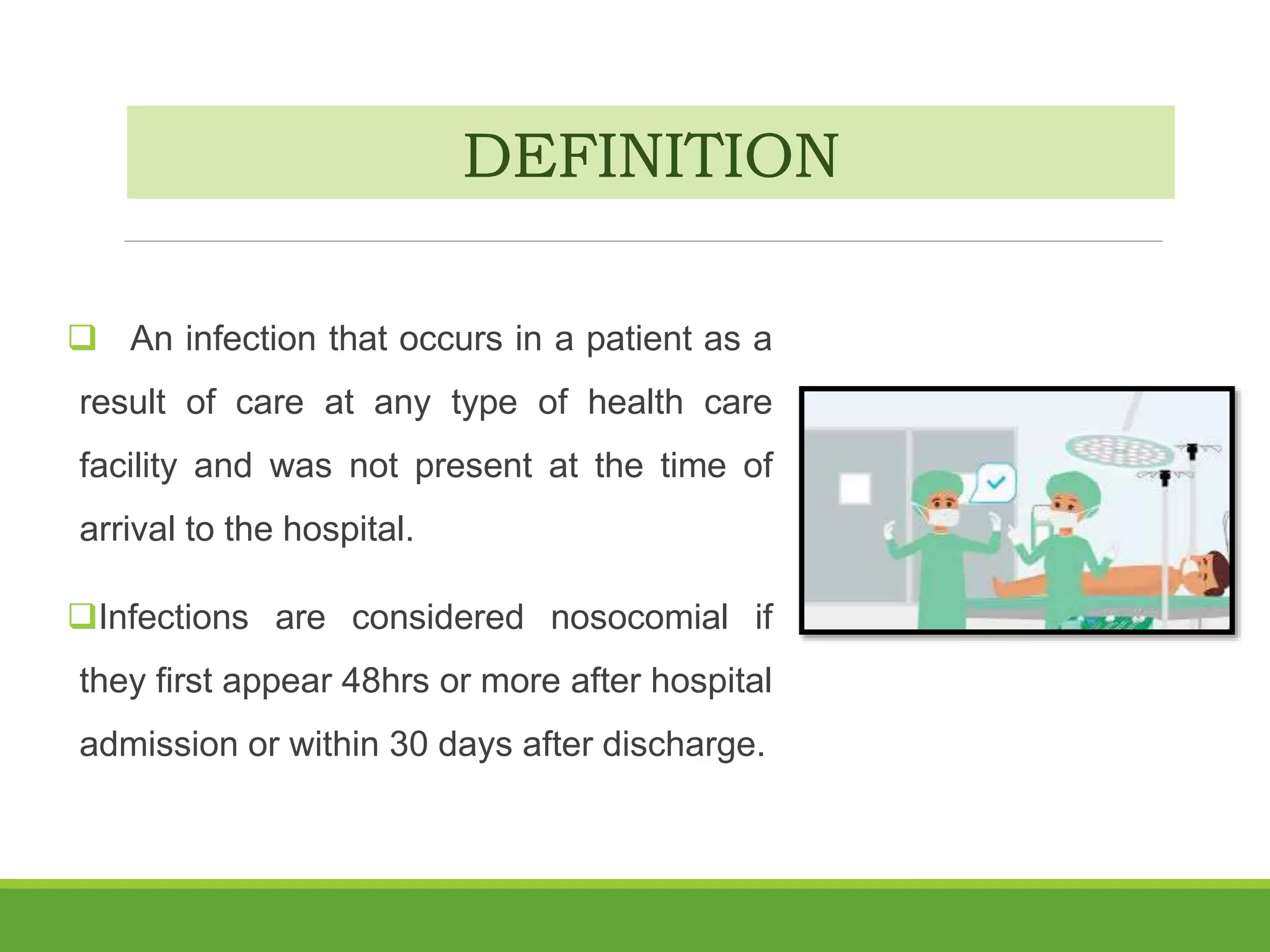
 An infection that occurs in a patient as a
result of care at any type of health care
facility and was not present at the time of
arrival to the hospital.
Infections are considered nosocomial if
they first appear 48hrs or more after hospital
admission or within 30 days after discharge.
• Nosocomial infections accounts for 7% in developed and 10% in developing
countries.Hospital waste serves as potential source of pathogens and about
20%–25% of hospital waste is termed as hazardous.
•The nosocomial infection was seen more in the 40-60 year of age. The male
were more prone to nosocomial infections than the female.
•Infection rate is upto 5% to 10% but may be up to 28% in ICU
•UTI - 28%,Surgical site infection – 19%,Pneumonia – 17%,Blood steam
infection – 7% to 10%
INCIDENCE
ENDOGENOUS
•Patient own flora may invade
patient tissue during some
surgical operation or instrument
manipulation
•Normal commensalism of the
skin respiratory , urinary track
EXOGENOUS
•From another patient , staff
members environment in the
hospital
•Environmental sources are air,
water, food
•Cross infection
SOURCES OF INFECTION
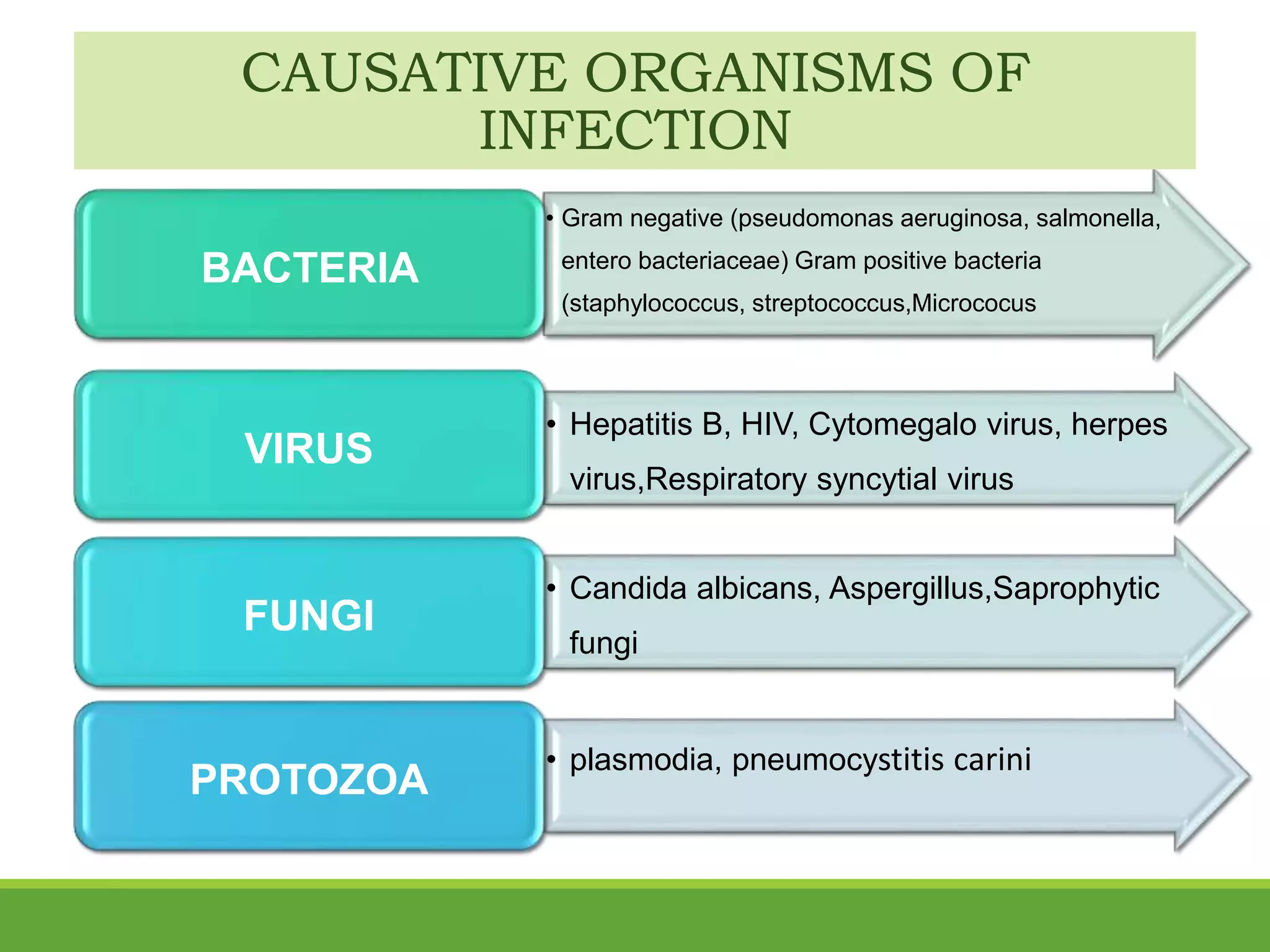
• Gram negative (pseudomonas aeruginosa, salmonella,
entero bacteriaceae) Gram positive bacteria
(staphylococcus, streptococcus,Micrococus
BACTERIA
• Hepatitis B, HIV, Cytomegalo virus, herpes
virus,Respiratory syncytial virus
VIRUS
• Candida albicans, Aspergillus,Saprophytic
fungi
FUNGI
• plasmodia, pneumocystitis carini
PROTOZOA
CAUSATIVE ORGANISMS OF
INFECTION
Lack of hand washing
Patient close together or
sharing room understaffing
Preparation of iv on the unit
Lack of isolation facilities in
separation of clean
Inadequate cleaning of
environment
RISK FACTORS
Ventilator-associated pneumonia
Staphylococcus aureus
Methicillin resistant Staphylococcus aureus
Candida albicans
Pseudomonas aeruginosa
Acinetobacter baumannii
Stenotrophomonas maltophilia
Clostridium difficile
COMMON NOSOCHOMIAL
INFECTIONS
Tuberculosis
Urinary tract infection
Hospital-acquired pneumonia
Gastroenteritis
Vancomycin-resistant
Enterococcus
Legionnaires’ disease.
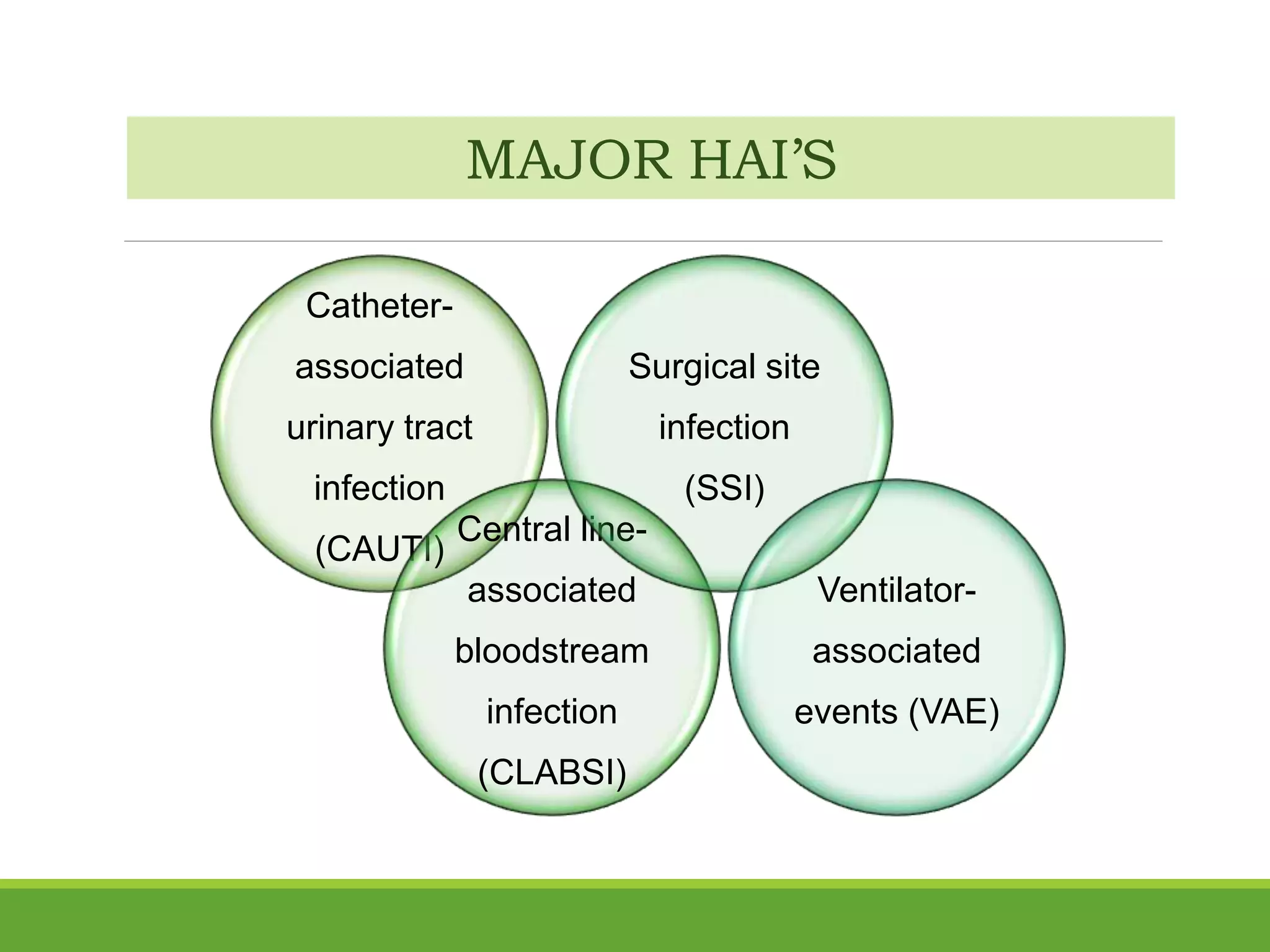
Catheter-
associated
urinary tract
infection
(CAUTI)
Central line-
associated
bloodstream
infection
(CLABSI)
Surgical site
infection
(SSI)
Ventilator-
associated
events (VAE)
MAJOR HAI’S
Contact
Airborne
Oral route
Parenteral
route
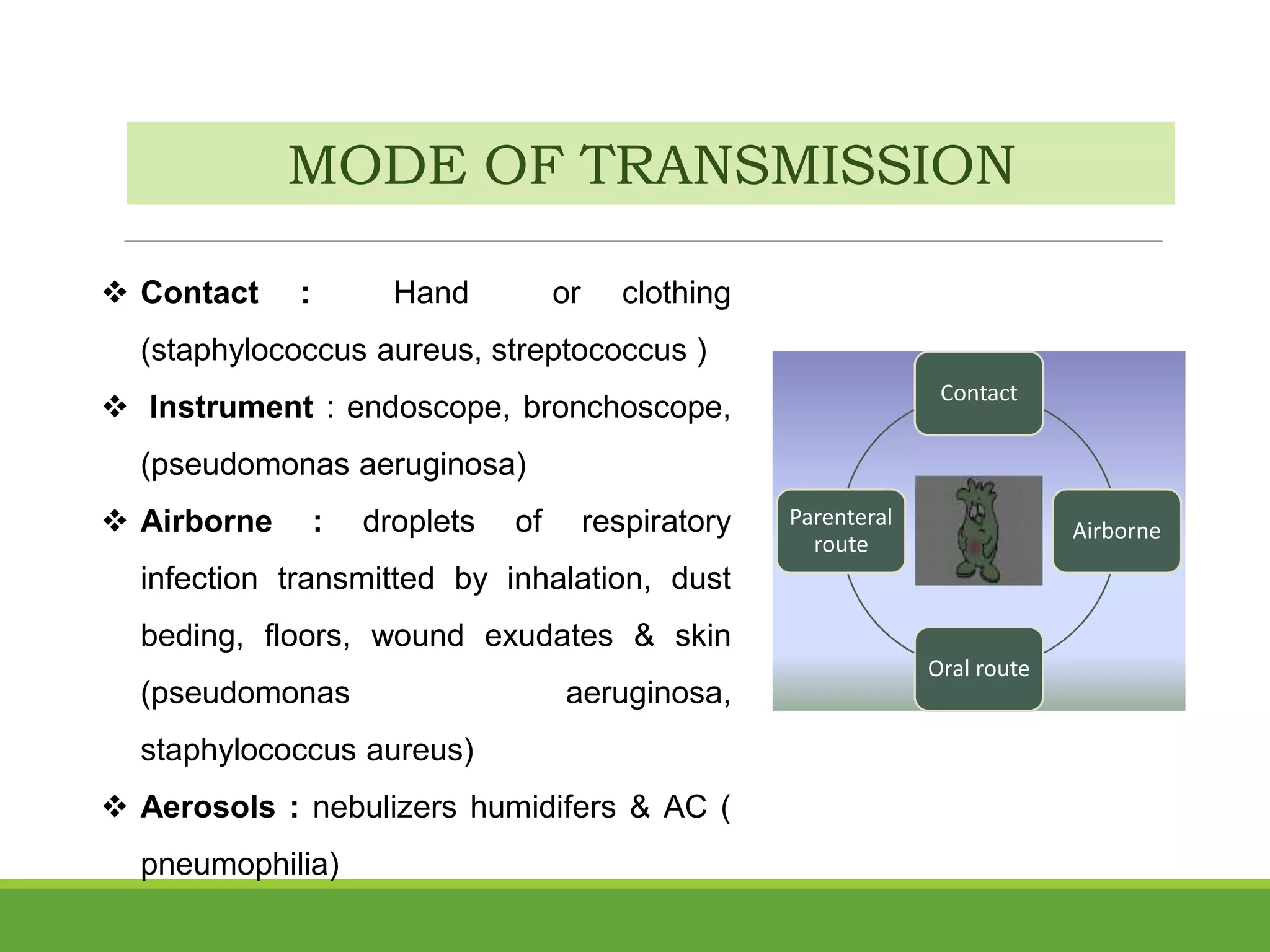
 Contact : Hand or clothing
(staphylococcus aureus, streptococcus )
 Instrument : endoscope, bronchoscope,
(pseudomonas aeruginosa)
 Airborne : droplets of respiratory
infection transmitted by inhalation, dust
beding, floors, wound exudates & skin
(pseudomonas aeruginosa,
staphylococcus aureus)
 Aerosols : nebulizers humidifers & AC (
pneumophilia)
MODE OF TRANSMISSION
Contact
Airborne
Oral route
Parenteral
route
 Oral route :
Hospital food may contain antibiotic resistant
bacteria may colonize intestine can cause
infection
 Parenteral route:
Disposal syringes & needles , blood
transfusion ( hepatitis B, HIV)
MODE OF TRANSMISSION
•Avoid surgical site infection
•An isolation unit for a patient infected by an
infectious disease
•Sterilization of medical equipment
•Validation and cleaning of hospitals
environment
PREVENTION
PPE used in healthcare
includes
◦ gloves, aprons, long
sleeved gowns,
goggles, fluid-
repellant surgical
masks, face visors
and respirator
masks.
PPE
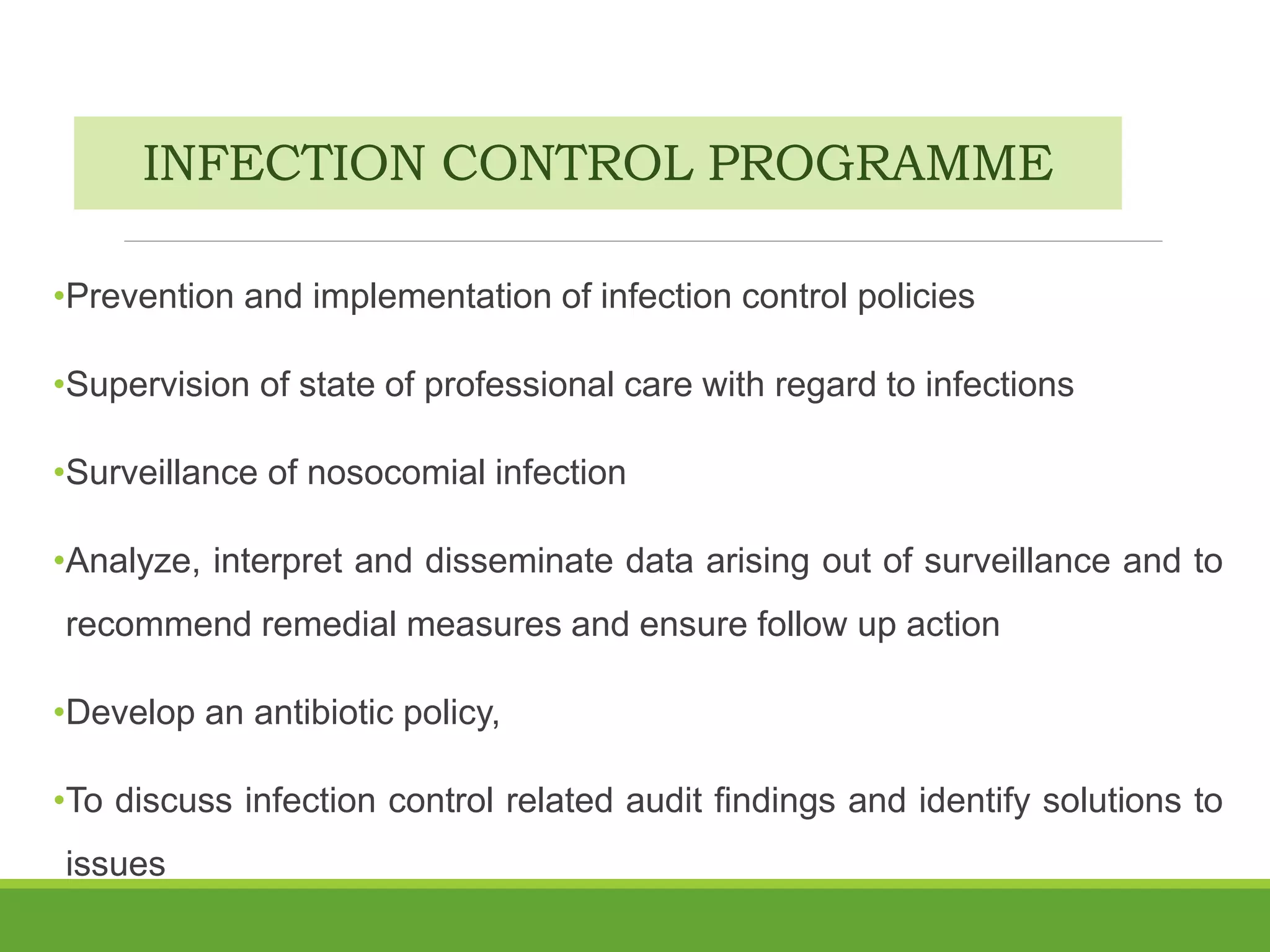
•Prevention and implementation of infection control policies
•Supervision of state of professional care with regard to infections
•Surveillance of nosocomial infection
•Analyze, interpret and disseminate data arising out of surveillance and to
recommend remedial measures and ensure follow up action
•Develop an antibiotic policy,
•To discuss infection control related audit findings and identify solutions to
issues
INFECTION CONTROL PROGRAMME
•Formulate policies & protocols on the methods of sterilization and
disinfection
•Employee health program
•Conduct in house orientation program
•Guidelines for segregation and disposal of hospital waste
•Conduct meeting every month (2nd Wednesday of every month)
INFECTION CONTROL PROGRAMME
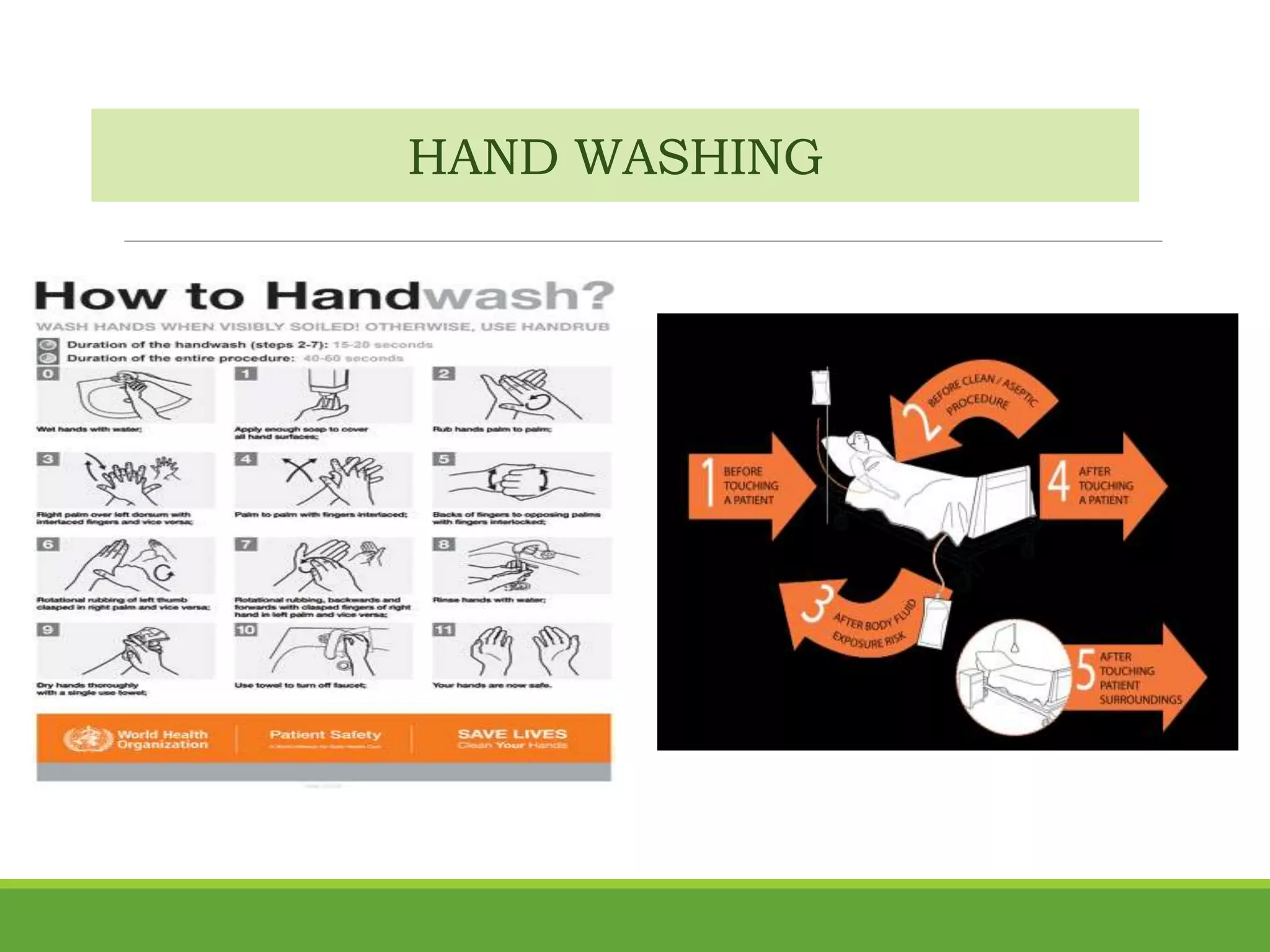
Follow hand washing protocol
Follow biomedical waste management
Attend HICC related class
Follow aseptic techniques while doing
procedures
Follow care bundle protocols to prevent
nosocomial infections
ROLE OF A NURSE
HAND WASHING
CAUTI BUNDLE
CLABSI BUNDLE
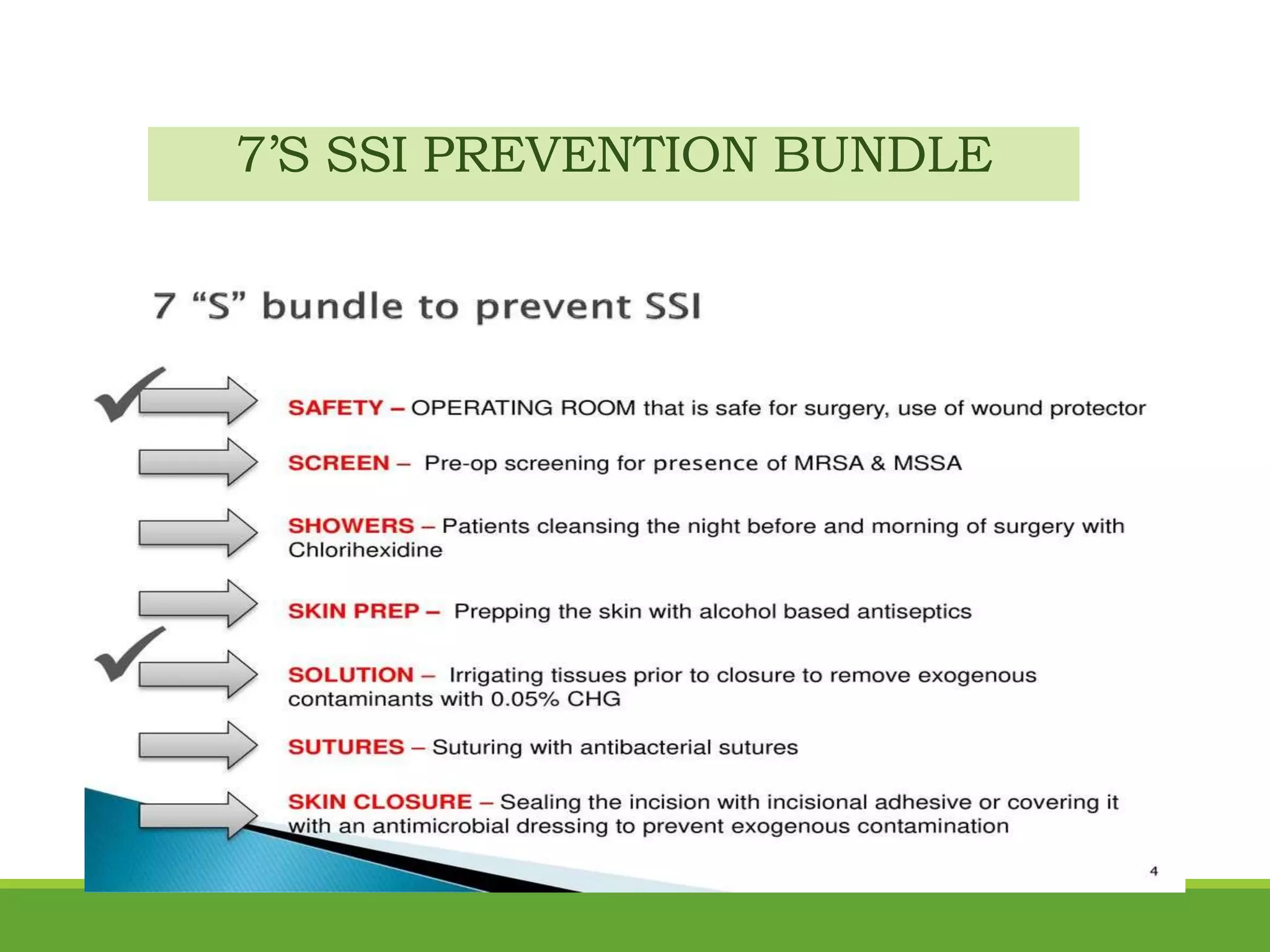
7’S SSI PREVENTION BUNDLE
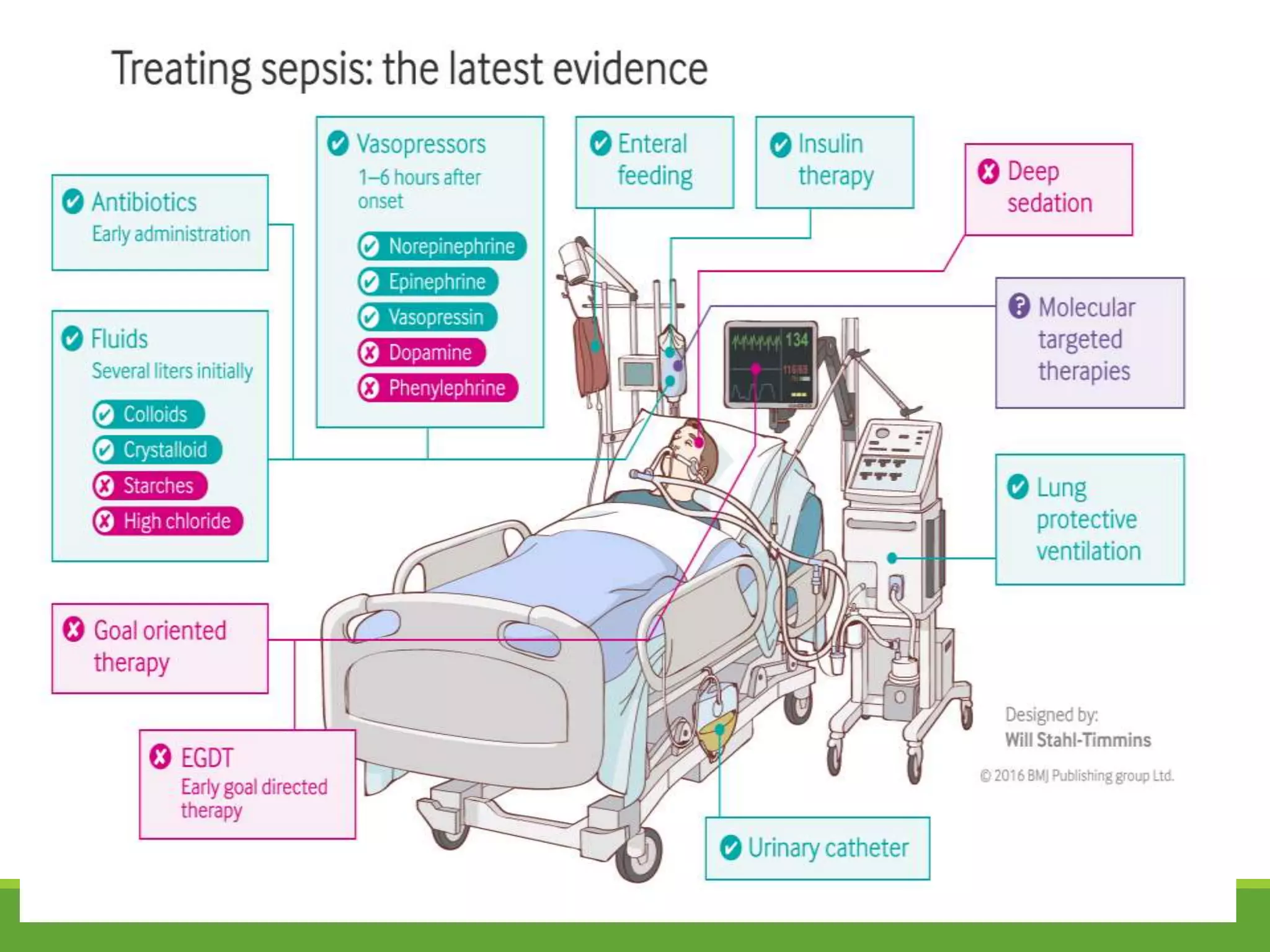
VAP
SURVEILLANCE FOR NOSOCOMIAL
INFECTION
Definition :The collection tabulation interpretation and dissemination
of data on the occurrence of nosocomial infection or other untoward
event for the purpose of their prevention and control
Purposes:
 Establish baseline rate
 Evaluate polices and procedures
 Evaluate control measures
 Our break control
 Licensing
HOSPITAL INFECTION CONTROL
COMMITTEE
•Every hospital must have an effective Hospital-acquired Infection Control
Committee.Responsible for the control of HAIs
•The membership of the hospital ICC should reflect the spectrum of clinical
services and administrative arrangements of the health care facility.
1.Chief executive, or hospital administrator or Medical superintendent (Chairperson).
2. Clinical microbiologist (Infection control officer).
3. Infection Control Nurse (ICN).
4. Infectious Diseases Physician (if available)
5. Chief of nursing services.
6. Medical record officer (if available).
7. Representative from the major clinical specialties.
8. Additionally representatives of any other department (pharmacy,maintenance,
housekeeping, etc) may be invited as necessary
HOSPITAL INFECTION CONTROL
COMMITTEE
To formulate & update policies on matters related to
 hospital infections
Review and approve surveillance and infection prevention program, emergence of
drug resistance
Use of different antimicrobial agents
Proper sterilization & disinfection procedures
To assess and promote improved practice at all levels of health facility.
To obtain and manage critical bacteriological data and information, including
surveillance data
FUNTIONS
•To ensure appropriate staff training
•Safety management
•Development of policies for the prevention and control of infection
•To develop its own infection control manual
•Monitor and evaluate the performance of program
•To recognize and investigating outbreaks of infections in the
hospital and community
FUNTIONS
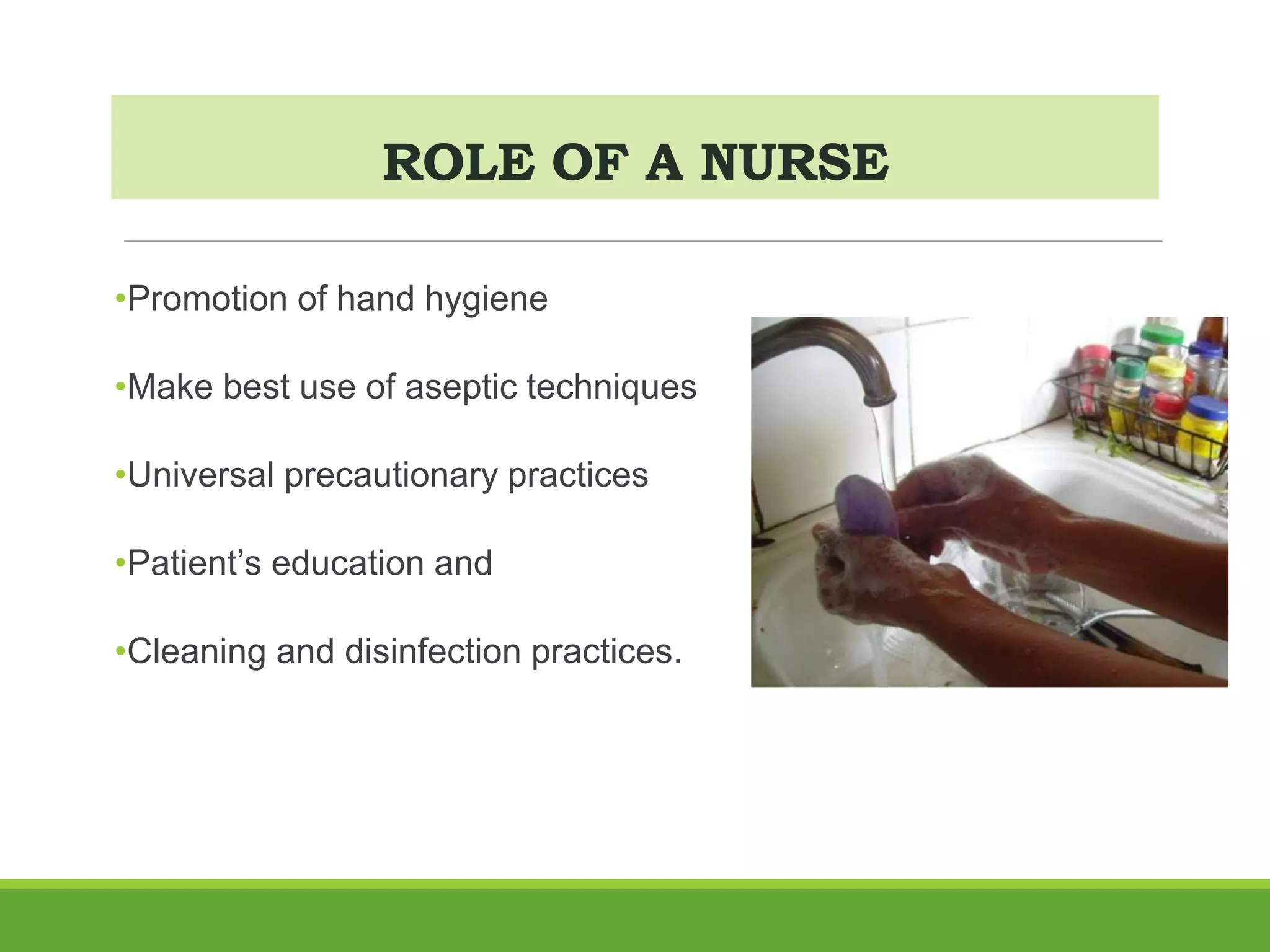
•Promotion of hand hygiene
•Make best use of aseptic techniques
•Universal precautionary practices
•Patient’s education and
•Cleaning and disinfection practices.
ROLE OF A NURSE
•CDC guidelines for infection control in hospital personnel. American
Journal of Infection Control, 2015, 26:289–354
•Prevention of Hospital-Acquired Infections: A Practical Guide. 2nd
Edition. World Health Organization;
•http://www.who.int/csr/resources/publications/whocdscsreph20021
2.pdf
•Guideline for prevention of nosocomial pneumonia. Centers for
Disease Control and Prevention, Respir Care 2014; 39:1191.
•Eggimann P and Pittet D. Infection Control in the ICU. Chest.
2001;120:2059-2093.
REFERENCES

Infection control in critical care units

  • 1.
    INFECTION CONTROL IN CRITICAL CAREUNIT Mrs. Keerthi Samuel Asst.Professor Vijay Marie CON
  • 2.
    INTRODUCTION  The intensivecare unit (ICU) of the hospital has always been where the most vulnerable patients are kept, so they can be closely monitored and treated, often with a one-to-one ratio of nurse to patient, for the most scrupulous of care.  Nosocomial infection comes from Greek work “nosus” meaning disease and “ komeion ” meaning “to take care” also called as “hospital acquired infection”.
  • 3.
    DEFINITION  An infectionthat occurs in a patient as a result of care at any type of health care facility and was not present at the time of arrival to the hospital. Infections are considered nosocomial if they first appear 48hrs or more after hospital admission or within 30 days after discharge.
  • 4.
    • Nosocomial infectionsaccounts for 7% in developed and 10% in developing countries.Hospital waste serves as potential source of pathogens and about 20%–25% of hospital waste is termed as hazardous. •The nosocomial infection was seen more in the 40-60 year of age. The male were more prone to nosocomial infections than the female. •Infection rate is upto 5% to 10% but may be up to 28% in ICU •UTI - 28%,Surgical site infection – 19%,Pneumonia – 17%,Blood steam infection – 7% to 10% INCIDENCE
  • 5.
    ENDOGENOUS •Patient own floramay invade patient tissue during some surgical operation or instrument manipulation •Normal commensalism of the skin respiratory , urinary track EXOGENOUS •From another patient , staff members environment in the hospital •Environmental sources are air, water, food •Cross infection SOURCES OF INFECTION
  • 6.
    • Gram negative(pseudomonas aeruginosa, salmonella, entero bacteriaceae) Gram positive bacteria (staphylococcus, streptococcus,Micrococus BACTERIA • Hepatitis B, HIV, Cytomegalo virus, herpes virus,Respiratory syncytial virus VIRUS • Candida albicans, Aspergillus,Saprophytic fungi FUNGI • plasmodia, pneumocystitis carini PROTOZOA CAUSATIVE ORGANISMS OF INFECTION
  • 7.
    Lack of handwashing Patient close together or sharing room understaffing Preparation of iv on the unit Lack of isolation facilities in separation of clean Inadequate cleaning of environment RISK FACTORS
  • 8.
    Ventilator-associated pneumonia Staphylococcus aureus Methicillinresistant Staphylococcus aureus Candida albicans Pseudomonas aeruginosa Acinetobacter baumannii Stenotrophomonas maltophilia Clostridium difficile COMMON NOSOCHOMIAL INFECTIONS Tuberculosis Urinary tract infection Hospital-acquired pneumonia Gastroenteritis Vancomycin-resistant Enterococcus Legionnaires’ disease.
  • 9.
  • 10.
    Contact Airborne Oral route Parenteral route  Contact: Hand or clothing (staphylococcus aureus, streptococcus )  Instrument : endoscope, bronchoscope, (pseudomonas aeruginosa)  Airborne : droplets of respiratory infection transmitted by inhalation, dust beding, floors, wound exudates & skin (pseudomonas aeruginosa, staphylococcus aureus)  Aerosols : nebulizers humidifers & AC ( pneumophilia) MODE OF TRANSMISSION
  • 11.
    Contact Airborne Oral route Parenteral route  Oralroute : Hospital food may contain antibiotic resistant bacteria may colonize intestine can cause infection  Parenteral route: Disposal syringes & needles , blood transfusion ( hepatitis B, HIV) MODE OF TRANSMISSION
  • 12.
    •Avoid surgical siteinfection •An isolation unit for a patient infected by an infectious disease •Sterilization of medical equipment •Validation and cleaning of hospitals environment PREVENTION
  • 13.
    PPE used inhealthcare includes ◦ gloves, aprons, long sleeved gowns, goggles, fluid- repellant surgical masks, face visors and respirator masks. PPE
  • 14.
    •Prevention and implementationof infection control policies •Supervision of state of professional care with regard to infections •Surveillance of nosocomial infection •Analyze, interpret and disseminate data arising out of surveillance and to recommend remedial measures and ensure follow up action •Develop an antibiotic policy, •To discuss infection control related audit findings and identify solutions to issues INFECTION CONTROL PROGRAMME
  • 15.
    •Formulate policies &protocols on the methods of sterilization and disinfection •Employee health program •Conduct in house orientation program •Guidelines for segregation and disposal of hospital waste •Conduct meeting every month (2nd Wednesday of every month) INFECTION CONTROL PROGRAMME
  • 16.
    Follow hand washingprotocol Follow biomedical waste management Attend HICC related class Follow aseptic techniques while doing procedures Follow care bundle protocols to prevent nosocomial infections ROLE OF A NURSE
  • 18.
  • 19.
  • 20.
  • 21.
  • 26.
  • 27.
    SURVEILLANCE FOR NOSOCOMIAL INFECTION Definition:The collection tabulation interpretation and dissemination of data on the occurrence of nosocomial infection or other untoward event for the purpose of their prevention and control Purposes:  Establish baseline rate  Evaluate polices and procedures  Evaluate control measures  Our break control  Licensing
  • 28.
    HOSPITAL INFECTION CONTROL COMMITTEE •Everyhospital must have an effective Hospital-acquired Infection Control Committee.Responsible for the control of HAIs •The membership of the hospital ICC should reflect the spectrum of clinical services and administrative arrangements of the health care facility.
  • 29.
    1.Chief executive, orhospital administrator or Medical superintendent (Chairperson). 2. Clinical microbiologist (Infection control officer). 3. Infection Control Nurse (ICN). 4. Infectious Diseases Physician (if available) 5. Chief of nursing services. 6. Medical record officer (if available). 7. Representative from the major clinical specialties. 8. Additionally representatives of any other department (pharmacy,maintenance, housekeeping, etc) may be invited as necessary HOSPITAL INFECTION CONTROL COMMITTEE
  • 30.
    To formulate &update policies on matters related to  hospital infections Review and approve surveillance and infection prevention program, emergence of drug resistance Use of different antimicrobial agents Proper sterilization & disinfection procedures To assess and promote improved practice at all levels of health facility. To obtain and manage critical bacteriological data and information, including surveillance data FUNTIONS
  • 31.
    •To ensure appropriatestaff training •Safety management •Development of policies for the prevention and control of infection •To develop its own infection control manual •Monitor and evaluate the performance of program •To recognize and investigating outbreaks of infections in the hospital and community FUNTIONS
  • 32.
    •Promotion of handhygiene •Make best use of aseptic techniques •Universal precautionary practices •Patient’s education and •Cleaning and disinfection practices. ROLE OF A NURSE
  • 33.
    •CDC guidelines forinfection control in hospital personnel. American Journal of Infection Control, 2015, 26:289–354 •Prevention of Hospital-Acquired Infections: A Practical Guide. 2nd Edition. World Health Organization; •http://www.who.int/csr/resources/publications/whocdscsreph20021 2.pdf •Guideline for prevention of nosocomial pneumonia. Centers for Disease Control and Prevention, Respir Care 2014; 39:1191. •Eggimann P and Pittet D. Infection Control in the ICU. Chest. 2001;120:2059-2093. REFERENCES