Asthma
고려대학교 안암병원 이은
주
2016.6.7
Definition-1
 Heterogeneous dz, characterized by chronic airway
inflammation
 Dx : characteristic Sx
(wheeze, shortness of breath, chest tightness, cough
worse at night or in the early morning
triggered by infection, exercise, allergen, weather…)
+
variable airflow limitation
(bronchodilator reversibility test, hyperresponsiveness test..)
Definition-2
 Asthma phenotypes
Allergic asthma: childhood, PHx/FHx(+) of allergic dz,
eosinophilic inflammation in sputum,
well response to ICH
Non-allergic asthma: adult, less well to ICS
Late-onset asthm: women, adult, often require higher doses of ICS
relatively refractory steroid
Asthma with fixed airflow limitation: long-standing, d/t
remodeling
Asthma with obesity: prominent Sx, little eosinophilic
inflammtaion
Diagnosis-1
Confirmed variable expiratory airflow limitation
*Documented excessive variability in
lung function AND airflow limitation
(* 아래의 test 중 하나 이상에서 증
명 )
The greater the variations, the more confident the Dx
At least once, when FEV1 is low, confirm that FEV1/FVC is
reduced (normally >0.75-0.8)
BDR(+) Increase in FEV1 >12% & 200ml
(after 200-400mcg albuterol)
Excessive variability in twice-daily
PEF over 2 weeks
Average daily diurnal PEF variabilitity >10%
Significant increase in lung function
after 4 weeks of anti-inflammatory Tx
Increase in FEV1 >12% & 200ml from 4 weeks of Tx
(PEF > 20%)
Exercise challenge test(+) Fall in FEV1 >10% & 200ml from baseline
Bronchial challenge test(+) Fall in FEV1 >20% (metacholine or histamine)
Fall in FEV1 >15% (hyperventilation, hypertonic saline, or
mannitol)
Excessive variation in lung function
between visits(less reliable)
Variation in FEV1 >12% & 200ml between visits
Diagnosis – 2
 Reversibility : improvement of FEV1(or PEF) after bronchodilator
or controller (ICS..)
≥ 12% & 200mL
 Variability : Sx / lung function 의 improvement / deterioration
예 > diurnal variability
Diagnosis -3
 Peak expiratory flow (PEF)
diurnal PEF variability =
(1-2 주간의 평균 )
≥ 10% 시 Dx 에 도움
( 밤 PEF)- ( 아침 PEF)
{( 밤 PEF)+ ( 아침 PEF)} /2
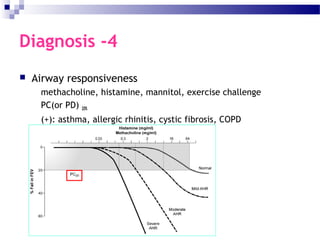
Diagnosis -4
 Airway responsiveness
methacholine, histamine, mannitol, exercise challenge
PC(or PD) 20%
(+): asthma, allergic rhinitis, cystic fibrosis, COPD
Diagnosis -5
 Allergic status
: strong association between asthma & allergic dz
skin test, specific IgE in serum (not total)
skin-prick test
: 팽진≥ 3mm
&
발적 ≥ 10mm
Differential Diagnosis
 Vocal cord dysfunction
 Hyperventilation, dysfunctional breathing
 COPD
 Bronchiectasis
 Cardiac failure
 Medication related cough
 Parenchymal lung dz, pulmonary embolism..
Classification
Characteristic
Controlled
(All of the following)
Partly controlled
(Any present in any week)
Uncontrolled
Daytime symptoms None (2 or less / week)
More than
twice / week
3 or more
features of partly
controlled asthma
present in any
week
Limitations of activities None Any
Nocturnal symptoms /
awakening
None Any
Need for reliever / rescue
treatment
None (2 or less / week)
More than
twice / week
Lung function
(PEF or FEV1)
Normal
< 80% predicted or personal
best (if known)
Assessment-1(Sx control)
Asthma Control Test(ACT)
Assessment-2(Future risk)
Risk factors for poor asthma outcomes
Potentially modifiable independent risk factors for flare-ups (exacerbations)
uncontrolled asthma Sx
High SABA use ( increased mortality if > 1x 200-dose canister/month)
Inadequate ICS: not prescribed ICS : poor adherence : incorrect inhaler technique
Low FEV1 (<60%)
Major psychological or socioeconomic problems
Exposures: smoking, allergen
Comorbidities : obesity, rhinosinusitis, confirmed food allergy
Sputum / blood eosinophilia
Pregnancy
Other major independent risk factors for flare-ups (exacerbations)
Ever intubated or in intensive care unit for asthma
≥ 1 severe exacerbation in last 12 months
Risk factors for developing fixed airflow limitation
Lack of ICS Tx
Exposures: smoke; noxious chemicals; occupational exposures
Low initial FEV1 ; chronic mucus hypersecretion; sputum or blood eosinophilia
Risk factors for medication side-effects
Systemic : frequent OCS; long-term, high dose/potent ICS; also taking P450 inhibitors
Local: high-dose / potent ICS; poor inhaler technique
Medication - Controller MedicationsController Medications
 Inhaled / systemic glucocorticosteroids (ICS)
 Leukotriene modifiers
 Long-acting inhaled / oral β2-agonists (LABA)
 Theophylline ( sustained-release)
 Anti-IgE
Medication - Reliever MedicationsReliever Medications
 Rapid-acting inhaled β2-agonists
 Inhaled anticholinergics
 Systemic glucocorticosteroids
 Theophylline (short-acting)
 Short-acting oral β2-agonists
Control-based asthma Mx
Sx
Exacerbations
Side-effects
Pt satisfaction
Lung function
Dx
Sx control & risk factors
(including lung function)
Inhaler technique &
adherence
Pt preference
Asthma medications
Non-pharmacological strategies
Tx modifiable risk factors
Stepwise approach-1
Step 1 Step 2 Step 3 Step 4 Step 5
Preferred
controller
choice
Low dose ICS Lose dose
ICS/LABA
Med/high
ICS/LABA
Refer for
add-on Tx
e.g.
tiotropium,
omalizumab,
mepolizumab
Other
controller
options
Consider low
dose ICS
LTRA
Low dose
theophylline
Med/high
dose ICS
Low dose
ICS+LTRA
(or + theoph)
Add
tiotropium
High dose
ICS+LTRA
(or + theoph)
Add low dose
OCS
Reliever As-needed SABA As-needed SABA or low dose ICS/formoterol
Stepwise approach-2
 3 개월 이상 Sx, PFT 가 안정적이면 stepdown 고려
- ICS dose 를 25-50% 정도를 3 개월 이상 간격으로 줄임
 만약 6-12 개월간 증상이 없고 , risk factor 가 없다면
controller 를 중단 고려 .
하지만 ICS 의 complete cessation 은 exacerbation 이
증가한다는 보고가 많아 권하지 않음 .
Manage asthma exacerbations
 Repetitive administration of rapid-acting inhaled
bronchodilators
 Early introduction of systemic glucocorticosteroid
 Oxygen supplement
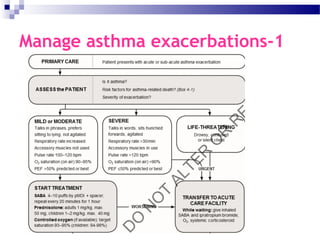
Manage asthma exacerbations-1
Manage asthma exacerbations-2
Manage asthma exacerbations-4
 Oxygen : target 93-95%
 SABA : 4-10 puffs q 20min for 1 hr
 4-10 puffs q 3-4 hrs ~ 6-10 puffs q 1-2hrs (primary care)
nebulizer 일때는 초기엔 continuous  이후엔 prn 으로
(adm 시 )
 Epinephrine: only anaphylaxis, angioedema
 Systemic steroid : prednisolone 1mg/kg(max 50mg) for 5-7 days
1 시간 이내로 투여  효과 보는데 4 시간은 걸려
oral = IV
 Ipratropium bromide (atrovent): addictive bronchodilation
 항생제는 routine 으로 주지 말 것 !!
Manage asthma exacerbations
 Magnesium : MgSO4 2g/IV (20 분간 ) single dose
FEV1 25-30% at presentation
pt who fail to response to initial Tx
 재원 기간 줄임
 Leukotriene modifiers : little data to suggest a role in acute
asthma
 Sedative : avoided during exacerbation
Drug side effects
 β2-agonists : muscle tremor, palpitation, K 저하
 Anticholinergics: dry mouth, urinary retension, glaucoma
 Theophylline : N/V, headache, diuresis, palpitation, arrhythmia,
seizures, death…
 Steroid: hoarseness, oral candidiasis,
truncal obesity, bruising, osteoporosis, DM, HTN,
gastric ulcer, proximal myopathy, depression, cataracts
Special consideration - Pregnancy
 Severity : 1/3 은 호전 , 1/3 은 악화 , 1/3 은 unchanged
 AE 가 중기에 흔함 .
 분만 도중 AE 가 흔하지는 않지만 , hyperventilation 에 의해
bronchoconstriction 발생 가능
 SABA 로 조절 가능
BA 를 많이 사용시 baby 에서 HypoG 가능
(24 시간 monitoring 요망 )
 Tx: theophylline, ICS, BA, leukotriene modifier(montelukast)
 Exacerbation : to avoid fetal hypoxia
rapid-acting BA, O2, systemic steroid
Medications

Ventolin / Atrovent (MDI)
Foster (MDI)Seretide (Diskus, MDI) Symbicort (Turbuhaler)
Oral steroid/ theophylline
Oral long acting β2-agonist
Leukotriene modifiers
기 타
27
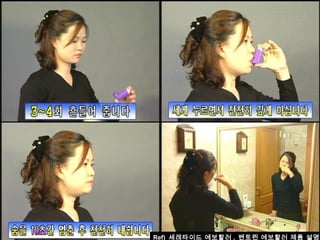
Ref) 세레타이드 에보할러 , 벤토린 에보할러 제품 설명서
Spacer
29
※ 사용법은 보조흡입기의 종류에 따라 다를 수 있으며 , 정확한 사항은 보조흡입기 사용법을 참고해주십시오 .
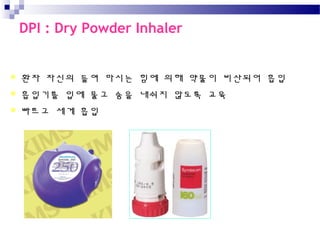
 환자 자신의 들여 마시는 힘에 의해 약물이 비산되어 흡입
 흡입기를 입에 물고 숨을 내쉬지 않도록 교육
 빠르고 세게 흡입
터부헬러 (Turbuhaler)디스커스 (DisKus)
DPI : Dry Powder Inhaler
31
숨을 끝까지 내쉰다 . 한번에 강하고 깊게 들이 마신다 .
5~10 초간 숨을 참은 후 코로 숨을 천천히 내쉰다
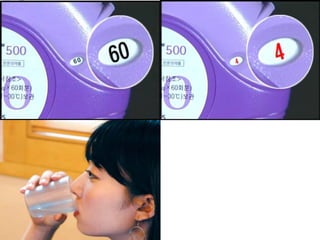
손잡이를 돌려 한번에 닫는다 .
물로 입안을 깨끗이 헹군다 .
Ref) 세레타이드 디스커스 제품 설명서
Cases
Case 1
 M/ 38
 CC: dyspnea, wheezing (onset: 3 일전 )
 PI : 약 10 일 전부터 cough, rhinorrhea 있어 오다가
내원 3 일 전부터 dyspnea, wheezing 발생하여 내원
 Never smoker
 PHx : DM/HTN/TBc/Hepatitis(-/-/-/-)
Allergic rhinitis(+)
 PEx; whole lung wheezing(+)
Case 2
 M/ 51
 CC: cough (onset: 3 달 전부터 )
 PI : 특이 병력 없는 never smoker 남자로
3 개월 전부터 dry cough 지속되어 내원
 PHx : DM/HTN/TBc/Hepatitis(-/-/-/-)
 PEx: SBS without c/w
CXR 및 PNS
Esophageal 24hr pH monitoring
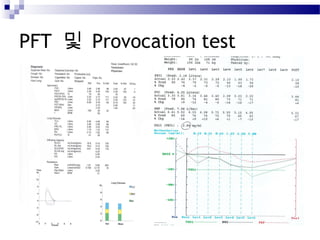
PFT 및 Provocation test

(마더리스크라운드) 임신 중 천식

  • 1.
  • 2.
    Definition-1  Heterogeneous dz,characterized by chronic airway inflammation  Dx : characteristic Sx (wheeze, shortness of breath, chest tightness, cough worse at night or in the early morning triggered by infection, exercise, allergen, weather…) + variable airflow limitation (bronchodilator reversibility test, hyperresponsiveness test..)
  • 3.
    Definition-2  Asthma phenotypes Allergicasthma: childhood, PHx/FHx(+) of allergic dz, eosinophilic inflammation in sputum, well response to ICH Non-allergic asthma: adult, less well to ICS Late-onset asthm: women, adult, often require higher doses of ICS relatively refractory steroid Asthma with fixed airflow limitation: long-standing, d/t remodeling Asthma with obesity: prominent Sx, little eosinophilic inflammtaion
  • 4.
    Diagnosis-1 Confirmed variable expiratoryairflow limitation *Documented excessive variability in lung function AND airflow limitation (* 아래의 test 중 하나 이상에서 증 명 ) The greater the variations, the more confident the Dx At least once, when FEV1 is low, confirm that FEV1/FVC is reduced (normally >0.75-0.8) BDR(+) Increase in FEV1 >12% & 200ml (after 200-400mcg albuterol) Excessive variability in twice-daily PEF over 2 weeks Average daily diurnal PEF variabilitity >10% Significant increase in lung function after 4 weeks of anti-inflammatory Tx Increase in FEV1 >12% & 200ml from 4 weeks of Tx (PEF > 20%) Exercise challenge test(+) Fall in FEV1 >10% & 200ml from baseline Bronchial challenge test(+) Fall in FEV1 >20% (metacholine or histamine) Fall in FEV1 >15% (hyperventilation, hypertonic saline, or mannitol) Excessive variation in lung function between visits(less reliable) Variation in FEV1 >12% & 200ml between visits
  • 5.
    Diagnosis – 2 Reversibility : improvement of FEV1(or PEF) after bronchodilator or controller (ICS..) ≥ 12% & 200mL  Variability : Sx / lung function 의 improvement / deterioration 예 > diurnal variability
  • 6.
    Diagnosis -3  Peakexpiratory flow (PEF) diurnal PEF variability = (1-2 주간의 평균 ) ≥ 10% 시 Dx 에 도움 ( 밤 PEF)- ( 아침 PEF) {( 밤 PEF)+ ( 아침 PEF)} /2
  • 7.
    Diagnosis -4  Airwayresponsiveness methacholine, histamine, mannitol, exercise challenge PC(or PD) 20% (+): asthma, allergic rhinitis, cystic fibrosis, COPD
  • 8.
    Diagnosis -5  Allergicstatus : strong association between asthma & allergic dz skin test, specific IgE in serum (not total) skin-prick test : 팽진≥ 3mm & 발적 ≥ 10mm
  • 9.
    Differential Diagnosis  Vocalcord dysfunction  Hyperventilation, dysfunctional breathing  COPD  Bronchiectasis  Cardiac failure  Medication related cough  Parenchymal lung dz, pulmonary embolism..
  • 10.
    Classification Characteristic Controlled (All of thefollowing) Partly controlled (Any present in any week) Uncontrolled Daytime symptoms None (2 or less / week) More than twice / week 3 or more features of partly controlled asthma present in any week Limitations of activities None Any Nocturnal symptoms / awakening None Any Need for reliever / rescue treatment None (2 or less / week) More than twice / week Lung function (PEF or FEV1) Normal < 80% predicted or personal best (if known)
  • 11.
  • 12.
  • 13.
    Assessment-2(Future risk) Risk factorsfor poor asthma outcomes Potentially modifiable independent risk factors for flare-ups (exacerbations) uncontrolled asthma Sx High SABA use ( increased mortality if > 1x 200-dose canister/month) Inadequate ICS: not prescribed ICS : poor adherence : incorrect inhaler technique Low FEV1 (<60%) Major psychological or socioeconomic problems Exposures: smoking, allergen Comorbidities : obesity, rhinosinusitis, confirmed food allergy Sputum / blood eosinophilia Pregnancy Other major independent risk factors for flare-ups (exacerbations) Ever intubated or in intensive care unit for asthma ≥ 1 severe exacerbation in last 12 months Risk factors for developing fixed airflow limitation Lack of ICS Tx Exposures: smoke; noxious chemicals; occupational exposures Low initial FEV1 ; chronic mucus hypersecretion; sputum or blood eosinophilia Risk factors for medication side-effects Systemic : frequent OCS; long-term, high dose/potent ICS; also taking P450 inhibitors Local: high-dose / potent ICS; poor inhaler technique
  • 14.
    Medication - ControllerMedicationsController Medications  Inhaled / systemic glucocorticosteroids (ICS)  Leukotriene modifiers  Long-acting inhaled / oral β2-agonists (LABA)  Theophylline ( sustained-release)  Anti-IgE
  • 15.
    Medication - RelieverMedicationsReliever Medications  Rapid-acting inhaled β2-agonists  Inhaled anticholinergics  Systemic glucocorticosteroids  Theophylline (short-acting)  Short-acting oral β2-agonists
  • 16.
    Control-based asthma Mx Sx Exacerbations Side-effects Ptsatisfaction Lung function Dx Sx control & risk factors (including lung function) Inhaler technique & adherence Pt preference Asthma medications Non-pharmacological strategies Tx modifiable risk factors
  • 17.
    Stepwise approach-1 Step 1Step 2 Step 3 Step 4 Step 5 Preferred controller choice Low dose ICS Lose dose ICS/LABA Med/high ICS/LABA Refer for add-on Tx e.g. tiotropium, omalizumab, mepolizumab Other controller options Consider low dose ICS LTRA Low dose theophylline Med/high dose ICS Low dose ICS+LTRA (or + theoph) Add tiotropium High dose ICS+LTRA (or + theoph) Add low dose OCS Reliever As-needed SABA As-needed SABA or low dose ICS/formoterol
  • 18.
    Stepwise approach-2  3개월 이상 Sx, PFT 가 안정적이면 stepdown 고려 - ICS dose 를 25-50% 정도를 3 개월 이상 간격으로 줄임  만약 6-12 개월간 증상이 없고 , risk factor 가 없다면 controller 를 중단 고려 . 하지만 ICS 의 complete cessation 은 exacerbation 이 증가한다는 보고가 많아 권하지 않음 .
  • 19.
    Manage asthma exacerbations Repetitive administration of rapid-acting inhaled bronchodilators  Early introduction of systemic glucocorticosteroid  Oxygen supplement
  • 20.
  • 21.
  • 22.
    Manage asthma exacerbations-4 Oxygen : target 93-95%  SABA : 4-10 puffs q 20min for 1 hr  4-10 puffs q 3-4 hrs ~ 6-10 puffs q 1-2hrs (primary care) nebulizer 일때는 초기엔 continuous  이후엔 prn 으로 (adm 시 )  Epinephrine: only anaphylaxis, angioedema  Systemic steroid : prednisolone 1mg/kg(max 50mg) for 5-7 days 1 시간 이내로 투여  효과 보는데 4 시간은 걸려 oral = IV  Ipratropium bromide (atrovent): addictive bronchodilation  항생제는 routine 으로 주지 말 것 !!
  • 23.
    Manage asthma exacerbations Magnesium : MgSO4 2g/IV (20 분간 ) single dose FEV1 25-30% at presentation pt who fail to response to initial Tx  재원 기간 줄임  Leukotriene modifiers : little data to suggest a role in acute asthma  Sedative : avoided during exacerbation
  • 24.
    Drug side effects β2-agonists : muscle tremor, palpitation, K 저하  Anticholinergics: dry mouth, urinary retension, glaucoma  Theophylline : N/V, headache, diuresis, palpitation, arrhythmia, seizures, death…  Steroid: hoarseness, oral candidiasis, truncal obesity, bruising, osteoporosis, DM, HTN, gastric ulcer, proximal myopathy, depression, cataracts
  • 25.
    Special consideration -Pregnancy  Severity : 1/3 은 호전 , 1/3 은 악화 , 1/3 은 unchanged  AE 가 중기에 흔함 .  분만 도중 AE 가 흔하지는 않지만 , hyperventilation 에 의해 bronchoconstriction 발생 가능  SABA 로 조절 가능 BA 를 많이 사용시 baby 에서 HypoG 가능 (24 시간 monitoring 요망 )  Tx: theophylline, ICS, BA, leukotriene modifier(montelukast)  Exacerbation : to avoid fetal hypoxia rapid-acting BA, O2, systemic steroid
  • 26.
    Medications  Ventolin / Atrovent(MDI) Foster (MDI)Seretide (Diskus, MDI) Symbicort (Turbuhaler) Oral steroid/ theophylline Oral long acting β2-agonist Leukotriene modifiers 기 타
  • 27.
    27 Ref) 세레타이드 에보할러, 벤토린 에보할러 제품 설명서
  • 28.
  • 29.
    29 ※ 사용법은 보조흡입기의종류에 따라 다를 수 있으며 , 정확한 사항은 보조흡입기 사용법을 참고해주십시오 .
  • 30.
     환자 자신의들여 마시는 힘에 의해 약물이 비산되어 흡입  흡입기를 입에 물고 숨을 내쉬지 않도록 교육  빠르고 세게 흡입 터부헬러 (Turbuhaler)디스커스 (DisKus) DPI : Dry Powder Inhaler
  • 31.
    31 숨을 끝까지 내쉰다. 한번에 강하고 깊게 들이 마신다 . 5~10 초간 숨을 참은 후 코로 숨을 천천히 내쉰다 손잡이를 돌려 한번에 닫는다 .
  • 32.
    물로 입안을 깨끗이헹군다 . Ref) 세레타이드 디스커스 제품 설명서
  • 33.
  • 34.
    Case 1  M/38  CC: dyspnea, wheezing (onset: 3 일전 )  PI : 약 10 일 전부터 cough, rhinorrhea 있어 오다가 내원 3 일 전부터 dyspnea, wheezing 발생하여 내원  Never smoker  PHx : DM/HTN/TBc/Hepatitis(-/-/-/-) Allergic rhinitis(+)  PEx; whole lung wheezing(+)
  • 36.
    Case 2  M/51  CC: cough (onset: 3 달 전부터 )  PI : 특이 병력 없는 never smoker 남자로 3 개월 전부터 dry cough 지속되어 내원  PHx : DM/HTN/TBc/Hepatitis(-/-/-/-)  PEx: SBS without c/w
  • 37.
  • 38.
  • 39.

Editor's Notes

  • #4 Allergic: most easily recognized Non-allergic: sputum이 neutrophil, eosino, pausigranulocytic 가능
  • #5 SABA:4시간, LABA: 15시간 이상 중단 후 BDR+ 만약 매일 diurnal PEF variability는 (차이)/평균 %를 일-2주간 측정하여 평균을 냄. (다른 PEF 기계에 의해 20%까지 차이 남)
  • #14 Systemic s/e: easy bruising, osteoporosis, cataract, adrenal supression Local s/e: oral th
  • #15 Regular 사용, airway inflammation 억제, Sx control, AE 줄이고, lung function 감소 줄이고
  • #16 증상 악화시 사용
  • #17 2-3개월 간격으로 평가하여 step up/down 가능 비약물적 치료: 비만이면 살빼고, 직업 혹은 allergen 관련이면 피하고.. 가난하면 덜 비싼약 주고, 예방접종해주고,
  • #18 2-3개월 간격으로 평가하여 step up/down 가능. 하지만 ICS를 중단하지는 말아라 Foster/ symbicort 모두 formoterol로 reliever로 가능- step 4에선 low dose로 maintenance와 reliever 모두. 유지용량 올려도 돼. High dose ICS는 3-6개월 정도 Try만 Omalizumab; Anti IgE Mepolizumab: anti IL-5
  • #20 환자에게는 Flare-up이라는 표현이 더 적당
  • #23 Phylline 계통은 주지 마라, should not be used – poor efficacy and safety profile