ICU Care Bundle Practices
Dr. Jayaprakash Appajigol
Associate Professor of Medicine, JNMC, Belgaum.
Consultant Physician KLE’s Dr. Prabhakar Kore Hospital and MRC,
Belgaum.
Bundles, According to the IHI
A "bundle" is a
group of evidence-based care components
for a given disease that, when executed
together, may result in better outcomes than
if implemented individually.
Institute for Health Care Improvement (IHI)
• In a bundle, the individual elements are built
around best evidence-based practices.
• The science supporting the individual
treatment strategies in a bundle is sufficiently
mature such that implementation of the
approach should be considered either best
practice or a reasonable and generally
accepted practice.
Bundles, According to the IHI
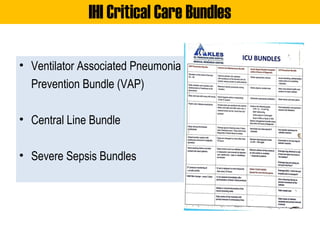
• Ventilator Associated Pneumonia
Prevention Bundle (VAP)
• Central Line Bundle
• Severe Sepsis Bundles
IHI Critical Care Bundles
VAP BUNDLE
http://www.ihi.org/IHI/Topics/CriticalCare/IntensiveCare/Changes/ImplementtheVentilatorBundle.htm
–DVT prophylaxis
–GI prophylaxis
–Head of bed (HOB) elevated to 30-45°
–Daily Sedation Vacation
–Daily Spontaneous Breathing Trial
connected
Ventilator-Associated Pneumonia (VAP)Bundle
DVT prophylaxis: tips
• Include deep venous prophylaxis as part of your ICU order
admission set and ventilator order set. Make application of
prophylaxis the default value on the form.
• Include deep venous prophylaxis as an item for discussion
on daily multidisciplinary rounds.
• Empower pharmacy to review orders for patients in the ICU
to ensure that some form of deep venous prophylaxis is in
place at all times on ICU patients.
• Post compliance with the intervention in a prominent place
in your ICU to encourage change and motivate staff.
Ventilator-Associated Pneumonia (VAP)Bundle
GI prophylaxis: tips
• Include peptic ulcer disease prophylaxis as part of your ICU
order admission set and ventilator order set. Make
application of prophylaxis the default value on the form.
• Include peptic ulcer disease prophylaxis as an item for
discussion on daily multidisciplinary rounds.
• Empower pharmacy to review orders for patients in the ICU
to ensure that some form of peptic ulcer disease
prophylaxis is in place at all times on ICU patients.
• Post compliance with the intervention in a prominent place
in your ICU to encourage change and motivate staff.
Ventilator-Associated Pneumonia (VAP)Bundle
Head of Bed elevation: tips I
• Implement a mechanism to ensure head-of-the-bed elevation,
such as including this intervention on nursing flow sheets and
as a topic at multidisciplinary rounds.
• Create an environment where respiratory therapists work
collaboratively with nursing to maintain head-of-the-bed
elevation.
• Involve families in the process by educating them about the
importance of head-of-the-bed elevation and encourage them
to notify clinical personnel when the bed does not appear to be
in the proper position.
Ventilator-Associated Pneumonia (VAP)Bundle
Head of Bed elevation: tips II
• Use visual cues so it is easy to identify when the bed is in
the proper position, such as a line on the wall that can only
be seen if the bed is below a 30-degree angle.
• Include this intervention on order sets for initiation and
weaning of mechanical ventilation, delivery of tube
feedings, and provision of oral care.
• Post compliance with the intervention in a prominent place
in your ICU to encourage change and motivate staff.
Ventilator-Associated Pneumonia (VAP)Bundle
Daily sedation vacation/ Spontaneous Breathing Trials: tips I
• Implement a protocol to lighten sedation daily at an appropriate
time to assess for neurological readiness to extubate.
• Include precautions to prevent self-extubation such as increased
monitoring and vigilance during the trial.
• Include a sedation vacation strategy in your overall plan to wean
the patient from the ventilator
• if you have a weaning protocol, add "sedation vacation" to that
strategy.
Ventilator-Associated Pneumonia (VAP)Bundle
Daily sedation vacation/ Spontaneous Breathing Trials: tips
II
• Assess that compliance is occurring each day on
multidisciplinary rounds.
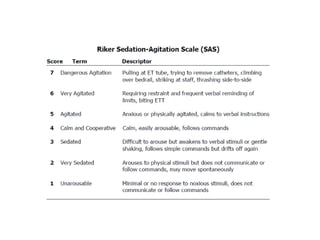
• Consider implementation of a sedation scale such as the
Riker scale to avoid oversedation.
• Post compliance with the intervention in a prominent place in
your ICU to encourage change and motivate staff.
Ventilator-Associated Pneumonia (VAP)Bundle
Central Line BUNDLE
http://www.ihi.org/IHI/Topics/CriticalCare/IntensiveCare/Changes/ImplementtheCentralLineBundle.htm
– Hand Hygiene
– Maximal Barrier Precautions Upon Insertion
– Chlorhexidine Skin Antisepsis
– Optimal Catheter Site Selection, with Avoidance of the
Femoral Vein for Central Venous Access in Adult
Patients
– Daily Review of Line Necessity with Prompt Removal of
Unnecessary Lines
Central line bundle
Hand Hygiene: tips I
• Empower nursing to enforce use of a central line checklist to be
sure all processes related to central line placement are executed
for each line placement.
• Include hand hygiene as part of your checklist for central line
placement.
• Keep soap/alcohol-based hand washing dispensers prominently
placed and make universal precautions equipment, such as
gloves, only available near hand sanitation equipment.
Central line bundle
Hand Hygiene: tips II
• Post signs at the entry and exits to the patient room as
reminders.
• Initiate a campaign using posters including photos of
celebrated hospital doctors/employees recommending hand
washing.
• Create an environment where reminding each other about hand
washing is encouraged.
• Signs often become "invisible" after just a few days. Try
to alter them weekly or monthly (color, shape size).
Central line bundle
Maximal Barrier Precautions Upon Insertion: tips
• Empower nursing to enforce use of a central line checklist to
be sure all processes related to central line placement are
executed for each line placement.
• Include maximal barrier precautions as part of your checklist
for central line placement.
• Keep equipment ready stocked in a cart for central line
placement to avoid the difficulty of finding necessary
equipment to institute maximal barrier precautions.
Central line bundle
Chlorhexidine skin antisepsis: tips
• Empower nursing to enforce use of a central line checklist to
be sure all processes related to central line placement are
executed for each line placement.
• Include Chlorhexidine antisepsis as part of your checklist for
central line placement.
• Include Chlorhexidine antisepsis kits in carts storing central line
equipment. Many central line kits include povidone-iodine kits
and these must be avoided.
• Ensure that solution dries completely before an attempted line
insertion.
Central line bundle
Optimal catheter site selection: tips
• Empower nursing to enforce use of a central line checklist
to be sure all processes related to central line placement
are executed for each line placement.
• Include optimal site selection as part of your checklist for
central line placement with room for appropriate
contraindications (e.g., bleeding risks).
Central line bundle
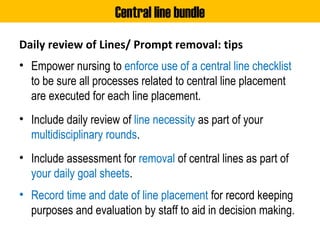
Daily review of Lines/ Prompt removal: tips
• Empower nursing to enforce use of a central line checklist
to be sure all processes related to central line placement
are executed for each line placement.
• Include daily review of line necessity as part of your
multidisciplinary rounds.
• Include assessment for removal of central lines as part of
your daily goal sheets.
• Record time and date of line placement for record keeping
purposes and evaluation by staff to aid in decision making.
Central line bundle
Severe Sepsis BUNDLES
http://www.ihi.org/IHI/Topics/CriticalCare/Sepsis/Changes/
Severe Sepsis BUNDLES
Severe Sepsis
The 3-Hour Resuscitation Bundle and
The 6-Hour Septic Shock Bundle
Severe Sepsis BUNDLES
The Severe Sepsis 3-Hour Resuscitation Bundle contains
the following elements, to be completed within 3 hours of
the time of presentation:
1.Measure Lactate Level
2. Obtain Blood Cultures Prior to Administration of Antibiotics
3. Administer Broad Spectrum Antibiotics
4. Administer 30 mL/kg Crystalloid for Hypotension or Lactate ≥4
mmol/L
Severe Sepsis BUNDLES
6-Hour Septic Shock Bundle: Evidence-based goals that
must be completed within 6 hours for patients with severe
sepsis.
1.Apply Vasopressors (for Hypotension That Does Not Respond to Initial
Fluid Resuscitation to Maintain a Mean Arterial Pressure (MAP) ≥65 mm
Hg)
2. In the Event of Persistent Arterial Hypotension Despite
Volume Resuscitation (Septic Shock) or Initial Lactate ≥4 mmol/L
a. Measure Central Venous Pressure (CVP)
b. Measure Central Venous Oxygen Saturation (ScvO2)
3. Remeasure Lactate If Initial Lactate Was Elevated
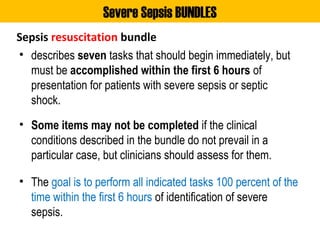
Sepsis resuscitation bundle
• describes seven tasks that should begin immediately, but
must be accomplished within the first 6 hours of
presentation for patients with severe sepsis or septic
shock.
• Some items may not be completed if the clinical
conditions described in the bundle do not prevail in a
particular case, but clinicians should assess for them.
• The goal is to perform all indicated tasks 100 percent of the
time within the first 6 hours of identification of severe
sepsis.
Severe Sepsis BUNDLES
Critical Care Bundle: Conclusions
• Listed the contents of the IHI Critical Care
bundles
– VAP
– Central Line
– Severe Sepsis
Institute for Health Care Improvement (IHI)
Care bundles originated in North America and are described
best as groups of evidence-based practice interventions
The theory behind care bundles is that when several evidence-
based interventions are grouped together in a single protocol,
it will improve patient outcome
Care bundles are relatively easy to develop, implement and
audit, and provide practitioners with a practical method for
implementing evidence-based practice
More and more data that the use of these patient-safety bundles
are associated with improved outcomes
Some clinicians disagree with the validity of the combined
content
Critical Care Bundle: Conclusions
Nevertheless, it is becoming part of standard practice for
us to document our awareness of these patient-safety
initiatives
Critical Care Bundle: Conclusions
Thank You
www.slideshare.net
Appajigol
Insertion
◦ Insert only for specific reasons
 Urinary output in critical ill
 Bladder outlet obstruction or neurogenic
bladder dysfunction
 Prevent contamination of sacral wounds
 Terminal care
◦ Competent HCW to insert
◦ Aseptic technique
◦ Closed system with bag below bladder
Urinary Catheter Care Bundle
 Management
◦ Review need for catheter daily
◦ Empty when ¾ full and use clean container for each patient
◦ Secure catheter to leg/abdomen
◦ Urine samples from sampling port only
◦ Hand hygiene & PPE before and after any catheter care
Urinary Catheter Care Bundle

ICU Care Bundles

  • 1.
    ICU Care BundlePractices Dr. Jayaprakash Appajigol Associate Professor of Medicine, JNMC, Belgaum. Consultant Physician KLE’s Dr. Prabhakar Kore Hospital and MRC, Belgaum.
  • 2.
    Bundles, According tothe IHI A "bundle" is a group of evidence-based care components for a given disease that, when executed together, may result in better outcomes than if implemented individually. Institute for Health Care Improvement (IHI)
  • 3.
    • In abundle, the individual elements are built around best evidence-based practices. • The science supporting the individual treatment strategies in a bundle is sufficiently mature such that implementation of the approach should be considered either best practice or a reasonable and generally accepted practice. Bundles, According to the IHI
  • 4.
    • Ventilator AssociatedPneumonia Prevention Bundle (VAP) • Central Line Bundle • Severe Sepsis Bundles IHI Critical Care Bundles
  • 5.
  • 6.
    –DVT prophylaxis –GI prophylaxis –Headof bed (HOB) elevated to 30-45° –Daily Sedation Vacation –Daily Spontaneous Breathing Trial connected Ventilator-Associated Pneumonia (VAP)Bundle
  • 7.
    DVT prophylaxis: tips •Include deep venous prophylaxis as part of your ICU order admission set and ventilator order set. Make application of prophylaxis the default value on the form. • Include deep venous prophylaxis as an item for discussion on daily multidisciplinary rounds. • Empower pharmacy to review orders for patients in the ICU to ensure that some form of deep venous prophylaxis is in place at all times on ICU patients. • Post compliance with the intervention in a prominent place in your ICU to encourage change and motivate staff. Ventilator-Associated Pneumonia (VAP)Bundle
  • 8.
    GI prophylaxis: tips •Include peptic ulcer disease prophylaxis as part of your ICU order admission set and ventilator order set. Make application of prophylaxis the default value on the form. • Include peptic ulcer disease prophylaxis as an item for discussion on daily multidisciplinary rounds. • Empower pharmacy to review orders for patients in the ICU to ensure that some form of peptic ulcer disease prophylaxis is in place at all times on ICU patients. • Post compliance with the intervention in a prominent place in your ICU to encourage change and motivate staff. Ventilator-Associated Pneumonia (VAP)Bundle
  • 9.
    Head of Bedelevation: tips I • Implement a mechanism to ensure head-of-the-bed elevation, such as including this intervention on nursing flow sheets and as a topic at multidisciplinary rounds. • Create an environment where respiratory therapists work collaboratively with nursing to maintain head-of-the-bed elevation. • Involve families in the process by educating them about the importance of head-of-the-bed elevation and encourage them to notify clinical personnel when the bed does not appear to be in the proper position. Ventilator-Associated Pneumonia (VAP)Bundle
  • 10.
    Head of Bedelevation: tips II • Use visual cues so it is easy to identify when the bed is in the proper position, such as a line on the wall that can only be seen if the bed is below a 30-degree angle. • Include this intervention on order sets for initiation and weaning of mechanical ventilation, delivery of tube feedings, and provision of oral care. • Post compliance with the intervention in a prominent place in your ICU to encourage change and motivate staff. Ventilator-Associated Pneumonia (VAP)Bundle
  • 11.
    Daily sedation vacation/Spontaneous Breathing Trials: tips I • Implement a protocol to lighten sedation daily at an appropriate time to assess for neurological readiness to extubate. • Include precautions to prevent self-extubation such as increased monitoring and vigilance during the trial. • Include a sedation vacation strategy in your overall plan to wean the patient from the ventilator • if you have a weaning protocol, add "sedation vacation" to that strategy. Ventilator-Associated Pneumonia (VAP)Bundle
  • 12.
    Daily sedation vacation/Spontaneous Breathing Trials: tips II • Assess that compliance is occurring each day on multidisciplinary rounds. • Consider implementation of a sedation scale such as the Riker scale to avoid oversedation. • Post compliance with the intervention in a prominent place in your ICU to encourage change and motivate staff. Ventilator-Associated Pneumonia (VAP)Bundle
  • 14.
  • 15.
    – Hand Hygiene –Maximal Barrier Precautions Upon Insertion – Chlorhexidine Skin Antisepsis – Optimal Catheter Site Selection, with Avoidance of the Femoral Vein for Central Venous Access in Adult Patients – Daily Review of Line Necessity with Prompt Removal of Unnecessary Lines Central line bundle
  • 16.
    Hand Hygiene: tipsI • Empower nursing to enforce use of a central line checklist to be sure all processes related to central line placement are executed for each line placement. • Include hand hygiene as part of your checklist for central line placement. • Keep soap/alcohol-based hand washing dispensers prominently placed and make universal precautions equipment, such as gloves, only available near hand sanitation equipment. Central line bundle
  • 17.
    Hand Hygiene: tipsII • Post signs at the entry and exits to the patient room as reminders. • Initiate a campaign using posters including photos of celebrated hospital doctors/employees recommending hand washing. • Create an environment where reminding each other about hand washing is encouraged. • Signs often become "invisible" after just a few days. Try to alter them weekly or monthly (color, shape size). Central line bundle
  • 18.
    Maximal Barrier PrecautionsUpon Insertion: tips • Empower nursing to enforce use of a central line checklist to be sure all processes related to central line placement are executed for each line placement. • Include maximal barrier precautions as part of your checklist for central line placement. • Keep equipment ready stocked in a cart for central line placement to avoid the difficulty of finding necessary equipment to institute maximal barrier precautions. Central line bundle
  • 19.
    Chlorhexidine skin antisepsis:tips • Empower nursing to enforce use of a central line checklist to be sure all processes related to central line placement are executed for each line placement. • Include Chlorhexidine antisepsis as part of your checklist for central line placement. • Include Chlorhexidine antisepsis kits in carts storing central line equipment. Many central line kits include povidone-iodine kits and these must be avoided. • Ensure that solution dries completely before an attempted line insertion. Central line bundle
  • 20.
    Optimal catheter siteselection: tips • Empower nursing to enforce use of a central line checklist to be sure all processes related to central line placement are executed for each line placement. • Include optimal site selection as part of your checklist for central line placement with room for appropriate contraindications (e.g., bleeding risks). Central line bundle
  • 21.
    Daily review ofLines/ Prompt removal: tips • Empower nursing to enforce use of a central line checklist to be sure all processes related to central line placement are executed for each line placement. • Include daily review of line necessity as part of your multidisciplinary rounds. • Include assessment for removal of central lines as part of your daily goal sheets. • Record time and date of line placement for record keeping purposes and evaluation by staff to aid in decision making. Central line bundle
  • 22.
  • 23.
    Severe Sepsis BUNDLES SevereSepsis The 3-Hour Resuscitation Bundle and The 6-Hour Septic Shock Bundle
  • 24.
    Severe Sepsis BUNDLES TheSevere Sepsis 3-Hour Resuscitation Bundle contains the following elements, to be completed within 3 hours of the time of presentation: 1.Measure Lactate Level 2. Obtain Blood Cultures Prior to Administration of Antibiotics 3. Administer Broad Spectrum Antibiotics 4. Administer 30 mL/kg Crystalloid for Hypotension or Lactate ≥4 mmol/L
  • 25.
    Severe Sepsis BUNDLES 6-HourSeptic Shock Bundle: Evidence-based goals that must be completed within 6 hours for patients with severe sepsis. 1.Apply Vasopressors (for Hypotension That Does Not Respond to Initial Fluid Resuscitation to Maintain a Mean Arterial Pressure (MAP) ≥65 mm Hg) 2. In the Event of Persistent Arterial Hypotension Despite Volume Resuscitation (Septic Shock) or Initial Lactate ≥4 mmol/L a. Measure Central Venous Pressure (CVP) b. Measure Central Venous Oxygen Saturation (ScvO2) 3. Remeasure Lactate If Initial Lactate Was Elevated
  • 26.
    Sepsis resuscitation bundle •describes seven tasks that should begin immediately, but must be accomplished within the first 6 hours of presentation for patients with severe sepsis or septic shock. • Some items may not be completed if the clinical conditions described in the bundle do not prevail in a particular case, but clinicians should assess for them. • The goal is to perform all indicated tasks 100 percent of the time within the first 6 hours of identification of severe sepsis. Severe Sepsis BUNDLES
  • 27.
    Critical Care Bundle:Conclusions • Listed the contents of the IHI Critical Care bundles – VAP – Central Line – Severe Sepsis Institute for Health Care Improvement (IHI)
  • 28.
    Care bundles originatedin North America and are described best as groups of evidence-based practice interventions The theory behind care bundles is that when several evidence- based interventions are grouped together in a single protocol, it will improve patient outcome Care bundles are relatively easy to develop, implement and audit, and provide practitioners with a practical method for implementing evidence-based practice More and more data that the use of these patient-safety bundles are associated with improved outcomes Some clinicians disagree with the validity of the combined content Critical Care Bundle: Conclusions
  • 29.
    Nevertheless, it isbecoming part of standard practice for us to document our awareness of these patient-safety initiatives Critical Care Bundle: Conclusions
  • 30.
  • 34.
    Insertion ◦ Insert onlyfor specific reasons  Urinary output in critical ill  Bladder outlet obstruction or neurogenic bladder dysfunction  Prevent contamination of sacral wounds  Terminal care ◦ Competent HCW to insert ◦ Aseptic technique ◦ Closed system with bag below bladder Urinary Catheter Care Bundle
  • 35.
     Management ◦ Reviewneed for catheter daily ◦ Empty when ¾ full and use clean container for each patient ◦ Secure catheter to leg/abdomen ◦ Urine samples from sampling port only ◦ Hand hygiene & PPE before and after any catheter care Urinary Catheter Care Bundle