Presented By:
Tehseen Javaid
Muhammad Amin
1. CONCOMITANCE / INCOMITANCE
2. ABNORMAL HEAD POSTURE
3. HESS CHART
DEFINITIONS
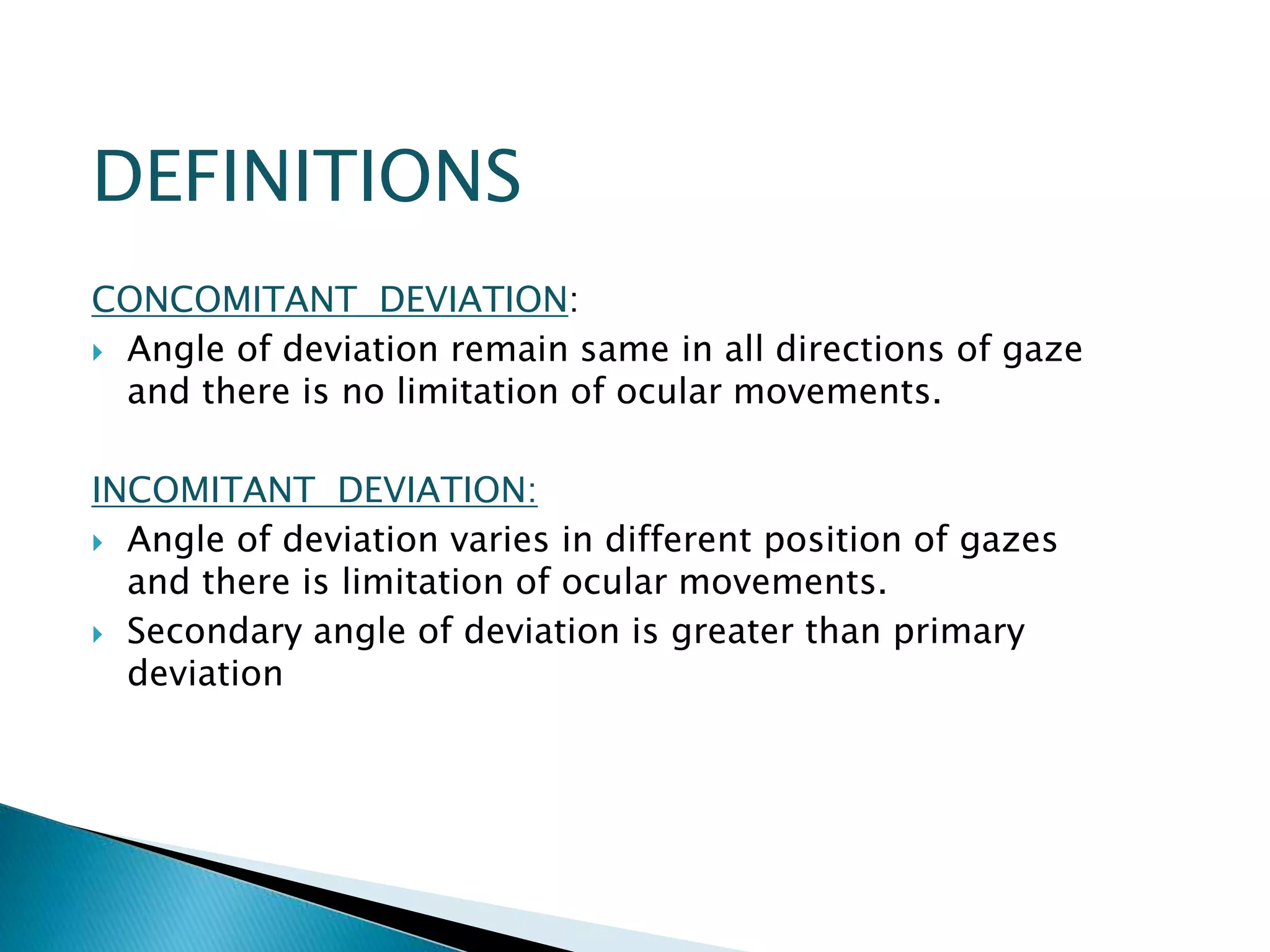
CONCOMITANT DEVIATION:
 Angle of deviation remain same in all directions of gaze
and there is no limitation of ocular movements.
INCOMITANT DEVIATION:
 Angle of deviation varies in different position of gazes
and there is limitation of ocular movements.
 Secondary angle of deviation is greater than primary
deviation
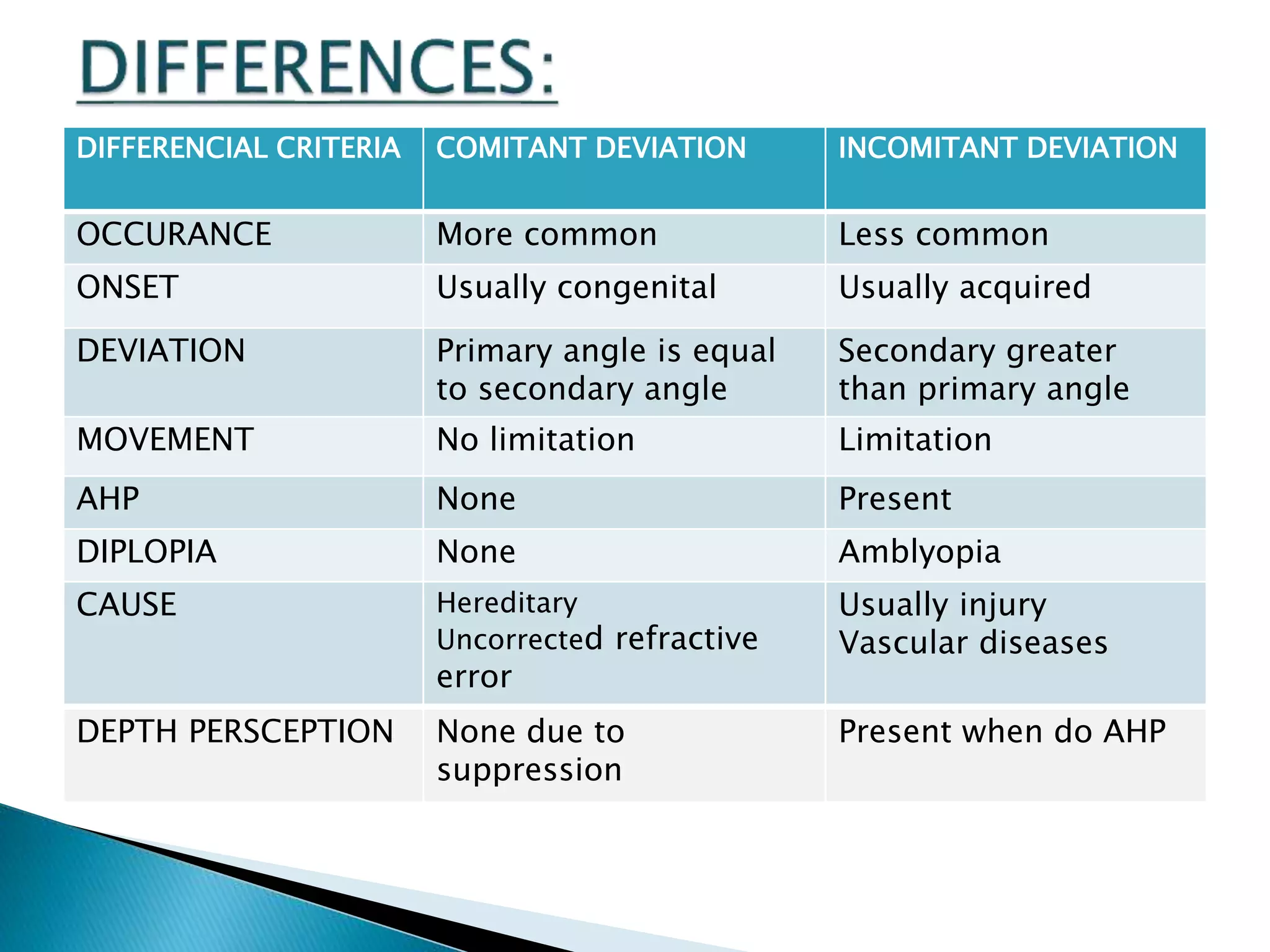
DIFFERENCIAL CRITERIA COMITANT DEVIATION INCOMITANT DEVIATION
OCCURANCE More common Less common
ONSET Usually congenital Usually acquired
DEVIATION Primary angle is equal
to secondary angle
Secondary greater
than primary angle
MOVEMENT No limitation Limitation
AHP None Present
DIPLOPIA None Amblyopia
CAUSE Hereditary
Uncorrected refractive
error
Usually injury
Vascular diseases
DEPTH PERSCEPTION None due to
suppression
Present when do AHP
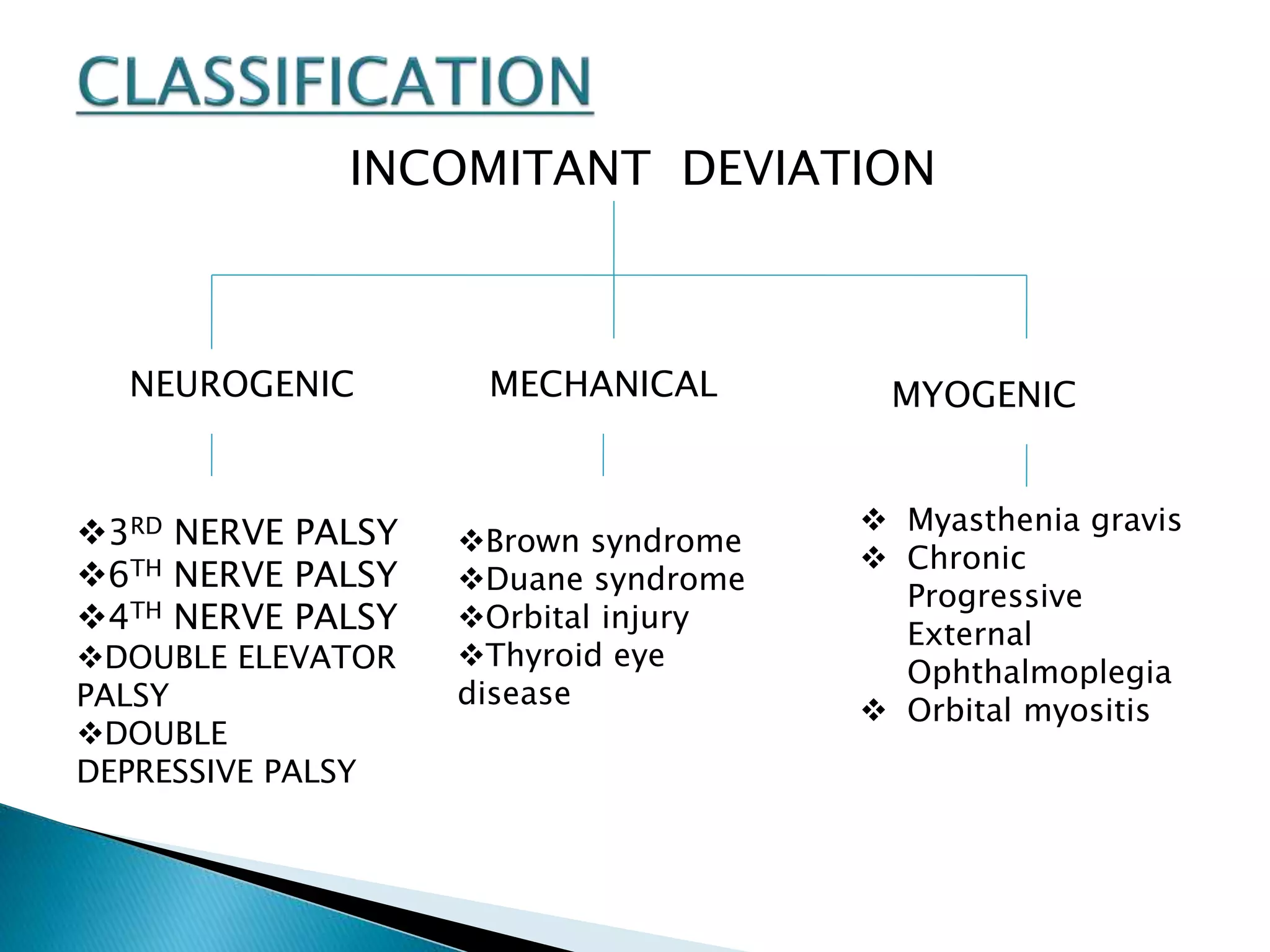
INCOMITANT DEVIATION
NEUROGENIC MYOGENICMECHANICAL
3RD NERVE PALSY
6TH NERVE PALSY
4TH NERVE PALSY
DOUBLE ELEVATOR
PALSY
DOUBLE
DEPRESSIVE PALSY
 Myasthenia gravis
 Chronic
Progressive
External
Ophthalmoplegia
 Orbital myositis
Brown syndrome
Duane syndrome
Orbital injury
Thyroid eye
disease
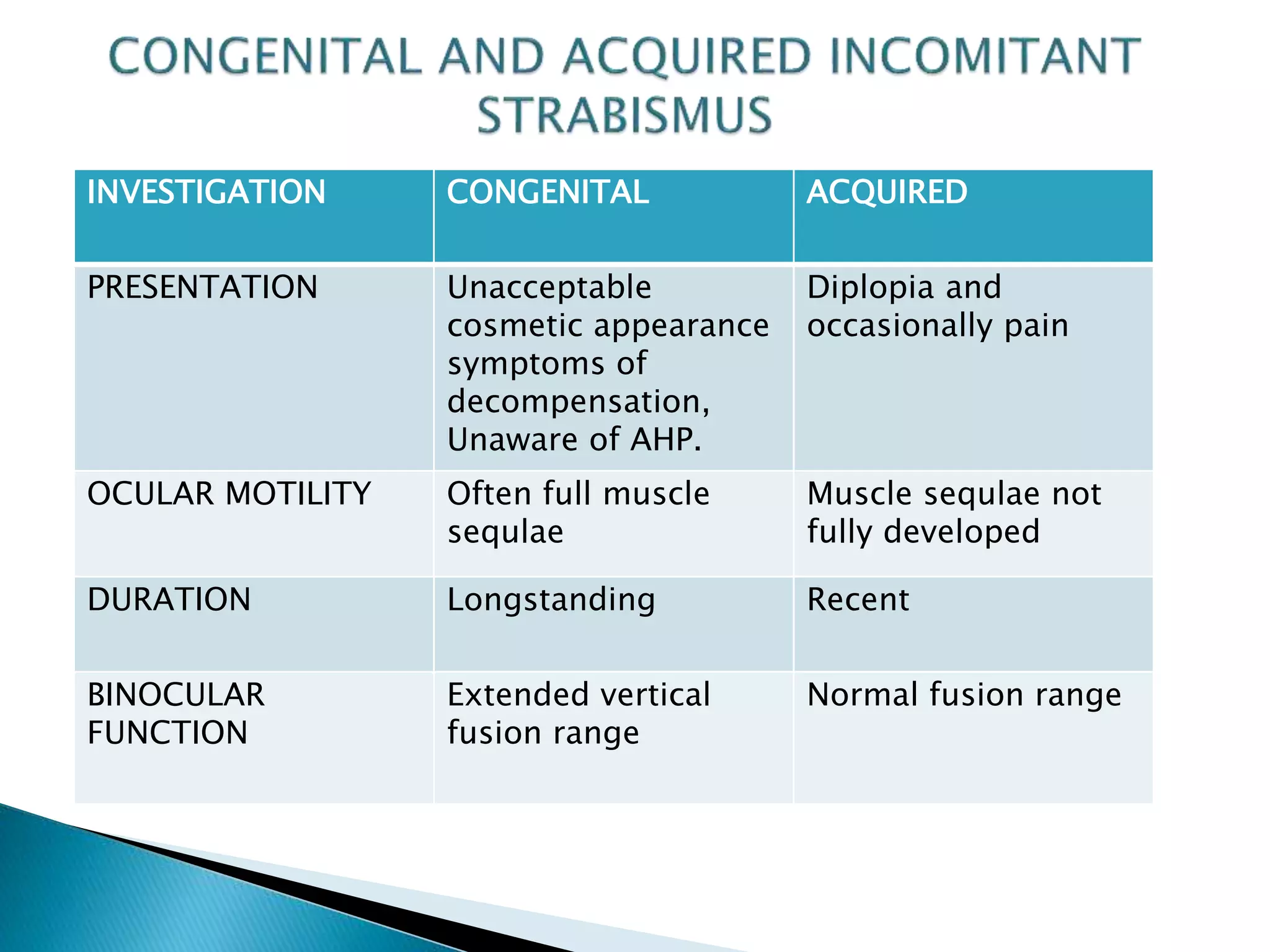
INVESTIGATION CONGENITAL ACQUIRED
PRESENTATION Unacceptable
cosmetic appearance
symptoms of
decompensation,
Unaware of AHP.
Diplopia and
occasionally pain
OCULAR MOTILITY Often full muscle
sequlae
Muscle sequlae not
fully developed
DURATION Longstanding Recent
BINOCULAR
FUNCTION
Extended vertical
fusion range
Normal fusion range
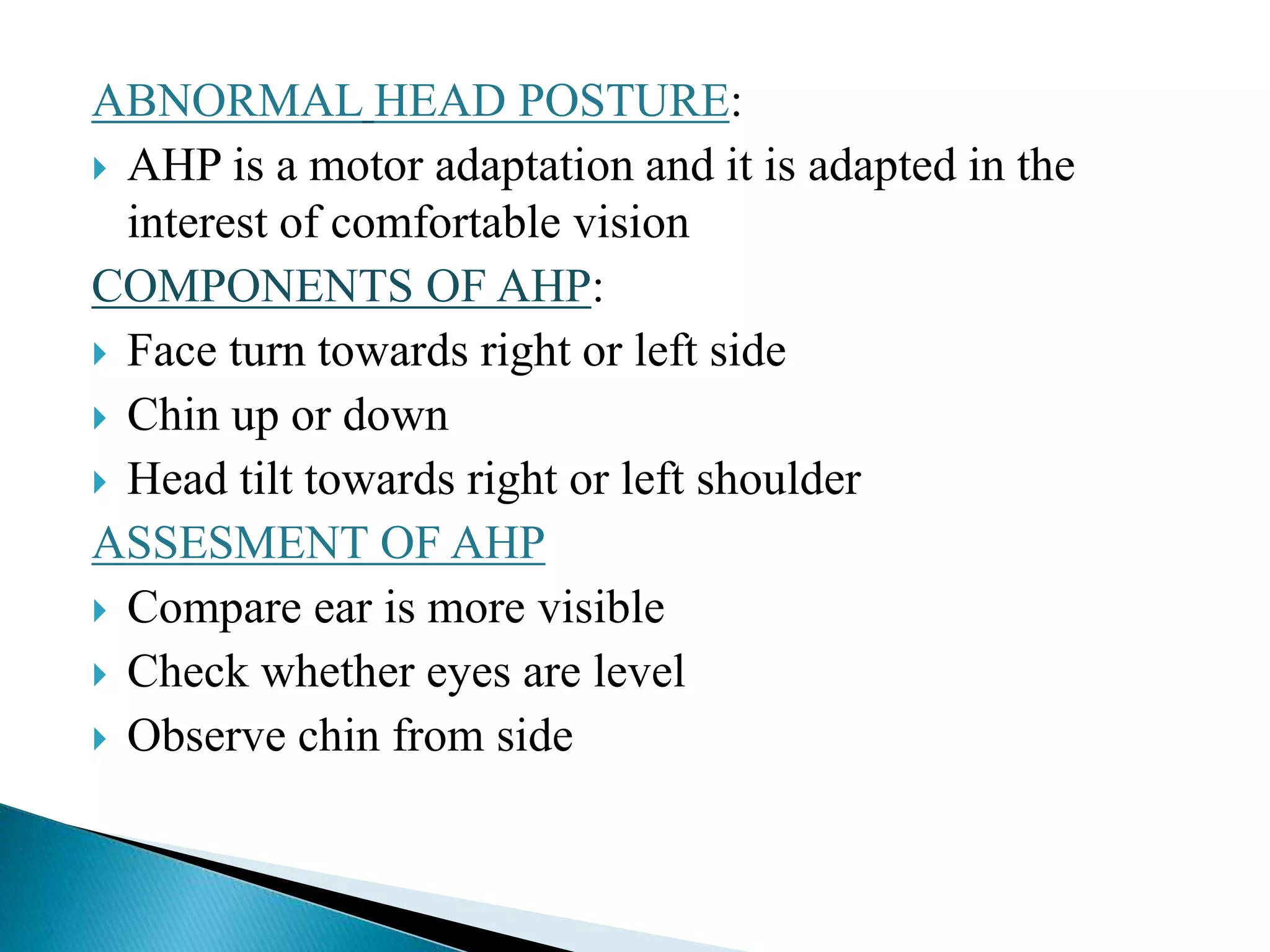
ABNORMAL HEAD POSTURE:
 AHP is a motor adaptation and it is adapted in the
interest of comfortable vision
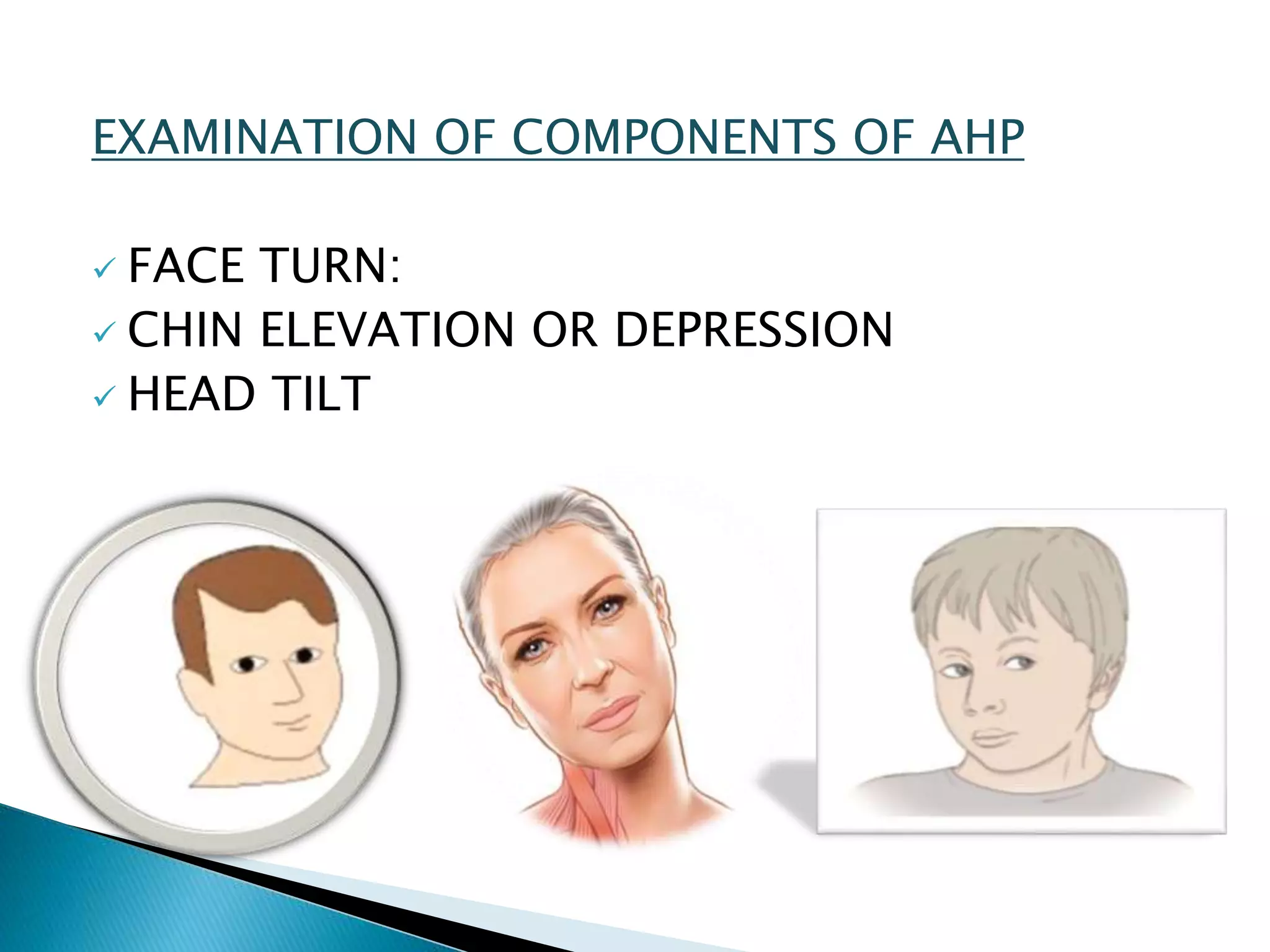
COMPONENTS OF AHP:
 Face turn towards right or left side
 Chin up or down
 Head tilt towards right or left shoulder
ASSESMENT OF AHP:
 Compare ear is more visible
 Check whether eyes are level
 Observe chin from side
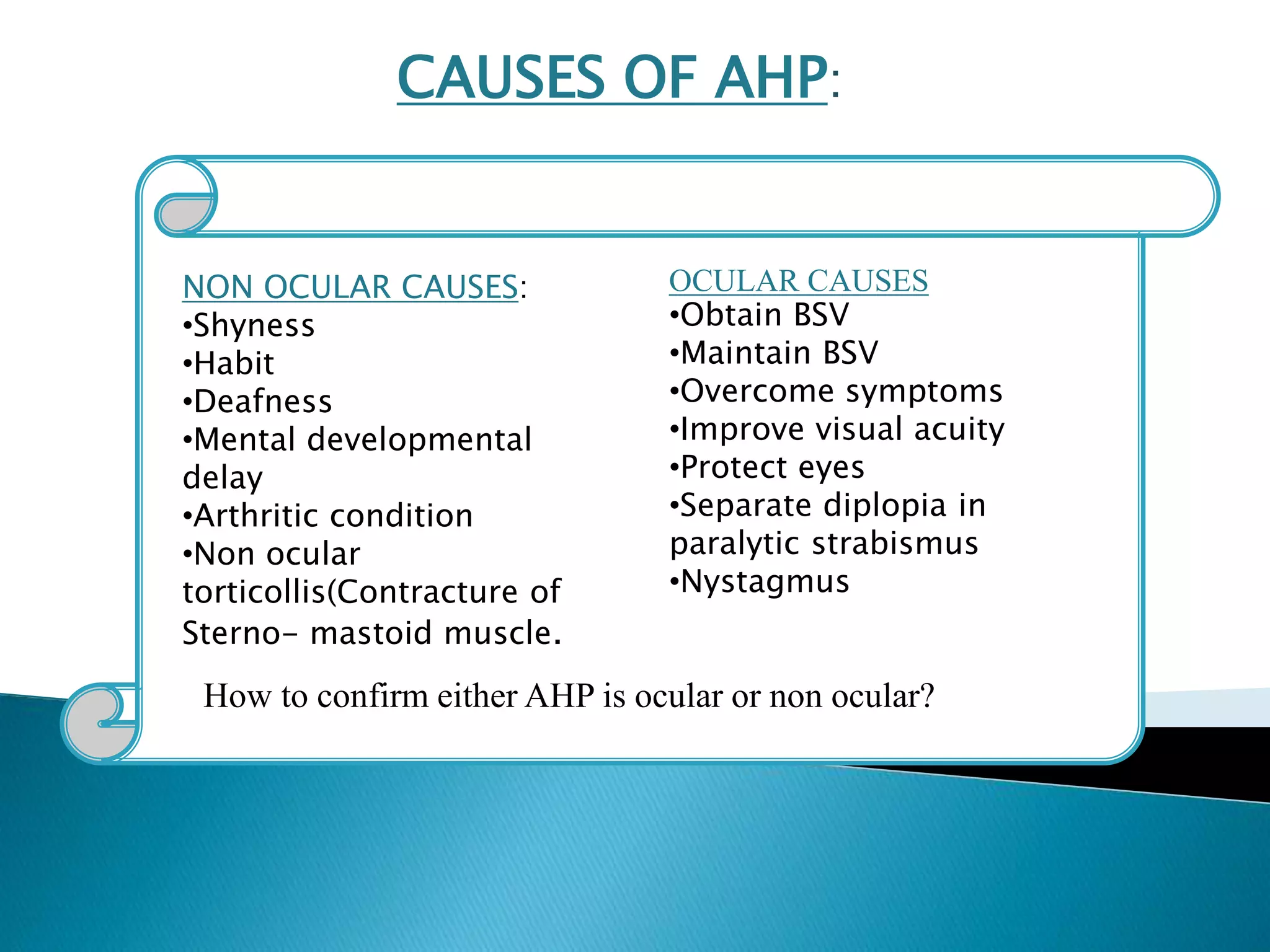
CAUSES OF AHP:
OCULAR CAUSES
•Obtain BSV
•Maintain BSV
•Overcome symptoms
•Improve visual acuity
•Protect eyes
•Separate diplopia in
paralytic strabismus
•Nystagmus
NON OCULAR CAUSES:
•Shyness
•Habit
•Deafness
•Mental developmental
delay
•Arthritic condition
•Non ocular
torticollis(Contracture of
Sterno- mastoid muscle.
How to confirm either AHP is ocular or non ocular?
EXAMINATION OF COMPONENTS OF AHP
 FACE TURN:
 CHIN ELEVATION OR DEPRESSION
 HEAD TILT
AHP IN PARALYTIC CONDITIONS:
NEUROGENIC PALSIES:
 3rd nerve palsy
Complete
Incomplete(divisional or isolated)
 4th nerve palsy
 6th nerve palsy
MECHANICAL PALSIES:
 Brown syndrome
 Duane’s syndrome
AV PATTERNS:
 A eso or V exo
 A exo or V eso
NYSTAGMUS:
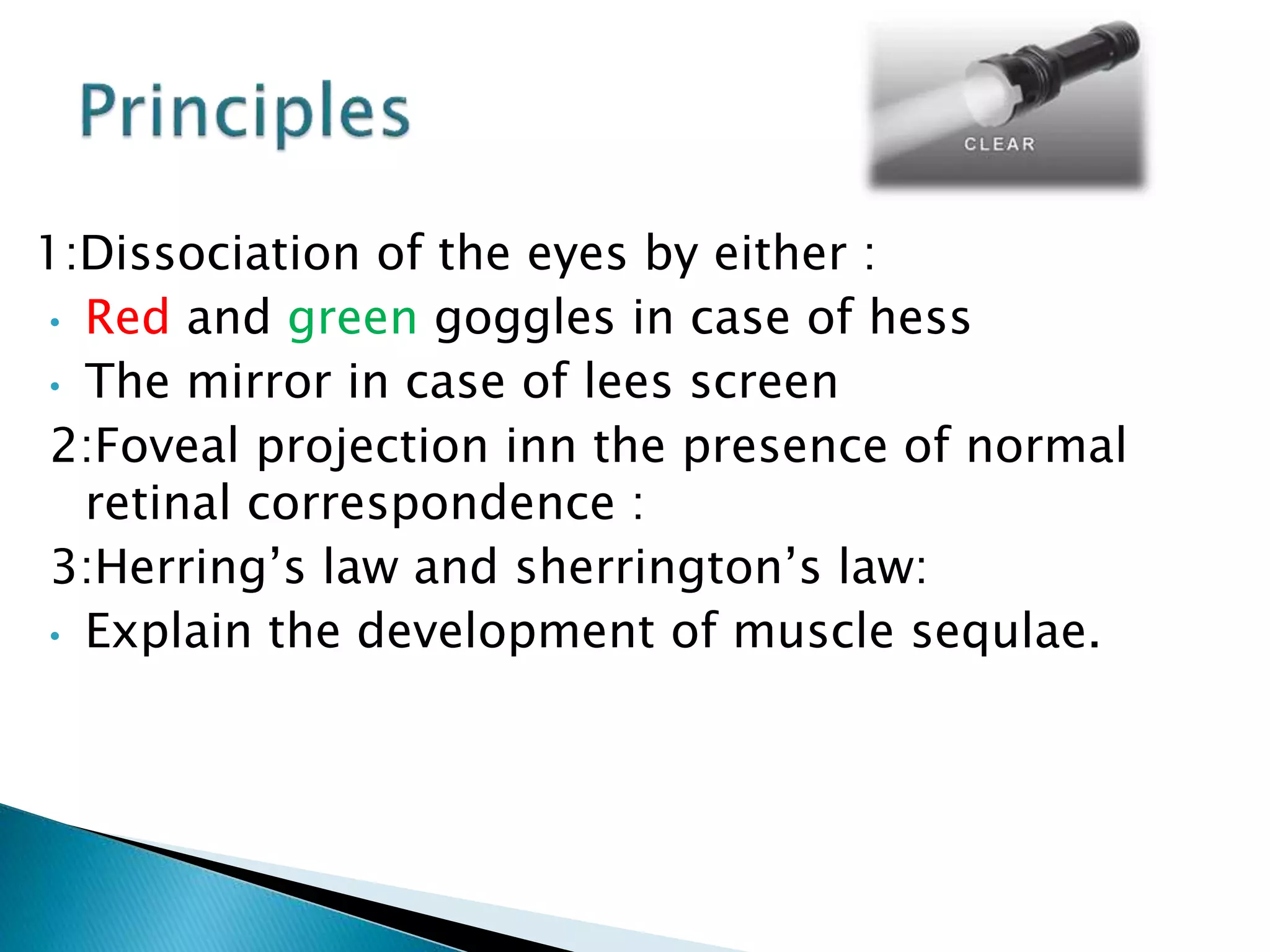
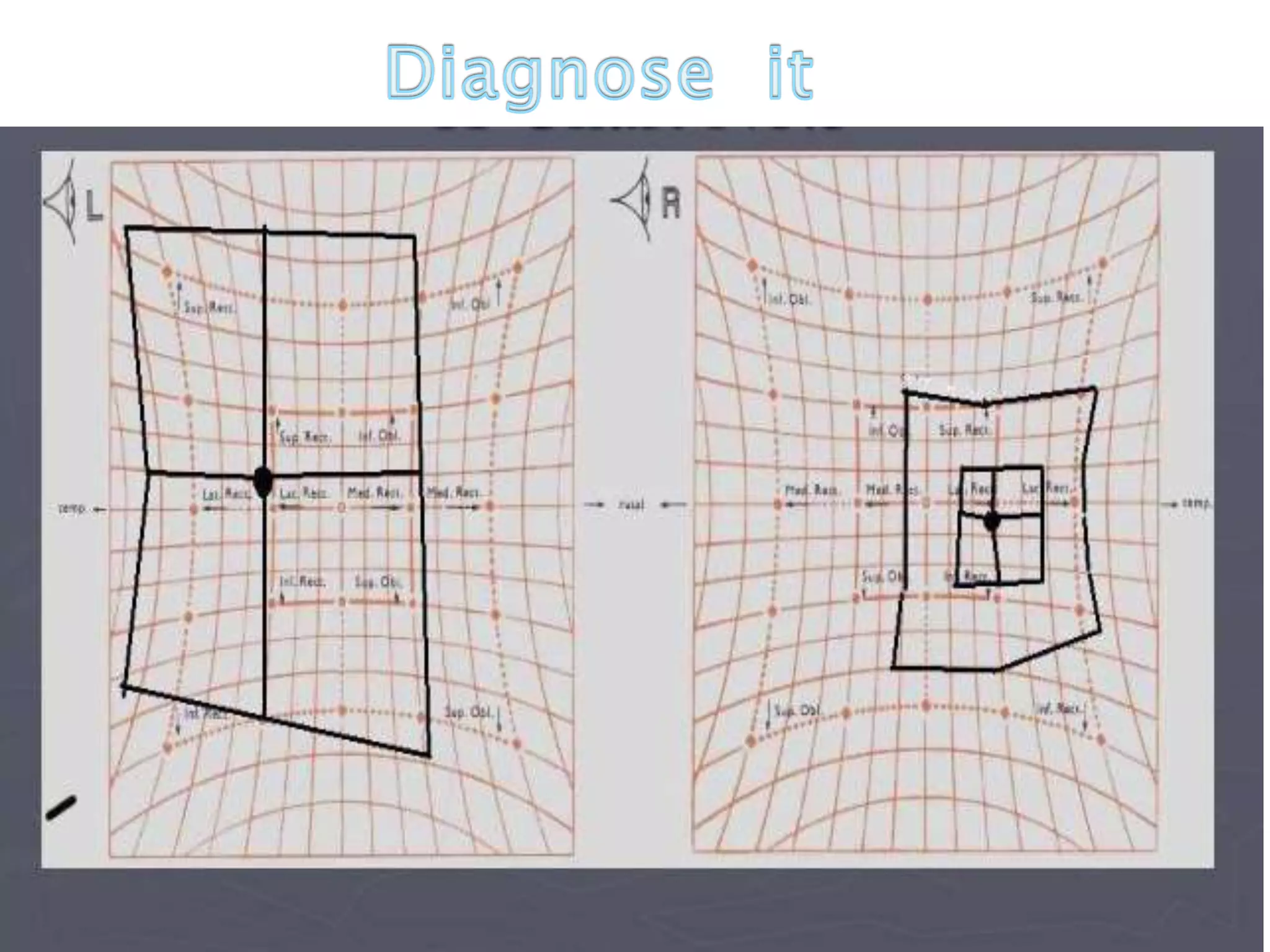
1:Dissociation of the eyes by either :
• Red and green goggles in case of hess
• The mirror in case of lees screen
2:Foveal projection inn the presence of normal
retinal correspondence :
3:Herring’s law and sherrington’s law:
• Explain the development of muscle sequlae.
 1:Diagnosis of:
 U/a or o/a of eom.
 Mechanical or neurogenic palsy
 Congenital/long standing
 Acquired/recent palsy
 2:planning of surgery and post-op effects of
surgery
 3:Monitoring of surgery
 Full muscle sequlae will include :
 E.g :sr u/a = io o/a
 :Ir o/a = so u/a
 What is the direction of the deviation eg: Eso, exo,
hyper, hypo?
 What is the size of the deviation?
 Is the deviation concomitant or incomitant ?
 Is there a smaller field ?
 Which is the affected muscle(s) or nerve(s) ?
 Has the muscle sequelae spread to produce concomitance ?
 Is the aetiology mechanical or neurogenic ?
 Is there an a or v pattern ?
Concomitant and Incomitant, AHP and Hess chart

Concomitant and Incomitant, AHP and Hess chart

  • 1.
  • 2.
    1. CONCOMITANCE /INCOMITANCE 2. ABNORMAL HEAD POSTURE 3. HESS CHART
  • 3.
    DEFINITIONS CONCOMITANT DEVIATION:  Angleof deviation remain same in all directions of gaze and there is no limitation of ocular movements. INCOMITANT DEVIATION:  Angle of deviation varies in different position of gazes and there is limitation of ocular movements.  Secondary angle of deviation is greater than primary deviation
  • 4.
    DIFFERENCIAL CRITERIA COMITANTDEVIATION INCOMITANT DEVIATION OCCURANCE More common Less common ONSET Usually congenital Usually acquired DEVIATION Primary angle is equal to secondary angle Secondary greater than primary angle MOVEMENT No limitation Limitation AHP None Present DIPLOPIA None Amblyopia CAUSE Hereditary Uncorrected refractive error Usually injury Vascular diseases DEPTH PERSCEPTION None due to suppression Present when do AHP
  • 5.
    INCOMITANT DEVIATION NEUROGENIC MYOGENICMECHANICAL 3RDNERVE PALSY 6TH NERVE PALSY 4TH NERVE PALSY DOUBLE ELEVATOR PALSY DOUBLE DEPRESSIVE PALSY  Myasthenia gravis  Chronic Progressive External Ophthalmoplegia  Orbital myositis Brown syndrome Duane syndrome Orbital injury Thyroid eye disease
  • 6.
    INVESTIGATION CONGENITAL ACQUIRED PRESENTATIONUnacceptable cosmetic appearance symptoms of decompensation, Unaware of AHP. Diplopia and occasionally pain OCULAR MOTILITY Often full muscle sequlae Muscle sequlae not fully developed DURATION Longstanding Recent BINOCULAR FUNCTION Extended vertical fusion range Normal fusion range
  • 8.
    ABNORMAL HEAD POSTURE: AHP is a motor adaptation and it is adapted in the interest of comfortable vision COMPONENTS OF AHP:  Face turn towards right or left side  Chin up or down  Head tilt towards right or left shoulder ASSESMENT OF AHP:  Compare ear is more visible  Check whether eyes are level  Observe chin from side
  • 9.
    CAUSES OF AHP: OCULARCAUSES •Obtain BSV •Maintain BSV •Overcome symptoms •Improve visual acuity •Protect eyes •Separate diplopia in paralytic strabismus •Nystagmus NON OCULAR CAUSES: •Shyness •Habit •Deafness •Mental developmental delay •Arthritic condition •Non ocular torticollis(Contracture of Sterno- mastoid muscle. How to confirm either AHP is ocular or non ocular?
  • 10.
    EXAMINATION OF COMPONENTSOF AHP  FACE TURN:  CHIN ELEVATION OR DEPRESSION  HEAD TILT
  • 11.
    AHP IN PARALYTICCONDITIONS: NEUROGENIC PALSIES:  3rd nerve palsy Complete Incomplete(divisional or isolated)  4th nerve palsy  6th nerve palsy MECHANICAL PALSIES:  Brown syndrome  Duane’s syndrome AV PATTERNS:  A eso or V exo  A exo or V eso NYSTAGMUS:
  • 13.
    1:Dissociation of theeyes by either : • Red and green goggles in case of hess • The mirror in case of lees screen 2:Foveal projection inn the presence of normal retinal correspondence : 3:Herring’s law and sherrington’s law: • Explain the development of muscle sequlae.
  • 14.
     1:Diagnosis of: U/a or o/a of eom.  Mechanical or neurogenic palsy  Congenital/long standing  Acquired/recent palsy  2:planning of surgery and post-op effects of surgery  3:Monitoring of surgery  Full muscle sequlae will include :  E.g :sr u/a = io o/a  :Ir o/a = so u/a
  • 15.
     What isthe direction of the deviation eg: Eso, exo, hyper, hypo?  What is the size of the deviation?  Is the deviation concomitant or incomitant ?  Is there a smaller field ?  Which is the affected muscle(s) or nerve(s) ?  Has the muscle sequelae spread to produce concomitance ?  Is the aetiology mechanical or neurogenic ?  Is there an a or v pattern ?