Optom. Ankit S. Varshney
B.Optom, M.Optom, Ph.D. in Optometry (pursuing) Fellow of IACLE (Aus.), Fellow of ASCO(Mum.)
Prof. at (Shree Bharatimaiya College of Optometry & Physiotherapy, Surat)
Life Member of Indian Optometric Association (IOA)
Associate Member of Association of Schools and Colleges of Optometry(ASCO)
Member of Optometry Council of India(OCI)
Educator Member of International Association of Contact lense Educators (Australia)(IACLE)
Mail id: ankitsvarshney@yahoo.com
Whatsapp no. +918155955820
 Binocular vision & strabismus –gk von
noorden
 Clinical mangement of strabismus elezabeth
e.Calarossa & michael w. Rouse
 Aao- section: pediatric ophthalmology &
strabismus
 Strabismus simplified- pradeep sharma
 Practical orthoptics in the treatment of squint-
lyle and jackson’s15 July 2020 Optom.AnkitVarshney 2
Skin
Conjunctiva
Tenon’s layer
Eye Muscles
Left eye
15 July 2020 Optom.AnkitVarshney 3
Eye Muscles
Left eye
Superior Oblique/Trochlear Muscle
Superior Rectus Muscle
Lateral Rectus Muscle
Inferior Rectus Muscle
Inferior Oblique Muscle
Medial Rectus Muscle
15 July 2020 Optom.AnkitVarshney 4
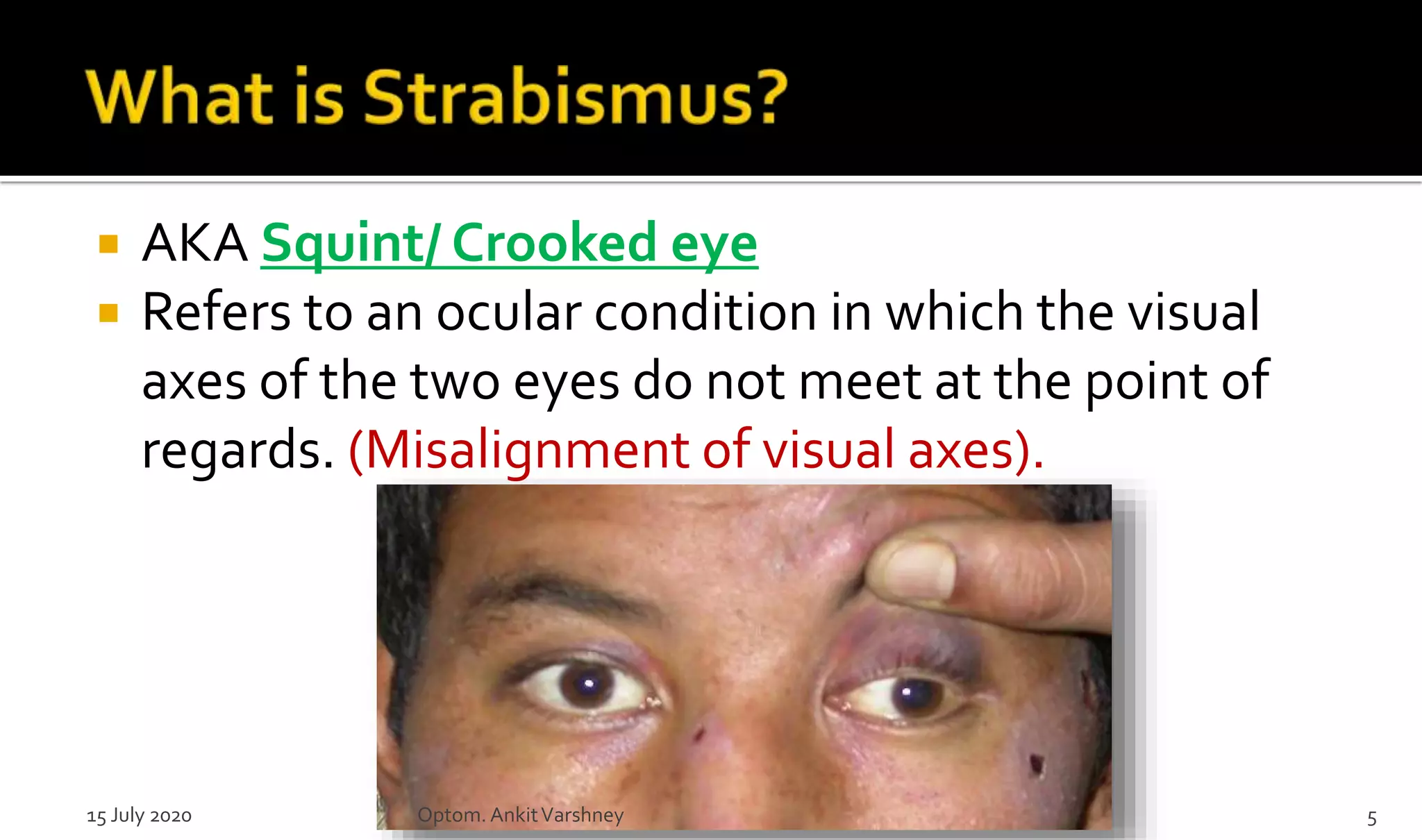
 AKA Squint/ Crooked eye
 Refers to an ocular condition in which the visual
axes of the two eyes do not meet at the point of
regards. (Misalignment of visual axes).
15 July 2020 Optom.AnkitVarshney 5
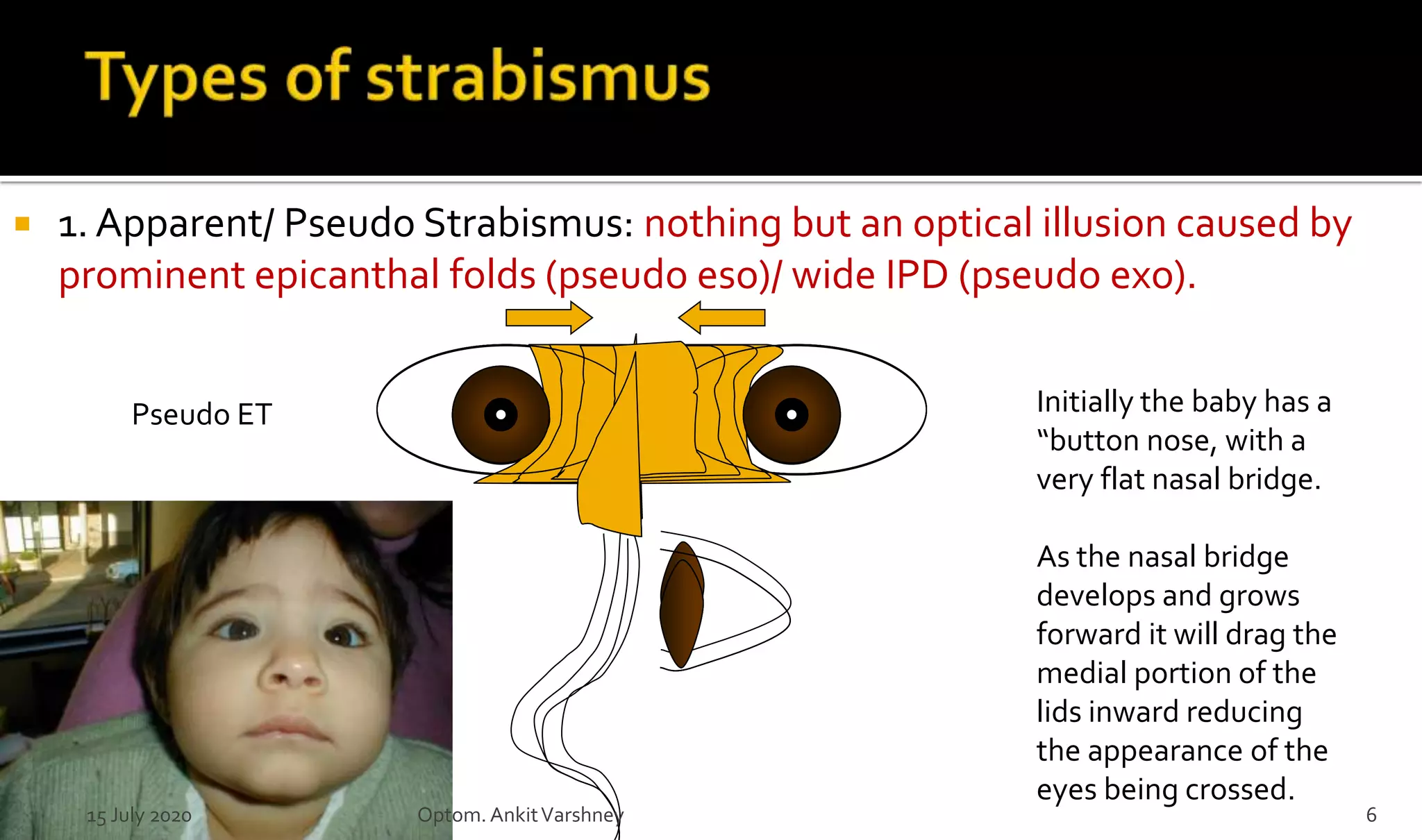
 1. Apparent/ Pseudo Strabismus: nothing but an optical illusion caused by
prominent epicanthal folds (pseudo eso)/ wide IPD (pseudo exo).
Pseudo ET Initially the baby has a
“button nose, with a
very flat nasal bridge.
As the nasal bridge
develops and grows
forward it will drag the
medial portion of the
lids inward reducing
the appearance of the
eyes being crossed.
15 July 2020 Optom.AnkitVarshney 6
 2. Latent Strabismus (Phoria): deviations are
present only some of the time: (interruption of
BV, fatigue, illness, stress)
Orthophoria
15 July 2020 Optom.AnkitVarshney 7
 3. Manifest Strabismus (tropia):
eyes deviated all the time
 Concomitant ( Non-paralytic)
 Incomitant strabismus (Paralytic/ Restrictive/
A &V pattern)
Esotropia
15 July 2020 Optom.AnkitVarshney 8
 Manifest squint in which the amount of deviation
in squinting eye remains constant in all directions
of the gaze and there is no associated limitation in
ocular movement.
15 July 2020 Optom.AnkitVarshney 9
 Manifest squint in which the amount of deviation
varies in different directions of gaze.
1. Paralytic squint: It refers to ocular deviation resulting
from complete/incomplete paralysis of one or more
EOM.
2. Restrictive squint: in this, the EOM involved is not
paralyzed but its movement is mechanically restricted.
It is differentiate by smaller amount of ocular
deviation and a Positive FDT.
15 July 2020 Optom.AnkitVarshney 10
Classified in two types:
1. Congenital causes (Musculo-fascial innervational anomalies):
DRS, Brown’s SO sheath Syndrome, Strabismus fixus & muscle
fibrosis syndrome.
2. Acquired causes: Dysthyroid orbito myopathy, pseudotumor,
orbital tumors, fibrosis of EOM secondary to trauma or surgery.
15 July 2020 Optom.AnkitVarshney 11
 Duane syndrome is a rare, congenital disorder of
eye movement
 Stilling andTurk : described it first
 Duane popularised it
 Affecting the Horizontally acting muscle: so it
Horizontal strabismus.
15 July 2020 Optom.AnkitVarshney 13
 Incidence 1-4 percent of all strabismus
 Mostly Sporadic
 Female > Males (3:2)
 Left eye > Right eye (60-75%) where unilateral
 Bilateral 18-22%
 Many associated congenital anomalies
 Occasionally familial
15 July 2020 Optom.AnkitVarshney 14
 Goldenhar Syndrome :
Hemifacial microsomia, ocular dermoids, ear
anomalies, preauricular skin tags, upper eyelid
colobomas.
 Wildervanck Syndrome :
Sensorineural hearing loss, Klippel Fiel anomaly
with fused cervical vertebrae, epibulbar dermoid.
 Klippel-feil syndrome
15 July 2020 Optom.AnkitVarshney 15
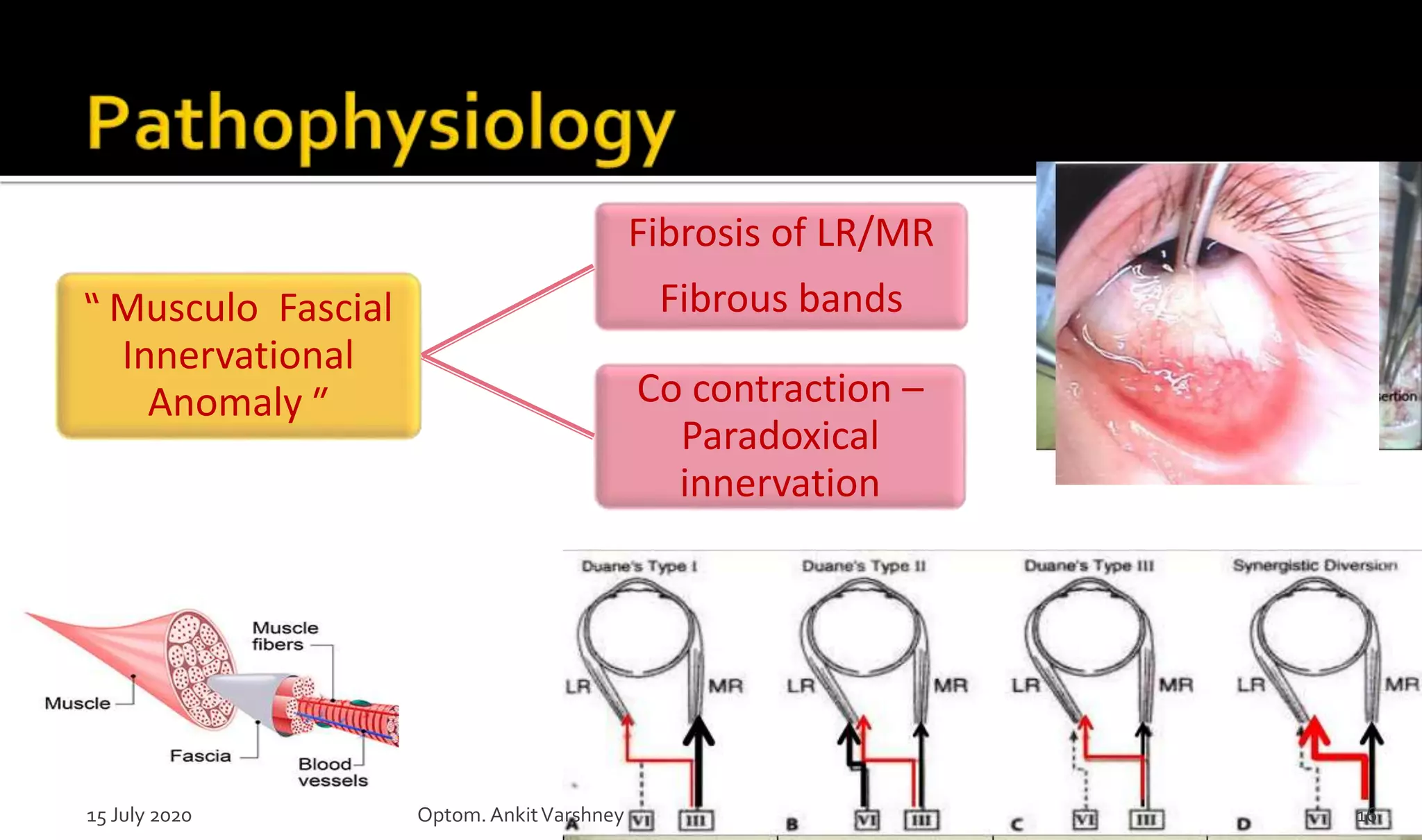
“ Musculo Fascial
Innervational
Anomaly ”
Fibrosis of LR/MR
Fibrous bands
Co contraction –
Paradoxical
innervation
15 July 2020 Optom.AnkitVarshney 16
 Type I (d): Failure or limitation of abduction.
 Type II (dd): Failure or limitation of adduction.
 Type III (ddd): Failure of abduction and adduction
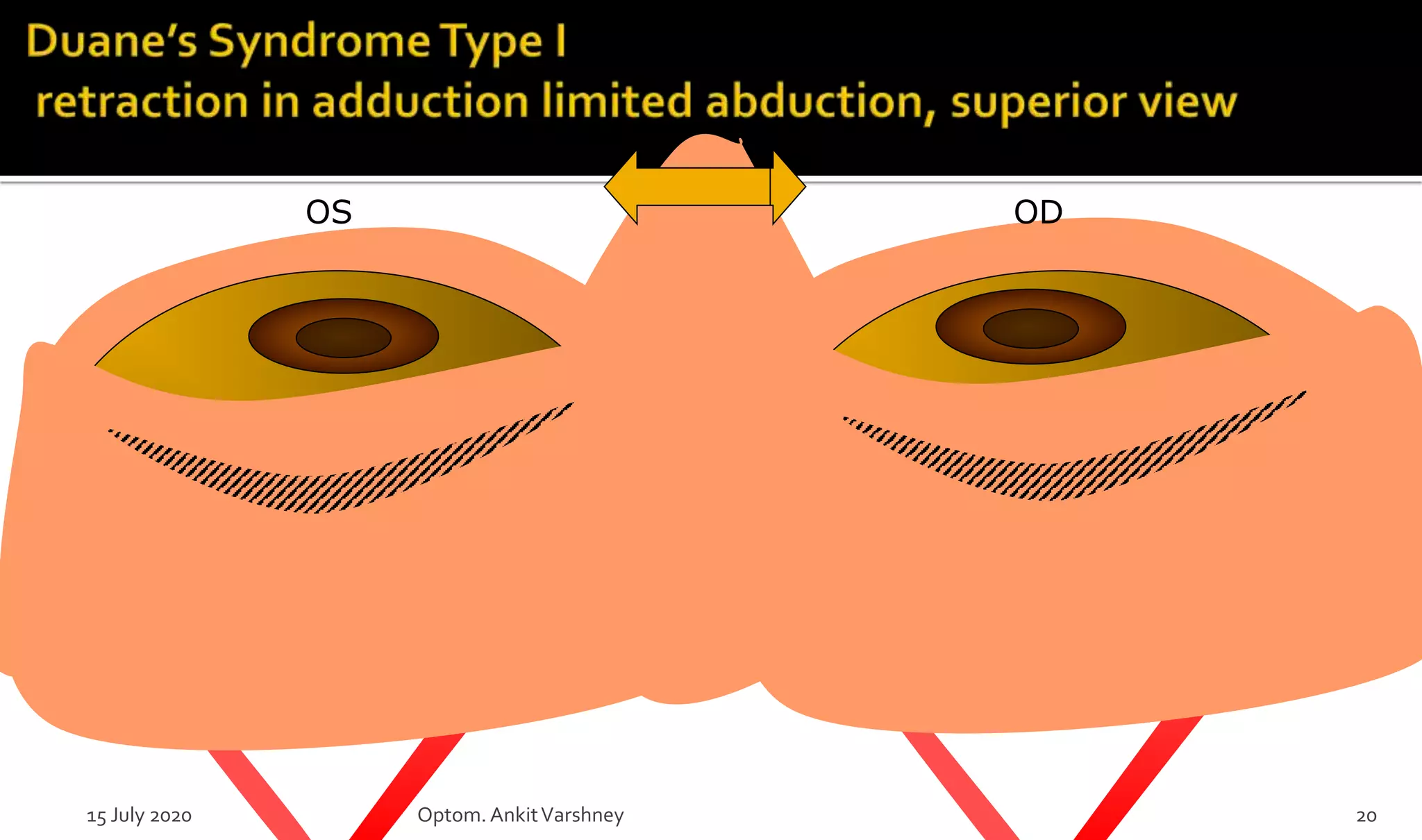
Classic features
Retraction of globe on adduction
Adduction narrowing of palpebral fissure
Upshoot / downshoot of eye in adduction
15 July 2020 Optom.AnkitVarshney 17
15 July 2020 Optom.AnkitVarshney 18
OS OD
15 July 2020 Optom.AnkitVarshney 19
OS OD
15 July 2020 Optom.AnkitVarshney 20
15 July 2020 Optom.AnkitVarshney 21
15 July 2020 Optom.AnkitVarshney 22
15 July 2020 Optom.AnkitVarshney 23
 Squinting
 Head tilt
 Loss of binocular vision
 Reduced ocular movement
 Facial asymmetry
 Picture of paralytic squint
15 July 2020 Optom.AnkitVarshney 24
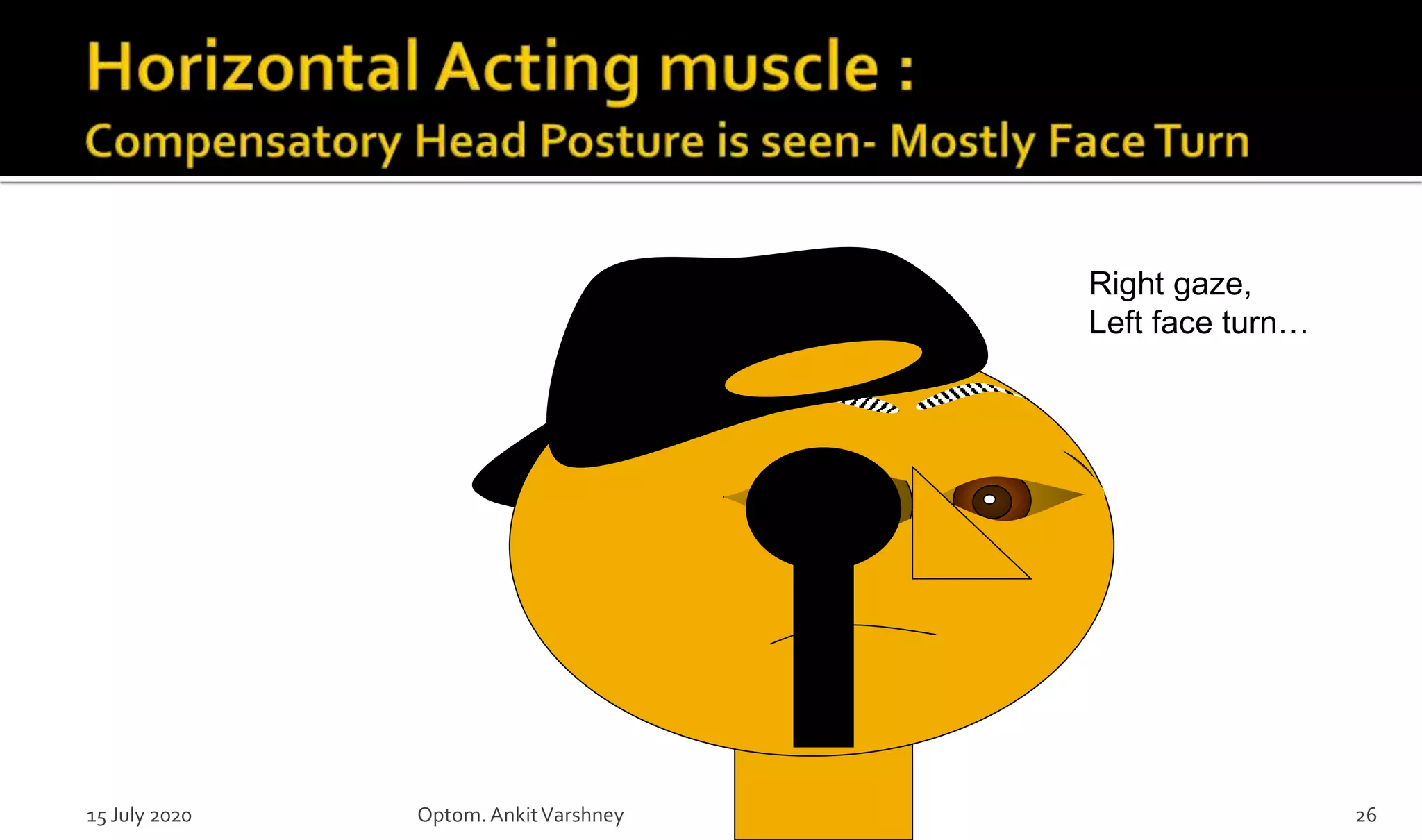
 AHP
 Strabismus ( 77% of cases)
 Globe retraction
 Palpebral fissure narrowing
 Anisometropia /amblyopia
 Sensory adaptation with excellent binocular functions
-suppression without diplopia in gaze of abnormal
muscle
15 July 2020 Optom.AnkitVarshney 25
Right gaze,
Left face turn…
15 July 2020 Optom.AnkitVarshney 26
 30 PD LET actually,
 But can fuse in right
gaze, left head turn
Check his ductions…
Primary gaze
15 July 2020 Optom.AnkitVarshney 27
 30 PD LET actually,
 But can fuse in right
gaze, left head turn
 Notice the limited
abduction and narrow
fissure in adduction
Left gaze,
Right face turn…
15 July 2020 Optom.AnkitVarshney 28
 Bilateral DRS
15 July 2020 Optom.AnkitVarshney 29
DRS
 ET small angle
 Narrowing
 Saccadic velocities
SIXTH N PALSY (LR)
 ET large angle
 -ve
 Slow in abduction only
MOBIUS SYNDROME:
Rare condition affecting bilateral sixth and seventh (facial) cranial nerve palsy.
15 July 2020 Optom.AnkitVarshney 30
 Treat refractive error
/amblyopia
 Conservative : Age 5-6 yrs
 Prisms: up to 25 error
 Special seating arrangement for
children in schools
15 July 2020 Optom.AnkitVarshney 31
 Conservative : Age 5-6 yrs
 Vision therapy for secondary convergence insufficiency
Normal Convergence
Convergence Insufficiency
15 July 2020 Optom.AnkitVarshney 32
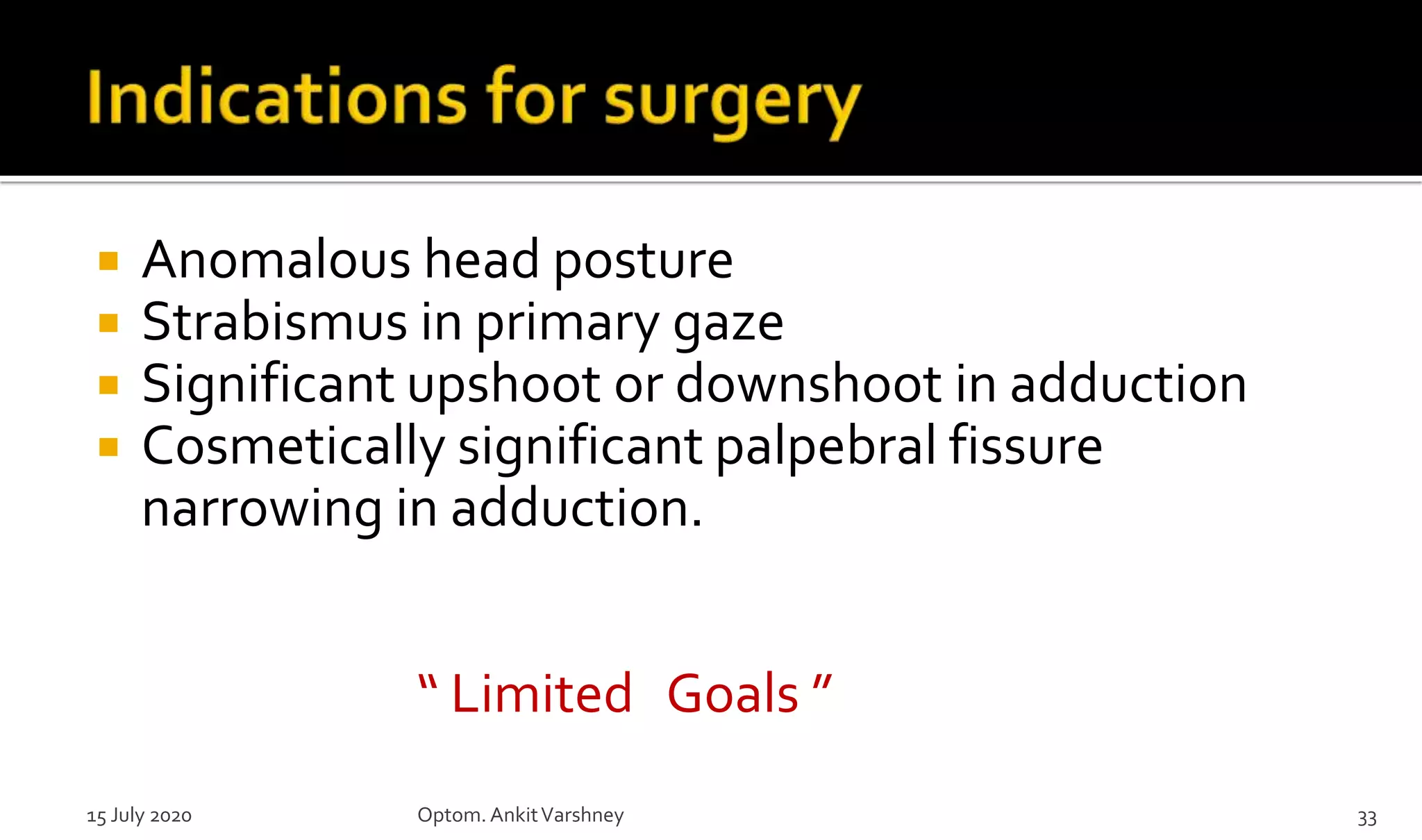
 Anomalous head posture
 Strabismus in primary gaze
 Significant upshoot or downshoot in adduction
 Cosmetically significant palpebral fissure
narrowing in adduction.
“ Limited Goals ”
15 July 2020 Optom.AnkitVarshney 33
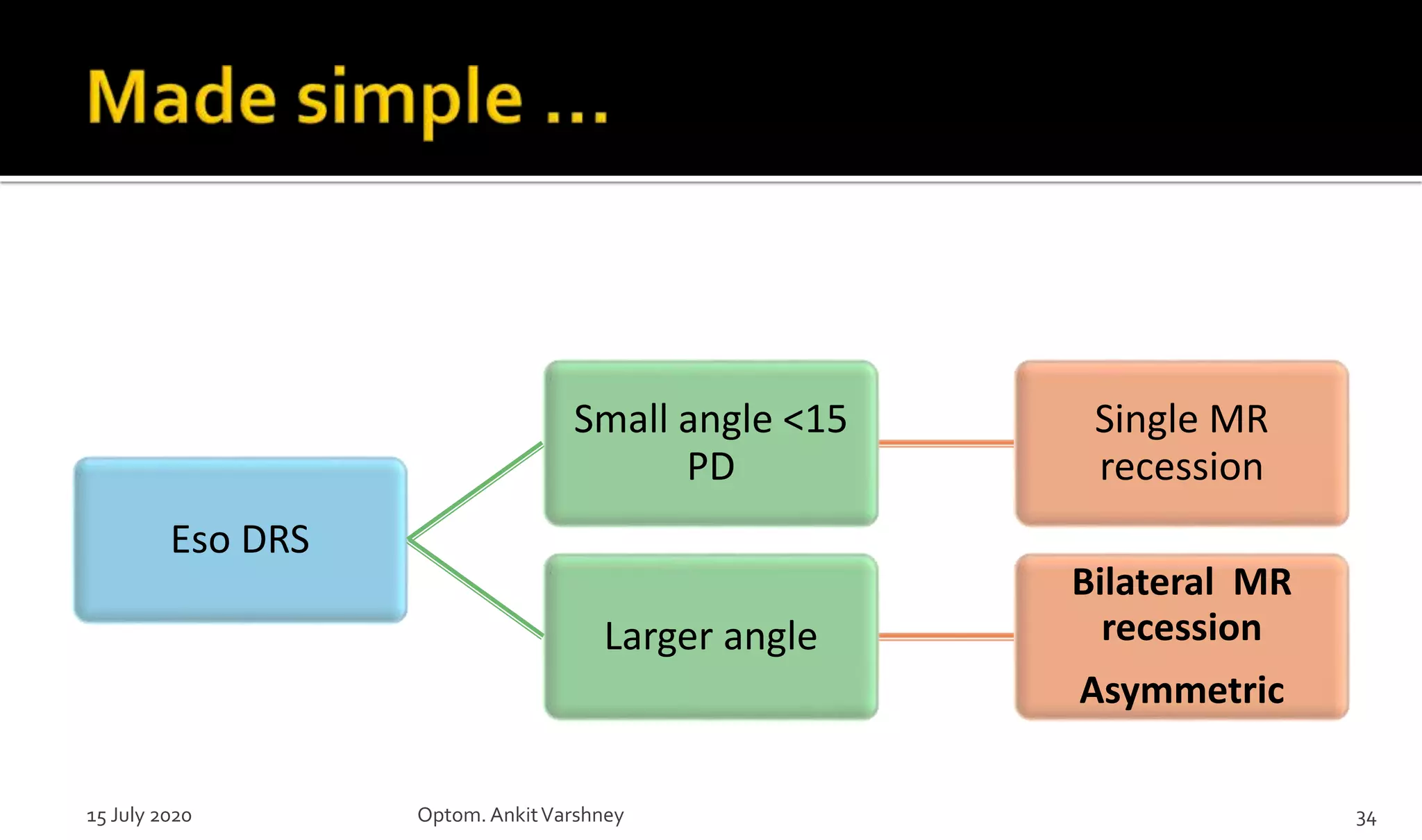
Eso DRS
Small angle <15
PD
Single MR
recession
Larger angle
Bilateral MR
recession
Asymmetric
15 July 2020 Optom.AnkitVarshney 34
Exo DRS
Small angle <15
PD
Single LR
recession
Larger angle
Bilateral LR
recession
Symmetric
15 July 2020 Optom.AnkitVarshney 35
Upshoots
Downshoots
Globe retraction
Recession of MR
and LR
Y split
Posterior fixation
suture to LR
15 July 2020 Optom.AnkitVarshney 36
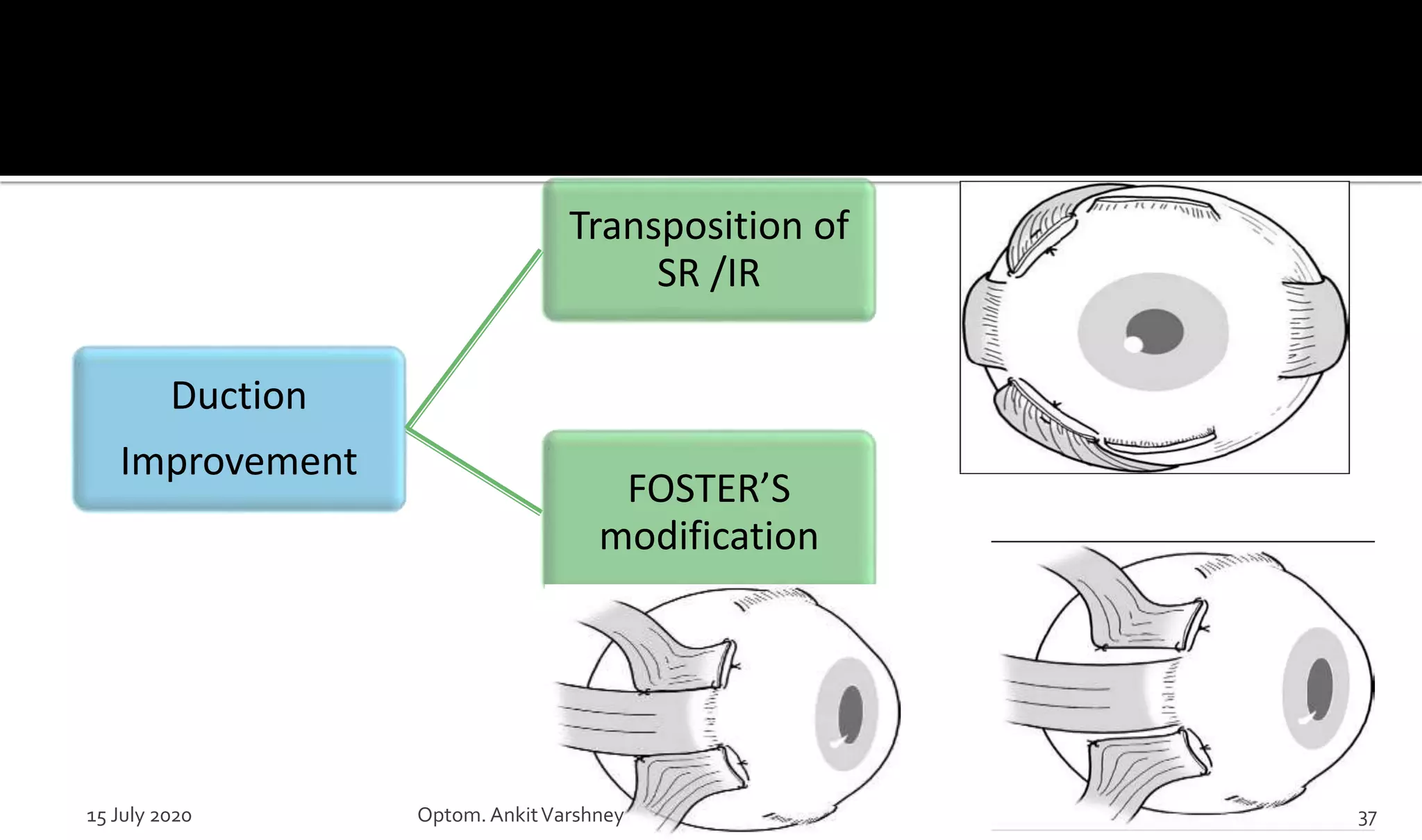
Duction
Improvement
Transposition of
SR /IR
FOSTER’S
modification
15 July 2020 Optom.AnkitVarshney 37
 A very rare condition, in which both eyes are fixed
(in extreme duction), by fibrous tightening of MR
(Convergent strabismus fixus) or LR (Divergent
strabismus fixus).
 FDT confirms their immobility.
 Affecting the Horizontally acting muscle.
15 July 2020 Optom.AnkitVarshney 38
15 July 2020 Optom.AnkitVarshney 39
 Convergent strabismus fixus: Complete
disinsertion of MR and resection of LR.
 Divergent strabismus fixus: just reverse of above
15 July 2020 Optom.AnkitVarshney 40
Brown Syndrome
1. Absence of elevation in adduction
2. Downshoot or hypotropia in attempting elevation
in adduction
3. Unaffected elevation in primary and abducted
position
4. Y pattern with divergence in upgaze
5. Anomalous head posture (Often seen with chin up
position)
6. Positive FDT
7. 2/3 are mild and do not require treatment if ortho
in primary15 July 2020 Optom.AnkitVarshney 42
 Trauma or
 Infection ofTrochlear area
 SO tucking Sx
 Canine tooth syndrome: Dog bites- scarring SO
15 July 2020 Optom.AnkitVarshney 43
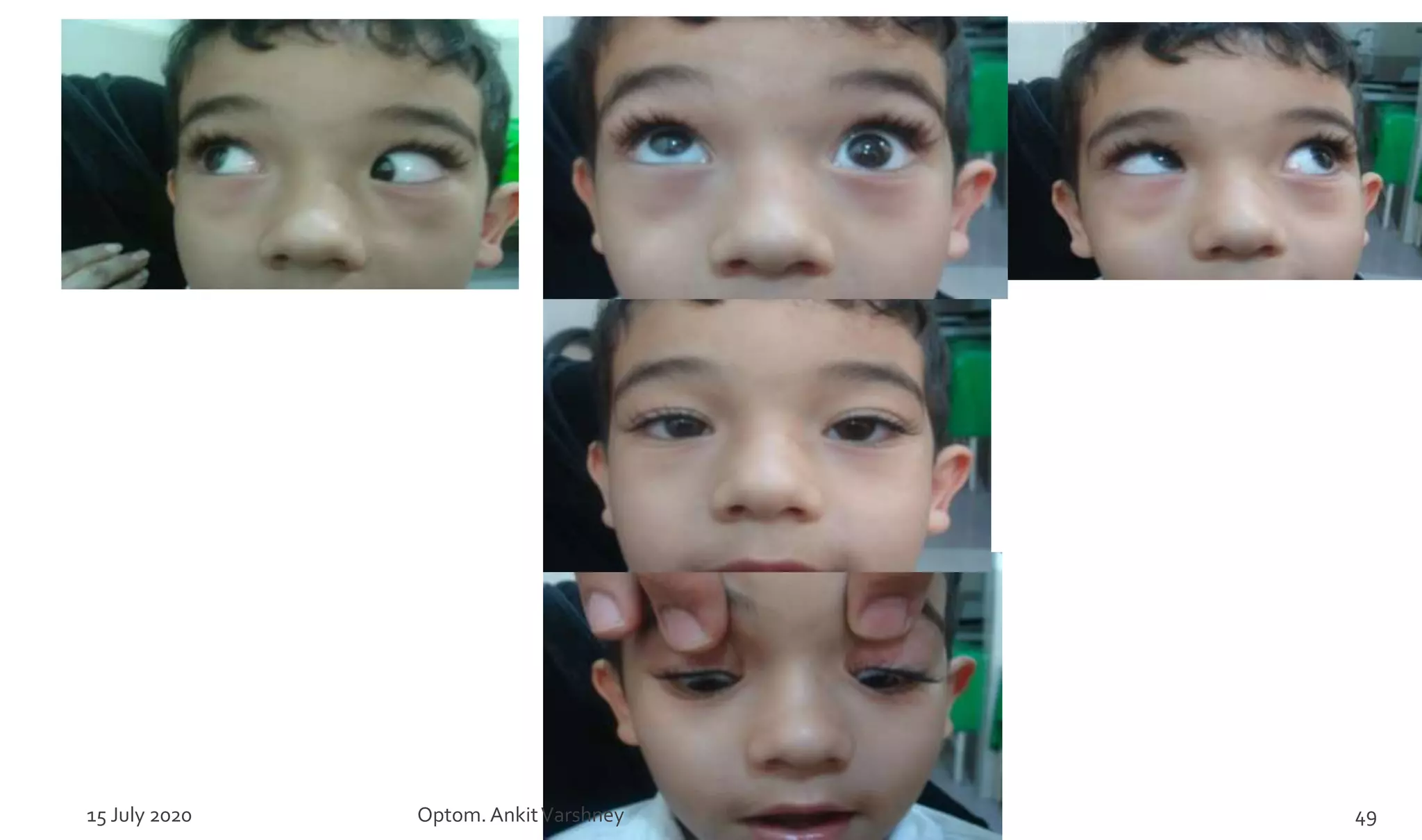
Divergence in upgaze
Down shoot in attempted elevation in adduction?
15 July 2020 Optom.AnkitVarshney 44
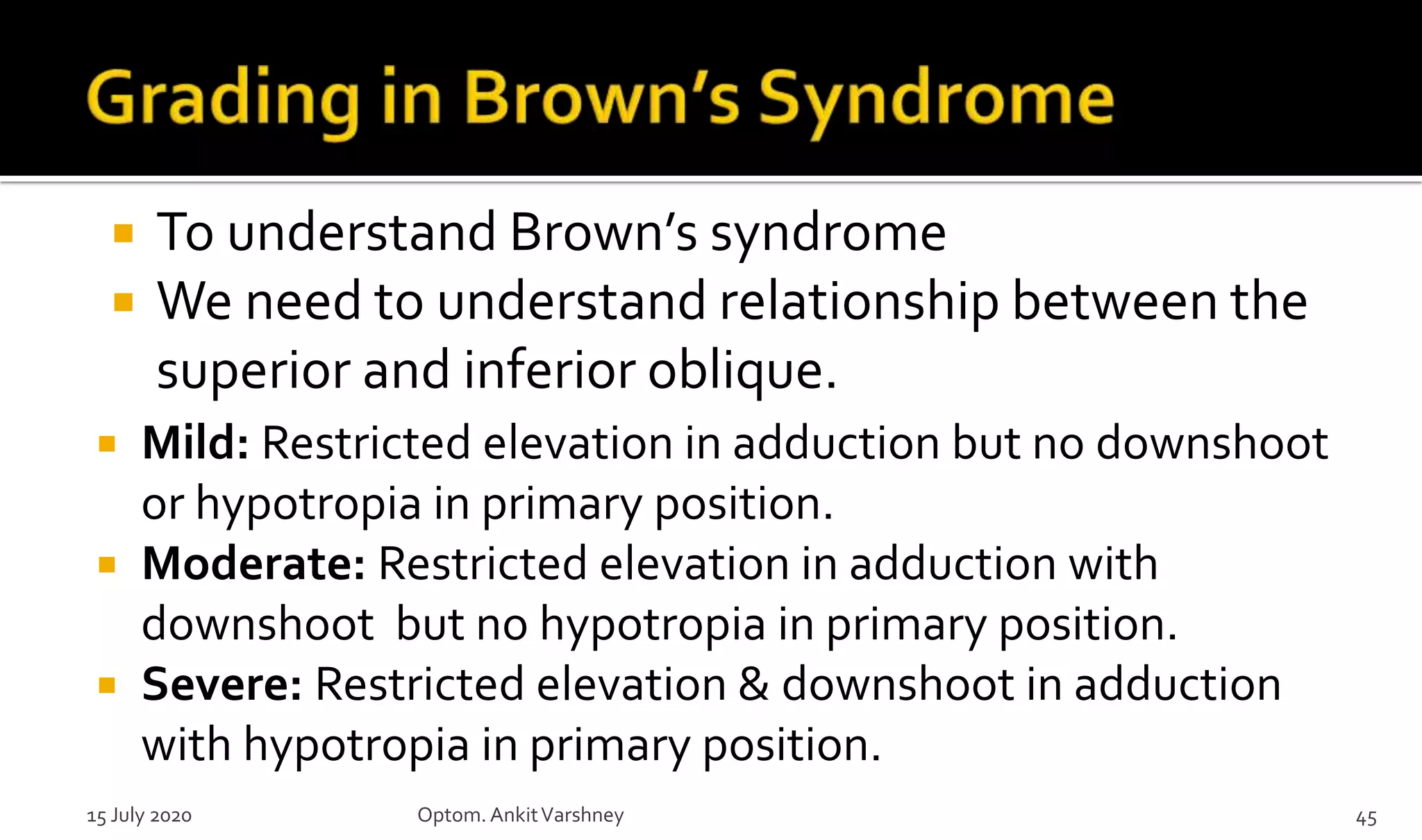
 Mild: Restricted elevation in adduction but no downshoot
or hypotropia in primary position.
 Moderate: Restricted elevation in adduction with
downshoot but no hypotropia in primary position.
 Severe: Restricted elevation & downshoot in adduction
with hypotropia in primary position.
 To understand Brown’s syndrome
 We need to understand relationship between the
superior and inferior oblique.
15 July 2020 Optom.AnkitVarshney 45
15 July 2020 Optom.AnkitVarshney 46
15 July 2020 Optom.AnkitVarshney 47
Restriction of the superior oblique tendon at the
trochlear pulley
15 July 2020 Optom.AnkitVarshney 48
15 July 2020 Optom.AnkitVarshney 49
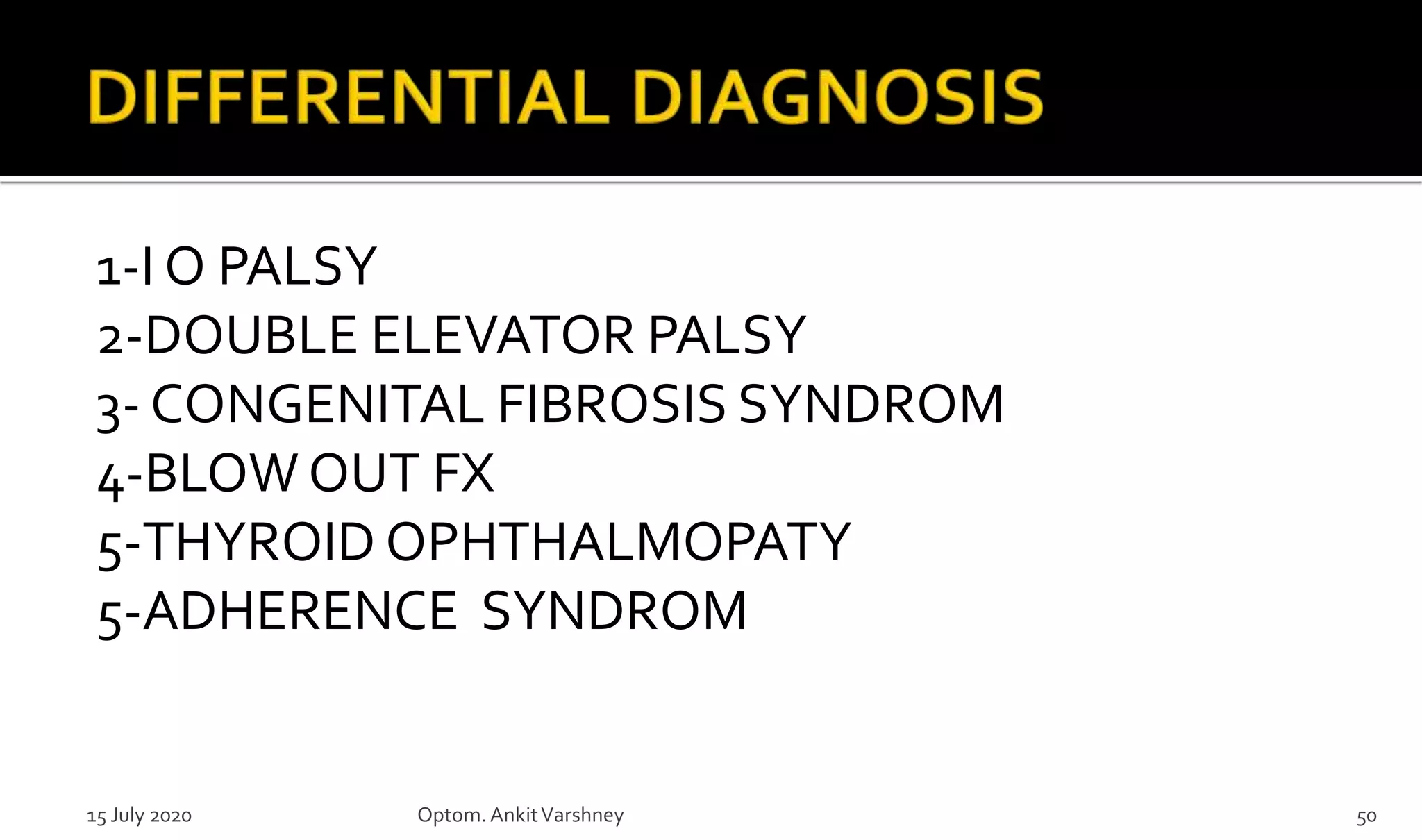
1-I O PALSY
2-DOUBLE ELEVATOR PALSY
3- CONGENITAL FIBROSIS SYNDROM
4-BLOW OUT FX
5-THYROID OPHTHALMOPATY
5-ADHERENCE SYNDROM
15 July 2020 Optom.AnkitVarshney 50
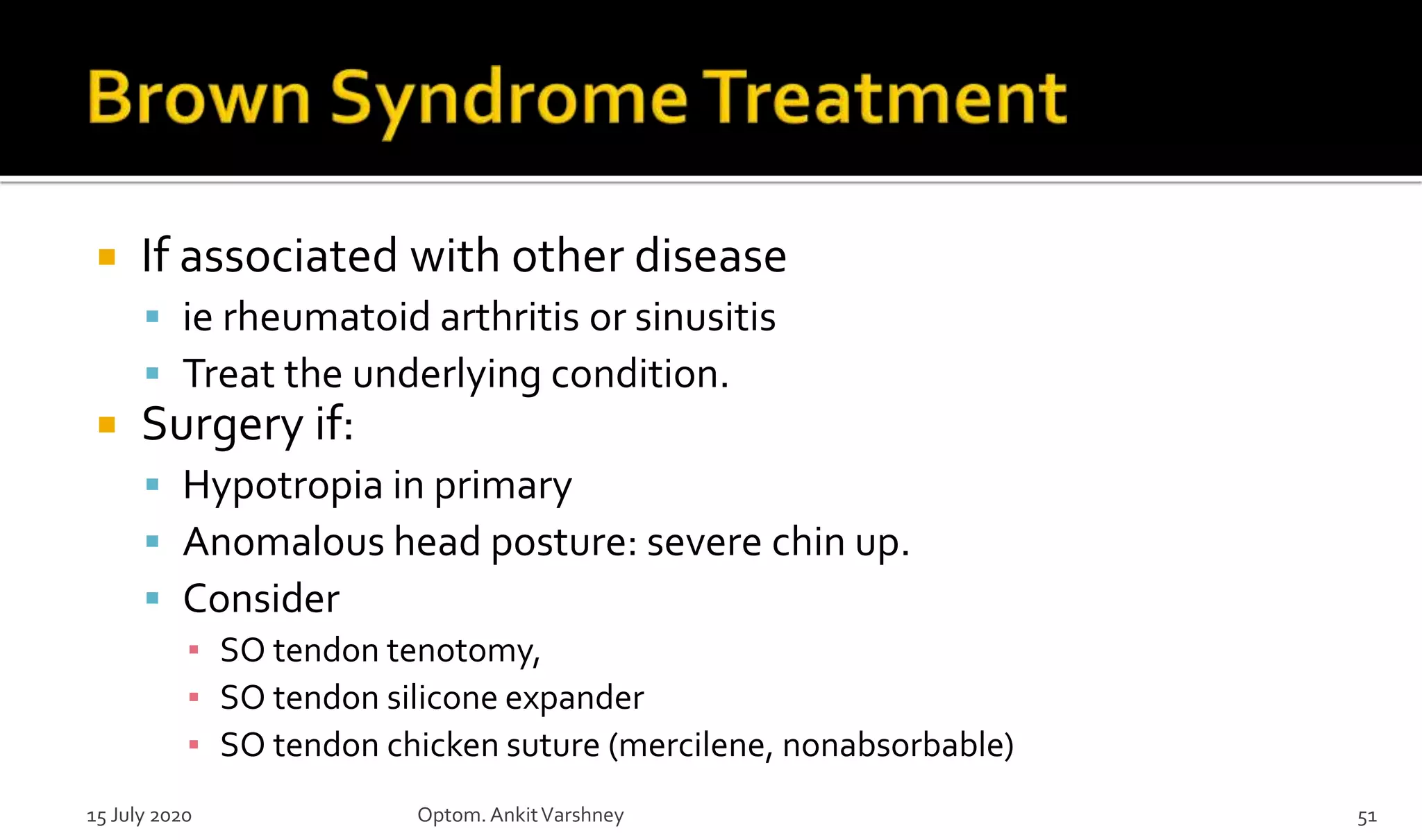
 If associated with other disease
 ie rheumatoid arthritis or sinusitis
 Treat the underlying condition.
 Surgery if:
 Hypotropia in primary
 Anomalous head posture: severe chin up.
 Consider
▪ SO tendon tenotomy,
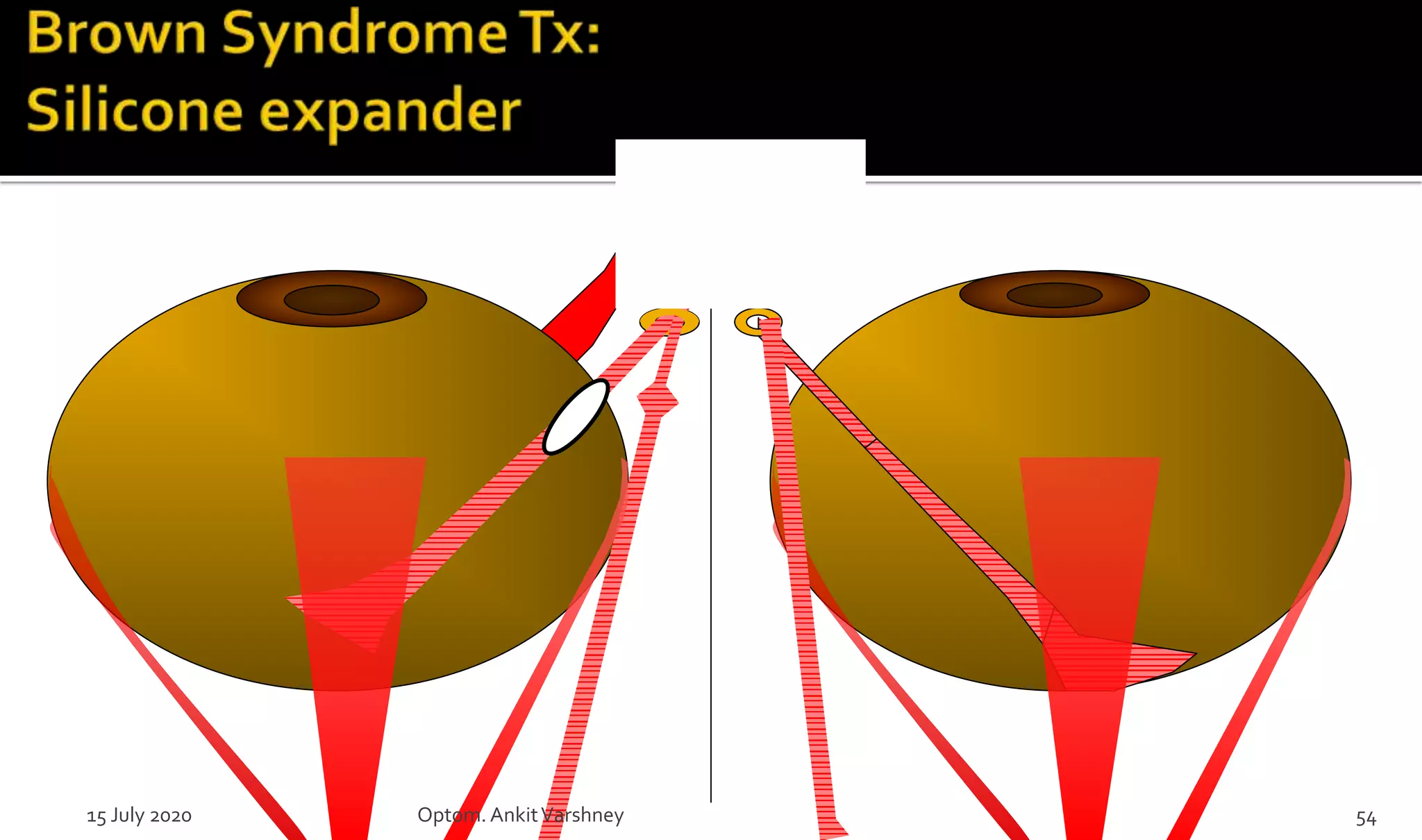
▪ SO tendon silicone expander
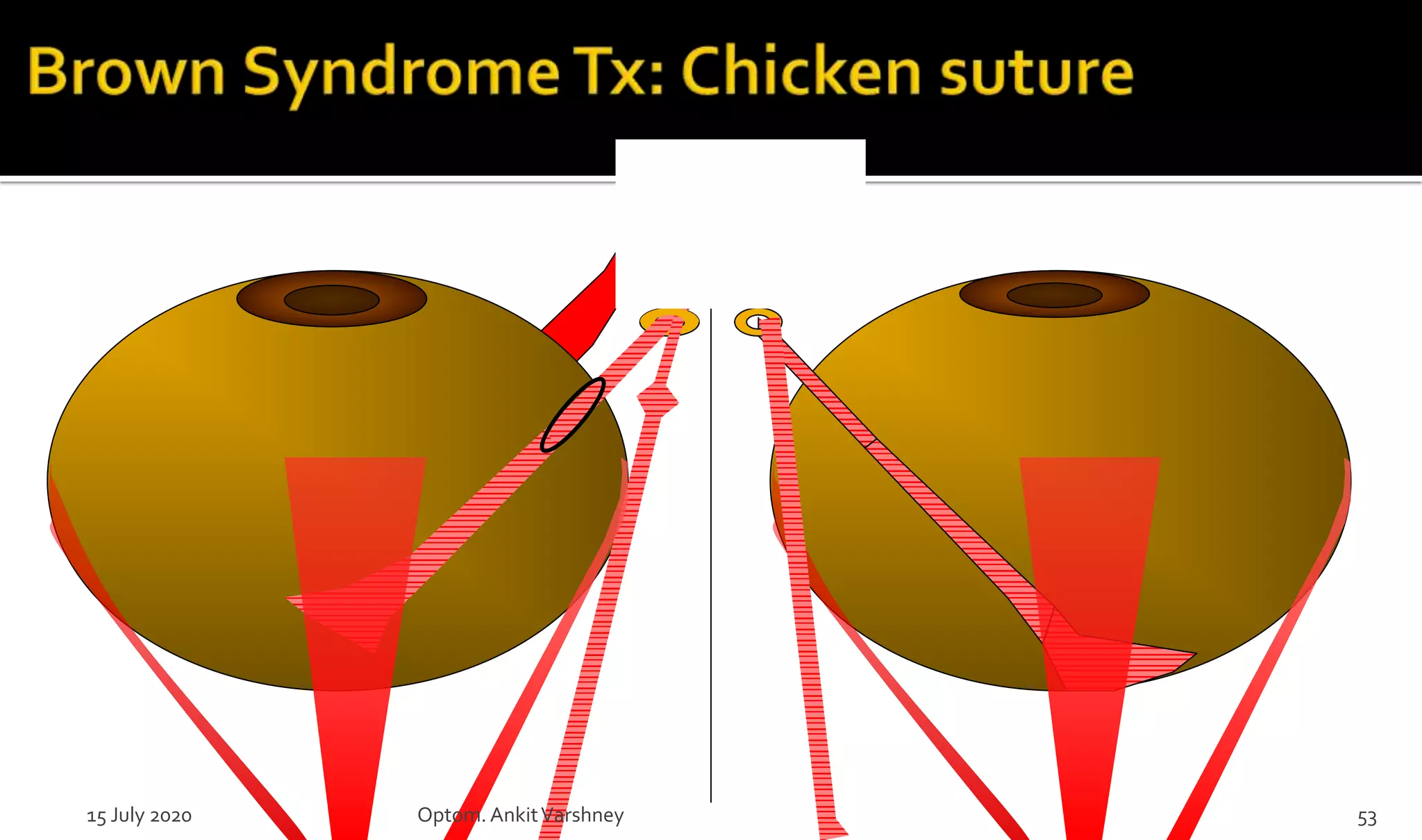
▪ SO tendon chicken suture (mercilene, nonabsorbable)
15 July 2020 Optom.AnkitVarshney 51
SR
MR
LR
IR
SR
LR
RM
IR
IOIO
15 July 2020 Optom.AnkitVarshney 52
15 July 2020 Optom.AnkitVarshney 53
15 July 2020 Optom.AnkitVarshney 54
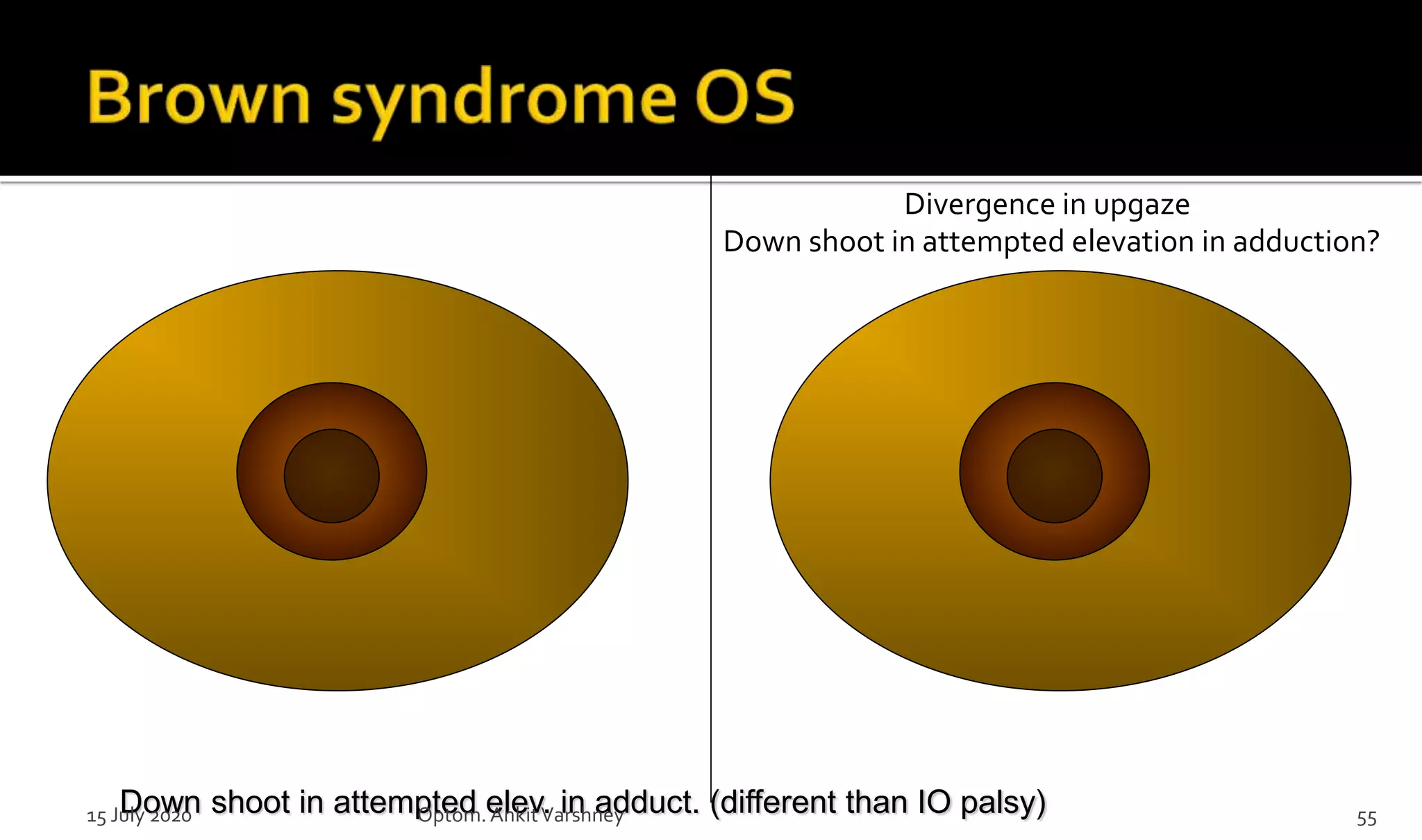
Divergence in upgaze
Down shoot in attempted elevation in adduction?
Down shoot in attempted elev. in adduct. (different than IO palsy)15 July 2020 Optom.AnkitVarshney 55
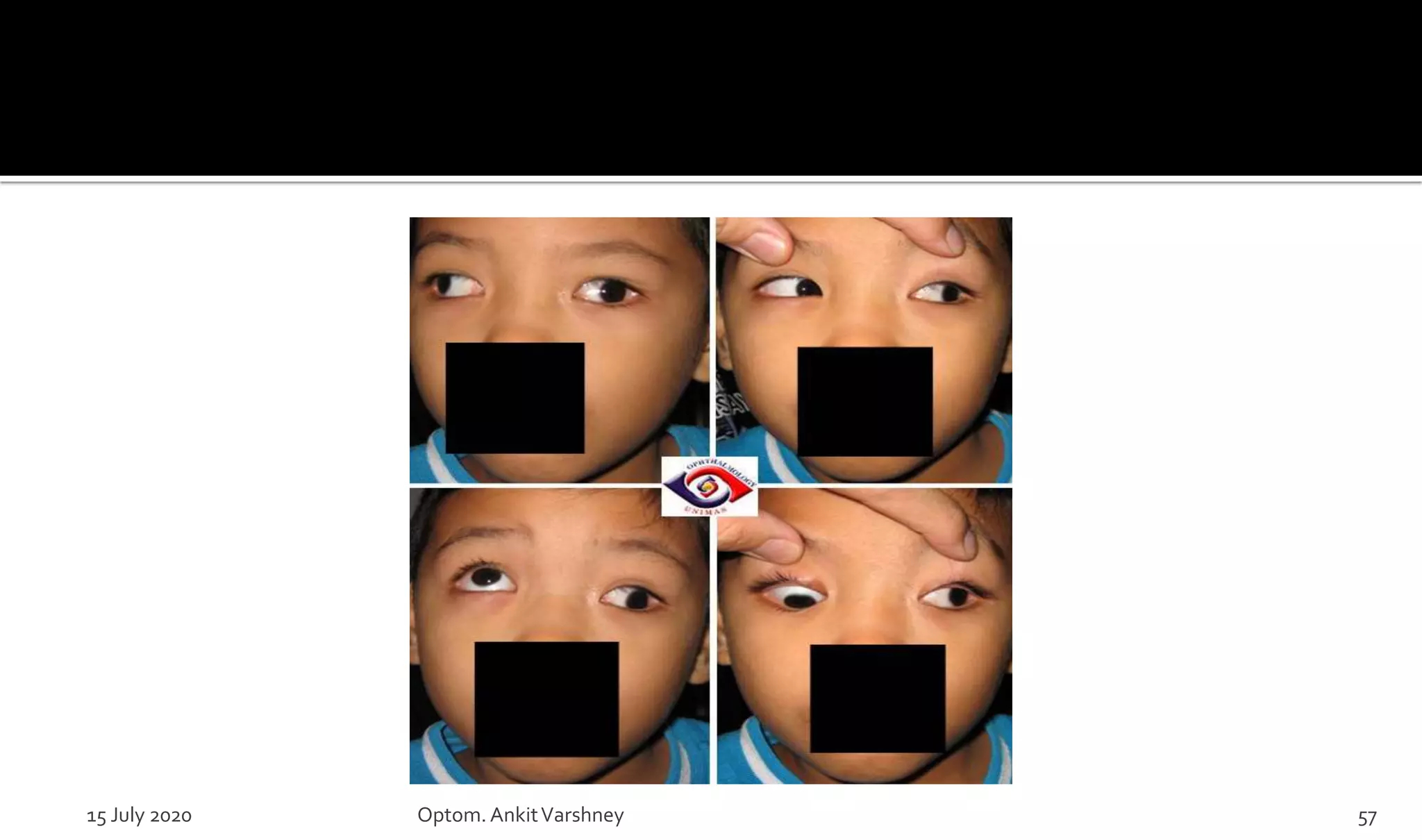
 Rare, Nonprogressive, Autosomal dominant.
 Characterized by hypoplasia and fibrosis of EOM & LPS.
 Bilateral congenital Ptosis.
 In primary position each eye is fixed below the horizontal
by about 10 o due to Congenital fibrosis of the inferior
rectus.
 Thus hypotropic eye may be severe exotropic or esotropic
due to involvement of the horizontal recti.
15 July 2020 Optom.AnkitVarshney 56
15 July 2020 Optom.AnkitVarshney 57
 Surgery is difficult and requires release of the
restricted muscles;
 A good surgical result aligns the eyes in primary
position, but full ocular rotations cannot be
restored and the outcome is unpredictable.
15 July 2020 Optom.AnkitVarshney 58
 Developmental anomaly occurring between the
EOMs and their fascial sheaths.
 Abnormal connections most commonly occur
between the LR and IO, and between the SR and
SO muscles.
15 July 2020 Optom.AnkitVarshney 59
 Diagnosis often mysterious SO LOOK for it !
 Treat Ref Error , amblyopia
 Risk benefit ratio of surgery to be well understood
by patients and surgeon
 Tailor made surgery required for every case
15 July 2020 Optom.AnkitVarshney 60
 Thank you
15 July 2020 Optom.AnkitVarshney 61

Restrictive Strabismus by Ankit Varshney

  • 1.
    Optom. Ankit S.Varshney B.Optom, M.Optom, Ph.D. in Optometry (pursuing) Fellow of IACLE (Aus.), Fellow of ASCO(Mum.) Prof. at (Shree Bharatimaiya College of Optometry & Physiotherapy, Surat) Life Member of Indian Optometric Association (IOA) Associate Member of Association of Schools and Colleges of Optometry(ASCO) Member of Optometry Council of India(OCI) Educator Member of International Association of Contact lense Educators (Australia)(IACLE) Mail id: ankitsvarshney@yahoo.com Whatsapp no. +918155955820
  • 2.
     Binocular vision& strabismus –gk von noorden  Clinical mangement of strabismus elezabeth e.Calarossa & michael w. Rouse  Aao- section: pediatric ophthalmology & strabismus  Strabismus simplified- pradeep sharma  Practical orthoptics in the treatment of squint- lyle and jackson’s15 July 2020 Optom.AnkitVarshney 2
  • 3.
    Skin Conjunctiva Tenon’s layer Eye Muscles Lefteye 15 July 2020 Optom.AnkitVarshney 3
  • 4.
    Eye Muscles Left eye SuperiorOblique/Trochlear Muscle Superior Rectus Muscle Lateral Rectus Muscle Inferior Rectus Muscle Inferior Oblique Muscle Medial Rectus Muscle 15 July 2020 Optom.AnkitVarshney 4
  • 5.
     AKA Squint/Crooked eye  Refers to an ocular condition in which the visual axes of the two eyes do not meet at the point of regards. (Misalignment of visual axes). 15 July 2020 Optom.AnkitVarshney 5
  • 6.
     1. Apparent/Pseudo Strabismus: nothing but an optical illusion caused by prominent epicanthal folds (pseudo eso)/ wide IPD (pseudo exo). Pseudo ET Initially the baby has a “button nose, with a very flat nasal bridge. As the nasal bridge develops and grows forward it will drag the medial portion of the lids inward reducing the appearance of the eyes being crossed. 15 July 2020 Optom.AnkitVarshney 6
  • 7.
     2. LatentStrabismus (Phoria): deviations are present only some of the time: (interruption of BV, fatigue, illness, stress) Orthophoria 15 July 2020 Optom.AnkitVarshney 7
  • 8.
     3. ManifestStrabismus (tropia): eyes deviated all the time  Concomitant ( Non-paralytic)  Incomitant strabismus (Paralytic/ Restrictive/ A &V pattern) Esotropia 15 July 2020 Optom.AnkitVarshney 8
  • 9.
     Manifest squintin which the amount of deviation in squinting eye remains constant in all directions of the gaze and there is no associated limitation in ocular movement. 15 July 2020 Optom.AnkitVarshney 9
  • 10.
     Manifest squintin which the amount of deviation varies in different directions of gaze. 1. Paralytic squint: It refers to ocular deviation resulting from complete/incomplete paralysis of one or more EOM. 2. Restrictive squint: in this, the EOM involved is not paralyzed but its movement is mechanically restricted. It is differentiate by smaller amount of ocular deviation and a Positive FDT. 15 July 2020 Optom.AnkitVarshney 10
  • 11.
    Classified in twotypes: 1. Congenital causes (Musculo-fascial innervational anomalies): DRS, Brown’s SO sheath Syndrome, Strabismus fixus & muscle fibrosis syndrome. 2. Acquired causes: Dysthyroid orbito myopathy, pseudotumor, orbital tumors, fibrosis of EOM secondary to trauma or surgery. 15 July 2020 Optom.AnkitVarshney 11
  • 13.
     Duane syndromeis a rare, congenital disorder of eye movement  Stilling andTurk : described it first  Duane popularised it  Affecting the Horizontally acting muscle: so it Horizontal strabismus. 15 July 2020 Optom.AnkitVarshney 13
  • 14.
     Incidence 1-4percent of all strabismus  Mostly Sporadic  Female > Males (3:2)  Left eye > Right eye (60-75%) where unilateral  Bilateral 18-22%  Many associated congenital anomalies  Occasionally familial 15 July 2020 Optom.AnkitVarshney 14
  • 15.
     Goldenhar Syndrome: Hemifacial microsomia, ocular dermoids, ear anomalies, preauricular skin tags, upper eyelid colobomas.  Wildervanck Syndrome : Sensorineural hearing loss, Klippel Fiel anomaly with fused cervical vertebrae, epibulbar dermoid.  Klippel-feil syndrome 15 July 2020 Optom.AnkitVarshney 15
  • 16.
    “ Musculo Fascial Innervational Anomaly” Fibrosis of LR/MR Fibrous bands Co contraction – Paradoxical innervation 15 July 2020 Optom.AnkitVarshney 16
  • 17.
     Type I(d): Failure or limitation of abduction.  Type II (dd): Failure or limitation of adduction.  Type III (ddd): Failure of abduction and adduction Classic features Retraction of globe on adduction Adduction narrowing of palpebral fissure Upshoot / downshoot of eye in adduction 15 July 2020 Optom.AnkitVarshney 17
  • 18.
    15 July 2020Optom.AnkitVarshney 18
  • 19.
    OS OD 15 July2020 Optom.AnkitVarshney 19
  • 20.
    OS OD 15 July2020 Optom.AnkitVarshney 20
  • 21.
    15 July 2020Optom.AnkitVarshney 21
  • 22.
    15 July 2020Optom.AnkitVarshney 22
  • 23.
    15 July 2020Optom.AnkitVarshney 23
  • 24.
     Squinting  Headtilt  Loss of binocular vision  Reduced ocular movement  Facial asymmetry  Picture of paralytic squint 15 July 2020 Optom.AnkitVarshney 24
  • 25.
     AHP  Strabismus( 77% of cases)  Globe retraction  Palpebral fissure narrowing  Anisometropia /amblyopia  Sensory adaptation with excellent binocular functions -suppression without diplopia in gaze of abnormal muscle 15 July 2020 Optom.AnkitVarshney 25
  • 26.
    Right gaze, Left faceturn… 15 July 2020 Optom.AnkitVarshney 26
  • 27.
     30 PDLET actually,  But can fuse in right gaze, left head turn Check his ductions… Primary gaze 15 July 2020 Optom.AnkitVarshney 27
  • 28.
     30 PDLET actually,  But can fuse in right gaze, left head turn  Notice the limited abduction and narrow fissure in adduction Left gaze, Right face turn… 15 July 2020 Optom.AnkitVarshney 28
  • 29.
     Bilateral DRS 15July 2020 Optom.AnkitVarshney 29
  • 30.
    DRS  ET smallangle  Narrowing  Saccadic velocities SIXTH N PALSY (LR)  ET large angle  -ve  Slow in abduction only MOBIUS SYNDROME: Rare condition affecting bilateral sixth and seventh (facial) cranial nerve palsy. 15 July 2020 Optom.AnkitVarshney 30
  • 31.
     Treat refractiveerror /amblyopia  Conservative : Age 5-6 yrs  Prisms: up to 25 error  Special seating arrangement for children in schools 15 July 2020 Optom.AnkitVarshney 31
  • 32.
     Conservative :Age 5-6 yrs  Vision therapy for secondary convergence insufficiency Normal Convergence Convergence Insufficiency 15 July 2020 Optom.AnkitVarshney 32
  • 33.
     Anomalous headposture  Strabismus in primary gaze  Significant upshoot or downshoot in adduction  Cosmetically significant palpebral fissure narrowing in adduction. “ Limited Goals ” 15 July 2020 Optom.AnkitVarshney 33
  • 34.
    Eso DRS Small angle<15 PD Single MR recession Larger angle Bilateral MR recession Asymmetric 15 July 2020 Optom.AnkitVarshney 34
  • 35.
    Exo DRS Small angle<15 PD Single LR recession Larger angle Bilateral LR recession Symmetric 15 July 2020 Optom.AnkitVarshney 35
  • 36.
    Upshoots Downshoots Globe retraction Recession ofMR and LR Y split Posterior fixation suture to LR 15 July 2020 Optom.AnkitVarshney 36
  • 37.
  • 38.
     A veryrare condition, in which both eyes are fixed (in extreme duction), by fibrous tightening of MR (Convergent strabismus fixus) or LR (Divergent strabismus fixus).  FDT confirms their immobility.  Affecting the Horizontally acting muscle. 15 July 2020 Optom.AnkitVarshney 38
  • 39.
    15 July 2020Optom.AnkitVarshney 39
  • 40.
     Convergent strabismusfixus: Complete disinsertion of MR and resection of LR.  Divergent strabismus fixus: just reverse of above 15 July 2020 Optom.AnkitVarshney 40
  • 41.
  • 42.
    1. Absence ofelevation in adduction 2. Downshoot or hypotropia in attempting elevation in adduction 3. Unaffected elevation in primary and abducted position 4. Y pattern with divergence in upgaze 5. Anomalous head posture (Often seen with chin up position) 6. Positive FDT 7. 2/3 are mild and do not require treatment if ortho in primary15 July 2020 Optom.AnkitVarshney 42
  • 43.
     Trauma or Infection ofTrochlear area  SO tucking Sx  Canine tooth syndrome: Dog bites- scarring SO 15 July 2020 Optom.AnkitVarshney 43
  • 44.
    Divergence in upgaze Downshoot in attempted elevation in adduction? 15 July 2020 Optom.AnkitVarshney 44
  • 45.
     Mild: Restrictedelevation in adduction but no downshoot or hypotropia in primary position.  Moderate: Restricted elevation in adduction with downshoot but no hypotropia in primary position.  Severe: Restricted elevation & downshoot in adduction with hypotropia in primary position.  To understand Brown’s syndrome  We need to understand relationship between the superior and inferior oblique. 15 July 2020 Optom.AnkitVarshney 45
  • 46.
    15 July 2020Optom.AnkitVarshney 46
  • 47.
    15 July 2020Optom.AnkitVarshney 47
  • 48.
    Restriction of thesuperior oblique tendon at the trochlear pulley 15 July 2020 Optom.AnkitVarshney 48
  • 49.
    15 July 2020Optom.AnkitVarshney 49
  • 50.
    1-I O PALSY 2-DOUBLEELEVATOR PALSY 3- CONGENITAL FIBROSIS SYNDROM 4-BLOW OUT FX 5-THYROID OPHTHALMOPATY 5-ADHERENCE SYNDROM 15 July 2020 Optom.AnkitVarshney 50
  • 51.
     If associatedwith other disease  ie rheumatoid arthritis or sinusitis  Treat the underlying condition.  Surgery if:  Hypotropia in primary  Anomalous head posture: severe chin up.  Consider ▪ SO tendon tenotomy, ▪ SO tendon silicone expander ▪ SO tendon chicken suture (mercilene, nonabsorbable) 15 July 2020 Optom.AnkitVarshney 51
  • 52.
  • 53.
    15 July 2020Optom.AnkitVarshney 53
  • 54.
    15 July 2020Optom.AnkitVarshney 54
  • 55.
    Divergence in upgaze Downshoot in attempted elevation in adduction? Down shoot in attempted elev. in adduct. (different than IO palsy)15 July 2020 Optom.AnkitVarshney 55
  • 56.
     Rare, Nonprogressive,Autosomal dominant.  Characterized by hypoplasia and fibrosis of EOM & LPS.  Bilateral congenital Ptosis.  In primary position each eye is fixed below the horizontal by about 10 o due to Congenital fibrosis of the inferior rectus.  Thus hypotropic eye may be severe exotropic or esotropic due to involvement of the horizontal recti. 15 July 2020 Optom.AnkitVarshney 56
  • 57.
    15 July 2020Optom.AnkitVarshney 57
  • 58.
     Surgery isdifficult and requires release of the restricted muscles;  A good surgical result aligns the eyes in primary position, but full ocular rotations cannot be restored and the outcome is unpredictable. 15 July 2020 Optom.AnkitVarshney 58
  • 59.
     Developmental anomalyoccurring between the EOMs and their fascial sheaths.  Abnormal connections most commonly occur between the LR and IO, and between the SR and SO muscles. 15 July 2020 Optom.AnkitVarshney 59
  • 60.
     Diagnosis oftenmysterious SO LOOK for it !  Treat Ref Error , amblyopia  Risk benefit ratio of surgery to be well understood by patients and surgeon  Tailor made surgery required for every case 15 July 2020 Optom.AnkitVarshney 60
  • 61.
     Thank you 15July 2020 Optom.AnkitVarshney 61