VIKAS SHARMA MANISH PANDEY ARCHIT SARWAL   ROHIT DOSHI ANAMIKA ALOK SHRIVASTAVA ROUNAK TALWAR ADITI AMBASTHA RACHIT JOSHI SAMEER By, By, FEMTOCELL
NGN NGOSS IMS History Evolution Why IMS Architecture IMS Layers IMS platform Identity SIP Benefits of IMS Billing of IMS Business drivers Service Drivers IMS services Video Flow of Presentation
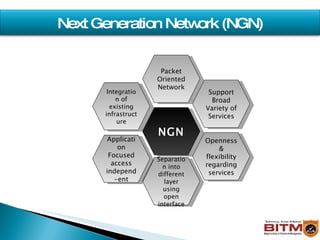
Packet Oriented Network Support Broad Variety of Services Openness & flexibility regarding services Separation into different layer using open interface Integration of existing infrastructure Application Focused access independ-ent NGN Next Generation Network (NGN)
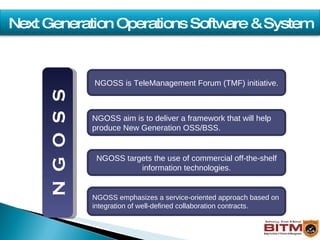
N  G  O  S  S NGOSS is TeleManagement Forum (TMF) initiative. NGOSS aim is to deliver a framework that will help produce New Generation OSS/BSS.  NGOSS targets the use of commercial off-the-shelf information technologies. NGOSS emphasizes a service-oriented approach based on integration of well-defined collaboration contracts. Next Generation Operations Software & System
Call handling  Signaling & IN TDM-Transport Call handling  Signaling & IN TDM-Transport Call-by-Call, VAS IP-based Control IP-Transport (IP-) Applications Yesterday‘s Monopoly Today‘s Monolith Tomorrow‘s Disintegration open interface proprietary interface Carrier has control of the entire PSTN There is only one business model Carrier controls (customer) access and control layer Business model defined by price competition The network is split into three independent layers with IP as the common protocol and open interfaces between layers Different entities may operate in all layers Separate business models emerge for sales, service and access/transport open interface Value Added Services NGN Towards  NGN
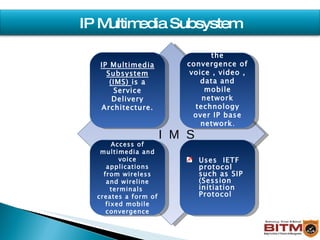
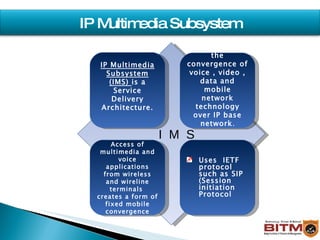
IP Multimedia Subsystem (IMS)  is a Service Delivery Architecture. I  M  S It enables the convergence of voice , video , data and mobile network technology over IP base network . Uses  IETF protocol such as SIP (Session initiation Protocol Access of multimedia and voice applications from wireless and wireline terminals  creates a form of fixed mobile convergence IP Multimedia Subsystem
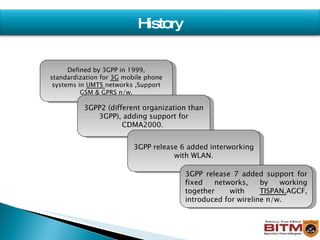
Defined by 3GPP in 1999, standardization for  3G  mobile phone systems in  UMTS  networks ,Support GSM & GPRS n/w. 3GPP2 (different organization than 3GPP), adding support for CDMA2000.  3GPP release 6 added interworking with WLAN. 3GPP release 7 added support for fixed networks, by working together with  TISPAN. AGCF, introduced for wireline n/w.  History
Defined by 3GPP in 1999, standardization for  3G  mobile phone systems in  UMTS  networks ,Support GSM & GPRS n/w. 3GPP2 (different organization than 3GPP), adding support for CDMA2000.  3GPP release 6 added interworking with WLAN. 3GPP release 7 added support for fixed networks, by working together with  TISPAN. AGCF,  introduced for wireline n/w.  History
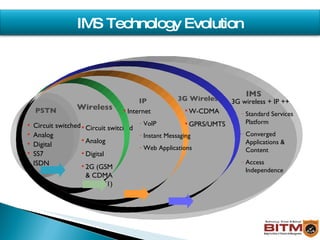
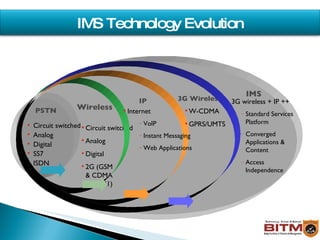
IMS Technology Evolution PSTN Circuit switched  Analog Digital SS7 ISDN Circuit switched Analog Digital 2G (GSM  & CDMA ANSI-41)  3G Wireless Wireless 3G wireless + IP ++ Standard Services Platform Converged Applications & Content Access Independence IP IMS Internet VoIP Instant Messaging Web Applications W-CDMA GPRS/UMTS
Need a better environment for creating and deploying high value multimedia services Transform business models from voice-driven to service-driven businesses Fixed-Mobile Convergence on a common IP application and service delivery architecture  Grow and protect subscriber base, increase ARPU. Deliver a differentiated portfolio of value-added services Provide more subscriber focused offerings  Why IMS
Controlling CAPEX and OPEX Maturity and adoption of SIP  Common function are used for different services Provides horizontal layer architecture Faster time to market with new services   Develop on standards-based technology Better QoS Reduce time to m arket for new applications with web development model. Why IMS cont…..
Controlling CAPEX and OPEX Maturity and adoption of SIP Common function are used for different services Provides horizontal layer architecture Faster time to market with new services   Develop on standards-based technology Better QoS Reduce time to m arket for new applications with web development model. Why IMS cont…..
Architecture Application Server Application Server Application Server Session Control HSS Centralized  Databases Media Control  & Gateways PSTN 2G/3G Mobile Wireless Broadband Wireline Broadband Res./ Enterprize Services plane (Application Layer) Session Control Plane  (Session and DB Layer) Media Control Plane   (Media Control  & Gateway Layer) Network Plane (Access and Transport)
Architecture
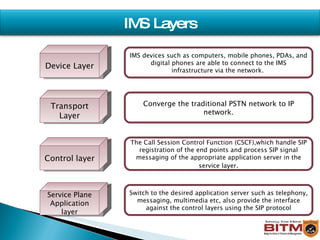
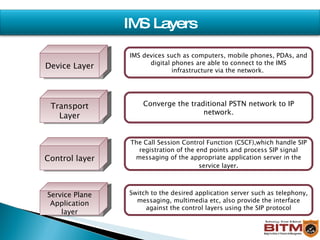
Transport Layer Control layer Device Layer IMS devices such as computers, mobile phones, PDAs, and digital phones are able to connect to the IMS infrastructure via the network.  Converge the traditional PSTN network to IP network. The Call Session Control Function (CSCF),which handle SIP registration of the end points and process SIP signal messaging of the appropriate application server in the service layer . Service Plane Application layer Switch to the desired application server such as telephony, messaging, multimedia etc, also provide the interface against the control layers using the SIP protocol IMS Layers
IMS Common platform
Different Services single medium
SS7 MSC SCP HLR Carrier A  GSM / ANSI Network MSC HLR Carrier B  GSM / ANSI Network SCP Traditional View
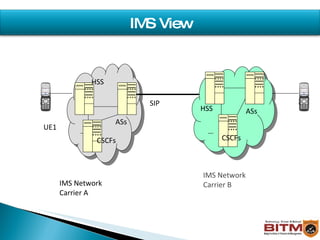
UE1 SIP IMS Network Carrier A IMS Network Carrier B ASs HSS HSS ASs CSCFs CSCFs IMS View
Private User Identity Relationship Between User Identities [email_address] Sip:zehan.zeb@newstore.com tel:+17324567888 Sip:zehan.zeb@example.com tel:+88028112347 IMS Subscriber
The Session Initiation Protocol (SIP) is a siglaling protocol, widely used for controlling  multimedia communication session such as voice and video calls over Internet Protocol (IP). Other feasible application examples include  video conferrencing, streaming multimedia distribution, instant messaging  presence information and online games. The SIP protocol is a TCP/IP-based Application Layer protocol It can used to create two party , multiparty or multicast session Session Initiation Protocol (SIP)
The Session Initiation Protocol (SIP) is a signaling protocol, widely used for controlling  multimedia communication session such as voice and video calls over Internet Protocol (IP). Other feasible application examples include  video conferrencing, streaming multimedia distribution, instant messaging  presence information and online games. The SIP protocol is a TCP/IP-based Application Layer protocol It can used to create two party , multiparty or multicast session Session Initiation Protocol (SIP)
SIP Messages SIP message BYE OPTION CANCEL ACK REGISTER INVITE SIP Formats Sib:bob@201.203.98.87 Sip:bob@fhda.edu Sip:bob@408-897-987 IP v4 address Email address phone no Session Initiation Protocol (SIP)  cntd….
SIP Messages SIP message BYE OPTION CANCEL ACK REGISTER INVITE SIP Formats Sib:bob@201.203.98.87 Sip:bob@fhda.edu Sip:bob@408-897-987 IP v4 address Email address phone no Session Initiation Protocol (SIP)  cont….
Shared Resources Media server resources   Common user data  Single user profile across applications Integrated applications Session Control Common Session Control (SIP) Provides common service policies Leverages investments across multiple  applications Access Network Agnostic Eliminates multiple service solutions Network transparency Consistent services across networks Converged Applications Across Networks Reduced development costs and time Voice, Video and data services Write once / use many Transport   Control Applications   DSL Mobile PSTN Web Content SIP Access CMTS Benefits of IMS Voice Video Hosted Services Data
Packet Switch n/w CSCF SIP S S  SIP M CCF SCF Circuit Switch n/w Balance mgmt Replenishment Product  Catalog CONVERGENT CHARGING Online Charging Offline Charging Mediation Diameter IMS  Application   Server IMS Session Control IMS interworking Gateways Billing in IMS HSS
Customer Lock-in/ Churn reduction Improve margin Improve TTM  (Time To Market) To provide mechanisms that ensure customers stay with an operator e.g n/w data storage  network initiated actions, community products etc. One stop shop approach Lower Opex & Capex. All-encompassing tariff structure for fixed and mobile. Unifying platforms across networks Enable services to have a short  Introduction phase to overall PLC (Product Life Cycle). Revenue Sharing with content providers. Business drivers for IMS
IMS Deployment Wireless Operator Infrastructure Vendor  Service Planned BT (UK) Undisclosed BT Fusion fixed/mobile converged phone service eAaccess (Japan) Lucent Multimedia, HSDPA France Telecom Siemens Fixedmobile convergence MM02 (UK) Siemens Push-to-talk over cellular (POC), multimedia conferencing Saunalahti (Finland) Nokia VoIP and rich multimedia to both mobile and fixed telephony customers Telecom Italia Mobile Ericsson and Nokia Video sharing Telefonica (Spain) Ericsson Converged wireless/wireline IMS deployment Telia Sonera  (Nordic region) Ericsson, Nokia, and Siemens Instant messaging, video sharing, gaming among different mobile operators TMN (Portugal) Nokia Video sharing
IMS Equipment Revenue
PUSH-TO-TALK over mobile phone. Interactive Gaming Shared folders Instant Messaging services Voice Messaging Voice and Video Telephony Video-conferencing. Real Time Video Sharing. IMS Services
IMS Services


Ims, Ip Multimedia System

  • 1.
    VIKAS SHARMA MANISHPANDEY ARCHIT SARWAL ROHIT DOSHI ANAMIKA ALOK SHRIVASTAVA ROUNAK TALWAR ADITI AMBASTHA RACHIT JOSHI SAMEER By, By, FEMTOCELL
  • 2.
    NGN NGOSS IMSHistory Evolution Why IMS Architecture IMS Layers IMS platform Identity SIP Benefits of IMS Billing of IMS Business drivers Service Drivers IMS services Video Flow of Presentation
  • 3.
    Packet Oriented NetworkSupport Broad Variety of Services Openness & flexibility regarding services Separation into different layer using open interface Integration of existing infrastructure Application Focused access independ-ent NGN Next Generation Network (NGN)
  • 4.
    Packet Oriented NetworkSupport Broad Variety of Services Openness & flexibility regarding services Separation into different layer using open interface Integration of existing infrastructure Application Focused access independ-ent NGN Next Generation Network (NGN)
  • 5.
    N G O S S NGOSS is TeleManagement Forum (TMF) initiative. NGOSS aim is to deliver a framework that will help produce New Generation OSS/BSS. NGOSS targets the use of commercial off-the-shelf information technologies. NGOSS emphasizes a service-oriented approach based on integration of well-defined collaboration contracts. Next Generation Operations Software & System
  • 6.
    N G O S S NGOSS is TeleManagement Forum (TMF) initiative. NGOSS aim is to deliver a framework that will help produce New Generation OSS/BSS. NGOSS targets the use of commercial off-the-shelf information technologies. NGOSS emphasizes a service-oriented approach based on integration of well-defined collaboration contracts. Next Generation Operations Software & System
  • 7.
    Call handling Signaling & IN TDM-Transport Call handling Signaling & IN TDM-Transport Call-by-Call, VAS IP-based Control IP-Transport (IP-) Applications Yesterday‘s Monopoly Today‘s Monolith Tomorrow‘s Disintegration open interface proprietary interface Carrier has control of the entire PSTN There is only one business model Carrier controls (customer) access and control layer Business model defined by price competition The network is split into three independent layers with IP as the common protocol and open interfaces between layers Different entities may operate in all layers Separate business models emerge for sales, service and access/transport open interface Value Added Services NGN Towards NGN
  • 8.
    IP Multimedia Subsystem(IMS) is a Service Delivery Architecture. I M S It enables the convergence of voice , video , data and mobile network technology over IP base network . Uses IETF protocol such as SIP (Session initiation Protocol Access of multimedia and voice applications from wireless and wireline terminals creates a form of fixed mobile convergence IP Multimedia Subsystem
  • 9.
    IP Multimedia Subsystem(IMS) is a Service Delivery Architecture. I M S It enables the convergence of voice , video , data and mobile network technology over IP base network . Uses IETF protocol such as SIP (Session initiation Protocol Access of multimedia and voice applications from wireless and wireline terminals creates a form of fixed mobile convergence IP Multimedia Subsystem
  • 10.
    Defined by 3GPPin 1999, standardization for 3G mobile phone systems in UMTS networks ,Support GSM & GPRS n/w. 3GPP2 (different organization than 3GPP), adding support for CDMA2000. 3GPP release 6 added interworking with WLAN. 3GPP release 7 added support for fixed networks, by working together with TISPAN. AGCF, introduced for wireline n/w. History
  • 11.
    Defined by 3GPPin 1999, standardization for 3G mobile phone systems in UMTS networks ,Support GSM & GPRS n/w. 3GPP2 (different organization than 3GPP), adding support for CDMA2000. 3GPP release 6 added interworking with WLAN. 3GPP release 7 added support for fixed networks, by working together with TISPAN. AGCF, introduced for wireline n/w. History
  • 12.
    IMS Technology EvolutionPSTN Circuit switched Analog Digital SS7 ISDN Circuit switched Analog Digital 2G (GSM & CDMA ANSI-41) 3G Wireless Wireless 3G wireless + IP ++ Standard Services Platform Converged Applications & Content Access Independence IP IMS Internet VoIP Instant Messaging Web Applications W-CDMA GPRS/UMTS
  • 13.
    IMS Technology EvolutionPSTN Circuit switched Analog Digital SS7 ISDN Circuit switched Analog Digital 2G (GSM & CDMA ANSI-41) 3G Wireless Wireless 3G wireless + IP ++ Standard Services Platform Converged Applications & Content Access Independence IP IMS Internet VoIP Instant Messaging Web Applications W-CDMA GPRS/UMTS
  • 14.
    Need a betterenvironment for creating and deploying high value multimedia services Transform business models from voice-driven to service-driven businesses Fixed-Mobile Convergence on a common IP application and service delivery architecture Grow and protect subscriber base, increase ARPU. Deliver a differentiated portfolio of value-added services Provide more subscriber focused offerings Why IMS
  • 15.
    Need a betterenvironment for creating and deploying high value multimedia services Transform business models from voice-driven to service-driven businesses Fixed-Mobile Convergence on a common IP application and service delivery architecture Grow and protect subscriber base, increase ARPU. Deliver a differentiated portfolio of value-added services Provide more subscriber focused offerings Why IMS
  • 16.
    Controlling CAPEX andOPEX Maturity and adoption of SIP Common function are used for different services Provides horizontal layer architecture Faster time to market with new services Develop on standards-based technology Better QoS Reduce time to m arket for new applications with web development model. Why IMS cont…..
  • 17.
    Controlling CAPEX andOPEX Maturity and adoption of SIP Common function are used for different services Provides horizontal layer architecture Faster time to market with new services Develop on standards-based technology Better QoS Reduce time to m arket for new applications with web development model. Why IMS cont…..
  • 18.
    Architecture Application ServerApplication Server Application Server Session Control HSS Centralized Databases Media Control & Gateways PSTN 2G/3G Mobile Wireless Broadband Wireline Broadband Res./ Enterprize Services plane (Application Layer) Session Control Plane (Session and DB Layer) Media Control Plane (Media Control & Gateway Layer) Network Plane (Access and Transport)
  • 19.
  • 20.
    Transport Layer Controllayer Device Layer IMS devices such as computers, mobile phones, PDAs, and digital phones are able to connect to the IMS infrastructure via the network. Converge the traditional PSTN network to IP network. The Call Session Control Function (CSCF),which handle SIP registration of the end points and process SIP signal messaging of the appropriate application server in the service layer . Service Plane Application layer Switch to the desired application server such as telephony, messaging, multimedia etc, also provide the interface against the control layers using the SIP protocol IMS Layers
  • 21.
    Transport Layer Controllayer Device Layer IMS devices such as computers, mobile phones, PDAs, and digital phones are able to connect to the IMS infrastructure via the network. Converge the traditional PSTN network to IP network. The Call Session Control Function (CSCF),which handle SIP registration of the end points and process SIP signal messaging of the appropriate application server in the service layer . Service Plane Application layer Switch to the desired application server such as telephony, messaging, multimedia etc, also provide the interface against the control layers using the SIP protocol IMS Layers
  • 22.
  • 23.
  • 24.
    SS7 MSC SCPHLR Carrier A GSM / ANSI Network MSC HLR Carrier B GSM / ANSI Network SCP Traditional View
  • 25.
    UE1 SIP IMSNetwork Carrier A IMS Network Carrier B ASs HSS HSS ASs CSCFs CSCFs IMS View
  • 26.
    Private User IdentityRelationship Between User Identities [email_address] Sip:zehan.zeb@newstore.com tel:+17324567888 Sip:zehan.zeb@example.com tel:+88028112347 IMS Subscriber
  • 27.
    The Session InitiationProtocol (SIP) is a siglaling protocol, widely used for controlling multimedia communication session such as voice and video calls over Internet Protocol (IP). Other feasible application examples include video conferrencing, streaming multimedia distribution, instant messaging presence information and online games. The SIP protocol is a TCP/IP-based Application Layer protocol It can used to create two party , multiparty or multicast session Session Initiation Protocol (SIP)
  • 28.
    The Session InitiationProtocol (SIP) is a signaling protocol, widely used for controlling multimedia communication session such as voice and video calls over Internet Protocol (IP). Other feasible application examples include video conferrencing, streaming multimedia distribution, instant messaging presence information and online games. The SIP protocol is a TCP/IP-based Application Layer protocol It can used to create two party , multiparty or multicast session Session Initiation Protocol (SIP)
  • 29.
    SIP Messages SIPmessage BYE OPTION CANCEL ACK REGISTER INVITE SIP Formats Sib:bob@201.203.98.87 Sip:bob@fhda.edu Sip:bob@408-897-987 IP v4 address Email address phone no Session Initiation Protocol (SIP) cntd….
  • 30.
    SIP Messages SIPmessage BYE OPTION CANCEL ACK REGISTER INVITE SIP Formats Sib:bob@201.203.98.87 Sip:bob@fhda.edu Sip:bob@408-897-987 IP v4 address Email address phone no Session Initiation Protocol (SIP) cont….
  • 31.
    Shared Resources Mediaserver resources Common user data Single user profile across applications Integrated applications Session Control Common Session Control (SIP) Provides common service policies Leverages investments across multiple applications Access Network Agnostic Eliminates multiple service solutions Network transparency Consistent services across networks Converged Applications Across Networks Reduced development costs and time Voice, Video and data services Write once / use many Transport Control Applications DSL Mobile PSTN Web Content SIP Access CMTS Benefits of IMS Voice Video Hosted Services Data
  • 32.
    Packet Switch n/wCSCF SIP S S SIP M CCF SCF Circuit Switch n/w Balance mgmt Replenishment Product Catalog CONVERGENT CHARGING Online Charging Offline Charging Mediation Diameter IMS Application Server IMS Session Control IMS interworking Gateways Billing in IMS HSS
  • 33.
    Packet Switch n/wCSCF SIP S S SIP M CCF SCF Circuit Switch n/w Balance mgmt Replenishment Product Catalog CONVERGENT CHARGING Online Charging Offline Charging Mediation Diameter IMS Application Server IMS Session Control IMS interworking Gateways Billing in IMS HSS
  • 34.
    Customer Lock-in/ Churnreduction Improve margin Improve TTM (Time To Market) To provide mechanisms that ensure customers stay with an operator e.g n/w data storage network initiated actions, community products etc. One stop shop approach Lower Opex & Capex. All-encompassing tariff structure for fixed and mobile. Unifying platforms across networks Enable services to have a short Introduction phase to overall PLC (Product Life Cycle). Revenue Sharing with content providers. Business drivers for IMS
  • 35.
    Customer Lock-in/ Churnreduction Improve margin Improve TTM (Time To Market) To provide mechanisms that ensure customers stay with an operator e.g n/w data storage network initiated actions, community products etc. One stop shop approach Lower Opex & Capex. All-encompassing tariff structure for fixed and mobile. Unifying platforms across networks Enable services to have a short Introduction phase to overall PLC (Product Life Cycle). Revenue Sharing with content providers. Business drivers for IMS
  • 36.
    IMS Deployment WirelessOperator Infrastructure Vendor Service Planned BT (UK) Undisclosed BT Fusion fixed/mobile converged phone service eAaccess (Japan) Lucent Multimedia, HSDPA France Telecom Siemens Fixedmobile convergence MM02 (UK) Siemens Push-to-talk over cellular (POC), multimedia conferencing Saunalahti (Finland) Nokia VoIP and rich multimedia to both mobile and fixed telephony customers Telecom Italia Mobile Ericsson and Nokia Video sharing Telefonica (Spain) Ericsson Converged wireless/wireline IMS deployment Telia Sonera (Nordic region) Ericsson, Nokia, and Siemens Instant messaging, video sharing, gaming among different mobile operators TMN (Portugal) Nokia Video sharing
  • 37.
  • 38.
    PUSH-TO-TALK over mobilephone. Interactive Gaming Shared folders Instant Messaging services Voice Messaging Voice and Video Telephony Video-conferencing. Real Time Video Sharing. IMS Services
  • 39.
  • 40.
  • 41.