IP Multimedia Subsystem


Presenter : InamUllah Khosa
Head of Product Development, Turnotech Pakistan


Cornet Research Lab , Muhammad Ali Jinnah University
Presentation Plan
    Background - Evolution of 2G, 2.5G and 3G
    What is IMS
    Standardization Bodies
    Functions of IMS
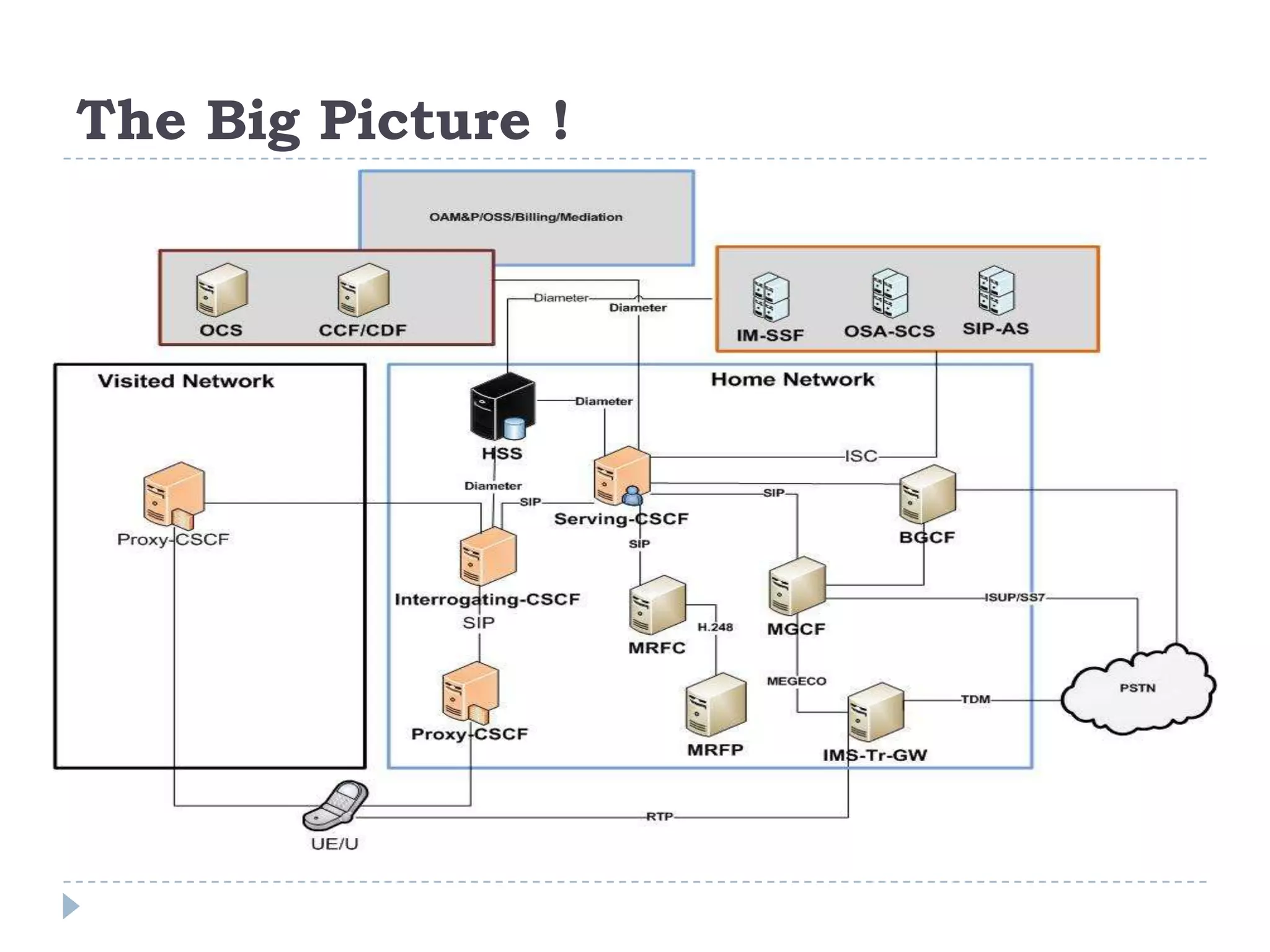
    IMS Architecture – The Big Picture
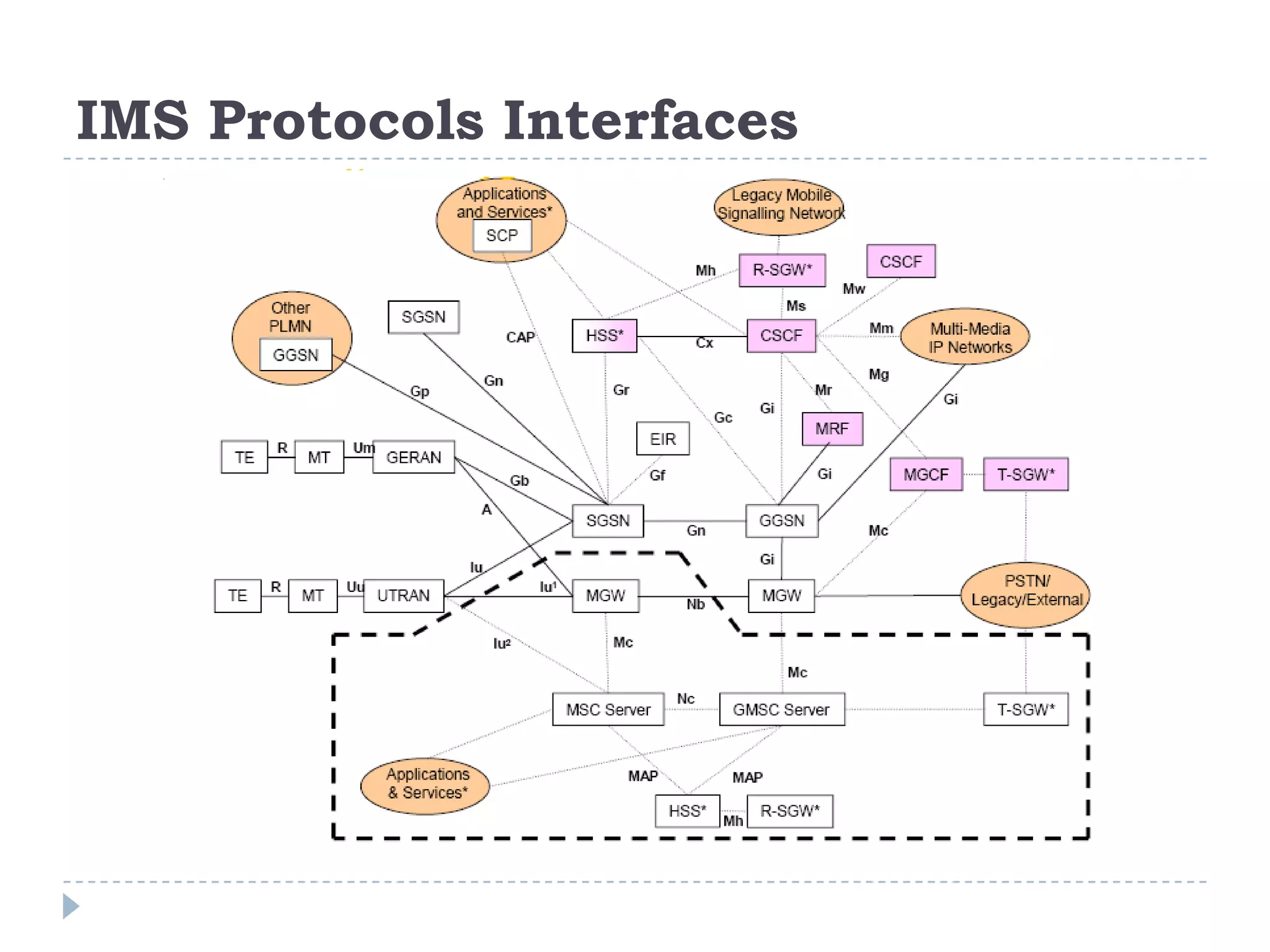
    IMS Components and Interfaces
    IMS Services Control Model
    IMS Protocols
    Conclusion
Setting the Stage.


        Revisiting the Past !
        (Network Evolution)
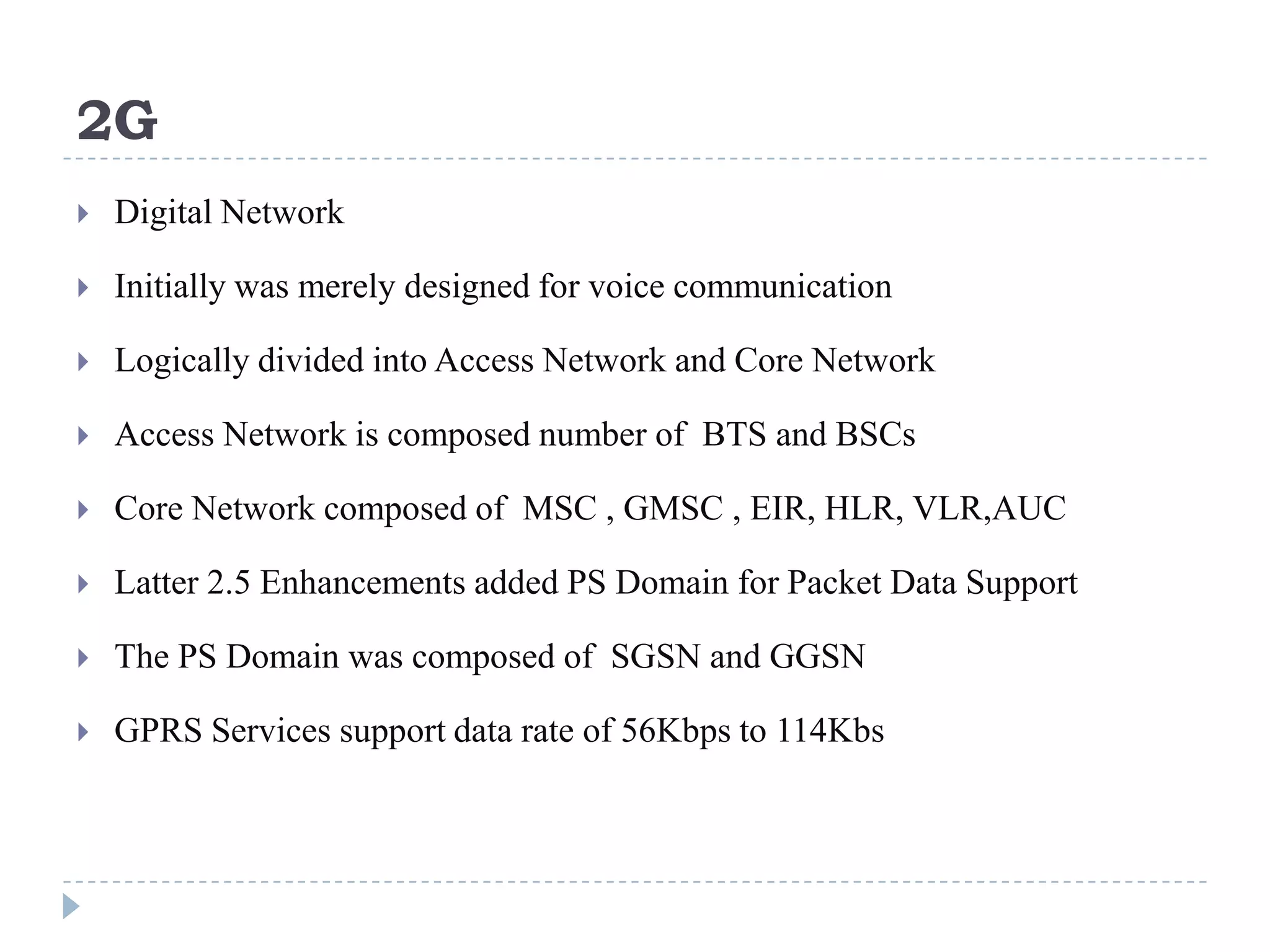
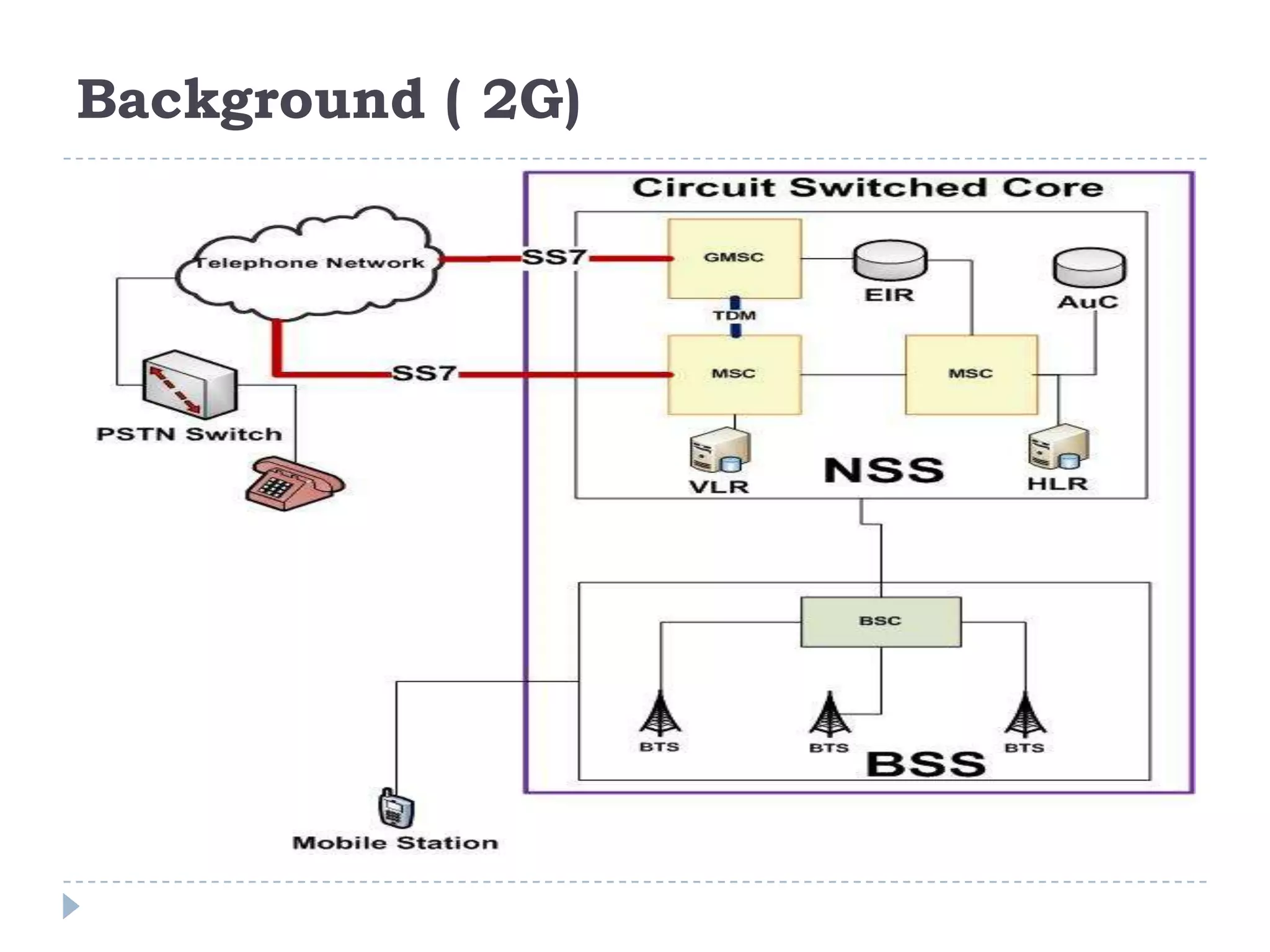
2G
   Digital Network

   Initially was merely designed for voice communication

   Logically divided into Access Network and Core Network

   Access Network is composed number of BTS and BSCs

   Core Network composed of MSC , GMSC , EIR, HLR, VLR,AUC

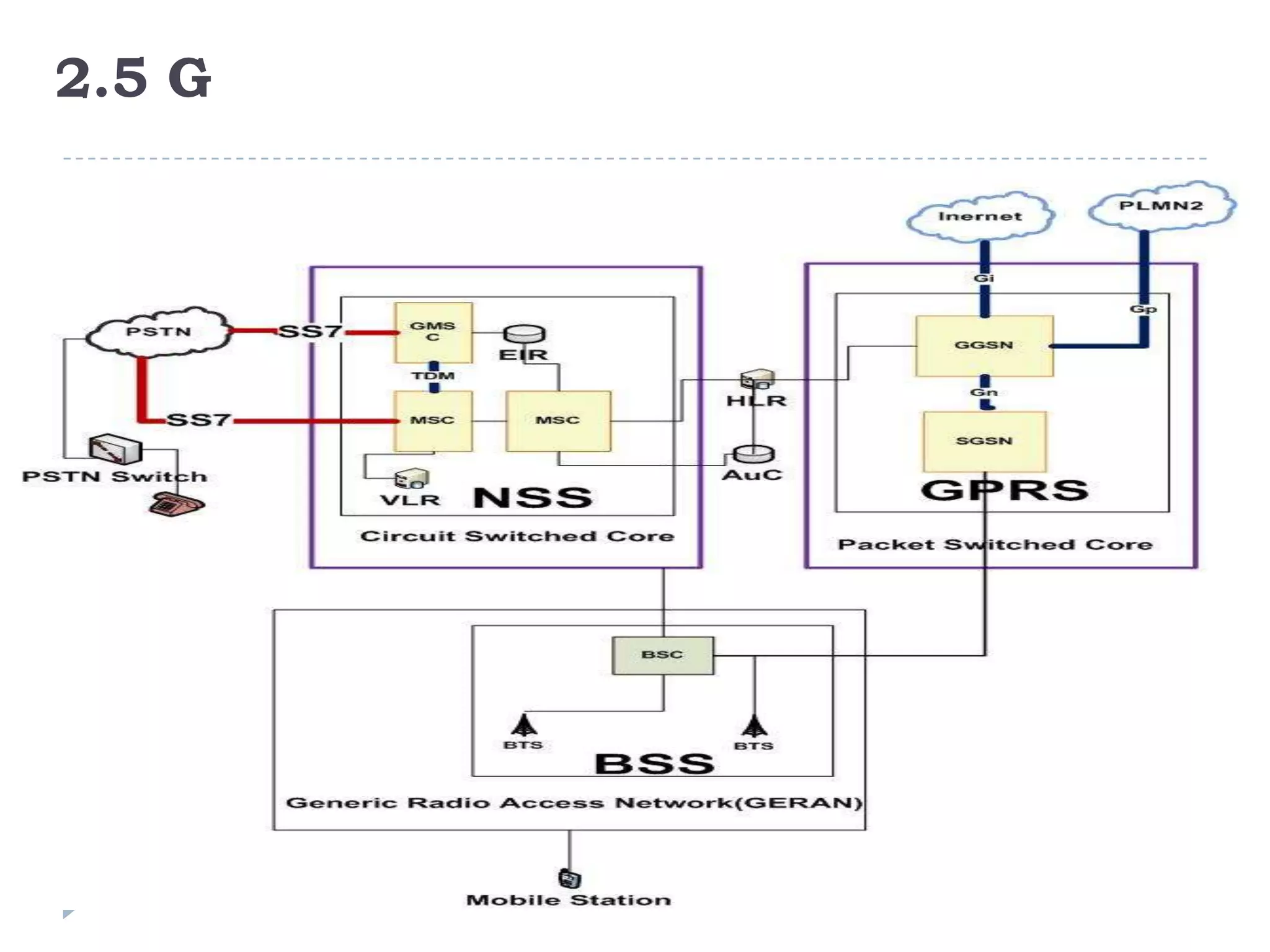
   Latter 2.5 Enhancements added PS Domain for Packet Data Support

   The PS Domain was composed of SGSN and GGSN

   GPRS Services support data rate of 56Kbps to 114Kbs
Background ( 2G)
2.5 G
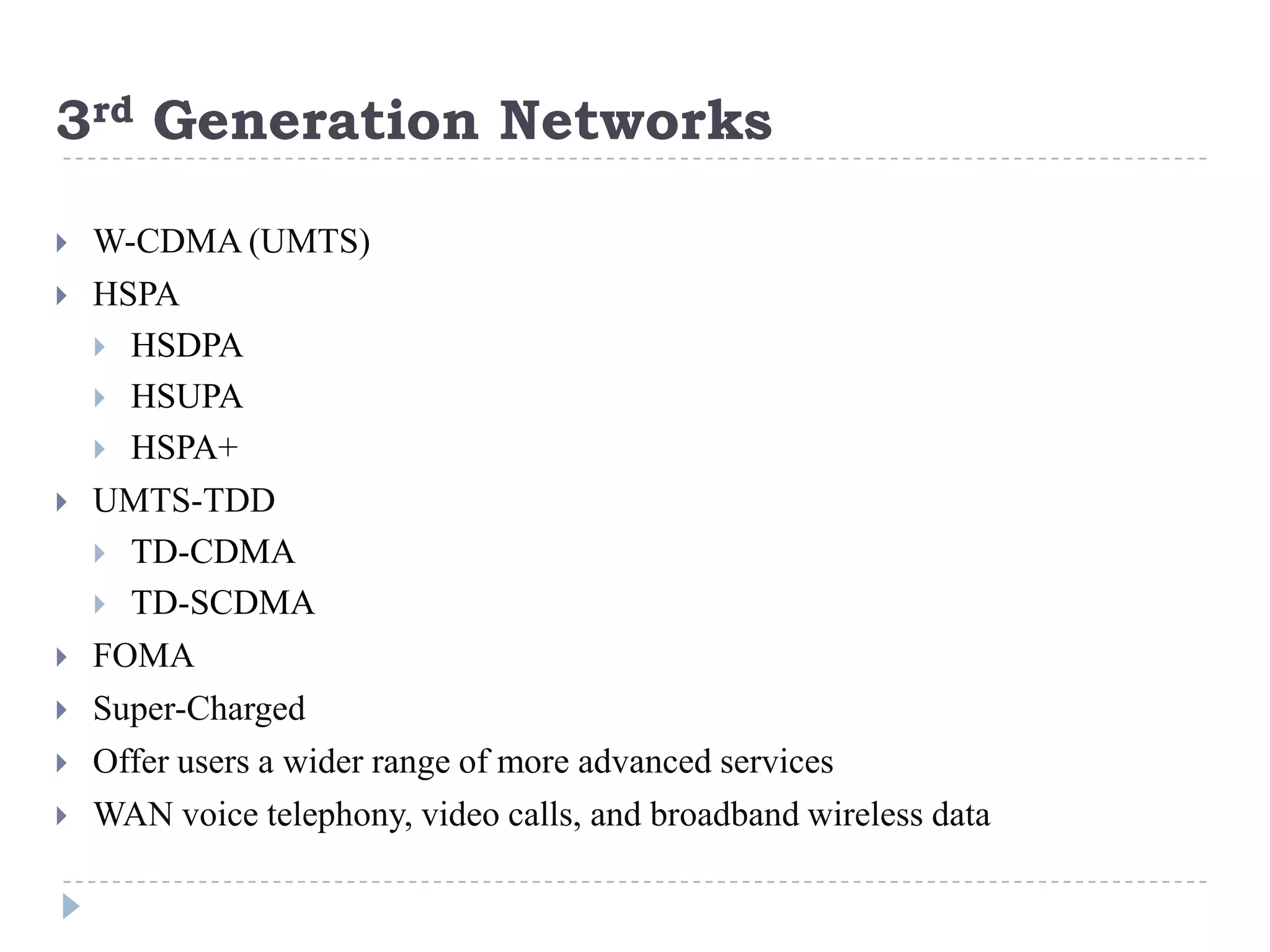
3rd Generation Networks

   W-CDMA (UMTS)
   HSPA
     HSDPA
     HSUPA
     HSPA+
   UMTS-TDD
     TD-CDMA
     TD-SCDMA
   FOMA
   Super-Charged
   Offer users a wider range of more advanced services
   WAN voice telephony, video calls, and broadband wireless data
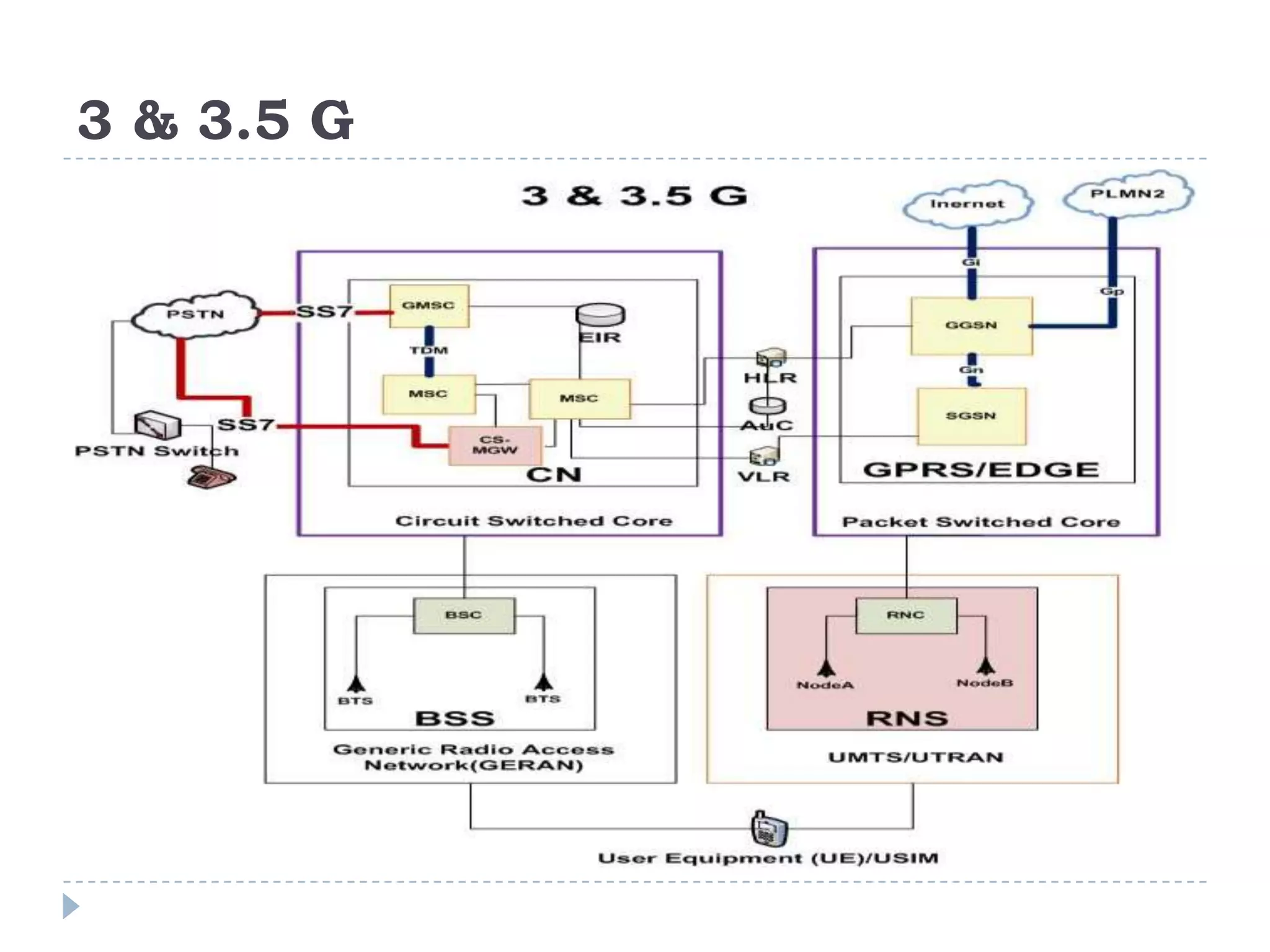
3 & 3.5 G
4G
   3GPP LTE
       improving spectral efficiency
       lowering costs
       improving services

       LTE air interface is a completely new system based on
           OFDMA in the downlink

           SC-FDMA (DFTS-FDMA) in the uplink

   Flash-OFDM
       adaptation to severe channel conditions
       Robust against narrow-band co-channel interference

       High spectral efficiency
       Low sensitivity to time synchronization errors
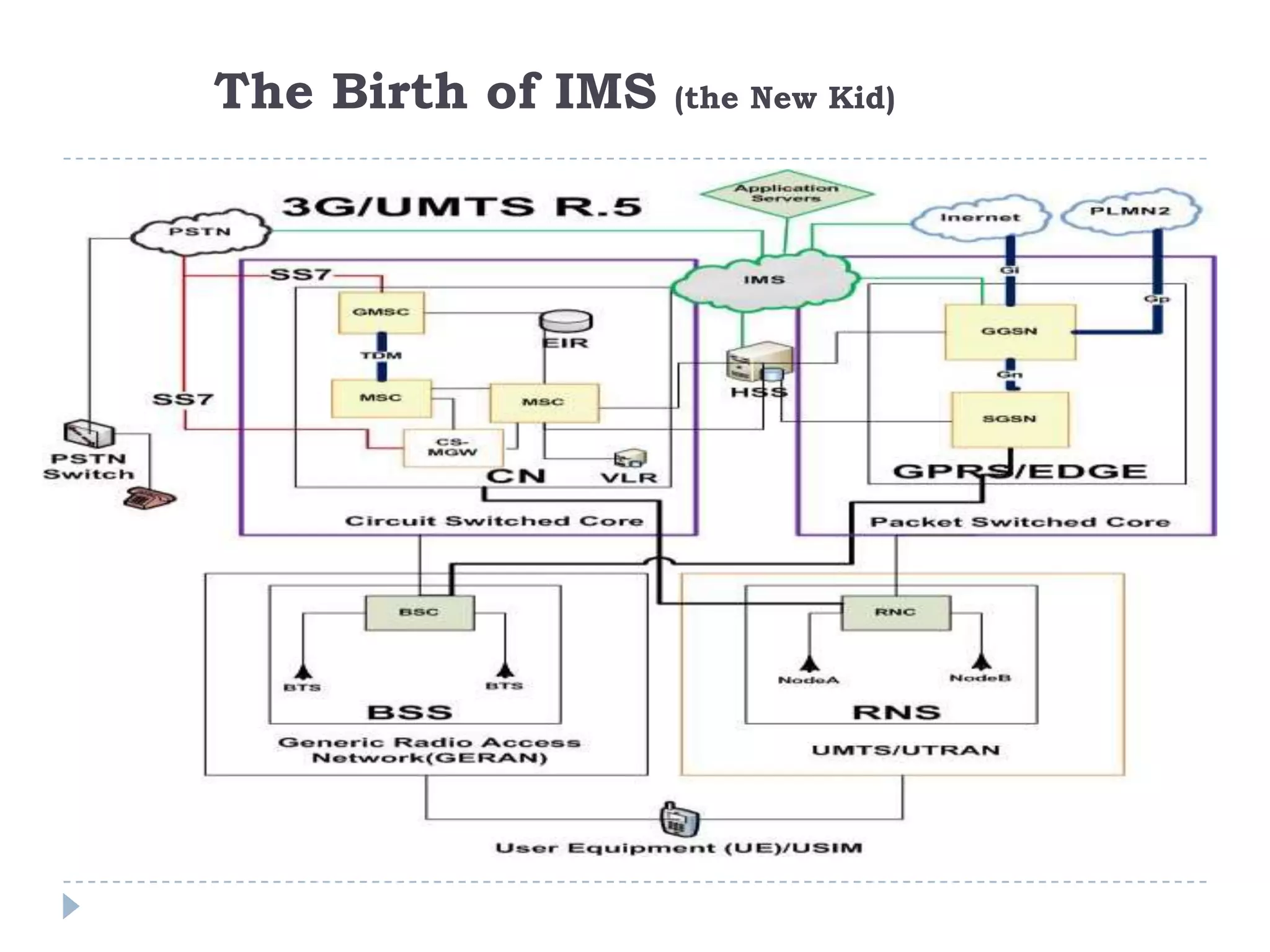
The Birth of IMS   (the New Kid)
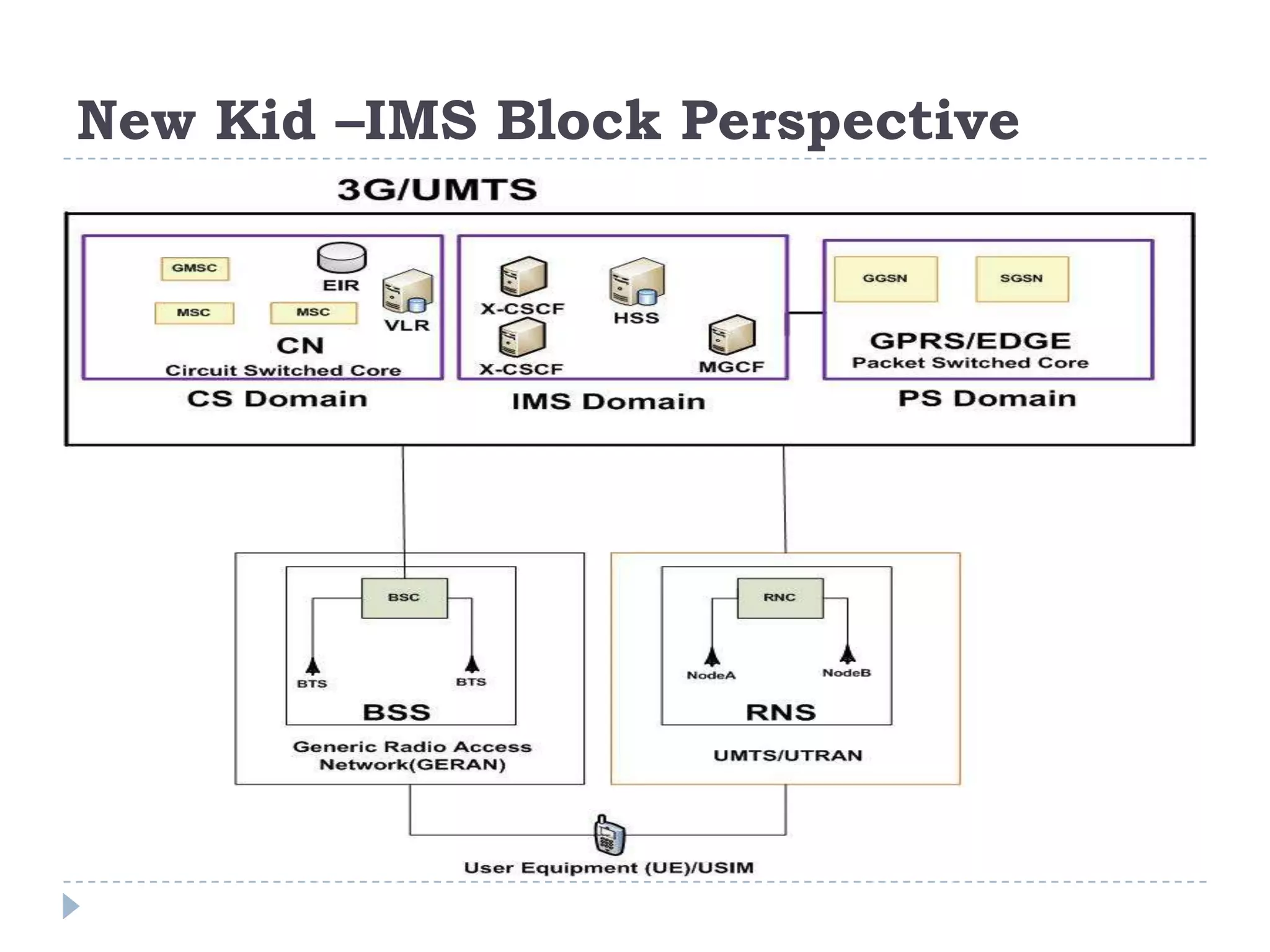
New Kid –IMS Block Perspective
What is IMS ?
   IP Multimedia Subsystem
   Architectural Framework
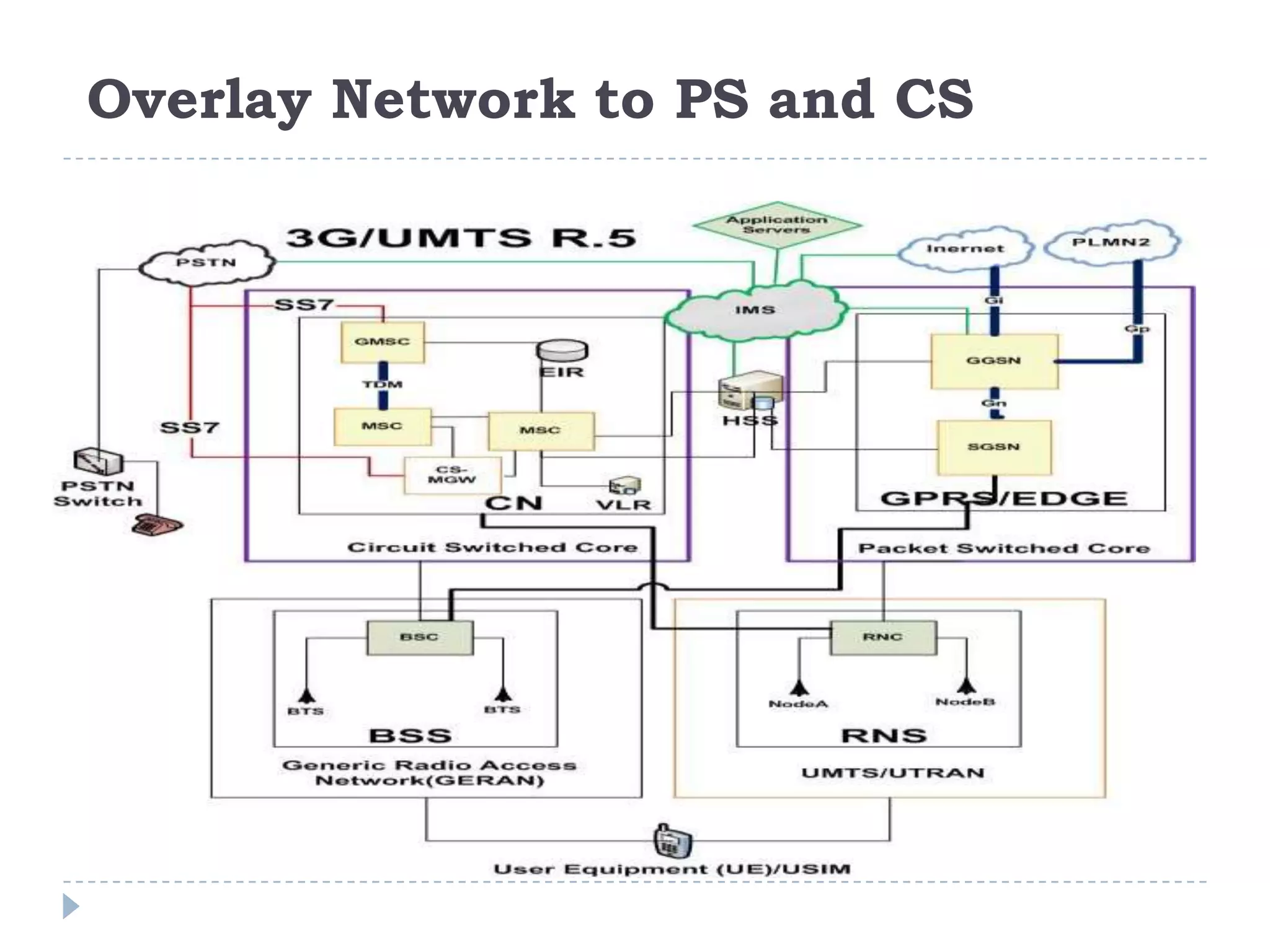
   Overlay Network (PS and CS Networks)
       Support for IP-Based Interactive Multimedia (QoS)
       Mandatory Support for IPV6
       Signaling based on IETF Protocol SIP , DIAMETER and COPS
       Core and Access
       Integration with PSTN

   Access Independent
       Wireless ( UMTS , WLAN, WiMAX)
       Wired ( DSL)
Overlay Network to PS and CS
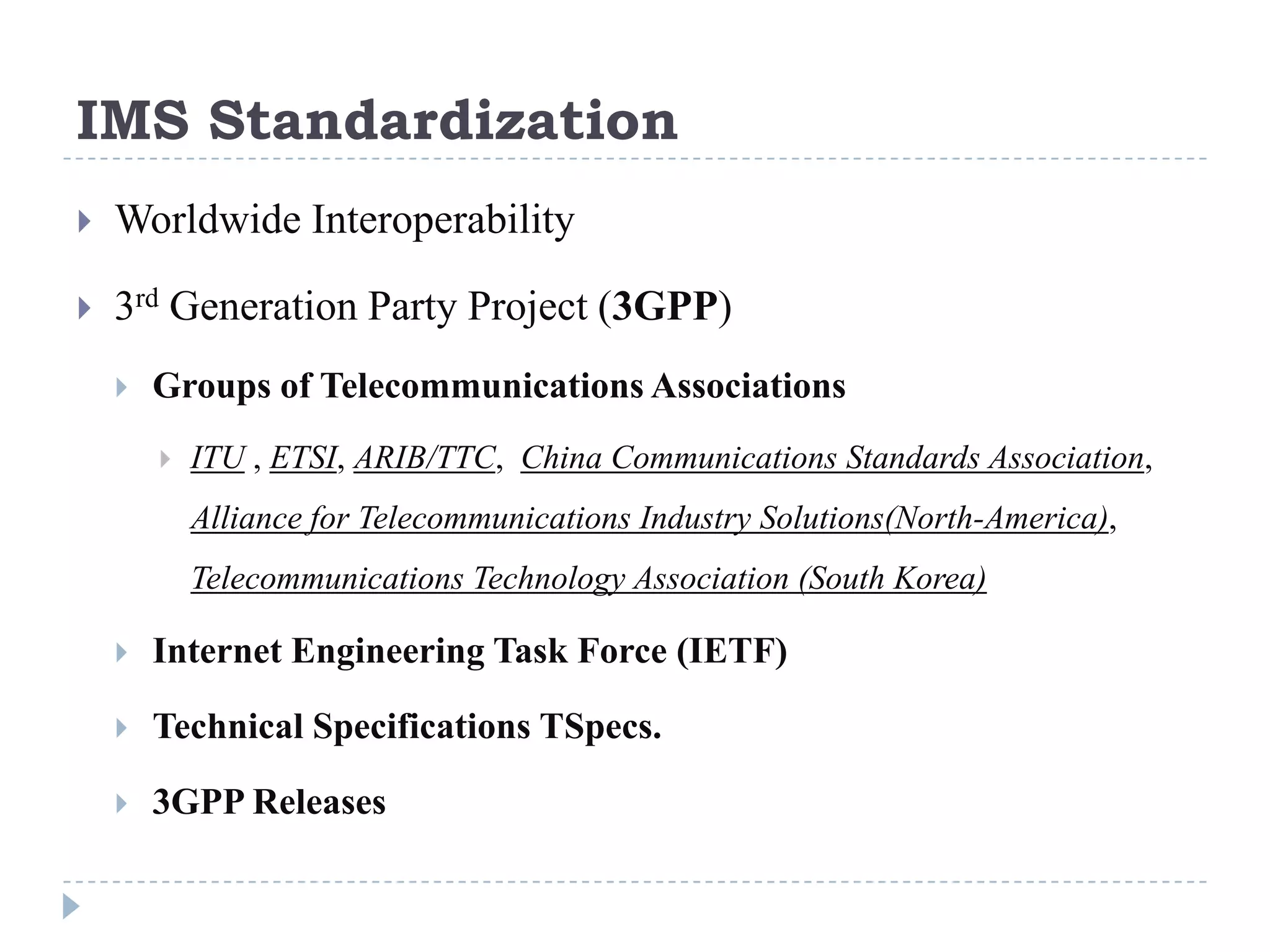
IMS Standardization
   Worldwide Interoperability

   3rd Generation Party Project (3GPP)
       Groups of Telecommunications Associations
           ITU , ETSI, ARIB/TTC, China Communications Standards Association,
            Alliance for Telecommunications Industry Solutions(North-America),
            Telecommunications Technology Association (South Korea)

       Internet Engineering Task Force (IETF)

       Technical Specifications TSpecs.

       3GPP Releases
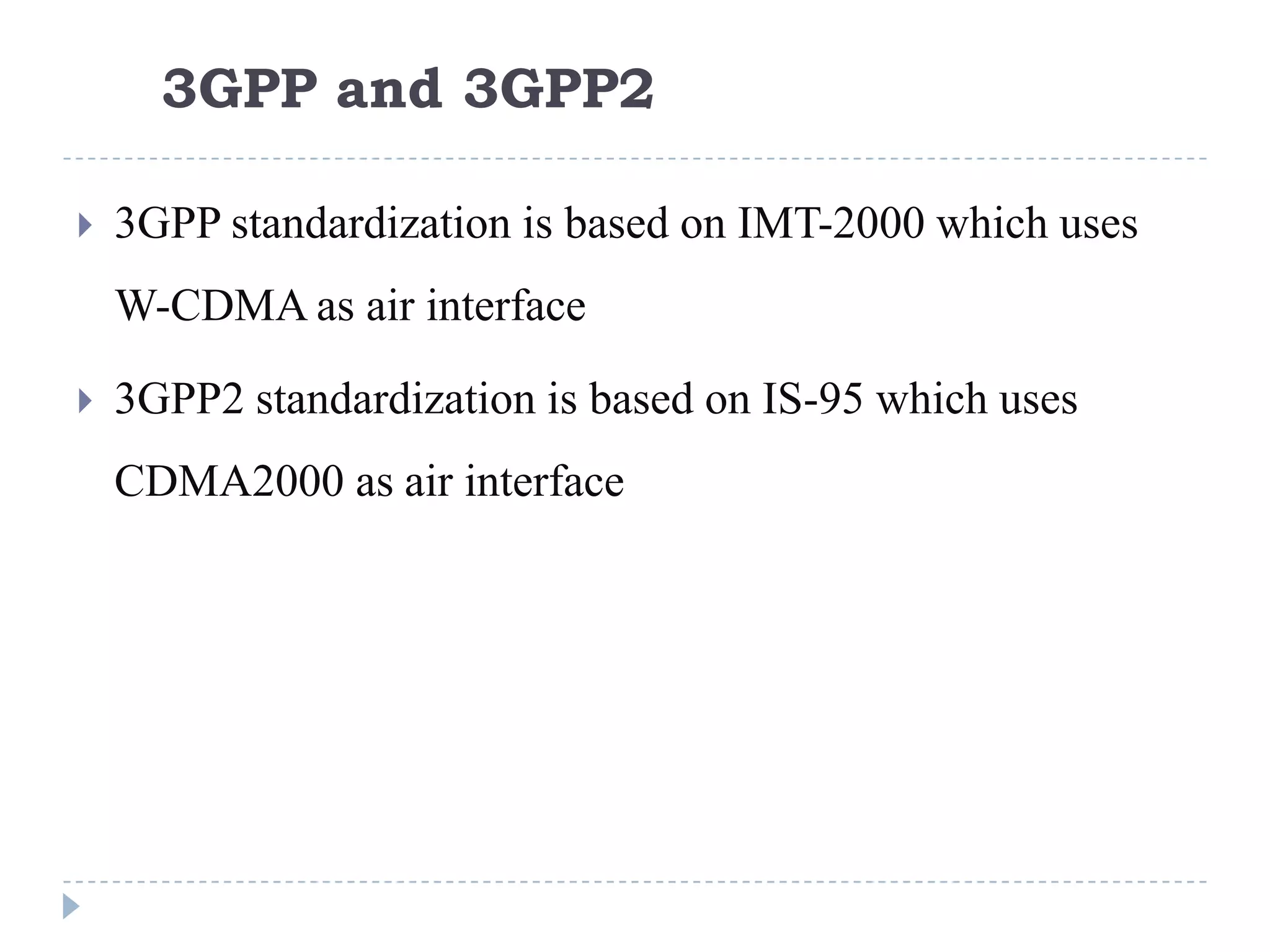
3GPP and 3GPP2

   3GPP standardization is based on IMT-2000 which uses
    W-CDMA as air interface

   3GPP2 standardization is based on IS-95 which uses
    CDMA2000 as air interface
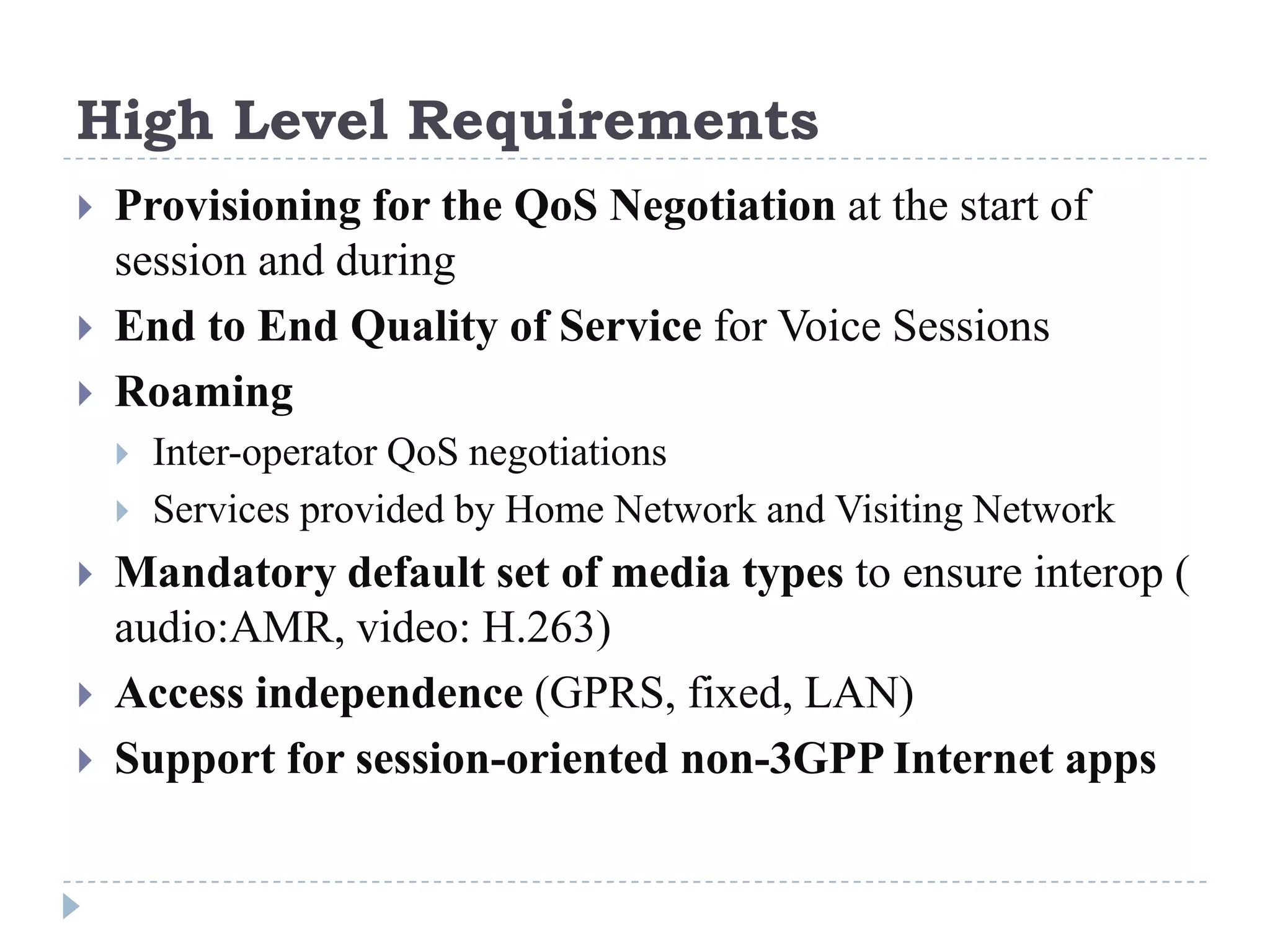
High Level Requirements
   Provisioning for the QoS Negotiation at the start of
    session and during
   End to End Quality of Service for Voice Sessions
   Roaming
       Inter-operator QoS negotiations
       Services provided by Home Network and Visiting Network
   Mandatory default set of media types to ensure interop (
    audio:AMR, video: H.263)
   Access independence (GPRS, fixed, LAN)
   Support for session-oriented non-3GPP Internet apps
Can’t we Live without it ?
   Surely We Can But what about the Operators and Service
    Providers?
    Involved parties
     Operators, Users, Content Providers, Legal Authorities, …
   All-IP network
     Interactive Multimedia
     QoS guarantee
     Access transparency, seamless handover
     AAA
     Billing, Charging
Continued…
   Services and Service Aggregation
     3rd party Application Servers
       Services: No preferential treatment of voice
        Voice (VoIP) is just one service, positioned at
        same level like
       any other services
   Communication security in IP networks
     Signaling and Media
       Access and Core
       Regulatory requirements (lawful interception)
Key Functions of IMS network

   Session Control/Management

   Subscription/Registrations Management

   Service Control

   Charging and Billing

   Operations, Administration, Maintenance and
    Provisioning (OAM&P/OSS)

   Interworking with PSTN
IMS Components
   Call State Control Functions
       P-CSCF, I-CSCF and S-CSCF
   Home Subscriber Server(HSS)
   Media Resource Functions
       MRFC, MRFP
   Interworking Functions
       BGCF, MGCF, IMS-MGW, WAG/PDG, IMS-IWF, IETF-3GPP
        IWG
   Charging Functions
       Online Charging System ( OCS)
       Offline Charging System ( CCF/CDF)
   OAM&P Entities
The Big Picture !
IMS Protocols Interfaces
IMS Service Control
   Value Added Services are Provided by AS in IMS

   Application Servers are defined as a part of Service
    Profile

   Service Profiles are defined as a Part of User Profile

   Each Service Profile contains Initial Filter Criteria

   Initial Filter Criterion defines a user’s subscribed service
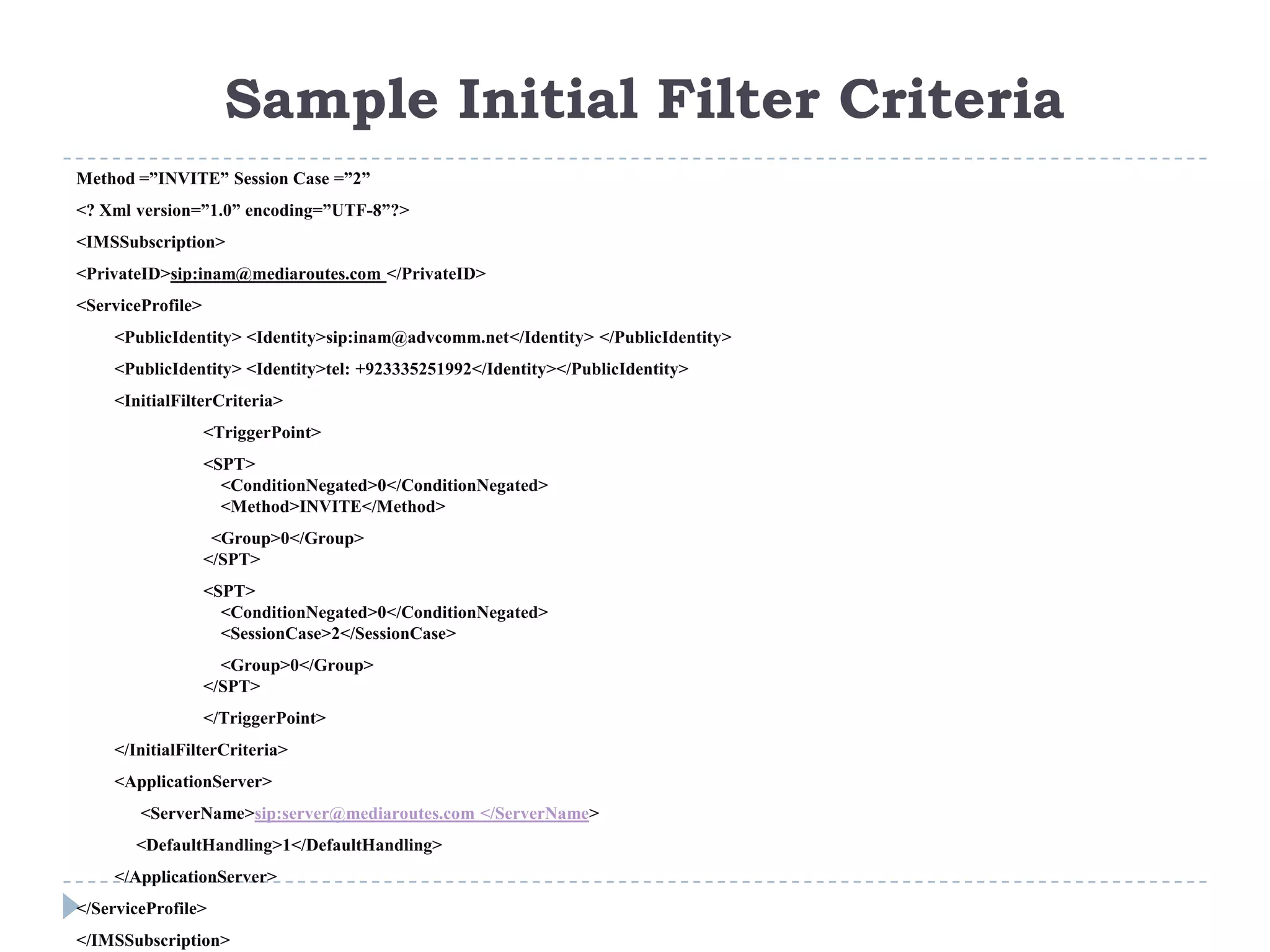
Sample Initial Filter Criteria
Method =”INVITE” Session Case =”2”
<? Xml version=”1.0” encoding=”UTF-8”?>
<IMSSubscription>
<PrivateID>sip:inam@mediaroutes.com </PrivateID>
<ServiceProfile>
    <PublicIdentity> <Identity>sip:inam@advcomm.net</Identity> </PublicIdentity>
    <PublicIdentity> <Identity>tel: +923335251992</Identity></PublicIdentity>
    <InitialFilterCriteria>
                   <TriggerPoint>
                   <SPT>
                     <ConditionNegated>0</ConditionNegated>
                     <Method>INVITE</Method>
                    <Group>0</Group>
                   </SPT>
                   <SPT>
                     <ConditionNegated>0</ConditionNegated>
                     <SessionCase>2</SessionCase>
                     <Group>0</Group>
                   </SPT>
                   </TriggerPoint>
    </InitialFilterCriteria>
    <ApplicationServer>
        <ServerName>sip:server@mediaroutes.com </ServerName>
       <DefaultHandling>1</DefaultHandling>
    </ApplicationServer>
</ServiceProfile>
</IMSSubscription>
Initial Filter Criteria Continued….
   Each iFC contains Priority, Trigger Point and Application Server, Default Handling and

   These iFCs are evaluated on the initial requests

       INVITE ,MESSAGE , OPTIONS, SUBSCRIBE

   S-CSCF checks filter criteria

   Once the AS has been identified

   S-CSCF creates Route header to forward message to AS

   Additionally, the S-CSCF places itself to the Route header to get back the message afterwards

   In the user part of the SIP URI of this own Route entry

   the S-CSCF may enter some state information to understand, that it already received and
    processed this message (other ways of providing state are possible)
Continued..
   On registration the S-CSCF receives user profile from HSS
   Filter criteria determine the services that are applicable to the
    collection of Public User Identities of the profile
   S-CSCF assesses the criteria in the order of their priority
   Filter criteria contain trigger points, which are Boolean
    conditions
   If the trigger point fires the request goes to the corresponding
    AS
   After receiving back the request the next criteria is checked
Protocols Used in IMS Networks
   Session Initiation Protocol (SIP)
       Registration , Authentication
       Call Control/Session Establishment
       Interworking Functions
   DIAMETER
       Next Generation AAA Model
       Pull/Push Registrations Data
       User Profiles
       Service Provisioning/Service Control
       IMS Charging
   Common Open Policy Service ( COPS)
       QoS Parameters Negotiations
User Identification in IMS

   Public User Identities ( IMPU)
     IMS user has one or more Public User Identity
     Either a SIP URI or a TEL URI
     sip:+92-1111111@ufone.net;user=phone
     tel:+92-42-664-832356
     TEL URIs are required to make calls between IMS/PSTN
    - Envision: at least one TEL URI and one SIP URI Per
      Subscriber
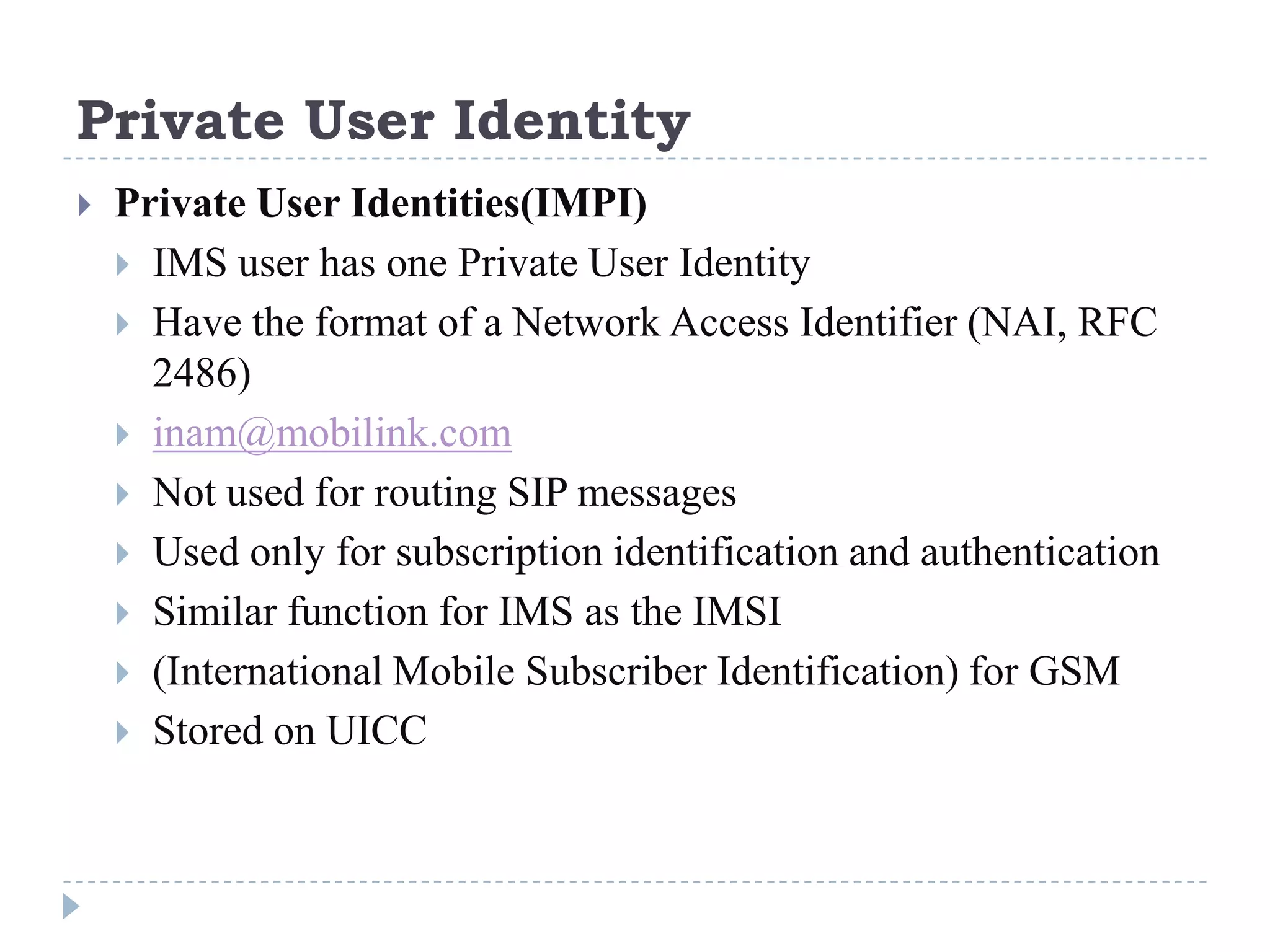
Private User Identity
   Private User Identities(IMPI)
     IMS user has one Private User Identity
     Have the format of a Network Access Identifier (NAI, RFC
      2486)
     inam@mobilink.com
     Not used for routing SIP messages
     Used only for subscription identification and authentication
     Similar function for IMS as the IMSI
     (International Mobile Subscriber Identification) for GSM
     Stored on UICC
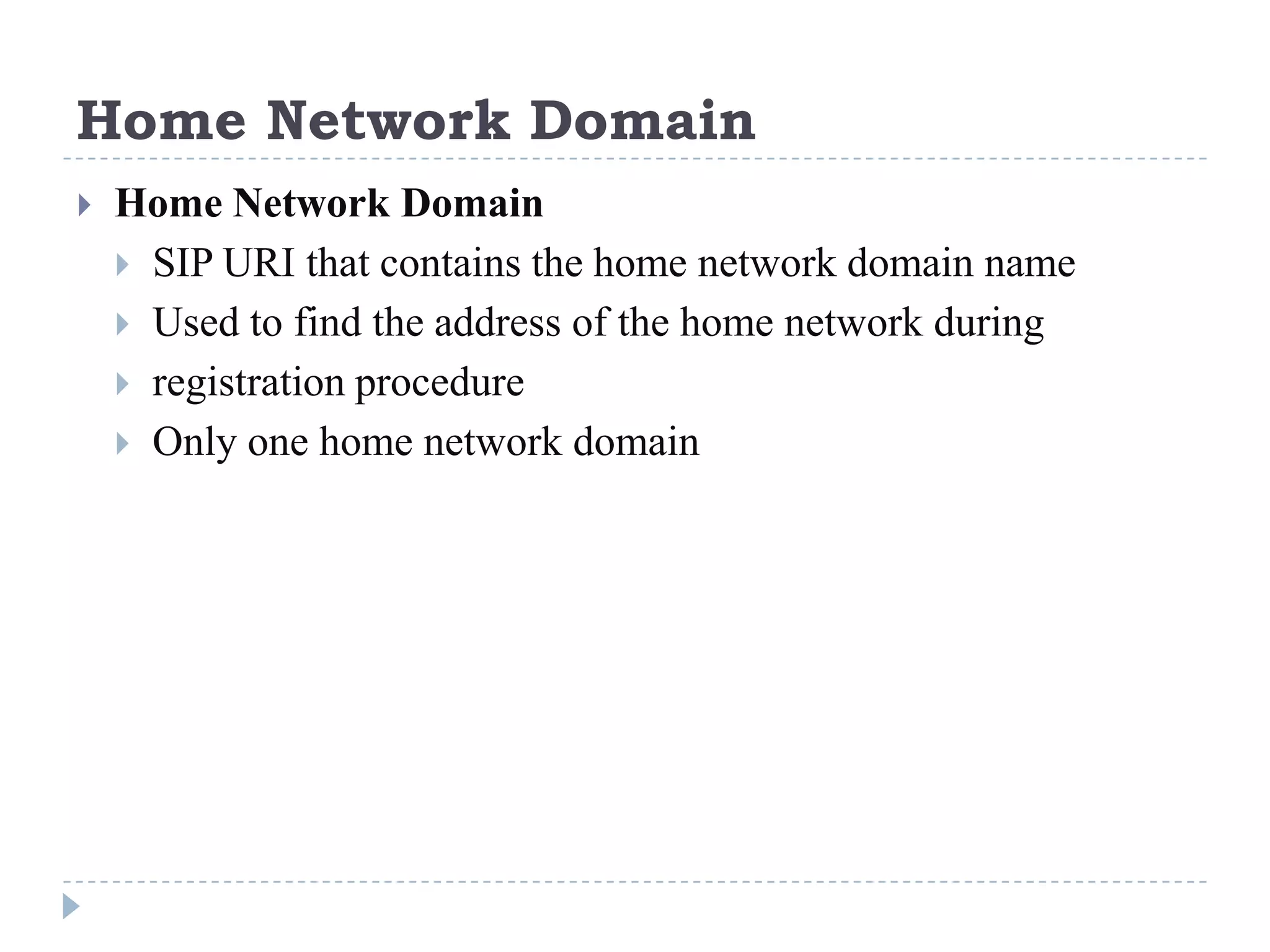
Home Network Domain
   Home Network Domain
     SIP URI that contains the home network domain name
     Used to find the address of the home network during
     registration procedure
     Only one home network domain
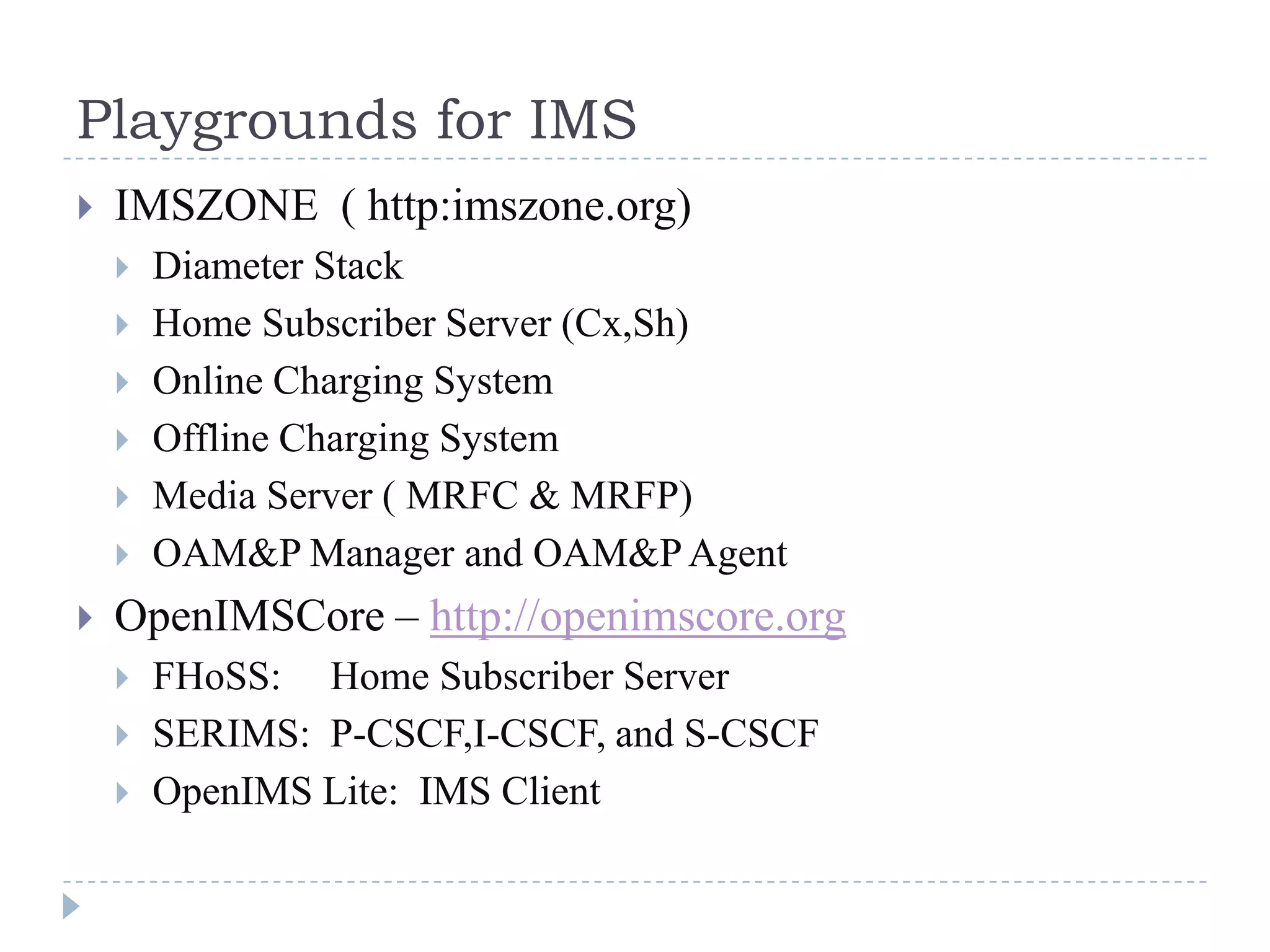
Playgrounds for IMS
   IMSZONE ( http:imszone.org)
       Diameter Stack
       Home Subscriber Server (Cx,Sh)
       Online Charging System
       Offline Charging System
       Media Server ( MRFC & MRFP)
       OAM&P Manager and OAM&P Agent
   OpenIMSCore – http://openimscore.org
       FHoSS: Home Subscriber Server
       SERIMS: P-CSCF,I-CSCF, and S-CSCF
       OpenIMS Lite: IMS Client
End of this Episode


      Thank You !

IP Multimedia Subsystems Overview - My Training on IMS

  • 1.
    IP Multimedia Subsystem Presenter: InamUllah Khosa Head of Product Development, Turnotech Pakistan Cornet Research Lab , Muhammad Ali Jinnah University
  • 2.
    Presentation Plan  Background - Evolution of 2G, 2.5G and 3G  What is IMS  Standardization Bodies  Functions of IMS  IMS Architecture – The Big Picture  IMS Components and Interfaces  IMS Services Control Model  IMS Protocols  Conclusion
  • 3.
    Setting the Stage. Revisiting the Past ! (Network Evolution)
  • 4.
    2G  Digital Network  Initially was merely designed for voice communication  Logically divided into Access Network and Core Network  Access Network is composed number of BTS and BSCs  Core Network composed of MSC , GMSC , EIR, HLR, VLR,AUC  Latter 2.5 Enhancements added PS Domain for Packet Data Support  The PS Domain was composed of SGSN and GGSN  GPRS Services support data rate of 56Kbps to 114Kbs
  • 5.
  • 6.
  • 7.
    3rd Generation Networks  W-CDMA (UMTS)  HSPA  HSDPA  HSUPA  HSPA+  UMTS-TDD  TD-CDMA  TD-SCDMA  FOMA  Super-Charged  Offer users a wider range of more advanced services  WAN voice telephony, video calls, and broadband wireless data
  • 8.
  • 9.
    4G  3GPP LTE  improving spectral efficiency  lowering costs  improving services  LTE air interface is a completely new system based on  OFDMA in the downlink  SC-FDMA (DFTS-FDMA) in the uplink  Flash-OFDM  adaptation to severe channel conditions  Robust against narrow-band co-channel interference  High spectral efficiency  Low sensitivity to time synchronization errors
  • 10.
    The Birth ofIMS (the New Kid)
  • 11.
    New Kid –IMSBlock Perspective
  • 12.
    What is IMS?  IP Multimedia Subsystem  Architectural Framework  Overlay Network (PS and CS Networks)  Support for IP-Based Interactive Multimedia (QoS)  Mandatory Support for IPV6  Signaling based on IETF Protocol SIP , DIAMETER and COPS  Core and Access  Integration with PSTN  Access Independent  Wireless ( UMTS , WLAN, WiMAX)  Wired ( DSL)
  • 13.
  • 14.
    IMS Standardization  Worldwide Interoperability  3rd Generation Party Project (3GPP)  Groups of Telecommunications Associations  ITU , ETSI, ARIB/TTC, China Communications Standards Association, Alliance for Telecommunications Industry Solutions(North-America), Telecommunications Technology Association (South Korea)  Internet Engineering Task Force (IETF)  Technical Specifications TSpecs.  3GPP Releases
  • 15.
    3GPP and 3GPP2  3GPP standardization is based on IMT-2000 which uses W-CDMA as air interface  3GPP2 standardization is based on IS-95 which uses CDMA2000 as air interface
  • 16.
    High Level Requirements  Provisioning for the QoS Negotiation at the start of session and during  End to End Quality of Service for Voice Sessions  Roaming  Inter-operator QoS negotiations  Services provided by Home Network and Visiting Network  Mandatory default set of media types to ensure interop ( audio:AMR, video: H.263)  Access independence (GPRS, fixed, LAN)  Support for session-oriented non-3GPP Internet apps
  • 17.
    Can’t we Livewithout it ?  Surely We Can But what about the Operators and Service Providers?  Involved parties  Operators, Users, Content Providers, Legal Authorities, …  All-IP network  Interactive Multimedia  QoS guarantee  Access transparency, seamless handover  AAA  Billing, Charging
  • 18.
    Continued…  Services and Service Aggregation  3rd party Application Servers  Services: No preferential treatment of voice  Voice (VoIP) is just one service, positioned at same level like  any other services  Communication security in IP networks  Signaling and Media  Access and Core  Regulatory requirements (lawful interception)
  • 19.
    Key Functions ofIMS network  Session Control/Management  Subscription/Registrations Management  Service Control  Charging and Billing  Operations, Administration, Maintenance and Provisioning (OAM&P/OSS)  Interworking with PSTN
  • 20.
    IMS Components  Call State Control Functions  P-CSCF, I-CSCF and S-CSCF  Home Subscriber Server(HSS)  Media Resource Functions  MRFC, MRFP  Interworking Functions  BGCF, MGCF, IMS-MGW, WAG/PDG, IMS-IWF, IETF-3GPP IWG  Charging Functions  Online Charging System ( OCS)  Offline Charging System ( CCF/CDF)  OAM&P Entities
  • 21.
  • 22.
  • 23.
    IMS Service Control  Value Added Services are Provided by AS in IMS  Application Servers are defined as a part of Service Profile  Service Profiles are defined as a Part of User Profile  Each Service Profile contains Initial Filter Criteria  Initial Filter Criterion defines a user’s subscribed service
  • 24.
    Sample Initial FilterCriteria Method =”INVITE” Session Case =”2” <? Xml version=”1.0” encoding=”UTF-8”?> <IMSSubscription> <PrivateID>sip:inam@mediaroutes.com </PrivateID> <ServiceProfile> <PublicIdentity> <Identity>sip:inam@advcomm.net</Identity> </PublicIdentity> <PublicIdentity> <Identity>tel: +923335251992</Identity></PublicIdentity> <InitialFilterCriteria> <TriggerPoint> <SPT> <ConditionNegated>0</ConditionNegated> <Method>INVITE</Method> <Group>0</Group> </SPT> <SPT> <ConditionNegated>0</ConditionNegated> <SessionCase>2</SessionCase> <Group>0</Group> </SPT> </TriggerPoint> </InitialFilterCriteria> <ApplicationServer> <ServerName>sip:server@mediaroutes.com </ServerName> <DefaultHandling>1</DefaultHandling> </ApplicationServer> </ServiceProfile> </IMSSubscription>
  • 25.
    Initial Filter CriteriaContinued….  Each iFC contains Priority, Trigger Point and Application Server, Default Handling and  These iFCs are evaluated on the initial requests  INVITE ,MESSAGE , OPTIONS, SUBSCRIBE  S-CSCF checks filter criteria  Once the AS has been identified  S-CSCF creates Route header to forward message to AS  Additionally, the S-CSCF places itself to the Route header to get back the message afterwards  In the user part of the SIP URI of this own Route entry  the S-CSCF may enter some state information to understand, that it already received and processed this message (other ways of providing state are possible)
  • 26.
    Continued..  On registration the S-CSCF receives user profile from HSS  Filter criteria determine the services that are applicable to the collection of Public User Identities of the profile  S-CSCF assesses the criteria in the order of their priority  Filter criteria contain trigger points, which are Boolean conditions  If the trigger point fires the request goes to the corresponding AS  After receiving back the request the next criteria is checked
  • 27.
    Protocols Used inIMS Networks  Session Initiation Protocol (SIP)  Registration , Authentication  Call Control/Session Establishment  Interworking Functions  DIAMETER  Next Generation AAA Model  Pull/Push Registrations Data  User Profiles  Service Provisioning/Service Control  IMS Charging  Common Open Policy Service ( COPS)  QoS Parameters Negotiations
  • 28.
    User Identification inIMS  Public User Identities ( IMPU)  IMS user has one or more Public User Identity  Either a SIP URI or a TEL URI  sip:+92-1111111@ufone.net;user=phone  tel:+92-42-664-832356  TEL URIs are required to make calls between IMS/PSTN - Envision: at least one TEL URI and one SIP URI Per Subscriber
  • 29.
    Private User Identity  Private User Identities(IMPI)  IMS user has one Private User Identity  Have the format of a Network Access Identifier (NAI, RFC 2486)  inam@mobilink.com  Not used for routing SIP messages  Used only for subscription identification and authentication  Similar function for IMS as the IMSI  (International Mobile Subscriber Identification) for GSM  Stored on UICC
  • 30.
    Home Network Domain  Home Network Domain  SIP URI that contains the home network domain name  Used to find the address of the home network during  registration procedure  Only one home network domain
  • 31.
    Playgrounds for IMS  IMSZONE ( http:imszone.org)  Diameter Stack  Home Subscriber Server (Cx,Sh)  Online Charging System  Offline Charging System  Media Server ( MRFC & MRFP)  OAM&P Manager and OAM&P Agent  OpenIMSCore – http://openimscore.org  FHoSS: Home Subscriber Server  SERIMS: P-CSCF,I-CSCF, and S-CSCF  OpenIMS Lite: IMS Client
  • 32.
    End of thisEpisode Thank You !