NG
N
Next Generation
Network
Presented By
Nour Frikha Becem Abid
2016-2017
Plan
Introduction
NGN Definition
NGN Standardization
NGN Conceptual Model
Convergence Towards NGN
NGN Softswitch-Base Architecture
NGN Configuration and Topology
01
02
03
04
05
06
07
Conclusion08
Introduction
Today, telephony, the Internet, and the cellular mobile
networks continue to be different domains, each has its own
protocols and services.
Internet Other…
PSTN Mobile
NGN ALL-IP Network
Introduction
General Idea
3
2 1
3
12
Data
Voice
Multimedia
Packets
Introduction History
NGN Definition
NGN is a packet-based network able to provide
Telecommunication Services to users and able to make use
of multiple broadband, QoS-enabled transport technologies
and in which service-related functions are independent of the
underlying transport-related technologies.
It enables unfettered access for users to networks and to
competing service providers and services of their choice. It
supports generalized mobility which will allow consistent and
ubiquitous provision of services to users.
NGN Definition
Characteristics
QoS-enabled Transport Technologies
(Delay, Throughput, and Reliability)
Unified Global Networking Platform
Packet-Based Network
Provides Telecommunication Services to Users
Services are Independent of Transport Technologies
Unfettered Access for Users to Networks and Services
Generalized Mobility Which Allow Consistent and
Ubiquitous Provision of Services to Users
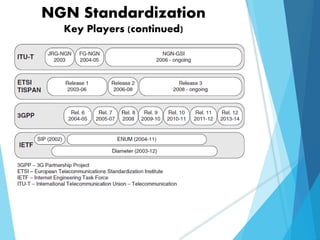
3GPP
NGN Standardization
Key Players
ITU-T
ITU Telecommunication
Standardization Sector
ITU-T
NGN-GSI
ATIS
NGN FG
ETSI
TISPAN
ATIS
Alliance for Telecom.
Industry
ETSI
European Telecom.
Standards Institute
3GPP
3rd Generation Partnership
Project
NGN Standardization
Key Players (continued)
NGN Standardization
Problems
Within the NGN concepts the standardization institutions are still
working on the following issues and problems:
> Existing networks migration towards NGN
> Development in the field of access technologies
> Connection of other networks to IP networks
> Provision of services and development of new ones
> Interworking in the area of addressing
> Interworking of signaling systems
> Roaming a mobility
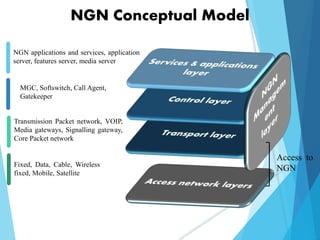
NGN Conceptual Model
Access to
NGN
NGN applications and services, application
server, features server, media server
MGC, Softswitch, Call Agent,
Gatekeeper
Transmission Packet network, VOIP,
Media gateways, Signalling gateway,
Core Packet network
Fixed, Data, Cable, Wireless
fixed, Mobile, Satellite
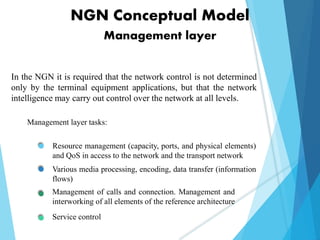
In the NGN it is required that the network control is not determined
only by the terminal equipment applications, but that the network
intelligence may carry out control over the network at all levels.
Management layer
NGN Conceptual Model
Management layer tasks:
Resource management (capacity, ports, and physical elements)
and QoS in access to the network and the transport network
Various media processing, encoding, data transfer (information
flows)
Service control
Management of calls and connection. Management and
interworking of all elements of the reference architecture
Convergence towards NGN
Today’s network is divided into:
o Public Switched Telephone Network
o Packet Switched Networks (LAN, WAN,…)
o Cellular Mobile Networks
Convergence is the process of interconnection of traditional
switched circuit networks (PSTN and Mobile Networks)
and packet-base networks that use IP (Internet Protocol).
Migration scenarios of different types of networks platforms
are based on the idea to integrate TDM (Time Division
Multiplexing) and IP (Internet Protocol) platforms into one
converged NGN platform (from the point of network
infrastructure, as well as services).
Evolutional scenarios
TDM
IP
NGN
Convergence towards NGN
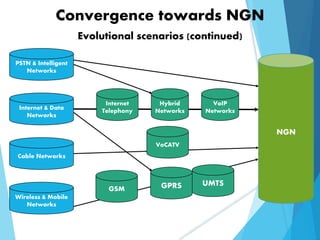
Evolutional scenarios (continued)
Convergence towards NGN
PSTN & Intelligent
Networks
Internet & Data
Networks
Cable Networks
Wireless & Mobile
Networks
Internet
Telephony
Hybrid
Networks
VoIP
Networks
VoCATV
GSM GPRS UMTS
NGN
From Vertical Silos to Horizontal NGN Architecture
Convergence towards NGN
Transport
Service
Control
Application
Access
End Points
MobileNetworks
PSTN/ISDN
Data/IPNetworks
Cable/TerrestrialTV
Vertical Silo Architecture
per service
Services
Existing and Newly Emerging
Services
Horizontal Layered
Multi-Service Architecture
Services & Network Control
(QoS, Security, IP Mobility)
Multi-Service IP Backbone
Wireless
Access
Wireline
Access
Services
Comparing the Features of PSTN/IN, Internet, and NGN
Convergence towards NGN
PSTN/IN Internet NGN
Multimedia Services NO YES YES
QoS support YES NO YES
Network Intelligence YES NO YES
Intelligent Terminal Equipment NO YES YES
Integrated Supervision & Control YES NO YES
Reliability High Low High
Service Creation Complex ad-hoc Systematic
Simplicity of Services use Medium High High
Modularity Low Medium High
Time of Service Introduction Long Short Short
Openness of Architecture Small High High
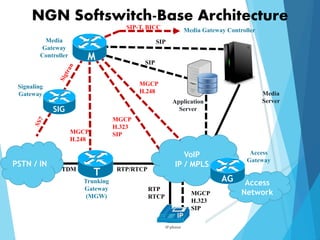
NGN Softswitch-Base Architecture
Access
Network
PSTN / IN
RTP
RTCP
VoIP
IP / MPLS
MGCP
H.323
SIP
Trunking
Gateway
(MGW)
TDM RTP/RTCP
Access
Gateway
Media
ServerApplication
Server
Signaling
Gateway
Media
Gateway
Controller
SIP
SIP
MGCP
H.248
MGCP
H.323
SIP
MGCP
H.248
Media Gateway ControllerSIP-T, BICC
M
T
AG
SIG
NGN Softswitch-Base Architecture
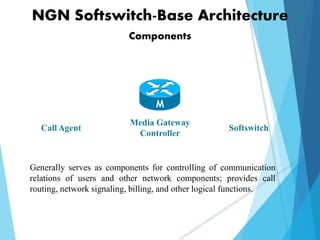
Components
Media Gateway
Controller
Generally serves as components for controlling of communication
relations of users and other network components; provides call
routing, network signaling, billing, and other logical functions.
Call Agent Softswitch
M
NGN Softswitch-Base Architecture
Components
Media Gateway
Operate within transport plane, perform all function related to media
physical transport between different networks, media processing
functions (transcoding, echo cancellation, jitter managing), tones
processing and management of information transport.
Trunking gateways: interface between the PSTN/PLMN and VoIP
Residential gateway: provide traditional analog (RJ11) interface to VoIP
Access gateway: provide traditional analog or PBX interface to VoIP
Signaling network: provide change of signalization systems between
PSTN/PLMN to VoIP
T
NGN Softswitch-Base Architecture
Components
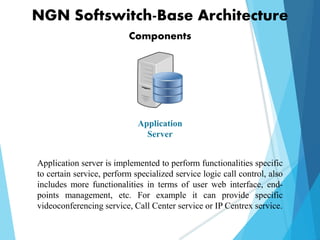
Application
Server
Application server is implemented to perform functionalities specific
to certain service, perform specialized service logic call control, also
includes more functionalities in terms of user web interface, end-
points management, etc. For example it can provide specific
videoconferencing service, Call Center service or IP Centrex service.
NGN Softswitch-Base Architecture
Components
Media
Server
Media server provides functionalities allow interaction between
calling party and application using end-point device. It provides
Media Resource Functions (tones detection, speech synthesis and
recognition, compressions, media mixing, etc.) and Media Control
Functions that control of media functions (voice message play
management, conference bridge, fax message management, etc.)
NGN Configuration and Topology
INNI: Internal Network-Network Interface
NNI: Network-Network Interface
UNI: User Network Interface
Conclusion
 Other Architectures
 IMS and entities (P-CSCF, I-CSCF,…)
 TISPAN NGN
 GSM
 NGN Protocols
 SIP (Session Initiation Protocol)
 SDP (Session Description Protocol)
 RTP (Real Time Transport Protocol)
 NGN Standards
 Services and QoS
ThankYouFor Your Attention

Ngn presentation

  • 1.
  • 2.
    Plan Introduction NGN Definition NGN Standardization NGNConceptual Model Convergence Towards NGN NGN Softswitch-Base Architecture NGN Configuration and Topology 01 02 03 04 05 06 07 Conclusion08
  • 3.
    Introduction Today, telephony, theInternet, and the cellular mobile networks continue to be different domains, each has its own protocols and services. Internet Other… PSTN Mobile NGN ALL-IP Network
  • 4.
  • 5.
  • 6.
    NGN Definition NGN isa packet-based network able to provide Telecommunication Services to users and able to make use of multiple broadband, QoS-enabled transport technologies and in which service-related functions are independent of the underlying transport-related technologies. It enables unfettered access for users to networks and to competing service providers and services of their choice. It supports generalized mobility which will allow consistent and ubiquitous provision of services to users.
  • 7.
    NGN Definition Characteristics QoS-enabled TransportTechnologies (Delay, Throughput, and Reliability) Unified Global Networking Platform Packet-Based Network Provides Telecommunication Services to Users Services are Independent of Transport Technologies Unfettered Access for Users to Networks and Services Generalized Mobility Which Allow Consistent and Ubiquitous Provision of Services to Users
  • 8.
    3GPP NGN Standardization Key Players ITU-T ITUTelecommunication Standardization Sector ITU-T NGN-GSI ATIS NGN FG ETSI TISPAN ATIS Alliance for Telecom. Industry ETSI European Telecom. Standards Institute 3GPP 3rd Generation Partnership Project
  • 9.
  • 10.
    NGN Standardization Problems Within theNGN concepts the standardization institutions are still working on the following issues and problems: > Existing networks migration towards NGN > Development in the field of access technologies > Connection of other networks to IP networks > Provision of services and development of new ones > Interworking in the area of addressing > Interworking of signaling systems > Roaming a mobility
  • 11.
    NGN Conceptual Model Accessto NGN NGN applications and services, application server, features server, media server MGC, Softswitch, Call Agent, Gatekeeper Transmission Packet network, VOIP, Media gateways, Signalling gateway, Core Packet network Fixed, Data, Cable, Wireless fixed, Mobile, Satellite
  • 12.
    In the NGNit is required that the network control is not determined only by the terminal equipment applications, but that the network intelligence may carry out control over the network at all levels. Management layer NGN Conceptual Model Management layer tasks: Resource management (capacity, ports, and physical elements) and QoS in access to the network and the transport network Various media processing, encoding, data transfer (information flows) Service control Management of calls and connection. Management and interworking of all elements of the reference architecture
  • 13.
    Convergence towards NGN Today’snetwork is divided into: o Public Switched Telephone Network o Packet Switched Networks (LAN, WAN,…) o Cellular Mobile Networks Convergence is the process of interconnection of traditional switched circuit networks (PSTN and Mobile Networks) and packet-base networks that use IP (Internet Protocol).
  • 14.
    Migration scenarios ofdifferent types of networks platforms are based on the idea to integrate TDM (Time Division Multiplexing) and IP (Internet Protocol) platforms into one converged NGN platform (from the point of network infrastructure, as well as services). Evolutional scenarios TDM IP NGN Convergence towards NGN
  • 15.
    Evolutional scenarios (continued) Convergencetowards NGN PSTN & Intelligent Networks Internet & Data Networks Cable Networks Wireless & Mobile Networks Internet Telephony Hybrid Networks VoIP Networks VoCATV GSM GPRS UMTS NGN
  • 16.
    From Vertical Silosto Horizontal NGN Architecture Convergence towards NGN Transport Service Control Application Access End Points MobileNetworks PSTN/ISDN Data/IPNetworks Cable/TerrestrialTV Vertical Silo Architecture per service Services Existing and Newly Emerging Services Horizontal Layered Multi-Service Architecture Services & Network Control (QoS, Security, IP Mobility) Multi-Service IP Backbone Wireless Access Wireline Access Services
  • 17.
    Comparing the Featuresof PSTN/IN, Internet, and NGN Convergence towards NGN PSTN/IN Internet NGN Multimedia Services NO YES YES QoS support YES NO YES Network Intelligence YES NO YES Intelligent Terminal Equipment NO YES YES Integrated Supervision & Control YES NO YES Reliability High Low High Service Creation Complex ad-hoc Systematic Simplicity of Services use Medium High High Modularity Low Medium High Time of Service Introduction Long Short Short Openness of Architecture Small High High
  • 18.
    NGN Softswitch-Base Architecture Access Network PSTN/ IN RTP RTCP VoIP IP / MPLS MGCP H.323 SIP Trunking Gateway (MGW) TDM RTP/RTCP Access Gateway Media ServerApplication Server Signaling Gateway Media Gateway Controller SIP SIP MGCP H.248 MGCP H.323 SIP MGCP H.248 Media Gateway ControllerSIP-T, BICC M T AG SIG
  • 19.
    NGN Softswitch-Base Architecture Components MediaGateway Controller Generally serves as components for controlling of communication relations of users and other network components; provides call routing, network signaling, billing, and other logical functions. Call Agent Softswitch M
  • 20.
    NGN Softswitch-Base Architecture Components MediaGateway Operate within transport plane, perform all function related to media physical transport between different networks, media processing functions (transcoding, echo cancellation, jitter managing), tones processing and management of information transport. Trunking gateways: interface between the PSTN/PLMN and VoIP Residential gateway: provide traditional analog (RJ11) interface to VoIP Access gateway: provide traditional analog or PBX interface to VoIP Signaling network: provide change of signalization systems between PSTN/PLMN to VoIP T
  • 21.
    NGN Softswitch-Base Architecture Components Application Server Applicationserver is implemented to perform functionalities specific to certain service, perform specialized service logic call control, also includes more functionalities in terms of user web interface, end- points management, etc. For example it can provide specific videoconferencing service, Call Center service or IP Centrex service.
  • 22.
    NGN Softswitch-Base Architecture Components Media Server Mediaserver provides functionalities allow interaction between calling party and application using end-point device. It provides Media Resource Functions (tones detection, speech synthesis and recognition, compressions, media mixing, etc.) and Media Control Functions that control of media functions (voice message play management, conference bridge, fax message management, etc.)
  • 23.
    NGN Configuration andTopology INNI: Internal Network-Network Interface NNI: Network-Network Interface UNI: User Network Interface
  • 24.
    Conclusion  Other Architectures IMS and entities (P-CSCF, I-CSCF,…)  TISPAN NGN  GSM  NGN Protocols  SIP (Session Initiation Protocol)  SDP (Session Description Protocol)  RTP (Real Time Transport Protocol)  NGN Standards  Services and QoS
  • 25.

Editor's Notes

  • #4 its most important protocols, the Transmission Control Protocol (TCP) and the Internet Protocol (IP),
  • #5 One network transports all type of data and provide services (voice, data, all sorts of media) by encapsulating these into packets using TCP/IP. NGNs are commonly built around the Internet Protocol (IP), and therefore the term all IP is also sometimes used to describe the transformation toward NGN.
  • #6 The realization of the idea for NGN has started in 2003 (Figure 3.3). In each standards body has been organized a standard group dedicated to NGN. The ITU-T has started its work on NGN in 2003 by creating the so-called Joint Rapporteur Group on Next Generation Network (JRG-NGN), which targeted to study several main subjects such as: NGN requirements, the general reference model, NGN functional requirements and functional architecture, and evolution to NGN (from existing telecommunication networks at that time). This group delivered two fundamental NGN recommendations: • General overview of NGN (Y.2001 [2]); • General principles and general reference model for NGN (Y.2011 [3]). The JRG-NGNwas formed from experts of ITU-T Study Group 13 (SG13), which is targeted to future networks, including cloud computing, mobile, and NGN. In 2004 the ITU-T Focus Group on Next Generation Network (FG-NGN) was established, which lasted for 1.5 years (until November 2005). Its main targetwas to accelerate the activities started by the JRG-NGN. In the period 2004–2005 several key aspects regarding the NGN were addressed by this group, such as: functional architecture and mobility, QoS, control and signaling aspects, service and security capabilities, the migration path from PSTN/ISDN networks to NGN, as well as future packet-based networks and their requirements. The work of FG-NGN was published in proceedings in 2005 [3]. From 2006 the work on NGN standardization within the ITU-T was transferred to the Next Generation Network Global Standards Initiative (NGN-GSI), which is working on detailed standards for NGN deployment by collaboration with different ITU-T Study Groups. The established objectives and goals of NGN-GSI were to further strengthen the leading role of ITU-T among other standardization bodies involved with NGN, to coordinate work between different ITU-T Study Groups working on various NGN recommendations, and to produce global standards based on the telecommunications market needs (which are continuously changing and often cannot be precisely predicted). Since the start of the NGN standardization process in ITU many operators have started to migrate to all-IP networks, including the telephony migration to VoIP with similar QoS, security, and signaling support as in PSTN. The PSTN transition to all-IP environment was the most important driver for NGN from the start, thus NGN release 1 was mainly focused to VoIP. However, since the realization of NGN is an evolutionary process and different operators and administrations will start it at different times, there is a need to have different approaches for building a NGN or transition from PSTN and PLMN (which both have high investments, either is equipment or other resources such as frequency bands for mobile networks) toward the NGN.
  • #7 NGN Definition: ETSI : NGN is a concept of the defining and establishing of the networks, allowing a formal distribution of functionalities into separate layers and planes by using open interfaces, making it possible for the service providers and operators to create a platform which can be gradually developed thanks to creation, implementation and effective management of innovative services.
  • #8 NGN is a packet-based network able to provide Telecommunication Services to users and able to make use of multiple broadband, QoS-enabled transport technologies and in which service-related functions are independent of the underlying transport-related technologies. It enables unfettered access for users to networks and to competing service providers and services of their choice. It supports generalized mobility which will allow consistent and ubiquitous provision of services to users.
  • #9 NGN-GSI (Next Generation Networks Global Standards Initiative) ATIS NGN force group ETSI TISPAN: Telecom & Internet Conveged Services and protocols for advanced networks
  • #12 The access layer provides the infrastructure, for example an access network between the end user and the transport network. The access network can be both wireless and fixed and it can be based on various transport media. The transport layer ensures the transport between the individual nodes (points) of the network, to which are connected access networks. It connects physical elements deployed in the individual layers It also enables the transport of different types of traffic, media (signaling, interactive data, real-time video, voice communication, etc.) The control layer includes the control of services and network elements. This layer is responsible for set-up/establishing, control and cancelling of the multimedia session. It ensures the control of sources as well, depending on the service requirements. One of the fundamental NGN principles is the separation of control logic from the switching hardware. The service layer, which can be used to create more complex and sophisticatoffers the basic service functionsed services and applications. It controls the progress of the service based on its logic.
  • #14 As it has already been stated, the next generation networks are a vision of a converged network, meeting all the requirements for a converged universal packet network of the future. That is why it is appropriate to look into their evolution and to outline their future trends and the open issues to be solved as well.
  • #16 VoCATV: Voice over Cable TV: UMTS: universal mobile telecommunication system: 3rd generation. Based on GSM
  • #17 Integrated Services for Digital Network (ISDN) is a set of communication standards for simultaneous digital transmission of voice, video, data, and other network services over the traditional circuits of the public switched telephone network. Terrestrial television is a type of television broadcasting using radio signals for transmission and television antennas and tuners for reception
  • #19 NGN architecture based on software switching technology (softswitch) can be supposed as first and unique evolution step in NGN, although there are more modern architecture available nowadays (for example see chapter IMS based architecture). However, it has built up philosophy of building of new NGN networks and validated principles and features of NGN architecture and its components towards its next evolution This architecture was the first which drive was significantly motivated by telecommunication vendors, naturally reflecting on massive development of VoIP protocol family and by telecommunication providers demand to implement services more modern and more efficient way. Multiprotocol Label Switching (MPLS) is a mechanism in high-performance telecommunications networks that directs data from one network node to the next based on short path labels rather than long network addresses
  • #21 A registered jack (RJ) is a standardized[1][2][3] physical network interface—both jack construction and wiring pattern—for connecting telecommunications or data equipment to a service provided by a local exchange carrier or long distance carrier. The standard designs for these connectors and their wiring are named RJ11, RJ14, RJ21,RJ35, RJ45, RJ48, etc. PBX is a system that connects telephone extensions of a company to outside public telephone network as well as to mobile networks.
  • #24 Customer network: This is a network deployed at home or at enterprise, which is connected via the UNI with NGN access network. • Access network: This network collects the end-user traffic from customer network to the core network in both directions. It also aggregates the traffic from different end-users to the core network. Also, it can be divided into several domains, and in such case network elements within a single domain are interconnected with so-called INNI (Internal Network– Network Interface). Connections between network elements from different domains as well as between access networks and core networks are realized via the NNI. • Core network: This type of network provides transport of user data as well as control and management information between different network elements (e.g., between core routers). A core network may have several domains. Within a single domain network elements are interconnected via INNI, while NNI is used between different core network domains or between a core network and other network (e.g., access network, transit network).