IMS Core Elements
IP Multimedia Subsystem Series
IMS Core Elements
P-CSCF
I-CSCF
S-CSCFHSS
UE
ASService
Session
Control
Access
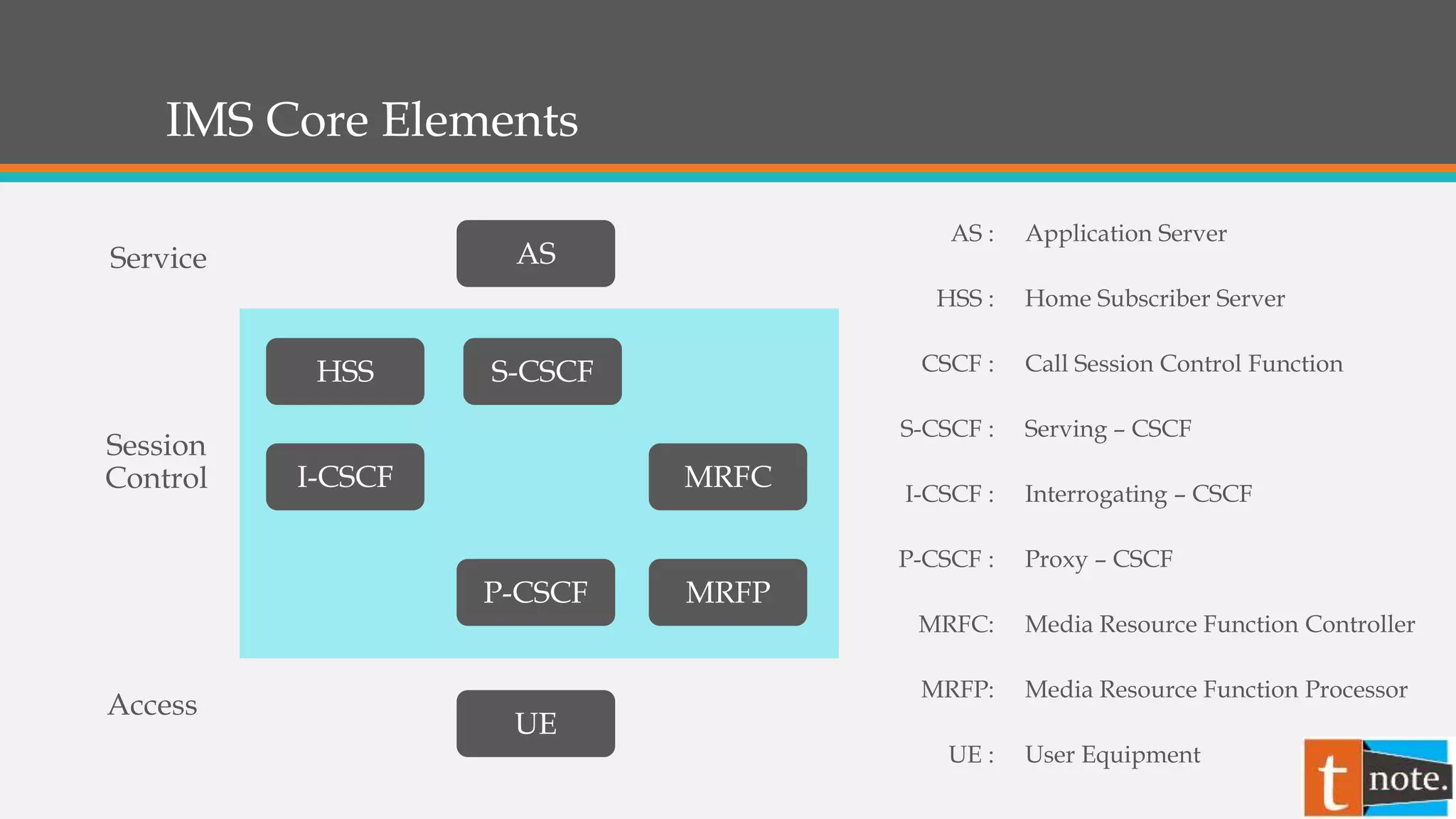
AS :
HSS :
CSCF :
S-CSCF :
I-CSCF :
P-CSCF :
MRFC:
MRFP:
UE :
Application Server
Home Subscriber Server
Call Session Control Function
Serving – CSCF
Interrogating – CSCF
Proxy – CSCF
Media Resource Function Controller
Media Resource Function Processor
User Equipment
MRFC
MRFP
Proxy – Call Session Control Function
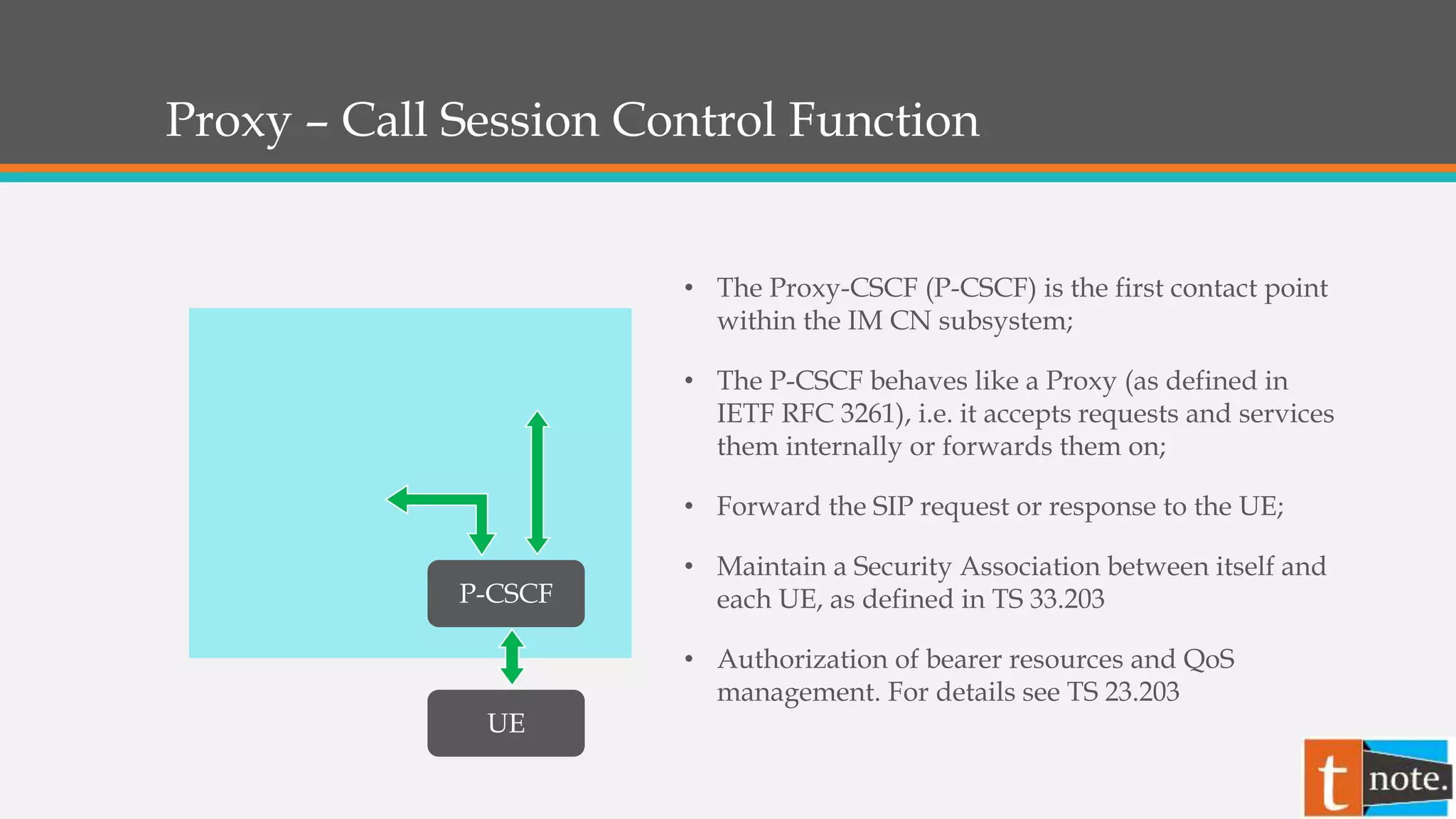
• The Proxy-CSCF (P-CSCF) is the first contact point
within the IM CN subsystem;
• The P-CSCF behaves like a Proxy (as defined in
IETF RFC 3261), i.e. it accepts requests and services
them internally or forwards them on;
• Forward the SIP request or response to the UE;
• Maintain a Security Association between itself and
each UE, as defined in TS 33.203
• Authorization of bearer resources and QoS
management. For details see TS 23.203
P-CSCF
UE
P-CSCF
I-CSCF
UE
Interrogating – Call Session Control Function
OtherIMSNetwork
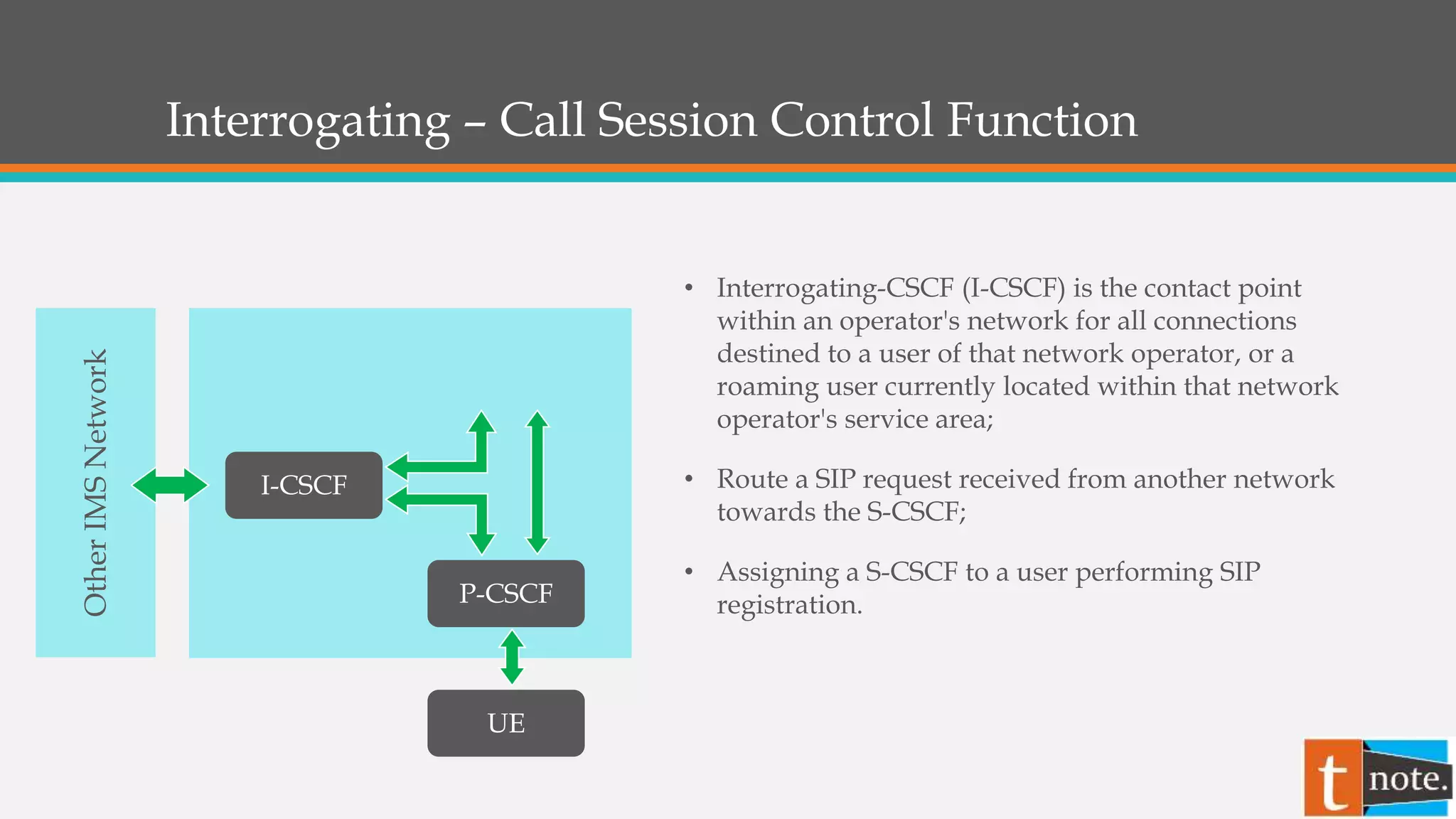
• Interrogating-CSCF (I-CSCF) is the contact point
within an operator's network for all connections
destined to a user of that network operator, or a
roaming user currently located within that network
operator's service area;
• Route a SIP request received from another network
towards the S-CSCF;
• Assigning a S-CSCF to a user performing SIP
registration.
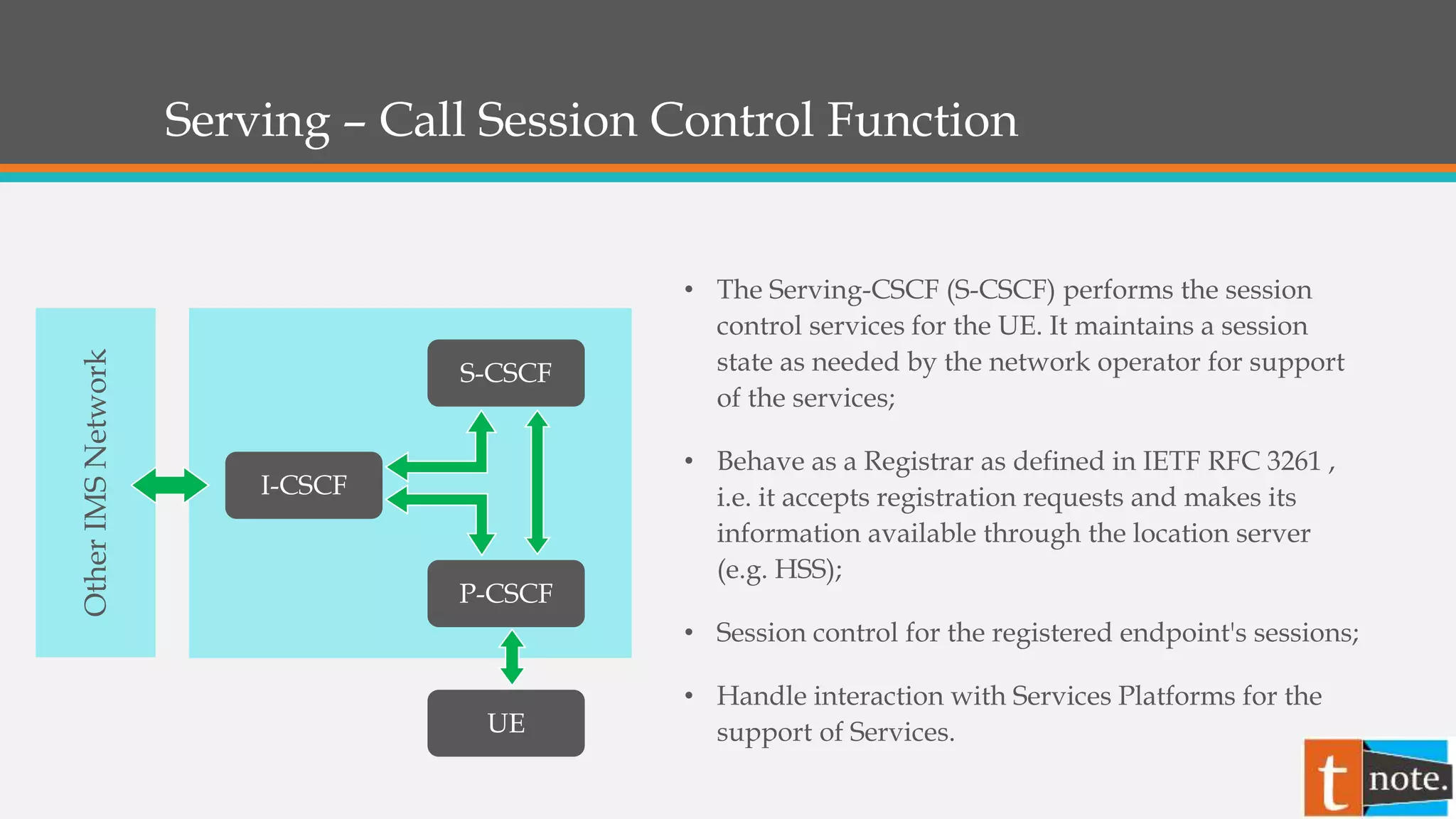
Serving – Call Session Control Function
P-CSCF
I-CSCF
UE
OtherIMSNetwork
S-CSCF
• The Serving-CSCF (S-CSCF) performs the session
control services for the UE. It maintains a session
state as needed by the network operator for support
of the services;
• Behave as a Registrar as defined in IETF RFC 3261 ,
i.e. it accepts registration requests and makes its
information available through the location server
(e.g. HSS);
• Session control for the registered endpoint's sessions;
• Handle interaction with Services Platforms for the
support of Services.
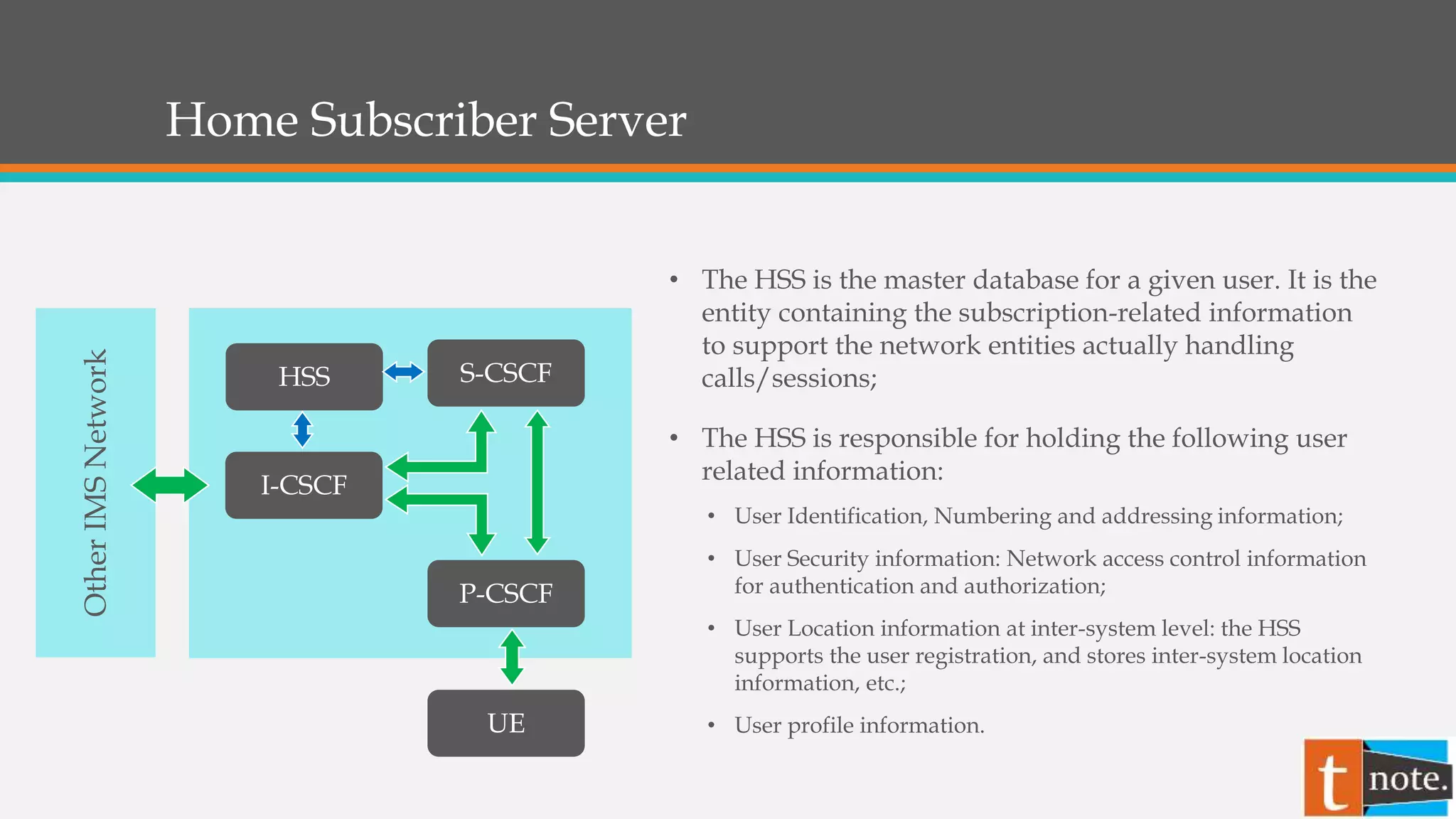
Home Subscriber Server
P-CSCF
I-CSCF
HSS
UE
• The HSS is the master database for a given user. It is the
entity containing the subscription-related information
to support the network entities actually handling
calls/sessions;
• The HSS is responsible for holding the following user
related information:
• User Identification, Numbering and addressing information;
• User Security information: Network access control information
for authentication and authorization;
• User Location information at inter-system level: the HSS
supports the user registration, and stores inter-system location
information, etc.;
• User profile information.
OtherIMSNetwork
S-CSCF
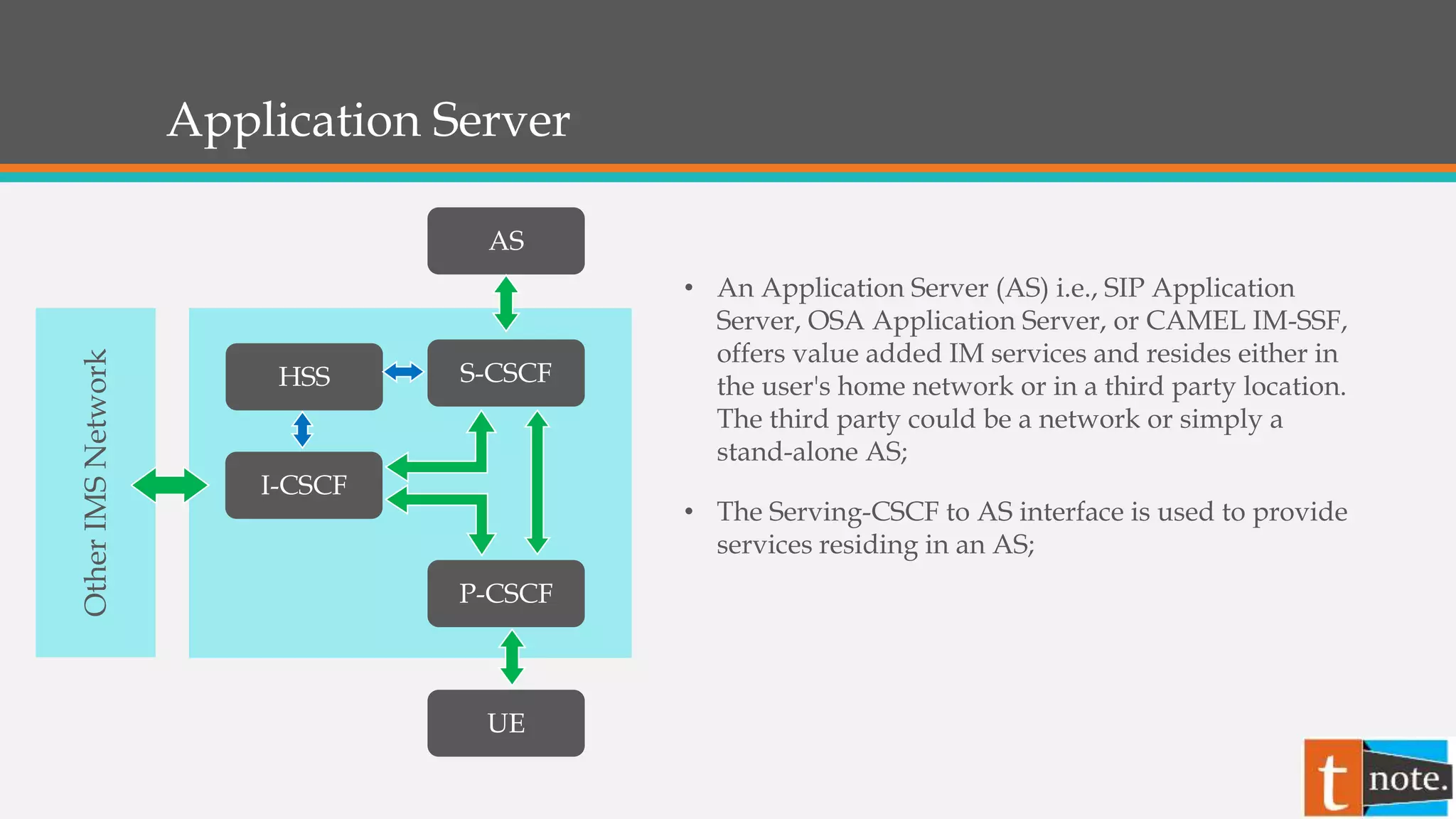
Application Server
P-CSCF
I-CSCF
HSS
UE
OtherIMSNetwork
S-CSCF
AS
• An Application Server (AS) i.e., SIP Application
Server, OSA Application Server, or CAMEL IM-SSF,
offers value added IM services and resides either in
the user's home network or in a third party location.
The third party could be a network or simply a
stand-alone AS;
• The Serving-CSCF to AS interface is used to provide
services residing in an AS;
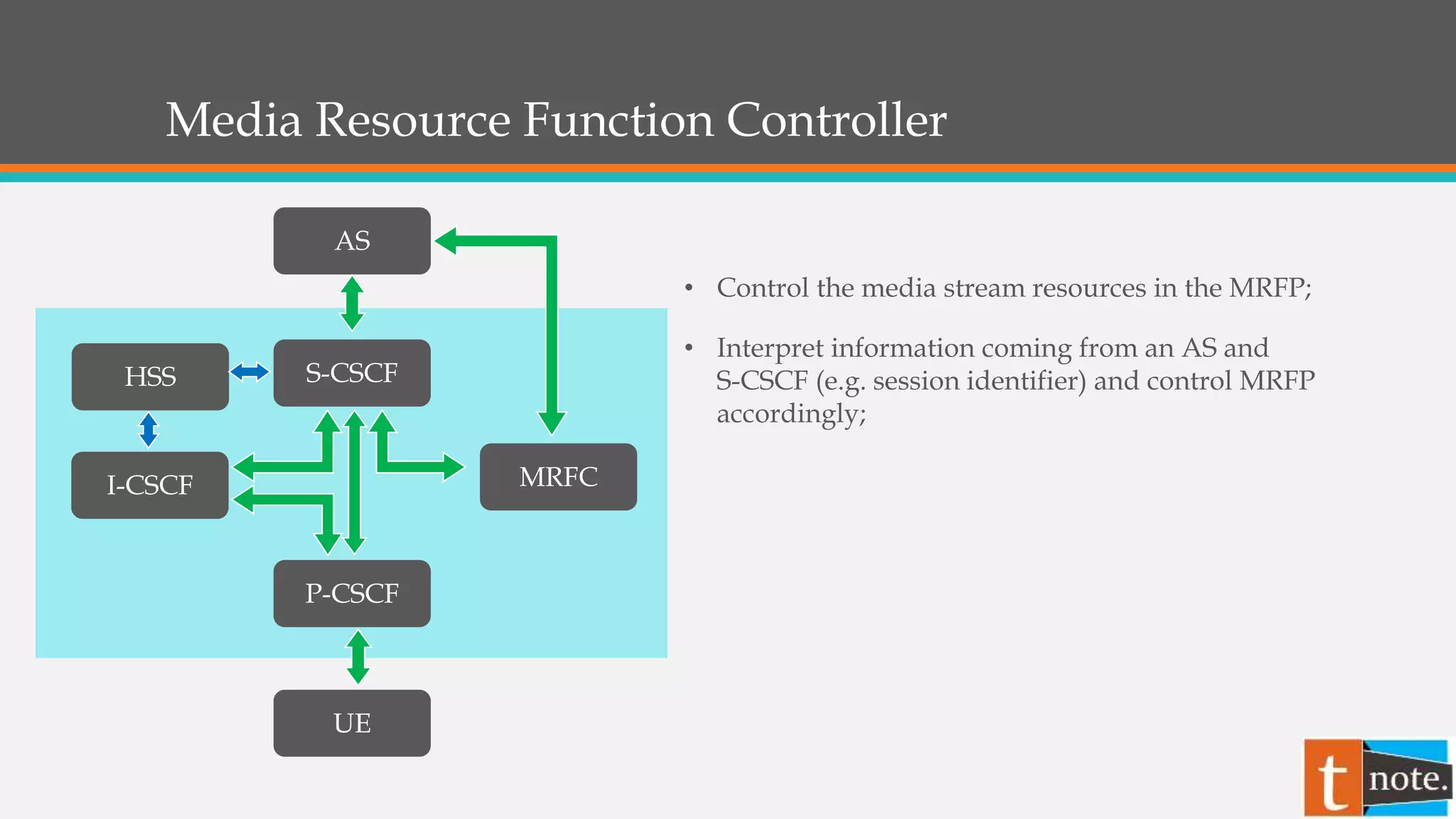
Media Resource Function Controller
P-CSCF
I-CSCF
HSS
UE
S-CSCF
AS
MRFC
• Control the media stream resources in the MRFP;
• Interpret information coming from an AS and
S-CSCF (e.g. session identifier) and control MRFP
accordingly;
Media Resource Function Processor
P-CSCF
I-CSCF
HSS
UE
S-CSCF
AS
MRFC
MRFP
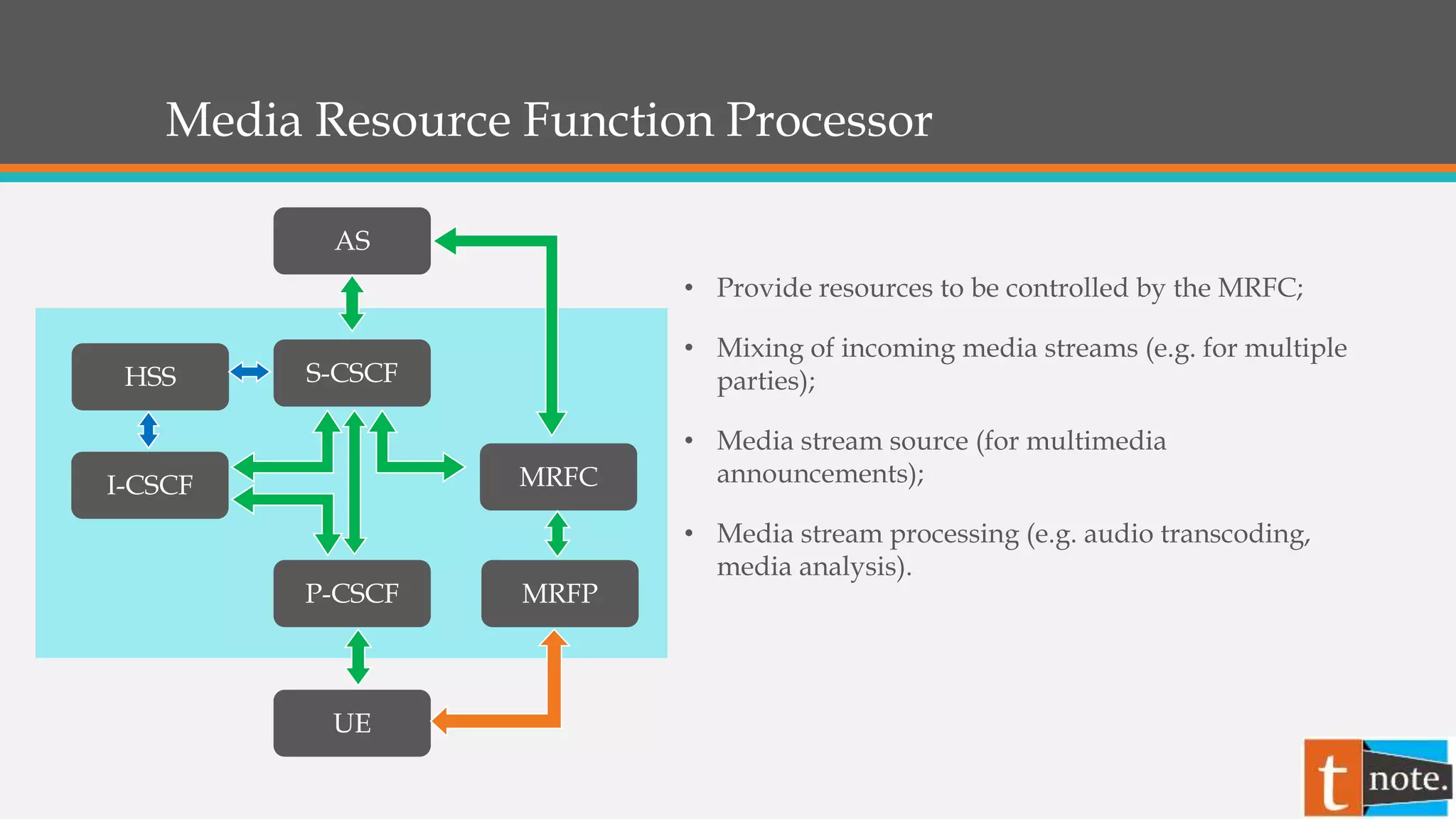
• Provide resources to be controlled by the MRFC;
• Mixing of incoming media streams (e.g. for multiple
parties);
• Media stream source (for multimedia
announcements);
• Media stream processing (e.g. audio transcoding,
media analysis).
thank you

IMS Core Elements

  • 1.
    IMS Core Elements IPMultimedia Subsystem Series
  • 2.
    IMS Core Elements P-CSCF I-CSCF S-CSCFHSS UE ASService Session Control Access AS: HSS : CSCF : S-CSCF : I-CSCF : P-CSCF : MRFC: MRFP: UE : Application Server Home Subscriber Server Call Session Control Function Serving – CSCF Interrogating – CSCF Proxy – CSCF Media Resource Function Controller Media Resource Function Processor User Equipment MRFC MRFP
  • 3.
    Proxy – CallSession Control Function • The Proxy-CSCF (P-CSCF) is the first contact point within the IM CN subsystem; • The P-CSCF behaves like a Proxy (as defined in IETF RFC 3261), i.e. it accepts requests and services them internally or forwards them on; • Forward the SIP request or response to the UE; • Maintain a Security Association between itself and each UE, as defined in TS 33.203 • Authorization of bearer resources and QoS management. For details see TS 23.203 P-CSCF UE
  • 4.
    P-CSCF I-CSCF UE Interrogating – CallSession Control Function OtherIMSNetwork • Interrogating-CSCF (I-CSCF) is the contact point within an operator's network for all connections destined to a user of that network operator, or a roaming user currently located within that network operator's service area; • Route a SIP request received from another network towards the S-CSCF; • Assigning a S-CSCF to a user performing SIP registration.
  • 5.
    Serving – CallSession Control Function P-CSCF I-CSCF UE OtherIMSNetwork S-CSCF • The Serving-CSCF (S-CSCF) performs the session control services for the UE. It maintains a session state as needed by the network operator for support of the services; • Behave as a Registrar as defined in IETF RFC 3261 , i.e. it accepts registration requests and makes its information available through the location server (e.g. HSS); • Session control for the registered endpoint's sessions; • Handle interaction with Services Platforms for the support of Services.
  • 6.
    Home Subscriber Server P-CSCF I-CSCF HSS UE •The HSS is the master database for a given user. It is the entity containing the subscription-related information to support the network entities actually handling calls/sessions; • The HSS is responsible for holding the following user related information: • User Identification, Numbering and addressing information; • User Security information: Network access control information for authentication and authorization; • User Location information at inter-system level: the HSS supports the user registration, and stores inter-system location information, etc.; • User profile information. OtherIMSNetwork S-CSCF
  • 7.
    Application Server P-CSCF I-CSCF HSS UE OtherIMSNetwork S-CSCF AS • AnApplication Server (AS) i.e., SIP Application Server, OSA Application Server, or CAMEL IM-SSF, offers value added IM services and resides either in the user's home network or in a third party location. The third party could be a network or simply a stand-alone AS; • The Serving-CSCF to AS interface is used to provide services residing in an AS;
  • 8.
    Media Resource FunctionController P-CSCF I-CSCF HSS UE S-CSCF AS MRFC • Control the media stream resources in the MRFP; • Interpret information coming from an AS and S-CSCF (e.g. session identifier) and control MRFP accordingly;
  • 9.
    Media Resource FunctionProcessor P-CSCF I-CSCF HSS UE S-CSCF AS MRFC MRFP • Provide resources to be controlled by the MRFC; • Mixing of incoming media streams (e.g. for multiple parties); • Media stream source (for multimedia announcements); • Media stream processing (e.g. audio transcoding, media analysis).
  • 10.

Editor's Notes

  • #7 A Home Network may contain one or several HSSs: it depends on the number of mobile subscribers, on the capacity of the equipment and on the organisation of the network; The HSS also generates User Security information for mutual authentication, communication integrity check and ciphering. The HSS consists of the following functionalities: IP multimedia functionality to provide support to control functions of the IM subsystem such as the CSCF; The subset of the HLR/AUC functionality required by the PS Domain (GPRS and EPC;. The subset of the HLR/AUC functionality required by the CS Domain.
  • #8 The OSA Application Server does not directly interact with the IMS network entities but through the OSA Service Capability Servers (OSA SCS-s). Further information on OSA is provided in TS 22.127 [4]. A SIP Application Server specified within 3GPP that supports IMS reference points (e.g. ISC, Sh, Ut), in support of an application, is considered as part of the IM CN subsystem. Examples of such ASs are SCC AS and TAS.