Company and Technology overview
Content Indigo Group SIP Technology Network components Network configurations Services Indigo products
Indigo Group  -  1 « Software and services for Internet real time telecommunications and collaboration »   VoIP (Internet telephony) Audio/Video Conferencing Instant Messaging Presence distribution Many other innovative services
Indigo Group  -  2 Indigo Software founded in 1999: First SIP company in Belgium (became US in 2000) Participated in the development of the SIP technology One of the first implementations First CPL server and editor First SIMPLE (client and server) implementation Indigo Engineering founded in 2004: Belgian company Indigo Software technology and products Product development and reselling Professional services
SIP Session Initiation Protocol Successor of H323 (ITU) Internet Protocol standardized by IETF (Internet Engineering Task Force) For  real - time telecommunications Control the establishment, management and tear down of multimedia session Only signaling part (like Canal D in ISDN) Standard: RFC 2543 (1999) and RFC 3261 (2002) Many other related RFC/Internet draft and growing
SIP Protocol  -  1 Internet like (HTTP, SMTP, etc) Text based: Start Line: Request/Response Headers Body Extensible: standard and non standard extensions (like HTML) Method Headers Body (MIME types) Independent of the media (e.g. SDP for session description)
SIP Protocol - 2 Secure: Digest authentication, TLS (certificate based), SIPS (S/MIME) but requires independent media security Interoperable :  major issue with H323 Scalable :  domain hierarchy using standard DNS architecture  (Internet architecture) Large industry support (Cisco, Microsoft, Alcatel, Siemens, Ericsson, Nokia, Nortel, etc.) Selected for Multimedia session in UMTS (IMS: IP Multimedia Subsystem)
SIP Protocol - 3 User (resource) identified by an URL/URI (like an email address) scheme:user@domain E.g.: sip:nicolas@indigosw.com tel: +3222303594 mailto: nicolas @ indigosw .com http://www.indigosw.com/~nicolas Generally simplified (like email addresses): user@domain :  nicolas @ indigosw .com user: nicolas tel: 022303594 One URI identifies one person, resource or group and not a device An URI is linked to device s  or other URI s  through the registration process
Principle  /1 Registrar Server Location Server Proxy Server Private network / Internet Domain 1 Domain 2 [email_address] [email_address] DNS Server registration [email_address] Proxy Server call [email_address] domain2 ? user2 ? Media
Principle /2 call info @indigosw.com Directed to the user Caller [email_address] [email_address] 022303594 [email_address] Desk A Desk B Forking
SIP Advantages Interoperable Scalable Service independent Extensible Secure Identifies the user, able to locate user Efficient routing Reliable (retransmission mechanism)
Comparison with PSTN More functionalities in end-points One network for both voice and data Better service integration Vendor independent (compared to PBX) Number/address linked to user One point of contact (the network knows the user location) Own management of network Easier to use (yes, this is the objective!) Forecast: in 2008, 44% of corporate lines Close integration (too much?)
Comparison with Skype Open protocol Interoperable (many vendors) Control (route can be controlled, authentication, firewalls) Security (your communication will not be sent through your neighbor network) Scalable (using domain) Can be implemented locally Industry support Vendor independent (Skype = one provider) Better integration with other protocols/services Requires more infrastructure (e.g. NAT traversal) Skype : directory / SIP : DNS Skype = « cheap » solution (simplicity ~ strong architecture)
Network components  -  1 End-points = UA (User Agent) SIP phones (~ 50 – 500 $) : simple, office, wi-fi, etc Soft phones (Windows Messenger, eyeBeam,  GnomeMeeting,  etc) ATA (Analog Terminal Adaptor) with or w/o PSTN connection (< 250 $) Residential gateways Gateway (ISDN connection PRI E1/T1) Media server (~audio bridge) / MCU (Multipoint Control Unit) Voice mail IVR (Interactive Voice Response) IP PBX
Network components - 2 SIP Servers Registrar server (+ location server) Proxy server (+ CPL Server) Redirect server Presence Agent / Notification server SIP Application server Other Servers: DNS Server: domain    server Enum Server: telephone number    server Xcap server: User parameters (buddy list, authorization list,  CPL scripts,  etc) Web/Mail server
Network Components - 3 Session Border Controller (NAT traversal: common issue) Router with ALG (Cisco, Ingate, etc) NAT Traversal (Jasomi) STUN / TURN Server (media gateway) uPNP Special SIP phone features
Network Components – IP PBX IP PBX (e.g. Asterisk) UA functionalities: Gateway, IVR, MCU, etc Multiple technologies: PSTN, SIP, H323, MGCP, IAX Voice oriented « Telco » model Designed for traditional telecom Integrated functionalities (not in client) Centralized model Access to PSTN/ISDN network PBX (local) + switch (Operator) Easier to understand SIP Proxy Signaling server (no media): Routing, Application server One technology/protocol: SIP Service independence Internet Model Designed for multimedia Functionality in client/application Distributed model Access to IP network SIP server (local) + network (ISP) Internet minded
Network configurations options Phones: POTS phones (PSTN) PBX Phones SIP Phones Connections: PSTN/ISDN IP Component / service location (conversion, servers, etc): Hosted Local Many options: see examples
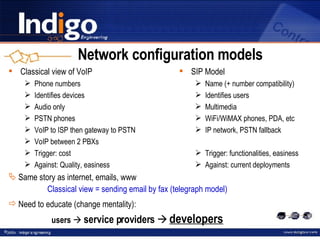
Network configuration models Classical view of VoIP Phone numbers Identifies devices Audio only PSTN phones VoIP to ISP then gateway to PSTN VoIP between 2 PBXs Trigger: cost Against: Quality, easiness SIP Model Name (+ number compatibility) Identifies users Multimedia Wi F i/Wi MAX  phones, PDA, etc IP network, PSTN fallback Trigger: functionalities, easiness Against: current deployments Same story as internet, emails, www Classical view = sending email by fax (telegraph model) Need to educate (change mentality):  users      service providers      developers
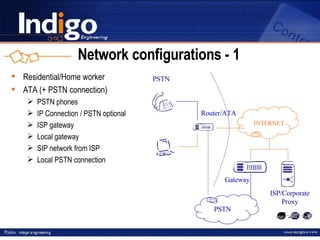
Network configurations - 1 Residential/Home worker ATA (+ PSTN connection) PSTN phones IP Connection / PSTN optional ISP gateway Local gateway SIP network from ISP Local PSTN connection Router/ATA PSTN INTERNET PSTN ISP/Corporate Proxy Gateway
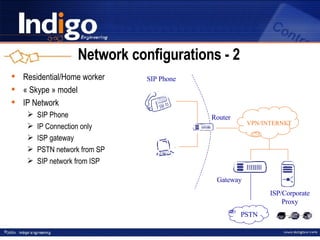
Network configurations - 2 Residential/Home worker « Skype » model IP Network SIP Phone IP Connection only ISP gateway PSTN network from SP SIP network from ISP Router SIP Phone ISP/Corporate Proxy VPN/INTERNET Gateway PSTN
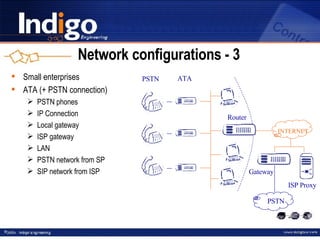
Network configurations - 3 Small enterprises ATA (+ PSTN connection) PSTN phones IP Connection Local gateway ISP gateway LAN PSTN network from SP SIP network from ISP ATA PSTN Router ISP Proxy INTERNET Gateway PSTN
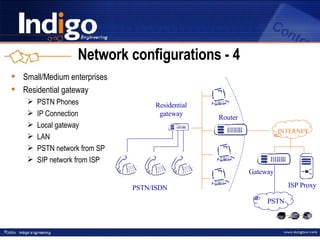
Network configurations - 4 Small/Medium enterprises Residential gateway PSTN Phones IP Connection Local gateway LAN PSTN network from SP SIP network from ISP Residential gateway PSTN /ISDN Router INTERNET ISP Proxy Gateway PSTN
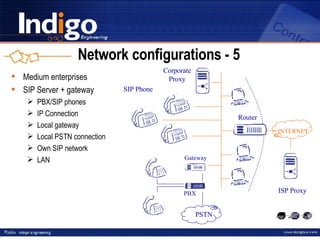
Network configurations - 5 Medium enterprises SIP Server + gateway PBX/SIP phones IP Connection Local gateway Local PSTN connection Own SIP network LAN Gateway PBX Router ISP Proxy INTERNET SIP Phone Corporate Proxy PSTN
Network configurations - 6 Medium/large enterprises Distributed / centralized Gateway PBX Router VPN/INTERNET Corporate Proxy PSTN Gateway PBX Router Corporate Proxy PSTN Router Road Warriors Home worker [distributed only]
SIP Services examples Multimedia session Conferencing Collaboration Instant Messaging Event notification Crisis communication Etc Unified Communication Simple, efficient, integrated, extensible
Multimedia Session: principles Supported devices: IP Phones (Desk phones,  W i F i phones , WiMAX? ) POTS phones (residential gateway (ATA) or network gateways) Mobile phones (through gateways) Enterprise telephony systems (IP PBX or PBX connected to a gateway) Soft phones (PC, PDA, Smart Phones)
Multimedia session: examples Telephony Video Instant Messaging Conferencing Application sharing Collaboration
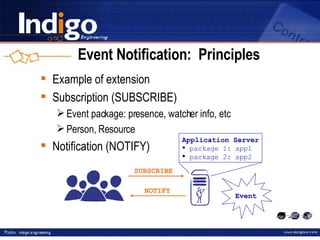
Event Notification:  Principles Example of extension Subscription (SUBSCRIBE) Event package: presence, watcher info, etc Person, Resource Notification (NOTIFY) SUBSCRIBE Event NOTIFY Application Server package 1: app1 package 2: app2
Event Notification: examples Presence (buddy list) Voice mail Mail box Stock quotes Resource availability (meeting room, conference bridge, etc)
What’s next Intelligent routing based on presence information Integrated services Deeper unified communication Mobile communication Advanced collaboration tools Better integration with devices
Indigo SIP Products Server Side Components Registrar / Location server Proxy / Redirect server Presence Server API Building blocks Server API Collaboration tools ICS (ad hoc conferencing based on IM interface) Services Training, network design, installation, custom development, etc
Contact Nicolas Zastavni: Director of Engineering Mail:  nicolas @ indigosw .com Tel: +32 2 535 77 87 Fax: +32 2 535 77 00 Indigo Engineering www. indigosw .com
Appendix
Achievements 1999 SIP Stack development 2000 User Agent Proxy/Registrar Servers 2001 SIP Foundation Class SDK CPL Server and Editor Early SIMPLE Presence Server SIP&SIMPLE User Agent Advanced SIP Proxy/ Registrar 2002 SIP Foundation Class SIP Server and SDK Presence server and SDK 3PCC 2003 Indigo Communication Server IP Call IM Works 2004 Instant Conferencing (ICS)
Indigo Technology Java-based development Modular, re-usable and extensible Scalable and fully multi-threaded Strong ability to leverage and integrate open source packages Multi-platform and fully interoperable Web integration Wide set of multi-level, open APIs  Powerful web administration tools Over 500,000 lines of code in the platform Unix and Linux friendly Strongly IETF centric
IETF Compliance RFC 2543/3261:  Session Initiation Protocol   RFC 2327 :  Session Description Protocol   RFC 2976 :  The SIP INFO Method   RFC 3263 :  Locating SIP Servers   RFC 3264 :  An Offer/Answer Model with  SDP RFC 3265 :  Specific Event Notification   RFC 3581 :  An Extension to SIP for Symmetric Response Routing   RFC 2806 :  URLs for Telephone Calls   RFC 2916 :  E.164 number and DNS   RFC 3268 :  AES Cipher suites for TLS RFC 3428 :  SIP Extension for Instant Messaging   RFC 2778 :  A Model for Presence and Instant Messaging   RFC 2779 :  Instant Messaging/Presence Protocol Requirements   RFC 3856 :  Presence Event Package for  SIP RFC 3859 :  Common Profile for Presence RFC 3860 :  Common Profile for Instant Messaging   RFC 3861 :  Address Resolution for Instant Messaging and Presence RFC 3862 :  CPIM: Message Format   RFC 3863 :  Presence Information Data Format
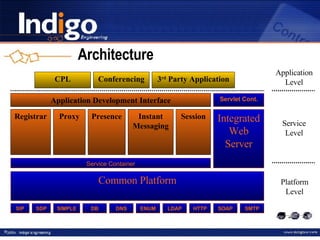
Architecture Common Platform Registrar Proxy Presence Conferencing Instant Messaging SIP SDP SIMPLE DB DNS ENUM LDAP HTTP SOAP SMTP Integrated Web Server Service Container Application Development Interface Servlet Cont. CPL Session 3 rd  Party Application Application Level Service Level Platform Level
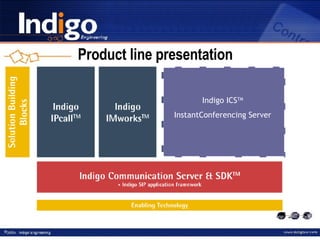
Products Enabling technology platform State of the art SIP server components Component specialized set of APIs Home-grown applications leveraging the platform SIP-based IP Telephony Service Secure Corporate IM Presence-based, ad-hoc IP conferencing Services Strong support Professional services
Product line presentation Indigo ICS TM InstantConferencing Server
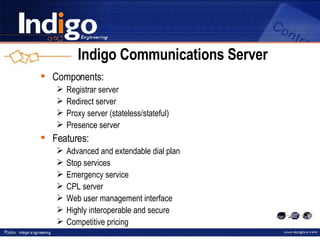
Indigo Communications Server Components: Registrar server Redirect server Proxy server (stateless/stateful) Presence server Features: Advanced and extendable dial plan Stop services Emergency service CPL server Web user management interface Highly interoperable and secure Competitive pricing
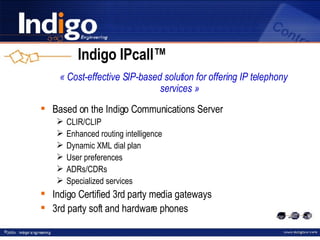
Indigo IPcall™ « Cost-effective SIP-based solution for offering IP telephony services » Based on the Indigo Communications Server CLIR/CLIP Enhanced routing intelligence Dynamic XML dial plan User preferences ADRs/CDRs Specialized services Indigo Certified 3rd party media gateways 3rd party soft and hardware phones
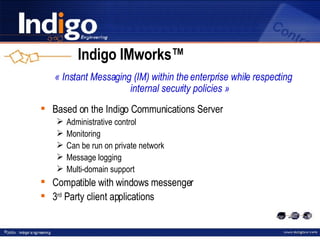
Indigo IMworks™ « Instant Messaging (IM) within the enterprise while respecting internal security policies » Based on the Indigo Communications Server Administrative control Monitoring Can be run on private network Message logging Multi-domain support Compatible with windows messenger 3 rd  Party client applications
Indigo ICS™ « Set up a voice/IM conference with your colleagues wherever they are, right from your desktop and instantaneously, and drastically reduce your conferencing costs » Key features: IP-based, presence-enabled conferencing You can start a conference from your IM window Ad-hoc conferencing You can start up a conference when you see the people online Convenient drag and drop conference setup You can drag buddies into a conference launchpad Multi-networks conferencing Corporate IP users on private LAN / VPN GSTN participants (customers, partners, road warriors) Remote access employees (IP road warriors)
Indigo ICS™ (cont) Deployment Appliance product: Integrates Indigo Communications Server Conferencing application Media server Media gateway (connectivity with PBX, GSTN network) Can work autonomously with no additional SIP/SIMPLE infrastructure Or can complement a deployed infrastructure (Cisco, MS LCS) for adding Instant Conferencing

Indigo Product And Technology Overivew 2005

  • 1.
  • 2.
    Content Indigo GroupSIP Technology Network components Network configurations Services Indigo products
  • 3.
    Indigo Group - 1 « Software and services for Internet real time telecommunications and collaboration » VoIP (Internet telephony) Audio/Video Conferencing Instant Messaging Presence distribution Many other innovative services
  • 4.
    Indigo Group - 2 Indigo Software founded in 1999: First SIP company in Belgium (became US in 2000) Participated in the development of the SIP technology One of the first implementations First CPL server and editor First SIMPLE (client and server) implementation Indigo Engineering founded in 2004: Belgian company Indigo Software technology and products Product development and reselling Professional services
  • 5.
    SIP Session InitiationProtocol Successor of H323 (ITU) Internet Protocol standardized by IETF (Internet Engineering Task Force) For real - time telecommunications Control the establishment, management and tear down of multimedia session Only signaling part (like Canal D in ISDN) Standard: RFC 2543 (1999) and RFC 3261 (2002) Many other related RFC/Internet draft and growing
  • 6.
    SIP Protocol - 1 Internet like (HTTP, SMTP, etc) Text based: Start Line: Request/Response Headers Body Extensible: standard and non standard extensions (like HTML) Method Headers Body (MIME types) Independent of the media (e.g. SDP for session description)
  • 7.
    SIP Protocol -2 Secure: Digest authentication, TLS (certificate based), SIPS (S/MIME) but requires independent media security Interoperable : major issue with H323 Scalable : domain hierarchy using standard DNS architecture (Internet architecture) Large industry support (Cisco, Microsoft, Alcatel, Siemens, Ericsson, Nokia, Nortel, etc.) Selected for Multimedia session in UMTS (IMS: IP Multimedia Subsystem)
  • 8.
    SIP Protocol -3 User (resource) identified by an URL/URI (like an email address) scheme:user@domain E.g.: sip:nicolas@indigosw.com tel: +3222303594 mailto: nicolas @ indigosw .com http://www.indigosw.com/~nicolas Generally simplified (like email addresses): user@domain : nicolas @ indigosw .com user: nicolas tel: 022303594 One URI identifies one person, resource or group and not a device An URI is linked to device s or other URI s through the registration process
  • 9.
    Principle /1Registrar Server Location Server Proxy Server Private network / Internet Domain 1 Domain 2 [email_address] [email_address] DNS Server registration [email_address] Proxy Server call [email_address] domain2 ? user2 ? Media
  • 10.
    Principle /2 callinfo @indigosw.com Directed to the user Caller [email_address] [email_address] 022303594 [email_address] Desk A Desk B Forking
  • 11.
    SIP Advantages InteroperableScalable Service independent Extensible Secure Identifies the user, able to locate user Efficient routing Reliable (retransmission mechanism)
  • 12.
    Comparison with PSTNMore functionalities in end-points One network for both voice and data Better service integration Vendor independent (compared to PBX) Number/address linked to user One point of contact (the network knows the user location) Own management of network Easier to use (yes, this is the objective!) Forecast: in 2008, 44% of corporate lines Close integration (too much?)
  • 13.
    Comparison with SkypeOpen protocol Interoperable (many vendors) Control (route can be controlled, authentication, firewalls) Security (your communication will not be sent through your neighbor network) Scalable (using domain) Can be implemented locally Industry support Vendor independent (Skype = one provider) Better integration with other protocols/services Requires more infrastructure (e.g. NAT traversal) Skype : directory / SIP : DNS Skype = « cheap » solution (simplicity ~ strong architecture)
  • 14.
    Network components - 1 End-points = UA (User Agent) SIP phones (~ 50 – 500 $) : simple, office, wi-fi, etc Soft phones (Windows Messenger, eyeBeam, GnomeMeeting, etc) ATA (Analog Terminal Adaptor) with or w/o PSTN connection (< 250 $) Residential gateways Gateway (ISDN connection PRI E1/T1) Media server (~audio bridge) / MCU (Multipoint Control Unit) Voice mail IVR (Interactive Voice Response) IP PBX
  • 15.
    Network components -2 SIP Servers Registrar server (+ location server) Proxy server (+ CPL Server) Redirect server Presence Agent / Notification server SIP Application server Other Servers: DNS Server: domain  server Enum Server: telephone number  server Xcap server: User parameters (buddy list, authorization list, CPL scripts, etc) Web/Mail server
  • 16.
    Network Components -3 Session Border Controller (NAT traversal: common issue) Router with ALG (Cisco, Ingate, etc) NAT Traversal (Jasomi) STUN / TURN Server (media gateway) uPNP Special SIP phone features
  • 17.
    Network Components –IP PBX IP PBX (e.g. Asterisk) UA functionalities: Gateway, IVR, MCU, etc Multiple technologies: PSTN, SIP, H323, MGCP, IAX Voice oriented « Telco » model Designed for traditional telecom Integrated functionalities (not in client) Centralized model Access to PSTN/ISDN network PBX (local) + switch (Operator) Easier to understand SIP Proxy Signaling server (no media): Routing, Application server One technology/protocol: SIP Service independence Internet Model Designed for multimedia Functionality in client/application Distributed model Access to IP network SIP server (local) + network (ISP) Internet minded
  • 18.
    Network configurations optionsPhones: POTS phones (PSTN) PBX Phones SIP Phones Connections: PSTN/ISDN IP Component / service location (conversion, servers, etc): Hosted Local Many options: see examples
  • 19.
    Network configuration modelsClassical view of VoIP Phone numbers Identifies devices Audio only PSTN phones VoIP to ISP then gateway to PSTN VoIP between 2 PBXs Trigger: cost Against: Quality, easiness SIP Model Name (+ number compatibility) Identifies users Multimedia Wi F i/Wi MAX phones, PDA, etc IP network, PSTN fallback Trigger: functionalities, easiness Against: current deployments Same story as internet, emails, www Classical view = sending email by fax (telegraph model) Need to educate (change mentality): users  service providers  developers
  • 20.
    Network configurations -1 Residential/Home worker ATA (+ PSTN connection) PSTN phones IP Connection / PSTN optional ISP gateway Local gateway SIP network from ISP Local PSTN connection Router/ATA PSTN INTERNET PSTN ISP/Corporate Proxy Gateway
  • 21.
    Network configurations -2 Residential/Home worker « Skype » model IP Network SIP Phone IP Connection only ISP gateway PSTN network from SP SIP network from ISP Router SIP Phone ISP/Corporate Proxy VPN/INTERNET Gateway PSTN
  • 22.
    Network configurations -3 Small enterprises ATA (+ PSTN connection) PSTN phones IP Connection Local gateway ISP gateway LAN PSTN network from SP SIP network from ISP ATA PSTN Router ISP Proxy INTERNET Gateway PSTN
  • 23.
    Network configurations -4 Small/Medium enterprises Residential gateway PSTN Phones IP Connection Local gateway LAN PSTN network from SP SIP network from ISP Residential gateway PSTN /ISDN Router INTERNET ISP Proxy Gateway PSTN
  • 24.
    Network configurations -5 Medium enterprises SIP Server + gateway PBX/SIP phones IP Connection Local gateway Local PSTN connection Own SIP network LAN Gateway PBX Router ISP Proxy INTERNET SIP Phone Corporate Proxy PSTN
  • 25.
    Network configurations -6 Medium/large enterprises Distributed / centralized Gateway PBX Router VPN/INTERNET Corporate Proxy PSTN Gateway PBX Router Corporate Proxy PSTN Router Road Warriors Home worker [distributed only]
  • 26.
    SIP Services examplesMultimedia session Conferencing Collaboration Instant Messaging Event notification Crisis communication Etc Unified Communication Simple, efficient, integrated, extensible
  • 27.
    Multimedia Session: principlesSupported devices: IP Phones (Desk phones, W i F i phones , WiMAX? ) POTS phones (residential gateway (ATA) or network gateways) Mobile phones (through gateways) Enterprise telephony systems (IP PBX or PBX connected to a gateway) Soft phones (PC, PDA, Smart Phones)
  • 28.
    Multimedia session: examplesTelephony Video Instant Messaging Conferencing Application sharing Collaboration
  • 29.
    Event Notification: Principles Example of extension Subscription (SUBSCRIBE) Event package: presence, watcher info, etc Person, Resource Notification (NOTIFY) SUBSCRIBE Event NOTIFY Application Server package 1: app1 package 2: app2
  • 30.
    Event Notification: examplesPresence (buddy list) Voice mail Mail box Stock quotes Resource availability (meeting room, conference bridge, etc)
  • 31.
    What’s next Intelligentrouting based on presence information Integrated services Deeper unified communication Mobile communication Advanced collaboration tools Better integration with devices
  • 32.
    Indigo SIP ProductsServer Side Components Registrar / Location server Proxy / Redirect server Presence Server API Building blocks Server API Collaboration tools ICS (ad hoc conferencing based on IM interface) Services Training, network design, installation, custom development, etc
  • 33.
    Contact Nicolas Zastavni:Director of Engineering Mail: nicolas @ indigosw .com Tel: +32 2 535 77 87 Fax: +32 2 535 77 00 Indigo Engineering www. indigosw .com
  • 34.
  • 35.
    Achievements 1999 SIPStack development 2000 User Agent Proxy/Registrar Servers 2001 SIP Foundation Class SDK CPL Server and Editor Early SIMPLE Presence Server SIP&SIMPLE User Agent Advanced SIP Proxy/ Registrar 2002 SIP Foundation Class SIP Server and SDK Presence server and SDK 3PCC 2003 Indigo Communication Server IP Call IM Works 2004 Instant Conferencing (ICS)
  • 36.
    Indigo Technology Java-baseddevelopment Modular, re-usable and extensible Scalable and fully multi-threaded Strong ability to leverage and integrate open source packages Multi-platform and fully interoperable Web integration Wide set of multi-level, open APIs Powerful web administration tools Over 500,000 lines of code in the platform Unix and Linux friendly Strongly IETF centric
  • 37.
    IETF Compliance RFC2543/3261: Session Initiation Protocol RFC 2327 : Session Description Protocol RFC 2976 : The SIP INFO Method RFC 3263 : Locating SIP Servers RFC 3264 : An Offer/Answer Model with SDP RFC 3265 : Specific Event Notification RFC 3581 : An Extension to SIP for Symmetric Response Routing RFC 2806 : URLs for Telephone Calls RFC 2916 : E.164 number and DNS RFC 3268 : AES Cipher suites for TLS RFC 3428 : SIP Extension for Instant Messaging RFC 2778 : A Model for Presence and Instant Messaging RFC 2779 : Instant Messaging/Presence Protocol Requirements RFC 3856 : Presence Event Package for SIP RFC 3859 : Common Profile for Presence RFC 3860 : Common Profile for Instant Messaging RFC 3861 : Address Resolution for Instant Messaging and Presence RFC 3862 : CPIM: Message Format RFC 3863 : Presence Information Data Format
  • 38.
    Architecture Common PlatformRegistrar Proxy Presence Conferencing Instant Messaging SIP SDP SIMPLE DB DNS ENUM LDAP HTTP SOAP SMTP Integrated Web Server Service Container Application Development Interface Servlet Cont. CPL Session 3 rd Party Application Application Level Service Level Platform Level
  • 39.
    Products Enabling technologyplatform State of the art SIP server components Component specialized set of APIs Home-grown applications leveraging the platform SIP-based IP Telephony Service Secure Corporate IM Presence-based, ad-hoc IP conferencing Services Strong support Professional services
  • 40.
    Product line presentationIndigo ICS TM InstantConferencing Server
  • 41.
    Indigo Communications ServerComponents: Registrar server Redirect server Proxy server (stateless/stateful) Presence server Features: Advanced and extendable dial plan Stop services Emergency service CPL server Web user management interface Highly interoperable and secure Competitive pricing
  • 42.
    Indigo IPcall™ « Cost-effectiveSIP-based solution for offering IP telephony services » Based on the Indigo Communications Server CLIR/CLIP Enhanced routing intelligence Dynamic XML dial plan User preferences ADRs/CDRs Specialized services Indigo Certified 3rd party media gateways 3rd party soft and hardware phones
  • 43.
    Indigo IMworks™ « InstantMessaging (IM) within the enterprise while respecting internal security policies » Based on the Indigo Communications Server Administrative control Monitoring Can be run on private network Message logging Multi-domain support Compatible with windows messenger 3 rd Party client applications
  • 44.
    Indigo ICS™ « Setup a voice/IM conference with your colleagues wherever they are, right from your desktop and instantaneously, and drastically reduce your conferencing costs » Key features: IP-based, presence-enabled conferencing You can start a conference from your IM window Ad-hoc conferencing You can start up a conference when you see the people online Convenient drag and drop conference setup You can drag buddies into a conference launchpad Multi-networks conferencing Corporate IP users on private LAN / VPN GSTN participants (customers, partners, road warriors) Remote access employees (IP road warriors)
  • 45.
    Indigo ICS™ (cont)Deployment Appliance product: Integrates Indigo Communications Server Conferencing application Media server Media gateway (connectivity with PBX, GSTN network) Can work autonomously with no additional SIP/SIMPLE infrastructure Or can complement a deployed infrastructure (Cisco, MS LCS) for adding Instant Conferencing