ENABLINGENHANCEDSERVICES
THROUGHIMSTECHNOLOGY
Sebastian Schumann
Slovak Telekom
24. April 2013. Barcelona, Spain.
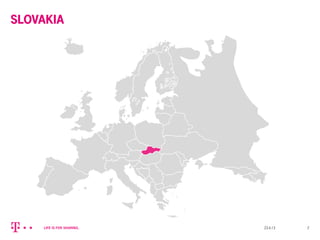
SLOVAKIA
23.4.13 2
ABOUTSLOVAKTELEKOM
Slovak Telekom Group is the telecommunication market leader in Slovakia
Former fixed and mobile incumbent (merger in 2010), Zoznam, Posam
We provide fixed network services, mobile communications, Internet access + content,
data services, CPE, ICT services (data center + cloud), radio and TV broadcasting
as well as commercial call center services.
The major shareholder is Deutsche Telekom AG, one of the largest telecommunications
operators worldwide.
Successful deployments in SEE as well as in DT group:
§  One of the biggest national-wide deployment of NGN technology in Europe in 2004,
whole city migrated to all-IP NGN in 2007
§  Fixed network IMS migration started in 2011 (class 5 replacement)
§  Leader in IPTV (since 2006), offering also hybrid satellite TV (since 2009) and OTT app
(since 2012)
§  Extensive FTTx deployments (360k households)
23.4.13 3
SCOPE
SLOVAK TELEKOM CASE STUDY
Enabling Enhanced Services Through IMS Technology
§  Mobile integration status
§  Overview of new IP based services
§  Evolution of the integration platform
Fixed network evolution from PSTN & NGN towards the IMS.
Mobile and IPTV architecture overview.
The road ahead…
Focal Points
23.4.13 4
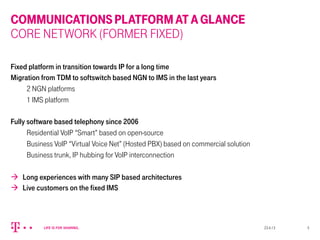
COMMUNICATIONSPLATFORMATAGLANCE
CORE NETWORK (FORMER FIXED)
Fixed platform in transition towards IP for a long time
Migration from TDM to softswitch based NGN to IMS in the last years
2 NGN platforms
1 IMS platform
Fully software based telephony since 2006
Residential VoIP “Smart” based on open-source
Business VoIP “Virtual Voice Net” (Hosted PBX) based on commercial solution
Business trunk, IP hubbing for VoIP interconnection
à  Long experiences with many SIP based architectures
à  Live customers on the fixed IMS
23.4.13 5
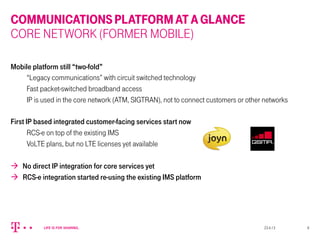
COMMUNICATIONSPLATFORMATAGLANCE
CORE NETWORK (FORMER MOBILE)
Mobile platform still “two-fold”
“Legacy communications” with circuit switched technology
Fast packet-switched broadband access
IP is used in the core network (ATM, SIGTRAN), not to connect customers or other networks
First IP based integrated customer-facing services start now
RCS-e on top of the existing IMS
VoLTE plans, but no LTE licenses yet available
à  No direct IP integration for core services yet
à  RCS-e integration started re-using the existing IMS platform
23.4.13 6
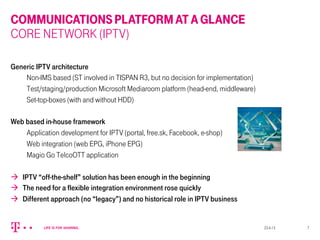
COMMUNICATIONSPLATFORMATAGLANCE
CORE NETWORK (IPTV)
Generic IPTV architecture
Non-IMS based (ST involved in TISPAN R3, but no decision for implementation)
Test/staging/production Microsoft Mediaroom platform (head-end, middleware)
Set-top-boxes (with and without HDD)
Web based in-house framework
Application development for IPTV (portal, free.sk, Facebook, e-shop)
Web integration (web EPG, iPhone EPG)
Magio Go TelcoOTT application
à  IPTV “off-the-shelf” solution has been enough in the beginning
à  The need for a flexible integration environment rose quickly
à  Different approach (no “legacy”) and no historical role in IPTV business
23.4.13 7
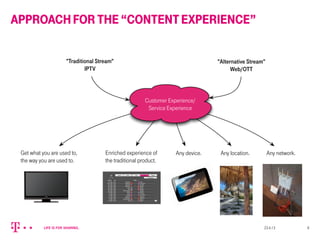
APPROACHFORTHE“CONTENTEXPERIENCE”
23.4.13 8
Get what you are used to,
the way you are used to.
Enriched experience of
the traditional product.
Any device.
Customer Experience/
Service Experience
"Traditional Stream"
IPTV
"Alternative Stream"
Web/OTT
Any location. Any network.
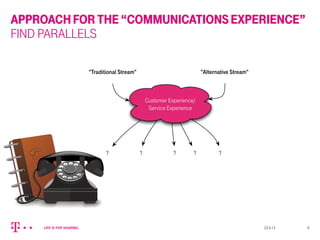
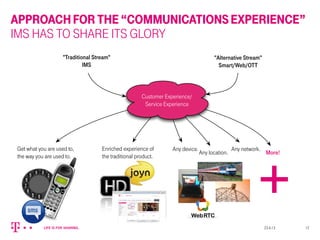
APPROACHFORTHE“COMMUNICATIONSEXPERIENCE”
FIND PARALLELS
23.4.13 9
? ? ?
Customer Experience/
Service Experience
"Traditional Stream" "Alternative Stream"
? ?
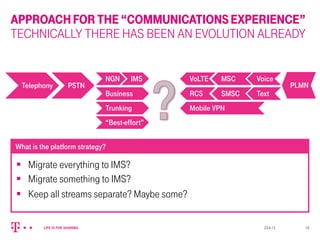
APPROACHFORTHE“COMMUNICATIONSEXPERIENCE”
TECHNICALLY THERE HAS BEEN AN EVOLUTION ALREADY
23.4.13 10
NGN
Business
Telephony PSTN
IMS
“Best-effort”
Trunking
§  Migrate everything to IMS?
§  Migrate something to IMS?
§  Keep all streams separate? Maybe some?
What is the platform strategy?
VoLTE MSC Voice
RCS SMSC Text
PLMN
Mobile VPN
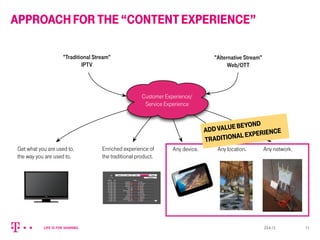
APPROACHFORTHE“CONTENTEXPERIENCE”
23.4.13 11
Get what you are used to,
the way you are used to.
Enriched experience of
the traditional product.
Any device.
Customer Experience/
Service Experience
"Traditional Stream"
IPTV
"Alternative Stream"
Web/OTT
Any location. Any network.
ADDVALUEBEYOND
TRADITIONALEXPERIENCE
APPROACHFORTHE“COMMUNICATIONSEXPERIENCE”
IMS HAS TO SHARE ITS GLORY
23.4.13 12
Get what you are used to,
the way you are used to.
Enriched experience of
the traditional product.
Any device.
Customer Experience/
Service Experience
"Traditional Stream"
IMS
"Alternative Stream"
Smart/Web/OTT
Any location.
Any network.
More!
+
23.4.13 13
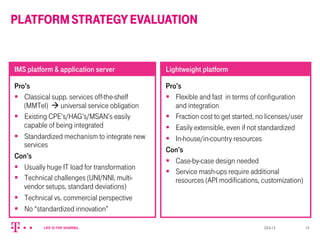
Pro’s
§  Classical supp. services off-the-shelf
(MMTel) à universal service obligation
§  Existing CPE’s/HAG’s/MSAN’s easily
capable of being integrated
§  Standardized mechanism to integrate new
services
Con’s
§  Usually huge IT load for transformation
§  Technical challenges (UNI/NNI, multi-
vendor setups, standard deviations)
§  Technical vs. commercial perspective
§  No “standardized innovation”
PLATFORMSTRATEGYEVALUATION
IMS platform & application server
Pro’s
§  Flexible and fast in terms of configuration
and integration
§  Fraction cost to get started, no licenses/user
§  Easily extensible, even if not standardized
§  In-house/in-country resources
Con’s
§  Case-by-case design needed
§  Service mash-ups require additional
resources (API modifications, customization)
Lightweight platform
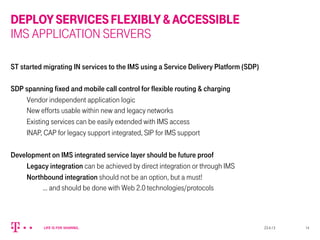
DEPLOYSERVICESFLEXIBLY&ACCESSIBLE
IMS APPLICATION SERVERS
ST started migrating IN services to the IMS using a Service Delivery Platform (SDP)
SDP spanning fixed and mobile call control for flexible routing & charging
Vendor independent application logic
New efforts usable within new and legacy networks
Existing services can be easily extended with IMS access
INAP, CAP for legacy support integrated, SIP for IMS support
Development on IMS integrated service layer should be future proof
Legacy integration can be achieved by direct integration or through IMS
Northbound integration should not be an option, but a must!
… and should be done with Web 2.0 technologies/protocols
23.4.13 14
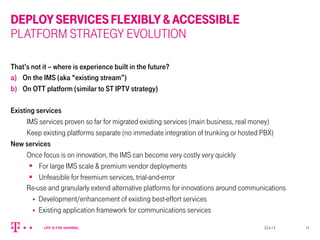
DEPLOYSERVICESFLEXIBLY&ACCESSIBLE
PLATFORM STRATEGY EVOLUTION
That’s not it – where is experience built in the future?
a)  On the IMS (aka “existing stream”)
b)  On OTT platform (similar to ST IPTV strategy)
Existing services
IMS services proven so far for migrated existing services (main business, real money)
Keep existing platforms separate (no immediate integration of trunking or hosted PBX)
New services
Once focus is on innovation, the IMS can become very costly very quickly
§  For large IMS scale & premium vendor deployments
§  Unfeasible for freemium services, trial-and-error
Re-use and granularly extend alternative platforms for innovations around communications
§  Development/enhancement of existing best-effort services
§  Existing application framework for communications services
23.4.13 15
WHATISTHEULTIMATEPLATFORMSTRATEGY?
Question not easy and universally to answer.
Reflection needed on the focal points:
§  New telephony platform with similar features as the old one to get started?
§  New services fits in concept of sessions?
§  Deep network integration needed?
§  Is the IT flexible enough (or no advanced requirements for integration)?
§  Will the business case fly considering different pace for innovations?
à  Case-by-case decision, not just use because it is there (efficiency, suitability).
à  Technical pureness vs. commercial feasibility (e.g. trunking).
à  Application layer convergence using SDP helps partially (mid-term legacy support).
23.4.13 16
SUMMARY
Migration of legacy platforms to the IMS is currently mainly cost driven
Lower OPEX and class 5 migration main motivation
IMS seen as the best alternative at the moment – following the legacy view of telephony
No innovations from customer perspective
Business telephony was there before
PSTN emulation is nothing new for the customer
What can Telco’s do once they have an IMS/RCS infrastructure (for whatever reason)
Wrong: Look at what we can do with it. Create need or technical motivation. (joyn?!)
Right: Check what we need! And what our customers need
à Look how the IMS and transitioned Telco infrastructure can help
à Be open for alternative approaches
23.4.13 17
CONCLUSION
Business is king, not the architecture.
§  Main business still legacy à IMS
§  Highly competitive market
§  To remain competitive, an alternative strategy should be followed in parallel
§  Not the cure for everything
§  Bridge to emerging markets
§  Faster innovation, trial and error
§  Find new business models
§  Consider the web (also with regard to payment options, feature activation, etc.)
§  Integrate, but offer also means to be integrated (messaging, voice)
§  Focus on user’s needs & experience - tech driven services and features are wrong!
23.4.13 18
THANKYOU!
Sebastian Schumann
Senior Designer
Slovak Telekom, a.s.
Sebastian.Schumann@telekom.sk
+421 903 419 345
@s_schumann
sschumann
REFERENCES
[1] Open Clipart
[2] Flickr
23.4.13 20

Enabling Enhanced Services Through IMS Technology

  • 1.
  • 2.
  • 3.
    ABOUTSLOVAKTELEKOM Slovak Telekom Groupis the telecommunication market leader in Slovakia Former fixed and mobile incumbent (merger in 2010), Zoznam, Posam We provide fixed network services, mobile communications, Internet access + content, data services, CPE, ICT services (data center + cloud), radio and TV broadcasting as well as commercial call center services. The major shareholder is Deutsche Telekom AG, one of the largest telecommunications operators worldwide. Successful deployments in SEE as well as in DT group: §  One of the biggest national-wide deployment of NGN technology in Europe in 2004, whole city migrated to all-IP NGN in 2007 §  Fixed network IMS migration started in 2011 (class 5 replacement) §  Leader in IPTV (since 2006), offering also hybrid satellite TV (since 2009) and OTT app (since 2012) §  Extensive FTTx deployments (360k households) 23.4.13 3
  • 4.
    SCOPE SLOVAK TELEKOM CASESTUDY Enabling Enhanced Services Through IMS Technology §  Mobile integration status §  Overview of new IP based services §  Evolution of the integration platform Fixed network evolution from PSTN & NGN towards the IMS. Mobile and IPTV architecture overview. The road ahead… Focal Points 23.4.13 4
  • 5.
    COMMUNICATIONSPLATFORMATAGLANCE CORE NETWORK (FORMERFIXED) Fixed platform in transition towards IP for a long time Migration from TDM to softswitch based NGN to IMS in the last years 2 NGN platforms 1 IMS platform Fully software based telephony since 2006 Residential VoIP “Smart” based on open-source Business VoIP “Virtual Voice Net” (Hosted PBX) based on commercial solution Business trunk, IP hubbing for VoIP interconnection à  Long experiences with many SIP based architectures à  Live customers on the fixed IMS 23.4.13 5
  • 6.
    COMMUNICATIONSPLATFORMATAGLANCE CORE NETWORK (FORMERMOBILE) Mobile platform still “two-fold” “Legacy communications” with circuit switched technology Fast packet-switched broadband access IP is used in the core network (ATM, SIGTRAN), not to connect customers or other networks First IP based integrated customer-facing services start now RCS-e on top of the existing IMS VoLTE plans, but no LTE licenses yet available à  No direct IP integration for core services yet à  RCS-e integration started re-using the existing IMS platform 23.4.13 6
  • 7.
    COMMUNICATIONSPLATFORMATAGLANCE CORE NETWORK (IPTV) GenericIPTV architecture Non-IMS based (ST involved in TISPAN R3, but no decision for implementation) Test/staging/production Microsoft Mediaroom platform (head-end, middleware) Set-top-boxes (with and without HDD) Web based in-house framework Application development for IPTV (portal, free.sk, Facebook, e-shop) Web integration (web EPG, iPhone EPG) Magio Go TelcoOTT application à  IPTV “off-the-shelf” solution has been enough in the beginning à  The need for a flexible integration environment rose quickly à  Different approach (no “legacy”) and no historical role in IPTV business 23.4.13 7
  • 8.
    APPROACHFORTHE“CONTENTEXPERIENCE” 23.4.13 8 Get whatyou are used to, the way you are used to. Enriched experience of the traditional product. Any device. Customer Experience/ Service Experience "Traditional Stream" IPTV "Alternative Stream" Web/OTT Any location. Any network.
  • 9.
    APPROACHFORTHE“COMMUNICATIONSEXPERIENCE” FIND PARALLELS 23.4.13 9 ?? ? Customer Experience/ Service Experience "Traditional Stream" "Alternative Stream" ? ?
  • 10.
    APPROACHFORTHE“COMMUNICATIONSEXPERIENCE” TECHNICALLY THERE HASBEEN AN EVOLUTION ALREADY 23.4.13 10 NGN Business Telephony PSTN IMS “Best-effort” Trunking §  Migrate everything to IMS? §  Migrate something to IMS? §  Keep all streams separate? Maybe some? What is the platform strategy? VoLTE MSC Voice RCS SMSC Text PLMN Mobile VPN
  • 11.
    APPROACHFORTHE“CONTENTEXPERIENCE” 23.4.13 11 Get whatyou are used to, the way you are used to. Enriched experience of the traditional product. Any device. Customer Experience/ Service Experience "Traditional Stream" IPTV "Alternative Stream" Web/OTT Any location. Any network. ADDVALUEBEYOND TRADITIONALEXPERIENCE
  • 12.
    APPROACHFORTHE“COMMUNICATIONSEXPERIENCE” IMS HAS TOSHARE ITS GLORY 23.4.13 12 Get what you are used to, the way you are used to. Enriched experience of the traditional product. Any device. Customer Experience/ Service Experience "Traditional Stream" IMS "Alternative Stream" Smart/Web/OTT Any location. Any network. More! +
  • 13.
    23.4.13 13 Pro’s §  Classicalsupp. services off-the-shelf (MMTel) à universal service obligation §  Existing CPE’s/HAG’s/MSAN’s easily capable of being integrated §  Standardized mechanism to integrate new services Con’s §  Usually huge IT load for transformation §  Technical challenges (UNI/NNI, multi- vendor setups, standard deviations) §  Technical vs. commercial perspective §  No “standardized innovation” PLATFORMSTRATEGYEVALUATION IMS platform & application server Pro’s §  Flexible and fast in terms of configuration and integration §  Fraction cost to get started, no licenses/user §  Easily extensible, even if not standardized §  In-house/in-country resources Con’s §  Case-by-case design needed §  Service mash-ups require additional resources (API modifications, customization) Lightweight platform
  • 14.
    DEPLOYSERVICESFLEXIBLY&ACCESSIBLE IMS APPLICATION SERVERS STstarted migrating IN services to the IMS using a Service Delivery Platform (SDP) SDP spanning fixed and mobile call control for flexible routing & charging Vendor independent application logic New efforts usable within new and legacy networks Existing services can be easily extended with IMS access INAP, CAP for legacy support integrated, SIP for IMS support Development on IMS integrated service layer should be future proof Legacy integration can be achieved by direct integration or through IMS Northbound integration should not be an option, but a must! … and should be done with Web 2.0 technologies/protocols 23.4.13 14
  • 15.
    DEPLOYSERVICESFLEXIBLY&ACCESSIBLE PLATFORM STRATEGY EVOLUTION That’snot it – where is experience built in the future? a)  On the IMS (aka “existing stream”) b)  On OTT platform (similar to ST IPTV strategy) Existing services IMS services proven so far for migrated existing services (main business, real money) Keep existing platforms separate (no immediate integration of trunking or hosted PBX) New services Once focus is on innovation, the IMS can become very costly very quickly §  For large IMS scale & premium vendor deployments §  Unfeasible for freemium services, trial-and-error Re-use and granularly extend alternative platforms for innovations around communications §  Development/enhancement of existing best-effort services §  Existing application framework for communications services 23.4.13 15
  • 16.
    WHATISTHEULTIMATEPLATFORMSTRATEGY? Question not easyand universally to answer. Reflection needed on the focal points: §  New telephony platform with similar features as the old one to get started? §  New services fits in concept of sessions? §  Deep network integration needed? §  Is the IT flexible enough (or no advanced requirements for integration)? §  Will the business case fly considering different pace for innovations? à  Case-by-case decision, not just use because it is there (efficiency, suitability). à  Technical pureness vs. commercial feasibility (e.g. trunking). à  Application layer convergence using SDP helps partially (mid-term legacy support). 23.4.13 16
  • 17.
    SUMMARY Migration of legacyplatforms to the IMS is currently mainly cost driven Lower OPEX and class 5 migration main motivation IMS seen as the best alternative at the moment – following the legacy view of telephony No innovations from customer perspective Business telephony was there before PSTN emulation is nothing new for the customer What can Telco’s do once they have an IMS/RCS infrastructure (for whatever reason) Wrong: Look at what we can do with it. Create need or technical motivation. (joyn?!) Right: Check what we need! And what our customers need à Look how the IMS and transitioned Telco infrastructure can help à Be open for alternative approaches 23.4.13 17
  • 18.
    CONCLUSION Business is king,not the architecture. §  Main business still legacy à IMS §  Highly competitive market §  To remain competitive, an alternative strategy should be followed in parallel §  Not the cure for everything §  Bridge to emerging markets §  Faster innovation, trial and error §  Find new business models §  Consider the web (also with regard to payment options, feature activation, etc.) §  Integrate, but offer also means to be integrated (messaging, voice) §  Focus on user’s needs & experience - tech driven services and features are wrong! 23.4.13 18
  • 19.
    THANKYOU! Sebastian Schumann Senior Designer SlovakTelekom, a.s. Sebastian.Schumann@telekom.sk +421 903 419 345 @s_schumann sschumann
  • 20.