Overview
 GPRS network architecture
 MS attach and Detach
 Temporary Block Flow
 PDP context
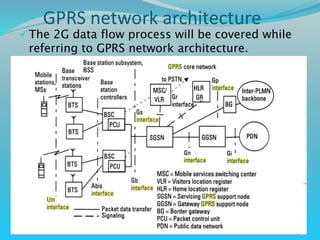
GPRS network architecture
The 2G data flow process will be covered while
referring to GPRS network architecture.
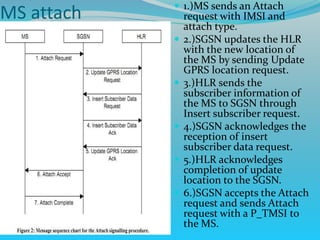
 1.)MS sends an Attach
request with IMSI and
attach type.
 2.)SGSN updates the HLR
with the new location of
the MS by sending Update
GPRS location request.
 3.)HLR sends the
subscriber information of
the MS to SGSN through
Insert subscriber request.
 4.)SGSN acknowledges the
reception of insert
subscriber data request.
 5.)HLR acknowledges
completion of update
location to the SGSN.
 6.)SGSN accepts the Attach
request and sends Attach
request with a P_TMSI to
the MS.
MS attach
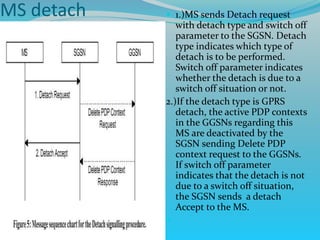
 1.)MS sends Detach request
with detach type and switch off
parameter to the SGSN. Detach
type indicates which type of
detach is to be performed.
Switch off parameter indicates
whether the detach is due to a
switch off situation or not.
2.)If the detach type is GPRS
detach, the active PDP contexts
in the GGSNs regarding this
MS are deactivated by the
SGSN sending Delete PDP
context request to the GGSNs.
If switch off parameter
indicates that the detach is not
due to a switch off situation,
the SGSN sends a detach
Accept to the MS.

MS detach
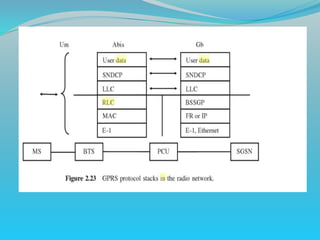
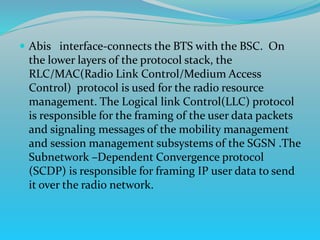
 Abis interface-connects the BTS with the BSC. On
the lower layers of the protocol stack, the
RLC/MAC(Radio Link Control/Medium Access
Control) protocol is used for the radio resource
management. The Logical link Control(LLC) protocol
is responsible for the framing of the user data packets
and signaling messages of the mobility management
and session management subsystems of the SGSN .The
Subnetwork –Dependent Convergence protocol
(SCDP) is responsible for framing IP user data to send
it over the radio network.
 Temporary Block Flow (TBF) is a connection established
between a Mobile Station (MS) and a Base Station (BS) to enable
packet exchanges between the BS and MS entities in GPRS
networks.
 In GPRS, TBF set-up is performed on a random access channel
(RACH) and requires some time. In a typical GPRS system, the
network needs to establish a downlink (DL) TBF to transfer data
in the DL direction and an uplink (UL) TBF to transfer data in
the UL direction. TBFs are typically short-lived and are generally
only active during data transfers.
 A TBF is characterized by one or several PDCHs allocated by the
network to an MS for the duration of the data transfer. Once the
data transfer is finished, the TBF is released.
Temporary block flow
 A TBF is characterized by one or several PDCHs allocated
by the network to an MS for the duration of the data
transfer. Once the data transfer is finished, the TBF is
released. A PDTCH is divided into 11 blocks, each block
holds one RLC data frame. Each block is allocated to a TBF
– owned by a mobile. Allocation and sharing of downlink
PDTCH is controlled by the network; the network will only
have to address the right mobile using TFI.
 When the mobile must send continuous data to the
network, it requests the establishment of an uplink TBF by
sending signaling information over CCCH(common
control channel) or PCCCH(Packet common control
channel). When the network wants to send data to the
mobile, it assigns a downlink TBF between the two
RR(Radio resource) entities.
 TBF can either be :
 Network initiated
 MS initiated
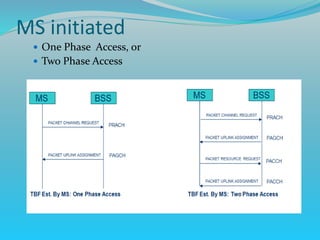
 One Phase Access, or
 Two Phase Access
MS initiated
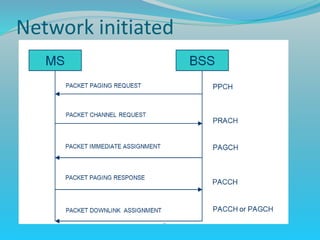
Network initiated
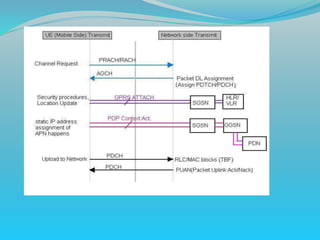
 Mobile originated packet transfer is achieved by a two
phase process.
 During the first phase ,the MS sends a packet-channel
request message to the BSC through the Packet
Random Access Channel.(PRACH)
MS initiated
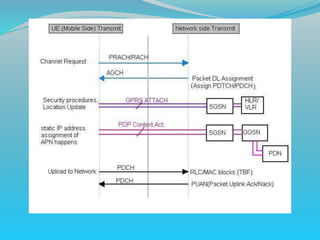
On receiving the message , the BSC replies with a packet
immediate assignment message in a AGCH(Access
Granted Channel).
During the second phase , the MS sends a packet-
resource request message to the BSC. This message
includes the description of the uplink resource
requirement. The BSC then responds with a packet –
resource assignment message.
 The Packet resource assignment message includes a
list of PDCHs that the MS may use for data
transmission, and an uplink State Flag (USF) for each
PDCH .The USF is a three-bit value that is used to
indicate the availability of radio block to the MS. The
MS then constantly monitors the downlink radio
blocks of the allocated PDCHs. If the MS detects its
USF in the downlink radio block header of the
corresponding PDCH, it may use the next uplink radio
block in this PDCH for data transfer.
 The MS may then activate Packet data protocol(PDP)
contexts via an activation signaling procedure.
PDP context
 The packet data protocol context is a data
structure present on both the serving GPRS
support node (SGSN) and the gateway GPRS
support node (GGSN) which contains the
subscriber's session information when the
subscriber has an active session. When a mobile
wants to use GPRS, it must first attach and then
activate a PDP context.
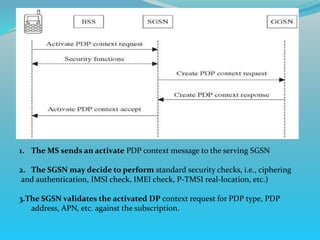
1. The MS sends an activate PDP context message to the serving SGSN
2. The SGSN may decide to perform standard security checks, i.e., ciphering
and authentication, IMSI check, IMEI check, P-TMSI real-location, etc.)
3.The SGSN validates the activated DP context request for PDP type, PDP
address, APN, etc. against the subscription.
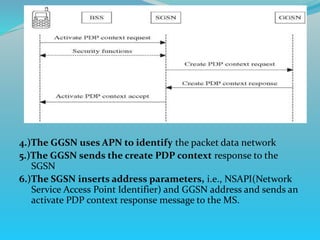
4.)The GGSN uses APN to identify the packet data network
5.)The GGSN sends the create PDP context response to the
SGSN
6.)The SGSN inserts address parameters, i.e., NSAPI(Network
Service Access Point Identifier) and GGSN address and sends an
activate PDP context response message to the MS.
 After the transfer of packet data is complete , the MS
triggers a deactivation signaling procedure to remove
the data path in SGSN and GGSN.
 After the SGSN receives the request from the the MS,
the SGSN notifies the GGSN to deactivate the
associated data path . The MS is still in a ready state
after the Deactivation procedure and other active PDP
contexts identified by different NSAPIs are not
affected.
Thank you

2 g data call flow

  • 2.
    Overview  GPRS networkarchitecture  MS attach and Detach  Temporary Block Flow  PDP context
  • 3.
    GPRS network architecture The2G data flow process will be covered while referring to GPRS network architecture.
  • 4.
     1.)MS sendsan Attach request with IMSI and attach type.  2.)SGSN updates the HLR with the new location of the MS by sending Update GPRS location request.  3.)HLR sends the subscriber information of the MS to SGSN through Insert subscriber request.  4.)SGSN acknowledges the reception of insert subscriber data request.  5.)HLR acknowledges completion of update location to the SGSN.  6.)SGSN accepts the Attach request and sends Attach request with a P_TMSI to the MS. MS attach
  • 5.
     1.)MS sendsDetach request with detach type and switch off parameter to the SGSN. Detach type indicates which type of detach is to be performed. Switch off parameter indicates whether the detach is due to a switch off situation or not. 2.)If the detach type is GPRS detach, the active PDP contexts in the GGSNs regarding this MS are deactivated by the SGSN sending Delete PDP context request to the GGSNs. If switch off parameter indicates that the detach is not due to a switch off situation, the SGSN sends a detach Accept to the MS.  MS detach
  • 7.
     Abis interface-connectsthe BTS with the BSC. On the lower layers of the protocol stack, the RLC/MAC(Radio Link Control/Medium Access Control) protocol is used for the radio resource management. The Logical link Control(LLC) protocol is responsible for the framing of the user data packets and signaling messages of the mobility management and session management subsystems of the SGSN .The Subnetwork –Dependent Convergence protocol (SCDP) is responsible for framing IP user data to send it over the radio network.
  • 8.
     Temporary BlockFlow (TBF) is a connection established between a Mobile Station (MS) and a Base Station (BS) to enable packet exchanges between the BS and MS entities in GPRS networks.  In GPRS, TBF set-up is performed on a random access channel (RACH) and requires some time. In a typical GPRS system, the network needs to establish a downlink (DL) TBF to transfer data in the DL direction and an uplink (UL) TBF to transfer data in the UL direction. TBFs are typically short-lived and are generally only active during data transfers.  A TBF is characterized by one or several PDCHs allocated by the network to an MS for the duration of the data transfer. Once the data transfer is finished, the TBF is released. Temporary block flow
  • 9.
     A TBFis characterized by one or several PDCHs allocated by the network to an MS for the duration of the data transfer. Once the data transfer is finished, the TBF is released. A PDTCH is divided into 11 blocks, each block holds one RLC data frame. Each block is allocated to a TBF – owned by a mobile. Allocation and sharing of downlink PDTCH is controlled by the network; the network will only have to address the right mobile using TFI.  When the mobile must send continuous data to the network, it requests the establishment of an uplink TBF by sending signaling information over CCCH(common control channel) or PCCCH(Packet common control channel). When the network wants to send data to the mobile, it assigns a downlink TBF between the two RR(Radio resource) entities.
  • 10.
     TBF caneither be :  Network initiated  MS initiated
  • 11.
     One PhaseAccess, or  Two Phase Access MS initiated
  • 12.
  • 13.
     Mobile originatedpacket transfer is achieved by a two phase process.  During the first phase ,the MS sends a packet-channel request message to the BSC through the Packet Random Access Channel.(PRACH) MS initiated
  • 15.
    On receiving themessage , the BSC replies with a packet immediate assignment message in a AGCH(Access Granted Channel). During the second phase , the MS sends a packet- resource request message to the BSC. This message includes the description of the uplink resource requirement. The BSC then responds with a packet – resource assignment message.
  • 17.
     The Packetresource assignment message includes a list of PDCHs that the MS may use for data transmission, and an uplink State Flag (USF) for each PDCH .The USF is a three-bit value that is used to indicate the availability of radio block to the MS. The MS then constantly monitors the downlink radio blocks of the allocated PDCHs. If the MS detects its USF in the downlink radio block header of the corresponding PDCH, it may use the next uplink radio block in this PDCH for data transfer.  The MS may then activate Packet data protocol(PDP) contexts via an activation signaling procedure.
  • 18.
    PDP context  Thepacket data protocol context is a data structure present on both the serving GPRS support node (SGSN) and the gateway GPRS support node (GGSN) which contains the subscriber's session information when the subscriber has an active session. When a mobile wants to use GPRS, it must first attach and then activate a PDP context.
  • 19.
    1. The MSsends an activate PDP context message to the serving SGSN 2. The SGSN may decide to perform standard security checks, i.e., ciphering and authentication, IMSI check, IMEI check, P-TMSI real-location, etc.) 3.The SGSN validates the activated DP context request for PDP type, PDP address, APN, etc. against the subscription.
  • 20.
    4.)The GGSN usesAPN to identify the packet data network 5.)The GGSN sends the create PDP context response to the SGSN 6.)The SGSN inserts address parameters, i.e., NSAPI(Network Service Access Point Identifier) and GGSN address and sends an activate PDP context response message to the MS.
  • 21.
     After thetransfer of packet data is complete , the MS triggers a deactivation signaling procedure to remove the data path in SGSN and GGSN.  After the SGSN receives the request from the the MS, the SGSN notifies the GGSN to deactivate the associated data path . The MS is still in a ready state after the Deactivation procedure and other active PDP contexts identified by different NSAPIs are not affected.
  • 22.