
Prepared By :- RAHUL KAUSHAL 101020
INTRODUCTION TO NEXT GENERATION NETWORKS A Next Generation Network is a –  packet-based network  able to provide  telecommunication  services –  able to make use of multiple  broadband  access technologies –  QoS-enabled transport  technologies, and –  in which  service-related functions are independent  from underlying transport-related technologies •  It offers unrestricted access by users to different service providers •  It supports generalized mobility which will allow consistent and ubiquitous provision of services to users
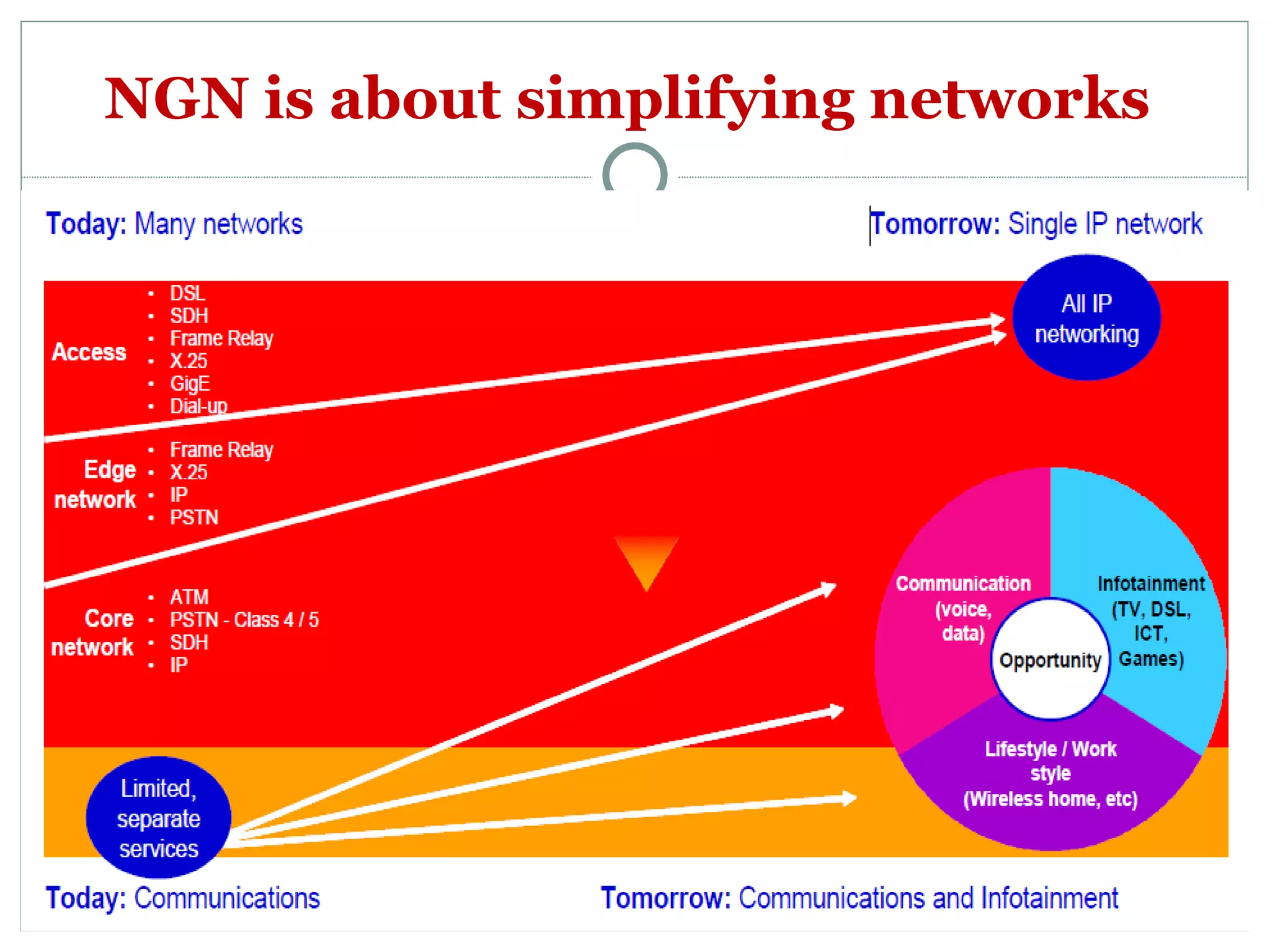
NGN is about simplifying networks
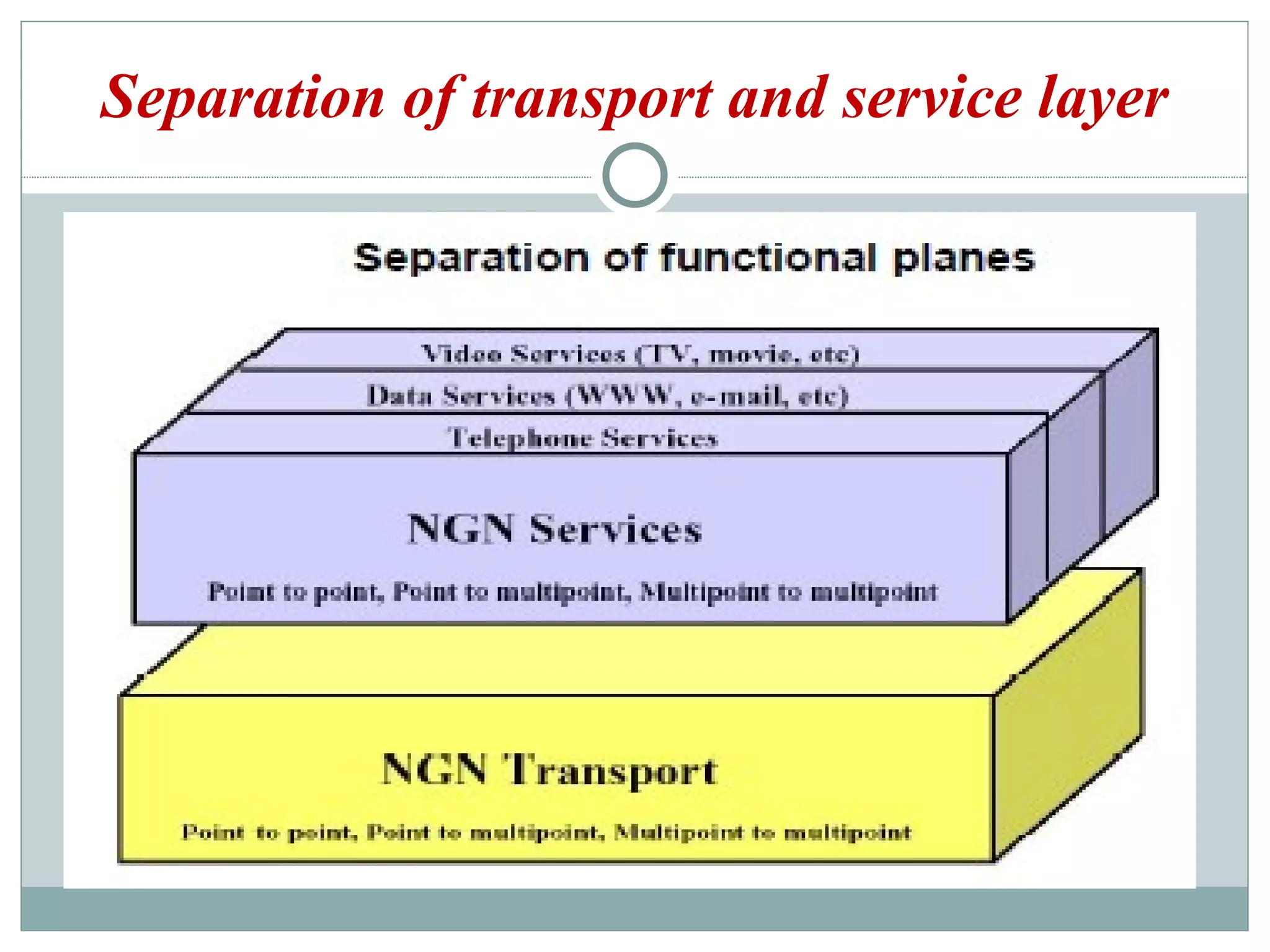
Next generation core networks The next generation  core networks are defined on the basis of their underlying technological  “components” that include –  IP-based network: Packet-based, multi-purpose: Separation of transport and service layer:
Separation of transport and service layer
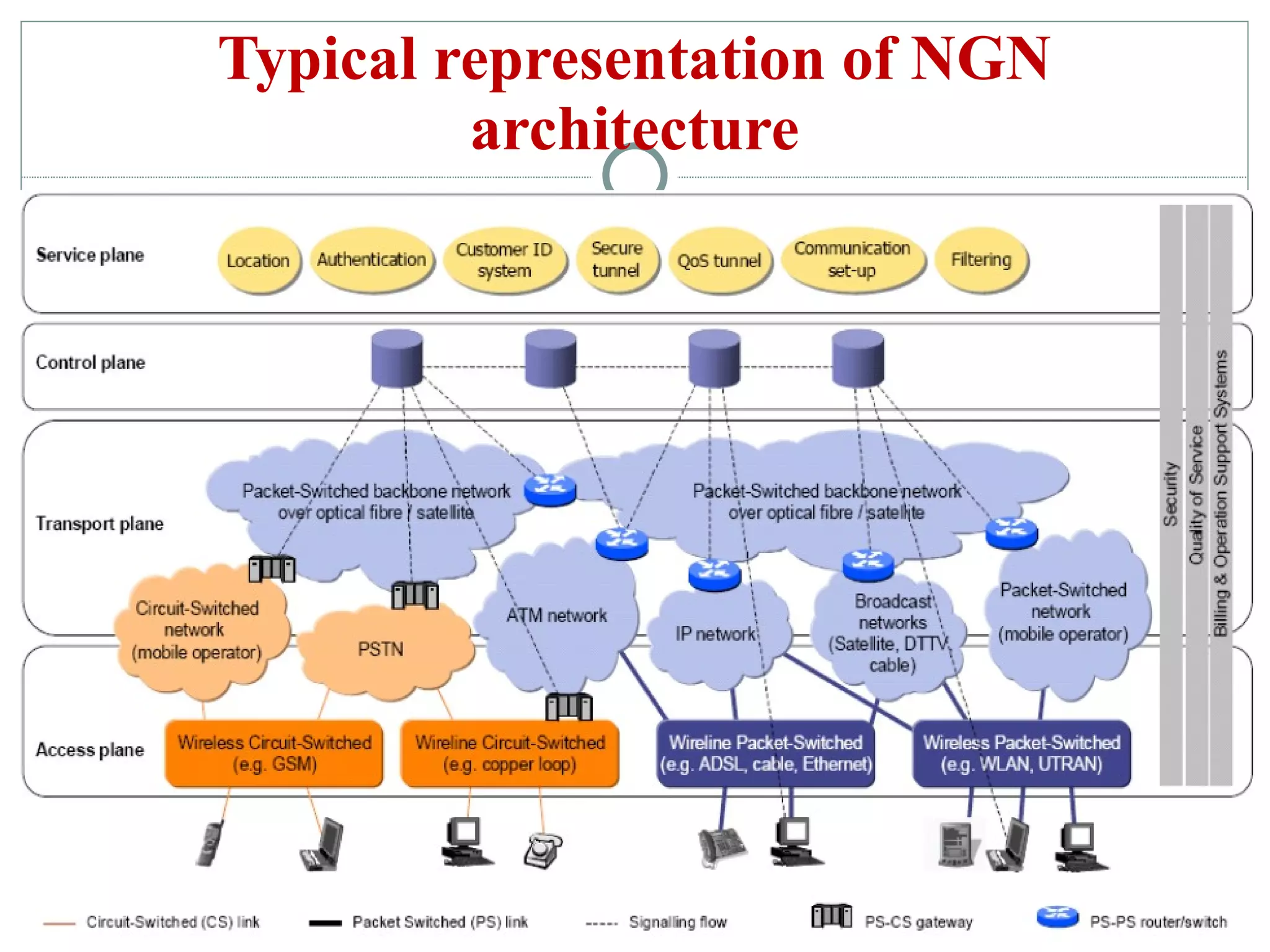
Typical representation of NGN architecture
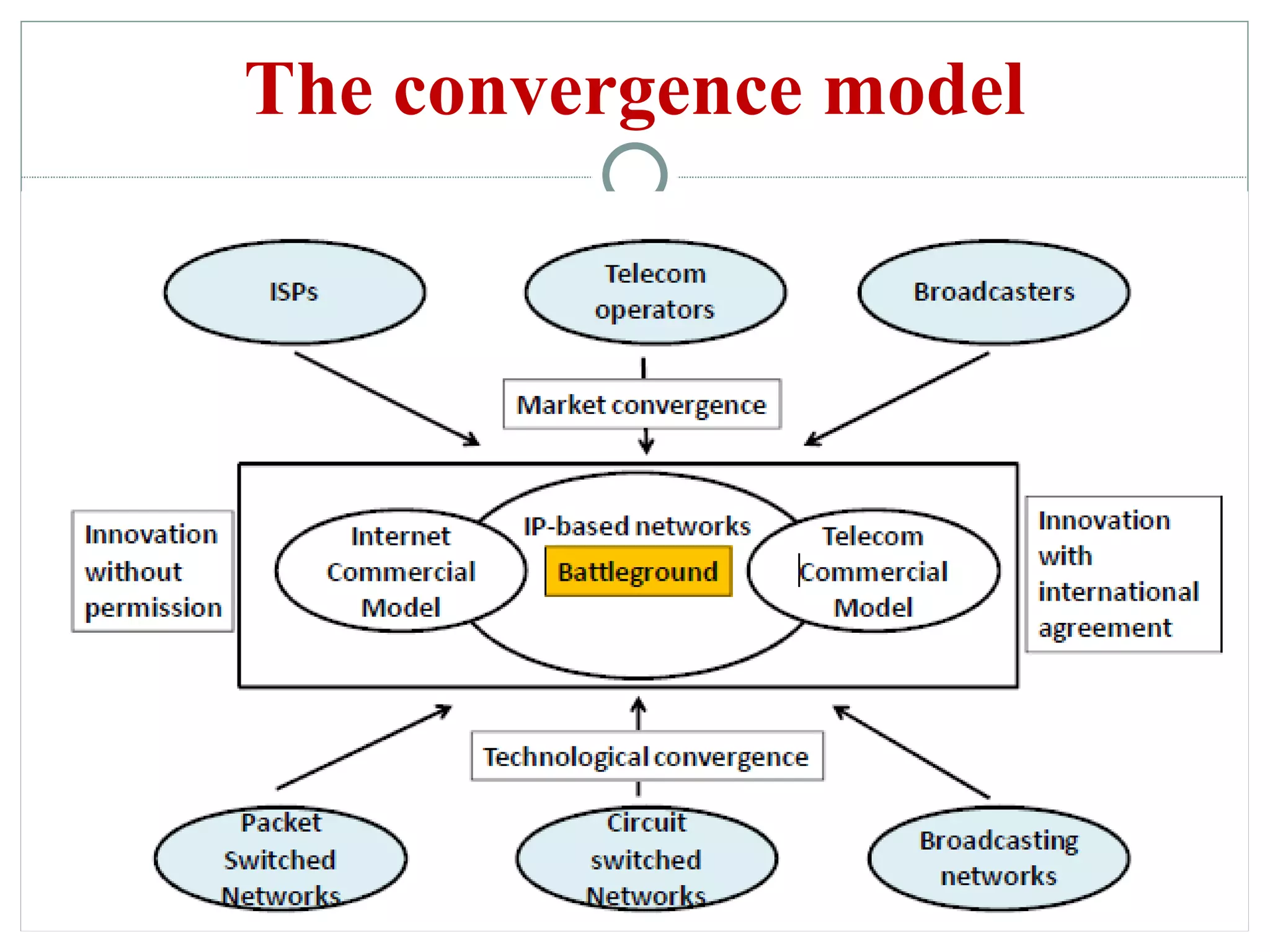
What is convergence? The path towards convergence was led mainly by the increasing digitalization of content, the shift towards IP-based networks, the diffusion of high-speed broadband access, and the availability of multi-media communication and computing devices. Convergence is taking place at different levels: Network convergence Service convergence Industry/market convergence Device convergence Converged user experience
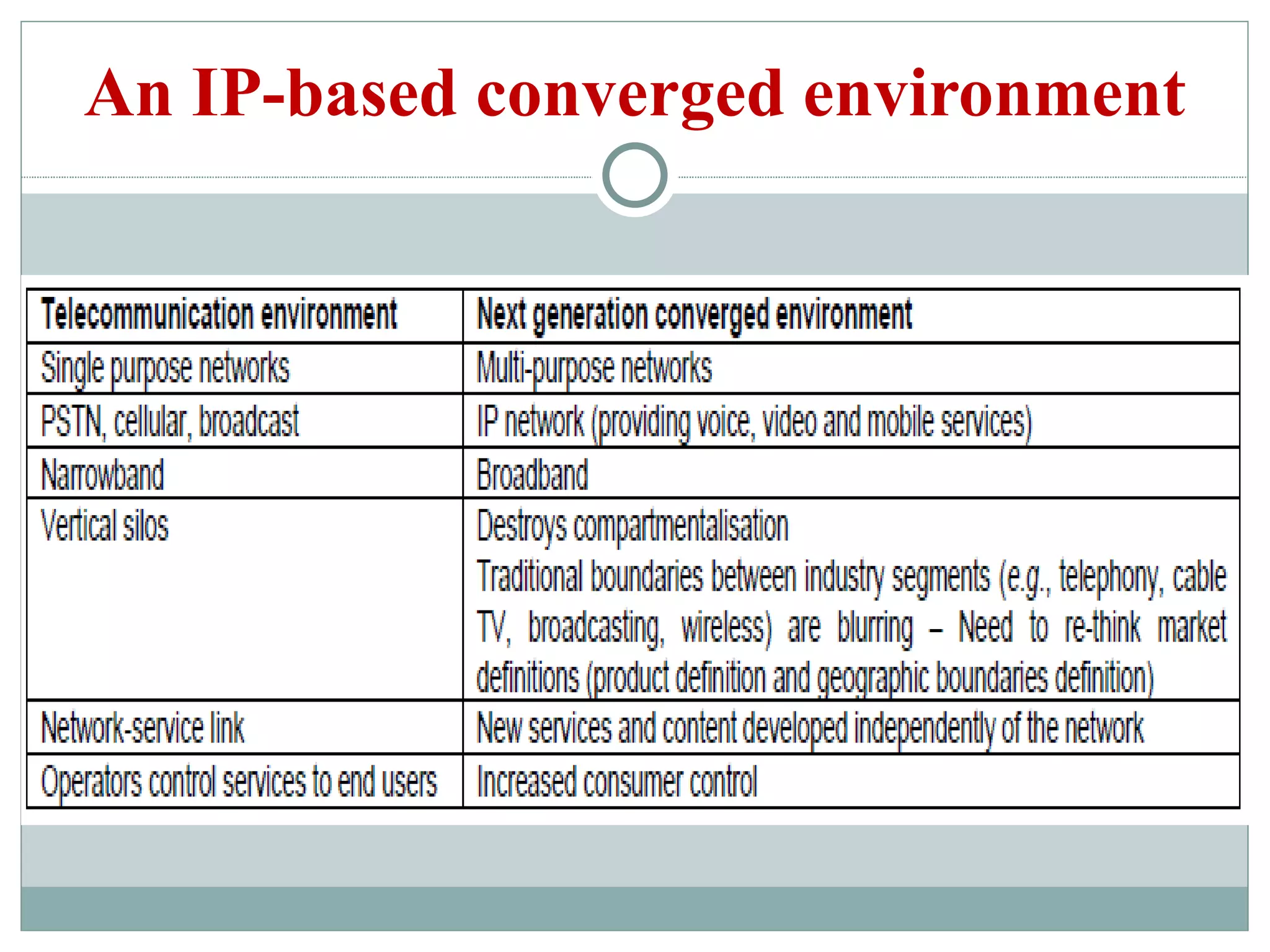
Convergence and NGN Convergence in network technologies, services and in terminal equipment is at the basis of change in innovative offers and new business models in the communications sector. The utilization of the term “convergence” represents the shift from the traditional “vertical silos” architecture,  i.e. a situation  in which different services were provided through separate networks (mobile, fixed, CATV, IP), to a situation in which communication services will be accessed and used seamlessly across different networks and provided over multiple platforms, in an interactive way.
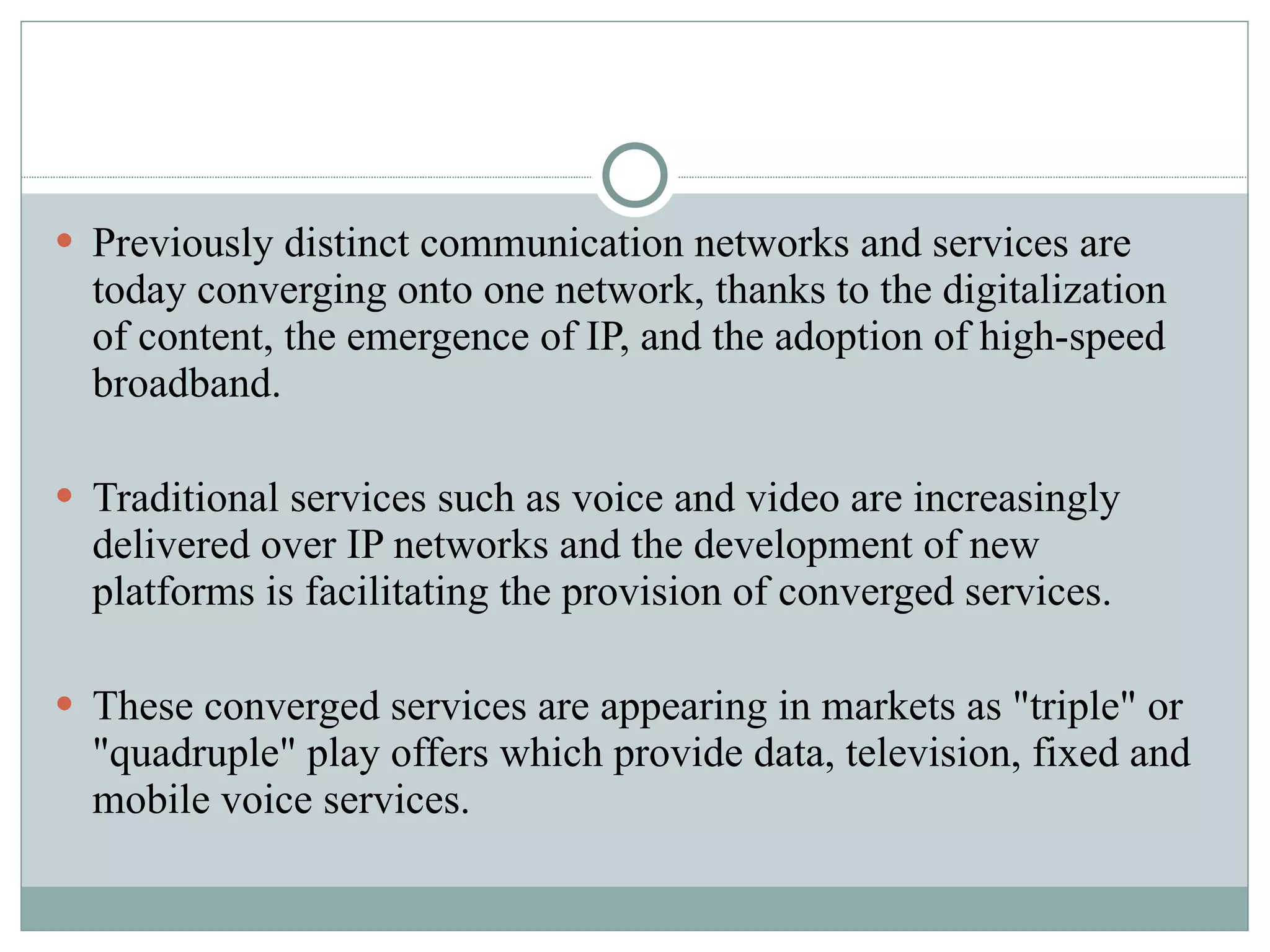
Previously distinct communication networks and services are today converging onto one network, thanks to the digitalization of content, the emergence of IP, and the adoption of high-speed broadband. Traditional services such as voice and video are increasingly delivered over IP networks and the development of new platforms is facilitating the provision of converged services. These converged services are appearing in markets as "triple" or "quadruple" play offers which provide data, television, fixed and mobile voice services.
An IP-based converged environment
The convergence model
 

Ngn and convegence

  • 1.
    Prepared By :-RAHUL KAUSHAL 101020
  • 2.
    INTRODUCTION TO NEXTGENERATION NETWORKS A Next Generation Network is a – packet-based network able to provide telecommunication services – able to make use of multiple broadband access technologies – QoS-enabled transport technologies, and – in which service-related functions are independent from underlying transport-related technologies • It offers unrestricted access by users to different service providers • It supports generalized mobility which will allow consistent and ubiquitous provision of services to users
  • 3.
    NGN is aboutsimplifying networks
  • 4.
    Next generation corenetworks The next generation core networks are defined on the basis of their underlying technological “components” that include – IP-based network: Packet-based, multi-purpose: Separation of transport and service layer:
  • 5.
    Separation of transportand service layer
  • 6.
    Typical representation ofNGN architecture
  • 7.
    What is convergence?The path towards convergence was led mainly by the increasing digitalization of content, the shift towards IP-based networks, the diffusion of high-speed broadband access, and the availability of multi-media communication and computing devices. Convergence is taking place at different levels: Network convergence Service convergence Industry/market convergence Device convergence Converged user experience
  • 8.
    Convergence and NGNConvergence in network technologies, services and in terminal equipment is at the basis of change in innovative offers and new business models in the communications sector. The utilization of the term “convergence” represents the shift from the traditional “vertical silos” architecture, i.e. a situation in which different services were provided through separate networks (mobile, fixed, CATV, IP), to a situation in which communication services will be accessed and used seamlessly across different networks and provided over multiple platforms, in an interactive way.
  • 9.
    Previously distinct communicationnetworks and services are today converging onto one network, thanks to the digitalization of content, the emergence of IP, and the adoption of high-speed broadband. Traditional services such as voice and video are increasingly delivered over IP networks and the development of new platforms is facilitating the provision of converged services. These converged services are appearing in markets as "triple" or "quadruple" play offers which provide data, television, fixed and mobile voice services.
  • 10.
  • 11.
  • 12.