Release 5 architecture and beyond
© Siemens 2
Agenda
1. IMS
2. IMS based new services
3. Release 4 migration path to Release 5
4. 3GPP Release 6 and beyond
5. Siemens portfolio
© Siemens 3
1. IMS “IP Multimedia Subsystem”:
• Overview of 3GPP IMS
• Network architecture
• Network elements
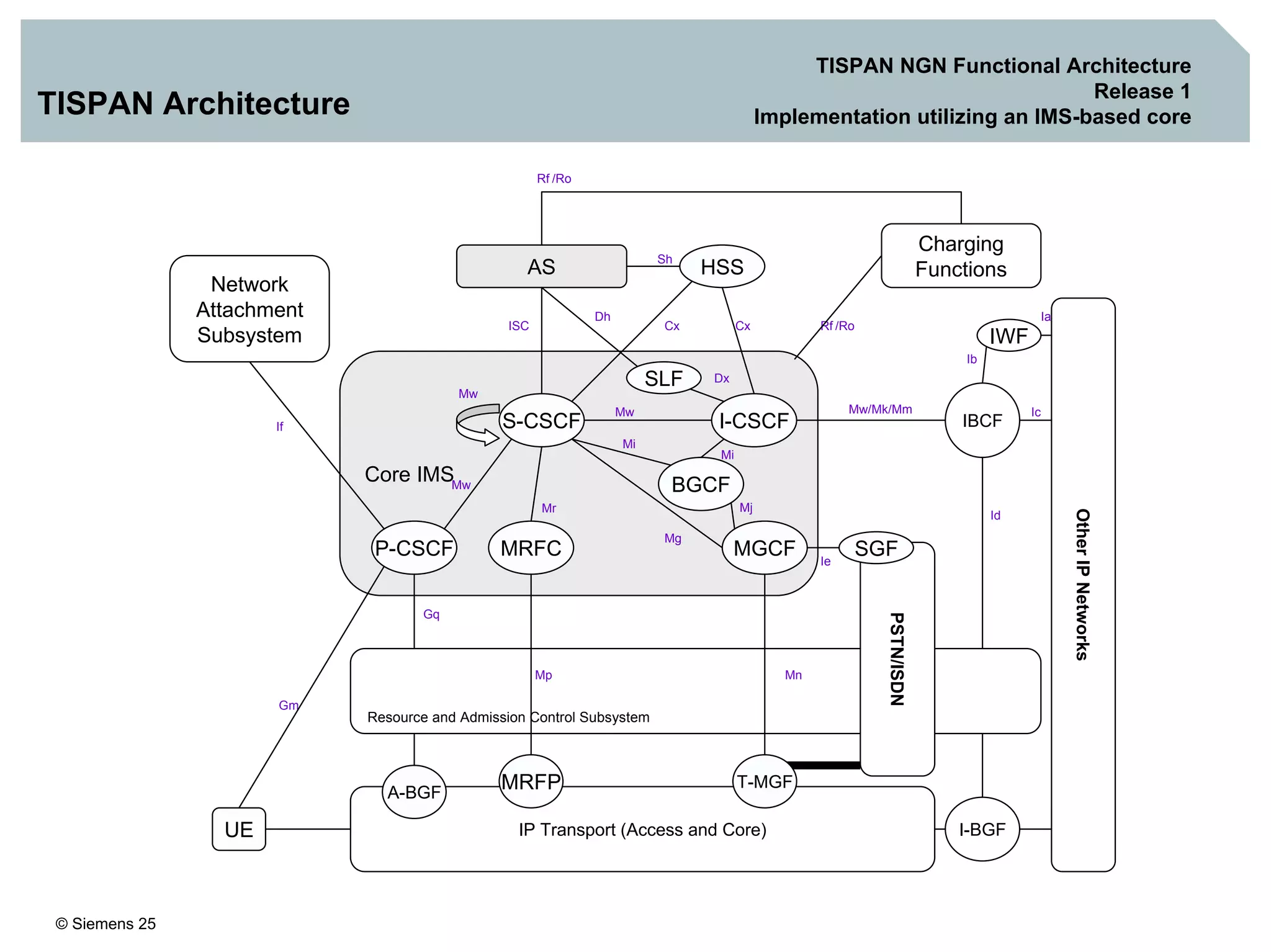
• TISPAN architecture
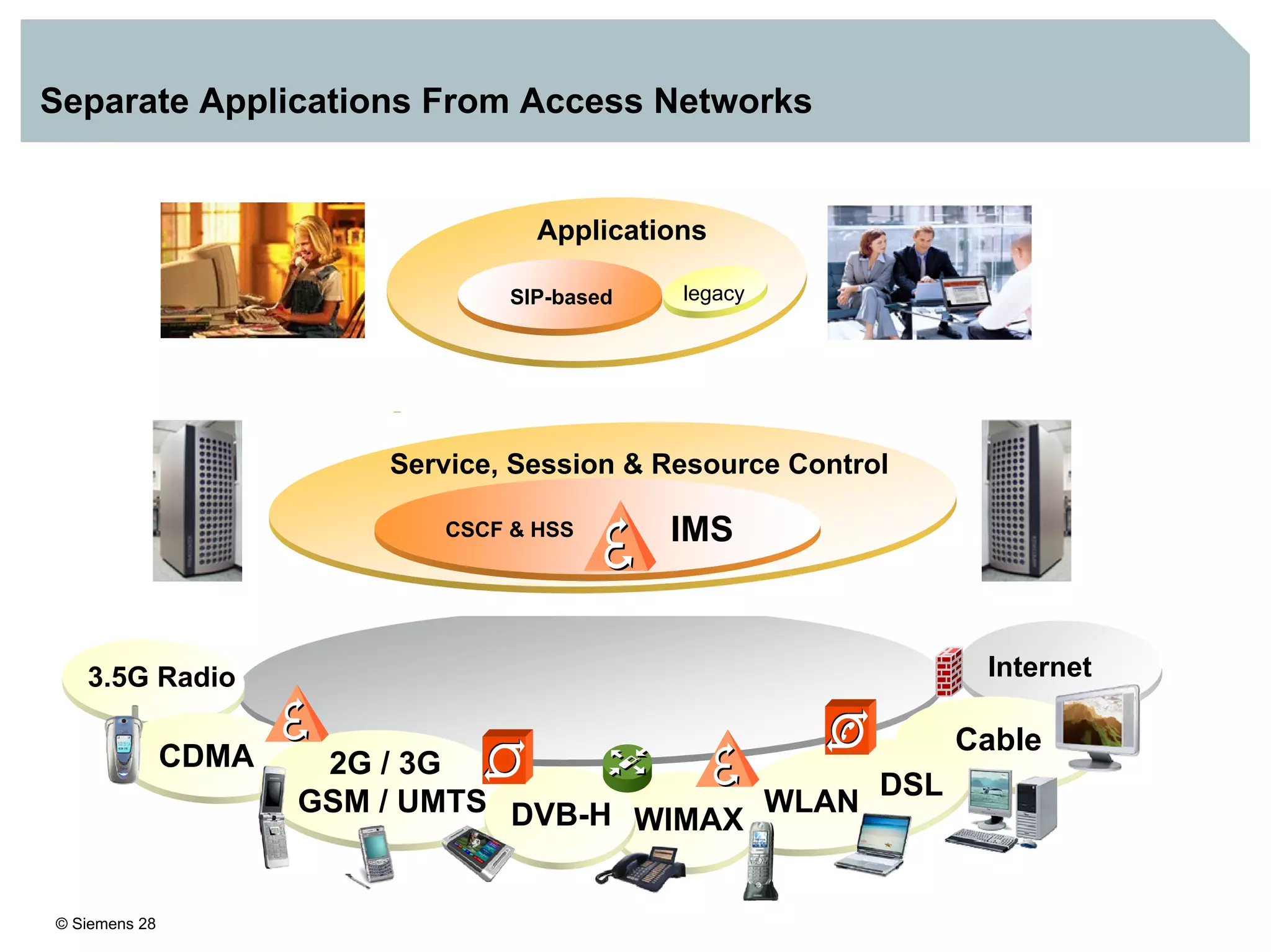
• Access independency
© Siemens 4
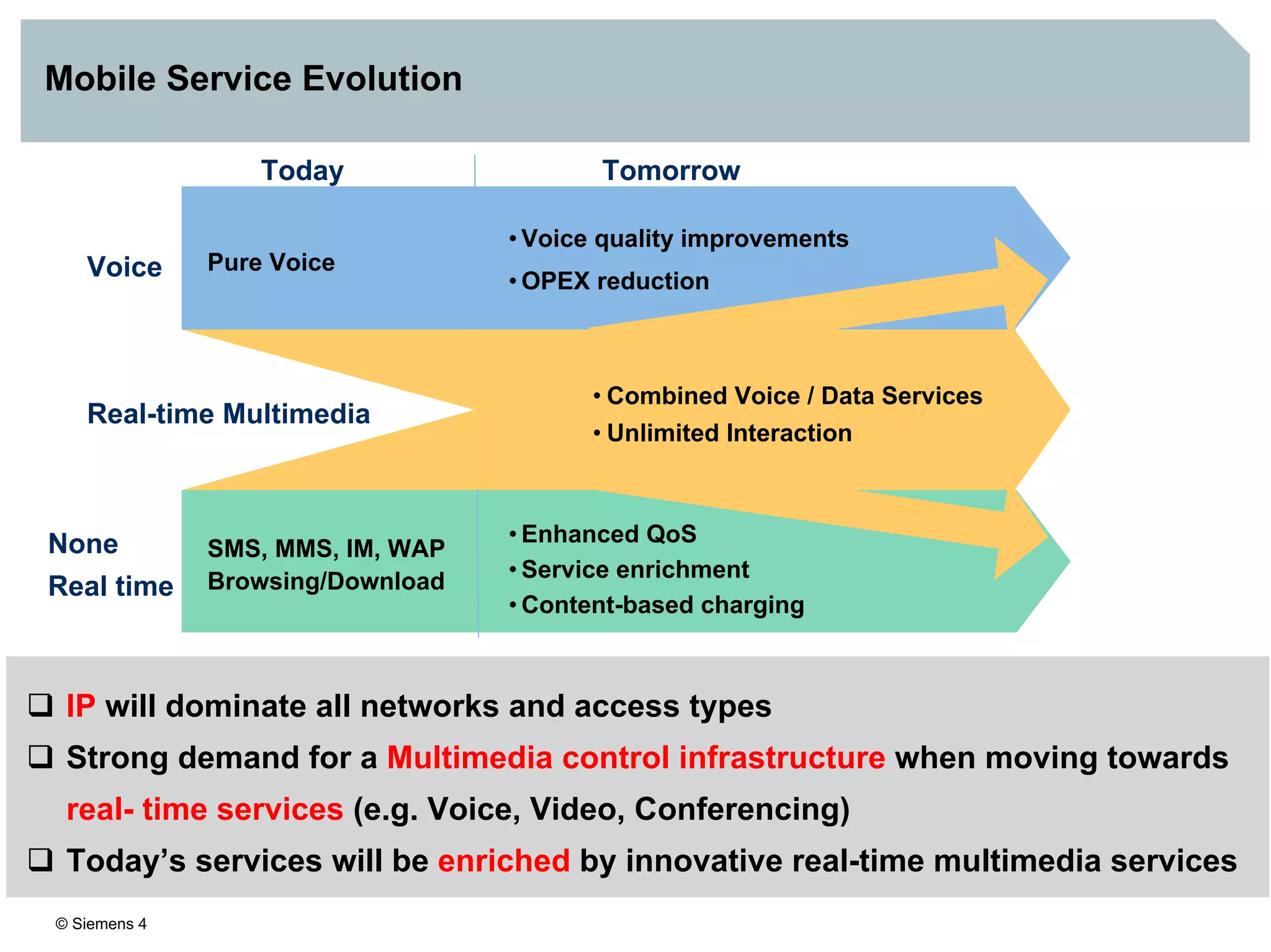
Mobile Service Evolution
Today Tomorrow
SMS, MMS, IM, WAP
Browsing/Download
• Enhanced QoS
• Service enrichment
• Content-based charging
Pure Voice
• Voice quality improvements
• OPEX reduction
ltimedia
IP will dominate all networks and access types
Strong demand for a Multimedia control infrastructure when moving towards
real- time services (e.g. Voice, Video, Conferencing)
Today’s services will be enriched by innovative real-time multimedia services
Voice
Real-time Mu
• Combined Voice / Data Services
• Unlimited Interaction
None
Real time
© Siemens 5
IMS History/Roadmap in 3GPP
3GPP Release 2000:
• discussion started in 2000 after the completion of 3GPP R99.
• included the Transport/Control split, MMS, All-IP, etc.
• Release 2000 was split into 3GPP R4 and 3GPP R5.
• the All-IP system (later renamed in IMS) was assigned to R5.
3GPP Release 4:
• no IMS work was performed in this release.
3GPP Release 5:
• the IMS was introduced as part of the 3GPP R5 standard.
• the IMS architecture and key concepts were defined.
• the IMS R5 feature-set was frozen in March 2002.
• several IMS features were left for future releases.
3GPP Release 6:
• an appropriate RAB for audio calls over UMTS-PS Domain.
• external PDF, WLAN access and CS-Domain Interworking are the main topics.
• Enhanced Charging and Lawful interception.
• the IMS R6 feature set was frozen in June 2004. The R6 Stage 3 works are still ongoing but almost closed.
3GPP Release 7:
• the IMS R7 feature set definition is closed (e.g. MRF, Enhanced interworking CS and the IMS, WLAN Enhancements,
Combinational Services phase 2, Voice Call Continuity).
© Siemens 6
What is Release 5?
More than IMS
• The IP Multimedia Subsystem (IMS)
• TS 22.228, TS 23.002, TS 23.221, TS 23.228, TS 24.228, …
• RFC 3261, RFC 2396, RFC 2486, RFC 2806, RFC 2916, …
• Other Features
• HSDPA
• IP UTRAN
• AMR-WB (7khz codec)
• CAMEL Phase 4
• Iu Flexibility
• End-to-End QoS
• Security Enhancements
• …
© Siemens 7
Key IMS Standards at the 3GPP
The 3GPP IMS Standards can be found under ftp://ftp.3gpp.org/Specs/archive/:
Architecture: TS23.002 (3GPP Network Architecture)
IMS Session Control: TS23.228 (IMS), TS24.228
(SIP Signaling Flows, informal), TS24.229 (IMS Call Control)
Security Mechanisms: TS33.102 (Security architecture),
TS33.203 (Access Security), TS33.210 (Network Security), TS31.103 (ISIM)
Regulatory issues (Lawful interception): TS33.106/TS33.107/TS33.108
IMS Charging: TS23.815 (Charging/Architecture), TS32.200 (Charging Principles),
TS32.225/TS32.235 (IMS Charging Data)
IMS Interfaces: TS29.328/TS29.329 (Sh-interface),
TS29.228/TS29.229 (Cx-, Dx-interface), TS29.207 (Go-interface)
IMS Services: TS23.141/TS24.141/TS33.141 (Presence), TS22.340/TS24.247 (Messaging),
TS24.147 (Conferencing)
IMS QoS: TS23.107/TS23.207 (QoS Concept/Architecture), TS29.208 (QoS Signaling Flows)
IMS Interworking: TS 29.163 (to CS/PSTN), TS23.234/TS24.234
(to the WLAN), TS29.962 (to SIP Clients in the Internet)
© Siemens 8
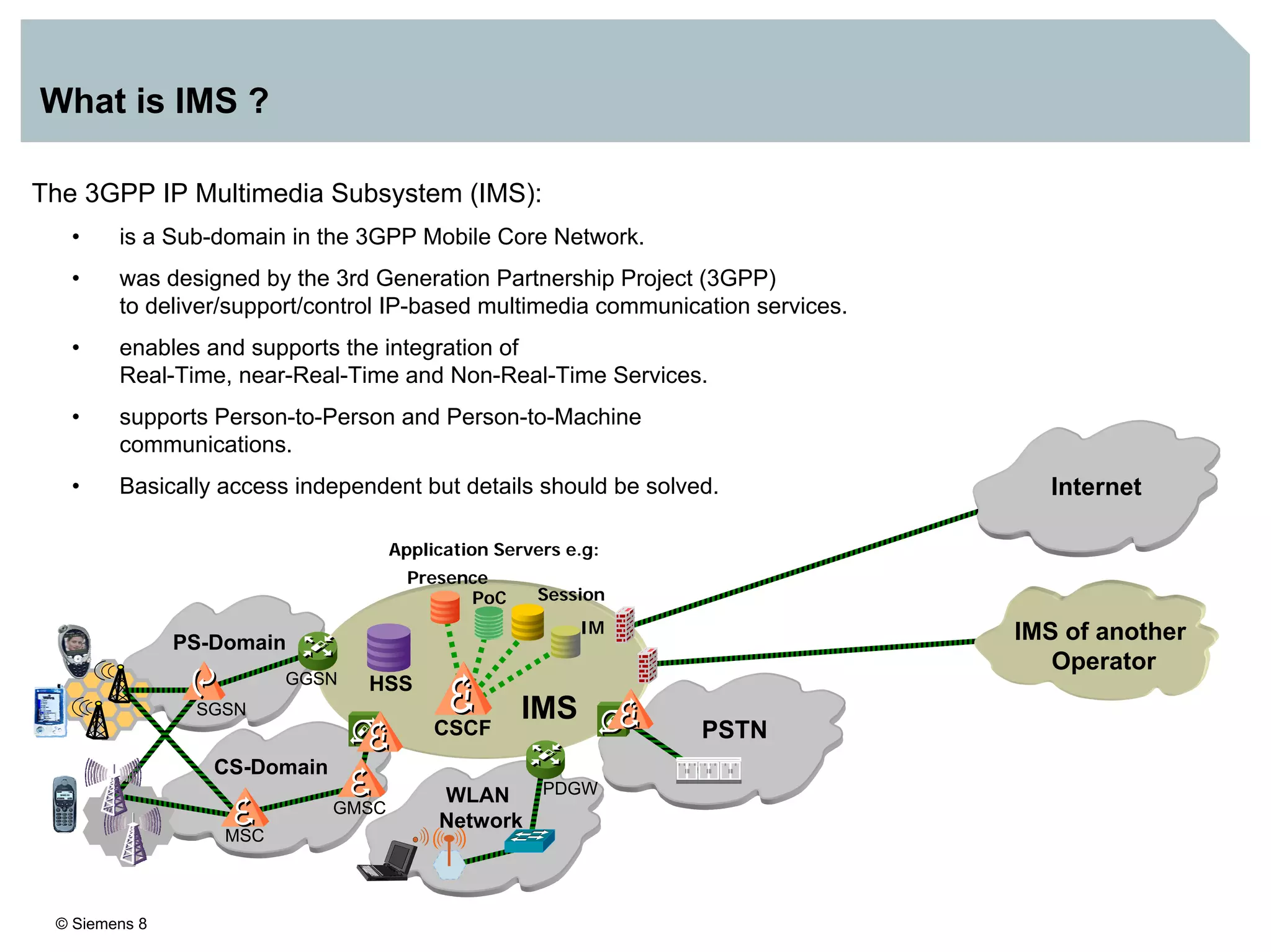
What is IMS ?
The 3GPP IP Multimedia Subsystem (IMS):
• is a Sub-domain in the 3GPP Mobile Core Network.
• was designed by the 3rd Generation Partnership Project (3GPP)
to deliver/support/control IP-based multimedia communication services.
• enables and supports the integration of
Real-Time, near-Real-Time and Non-Real-Time Services.
• supports Person-to-Person and Person-to-Machine
communications.
• Basically access independent but details should be solved.
CS-Domain
GMSC
WLAN
Network
PS-Domain
GGSN
PSTN
Internet
IMS of another
Operator
IMSSGSN
MSC
Application Servers e.g:
Presence
IM
CSCF
PoC
HSS
PDGW
Session
© Siemens 9
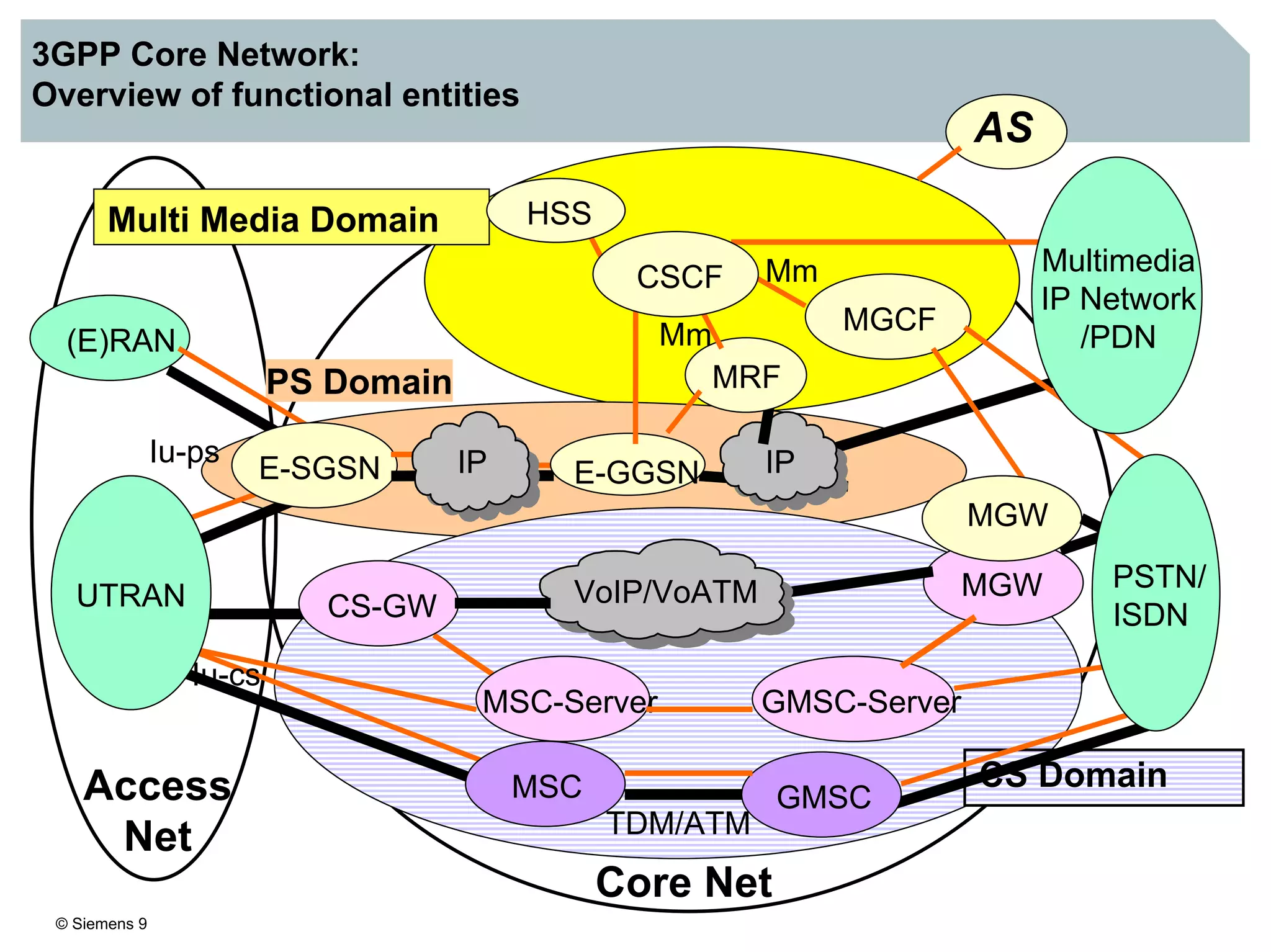
3GPP Core Network:
Overview of functional entities
Core Net
Access
Net
(E)RAN
Multi Media Domain
PS Domain
CS Domain
TDM/ATM
MSC GMSC
Iu-cs
MGW
CS-GW
MSC-Server
VoIP/VoATM
GMSC-Server
Iu-ps
E-SGSN IP E-GGSN IP
MGCF
MRF
Mm
Mm
MGW
HSS
CSCF
AS
UTRAN
PSTN/
ISDN
Multimedia
IP Network
/PDN
© Siemens 10
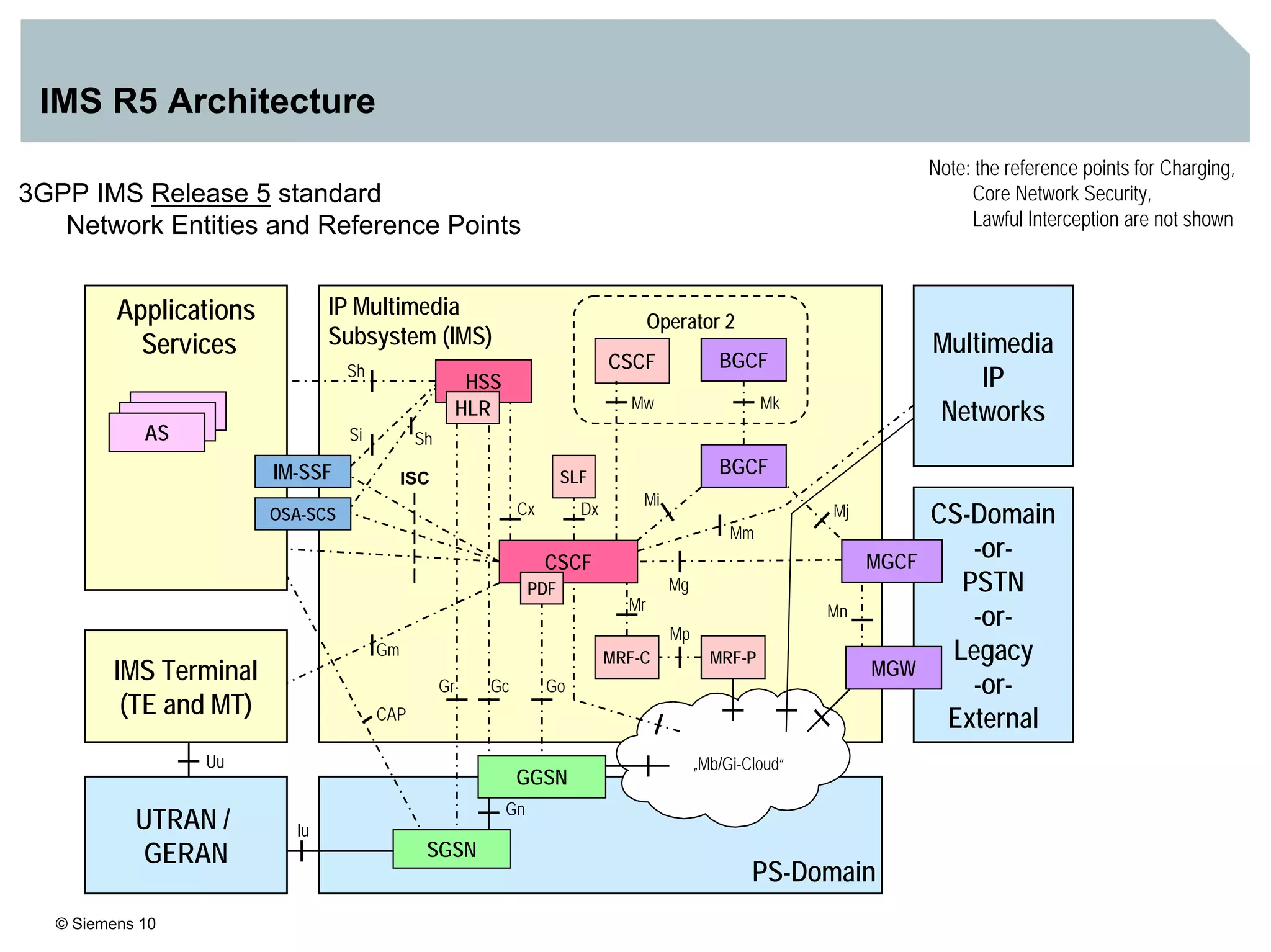
IMS R5 Architecture
3GPP IMS Release 5 standard
Network Entities and Reference Points
CS-Domain
-or-
PSTN
-or-
Legacy
-or-
External
PS-Domain
CSCF
CSCF
MRF-C
Mr
Cx
Sh
Gr
Mm
Mw
Mn
Gc
Mg
Gn
Iu
BGCF
Mi
Mk
Mj
Go
Gm
SLF
Dx
„Mb/Gi-Cloud“
PDF
MRF-P
Mp
ISC
Uu
Operator 2
Si
IMS Terminal
(TE and MT)
UTRAN /
GERAN
Multimedia
IP
Networks
MGCF
MGW
IP Multimedia
Subsystem (IMS)
Applications
Services
AS
OSA-SCS
IM-SSF
HSS
HLR
Sh
Note: the reference points for Charging,
Core Network Security,
Lawful Interception are not shown
BGCF
GGSN
CAP
SGSN
© Siemens 11
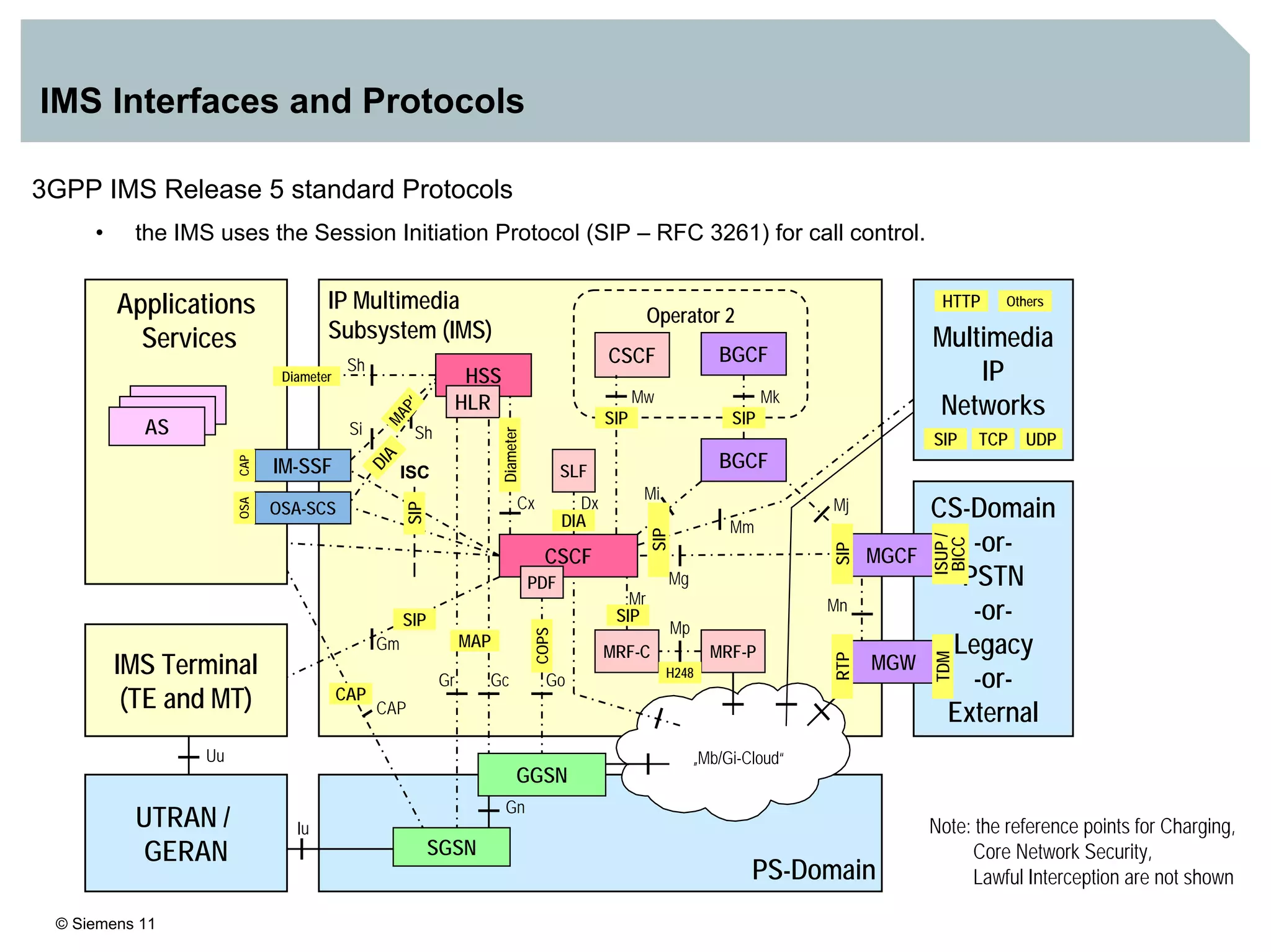
IMS Interfaces and Protocols
3GPP IMS Release 5 standard Protocols
• the IMS uses the Session Initiation Protocol (SIP – RFC 3261) for call control.
Note: the reference points for Charging,
Core Network Security,
Lawful Interception are not shown
CS-Domain
-or-
PSTN
-or-
Legacy
-or-
External
PS-Domain
CSCF
CSCF
MRF-C
Mr
Cx
Sh
Gr
Mm
Mw
Mn
Gc
Mg
Gn
Iu
BGCF
Mi
Mk
Mj
Go
Gm
SLF
Dx
„Mb/Gi-Cloud“
PDF
MRF-P
Mp
ISC
Uu
Operator 2
Si
IMS Terminal
(TE and MT)
UTRAN /
GERAN
Multimedia
IP
Networks
MGCF
MGW
IP Multimedia
Subsystem (IMS)
Applications
Services
AS
OSA-SCS
IM-SSF
HSS
HLR
Sh SIP TCP UDP
HTTP Others
ISUP/
BICC
TDM
RTPSIP
DIA
SIP SIP
SIP
H248
SIP
Diameter
MAP‘SIP
CAPOSA
Diameter
CAP
MAP
SIP
COPS
DIA
BGCF
CAP
GGSN
SGSN
© Siemens 12
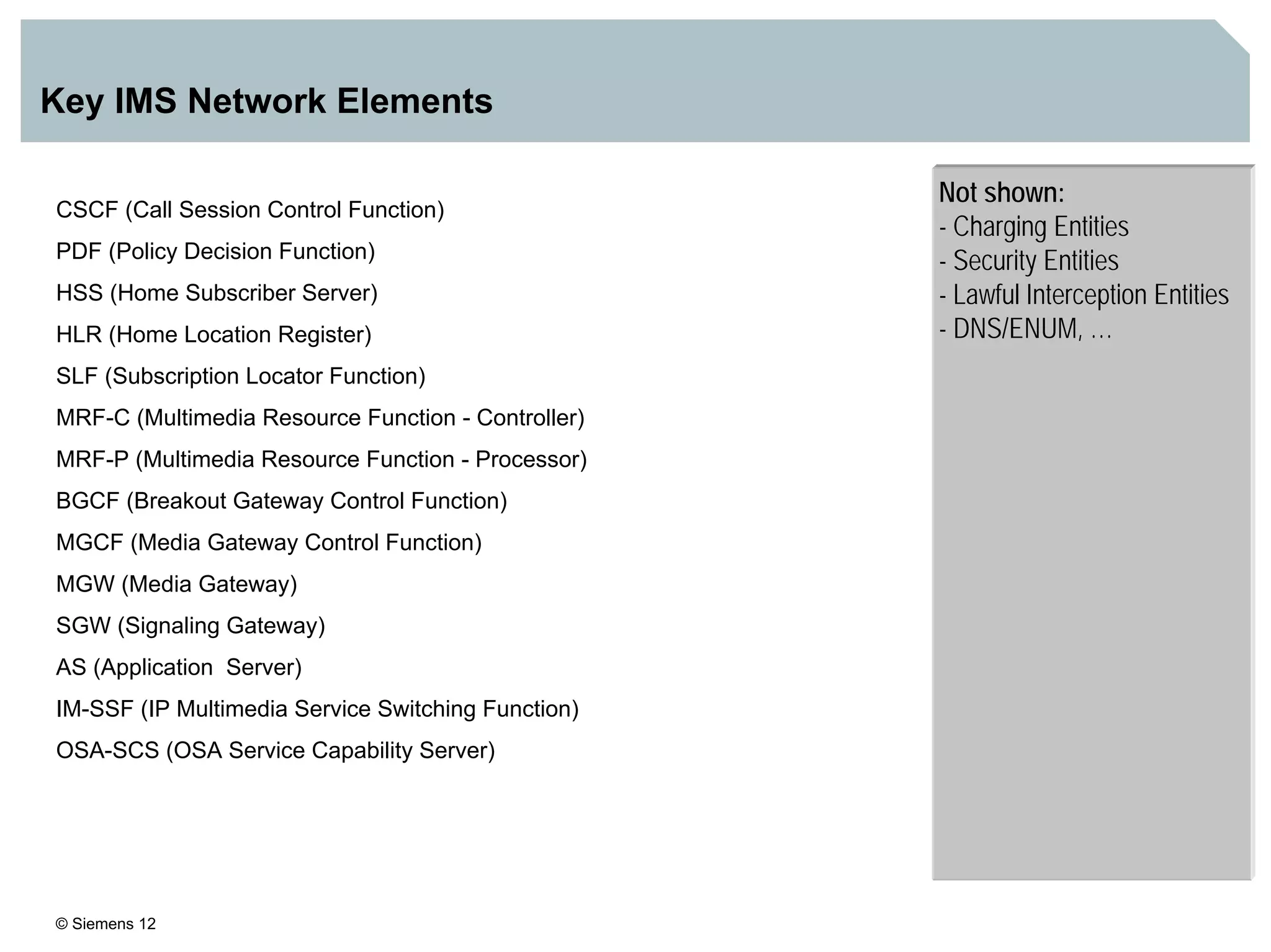
Key IMS Network Elements
Not shown:
- Charging Entities
- Security Entities
- Lawful Interception Entities
- DNS/ENUM, …
CSCF (Call Session Control Function)
PDF (Policy Decision Function)
HSS (Home Subscriber Server)
HLR (Home Location Register)
SLF (Subscription Locator Function)
MRF-C (Multimedia Resource Function - Controller)
MRF-P (Multimedia Resource Function - Processor)
BGCF (Breakout Gateway Control Function)
MGCF (Media Gateway Control Function)
MGW (Media Gateway)
SGW (Signaling Gateway)
AS (Application Server)
IM-SSF (IP Multimedia Service Switching Function)
OSA-SCS (OSA Service Capability Server)
© Siemens 13
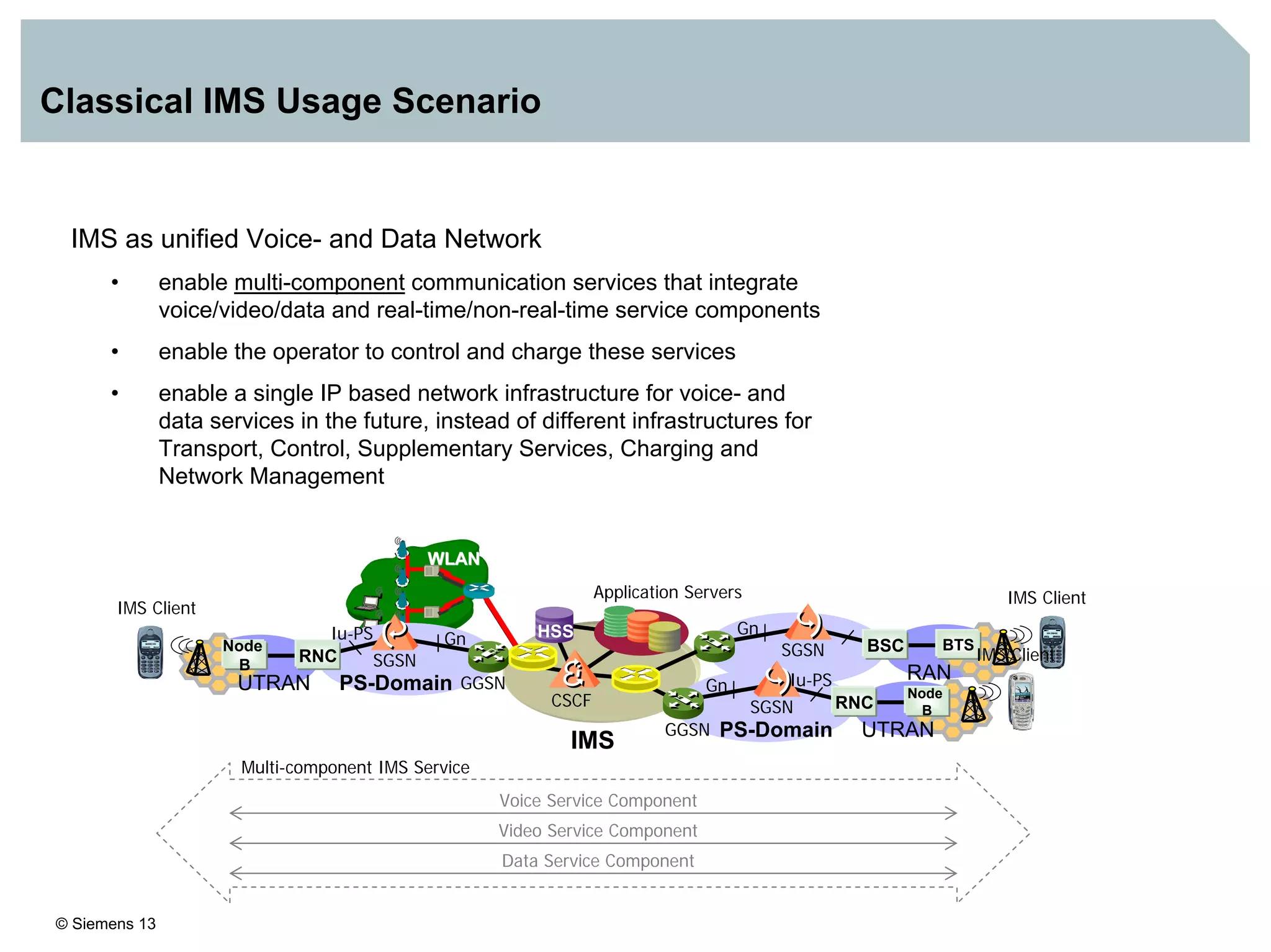
Classical IMS Usage Scenario
IMS as unified Voice- and Data Network
• enable multi-component communication services that integrate
voice/video/data and real-time/non-real-time service components
• enable the operator to control and charge these services
• enable a single IP based network infrastructure for voice- and
data services in the future, instead of different infrastructures for
Transport, Control, Supplementary Services, Charging and
Network Management
IMS
HSS
CSCF
Application Servers
Multi-component IMS Service
Voice Service Component
Video Service Component
Data Service Component
WLANWLAN
SGSN
Node
B
RNC
UTRAN
Iu-PS Gn
GGSNPS-Domain
IMS Client
SGSN BTSBSC
RAN
Gn
IMS Client
SGSN
Node
BRNC
UTRAN
Iu-PSGn
PS-Domain
IMS Client
GGSN
© Siemens 14
Future positioning of IMS from the 3GPP point of view
Positioning for near-term
Work together with UMTS PS domain, GPRS or WLAN complimentary to circuit switched
• Focused on new IP and SIP based applications
• Focused on integrating web content, presence information and combinational services
to the CS calls.
• Be prepared for other access types (e.g. xDSL or WiMAX)
Medium to long-term
Work together with all possible standardized access types for:
• Offer CS services over IMS (including Mobile IP Centrex and CAMEL)
• Capability to slowly take over voice from the CS Domain
© Siemens 15
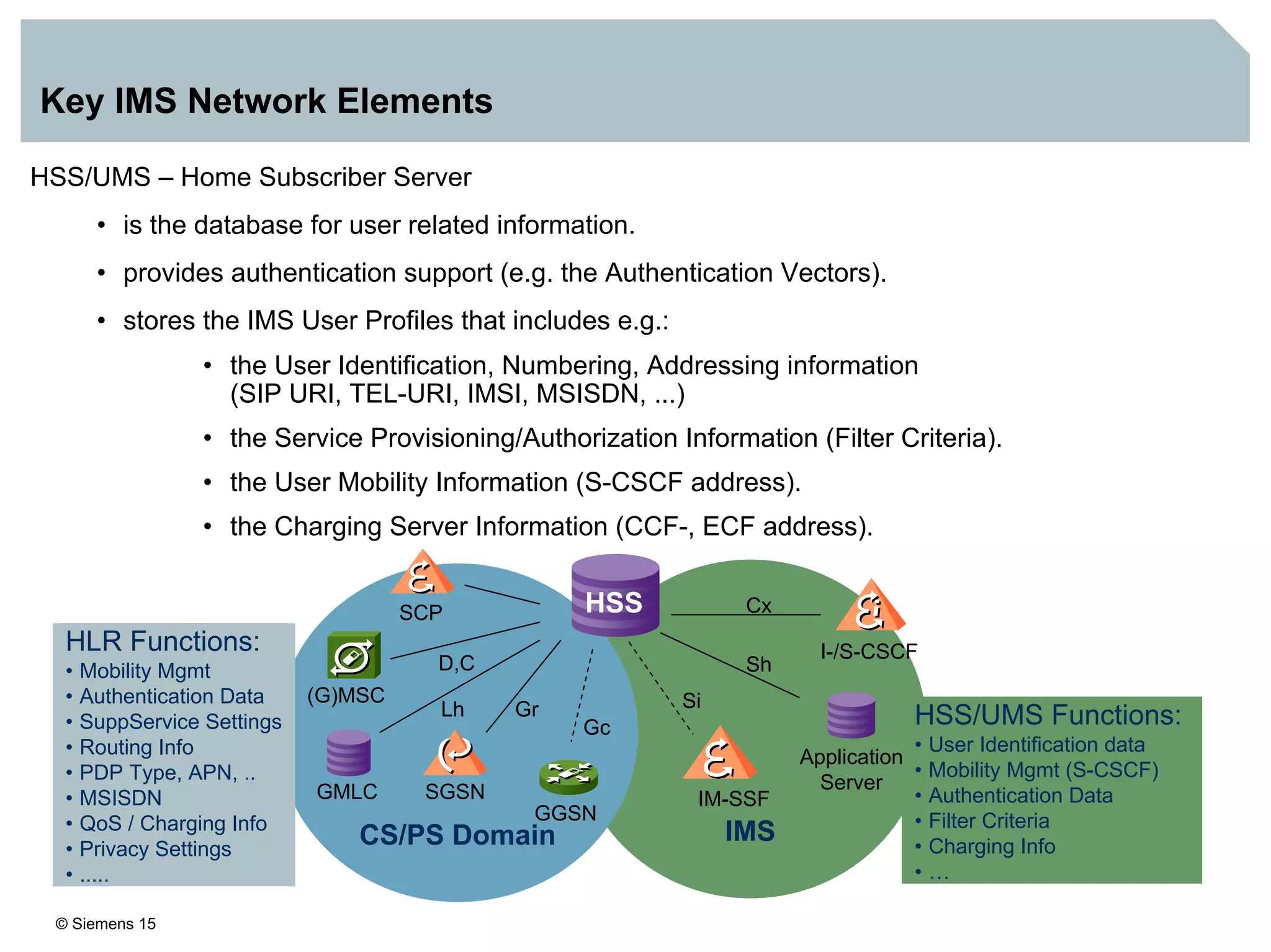
Key IMS Network Elements
HSS/UMS – Home Subscriber Server
• is the database for user related information.
• provides authentication support (e.g. the Authentication Vectors).
• stores the IMS User Profiles that includes e.g.:
• the User Identification, Numbering, Addressing information
(SIP URI, TEL-URI, IMSI, MSISDN, ...)
• the Service Provisioning/Authorization Information (Filter Criteria).
• the User Mobility Information (S-CSCF address).
• the Charging Server Information (CCF-, ECF address).
IMS
HSS/UMS Functions:
• User Identification data
• Mobility Mgmt (S-CSCF)
• Authentication Data
• Filter Criteria
• Charging Info
• …
I-/S-CSCF
Cx
Application
Server
Sh
Si
IM-SSF
CS/PS Domain
HSS
SGSN
(G)MSC
GGSN
SCP
GMLC
HLR Functions:
• Mobility Mgmt
• Authentication Data
• SuppService Settings
• Routing Info
• PDP Type, APN, ..
• MSISDN
• QoS / Charging Info
• Privacy Settings
• .....
D,C
Gr
Gc
Lh
© Siemens 16
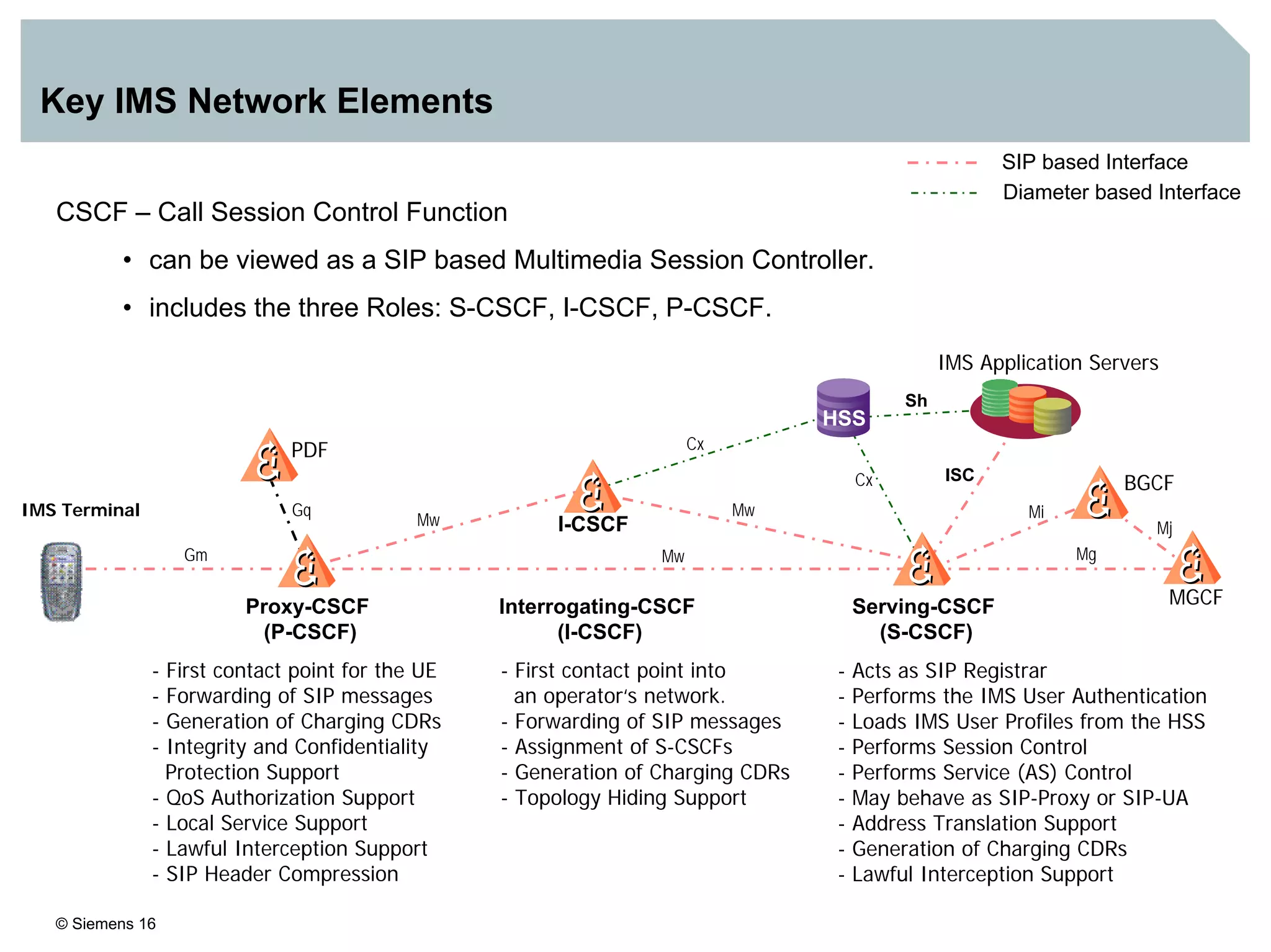
Key IMS Network Elements
SIP based Interface
Diameter based Interface
CSCF – Call Session Control Function
• can be viewed as a SIP based Multimedia Session Controller.
• includes the three Roles: S-CSCF, I-CSCF, P-CSCF.
IMS Application Servers
HSS
Cx
Mw
Mg
Mi
Mj
Gm
ISC
Proxy-CSCF
(P-CSCF)
Serving-CSCF
(S-CSCF)
Interrogating-CSCF
(I-CSCF)
Sh
Cx
Mw
Mw
BGCF
MGCF
IMS Terminal Gq
PDF
I-CSCF
- First contact point for the UE
- Forwarding of SIP messages
- Generation of Charging CDRs
- Integrity and Confidentiality
Protection Support
- QoS Authorization Support
- Local Service Support
- Lawful Interception Support
- SIP Header Compression
- First contact point into
an operator‘s network.
- Forwarding of SIP messages
- Assignment of S-CSCFs
- Generation of Charging CDRs
- Topology Hiding Support
- Acts as SIP Registrar
- Performs the IMS User Authentication
- Loads IMS User Profiles from the HSS
- Performs Session Control
- Performs Service (AS) Control
- May behave as SIP-Proxy or SIP-UA
- Address Translation Support
- Generation of Charging CDRs
- Lawful Interception Support
© Siemens 17
Key IMS Network Elements
SIP based Interface
Diameter based Interface
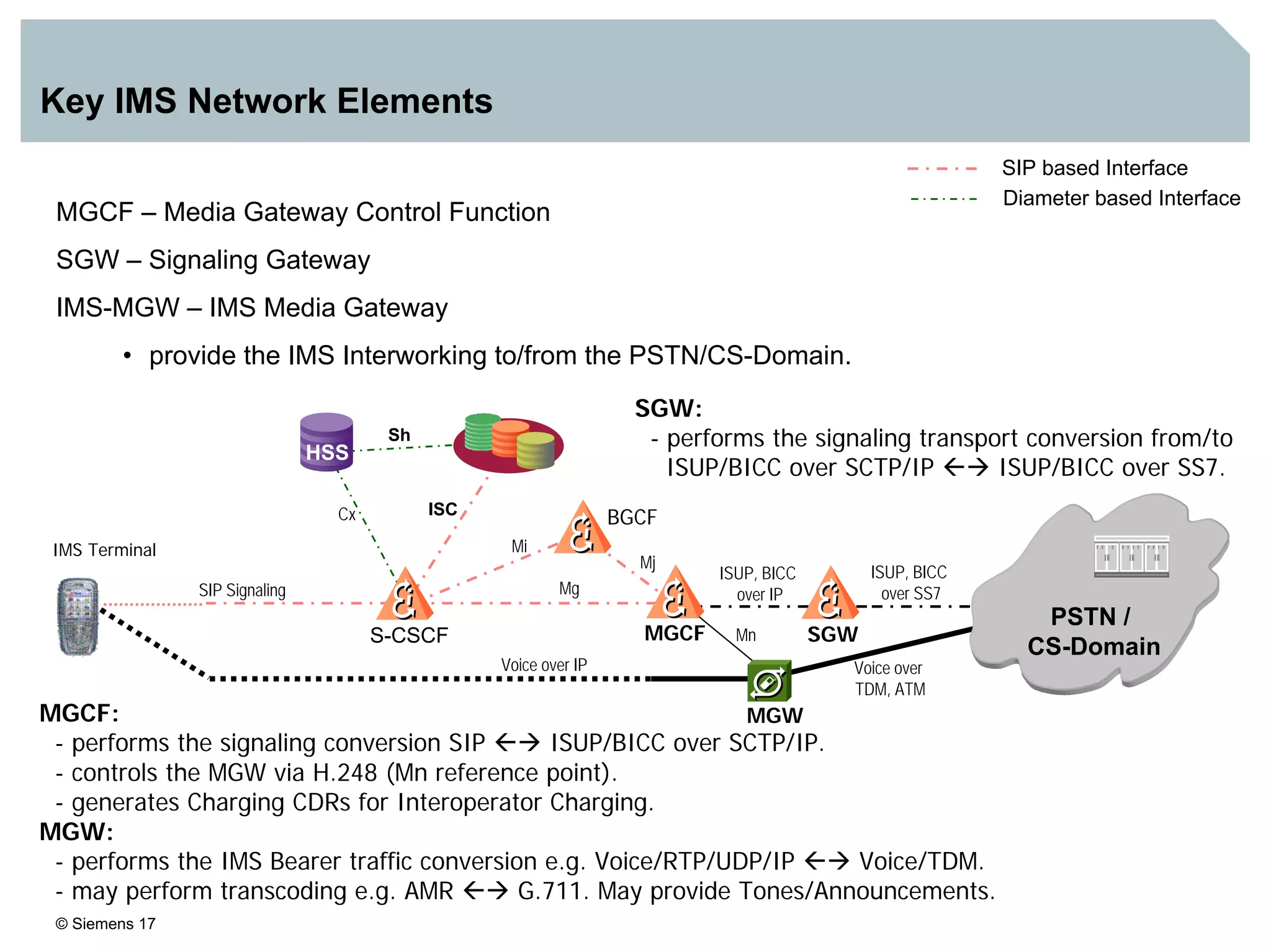
MGCF – Media Gateway Control Function
SGW – Signaling Gateway
IMS-MGW – IMS Media Gateway
• provide the IMS Interworking to/from the PSTN/CS-Domain.
MGCF:
- performs the signaling conversion SIP ISUP/BICC over SCTP/IP.
- controls the MGW via H.248 (Mn reference point).
- generates Charging CDRs for Interoperator Charging.
MGW:
- performs the IMS Bearer traffic conversion e.g. Voice/RTP/UDP/IP Voice/TDM.
- may perform transcoding e.g. AMR G.711. May provide Tones/Announcements.
S-CSCF
HSS
Mg
Mi
Mj
ISC
Sh
Cx BGCF
MGCF SGW
ISUP, BICC
over SS7
Voice over
TDM, ATM
Voice over IP
MGW
PSTN /
CS-Domain
ISUP, BICC
over IP
Mn
SIP Signaling
SGW:
- performs the signaling transport conversion from/to
ISUP/BICC over SCTP/IP ISUP/BICC over SS7.
IMS Terminal
© Siemens 18
Key IMS Network Elements
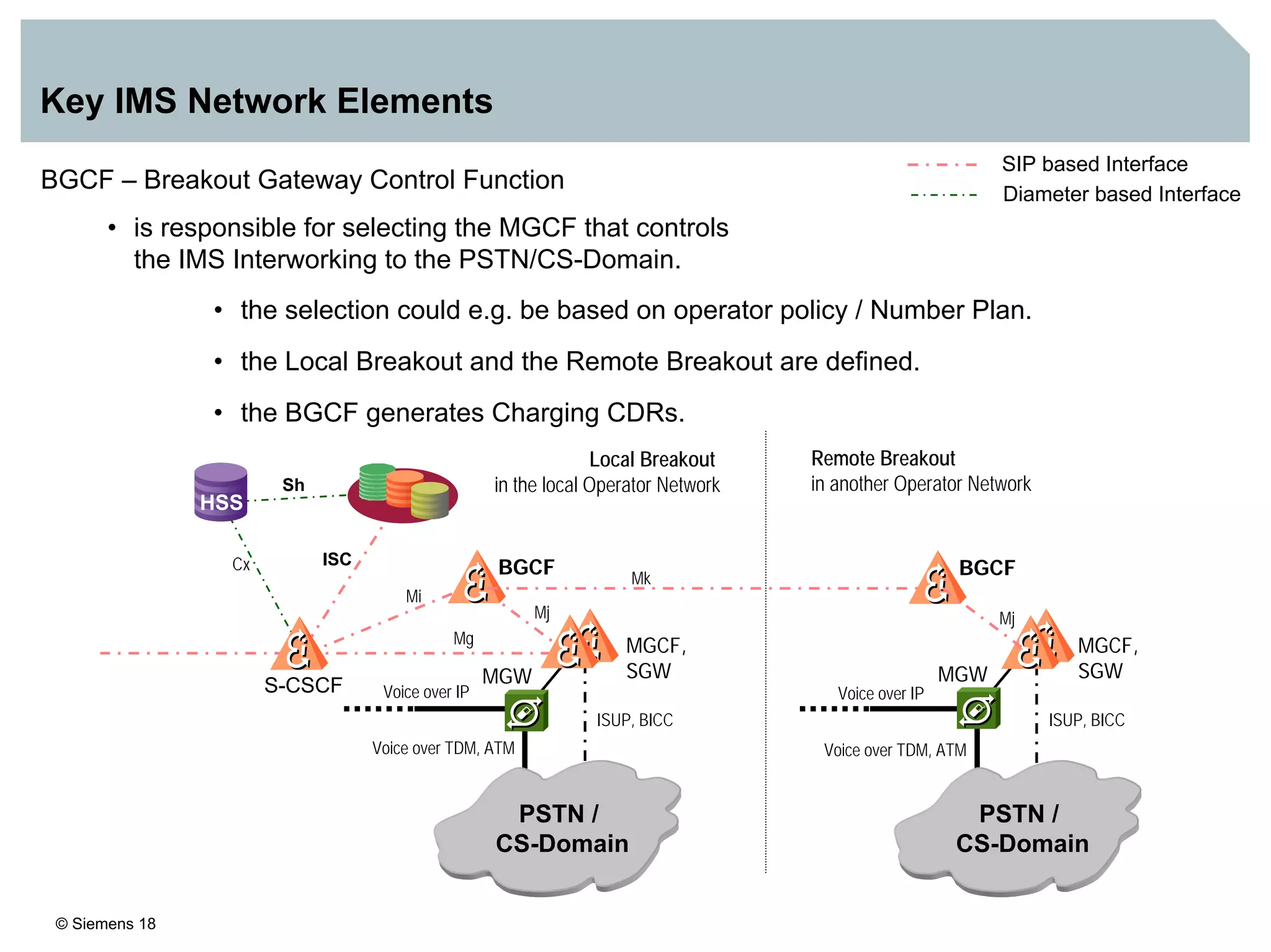
BGCF – Breakout Gateway Control Function
• is responsible for selecting the MGCF that controls
the IMS Interworking to the PSTN/CS-Domain.
• the selection could e.g. be based on operator policy / Number Plan.
• the Local Breakout and the Remote Breakout are defined.
• the BGCF generates Charging CDRs.
SIP based Interface
Diameter based Interface
S-CSCF
HSS
Mg
Mi
Mj
ISC
Sh
Cx BGCF
MGCF,
SGW
BGCF
Mj
Mk
Remote Breakout
in another Operator Network
Local Breakout
in the local Operator Network
MGCF,
SGW
PSTN /
CS-Domain
PSTN /
CS-Domain
ISUP, BICC ISUP, BICC
Voice over TDM, ATM Voice over TDM, ATM
Voice over IP
MGW MGW
Voice over IP
© Siemens 19
Key IMS Network Elements
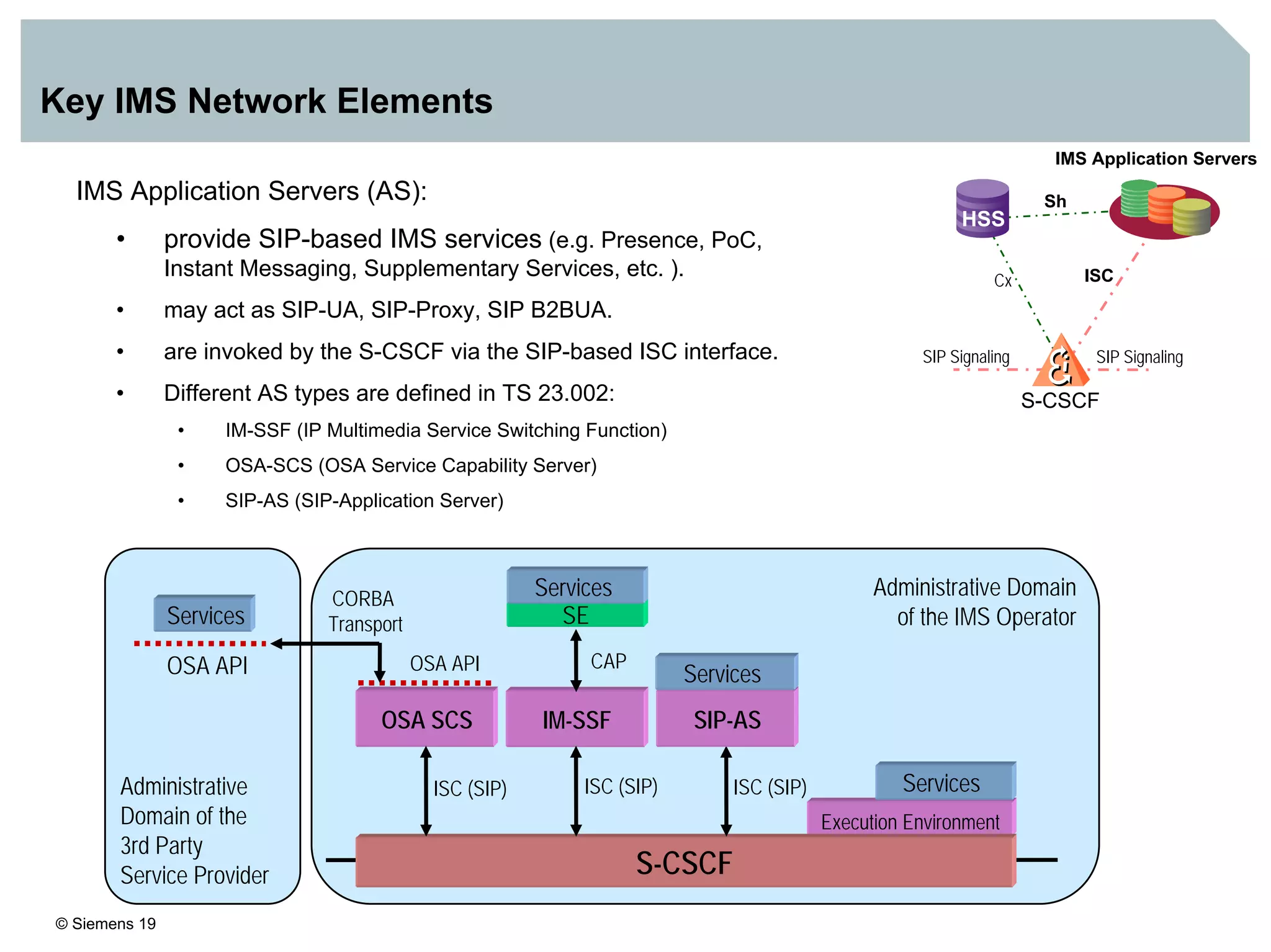
IMS Application Servers (AS):
• provide SIP-based IMS services (e.g. Presence, PoC,
Instant Messaging, Supplementary Services, etc. ).
• may act as SIP-UA, SIP-Proxy, SIP B2BUA.
• are invoked by the S-CSCF via the SIP-based ISC interface.
• Different AS types are defined in TS 23.002:
• IM-SSF (IP Multimedia Service Switching Function)
• OSA-SCS (OSA Service Capability Server)
• SIP-AS (SIP-Application Server)
S-CSCF
HSS
ISC
Sh
Cx
IMS Application Servers
SIP Signaling SIP Signaling
Administrative Domain
of the IMS Operator
Execution Environment
Services
S-CSCF
ISC (SIP)ISC (SIP)ISC (SIP)Administrative
Domain of the
3rd Party
Service Provider
SE
Services
OSA API
IM-SSFOSA SCS SIP-AS
OSA API
Services
CAP
CORBA
Transport
Services
© Siemens 20
IMS Registration and User Authentication
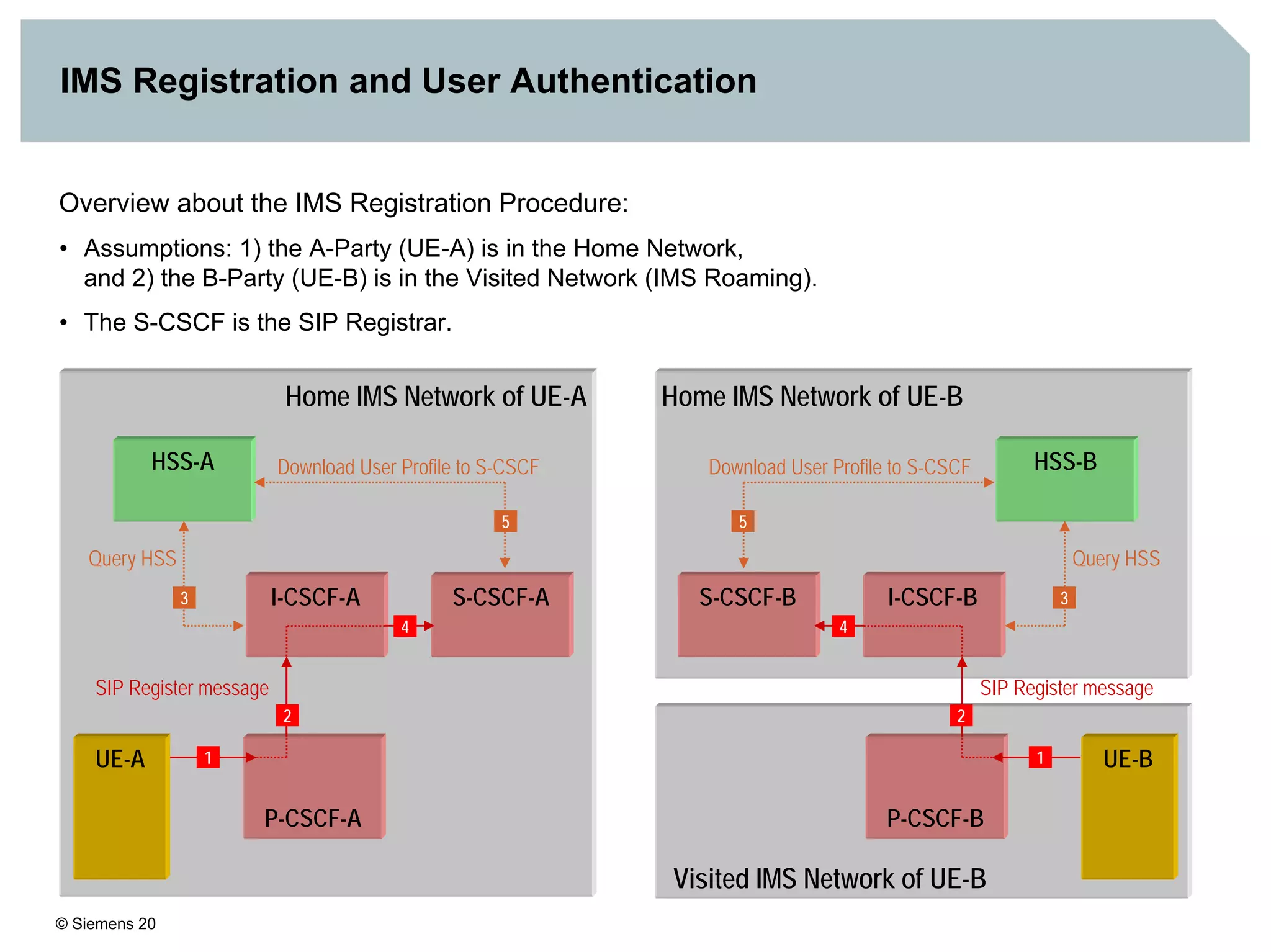
Overview about the IMS Registration Procedure:
• Assumptions: 1) the A-Party (UE-A) is in the Home Network,
and 2) the B-Party (UE-B) is in the Visited Network (IMS Roaming).
• The S-CSCF is the SIP Registrar.
Home IMS Network of UE-A
P-CSCF-A
S-CSCF-AI-CSCF-A
HSS-A
UE-A
SIP Register message
1
2
4
Query HSS
Download User Profile to S-CSCF
3
5
Home IMS Network of UE-B
P-CSCF-B
S-CSCF-B I-CSCF-B
HSS-B
UE-B
SIP Register message
1
2
4
Query HSS
Download User Profile to S-CSCF
3
5
Visited IMS Network of UE-B
© Siemens 21
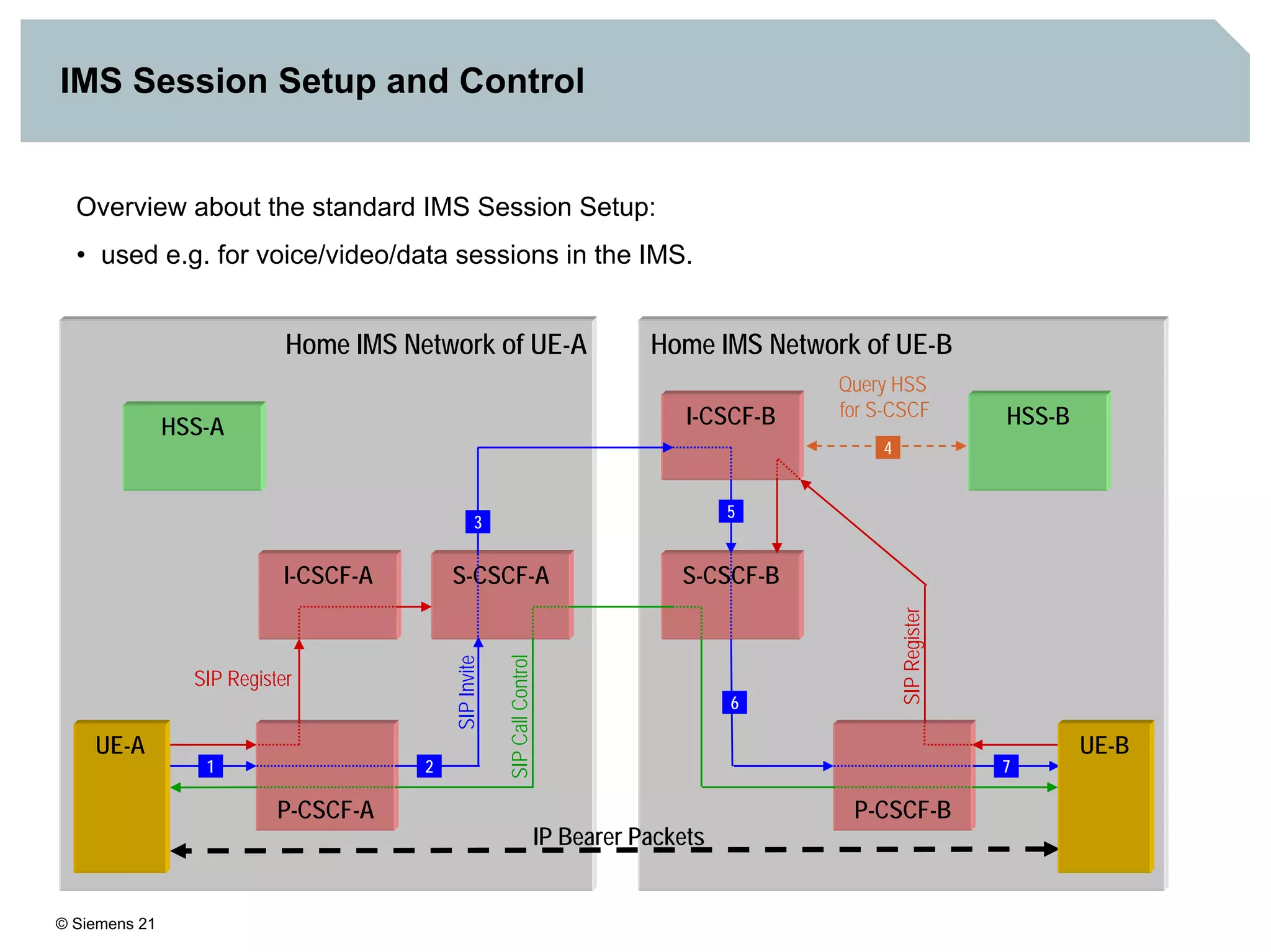
IMS Session Setup and Control
Overview about the standard IMS Session Setup:
• used e.g. for voice/video/data sessions in the IMS.
Home IMS Network of UE-A Home IMS Network of UE-B
P-CSCF-A
I-CSCF-B
P-CSCF-B
HSS-B
S-CSCF-A S-CSCF-B
1 2
3
4
5
6
7
SIPInvite
SIPCallControl
SIPRegister
I-CSCF-A
HSS-A
UE-BUE-A
SIP Register
IP Bearer Packets
Query HSS
for S-CSCF
© Siemens 22
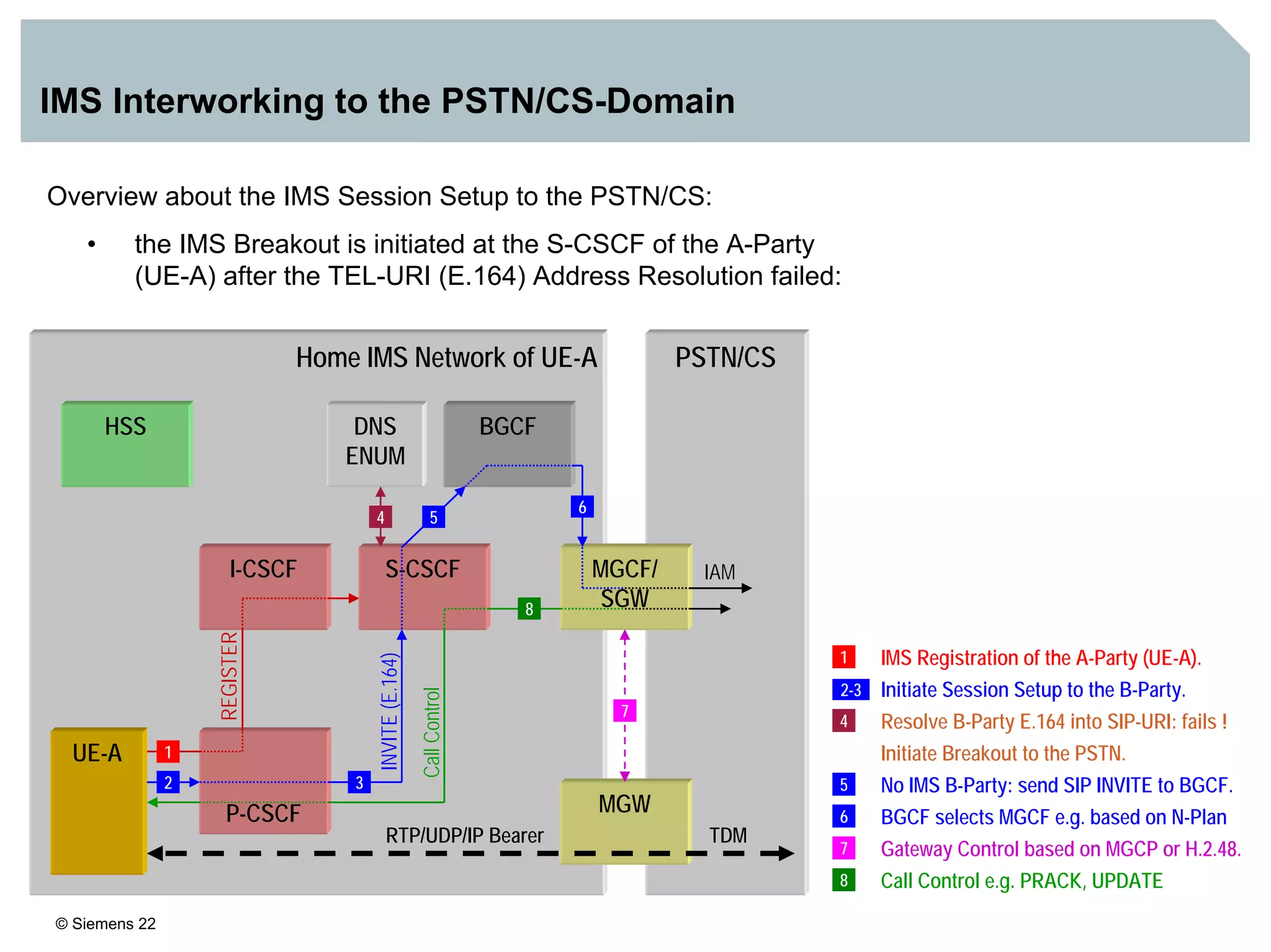
IMS Interworking to the PSTN/CS-Domain
Overview about the IMS Session Setup to the PSTN/CS:
• the IMS Breakout is initiated at the S-CSCF of the A-Party
(UE-A) after the TEL-URI (E.164) Address Resolution failed:
PSTN/CSHome IMS Network of UE-A
P-CSCF
S-CSCF MGCF/
SGW
BGCF
REGISTER
INVITE(E.164)
CallControl
2 3
5
I-CSCF
HSS
6
1
DNS
ENUM
4
UE-A
IAM
RTP/UDP/IP Bearer TDM
8
MGW
7
2-3
4
1 IMS Registration of the A-Party (UE-A).
Resolve B-Party E.164 into SIP-URI: fails !
Initiate Session Setup to the B-Party.
6
7
5 No IMS B-Party: send SIP INVITE to BGCF.
Gateway Control based on MGCP or H.2.48.
BGCF selects MGCF e.g. based on N-Plan
Call Control e.g. PRACK, UPDATE8
Initiate Breakout to the PSTN.
© Siemens 23
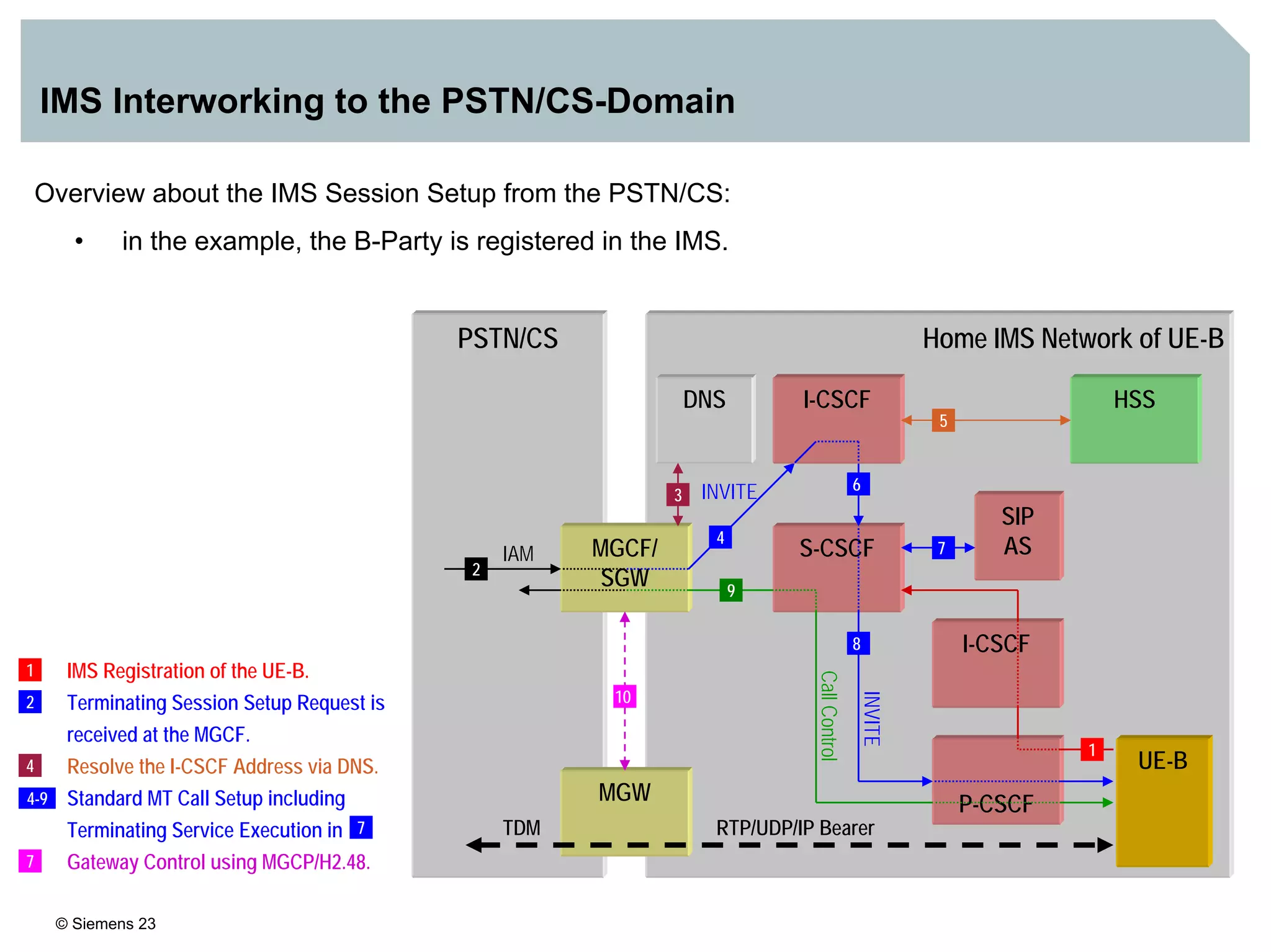
IMS Interworking to the PSTN/CS-Domain
Overview about the IMS Session Setup from the PSTN/CS:
• in the example, the B-Party is registered in the IMS.
4-9
4
1 IMS Registration of the UE-B.
Resolve the I-CSCF Address via DNS.
Standard MT Call Setup including
7 Gateway Control using MGCP/H2.48.
2 Terminating Session Setup Request is
received at the MGCF.
Terminating Service Execution in 7
PSTN/CS Home IMS Network of UE-B
P-CSCF
S-CSCFMGCF/
SGW
INVITE
CallControl
8
6
I-CSCF
HSS
2
1
DNS
3
UE-B
IAM
RTP/UDP/IP BearerTDM
9
I-CSCF
4
SIP
AS7
INVITE
MGW
10
5
© Siemens 24
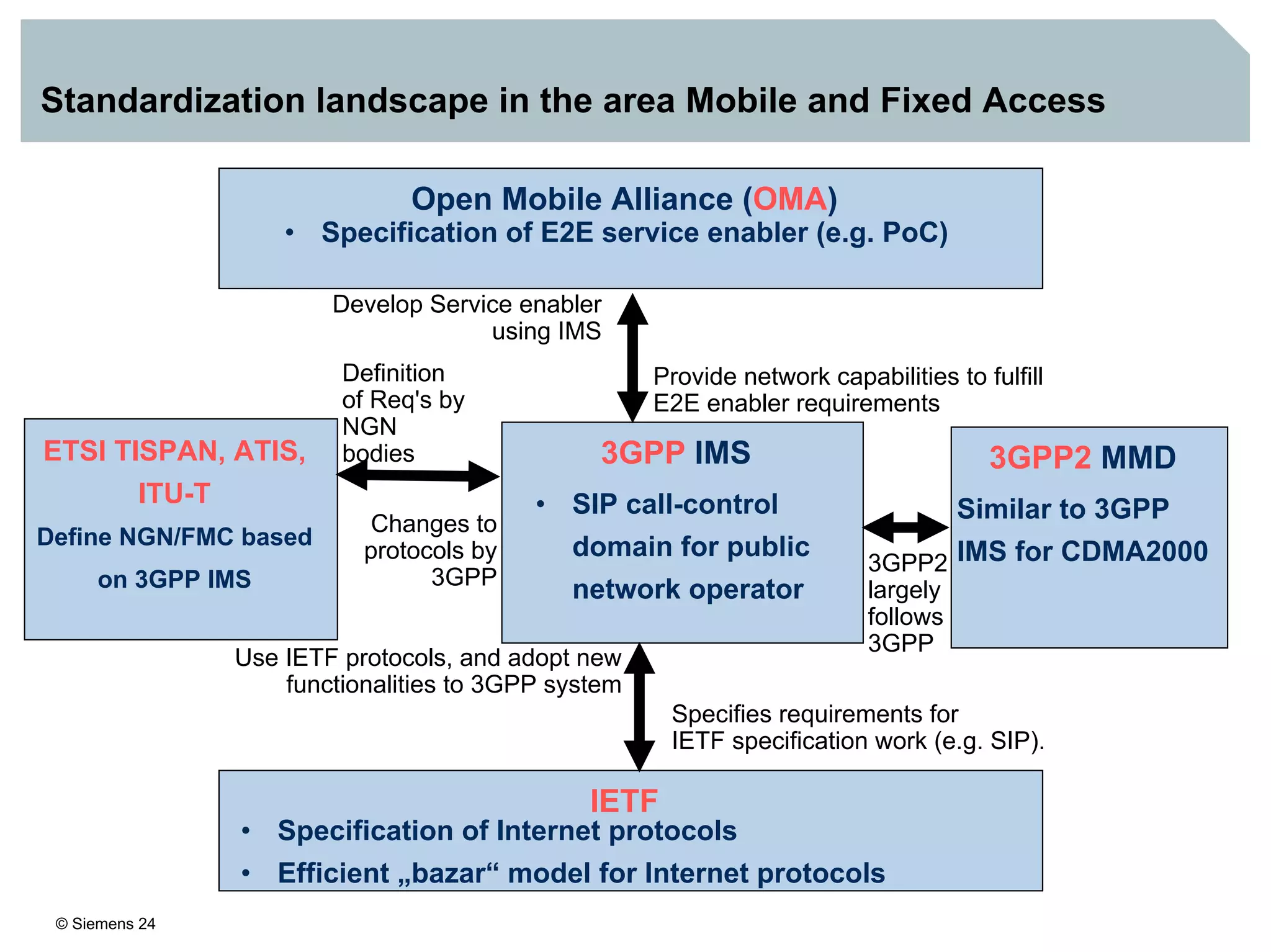
3GPP IMS
• SIP call-control
domain for public
network operator
IETF
• Specification of Internet protocols
• Efficient „bazar“ model for Internet protocols
Use IETF protocols, and adopt new
functionalities to 3GPP system
Specifies requirements for
IETF specification work (e.g. SIP).
3GPP2 MMD
Similar to 3GPP
IMS for CDMA20003GPP2
largely
follows
3GPP
Open Mobile Alliance (OMA)
• Specification of E2E service enabler (e.g. PoC)
Provide network capabilities to fulfill
E2E enabler requirements
Develop Service enabler
using IMS
ETSI TISPAN, ATIS,
ITU-T
Define NGN/FMC based
on 3GPP IMS
Definition
of Req's by
NGN
bodies
Changes to
protocols by
3GPP
Standardization landscape in the area Mobile and Fixed Access
© Siemens 25
TISPAN NGN Functional Architecture
Release 1
Implementation utilizing an IMS-based coreTISPAN Architecture
Rf /Ro
IP Transport (Access and Core)
Resource and Admission Control Subsystem
Core IMS
AS
Charging
Functions
Mw
Mw Mw/Mk/Mm
Mr
Mg
Mj
Mi
Mp Mn
Gm
Gq
ISC Cx
Dx
Dh
Sh
Ic
Rf /RoCx
Ib
Ia
Id
If
Ie
Mi
Network
Attachment
Subsystem
AS
Charging
FunctionsHSS
I-CSCF
SLF
BGCF
MGCFMRFCP-CSCF
UE
A-BGF
MRFP
PSTN/ISDN
T-MGF
SGF
I-BGF
OtherIPNetworks
IBCF
IWF
Mw
S-CSCF
© Siemens 26
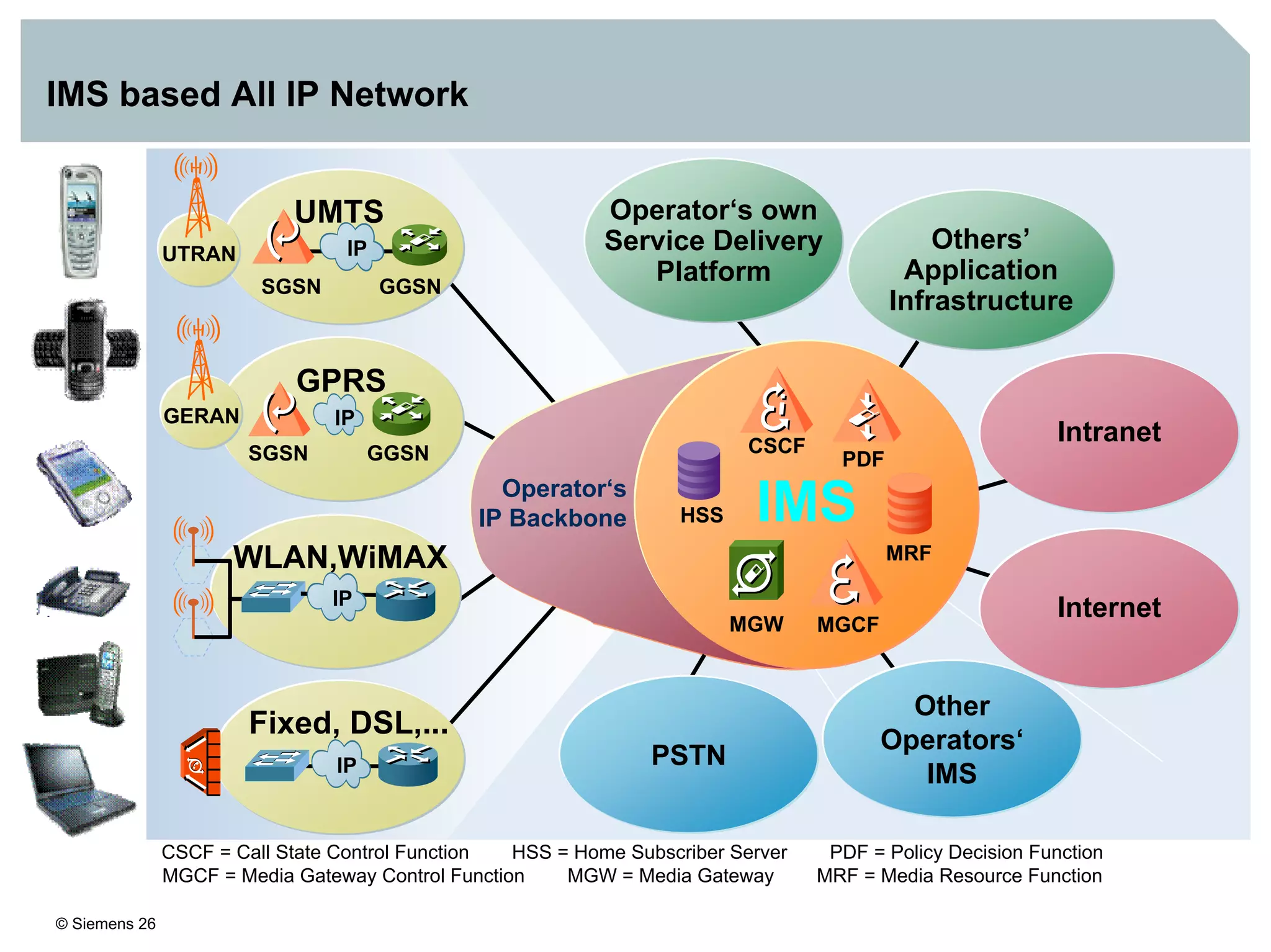
GPRS
SGSN GGSN
IPGERAN
WLAN,WiMAX
IP
UMTS
SGSN GGSN
UTRAN IP
Fixed, DSL,...
IP
Others’
Application
Infrastructure
Intranet
Internet
IMSOperator‘s
IP Backbone
Operator‘s own
Service Delivery
Platform
Other
Operators‘
IMS
PSTN
HSS
CSCF
MGCFMGW
PDF
MRF
IMS based All IP Network
CSCF = Call State Control Function HSS = Home Subscriber Server PDF = Policy Decision Function
MGCF = Media Gateway Control Function MGW = Media Gateway MRF = Media Resource Function
© Siemens 27
2. IMS based new services:
• How the new services can be offered
• Which services would be low hanging fruit
© Siemens 28
Session Control
Applications
Subscribers
Mobile Clients Fixed Clients
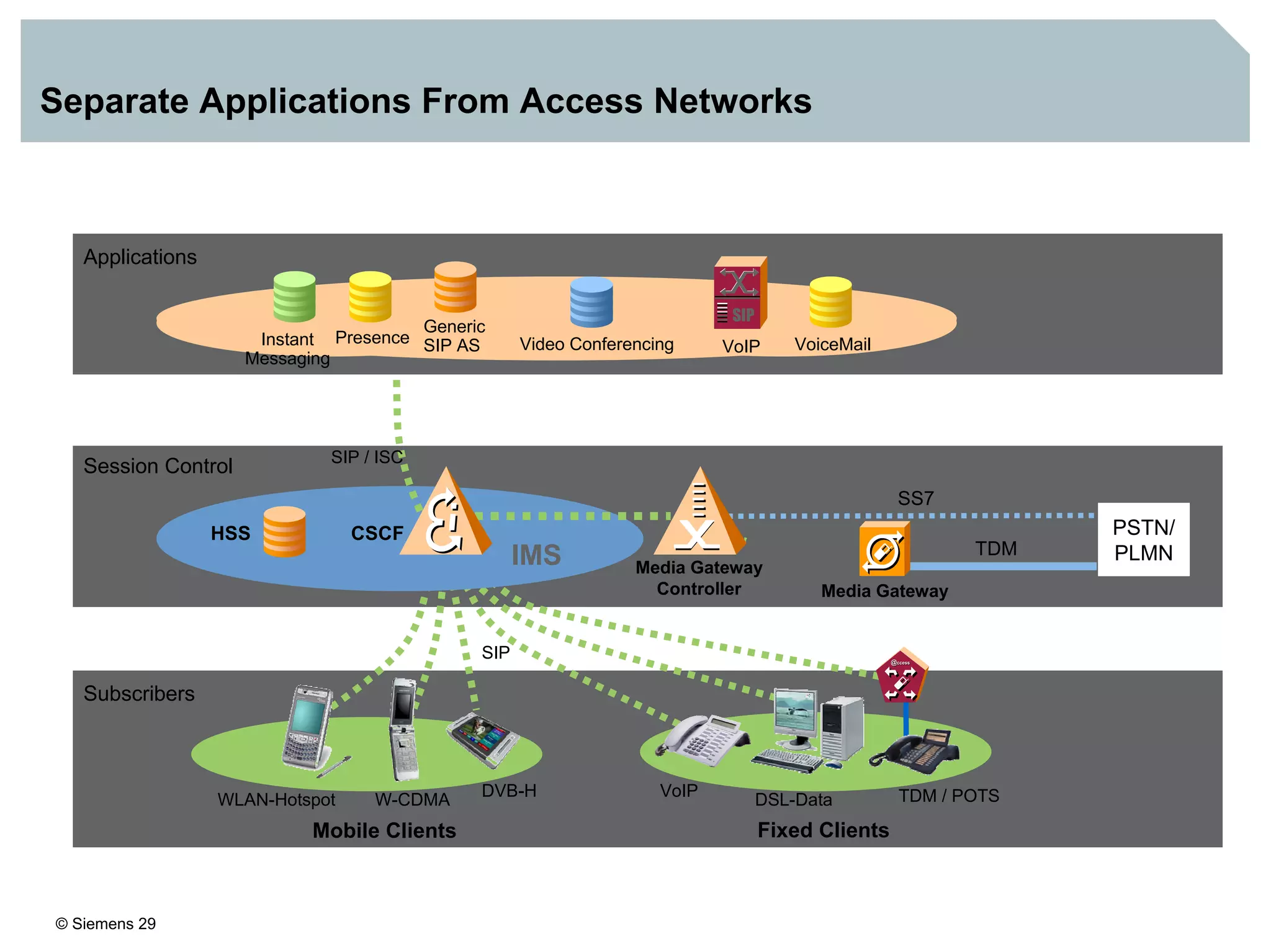
Separate Applications From Access Networks
HSS
IMS
SS7
TDM
CFX-5000CMS-8200 Media Gateway
Controller Media Gateway
Video Conferencing VoiceMailPresence
VoIP
PSTN/
PLMN
Generic
SIP AS
hiQ 4200
Instant
Messaging
SIP / ISC
DVB-H
W-CDMAWLAN-Hotspot
VoIP
DSL-Data TDM / POTS
SIP
CSCF
3.5G Radio Internet
WLAN
2G / 3G
GSM / UMTS
WIMAX
Cable
DSL
CDMA
DVB-H
CSCF & HSS
Service, Session & Resource Control
IMS
Applications
SIP-based legacy
© Siemens 29
Separate Applications From Access Networks
Session Control
Applications
Subscribers
Mobile Clients Fixed Clients
HSS
IMS
SS7
TDM
Media Gateway
Controller Media Gateway
PSTN/
PLMN
Video Conferencing VoiceMailPresence
VoIP
Generic
SIP ASInstant
Messaging
SIP / ISC
DVB-H
W-CDMAWLAN-Hotspot
VoIP
DSL-Data TDM / POTS
SIP
CSCF
© Siemens 30
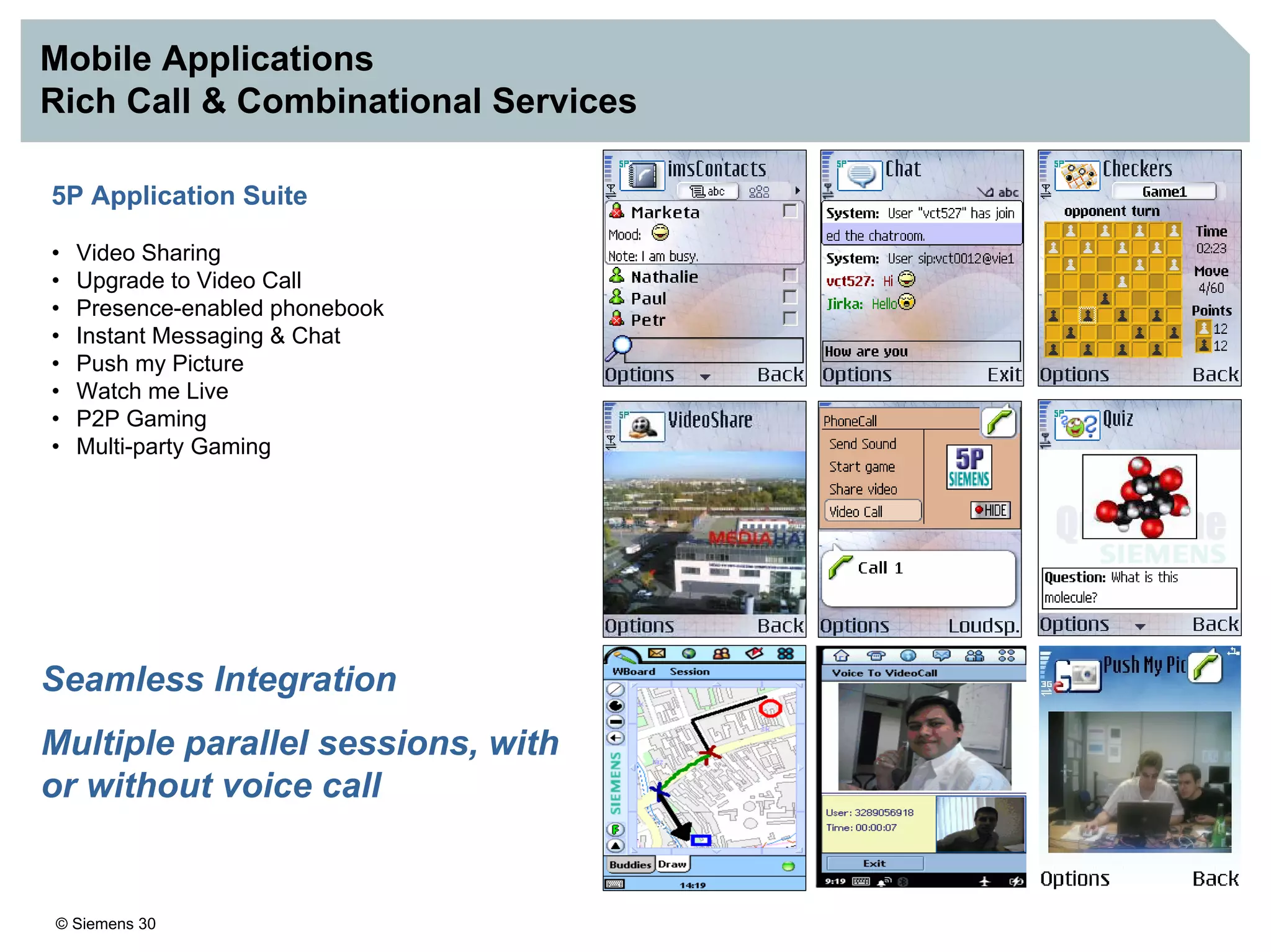
Mobile Applications
Rich Call & Combinational Services
5P Application Suite
• Video Sharing
• Upgrade to Video Call
• Presence-enabled phonebook
• Instant Messaging & Chat
• Push my Picture
• Watch me Live
• P2P Gaming
• Multi-party Gaming
Seamless Integration
Multiple parallel sessions, with
or without voice call
© Siemens 31
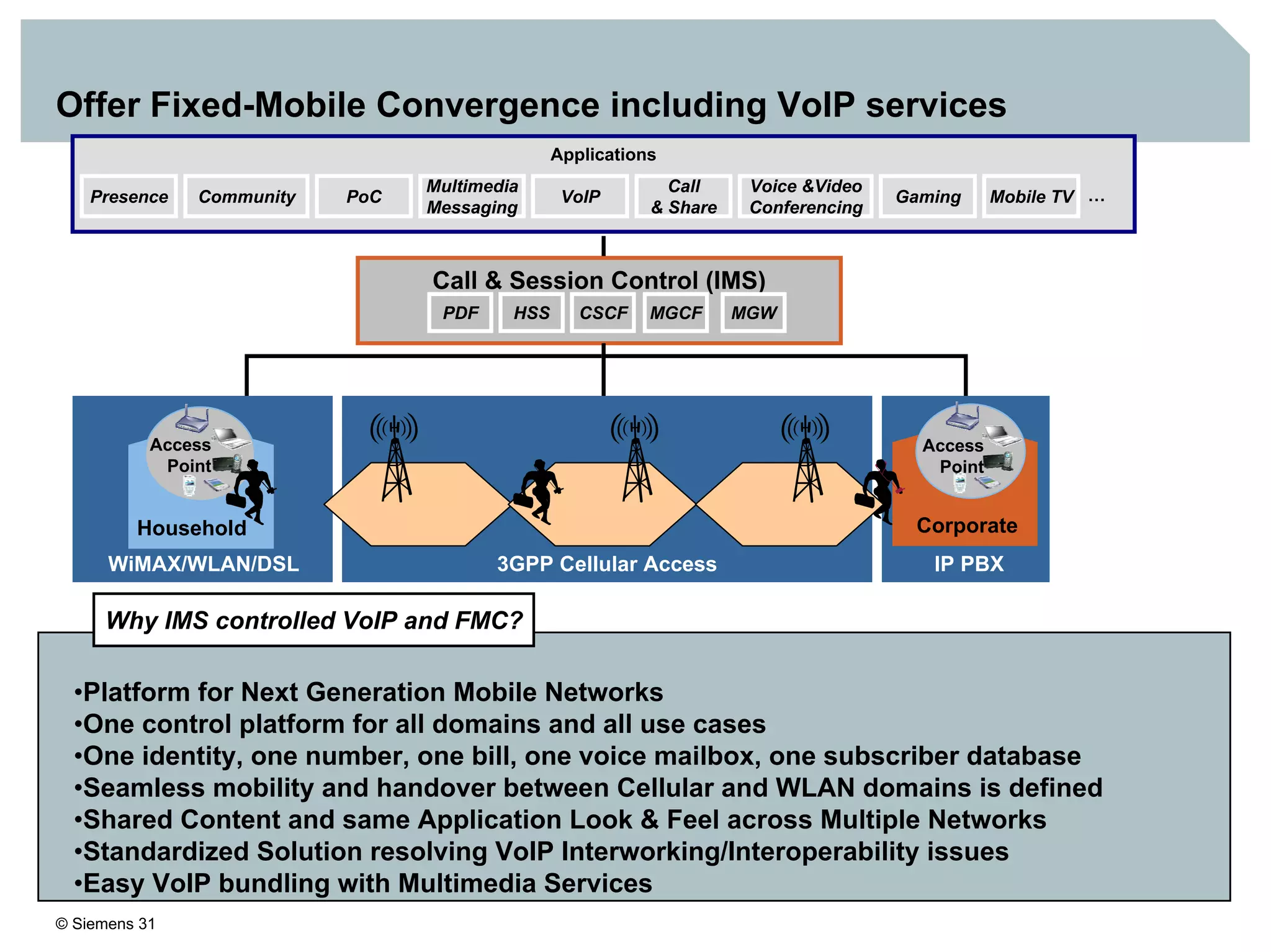
Offer Fixed-Mobile Convergence including VoIP services
Call & Session Control (IMS)
PDF HSS CSCF MGCF MGW
WiMAX/WLAN/DSL
Household
Access
Point
IP PBX3GPP Cellular Access
Corporate
Access
Point
Applications
Presence Community PoC
Multimedia
Messaging
VoIP
Call
& Share
Voice &Video
Conferencing
Gaming Mobile TV …
•Platform for Next Generation Mobile Networks
•One control platform for all domains and all use cases
•One identity, one number, one bill, one voice mailbox, one subscriber database
•Seamless mobility and handover between Cellular and WLAN domains is defined
•Shared Content and same Application Look & Feel across Multiple Networks
•Standardized Solution resolving VoIP Interworking/Interoperability issues
•Easy VoIP bundling with Multimedia Services
Why IMS controlled VoIP and FMC?
© Siemens 32
3. Release 4 migration path to Release 5:
• Signalling
• Media
© Siemens 33
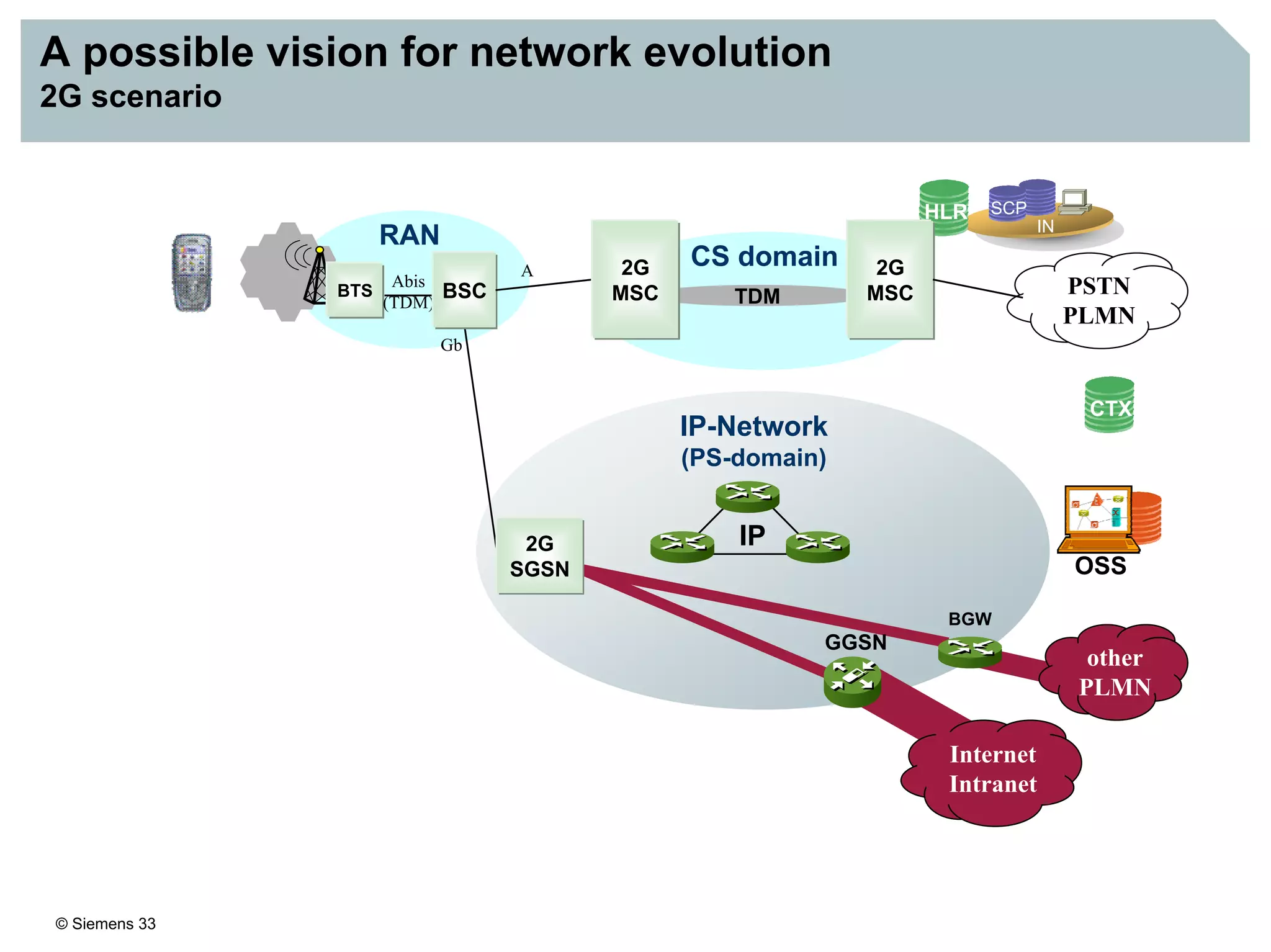
CS domain
A possible vision for network evolution
2G scenario
BTS
A
Abis
(TDM)
Gb
RAN
SCP
IN
HLR
BSC PSTN
PLMN
TDM
2G
MSC
2G
MSC
IP-Network
(PS-domain)
Internet
Intranet
other
PLMN
BGW
2G
SGSN
GGSN
IP
OSS
CTX
© Siemens 34
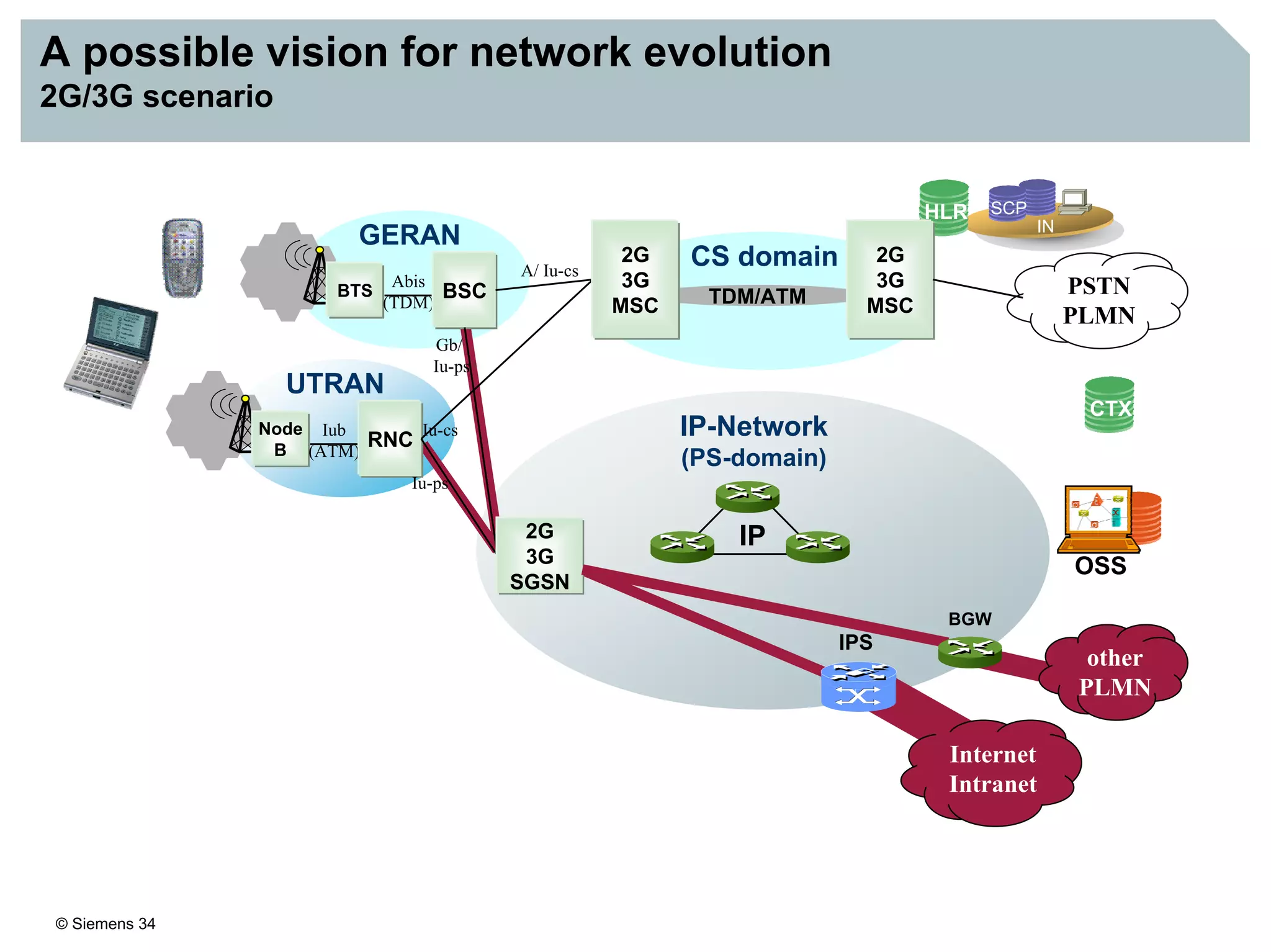
CS domain
A possible vision for network evolution
2G/3G scenario
BTS
A/ Iu-cs
Abis
(TDM)
Gb/
Iu-ps
GERAN
Node
B
UTRAN
Iub
(ATM)
RNC
SCP
IN
HLR
Iu-ps
Iu-cs
BSC PSTN
PLMN
TDM/ATM
2G
3G
MSC
2G
3G
MSC
IP-Network
(PS-domain)
Internet
Intranet
other
PLMN
BGW
2G
3G
SGSN
IPS
IP
OSS
CTX
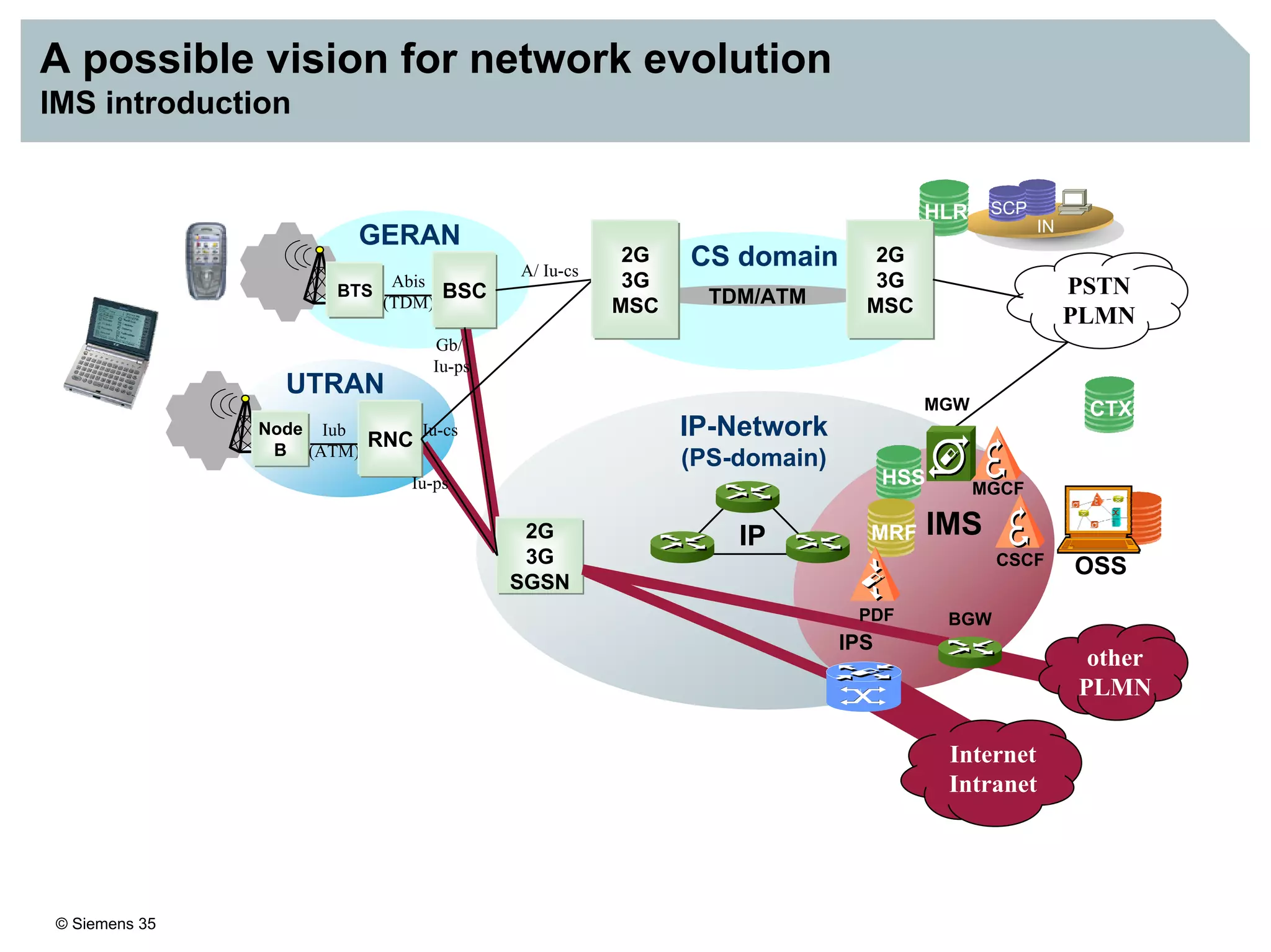
© Siemens 35
CS domain
A possible vision for network evolution
IMS introduction
BTS
A/ Iu-cs
Abis
(TDM)
Gb/
Iu-ps
GERAN
Node
B
UTRAN
Iub
(ATM)
RNC
SCP
IN
HLR
Iu-ps
2G
3G
SGSN
Iu-cs
BSC PSTN
PLMN
TDM/ATM
2G
3G
MSC
2G
3G
MSC
IP-Network
(PS-domain)
MGCF
IMS
CSCF
MGW
HSS
MRF
other
PLMN
BGW
IPS
PDF
Internet
Intranet
IP
OSS
CTX
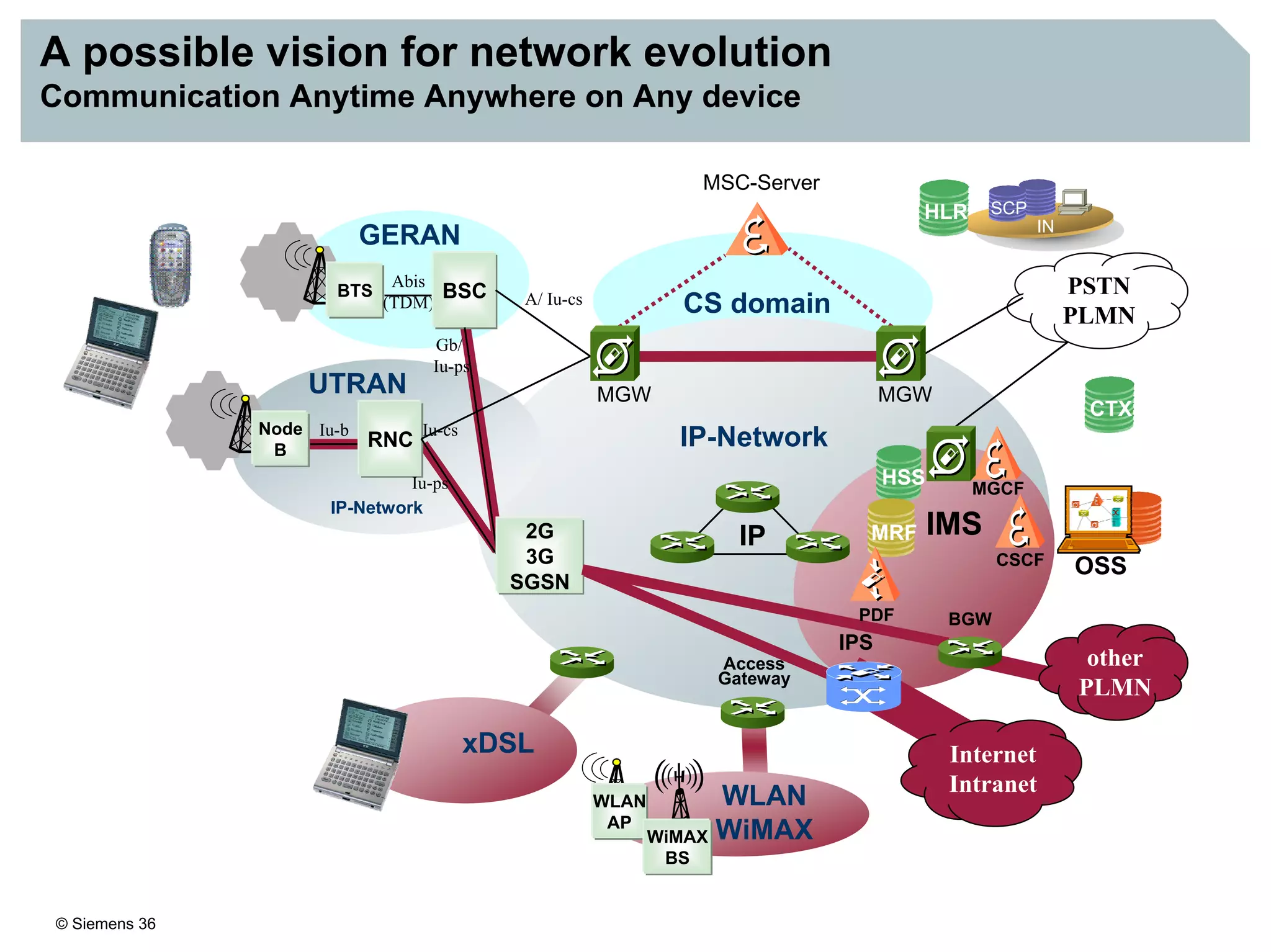
© Siemens 36
A possible vision for network evolution
Communication Anytime Anywhere on Any device
CS domain
BTS A/ Iu-cs
Abis
(TDM)
Gb/
Iu-ps
GERAN
Node
B
UTRAN
Iu-b
RNC
SCP
IN
HLR
Iu-ps
Iu-cs
BSC PSTN
PLMN
IP-Network
IMS
HSS
MRF
MSC-Server
Internet
Intranet
other
PLMN
2G
3G
SGSN
OSS
IP-Network
IPS
xDSL
WLAN
AP
Access
Gateway
WLAN
WiMAXWiMAX
BS
BGW
MGWMGW
MGCF
CSCF
PDF
IP
CTX
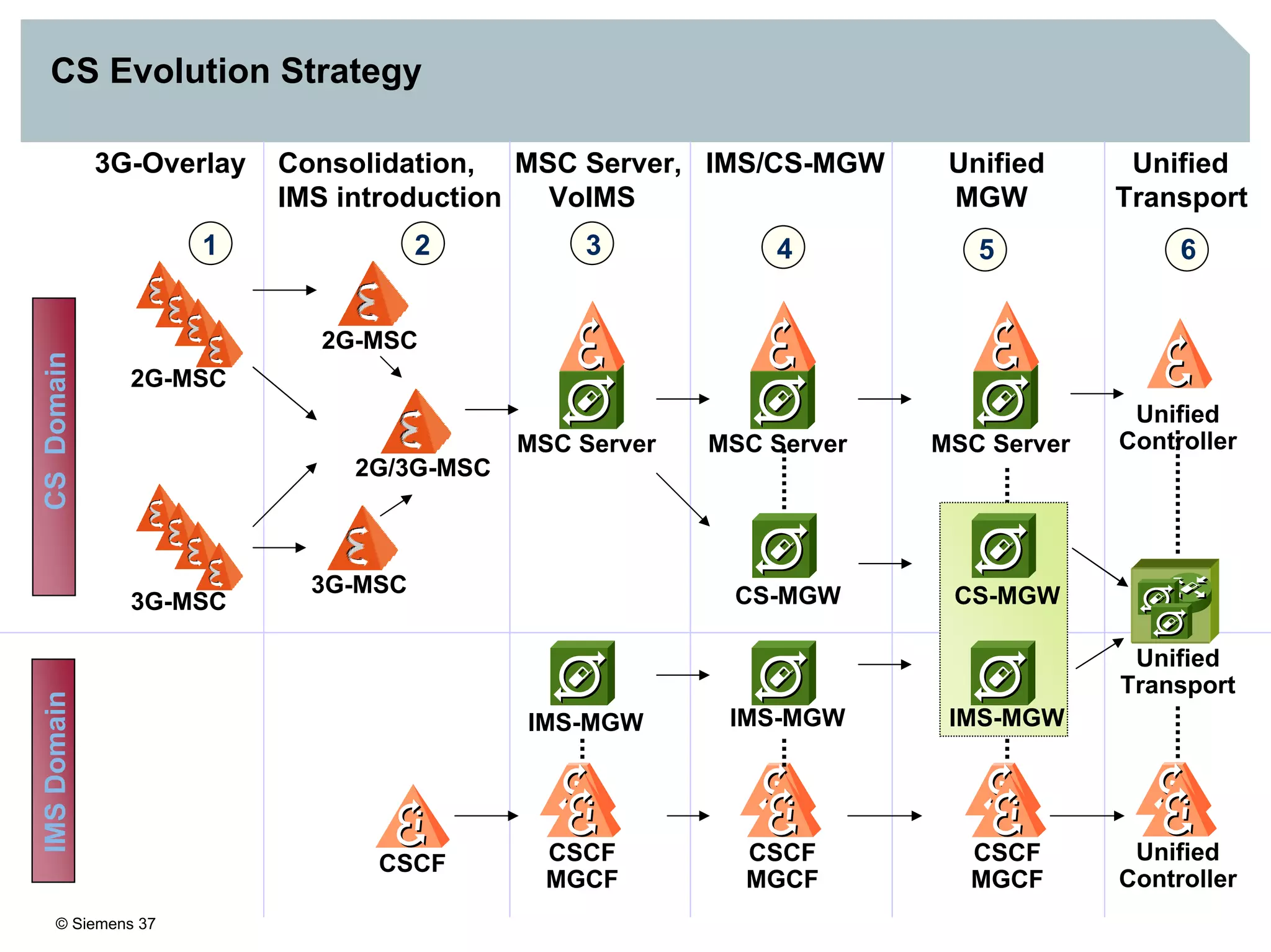
© Siemens 37
3G-Overlay Consolidation, MSC Server, IMS/CS-MGW Unified Unified
IMS introduction VoIMS MGW Transport
2G-MSC
3G-MSC
2G/3G-MSC
CSCF
IMS-MGW
2G-MSC
3G-MSC
CSCF
MGCF
IMSDomainCSDomain
CSCF
MGCF
CSCF
MGCF
21 3 4 5
Unified
Controller
Unified
Transport
Unified
Controller
6
IMS-MGW
CS-MGW
MSC Server MSC ServerMSC Server
IMS-MGW
CS-MGW
CS Evolution Strategy
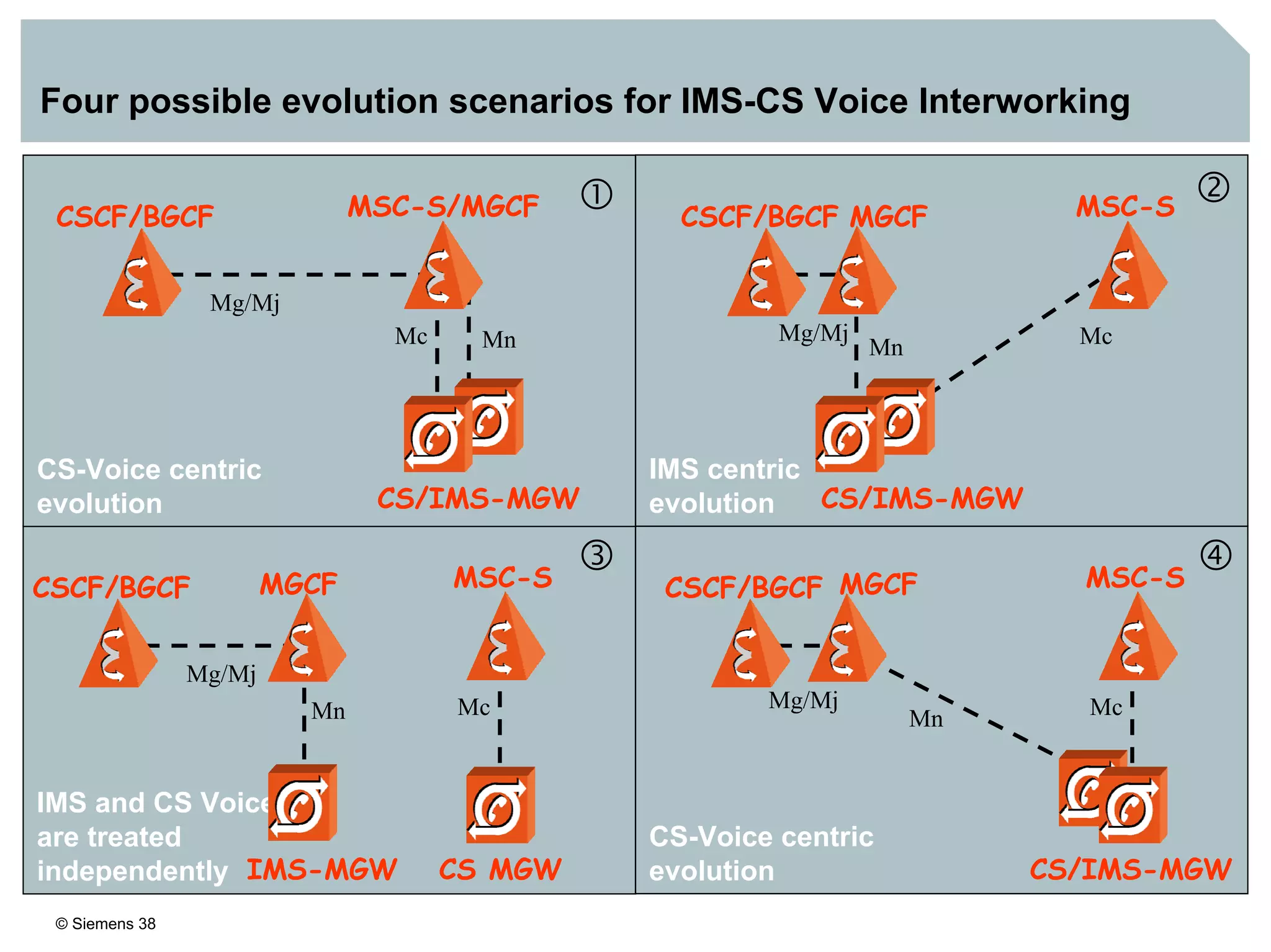
© Siemens 38
Four possible evolution scenarios for IMS-CS Voice Interworking
CS-Voice centric
evolution
IMS and CS Voice
are treated
independently
IMS centric
evolution
CS-Voice centric
evolution
CS MGW
Mc
MSC-S
Mn
Mg/Mj
MGCF
IMS-MGW
CSCF/BGCF
Mc
MSC-S/MGCF
Mn
Mg/Mj
CS/IMS-MGW
CSCF/BGCF
Mc
MSC-S
Mn
CS/IMS-MGW
CSCF/BGCF
Mc
MSC-S
Mn
Mg/Mj
MGCF
CS/IMS-MGW
CSCF/BGCF
Mg/Mj
MGCF
© Siemens 39
4. 3GPP Release 6 and beyond:
• Release 6
• Release 7
• NGMN / LTE
© Siemens 40
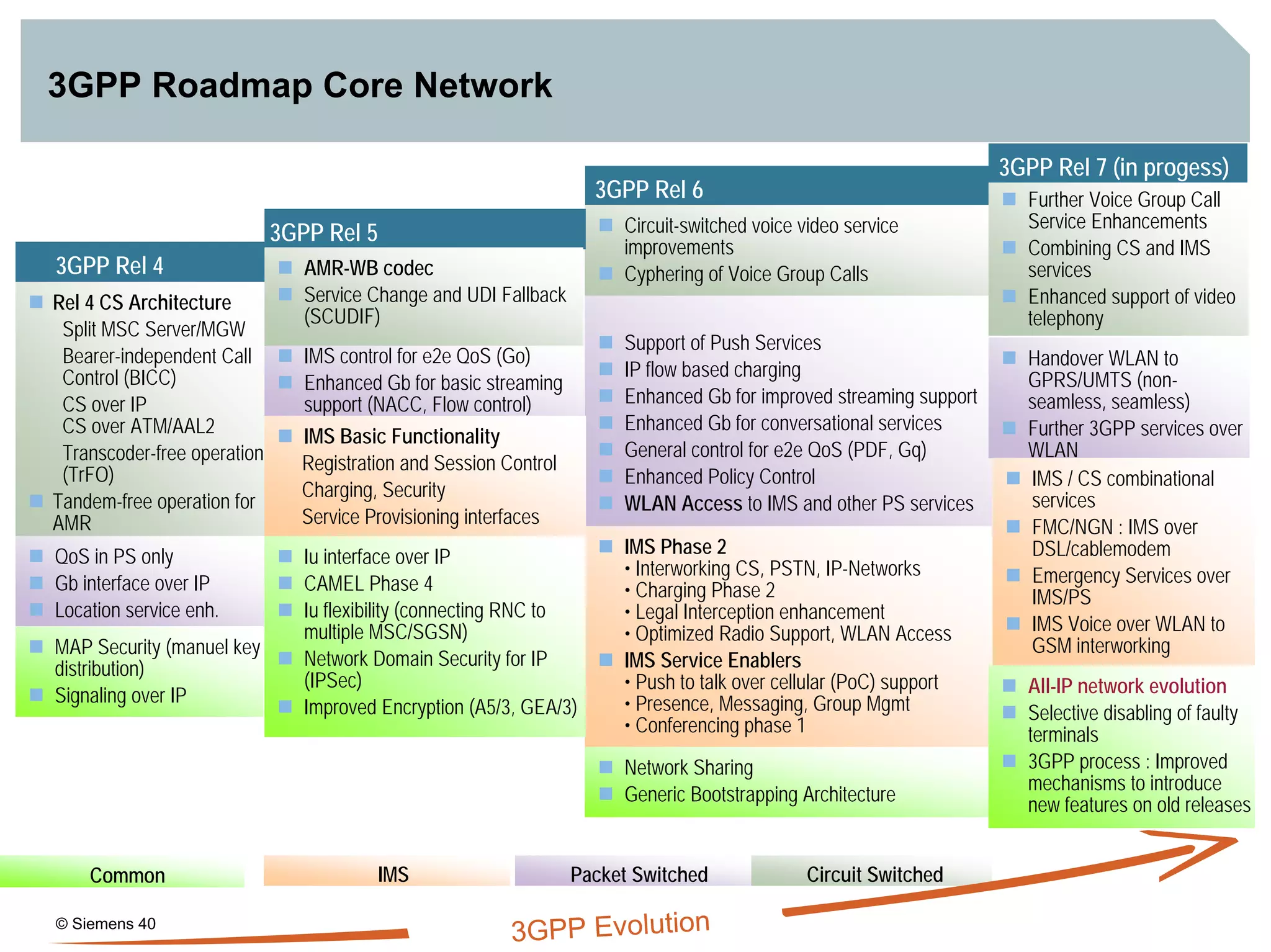
3GPP Roadmap Core Network
3GPP Rel 6
Support of Push Services
IP flow based charging
Enhanced Gb for improved streaming support
Enhanced Gb for conversational services
General control for e2e QoS (PDF, Gq)
Enhanced Policy Control
WLAN Access to IMS and other PS services
Circuit-switched voice video service
improvements
Cyphering of Voice Group Calls
IMS Phase 2
• Interworking CS, PSTN, IP-Networks
• Charging Phase 2
• Legal Interception enhancement
• Optimized Radio Support, WLAN Access
IMS Service Enablers
• Push to talk over cellular (PoC) support
• Presence, Messaging, Group Mgmt
• Conferencing phase 1
3GPP Rel 4
Rel 4 CS Architecture
Split MSC Server/MGW
Bearer-independent Call
Control (BICC)
CS over IP
CS over ATM/AAL2
Transcoder-free operation
(TrFO)
Tandem-free operation for
AMR
QoS in PS only
Gb interface over IP
Location service enh.
3GPP Rel 7 (in progess)
Handover WLAN to
GPRS/UMTS (non-
seamless, seamless)
Further 3GPP services over
WLAN
Further Voice Group Call
Service Enhancements
Combining CS and IMS
services
Enhanced support of video
telephony
IMS / CS combinational
services
FMC/NGN : IMS over
DSL/cablemodem
Emergency Services over
IMS/PS
IMS Voice over WLAN to
GSM interworkingMAP Security (manuel key
distribution)
Signaling over IP
Network Sharing
Generic Bootstrapping Architecture
All-IP network evolution
Selective disabling of faulty
terminals
3GPP process : Improved
mechanisms to introduce
new features on old releases
3GPP Rel 5
IMS control for e2e QoS (Go)
Enhanced Gb for basic streaming
support (NACC, Flow control)
AMR-WB codec
Service Change and UDI Fallback
(SCUDIF)
IMS Basic Functionality
Registration and Session Control
Charging, Security
Service Provisioning interfaces
Iu interface over IP
CAMEL Phase 4
Iu flexibility (connecting RNC to
multiple MSC/SGSN)
Network Domain Security for IP
(IPSec)
Improved Encryption (A5/3, GEA/3)
Circuit SwitchedPacket SwitchedIMSCommon
3GPP Evolution
© Siemens 41
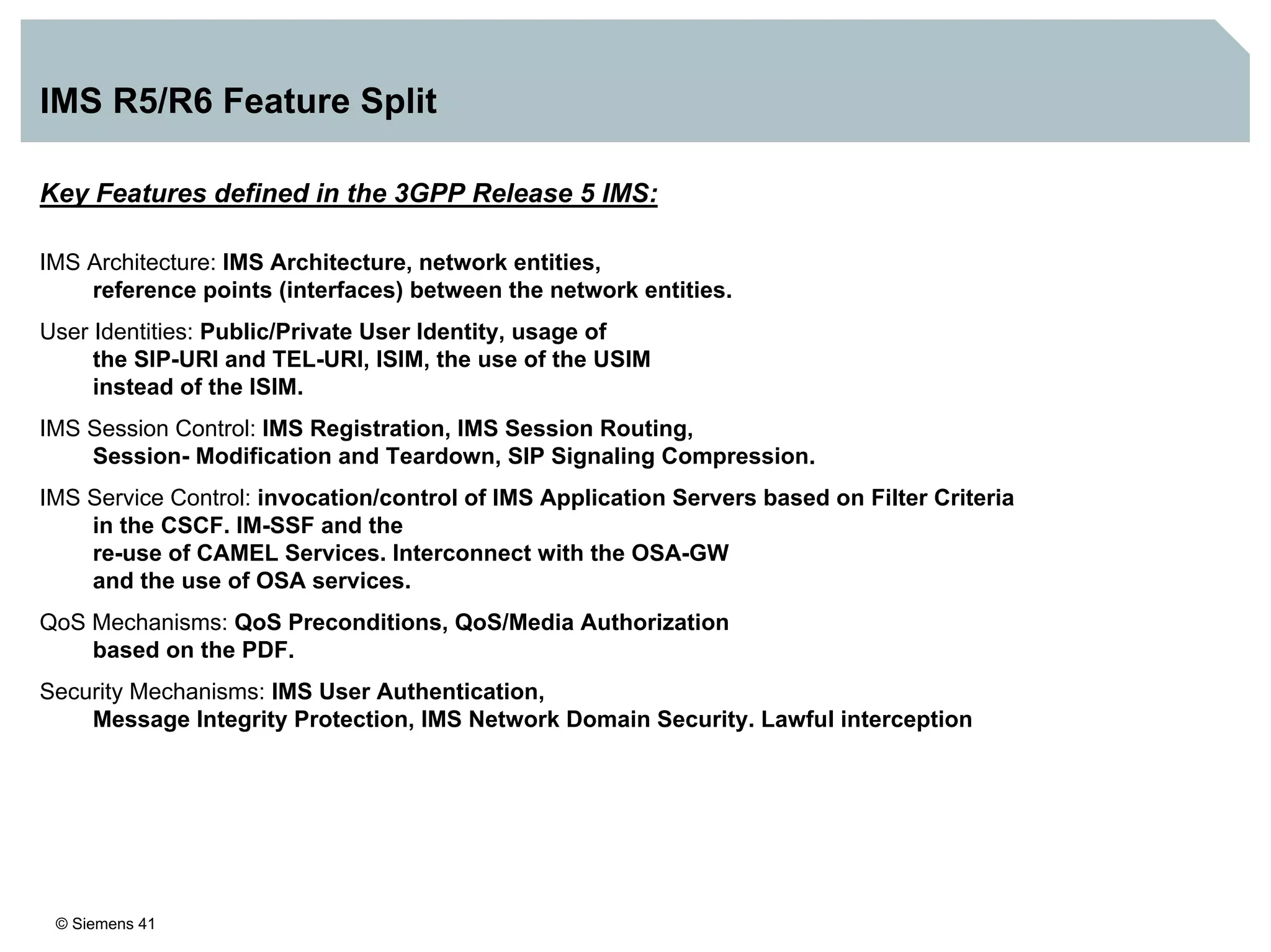
IMS R5/R6 Feature Split
Key Features defined in the 3GPP Release 5 IMS:
IMS Architecture: IMS Architecture, network entities,
reference points (interfaces) between the network entities.
User Identities: Public/Private User Identity, usage of
the SIP-URI and TEL-URI, ISIM, the use of the USIM
instead of the ISIM.
IMS Session Control: IMS Registration, IMS Session Routing,
Session- Modification and Teardown, SIP Signaling Compression.
IMS Service Control: invocation/control of IMS Application Servers based on Filter Criteria
in the CSCF. IM-SSF and the
re-use of CAMEL Services. Interconnect with the OSA-GW
and the use of OSA services.
QoS Mechanisms: QoS Preconditions, QoS/Media Authorization
based on the PDF.
Security Mechanisms: IMS User Authentication,
Message Integrity Protection, IMS Network Domain Security. Lawful interception
© Siemens 42
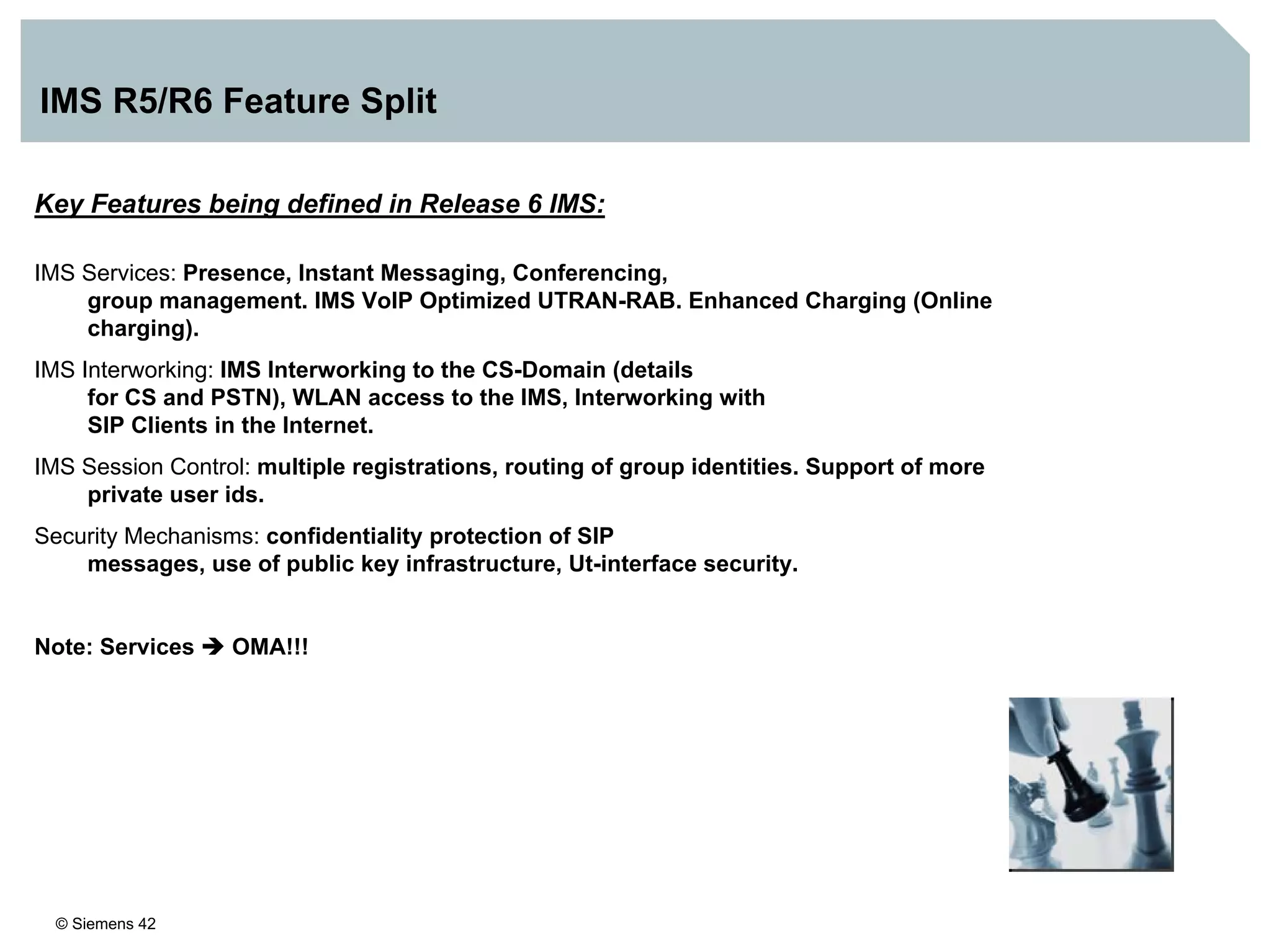
IMS R5/R6 Feature Split
Key Features being defined in Release 6 IMS:
IMS Services: Presence, Instant Messaging, Conferencing,
group management. IMS VoIP Optimized UTRAN-RAB. Enhanced Charging (Online
charging).
IMS Interworking: IMS Interworking to the CS-Domain (details
for CS and PSTN), WLAN access to the IMS, Interworking with
SIP Clients in the Internet.
IMS Session Control: multiple registrations, routing of group identities. Support of more
private user ids.
Security Mechanisms: confidentiality protection of SIP
messages, use of public key infrastructure, Ut-interface security.
Note: Services OMA!!!
© Siemens 43
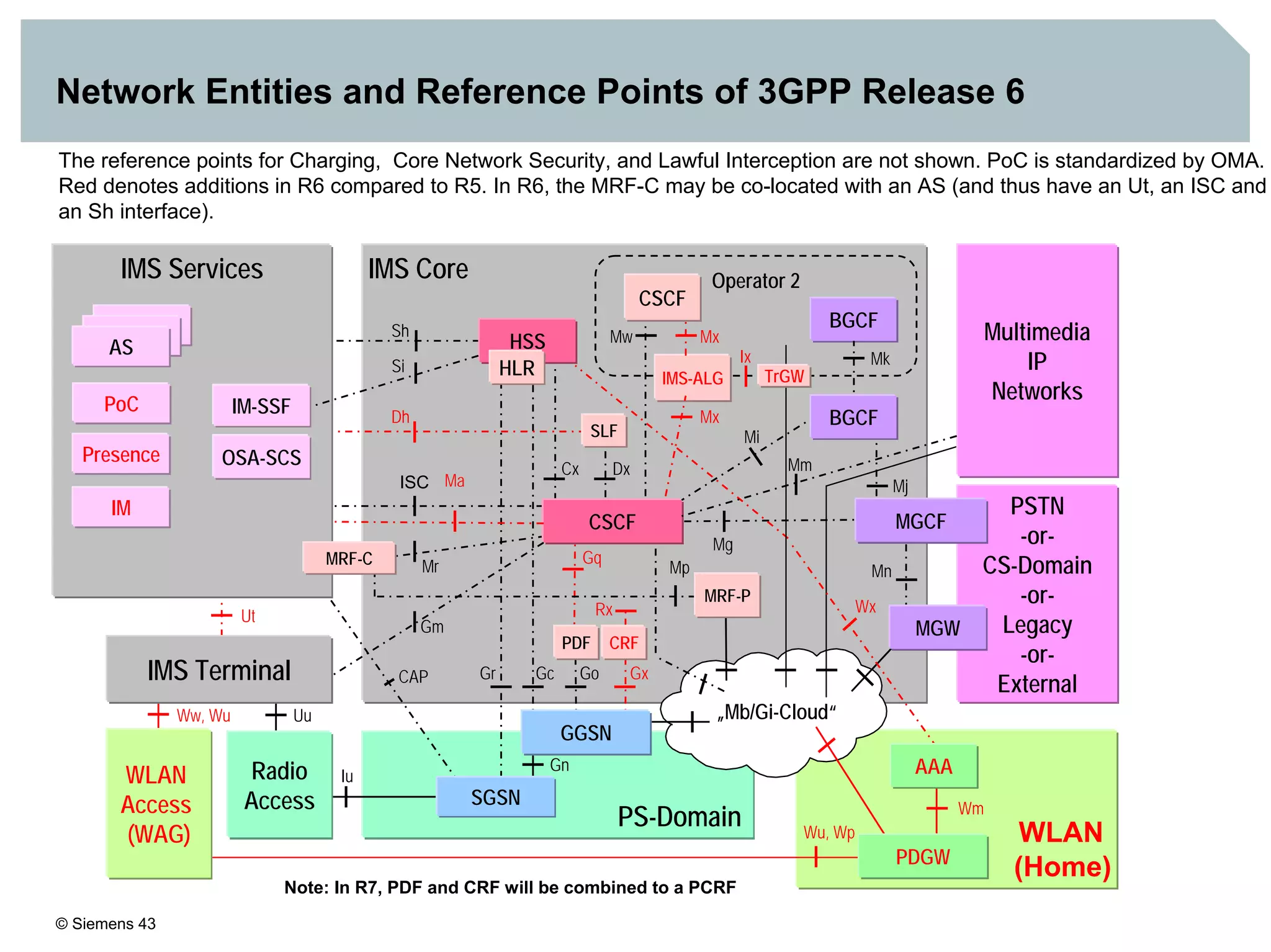
Network Entities and Reference Points of 3GPP Release 6
Ww, Wu
WLAN
(Home)
IMS Core
Ut
PSTN
-or-
CS-Domain
-or-
Legacy
-or-
External
PS-Domain
CAP
Mr
Cx
Sh
Gr
Mm
Mw
Mn
Gc
Mg
Gn
Iu
BGCF
Mi
Mk
Mj
Go
Gm
Dx
„Mb/Gi-Cloud“
PDF
Mp
ISC
Uu
Operator 2
Si
IMS Terminal
Radio
Access
Multimedia
IP
Networks
MGCF
MGW
BGCF
Gq
CSCF
SLF
IMS Services
AS
OSA-SCS
IM-SSF
Presence
IM
Dh
HSS
HLR
Wx
Wu, Wp
SGSN
WLAN
Access
(WAG)
Wm
AAA
PDGW
The reference points for Charging, Core Network Security, and Lawful Interception are not shown. PoC is standardized by OMA.
Red denotes additions in R6 compared to R5. In R6, the MRF-C may be co-located with an AS (and thus have an Ut, an ISC and
an Sh interface).
PoC
MRF-C
MRF-P
IMS-ALG
CSCF
Mx
Mx
Ix
TrGW
Ma
GGSN
CRF
Gx
Rx
Note: In R7, PDF and CRF will be combined to a PCRF
© Siemens 44
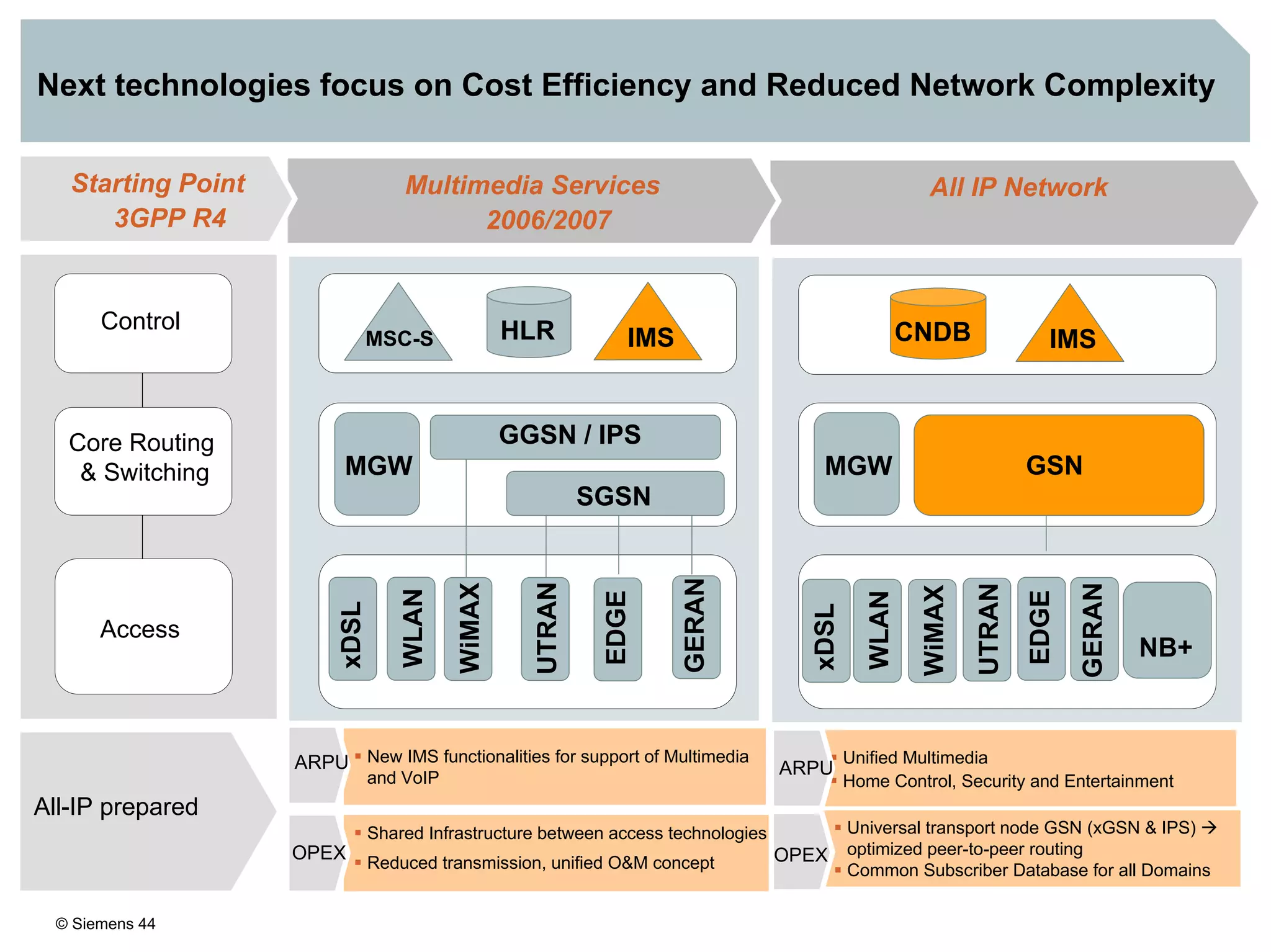
Next technologies focus on Cost Efficiency and Reduced Network Complexity
Universal transport node GSN (xGSN & IPS)
optimized peer-to-peer routing
Common Subscriber Database for all Domains
NB+
All IP NetworkMultimedia Services
2006/2007
Starting Point
3GPP R4
Access
Core Routing
& Switching
Control
IMSMSC-S HLR
MGW
SGSN
WLAN
WiMAX
UTRAN
IMSCNDB
MGW
IPS
GSN
Shared Infrastructure between access technologies
Reduced transmission, unified O&M concept
OPEX
New IMS functionalities for support of Multimedia
and VoIP
ARPU Unified Multimedia
Home Control, Security and Entertainment
OPEX
ARPU
All-IP prepared
GERAN
xDSL
EDGE
GGSN / IPS
WLAN
WiMAX
UTRAN
GERAN
xDSL
EDGE
© Siemens 45
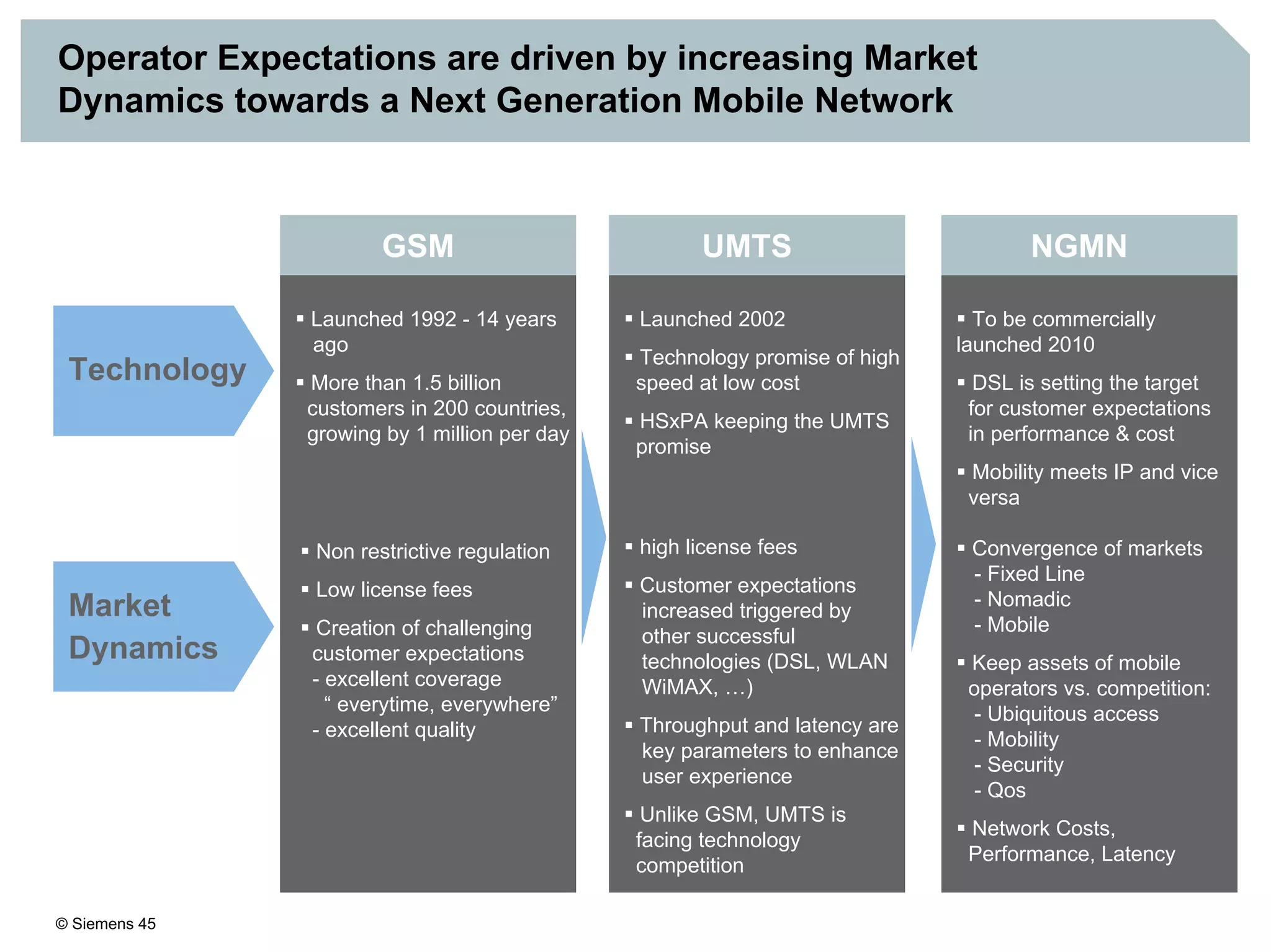
Operator Expectations are driven by increasing Market
Dynamics towards a Next Generation Mobile Network
Technology
Market
Dynamics
Launched 1992 - 14 years
ago
More than 1.5 billion
customers in 200 countries,
growing by 1 million per day
GSM UMTS NGMN
Non restrictive regulation
Low license fees
Creation of challenging
customer expectations
- excellent coverage
“ everytime, everywhere”
- excellent quality
Launched 2002
Technology promise of high
speed at low cost
HSxPA keeping the UMTS
promise
high license fees
Customer expectations
increased triggered by
other successful
technologies (DSL, WLAN
WiMAX, …)
Throughput and latency are
key parameters to enhance
user experience
Unlike GSM, UMTS is
facing technology
competition
To be commercially
launched 2010
DSL is setting the target
for customer expectations
in performance & cost
Mobility meets IP and vice
versa
Convergence of markets
- Fixed Line
- Nomadic
- Mobile
Keep assets of mobile
operators vs. competition:
- Ubiquitous access
- Mobility
- Security
- Qos
Network Costs,
Performance, Latency
© Siemens 46
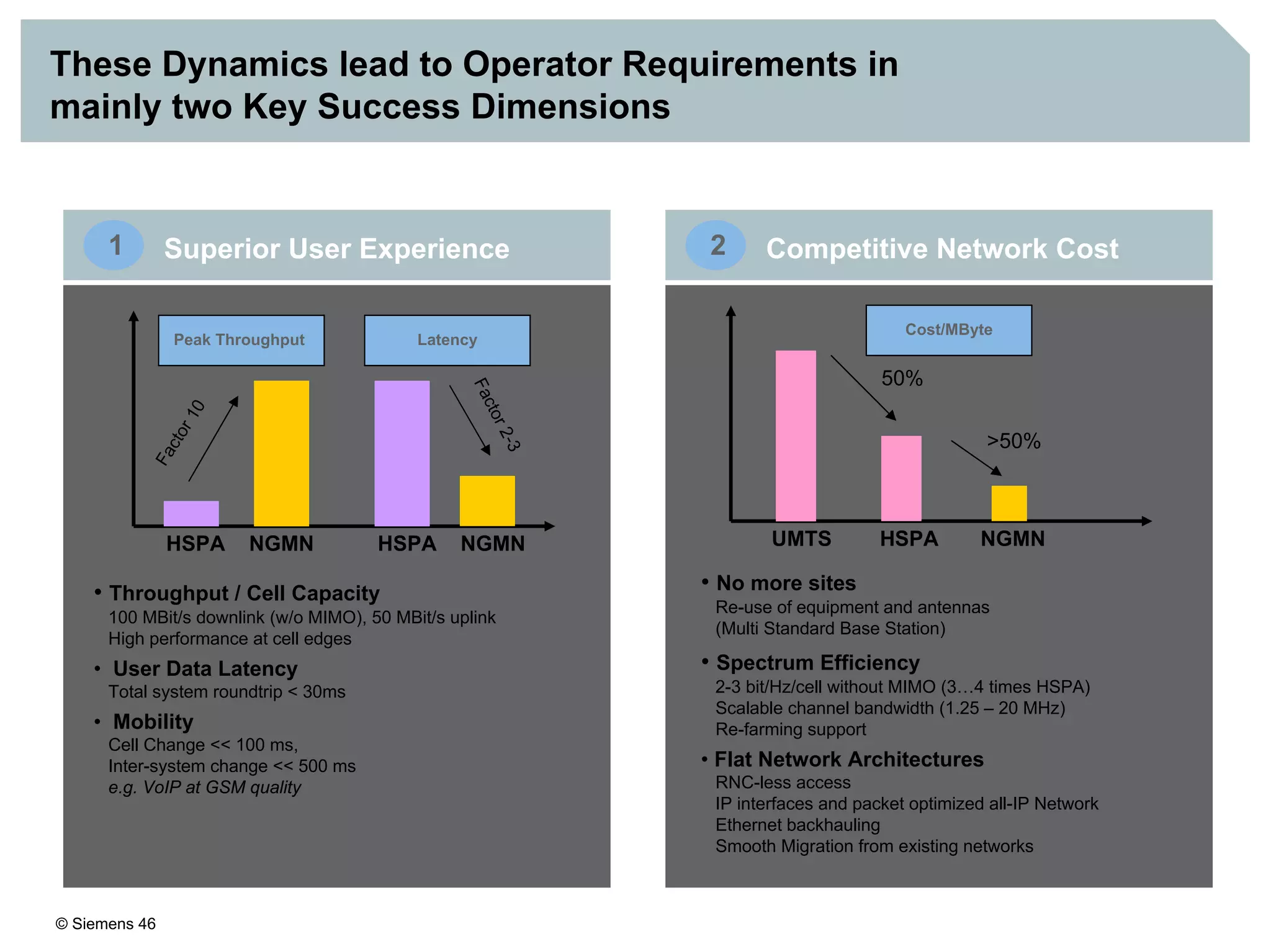
These Dynamics lead to Operator Requirements in
mainly two Key Success Dimensions
1 Superior User Experience 2 Competitive Network Cost
• Throughput / Cell Capacity
100 MBit/s downlink (w/o MIMO), 50 MBit/s uplink
High performance at cell edges
• User Data Latency
Total system roundtrip < 30ms
• Mobility
Cell Change << 100 ms,
Inter-system change << 500 ms
e.g. VoIP at GSM quality
HSPA NGMN HSPA NGMN
Peak Throughput Latency
Factor10
Factor2-3
UMTS HSPA NGMN
50%
>50%
Cost/MByte
• No more sites
Re-use of equipment and antennas
(Multi Standard Base Station)
• Spectrum Efficiency
2-3 bit/Hz/cell without MIMO (3…4 times HSPA)
Scalable channel bandwidth (1.25 – 20 MHz)
Re-farming support
• Flat Network Architectures
RNC-less access
IP interfaces and packet optimized all-IP Network
Ethernet backhauling
Smooth Migration from existing networks
© Siemens 47
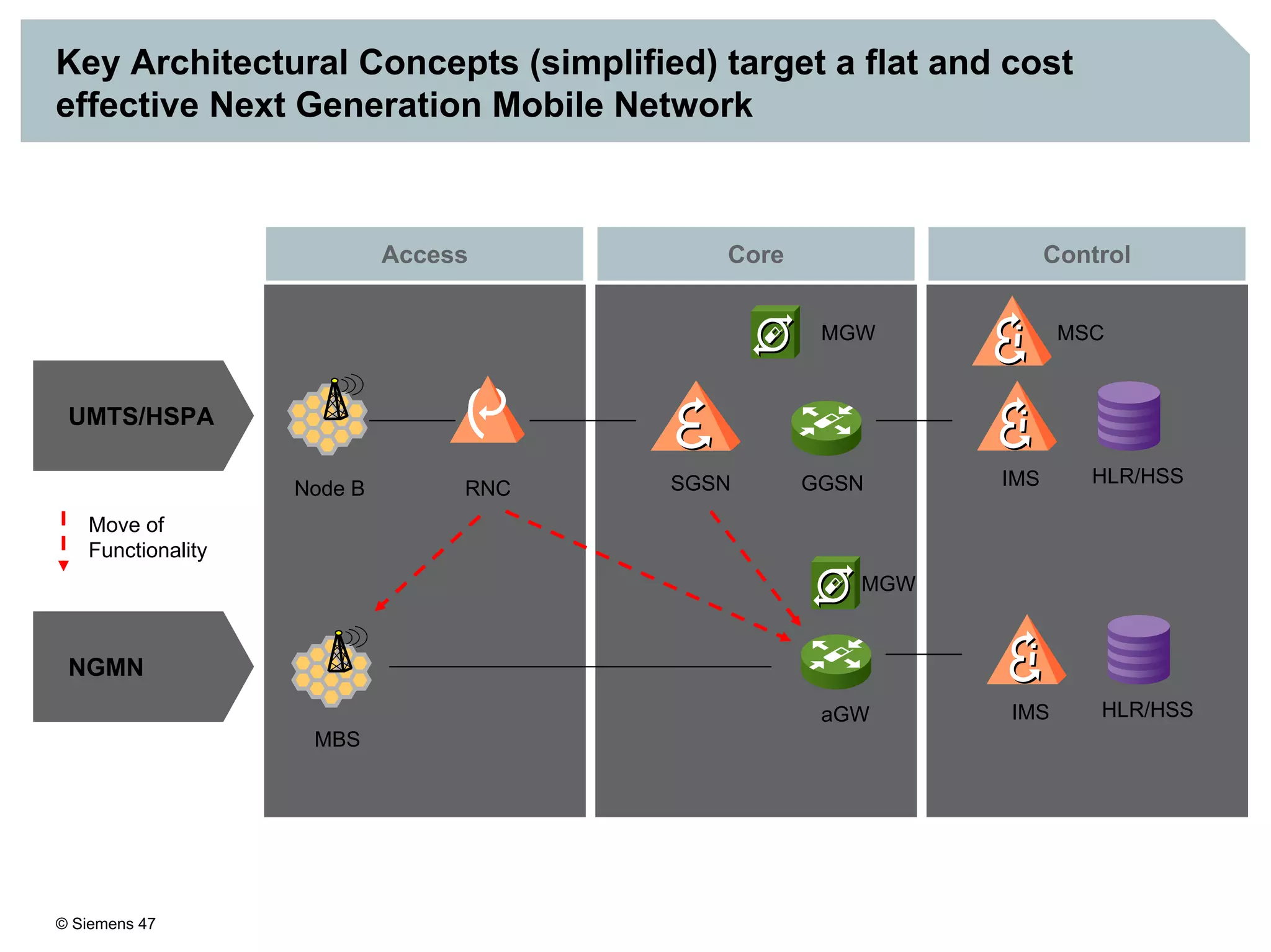
Key Architectural Concepts (simplified) target a flat and cost
effective Next Generation Mobile Network
UMTS/HSPA
Access Core Control
Node B RNC SGSN GGSN
MSCMGW
IMS HLR/HSS
NGMN
MBS
aGW IMS HLR/HSS
MGW
Move of
Functionality
© Siemens 48
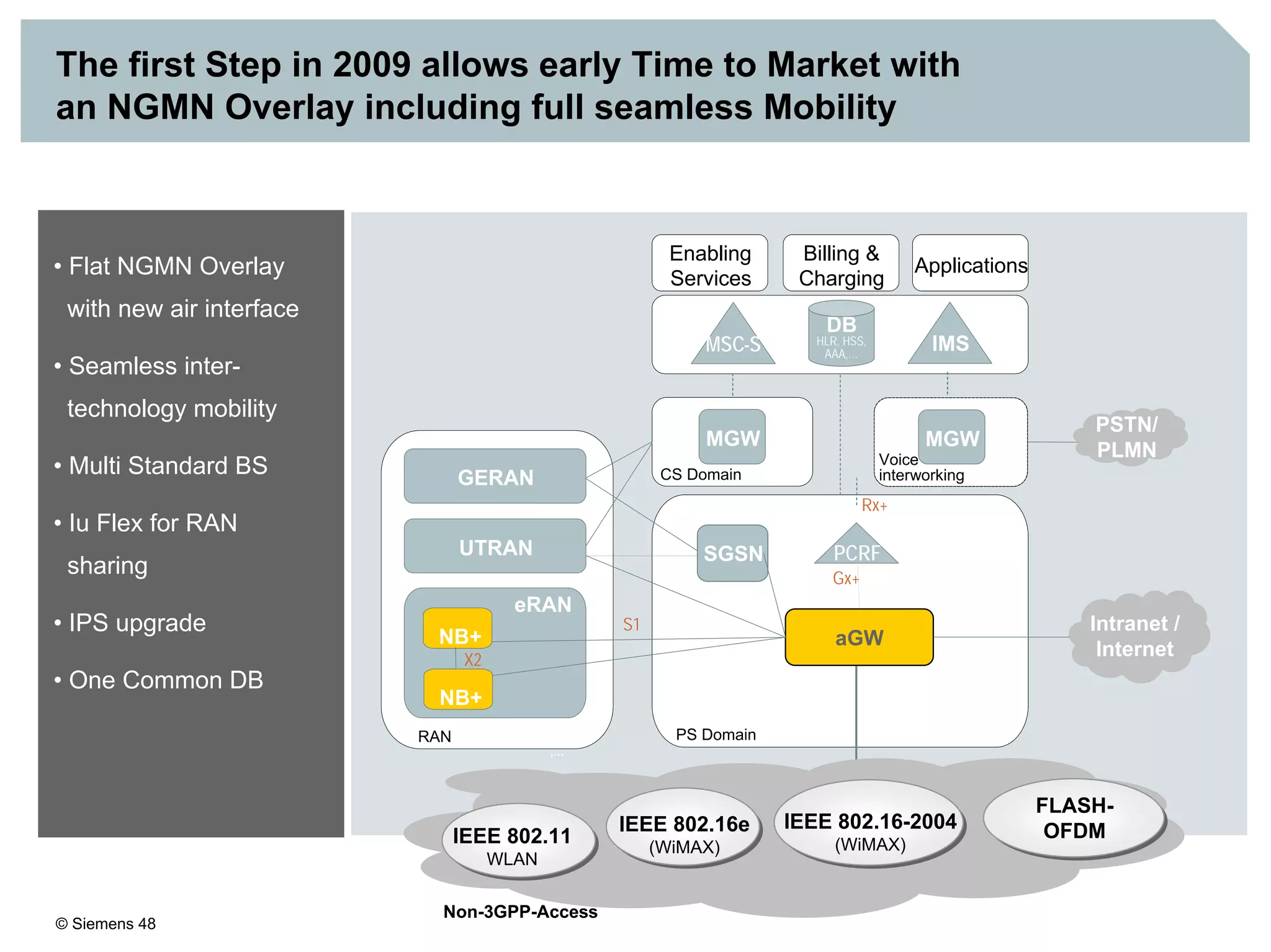
The first Step in 2009 allows early Time to Market with
an NGMN Overlay including full seamless Mobility
MGW
(CS-)
MGW
(PSTN-)
PS DomainRadio
IMSMSC-S
DB
HLR, HSS,
AAA,…
CS Domain
IPS
GGSN,
SGSN
SGSN+
MM, CM, LI,
Ciph
GERAN
Applications
Enabling
Services
Billing &
Charging
PCRF
UTRAN
NGMN
NB+
CPS
PSTN
Non-3GPP
WLAN, WiMAX ,…
Intranet /
Internet
Voice
interworking
MGW
eIub-c
eIu
eIu
Gx+
MGW
Rx+
Note: Not all interfaces are shown
NGMN
High Speed Overlay
PS DomainRAN
IMSMSC-S
DB
HLR, HSS,
AAA,…
CS Domain
SGSN
GERAN
Applications
Enabling
Services
Billing &
Charging
UTRAN
eRAN
,…,…
Voice
interworking
MGW
S1
Gx+
MGW
Rx+
PSTN/
PLMN
NB+
NB+
X2
PCRF
Intranet /
Internet
aGW
• Flat NGMN Overlay
with new air interface
• Seamless inter-
technology mobility
• Multi Standard BS
• Iu Flex for RAN
sharing
• IPS upgrade
• One Common DB
Non-3GPP-Access
IEEE 802.11
WLAN
IEEE 802.16e
(WiMAX)
IEEE 802.16-2004
(WiMAX)
FLASH-
OFDM
© Siemens 49
PS DomainRadio
IMS
DB
HLR, HSS,
AAA,…
GERAN
Applications
Enabling
Services
Billing &
Charging
PCRF
UTRAN
NGMN
NB+
CPS
PSTN
Non-3GPP
WLAN, WiMAX ,…
Voice
interworking
eIub-c eIu-c
eIu-u
MGW
Rx+
Note: Not all interfaces are shown
PS Domain
IMS
DB
HLR, HSS,
AAA,…
GERAN
Applications
Enabling
Services
Billing &
Charging
UTRAN
NGMN
NB+
Voice
interworking
Gx+
MGW
Rx+
PSTN/
PLMN
Radio
NGMN
NB+
CPS
eIub-c
RAN
eRAN
NB+
NB+
X2
S1
PCRFSGSN
aGW
Intranet /
Internet
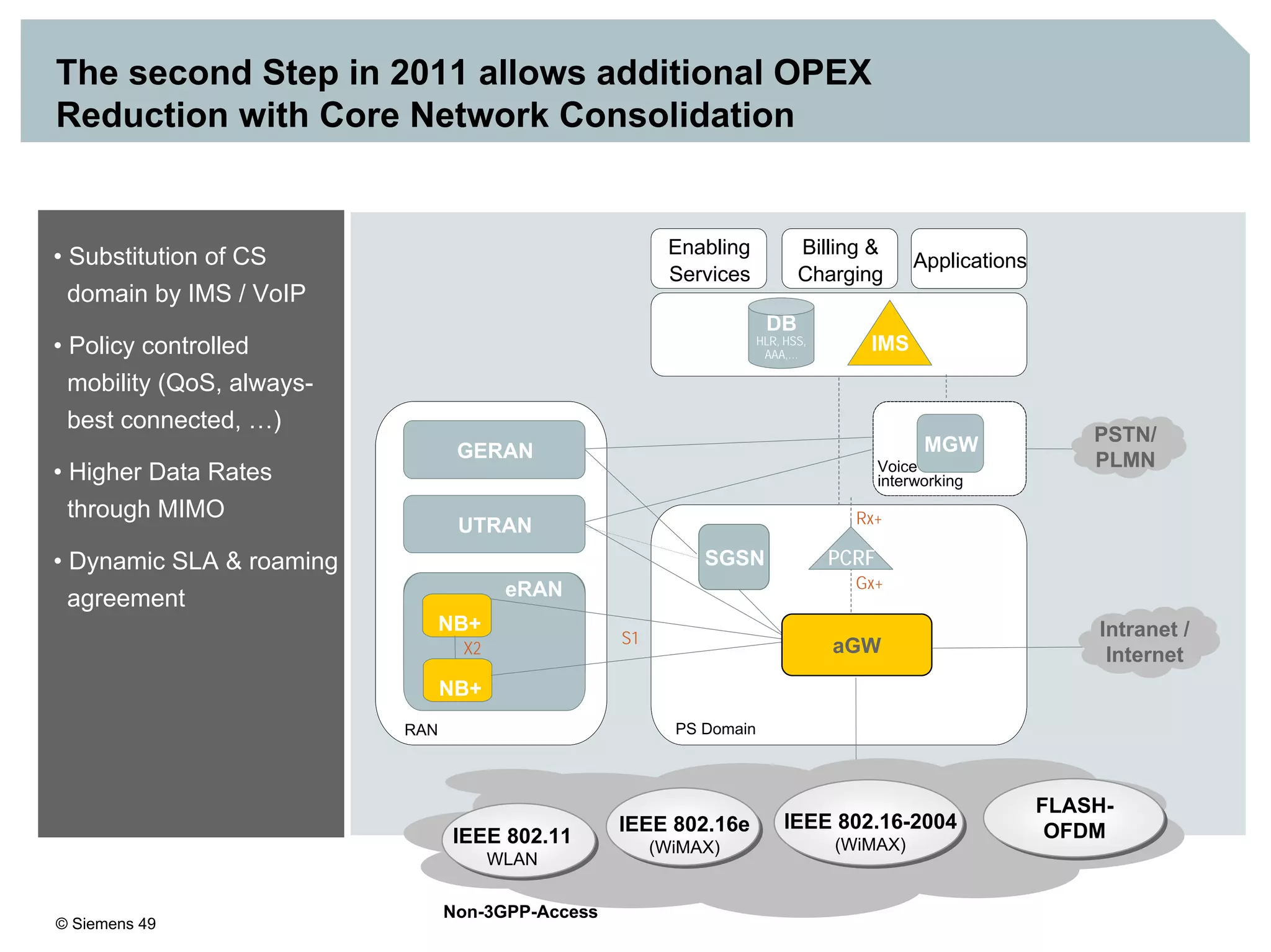
• Substitution of CS
domain by IMS / VoIP
• Policy controlled
mobility (QoS, always-
best connected, …)
• Higher Data Rates
through MIMO
• Dynamic SLA & roaming
agreement
The second Step in 2011 allows additional OPEX
Reduction with Core Network Consolidation
IEEE 802.11
WLAN
IEEE 802.16e
(WiMAX)
IEEE 802.16-2004
(WiMAX)
FLASH-
OFDM
Non-3GPP-Access
© Siemens 50
5. Siemens portfolio:
• Mapping of 3GPP to the Siemens products
• IMS Core Network
• TISPAN mapping
• Roadmap
• GSM / WLAN romaing and handover
© Siemens 51
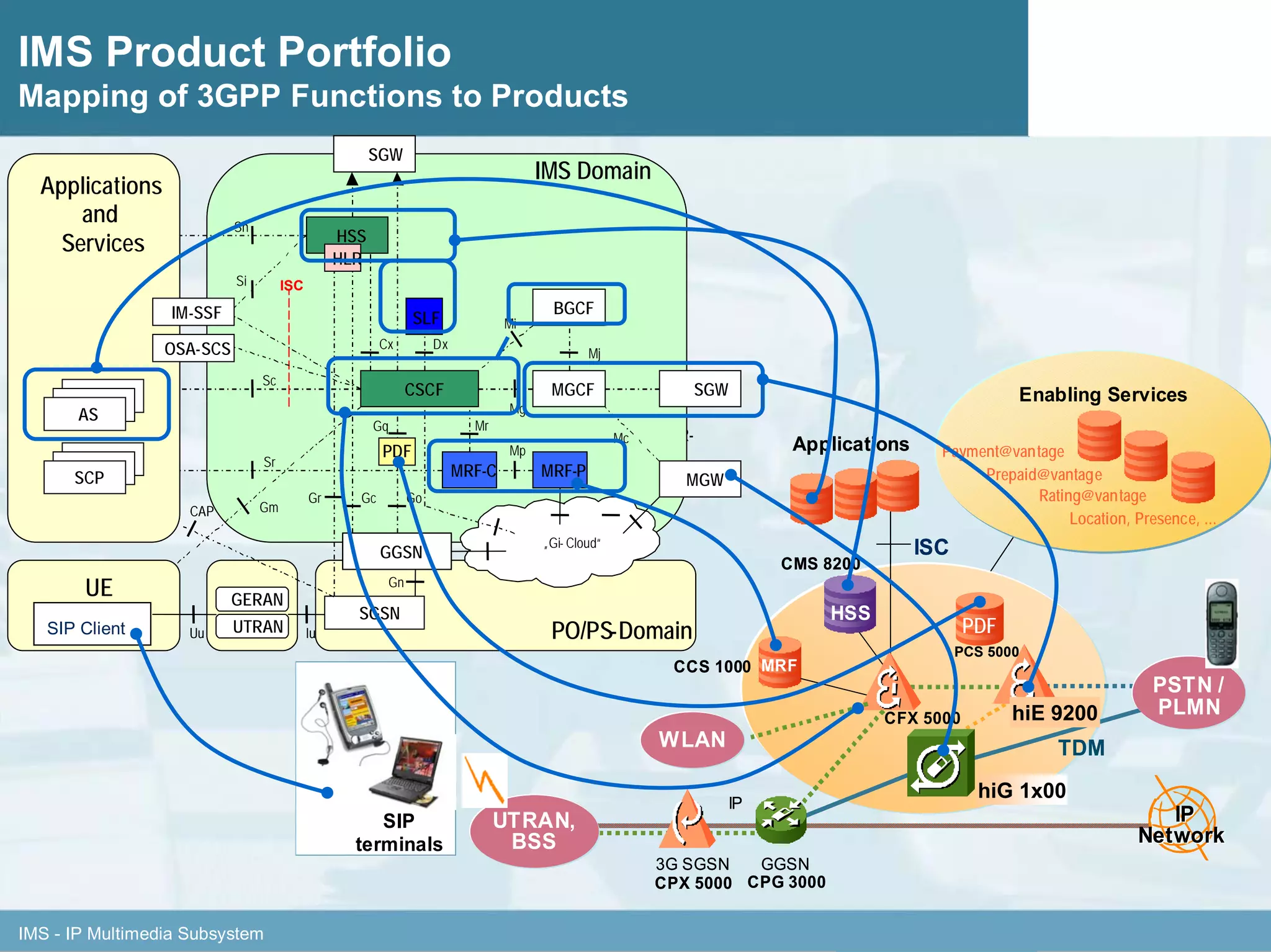
IMS Product Portfolio
Mapping of 3GPP Functions to Products
IMS - IP Multimedia Subsystem © Siemens, 2002
Enabling Services
Applications
IP
CMS 8200
CCS 1000
TDM
CFX 5200
HSS
3G SGSN
CPX 5000
GGSN
CPG 3000
SIP
terminals
IP
Network
IP
Network
UTRAN,
BSS
PSTN /
PLMN
MRF
Payment@vantage
Rating@vantage
Prepaid@vantage
Location, Presence, ...
CMG 3000
ISC
WLAN
CFX 5000
Enabling Services
Applications
IP
CMS 8200
CCS 1000
TDM
CFX 5200
HSSHSS
3G SGSN
CPX 5000
GGSN
CPG 3000
SIP
terminals
IP
Network
IP
Network
IP
Network
IP
Network
SIP
terminals
UTRAN,
BSS
PSTN /
PLMN
MRFMRF
Payment@vantage
Rating@vantage
Prepaid@vantage
Location, Presence, ...
CMG 3000
ISC
WLAN
CFX 5000
Operator 1Applications
and
Services
PO/PS-Domain
HSS
R-
CSCF
GGSN
MRF-CSCP
MGCF
MGW
SGSN
UTRAN
CAP
Mr
Cx
Sh
Sc
Gr
Mc
Gc
Mg
Gn
Iu
T-SGW
BGCF
Mi
Mj
Go
Gm
SLF
Dx
AS
„Gi- Cloud“
PCF
OSA-SCS
IM-SSF
MRF-P
Mp
Sr
ISC
R-SGW
GERAN
UE
Uu
HLR
Si
IMS Domain
Applications
and
Services
PO/PS-Domain
HSS
CSCF
GGSN
MRF-CSCP
MGCF
MGW
SGSN
UTRAN
CAP
Mr
Cx
Sh
Sc
Gr
Mc
Gc
Mg
Gn
Iu
SGW
BGCF
Mi
Mj
Go
Gm
SLF
Dx
AS
„Gi- Cloud“
PDF
OSA-SCS
IM-SSF
MRF-P
Mp
Sr
ISC
SGW
GERAN
UE
Uu
HLR
Si
SIP Client
Gq
PDF
hiG 1x00
hiE 9200
PCS 5000
© Siemens 52
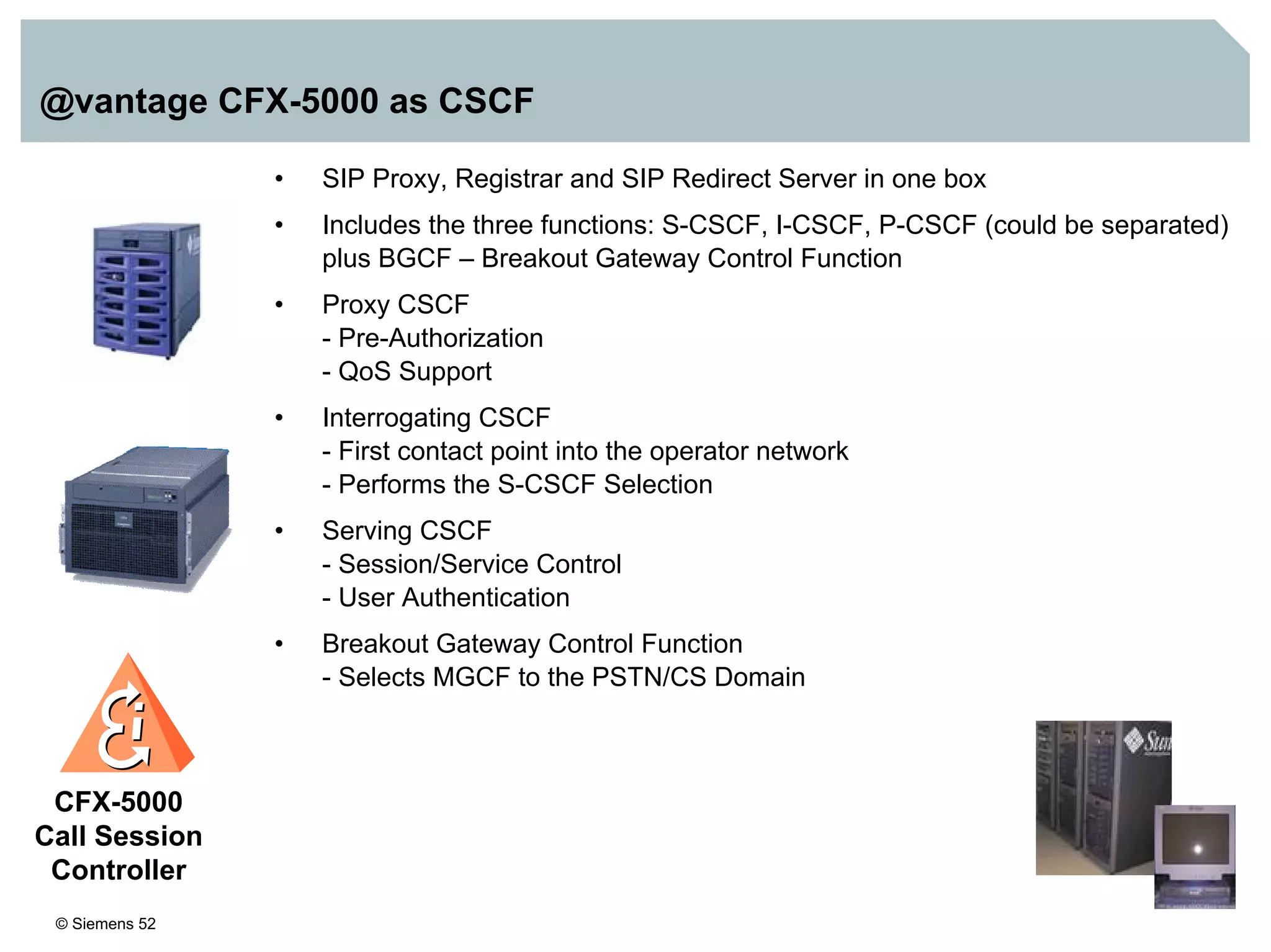
@vantage CFX-5000 as CSCF
• SIP Proxy, Registrar and SIP Redirect Server in one box
• Includes the three functions: S-CSCF, I-CSCF, P-CSCF (could be separated)
plus BGCF – Breakout Gateway Control Function
• Proxy CSCF
- Pre-Authorization
- QoS Support
• Interrogating CSCF
- First contact point into the operator network
- Performs the S-CSCF Selection
• Serving CSCF
- Session/Service Control
- User Authentication
• Breakout Gateway Control Function
- Selects MGCF to the PSTN/CS Domain
CFX-5000
Call Session
Controller
© Siemens 53
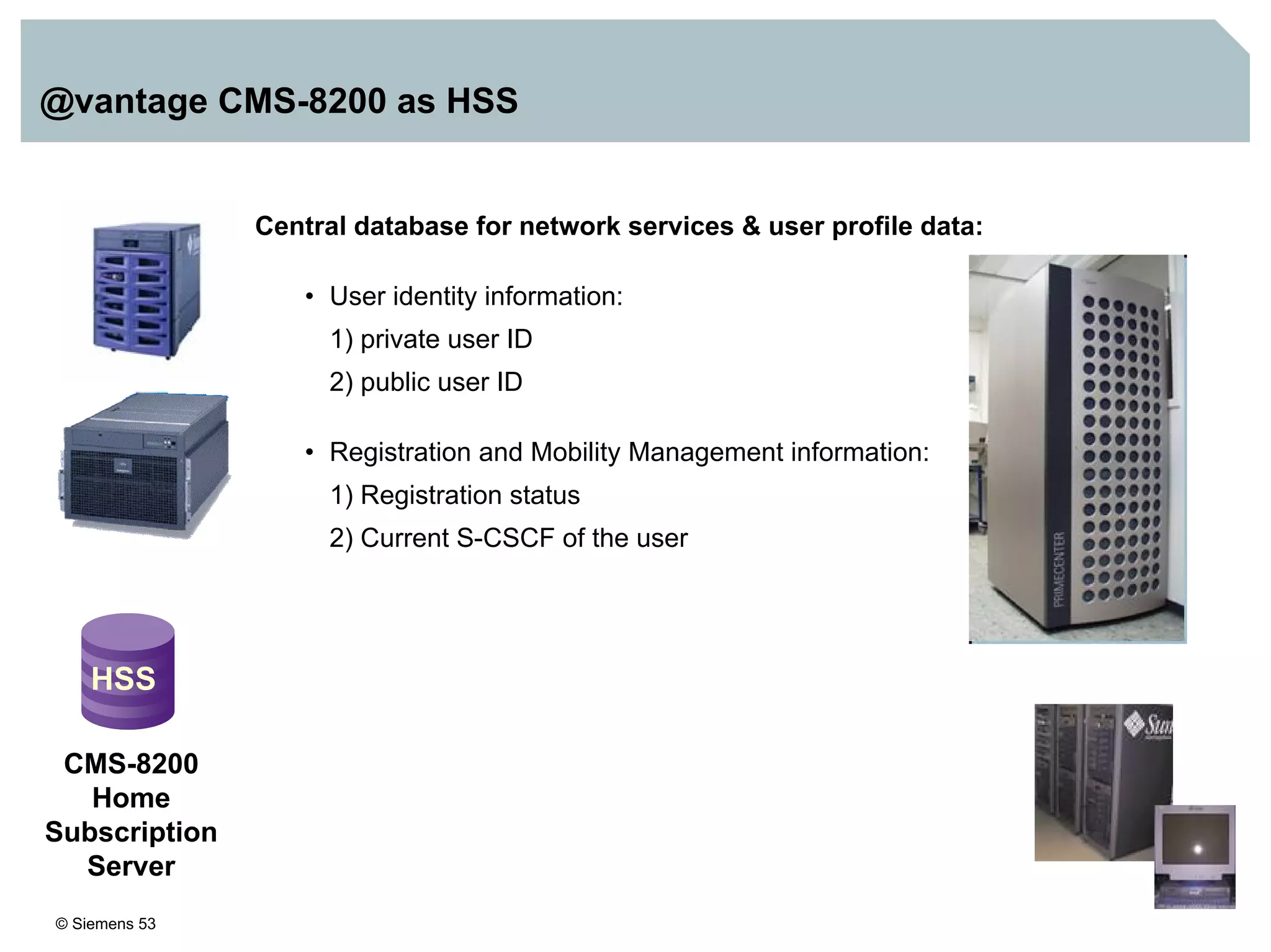
@vantage CMS-8200 as HSS
Central database for network services & user profile data:
• User identity information:
1) private user ID
2) public user ID
• Registration and Mobility Management information:
1) Registration status
2) Current S-CSCF of the user
HSS
CMS-8200
Home
Subscription
Server
© Siemens 54
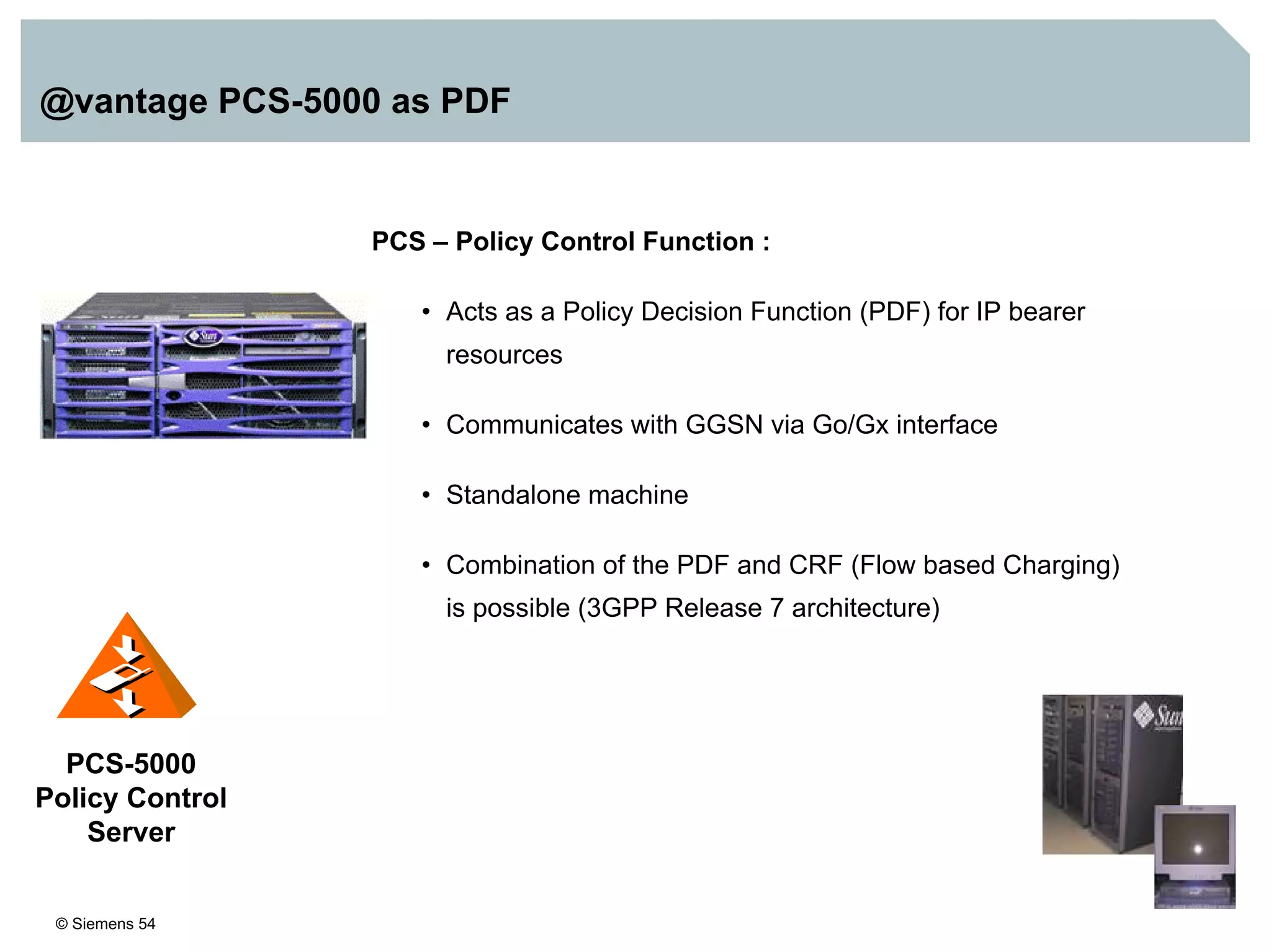
@vantage PCS-5000 as PDF
PCS – Policy Control Function :
• Acts as a Policy Decision Function (PDF) for IP bearer
resources
• Communicates with GGSN via Go/Gx interface
• Standalone machine
• Combination of the PDF and CRF (Flow based Charging)
is possible (3GPP Release 7 architecture)
PCS-5000
Policy Control
Server
© Siemens 55
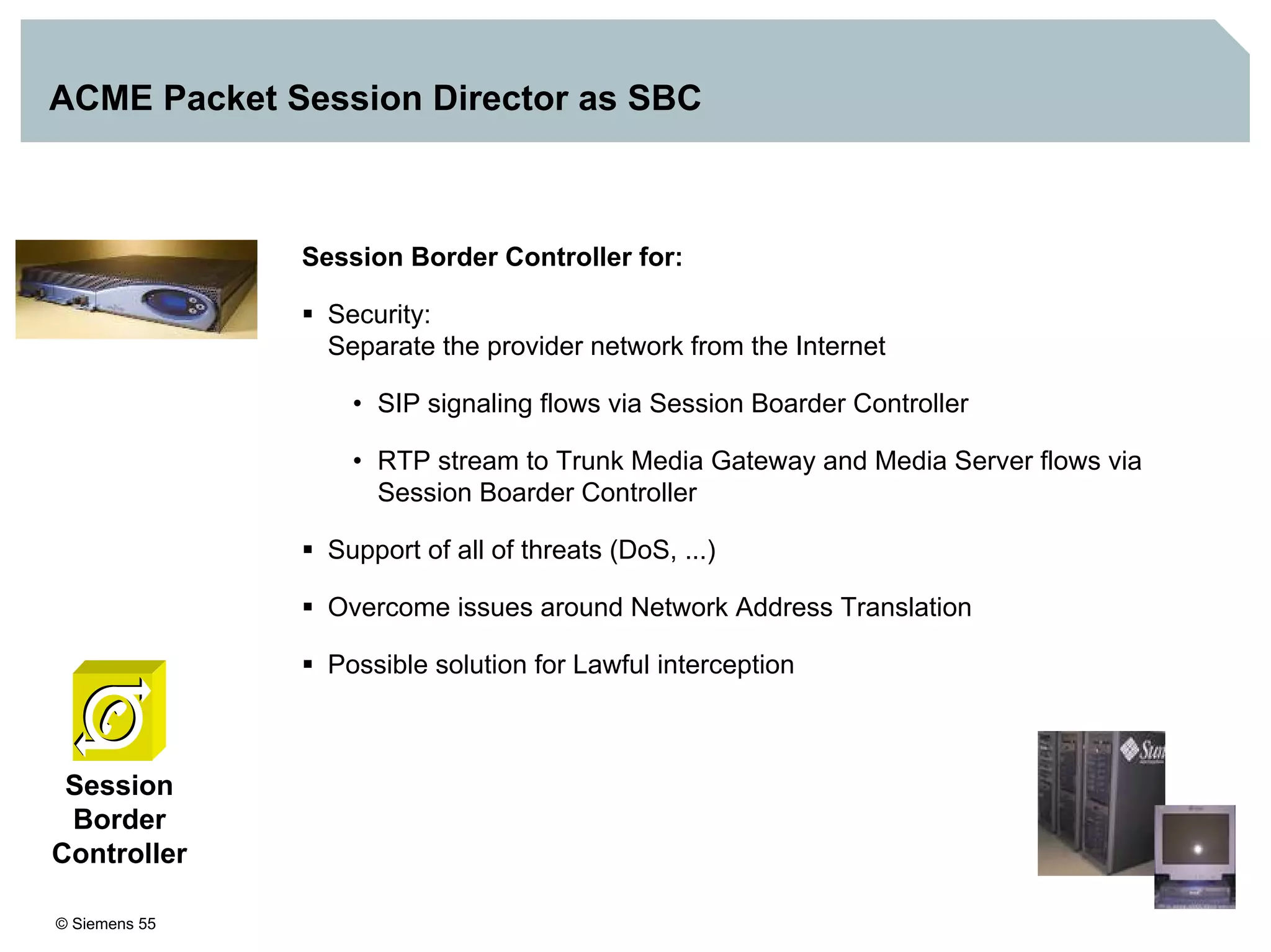
ACME Packet Session Director as SBC
Session Border Controller for:
Security:
Separate the provider network from the Internet
• SIP signaling flows via Session Boarder Controller
• RTP stream to Trunk Media Gateway and Media Server flows via
Session Boarder Controller
Support of all of threats (DoS, ...)
Overcome issues around Network Address Translation
Possible solution for Lawful interception
Session
Border
Controller
© Siemens 56
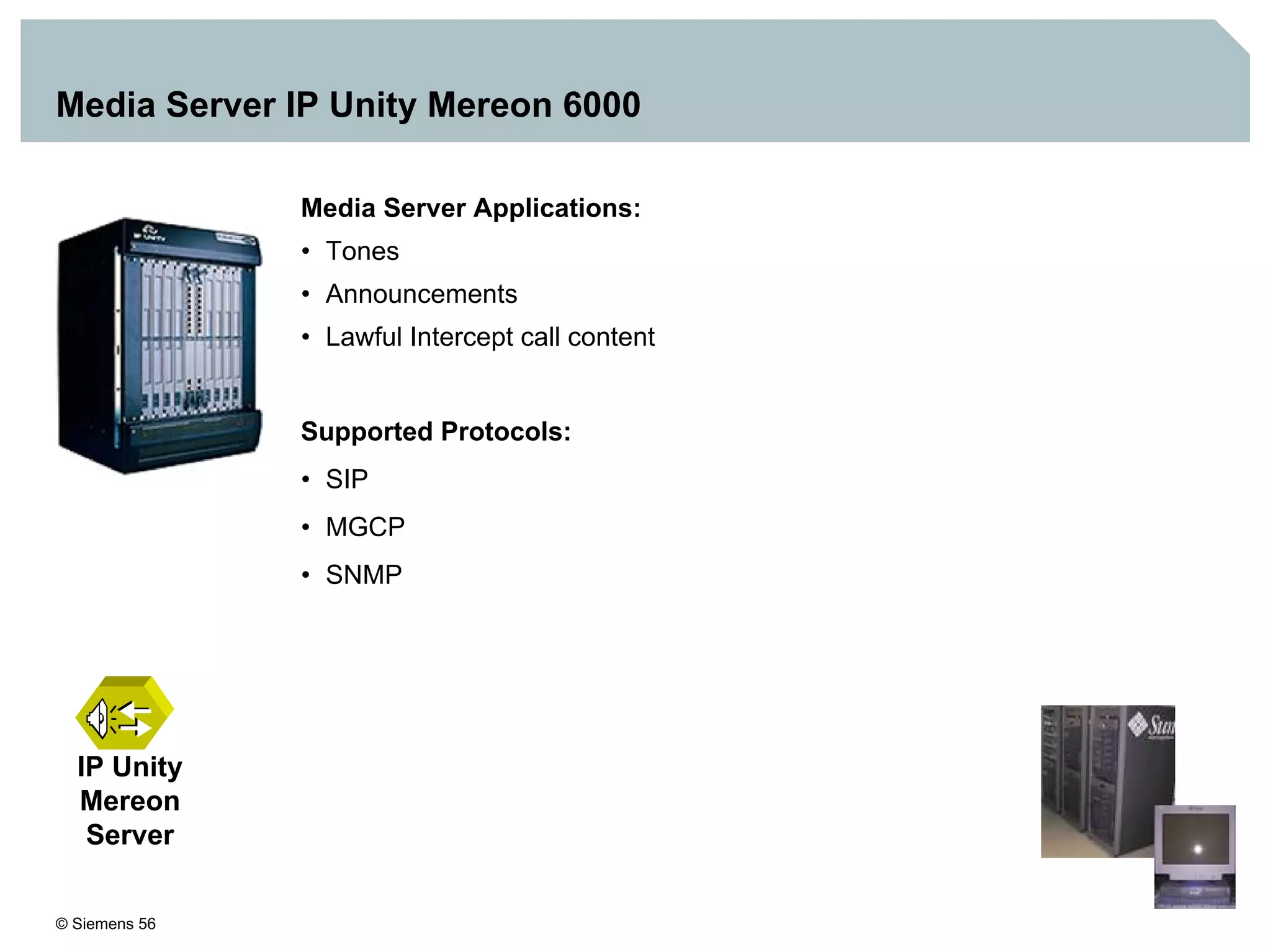
Media Server IP Unity Mereon 6000
IP Unity
Mereon
Server
Media Server Applications:
• Tones
• Announcements
• Lawful Intercept call content
Supported Protocols:
• SIP
• MGCP
• SNMP
© Siemens 57
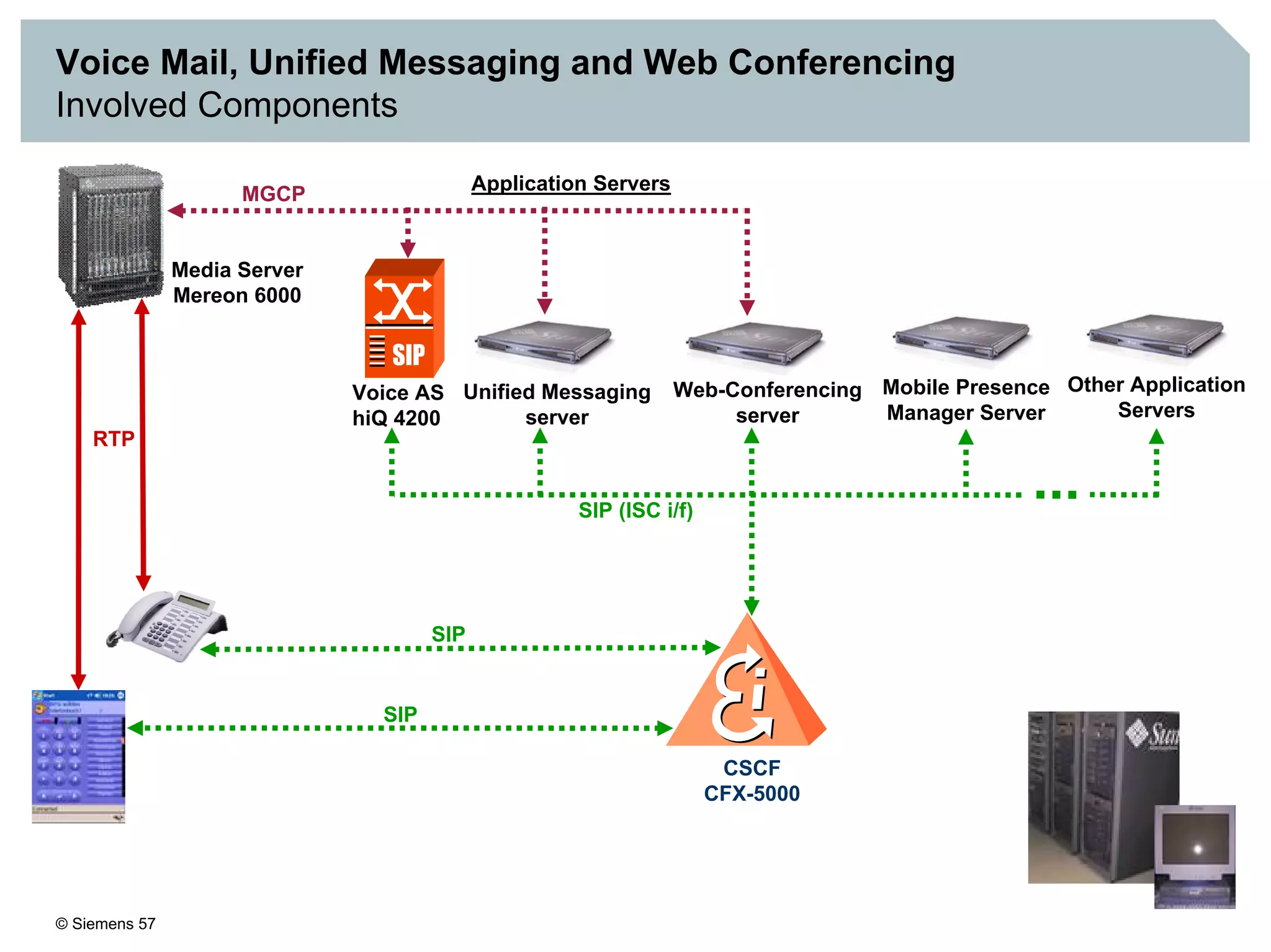
Voice AS
hiQ 4200
Media Server
Mereon 6000
Unified Messaging
server
Web-Conferencing
server
MGCP
Application Servers
CSCF
CFX-5000
Voice Mail, Unified Messaging and Web Conferencing
Involved Components
SIP (ISC i/f)
SIP
SIP
RTP
Mobile Presence
Manager Server
Other Application
Servers
© Siemens 58
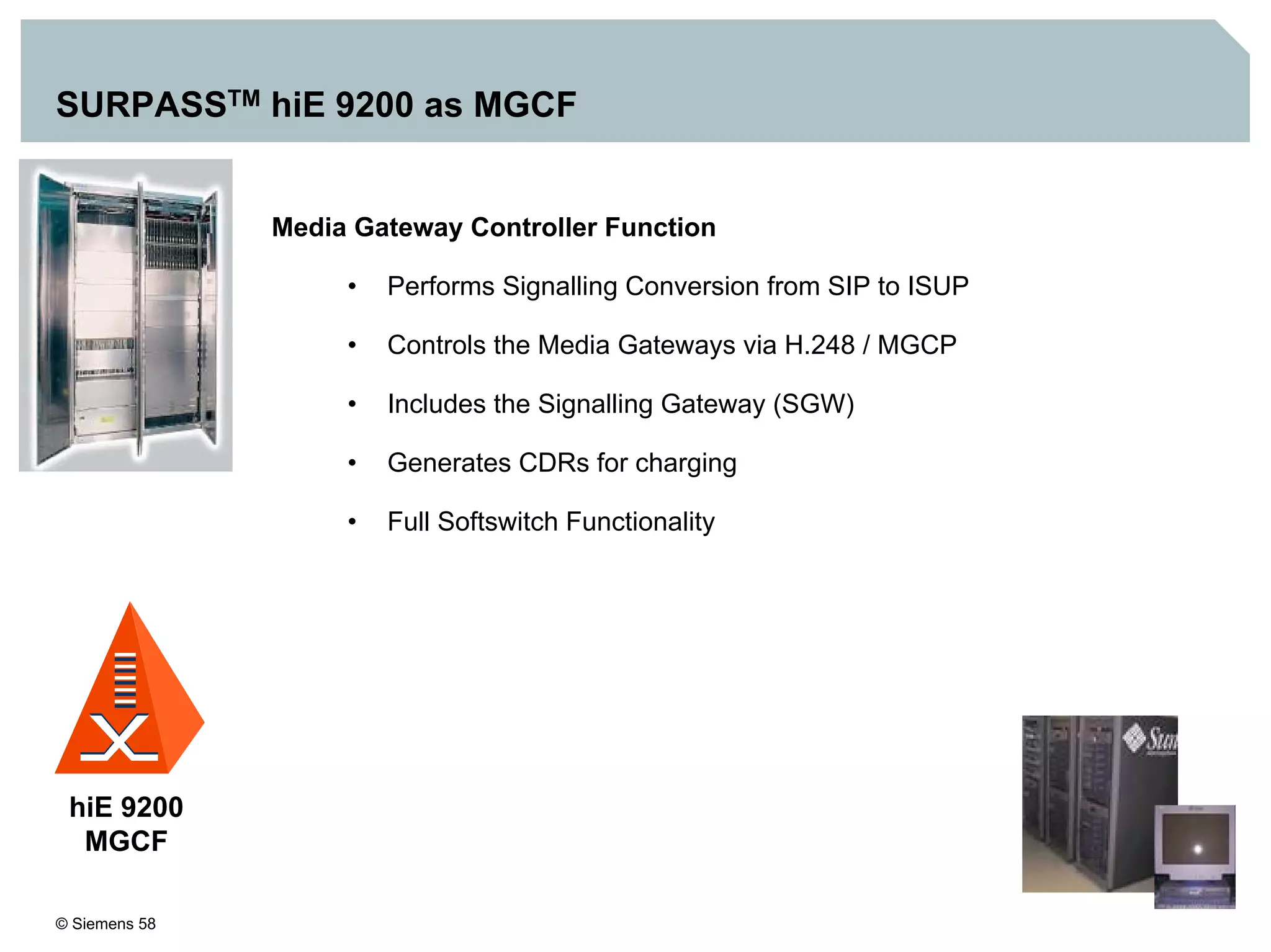
SURPASSTM hiE 9200 as MGCF
hiE 9200
MGCF
Media Gateway Controller Function
• Performs Signalling Conversion from SIP to ISUP
• Controls the Media Gateways via H.248 / MGCP
• Includes the Signalling Gateway (SGW)
• Generates CDRs for charging
• Full Softswitch Functionality
© Siemens 59
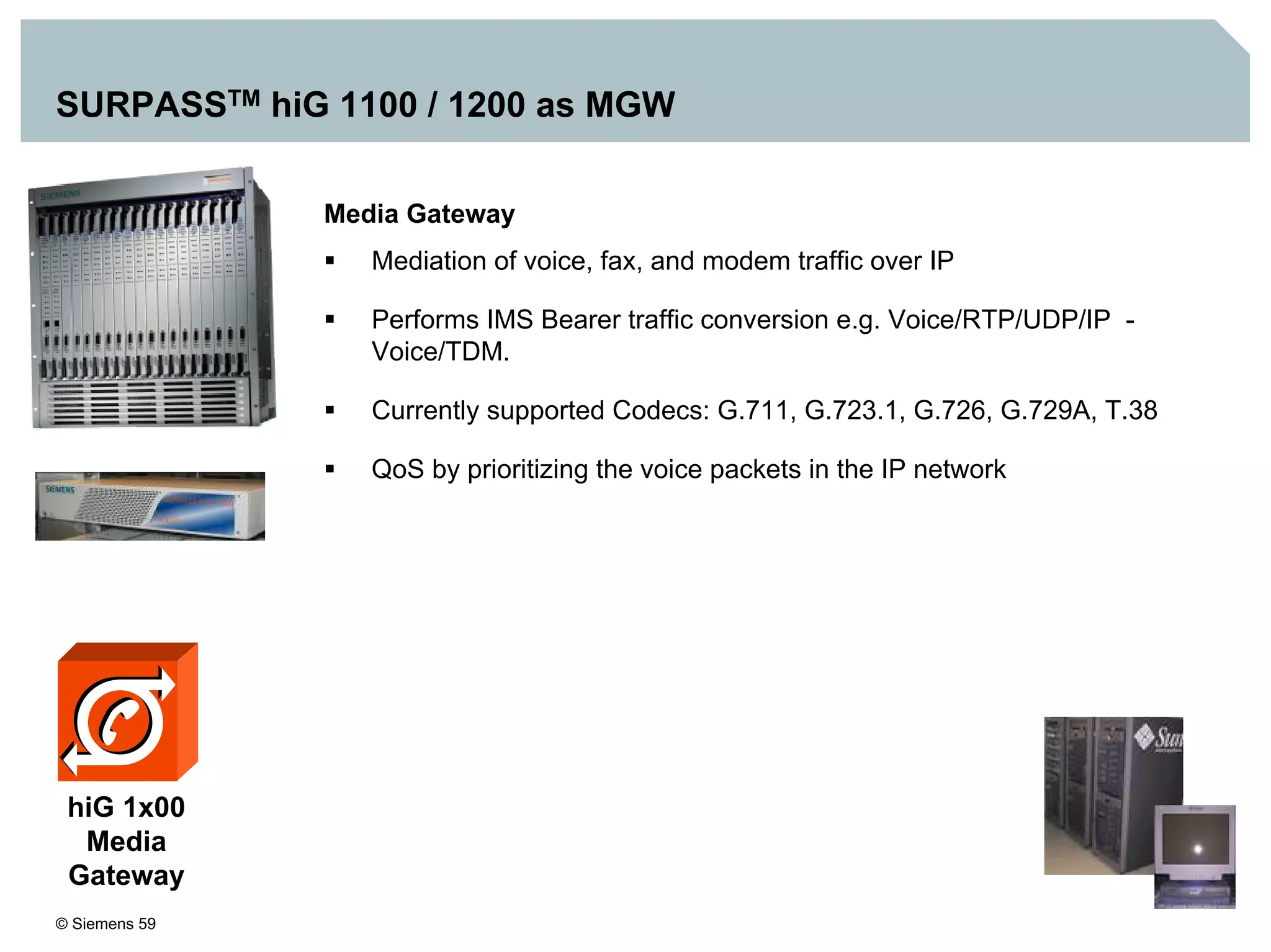
SURPASSTM hiG 1100 / 1200 as MGW
Media Gateway
Mediation of voice, fax, and modem traffic over IP
Performs IMS Bearer traffic conversion e.g. Voice/RTP/UDP/IP -
Voice/TDM.
Currently supported Codecs: G.711, G.723.1, G.726, G.729A, T.38
QoS by prioritizing the voice packets in the IP network
hiG 1x00
Media
Gateway
© Siemens 60
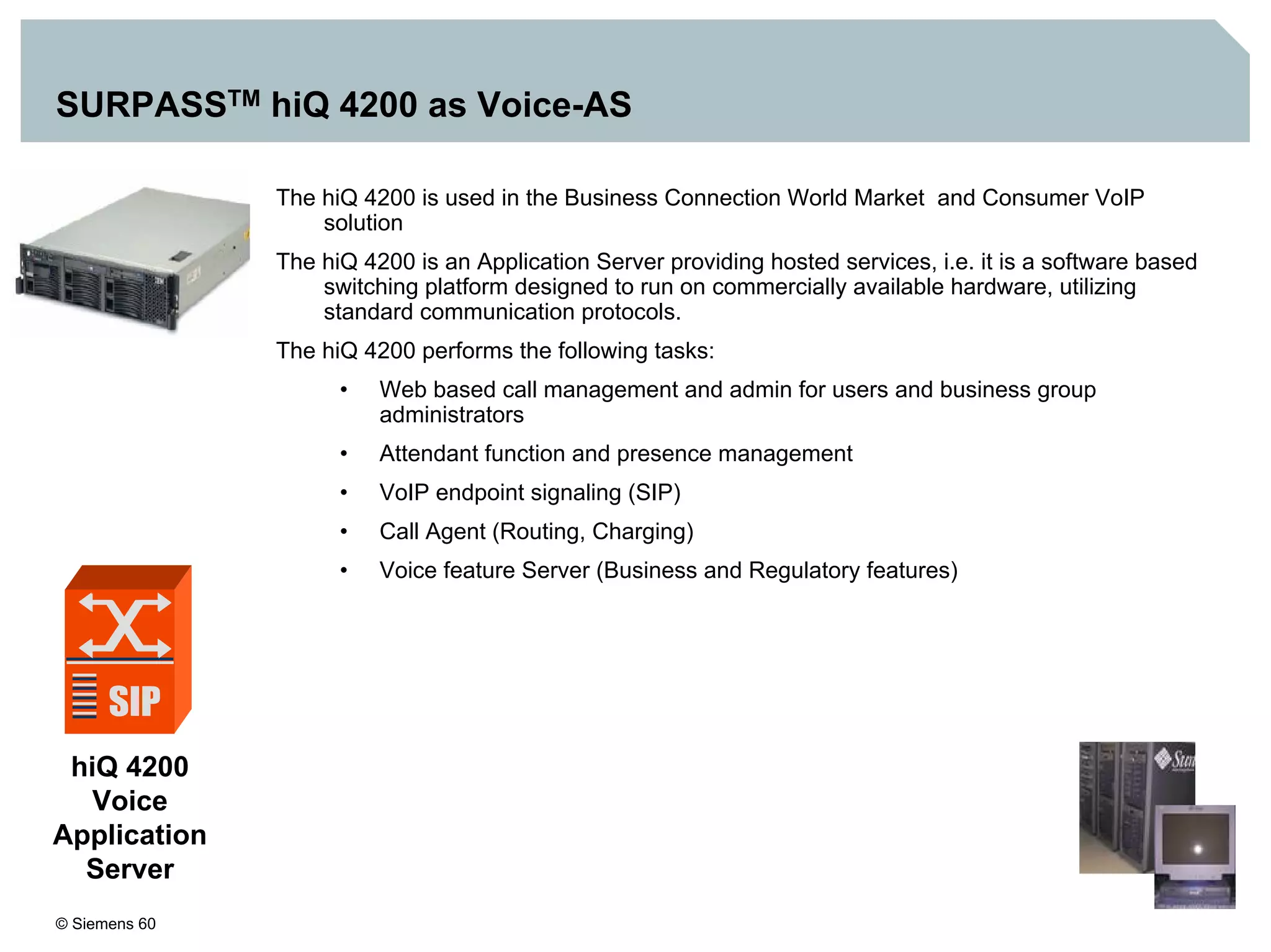
SURPASSTM hiQ 4200 as Voice-AS
hiQ 4200
Voice
Application
Server
The hiQ 4200 is used in the Business Connection World Market and Consumer VoIP
solution
The hiQ 4200 is an Application Server providing hosted services, i.e. it is a software based
switching platform designed to run on commercially available hardware, utilizing
standard communication protocols.
The hiQ 4200 performs the following tasks:
• Web based call management and admin for users and business group
administrators
• Attendant function and presence management
• VoIP endpoint signaling (SIP)
• Call Agent (Routing, Charging)
• Voice feature Server (Business and Regulatory features)
© Siemens 61
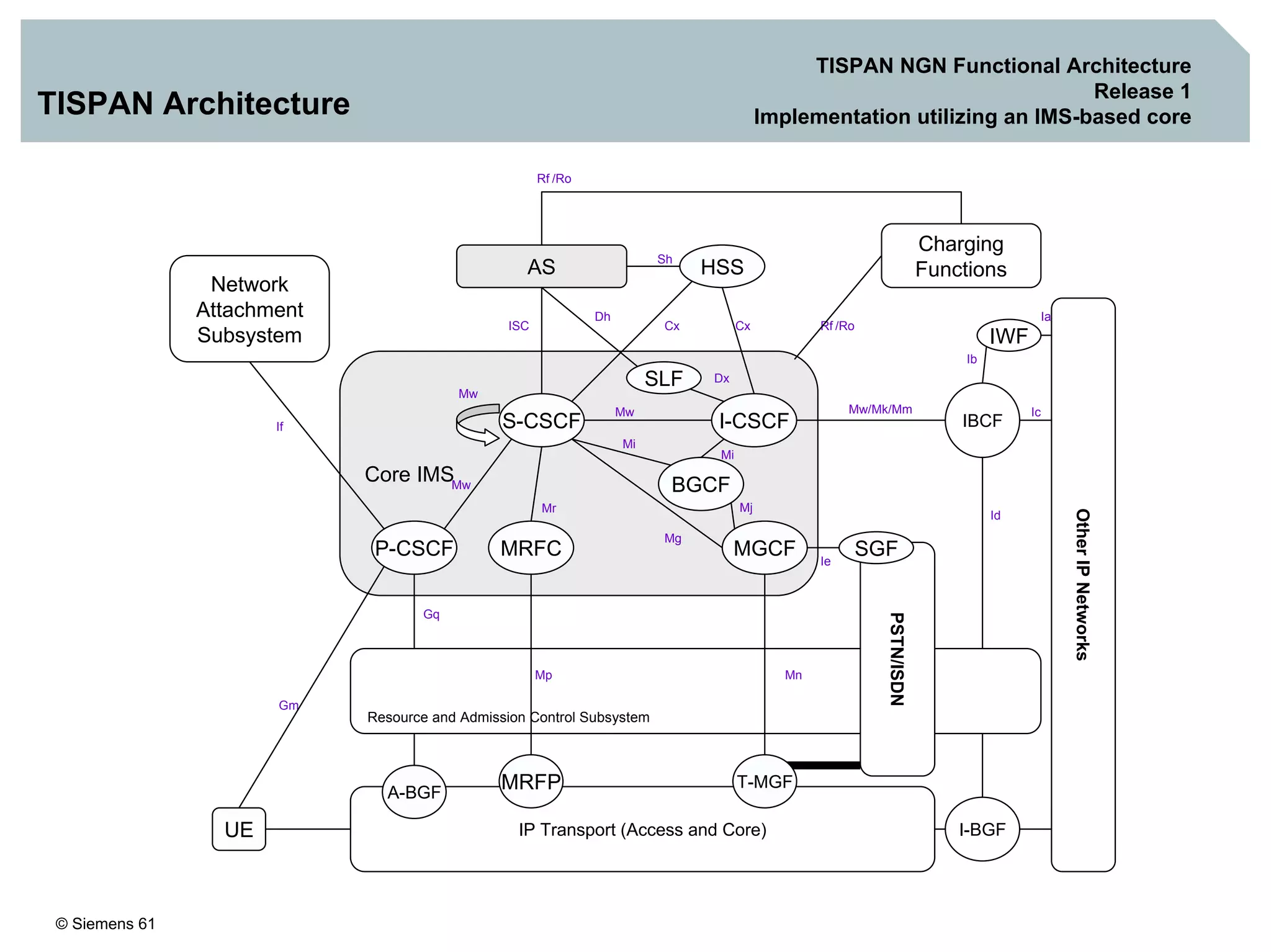
TISPAN NGN Functional Architecture
Release 1
Implementation utilizing an IMS-based coreTISPAN Architecture
Rf /Ro
IP Transport (Access and Core)
Resource and Admission Control Subsystem
Core IMS
AS
Charging
Functions
Mw
Mw Mw/Mk/Mm
Mr
Mg
Mj
Mi
Mp Mn
Gm
Gq
ISC Cx
Dx
Dh
Sh
Ic
Rf /RoCx
Ib
Ia
Id
If
Ie
Mi
Network
Attachment
Subsystem
AS
Charging
FunctionsHSS
I-CSCF
SLF
BGCF
MGCFMRFCP-CSCF
UE
A-BGF
MRFP
PSTN/ISDN
T-MGF
SGF
I-BGF
OtherIPNetworks
IBCF
IWF
Mw
S-CSCF
© Siemens 62
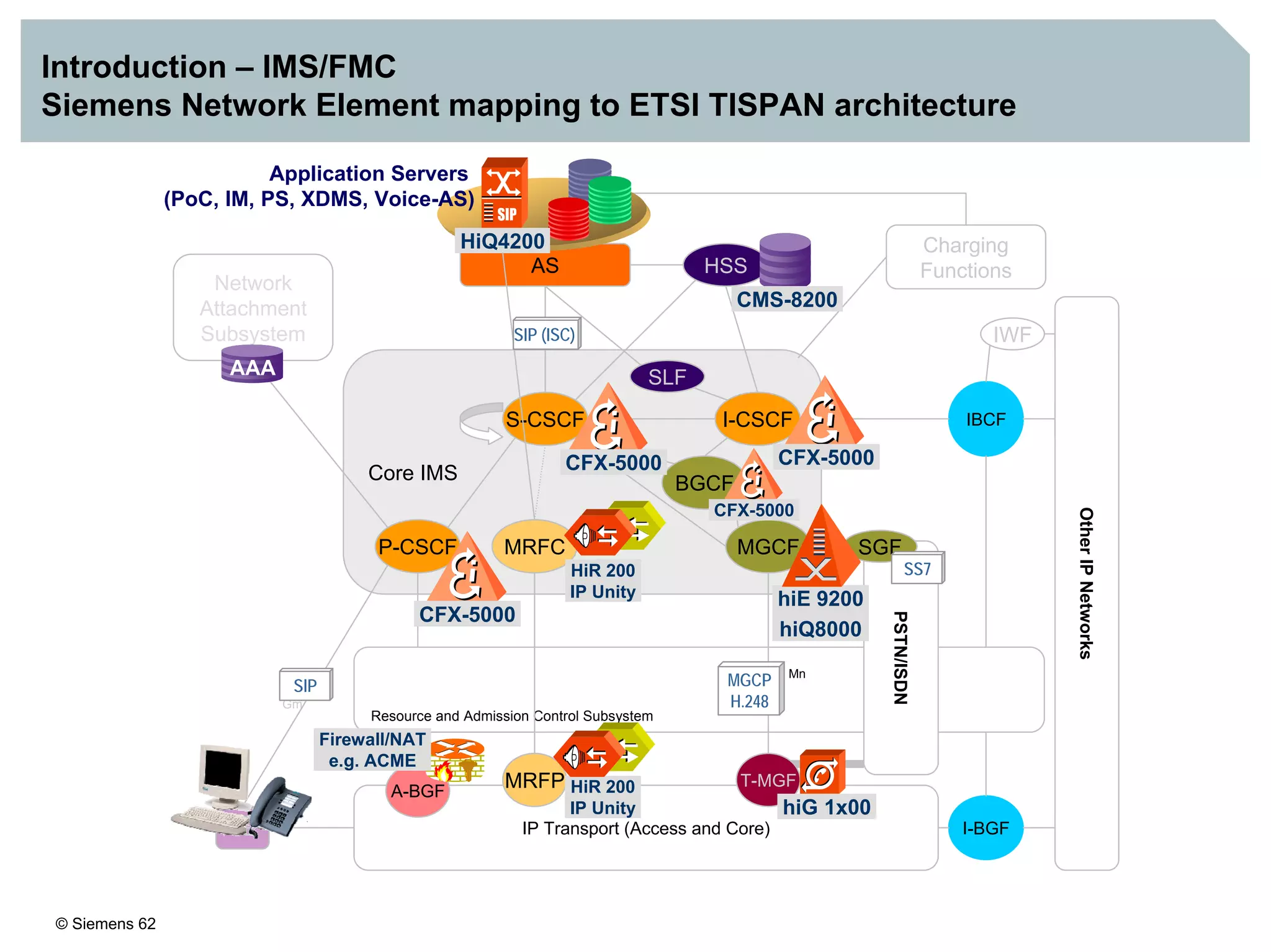
Introduction – IMS/FMC
Siemens Network Element mapping to ETSI TISPAN architecture
IP Transport (Access and Core)
Resource and Admission Control Subsystem
Core IMS
AS
Charging
Functions
Mn
Gm
ISC
Network
Attachment
Subsystem
AS
Charging
FunctionsHSS
I-CSCF
SLF
BGCF
MGCFMRFCP-CSCF
UE
A-BGF
MRFP
PSTN/ISDN
T-MGF
SGF
I-BGF
OtherIPNetworks
IBCF
IWF
S-CSCF
HiQ4200
CMS-8200
hiG 1x00
AAA
CFX-5000
SIP
SIP (ISC)
SS7
CFX-5000
CFX-5000
hiE 9200
hiQ8000
Application Servers
(PoC, IM, PS, XDMS, Voice-AS)
MGCP
H.248
CFX-5000
HiR 200
IP Unity
HiR 200
IP Unity
Firewall/NAT
e.g. ACME
© Siemens 63
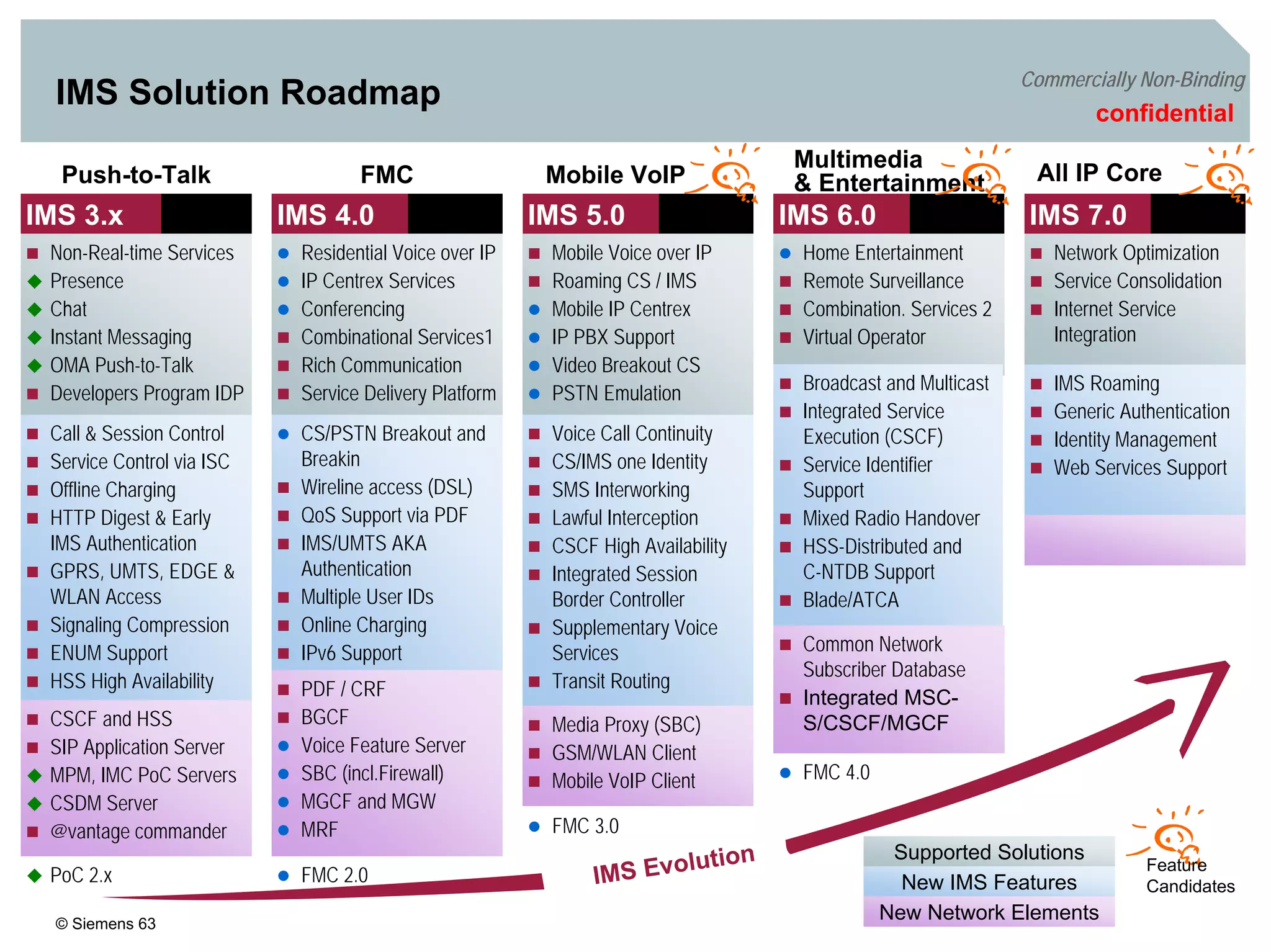
Commercially Non-Binding
IMS Solution Roadmap confidential
IMS Evolution
IMS 3.x
Call & Session Control
Service Control via ISC
Offline Charging
HTTP Digest & Early
IMS Authentication
GPRS, UMTS, EDGE &
WLAN Access
Signaling Compression
ENUM Support
HSS High Availability
Non-Real-time Services
Presence
Chat
Instant Messaging
OMA Push-to-Talk
Developers Program IDP
CSCF and HSS
SIP Application Server
MPM, IMC PoC Servers
CSDM Server
@vantage commander
Supported Solutions
New IMS Features
Feature
Candidates
IMS 4.0
CS/PSTN Breakout and
Breakin
Wireline access (DSL)
QoS Support via PDF
IMS/UMTS AKA
Authentication
Multiple User IDs
Online Charging
IPv6 Support
Residential Voice over IP
IP Centrex Services
Conferencing
Combinational Services1
Rich Communication
Service Delivery Platform
IMS 5.0
Voice Call Continuity
CS/IMS one Identity
SMS Interworking
Lawful Interception
CSCF High Availability
Integrated Session
Border Controller
Supplementary Voice
Services
Transit Routing
Mobile Voice over IP
Roaming CS / IMS
Mobile IP Centrex
IP PBX Support
Video Breakout CS
PSTN Emulation
IMS 6.0
Home Entertainment
Remote Surveillance
Combination. Services 2
Virtual Operator
IMS 7.0
IMS Roaming
Generic Authentication
Identity Management
Web Services Support
Network Optimization
Service Consolidation
Internet Service
Integration
Push-to-Talk FMC Mobile VoIP
Multimedia
& Entertainment
PDF / CRF
BGCF
Voice Feature Server
SBC (incl.Firewall)
MGCF and MGW
MRF
Media Proxy (SBC)
GSM/WLAN Client
Mobile VoIP Client
New Network Elements
All IP Core
FMC 2.0
FMC 3.0
FMC 4.0
Broadcast and Multicast
Integrated Service
Execution (CSCF)
Service Identifier
Support
Mixed Radio Handover
HSS-Distributed and
C-NTDB Support
Blade/ATCA
Common Network
Subscriber Database
Integrated MSC-
S/CSCF/MGCF
PoC 2.x
© Siemens 64
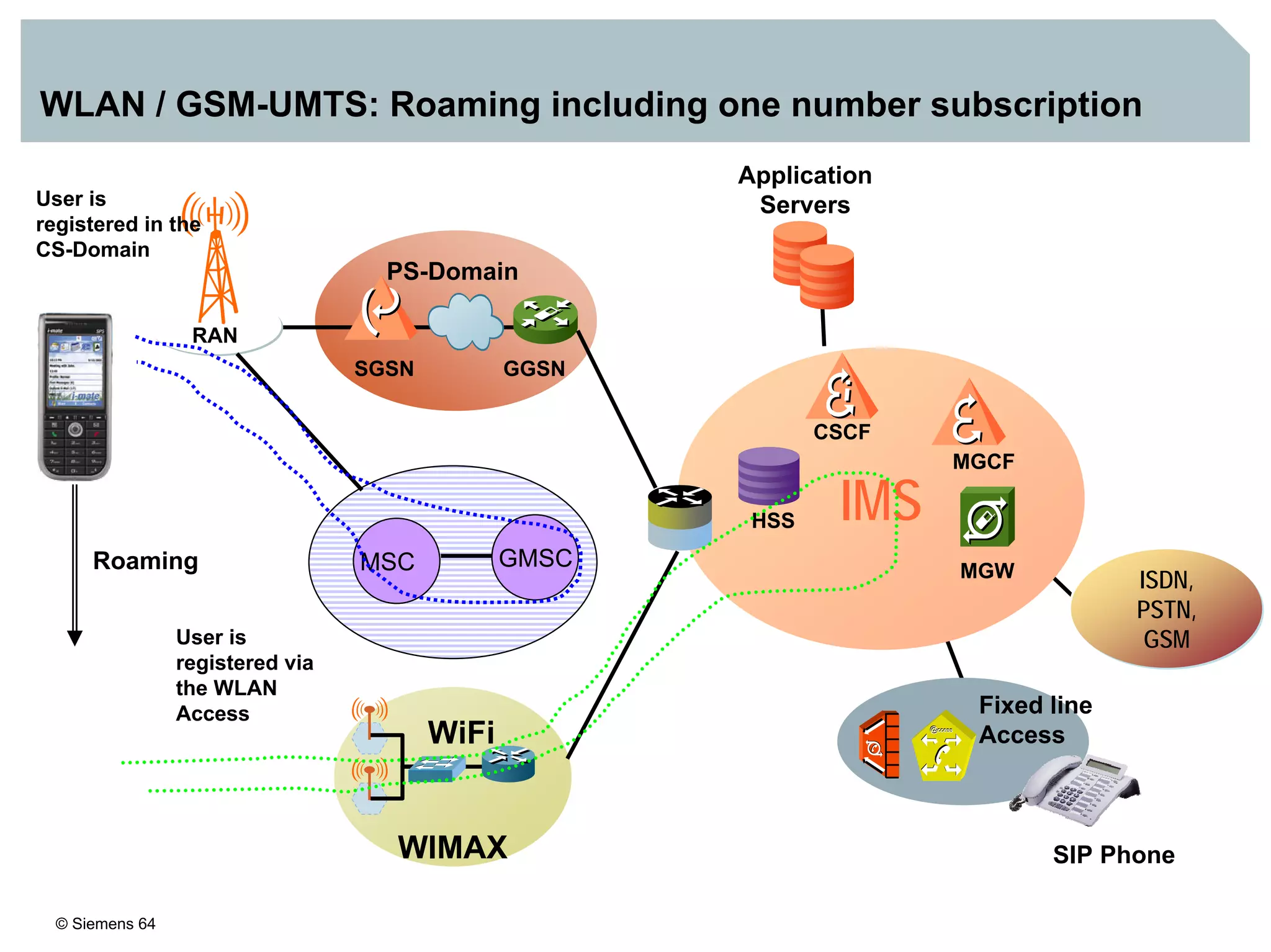
WLAN / GSM-UMTS: Roaming including one number subscription
IMS
PS-Domain
SGSN GGSN
RAN
ISDN,
PSTN,
GSM
Application
Servers
HSS
CSCF
MGCF
MGW
SIP Phone
Fixed line
Access
GMSCMSC
WiFi
WIMAX
Roaming
User is
registered in the
CS-Domain
User is
registered via
the WLAN
Access
© Siemens 65
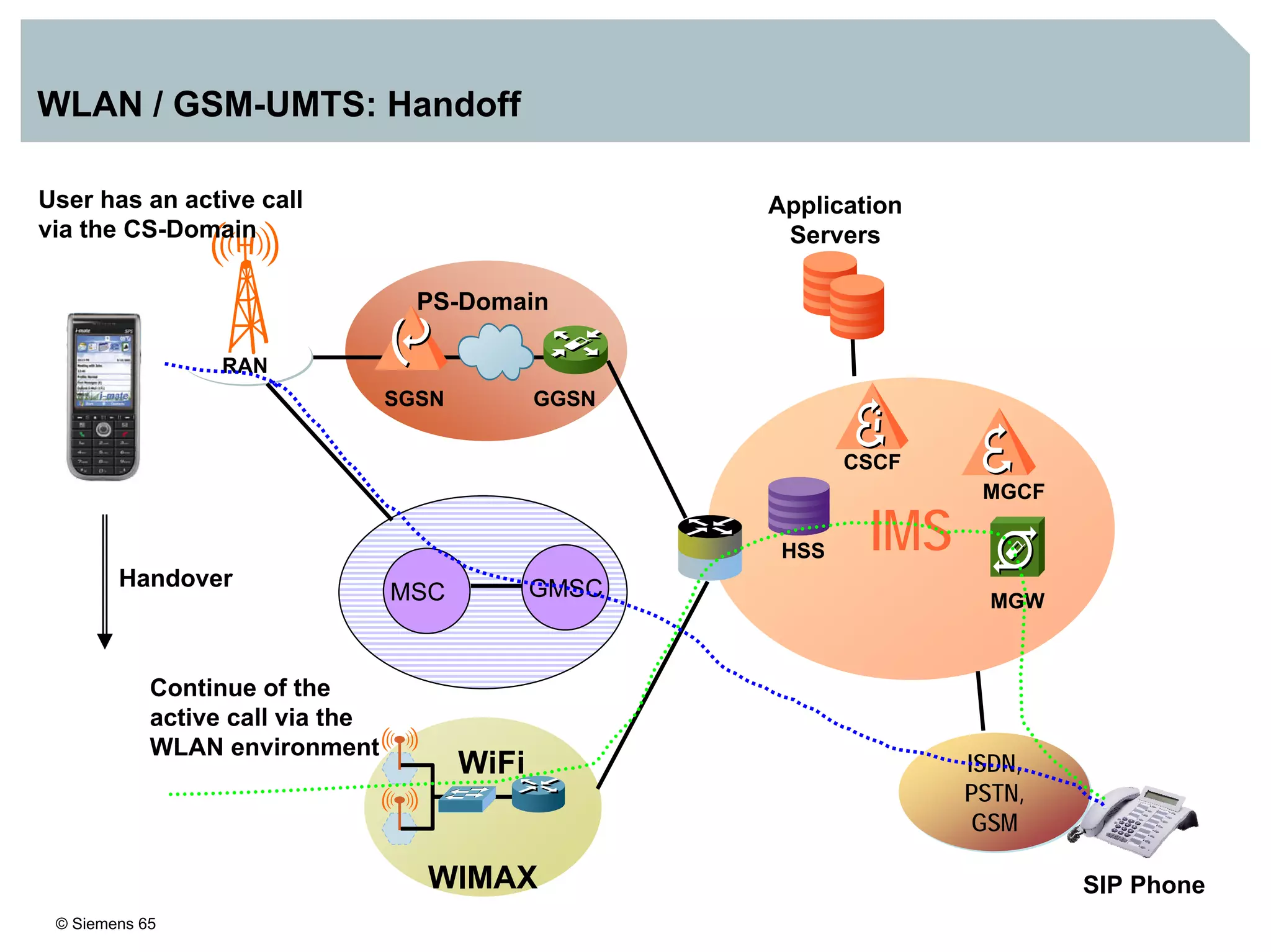
WLAN / GSM-UMTS: Handoff
IMS
PS-Domain
SGSN GGSN
RAN
Application
Servers
HSS
CSCF
MGCF
MGW
SIP Phone
GMSCMSC
WiFi
WIMAX
Handover
ISDN,
PSTN,
GSM
User has an active call
via the CS-Domain
Continue of the
active call via the
WLAN environment
© Siemens 66
Thanks for your attention!

Release 5 arch and beyond v06

  • 1.
  • 2.
    © Siemens 2 Agenda 1.IMS 2. IMS based new services 3. Release 4 migration path to Release 5 4. 3GPP Release 6 and beyond 5. Siemens portfolio
  • 3.
    © Siemens 3 1.IMS “IP Multimedia Subsystem”: • Overview of 3GPP IMS • Network architecture • Network elements • TISPAN architecture • Access independency
  • 4.
    © Siemens 4 MobileService Evolution Today Tomorrow SMS, MMS, IM, WAP Browsing/Download • Enhanced QoS • Service enrichment • Content-based charging Pure Voice • Voice quality improvements • OPEX reduction ltimedia IP will dominate all networks and access types Strong demand for a Multimedia control infrastructure when moving towards real- time services (e.g. Voice, Video, Conferencing) Today’s services will be enriched by innovative real-time multimedia services Voice Real-time Mu • Combined Voice / Data Services • Unlimited Interaction None Real time
  • 5.
    © Siemens 5 IMSHistory/Roadmap in 3GPP 3GPP Release 2000: • discussion started in 2000 after the completion of 3GPP R99. • included the Transport/Control split, MMS, All-IP, etc. • Release 2000 was split into 3GPP R4 and 3GPP R5. • the All-IP system (later renamed in IMS) was assigned to R5. 3GPP Release 4: • no IMS work was performed in this release. 3GPP Release 5: • the IMS was introduced as part of the 3GPP R5 standard. • the IMS architecture and key concepts were defined. • the IMS R5 feature-set was frozen in March 2002. • several IMS features were left for future releases. 3GPP Release 6: • an appropriate RAB for audio calls over UMTS-PS Domain. • external PDF, WLAN access and CS-Domain Interworking are the main topics. • Enhanced Charging and Lawful interception. • the IMS R6 feature set was frozen in June 2004. The R6 Stage 3 works are still ongoing but almost closed. 3GPP Release 7: • the IMS R7 feature set definition is closed (e.g. MRF, Enhanced interworking CS and the IMS, WLAN Enhancements, Combinational Services phase 2, Voice Call Continuity).
  • 6.
    © Siemens 6 Whatis Release 5? More than IMS • The IP Multimedia Subsystem (IMS) • TS 22.228, TS 23.002, TS 23.221, TS 23.228, TS 24.228, … • RFC 3261, RFC 2396, RFC 2486, RFC 2806, RFC 2916, … • Other Features • HSDPA • IP UTRAN • AMR-WB (7khz codec) • CAMEL Phase 4 • Iu Flexibility • End-to-End QoS • Security Enhancements • …
  • 7.
    © Siemens 7 KeyIMS Standards at the 3GPP The 3GPP IMS Standards can be found under ftp://ftp.3gpp.org/Specs/archive/: Architecture: TS23.002 (3GPP Network Architecture) IMS Session Control: TS23.228 (IMS), TS24.228 (SIP Signaling Flows, informal), TS24.229 (IMS Call Control) Security Mechanisms: TS33.102 (Security architecture), TS33.203 (Access Security), TS33.210 (Network Security), TS31.103 (ISIM) Regulatory issues (Lawful interception): TS33.106/TS33.107/TS33.108 IMS Charging: TS23.815 (Charging/Architecture), TS32.200 (Charging Principles), TS32.225/TS32.235 (IMS Charging Data) IMS Interfaces: TS29.328/TS29.329 (Sh-interface), TS29.228/TS29.229 (Cx-, Dx-interface), TS29.207 (Go-interface) IMS Services: TS23.141/TS24.141/TS33.141 (Presence), TS22.340/TS24.247 (Messaging), TS24.147 (Conferencing) IMS QoS: TS23.107/TS23.207 (QoS Concept/Architecture), TS29.208 (QoS Signaling Flows) IMS Interworking: TS 29.163 (to CS/PSTN), TS23.234/TS24.234 (to the WLAN), TS29.962 (to SIP Clients in the Internet)
  • 8.
    © Siemens 8 Whatis IMS ? The 3GPP IP Multimedia Subsystem (IMS): • is a Sub-domain in the 3GPP Mobile Core Network. • was designed by the 3rd Generation Partnership Project (3GPP) to deliver/support/control IP-based multimedia communication services. • enables and supports the integration of Real-Time, near-Real-Time and Non-Real-Time Services. • supports Person-to-Person and Person-to-Machine communications. • Basically access independent but details should be solved. CS-Domain GMSC WLAN Network PS-Domain GGSN PSTN Internet IMS of another Operator IMSSGSN MSC Application Servers e.g: Presence IM CSCF PoC HSS PDGW Session
  • 9.
    © Siemens 9 3GPPCore Network: Overview of functional entities Core Net Access Net (E)RAN Multi Media Domain PS Domain CS Domain TDM/ATM MSC GMSC Iu-cs MGW CS-GW MSC-Server VoIP/VoATM GMSC-Server Iu-ps E-SGSN IP E-GGSN IP MGCF MRF Mm Mm MGW HSS CSCF AS UTRAN PSTN/ ISDN Multimedia IP Network /PDN
  • 10.
    © Siemens 10 IMSR5 Architecture 3GPP IMS Release 5 standard Network Entities and Reference Points CS-Domain -or- PSTN -or- Legacy -or- External PS-Domain CSCF CSCF MRF-C Mr Cx Sh Gr Mm Mw Mn Gc Mg Gn Iu BGCF Mi Mk Mj Go Gm SLF Dx „Mb/Gi-Cloud“ PDF MRF-P Mp ISC Uu Operator 2 Si IMS Terminal (TE and MT) UTRAN / GERAN Multimedia IP Networks MGCF MGW IP Multimedia Subsystem (IMS) Applications Services AS OSA-SCS IM-SSF HSS HLR Sh Note: the reference points for Charging, Core Network Security, Lawful Interception are not shown BGCF GGSN CAP SGSN
  • 11.
    © Siemens 11 IMSInterfaces and Protocols 3GPP IMS Release 5 standard Protocols • the IMS uses the Session Initiation Protocol (SIP – RFC 3261) for call control. Note: the reference points for Charging, Core Network Security, Lawful Interception are not shown CS-Domain -or- PSTN -or- Legacy -or- External PS-Domain CSCF CSCF MRF-C Mr Cx Sh Gr Mm Mw Mn Gc Mg Gn Iu BGCF Mi Mk Mj Go Gm SLF Dx „Mb/Gi-Cloud“ PDF MRF-P Mp ISC Uu Operator 2 Si IMS Terminal (TE and MT) UTRAN / GERAN Multimedia IP Networks MGCF MGW IP Multimedia Subsystem (IMS) Applications Services AS OSA-SCS IM-SSF HSS HLR Sh SIP TCP UDP HTTP Others ISUP/ BICC TDM RTPSIP DIA SIP SIP SIP H248 SIP Diameter MAP‘SIP CAPOSA Diameter CAP MAP SIP COPS DIA BGCF CAP GGSN SGSN
  • 12.
    © Siemens 12 KeyIMS Network Elements Not shown: - Charging Entities - Security Entities - Lawful Interception Entities - DNS/ENUM, … CSCF (Call Session Control Function) PDF (Policy Decision Function) HSS (Home Subscriber Server) HLR (Home Location Register) SLF (Subscription Locator Function) MRF-C (Multimedia Resource Function - Controller) MRF-P (Multimedia Resource Function - Processor) BGCF (Breakout Gateway Control Function) MGCF (Media Gateway Control Function) MGW (Media Gateway) SGW (Signaling Gateway) AS (Application Server) IM-SSF (IP Multimedia Service Switching Function) OSA-SCS (OSA Service Capability Server)
  • 13.
    © Siemens 13 ClassicalIMS Usage Scenario IMS as unified Voice- and Data Network • enable multi-component communication services that integrate voice/video/data and real-time/non-real-time service components • enable the operator to control and charge these services • enable a single IP based network infrastructure for voice- and data services in the future, instead of different infrastructures for Transport, Control, Supplementary Services, Charging and Network Management IMS HSS CSCF Application Servers Multi-component IMS Service Voice Service Component Video Service Component Data Service Component WLANWLAN SGSN Node B RNC UTRAN Iu-PS Gn GGSNPS-Domain IMS Client SGSN BTSBSC RAN Gn IMS Client SGSN Node BRNC UTRAN Iu-PSGn PS-Domain IMS Client GGSN
  • 14.
    © Siemens 14 Futurepositioning of IMS from the 3GPP point of view Positioning for near-term Work together with UMTS PS domain, GPRS or WLAN complimentary to circuit switched • Focused on new IP and SIP based applications • Focused on integrating web content, presence information and combinational services to the CS calls. • Be prepared for other access types (e.g. xDSL or WiMAX) Medium to long-term Work together with all possible standardized access types for: • Offer CS services over IMS (including Mobile IP Centrex and CAMEL) • Capability to slowly take over voice from the CS Domain
  • 15.
    © Siemens 15 KeyIMS Network Elements HSS/UMS – Home Subscriber Server • is the database for user related information. • provides authentication support (e.g. the Authentication Vectors). • stores the IMS User Profiles that includes e.g.: • the User Identification, Numbering, Addressing information (SIP URI, TEL-URI, IMSI, MSISDN, ...) • the Service Provisioning/Authorization Information (Filter Criteria). • the User Mobility Information (S-CSCF address). • the Charging Server Information (CCF-, ECF address). IMS HSS/UMS Functions: • User Identification data • Mobility Mgmt (S-CSCF) • Authentication Data • Filter Criteria • Charging Info • … I-/S-CSCF Cx Application Server Sh Si IM-SSF CS/PS Domain HSS SGSN (G)MSC GGSN SCP GMLC HLR Functions: • Mobility Mgmt • Authentication Data • SuppService Settings • Routing Info • PDP Type, APN, .. • MSISDN • QoS / Charging Info • Privacy Settings • ..... D,C Gr Gc Lh
  • 16.
    © Siemens 16 KeyIMS Network Elements SIP based Interface Diameter based Interface CSCF – Call Session Control Function • can be viewed as a SIP based Multimedia Session Controller. • includes the three Roles: S-CSCF, I-CSCF, P-CSCF. IMS Application Servers HSS Cx Mw Mg Mi Mj Gm ISC Proxy-CSCF (P-CSCF) Serving-CSCF (S-CSCF) Interrogating-CSCF (I-CSCF) Sh Cx Mw Mw BGCF MGCF IMS Terminal Gq PDF I-CSCF - First contact point for the UE - Forwarding of SIP messages - Generation of Charging CDRs - Integrity and Confidentiality Protection Support - QoS Authorization Support - Local Service Support - Lawful Interception Support - SIP Header Compression - First contact point into an operator‘s network. - Forwarding of SIP messages - Assignment of S-CSCFs - Generation of Charging CDRs - Topology Hiding Support - Acts as SIP Registrar - Performs the IMS User Authentication - Loads IMS User Profiles from the HSS - Performs Session Control - Performs Service (AS) Control - May behave as SIP-Proxy or SIP-UA - Address Translation Support - Generation of Charging CDRs - Lawful Interception Support
  • 17.
    © Siemens 17 KeyIMS Network Elements SIP based Interface Diameter based Interface MGCF – Media Gateway Control Function SGW – Signaling Gateway IMS-MGW – IMS Media Gateway • provide the IMS Interworking to/from the PSTN/CS-Domain. MGCF: - performs the signaling conversion SIP ISUP/BICC over SCTP/IP. - controls the MGW via H.248 (Mn reference point). - generates Charging CDRs for Interoperator Charging. MGW: - performs the IMS Bearer traffic conversion e.g. Voice/RTP/UDP/IP Voice/TDM. - may perform transcoding e.g. AMR G.711. May provide Tones/Announcements. S-CSCF HSS Mg Mi Mj ISC Sh Cx BGCF MGCF SGW ISUP, BICC over SS7 Voice over TDM, ATM Voice over IP MGW PSTN / CS-Domain ISUP, BICC over IP Mn SIP Signaling SGW: - performs the signaling transport conversion from/to ISUP/BICC over SCTP/IP ISUP/BICC over SS7. IMS Terminal
  • 18.
    © Siemens 18 KeyIMS Network Elements BGCF – Breakout Gateway Control Function • is responsible for selecting the MGCF that controls the IMS Interworking to the PSTN/CS-Domain. • the selection could e.g. be based on operator policy / Number Plan. • the Local Breakout and the Remote Breakout are defined. • the BGCF generates Charging CDRs. SIP based Interface Diameter based Interface S-CSCF HSS Mg Mi Mj ISC Sh Cx BGCF MGCF, SGW BGCF Mj Mk Remote Breakout in another Operator Network Local Breakout in the local Operator Network MGCF, SGW PSTN / CS-Domain PSTN / CS-Domain ISUP, BICC ISUP, BICC Voice over TDM, ATM Voice over TDM, ATM Voice over IP MGW MGW Voice over IP
  • 19.
    © Siemens 19 KeyIMS Network Elements IMS Application Servers (AS): • provide SIP-based IMS services (e.g. Presence, PoC, Instant Messaging, Supplementary Services, etc. ). • may act as SIP-UA, SIP-Proxy, SIP B2BUA. • are invoked by the S-CSCF via the SIP-based ISC interface. • Different AS types are defined in TS 23.002: • IM-SSF (IP Multimedia Service Switching Function) • OSA-SCS (OSA Service Capability Server) • SIP-AS (SIP-Application Server) S-CSCF HSS ISC Sh Cx IMS Application Servers SIP Signaling SIP Signaling Administrative Domain of the IMS Operator Execution Environment Services S-CSCF ISC (SIP)ISC (SIP)ISC (SIP)Administrative Domain of the 3rd Party Service Provider SE Services OSA API IM-SSFOSA SCS SIP-AS OSA API Services CAP CORBA Transport Services
  • 20.
    © Siemens 20 IMSRegistration and User Authentication Overview about the IMS Registration Procedure: • Assumptions: 1) the A-Party (UE-A) is in the Home Network, and 2) the B-Party (UE-B) is in the Visited Network (IMS Roaming). • The S-CSCF is the SIP Registrar. Home IMS Network of UE-A P-CSCF-A S-CSCF-AI-CSCF-A HSS-A UE-A SIP Register message 1 2 4 Query HSS Download User Profile to S-CSCF 3 5 Home IMS Network of UE-B P-CSCF-B S-CSCF-B I-CSCF-B HSS-B UE-B SIP Register message 1 2 4 Query HSS Download User Profile to S-CSCF 3 5 Visited IMS Network of UE-B
  • 21.
    © Siemens 21 IMSSession Setup and Control Overview about the standard IMS Session Setup: • used e.g. for voice/video/data sessions in the IMS. Home IMS Network of UE-A Home IMS Network of UE-B P-CSCF-A I-CSCF-B P-CSCF-B HSS-B S-CSCF-A S-CSCF-B 1 2 3 4 5 6 7 SIPInvite SIPCallControl SIPRegister I-CSCF-A HSS-A UE-BUE-A SIP Register IP Bearer Packets Query HSS for S-CSCF
  • 22.
    © Siemens 22 IMSInterworking to the PSTN/CS-Domain Overview about the IMS Session Setup to the PSTN/CS: • the IMS Breakout is initiated at the S-CSCF of the A-Party (UE-A) after the TEL-URI (E.164) Address Resolution failed: PSTN/CSHome IMS Network of UE-A P-CSCF S-CSCF MGCF/ SGW BGCF REGISTER INVITE(E.164) CallControl 2 3 5 I-CSCF HSS 6 1 DNS ENUM 4 UE-A IAM RTP/UDP/IP Bearer TDM 8 MGW 7 2-3 4 1 IMS Registration of the A-Party (UE-A). Resolve B-Party E.164 into SIP-URI: fails ! Initiate Session Setup to the B-Party. 6 7 5 No IMS B-Party: send SIP INVITE to BGCF. Gateway Control based on MGCP or H.2.48. BGCF selects MGCF e.g. based on N-Plan Call Control e.g. PRACK, UPDATE8 Initiate Breakout to the PSTN.
  • 23.
    © Siemens 23 IMSInterworking to the PSTN/CS-Domain Overview about the IMS Session Setup from the PSTN/CS: • in the example, the B-Party is registered in the IMS. 4-9 4 1 IMS Registration of the UE-B. Resolve the I-CSCF Address via DNS. Standard MT Call Setup including 7 Gateway Control using MGCP/H2.48. 2 Terminating Session Setup Request is received at the MGCF. Terminating Service Execution in 7 PSTN/CS Home IMS Network of UE-B P-CSCF S-CSCFMGCF/ SGW INVITE CallControl 8 6 I-CSCF HSS 2 1 DNS 3 UE-B IAM RTP/UDP/IP BearerTDM 9 I-CSCF 4 SIP AS7 INVITE MGW 10 5
  • 24.
    © Siemens 24 3GPPIMS • SIP call-control domain for public network operator IETF • Specification of Internet protocols • Efficient „bazar“ model for Internet protocols Use IETF protocols, and adopt new functionalities to 3GPP system Specifies requirements for IETF specification work (e.g. SIP). 3GPP2 MMD Similar to 3GPP IMS for CDMA20003GPP2 largely follows 3GPP Open Mobile Alliance (OMA) • Specification of E2E service enabler (e.g. PoC) Provide network capabilities to fulfill E2E enabler requirements Develop Service enabler using IMS ETSI TISPAN, ATIS, ITU-T Define NGN/FMC based on 3GPP IMS Definition of Req's by NGN bodies Changes to protocols by 3GPP Standardization landscape in the area Mobile and Fixed Access
  • 25.
    © Siemens 25 TISPANNGN Functional Architecture Release 1 Implementation utilizing an IMS-based coreTISPAN Architecture Rf /Ro IP Transport (Access and Core) Resource and Admission Control Subsystem Core IMS AS Charging Functions Mw Mw Mw/Mk/Mm Mr Mg Mj Mi Mp Mn Gm Gq ISC Cx Dx Dh Sh Ic Rf /RoCx Ib Ia Id If Ie Mi Network Attachment Subsystem AS Charging FunctionsHSS I-CSCF SLF BGCF MGCFMRFCP-CSCF UE A-BGF MRFP PSTN/ISDN T-MGF SGF I-BGF OtherIPNetworks IBCF IWF Mw S-CSCF
  • 26.
    © Siemens 26 GPRS SGSNGGSN IPGERAN WLAN,WiMAX IP UMTS SGSN GGSN UTRAN IP Fixed, DSL,... IP Others’ Application Infrastructure Intranet Internet IMSOperator‘s IP Backbone Operator‘s own Service Delivery Platform Other Operators‘ IMS PSTN HSS CSCF MGCFMGW PDF MRF IMS based All IP Network CSCF = Call State Control Function HSS = Home Subscriber Server PDF = Policy Decision Function MGCF = Media Gateway Control Function MGW = Media Gateway MRF = Media Resource Function
  • 27.
    © Siemens 27 2.IMS based new services: • How the new services can be offered • Which services would be low hanging fruit
  • 28.
    © Siemens 28 SessionControl Applications Subscribers Mobile Clients Fixed Clients Separate Applications From Access Networks HSS IMS SS7 TDM CFX-5000CMS-8200 Media Gateway Controller Media Gateway Video Conferencing VoiceMailPresence VoIP PSTN/ PLMN Generic SIP AS hiQ 4200 Instant Messaging SIP / ISC DVB-H W-CDMAWLAN-Hotspot VoIP DSL-Data TDM / POTS SIP CSCF 3.5G Radio Internet WLAN 2G / 3G GSM / UMTS WIMAX Cable DSL CDMA DVB-H CSCF & HSS Service, Session & Resource Control IMS Applications SIP-based legacy
  • 29.
    © Siemens 29 SeparateApplications From Access Networks Session Control Applications Subscribers Mobile Clients Fixed Clients HSS IMS SS7 TDM Media Gateway Controller Media Gateway PSTN/ PLMN Video Conferencing VoiceMailPresence VoIP Generic SIP ASInstant Messaging SIP / ISC DVB-H W-CDMAWLAN-Hotspot VoIP DSL-Data TDM / POTS SIP CSCF
  • 30.
    © Siemens 30 MobileApplications Rich Call & Combinational Services 5P Application Suite • Video Sharing • Upgrade to Video Call • Presence-enabled phonebook • Instant Messaging & Chat • Push my Picture • Watch me Live • P2P Gaming • Multi-party Gaming Seamless Integration Multiple parallel sessions, with or without voice call
  • 31.
    © Siemens 31 OfferFixed-Mobile Convergence including VoIP services Call & Session Control (IMS) PDF HSS CSCF MGCF MGW WiMAX/WLAN/DSL Household Access Point IP PBX3GPP Cellular Access Corporate Access Point Applications Presence Community PoC Multimedia Messaging VoIP Call & Share Voice &Video Conferencing Gaming Mobile TV … •Platform for Next Generation Mobile Networks •One control platform for all domains and all use cases •One identity, one number, one bill, one voice mailbox, one subscriber database •Seamless mobility and handover between Cellular and WLAN domains is defined •Shared Content and same Application Look & Feel across Multiple Networks •Standardized Solution resolving VoIP Interworking/Interoperability issues •Easy VoIP bundling with Multimedia Services Why IMS controlled VoIP and FMC?
  • 32.
    © Siemens 32 3.Release 4 migration path to Release 5: • Signalling • Media
  • 33.
    © Siemens 33 CSdomain A possible vision for network evolution 2G scenario BTS A Abis (TDM) Gb RAN SCP IN HLR BSC PSTN PLMN TDM 2G MSC 2G MSC IP-Network (PS-domain) Internet Intranet other PLMN BGW 2G SGSN GGSN IP OSS CTX
  • 34.
    © Siemens 34 CSdomain A possible vision for network evolution 2G/3G scenario BTS A/ Iu-cs Abis (TDM) Gb/ Iu-ps GERAN Node B UTRAN Iub (ATM) RNC SCP IN HLR Iu-ps Iu-cs BSC PSTN PLMN TDM/ATM 2G 3G MSC 2G 3G MSC IP-Network (PS-domain) Internet Intranet other PLMN BGW 2G 3G SGSN IPS IP OSS CTX
  • 35.
    © Siemens 35 CSdomain A possible vision for network evolution IMS introduction BTS A/ Iu-cs Abis (TDM) Gb/ Iu-ps GERAN Node B UTRAN Iub (ATM) RNC SCP IN HLR Iu-ps 2G 3G SGSN Iu-cs BSC PSTN PLMN TDM/ATM 2G 3G MSC 2G 3G MSC IP-Network (PS-domain) MGCF IMS CSCF MGW HSS MRF other PLMN BGW IPS PDF Internet Intranet IP OSS CTX
  • 36.
    © Siemens 36 Apossible vision for network evolution Communication Anytime Anywhere on Any device CS domain BTS A/ Iu-cs Abis (TDM) Gb/ Iu-ps GERAN Node B UTRAN Iu-b RNC SCP IN HLR Iu-ps Iu-cs BSC PSTN PLMN IP-Network IMS HSS MRF MSC-Server Internet Intranet other PLMN 2G 3G SGSN OSS IP-Network IPS xDSL WLAN AP Access Gateway WLAN WiMAXWiMAX BS BGW MGWMGW MGCF CSCF PDF IP CTX
  • 37.
    © Siemens 37 3G-OverlayConsolidation, MSC Server, IMS/CS-MGW Unified Unified IMS introduction VoIMS MGW Transport 2G-MSC 3G-MSC 2G/3G-MSC CSCF IMS-MGW 2G-MSC 3G-MSC CSCF MGCF IMSDomainCSDomain CSCF MGCF CSCF MGCF 21 3 4 5 Unified Controller Unified Transport Unified Controller 6 IMS-MGW CS-MGW MSC Server MSC ServerMSC Server IMS-MGW CS-MGW CS Evolution Strategy
  • 38.
    © Siemens 38 Fourpossible evolution scenarios for IMS-CS Voice Interworking CS-Voice centric evolution IMS and CS Voice are treated independently IMS centric evolution CS-Voice centric evolution CS MGW Mc MSC-S Mn Mg/Mj MGCF IMS-MGW CSCF/BGCF Mc MSC-S/MGCF Mn Mg/Mj CS/IMS-MGW CSCF/BGCF Mc MSC-S Mn CS/IMS-MGW CSCF/BGCF Mc MSC-S Mn Mg/Mj MGCF CS/IMS-MGW CSCF/BGCF Mg/Mj MGCF
  • 39.
    © Siemens 39 4.3GPP Release 6 and beyond: • Release 6 • Release 7 • NGMN / LTE
  • 40.
    © Siemens 40 3GPPRoadmap Core Network 3GPP Rel 6 Support of Push Services IP flow based charging Enhanced Gb for improved streaming support Enhanced Gb for conversational services General control for e2e QoS (PDF, Gq) Enhanced Policy Control WLAN Access to IMS and other PS services Circuit-switched voice video service improvements Cyphering of Voice Group Calls IMS Phase 2 • Interworking CS, PSTN, IP-Networks • Charging Phase 2 • Legal Interception enhancement • Optimized Radio Support, WLAN Access IMS Service Enablers • Push to talk over cellular (PoC) support • Presence, Messaging, Group Mgmt • Conferencing phase 1 3GPP Rel 4 Rel 4 CS Architecture Split MSC Server/MGW Bearer-independent Call Control (BICC) CS over IP CS over ATM/AAL2 Transcoder-free operation (TrFO) Tandem-free operation for AMR QoS in PS only Gb interface over IP Location service enh. 3GPP Rel 7 (in progess) Handover WLAN to GPRS/UMTS (non- seamless, seamless) Further 3GPP services over WLAN Further Voice Group Call Service Enhancements Combining CS and IMS services Enhanced support of video telephony IMS / CS combinational services FMC/NGN : IMS over DSL/cablemodem Emergency Services over IMS/PS IMS Voice over WLAN to GSM interworkingMAP Security (manuel key distribution) Signaling over IP Network Sharing Generic Bootstrapping Architecture All-IP network evolution Selective disabling of faulty terminals 3GPP process : Improved mechanisms to introduce new features on old releases 3GPP Rel 5 IMS control for e2e QoS (Go) Enhanced Gb for basic streaming support (NACC, Flow control) AMR-WB codec Service Change and UDI Fallback (SCUDIF) IMS Basic Functionality Registration and Session Control Charging, Security Service Provisioning interfaces Iu interface over IP CAMEL Phase 4 Iu flexibility (connecting RNC to multiple MSC/SGSN) Network Domain Security for IP (IPSec) Improved Encryption (A5/3, GEA/3) Circuit SwitchedPacket SwitchedIMSCommon 3GPP Evolution
  • 41.
    © Siemens 41 IMSR5/R6 Feature Split Key Features defined in the 3GPP Release 5 IMS: IMS Architecture: IMS Architecture, network entities, reference points (interfaces) between the network entities. User Identities: Public/Private User Identity, usage of the SIP-URI and TEL-URI, ISIM, the use of the USIM instead of the ISIM. IMS Session Control: IMS Registration, IMS Session Routing, Session- Modification and Teardown, SIP Signaling Compression. IMS Service Control: invocation/control of IMS Application Servers based on Filter Criteria in the CSCF. IM-SSF and the re-use of CAMEL Services. Interconnect with the OSA-GW and the use of OSA services. QoS Mechanisms: QoS Preconditions, QoS/Media Authorization based on the PDF. Security Mechanisms: IMS User Authentication, Message Integrity Protection, IMS Network Domain Security. Lawful interception
  • 42.
    © Siemens 42 IMSR5/R6 Feature Split Key Features being defined in Release 6 IMS: IMS Services: Presence, Instant Messaging, Conferencing, group management. IMS VoIP Optimized UTRAN-RAB. Enhanced Charging (Online charging). IMS Interworking: IMS Interworking to the CS-Domain (details for CS and PSTN), WLAN access to the IMS, Interworking with SIP Clients in the Internet. IMS Session Control: multiple registrations, routing of group identities. Support of more private user ids. Security Mechanisms: confidentiality protection of SIP messages, use of public key infrastructure, Ut-interface security. Note: Services OMA!!!
  • 43.
    © Siemens 43 NetworkEntities and Reference Points of 3GPP Release 6 Ww, Wu WLAN (Home) IMS Core Ut PSTN -or- CS-Domain -or- Legacy -or- External PS-Domain CAP Mr Cx Sh Gr Mm Mw Mn Gc Mg Gn Iu BGCF Mi Mk Mj Go Gm Dx „Mb/Gi-Cloud“ PDF Mp ISC Uu Operator 2 Si IMS Terminal Radio Access Multimedia IP Networks MGCF MGW BGCF Gq CSCF SLF IMS Services AS OSA-SCS IM-SSF Presence IM Dh HSS HLR Wx Wu, Wp SGSN WLAN Access (WAG) Wm AAA PDGW The reference points for Charging, Core Network Security, and Lawful Interception are not shown. PoC is standardized by OMA. Red denotes additions in R6 compared to R5. In R6, the MRF-C may be co-located with an AS (and thus have an Ut, an ISC and an Sh interface). PoC MRF-C MRF-P IMS-ALG CSCF Mx Mx Ix TrGW Ma GGSN CRF Gx Rx Note: In R7, PDF and CRF will be combined to a PCRF
  • 44.
    © Siemens 44 Nexttechnologies focus on Cost Efficiency and Reduced Network Complexity Universal transport node GSN (xGSN & IPS) optimized peer-to-peer routing Common Subscriber Database for all Domains NB+ All IP NetworkMultimedia Services 2006/2007 Starting Point 3GPP R4 Access Core Routing & Switching Control IMSMSC-S HLR MGW SGSN WLAN WiMAX UTRAN IMSCNDB MGW IPS GSN Shared Infrastructure between access technologies Reduced transmission, unified O&M concept OPEX New IMS functionalities for support of Multimedia and VoIP ARPU Unified Multimedia Home Control, Security and Entertainment OPEX ARPU All-IP prepared GERAN xDSL EDGE GGSN / IPS WLAN WiMAX UTRAN GERAN xDSL EDGE
  • 45.
    © Siemens 45 OperatorExpectations are driven by increasing Market Dynamics towards a Next Generation Mobile Network Technology Market Dynamics Launched 1992 - 14 years ago More than 1.5 billion customers in 200 countries, growing by 1 million per day GSM UMTS NGMN Non restrictive regulation Low license fees Creation of challenging customer expectations - excellent coverage “ everytime, everywhere” - excellent quality Launched 2002 Technology promise of high speed at low cost HSxPA keeping the UMTS promise high license fees Customer expectations increased triggered by other successful technologies (DSL, WLAN WiMAX, …) Throughput and latency are key parameters to enhance user experience Unlike GSM, UMTS is facing technology competition To be commercially launched 2010 DSL is setting the target for customer expectations in performance & cost Mobility meets IP and vice versa Convergence of markets - Fixed Line - Nomadic - Mobile Keep assets of mobile operators vs. competition: - Ubiquitous access - Mobility - Security - Qos Network Costs, Performance, Latency
  • 46.
    © Siemens 46 TheseDynamics lead to Operator Requirements in mainly two Key Success Dimensions 1 Superior User Experience 2 Competitive Network Cost • Throughput / Cell Capacity 100 MBit/s downlink (w/o MIMO), 50 MBit/s uplink High performance at cell edges • User Data Latency Total system roundtrip < 30ms • Mobility Cell Change << 100 ms, Inter-system change << 500 ms e.g. VoIP at GSM quality HSPA NGMN HSPA NGMN Peak Throughput Latency Factor10 Factor2-3 UMTS HSPA NGMN 50% >50% Cost/MByte • No more sites Re-use of equipment and antennas (Multi Standard Base Station) • Spectrum Efficiency 2-3 bit/Hz/cell without MIMO (3…4 times HSPA) Scalable channel bandwidth (1.25 – 20 MHz) Re-farming support • Flat Network Architectures RNC-less access IP interfaces and packet optimized all-IP Network Ethernet backhauling Smooth Migration from existing networks
  • 47.
    © Siemens 47 KeyArchitectural Concepts (simplified) target a flat and cost effective Next Generation Mobile Network UMTS/HSPA Access Core Control Node B RNC SGSN GGSN MSCMGW IMS HLR/HSS NGMN MBS aGW IMS HLR/HSS MGW Move of Functionality
  • 48.
    © Siemens 48 Thefirst Step in 2009 allows early Time to Market with an NGMN Overlay including full seamless Mobility MGW (CS-) MGW (PSTN-) PS DomainRadio IMSMSC-S DB HLR, HSS, AAA,… CS Domain IPS GGSN, SGSN SGSN+ MM, CM, LI, Ciph GERAN Applications Enabling Services Billing & Charging PCRF UTRAN NGMN NB+ CPS PSTN Non-3GPP WLAN, WiMAX ,… Intranet / Internet Voice interworking MGW eIub-c eIu eIu Gx+ MGW Rx+ Note: Not all interfaces are shown NGMN High Speed Overlay PS DomainRAN IMSMSC-S DB HLR, HSS, AAA,… CS Domain SGSN GERAN Applications Enabling Services Billing & Charging UTRAN eRAN ,…,… Voice interworking MGW S1 Gx+ MGW Rx+ PSTN/ PLMN NB+ NB+ X2 PCRF Intranet / Internet aGW • Flat NGMN Overlay with new air interface • Seamless inter- technology mobility • Multi Standard BS • Iu Flex for RAN sharing • IPS upgrade • One Common DB Non-3GPP-Access IEEE 802.11 WLAN IEEE 802.16e (WiMAX) IEEE 802.16-2004 (WiMAX) FLASH- OFDM
  • 49.
    © Siemens 49 PSDomainRadio IMS DB HLR, HSS, AAA,… GERAN Applications Enabling Services Billing & Charging PCRF UTRAN NGMN NB+ CPS PSTN Non-3GPP WLAN, WiMAX ,… Voice interworking eIub-c eIu-c eIu-u MGW Rx+ Note: Not all interfaces are shown PS Domain IMS DB HLR, HSS, AAA,… GERAN Applications Enabling Services Billing & Charging UTRAN NGMN NB+ Voice interworking Gx+ MGW Rx+ PSTN/ PLMN Radio NGMN NB+ CPS eIub-c RAN eRAN NB+ NB+ X2 S1 PCRFSGSN aGW Intranet / Internet • Substitution of CS domain by IMS / VoIP • Policy controlled mobility (QoS, always- best connected, …) • Higher Data Rates through MIMO • Dynamic SLA & roaming agreement The second Step in 2011 allows additional OPEX Reduction with Core Network Consolidation IEEE 802.11 WLAN IEEE 802.16e (WiMAX) IEEE 802.16-2004 (WiMAX) FLASH- OFDM Non-3GPP-Access
  • 50.
    © Siemens 50 5.Siemens portfolio: • Mapping of 3GPP to the Siemens products • IMS Core Network • TISPAN mapping • Roadmap • GSM / WLAN romaing and handover
  • 51.
    © Siemens 51 IMSProduct Portfolio Mapping of 3GPP Functions to Products IMS - IP Multimedia Subsystem © Siemens, 2002 Enabling Services Applications IP CMS 8200 CCS 1000 TDM CFX 5200 HSS 3G SGSN CPX 5000 GGSN CPG 3000 SIP terminals IP Network IP Network UTRAN, BSS PSTN / PLMN MRF Payment@vantage Rating@vantage Prepaid@vantage Location, Presence, ... CMG 3000 ISC WLAN CFX 5000 Enabling Services Applications IP CMS 8200 CCS 1000 TDM CFX 5200 HSSHSS 3G SGSN CPX 5000 GGSN CPG 3000 SIP terminals IP Network IP Network IP Network IP Network SIP terminals UTRAN, BSS PSTN / PLMN MRFMRF Payment@vantage Rating@vantage Prepaid@vantage Location, Presence, ... CMG 3000 ISC WLAN CFX 5000 Operator 1Applications and Services PO/PS-Domain HSS R- CSCF GGSN MRF-CSCP MGCF MGW SGSN UTRAN CAP Mr Cx Sh Sc Gr Mc Gc Mg Gn Iu T-SGW BGCF Mi Mj Go Gm SLF Dx AS „Gi- Cloud“ PCF OSA-SCS IM-SSF MRF-P Mp Sr ISC R-SGW GERAN UE Uu HLR Si IMS Domain Applications and Services PO/PS-Domain HSS CSCF GGSN MRF-CSCP MGCF MGW SGSN UTRAN CAP Mr Cx Sh Sc Gr Mc Gc Mg Gn Iu SGW BGCF Mi Mj Go Gm SLF Dx AS „Gi- Cloud“ PDF OSA-SCS IM-SSF MRF-P Mp Sr ISC SGW GERAN UE Uu HLR Si SIP Client Gq PDF hiG 1x00 hiE 9200 PCS 5000
  • 52.
    © Siemens 52 @vantageCFX-5000 as CSCF • SIP Proxy, Registrar and SIP Redirect Server in one box • Includes the three functions: S-CSCF, I-CSCF, P-CSCF (could be separated) plus BGCF – Breakout Gateway Control Function • Proxy CSCF - Pre-Authorization - QoS Support • Interrogating CSCF - First contact point into the operator network - Performs the S-CSCF Selection • Serving CSCF - Session/Service Control - User Authentication • Breakout Gateway Control Function - Selects MGCF to the PSTN/CS Domain CFX-5000 Call Session Controller
  • 53.
    © Siemens 53 @vantageCMS-8200 as HSS Central database for network services & user profile data: • User identity information: 1) private user ID 2) public user ID • Registration and Mobility Management information: 1) Registration status 2) Current S-CSCF of the user HSS CMS-8200 Home Subscription Server
  • 54.
    © Siemens 54 @vantagePCS-5000 as PDF PCS – Policy Control Function : • Acts as a Policy Decision Function (PDF) for IP bearer resources • Communicates with GGSN via Go/Gx interface • Standalone machine • Combination of the PDF and CRF (Flow based Charging) is possible (3GPP Release 7 architecture) PCS-5000 Policy Control Server
  • 55.
    © Siemens 55 ACMEPacket Session Director as SBC Session Border Controller for: Security: Separate the provider network from the Internet • SIP signaling flows via Session Boarder Controller • RTP stream to Trunk Media Gateway and Media Server flows via Session Boarder Controller Support of all of threats (DoS, ...) Overcome issues around Network Address Translation Possible solution for Lawful interception Session Border Controller
  • 56.
    © Siemens 56 MediaServer IP Unity Mereon 6000 IP Unity Mereon Server Media Server Applications: • Tones • Announcements • Lawful Intercept call content Supported Protocols: • SIP • MGCP • SNMP
  • 57.
    © Siemens 57 VoiceAS hiQ 4200 Media Server Mereon 6000 Unified Messaging server Web-Conferencing server MGCP Application Servers CSCF CFX-5000 Voice Mail, Unified Messaging and Web Conferencing Involved Components SIP (ISC i/f) SIP SIP RTP Mobile Presence Manager Server Other Application Servers
  • 58.
    © Siemens 58 SURPASSTMhiE 9200 as MGCF hiE 9200 MGCF Media Gateway Controller Function • Performs Signalling Conversion from SIP to ISUP • Controls the Media Gateways via H.248 / MGCP • Includes the Signalling Gateway (SGW) • Generates CDRs for charging • Full Softswitch Functionality
  • 59.
    © Siemens 59 SURPASSTMhiG 1100 / 1200 as MGW Media Gateway Mediation of voice, fax, and modem traffic over IP Performs IMS Bearer traffic conversion e.g. Voice/RTP/UDP/IP - Voice/TDM. Currently supported Codecs: G.711, G.723.1, G.726, G.729A, T.38 QoS by prioritizing the voice packets in the IP network hiG 1x00 Media Gateway
  • 60.
    © Siemens 60 SURPASSTMhiQ 4200 as Voice-AS hiQ 4200 Voice Application Server The hiQ 4200 is used in the Business Connection World Market and Consumer VoIP solution The hiQ 4200 is an Application Server providing hosted services, i.e. it is a software based switching platform designed to run on commercially available hardware, utilizing standard communication protocols. The hiQ 4200 performs the following tasks: • Web based call management and admin for users and business group administrators • Attendant function and presence management • VoIP endpoint signaling (SIP) • Call Agent (Routing, Charging) • Voice feature Server (Business and Regulatory features)
  • 61.
    © Siemens 61 TISPANNGN Functional Architecture Release 1 Implementation utilizing an IMS-based coreTISPAN Architecture Rf /Ro IP Transport (Access and Core) Resource and Admission Control Subsystem Core IMS AS Charging Functions Mw Mw Mw/Mk/Mm Mr Mg Mj Mi Mp Mn Gm Gq ISC Cx Dx Dh Sh Ic Rf /RoCx Ib Ia Id If Ie Mi Network Attachment Subsystem AS Charging FunctionsHSS I-CSCF SLF BGCF MGCFMRFCP-CSCF UE A-BGF MRFP PSTN/ISDN T-MGF SGF I-BGF OtherIPNetworks IBCF IWF Mw S-CSCF
  • 62.
    © Siemens 62 Introduction– IMS/FMC Siemens Network Element mapping to ETSI TISPAN architecture IP Transport (Access and Core) Resource and Admission Control Subsystem Core IMS AS Charging Functions Mn Gm ISC Network Attachment Subsystem AS Charging FunctionsHSS I-CSCF SLF BGCF MGCFMRFCP-CSCF UE A-BGF MRFP PSTN/ISDN T-MGF SGF I-BGF OtherIPNetworks IBCF IWF S-CSCF HiQ4200 CMS-8200 hiG 1x00 AAA CFX-5000 SIP SIP (ISC) SS7 CFX-5000 CFX-5000 hiE 9200 hiQ8000 Application Servers (PoC, IM, PS, XDMS, Voice-AS) MGCP H.248 CFX-5000 HiR 200 IP Unity HiR 200 IP Unity Firewall/NAT e.g. ACME
  • 63.
    © Siemens 63 CommerciallyNon-Binding IMS Solution Roadmap confidential IMS Evolution IMS 3.x Call & Session Control Service Control via ISC Offline Charging HTTP Digest & Early IMS Authentication GPRS, UMTS, EDGE & WLAN Access Signaling Compression ENUM Support HSS High Availability Non-Real-time Services Presence Chat Instant Messaging OMA Push-to-Talk Developers Program IDP CSCF and HSS SIP Application Server MPM, IMC PoC Servers CSDM Server @vantage commander Supported Solutions New IMS Features Feature Candidates IMS 4.0 CS/PSTN Breakout and Breakin Wireline access (DSL) QoS Support via PDF IMS/UMTS AKA Authentication Multiple User IDs Online Charging IPv6 Support Residential Voice over IP IP Centrex Services Conferencing Combinational Services1 Rich Communication Service Delivery Platform IMS 5.0 Voice Call Continuity CS/IMS one Identity SMS Interworking Lawful Interception CSCF High Availability Integrated Session Border Controller Supplementary Voice Services Transit Routing Mobile Voice over IP Roaming CS / IMS Mobile IP Centrex IP PBX Support Video Breakout CS PSTN Emulation IMS 6.0 Home Entertainment Remote Surveillance Combination. Services 2 Virtual Operator IMS 7.0 IMS Roaming Generic Authentication Identity Management Web Services Support Network Optimization Service Consolidation Internet Service Integration Push-to-Talk FMC Mobile VoIP Multimedia & Entertainment PDF / CRF BGCF Voice Feature Server SBC (incl.Firewall) MGCF and MGW MRF Media Proxy (SBC) GSM/WLAN Client Mobile VoIP Client New Network Elements All IP Core FMC 2.0 FMC 3.0 FMC 4.0 Broadcast and Multicast Integrated Service Execution (CSCF) Service Identifier Support Mixed Radio Handover HSS-Distributed and C-NTDB Support Blade/ATCA Common Network Subscriber Database Integrated MSC- S/CSCF/MGCF PoC 2.x
  • 64.
    © Siemens 64 WLAN/ GSM-UMTS: Roaming including one number subscription IMS PS-Domain SGSN GGSN RAN ISDN, PSTN, GSM Application Servers HSS CSCF MGCF MGW SIP Phone Fixed line Access GMSCMSC WiFi WIMAX Roaming User is registered in the CS-Domain User is registered via the WLAN Access
  • 65.
    © Siemens 65 WLAN/ GSM-UMTS: Handoff IMS PS-Domain SGSN GGSN RAN Application Servers HSS CSCF MGCF MGW SIP Phone GMSCMSC WiFi WIMAX Handover ISDN, PSTN, GSM User has an active call via the CS-Domain Continue of the active call via the WLAN environment
  • 66.
    © Siemens 66 Thanksfor your attention!