IMS – IP Multimedia Subsystem Architecture, Protocols and Services Waldir R Pires Jr Siemens Manaus 2005.06.21
Contents Introduction IMS Overview IMS Applications/Services Conclusion References
Introduction Shift towards an all IP system Reasons Reduction of costs, creation of new revenue Increased competition and innovation demands Internet coverage Merge of fixed and mobile networks Services today are obsolete Multimedia services not yet available to the mobile networks – a natural evolution Common Infrastructure for services
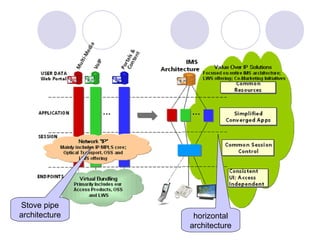
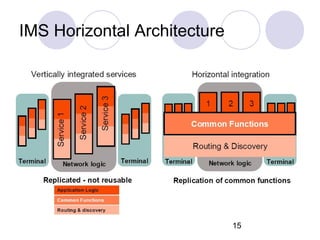
Stove pipe architecture horizontal architecture
Why IMS? Involved parties Operators, Users, Content Providers, Legal Authorities, … All-IP network Interactive Multimedia QoS guarantee Access transparency, seamless handover AAA, Billing, Charging Service Aggregation 3rd party Application Servers Services: No preferential treatment of voice Voice (VoIP) is just one service, positioned at same level like any other services Communication security in IP networks Signaling and Media Access and Core Regulatory requirements (lawful interception, …)
Contents Introduction IMS Overview IMS Applications/Services Conclusion References
IMS Definition The IMS is a standards-based architecture that provides: integrated Internet-based, multimedia, multi-session applications to mobile users at the same time guaranteeing QoS across different access network technologies and  allowing operators to charge transparently through any medium used.  Defined by 3GPP, 3GPP2 and TISPAN OMA (service interoperability), IETF (Internet standards)
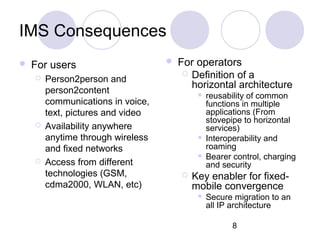
IMS Consequences For users Person2person and person2content communications in voice, text, pictures and video Availability anywhere anytime through wireless and fixed networks Access from different technologies (GSM, cdma2000, WLAN, etc) For operators Definition of a horizontal architecture  reusability of common functions in multiple applications (From stovepipe to horizontal services) Interoperability and roaming Bearer control, charging and security Key enabler for fixed-mobile convergence Secure migration to an all IP architecture
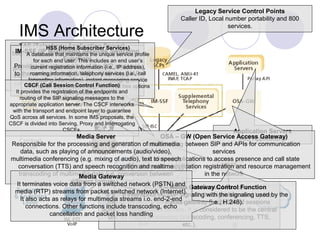
IMS Architecture Legacy Service Control Points Caller ID, Local number portability and 800 services. Application Servers IMS Applications OSA – GW (Open Service Access Gateway) inter-working between SIP and APIs for communication services It allows applications to access presence and call state information, application registration and resource management in the network Non-Telephony Services outside the telephony call model, such as Instant Messaging, Push To Talk and presence enabled TAS (Telephony Application Server) back-to-back SIP user agent that maintains the call state provides the basic call processing services including digit analysis, routing, call setup, call waiting, call forwarding, conferencing, etc. IM-SSF (IP Multimedia Services Switching Function) Provides the interworking of the SIP message to the corresponding CAMEL, ANSI-41, INAP or (TCAP) messages, services such as calling name, 800 services, etc. HSS (Home Subscriber Services) A database that maintains the unique service profile for each end user. This includes an end user’s current registration information (i.e., IP address), roaming information, telephony services (i.e., call forwarding information), instant messaging service information (i.e., buddies list), voice mail box options (i.e., greetings), etc.  CSCF (Call Session Control Function) It provides the registration of the endpoints and routing of the SIP signaling messages to the appropriate application server. The CSCF interworks with the transport and endpoint layer to guarantee QoS across all services. In some IMS proposals, the CSCF is divided into Serving, Proxy and Interrogating CSCFs. MRCF – Media Resource Control Function It interworks the SIP signaling with the signaling used by the media servers. It also manages the distribution of sessions across multiple media servers. It is considered to be the central unit for media processing (transcoding, conferencing, TTS, etc.), MGCF – Media Gateway Control Function It interworks the SIP signaling with the signaling used by the media gateway (i.e., H.248).  Media Server Responsible for the processing and generation of multimedia data, such as playing of announcements (audio/video), multimedia conferencing (e.g. mixing of audio), text to speech conversation (TTS) and speech recognition and realtime transcoding of multimedia data (i.e. conversion between different formats).  Media Gateway It terminates voice data from a switched network (PSTN) and media (RTP) streams from packet switched network (Internet). It also acts as relays for multimedia streams i.o. end-2-end connections. Other functions include transcoding, echo cancellation and packet loss handling
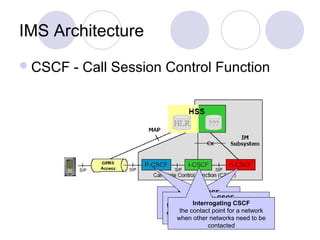
IMS Architecture CSCF - Call Session Control Function Serving CSCF SIP server that maintains session state for IMS services Proxy CSCF the first point of contact for the user entity and forward SIP messages to the user’s home S-CSCF Interrogating CSCF the contact point for a network when other networks need to be contacted
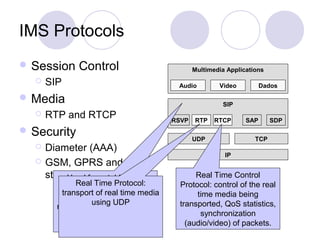
IMS Protocols Session Control SIP Media RTP and RTCP Security Diameter (AAA) GSM, GPRS and 3G standards IP UDP TCP SIP RSVP RTP RTCP SAP SDP Multimedia Applications Audio Video Dados Used for establishing, modifying and terminating multimedia sessions. It relies on other protocols for transport and QoS reservation. Real Time Protocol: transport of real time media using UDP Real Time Control Protocol: control of the real time media being transported, QoS statistics, synchronization (audio/video) of packets.
Contents Introduction IMS Overview IMS Applications/Services Conclusion References
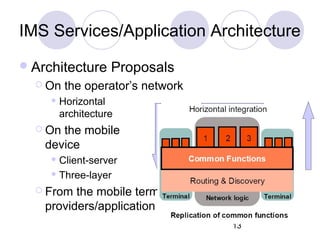
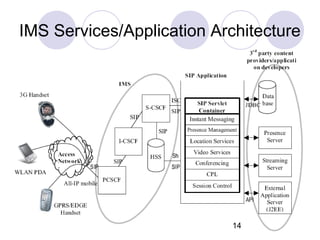
IMS Services/Application Architecture Architecture Proposals On the operator’s network Horizontal  architecture On the mobile  device Client-server Three-layer From the mobile terminal down to the content providers/application developers
IMS Services/Application Architecture
IMS Horizontal Architecture
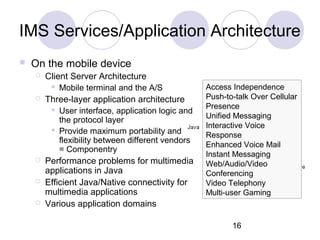
IMS Services/Application Architecture On the mobile device Client Server Architecture Mobile terminal and the A/S Three-layer application architecture User interface, application logic and the protocol layer Provide maximum portability and flexibility between different vendors = Componentry Performance problems for multimedia applications in Java Efficient Java/Native connectivity for multimedia applications Various application domains Access Independence Push-to-talk Over Cellular Presence Unified Messaging Interactive Voice Response Enhanced Voice Mail Instant Messaging Web/Audio/Video Conferencing Video Telephony Multi-user Gaming
Contents Introduction IMS Overview IMS Applications/Services Conclusion References
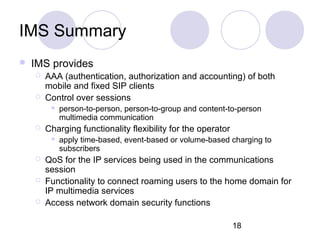
IMS Summary IMS provides AAA (authentication, authorization and accounting) of both mobile and fixed SIP clients Control over sessions person-to-person, person-to-group and content-to-person multimedia communication Charging functionality flexibility for the operator  apply time-based, event-based or volume-based charging to subscribers QoS for the IP services being used in the communications session Functionality to connect roaming users to the home domain for IP multimedia services Access network domain security functions
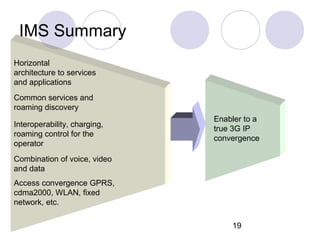
IMS Summary Horizontal architecture to services and applications Common services and roaming discovery Interoperability, charging, roaming control for the operator Combination of voice, video and data Access convergence GPRS, cdma2000, WLAN, fixed network, etc. Enabler to a  true 3G IP  convergence
Conclusion Issues/Challenges Costs of conversion to IMS Competition and market divergence Performance Security
Contents Introduction IMS Overview IMS Applications/Services Conclusion References
References [1] V. Koukoulidis and M. Shah, The IP Multimedia Domain in Wireless Networks: Concepts, Architecture, Protocols and Applications, Siemens Information and Communication Mobile, Boca Raton, Fl, Proceedings of the IEEE Sixth International Symposium on Multimedia Software Engineering (ISMSE’04), IEEE, 2004.  [2] P. Polvora, C. Öström, Plan Your IP-Competence Strategically, Ericsson Seminar, http://www.ericsson.com/learning, April 2005, Ericsson AB 2005. [3] 3GPP Homepage, http://www.3gpp.org/specs/specs.htm [4] Open Mobile Alliance (OMA) Homepage,  http:// www.openmobilealliance.org [5] Session Initiation Protocol Charter Homepage,  http://www.ietf.org/html.charters/sip-charter.html
References [6] IP Multimedia Subsystem (IMS): Service Architecture, Lucent Technologies, February, 2005,  [7] IMS – IP Multimedia Subsystem: The value of using the IMS architecture, White Paper, Ericsson, October 2004,  [8] Motorola IP Multimedia System White Paper, February, 2004,  [9] IP Multimedia: a New Era in Communications, Nokia White Paper,  [10] The Protocol Dictionary Homepage,  http://www.javvin.com/protocolH245.html [11] P. Howard, 3GPP Security and Authentication, September 13, 2001,  http://www.ietf.org/proceedings/01aug/slides/sipping-7/index.htm
References [12] Open IMS Homepage,  http://www.fokus.gmd.de/bereichsseiten/testbeds/ims_playground/playground/hss.php?lang =de [13] 3GPP TS 23.228: "IP Multimedia Subsystem (IMS)" [14] IETF RFC 3261: "SIP: Session Initiation Protocol" [15] 3GPP TS 23.218: "IP Multimedia (IM) session handling, IM call model" [16] 3GPP TS 29.228:" IP Multimedia (IM) Subsystem Cx Interface; Signalling flows and message contents" [17] The Parlay Group homepage,  http:// www.parlay.org / [18] H. Montes, G Gomez, H Cuny, Nokia Networks, J. Paris, Deployment of IP Multimedia Streaming Services in Third Generation Mobile Networks, IEEE Wireless Communications, October 2002 [19] Siemens IP Multimedia Subsystem (IMS): The Domain for Services, Whitepaper

IMS IP multimedia subsystem presentation

  • 1.
    IMS – IPMultimedia Subsystem Architecture, Protocols and Services Waldir R Pires Jr Siemens Manaus 2005.06.21
  • 2.
    Contents Introduction IMSOverview IMS Applications/Services Conclusion References
  • 3.
    Introduction Shift towardsan all IP system Reasons Reduction of costs, creation of new revenue Increased competition and innovation demands Internet coverage Merge of fixed and mobile networks Services today are obsolete Multimedia services not yet available to the mobile networks – a natural evolution Common Infrastructure for services
  • 4.
    Stove pipe architecturehorizontal architecture
  • 5.
    Why IMS? Involvedparties Operators, Users, Content Providers, Legal Authorities, … All-IP network Interactive Multimedia QoS guarantee Access transparency, seamless handover AAA, Billing, Charging Service Aggregation 3rd party Application Servers Services: No preferential treatment of voice Voice (VoIP) is just one service, positioned at same level like any other services Communication security in IP networks Signaling and Media Access and Core Regulatory requirements (lawful interception, …)
  • 6.
    Contents Introduction IMSOverview IMS Applications/Services Conclusion References
  • 7.
    IMS Definition TheIMS is a standards-based architecture that provides: integrated Internet-based, multimedia, multi-session applications to mobile users at the same time guaranteeing QoS across different access network technologies and allowing operators to charge transparently through any medium used. Defined by 3GPP, 3GPP2 and TISPAN OMA (service interoperability), IETF (Internet standards)
  • 8.
    IMS Consequences Forusers Person2person and person2content communications in voice, text, pictures and video Availability anywhere anytime through wireless and fixed networks Access from different technologies (GSM, cdma2000, WLAN, etc) For operators Definition of a horizontal architecture reusability of common functions in multiple applications (From stovepipe to horizontal services) Interoperability and roaming Bearer control, charging and security Key enabler for fixed-mobile convergence Secure migration to an all IP architecture
  • 9.
    IMS Architecture LegacyService Control Points Caller ID, Local number portability and 800 services. Application Servers IMS Applications OSA – GW (Open Service Access Gateway) inter-working between SIP and APIs for communication services It allows applications to access presence and call state information, application registration and resource management in the network Non-Telephony Services outside the telephony call model, such as Instant Messaging, Push To Talk and presence enabled TAS (Telephony Application Server) back-to-back SIP user agent that maintains the call state provides the basic call processing services including digit analysis, routing, call setup, call waiting, call forwarding, conferencing, etc. IM-SSF (IP Multimedia Services Switching Function) Provides the interworking of the SIP message to the corresponding CAMEL, ANSI-41, INAP or (TCAP) messages, services such as calling name, 800 services, etc. HSS (Home Subscriber Services) A database that maintains the unique service profile for each end user. This includes an end user’s current registration information (i.e., IP address), roaming information, telephony services (i.e., call forwarding information), instant messaging service information (i.e., buddies list), voice mail box options (i.e., greetings), etc. CSCF (Call Session Control Function) It provides the registration of the endpoints and routing of the SIP signaling messages to the appropriate application server. The CSCF interworks with the transport and endpoint layer to guarantee QoS across all services. In some IMS proposals, the CSCF is divided into Serving, Proxy and Interrogating CSCFs. MRCF – Media Resource Control Function It interworks the SIP signaling with the signaling used by the media servers. It also manages the distribution of sessions across multiple media servers. It is considered to be the central unit for media processing (transcoding, conferencing, TTS, etc.), MGCF – Media Gateway Control Function It interworks the SIP signaling with the signaling used by the media gateway (i.e., H.248). Media Server Responsible for the processing and generation of multimedia data, such as playing of announcements (audio/video), multimedia conferencing (e.g. mixing of audio), text to speech conversation (TTS) and speech recognition and realtime transcoding of multimedia data (i.e. conversion between different formats). Media Gateway It terminates voice data from a switched network (PSTN) and media (RTP) streams from packet switched network (Internet). It also acts as relays for multimedia streams i.o. end-2-end connections. Other functions include transcoding, echo cancellation and packet loss handling
  • 10.
    IMS Architecture CSCF- Call Session Control Function Serving CSCF SIP server that maintains session state for IMS services Proxy CSCF the first point of contact for the user entity and forward SIP messages to the user’s home S-CSCF Interrogating CSCF the contact point for a network when other networks need to be contacted
  • 11.
    IMS Protocols SessionControl SIP Media RTP and RTCP Security Diameter (AAA) GSM, GPRS and 3G standards IP UDP TCP SIP RSVP RTP RTCP SAP SDP Multimedia Applications Audio Video Dados Used for establishing, modifying and terminating multimedia sessions. It relies on other protocols for transport and QoS reservation. Real Time Protocol: transport of real time media using UDP Real Time Control Protocol: control of the real time media being transported, QoS statistics, synchronization (audio/video) of packets.
  • 12.
    Contents Introduction IMSOverview IMS Applications/Services Conclusion References
  • 13.
    IMS Services/Application ArchitectureArchitecture Proposals On the operator’s network Horizontal architecture On the mobile device Client-server Three-layer From the mobile terminal down to the content providers/application developers
  • 14.
  • 15.
  • 16.
    IMS Services/Application ArchitectureOn the mobile device Client Server Architecture Mobile terminal and the A/S Three-layer application architecture User interface, application logic and the protocol layer Provide maximum portability and flexibility between different vendors = Componentry Performance problems for multimedia applications in Java Efficient Java/Native connectivity for multimedia applications Various application domains Access Independence Push-to-talk Over Cellular Presence Unified Messaging Interactive Voice Response Enhanced Voice Mail Instant Messaging Web/Audio/Video Conferencing Video Telephony Multi-user Gaming
  • 17.
    Contents Introduction IMSOverview IMS Applications/Services Conclusion References
  • 18.
    IMS Summary IMSprovides AAA (authentication, authorization and accounting) of both mobile and fixed SIP clients Control over sessions person-to-person, person-to-group and content-to-person multimedia communication Charging functionality flexibility for the operator apply time-based, event-based or volume-based charging to subscribers QoS for the IP services being used in the communications session Functionality to connect roaming users to the home domain for IP multimedia services Access network domain security functions
  • 19.
    IMS Summary Horizontalarchitecture to services and applications Common services and roaming discovery Interoperability, charging, roaming control for the operator Combination of voice, video and data Access convergence GPRS, cdma2000, WLAN, fixed network, etc. Enabler to a true 3G IP convergence
  • 20.
    Conclusion Issues/Challenges Costsof conversion to IMS Competition and market divergence Performance Security
  • 21.
    Contents Introduction IMSOverview IMS Applications/Services Conclusion References
  • 22.
    References [1] V.Koukoulidis and M. Shah, The IP Multimedia Domain in Wireless Networks: Concepts, Architecture, Protocols and Applications, Siemens Information and Communication Mobile, Boca Raton, Fl, Proceedings of the IEEE Sixth International Symposium on Multimedia Software Engineering (ISMSE’04), IEEE, 2004. [2] P. Polvora, C. Öström, Plan Your IP-Competence Strategically, Ericsson Seminar, http://www.ericsson.com/learning, April 2005, Ericsson AB 2005. [3] 3GPP Homepage, http://www.3gpp.org/specs/specs.htm [4] Open Mobile Alliance (OMA) Homepage, http:// www.openmobilealliance.org [5] Session Initiation Protocol Charter Homepage, http://www.ietf.org/html.charters/sip-charter.html
  • 23.
    References [6] IPMultimedia Subsystem (IMS): Service Architecture, Lucent Technologies, February, 2005, [7] IMS – IP Multimedia Subsystem: The value of using the IMS architecture, White Paper, Ericsson, October 2004, [8] Motorola IP Multimedia System White Paper, February, 2004, [9] IP Multimedia: a New Era in Communications, Nokia White Paper, [10] The Protocol Dictionary Homepage, http://www.javvin.com/protocolH245.html [11] P. Howard, 3GPP Security and Authentication, September 13, 2001, http://www.ietf.org/proceedings/01aug/slides/sipping-7/index.htm
  • 24.
    References [12] OpenIMS Homepage, http://www.fokus.gmd.de/bereichsseiten/testbeds/ims_playground/playground/hss.php?lang =de [13] 3GPP TS 23.228: "IP Multimedia Subsystem (IMS)" [14] IETF RFC 3261: "SIP: Session Initiation Protocol" [15] 3GPP TS 23.218: "IP Multimedia (IM) session handling, IM call model" [16] 3GPP TS 29.228:" IP Multimedia (IM) Subsystem Cx Interface; Signalling flows and message contents" [17] The Parlay Group homepage, http:// www.parlay.org / [18] H. Montes, G Gomez, H Cuny, Nokia Networks, J. Paris, Deployment of IP Multimedia Streaming Services in Third Generation Mobile Networks, IEEE Wireless Communications, October 2002 [19] Siemens IP Multimedia Subsystem (IMS): The Domain for Services, Whitepaper