Presented By LOKESH GUPTA RAKESH SONAR MANISH PANDEY VIKASH SHARMA BAIJNATH MANDAL ADITYA MAHAKULKAR ETOM PROCESS MODEL Balaji Institute Of Telecom Management ( BITM) Pune
Purpose of the framework Service providers require well-automated operations processes They are faced with  ever-increasing competition unpredictable market  an industry undergoing shakeup. The challenges before the service providers are  Quickly provisioning new customers  Service quality issues Introduction of  new value-added services  Improvements in customer support.  Manage the integration required in mergers and acquisitions activity due to the consolidation trend the industry is now experiencing.
Objective behind TOM & eTOM An ‘Industry owned’  common business process model Common definitions to  describe processes of a Service Provider Agreement on the basic  information required to perform each process , sub-process and process activity A process framework for identifying which processes and interfaces are in most  need of integration and automation
Purpose of the framework is to implement a process driven approach for managing the enterprise. Ensure integration among all vital ESS. The focus of eTOM is on the business processes The linkages between the processes Identification of interfaces Common definition of terms Agreement on basic information required for each process and identification of interfaces
Concept of ETOM The eTOM (enhanced Telecom Operations Map) is a guidebook, the most widely used and accepted standard for business processes in the telecommunications industry. common companion of  ITIL. these frameworks are part of the larger context of Total Quality Management. ITU-T International Recommendation, known in 2004. follow a customer focused pattern.
Strategies within ETOM suggest business-to-customer relationship Also business-to-business relationships ETOM is the product of the TeleManagement Forum. part of the International Telecommunications Union. developed in 1995. through  contributions of more than 35 TMF member companies and was formally approved by the ITU in 2004. ETOM  describes all the enterprise processes required by a service provider and analyzes them. strength of eTOM as a business process framework is that it is part of the TM Forum NGOSS program and links with other work underway in NGOSS
 
 
Some Standard ITIL ISO9000 ETOM The eTOM team is responsible for capturing and representing business requirements in the form of business process models, and for developing and publishing these in the eTOM documentation.
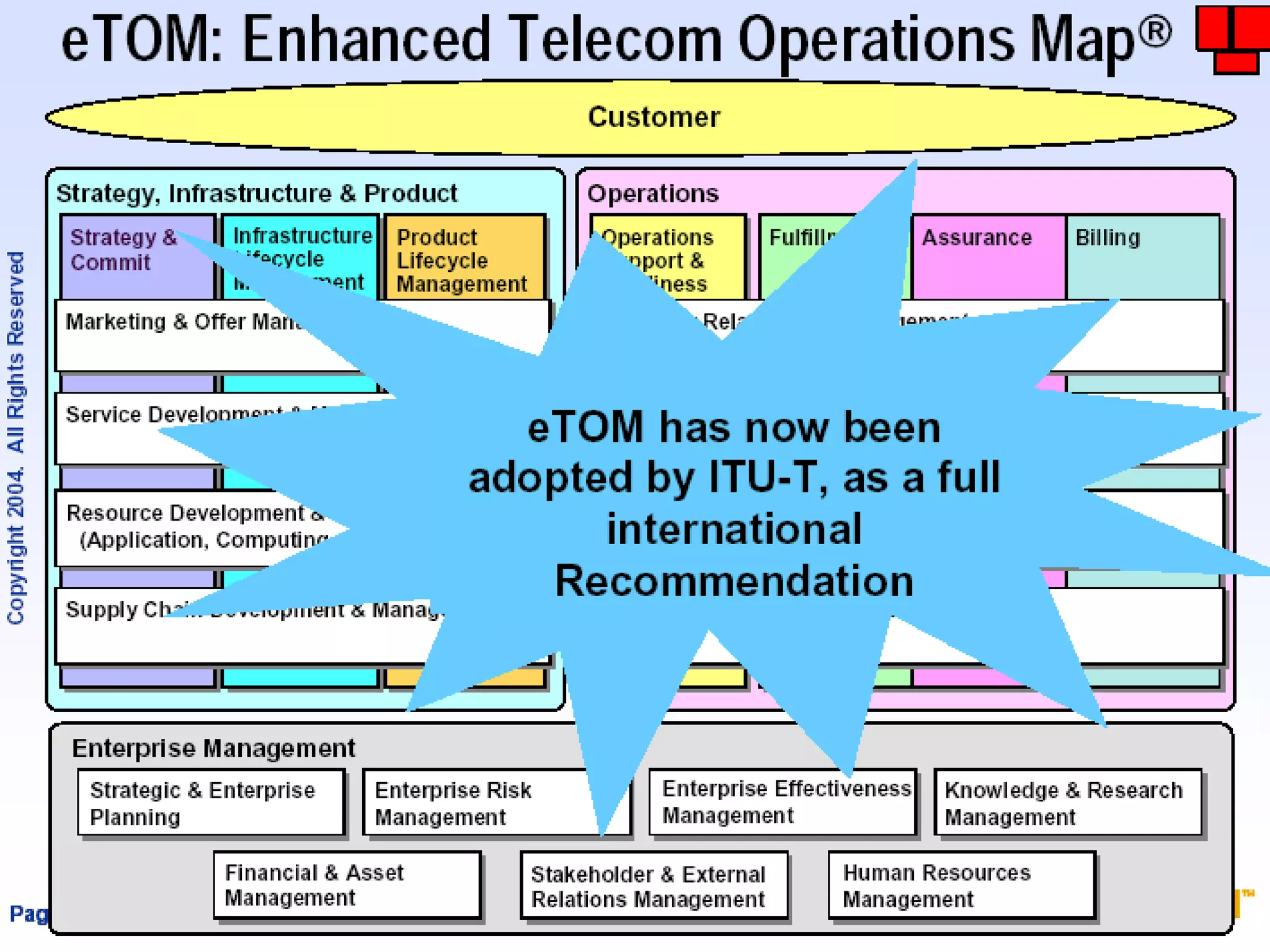
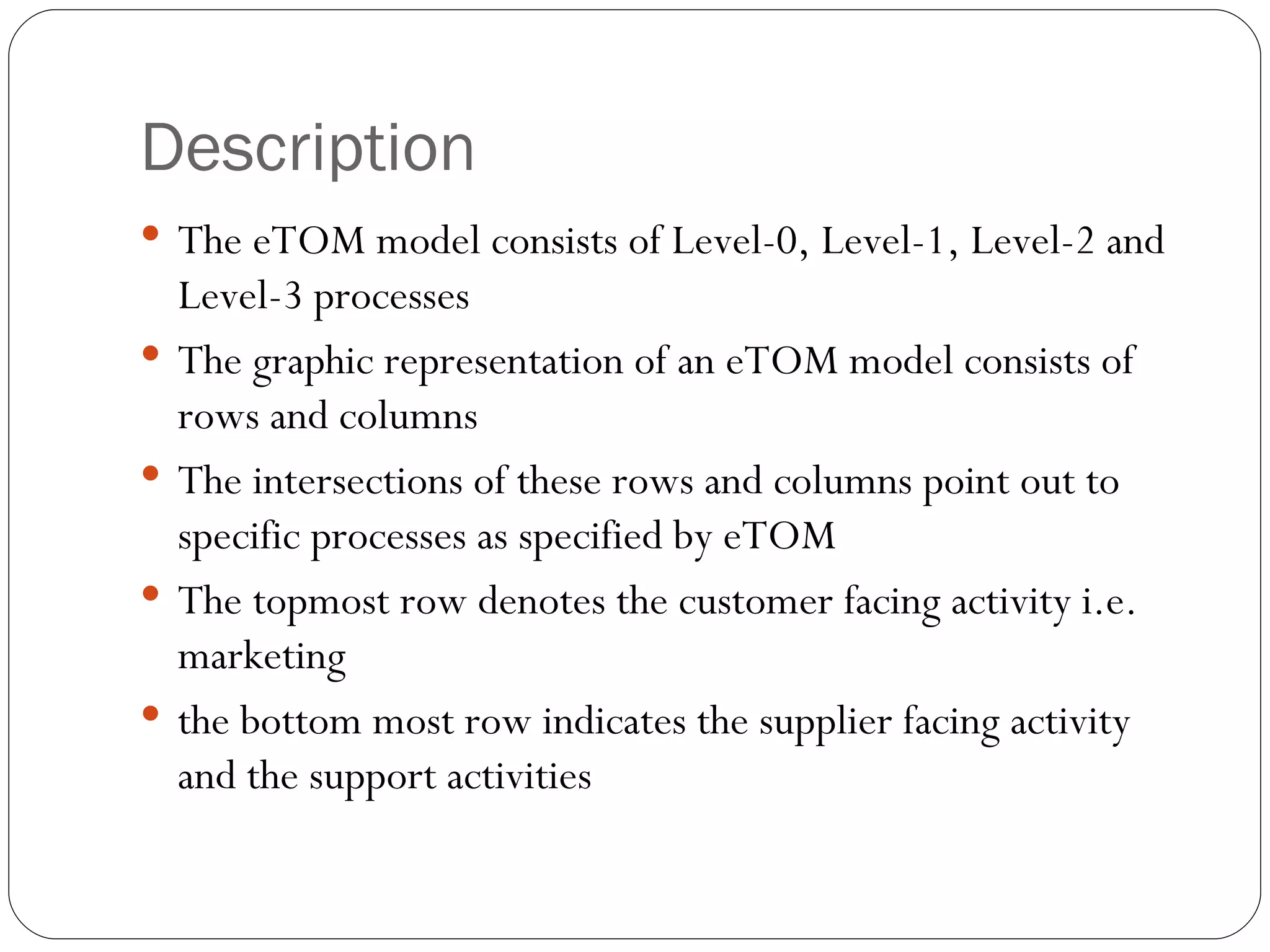
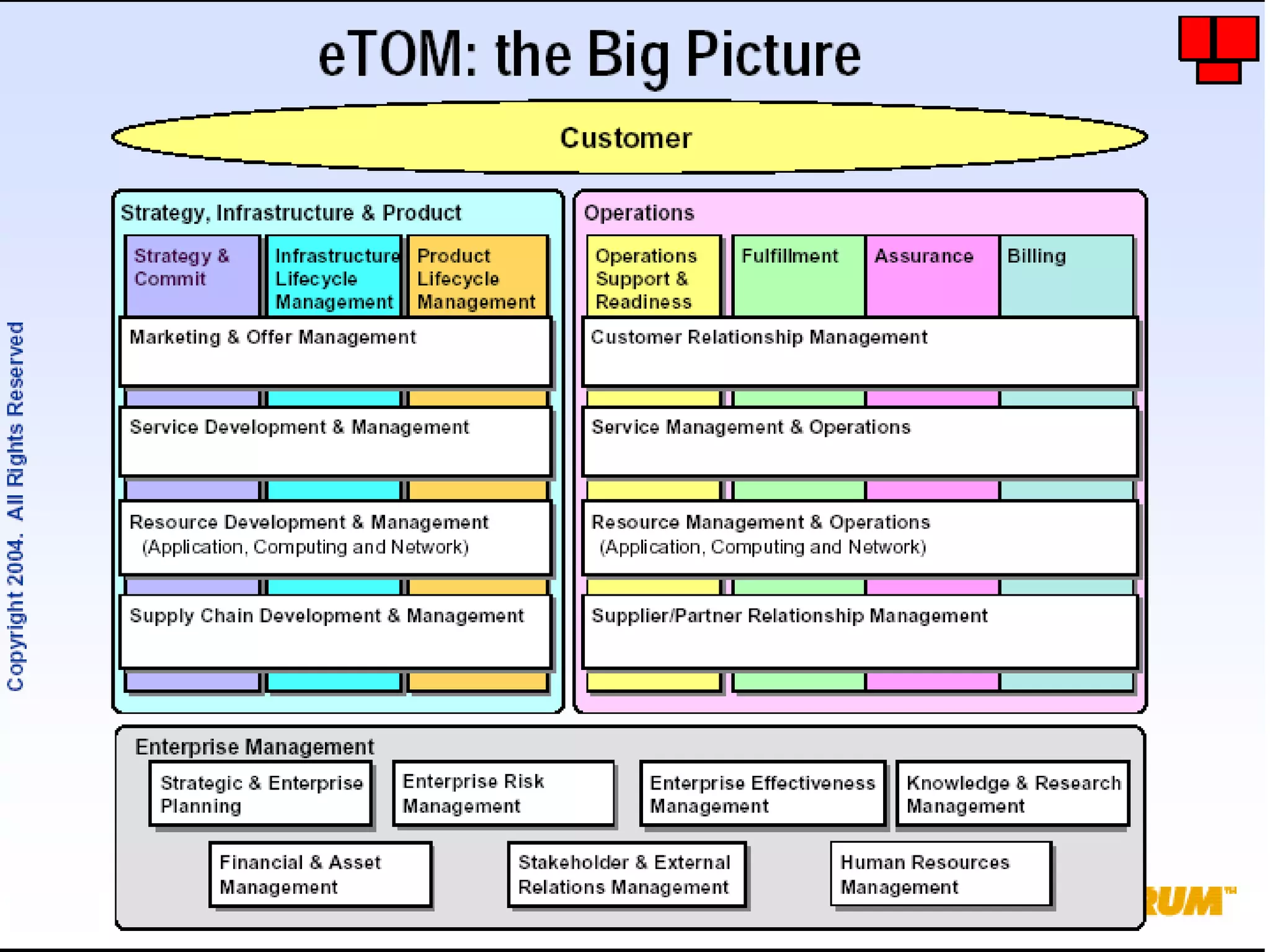
Description The eTOM model consists of Level-0, Level-1, Level-2 and Level-3 processes The graphic representation of an eTOM model consists of rows and columns The intersections of these rows and columns point out to specific processes as specified by eTOM The topmost row denotes the customer facing activity i.e. marketing the bottom most row indicates the supplier facing activity and the support activities


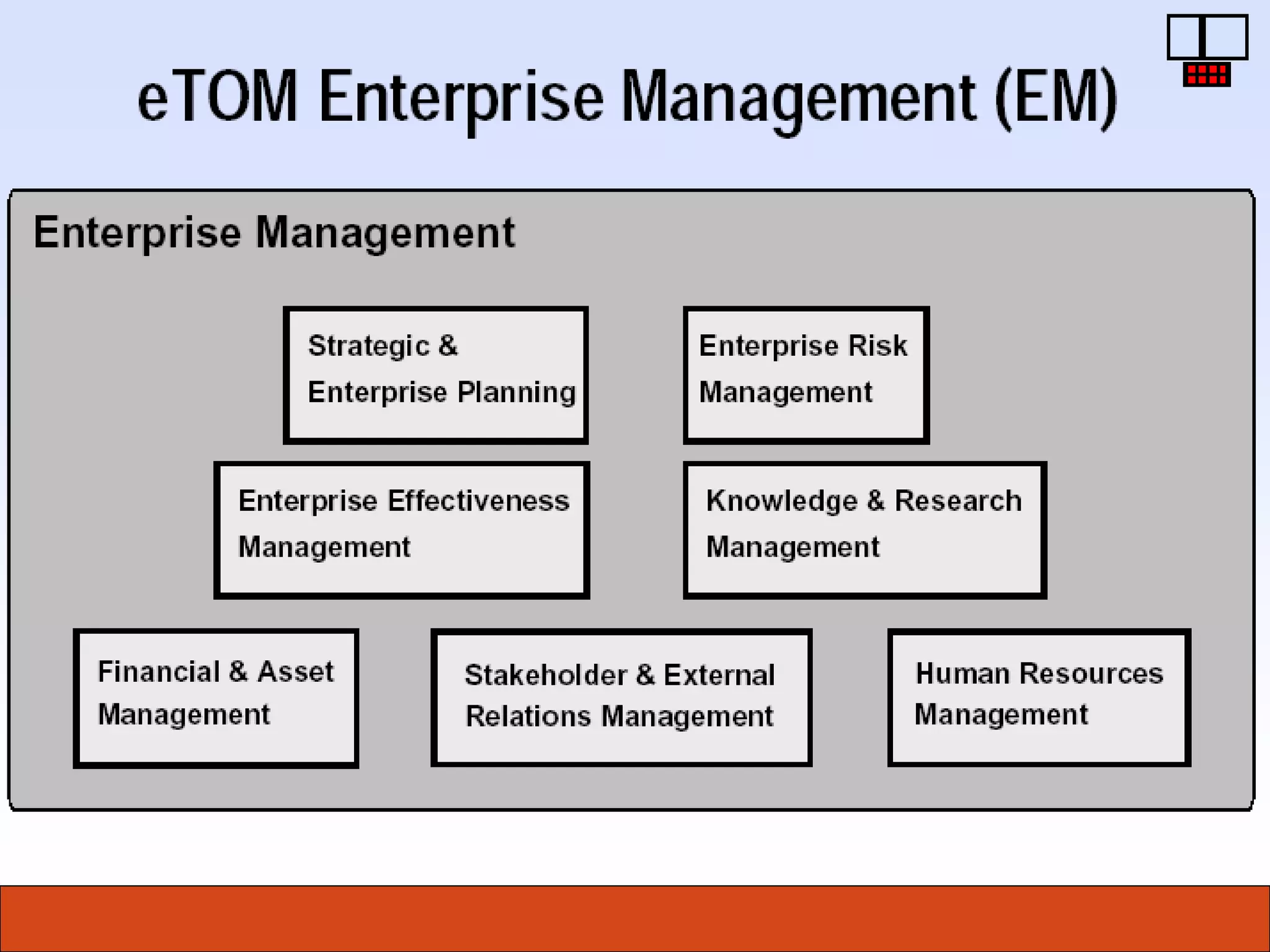
Advantages It develops a scope addressing all enterprise processes. It distinctly identifies marketing processes to reflect their heightened importance in an e business world. It distinctly identifies Enterprise Management processes, so that everyone in the enterprise is able to identify their critical processes, thereby enabling process framework acceptance across the enterprise. It brings Fulfillment, Assurance and Billing (FAB) onto the high-level framework view to emphasize the customer priority processes as the focus of the enterprise
eTOM Models
The eTOM Business Relationship Context Model
Service Provider Relationships
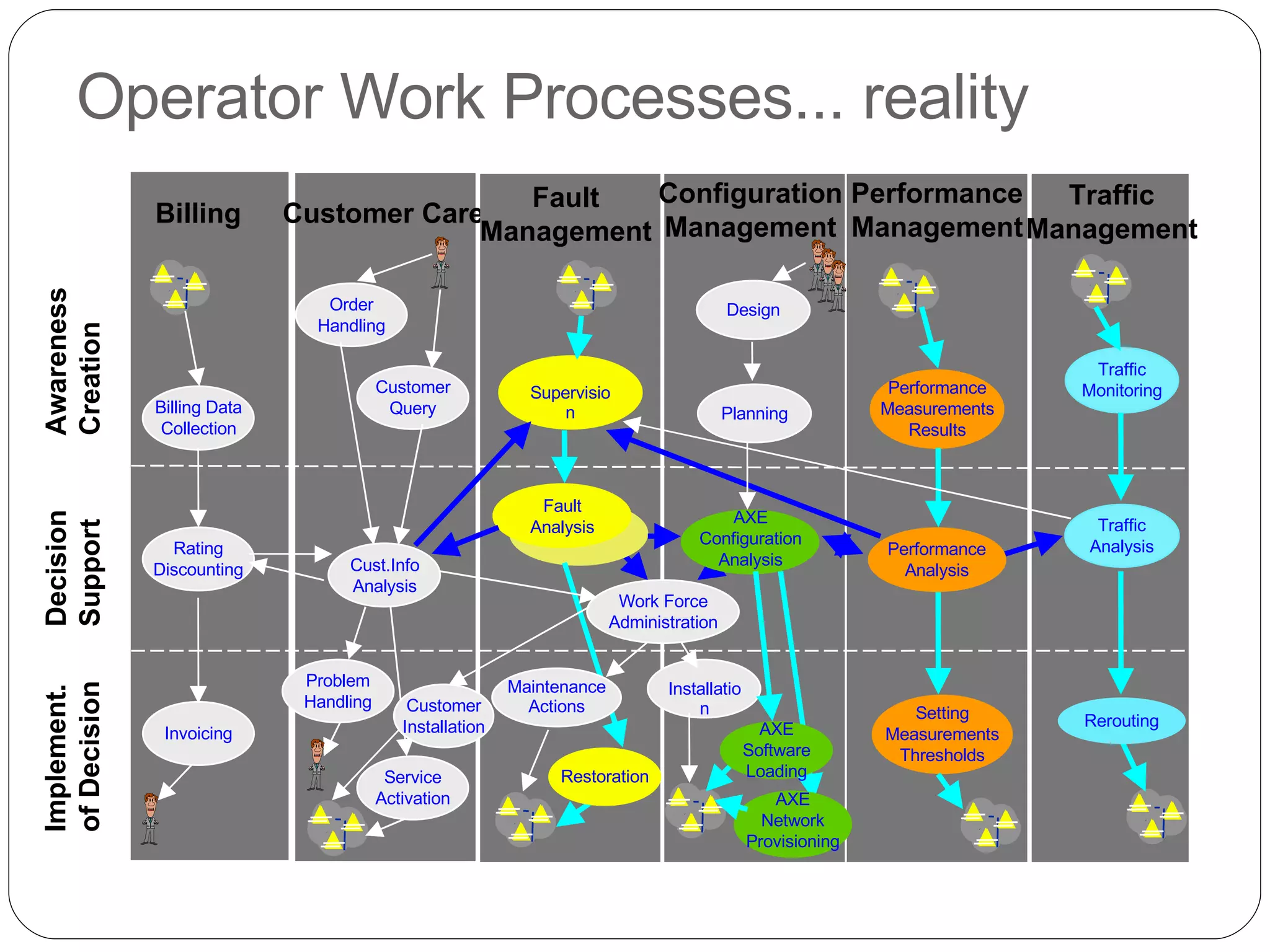
Operator Work Processes... reality Customer Care Performance Management Fault Management Configuration Management Billing Traffic Management Awareness Creation Decision Support Implement. of Decision Supervision Restoration Fault Analysis Traffic Monitoring Traffic Analysis Rerouting Performance Measurements Results Setting Measurements Thresholds Performance Analysis Maintenance Actions Work Force Administration Billing Data Collection Invoicing Rating Discounting Order Handling Customer Query Cust.Info Analysis Service Activation Design Installation Problem Handling Planning Customer Installation AXE Network Provisioning AXE Configuration Analysis AXE Software Loading
Other Operators eTOM is a framework for defining your own processes, not the final  answer itself. Fault Analysis Performance Data  Collection Service Inventory Resource Inventory Customer Care Order Manager Network Activator Other OSS Supervision  Usage Data  Collection Fault Data  Collection Fault Management Service Activation Billing &  Rating Quality of Service   Billing Product Inventory Inventory
Any J2EE-Compliant Application Server EMS EMS NMS NMS EMS Connector API Java API XML API Java upon JMS/IIOP/RMI XML upon JMS Java upon JMS/IIOP/RMI XML upon JMS Third-Party Solutions JAXR  ebXML JAXM  SOAP JAX-RPC UDDI WSDL B2B Web Services enabled Solutions Legacy Solutions API XML  enabled Application XML API Wrapping and Adapters Strategies Connector Legacy Application Native Implementations API J2EE Application API XML Application


Etom

  • 1.
    Presented By LOKESHGUPTA RAKESH SONAR MANISH PANDEY VIKASH SHARMA BAIJNATH MANDAL ADITYA MAHAKULKAR ETOM PROCESS MODEL Balaji Institute Of Telecom Management ( BITM) Pune
  • 2.
    Purpose of theframework Service providers require well-automated operations processes They are faced with ever-increasing competition unpredictable market an industry undergoing shakeup. The challenges before the service providers are Quickly provisioning new customers Service quality issues Introduction of new value-added services Improvements in customer support. Manage the integration required in mergers and acquisitions activity due to the consolidation trend the industry is now experiencing.
  • 3.
    Objective behind TOM& eTOM An ‘Industry owned’ common business process model Common definitions to describe processes of a Service Provider Agreement on the basic information required to perform each process , sub-process and process activity A process framework for identifying which processes and interfaces are in most need of integration and automation
  • 4.
    Purpose of theframework is to implement a process driven approach for managing the enterprise. Ensure integration among all vital ESS. The focus of eTOM is on the business processes The linkages between the processes Identification of interfaces Common definition of terms Agreement on basic information required for each process and identification of interfaces
  • 5.
    Concept of ETOMThe eTOM (enhanced Telecom Operations Map) is a guidebook, the most widely used and accepted standard for business processes in the telecommunications industry. common companion of ITIL. these frameworks are part of the larger context of Total Quality Management. ITU-T International Recommendation, known in 2004. follow a customer focused pattern.
  • 6.
    Strategies within ETOMsuggest business-to-customer relationship Also business-to-business relationships ETOM is the product of the TeleManagement Forum. part of the International Telecommunications Union. developed in 1995. through contributions of more than 35 TMF member companies and was formally approved by the ITU in 2004. ETOM describes all the enterprise processes required by a service provider and analyzes them. strength of eTOM as a business process framework is that it is part of the TM Forum NGOSS program and links with other work underway in NGOSS
  • 7.
  • 8.
  • 9.
    Some Standard ITILISO9000 ETOM The eTOM team is responsible for capturing and representing business requirements in the form of business process models, and for developing and publishing these in the eTOM documentation.
  • 10.
    Description The eTOMmodel consists of Level-0, Level-1, Level-2 and Level-3 processes The graphic representation of an eTOM model consists of rows and columns The intersections of these rows and columns point out to specific processes as specified by eTOM The topmost row denotes the customer facing activity i.e. marketing the bottom most row indicates the supplier facing activity and the support activities
  • 11.
  • 12.
  • 13.
  • 14.
  • 15.
  • 16.
  • 17.
  • 18.
  • 19.
  • 20.
  • 21.
  • 22.
  • 23.
    Advantages It developsa scope addressing all enterprise processes. It distinctly identifies marketing processes to reflect their heightened importance in an e business world. It distinctly identifies Enterprise Management processes, so that everyone in the enterprise is able to identify their critical processes, thereby enabling process framework acceptance across the enterprise. It brings Fulfillment, Assurance and Billing (FAB) onto the high-level framework view to emphasize the customer priority processes as the focus of the enterprise
  • 24.
  • 25.
    The eTOM BusinessRelationship Context Model
  • 26.
  • 27.
    Operator Work Processes...reality Customer Care Performance Management Fault Management Configuration Management Billing Traffic Management Awareness Creation Decision Support Implement. of Decision Supervision Restoration Fault Analysis Traffic Monitoring Traffic Analysis Rerouting Performance Measurements Results Setting Measurements Thresholds Performance Analysis Maintenance Actions Work Force Administration Billing Data Collection Invoicing Rating Discounting Order Handling Customer Query Cust.Info Analysis Service Activation Design Installation Problem Handling Planning Customer Installation AXE Network Provisioning AXE Configuration Analysis AXE Software Loading
  • 28.
    Other Operators eTOMis a framework for defining your own processes, not the final answer itself. Fault Analysis Performance Data Collection Service Inventory Resource Inventory Customer Care Order Manager Network Activator Other OSS Supervision Usage Data Collection Fault Data Collection Fault Management Service Activation Billing & Rating Quality of Service Billing Product Inventory Inventory
  • 29.
    Any J2EE-Compliant ApplicationServer EMS EMS NMS NMS EMS Connector API Java API XML API Java upon JMS/IIOP/RMI XML upon JMS Java upon JMS/IIOP/RMI XML upon JMS Third-Party Solutions JAXR ebXML JAXM SOAP JAX-RPC UDDI WSDL B2B Web Services enabled Solutions Legacy Solutions API XML enabled Application XML API Wrapping and Adapters Strategies Connector Legacy Application Native Implementations API J2EE Application API XML Application
  • 30.
  • 31.