IP Multimedia Subsystem (IMS) standards 2010 Telecom Master Class
Agenda 2G - 3G – 4G : UMTS & IMS IMS Overview and components Architecture & Call flows Migration to IMS Summary
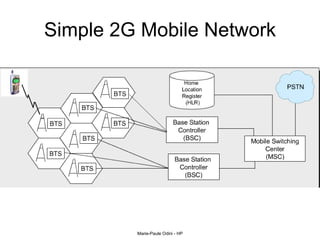
Simple 2G Mobile Network
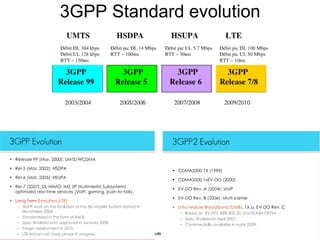
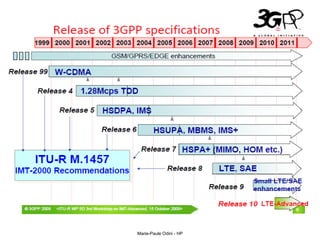
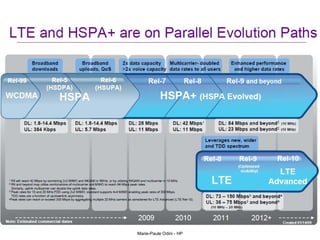
3GPP Standard evolution


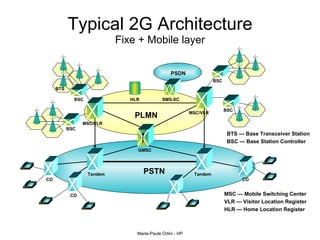
Typical 2G Architecture Fixe + Mobile layer BTS — Base Transceiver Station  BSC — Base Station Controller MSC — Mobile Switching Center VLR — Visitor Location Register HLR — Home Location Register BTS BSC MSC/VLR HLR BSC GMSC CO BSC BSC MSC/VLR CO PSTN PLMN CO Tandem Tandem SMS-SC PSDN
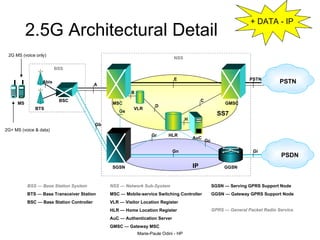
2.5G Architectural Detail BSS — Base Station System BTS — Base Transceiver Station BSC — Base Station Controller  NSS — Network Sub-System MSC — Mobile-service Switching Controller VLR — Visitor Location Register HLR — Home Location Register AuC — Authentication Server GMSC — Gateway MSC SGSN — Serving GPRS Support Node GGSN — Gateway GPRS Support Node GPRS — General Packet Radio Service 2G MS (voice only) + DATA - IP SS7 BTS BSC MSC VLR HLR AuC GMSC BSS PSTN NSS A E C D PSTN Abis B H MS IP 2G+ MS (voice & data) PSDN Gi SGSN Gr Gb Gs GGSN Gc Gn
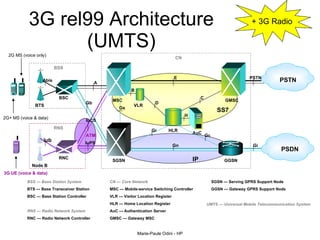
3G rel99 Architecture (UMTS) SS7 IP BTS BSC MSC VLR HLR AuC GMSC BSS SGSN GGSN PSTN PSDN CN Gs BSS — Base Station System BTS — Base Transceiver Station BSC — Base Station Controller RNS — Radio Network System RNC — Radio Network Controller CN — Core Network MSC — Mobile-service Switching Controller VLR — Visitor Location Register HLR — Home Location Register AuC — Authentication Server GMSC — Gateway MSC SGSN — Serving GPRS Support Node GGSN — Gateway GPRS Support Node A E PSTN 2G MS (voice only) 2G+ MS (voice & data) UMTS — Universal Mobile Telecommunication System Gb 3G UE (voice & data) Node B RNC RNS IuCS ATM + 3G Radio C D Gc Gr Gn Gi Abis B H Iub IuPS
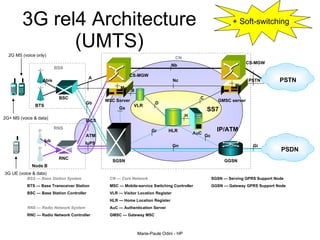
3G rel4 Architecture (UMTS) + Soft-switching SS7 IP/ATM BTS BSC MSC Server VLR HLR AuC GMSC server BSS SGSN GGSN PSTN PSDN CN C D Gc Gr Gn Gi Gb Abis Gs B H BSS — Base Station System BTS — Base Transceiver Station BSC — Base Station Controller RNS — Radio Network System RNC — Radio Network Controller CN — Core Network MSC — Mobile-service Switching Controller VLR — Visitor Location Register HLR — Home Location Register AuC — Authentication Server GMSC — Gateway MSC SGSN — Serving GPRS Support Node GGSN — Gateway GPRS Support Node A Nc 2G MS (voice only) 2G+ MS (voice & data) Node B RNC RNS Iub IuCS IuPS 3G UE (voice & data) Mc CS-MGW CS-MGW Nb PSTN Mc ATM
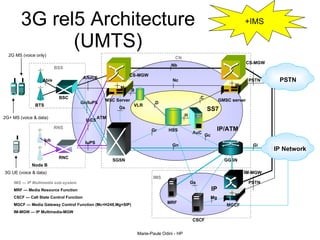
3G rel5 Architecture (UMTS) SS7 IP/ATM BTS BSC MSC Server VLR HSS AuC GMSC server BSS SGSN GGSN PSTN CN Gs IMS — IP Multimedia sub-system MRF — Media Resource Function CSCF — Call State Control Function MGCF — Media Gateway Control Function (Mc=H248,Mg=SIP) IM-MGW — IP Multimedia-MGW Nc 2G MS (voice only) 2G+ MS (voice & data) Node B RNC RNS 3G UE (voice & data) CS-MGW CS-MGW Nb PSTN IuCS IuPS ATM IMS IP PSTN MGCF IM-MGW IP Network +IMS  Gb/IuPS A/IuCS C D Gc Gr Gn Gi Abis B H Iub Mc Mc Mc MRF CSCF Mg Gs
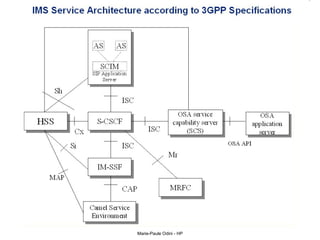
3GPP view of IMS
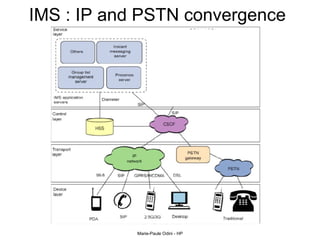
IMS : IP and PSTN convergence
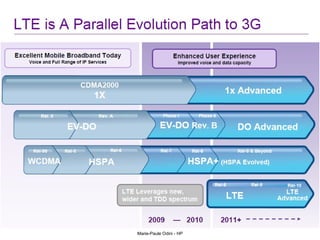
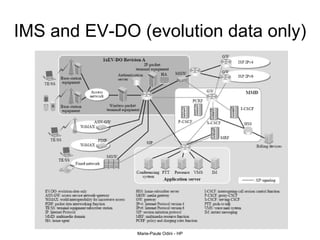
IMS and EV-DO (evolution data only)
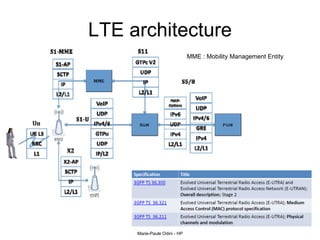
LTE architecture MME : Mobility Management Entity
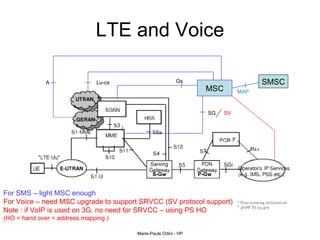
LTE and Voice MSC SMSC MAP Gs SG Lu-cs A For SMS – light MSC enough  For Voice – need MSC upgrade to support SRVCC (SV protocol support) Note : if VoIP is used on 3G, no need for SRVCC – using PS HO  (HO = hand over = address mapping ) SV S-Gw P-Gw F
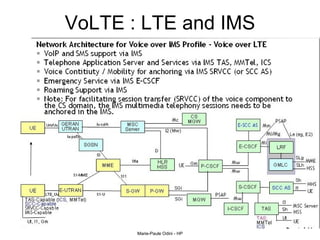
VoLTE : LTE and IMS
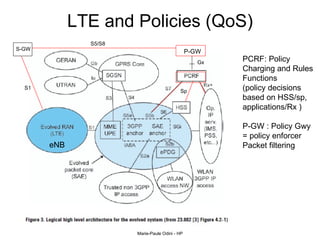
LTE and Policies (QoS) PCRF: Policy Charging and Rules Functions (policy decisions based on HSS/sp, applications/Rx ) P-GW : Policy Gwy = policy enforcer Packet filtering P-GW Gx S-GW S1 S5/S8 Sp eNB
IMS overview
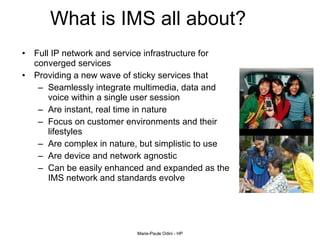
What is IMS all about? Full IP network and service infrastructure for converged services  Providing a new wave of sticky services that Seamlessly integrate multimedia, data and voice within a single user session Are instant, real time in nature  Focus on customer environments and their lifestyles Are complex in nature, but simplistic to use Are device and network agnostic Can be easily enhanced and expanded as the IMS network and standards evolve
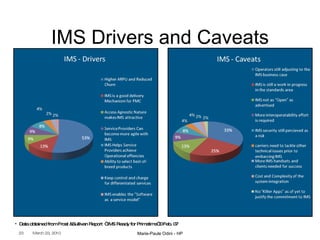
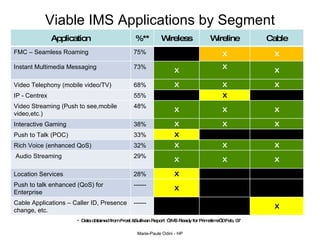
IMS Drivers and Caveats March 23, 2010 Data obtained from Frost &Sullivan Report  “ IMS Ready for Primetime” – Feb. 07
Viable IMS Applications by Segment Data obtained from Frost &Sullivan Report  “ IMS Ready for Primetime” – Feb. 07 X X X 32% Rich Voice (enhanced QoS) X X X 29% Audio Streaming X X X 48% Video Streaming (Push to see,mobile video,etc.) X 55% IP - Centrex X X 75% FMC – Seamless Roaming Application %** Wireless Wireline Cable Instant Multimedia Messaging 73% X X X Video Telephony (mobile video/TV)  68% X X X Interactive Gaming 38% X X X Push to Talk (POC) 33% X Location Services 28% X Push to talk enhanced (QoS) for Enterprise ------ X Cable Applications – Caller ID, Presence change, etc. ------ X
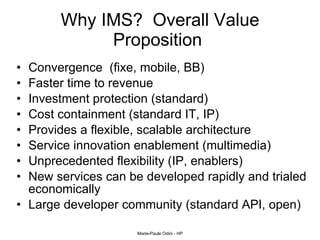
Why IMS?  Overall Value Proposition  Convergence  (fixe, mobile, BB) Faster time to revenue Investment protection (standard) Cost containment (standard IT, IP) Provides a flexible, scalable architecture  Service innovation enablement (multimedia) Unprecedented flexibility (IP, enablers) New services can be developed rapidly and trialed economically Large developer community (standard API, open)
IMS Components CSCF
Proxy-CSCF A first contact point inside a local (or visited) IMS  Acts as a SIP Proxy Server  accepts SIP requests from User Equipment (UE) and then either serves these requests or forwards them to other servers  Functions include: Forward SIP REGISTER request from UE to the home network  Forward other SIP messages from a UE to a SIP server (e.g.,the mobile’s S-CSCF in the mobile’s home network). Forward SIP messages from the network to a device  Perform necessary modifications to the SIP requests before forwarding them to other network entities  Maintain a security association with the mobile Detect emergency session Create CDRs
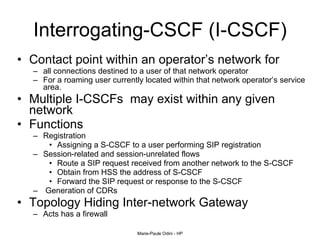
Interrogating-CSCF (I-CSCF) Contact point within an operator’s network for all connections destined to a user of that network operator  For a roaming user currently located within that network operator’s service area.   Multiple I-CSCFs  may exist within any given network  Functions  Registration Assigning a S-CSCF to a user performing SIP registration  Session-related and session-unrelated flows Route a SIP request received from another network to the S-CSCF  Obtain from HSS the address of S-CSCF  Forward the SIP request or response to the S-CSCF  Generation of CDRs  Topology Hiding Inter-network Gateway Acts has a firewall
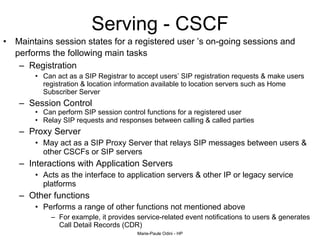
Serving - CSCF Maintains session states for a registered user ’s on-going sessions and performs the following main tasks   Registration Can act as a SIP Registrar to accept users’ SIP registration requests & make users  registration & location information available to location servers such as Home Subscriber Server Session Control Can perform SIP session control functions for a registered user Relay SIP requests and responses between calling & called parties Proxy Server May act as a SIP Proxy Server that relays SIP messages between users & other CSCFs or SIP servers Interactions with Application Servers Acts as the interface to application servers & other IP or legacy service platforms Other functions Performs a range of other functions not mentioned above  For example, it provides service-related event notifications to users & generates Call Detail Records (CDR)
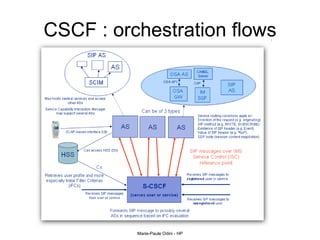
CSCF : orchestration flows
IMS Component HSS
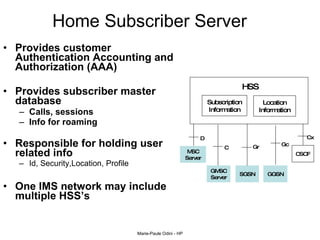
Home Subscriber Server  Provides customer Authentication Accounting and Authorization (AAA) Provides subscriber master database   Calls, sessions Info for roaming Responsible for holding user related info   Id, Security,Location, Profile  One IMS network may include multiple HSS’s SGSN GGSN CSCF D C Gr Gc Cx HSS Subscription Information Location Information GMSC Server MSC Server
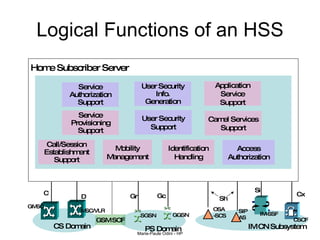
Logical Functions of an HSS CS Domain PS Domain IM CN Subsystem C Gr D Gc Sh Si Cx GGSN SGSN CSCF IM-SSF SIP AS OSA -SCS GMSC MSC/VLR GSM SCF Mobility Management Home Subscriber Server Identification Handling Access Authorization User Security Info. Generation Service Authorization Support Application Service Support Service Provisioning Support Call/Session Establishment Support Camel Services Support User Security Support
IMS Components SIP AS
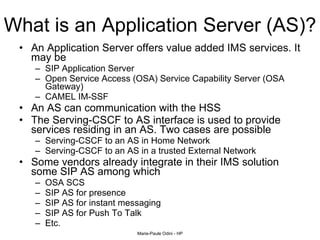
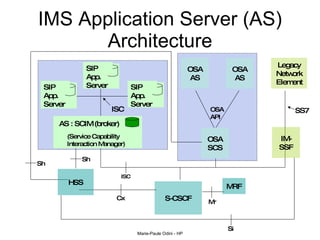
What is an Application Server (AS)? An Application Server offers value added IMS services. It may be  SIP Application Server Open Service Access (OSA) Service Capability Server (OSA Gateway) CAMEL IM-SSF An AS can communication with the HSS The Serving-CSCF to AS interface is used to provide services residing in an AS. Two cases are possible  Serving-CSCF to an AS in Home Network Serving-CSCF to an AS in a trusted External Network Some vendors already integrate in their IMS solution some SIP AS among which  OSA SCS SIP AS for presence SIP AS for instant messaging SIP AS for Push To Talk Etc.
IMS Application Server (AS) Architecture OSA AS OSA AS AS : SCIM (broker) ISC Cx OSA SCS Legacy Network Element OSA API S-CSCF (Service Capability Interaction Manager) IM-SSF SS7 Mr MRF ISC Sh Si HSS Sh SIP App. Server SIP App. Server SIP App. Server
Legacy integration :  * Parlay Application Server * IM-SSF to Camel
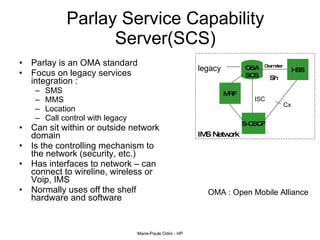
Parlay Service Capability Server(SCS) Parlay is an OMA standard  Focus on legacy services integration :  SMS MMS Location Call control with legacy  Can sit within or outside network domain Is the controlling mechanism to the network (security, etc.) Has interfaces to network – can connect to wireline, wireless or Voip, IMS Normally uses off the shelf hardware and software OMA : Open Mobile Alliance legacy OSA SCS MRF S-CSCF HSS Diameter Sh IMS Network Cx ISC
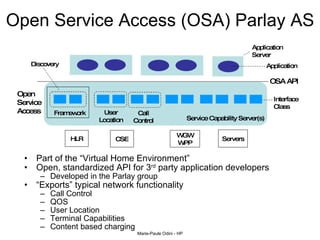
Open Service Access (OSA) Parlay AS Part of the “Virtual Home Environment” Open, standardized API for 3 rd  party application developers Developed in the Parlay group “ Exports” typical network functionality Call Control QOS User Location Terminal Capabilities Content based charging Open Service Access Interface Class OSA API Application Application Server Framework Discovery Service Capability Server(s) Call Control User Location HLR CSE WGW WPP Servers
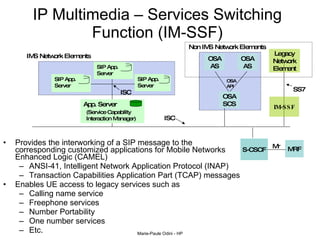
IP Multimedia – Services Switching Function (IM-SSF) Provides the interworking of a SIP message to the corresponding customized applications for Mobile Networks Enhanced Logic (CAMEL)  ANSI-41, Intelligent Network Application Protocol (INAP)  Transaction Capabilities Application Part (TCAP) messages  Enables UE access to legacy services such as  Calling name service  Freephone services Number Portability  One number services Etc. App. Server ISC Legacy Network Element OSA AS OSA AS OSA SCS OSA API S-CSCF (Service Capability Interaction Manager) IM-SSF ISC SS7 IMS Network Elements Non IMS Network Elements MRF Mr SIP App. Server SIP App. Server SIP App. Server
Media Resource Function  MRF media server (serveur vocal)  conference server
Standard Media Server functionality Announcements (audio and video) Automated Speech Recognition (ASR) Billing Record Creation (CDR, IPDR) Fax Detection Interactive Voice Response (IVR) Recording Text-To-Speech conversion (TTS) Transcoding between different codecs or rates Multi-unicasting (replicating the audio and video payload of RTP) Open Standard interfaces (SIP, VXML)
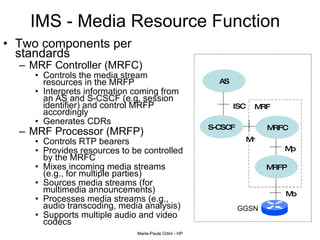
IMS - Media Resource Function  Two components per standards MRF Controller (MRFC)  Controls the media stream resources in the MRFP Interprets information coming from an AS and S-CSCF (e.g. session identifier) and control MRFP accordingly Generates CDRs MRF Processor (MRFP) Controls RTP bearers Provides resources to be controlled by the MRFC Mixes incoming media streams (e.g., for multiple parties) Sources media streams (for multimedia announcements) Processes media streams (e.g., audio transcoding, media analysis) Supports multiple audio and video codecs AS MRFP ISC Mr S-CSCF MRFC Mb Mp MRF GGSN
IMS Components BGCF
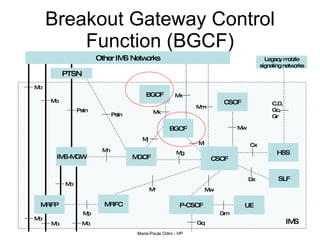
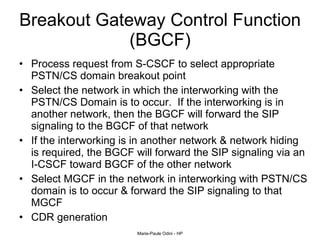
Breakout Gateway Control Function (BGCF) C,D, Gc, Gr UE Mm Mk Mk Pstn Pstn Mj Mg Mr Mp Mw Gm Dx Cx Legacy mobile signaling networks Mn Mb Mb IMS Mw PTSN HSS SLF P-CSCF MRFC MGCF BGCF BGCF IMS-MGW MRFP CSCF CSCF Gq Mi Mb Mb Mb Mb Other IMS Networks
Breakout Gateway Control Function (BGCF) Process request from S-CSCF to select appropriate PSTN/CS domain breakout point  Select the network in which the interworking with the PSTN/CS Domain is to occur.  If the interworking is in another network, then the BGCF will forward the SIP signaling to the BGCF of that network If the interworking is in another network & network hiding is required, the BGCF will forward the SIP signaling via an I-CSCF toward BGCF of the other network Select MGCF in the network in interworking with PSTN/CS domain is to occur & forward the SIP signaling to that MGCF CDR generation
IMS architecture &  Call Flows
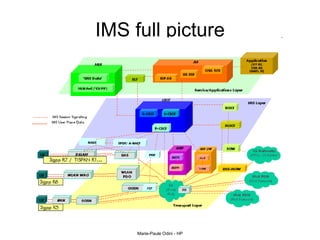
IMS full picture
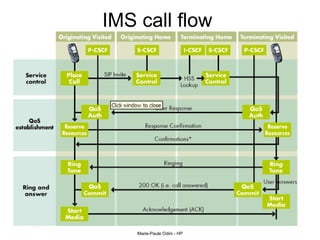
IMS call flow
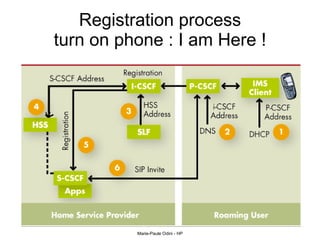
Registration process turn on phone : I am Here !
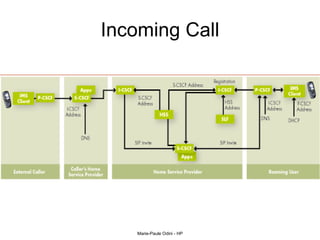
Incoming Call
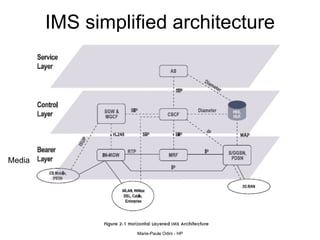
IMS simplified architecture Media
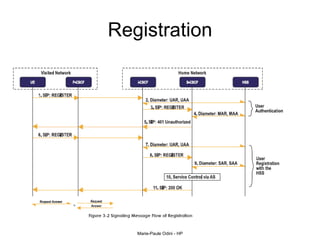
Registration
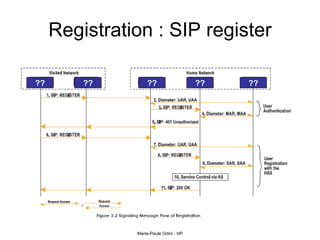
Registration : SIP register ?? ?? ?? ?? ??
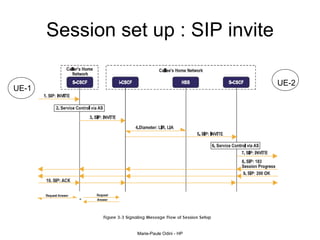
Session set up : SIP invite UE-1 UE-2
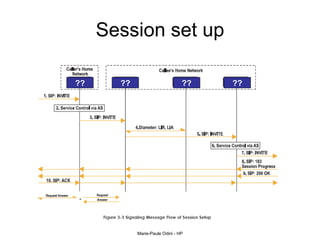
Session set up ?? ?? ?? ??
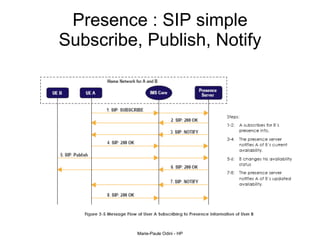
Presence : SIP simple Subscribe, Publish, Notify
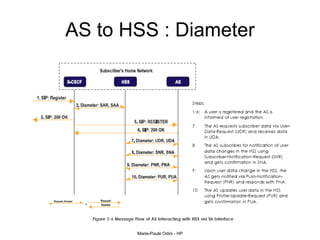
AS to HSS : Diameter
Other examples
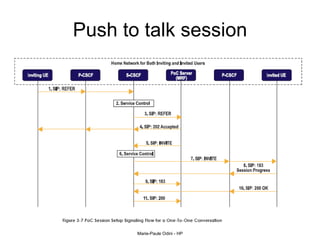
Push to talk session
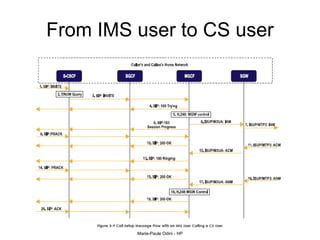
From IMS user to CS user
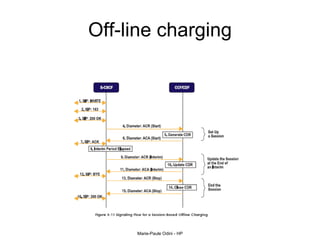
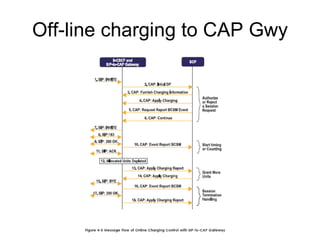
Off-line charging
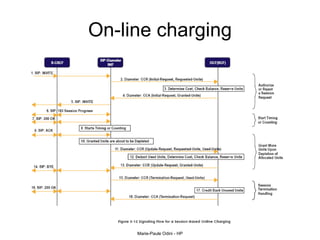
On-line charging
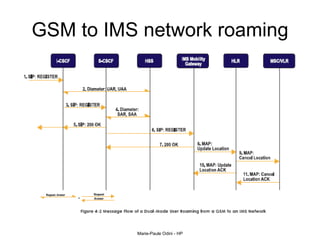
GSM to IMS network roaming
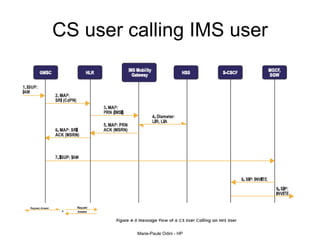
CS user calling IMS user
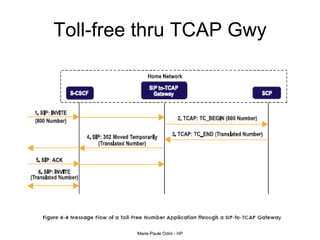
Toll-free thru TCAP Gwy
Off-line charging to CAP Gwy
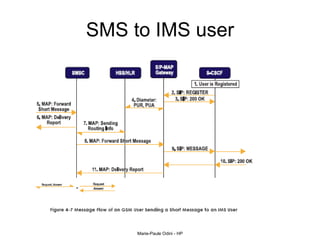
SMS to IMS user
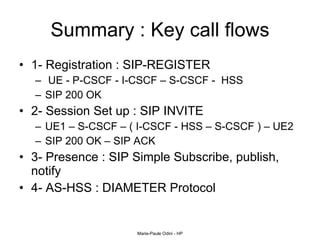
Summary : Key call flows 1- Registration : SIP-REGISTER UE - P-CSCF - I-CSCF – S-CSCF -  HSS  SIP 200 OK 2- Session Set up : SIP INVITE UE1 – S-CSCF – ( I-CSCF - HSS – S-CSCF ) – UE2 SIP 200 OK – SIP ACK  3- Presence : SIP Simple Subscribe, publish, notify 4- AS-HSS : DIAMETER Protocol
Migration towards IMS
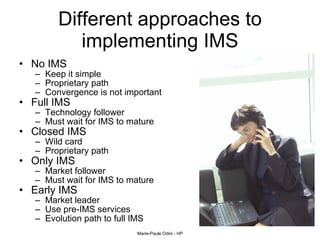
Different approaches to implementing IMS No IMS  Keep it simple Proprietary path Convergence is not important Full IMS  Technology follower Must wait for IMS to mature Closed IMS Wild card Proprietary path Only IMS  Market follower Must wait for IMS to mature Early IMS  Market leader Use pre-IMS services Evolution path to full IMS
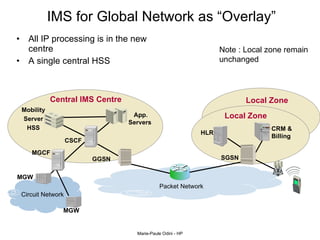
IMS for Global Network as “Overlay” All IP processing is in the new centre A single central HSS Packet Network Local Zone SGSN Central IMS Centre App. Servers MGW GGSN Circuit Network CSCF   Mobility Server HSS HLR CRM & Billing MGCF MGW Local Zone Note : Local zone remain unchanged
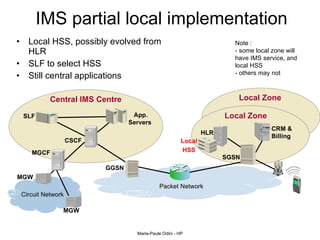
IMS partial local implementation Local HSS, possibly evolved from HLR SLF to select HSS Still central applications Packet Network Local Zone SGSN Central IMS Centre App. Servers MGW GGSN Circuit Network CSCF   HLR CRM & Billing MGCF MGW SLF Local HSS Note :  - some local zone will have IMS service, and local HSS - others may not  Local Zone
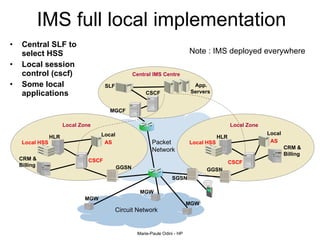
IMS full local implementation Central SLF to select HSS Local session control (cscf) Some local applications Circuit Network MGW Local Zone GGSN HLR CRM & Billing Local HSS CSCF   Local  AS Central IMS Centre App. Servers SLF Local Zone GGSN HLR CRM & Billing Local HSS CSCF  Local  AS MGW Packet  Network MGW SGSN MGCF CSCF   Note : IMS deployed everywhere

IMS Standards

  • 1.
    IP Multimedia Subsystem(IMS) standards 2010 Telecom Master Class
  • 2.
    Agenda 2G -3G – 4G : UMTS & IMS IMS Overview and components Architecture & Call flows Migration to IMS Summary
  • 3.
  • 4.
  • 5.
  • 6.
  • 7.
  • 8.
  • 9.
    Typical 2G ArchitectureFixe + Mobile layer BTS — Base Transceiver Station BSC — Base Station Controller MSC — Mobile Switching Center VLR — Visitor Location Register HLR — Home Location Register BTS BSC MSC/VLR HLR BSC GMSC CO BSC BSC MSC/VLR CO PSTN PLMN CO Tandem Tandem SMS-SC PSDN
  • 10.
    2.5G Architectural DetailBSS — Base Station System BTS — Base Transceiver Station BSC — Base Station Controller NSS — Network Sub-System MSC — Mobile-service Switching Controller VLR — Visitor Location Register HLR — Home Location Register AuC — Authentication Server GMSC — Gateway MSC SGSN — Serving GPRS Support Node GGSN — Gateway GPRS Support Node GPRS — General Packet Radio Service 2G MS (voice only) + DATA - IP SS7 BTS BSC MSC VLR HLR AuC GMSC BSS PSTN NSS A E C D PSTN Abis B H MS IP 2G+ MS (voice & data) PSDN Gi SGSN Gr Gb Gs GGSN Gc Gn
  • 11.
    3G rel99 Architecture(UMTS) SS7 IP BTS BSC MSC VLR HLR AuC GMSC BSS SGSN GGSN PSTN PSDN CN Gs BSS — Base Station System BTS — Base Transceiver Station BSC — Base Station Controller RNS — Radio Network System RNC — Radio Network Controller CN — Core Network MSC — Mobile-service Switching Controller VLR — Visitor Location Register HLR — Home Location Register AuC — Authentication Server GMSC — Gateway MSC SGSN — Serving GPRS Support Node GGSN — Gateway GPRS Support Node A E PSTN 2G MS (voice only) 2G+ MS (voice & data) UMTS — Universal Mobile Telecommunication System Gb 3G UE (voice & data) Node B RNC RNS IuCS ATM + 3G Radio C D Gc Gr Gn Gi Abis B H Iub IuPS
  • 12.
    3G rel4 Architecture(UMTS) + Soft-switching SS7 IP/ATM BTS BSC MSC Server VLR HLR AuC GMSC server BSS SGSN GGSN PSTN PSDN CN C D Gc Gr Gn Gi Gb Abis Gs B H BSS — Base Station System BTS — Base Transceiver Station BSC — Base Station Controller RNS — Radio Network System RNC — Radio Network Controller CN — Core Network MSC — Mobile-service Switching Controller VLR — Visitor Location Register HLR — Home Location Register AuC — Authentication Server GMSC — Gateway MSC SGSN — Serving GPRS Support Node GGSN — Gateway GPRS Support Node A Nc 2G MS (voice only) 2G+ MS (voice & data) Node B RNC RNS Iub IuCS IuPS 3G UE (voice & data) Mc CS-MGW CS-MGW Nb PSTN Mc ATM
  • 13.
    3G rel5 Architecture(UMTS) SS7 IP/ATM BTS BSC MSC Server VLR HSS AuC GMSC server BSS SGSN GGSN PSTN CN Gs IMS — IP Multimedia sub-system MRF — Media Resource Function CSCF — Call State Control Function MGCF — Media Gateway Control Function (Mc=H248,Mg=SIP) IM-MGW — IP Multimedia-MGW Nc 2G MS (voice only) 2G+ MS (voice & data) Node B RNC RNS 3G UE (voice & data) CS-MGW CS-MGW Nb PSTN IuCS IuPS ATM IMS IP PSTN MGCF IM-MGW IP Network +IMS Gb/IuPS A/IuCS C D Gc Gr Gn Gi Abis B H Iub Mc Mc Mc MRF CSCF Mg Gs
  • 14.
  • 15.
    IMS : IPand PSTN convergence
  • 16.
    IMS and EV-DO(evolution data only)
  • 17.
    LTE architecture MME: Mobility Management Entity
  • 18.
    LTE and VoiceMSC SMSC MAP Gs SG Lu-cs A For SMS – light MSC enough For Voice – need MSC upgrade to support SRVCC (SV protocol support) Note : if VoIP is used on 3G, no need for SRVCC – using PS HO (HO = hand over = address mapping ) SV S-Gw P-Gw F
  • 19.
    VoLTE : LTEand IMS
  • 20.
    LTE and Policies(QoS) PCRF: Policy Charging and Rules Functions (policy decisions based on HSS/sp, applications/Rx ) P-GW : Policy Gwy = policy enforcer Packet filtering P-GW Gx S-GW S1 S5/S8 Sp eNB
  • 21.
  • 22.
    What is IMSall about? Full IP network and service infrastructure for converged services Providing a new wave of sticky services that Seamlessly integrate multimedia, data and voice within a single user session Are instant, real time in nature Focus on customer environments and their lifestyles Are complex in nature, but simplistic to use Are device and network agnostic Can be easily enhanced and expanded as the IMS network and standards evolve
  • 23.
    IMS Drivers andCaveats March 23, 2010 Data obtained from Frost &Sullivan Report “ IMS Ready for Primetime” – Feb. 07
  • 24.
    Viable IMS Applicationsby Segment Data obtained from Frost &Sullivan Report “ IMS Ready for Primetime” – Feb. 07 X X X 32% Rich Voice (enhanced QoS) X X X 29% Audio Streaming X X X 48% Video Streaming (Push to see,mobile video,etc.) X 55% IP - Centrex X X 75% FMC – Seamless Roaming Application %** Wireless Wireline Cable Instant Multimedia Messaging 73% X X X Video Telephony (mobile video/TV) 68% X X X Interactive Gaming 38% X X X Push to Talk (POC) 33% X Location Services 28% X Push to talk enhanced (QoS) for Enterprise ------ X Cable Applications – Caller ID, Presence change, etc. ------ X
  • 25.
    Why IMS? Overall Value Proposition Convergence (fixe, mobile, BB) Faster time to revenue Investment protection (standard) Cost containment (standard IT, IP) Provides a flexible, scalable architecture Service innovation enablement (multimedia) Unprecedented flexibility (IP, enablers) New services can be developed rapidly and trialed economically Large developer community (standard API, open)
  • 26.
  • 27.
    Proxy-CSCF A firstcontact point inside a local (or visited) IMS Acts as a SIP Proxy Server accepts SIP requests from User Equipment (UE) and then either serves these requests or forwards them to other servers Functions include: Forward SIP REGISTER request from UE to the home network Forward other SIP messages from a UE to a SIP server (e.g.,the mobile’s S-CSCF in the mobile’s home network). Forward SIP messages from the network to a device Perform necessary modifications to the SIP requests before forwarding them to other network entities Maintain a security association with the mobile Detect emergency session Create CDRs
  • 28.
    Interrogating-CSCF (I-CSCF) Contactpoint within an operator’s network for all connections destined to a user of that network operator For a roaming user currently located within that network operator’s service area. Multiple I-CSCFs may exist within any given network Functions Registration Assigning a S-CSCF to a user performing SIP registration Session-related and session-unrelated flows Route a SIP request received from another network to the S-CSCF Obtain from HSS the address of S-CSCF Forward the SIP request or response to the S-CSCF Generation of CDRs Topology Hiding Inter-network Gateway Acts has a firewall
  • 29.
    Serving - CSCFMaintains session states for a registered user ’s on-going sessions and performs the following main tasks Registration Can act as a SIP Registrar to accept users’ SIP registration requests & make users registration & location information available to location servers such as Home Subscriber Server Session Control Can perform SIP session control functions for a registered user Relay SIP requests and responses between calling & called parties Proxy Server May act as a SIP Proxy Server that relays SIP messages between users & other CSCFs or SIP servers Interactions with Application Servers Acts as the interface to application servers & other IP or legacy service platforms Other functions Performs a range of other functions not mentioned above For example, it provides service-related event notifications to users & generates Call Detail Records (CDR)
  • 30.
  • 31.
  • 32.
    Home Subscriber Server Provides customer Authentication Accounting and Authorization (AAA) Provides subscriber master database Calls, sessions Info for roaming Responsible for holding user related info Id, Security,Location, Profile One IMS network may include multiple HSS’s SGSN GGSN CSCF D C Gr Gc Cx HSS Subscription Information Location Information GMSC Server MSC Server
  • 33.
    Logical Functions ofan HSS CS Domain PS Domain IM CN Subsystem C Gr D Gc Sh Si Cx GGSN SGSN CSCF IM-SSF SIP AS OSA -SCS GMSC MSC/VLR GSM SCF Mobility Management Home Subscriber Server Identification Handling Access Authorization User Security Info. Generation Service Authorization Support Application Service Support Service Provisioning Support Call/Session Establishment Support Camel Services Support User Security Support
  • 34.
  • 35.
    What is anApplication Server (AS)? An Application Server offers value added IMS services. It may be SIP Application Server Open Service Access (OSA) Service Capability Server (OSA Gateway) CAMEL IM-SSF An AS can communication with the HSS The Serving-CSCF to AS interface is used to provide services residing in an AS. Two cases are possible Serving-CSCF to an AS in Home Network Serving-CSCF to an AS in a trusted External Network Some vendors already integrate in their IMS solution some SIP AS among which OSA SCS SIP AS for presence SIP AS for instant messaging SIP AS for Push To Talk Etc.
  • 36.
    IMS Application Server(AS) Architecture OSA AS OSA AS AS : SCIM (broker) ISC Cx OSA SCS Legacy Network Element OSA API S-CSCF (Service Capability Interaction Manager) IM-SSF SS7 Mr MRF ISC Sh Si HSS Sh SIP App. Server SIP App. Server SIP App. Server
  • 37.
    Legacy integration : * Parlay Application Server * IM-SSF to Camel
  • 38.
    Parlay Service CapabilityServer(SCS) Parlay is an OMA standard Focus on legacy services integration : SMS MMS Location Call control with legacy Can sit within or outside network domain Is the controlling mechanism to the network (security, etc.) Has interfaces to network – can connect to wireline, wireless or Voip, IMS Normally uses off the shelf hardware and software OMA : Open Mobile Alliance legacy OSA SCS MRF S-CSCF HSS Diameter Sh IMS Network Cx ISC
  • 39.
    Open Service Access(OSA) Parlay AS Part of the “Virtual Home Environment” Open, standardized API for 3 rd party application developers Developed in the Parlay group “ Exports” typical network functionality Call Control QOS User Location Terminal Capabilities Content based charging Open Service Access Interface Class OSA API Application Application Server Framework Discovery Service Capability Server(s) Call Control User Location HLR CSE WGW WPP Servers
  • 40.
    IP Multimedia –Services Switching Function (IM-SSF) Provides the interworking of a SIP message to the corresponding customized applications for Mobile Networks Enhanced Logic (CAMEL) ANSI-41, Intelligent Network Application Protocol (INAP) Transaction Capabilities Application Part (TCAP) messages Enables UE access to legacy services such as Calling name service Freephone services Number Portability One number services Etc. App. Server ISC Legacy Network Element OSA AS OSA AS OSA SCS OSA API S-CSCF (Service Capability Interaction Manager) IM-SSF ISC SS7 IMS Network Elements Non IMS Network Elements MRF Mr SIP App. Server SIP App. Server SIP App. Server
  • 41.
    Media Resource Function MRF media server (serveur vocal) conference server
  • 42.
    Standard Media Serverfunctionality Announcements (audio and video) Automated Speech Recognition (ASR) Billing Record Creation (CDR, IPDR) Fax Detection Interactive Voice Response (IVR) Recording Text-To-Speech conversion (TTS) Transcoding between different codecs or rates Multi-unicasting (replicating the audio and video payload of RTP) Open Standard interfaces (SIP, VXML)
  • 43.
    IMS - MediaResource Function Two components per standards MRF Controller (MRFC) Controls the media stream resources in the MRFP Interprets information coming from an AS and S-CSCF (e.g. session identifier) and control MRFP accordingly Generates CDRs MRF Processor (MRFP) Controls RTP bearers Provides resources to be controlled by the MRFC Mixes incoming media streams (e.g., for multiple parties) Sources media streams (for multimedia announcements) Processes media streams (e.g., audio transcoding, media analysis) Supports multiple audio and video codecs AS MRFP ISC Mr S-CSCF MRFC Mb Mp MRF GGSN
  • 44.
  • 45.
    Breakout Gateway ControlFunction (BGCF) C,D, Gc, Gr UE Mm Mk Mk Pstn Pstn Mj Mg Mr Mp Mw Gm Dx Cx Legacy mobile signaling networks Mn Mb Mb IMS Mw PTSN HSS SLF P-CSCF MRFC MGCF BGCF BGCF IMS-MGW MRFP CSCF CSCF Gq Mi Mb Mb Mb Mb Other IMS Networks
  • 46.
    Breakout Gateway ControlFunction (BGCF) Process request from S-CSCF to select appropriate PSTN/CS domain breakout point Select the network in which the interworking with the PSTN/CS Domain is to occur. If the interworking is in another network, then the BGCF will forward the SIP signaling to the BGCF of that network If the interworking is in another network & network hiding is required, the BGCF will forward the SIP signaling via an I-CSCF toward BGCF of the other network Select MGCF in the network in interworking with PSTN/CS domain is to occur & forward the SIP signaling to that MGCF CDR generation
  • 47.
    IMS architecture & Call Flows
  • 48.
  • 49.
  • 50.
    Registration process turnon phone : I am Here !
  • 51.
  • 52.
  • 53.
  • 54.
    Registration : SIPregister ?? ?? ?? ?? ??
  • 55.
    Session set up: SIP invite UE-1 UE-2
  • 56.
    Session set up?? ?? ?? ??
  • 57.
    Presence : SIPsimple Subscribe, Publish, Notify
  • 58.
    AS to HSS: Diameter
  • 59.
  • 60.
    Push to talksession
  • 61.
    From IMS userto CS user
  • 62.
  • 63.
  • 64.
    GSM to IMSnetwork roaming
  • 65.
  • 66.
  • 67.
  • 68.
  • 69.
    Summary : Keycall flows 1- Registration : SIP-REGISTER UE - P-CSCF - I-CSCF – S-CSCF - HSS SIP 200 OK 2- Session Set up : SIP INVITE UE1 – S-CSCF – ( I-CSCF - HSS – S-CSCF ) – UE2 SIP 200 OK – SIP ACK 3- Presence : SIP Simple Subscribe, publish, notify 4- AS-HSS : DIAMETER Protocol
  • 70.
  • 71.
    Different approaches toimplementing IMS No IMS Keep it simple Proprietary path Convergence is not important Full IMS Technology follower Must wait for IMS to mature Closed IMS Wild card Proprietary path Only IMS Market follower Must wait for IMS to mature Early IMS Market leader Use pre-IMS services Evolution path to full IMS
  • 72.
    IMS for GlobalNetwork as “Overlay” All IP processing is in the new centre A single central HSS Packet Network Local Zone SGSN Central IMS Centre App. Servers MGW GGSN Circuit Network CSCF Mobility Server HSS HLR CRM & Billing MGCF MGW Local Zone Note : Local zone remain unchanged
  • 73.
    IMS partial localimplementation Local HSS, possibly evolved from HLR SLF to select HSS Still central applications Packet Network Local Zone SGSN Central IMS Centre App. Servers MGW GGSN Circuit Network CSCF HLR CRM & Billing MGCF MGW SLF Local HSS Note : - some local zone will have IMS service, and local HSS - others may not Local Zone
  • 74.
    IMS full localimplementation Central SLF to select HSS Local session control (cscf) Some local applications Circuit Network MGW Local Zone GGSN HLR CRM & Billing Local HSS CSCF Local AS Central IMS Centre App. Servers SLF Local Zone GGSN HLR CRM & Billing Local HSS CSCF Local AS MGW Packet Network MGW SGSN MGCF CSCF Note : IMS deployed everywhere

Editor's Notes

  • #18 MME: - Mobility Management Entity MME is a control entity, which means it’s completely responsible for all the control plane operations. All the NAS signaling originates at UE and terminates in MME. MME does tracking area list management, selection of PGW/SGW and also selection of other MME during handovers. It is the first contact point for the 2G and 3G networks. MME is also responsible for SGSN selection during LTE to 2G/3G handovers. The UE is also authenticated by MME. All signaling traffic flow through MME so the same can lawfully intercepted. MME is also responsible for bearer management functions including establishment of dedicated bearers. SGW: - Serving Gateway Serving gateway terminates the interface towards EUTRAN. For each UE associated with EPS, at a given point of time, there is a single Serving GW. SGW acts a local mobility anchor for inter eNB handovers. It also acts a mobility anchor for inter 3GPP mobility. SGW is responsible for packet routeing and forwarding, buffering the downlink packets and lawful interception. As eNB is responsible for uplink packet marking, SGW is responsible for downlink packet marking. One way to do this is mark the Diffserv field is IP packet based on QCI field. If the S5/S8 interface is PMIP based then SGW acts a Mobility Anchor Gateway (MAG). All the MAG responsibilities can be assigned to SGW. It is also responsible for assigning a GRE key that can be used by PGW in downlink. For a MAG of non trusted 3GPP access SGW acts as LMA. PGW: - PDN Gateway PGW terminates SGi interface towards the PDN. PGW is responsible for all the IP packet based operations such as deep packet inspection, UE IP address allocation, Transport level packet marking in uplink and downlink, accounting etc. PGW contacts PCRF to determine the QoS for bearers. It is also responsible for UL and DL rate enforcement based on APN-AMBR. It is synonymous to GGSN of pre release 8 networks. For PMIP based S5/S8 interface PGW acts as LMA. It is responsible for assigning IP address to UE, and also GRE Key to SGW that should be used in uplink.