Intelligent Networks Park Jung Wan (jwpark77@kaist.ac.kr) Kang Tai Hun (thkang@cnr.kaist.ac.kr) < Telephone & Internet Telephony Networks >
Contents Introduction Related standard Operation procedure Technical issues The method of performance evaluations of the systems Others
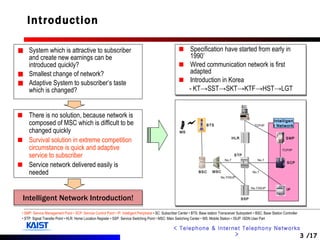
Introduction System which is attractive to subscriber and create new earnings can be introduced quickly?  Smallest change of network? Adaptive System to subscriber’s taste which is changed? There is no solution, because network is composed of MSC which is difficult to be changed quickly Survival solution in extreme competition circumstance is quick and adaptive service to subscriber Service network delivered easily is needed Intelligent Network Introduction! Specification have started from early in 1990’ Wired communication network is first adapted Introduction in Korea - KT->SST->SKT->KTF->HST->LGT  BSC MSC BTS MS SC HLR STP SSP IP SMP SCP No.7 No.7/ISUP No.7/ISUP No.7 No.7 TCP/IP TCP/IP Intelligent Network •  SMP: Service Management Point • SCP: Service Control Point • IP: Intelligent Peripheral  • SC: Subscriber Center • BTS: Base station Transceiver Subsystem • BSC: Base Station Controller  •  STP: Signal Transfer Point • HLR: Home Location Register • SSP: Service Switching Point • MSC: Main Switching Center • MS: Mobile Station • ISUP: ISDN User Part
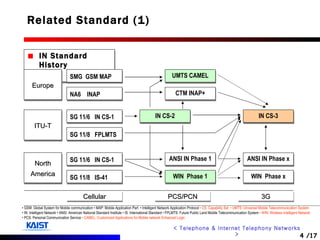
Related Standard (1) IN Standard History Europe SMG  GSM MAP NA6  INAP ITU-T SG 11/6  IN CS-1 SG 11/8  FPLMTS North America SG 11/6  IN CS-1 SG 11/8  IS-41 CTM INAP+ UMTS CAMEL IN CS-2 ANSI IN Phase 1 WIN  Phase 1 IN CS-3 ANSI IN Phase x WIN  Phase x Cellular PCS/PCN 3G •  GSM: Global System for Mobile communication • MAP: Mobile Application Part  • Intelligent Network Application Protocol  • CS: Capability Set   • UMTS: Universal Mobile Telecommunication System •  IN: Intelligent Network • ANSI: American National Standard Institute • IS: International Standard • FPLMTS: Future Public Land Mobile Telecommunication System  • WIN: Wireless Intelligent Network   •  PCS: Personal Communication Service  • CAMEL: Customized Applications for Mobile network Enhanced Logic
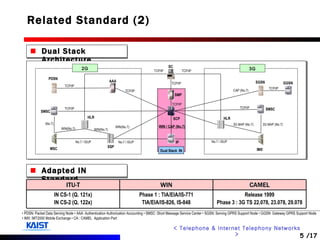
Related Standard (2) Adapted IN Standard Dual Stack Architecture •  PDSN: Packet Data Serving Node • AAA: Authentication Authorization Accounting • SMSC: Short Message Service Center • SGSN: Serving GPRS Support Node • GGSN: Gateway GPRS Support Node  •  IMX: IMT2000 Mobile Exchange • CA : CAMEL  Application Part Release 1999 Phase 3 : 3G TS 22.078, 23.078, 29.078 Phase 1 : TIA/EIA/IS-771 TIA/EIA/IS-826, IS-848 IN CS-1 (Q. 121x) IN CS-2 (Q. 122x) CAMEL WIN ITU-T SC SMP SCP IP SSP MSC SMSC PDSN AAA HLR HLR IMX SMSC SGSN GGSN No.7 / ISUP No.7 / ISUP No.7 / ISUP WIN(No.7) WIN(No.7) (No.7) 3G MAP (No.7) 3G MAP (No.7) CAP (No.7) WIN(No.7) WIN / CAP (No.7) TCP/IP TCP/IP TCP/IP TCP/IP TCP/IP TCP/IP TCP/IP TCP/IP TCP/IP Dual Stack  IN 2G 3G
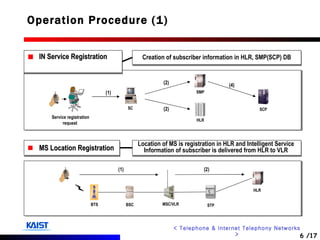
Operation Procedure (1) IN Service Registration Creation of subscriber information in HLR, SMP(SCP) DB MS Location Registration Location of MS is registration in HLR and Intelligent Service  Information of subscriber is delivered from HLR to VLR  (1) (2) (2) (4) (1) (2) BTS BSC MSC/VLR STP HLR Service registration request  SC SMP HLR SCP
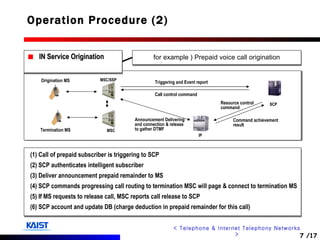
Operation Procedure (2) IN Service Origination for example ) Prepaid voice call origination MSC/SSP IP SCP Origination MS Announcement Delivering and connection & release to gather DTMF Command achievement result Resource control command Call control command Triggering and Event report (1) Call of prepaid subscriber is triggering to SCP (2) SCP authenticates intelligent subscriber (3) Deliver announcement prepaid remainder to MS (4) SCP commands progressing call routing to termination MSC will page & connect to termination MS (5) If MS requests to release call, MSC reports call release to SCP (6) SCP account and update DB (charge deduction in prepaid remainder for this call) Termination MS MSC
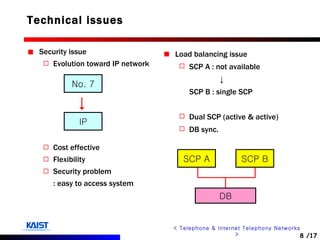
Technical issues Security issue Evolution toward IP network Cost effective Flexibility Security problem : easy to access system Load balancing issue SCP A : not available ↓ SCP B : single SCP Dual SCP (active & active) DB sync. SCP A SCP B DB No. 7 IP
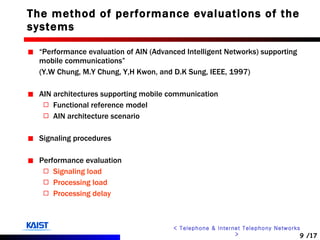
The method of performance evaluations of the systems “Performance evaluation of AIN (Advanced Intelligent Networks) supporting mobile communications” (Y.W Chung, M.Y Chung, Y,H Kwon, and D.K Sung, IEEE, 1997) AIN architectures supporting mobile communication Functional reference model AIN architecture scenario Signaling procedures Performance evaluation Signaling load Processing load Processing delay
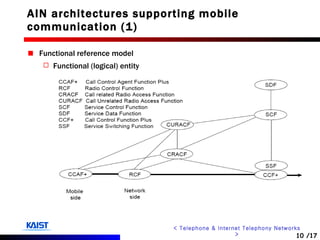
AIN architectures supporting mobile communication (1) Functional reference model Functional (logical) entity
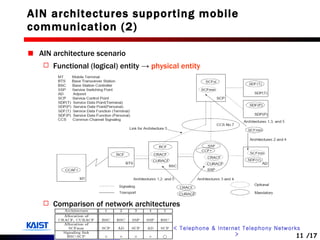
AIN architectures supporting mobile communication (2) AIN architecture scenario Functional (logical) entity ->  physical entity Comparison of network architectures
Signaling procedures Mobility related Location update (Intra-SSP, Inter-SSP) Handoff (Intra-BSC, Inter-BSC, Inter-SSP) Call related Call origination Call termination Call release UPT outgoing and incoming calls
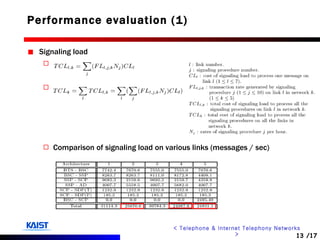
Performance evaluation (1) Signaling load Comparison of signaling load on various links (messages / sec)
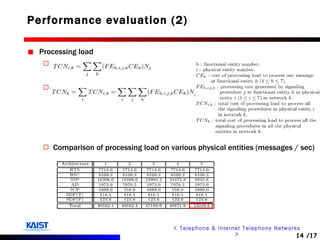
Performance evaluation (2) Processing load Comparison of processing load on various physical entities (messages / sec)
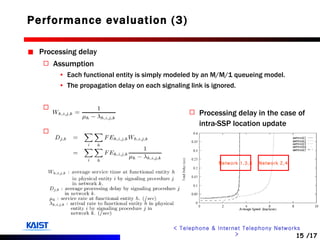
Performance evaluation (3) Processing delay Assumption Each functional entity is simply modeled by an M/M/1 queueing model. The propagation delay on each signaling link is ignored. Processing delay in the case of intra-SSP location update Network 1,3,5 Network 2,4
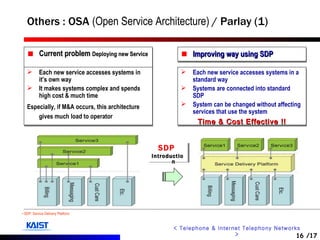
Current problem  Deploying new Service Others : OSA  (Open Service Architecture)  / Parlay (1) Each new service accesses systems in it’s own way It makes systems complex and spends high cost & much time Especially, if M&A occurs, this architecture gives much load to operator  SDP   Introduction Each new service accesses systems in a standard way Systems are connected into standard SDP System can be changed without affecting services that use the system Time & Cost Effective !! Improving way using SDP •  SDP: Service Delivery Platform
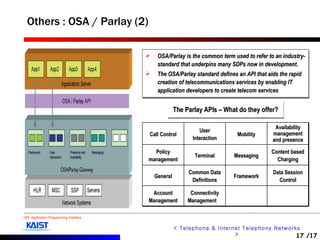
Others : OSA / Parlay (2) OSA/Parlay is the common term used to refer to an industry-standard that underpins many SDPs now in development. The OSA/Parlay standard defines an API that aids the rapid creation of telecommunications services by enabling IT application developers to create telecom services The Parlay APIs – What do they offer? •  API: Application Programming Interface Connectivity Management  Account Management Data Session Control Framework Common Data Definitions General Content based Charging Messaging Terminal Policy management Availability management and presence Mobility User Interaction Call Control

Project

  • 1.
    Intelligent Networks ParkJung Wan (jwpark77@kaist.ac.kr) Kang Tai Hun (thkang@cnr.kaist.ac.kr) < Telephone & Internet Telephony Networks >
  • 2.
    Contents Introduction Relatedstandard Operation procedure Technical issues The method of performance evaluations of the systems Others
  • 3.
    Introduction System whichis attractive to subscriber and create new earnings can be introduced quickly? Smallest change of network? Adaptive System to subscriber’s taste which is changed? There is no solution, because network is composed of MSC which is difficult to be changed quickly Survival solution in extreme competition circumstance is quick and adaptive service to subscriber Service network delivered easily is needed Intelligent Network Introduction! Specification have started from early in 1990’ Wired communication network is first adapted Introduction in Korea - KT->SST->SKT->KTF->HST->LGT BSC MSC BTS MS SC HLR STP SSP IP SMP SCP No.7 No.7/ISUP No.7/ISUP No.7 No.7 TCP/IP TCP/IP Intelligent Network • SMP: Service Management Point • SCP: Service Control Point • IP: Intelligent Peripheral • SC: Subscriber Center • BTS: Base station Transceiver Subsystem • BSC: Base Station Controller • STP: Signal Transfer Point • HLR: Home Location Register • SSP: Service Switching Point • MSC: Main Switching Center • MS: Mobile Station • ISUP: ISDN User Part
  • 4.
    Related Standard (1)IN Standard History Europe SMG GSM MAP NA6 INAP ITU-T SG 11/6 IN CS-1 SG 11/8 FPLMTS North America SG 11/6 IN CS-1 SG 11/8 IS-41 CTM INAP+ UMTS CAMEL IN CS-2 ANSI IN Phase 1 WIN Phase 1 IN CS-3 ANSI IN Phase x WIN Phase x Cellular PCS/PCN 3G • GSM: Global System for Mobile communication • MAP: Mobile Application Part • Intelligent Network Application Protocol • CS: Capability Set • UMTS: Universal Mobile Telecommunication System • IN: Intelligent Network • ANSI: American National Standard Institute • IS: International Standard • FPLMTS: Future Public Land Mobile Telecommunication System • WIN: Wireless Intelligent Network • PCS: Personal Communication Service • CAMEL: Customized Applications for Mobile network Enhanced Logic
  • 5.
    Related Standard (2)Adapted IN Standard Dual Stack Architecture • PDSN: Packet Data Serving Node • AAA: Authentication Authorization Accounting • SMSC: Short Message Service Center • SGSN: Serving GPRS Support Node • GGSN: Gateway GPRS Support Node • IMX: IMT2000 Mobile Exchange • CA : CAMEL Application Part Release 1999 Phase 3 : 3G TS 22.078, 23.078, 29.078 Phase 1 : TIA/EIA/IS-771 TIA/EIA/IS-826, IS-848 IN CS-1 (Q. 121x) IN CS-2 (Q. 122x) CAMEL WIN ITU-T SC SMP SCP IP SSP MSC SMSC PDSN AAA HLR HLR IMX SMSC SGSN GGSN No.7 / ISUP No.7 / ISUP No.7 / ISUP WIN(No.7) WIN(No.7) (No.7) 3G MAP (No.7) 3G MAP (No.7) CAP (No.7) WIN(No.7) WIN / CAP (No.7) TCP/IP TCP/IP TCP/IP TCP/IP TCP/IP TCP/IP TCP/IP TCP/IP TCP/IP Dual Stack IN 2G 3G
  • 6.
    Operation Procedure (1)IN Service Registration Creation of subscriber information in HLR, SMP(SCP) DB MS Location Registration Location of MS is registration in HLR and Intelligent Service Information of subscriber is delivered from HLR to VLR (1) (2) (2) (4) (1) (2) BTS BSC MSC/VLR STP HLR Service registration request SC SMP HLR SCP
  • 7.
    Operation Procedure (2)IN Service Origination for example ) Prepaid voice call origination MSC/SSP IP SCP Origination MS Announcement Delivering and connection & release to gather DTMF Command achievement result Resource control command Call control command Triggering and Event report (1) Call of prepaid subscriber is triggering to SCP (2) SCP authenticates intelligent subscriber (3) Deliver announcement prepaid remainder to MS (4) SCP commands progressing call routing to termination MSC will page & connect to termination MS (5) If MS requests to release call, MSC reports call release to SCP (6) SCP account and update DB (charge deduction in prepaid remainder for this call) Termination MS MSC
  • 8.
    Technical issues Securityissue Evolution toward IP network Cost effective Flexibility Security problem : easy to access system Load balancing issue SCP A : not available ↓ SCP B : single SCP Dual SCP (active & active) DB sync. SCP A SCP B DB No. 7 IP
  • 9.
    The method ofperformance evaluations of the systems “Performance evaluation of AIN (Advanced Intelligent Networks) supporting mobile communications” (Y.W Chung, M.Y Chung, Y,H Kwon, and D.K Sung, IEEE, 1997) AIN architectures supporting mobile communication Functional reference model AIN architecture scenario Signaling procedures Performance evaluation Signaling load Processing load Processing delay
  • 10.
    AIN architectures supportingmobile communication (1) Functional reference model Functional (logical) entity
  • 11.
    AIN architectures supportingmobile communication (2) AIN architecture scenario Functional (logical) entity -> physical entity Comparison of network architectures
  • 12.
    Signaling procedures Mobilityrelated Location update (Intra-SSP, Inter-SSP) Handoff (Intra-BSC, Inter-BSC, Inter-SSP) Call related Call origination Call termination Call release UPT outgoing and incoming calls
  • 13.
    Performance evaluation (1)Signaling load Comparison of signaling load on various links (messages / sec)
  • 14.
    Performance evaluation (2)Processing load Comparison of processing load on various physical entities (messages / sec)
  • 15.
    Performance evaluation (3)Processing delay Assumption Each functional entity is simply modeled by an M/M/1 queueing model. The propagation delay on each signaling link is ignored. Processing delay in the case of intra-SSP location update Network 1,3,5 Network 2,4
  • 16.
    Current problem Deploying new Service Others : OSA (Open Service Architecture) / Parlay (1) Each new service accesses systems in it’s own way It makes systems complex and spends high cost & much time Especially, if M&A occurs, this architecture gives much load to operator SDP Introduction Each new service accesses systems in a standard way Systems are connected into standard SDP System can be changed without affecting services that use the system Time & Cost Effective !! Improving way using SDP • SDP: Service Delivery Platform
  • 17.
    Others : OSA/ Parlay (2) OSA/Parlay is the common term used to refer to an industry-standard that underpins many SDPs now in development. The OSA/Parlay standard defines an API that aids the rapid creation of telecommunications services by enabling IT application developers to create telecom services The Parlay APIs – What do they offer? • API: Application Programming Interface Connectivity Management Account Management Data Session Control Framework Common Data Definitions General Content based Charging Messaging Terminal Policy management Availability management and presence Mobility User Interaction Call Control