IMS Signaling
SEBASTIAN SCHUMANN
SLOVAK TELEKOM
12 MARCH 2014
BRATISLAVA, SLOVAKIA
Revision 3
Outline
 Summary “SIP & IMS Basics”
 IMS and its Services
 Protocols
 Service Triggering
 Q/A
Note!
 These slides only summarize the lecture. Take notes.
 Fixed agenda: IMS Signaling
 Besides that:
 Ask questions (how is it done in real-world, how did Slovak
Telekom do it)
 Interrupt (I don’t understand, can you provide samples, can
we skip that)
 Contribute (I’ve heard/read that…, I’m interested in…)
 Discuss…
Summary “SIP & IMS Basics”
Reference to lecture.
SIP Overview
 Protocol overview
 Basic architecture
 Types of servers
 Separated by basic functionality
 Request methods, responses, call flows
 Session Description Protocol (SDP)
IP Multimedia Subsystem (IMS)
 Basic overview
 Architecture
 Horizontally layered approach
 Functional elements
 Flow details
 Registration
 Basic call setup
IMS and its Services
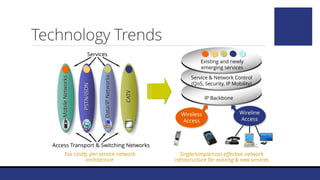
Technology Trends
Services
Data/IPNetworks
MobileNetworks
PSTN/ISDN
CATV
Access Transport & Switching Networks
Wireless
Access
Wireline
Access
IP Backbone
Existing and newly
emerging services
Service & Network Control
(QoS, Security, IP Mobility)
Too costly, per-service network
architecture
Single/simple/cost-effective network
infrastructure for existing & new services
Access & Transport
Plane
Core
Network
Session
Control Plane
Service Architecture
Applications/Services
Plane
HSSCSCF
Access
Networ
k
Other
Networks
Web Portal
Application
Servers
Session
Control
Centralized
Databases
Media
Control &
Gateways
Media
Server
IMS: Simplified Concept
Recapitulation
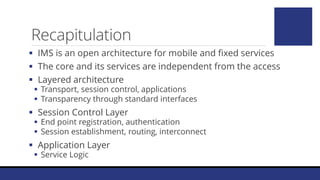
 IMS is an open architecture for mobile and fixed services
 The core and its services are independent from the access
 Layered architecture
 Transport, session control, applications
 Transparency through standard interfaces
 Session Control Layer
 End point registration, authentication
 Session establishment, routing, interconnect
 Application Layer
 Service Logic
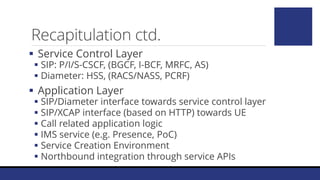
Recapitulation ctd.
 Service Control Layer
 SIP: P/I/S-CSCF, (BGCF, I-BCF, MRFC, AS)
 Diameter: HSS, (RACS/NASS, PCRF)
 Application Layer
 SIP/Diameter interface towards service control layer
 SIP/XCAP interface (based on HTTP) towards UE
 Call related application logic
 IMS service (e.g. Presence, PoC)
 Service Creation Environment
 Northbound integration through service APIs
IMS entities
(Wiley, The IMS Concepts and Services)
 Session management and routing family (CSCFs)
 Databases (HSS, SLF)
 Services (e.g. AS)
 Support functions (PDF, SEG, THIG)
 Charging
 Interworking functions (BGCF, MGCF, IMS-MGW, SGW)
Core nodes
 CSCF components separate logical functionality
 P-CSCF eq. SIP Proxy. It acts as access point for UE towards the
IMS core.
 I-CSCF eq. Inbound Proxy. It is placed on the borders of two
IMS domains. Entry point for served home users from visited
networks.
 S-CSCF eq. SIP Registrar/Location Server. It also acts as an
anchor point for IMS service control (ISC) and service
invocation (based on iFCs).
 HSS contains all subscriber and service related data
 No special entity in basic SIP (simply: user database)
Session Management & Routing
 Proxy-CSCF – User contact point with the IM CN
 SIP compression, IPSec association, PDF interaction
 Interrogating-CSCF – Subscriber contact point
 Next-hop lookup from HSS, S-CSCF assignment and
routing, THIG functionality
 Serving-CSCF – Service profile internal procedures
 Handling registration, challenging UE, routing decisions
 Responsible for Registration and Session Establishment,
Charging Data Generation, Media content check
Databases
 HSS
 Data storage for all subscriber and service-related data
 SLF
 Find HSS address for multiple HSS environment
 SIP Application Server
 Stand-alone AS
 Northbound integration using various protocols possible,
e.g., HTTP REST, Parlay X
 Open Service Access (OSA) gateway
 Connect northbound to OSA Parlay based AS
 IM Service Switching Function (SSF)
 Connect northbound the AS layer to legacy services using
IN protocols (e.g. INAP, CAMEL)
Application Server
Other real-world components
 Resource and Admission Control Subsystem (RACS)
 Mechanisms for applications to request and reserve the
resources from access network (Session Admission Control,
resource reservation)
 Network Attachment Subsystem (NASS)
 Registration and initialization of CPE for access to IMS services
(IP addresses and configuration, user authentication)
 Policy and Charging Control (PCC) framework
 Policy and Charging Rules Function (PCRF)
 Policy and Charging Enforcement Function (PCEF)
 Signaling
 SIP (signaling protocol)
 SDP (embedded in SIP, describes the session, negotiation)
 Media
 RTP (end-to-end media delivery (audio, video))
 MSRP (messaging, file transfer)
 DNS
 Diameter (AAA)
 IPSec (secure communication)
 MEGACO (media gateway control)
Protocols (extract)
Protocols
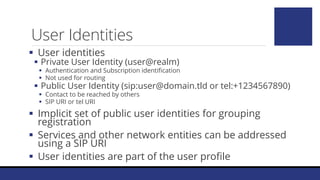
User Identities
 User identities
 Private User Identity (user@realm)
 Authentication and Subscription identification
 Not used for routing
 Public User Identity (sip:user@domain.tld or tel:+1234567890)
 Contact to be reached by others
 SIP URI or tel URI
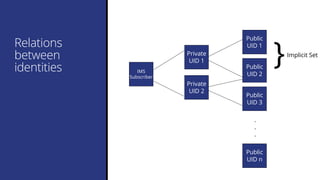
 Implicit set of public user identities for grouping
registration
 Services and other network entities can be addressed
using a SIP URI
 User identities are part of the user profile
Relations
between
identities IMS
Subscriber
Private
UID 2
Private
UID 1
Public
UID 1
Public
UID 3
Public
UID 2
Public
UID n
.
.
.
}Implicit Set
IMS Registration
 Required before a user can access services or perform
calls
 Precondition: UE has IP address & knows IMS entry point
 All CSCF are used
 P-CSCF (home/visited): Entry point, determines I-CSCF
 I-CSCF (home): Determines S-CSCF
 S-CSCF (home): Authenticates the subscriber, registers IMS
subscriber, interacts with service layer
 User assigned to one S-CSCF after successful registration
 Knows user profile until de-registration
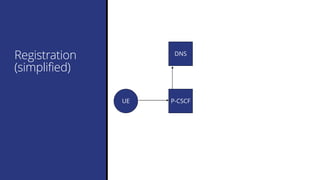
Registration
(simplified)
P-CSCF
DNS
UE
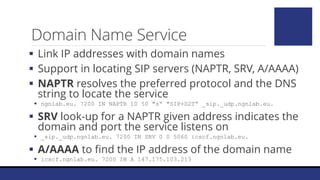
Domain Name Service
 Link IP addresses with domain names
 Support in locating SIP servers (NAPTR, SRV, A/AAAA)
 NAPTR resolves the preferred protocol and the DNS
string to locate the service
 ngnlab.eu. 7200 IN NAPTR 10 50 "s“ "SIP+D2T“ _sip._udp.ngnlab.eu.
 SRV look-up for a NAPTR given address indicates the
domain and port the service listens on
 _sip._udp.ngnlab.eu. 7200 IN SRV 0 0 5060 icscf.ngnlab.eu.
 A/AAAA to find the IP address of the domain name
 icscf.ngnlab.eu. 7200 IN A 147.175.103.213
Registration
(simplified)
P-CSCF I-CSCF S-CSCF
DNS
UE
HSS
Important SIP “additions”
 P-Access-Network-Info includes port location/cell
 From/To eq. IMPU
 Path informs S-CSCF about routing destination for terminating requests
 Collected during registration using INVITE (e.g. P-CSCF)
 Populated to Route headers in in-registration terminating requests on S-CSCF
 Authorization contains IMPI and other values
 200 OK Service-Route to populate S-CSCF address to P-CSCF for
originating requests
 Populated to Route headers in in-registration originating requests on UE
Important SIP “additions” – ctd.
 Choose a registered IMPU for session establishment
 UE – P-CSCF: P-Preferred-Identity
 P-CSCF – I/S-CSCF : P-Asserted-Identity
 P-Associated-URI informs client about registered
IMPUs
 Event: reg after registration to inform UE about
events on S-CSCF (e.g. HSS-initiated deregistration)
 After registration, subscriber is reachable through
public user identity for communication
 IMS subscriber can access services now or perform
calls
 P-CSCF (home or local)
 Proxy, contacts assigned S-CSCF for the calling subscriber
 S-CSCF (home)
 Service control and logic
 Contacts application or other party
 I-CSCF
 Entry point for communication from other domain
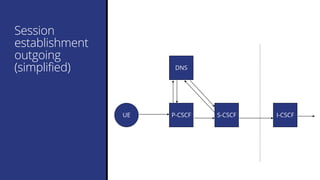
IMS Session Establishment
Session
establishment
outgoing
(simplified)
P-CSCF I-CSCFS-CSCF
DNS
UE
Session
establishment
incoming
(simplified)
P-CSCFI-CSCF S-CSCF
HSS
UE
To simplify matters, DNS is omitted in these slides.
 Message content within a SIP session (similar to RTP)
 Rendezvous mechanism mandatory (e.g. SDP)
 MSRP URI’s
 Accepted content
 SDP
c=IN IP4 atlanta.example.com
m=message 7654 TCP/MSRP *
a=accept-types:text/plain
a=path:msrp://atlanta.example.com:7654/jshA7weztas;tcp
Message Session Relay Protocol
(MSRP)
MSRP ctd.
 MSRP exchange
MSRP a786hjs2 SEND
To-Path: msrp://biloxi.example.com:12763/kjhd37s2s20w2a;tcp
From-Path: msrp://atlanta.example.com:7654/jshA7weztas;tcp
Message-ID: 87652491
Byte-Range: 1-25/25
Content-Type: text/plain
Hey Bob, are you there?
-------a786hjs2$
MSRP a786hjs2 200 OK
To-Path: msrp://atlanta.example.com:7654/jshA7weztas;tcp
From-Path: msrp://biloxi.example.com:12763/kjhd37s2s20w2a;tcp
-------a786hjs2$
MSRP ctd.
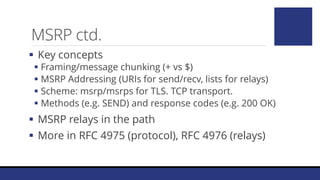
 Key concepts
 Framing/message chunking (+ vs $)
 MSRP Addressing (URIs for send/recv, lists for relays)
 Scheme: msrp/msrps for TLS. TCP transport.
 Methods (e.g. SEND) and response codes (e.g. 200 OK)
 MSRP relays in the path
 More in RFC 4975 (protocol), RFC 4976 (relays)
Messaging/Presence
 SIP MESSAGE
 SIP SIMPLE
 SIP SUBSCRIBE/NOTIFY
 SIP PUBLISH
 Many extensions
 Standard bodies: IETF, OMA
Service Triggering
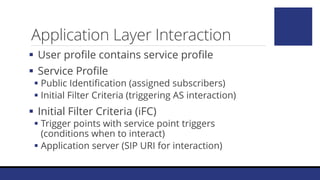
Application Layer Interaction
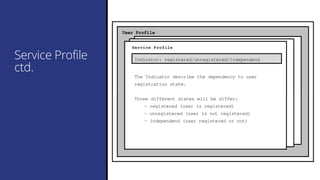
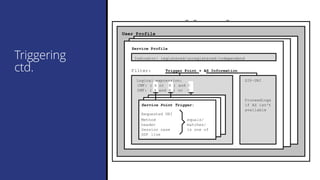
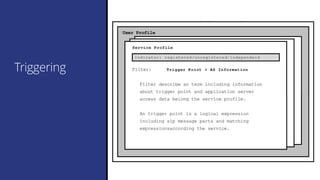
 User profile contains service profile
 Service Profile
 Public Identification (assigned subscribers)
 Initial Filter Criteria (triggering AS interaction)
 Initial Filter Criteria (iFC)
 Trigger points with service point triggers
(conditions when to interact)
 Application server (SIP URI for interaction)
Service Profile
Service Profile
ctd.
Triggering
Triggering
ctd.
Filtering
 Only initial SIP requests
 Initial filter criteria (iFC) retrieved from HSS during
registration
 Subsequent filter criteria (sFC) provided by
application server (beyond 3GPP R8)
 Allows dynamic definition of trigger points during
application runtime
 I/S-CSCF are interaction points with the service layer
 I-CSCF for public service identities (PSI)  explicit access
 S-CSCF for services (of served users)  implicit access
 Applications have interface towards HSS
 User profile information
 Location information, service information
 Complexity of security, authorization, access
interaction etc. all handled by the core
Application Routing
Application Routing ctd.
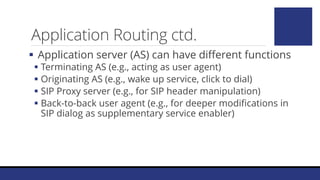
 Application server (AS) can have different functions
 Terminating AS (e.g., acting as user agent)
 Originating AS (e.g., wake up service, click to dial)
 SIP Proxy server (e.g., for SIP header manipulation)
 Back-to-back user agent (e.g., for deeper modifications in
SIP dialog as supplementary service enabler)
Q/A
Your Questions!
Is anything still unanswered?
 How do IMS services work?
 Why is the IMS needed for some communications services?
Is it?
 But I have heard of service X, why don’t they use the IMS?
 Will we build all future services on top of IMS?
 Are IMS services only those inherited from the Telco past?
 Will Telco’s deploy multiple IMS? IMS in the cloud? Share an
IMS?
 Will IMS bring in new revenues? Is it cheaper to deploy
services on the IMS compared to stand-alone deployments?
 Deepen understanding of CSCF/HSS roles
 Function of components
 Routing within control layer and towards applications
 Understanding IMS user identities
 Service control, routing, application layer interaction
 Many things omitted in this presentation
 Network access layer, IMS reference points names
 S-CSCF assignments in detail, SLF/HSS separation
 QoS resource reservation
 PSTN Breakout
 Charging
 Hopefully covered all open questions (last chance )
Summary
Thank you.
SEBASTIAN SCHUMANN
MAIL@S-SCHUMANN.COM
@S_SCHUMANN
SSCHUMANN
This lecture is available at the following link:
http://bit.ly/fiit-ims-signaling-3
Download
References
 All references are stated on the respective slides.
 If you feel that content where you hold the
copyright is displayed within these slides and you
do not like it, miss a link/reference, or want me to
remove it altogether please let me know.

IMS Signaling (Rev. 3)

  • 1.
    IMS Signaling SEBASTIAN SCHUMANN SLOVAKTELEKOM 12 MARCH 2014 BRATISLAVA, SLOVAKIA Revision 3
  • 2.
    Outline  Summary “SIP& IMS Basics”  IMS and its Services  Protocols  Service Triggering  Q/A
  • 3.
    Note!  These slidesonly summarize the lecture. Take notes.  Fixed agenda: IMS Signaling  Besides that:  Ask questions (how is it done in real-world, how did Slovak Telekom do it)  Interrupt (I don’t understand, can you provide samples, can we skip that)  Contribute (I’ve heard/read that…, I’m interested in…)  Discuss…
  • 4.
    Summary “SIP &IMS Basics” Reference to lecture.
  • 5.
    SIP Overview  Protocoloverview  Basic architecture  Types of servers  Separated by basic functionality  Request methods, responses, call flows  Session Description Protocol (SDP)
  • 6.
    IP Multimedia Subsystem(IMS)  Basic overview  Architecture  Horizontally layered approach  Functional elements  Flow details  Registration  Basic call setup
  • 7.
    IMS and itsServices
  • 8.
    Technology Trends Services Data/IPNetworks MobileNetworks PSTN/ISDN CATV Access Transport& Switching Networks Wireless Access Wireline Access IP Backbone Existing and newly emerging services Service & Network Control (QoS, Security, IP Mobility) Too costly, per-service network architecture Single/simple/cost-effective network infrastructure for existing & new services
  • 9.
    Access & Transport Plane Core Network Session ControlPlane Service Architecture Applications/Services Plane HSSCSCF Access Networ k Other Networks Web Portal Application Servers Session Control Centralized Databases Media Control & Gateways Media Server IMS: Simplified Concept
  • 10.
    Recapitulation  IMS isan open architecture for mobile and fixed services  The core and its services are independent from the access  Layered architecture  Transport, session control, applications  Transparency through standard interfaces  Session Control Layer  End point registration, authentication  Session establishment, routing, interconnect  Application Layer  Service Logic
  • 11.
    Recapitulation ctd.  ServiceControl Layer  SIP: P/I/S-CSCF, (BGCF, I-BCF, MRFC, AS)  Diameter: HSS, (RACS/NASS, PCRF)  Application Layer  SIP/Diameter interface towards service control layer  SIP/XCAP interface (based on HTTP) towards UE  Call related application logic  IMS service (e.g. Presence, PoC)  Service Creation Environment  Northbound integration through service APIs
  • 12.
    IMS entities (Wiley, TheIMS Concepts and Services)  Session management and routing family (CSCFs)  Databases (HSS, SLF)  Services (e.g. AS)  Support functions (PDF, SEG, THIG)  Charging  Interworking functions (BGCF, MGCF, IMS-MGW, SGW)
  • 13.
    Core nodes  CSCFcomponents separate logical functionality  P-CSCF eq. SIP Proxy. It acts as access point for UE towards the IMS core.  I-CSCF eq. Inbound Proxy. It is placed on the borders of two IMS domains. Entry point for served home users from visited networks.  S-CSCF eq. SIP Registrar/Location Server. It also acts as an anchor point for IMS service control (ISC) and service invocation (based on iFCs).  HSS contains all subscriber and service related data  No special entity in basic SIP (simply: user database)
  • 14.
    Session Management &Routing  Proxy-CSCF – User contact point with the IM CN  SIP compression, IPSec association, PDF interaction  Interrogating-CSCF – Subscriber contact point  Next-hop lookup from HSS, S-CSCF assignment and routing, THIG functionality  Serving-CSCF – Service profile internal procedures  Handling registration, challenging UE, routing decisions  Responsible for Registration and Session Establishment, Charging Data Generation, Media content check
  • 15.
    Databases  HSS  Datastorage for all subscriber and service-related data  SLF  Find HSS address for multiple HSS environment
  • 16.
     SIP ApplicationServer  Stand-alone AS  Northbound integration using various protocols possible, e.g., HTTP REST, Parlay X  Open Service Access (OSA) gateway  Connect northbound to OSA Parlay based AS  IM Service Switching Function (SSF)  Connect northbound the AS layer to legacy services using IN protocols (e.g. INAP, CAMEL) Application Server
  • 17.
    Other real-world components Resource and Admission Control Subsystem (RACS)  Mechanisms for applications to request and reserve the resources from access network (Session Admission Control, resource reservation)  Network Attachment Subsystem (NASS)  Registration and initialization of CPE for access to IMS services (IP addresses and configuration, user authentication)  Policy and Charging Control (PCC) framework  Policy and Charging Rules Function (PCRF)  Policy and Charging Enforcement Function (PCEF)
  • 18.
     Signaling  SIP(signaling protocol)  SDP (embedded in SIP, describes the session, negotiation)  Media  RTP (end-to-end media delivery (audio, video))  MSRP (messaging, file transfer)  DNS  Diameter (AAA)  IPSec (secure communication)  MEGACO (media gateway control) Protocols (extract)
  • 19.
  • 20.
    User Identities  Useridentities  Private User Identity (user@realm)  Authentication and Subscription identification  Not used for routing  Public User Identity (sip:user@domain.tld or tel:+1234567890)  Contact to be reached by others  SIP URI or tel URI  Implicit set of public user identities for grouping registration  Services and other network entities can be addressed using a SIP URI  User identities are part of the user profile
  • 21.
    Relations between identities IMS Subscriber Private UID 2 Private UID1 Public UID 1 Public UID 3 Public UID 2 Public UID n . . . }Implicit Set
  • 22.
    IMS Registration  Requiredbefore a user can access services or perform calls  Precondition: UE has IP address & knows IMS entry point  All CSCF are used  P-CSCF (home/visited): Entry point, determines I-CSCF  I-CSCF (home): Determines S-CSCF  S-CSCF (home): Authenticates the subscriber, registers IMS subscriber, interacts with service layer  User assigned to one S-CSCF after successful registration  Knows user profile until de-registration
  • 23.
  • 24.
    Domain Name Service Link IP addresses with domain names  Support in locating SIP servers (NAPTR, SRV, A/AAAA)  NAPTR resolves the preferred protocol and the DNS string to locate the service  ngnlab.eu. 7200 IN NAPTR 10 50 "s“ "SIP+D2T“ _sip._udp.ngnlab.eu.  SRV look-up for a NAPTR given address indicates the domain and port the service listens on  _sip._udp.ngnlab.eu. 7200 IN SRV 0 0 5060 icscf.ngnlab.eu.  A/AAAA to find the IP address of the domain name  icscf.ngnlab.eu. 7200 IN A 147.175.103.213
  • 25.
  • 26.
    Important SIP “additions” P-Access-Network-Info includes port location/cell  From/To eq. IMPU  Path informs S-CSCF about routing destination for terminating requests  Collected during registration using INVITE (e.g. P-CSCF)  Populated to Route headers in in-registration terminating requests on S-CSCF  Authorization contains IMPI and other values  200 OK Service-Route to populate S-CSCF address to P-CSCF for originating requests  Populated to Route headers in in-registration originating requests on UE
  • 27.
    Important SIP “additions”– ctd.  Choose a registered IMPU for session establishment  UE – P-CSCF: P-Preferred-Identity  P-CSCF – I/S-CSCF : P-Asserted-Identity  P-Associated-URI informs client about registered IMPUs  Event: reg after registration to inform UE about events on S-CSCF (e.g. HSS-initiated deregistration)
  • 28.
     After registration,subscriber is reachable through public user identity for communication  IMS subscriber can access services now or perform calls  P-CSCF (home or local)  Proxy, contacts assigned S-CSCF for the calling subscriber  S-CSCF (home)  Service control and logic  Contacts application or other party  I-CSCF  Entry point for communication from other domain IMS Session Establishment
  • 29.
  • 30.
  • 31.
     Message contentwithin a SIP session (similar to RTP)  Rendezvous mechanism mandatory (e.g. SDP)  MSRP URI’s  Accepted content  SDP c=IN IP4 atlanta.example.com m=message 7654 TCP/MSRP * a=accept-types:text/plain a=path:msrp://atlanta.example.com:7654/jshA7weztas;tcp Message Session Relay Protocol (MSRP)
  • 32.
    MSRP ctd.  MSRPexchange MSRP a786hjs2 SEND To-Path: msrp://biloxi.example.com:12763/kjhd37s2s20w2a;tcp From-Path: msrp://atlanta.example.com:7654/jshA7weztas;tcp Message-ID: 87652491 Byte-Range: 1-25/25 Content-Type: text/plain Hey Bob, are you there? -------a786hjs2$ MSRP a786hjs2 200 OK To-Path: msrp://atlanta.example.com:7654/jshA7weztas;tcp From-Path: msrp://biloxi.example.com:12763/kjhd37s2s20w2a;tcp -------a786hjs2$
  • 33.
    MSRP ctd.  Keyconcepts  Framing/message chunking (+ vs $)  MSRP Addressing (URIs for send/recv, lists for relays)  Scheme: msrp/msrps for TLS. TCP transport.  Methods (e.g. SEND) and response codes (e.g. 200 OK)  MSRP relays in the path  More in RFC 4975 (protocol), RFC 4976 (relays)
  • 34.
    Messaging/Presence  SIP MESSAGE SIP SIMPLE  SIP SUBSCRIBE/NOTIFY  SIP PUBLISH  Many extensions  Standard bodies: IETF, OMA
  • 35.
  • 36.
    Application Layer Interaction User profile contains service profile  Service Profile  Public Identification (assigned subscribers)  Initial Filter Criteria (triggering AS interaction)  Initial Filter Criteria (iFC)  Trigger points with service point triggers (conditions when to interact)  Application server (SIP URI for interaction)
  • 37.
  • 38.
  • 39.
  • 40.
  • 41.
    Filtering  Only initialSIP requests  Initial filter criteria (iFC) retrieved from HSS during registration  Subsequent filter criteria (sFC) provided by application server (beyond 3GPP R8)  Allows dynamic definition of trigger points during application runtime
  • 42.
     I/S-CSCF areinteraction points with the service layer  I-CSCF for public service identities (PSI)  explicit access  S-CSCF for services (of served users)  implicit access  Applications have interface towards HSS  User profile information  Location information, service information  Complexity of security, authorization, access interaction etc. all handled by the core Application Routing
  • 43.
    Application Routing ctd. Application server (AS) can have different functions  Terminating AS (e.g., acting as user agent)  Originating AS (e.g., wake up service, click to dial)  SIP Proxy server (e.g., for SIP header manipulation)  Back-to-back user agent (e.g., for deeper modifications in SIP dialog as supplementary service enabler)
  • 44.
  • 45.
    Is anything stillunanswered?  How do IMS services work?  Why is the IMS needed for some communications services? Is it?  But I have heard of service X, why don’t they use the IMS?  Will we build all future services on top of IMS?  Are IMS services only those inherited from the Telco past?  Will Telco’s deploy multiple IMS? IMS in the cloud? Share an IMS?  Will IMS bring in new revenues? Is it cheaper to deploy services on the IMS compared to stand-alone deployments?
  • 46.
     Deepen understandingof CSCF/HSS roles  Function of components  Routing within control layer and towards applications  Understanding IMS user identities  Service control, routing, application layer interaction  Many things omitted in this presentation  Network access layer, IMS reference points names  S-CSCF assignments in detail, SLF/HSS separation  QoS resource reservation  PSTN Breakout  Charging  Hopefully covered all open questions (last chance ) Summary
  • 47.
  • 48.
    This lecture isavailable at the following link: http://bit.ly/fiit-ims-signaling-3 Download
  • 49.
    References  All referencesare stated on the respective slides.  If you feel that content where you hold the copyright is displayed within these slides and you do not like it, miss a link/reference, or want me to remove it altogether please let me know.