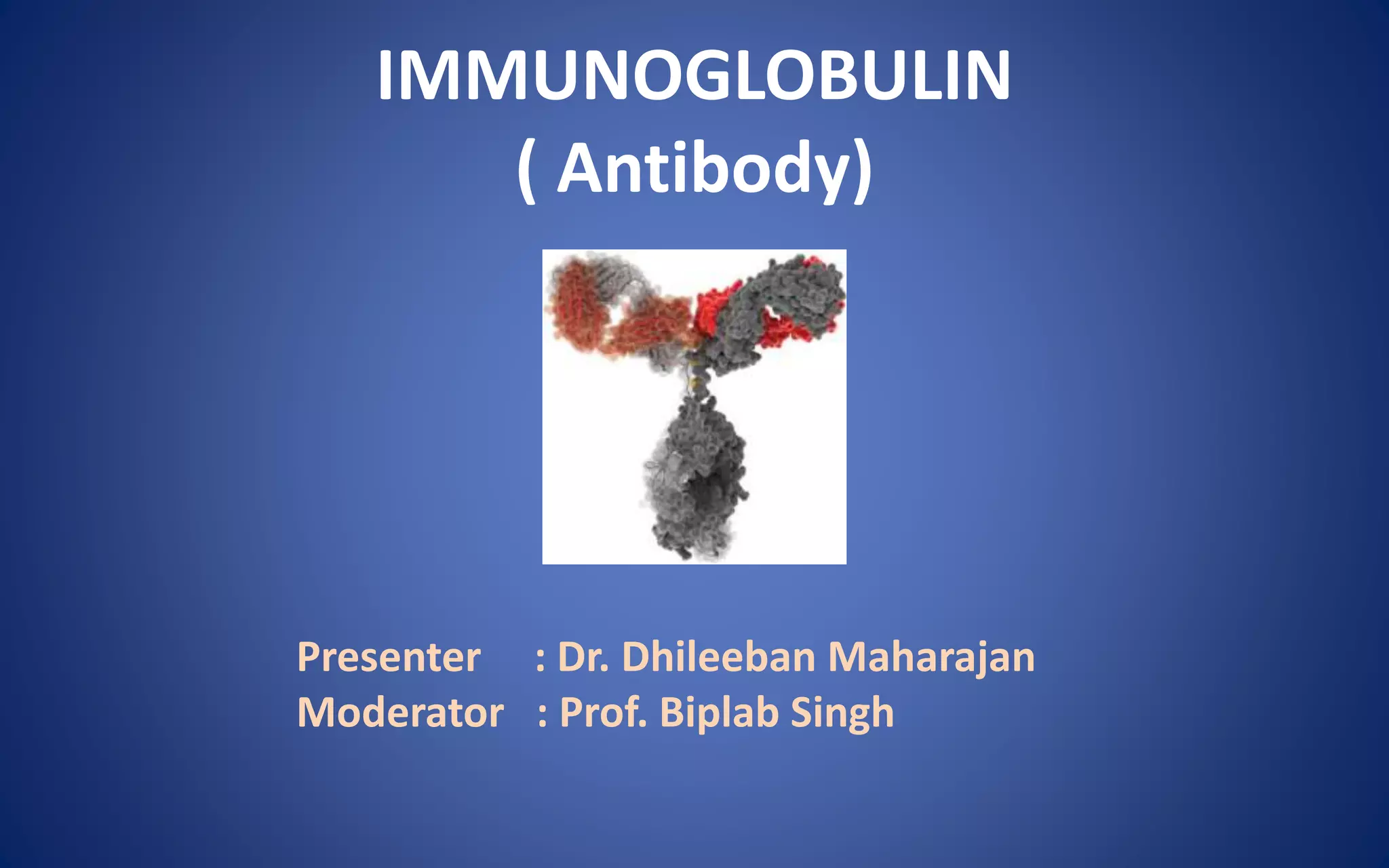
IMMUNOGLOBULIN
( Antibody)
Presenter : Dr. Dhileeban Maharajan
Moderator : Prof. Biplab Singh
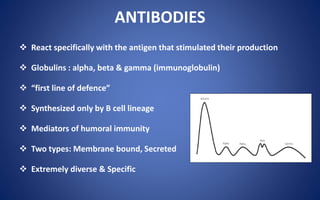
ANTIBODIES
 React specifically with the antigen that stimulated their production
 Globulins : alpha, beta & gamma (immunoglobulin)
 “first line of defence”
 Synthesized only by B cell lineage
 Mediators of humoral immunity
 Two types: Membrane bound, Secreted
 Extremely diverse & Specific
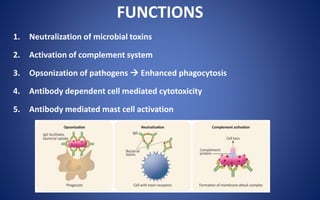
FUNCTIONS
1. Neutralization of microbial toxins
2. Activation of complement system
3. Opsonization of pathogens  Enhanced phagocytosis
4. Antibody dependent cell mediated cytotoxicity
5. Antibody mediated mast cell activation
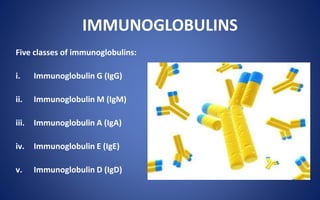
IMMUNOGLOBULINS
Five classes of immunoglobulins:
i. Immunoglobulin G (IgG)
ii. Immunoglobulin M (IgM)
iii. Immunoglobulin A (IgA)
iv. Immunoglobulin E (IgE)
v. Immunoglobulin D (IgD)
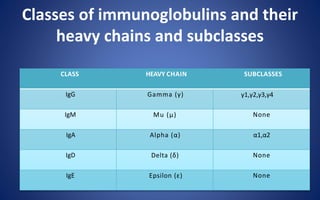
Classes of immunoglobulins and their
heavy chains and subclasses
CLASS HEAVY CHAIN SUBCLASSES
IgG Gamma (γ) γ1,γ2,γ3,γ4
IgM Mu (µ) None
IgA Alpha (α) α1,α2
IgD Delta (δ) None
IgE Epsilon (ε) None
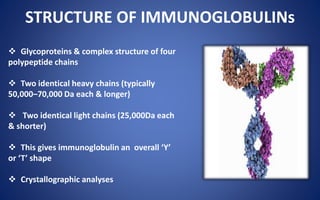
STRUCTURE OF IMMUNOGLOBULINs
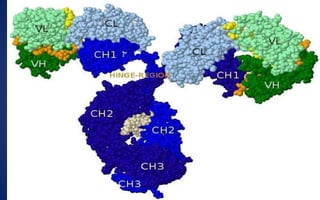
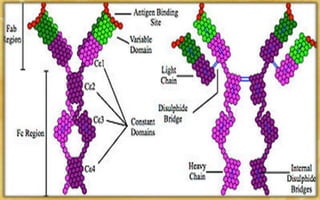
 Glycoproteins & complex structure of four
polypeptide chains
 Two identical heavy chains (typically
50,000–70,000 Da each & longer)
 Two identical light chains (25,000Da each
& shorter)
 This gives immunoglobulin an overall ‘Y’
or ‘T’ shape
 Crystallographic analyses
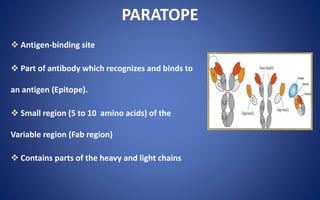
PARATOPE
 Antigen-binding site
 Part of antibody which recognizes and binds to
an antigen (Epitope).
 Small region (5 to 10 amino acids) of the
Variable region (Fab region)
 Contains parts of the heavy and light chains
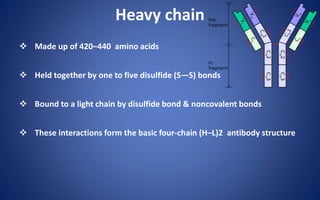
Heavy chain
 Made up of 420–440 amino acids
 Held together by one to five disulfide (S—S) bonds
 Bound to a light chain by disulfide bond & noncovalent bonds
 These interactions form the basic four-chain (H–L)2 antibody structure
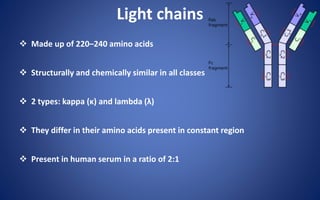
Light chains
 Made up of 220–240 amino acids
 Structurally and chemically similar in all classes
 2 types: kappa (κ) and lambda (λ)
 They differ in their amino acids present in constant region
 Present in human serum in a ratio of 2:1
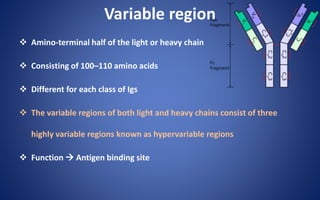
Variable region
 Amino-terminal half of the light or heavy chain
 Consisting of 100–110 amino acids
 Different for each class of Igs
 The variable regions of both light and heavy chains consist of three
highly variable regions known as hypervariable regions
 Function  Antigen binding site
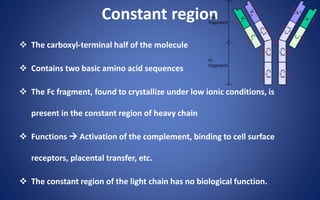
Constant region
 The carboxyl-terminal half of the molecule
 Contains two basic amino acid sequences
 The Fc fragment, found to crystallize under low ionic conditions, is
present in the constant region of heavy chain
 Functions  Activation of the complement, binding to cell surface
receptors, placental transfer, etc.
 The constant region of the light chain has no biological function.
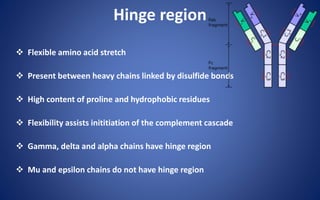
Hinge region
 Flexible amino acid stretch
 Present between heavy chains linked by disulfide bonds
 High content of proline and hydrophobic residues
 Flexibility assists inititiation of the complement cascade
 Gamma, delta and alpha chains have hinge region
 Mu and epsilon chains do not have hinge region
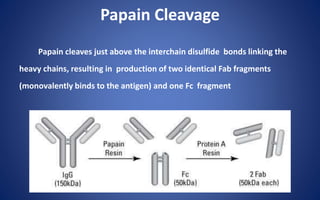
Papain Cleavage
Papain cleaves just above the interchain disulfide bonds linking the
heavy chains, resulting in production of two identical Fab fragments
(monovalently binds to the antigen) and one Fc fragment
Pepsin Cleavage
Pepsin cleaves just below these bonds, thereby generating different
digestion products producing an Fc fragment and two Fab fragments
[F(ab)2], which upon exposure to reducing conditions are separated into
Fab monomeric units
Antigen determinants
• 3 major determinants:
– Isotypes
– Allotypes
– Idiotypes
Isotypes
 A particular constant region of the light-or heavy-chain of the Ig which is
used to classify them
 present in all members of a species
 Heavy chain isotype markers: µ,γ,α,δ and ε for IgM, IgG, IgA, IgD, and
IgE, respectively
 Light chain isotype markers: κ and λ
Allotypes
 Allelic differences in both the variable and constant regions of
immunoglobulin
 Am on α heavy chains, Gm on γ heavy chains, and Km on κ light chains
 >25 Gm types ,3 Km and 2 Am on IgA have been described
 Allotype markers are absent on µ, δ, ε heavy chains and on λ light chains
Idiotypes
 A specificity that is associated with the variable region
 Idiotype markers are found on the hypervariable region of the Ig
 Idiotypes are specific for each antibody molecule
 Anti-idiotypic antibodies produced against Fab fragments prevent
antigen–antibody interaction
Biosynthesis of Immunoglobulins
• B lymphocytes and plasma cells take part in the synthesis of immunoglobulins
• Resting B cells synthesize only small amounts of Igs that mainly get incorporated
into cell membranes but plasma cells (abundant cytoplasm & rich in ER) produce
and secrete large amounts of immunoglobulins
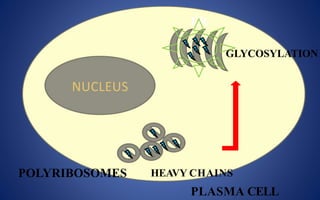
• In separate polyribosomes, the heavy chain & light chains are produced and later
joined either as H-L hemimolecule or as H2 & L2, Later they associate to form
complete molecule
NUCLEUS
ER
POLYRIBOSOMES HEAVY CHAINS
PLASMA CELL
GLYCOSYLATION
Immunoglobulin G
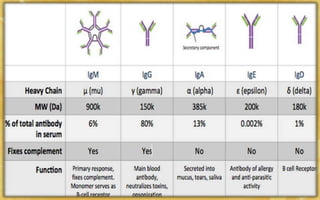
 Molecular weight of 150,000 Da
 half-life of 23 days (longest among all the Igs)
 most abundant - about 80% of the total serum immunoglobulin
 Four IgG subclasses based on γ chain isotypes : IgG1, IgG2, IgG3, and IgG4
o IgG1, IgG3 & IgG4: cross placental barrier
o IgG3, IgG1 & IgG2: complement activation
o IgG1 & IgG3: mediate opsonisation (high affinity for Fc receptors of phagocytes)
Biological activity
 In response to infection, IgG antibodies appear late after appearance of
IgM antibodies, but persists for a longer period
 Protection against the microorganisms
 Distributed equally in the intra and extra- vascular compartments
 Only Ig that crosses the placenta & confers natural passive immunity to
the newborns
 Takes part in precipitation, complement fixation & neutralization of
toxins and viruses and binds to microorganisms and facilitates the
process of phagocytosis
Immunoglobulin M
 Constitute about 5–8% of total serum Ig
 Intra-vascular distribution
 Heavy molecule with molecular weight varying from 900k to 1,000k Da
 Half-life of 5 days
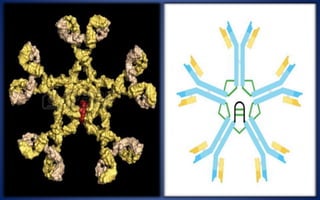
 basically a pentamer, composed of five Ig subunits & J-chain
 2 µ heavy chains & 2 κ/λ light chain
 Heavy chains are larger than those of IgG by about 20,000 Da,
corresponding to an extra domain on the constant region
Biological activities
 Pentameric IgM has high valency (10 antigen binding sites) thus efficient
in binding antigens with many repeating epitopes, such as viral particles
and RBCs
 Efficient than IgG in activating complement
 Good complement activation (two Fc regions in close proximity)
 First Ig produced in primary response; deficiency leads to septicaemia
 Also act as a B cell receptor
 Presence of IgM antibody in serum indicates recent infection (short lived
and disappear early)
 First Ig to be synthesized by a neonate in about 20 weeks of age; since it
is not able to cross placenta, its presence indicates intra-uterine infection
 The detection of IgM antibodies in serum is useful for the diagnosis of congenital
infections, such as syphilis, rubella, toxoplasmosis, etc.
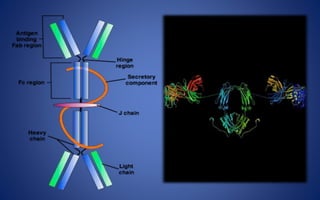
Immunoglobulin A
 2nd most abundant Ig (10–15% of serum IG)
 Half-life of 6–8 days
 Consists of α heavy chain (58-kDa & 470 amino acid residue) with 3
constant domains CH1, CH2, and CH3 and 1 variable domain VH
 Hinge region is situated between CH1 and CH2 domains
 An additional segment of 18-AA residues at the penultimate position of
the chain contains a cysteine residue where the J chain can be attached
through a disulfide bond.
 IgA occurs in two forms: Serum IgA and Secretory IgA
Serum IgA
 molecular weight of 60kDa & 1/2 life 6-8 days
 two subclasses, IgA1 and IgA2 (two α chain isotypes α1 and α2)
 α2 chain has two allotypes, A2m (1) and A2m (2), and does not have
disulfide bonds linking heavy to light chains
 Differences in the two α chains are found in two CH1 and five CH3
positions & hence there are three varieties of α heavy chains in humans
Secretory IgA
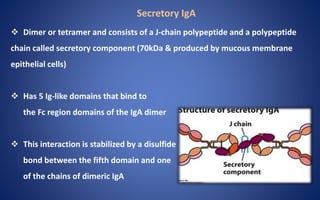
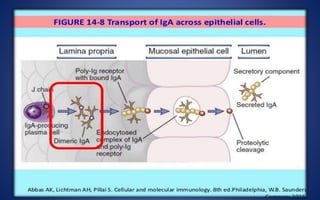
 Dimer or tetramer and consists of a J-chain polypeptide and a polypeptide
chain called secretory component (70kDa & produced by mucous membrane
epithelial cells)
 Has 5 Ig-like domains that bind to
the Fc region domains of the IgA dimer
 This interaction is stabilized by a disulfide
bond between the fifth domain and one
of the chains of dimeric IgA
 IgA-secreting plasma cells are concentrated along mucous membrane
surfaces
 The daily production of secretory IgA is greater than that of any other Igs
 Secretory IgA is the major Ig present in external secretions, such as
breast milk, saliva, tears & mucus of the bronchial, genitourinary, and
digestive tracts
 IgA activates the complement not by classical pathway but by alternative
pathway
Biological functions of secretory IgA
 It is polymeric & hence can cross-link large antigens with multiple
epitopes thus protects the mucous membranes against microbial
pathogens
 Binding of secretory IgA to bacterial and viral surface antigens prevents
attachment of the pathogens to the mucosal cells thus inhibiting
colonization.
 Complexes of secretory IgA and antigen are easily entrapped in mucus
and then eliminated by the ciliated epithelial cells of the respiratory tract
or by peristalsis of the gut
 IgA in breast milk protect the newborns against infection during the first
month of life
 Secretory IgA has shown to provide an important line of defense against
bacteria (such as Salmonella, Vibrio cholerae, and Neisseria ) and viruses
(such as polio, influenza, and reovirus)
Immunoglobin E
 IgE constitutes less than 1% of the total Ig pool
 Present in serum in a very low concentration (0.3 g/mL) & mostly found
extravascularly in lining of respiratory and intestinal tracts
 MW of 190K Da & ½ life of 2–3 days
 Unlike other Igs, IgE is a heat-labile protein, easily inactivated at 56°C in 1
hour
 Two ε heavy polypeptide chains (72-kDa, 550- AA residue), along with
two κ or two λ light chain, together by disulfide bonds
Biological activity
 Reaginic antibody mediates the type I immediate HS (atopy) reactions
 Responsible for the symptoms of hay fever, asthma & anaphylactic
shock
 IgE binds to Fc receptors on the membranes of blood basophils and
tissue mast cells & antigen (allergen) induces basophils and mast cells to
translocate their granules to the plasma membrane and release their
contents to the extracellular environment - a process known as
degranulation
 As a result, varieties of pharmacologically active mediators are released and
give rise to allergic manifestations
 Localized mast-cell degranulation necessary for antiparasitic defence
Immunoglobulin D
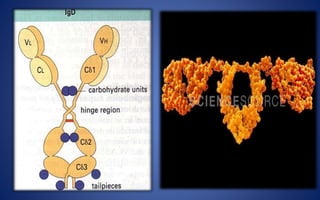
 IgD comprises less than 1% of serum Ig(MW 180k Da & half-life of only 2–3 days)
 IgD has basic four chain monomeric structure with two δ heavy chains (MW
63kDa each, 500-amino acid residue) and either two κ or two λ light chains(MW
22kDa each)
 The δ heavy polypeptide chain consisting of one variable region VH, and a three-
domain constant regions CH1, CH2, and CH3
 IgD is present on the surface of B lymphocytes and both IgD & IgM serve as
recognition receptors for antigens
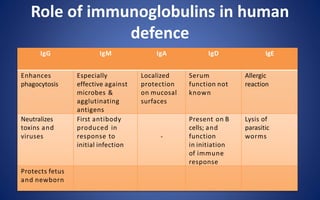
Role of immunoglobulins in human
defence
IgG IgM IgA IgD IgE
Enhances
phagocytosis
Especially
effective against
microbes &
agglutinating
antigens
Localized
protection
on mucosal
surfaces
Serum
function not
known
Allergic
reaction
Neutralizes
toxins and
viruses
First antibody
produced in
response to
initial infection
-
Present on B
cells; and
function
in initiation
of immune
response
Lysis of
parasitic
worms
Protects fetus
and newborn
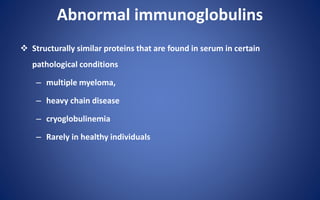
Abnormal immunoglobulins
 Structurally similar proteins that are found in serum in certain
pathological conditions
– multiple myeloma,
– heavy chain disease
– cryoglobulinemia
– Rarely in healthy individuals
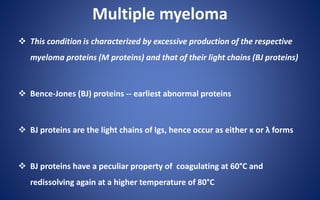
Multiple myeloma
 This condition is characterized by excessive production of the respective
myeloma proteins (M proteins) and that of their light chains (BJ proteins)
 Bence-Jones (BJ) proteins -- earliest abnormal proteins
 BJ proteins are the light chains of Igs, hence occur as either κ or λ forms
 BJ proteins have a peculiar property of coagulating at 60°C and
redissolving again at a higher temperature of 80°C
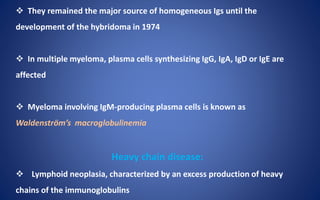
 They remained the major source of homogeneous Igs until the
development of the hybridoma in 1974
 In multiple myeloma, plasma cells synthesizing IgG, IgA, IgD or IgE are
affected
 Myeloma involving IgM-producing plasma cells is known as
Waldenström’s macroglobulinemia
Heavy chain disease:
 Lymphoid neoplasia, characterized by an excess production of heavy
chains of the immunoglobulins
Cryoglobulinemia
 Condition characterized by presence of cryoglobulins in blood
 The condition may not be always associated with disease but is often
found in patients with macroglobulinemia, SLE or myelomas
 Most cryoglobulins consist of either IgG or IgM or their mixed
precipitates & serum from patient precipitates on cooling and
redissolves on warming.
Immunoglobulin as Medicine
Immunosuppressive Antibodies
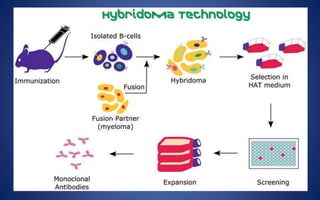
 Hybridoma Technology
 Milstein and Kohler – 1974
 HAMA – Human anti-mouse antibodies
Intravenous Immune Globulin (IVIG)
• Polyclonal human Immunoglobulin
• Thousands of healthy donors
• Not specific against single antigen
• Normalizing effect in immune network
• High Dose IVIG – 2gm/kg use:
– ITP
– Kawasaki’s disease
– GBS
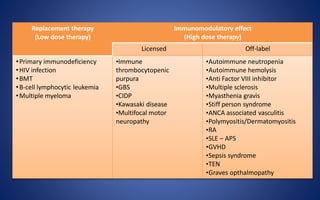
Replacement therapy
(Low dose therapy)
Immunomodulatory effect
(High dose therapy)
Licensed Off-label
•Primary immunodeficiency
•HIV infection
•BMT
•B-cell lymphocytic leukemia
•Multiple myeloma
•Immune
thrombocytopenic
purpura
•GBS
•CIDP
•Kawasaki disease
•Multifocal motor
neuropathy
•Autoimmune neutropenia
•Autoimmune hemolysis
•Anti Factor VIII inhibitor
•Multiple sclerosis
•Myasthenia gravis
•Stiff person syndrome
•ANCA associated vasculitis
•Polymyositis/Dermatomyositis
•RA
•SLE – APS
•GVHD
•Sepsis syndrome
•TEN
•Graves opthalmopathy
Hyperimmune Immunoglobulins
• Selected donor with high titers of antibodies against
particular agents
• To reduce the severity of infection
• Use:
– Respiratory syncytial virus
– CMV
– Varicella zoster
-- HHV 3
-- Hepatitis B virus
-- Tetanus
-- As anti-venom
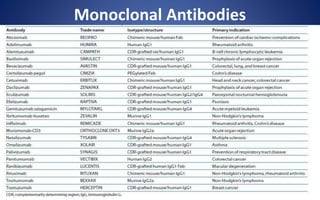
Monoclonal Antibodies
Thank You

Immunoglobulin

  • 1.
    IMMUNOGLOBULIN ( Antibody) Presenter :Dr. Dhileeban Maharajan Moderator : Prof. Biplab Singh
  • 2.
    ANTIBODIES  React specificallywith the antigen that stimulated their production  Globulins : alpha, beta & gamma (immunoglobulin)  “first line of defence”  Synthesized only by B cell lineage  Mediators of humoral immunity  Two types: Membrane bound, Secreted  Extremely diverse & Specific
  • 3.
    FUNCTIONS 1. Neutralization ofmicrobial toxins 2. Activation of complement system 3. Opsonization of pathogens  Enhanced phagocytosis 4. Antibody dependent cell mediated cytotoxicity 5. Antibody mediated mast cell activation
  • 4.
    IMMUNOGLOBULINS Five classes ofimmunoglobulins: i. Immunoglobulin G (IgG) ii. Immunoglobulin M (IgM) iii. Immunoglobulin A (IgA) iv. Immunoglobulin E (IgE) v. Immunoglobulin D (IgD)
  • 5.
    Classes of immunoglobulinsand their heavy chains and subclasses CLASS HEAVY CHAIN SUBCLASSES IgG Gamma (γ) γ1,γ2,γ3,γ4 IgM Mu (µ) None IgA Alpha (α) α1,α2 IgD Delta (δ) None IgE Epsilon (ε) None
  • 6.
    STRUCTURE OF IMMUNOGLOBULINs Glycoproteins & complex structure of four polypeptide chains  Two identical heavy chains (typically 50,000–70,000 Da each & longer)  Two identical light chains (25,000Da each & shorter)  This gives immunoglobulin an overall ‘Y’ or ‘T’ shape  Crystallographic analyses
  • 7.
    PARATOPE  Antigen-binding site Part of antibody which recognizes and binds to an antigen (Epitope).  Small region (5 to 10 amino acids) of the Variable region (Fab region)  Contains parts of the heavy and light chains
  • 8.
    Heavy chain  Madeup of 420–440 amino acids  Held together by one to five disulfide (S—S) bonds  Bound to a light chain by disulfide bond & noncovalent bonds  These interactions form the basic four-chain (H–L)2 antibody structure
  • 9.
    Light chains  Madeup of 220–240 amino acids  Structurally and chemically similar in all classes  2 types: kappa (κ) and lambda (λ)  They differ in their amino acids present in constant region  Present in human serum in a ratio of 2:1
  • 10.
    Variable region  Amino-terminalhalf of the light or heavy chain  Consisting of 100–110 amino acids  Different for each class of Igs  The variable regions of both light and heavy chains consist of three highly variable regions known as hypervariable regions  Function  Antigen binding site
  • 11.
    Constant region  Thecarboxyl-terminal half of the molecule  Contains two basic amino acid sequences  The Fc fragment, found to crystallize under low ionic conditions, is present in the constant region of heavy chain  Functions  Activation of the complement, binding to cell surface receptors, placental transfer, etc.  The constant region of the light chain has no biological function.
  • 12.
    Hinge region  Flexibleamino acid stretch  Present between heavy chains linked by disulfide bonds  High content of proline and hydrophobic residues  Flexibility assists inititiation of the complement cascade  Gamma, delta and alpha chains have hinge region  Mu and epsilon chains do not have hinge region
  • 13.
    Papain Cleavage Papain cleavesjust above the interchain disulfide bonds linking the heavy chains, resulting in production of two identical Fab fragments (monovalently binds to the antigen) and one Fc fragment
  • 14.
    Pepsin Cleavage Pepsin cleavesjust below these bonds, thereby generating different digestion products producing an Fc fragment and two Fab fragments [F(ab)2], which upon exposure to reducing conditions are separated into Fab monomeric units
  • 15.
    Antigen determinants • 3major determinants: – Isotypes – Allotypes – Idiotypes
  • 16.
    Isotypes  A particularconstant region of the light-or heavy-chain of the Ig which is used to classify them  present in all members of a species  Heavy chain isotype markers: µ,γ,α,δ and ε for IgM, IgG, IgA, IgD, and IgE, respectively  Light chain isotype markers: κ and λ
  • 17.
    Allotypes  Allelic differencesin both the variable and constant regions of immunoglobulin  Am on α heavy chains, Gm on γ heavy chains, and Km on κ light chains  >25 Gm types ,3 Km and 2 Am on IgA have been described  Allotype markers are absent on µ, δ, ε heavy chains and on λ light chains
  • 18.
    Idiotypes  A specificitythat is associated with the variable region  Idiotype markers are found on the hypervariable region of the Ig  Idiotypes are specific for each antibody molecule  Anti-idiotypic antibodies produced against Fab fragments prevent antigen–antibody interaction
  • 19.
    Biosynthesis of Immunoglobulins •B lymphocytes and plasma cells take part in the synthesis of immunoglobulins • Resting B cells synthesize only small amounts of Igs that mainly get incorporated into cell membranes but plasma cells (abundant cytoplasm & rich in ER) produce and secrete large amounts of immunoglobulins • In separate polyribosomes, the heavy chain & light chains are produced and later joined either as H-L hemimolecule or as H2 & L2, Later they associate to form complete molecule
  • 20.
  • 21.
    Immunoglobulin G  Molecularweight of 150,000 Da  half-life of 23 days (longest among all the Igs)  most abundant - about 80% of the total serum immunoglobulin  Four IgG subclasses based on γ chain isotypes : IgG1, IgG2, IgG3, and IgG4 o IgG1, IgG3 & IgG4: cross placental barrier o IgG3, IgG1 & IgG2: complement activation o IgG1 & IgG3: mediate opsonisation (high affinity for Fc receptors of phagocytes)
  • 22.
    Biological activity  Inresponse to infection, IgG antibodies appear late after appearance of IgM antibodies, but persists for a longer period  Protection against the microorganisms  Distributed equally in the intra and extra- vascular compartments  Only Ig that crosses the placenta & confers natural passive immunity to the newborns  Takes part in precipitation, complement fixation & neutralization of toxins and viruses and binds to microorganisms and facilitates the process of phagocytosis
  • 24.
    Immunoglobulin M  Constituteabout 5–8% of total serum Ig  Intra-vascular distribution  Heavy molecule with molecular weight varying from 900k to 1,000k Da  Half-life of 5 days  basically a pentamer, composed of five Ig subunits & J-chain  2 µ heavy chains & 2 κ/λ light chain  Heavy chains are larger than those of IgG by about 20,000 Da, corresponding to an extra domain on the constant region
  • 26.
    Biological activities  PentamericIgM has high valency (10 antigen binding sites) thus efficient in binding antigens with many repeating epitopes, such as viral particles and RBCs  Efficient than IgG in activating complement  Good complement activation (two Fc regions in close proximity)  First Ig produced in primary response; deficiency leads to septicaemia  Also act as a B cell receptor
  • 27.
     Presence ofIgM antibody in serum indicates recent infection (short lived and disappear early)  First Ig to be synthesized by a neonate in about 20 weeks of age; since it is not able to cross placenta, its presence indicates intra-uterine infection  The detection of IgM antibodies in serum is useful for the diagnosis of congenital infections, such as syphilis, rubella, toxoplasmosis, etc.
  • 28.
    Immunoglobulin A  2ndmost abundant Ig (10–15% of serum IG)  Half-life of 6–8 days  Consists of α heavy chain (58-kDa & 470 amino acid residue) with 3 constant domains CH1, CH2, and CH3 and 1 variable domain VH  Hinge region is situated between CH1 and CH2 domains  An additional segment of 18-AA residues at the penultimate position of the chain contains a cysteine residue where the J chain can be attached through a disulfide bond.
  • 30.
     IgA occursin two forms: Serum IgA and Secretory IgA Serum IgA  molecular weight of 60kDa & 1/2 life 6-8 days  two subclasses, IgA1 and IgA2 (two α chain isotypes α1 and α2)  α2 chain has two allotypes, A2m (1) and A2m (2), and does not have disulfide bonds linking heavy to light chains  Differences in the two α chains are found in two CH1 and five CH3 positions & hence there are three varieties of α heavy chains in humans
  • 31.
    Secretory IgA  Dimeror tetramer and consists of a J-chain polypeptide and a polypeptide chain called secretory component (70kDa & produced by mucous membrane epithelial cells)  Has 5 Ig-like domains that bind to the Fc region domains of the IgA dimer  This interaction is stabilized by a disulfide bond between the fifth domain and one of the chains of dimeric IgA
  • 32.
     IgA-secreting plasmacells are concentrated along mucous membrane surfaces  The daily production of secretory IgA is greater than that of any other Igs  Secretory IgA is the major Ig present in external secretions, such as breast milk, saliva, tears & mucus of the bronchial, genitourinary, and digestive tracts  IgA activates the complement not by classical pathway but by alternative pathway
  • 34.
    Biological functions ofsecretory IgA  It is polymeric & hence can cross-link large antigens with multiple epitopes thus protects the mucous membranes against microbial pathogens  Binding of secretory IgA to bacterial and viral surface antigens prevents attachment of the pathogens to the mucosal cells thus inhibiting colonization.
  • 35.
     Complexes ofsecretory IgA and antigen are easily entrapped in mucus and then eliminated by the ciliated epithelial cells of the respiratory tract or by peristalsis of the gut  IgA in breast milk protect the newborns against infection during the first month of life  Secretory IgA has shown to provide an important line of defense against bacteria (such as Salmonella, Vibrio cholerae, and Neisseria ) and viruses (such as polio, influenza, and reovirus)
  • 36.
    Immunoglobin E  IgEconstitutes less than 1% of the total Ig pool  Present in serum in a very low concentration (0.3 g/mL) & mostly found extravascularly in lining of respiratory and intestinal tracts  MW of 190K Da & ½ life of 2–3 days  Unlike other Igs, IgE is a heat-labile protein, easily inactivated at 56°C in 1 hour  Two ε heavy polypeptide chains (72-kDa, 550- AA residue), along with two κ or two λ light chain, together by disulfide bonds
  • 38.
    Biological activity  Reaginicantibody mediates the type I immediate HS (atopy) reactions  Responsible for the symptoms of hay fever, asthma & anaphylactic shock  IgE binds to Fc receptors on the membranes of blood basophils and tissue mast cells & antigen (allergen) induces basophils and mast cells to translocate their granules to the plasma membrane and release their contents to the extracellular environment - a process known as degranulation
  • 39.
     As aresult, varieties of pharmacologically active mediators are released and give rise to allergic manifestations  Localized mast-cell degranulation necessary for antiparasitic defence
  • 40.
    Immunoglobulin D  IgDcomprises less than 1% of serum Ig(MW 180k Da & half-life of only 2–3 days)  IgD has basic four chain monomeric structure with two δ heavy chains (MW 63kDa each, 500-amino acid residue) and either two κ or two λ light chains(MW 22kDa each)  The δ heavy polypeptide chain consisting of one variable region VH, and a three- domain constant regions CH1, CH2, and CH3  IgD is present on the surface of B lymphocytes and both IgD & IgM serve as recognition receptors for antigens
  • 43.
    Role of immunoglobulinsin human defence IgG IgM IgA IgD IgE Enhances phagocytosis Especially effective against microbes & agglutinating antigens Localized protection on mucosal surfaces Serum function not known Allergic reaction Neutralizes toxins and viruses First antibody produced in response to initial infection - Present on B cells; and function in initiation of immune response Lysis of parasitic worms Protects fetus and newborn
  • 44.
    Abnormal immunoglobulins  Structurallysimilar proteins that are found in serum in certain pathological conditions – multiple myeloma, – heavy chain disease – cryoglobulinemia – Rarely in healthy individuals
  • 45.
    Multiple myeloma  Thiscondition is characterized by excessive production of the respective myeloma proteins (M proteins) and that of their light chains (BJ proteins)  Bence-Jones (BJ) proteins -- earliest abnormal proteins  BJ proteins are the light chains of Igs, hence occur as either κ or λ forms  BJ proteins have a peculiar property of coagulating at 60°C and redissolving again at a higher temperature of 80°C
  • 46.
     They remainedthe major source of homogeneous Igs until the development of the hybridoma in 1974  In multiple myeloma, plasma cells synthesizing IgG, IgA, IgD or IgE are affected  Myeloma involving IgM-producing plasma cells is known as Waldenström’s macroglobulinemia Heavy chain disease:  Lymphoid neoplasia, characterized by an excess production of heavy chains of the immunoglobulins
  • 47.
    Cryoglobulinemia  Condition characterizedby presence of cryoglobulins in blood  The condition may not be always associated with disease but is often found in patients with macroglobulinemia, SLE or myelomas  Most cryoglobulins consist of either IgG or IgM or their mixed precipitates & serum from patient precipitates on cooling and redissolves on warming.
  • 48.
    Immunoglobulin as Medicine ImmunosuppressiveAntibodies  Hybridoma Technology  Milstein and Kohler – 1974  HAMA – Human anti-mouse antibodies
  • 49.
    Intravenous Immune Globulin(IVIG) • Polyclonal human Immunoglobulin • Thousands of healthy donors • Not specific against single antigen • Normalizing effect in immune network • High Dose IVIG – 2gm/kg use: – ITP – Kawasaki’s disease – GBS
  • 50.
    Replacement therapy (Low dosetherapy) Immunomodulatory effect (High dose therapy) Licensed Off-label •Primary immunodeficiency •HIV infection •BMT •B-cell lymphocytic leukemia •Multiple myeloma •Immune thrombocytopenic purpura •GBS •CIDP •Kawasaki disease •Multifocal motor neuropathy •Autoimmune neutropenia •Autoimmune hemolysis •Anti Factor VIII inhibitor •Multiple sclerosis •Myasthenia gravis •Stiff person syndrome •ANCA associated vasculitis •Polymyositis/Dermatomyositis •RA •SLE – APS •GVHD •Sepsis syndrome •TEN •Graves opthalmopathy
  • 51.
    Hyperimmune Immunoglobulins • Selecteddonor with high titers of antibodies against particular agents • To reduce the severity of infection • Use: – Respiratory syncytial virus – CMV – Varicella zoster -- HHV 3 -- Hepatitis B virus -- Tetanus -- As anti-venom
  • 53.
  • 54.