Humoral Immune Responses
 
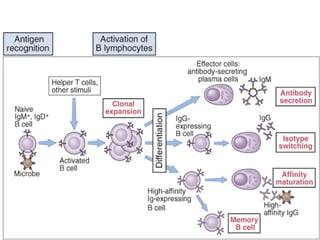
Naive B lymphocytes express two classes of membrane-bound antibodies, IgM (immunoglobulin M) and IgD, that function as the receptors for antigens Secreted antibodies have the same specificity as that of the naive B cell membrane receptors that recognized antigen to initiate the response One activated B cell may generate up to 4000 plasma cells, which can produce up to 10 12  antibody molecules per day
Some B cells may begin to produce antibodies of different heavy chain isotypes (or classes), which mediate different effector functions and are specialized to combat different types of microbes    heavy chain isotype (class) switching Repeated exposure to a protein antigen results in the production of antibodies with increasing affinity for the antigen    affinity maturation
Antibody responses to different antigens are classified as T-dependent or T-independent T dependent B cell stimulation via APC-TCR interaction Induces HC isotype switching and affinity maturation T independent B cell stimulation via interaction with lipids and other non protein antigen Little HC isotype switching and affinity maturation
 
 
Stimulation of B Lymphocytes by Antigen  Macrophages lining the subcapsular sinus may capture antigens and display them to B cells in adjacent follicles B lymphocytes specific for an antigen use their membrane-bound immunoglobulin (Ig) receptors to recognize the antigen in its native conformation (i.e., without a need for processing)
ANTIGEN-INDUCED SIGNALING IN B CELLS Antigen-induced clustering of membrane Ig receptors triggers biochemical signals that are transduced by receptor-associated signaling molecules


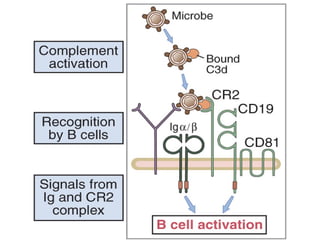
THE ROLE OF COMPLEMENT PROTEINS IN B CELL ACTIVATION Engagement of CR2 greatly enhances antigen-dependent activation responses of B cells Thus, complement proteins provide second signals for B cell activation C3d is the second signal for B lymphocytes B cell responses is also enhanced by microbial products engaging Toll-like receptors (TLRs) on the B cells B lymphocytes, like dendritic cells and other leukocytes, express numerous TLRs  Recognition of microbial products by these TLRs stimulates B cell proliferation and Ig secretion
FUNCTIONAL CONSEQUENCES OF ANTIGEN-MEDIATED B CELL ACTIVATION  B cell activation leads to increased expression of B7 costimulators, which provide second signals for T cell activation    amplify helper T cell responses expression of receptors for cytokines, which are the secreted mediators of helper T cell functions  Reduce expression of receptors for chemokines that are produced in lymphoid follicles    keep the B cells in these follicles
 
ACTIVATION AND MIGRATION OF HELPER T CELLS Upon activation, T cells reduce expression of the chemokine receptor CCR7, which recognizes chemokines produced in T cell zones, and B cells reduce expression of the receptor for a chemokine produced in the follicles The B and T cells migrate toward one another and meet at the edges of lymphoid follicles, and the next step in their interaction occurs here
 
PRESENTATION OF ANTIGENS BY B LYMPHOCYTES TO HELPER T CELLS B lymphocytes that bind protein antigens by their specific antigen receptors endocytose these antigens, process them in endosomal vesicles, and display class II MHC-associated peptides for recognition by CD4+ helper T cells Therefore, B lymphocytes are very efficient APCs for the antigens they specifically recognize Antigen-activated B lymphocytes also express costimulators, such as B7 molecules, that stimulate the helper T cells that recognize antigen displayed by the B cells
 
 
HEAVY CHAIN ISOTYPE (CLASS) SWITCHING Helper T cells stimulate the progeny of IgM and IgD-expressing B lymphocytes to produce antibodies of different heavy chain isotypes (classes) with different functions IgG1 and IgG3 (in humans) binds to high-affinity phagocyte Fc receptors specific for the γ heavy chain Heavy chain isotype switching is induced by a combination of CD40L-mediated signals and cytokines
X-linked hyper-IgM syndrome is caused by mutations in the CD40L gene, which is located in the X chromosome, leading to production of nonfunctional forms of CD40L In this disease, much of the serum antibody is IgM, because of defective heavy chain class switching Patients also suffer from defective cell-mediated immunity against intracellular microbes, because CD40L is important for T cell-mediated immunity
 
IgM-producing B cells, which have not undergone switching, contain in their Ig heavy chain locus a rearranged VDJ gene adjacent to the first constant region cluster, which is Cμ The heavy chain mRNA is produced by splicing of VDJ RNA to Cμ RNA, and this mRNA is translated to produce the μ heavy chain, which combines with a light chain to give rise to IgM antibody  Thus, the first antibody produced by B cells is IgM Signals from CD40 and cytokine receptors stimulate transcription through one of the constant regions that is downstream of Cμ In the intron 5' of each constant region (except Cδ) is a conserved nucleotide sequence called the switch region When a downstream constant region becomes transcriptionally active, the switch region 3' of Cμ recombines with the switch region 5' of that downstream constant region, and the intervening DNA is deleted
The enzyme called activation-induced deaminase (AID) plays a key role in these events by making nucleotides susceptible to cleavage and thus accessible to recombination Predictably, CD40 signals induce the expression of AID. This process is called switch recombination It brings the rearranged VDJ adjacent to a downstream C region The result is that the B cell begins to produce a new heavy chain isotype (which is determined by the C region of the antibody) with the same specificity as that of the original B cell (because specificity is determined by the rearranged VDJ)
Cytokines produced by helper T cells determine which heavy chain isotype is produced by influencing which heavy chain constant region gene participates in switch recombination  Production of opsonizing antibodies, which bind to phagocyte Fc receptors, is stimulated by interferon (IFN)-γ, the signature cytokine of TH1 cells IgE class is stimulated by interleukin (IL)-4, the signature cytokine of TH2 cells IgA antibody is the major isotype produced in mucosal lymphoid tissues and cytokines that promote switching to IgA are made in mucosal tissues.  IgA is the principal antibody isotype that can be actively secreted through mucosal epithelia
 
 
Affinity Maturation Process by which the affinity of antibodies produced in response to a protein antigen increases with prolonged or repeated exposure to that antigen Due to point mutations in the V regions, and particularly in the antigen-binding hypervariable regions Seen only in responses to helper T cell-dependent protein antigens, suggesting that helper cells are critical in the process
Occurs in the germinal centers of lymphoid follicles and is the result of somatic hypermutation of Ig genes in dividing B cells followed by the selection of high-affinity B cells by antigen The enzyme AID, which we mentioned is required for isotype switching, also plays a critical role in somatic mutation by changing nucleotides in the Ig genes and making them susceptible to the mutational machinery The frequency of Ig gene mutations is estimated to be one in 103 base pairs per cell per division, which is a thousand-fold greater than the mutation rate in most other genes For this reason, Ig mutation is called somatic hypermutation
Results in the generation of different B cell clones whose Ig molecules may bind with widely varying affinities to the antigen that initiated the response Germinal center B cells die by apoptosis unless they are rescued by antigen recognition or T cell help. At the same time as somatic hypermutation of Ig genes is going on in germinal centers, the antibody that was secreted earlier during the immune response binds residual antigen The antigen-antibody complexes that are formed may activate complement
These complexes are displayed by cells, called follicular dendritic cells, that reside in the germinal center and express receptors for the Fc portions of antibodies and for complement products, both of which help to display the antigen-antibody complexes Thus, B cells that have undergone somatic hypermutation are given a chance to bind antigen on follicular dendritic cells and be rescued from death B cells also may bind free antigen, process it, and present peptides to germinal center helper T cells, which then provide survival signals
As the immune response to a protein antigen develops, and especially with repeated antigen exposure, the amount of antibody produced increases As a result, the amount of available antigen decreases The B cells that are selected to survive must be able to bind antigen at lower and lower concentrations, and therefore these are cells whose antigen receptors are of higher and higher affinity The selected B cells leave the germinal center and secrete antibodies, resulting in increasing affinity of the antibodies produced as the response develops
 
Various stages of antibody responses to T cell-dependent protein antigens occur sequentially and in different anatomic compartments of lymphoid organs  Mature, naive B lymphocytes recognize antigens in lymphoid follicles and migrate out to encounter helper T cells at the edges of the follicles This B cell-rich zones and the T cell-rich zones is the site at which B cell proliferation and differentiation into antibody-secreting cells begin  Plasma cells that develop reside in lymphoid organs, usually outside the B cell-rich follicles, and the antibodies they secrete enter the blood
Heavy chain isotype switching is initiated outside the follicles Affinity maturation and much more isotype switching occur in germinal centers that are formed in follicles These events may be seen within a week after exposure to antigen Plasma cells that emerge from the germinal center migrate to the bone marrow- may live for months or years, continuing to produce antibodies
These antibodies provide a level of immediate protection if the antigen (microbe or toxin) reenters the body A fraction of the activated B cells, which often are the progeny of isotype-switched high-affinity B cells, do not differentiate into active antibody secretors but instead become memory cells
 
Antibody Responses to T-Independent Antigens Polysaccharide and lipid antigens often contain multivalent arrays of the same epitope, these antigens are able to cross-link many antigen receptors on a specific B cell This extensive cross-linking may activate the B cells strongly enough to stimulate their proliferation and differentiation without a requirement for T cell help Marginal zone B cells in the spleen are the major contributors to T-independent antibody responses to blood-borne antigens
B-1 B cells make T-independent responses to antigens of microbes in mucosal tissues and microbes that enter the peritoneum Naturally occurring protein antigens usually are not multivalent, and this may be why they do not induce full B cell responses by themselves but depend on helper T cells
 
Regulation of Humoral Immune Responses: Antibody Feedback As IgG antibody is produced and circulates throughout the body, the antibody binds to antigen that is still available in the blood and tissues, forming immune complexes B cells specific for the antigen may bind the antigen part of the immune complex by their Ig receptors At the same time, the Fc "tail" of the attached IgG antibody may be recognized by a special type of Fc receptor expressed on B cells called FcγRII  This Fc receptor delivers inhibitory signals that shut off antigen receptor-induced signals, thereby terminating B cell responses antibody feedback
Serves to terminate humoral immune responses once sufficient quantities of IgG antibodies have been produced  An effective therapy for some inflammatory diseases is the administration of pooled IgG, called intravenous immunoglobulin (IVIG) IVIG works by engaging the inhibitory Fc receptor on B cells (and perhaps on dendritic cells), thereby suppressing pathologic immune responses

Humoral Immunity

  • 1.
  • 2.
  • 3.
    Naive B lymphocytesexpress two classes of membrane-bound antibodies, IgM (immunoglobulin M) and IgD, that function as the receptors for antigens Secreted antibodies have the same specificity as that of the naive B cell membrane receptors that recognized antigen to initiate the response One activated B cell may generate up to 4000 plasma cells, which can produce up to 10 12 antibody molecules per day
  • 4.
    Some B cellsmay begin to produce antibodies of different heavy chain isotypes (or classes), which mediate different effector functions and are specialized to combat different types of microbes  heavy chain isotype (class) switching Repeated exposure to a protein antigen results in the production of antibodies with increasing affinity for the antigen  affinity maturation
  • 5.
    Antibody responses todifferent antigens are classified as T-dependent or T-independent T dependent B cell stimulation via APC-TCR interaction Induces HC isotype switching and affinity maturation T independent B cell stimulation via interaction with lipids and other non protein antigen Little HC isotype switching and affinity maturation
  • 6.
  • 7.
  • 8.
    Stimulation of BLymphocytes by Antigen Macrophages lining the subcapsular sinus may capture antigens and display them to B cells in adjacent follicles B lymphocytes specific for an antigen use their membrane-bound immunoglobulin (Ig) receptors to recognize the antigen in its native conformation (i.e., without a need for processing)
  • 9.
    ANTIGEN-INDUCED SIGNALING INB CELLS Antigen-induced clustering of membrane Ig receptors triggers biochemical signals that are transduced by receptor-associated signaling molecules
  • 10.
  • 11.
  • 12.
  • 13.
    THE ROLE OFCOMPLEMENT PROTEINS IN B CELL ACTIVATION Engagement of CR2 greatly enhances antigen-dependent activation responses of B cells Thus, complement proteins provide second signals for B cell activation C3d is the second signal for B lymphocytes B cell responses is also enhanced by microbial products engaging Toll-like receptors (TLRs) on the B cells B lymphocytes, like dendritic cells and other leukocytes, express numerous TLRs Recognition of microbial products by these TLRs stimulates B cell proliferation and Ig secretion
  • 14.
    FUNCTIONAL CONSEQUENCES OFANTIGEN-MEDIATED B CELL ACTIVATION B cell activation leads to increased expression of B7 costimulators, which provide second signals for T cell activation  amplify helper T cell responses expression of receptors for cytokines, which are the secreted mediators of helper T cell functions Reduce expression of receptors for chemokines that are produced in lymphoid follicles  keep the B cells in these follicles
  • 15.
  • 16.
    ACTIVATION AND MIGRATIONOF HELPER T CELLS Upon activation, T cells reduce expression of the chemokine receptor CCR7, which recognizes chemokines produced in T cell zones, and B cells reduce expression of the receptor for a chemokine produced in the follicles The B and T cells migrate toward one another and meet at the edges of lymphoid follicles, and the next step in their interaction occurs here
  • 17.
  • 18.
    PRESENTATION OF ANTIGENSBY B LYMPHOCYTES TO HELPER T CELLS B lymphocytes that bind protein antigens by their specific antigen receptors endocytose these antigens, process them in endosomal vesicles, and display class II MHC-associated peptides for recognition by CD4+ helper T cells Therefore, B lymphocytes are very efficient APCs for the antigens they specifically recognize Antigen-activated B lymphocytes also express costimulators, such as B7 molecules, that stimulate the helper T cells that recognize antigen displayed by the B cells
  • 19.
  • 20.
  • 21.
    HEAVY CHAIN ISOTYPE(CLASS) SWITCHING Helper T cells stimulate the progeny of IgM and IgD-expressing B lymphocytes to produce antibodies of different heavy chain isotypes (classes) with different functions IgG1 and IgG3 (in humans) binds to high-affinity phagocyte Fc receptors specific for the γ heavy chain Heavy chain isotype switching is induced by a combination of CD40L-mediated signals and cytokines
  • 22.
    X-linked hyper-IgM syndromeis caused by mutations in the CD40L gene, which is located in the X chromosome, leading to production of nonfunctional forms of CD40L In this disease, much of the serum antibody is IgM, because of defective heavy chain class switching Patients also suffer from defective cell-mediated immunity against intracellular microbes, because CD40L is important for T cell-mediated immunity
  • 23.
  • 24.
    IgM-producing B cells,which have not undergone switching, contain in their Ig heavy chain locus a rearranged VDJ gene adjacent to the first constant region cluster, which is Cμ The heavy chain mRNA is produced by splicing of VDJ RNA to Cμ RNA, and this mRNA is translated to produce the μ heavy chain, which combines with a light chain to give rise to IgM antibody Thus, the first antibody produced by B cells is IgM Signals from CD40 and cytokine receptors stimulate transcription through one of the constant regions that is downstream of Cμ In the intron 5' of each constant region (except Cδ) is a conserved nucleotide sequence called the switch region When a downstream constant region becomes transcriptionally active, the switch region 3' of Cμ recombines with the switch region 5' of that downstream constant region, and the intervening DNA is deleted
  • 25.
    The enzyme calledactivation-induced deaminase (AID) plays a key role in these events by making nucleotides susceptible to cleavage and thus accessible to recombination Predictably, CD40 signals induce the expression of AID. This process is called switch recombination It brings the rearranged VDJ adjacent to a downstream C region The result is that the B cell begins to produce a new heavy chain isotype (which is determined by the C region of the antibody) with the same specificity as that of the original B cell (because specificity is determined by the rearranged VDJ)
  • 26.
    Cytokines produced byhelper T cells determine which heavy chain isotype is produced by influencing which heavy chain constant region gene participates in switch recombination Production of opsonizing antibodies, which bind to phagocyte Fc receptors, is stimulated by interferon (IFN)-γ, the signature cytokine of TH1 cells IgE class is stimulated by interleukin (IL)-4, the signature cytokine of TH2 cells IgA antibody is the major isotype produced in mucosal lymphoid tissues and cytokines that promote switching to IgA are made in mucosal tissues. IgA is the principal antibody isotype that can be actively secreted through mucosal epithelia
  • 27.
  • 28.
  • 29.
    Affinity Maturation Processby which the affinity of antibodies produced in response to a protein antigen increases with prolonged or repeated exposure to that antigen Due to point mutations in the V regions, and particularly in the antigen-binding hypervariable regions Seen only in responses to helper T cell-dependent protein antigens, suggesting that helper cells are critical in the process
  • 30.
    Occurs in thegerminal centers of lymphoid follicles and is the result of somatic hypermutation of Ig genes in dividing B cells followed by the selection of high-affinity B cells by antigen The enzyme AID, which we mentioned is required for isotype switching, also plays a critical role in somatic mutation by changing nucleotides in the Ig genes and making them susceptible to the mutational machinery The frequency of Ig gene mutations is estimated to be one in 103 base pairs per cell per division, which is a thousand-fold greater than the mutation rate in most other genes For this reason, Ig mutation is called somatic hypermutation
  • 31.
    Results in thegeneration of different B cell clones whose Ig molecules may bind with widely varying affinities to the antigen that initiated the response Germinal center B cells die by apoptosis unless they are rescued by antigen recognition or T cell help. At the same time as somatic hypermutation of Ig genes is going on in germinal centers, the antibody that was secreted earlier during the immune response binds residual antigen The antigen-antibody complexes that are formed may activate complement
  • 32.
    These complexes aredisplayed by cells, called follicular dendritic cells, that reside in the germinal center and express receptors for the Fc portions of antibodies and for complement products, both of which help to display the antigen-antibody complexes Thus, B cells that have undergone somatic hypermutation are given a chance to bind antigen on follicular dendritic cells and be rescued from death B cells also may bind free antigen, process it, and present peptides to germinal center helper T cells, which then provide survival signals
  • 33.
    As the immuneresponse to a protein antigen develops, and especially with repeated antigen exposure, the amount of antibody produced increases As a result, the amount of available antigen decreases The B cells that are selected to survive must be able to bind antigen at lower and lower concentrations, and therefore these are cells whose antigen receptors are of higher and higher affinity The selected B cells leave the germinal center and secrete antibodies, resulting in increasing affinity of the antibodies produced as the response develops
  • 34.
  • 35.
    Various stages ofantibody responses to T cell-dependent protein antigens occur sequentially and in different anatomic compartments of lymphoid organs Mature, naive B lymphocytes recognize antigens in lymphoid follicles and migrate out to encounter helper T cells at the edges of the follicles This B cell-rich zones and the T cell-rich zones is the site at which B cell proliferation and differentiation into antibody-secreting cells begin Plasma cells that develop reside in lymphoid organs, usually outside the B cell-rich follicles, and the antibodies they secrete enter the blood
  • 36.
    Heavy chain isotypeswitching is initiated outside the follicles Affinity maturation and much more isotype switching occur in germinal centers that are formed in follicles These events may be seen within a week after exposure to antigen Plasma cells that emerge from the germinal center migrate to the bone marrow- may live for months or years, continuing to produce antibodies
  • 37.
    These antibodies providea level of immediate protection if the antigen (microbe or toxin) reenters the body A fraction of the activated B cells, which often are the progeny of isotype-switched high-affinity B cells, do not differentiate into active antibody secretors but instead become memory cells
  • 38.
  • 39.
    Antibody Responses toT-Independent Antigens Polysaccharide and lipid antigens often contain multivalent arrays of the same epitope, these antigens are able to cross-link many antigen receptors on a specific B cell This extensive cross-linking may activate the B cells strongly enough to stimulate their proliferation and differentiation without a requirement for T cell help Marginal zone B cells in the spleen are the major contributors to T-independent antibody responses to blood-borne antigens
  • 40.
    B-1 B cellsmake T-independent responses to antigens of microbes in mucosal tissues and microbes that enter the peritoneum Naturally occurring protein antigens usually are not multivalent, and this may be why they do not induce full B cell responses by themselves but depend on helper T cells
  • 41.
  • 42.
    Regulation of HumoralImmune Responses: Antibody Feedback As IgG antibody is produced and circulates throughout the body, the antibody binds to antigen that is still available in the blood and tissues, forming immune complexes B cells specific for the antigen may bind the antigen part of the immune complex by their Ig receptors At the same time, the Fc "tail" of the attached IgG antibody may be recognized by a special type of Fc receptor expressed on B cells called FcγRII This Fc receptor delivers inhibitory signals that shut off antigen receptor-induced signals, thereby terminating B cell responses antibody feedback
  • 43.
    Serves to terminatehumoral immune responses once sufficient quantities of IgG antibodies have been produced An effective therapy for some inflammatory diseases is the administration of pooled IgG, called intravenous immunoglobulin (IVIG) IVIG works by engaging the inhibitory Fc receptor on B cells (and perhaps on dendritic cells), thereby suppressing pathologic immune responses