Lecture-10
IMMUNOGLOBULINS : Structure and Function
Prof. Sreerama Krupanidhi
Email: sknbirac@gmail.com
08/30/2024 Prof. Sreerama Krupanidhi 2
Objectives
• To familiarize with the structure, complexity
and nature of antibodies/immunoglobulins.
• To understand the functions of various
regions of the assembled protein namely
Igs.
Expected Outcomes
• The nature of Immunoglobulin will be
known.
• The detailed structure of
Immunoglobulin as deciphered by
Porter and Edelman will be
familiarised.
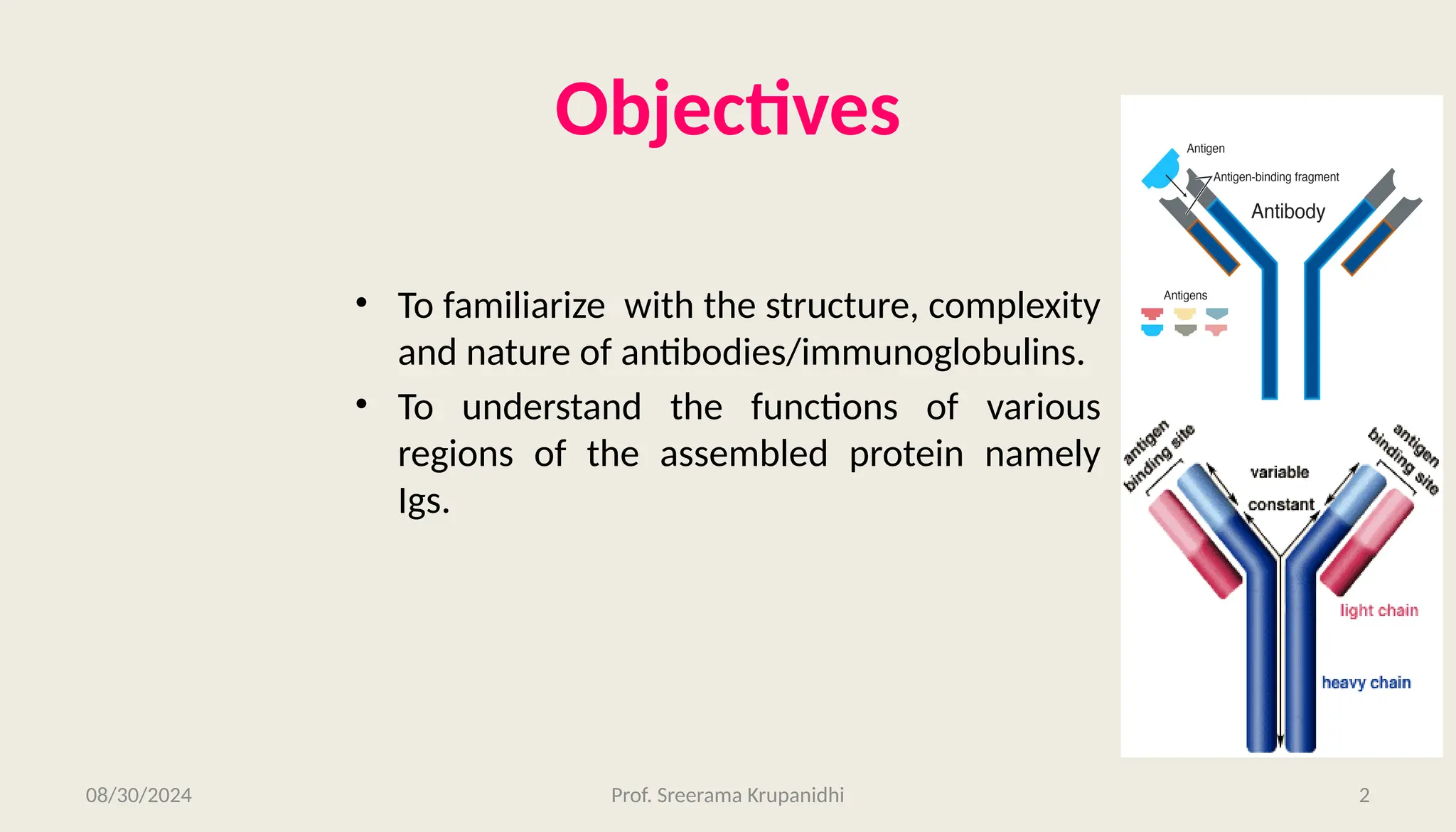
• The assembled Y-shaped structure of
Ig will be acquainted.
08/30/2024 Prof. Sreerama Krupanidhi 3
08/30/2024 Prof. Sreerama Krupanidhi 4
What are Immunoglobulins?
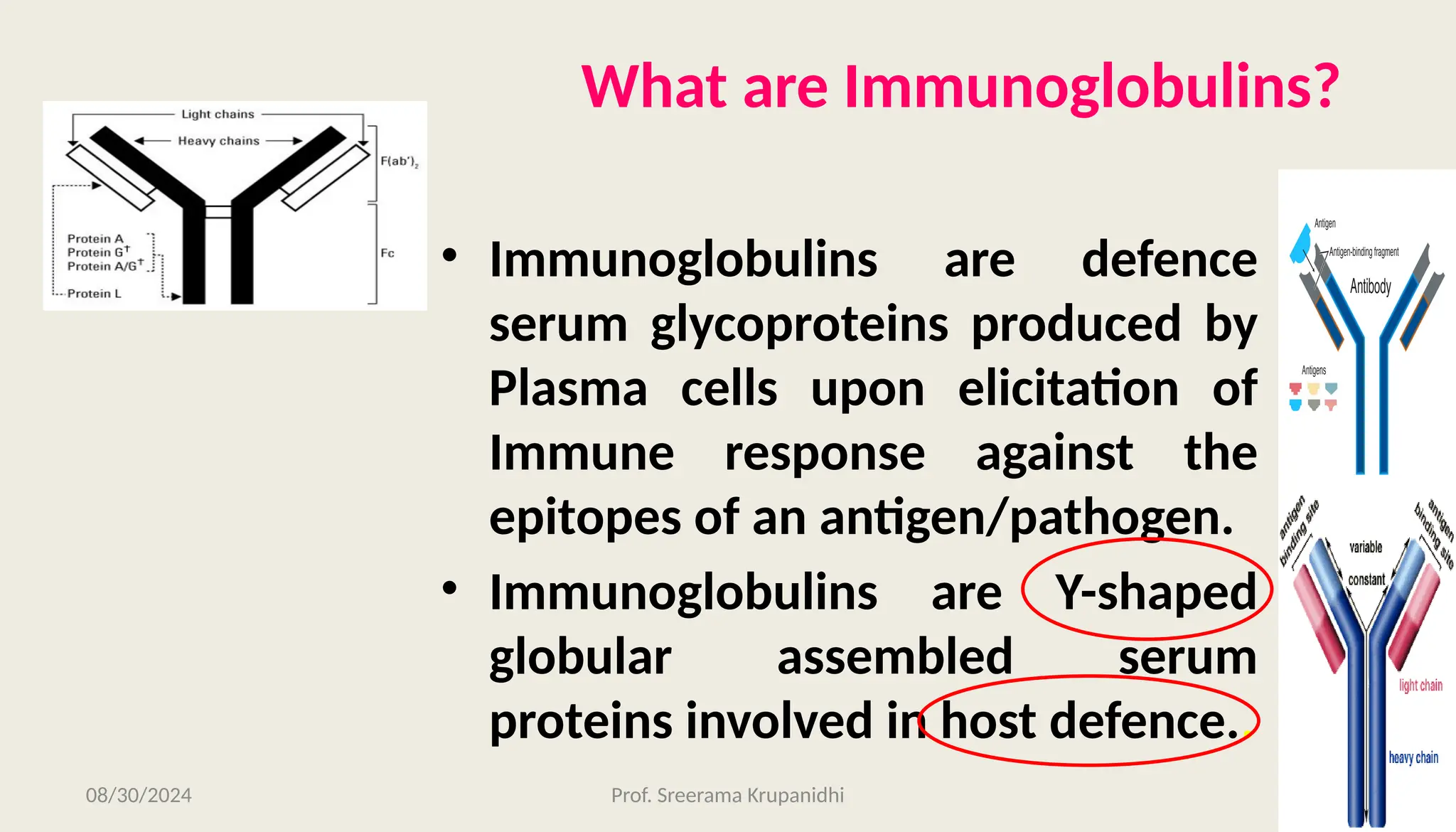
• Immunoglobulins are defence
serum glycoproteins produced by
Plasma cells upon elicitation of
Immune response against the
epitopes of an antigen/pathogen.
• Immunoglobulins are Y-shaped
globular assembled serum
proteins involved in host defence..
08/30/2024 Prof. Sreerama Krupanidhi 5
Which cell produces Igs?
Igs are synthesised by the
plasma cells.
Constitutes 20-25% serum
proteins.
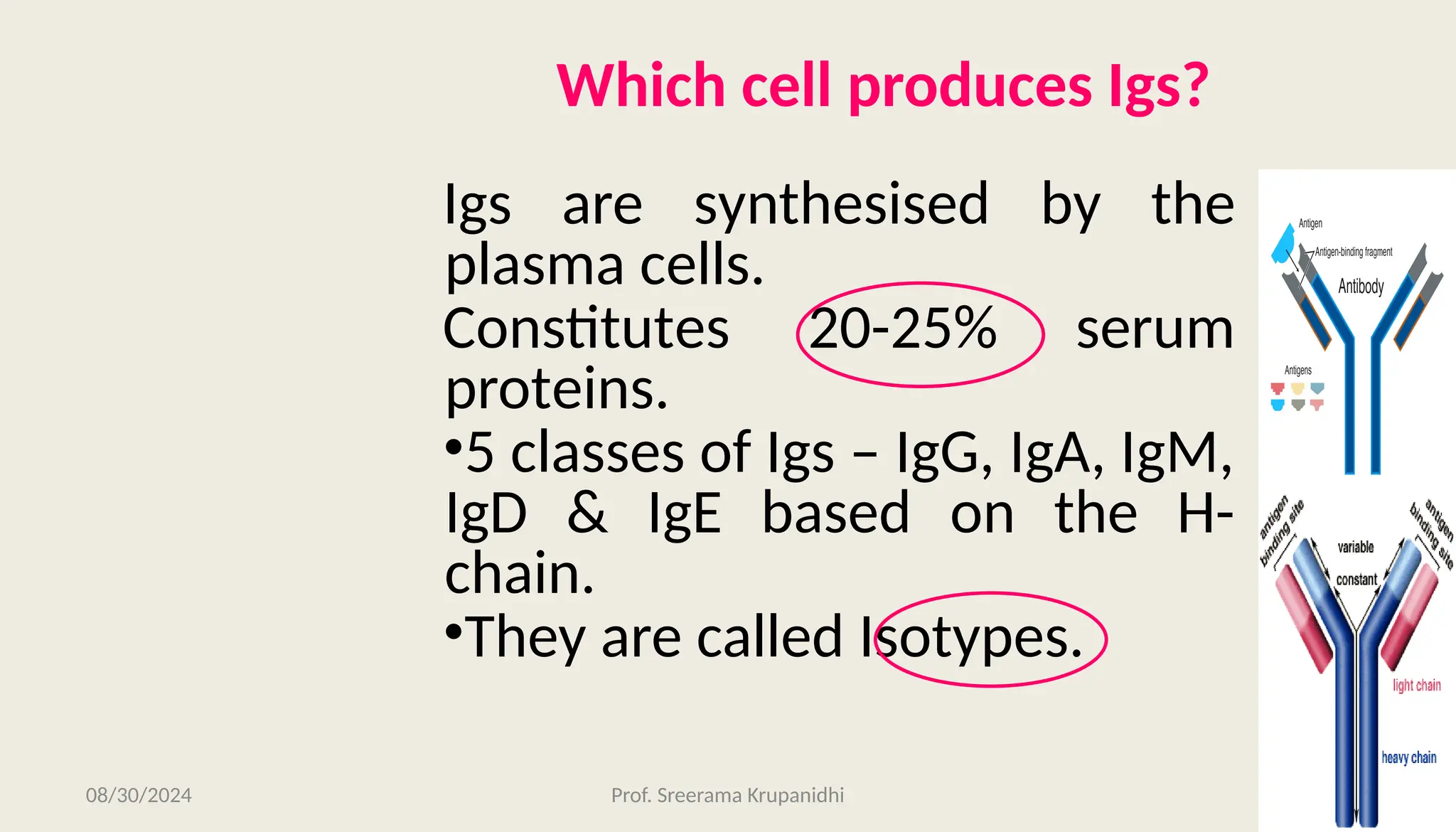
•5 classes of Igs – IgG, IgA, IgM,
IgD & IgE based on the H-
chain.
•They are called Isotypes.
08/30/2024 Prof. Sreerama Krupanidhi 6
Symmetry in Ig
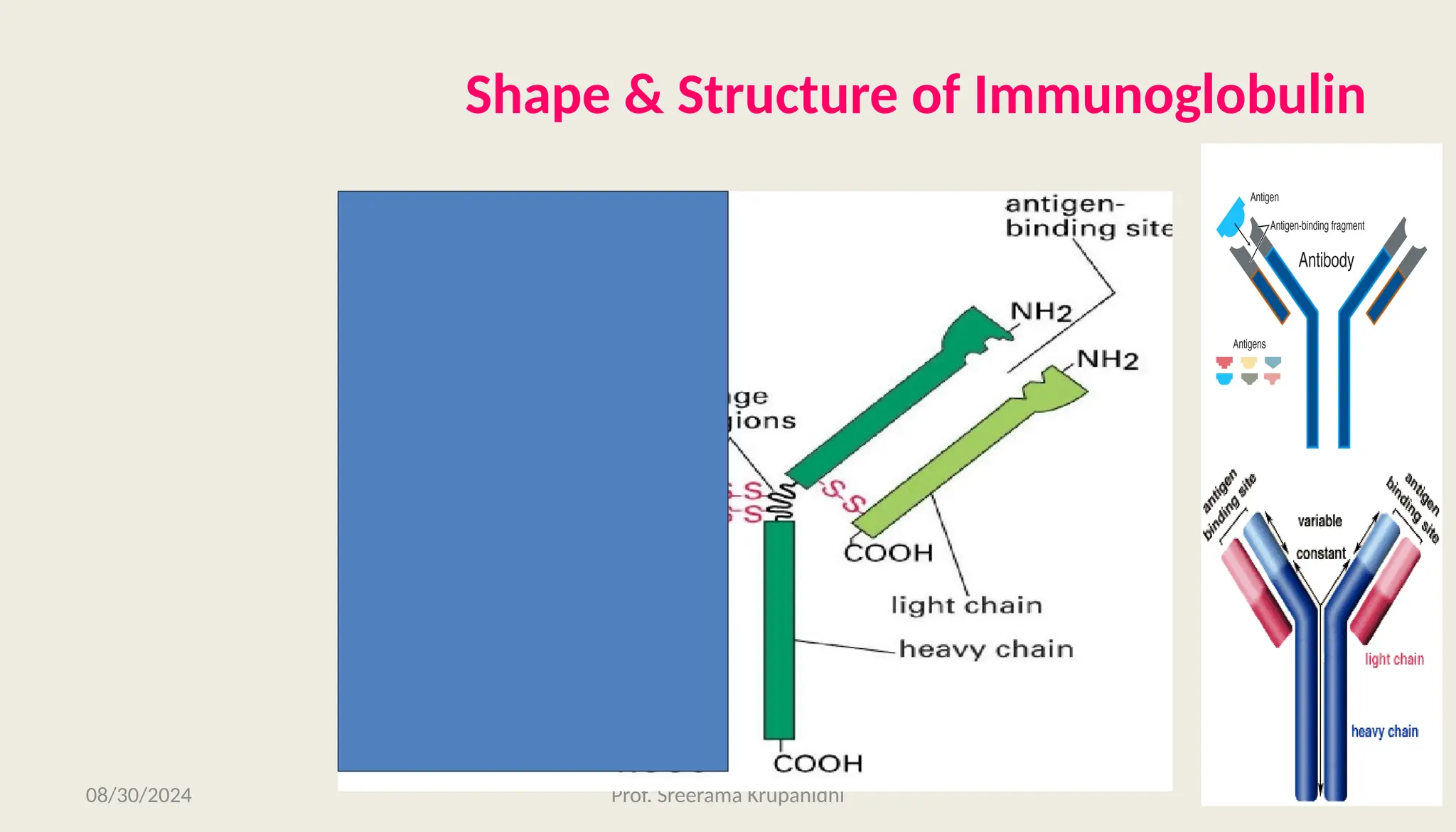
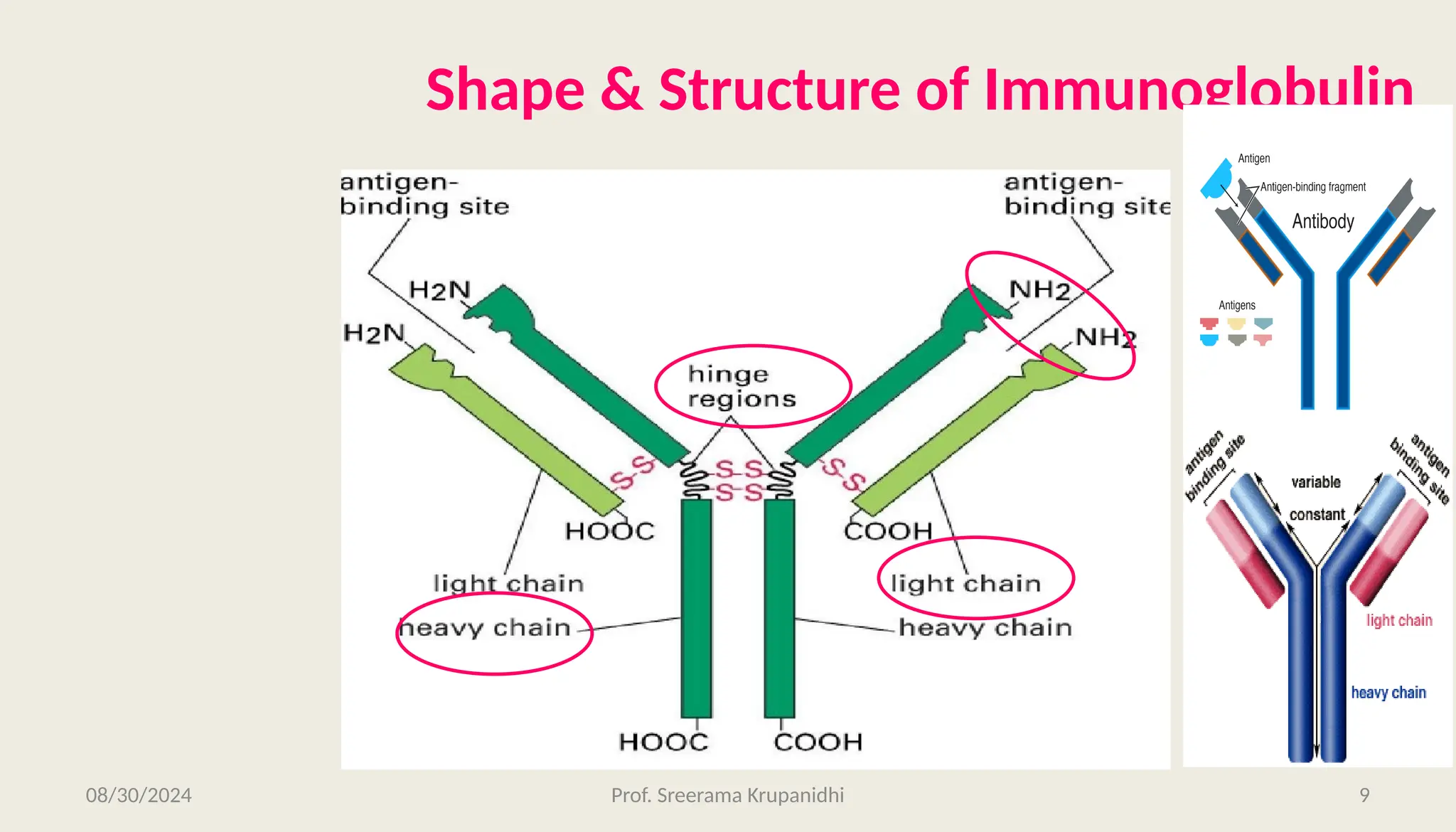
• Two pairs of polypeptide chains:
• Two Light chains on either side.
Each with 25,000 Daltons
• Two Heavy chains on either side.
Each with 50,000 Daltons.
• Both the L and H chains are
bound by disulphide bonds.
Shape & Structure of Immunoglobulin
08/30/2024 Prof. Sreerama Krupanidhi 7
Shape & Structure of Immunoglobulin
08/30/2024 Prof. Sreerama Krupanidhi 8
Shape & Structure of Immunoglobulin
08/30/2024 Prof. Sreerama Krupanidhi 9
08/30/2024 Prof. Sreerama Krupanidhi 10
Hyper variable regions
08/30/2024 Prof. Sreerama Krupanidhi 11
Hyper variable regions
08/30/2024 Prof. Sreerama Krupanidhi 12
Hyper variable regions
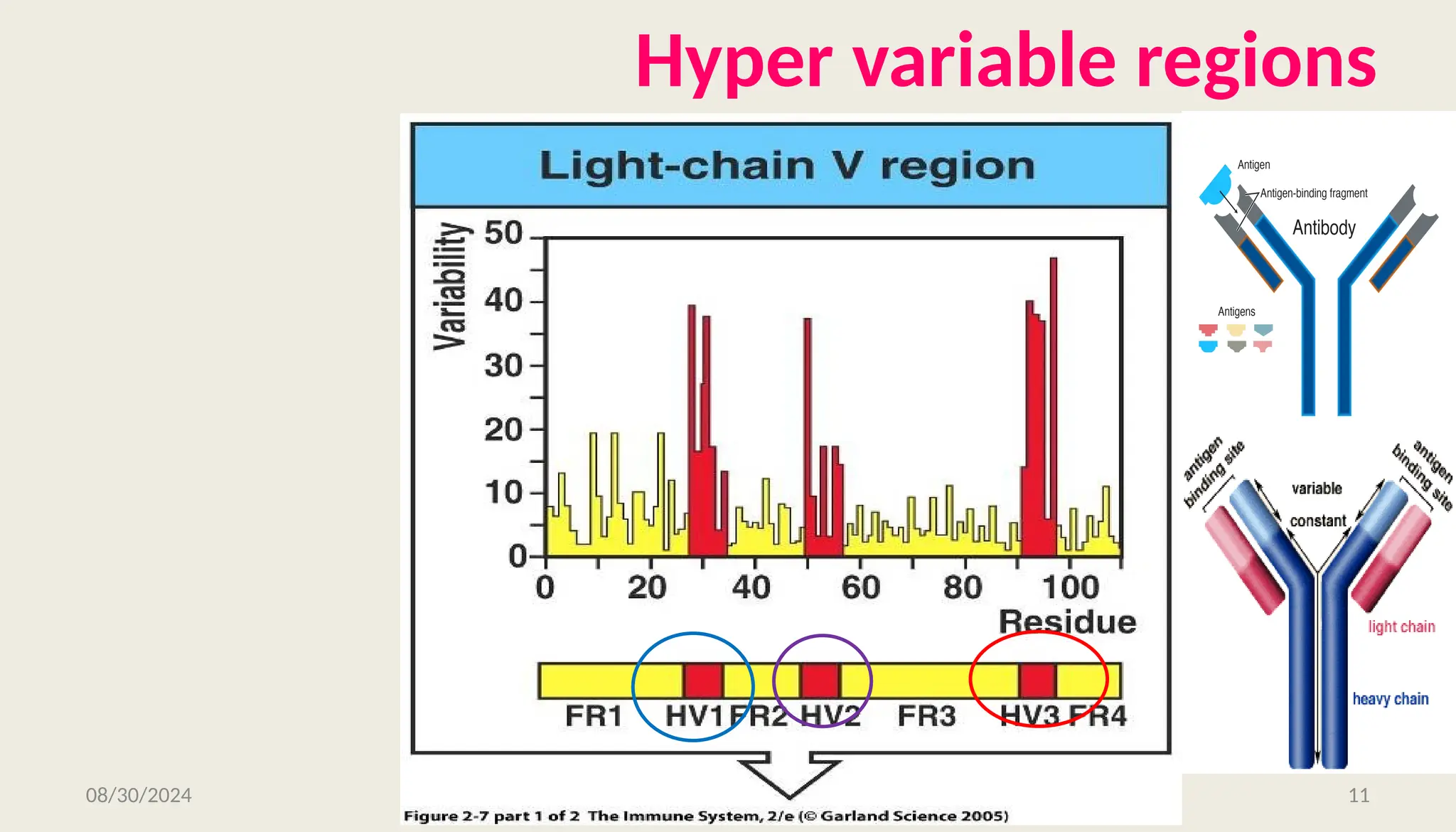
•Amino acid sequence in the variable region
of L & H chains are not uniformly variable
•Consists of some highly variable
(hypervariable) and some relatively
invariable zones
• Highly variable zones actually make contact
with the epitope on an Ag and are called as
Complementarity Determining Regions
(CDRs)
• 3 CDRs – each made up of 9 -12 amino
acids.
• CDR3 is the longest & most variable of the
three
08/30/2024 Prof. Sreerama Krupanidhi 13
Amino acids L and H chains of IgG
08/30/2024 Prof. Sreerama Krupanidhi 14
Types of Light chains of IgG
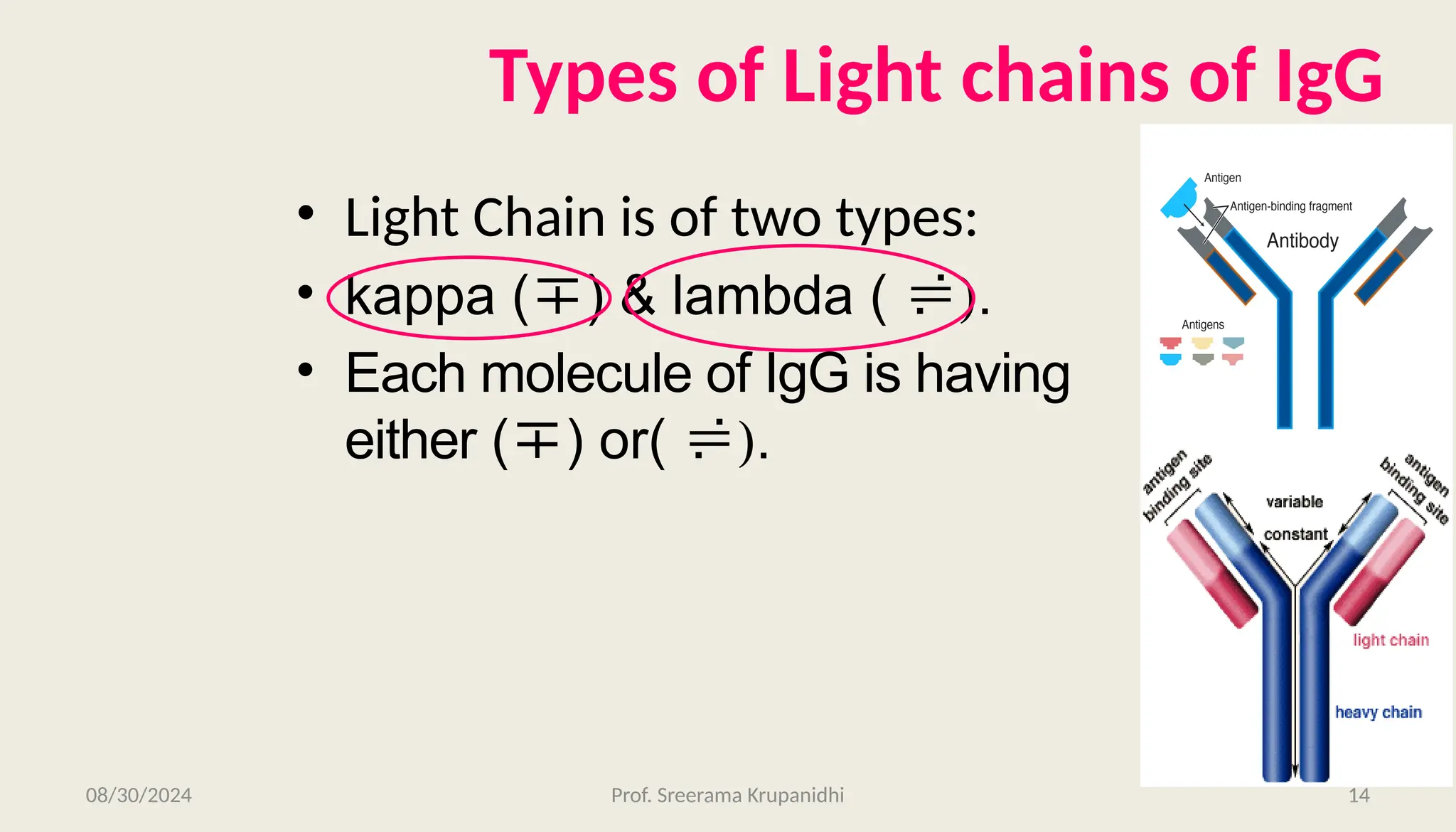
• Light Chain is of two types:
• kappa () & lambda ( )
 .
• Each molecule of IgG is having
either () or( )
 .
08/30/2024 Prof. Sreerama Krupanidhi 15
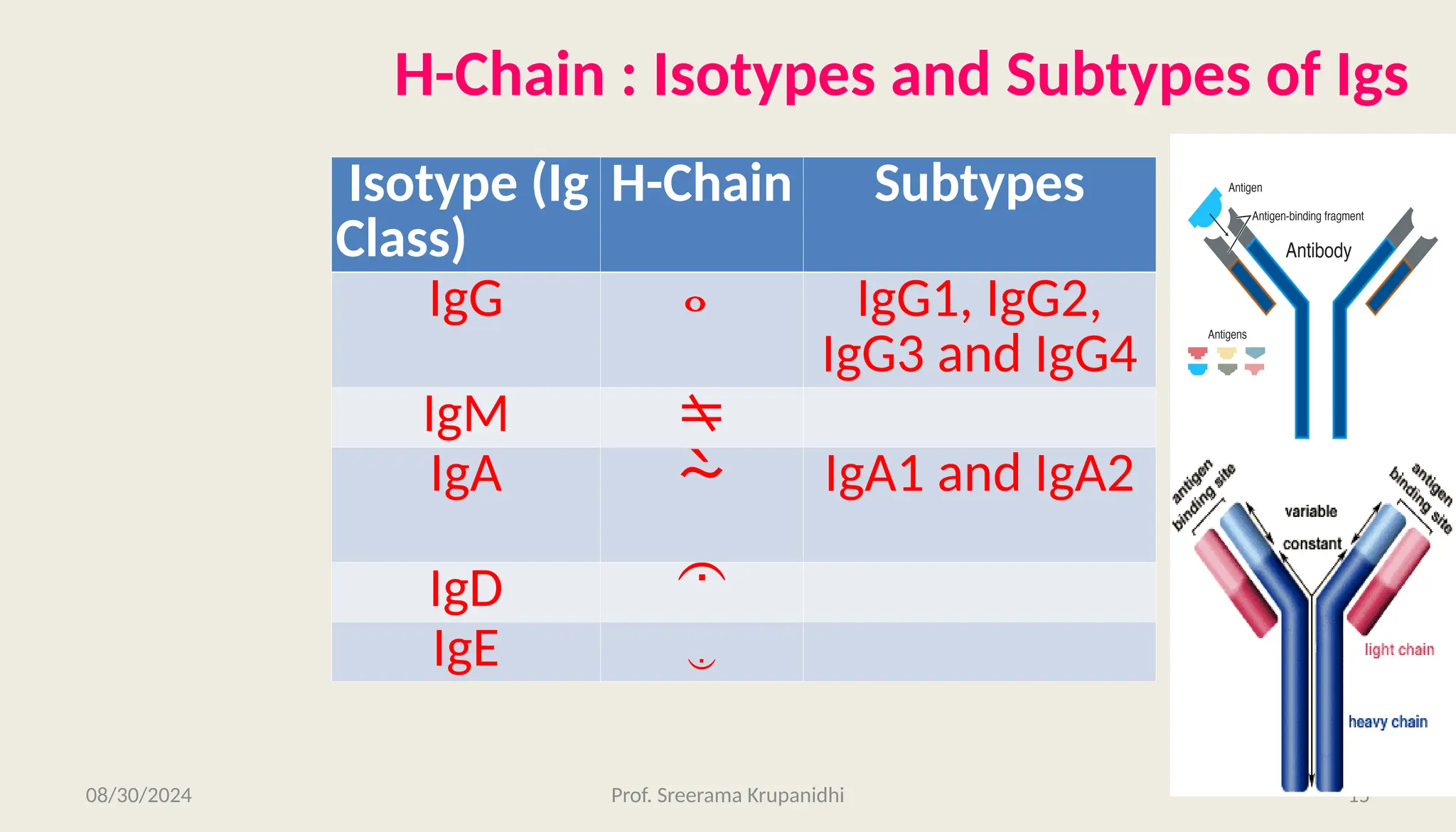
H-Chain : Isotypes and Subtypes of Igs
Isotype (Ig
Class)
H-Chain Subtypes
IgG  IgG1, IgG2,
IgG3 and IgG4
IgM 
IgA  IgA1 and IgA2
IgD 
IgE 
08/30/2024 Prof. Sreerama Krupanidhi 16
Structure of IgG
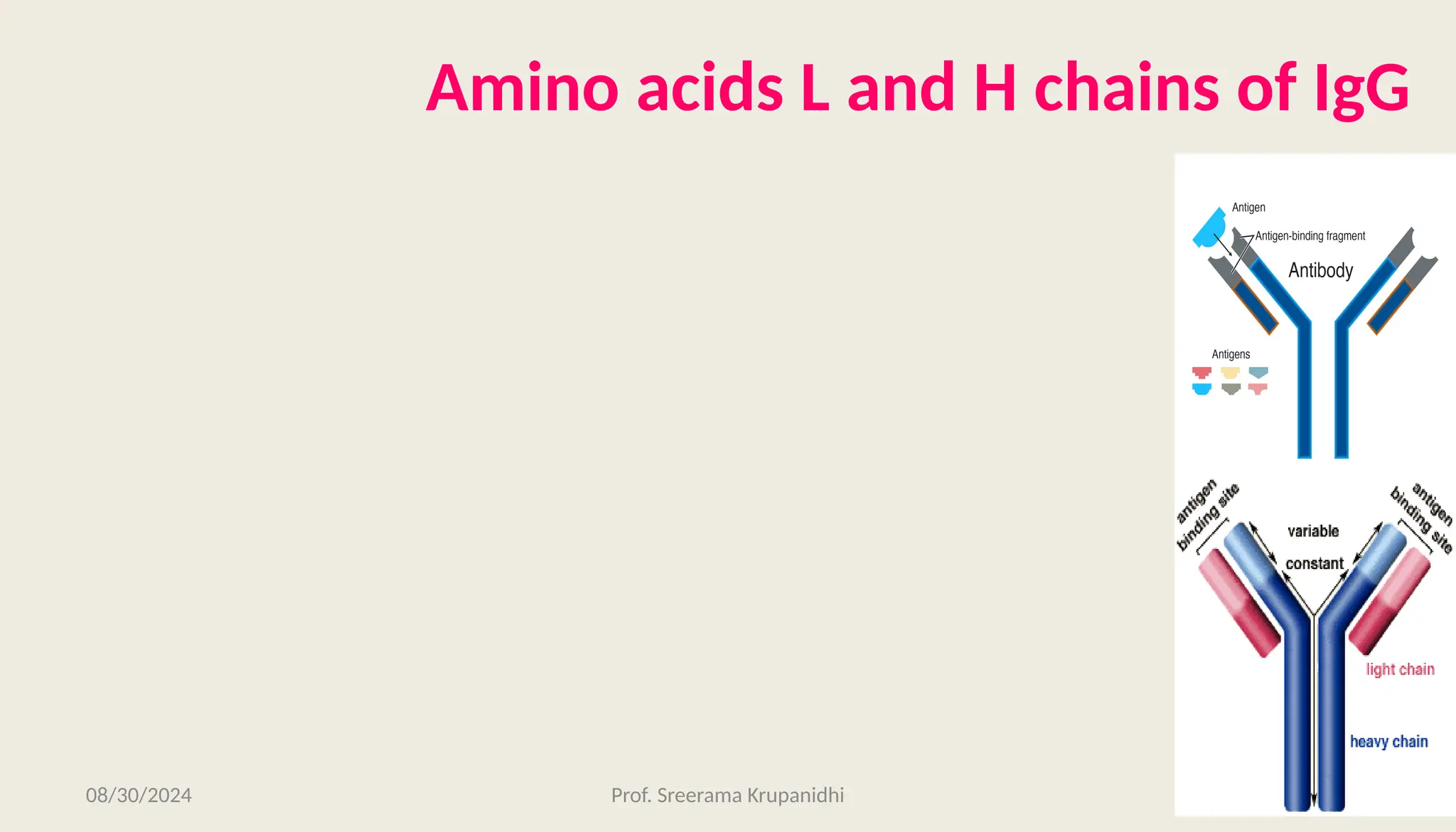
Light chain contains: TWO regions
– Variable region (VL) N-terminal
– Constant region (CL) C-terminal
Heavy Chain Contains: THREE regions
– CH1, CH2, and CH3
Ig contains TWO fragments
– Fab and FC
08/30/2024 Prof. Sreerama Krupanidhi 17
Y- Shaped structure
Porter and Edelman
Mercaptoethanol
reduction
1929-2014 1917-1985
Nobel Prize in the year 1972
Molecular structure of Abs
08/30/2024 Prof. Sreerama Krupanidhi 18
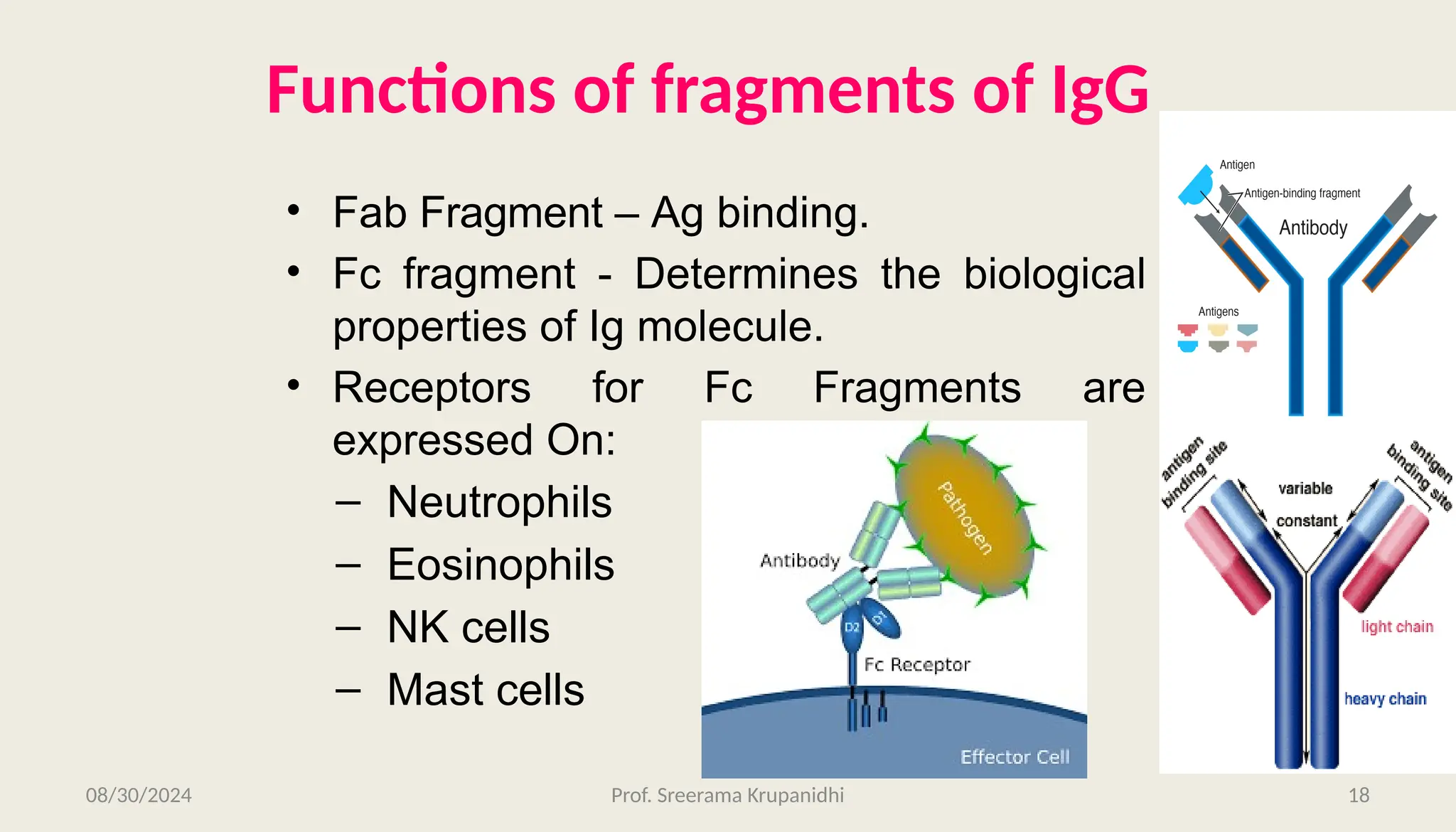
Functions of fragments of IgG
• Fab Fragment – Ag binding.
• Fc fragment - Determines the biological
properties of Ig molecule.
• Receptors for Fc Fragments are
expressed On:
– Neutrophils
– Eosinophils
– NK cells
– Mast cells
08/30/2024 Prof. Sreerama Krupanidhi 19
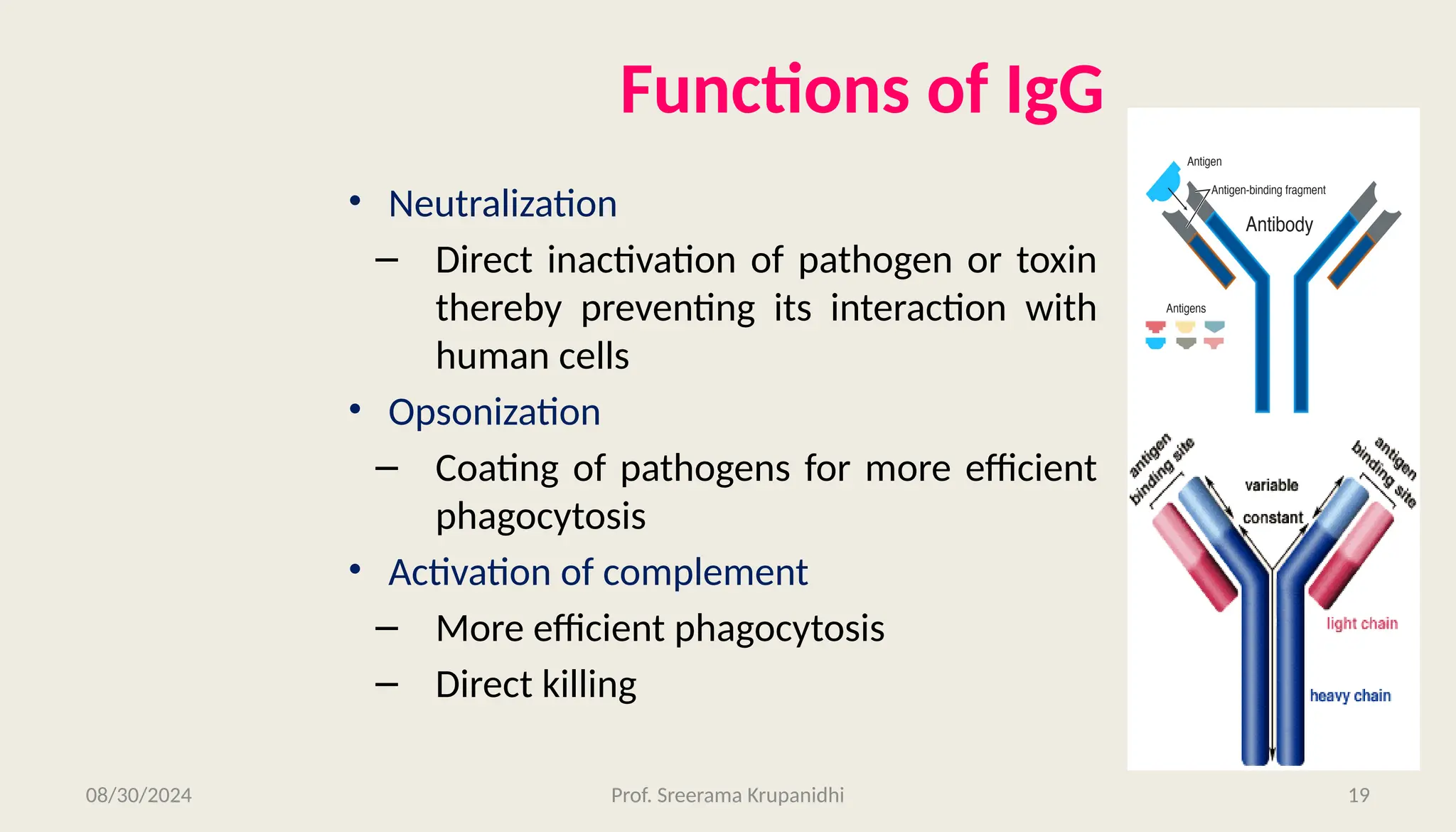
Functions of IgG
• Neutralization
– Direct inactivation of pathogen or toxin
thereby preventing its interaction with
human cells
• Opsonization
– Coating of pathogens for more efficient
phagocytosis
• Activation of complement
– More efficient phagocytosis
– Direct killing
08/30/2024 Prof. Sreerama Krupanidhi 20
Various functions of Igs
08/30/2024 Prof. Sreerama Krupanidhi 21
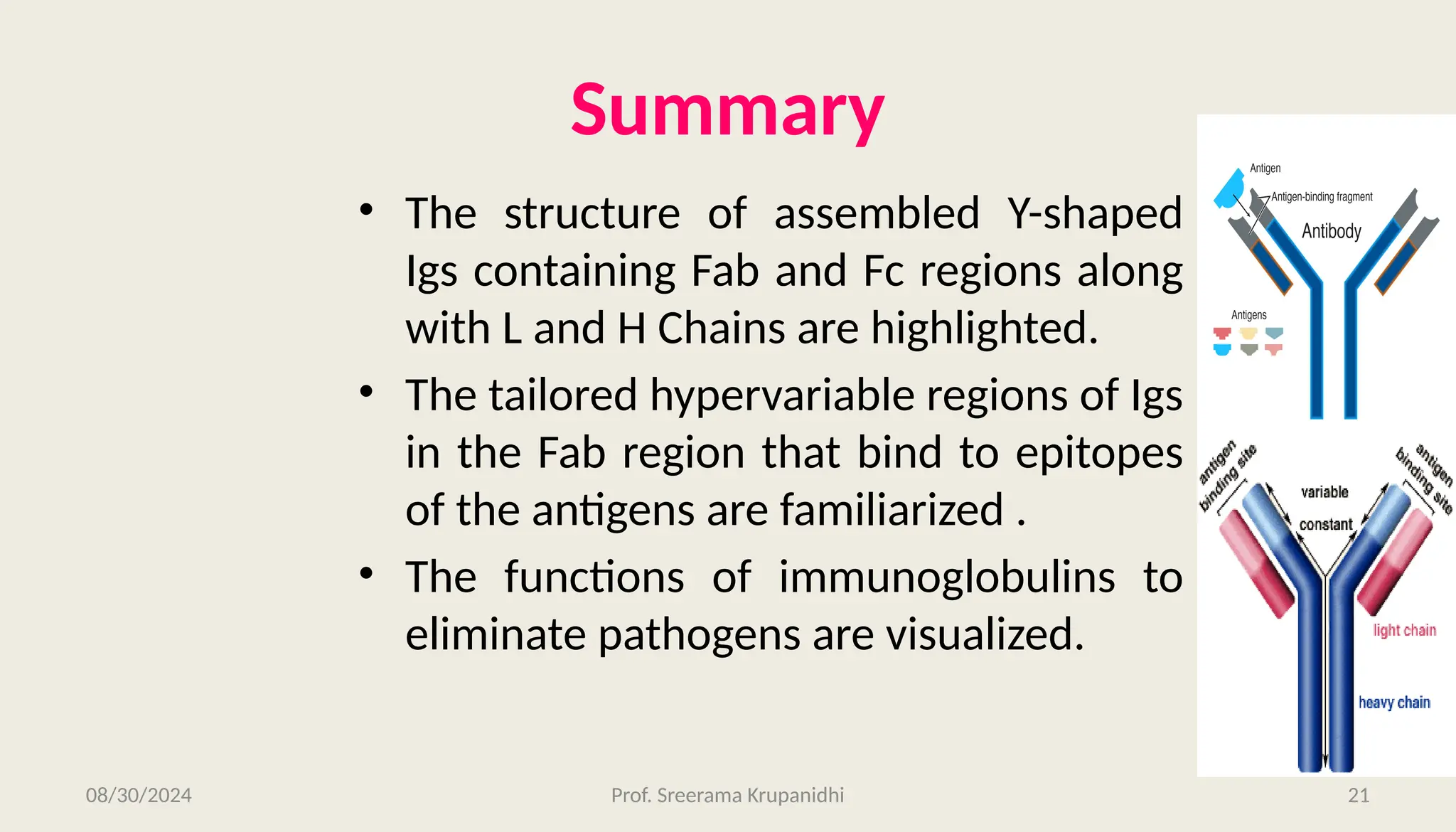
Summary
• The structure of assembled Y-shaped
Igs containing Fab and Fc regions along
with L and H Chains are highlighted.
• The tailored hypervariable regions of Igs
in the Fab region that bind to epitopes
of the antigens are familiarized .
• The functions of immunoglobulins to
eliminate pathogens are visualized.
08/30/2024 Prof. Sreerama Krupanidhi 22
Study Questions
1. Draw a neat labeled diagram of IgG. Deduce
imolecular weight of fragments of Igs using
pepsin and papain.
2. Indicate the number of amino acids present in
each Chain of Ig.
3. What are hypervariable regions? Indicate their
functions.
4. What are the divisions of H and L chains?
5. What are the immune roles of Fab and Fc
fragments of Ig?
08/30/2024 Prof. Sreerama Krupanidhi 23
Acknowledgements
We acknowledge the online resources
and public domains for the Preparation of
the content to develop teaching material
and for the dissemination of knowledge.
08/30/2024 Prof. Sreerama Krupanidhi 24

Lecture-10 Immunoglobulins: Their structure and function.pptx

  • 1.
    Lecture-10 IMMUNOGLOBULINS : Structureand Function Prof. Sreerama Krupanidhi Email: sknbirac@gmail.com
  • 2.
    08/30/2024 Prof. SreeramaKrupanidhi 2 Objectives • To familiarize with the structure, complexity and nature of antibodies/immunoglobulins. • To understand the functions of various regions of the assembled protein namely Igs.
  • 3.
    Expected Outcomes • Thenature of Immunoglobulin will be known. • The detailed structure of Immunoglobulin as deciphered by Porter and Edelman will be familiarised. • The assembled Y-shaped structure of Ig will be acquainted. 08/30/2024 Prof. Sreerama Krupanidhi 3
  • 4.
    08/30/2024 Prof. SreeramaKrupanidhi 4 What are Immunoglobulins? • Immunoglobulins are defence serum glycoproteins produced by Plasma cells upon elicitation of Immune response against the epitopes of an antigen/pathogen. • Immunoglobulins are Y-shaped globular assembled serum proteins involved in host defence..
  • 5.
    08/30/2024 Prof. SreeramaKrupanidhi 5 Which cell produces Igs? Igs are synthesised by the plasma cells. Constitutes 20-25% serum proteins. •5 classes of Igs – IgG, IgA, IgM, IgD & IgE based on the H- chain. •They are called Isotypes.
  • 6.
    08/30/2024 Prof. SreeramaKrupanidhi 6 Symmetry in Ig • Two pairs of polypeptide chains: • Two Light chains on either side. Each with 25,000 Daltons • Two Heavy chains on either side. Each with 50,000 Daltons. • Both the L and H chains are bound by disulphide bonds.
  • 7.
    Shape & Structureof Immunoglobulin 08/30/2024 Prof. Sreerama Krupanidhi 7
  • 8.
    Shape & Structureof Immunoglobulin 08/30/2024 Prof. Sreerama Krupanidhi 8
  • 9.
    Shape & Structureof Immunoglobulin 08/30/2024 Prof. Sreerama Krupanidhi 9
  • 10.
    08/30/2024 Prof. SreeramaKrupanidhi 10 Hyper variable regions
  • 11.
    08/30/2024 Prof. SreeramaKrupanidhi 11 Hyper variable regions
  • 12.
    08/30/2024 Prof. SreeramaKrupanidhi 12 Hyper variable regions •Amino acid sequence in the variable region of L & H chains are not uniformly variable •Consists of some highly variable (hypervariable) and some relatively invariable zones • Highly variable zones actually make contact with the epitope on an Ag and are called as Complementarity Determining Regions (CDRs) • 3 CDRs – each made up of 9 -12 amino acids. • CDR3 is the longest & most variable of the three
  • 13.
    08/30/2024 Prof. SreeramaKrupanidhi 13 Amino acids L and H chains of IgG
  • 14.
    08/30/2024 Prof. SreeramaKrupanidhi 14 Types of Light chains of IgG • Light Chain is of two types: • kappa () & lambda ( )  . • Each molecule of IgG is having either () or( )  .
  • 15.
    08/30/2024 Prof. SreeramaKrupanidhi 15 H-Chain : Isotypes and Subtypes of Igs Isotype (Ig Class) H-Chain Subtypes IgG  IgG1, IgG2, IgG3 and IgG4 IgM  IgA  IgA1 and IgA2 IgD  IgE 
  • 16.
    08/30/2024 Prof. SreeramaKrupanidhi 16 Structure of IgG Light chain contains: TWO regions – Variable region (VL) N-terminal – Constant region (CL) C-terminal Heavy Chain Contains: THREE regions – CH1, CH2, and CH3 Ig contains TWO fragments – Fab and FC
  • 17.
    08/30/2024 Prof. SreeramaKrupanidhi 17 Y- Shaped structure Porter and Edelman Mercaptoethanol reduction 1929-2014 1917-1985 Nobel Prize in the year 1972 Molecular structure of Abs
  • 18.
    08/30/2024 Prof. SreeramaKrupanidhi 18 Functions of fragments of IgG • Fab Fragment – Ag binding. • Fc fragment - Determines the biological properties of Ig molecule. • Receptors for Fc Fragments are expressed On: – Neutrophils – Eosinophils – NK cells – Mast cells
  • 19.
    08/30/2024 Prof. SreeramaKrupanidhi 19 Functions of IgG • Neutralization – Direct inactivation of pathogen or toxin thereby preventing its interaction with human cells • Opsonization – Coating of pathogens for more efficient phagocytosis • Activation of complement – More efficient phagocytosis – Direct killing
  • 20.
    08/30/2024 Prof. SreeramaKrupanidhi 20 Various functions of Igs
  • 21.
    08/30/2024 Prof. SreeramaKrupanidhi 21 Summary • The structure of assembled Y-shaped Igs containing Fab and Fc regions along with L and H Chains are highlighted. • The tailored hypervariable regions of Igs in the Fab region that bind to epitopes of the antigens are familiarized . • The functions of immunoglobulins to eliminate pathogens are visualized.
  • 22.
    08/30/2024 Prof. SreeramaKrupanidhi 22 Study Questions 1. Draw a neat labeled diagram of IgG. Deduce imolecular weight of fragments of Igs using pepsin and papain. 2. Indicate the number of amino acids present in each Chain of Ig. 3. What are hypervariable regions? Indicate their functions. 4. What are the divisions of H and L chains? 5. What are the immune roles of Fab and Fc fragments of Ig?
  • 23.
    08/30/2024 Prof. SreeramaKrupanidhi 23 Acknowledgements We acknowledge the online resources and public domains for the Preparation of the content to develop teaching material and for the dissemination of knowledge.
  • 24.