SEROLOGICAL TESTS FOR FUNGI
M.MEENAKSHI,
ASSISTANT PROFESSOR,
DEPARTMENT OF MICROBIOLOGY,
SRI RAMAKRISHNA COLLEGE OF
ARTS & SCIENCE FOR WOMEN,
COIMBATORE
SEROLOGICAL TESTS
The Antigens and antibodies are easier to detect than finding the organism
directly.Antigens and antibodies are produced in large quantities and can be found in
body fluids (blood, CSF, urine, BAL (Bronchoalveolar lavage).Culture is often
problematic, time consuming and insensitive due to the low concentration of the
organism in tissue
DETECTION OF ANTIBODIES
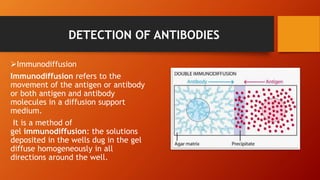
Immunodiffusion
Immunodiffusion refers to the
movement of the antigen or antibody
or both antigen and antibody
molecules in a diffusion support
medium.
It is a method of
gel immunodiffusion: the solutions
deposited in the wells dug in the gel
diffuse homogeneously in all
directions around the well.
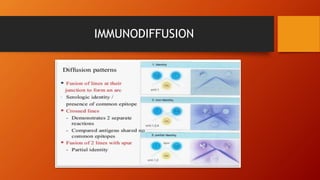
IMMUNODIFFUSION
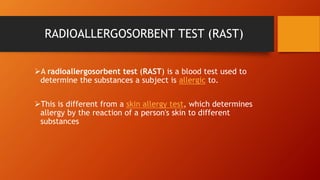
RADIOALLERGOSORBENT TEST (RAST)
A radioallergosorbent test (RAST) is a blood test used to
determine the substances a subject is allergic to.
This is different from a skin allergy test, which determines
allergy by the reaction of a person's skin to different
substances
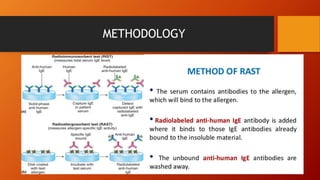
METHODOLOGY
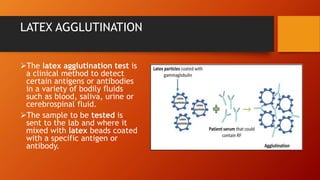
LATEX AGGLUTINATION
The latex agglutination test is
a clinical method to detect
certain antigens or antibodies
in a variety of bodily fluids
such as blood, saliva, urine or
cerebrospinal fluid.
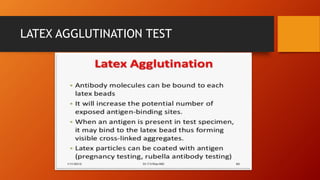
The sample to be tested is
sent to the lab and where it
mixed with latex beads coated
with a specific antigen or
antibody.
LATEX AGGLUTINATION TEST
DETECTION OF ANTIGENS
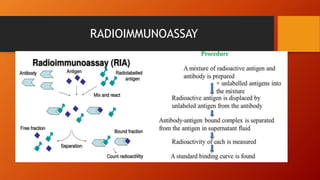
RADIOIMMUNOASSAY (RIA)
A radioimmunoassay is an immunoassay that uses radiolabeled molecules in a
stepwise formation of immune complexes.
 A RIA is a very sensitive in vitro assay technique used to measure
concentrations of substances, usually measuring antigen concentrations by
use of antibodies
RADIOIMMUNOASSAY
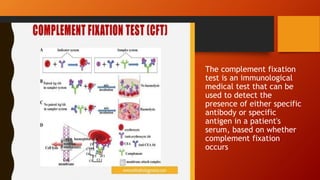
The complement fixation
test is an immunological
medical test that can be
used to detect the
presence of either specific
antibody or specific
antigen in a patient's
serum, based on whether
complement fixation
occurs
DETECTION OF ANTIBODIES & ANTIGENS
COMPLEMENT FIXATION TEST
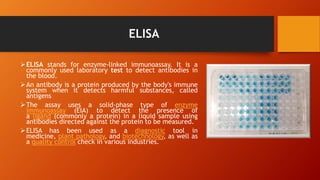
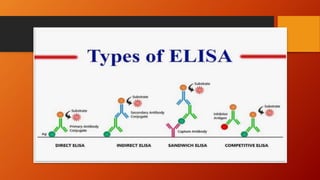
ELISA
ELISA stands for enzyme-linked immunoassay. It is a
commonly used laboratory test to detect antibodies in
the blood.
An antibody is a protein produced by the body's immune
system when it detects harmful substances, called
antigens
The assay uses a solid-phase type of enzyme
immunoassay (EIA) to detect the presence of
a ligand (commonly a protein) in a liquid sample using
antibodies directed against the protein to be measured.
ELISA has been used as a diagnostic tool in
medicine, plant pathology, and biotechnology, as well as
a quality control check in various industries.
PROTOCOL
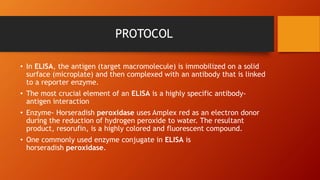
• In ELISA, the antigen (target macromolecule) is immobilized on a solid
surface (microplate) and then complexed with an antibody that is linked
to a reporter enzyme.
• The most crucial element of an ELISA is a highly specific antibody-
antigen interaction
• Enzyme- Horseradish peroxidase uses Amplex red as an electron donor
during the reduction of hydrogen peroxide to water. The resultant
product, resorufin, is a highly colored and fluorescent compound.
• One commonly used enzyme conjugate in ELISA is
horseradish peroxidase.
ELISA STEP-BY-STEP
Antibody coating - Specific capture antibody is immobilized on
high protein-binding plates by overnight incubation. ...
Protein capture - Samples and standard dilutions are added to
the wells and will be captured by the bound antibodies.
Detection antibody. ...
Streptavidin-enzyme conjugate. ...
Addition of substrate. ...
Analysis.
•
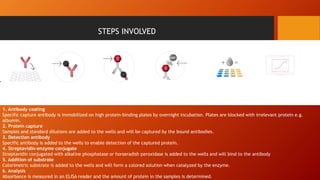
STEPS INVOLVED
1. Antibody coating
Specific capture antibody is immobilized on high protein-binding plates by overnight incubation. Plates are blocked with irrelevant protein e.g.
albumin.
2. Protein capture
Samples and standard dilutions are added to the wells and will be captured by the bound antibodies.
3. Detection antibody
Specific antibody is added to the wells to enable detection of the captured protein.
4. Streptavidin-enzyme conjugate
Streptavidin conjugated with alkaline phosphatase or horseradish peroxidase is added to the wells and will bind to the antibody
5. Addition of substrate
Colorimetric substrate is added to the wells and will form a colored solution when catalyzed by the enzyme.
6. Analysis
Absorbance is measured in an ELISA reader and the amount of protein in the samples is determined.
ADVANTAGES
Serology is a useful tool for rapid diagnosis of fungal disease
Results may be obtained within a few hours without the need of culture
Results may also be obtained several days before clinical symptoms
develop
More work needs to be done on candidosis serological testing
Continued screening allows clinicians to follow the progress of the
disease – however may be difficult to obtain appropriate specimens
Kits are expensive making continuous monitoring difficult
REFERENCES
1.C. Vaman Rao (2005). Immunology: a textbook. Alpha Science Int'l Ltd. pp. 112–
. ISBN 978-1-84265-255-8. Retrieved 3 December 2010.
2.Engvall, E (1972-11-22). "Enzyme-linked immunosorbent assay, Elisa". The Journal
of Immunology. 109 (1): 129–135. ISSN 0022-1767. PMID 4113792.
3."Immunodiffusion". ScienceDirect. Elsevier B.V. Archived from the original on 2017-
05-02. Retrieved 2017-05-19.
4. "Ouchterlony double immunodiffusion" (photograph). Retrieved 2017-05-
15.[permanent dead link]
5."Radial Immunodiffusion". Edvotek, Inc. 2017. Archived from the
original (photograph) on 2017-08-07. Retrieved 2017-08-07. Photograph of precipitin
circles in a Petri dish during radial immunodiffusion.

Serological test for fungi

  • 1.
    SEROLOGICAL TESTS FORFUNGI M.MEENAKSHI, ASSISTANT PROFESSOR, DEPARTMENT OF MICROBIOLOGY, SRI RAMAKRISHNA COLLEGE OF ARTS & SCIENCE FOR WOMEN, COIMBATORE
  • 2.
    SEROLOGICAL TESTS The Antigensand antibodies are easier to detect than finding the organism directly.Antigens and antibodies are produced in large quantities and can be found in body fluids (blood, CSF, urine, BAL (Bronchoalveolar lavage).Culture is often problematic, time consuming and insensitive due to the low concentration of the organism in tissue
  • 3.
    DETECTION OF ANTIBODIES Immunodiffusion Immunodiffusionrefers to the movement of the antigen or antibody or both antigen and antibody molecules in a diffusion support medium. It is a method of gel immunodiffusion: the solutions deposited in the wells dug in the gel diffuse homogeneously in all directions around the well.
  • 4.
  • 5.
    RADIOALLERGOSORBENT TEST (RAST) Aradioallergosorbent test (RAST) is a blood test used to determine the substances a subject is allergic to. This is different from a skin allergy test, which determines allergy by the reaction of a person's skin to different substances
  • 6.
  • 7.
    LATEX AGGLUTINATION The latexagglutination test is a clinical method to detect certain antigens or antibodies in a variety of bodily fluids such as blood, saliva, urine or cerebrospinal fluid. The sample to be tested is sent to the lab and where it mixed with latex beads coated with a specific antigen or antibody.
  • 8.
  • 9.
    DETECTION OF ANTIGENS RADIOIMMUNOASSAY(RIA) A radioimmunoassay is an immunoassay that uses radiolabeled molecules in a stepwise formation of immune complexes.  A RIA is a very sensitive in vitro assay technique used to measure concentrations of substances, usually measuring antigen concentrations by use of antibodies
  • 10.
  • 11.
    The complement fixation testis an immunological medical test that can be used to detect the presence of either specific antibody or specific antigen in a patient's serum, based on whether complement fixation occurs
  • 12.
  • 13.
  • 14.
    ELISA ELISA stands forenzyme-linked immunoassay. It is a commonly used laboratory test to detect antibodies in the blood. An antibody is a protein produced by the body's immune system when it detects harmful substances, called antigens The assay uses a solid-phase type of enzyme immunoassay (EIA) to detect the presence of a ligand (commonly a protein) in a liquid sample using antibodies directed against the protein to be measured. ELISA has been used as a diagnostic tool in medicine, plant pathology, and biotechnology, as well as a quality control check in various industries.
  • 16.
    PROTOCOL • In ELISA,the antigen (target macromolecule) is immobilized on a solid surface (microplate) and then complexed with an antibody that is linked to a reporter enzyme. • The most crucial element of an ELISA is a highly specific antibody- antigen interaction • Enzyme- Horseradish peroxidase uses Amplex red as an electron donor during the reduction of hydrogen peroxide to water. The resultant product, resorufin, is a highly colored and fluorescent compound. • One commonly used enzyme conjugate in ELISA is horseradish peroxidase.
  • 17.
    ELISA STEP-BY-STEP Antibody coating- Specific capture antibody is immobilized on high protein-binding plates by overnight incubation. ... Protein capture - Samples and standard dilutions are added to the wells and will be captured by the bound antibodies. Detection antibody. ... Streptavidin-enzyme conjugate. ... Addition of substrate. ... Analysis.
  • 18.
    • STEPS INVOLVED 1. Antibodycoating Specific capture antibody is immobilized on high protein-binding plates by overnight incubation. Plates are blocked with irrelevant protein e.g. albumin. 2. Protein capture Samples and standard dilutions are added to the wells and will be captured by the bound antibodies. 3. Detection antibody Specific antibody is added to the wells to enable detection of the captured protein. 4. Streptavidin-enzyme conjugate Streptavidin conjugated with alkaline phosphatase or horseradish peroxidase is added to the wells and will bind to the antibody 5. Addition of substrate Colorimetric substrate is added to the wells and will form a colored solution when catalyzed by the enzyme. 6. Analysis Absorbance is measured in an ELISA reader and the amount of protein in the samples is determined.
  • 19.
    ADVANTAGES Serology is auseful tool for rapid diagnosis of fungal disease Results may be obtained within a few hours without the need of culture Results may also be obtained several days before clinical symptoms develop More work needs to be done on candidosis serological testing Continued screening allows clinicians to follow the progress of the disease – however may be difficult to obtain appropriate specimens Kits are expensive making continuous monitoring difficult
  • 20.
    REFERENCES 1.C. Vaman Rao(2005). Immunology: a textbook. Alpha Science Int'l Ltd. pp. 112– . ISBN 978-1-84265-255-8. Retrieved 3 December 2010. 2.Engvall, E (1972-11-22). "Enzyme-linked immunosorbent assay, Elisa". The Journal of Immunology. 109 (1): 129–135. ISSN 0022-1767. PMID 4113792. 3."Immunodiffusion". ScienceDirect. Elsevier B.V. Archived from the original on 2017- 05-02. Retrieved 2017-05-19. 4. "Ouchterlony double immunodiffusion" (photograph). Retrieved 2017-05- 15.[permanent dead link] 5."Radial Immunodiffusion". Edvotek, Inc. 2017. Archived from the original (photograph) on 2017-08-07. Retrieved 2017-08-07. Photograph of precipitin circles in a Petri dish during radial immunodiffusion.