Immunofluorescence
Lecturer: S. Pordel
M.Sc. of Immunology
Introduction
 Immunofluorescence (IF) or cell imaging techniques
rely on the use of antibodies to label a specific target antigen
with a fluorescent dye (also called fluorophores or
fluorochromes) such as fluorescein isothiocyanate (FITC).
 Fluorochromes are dyes which have the ability to absorb
the short wavelength UV radiation and emit light of longer
wavelength fluorescence ( visible green light).
 Examples : FITC, Rhodamine
There are two ways of doing IF staining:
 Direct immunofluorescence
 Indirect immunofluorescence
 Direct immunofluorescence: Direct IF uses a single
antibody directed against the target of interest. The
primary antibody is directly conjugated to a fluorophore.
What is direct immunofluorescence?
Its applications are Clinical and Research.
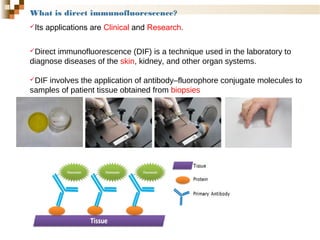
Direct immunofluorescence (DIF) is a technique used in the laboratory to 
diagnose diseases of the skin, kidney, and other organ systems. 
DIF involves the application of antibody–fluorophore conjugate molecules to 
samples of patient tissue obtained from biopsies
 Indirect
immunofluorescence:
Indirect IF uses two
antibodies. The primary
antibody is unconjugated
and a fluorophore-
conjugated secondary
antibody directed against
the primary antibody is
used for detection.
Toxoplasmosis:
We want to find anti-Toxoplasma antibodies in the patients
So
What should be our method?
1. Direct immunofluorescence
2. Indirect immunofluorescence
Continue…
TORCH Infections. Toxoplasmosis, Other (syphilis, varicella-zoster,
parvovirus B19), Rubella, Cytomegalovirus (CMV), and Herpes infections.
 IgM and IgG antibodies Identified in pregnant
women.
 IgM only is requested in baby …
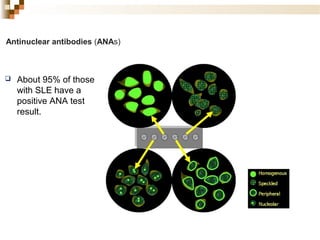
Antinuclear antibodies (ANAs)
 About 95% of those
with SLE have a
positive ANA test
result.
Immunofluorescence

Immunofluorescence

  • 1.
  • 2.
    Introduction  Immunofluorescence (IF)or cell imaging techniques rely on the use of antibodies to label a specific target antigen with a fluorescent dye (also called fluorophores or fluorochromes) such as fluorescein isothiocyanate (FITC).  Fluorochromes are dyes which have the ability to absorb the short wavelength UV radiation and emit light of longer wavelength fluorescence ( visible green light).  Examples : FITC, Rhodamine
  • 3.
    There are twoways of doing IF staining:  Direct immunofluorescence  Indirect immunofluorescence  Direct immunofluorescence: Direct IF uses a single antibody directed against the target of interest. The primary antibody is directly conjugated to a fluorophore.
  • 4.
    What is direct immunofluorescence? Itsapplications are Clinical and Research. Direct immunofluorescence (DIF) is a technique used in the laboratory to  diagnose diseases of the skin, kidney, and other organ systems.  DIF involves the application of antibody–fluorophore conjugate molecules to  samples of patient tissue obtained from biopsies
  • 6.
     Indirect immunofluorescence: Indirect IF usestwo antibodies. The primary antibody is unconjugated and a fluorophore- conjugated secondary antibody directed against the primary antibody is used for detection.
  • 7.
  • 8.
    We want tofind anti-Toxoplasma antibodies in the patients So What should be our method? 1. Direct immunofluorescence 2. Indirect immunofluorescence
  • 10.
  • 11.
    TORCH Infections. Toxoplasmosis,Other (syphilis, varicella-zoster, parvovirus B19), Rubella, Cytomegalovirus (CMV), and Herpes infections.  IgM and IgG antibodies Identified in pregnant women.  IgM only is requested in baby …
  • 12.
    Antinuclear antibodies (ANAs) About 95% of those with SLE have a positive ANA test result.

Editor's Notes

  • #8 T gondii is one of the most common human parasites in the world. The organism was first discovered in the gundi, a North African rodent.